• About

Brandon Ray Kirk

~ This site is dedicated to the collection, preservation, and promotion of history and culture in my section of Appalachia.

Brandon Ray Kirk

Tag Archives: crime

Interview with Nellie Thompson of Wayne, WV (1996)

05 Saturday Jul 2014

Posted by Brandon Ray Kirk in Culture of Honor, Harts, Lincoln County Feud, Twelve Pole Creek, Wayne

≈ Leave a comment

Tags

Al Brumfield, Andrew D. Robinson, Beech Fork, Ben Adams, Bob Dingess, Brandon Kirk, crime, diptheria, Goble Richardson, Green McCoy, Green Shoal, Guyandotte River, Harrison McCoy, Harts, Harts Creek, history, Lincoln County Feud, Lynza John McCoy, Milt Haley, Monroe Fry, music, Paris Brumfield, Ross Fowler, Sallie Dingess, Sherman McCoy, Spicie McCoy, Warren, Wayne, Wayne County, Wayne County News, West Fork, writing

A few weeks later, Brandon called Nellie Thompson in Wayne, West Virginia. Nellie reportedly had the picture of Milt Haley and Green McCoy.

“I don’t know if I have anything like that or not,” Nellie said, “but I do have an old letter from Green McCoy.”

What?

Almost hyperventilating, he asked her to read it over the telephone.

Nellie fetched it from somewhere in the house, said it was dated May 19, 1889, then read it to him and said he was welcome to see it.

The next day, she called Brandon back and said, “I think I’ve found that picture you were looking for. It’s a little tin picture with two men in it.”

Oh god.

A few days later, Brandon drove to see Nellie about the picture and letter. Before dropping in on her, he spent a little time at the local library where he located a story about Spicie McCoy.

“As I promised last week, today we will explore the life of a lady who claimed to have a cure for diphtheria,” the story, printed in the Wayne County News (1994), began. “Spicie (Adkins) McCoy Fry was so short that if you stretched out your arm she could have walked under it. Anyone who lived in the East Lynn area knew who Spicie Fry was because she had probably been in almost every church around to sing at a revival meeting, something she loved to do. Spicie was well educated. She saw that her children went to school. Once out of grade school, Spicie’s sons took advantage of correspondence courses in music, art, and any other subject they could get thru the mail order catalog. Spicie’s son Monroe Taylor Fry was a self-taught musician.”

After a short time, Brandon drove to Nellie’s home, where she produced a small tin picture of two men sitting together. One of the men was obviously Green McCoy based on the picture we had already seen of him. The other fellow, then, was Milt.

As Brandon stared at the tintype, Nellie handed him Green’s letter. It was penned in a surprisingly nice handwriting, addressed to his brother Harrison, and was apparently never mailed. At the time of his writing, it was spring and McCoy had just moved back to Harts — probably after a short stay with his family or in-laws in Wayne County. He may’ve been there with his older brother, John, who’d married a girl almost half his age from Wayne County earlier in February.

Dear Brother. after a long delay of time I take this opertunity of droping you a few lines to let you know that I am well hoping when these lines reaches you they may find you all the same. Harrison you must excuse me for not writing sooner. the cause of me not writing is this[:] the post master here is very careless. they let people brake open the letters and read them so I will write this time to let you know where I am and where Lynza is. I have moved back to the west fork of Harts Creek and Lynza is married and living in wayne co yet on beach fork. everybody is done planting corn very near in this country. every thing looks lively in this part. tell Father and mother that I[‘m] coming out this fall after crops are laid by if I live and Lynza will come with me. tell all howdy for me. you may look for us boath. if death nor sickness don’t tak[e] place we will come. Harrison I would rather you would not write anymore this summer. people brakes open the letters and reads them so I will not write a long letter. Brumfield and me lives in 2 miles of each other and has had no more trubble but every body says that he will kill me if I don’t kill him. I look to have trouble with him so I will close this time.

On the back of the letter was written the following: “My wife sends her best respects to you all and says she would like to see you all. my boy is beginning to walk. he is a spoiled boy to[o].”

Clutching carefully onto the tintype and letter, Brandon asked Nellie what she’d heard about Milt and Green’s death. She didn’t really know much, but her brother Goble Richardson said he’d always heard that pack-peddlers who boarded with Paris Brumfield never left his home alive. These men were supposedly killed, tied to rocks, and thrown to the bottom of the Guyan River where the fish ate their rotting corpses. Soon after the “disappearance” of these pack-peddlers, Paris would be seen riding the man’s horse, while his children would be playing with his merchandise.

When Brandon arrived home he studied over Green McCoy’s letter — all the cursive strokes, the occasional misspellings, trying to extract something from it beyond what it plainly read.

Strangely, the letter didn’t reveal to which Brumfield — Al or Paris — Green referred when he wrote, “every body says that he will kill me if I don’t kill him.” It seems likely, though, based on what Daisy Ross had said, that Green referenced Paris.

Still, it was Al Brumfield who was ambushed only three months later.

What started their trouble?

And who was the careless postmaster who allowed people to “brake open the letters and read them?”

At the time of the Haley-McCoy trouble, Harts had two post offices: Harts and Warren. The postmaster at Harts — where McCoy likely received his mail — was Ross Fowler, son to the Bill Fowler who was eventually driven away from Harts by the Brumfields. Ross, though, was close with the Brumfields and even ferried the 1889 posse across the river to Green Shoal with Milt and Green as prisoners (according to Bob Dingess) in October of 1889. A little later, he worked in Al Brumfield’s store. The postmaster at Warren was Andrew D. Robinson, a former justice of the peace and brother-in-law to Ben Adams and Sallie Dingess. Robinson seems to have been a man of good credit who stayed neutral in the trouble.

Dr. Ivan Tribe endorses “Blood in West Virginia”

03 Thursday Jul 2014

Posted by Brandon Ray Kirk in Lincoln County Feud

≈ 1 Comment

Tags

Appalachia, Blood in West Virginia, books, Brandon Kirk, crime, Harts, Hatfield-McCoy Feud, history, Ivan Tribe, Kentucky, Lincoln County, Mountaineer Jamboree, Rio Grande University, West Virginia, writing

I proudly announce Dr. Ivan Tribe’s endorsement of my book, Blood in West Virginia: Brumfield v. McCoy. Dr. Tribe, Professor Emeritus of History at Rio Grande University, ranks as one of Appalachia’s most distinguished and recognized historians. Best known for his Mountaineer Jamboree (1984), the definitive history of country music in West Virginia, Dr. Tribe is author of six additional books, beginning with Albany, Ohio: The First Fifty Years of a Rural Midwestern Community (1980). Dr. Tribe has also contributed over two hundred articles, composed at least eighty sets of liner notes for albums, and written more than forty record and book reviews. Throughout his long career as an educator and author, he has consistently offered top-notch scholarship on the subjects of traditional country music, bluegrass music, and coal mining communities. While I recommend any one of Dr. Tribe’s writings, his Mountaineer Jamboree remains a personal favorite. Receiving praise from such an outstanding scholar and accomplished author means a great deal to me.

Here is Dr. Tribe’s endorsement of Blood in West Virginia:

“Except for the Hatfield-McCoy Feud which spilled over into two states, eastern Kentucky is better known as Appalachia’s feud country. However, Brandon Kirk’s book demonstrates that Lincoln County, West Virginia had a feud that has been largely overlooked by prior chronicleers. The Brumfields versus a variety of persons named Adkins, McCoy, and Haley made the community of Harts a real hot spot among mountain communities in the late 1880s. Kirk’s Blood in West Virginia tells a fascinating story that elevates the Lincoln County feud to its proper place in Appalachian and West Virginia History.”

John W. Runyon 2

01 Tuesday Jul 2014

Posted by Brandon Ray Kirk in Lincoln County Feud, Timber, Wyoming County

≈ Leave a comment

Tags

A.R. Wittenberg, Anderson Beverly, Baileysville, Buskirk and Wittenberg, Clarence Hinkle, Cole and Crane Company, crime, Dr. C.W. Hall, Dr. S.A. Daniel, E.M. Seuter, genealogy, history, I.E. Christian, James Bertrand Runyon, James Ramey, John W Runyon, Kentucky, logging, Mary Runyon, Porter and Runyon, Reference Book of Wyoming County History, Samuel W. Porter, timbering, Vorheis, West Virginia, writing, Wyoming County, Wyoming Tribune

In that same time frame, John W. Runyon moved his family to Baileysville in Wyoming County, West Virginia, where he opened a business under the name of “Porter and Runyon.” He began to buy various items by credit at a store owned by Buskirk and Wittenberg, a partnership of contractors operating under the powerful Cole and Crane Company.

According to Bowman’s Reference Book of Wyoming County History (1965): “C. Crane and Co., by its contractors, Buskirk and Wittenburg, began a new era of removing timber by water. The company began building dams as soon as possible after taking over the contract.”

Buskirk and Wittenburg were often permitted to construct “roads for their convenience” and to destroy bridges for the purpose of splashing so long as they had them rebuilt. They built the only splash dam ever constructed on the Guyan River around 1903.

“The company maintained well stocked commissaries and logging camps to take care of their men,” according to the Wyoming County history. The main camp in their operation “had a commissary, blacksmith shop, business office, and post office named Vorheis, in honor of Buskirk’s daughter who had married a man named Vorheis. There were camps at Baileysville… Camps and stores were relocated from time to time as needed.” Their stores “carried a large and varied stock, including up-to-date clothing.”

Runyon’s bill at Buskirk’s and Wittenberg’s store began on May 22, 1899, when he bought a nine-dollar suit, and extended until July 17, 1900, when the store debt totaled $6,495.78. According to the bill, Runyon primarily purchased ordinary store items: bacon, beans, fruits, vegetables, coffees, tobacco, herbs, spices, silverware, kitchen utensils, nails, soap, shoes, hats, gloves, watches, candy, and various types of clothing. He also had bought a plethora of luxury items: a case of oysters, Cuban Gentlemen Cigars, several boxes of chewing gum, a box of roasted peanuts, dolls, musical instruments (including a violin), picture frames, guns, locks, turpentine, Castor Oil, clocks, fire crackers, and fishing gear.

Beginning on September 28, 1899, Runyon and Porter paid periodically on the bill (although Porter’s name was seldom mentioned specifically) and Runyon personally contributed $280.00 in January of 1900. The business folded around September 13, 1900, when Runyon made his last payment to Wittenberg and reduced his bill to $640.15.

Meanwhile, the census enumerator registered Runyon as follows: “John W. Ru[n]yon, logger, rents home, born Feb 1856 in KY, age 44, married 20 years, both parents born KY; Mary M. Ru[n]yon, born January 1861 in KY, age 39, married 20 years, mother of 1 child which is living, parents born in KY; Mary M. Ru[n]yon, born March 1889 in KY, age 11, niece, both parents born in KY.” John’s son-in-law Clarence Hinkle was listed two households away as a logger. Sam Porter was not listed in the census — perhaps well aware of the impending debt owed to Buskirk and Wittenberg. Little Mary Runyon was a daughter of John’s twin brother.

There were other legal troubles. In June of 1901, Drs. S.A. Daniel and C.W. Hall sued Runyon for a $50 debt (with interest). Apparently the doctors had rendered services to a James Ramey with the understanding that Runyon would pay his bill. When the trial took place on June 15, Runyon failed to show up. The court waited for an hour, then heard the plaintiff’s case and ruled against him. Curiously enough, Runyon appealed the decision on June 24, with funds for his appeal bond ($120) coming from the very doctors who originally sued him. In September a summons was delivered to an Anderson Beverly to appear as Runyon’s witness. On April 2, 1902 his appeal came before the court and the doctors didn’t appear even “though thrice solemnly called.” As a result, the judge ruled in Runyon’s favor and stated that he was to be paid “$5.00 for their false clamor herein” and that he “recover of the plaintiffs his costs in this behalf expended including an attorneys fee of $5.00 allowed by statute.”

By that time, Runyon was in a more serious lawsuit with Buskirk and Wittenberg over his store debt. In early July of 1901, Wittenberg sued Runyon and Porter, stating that he had not received a payment from them since September of the previous year. Wittenberg’s contacts with area politicians and influential residents had obvious legal implications. Runyon and Porter were issued a summons to appear in court on the first Monday in August to answer “A.R. Wittenberg of a plea of Trespass on the case in assumpsit damages $6,500.00.” Wittenberg’s use of the figure $6,500 referred to the original debt of $6,495.78, although records show the amount actually owed was $640.15. On the outside of this summons the following was written in poor handwriting, probably by a deputy-sheriff: “Serve[d] on the within name John W. Runyon by delivering to him an office copy of the within summon[s] in person on July 12, 1901.” A summons couldn’t be served to S.W. Porter who was “not found within my bailiwick this July 13, 1901.”

Porter was apparently not a resident of West Virginia (probably Kentucky). An affidavit of Non-Residence was filed on his behalf on August 5, 1901.

“This day I.E. Christian Personally appeared before me E.M. Seuter a Notary Public within and for said Wyoming County, West Virginia and upon oath says that S.W. Porter one of the defendants in the above styled action is a Nonresident of the State of West Virginia,” it read.

Because Wyoming County law couldn’t find him to serve a summons, an Order of Publication was issued on the first Monday in August 1901.

“At Rules held in the Clerk’s Office of the Circuit Court of Wyoming County on the first Monday in August 1901 A.R. Wittenberg vs. John W. Runyon and S.W. Porter partners trading and doing business under the firm name and style of Porter and Runyon,” it read. “The object of the above suit is to obtain a Judgment in favor of the plaintiff against the defendants for the sum of $640.15 and it appearing from an affidavit made and filed with the papers of this cause that S.W. Porter defendant in the above signed cause is a non resident of the State of West Virginia, and on motion of the plaintiff it is ordered that said defendant S.W. Porter do appear at Rules to be held in the clerk’s office of the circuit court of Wyoming County within one month after the first publication of this order and do what is necessary to protect his interest in this suit.”

Wittenberg spent five dollars and fifty cents paying for this publication, which was featured in the Wyoming Tribune from August 9th until August 30th.

It did little good. Porter was basically untouchable by Wyoming County authorities barring extradition papers.

Information at the Wyoming County Courthouse indicated that he never showed up to answer for his part in the failed business and, in so doing, crippled Runyon’s case against Wittenberg.

There is little information available on the actual trial, although records show the judge ruled against Runyon for $614.50 on September 30, 1901. Totaled near this figure was a compilation of the plaintiff’s costs ($32.81), which indicated that he was expected to pay that fee as well. Presumably, all of this debt fell on Runyon since his partner had left the state. He decided to appeal the case but as a non-property owner in Wyoming County, the owner of a failed business, and with no local contacts loyal enough to assist him, he was unable to put forth enough money to post the necessary bond. Wittenberg, meanwhile, prepared his case and hired lawyers.

In Search of Ed Haley 326

24 Tuesday Jun 2014

Posted by Brandon Ray Kirk in Big Harts Creek, Ed Haley, Lincoln County Feud

≈ Leave a comment

Tags

Bernie Adams, Big Branch, Billy Adkins, Brandon Kirk, Cacklin Hen, crime, Dood Dalton, Ed Haley, fiddle, fiddler, fiddling, Green McCoy, guitar, Harts, Harts Creek, history, Hollene Brumfield, John Hartford, Logan, Luster Dalton, Milt Haley, Mona Haley, music, Rockhouse Fork, Stump Dalton, Wild Horse, writing

From Harts proper, we headed up Harts Creek to the home of Luster Dalton, a son of Ed’s friend, Dood Dalton. Luster was born in 1924 and used to play the fiddle on weekends for free drinks at local “dives” with his brother Stump and two cousins. I asked him if he learned much from Ed and he said, “Yeah, I learned a lot from the old man Ed. He was a real fiddle player, son.”

I wondered if anybody around Harts played like Ed.

“Not as good as he could, no,” Luster said. “I’d have to say no to that. That old man really knew how to handle that job, buddy.”

Luster tried to remember some of Ed’s tunes.

“Way back in them days, they had one they called ‘Cacklin’ Hen’ and ‘Wild Horse’ and such as that on down the line,” he said.

I got my fiddle out and pointed it toward Luster, who said, “They ain’t a bit of use in me to try that. I’ve had too many bones broke.”

I tried to get him to just show me anything — but he refused.

He chose instead to talk, starting with how Ed came to visit his father on Big Branch.

“He came about onest a year and would maybe stay a month,” Luster said. “He’d maybe stay a week at Dad’s and go to some other family and stay a week and go up Logan and stay a week or so with somebody. Him and his old woman both would come and a couple three of his kids. Mona was one of them’s name. About all of them I guess has been to my dad’s. I don’t see how they raised a bunch of kids — neither one of them could see. That’s something we got to think about. They was good people. And a fella by the name of Bernie Adams used to come with them — he was a guitar picker — and they’d sit up there and sing and pick up at my dad’s till twelve o’clock and go to bed and go to sleep, get up the next morning, go into ‘er again. I went in the army in 1940, I believe it was, and I know I’ve not heard from them since then.”

Luster didn’t know if Milt Haley was a fiddler but had heard the old-timers talk about how either him or Green McCoy had shot Hollena Brumfield through the jaw at the mouth of the Rockhouse Fork on Harts Creek.

“They were murdered in a little log house,” Luster said. “They took a pole axe and beat them to death and then chopped them up.”

A Visit to the “Murder House” (1996)

22 Sunday Jun 2014

Posted by Brandon Ray Kirk in Green Shoal, Lincoln County Feud

≈ Leave a comment

Tags

Admiral S. Fry, Billy Adkins, Brandon Kirk, Cecil Lambert, crime, George Fry, Green McCoy, Green Shoal, history, John Hartford, Lincoln County Feud, Lon Lambert, Milt Haley, Virgie Rooney, Watson Lucas, writing

The next day, Brandon, Billy, and I went to investigate the Watson Lucas-Lon Lambert home at the mouth of Green Shoal. For a long time, we had suspected it of being the actual “murder house,” the place where Haley and McCoy had been brutally murdered in 1889. Cecil Lambert, the current owner and occupant of the dwelling, told us, however, upon our arrival that it was not the same house. He said his father, Lon, had told him prior to his death that the old Fry log house was long torn down. The Fry home, he said, had been located just a few feet downriver from the current home, generally at the present-day location of a garage. Cecil had done some recent remodeling and was pretty sure that his father was correct: he hadn’t found a single log anywhere behind the walls.

Cecil walked us over to a nearby embankment and showed us what he figured to be the last remaining vestige of the Fry house: some old foundation stones strewn down into a ditch. He then took us through the house, which (unfortunately for our imaginations) really didn’t have a nineteenth century look to it.

There was one thing on the second floor that excited us: easily visible through a large hole in the wall (courtesy of Cecil’s remodeling) were some old dried beans lying on the rafter “floor.” It made us think of what Vergia Rooney had said about people using the top story of the old Fry house for drying peaches and apples. Of course, the beans we could see were not George Fry’s…but finding them like we did sure struck us as a coincidence.

Back outside, Brandon walked around the house searching for anything that might connect it with the events of 1889. He made a significant find on the upriver side, which Vergia remembered as being part of the original house. Clearly visible in a corner was an old foundation stone just like the ones at the ditch. We did not notice any more old stones under the house that day, but Cecil later found many more after further remodeling. On the upriver (or “original”) side of the house, foundation stones were intact (at least partially) while on the downriver (or “newer”) side, foundation stones had been tossed in the ditch. There was also a “hidden” door on the downriver side of the house (where Vergia had remembered one swinging open in the old days).

Back at Billy’s, Brandon got out the Fry history book and located a picture of A.S. Fry’s home at Green Shoal, presumably taken around the time of the murders. We compared it mentally with what we remembered about the present home at Green Shoal and noted a few similarities but nothing really conclusive. Then we noticed in the photograph that the Fry dwelling had an extension of rough lumber off to one side that resembled the current Lambert house. It wasn’t clear whether the log portion was on the upriver or downriver side but if it was on the downriver side (the end Vergia said was torn away) it would explain why some of the old foundation stones were lying about in that direction. In such a scenario, both Vergia and Lambert would be correct in their account of what happened to the Fry house. In other words, there was a real chance that the building was at least partly intact — although radically remodeled.

In Search of Ed Haley 321

17 Tuesday Jun 2014

Posted by Brandon Ray Kirk in Big Harts Creek, Culture of Honor, Ed Haley, Lincoln County Feud, Timber

≈ Leave a comment

Tags

Allen Martin, Anthony Adams, Ben Adams, Boardtree Branch, Brandon Kirk, Charley Brumfield, crime, Ed Haley, Ewell Mullins, fiddling, Greasy George Adams, Green McCoy, Green Shoal, Harts, Harts Creek, history, Jeff Baisden, John Hartford, Jr., Kentucky, Lincoln County Feud, Logan County, Milt Haley, moonshining, murder, music, Paris Brumfield, Peter Mullins, Sol Adams, Still Hollow, Ticky George Adams, timbering, Trace Fork, Vilas Adams, West Virginia, Will Adkins, writing

Trying to lift our spirits, we went to see Vilas Adams, who lived on the Boardtree Branch of Trace Fork. Vilas was a great-grandson of Ben Adams and a grandson of Ticky George Adams. He was very friendly, inviting us inside his very nice home where his wife fed us a whole mess of good food, which we ate between asking questions.

I first asked him about his memories of Ed Haley, who he said frequented Ewell Mullins’ store during the late 1930s and early forties.

“Down there at old man Ewell’s store, they’d gather in there of an evening and tell tales, old man Jeff Baisden and them,” Vilas said. “My grandpaw Ant Adams and I would walk down there and then Ed would walk down there from Uncle Peter’s. It was a quarter a mile — just a little hop and a jump I call it. Ed would come in there and fiddle for them and if they wanted a certain song, they’d give him a quarter or fifty cents. That was good money I guess back then.”

Vilas’ grandfather Anthony Adams (a brother to Greasy George) always gave Ed a quarter to hear his favorite tune.

“What was Ed like?” I asked.

Vilas implied that he was withdrawn.

“Mostly he stayed with that fiddle,” he said. “He was good.”

Like most of the other older people in Harts, Vilas knew about the Haley-McCoy killings.

“My grandpaw would tell me them tales but I wouldn’t pay no attention,” he said. “He was telling about them fellers — Sol Adams — going over there and locating them and they went back and captured them. Well, his daddy Anthony tried to waylay them and take them back through here somewhere. They thought they’d come through these hills somewhere but they missed them.”

So, Sol Adams — a 20-year-old nephew to Ben Adams who was often called “Squire Sol” because of his status as an officer of the law — “went over and located Haley and McCoy” in Kentucky after the ambush. Meanwhile, his father Anthony and uncle Ben Adams, organized a gang to recapture them as the Brumfields brought them back through Harts Creek. This seemed strange: why would Sol operate against the interests of his family? And why would he have even been compelled to even become involved since he was a Logan County justice and the crime had occurred in Lincoln County?

Brandon asked Vilas if he knew who had been in the Adams gang and he said, “No, I’ve heard my grandpaw talk but I’ve forgot some of it. They was somebody from down around Hart somewhere. He said they took them over around Green Shoal or over in there somewhere and killed them. Grandpaw said they maybe hit them with axe handles.”

Vilas said his grandfather told him something horrible had happened to most of the men who murdered Haley and McCoy.

“He said just about every one of them that was in on that, something bad happened to them,” he said. “I heard one of them’s own boy killed one of them. And one of them got drowned and my grandpaw said the river wasn’t deep. Said he fell off a horse or something right at the mouth of Hart.”

Of course, Vilas was referring to Paris Brumfield, who was killed by his son Charley in 1891, and to Will Adkins, who drowned at the mouth of Harts Creek on November 23, 1889.

Brandon asked Vilas about “old Ben Adams” and he almost immediately started talking about the old timber business.

“See, that was my great-grandpaw,” he said. “They would build splash dams. They had one right out here. They had them tied some way or the other. And they built them up on Hart there, maybe up on Hoover, and they’d work all winter and put them logs in the creek. And in the spring when them floods come, it would wash all them logs down around Hart and then they’d put them together and raft them on down to Kenova. I guess that was all they had to make a living — timber and farm.”

Ben, of course, made his living in timber. He lived at the mouth of Adams Branch, a little tributary of Trace Fork presently referred to as Still Hollow.

“Over there at what we call Still Hollow, they said he had a still-house there and he had a license to make apple brandy back then,” Vilas said. “And he would go with a wagon everywhere and get apples. They was a log house over there in the mouth of that holler — just down the road here a little ways. When I was a boy the old log house was there, but it rotted down. Just one-story as far as I can remember. The old well’s there. He had some kind of an old store or saloon right there.”

Vilas speculated very little on Ben Adams’ personality, but compared him to his son, Greasy George Adams: “always a likeable fella but seemed like trouble followed him.” He heard that after Ben’s first wife died, he lived with first one woman, then the next. He eventually got into a heap of trouble by murdering a local postman, Jim Martin.

“He killed a fella right over there at the mouth of that hollow,” Vilas said. “My grandpaw said he had some sort of an old store or saloon and he was shooting out the door. Right there in the mouth of that holler. It broke him. Lawyers. Lost everything he had.”

It was rumored that Ben’s and Martin’s trouble had something to do with a woman or a right-of-way.

Pat Adkins interview in Harts, WV

09 Monday Jun 2014

Posted by Brandon Ray Kirk in Culture of Honor, Harts, Lincoln County Feud

≈ Leave a comment

Tags

Al Brumfield, Bill Brumfield, Bill Fowler, Billy Adkins, Black John Adkins, Brandon Kirk, crime, Fed Adkins, feud, Green McCoy, Harts, Harts Creek, Harvey "Long Harve" Dingess, history, Hollena "Tiny" Brumfield, Hollene Brumfield, John W Runyon, Lincoln County Feud, logging, Milt Haley, Paris Brumfield, Pat Adkins, writing

Later in the summer, Brandon visited his friend Pat Adkins, who lived in a little trailer just back of where the old Al Brumfield home once sat at the mouth of Harts Creek. Pat was raised in the magnificent Brumfield house and was its owner at the time of its burning. He was a first cousin to Billy Adkins.

Pat first spoke about Al and Hollena Brumfield, who he said charged people a ten-cents-per-log tax at their boom. The tax was a constant source of friction in the community. Even Al’s in-laws weren’t fond of the fee…and apparently weren’t spared from it, either.

“One time, Harvey Dingess had a big huge amount of logs out there and he said he wasn’t gonna pay no ten cents a log tax,” Pat said. “Harvey was Hollene’s brother. They all liked to drink so he come in there being jovial and friendly and brought Al and Hollene in a big special-made malt whiskey. They got a big drunken party going and finally around twelve o’clock they all got so drunk they went to bed. Harve had his men stationed over there on that hillside and when he waved a light from that porch upstairs them men come down there and cut that splash and let his logs through. The Brumfields got up the next morning — all their hangovers — and went out and looked and that splash had been cut and all of his logs had been run through and Harve was gone. He was on his way to Huntington to sell them.”

Brandon asked Pat if the log boom was the root of the 1889 troubles.

“Bill Brumfield’s wife, Aunt Tiny, told me about the famous posse ride to lynch Milt Haley and Green McCoy,” Pat said, cutting to the chase. “Runyon had a store up on Hart and that was among Hollene’s relatives up in there and she had the big timber operations down here — the splash dam, you know — and had a saloon. Runyon had a legal still where people brought their apples in and stuff to make brandy. Somebody else run one of them too up there — a Dingess. They was into it over the business. Runyon thought that if he could kill them, he could take control of the mouth of Hart. When Hollene came into business that was what she done. She killed out her enemy, or never killed him — burned him out. That was Bill Fowler. Bill Fowler was a businessman and he come into possession of the mouth of the creek. He had him a big saloon out there and she burned him out and burned his saloon and then she took it over. So, I guess Runyon got the same idea: ‘You took it. Now I’m going to get it from you.’ So he hired these guys to kill them and if he’d a killed them they’d a been out of the way and that woulda pretty well cinched him for it. He had plenty of money and he’d a rolled in here and coulda bought it. He’d been the top man then.”

According to Pat, locals quickly determined that Haley and McCoy were involved in the ambush of Al and Hollena Brumfield and formed a mob to capture them.

“They formed about sixty men,” he said. “I know Black John Adkins was in it. John was there a holding the horses. He wasn’t taking no part in it — just going along to show he was in support. I think everybody in the country around in this area and all of Hollena’s relatives were in it. Runyon, he left the country when he realized that they might be coming after him because they suspected him as hiring them.”

Pat said Mrs. Brumfield believed that her husband Bill was too young to have participated in the killings but would have “been in on it if he’d a been old enough.” Pat didn’t think his Grandpa Fed Adkins was in the mob either, but then said, “He might have been — probably was. You know, the killing took place there, I think, about where Lon Lambert’s house is, down under that riverbank. Black John said when Paris came out from under that bank he was just as bloody as he could be where he had stabbed on them men. Said, Paris Brumfield was bloody as a hog. Said, he just took a knife and cut them to pieces and I think they gave Paris the honor of killing them because it was a vengeance killing. They dared anybody to ever touch their bodies. I think they laid about nine days and got to smelling so bad they finally give them permission to bury them.”

In Pat’s view, those who participated in the killing of Milt and Green were not typically violent men. Haley’s and McCoy’s apparent guilt in ambushing Al Brumfield provided a justification for their bloody murders in the eyes of locals and ensured that the “peace-keeping” reputations of the vigilantes would endure as stories about the feud were handed down to later generations. For instance, despite the dangerous reputation of Paris Brumfield, Pat said, “Other than the killing of Haley and McCoy, he was really not a mean person. That was understandable that he helped kill Haley and McCoy if somebody was trying to kill your son. I never heard that he was a mean person. I don’t think he deliberately went around plotting up mean things to do. And I don’t think he was a cruel person.”

Just before Brandon left Pat, he asked him about growing up in Al Brumfield’s house. Pat said when he was young he often hid behind some large framed Brumfield family photographs stacked in an upstairs room. There was one in particular that he remembered: a picture of Al Brumfield — worn and blind, sitting in a chair on a porch.

In Search of Ed Haley 316

07 Saturday Jun 2014

Posted by Brandon Ray Kirk in Big Creek, Chapmanville, Culture of Honor, Ed Haley, Ferrellsburg, Green Shoal, Lincoln County Feud

≈ Leave a comment

Tags

Addison Vance, Admiral S. Fry, Basil Frye, Big Creek, Billy Adkins, Brandon Kirk, Burbus Dial, Cain Adkins, Chapmanville, crime, Essie McCann, Ferrellsburg, feud, Fry, George Fry, Green McCoy, Green Shoal, Harts Creek, history, John Hartford, Lincoln County Feud, Martha Dial, Milt Haley, West Fork, writing

I told Brandon that I would be coming to Harts at the end of July. In the meantime, he contacted Basil Frye, a grandson to George Fry. Basil, a resident of North Carolina, was old enough to know about the Haley-McCoy killings (he was born in 1925) but admittedly knew very little. He had heard through the family that his grandfather George agreed to let three “guards” stay overnight at his house with two prisoners (Milt and Green). That night, a mob of drunken vigilantes arrived with guns and demanded possession of the prisoners. The three guards allowed the gang to take Milt and Green outside where they were tied to a bush and eventually shot several times. The next morning, after daylight, the Frys and guards went outside and found the dead bodies.

Brandon asked Basil about the location of the old A.S. Fry-George Fry family home. He said he wasn’t sure of its location but always figured it to have been a short distance up Green Shoal, not at its mouth. He based that on the fact that his father, a son of George Fry, had been born in that vicinity in 1888 (a year before the killing). Billy Adkins had always heard that the old Fry home was up in that area, too, which caused a little doubt on our assuredness that the Milt and Green murders had taken place in the Lambert home at the mouth of Green Shoal. Brandon became even more confused when he went back to the Fry history and read how A.S. Fry (father of George) had two homes in the area: “a log cabin at Fry” (a.k.a. the mouth of Green Shoal) and “a stately house near Harts Creek, across the river from the log house.”

A little later, Brandon visited Essie McCann, an elderly neighbor in Ferrellsburg. Essie had been born on West Fork in 1910. She said her mother Martha Dial almost bumped into the 1889 mob as she rode toward her home on Big Creek with her husband. Upon hearing a troop of horses approaching their direction from Chapmanville, she and Mr. Dial knew it was the mob that had been recently sent out to capture Milt and Green. They hid in a patch of weeds near the riverbank and watched the mob ride by doubled up on horses. Essie said her mother recognized Addison Vance (a brother-in-law to Cain Adkins) riding in the group. Afterwards, Haley and McCoy were held in a house at Green Shoal where a group of men came and shot out the lights before killing them.

Haley-McCoy grave

06 Friday Jun 2014

Posted by Brandon Ray Kirk in Big Harts Creek, Lincoln County Feud, Timber

≈ Leave a comment

Tags

Appalachia, crime, feud, Green McCoy, Haley-McCoy grave, Harts Creek, history, Lincoln County, Lincoln County Feud, logging, Milt Haley, timbering, U.S. South, West Fork, West Virginia

Haley-McCoy grave, West Fork of Harts Creek, Lincoln County, WV,

Haley-McCoy grave, West Fork of Harts Creek, Lincoln County, WV,

Logging job that nearly destroyed the Haley-McCoy grave

Logging job that nearly destroyed the Haley-McCoy grave

Frank Phillips death 1898

03 Tuesday Jun 2014

Posted by Brandon Ray Kirk in Big Sandy Valley, Culture of Honor, Hatfield-McCoy Feud

≈ Leave a comment

Tags

Appalachia, crime, Frank Phillips, genealogy, Hatfield-McCoy Feud, history, Kentucky, Knox Creek, Logan County Banner, Pike County, U.S. South

Frank Phillips LCB 7.14.1898

Frank Phillips death, Logan County (WV) Banner, Thursday, July 14, 1898

Vergia Rooney recalls the “murder house”

03 Tuesday Jun 2014

Posted by Brandon Ray Kirk in Culture of Honor, Ed Haley, Green Shoal, Lincoln County Feud

≈ Leave a comment

Tags

Al Brumfield, Arena Ferrell, blind, Brandon Kirk, Cat Fry, crime, feud, Green McCoy, Green Shoal, Harts, history, Hollene Brumfield, Ida Taylor, J.L. Caldwell, Jake Davis, Jim Brumfield, Lincoln County, Lon Lambert, Mae Brumfield, Milt Haley, Paris Brumfield, Virgie Rooney, Watson Lucas, West Virginia, writing

In the early summer of 1996, Brandon made contact with Vergia Rooney, a daughter of Jim Brumfield and granddaughter of Paris Brumfield. Vergia was born in 1899 (making her the oldest person interviewed in this project) and was raised on Green Shoal. She was an older sister to Ida Taylor, with whom we had spoken in 1995. She had lived in Texas since 1930.

Vergia said Al Brumfield practically raised her father, who was young when his parents died. Later, when Vergia was about five years old, she went with her father to visit Al at his beautiful two-story white house in Harts. As far as she remembered, Al was well-dressed, clean-shaven, and had dark hair. He was blind, so he wore dark glasses and kept a cane near him. “He was suffering from a progressive illness he had which terminated to him being blind,” Vergia said. For much of the visit, Al sat in the first story front room facing the river, what he called the “sitting room.” He eventually adjourned to the kitchen where he sat at the table and had coffee and a piece of cake.

Vergia said Al’s home was nice and had a store built next to it so close that the two buildings almost touched each other. The whole place was busy with workers, all of whom were supervised by Aunt Hollena Brumfield. Vergia didn’t remember Al having a gristmill but he did have a large barn just up the creek in a bottom. A little further, behind Mae Brumfield’s present-day house, was his log boom, which had in earlier years been the scene of a lot of trouble.

This “earlier trouble,” of course, was the 1889 feud, which Vergia said started when some “McCoy outlaws” became jealous over the Brumfield boom and ambushed Al and Hollena as they rode a single horse down the creek. It was never proven, but Milt Haley and Green McCoy were accused of committing the ambush. They were taken to a two-story, log house at the mouth of Green Shoal and beaten to death by a Brumfield mob.

Vergia’s grandmother Cat Fry hid under a bed during the killings.

The morning after Milt and Green’s murder, Vergia’s mother spotted their bodies on her way to school.

“It was an awful sight,” Vergia said. “They were draped on the front steps and yard. One of them lay across the doorstep going into the house.”

There was never a trial because people like Cat Fry, who knew a lot about the killings, seldom discussed it. Vergia didn’t hear anyone mention the names of the participants when she lived in Harts because many of the people involved were still alive in the community.

Vergia said the murders occurred at the present-day Lon Lambert place at the mouth of Green Shoal. It was vacant when she first remembered it and was in terrible condition. At that time, it faced upriver and had a front and back door, which she remembered swinging open at times, with two steps leading into each of the two doorways. There were windows in the front and back of the house. It had, at most, two rooms on the bottom floor. The upstairs was used as a “drying room” for apples and peaches. Around 1905, Al Davis moved in and remodeled it. He tore the downriver side (back) away, which had pretty much collapsed, and boxed in the old door on the front of the house. A new front door was constructed to face the railroad tracks.

Vergia’s memories of Al Davis living in and remodeling the old Fry home were interesting in that he never owned the property. From 1902 until 1915, the property was in the hands of J.L. Caldwell, who likely rented it to Davis and perhaps others. Watson Lucas bought it in 1919 from Arena Ferrell.

“I am unable to remember in detail about the house as I never was inside the home until Watson Lucas brought the property,” Vergia later wrote Brandon. “I was there twice but several times after the Lamberts purchased the property from Watson Lucas. There were 2 BR, 1 LR-Kitchen, DR and bath room downstairs and I believe, there was a ladder [inside the house] utilized to [get] upstairs for awhile. I was never upstairs, but I think there [were] two rooms upstairs later on.”

Watson’s daughter-in-law Mabel Lucas remembered the home when she moved to Harts in 1939-40 as having four rooms downstairs and two rooms upstairs. There was no staircase in the house; to get upstairs, one had to climb a set of steps built outside against the upriver side of the building. So far as Mabel knew, the place was a frame house (not log), insinuating that the old Fry home had been torn down in previous years.

In Search of Ed Haley 312

30 Friday May 2014

Posted by Brandon Ray Kirk in Big Harts Creek, Culture of Honor

≈ Leave a comment

Tags

Allen Martin, Appalachia, Atlanta, Ben Adams, Brandon Kirk, Charley Brumfield, crime, Frank Adams, Georgia, Greasy George Adams, Harts Creek, history, Huntington Herald-Advertiser, Lawrence Haley, Logan County, moonshining, murder, Ward Brumfield, West Virginia, writing

“Greasy George” Adams, a son of Ben Adams, was apparently a notorious character on Harts Creek in the early decades of the twentieth century. Lawrence Haley had mentioned his name to me on my first trip to Ashland, while Brandon said his home was the scene of Charley and Ward Brumfield’s double murder in 1926. A 1953 article from the Huntington Herald-Advertiser titled “HARTS CREEK HOME WHERE FIVE MET DEATH NOW IS OFTEN SCENE OF PRAYER MEETINGS” had this great interview with Adams.

George Adams of Harts Creek in Logan County has his rifle on the wall now and instead of a pistol in his hand he carries a prayer book. He’s given up feuding and fighting and settled down to old-time religion at his neat farm home where five persons were killed in gun fights. Almost never does the tantalizing smell of moonshine cooking in a barrel up a mountain hollow drift down to taunt the nostrils of the man who proudly states he has made thousands of gallons and the law never chopped up one of his stills. “I put ’em high up in the hills and the law got too tired before they reached them,” he said.

THE HONKING of a brood of ducks and the whining of droves of bees busy at work at his 40 honey hives are about the only sounds which disturb the silence around his 25 acres of land today. Land which he says he was able to buy through the sale of bootleg liquor. But it was not always so at George Adams’ place. Several decades ago he recalls that when he heard a rifle singing through the hills he reckoned it was a neighbor shooting at another neighbor. Open season on humans has closed in the area since, and squirrels and rabbits are about the only targets. George Adams misses the sparsity of “shine” from the hill country he loves so well, even though he says he hasn’t touched a drop since the last killing at his home. “Dang revenooers probably don’t know how good moonshine made out of tomatoes is, or they wouldn’t go around bustin’ up all the stills in the country,” he said.

THE MOUNTAIN folk in the Harts Creek area will tell you that there’s many a home along the small stream which flows into the Guyandotte River that’s seen a shooting or a killing. But George Adams’ home is slightly above par for the area — five people have met violent deaths there. As “Greasy George,” which his neighbors call him, puts it: “No trouble for a man to get in trouble but it’s hell to get out!” And he’s a man who should know about trouble. His legs are a little wobbly now because of carrying his six foot of height and weight around for 72 years, and he gets a little short of breath when working too hard, but when he starts talking about his shooting scrapes, he has all the enthusiasm of a country boy walking a country mile to a country house to date a country girl for the first time.

“I FUST got into trouble when I was nineteen. Mail carrier undertook to kill Dad and I went after him. Somebody got him,” he said, hastily adding: “Weren’t too nice a way to treat a man who delivers letters.” George related that his Dad got shot four times in the exchange of lead and “we both went to jail.” A trial in Logan County lasted for three days and he said, “Dad nearly went broke paying off lawyers,” before a verdict of self defense was brought in. That shooting affair took place less than a mile from George’s present home but several years later his kitchen was the scene of a battle where he said “guns were going off like popcorn.” Three participants emptied their guns at each other after George said one of them knocked him down and out of the way. Three burials took place afterwards. Before George built his present frame house over a log cabin, the logs were speckled with the bullets which went wild. The house today is probably the only frame house in the nation which has a cement roof on it three inches thick. “Ran out of lumber and got concrete real cheap,” George said. “While the house is plenty warm in winter time it sure is hot in summer,” he added.

ADAMS recalls that except for getting a year in jail for fighting during the kitchen shooting affair, the only time he strayed from the Harts area was when he went on a three-year vacation in Atlanta, Ga., courtesy of the federal government. Things were peaceful at his house for a while until a relative “up and chased his wife over here,” he said. The relative, according to George, fired and hit the wife with a blast from a 16-gauge shot gun. The next and last time a shooting occurred in the old homestead, Frank Adams, George’s son, lost his life. He said the affair was due to drinking and “since then I haven’t touched a drop unless somebody put it in my food unbeknowst to me.” “My boys were singing a lot of old fool songs and I told ’em to shut up. My son got up and slapped me down. While I was knocked out somebody shot Frank.”

GEORGE SAID he had 18 children. Three are living at home with him now and the rest are in other parts of the state. He says he can’t recall all their names “but they are in the Bible.” During recent years his home which saw so much violence is now the scene of many a religious meeting. He has even constructed benches in his yard to seat the neighbors who come from miles around to hear the services. He’s not filled full of the brine and vinegar he had when he was younger and as he says: “Me and other folks have quit this tomfoolery.” But nevertheless, George remarked that he would “sorta like to git in ‘nuther shakedown if I wasn’t too old.” And on the wall overhanging his bed is his rifle. “Keep it so’s if a man keeps coming in the house at night when I say stop I can stop him,” he said.

In Search of Ed Haley 311

28 Wednesday May 2014

Posted by Brandon Ray Kirk in Ed Haley, Harts, Lincoln County Feud

≈ 1 Comment

Tags

Al Brumfield, Ann Brumfield, Appalachia, Ben Adams, Bob Adkins, Brandon Kirk, Burl Adams, Cain Adkins, crime, Daisy Ross, Ed Haley, Green McCoy, Guyandotte River, Harts, Harts Creek, Henderson Dingess, history, Howard Dalton, Imogene Haley, Joe Adams, John Frock Adams, John Hartford, John W Runyon, Lawrence Haley, Lawrence Kirk, Lincoln County, Logan County, Major Adkins, Milt Haley, Paris Brumfield, Peter McCoy, Sallie Dingess, Trace Fork, West Virginia, writing

Two months later, Brandon was still digging, but in a different way. He was knee-deep in land records at the Lincoln and Logan County court houses. He was curious — based on the economic aspect of the 1889 feud — to know about property ownership for feudists, particularly those with land around the mouth of Harts Creek.

He started with the Brumfields.

In 1889, Paris Brumfield owned 771 acres of land worth $1020, while his wife owned 367 acres worth $483. Al Brumfield had 295 acres (195 acres on Brown’s Branch and 100 acres on the Guyan River) worth $642. By combining Al’s totals to that of his parents, the Brumfields owned a total of 1433 acres of land worth $2143. A little further up Harts Creek, Henderson and Sarah Dingess owned 546 acres (five tracts) worth $1234.50 with a building valued at 100 dollars.

How did these totals compare to the land holdings of their enemies?

Well, Cain Adkins owned 205 acres worth $420 (with no buildings listed for 1889), while John Runyon owned 100 acres worth $187.50. Ben Adams owned at least 340 acres in Lincoln and Logan Counties (2 tracts) worth $380. By combining Ben’s property with that of Adkins and Runyon they owned 645 acres worth $987.50 — not even half of the Brumfield family holdings.

Based on these records, we realized that it might have been the financial superiority of the Brumfields and Dingesses which caused Adams, Runyon, and/or Adkins to act out against them (through Milt and Green).

But there was also a reason for the Brumfields to feel a little threatened themselves: John Runyon, whose 100 acres of property was situated geographically closest to them near the mouth of Harts Creek, had accumulated his estate in only three years of residence in Harts. His first tract, totaling 75 acres, was worth $1.50 and was deeded by A.S. “Major” Adkins in 1887. The other tract, totaling 25 acres and worth three dollars per acre, was deeded in 1888. Neither tract contained a building, according to land records.

Al’s 100 acres near the mouth of Harts Creek, in contrast, reflected eight years of effort.

Brumfield was likely concerned that Runyon had acquired so much land at the mouth of Harts in such a short time, especially since it was property that he wanted for himself.

It was immediately clear in looking at the feud in mild economic terms that Milt Haley and Green McCoy were pawns in a larger game between local elites. While Paris Brumfield, Al Brumfield, Cain Adkins, John Runyon, and Ben Adams were leading citizens, property owners and businessmen, Milt and Green were timber laborers and musicians who owned no property whatsoever. Based on what we’d heard from Daisy Ross, it was easy to see why Green might have took a shot at Paris, but why did he attack Al? And what was Milt’s motivation for even getting involved in the whole mess? Was he pulled into the fray because of his friendship to Green, as Daisy Ross had said? Or did he have connections to Ben Adams (a possible economic dependence on the timber-boss, his residence nearby Adams on Trace, or the fact his wife was related to Ben)?

And what did either man hope to gain from the assassination of Al Brumfield? I mean, that’s a hell of a lot to risk for a side of bacon and a few dollars. I had this nagging suspicion that they were maybe innocent of the crime, but Brandon was pretty well convinced of their guilt (as had been Lawrence Haley). He did, however, leave an opening by pointing out how Bob Adkins, Howard Dalton, Joe Adams and Lawrence Kirk had all heard that they were innocent. Bob and Joe had actually mentioned other suspects: Burl Adams, a nephew to Ben Adams, and John “Frock” Adams, a half-brother to Ed’s mother (who later shot his wife’s head off with a shotgun in his front yard). There was also the testimony of Preacher McCoy, who said Milt and Green were “as innocent as Jesus Christ on the cross.”

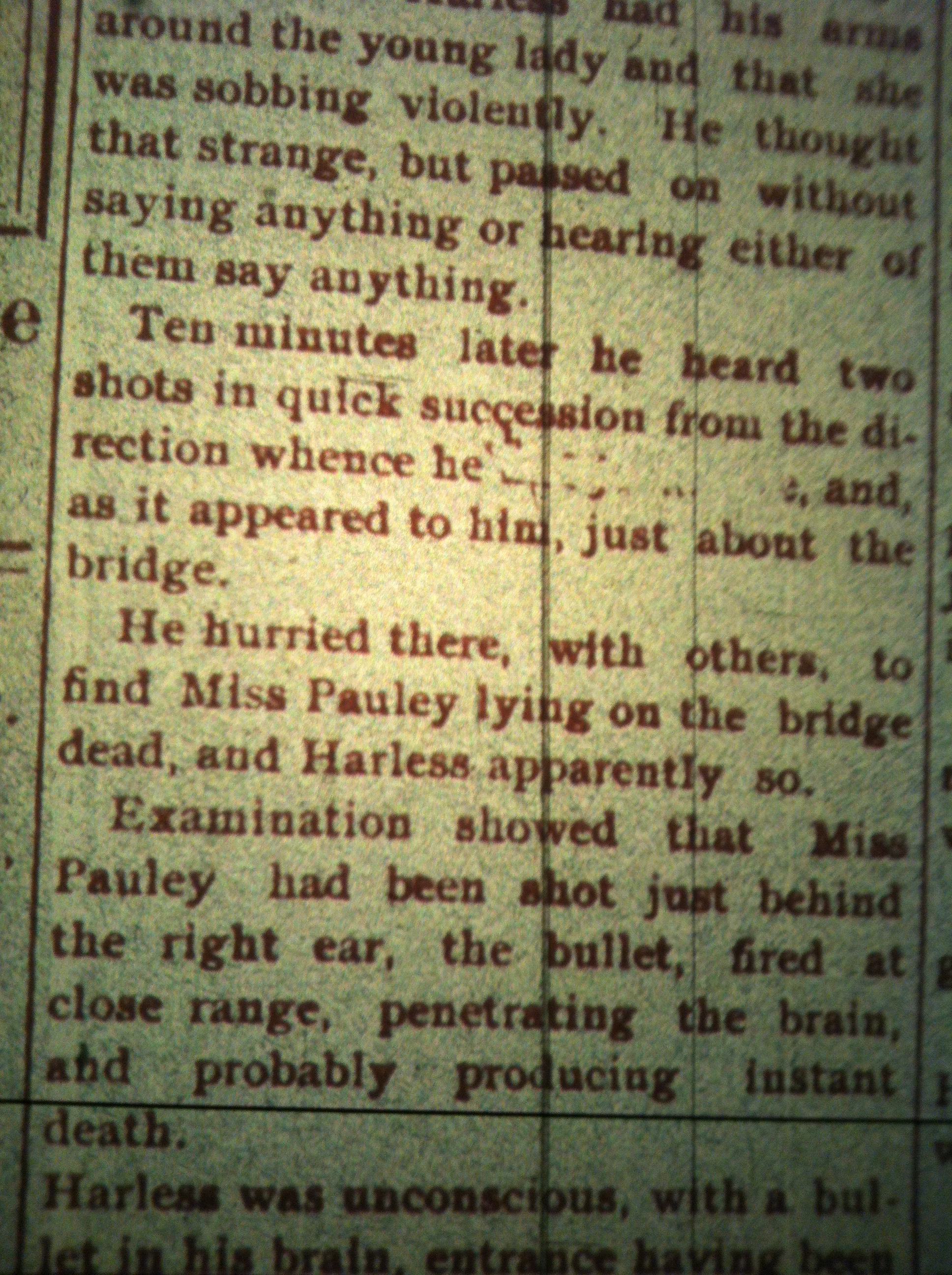
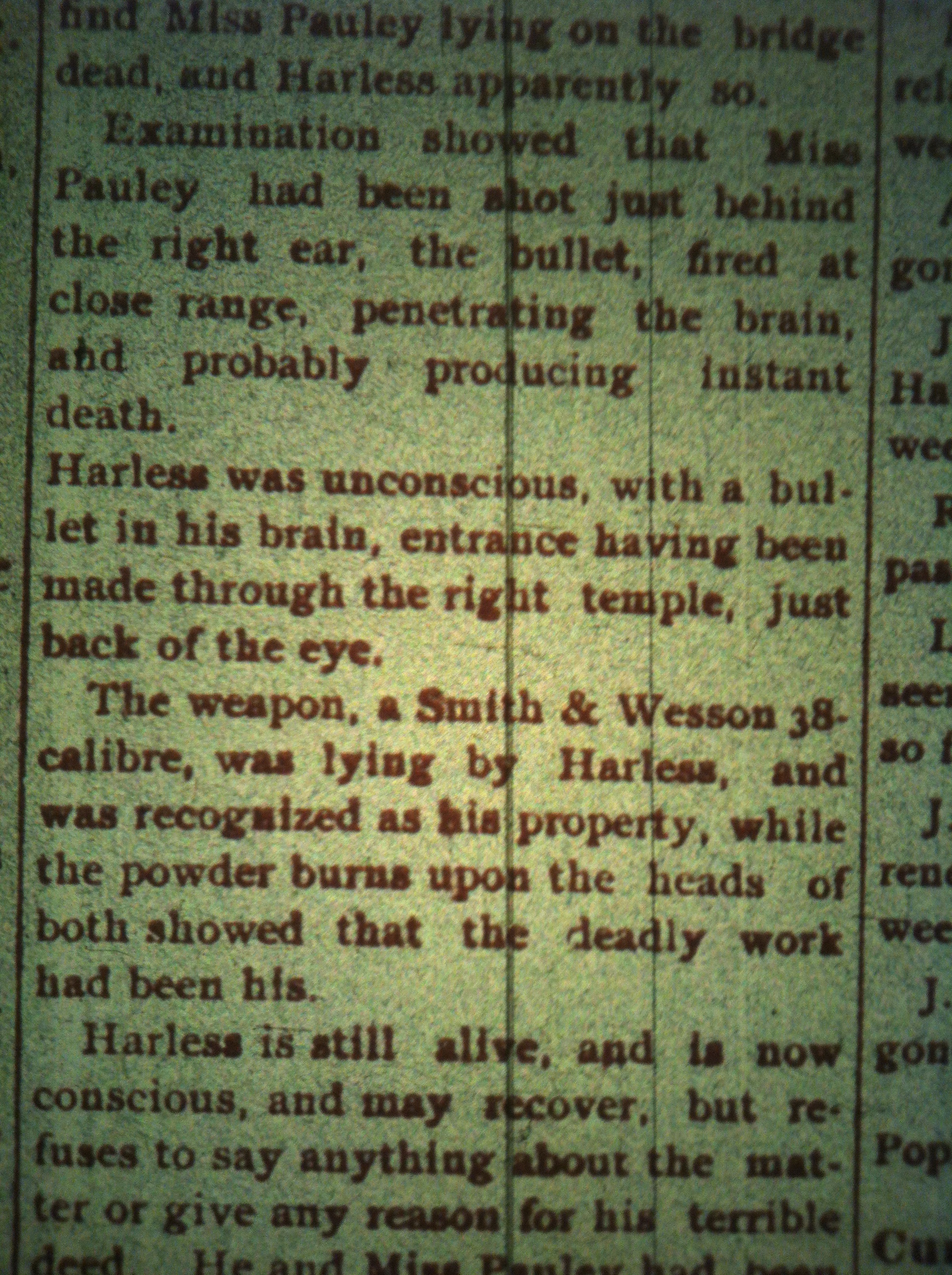
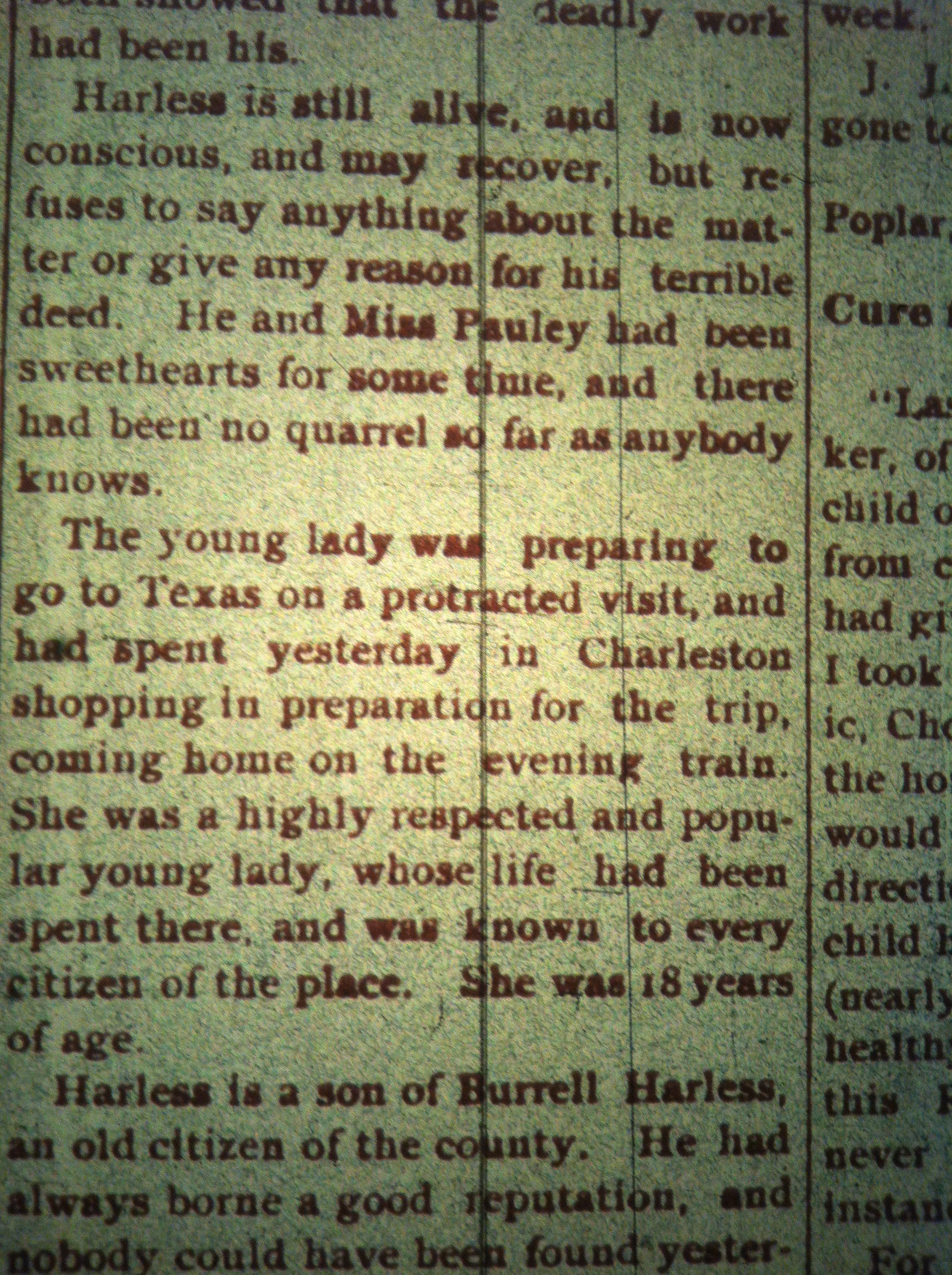
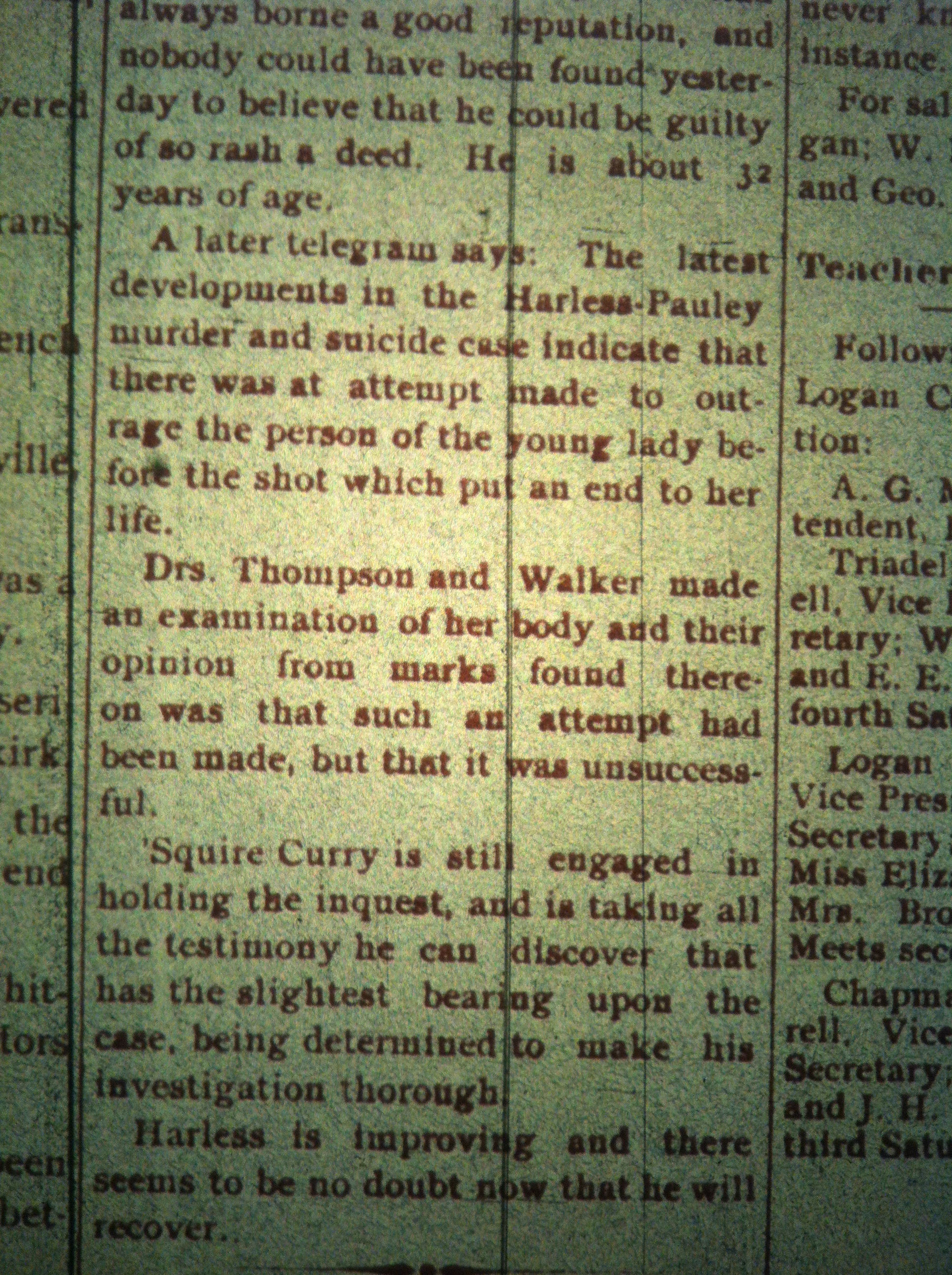
Wyatt Harless kills Maude Pauley 1901

26 Monday May 2014

Posted by Brandon Ray Kirk in Culture of Honor

≈ Leave a comment

Tags

Appalachia, Boone County, Brownstown, Burrell Harless, Charleston, crime, Dr. Thompson, Dr. Walker, history, Lens Creek, Logan County Banner, love, Maude Pauley, Texas, West Virginia, Wyatt Harless

Wyatt Harless kills Maude Pauley, Logan County Banner, August 1, 1901

Wyatt Harless kills Maude Pauley, Logan County (WV) Banner, Thursday, August 1, 1901

Wyatt Harless kills Maude Pauley LCB 8.1.01 2 Wyatt Harless kills Maude Pauley LCB 8.1.01 3 Wyatt Harless kills Maude Pauley LCB 8.1.01 4 Wyatt Harless kills Maude Pauley LCB 8.1.01 5 Wyatt Harless kills Maude Pauley LCB 8.1.01 6 Wyatt Harless kills Maude Pauley LCB 8.1.01 7

In Search of Ed Haley 303

11 Sunday May 2014

Posted by Brandon Ray Kirk in Ed Haley, Lincoln County Feud, Music, Stiltner

≈ Leave a comment

Tags

banjo, Brights Disease, Cain Adkins, Cain Adkins Jr., Catlettsburg, Chillicothe, Columbus, crime, Daisy Ross, Ed Haley, Faye Smith, fiddlers, fiddling, genealogy, Goble Fry, Green McCoy, Green McCoy Jr., guitar, Harkins Fry, history, Indian Girl, Kenova, Kentucky, Laurel Creek, Luther McCoy, Mariah Adkins, McCoy Time Singers, Monroe Fry, music, Ohio, Oscar Osborne, Salty Dog, Sherman Luther Haley, Sherman McCoy, Spicie McCoy, Time Has Made A Change, Wayne County, WCMI, West Virginia, Winchester Adkins, writing

After the feud, Cain Adkins settled on Laurel Creek in Wayne County and never returned to Harts. Not long afterward, he began suffering from some type of lingering illness.

“Grandpaw, he played a fiddle,” Daisy said. “They had him to play the fiddle on his deathbed. Somebody came in and they wanted to hear a song and he played it for him. He said, ‘They ain’t no harm in a fiddle. If they’s any harm, it’s when no one plays it.’ I’ve heard Mom tell the last song he played, but I don’t know what it was he played. Mom said it made him feel better.”

Cain died of Brights Disease in 1896.

His widow Mariah lived many more years.

“Grandmaw was a good person — she went to church every Sunday. The last ten years she went blind and stayed with Mom. Mom waited on her.”

She died in 1931.

It took Spicie years to forgive the Brumfields for killing Green. Even after remarrying Goble Fry (her first cousin) in 1893, she was unable to cope with Green’s death and always cried when recounting the tale of his murder. For years, her bitterness kept her from joining the church.

“She felt like he hadn’t done nothing to be killed for ’cause she loved him better than anything,” Daisy said. “Before she was baptized, my brother Sherman had went off to work — him and a bunch of boys — and they was all telling what church their mother belonged to and Sherman said to Mom, ‘Mom, I had to tell them you didn’t belong to the church.’ ‘Well,’ she said, ‘I can’t forgive the Brumfields.’ He said, ‘You can’t forget it, but you got to forgive them or you’ll go to the same place where they did.’ I heard him say that. I was a young woman.”

These were apparently inspiring words, because Spicie was baptized soon afterwards and formed a gospel quartet, “The McCoy Time Singers.” Her son, Sherman McCoy, was a key member.

“Brother Sherman could play any kind of instrument, but banjo is what he played mostly,” Daisy said. “He played all kinds of pretty tunes on the banjo that wasn’t gospel. And when he was on WCMI he wanted people to write in and tell him to play the gospel music, but he had to play the one that got the most requests and he didn’t get very much requests for the gospel. But Mom and Sherman sung them gospel songs on there. They had a program on WCMI one time.”

Daisy said the only known recordings of the McCoy Time Singers had been destroyed years ago.

“They made records of their quartet singing and they peeled up. Got damp. Monroe, my brother, got some and even wrapped them in cloth and they still peeled.”

I wanted to know more about Sherman McCoy, so I got out my banjo and played a little bit for Daisy. She said he played a lot with his uncle, Winchester Adkins (one of the best fiddlers in Wayne County), and a guitar player named Oscar Osborne.

“Brother Sherman was one of the best banjo players I ever heard,” Daisy said. “I’ve heard them on television but I’ve never heard anything to beat Brother Sherman. He played a guitar and taught music lessons. He played all kinds of jigs. Did you ever play ‘The Indian Girl’? He didn’t like to play that one very much because he had to tune it different but that was the prettiest tune I ever heard on the banjo. It sounded like he had more than ten fingers.”

I asked Daisy about Sherman playing with Ed Haley and she said, “He played music with Ed Haley and they played in Catlettsburg.”

That’s all she knew about it but I wondered just how well they actually knew each other. Was it possible that Ed named his oldest child Sherman Luther Haley after Sherman McCoy? I could just picture them loafing together as young bachelors.

Daisy said Green McCoy’s other son, Green Jr., was a singing instructor. She remembered the first time he came into contact with a guitar.

“Uncle Cain, he played a guitar,” she said. “He come down one time and wanted Green to see his guitar. Green only seen that guitar one time and worked a week and got him a guitar and tuned it up and was playing on it. He was gifted.”

What happened to him?

Faye said, “Uncle Green, he hadn’t been dead but I’d say about eight or ten years. He played a guitar good.”

Daisy said Green’s son Luther plays the guitar on the radio in the Columbus-Chillicothe area.

“Uncle Green said he was absolutely the best he ever heard,” she said.

She didn’t know much about Luther or have any recordings of him but had a videocassette tape of Green Jr. picking the guitar and singing in 1975. (I couldn’t help but note that Green Jr. and Ed Haley both had sons named Luther.)

Spicie’s children by Goble Fry also were talented musicians, hinting at a musical strain in her genetics as well.

“Uncle Monroe was a Fry — that was Mom’s brother — and Harkins — they both played music,” Faye said. “But now, Uncle Monroe could play, I guess, about any type of instrument. I remember him playing ‘Salty Dog’ one time.”

Daisy really bragged on her brother Harkins Fry, a music teacher and songwriter. He wrote one gospel song called “Time Has Made A Change”, which Daisy and Faye sang for us:

Time has made a change in the old homeplace.

Many of my friends have gone away,

Some never more in this life I shall see.

Time has made a change in me.

Time has made a change in the old homeplace.

Time has made a change in each smiling face,

And I know my friends can plainly see

Time has made a change in me.

In my childhood days I was well and strong.

I could climb the hillside all day long,

But I’m not today what I used to be.

Time has made a change in me.

When I reach my home in that land so fair.

Meet my friends awaiting me over there.

Free from toil and pain I shall ever be.

Time has made a change in me.

In Search of Ed Haley 301

02 Friday May 2014

Posted by Brandon Ray Kirk in Lincoln County Feud

≈ Leave a comment

Tags

Boney Lucas, Brandon Kirk, Cain Adkins, crime, Daisy Ross, Eden, Eliza Fry, Faye Smith, feud, Green McCoy, history, Imogene Haley, Kentucky, Logan County, Milt Haley, Paris Brumfield, Randolph McCoy, Sherman McCoy, Spicie McCoy, West Virginia, writing

Brandon asked Daisy about Paris Brumfield.

“Well, he had a band of people. They went around and killed a lot of people, they said. They called them a mob. Mommy said they had a mob and if they didn’t like somebody they’d kill them. The Brumfields was rough. The Brumfields first killed Grandpa’s son-in-law, Boney Lucas, and when Mom married Green McCoy they said they had another one they was gonna kill.”

Daisy told us an incredible story about Green whipping Paris in a fight.

“All I know, they was into a racket beforehand and Green McCoy got him down and pulled his eyes all out and said, ‘Go back.’ He said they was just like rubber — he’d pull his eyeballs out and they’d go back. Said you couldn’t pull them all the way out. He did finally get his sight back. Had to wear a blindfold for two or three weeks or a month. Laid around for a while.”

Faye said, “Mom said Grandma was laughing — she kinda thought it was funny to tell about him pulling that eyeball out and it popping back like a rubber band.”

We could just picture the fight, based on what we’d read in the Lambert Collection.

“Fist fights between neighborhood bullies, or to settle old scores” were a part of local culture in those times. “It was not uncommon for contestants to engage in ‘gouging,’ as a natural sequence of a fist fight. Weapons were banned, but many a man lost an eye, by having it gouged out.”

It probably wasn’t too long after Green’s fight with Paris that he and Milt were murdered. Daisy knew they were killed in October (just after Spicie’s twenty-third birthday) after being captured in Eden, Kentucky, where Green’s first family lived. She said a Brumfield mob easily took possession of them there because “the law was afraid of them.”

“Paris Brumfield was one of the ringleaders,” she said. “They brought them back from Kentucky up to Fry and killed them there. They made Green McCoy play the fiddle and he didn’t want to. They was a gonna kill him, they said. Mrs. Fry — that lived in that house — she crawled under the bed, she said. She was afraid they was gonna kill her.”

Mrs. Fry was a sister to Boney Lucas.

Daisy said some of the younger Brumfields protested Milt’s and Green’s murder.

“They are good Brumfields,” she said. “Like other people, they’re mean people in every generation. Some of the Brumfields was real good people.”

Daisy said Spicie didn’t go with Milt’s wife to beg for Milt’s and Green’s life, as we’d heard from Billy Adkins. Actually, Daisy didn’t think her mother had known Emma Haley but Brandon wondered about that since one of Emma’s uncles had married an aunt to Spicie McCoy years before. (Another confusing, but seemingly relevant, genealogical connection.)

“Then after they shot them and killed them,” Daisy said, “they took a pole axe and beat his brains in and his brains went up on the door, Mom said. Oh, that liked to killed Mom.”

After the murders, the Brumfields warned people not to touch Milt’s and Green’s bodies.

“The Hatfields up there was a friend to Green McCoy ’cause when they murdered them they wasn’t gonna let them be buried, they said, and the Hatfields from Logan County come down there with their rifles to see if Grandpaw had let them bury them on his farm,” Daisy said.

That seemed unlikely to us, considering how the Hatfields were busy feuding with Randolph McCoy’s clan, however, Devil Anse Hatfield’s mother was a first cousin to Spicie McCoy’s grandfather.

In any case, Daisy said there was no Hatfield-Brumfield trouble because Milt and Green were buried on Cain’s farm before the Hatfields arrived in Harts.

In later years, Spicie made several trips to the gravesite with her son, Sherman McCoy — sometimes on paw paw runs. Faye took Daisy and Spicie on a final trip in August of 1953. The graves were in bad shape.

“It looked like it had been neglected,” Daisy said. “They just had little rocks for their tombstone. I couldn’t go up there now — I’m ninety-one years old — but I went there several years ago with my mother.”

John Hartford’s Sketch of Milt Haley

01 Thursday May 2014

Posted by Brandon Ray Kirk in Ed Haley, Lincoln County Feud

≈ Leave a comment

Tags

Appalachia, art, crime, Daisy Ross, feud, John Hartford, Milt Haley, photo, U.S. South

John Hartford's sketch of Milt Haley, drawn in Kenova, WV, 1996

John Hartford’s sketch of Milt Haley, drawn in Kenova, WV, 1996

Hollena Brumfield Grave

30 Sunday Mar 2014

Posted by Brandon Ray Kirk in Harts, Lincoln County Feud, Women's History

≈ 2 Comments

Tags

Al Brumfield Cemetery, Appalachia, crime, feud, genealogy, Harts, Hollene Brumfield, Lincoln County, photos, U.S. South, West Virginia

Hollena (Dingess) Brumfield, a major character in the story of the Lincoln County Feud, is buried at Harts, Lincoln County, WV

Hollena (Dingess) Brumfield, a major character in the Lincoln County Feud, is buried at Harts, Lincoln County, WV

In Search of Ed Haley 274

27 Thursday Mar 2014

Posted by Brandon Ray Kirk in Culture of Honor, Ed Haley, Lincoln County Feud

≈ Leave a comment

Tags

Ashland, Boney Lucas, Cain Adkins, Catlettsburg, crime, Daisy Ross, Ed Haley, Eden, Fry, Goble Fry, Harts Creek, history, John Hartford, Kenova, Kentucky, Laurel Creek, Mariah Adkins, Milt Haley, murder, music, Sherman McCoy, Spicie McCoy, Wayne County, West Virginia, Winchester Adkins, writing

Excitedly, I next called Spicie McCoy’s daughter Daisy Ross who lived in Kenova, a small city near Huntington, West Virginia. Daisy’s voice was weak — she said she’d been down sick with a cold for the past week. I told her that we were trying to find out about Green McCoy’s death and she said, “My mother married Green McCoy and he was murdered. She married Goble Fry after he died. My mother was Spicie. She talked about Milt Haley. She just said they played music together, him and Green McCoy. They were good friends. I don’t know whether he was rough or not. I never heard Mom say nothing against Milt Haley.”

To our surprise, Daisy had no idea why Milt and Green were killed by the Brumfields.

“The Brumfields was rough: they had a mob,” she said. “The Brumfields first killed Grandpa’s son-in-law Boney Lucas, and when Mom married Green McCoy they said they had another’n they was gonna kill. Said they were gonna kill everything from the housecat up. They was just kindly mean people, I reckon.”

Daisy said Milt and Green tried to hide out from the Brumfields somewhere in Eden, Kentucky. She wasn’t sure where that was, but knew why they went there.

“Green McCoy had been married and had his wife and two children down there,” she said. “Yeah, Mommy didn’t know that, you see. Just before she got married, she got news that he had a wife and two children down there. He had told her that he had divorced her and Grandma said that hurt her awful bad and she couldn’t make Mommy understand it. Said Mom loved him so good she went ahead and married him anyhow.”

It didn’t take long for the Brumfields to locate Milt and Green.

“They went down and got them,” Daisy said. “The law was afraid of them, you know. They killed them there at Fry. And when the Brumfields killed them, they wasn’t satisfied with that. They took a pole-axe and beat their brains out and their brains splattered up on the door, Mom said. That hurt Mom so bad.”

I was chilled to the bone.

After Milt’s and Green’s murder, Daisy’s mother and family fled Harts Creek.

“The murder was in October and Grandpa and Uncle Winchester, his son, had to get out to Wayne County because they said they was gonna kill everything from the housecat up, the Brumfields did,” she said. “Grandma and Mom and the girls rented a boat and put all their household stuff and barrels of meat and come down on the river in January to Laurel Creek here in Wayne County. It was in January, but the peach trees was in full bloom, Mom said. Come a little warm spell and they all budded out in bloom. They didn’t have no menfolks to row the boat; the women had to do it. Mom said they was looking every minute to be drowned ’cause they was all kinds of stuff on the river. It was up from bank to bank.”

I asked Daisy if she knew Ed Haley and she said, “Yeah that’s the one played music with my brother, Sherman McCoy. My brother, he played the banjo. That was Green McCoy’s son you know and that was my half-brother. Ed Haley and Sherman McCoy — they was good friends. They got together and played music together down in Kentucky somewhere. I guess maybe in Catlettsburg or maybe in Ashland. He was Milt Haley’s son. And they said their fathers was killed together.”

Whirlwind Warrant (1918)

27 Thursday Mar 2014

Posted by Brandon Ray Kirk in Big Harts Creek, Culture of Honor, Whirlwind

≈ Leave a comment

Tags

Appalachia, crime, George Hensley, history, Jesse Blair, Logan County, Sol Adams, U.S. South, West Virginia

Jess Blair Warrant 1918 2

Jesse Blair warrant of arrest, Logan County, WV, 1918

← Older posts
Newer posts →

Feud Poll 1

If you had lived in the Harts Creek community during the 1880s, to which faction of feudists might you have given your loyalty?

Categories

  • Adkins Mill
  • African American History
  • American Revolutionary War
  • Ashland
  • Atenville
  • Banco
  • Barboursville
  • Battle of Blair Mountain
  • Beech Creek
  • Big Creek
  • Big Harts Creek
  • Big Sandy Valley
  • Big Ugly Creek
  • Boone County
  • Breeden
  • Calhoun County
  • Cemeteries
  • Chapmanville
  • Civil War
  • Clay County
  • Clothier
  • Coal
  • Cove Gap
  • Crawley Creek
  • Culture of Honor
  • Dingess
  • Dollie
  • Dunlow
  • East Lynn
  • Ed Haley
  • Eden Park
  • Enslow
  • Estep
  • Ethel
  • Ferrellsburg
  • Fourteen
  • French-Eversole Feud
  • Gilbert
  • Giles County
  • Gill
  • Green Shoal
  • Guyandotte River
  • Halcyon
  • Hamlin
  • Harts
  • Hatfield-McCoy Feud
  • Holden
  • Hungarian-American History
  • Huntington
  • Inez
  • Irish-Americans
  • Italian American History
  • Jamboree
  • Jewish History
  • John Hartford
  • Kermit
  • Kiahsville
  • Kitchen
  • Leet
  • Lincoln County Feud
  • Little Harts Creek
  • Logan
  • Man
  • Matewan
  • Meador
  • Midkiff
  • Monroe County
  • Montgomery County
  • Music
  • Native American History
  • Peach Creek
  • Pearl Adkins Diary
  • Pecks Mill
  • Peter Creek
  • Pikeville
  • Pilgrim
  • Poetry
  • Queens Ridge
  • Ranger
  • Rector
  • Roane County
  • Rowan County Feud
  • Salt Rock
  • Sand Creek
  • Shively
  • Spears
  • Sports
  • Spottswood
  • Spurlockville
  • Stiltner
  • Stone Branch
  • Tazewell County
  • Timber
  • Tom Dula
  • Toney
  • Turner-Howard Feud
  • Twelve Pole Creek
  • Uncategorized
  • Warren
  • Wayne
  • West Hamlin
  • Wewanta
  • Wharncliffe
  • Whirlwind
  • Williamson
  • Women's History
  • World War I
  • Wyoming County
  • Yantus

Feud Poll 2

Do you think Milt Haley and Green McCoy committed the ambush on Al and Hollene Brumfield in 1889?

Blogroll

  • Ancestry.com
  • Ashland (KY) Daily Independent News Article
  • Author FB page
  • Beckley (WV) Register-Herald News Article
  • Big Sandy News (KY) News Article
  • Blood in West Virginia FB
  • Blood in West Virginia order
  • Chapters TV Program
  • Facebook
  • Ghosts of Guyan
  • Herald-Dispatch News Article 1
  • Herald-Dispatch News Article 2
  • In Search of Ed Haley
  • Instagram
  • Lincoln (WV) Journal News Article
  • Lincoln (WV) Journal Thumbs Up
  • Lincoln County
  • Lincoln County Feud
  • Lincoln County Feud Lecture
  • LinkedIn
  • Logan (WV) Banner News Article
  • Lunch With Books
  • Our Overmountain Men: The Revolutionary War in Western Virginia (1775-1783)
  • Pinterest
  • Scarborough Society's Art and Lecture Series
  • Smithsonian Article
  • Spirit of Jefferson News Article
  • The Friendly Neighbor Radio Show 1
  • The Friendly Neighbor Radio Show 2
  • The Friendly Neighbor Radio Show 3
  • The Friendly Neighbor Radio Show 4
  • The New Yorker
  • The State Journal's 55 Good Things About WV
  • tumblr.
  • Twitter
  • Website
  • Weirton (WV) Daily Times Article
  • Wheeling (WV) Intelligencer News Article 1
  • Wheeling (WV) Intelligencer News Article 2
  • WOWK TV
  • Writers Can Read Open Mic Night

Feud Poll 3

Who do you think organized the ambush of Al and Hollene Brumfield in 1889?

Recent Posts

  • Logan County Jail in Logan, WV
  • Absentee Landowners of Magnolia District (1890, 1892, 1894)
  • Charles Spurlock Survey at Fourteen Mile Creek, Lincoln County, WV (1815)

Ed Haley Poll 1

What do you think caused Ed Haley to lose his sight when he was three years old?

Top Posts & Pages

  • Halcyon 4.10.1919
  • Civil War Gold Coins Hidden Near Chapmanville, WV
  • Halcyon-Yantus 12.08.1911
  • Ran'l McCoy's Final Months (1914)
  • Yantus 10.20.1911

Copyright

© Brandon Ray Kirk and brandonraykirk.wordpress.com, 1987-2023. Unauthorized use and/or duplication of this material without express and written permission from this blog’s author and/or owner is strictly prohibited. Excerpts and links may be used, provided that full and clear credit is given to Brandon Ray Kirk and brandonraykirk.wordpress.com with appropriate and specific direction to the original content.

Archives

  • February 2025
  • January 2025
  • October 2023
  • September 2023
  • December 2022
  • November 2022
  • May 2022
  • April 2022
  • February 2022
  • November 2021
  • October 2021
  • September 2021
  • June 2021
  • May 2021
  • April 2021
  • March 2021
  • February 2021
  • January 2021
  • December 2020
  • November 2020
  • October 2020
  • July 2020
  • June 2020
  • May 2020
  • April 2020
  • March 2020
  • February 2020
  • January 2020
  • December 2019
  • November 2019
  • October 2019
  • September 2019
  • August 2019
  • July 2019
  • June 2019
  • May 2019
  • April 2019
  • March 2019
  • February 2019
  • January 2019
  • December 2018
  • November 2018
  • October 2018
  • September 2018
  • August 2018
  • July 2018
  • June 2018
  • May 2018
  • April 2018
  • March 2018
  • February 2018
  • January 2018
  • December 2017
  • November 2017
  • October 2017
  • September 2017
  • August 2017
  • July 2017
  • June 2017
  • May 2017
  • April 2017
  • March 2017
  • February 2017
  • January 2017
  • December 2016
  • November 2016
  • October 2016
  • September 2016
  • August 2016
  • July 2016
  • June 2016
  • May 2016
  • April 2016
  • March 2016
  • February 2016
  • January 2016
  • December 2015
  • November 2015
  • October 2015
  • September 2015
  • August 2015
  • July 2015
  • June 2015
  • May 2015
  • April 2015
  • March 2015
  • February 2015
  • January 2015
  • December 2014
  • October 2014
  • September 2014
  • August 2014
  • July 2014
  • June 2014
  • May 2014
  • April 2014
  • March 2014
  • February 2014
  • January 2014
  • December 2013
  • November 2013
  • October 2013
  • September 2013
  • August 2013
  • July 2013
  • June 2013
  • May 2013
  • April 2013
  • March 2013
  • February 2013
  • January 2013
  • December 2012
  • November 2012

Enter your email address to follow this blog and receive notifications of new posts by email.

Join 2,927 other subscribers

Tags

Appalachia Ashland Big Creek Big Ugly Creek Blood in West Virginia Brandon Kirk Cabell County cemeteries Chapmanville Charleston civil war coal Confederate Army crime culture Ed Haley Ella Haley Ferrellsburg feud fiddler fiddling genealogy Green McCoy Guyandotte River Harts Harts Creek Hatfield-McCoy Feud history Huntington John Hartford Kentucky Lawrence Haley life Lincoln County Lincoln County Feud Logan Logan Banner Logan County Milt Haley Mingo County music Ohio photos timbering U.S. South Virginia Wayne County West Virginia Whirlwind writing

Blogs I Follow

  • OtterTales
  • Our Appalachia: A Blog Created by Students of Brandon Kirk
  • Piedmont Trails
  • Truman Capote
  • Appalachian Diaspora

BLOOD IN WEST VIRGINIA is now available for order at Amazon!

Blog at WordPress.com.

OtterTales

Writings from my travels and experiences. High and fine literature is wine, and mine is only water; but everybody likes water. Mark Twain

Our Appalachia: A Blog Created by Students of Brandon Kirk

This site is dedicated to the collection, preservation, and promotion of history and culture in Appalachia.

Piedmont Trails

Genealogy and History in North Carolina and Beyond

Truman Capote

A site about one of the most beautiful, interesting, tallented, outrageous and colorful personalities of the 20th Century

Appalachian Diaspora

  • Subscribe Subscribed
    • Brandon Ray Kirk
    • Join 789 other subscribers
    • Already have a WordPress.com account? Log in now.
    • Brandon Ray Kirk
    • Subscribe Subscribed
    • Sign up
    • Log in
    • Report this content
    • View site in Reader
    • Manage subscriptions
    • Collapse this bar
 

Loading Comments...