In Search of Ed Haley 164

Tags

, , , , , , , , , , , ,

A few days later, I was in Ashland at Pat Haley’s house, where the Haley clan had gathered in for Lawrence’s funeral. All of Lawrence’s kids were there, of course (Beverly, Steve and David), as was Clyde and Mona. I also spotted Noah, who introduced me to his son, James Edward Haley (Ed’s namesake). Pat made a point to introduce me to Patsy Haley and her son Scott, who were in from Cleveland. A little later, I played Ed’s fiddle for Lawrence’s service and it sounded so good that I seriously considered making it my main fiddle on stage. I quickly slipped into “the zone” and it was the first time I seemed to experience (as crazy as it may seem) the sensation of Ed and Lawrence both whispering in my ear, guiding me along, looking over my shoulder, and saying things like, “Easy now, don’t play so many notes.” “Yeah, try that and see if it works.” “You’re getting too far away from the melody.”

After the funeral, I returned to Pat’s and played for the family in the kitchen. I wasn’t really sure what to expect. I mean, with Lawrence gone it would have been really easy for the Haleys to say, “Thanks for showing an interest in Pop, now see ya later,” but instead they took me into their fold — with Pat leading the way.

There were a few new stories. For instance, Patsy’s son Scott Haley told me about “catching” his father Jack in private moments playing a fiddle right along with Ed’s records. I was excited to hear that and could easily imagine that Jack was the child who had inherited Ed’s talent for the fiddle. But when I asked Pat and Steve about it they gave Scott’s claim little credence. They said Jack might have tried to play with the records but he couldn’t really play anything. They fancied Scott’s memory to be a lot like the one they had of Lawrence, who occasionally strung up Ed’s fiddle (backwards because he was left-handed) and attempted to play along with the records. I never forgot the possibility, though, that Jack Haley could play the fiddle, which seemed to irritate Pat.

Before I left Ashland, Pat gave me Ed’s records. She said she wanted me to keep them because I would “know what to do with them.”

“I have a real love-hate relationship with those records,” Steve said jokingly. “When we were kids we had to tip-toe through the house to keep from scratching them.”

Pat also loaned me Ella’s postcards and explained why Lawrence hadn’t wanted me to see them on my first visit roughly four years earlier. Apparently, they alluded to the fact that Ella had conceived Ralph not by a previous marriage — but out of wedlock. Pat said Ella was boarding with a Mr. Payne and giving piano lessons to his five-year-old daughter in Farmers, Kentucky, when she became pregnant. Mr. Payne promptly returned her to her family in nearby Morehead.

In Search of Ed Haley 163

Tags

, , , , , , , , , , , ,

Once I returned to Nashville, I called Lawrence Haley, who was in the mood to reminisce.

“Me and Pop hitch-hiked to Cincinnati out of Portsmouth a time or two,” he said. “We took old 52. And we’d had about three rides to get there.”

I asked him if Ed took his fiddle on those trips and he said, “Yeah, if he thought he was gonna be in a little bit other than country settings, he would put it in the case. But most of the time, he’d just carry it in his hand, tucked under his arm, maybe, with the bow in his hand.”

I wondered if Ed packed any extra bags on the road and Lawrence said, “Mostly just the clothes on his back, unless he was going on an extended trip — then he’d pack him a suitcase. He’d, of course, fill it up about a third with his homemade tobacco. His own cure — apple or peach or something. He’d take him some of that with him and off he’d go.”

Lawrence Haley passed away on February 3, 1995, the 44th anniversary of his father’s death.

In Search of Ed Haley 162

Tags

, , , , , , , , , , , ,

By the mid-1990s, after several years of research, word had begun to leak out about my interest in Ed Haley. Around the first of 1995, Bluegrass Unlimited ran a story that prompted Bob Hutchison, a musician from Alledonia, Ohio, to write me.

“I played with an old fella down in Athens county (Ward Jarvis) who had played a lot and learned a lot from Ed Haley,” he wrote. “He played banjo with Ed and learned a lot of his tunes when he was a young man. He said Ed was the best he’d ever seen. Ward was in his 70’s when I got to know him and he was no slouch himself on the fiddle. He said Ed was big on different tunings on the fiddle. I learned the Icy Mountain tune from Ward that he had learned from Ed. Other tunes I remember him crediting Ed with were Camp Chase, Jimmy Johnson, Three forks of Reedy. Banjo Tramp was another of Ed’s. Ward has been dead for several years… Ward was originally from Braxton Co. W.Va.”

Ray Alden offered more information about Jarvis.

“In 1972 I went to Amesville, Ohio to visit instrument craftsman Ron Chacey,” he wrote. “Ron, on a very foggy night, brought me through some hilly back roads up to see Ward Jarvis, who had moved to the area in 1943 from Braxton County, West Virginia. Ward was 78 years old. I remember that special evening in which Ward played many unusual tunes, such as ‘Icy mountain,’ as well as a Kenny Baker Tune he had just learned from a record. It was lucky, since I didn’t have a tape recorder that evening, that Richard Carlin later went to tape Ward Jarvis [in 1976]. Old time musicians Dana Loomis and Grey Larson joined Richard and accompanied Ward at that session. Ward’s source for ‘Banjo Tramp’ was Ed Haley, who had a substantial influence over the Ohio River Valley Musicians in Ward’s younger days.”

Ray Alden’s statement about how Ed influenced a number of “Ohio River Valley Musicians” made me realize that thinking of him as a “Kentucky fiddler” or even a “West Virginia fiddler” was inaccurate. Early on, I’d dismissed the “Kentucky” label used on the Parkersburg Landing album, since he was born and raised in Logan County, West Virginia, and spent a great deal of time in central West Virginia, a hub for great musicians. Also, Lawrence Haley once said that he preferred to think of his father as a West Virginia fiddler because of how he was treated in Ashland. But I had to think, especially after reading Ray Alden’s statement, that it would be best to refer to Haley (in geographical terms) as a middle Ohio River Valley fiddler (or maybe even a Guyandotte-Big Sandy Valley musician) since his sphere of influence wasn’t limited to a single state.

Sometime in the middle of January 1995, I met Ugee Postalwait’s son at one of my shows in Birmingham, Alabama. It was my first encounter with Harold Postalwait, a rather robust man — clean-shaven with a beer gut and decked out in a snap-up shirt, cowboy hat and boots shined to perfection. He showed me Laury Hicks’ fiddle and some old family photographs.

In Search of Ed Haley 161

Tags

, , , , , , , , , , , ,

After hanging up with Pat, I called Ugee Postalwait — Laury Hicks’ daughter in Akron, Ohio — to tell her about getting the picture of Ed from Maxine McClain. Ugee was full of energy. Her memory was obviously working in overdrive.

“I used to know all of them,” she said of the old musicians in her part of the country. “They was all to our house. They’d come from miles around to hear Dad play, especially when Ed was in the country. Maybe they’d stay two or three days at our house. I’d get up of a morning to look see who was in the house asleep and who all I was gonna have to cook breakfast for, when I was a girl growing up. The young men would sleep in the boys’ room and they’d sleep in the floor. Then they’d sleep four crossways in the bed, too. As I get old, I get to thinking about all of them and wonder how in the world my dad ever fed them all. I been a cooking ever since I was nine years old for workhands and people like that. One morning — I never will forget I wasn’t very old, then — got up and got breakfast. We’d had cabbage the day before for supper. A big pot of cabbage. And Ed and Ella was there. I never put cabbage on the table for breakfast. Ed looked at me and he said, ‘Ugee, what did you do with that cabbage last night?’ I said, ‘It’s in there.’ ‘Well why didn’t you put it on the table for breakfast?’ I said, ‘Well who eats cabbage for breakfast?’ He said, ‘I do.’ Now I never seen anyone eat such a mess of cabbage for breakfast. Him and Ella did. Ella said, ‘Oh, we always eat the same thing we had for supper.’ I never will forget that. From that time on, whatever was left over from supper, I’d warm it up, you know, and fix it for their breakfast ’cause they would eat it. They liked cabbage or kraut.”

Ugee really laughed telling about that, then started in with another tale.

“One time they was some Baileys there and I believe they was some of them McClain boys, and I was peeling tomatoes for supper — you know, slicing them and putting them on the plate — and I had a plate on one end [of the table] and one on the other end. And Manuel Martin was there too, and Commodore Cole. And I looked in both places and them tomatoes was gone. ‘What in the world? Some of them’s come in and hid my tomatoes.’ I looked out and Ed was standing there sitting on the walk — I never will forget — a laughing, and he said, ‘Wait till she finds out.’ I said, ‘Ed did you get them tomatoes in there?’ He said, ‘We ate every one of them.’ I said, ‘If I could find the plate, I’d break it over your head.’ That Commodore Cole, he said, ‘You wouldn’t dare do that.’ Ed said, ‘Don’t dare her too much, Commodore. I know her.’ And they was a eating them tomatoes as fast as I was a peeling them. Them ornery birds, I never will forget that.”

“The last time I ever seen Ed was at his house,” Ugee said. “He looked at me and he said, ‘Ugee, can you still make a rhubarb pie?’ I said, ‘Why lord yes, I reckon I can. Why?’ He said, ‘Well, I want a rhubarb pie.’ And I made four and I never seen no such eating as he done that evening, him and Ella, on them rhubarb pies while they was hot — with milk cream over them. I can see them yet. I went down to Ashland, Kentucky. They lived on 45th Street.”

In Search of Ed Haley 160

Tags

, , , , , , , , , , , ,

A few weeks later, I called Lawrence Kirk, whose ancestors had played various roles in the story of Milt Haley’s death. I hadn’t spoken with him for several months. We talked more about Milt Haley’s murder.

“Back in the old days, these people’d get into trouble here and they’d run backwards and forwards across that Tug River,” he said. “That was the state line and the law didn’t bother them. If you crossed the state line, you was safe. But they got the papers out and went over there and got Haley and McCoy. Inez is where they went to and got them. Yes, sir. They either came up Jenny’s Creek or Marrowbone Creek. See, they had horse trails all through these woods back in them days. They come right across Twelve Pole and down Henderson up there in the head of main Hart. Come right down and up what they call the Bill Branch — some people calls it the Hugh Dingess Branch — right down Piney Fork. It’s a straight shoot through there. I’ll tell you what. Come up sometime when you’ve got a day or two and we can drive right through there.”

Boy, that sure sounded good to me.

In the meantime, Pat kept me up on everything. She said Mona was helping her look after Lawrence and had even spent the night. Clyde had come in for Christmas.

“They had a red hat on him and a great big sign across the front which said ‘Clyde.’ They had a pair of pants that was rolled over about three times tops, the shoes was way too big, and, I mean, it was sad. The hat was red, his sweater was blue, and his shoes was white. Mona said they got half-way home from Cincinnati, and he was just talking away, you know, about things that had happened in their past, and then he began looking out the window and all of a sudden he turned around and he said, ‘Who in the hell are you?’ And she thought, ‘Uh, oh, it’s gonna be good.’ Larry was very happy to see him.”

In Search of Ed Haley 159

Tags

, , , , , , , , , , , ,

In one of those “passing the torch moments,” Lawrence reached the telephone to his sister, Mona. I told her about Milt Haley being a fiddler, and she said, “Really? Well we didn’t never know that.”

I figured that Ed had kept all of the details about Milt hidden from his kids, but Mona said, “Well, he talked about it some, because I wouldn’t know what I know about it if he hadn’t. You did find out what I told you was true, didn’t you? It wasn’t my dad’s mother that was killed, the way I heard it. It was one of the Hatfield women. Got half her face shot away and it killed her. That’s why they retaliated against Green McCoy and my grandfather. That’s only hearsay, but it had to come from Pop. I do remember him saying that.”

Pat seemed pleased that Mona was visiting Lawrence.

“He asks for her a lot,” she said.

I wanted to know more about Lawrence’s condition.

“He sits with his eyes closed and he found a pair of sunglasses that look exactly like the ones his daddy wore,” Pat said. “These are a pair that one of the kids bought. They were laying on the dining room table and he picked them up and said, ‘There’s my glasses.’ He insists on wearing them and you would think it was Ed Haley back many years ago. He talks about horse and buggies a lot. He sits with your book constantly. He does not like to look at the picture of his mother’s tombstone. What keeps you in his mind a lot, he listens to the tapes and he knows he gave you the records. Beverly was here this past weekend. He knew who she was but he was still talking in riddles. But today he’s pretty much himself. He got up and got dressed about 5:30 and he’s been roaming ever since.”

In Search of Ed Haley 158

Tags

, , , , , , , ,

I called Lawrence and Pat to tell them about this new discovery. Pat put me on the telephone with Lawrence, who seemed to be doing better. I asked him why he thought none of the Haley kids ever learned the fiddle.

“I think Pop took interest in us as far as he knew how to take interest in us,” he said. “Whatever he could’ve taught us he most certainly would have. But we’d ruther be out running in the woods than sitting at a table trying to learn ‘Forks of Sandy’ or something like that. He would ruther teach it to the ones who could and who showed interest in it, and let it go at that. Pop never did try to get me to learn the fiddle because I was left-handed. I guess he figured that would be too much of a challenge for him even, to try to teach violin to a left-handed violin player.”

I told Lawrence he knew more about the fiddle than a lot of professional musicians and he said, “Well, I guess I learned just about as much of it as he did. I appreciate any good words that can be said about me and the violin. My sister’s here and if you could get her interested, she might be able to tell you as much about it as I can. She took more interest in the music of our mother, I know that. But she could pick up the fiddle and play the fiddle and play the mandolin and the piano and other instruments.”

Lawrence said, “Now if you want to talk to my sister a minute, maybe she can tell you something. If she can’t, I don’t know who else to tell you. She could probably tell you as much about it as any of us.”

In Search of Ed Haley 157

Tags

, , , , , , , , , , , ,

     Around that time, I received a very important letter in the mail from Brandon Kirk, the Harts genealogist. “Here are some documents pertaining to your research which I found in the F.B. Lambert Collection here at Marshall University,” he wrote. “There is a good chance that there may be more references in the collection regarding old time fiddlers.” Along with Brandon’s note was a single photocopied page of an interview with someone named Sam Vinson Harold on February 22, 1951. “Ed Haley was originally from Kentucky, about Ashland,” Lambert wrote. “I think he is living yet. Milt Haley, Blind Ed’s father, was a great fiddler. Some one shot him, on his porch, at mo. of Green Shoals.” Harold claimed to have penned the tune about Milt Haley’s death, “The Lincoln County Crew”, with someone named Tom Ferrell. This interview — while small in content — was a great find because it was the first solid reference that Milt was a fiddler, which meant Ed would’ve had music around in his childhood and could’ve possibly even begun learning to play by watching him.

In Search of Ed Haley 156

Tags

, , , , , , , , , , , ,

I gave Pat a call to check on Lawrence, who was back at home in Ashland. Pat said Mona had been a frequent visitor since Lawrence’s heart attack and was starting to open up about her painful memories of Ed.

“Mona said her father was the cruelest, most horrible man to her,” Pat said. “Even her mother was not the mother to her that she was to Lawrence. And she said Lawrence was always the favorite. And I said to her, ‘I didn’t see any of the ugliness of your daddy or your mother,’ and Larry has never ever said anything about his father except he’ll tell you he got drunk or he’ll tell you he was mean to Mom once in a while. But he has told me he never did see his father strike his mother. Mona said she has heard them and said the things that her daddy has said to her mother were just too horrible for her to repeat. She used to put her head under the covers to keep from listening. But Larry has none of these memories. Memories he has of his dad were always good memories. But Mona will agree: there was two out of all that were the favorites: the oldest boy Ralph and Lawrence. Mona says she is very sorry that in the last years of her mother’s life she did not help me any more than she did. I was very young when his mother passed away and I had three small children.”

Pat said Lawrence was starting to act a great deal like his mother.

“There is so much that is coming back to me that was exactly like his mother,” she said. “For one thing, when I help him to the bathroom, he takes the same little steps. He goes with his eyes closed most of the time, just like he can’t see. And he’ll sit with his eyes closed. You know there is those little things, like he won’t ever eat with a fork anymore — he eats with a spoon. His mother always did. And he drinks a lot of water, just like she did. There’s just so many of his little mannerisms that remind me so much of his mother. He will call me ‘Mom’ a lot. I don’t know if I told you, but one night he was crying and I went in to him and I said, ‘Honey, what’s the matter?’ and he said, ‘Mommy, rock me. Rock me, Mommy.’ He was back in his childhood and it just breaks your heart John when that happens. He’d been talking, he wanted to go to Morehead.”

There was more bad news for Pat. Her daughter Beverly had recently been diagnosed with cancer.

In Search of Ed Haley 155

Tags

, , , , , , , , , , , ,

Benjamin Wade Walker, the man who organized the Milt Haley burial party, was born in June of 1851 in southwest Virginia. He came to Harts when he was very young with his mother Marinda (Steele) Davis and a few siblings. The family settled near Green Shoal where Marinda soon married Baptist T. Fry. Baptist was the uncle of George Fry — at whose home the Haley-McCoy murders took place — as well as his closest neighbor in 1889. Walker, then, was a step-first cousin (and former neighbor) to George Fry, perhaps explaining why he was inclined to remove Milt Haley and Green McCoy’s battered corpses from his yard and bury them.

Around 1877, Walker married Juliantes Adkins, a daughter of Enos “Jake” and Leticia McKibbon (Toney) Adkins, large landowners at Douglas Branch. Julia was also a first cousin to Al Brumfield. Mr. and Mrs. Walker settled on Walker’s Branch at Low Gap near West Fork. About 1883, Hezekiah “Carr” Adkins sold them this property, 25 acres on Guyan River originally part of a 260-acre 1855 survey for Abner Vance. The Walkers raised nine daughters and a grandson.

In 1889, following Milt and Green’s murder, Walker risked harm by organizing a burial party for them. He reportedly buried the men on his property. A year later, in 1890, he was ordained a minister in the United Baptist Church. In 1898, he was a founding member of the Low Gap United Baptist Church, which met for over forty years in a school building that still stands near the site of the old Walker homestead. He was president of the district board of education in 1902, 1911, 1912, and 1914. He died in December 1917.

“Rev. B.W. Walker, one of the best known citizens of the county, died at his home at Ferrellsburg, on last Wednesday, after a lingering illness of dropsy,” according to a front page story in the Lincoln Republican dated Thursday, January 3, 1918. “Rev. Walker was a great worker in the Master’s vineyard and had been a consistent Christian for years. He is survived by his wife and eight daughters. Burial services were conducted at the Low Gap cemetery.”

At the funeral, Walker’s beard was full of snow.

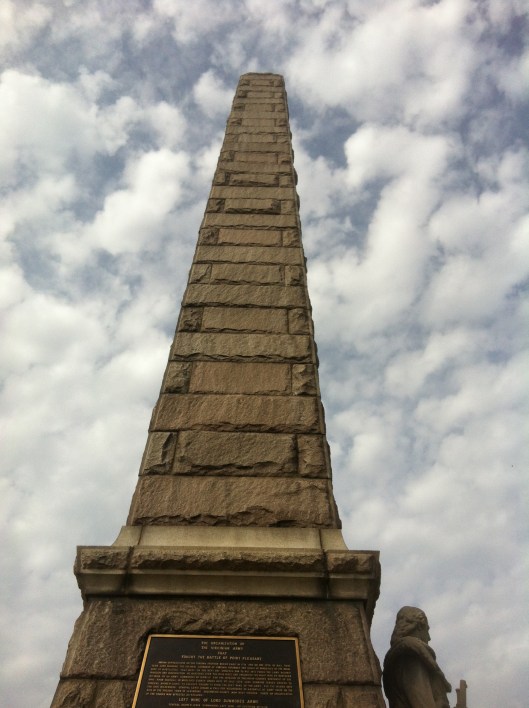
Battle of Point Pleasant

Tags

, , , , , , ,

IMG_7243

Monument commemorating the Battle of Point Pleasant, which occurred between Native Americans and Virginians at the mouth of the Kanawha River on October 10, 1774. Considered the key event of Dunmore’s War, some regard it as the first battle of the American Revolution. Photo taken in the spring of 2013.

In Search of Ed Haley 154

Tags

, , , , , , , , , , , ,

Not long after my call to Wilson, I received word from Bruce Nemerov that he’d finished dubbing about a third of Haley’s recordings. He sent me cassette copies, along with an audio log (which gave detailed information about the records). I listened extra close to the Nemerov copies and noticed how Ed’s playing gave the impression of being very notey, as I had originally interpreted it. This was, I determined, somewhat of an illusion.

“I don’t think your dad played as many notes as he sounds like he’s playing,” I said to Lawrence by telephone. “It sounds to me like he’s putting so much into some of those notes that they sound like they’re more than one note.”

Lawrence said, “He might be doing that, I really don’t know. The only thing I’ll go on is what it sounds to me like. I’ve seen and heard some fiddlers that it just seems like they draw a bow completely just to get one little note. Pop could get a dozen or two out of a draw of the bow. It seemed to me like that his fingers was all the time moving. He was probably touching the strings so lightly a lot of people might not have even heard some of the notes. That’s just my speculation. Pop knew how to use that bow to get force whenever he needed it and when to let up on it and to let a general sweet note come through.”

Lawrence continued, “I guess that’s what helped him in his technique that nobody else seemed to a been able to master. They might have been seeing him make the notes, but how he was pressuring the bow they might not have paid that much attention. You would have to have, I guess, a camera of some sort on it so you could go back and study what was done. You’d hear a note then you’d watch the finger and then you’d go back and hear the note and watch the bow. Maybe the little change in the muscles in his fingers or hand or wrist or something. You’d have to watch all of that and just keep going back and just keep going over it and going over it. But he got them in there, I know that. All of them wasn’t exactly crisp and clear. You could probably hear it in some of the records. I wish you’d been able to have met my dad. I think he’d a liked you and I think he’d a taught you all he could — all you was capable of or all he was capable of teaching you anyway.”

Lawrence said, “I don’t know how many fiddlers that I wouldn’t even have an idea of their names that used to come around to watch Pop play. They wasn’t there all the time, I don’t think, for the entertainment. They was there to learn some of the stuff, too. We used to go out on Route 5 about eight or ten miles. They was an old man out there that played and he said, ‘Ed, come see me whenever you can.’ He had a boy that had polio or something — had a short leg. It was a typical Kentucky hillside home. It had a big banistered front porch. And we used to go out there and maybe spend the weekend with these people. They’d just sit out there and play on the front porch. I can’t remember their name. I remember seeing the boy — he was quite a bit older than me at the time. He was almost a full-grown man. He’d walk with his hand on his knee a lot to keep that leg from giving way. That’s about all I can remember. Course I was probably eating better than I was if I had been home. People out in the country like that have usually got a cow and a good garden or good canned stuff anyway. These people were good people. They liked my dad, too.”

I asked Lawrence how things were going in his family and he seemed a little down about Mona and Noah.

“Mona passes our house just about every day — at the foot of the hill down here — and won’t even stop by,” he said. “Noah, whenever he’s in town, he’ll usually stop by. He’s back in Cleveland and got him an apartment and he likes it back up there. See, Noah gets in trouble every now and then; he has to move. I think he gets in gambling debts. He got down in Newport one year — it might have been eight or ten years after he got married — and got down there on a three or four day drinking and gambling spree and they liked to beat him to death down there, I think, ’cause he couldn’t come up with his tab on his gambling. So I think he gets in that condition every now and then and he has to take off somewhere else.”

I asked if Mona was a gambler and Lawrence said, “Now Mona, she goes over in Catlettsburg and she plays Soda Rum or something like that and gambles on that. I quit gambling of all sorts before I was married. Whenever Noah and Clyde and Jack would come around and want to play nickel-and-dime poker, I’d say, ‘Well, Pat will give you a blanket. You guys go right on outside, spread it out on the lawn, and play your nickel-and-dime poker out there.’ I wouldn’t let them play it in the house.”

A few days after speaking with Lawrence, I received word from Pat that he’d suffered a massive heart attack. It came as quite a shock, even though his health had been failing since my last trip to Ashland. Pat said the doctors didn’t give him long to live.

In Search of Ed Haley 153

Tags

, , , , , , , , , , ,

I called Wilson Douglas a few weeks later, still blown away by Ed’s incredibly fast fiddling on the Holbrook recordings. I raved about it to Wilson — how it was like a “rush of music” — who showed no surprise that he fiddled with so much of what he called “drive.”

“Now, they’s another tune I thought about that Haley played, he called it ‘Dance Around Molly’,” he said. “My god, Haley could play that. It’s a real good tune. Got a lot of drive about it. ‘They’s so many tunes,’ Ed said, ‘a man can’t learn them all, but I guess he can keep trying.'”

I played Ed’s recording of “Fifteen Days in Georgia” for Wilson and asked him if he played that fast at Laury Hicks’ house.

“About the same, John,” he said. “He was a great hand to play a tune in whatever time it was pitched in. He didn’t overplay his notes. And he played the solid driving note. He didn’t skip over it like skipping over with a motor boat.”

Wilson said one of the tunes that Ed played at Laury Hicks’ grave was “Arkansas Traveler”.