Tags
Appalachia, Bill Adkins, culture, fiddler, Harts, history, life, Lincoln County, photos, timbering, West Virginia

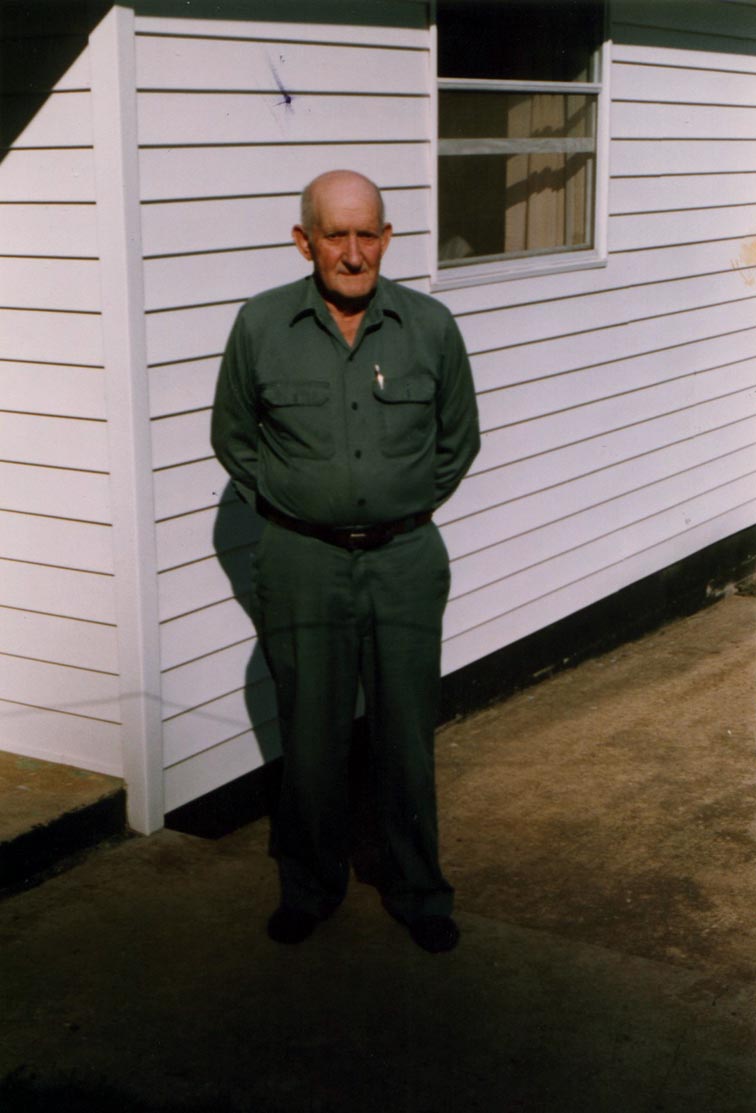
Bill Adkins of Harts, Lincoln County, WV

03 Monday Mar 2014
Tags
Appalachia, Bill Adkins, culture, fiddler, Harts, history, life, Lincoln County, photos, timbering, West Virginia
Bill Adkins of Harts, Lincoln County, WV
03 Monday Mar 2014
Tags
Appalachia, Bill Adkins, Billy Adkins, Black John Adkins, Brandon Kirk, Dood Dalton, Fed Adkins, fiddlers, fiddling, Harts, history, Lincoln County, music, West Virginia
Meanwhile, Brandon and Billy were back at the bedside of Bill Adkins. Bill said Ed used to visit his father Fed Adkins for two or three days at a time when he was a boy. Fed and his family lived in Harts with Black John Adkins, a mulatto cousin who had neen present at the Haley-McCoy executions in 1889. When Haley came by, he usually traveled with Dood Dalton, a fiddler from Big Branch who played with a similar style. Ed and Dood played for all night dances at Fed’s but never sang anything. Bill said Ed played fast and smooth and was a “long bow” fiddler. He tapped his feet while playing.
Fed and Black John were both fiddlers, Bill said, but they never played with Ed and Dood. Instead, they tried to copy them after they left.
Bill said Ed didn’t drink at his father’s home and was a very serious person, never carrying on much. People led him around. When he stayed overnight, he slept in the same bed as Bill and the other Adkins boys.
02 Sunday Mar 2014
Posted in Big Sandy Valley, Ed Haley, Music, Women's History
Tags
Appalachia, culture, fiddle, fiddler, history, Josie Cline, Kentucky, Kermit, life, music, photos, Tug River, Warfield, West Virginia

The fiddle of Josie (Spaulding) Cline, “Lady Champion Fiddler of Kentucky, Virginia, Ohio & West Virginia”
02 Sunday Mar 2014
Posted in Big Sandy Valley, Ed Haley, Music
Tags
blind, Charleston, Ed Haley, Ella Haley, fiddlers, history, John Spaulding, Josie Cline, Kentucky, Kermit, Martin County, Mont Spaulding, music, Norton, Virginia, Warfield, Wayne County, West Virginia, writing
John and Mary A. Spaulding were the parents of Josie Cline and Mont Spaulding, two fiddlers in Kermit, West Virginia, somehow affiliated with Ed Haley. In all, John and Mary had six children: Mont Spaulding (1860), Josephine Spaulding (c.1864), Virginia Spaulding (c.1867), Linsy Spaulding (1870), Nickiti Spaulding (c.1873) and Lizzie Spaulding (1878). In 1870, the Spauldings lived in the Lincoln District of Wayne County, West Virginia. In the late 1870s, they moved over to the Warfield area of Martin County, Kentucky. John died around 1878. In 1880, Mont was listed in census records as a blind person. In 1900, he and his mother Mary lived with his sister Lizzie Fitzpatrick in Martin County.
In 1910, according to census records, “Monterville Spaulding” lived in the Big Elk Precinct of Martin County where he was listed as a 48-year-old widowed traveling musician. Listed with him in that census were five children, including 20-year-old Dora Spaulding and 11-year-old James Spaulding. Based on this census, there was a solid (although not genealogical) connection between Ella Haley and the Spauldings. Between 1911-12, Ella received several postcards from a “Mont, Dora, and Jim Spaulding” from various places — Richmond, Virginia; Charleston, West Virginia; and Norton, Virginia. In light of the 1910 census, which gave Mont’s occupation as that of a traveling musician while listing him with two children named Dora and James, it seemed obvious that Ella knew Mont from her early years. Mont was gone from Martin County in 1920.
01 Saturday Mar 2014
Posted in Big Harts Creek, Ed Haley
Tags
Appalachia, culture, genealogy, Harts Creek, history, Jeff Baisden, life, photos, West Virginia

Jeff Baisden, a resident of Trace Fork of Big Harts Creek, Logan County, West Virginia
01 Saturday Mar 2014
Posted in Big Harts Creek, Culture of Honor, Ed Haley, Music
Tags
Ben Adams, Billy Adkins, Brandon Kirk, Cas Baisden, Clyde Haley, crime, Dingess, Ed Haley, Ella Haley, Ewell Mullins, genealogy, Greasy George Adams, Harriet Baisden, Harts Creek, history, Jeff Baisden, John Frock Adams, Johnny Hager, Maggie Mullins, murder, music, Peter Mullins, Ticky George Adams, Weddie Mullins, West Virginia, writing
One fall day, Brandon and Billy drove to see 80-something-year-old Cas Baisden, a son of Jeff and Harriet (Jonas) Baisden. Cas lived on a farm near the mouth of Smoke House with a relative of Uncle Peter Mullins. He had been mostly raised by Uncle Peter and had vivid memories of watching Ed Haley play in his yard, as well as in the house. He said Ed didn’t usually have a very big crowd around him. “People didn’t care a bit, even though he was about as good as they was,” Cas said. He said Ed and his wife could play anything. “He was real skinny and would drink anything he could get his hands on.” He added that Ed knew all the roads and trails up around the creek and could walk them as well as a sighted person.
Ed’s uncle Weddie Mullins married Cas’ aunt, Maggie Jonas. Cas said Weddie went to Dingess to get some booze one time and was killed in a shooting scrape. The man who shot him was laid up in bed when Weddie’s half-brother John Adams came in and asked, “Do you think he’ll make it?” Someone said he might live so Adams pulled out his gun and said, “I know he won’t,” and opened fire on him. Later, in unrelated events, Adams “blew his wife’s head off.”
Cas said Ed’s uncle Ticky George Adams was harmless. He was a small man, short and chubby, who dug ginseng a lot on Big Creek. George was a brother-in-law to Ed’s friend Johnny Hager, who came from the North Fork of Big Creek and stayed a lot with Ewell Mullins and others around Harts. Johnny was a good fellow, a musician and a non-drinker.
Cas knew that Ed sold his homeplace on Trace to Uncle Peter’s son, Ewell Mullins. It was a plank building with two long rooms. In the rear of the eating room there was a flat-rock chimney with a long fireplace. The other room was used for sleeping. Later, an old store building was pushed up against the sleeping room to make a kitchen. The house had no porch.
Cas said Ed’s son Clyde Haley was “like a monkey” when it came to climbing trees; one time, he climbed 40 feet up into a tree and all the other kids ran away because they didn’t want to see him fall.
Cas remembered sketches about Ben Adams but didn’t know if he had been involved in the 1889 feud. At one time, he operated a store on main Harts Creek below the mouth of Smoke House. Across the creek, he had a saloon made entirely of rock. Later, he lived on Trace. Cas said part of his old mill-dam could be seen in the creek at the Greasy George Adams place.
28 Friday Feb 2014
Posted in Big Harts Creek, Ed Haley
Tags
Anna Adams, Appalachia, culture, genealogy, Harts Creek, history, John Adams, life, Logan County, photos, West Virginia

John and Anna Adams, Trace Fork of Big Harts Creek, Logan County, WV
28 Friday Feb 2014
Posted in Big Harts Creek, Chapmanville, Ed Haley, Music
Tags
Anna Adams, Billy Adkins, Brandon Kirk, Chapmanville, Ed Haley, Ella Haley, fiddling, Gaynelle Thompson, history, Imogene Haley, John Adams, Kiahs Creek, Little Harts Creek, Logan County, Milt Haley, Mona Haley, music, Roxie Mullins, Ticky George Adams, Wayne County, West Virginia, writing
In Chapmanville, Brandon and Billy dropped in on Gaynelle (Adams) Thompson, a granddaughter of Ticky George Adams who spent a lot of time with Aunt Roxie Mullins during her “last days.” Gaynelle said Ed Haley’s mother never remarried after Milt’s death and died prematurely when Ed was eight to ten years old. She said Ed used to visit her parents, John and Anna Adams, on Trace Fork during the summers in the ’30s and ’40s. “Everybody in the country thought they was nothing like him,” she said. Gaynelle heard that Ed was a drinker and could get rough but said he was well mannered at the Adams home. He never cursed or drank and talked mostly to Gaynelle’s mother. He came with his daughter and wife and stopped visiting when he became too sick to travel just a few years before his death. In earlier years, he played on Kiah’s Creek and Little Harts Creek near the Wayne County line.
26 Wednesday Feb 2014
Posted in Big Harts Creek, Ed Haley, Lincoln County Feud
Joe Adams, Trace Fork of Big Harts Creek, Logan County, WV, 1995
26 Wednesday Feb 2014
Posted in Ed Haley, Lincoln County Feud, Music
Tags
Admiral S. Fry, Al Brumfield, Arena Ferrell, Boney Lucas, Burbus Toney, Cat Fry, Charles Lucas, Christian Fry, crime, Eliza Fry, Evermont Ward Fry, genealogy, George Fry, George McComas, George W. Ferrell, Green Shoal, Guyandotte, history, James L. Caldwell, Jesse James, John Brumfield, Milt Haley, Paris Brumfield, The Lincoln County Crew, Watson Lucas, West Virginia, writing
According to the Fry history, A.S. Fry eventually moved to Guyandotte, a river town in Cabell County, “where he built and owned a hotel. The Jesse James gang, who robbed a Huntington bank, stayed in his hotel for several nights.” His son George, meanwhile, took control of the family interests at Green Shoal. He presumably lived in the family homestead, where he was located at the time of Milt and Green’s murder in 1889. Deed records refer to it “as the old A.S. Fry homestead above the mouth of Green Shoals” and describe it as follows:
BEGINNING at the mouth of Green Shoals Creek, thence up with the meanderings of said creek to a survey made by C.T. fry, thence with the line of same to a white oak corner on a point, thence up the said point with the line of Chas. Lucas to the top of the mountain, thence running with the ridge to the head of a little ravine to a dog-wood corner made by C.T. Fry, thence down the hollow with C.T. Fry’s and B.C. Toney’s lands to a walnut corner made by said C.T. Fry, thence down the hill with John Fry’s and B.C. Toney’s line to the river, thence down with meanderings of the river to the place of beginning, containing seventy-five acres, more or less.
Although the deed was vague in giving its coordinates, it clearly proved that the “A.S. Fry homestead” — and thus the site of Milt and Green’s murder — was on the same side of the river as the railroad tracks.
By 1889, when the Brumfield gang took over the Fry house, George and his wife Eliza had a six-year-old daughter and a one-year-old son. Cat Fry, a niece, also lived in the home. The family was connected to various participants in the 1889 troubles. Eliza’s older brother was married to Paris Brumfield’s sister, while two of her sisters were married to Brumfield’s nephews. These marriages were perhaps complicated when Paris murdered Mrs. Fry’s brother, Boney Lucas.
Following the Haley-McCoy murders, George Fry suffered some bad luck. In 1892, his wife reportedly had an illegitimate child by John Brumfield (Al’s younger brother). Four years later, his father sold the family homestead on Green Shoal to Arena Ferrell, a local storekeeper. George’s wife died around 1902 “when her children were young” (according to one source) and was buried in the old Fry Cemetery at Green Shoal. A.S. Fry himself was murdered at his hotel in 1904. George afterwards moved to Guyandotte where he died on May 19, 1905. Control of family businesses thereafter went to his brother Evermont Ward Fry, who was still alive as late as October 1939.
As for the “murder house” itself, Arena Ferrell deeded it to her adopted son George W. Ferrell, who is credited with writing “The Lincoln County Crew” — the song about Milt’s death. In 1899, he sold it to George R. McComas, who in turn sold it to J.L. Caldwell three years later. (This was probably the same J.L. Caldwell referred to in George Fry’s 1880 letter.) It was around that time (1902-04) when the railroad came through the Guyan Valley, which apparently had a direct effect on the “murder house.”
“The railroad now runs through one side of the house as well as that of the school building,” Ward told Fred Lambert. “This school was about one fourth mile above our residence.”
In 1915, Caldwell sold the property back to Arena Ferrell. Then, in 1919, it was transferred to Watson Lucas, whose heirs sold it to the current owners, the Lamberts, in the 1960s.
25 Tuesday Feb 2014
Posted in Ed Haley, Lincoln County Feud
The former location of the A.S. Fry home, Green Shoal, Lincoln County, West Virginia, 2007
25 Tuesday Feb 2014
Posted in Culture of Honor, Ed Haley, Lincoln County Feud
Tags
Admiral S. Fry, Anderson County, Burbus Toney, Charles Lucas, Cincinnati, civil war, Eliza Fry, Evermont Ward Fry, Franklin County, Fred B. Lambert, Garnett, genealogy, George Fry, Green Shoal, history, James L. Caldwell, Kansas, Lucinda Lucas, Ohio, Ottawa, Rhoda Fry, Will Fry, writing
A.S. Fry — the man who owned the home where Milt Haley and Green McCoy were murdered — was a former officer in the Confederate army and early businessman in Harts. According to the Fry history, “Shortly after his return home from the War, his adventurous spirit led him to Kansas and on to Texas; his family remained in Lincoln County. After his return from the West, his youngest son was born.” This son, Evermont Ward Fry, was born in 1872 and was later interviewed by Fred Lambert.
“When I was a boy, people gathered for a week’s religious meetings,” Fry told Lambert. “My father would keep from forty to fifty people. They held meetings in the summer or early fall. The people came on horseback from all directions. The preaching was at the Green Shoal School house; this was an old log building. Before it stood three or four beech trees. Preaching was under these trees. On one occasion my father’s house caught fire. He kept store and had just received an order of five or six dozen buckets. It was the nighttime, but he got out the fire buckets and the men formed a line up from the river. They put out the fire, but one end of the house was pretty badly burned.”
In subsequent years, A.S. Fry made other trips West, apparently with his son, George. George Franklin Fry was born in 1858 and was married to his first cousin, Eliza Virginia Lucas, a daughter of Charles and Lucinda (Fry) Lucas.
“Mrs. Rhoda Fry — Wear in this city and will Remain Hear for a few days,” A.S. Fry wrote to his wife from Ottawa, Franklin County, Kansas, on July 14, 1880. “Lands is from $3 to $20 dollars per acor. Thare is fine crops hear. We may By Land in this County. This is said to be the beste County in the state and thare is thousands of acors for sail heare. It is vary warm. I don’t know when I will be at home. I will wright when I will be at home and I want you and Ward to meet me at huntington. This is a nice Country. I will wright to you in 2 or 3 days what we ar a doing. We have Gist Reatch this City. The Pepel is all Kind and seemes to tak intrust in Emzy Jane. I have nothing worthey of wrighting. Give all of my frieands best Respects for me and tell BC Toney not to Rune his stones two close. So I will close by saying that we ar well. Hoping the last few Lines will find you all well. So fare well. If you Right Direct yere Letter A.S. Fry, Garnett, Anderison Co., Kansas.”
“We wrote you from Cincinnati Ohio regarding Goods,” George wrote as an attachment to the aforementioned letter. “We bough[t] a little stock — and if Will has not gone after them go at once — they are in care of J.L. Caldwell. We also sent Bills at same time. In close you will find a butiful song bough[t] on Train.”
24 Monday Feb 2014
Posted in Big Harts Creek, Culture of Honor, Ed Haley, Lincoln County Feud, Timber
Tags
Al Brumfield, Ben Adams, Billy Hall, crime, Ed Haley, Eveline Dingess, feud, Floyd Dingess, Harts Creek, Henderson Dingess, history, Hollene Brumfield, Hugh Dingess, Imogene Haley, John W Runyon, Kentucky, Kiahs Creek, Robinson Creek, West Virginia, writing
At the time of the ambush on Al and Hollena Brumfield, Henderson Dingess and his family were in no mood to see yet another one of their fold die violently. Less than a year before, on November 15, 1888, Floyd Dingess, an older son of Henderson, was murdered while working logs at the mouth of Rockhouse Fork on Harts Creek. It was a horrific deed: Floyd, whose wife was several months pregnant, was murdered by his own brother-in-law, Billy Hall. Floyd had never been popular with the Halls. He reportedly made a habit of bullying Billy. It was said that when he came home from working, his wife would clatter pots and pans in the kitchen just so her family wouldn’t hear his footsteps.
When Billy finally shot Floyd on that fateful day, some of the younger Dingess boys were fishing in the creek nearby. They raced home to tell their family what had happened, while Billy quickly returned home and received instructions to hide out in Robinson Creek, Kentucky. Meanwhile, Floyd’s pregnant wife was floated across the creek to her husband, who died in her arms. Hugh Dingess, Floyd’s brother, tracked Billy to Kiah’s Creek but lost his trail. For years, Hugh was devastated by his brother’s death. He used to get drunk and shoot the Halls’ cattle.
The Dingesses eventually learned the whereabouts of Billy Hall and prepared to fetch him by force. The Halls on Harts Creek caught wind of their plan and sent word to Billy to escape by train to Tennessee, which he did — and was never heard from again.
Surely, when Milt Haley and Green McCoy shot Hollena Brumfield less than a year later, the Dingess family was determined to execute a harsh revenge. It was, after all, the second attack on their clan in several months. We wondered then, why would Milt, Green, Runyon, and Ben Adams — knowing the fate of poor Billy Hall — want to risk their lives (and fortunes) to attack Brumfield? Surely Milt and Green — taking a cue from Billy Hall — were well aware that once they committed their heinous act, the only avenue open to them was to flee the state forever. We also wondered if Milt just abandoned Emma and Ed on Trace Fork or if there was some kind of arrangement to later meet him in Kentucky?
23 Sunday Feb 2014
Posted in Ed Haley, Ferrellsburg, Native American History, Women's History
Tags
Appalachia, culture, Ferrellsburg, history, life, Lincoln County, Native American History, photos, Stella Mullins, West Virginia

Stella (Abbott) Mullins of Ferrellsburg, Lincoln County, West Virginia
23 Sunday Feb 2014
Posted in Culture of Honor, Ed Haley, Lincoln County Feud
Tags
Al Brumfield, Billy Adkins, Brandon Kirk, crime, feud, Green McCoy, Green Shoal, history, Milt Haley, Opal Brumfield, Paris Brumfield, Rome Lambert, Stella Abbott, Tucker Fry, Wayne Brumfield, West Virginia, writing
A little later, Brandon and Billy visited Wayne Brumfield at Douglas Branch in Ferrellsburg. Wayne was born in 1926 and is the great-grandson of Paris Brumfield. As expected, Wayne and his wife Opal knew the general story of the Haley-McCoy killings. Wayne said the whole trouble was over someone losing timber but he never heard of anyone named John Runyon or Ben Adams. He said Tucker Fry and Rome Lambert — two residents of Green Shoal who (Brandon discovered) were married to Al Brumfield’s first cousins — supposedly participated in the Brumfield mob. According to Opal, Milt or Green said to the other, “Eat plenty ’cause it’ll be our last meal.” She also remembered hearing that Stella Mullins cooked their dinner, that a pistol was used to kill them, that someone hid under a bed and that chickens pecked at their brains in the yard. Wayne said people were afraid to touch Haley and McCoy’s bodies.
22 Saturday Feb 2014
Posted in Harts, Pearl Adkins Diary, Women's History
Tags
Appalachia, culture, genealogy, Harts, history, life, Lincoln County, Pearl Adkins, photos, West Virginia, writers, writing

Pearl Adkins (left), Harts, Lincoln County, WV
22 Saturday Feb 2014
Posted in Big Sandy Valley, Ed Haley
Tags
Andrew Francis Messinger, Bill Duty, Blackburn Messinger, David Messinger, Fall Creek, genealogy, George T. Swain, George W. Parsley, history, James Muncy, James Parsley, John H. Messinger, Jr., Keenan Parsley, Kentucky, Lawrence County, Lincoln County, Marcum-Muncy Feud, Nellie Muncy, Nicholas Messinger, Pigeon Creek, Ryburn Parsley, Tug River, Wayne County, West Virginia, Wilson Messinger, writing
Penelope Muncy — Milt Haley’s mother — was born around 1823 to James Muncy and Mary Martha Copley. Nellie, as she was sometimes called, was probably an illegitimate child. On January 23, 1840, she married Ryburn Parsley in Lawrence County, Kentucky. In her marriage record, she gave her last name as Copley…not Muncy. According to Logan County historian George T. Swain, Nellie and her husband settled on Jenny’s Creek near the Tug Fork. They had at least four children: James Parsley (born c.1842), George W. Parsley (born c.1845), Sarah J. Parsley (born c.1848) and Martha Parsley (born c.1850). Ryburn was listed in the 1850 Logan County Census of (West) Virginia as a farmer then disappeared from local records. Swain’s history of Logan County gives a clue: “Riburn [Parsley], who married a Miss Muncey, became involved in the Muncey-Marcum feud and moved to Mississippi and became a brigadier general of the Confederate States in the Civil War.”
Strangely, Parsley left his wife and children in the Tug Valley.
In 1853, Nellie gave birth to a son named Keenan Parsley at Big Hurricane Creek near FortGay on the Big Sandy River in Wayne County. In Keenan’s birth record, no father was listed, perhaps indicating that he was an illegitimate child. Approximately three years later, Nellie gave birth to a son census records identify as Thomas P. Parsley – a.k.a. Thomas Milton Haley.
In 1860 Nellie married Wilson Messinger in Logan County. In her marriage record she gave her age as 37 years, her surname as Muncy instead of Copley or Parsley and listed her parents’ names as James and Mary Muncy. She also referred to herself, curiously enough, as a widow. At the time of the marriage, Wilson Messinger (also widowed) had five children: Mary Messinger, born about 1844; Blackburn Messinger, born about 1846; Andrew Francis Messinger, born about 1848; John H. Messinger, born about 1850; and David Messinger, born about 1855.
In the 1860 Logan County Census, Wilson and Nellie lived at the mouth of Pigeon Creek in the Tug Valley near Bill Duty. Wilson operated a mill and owned $250 worth of personal property. He had the following children in his household: two Parsley stepchildren (including Milt), five children, and a newborn son, Wilson Messinger, Jr., who was less than a year old.
By 1870, Nellie and Wilson had disappeared from West Virginia census records, possibly indicating their death or a move across the Tug into Kentucky. The family seems to have broken apart, as many of the Messinger children flocked to live near their wealthy grandfather Nicholas Messinger, a water mill operator in the Fall Creek area of Lincoln County.
Milt Haley apparently didn’t follow his stepsiblings to the GuyandotteValley. In 1870, he was still on Pigeon Creek in the home of Bill Duty, who was no apparent kin to him. Was it a coincidence that Duty had been a close neighbor to the Messingers in 1860?
20 Thursday Feb 2014
Posted in Big Harts Creek, Harts
Tags
Appalachia, Brandon Kirk, genealogy, Harts, life, Lincoln County, Mae Brumfield, photos, West Virginia

Your humble author with his absolute dearest friend, Mae Brumfield, Harts, Lincoln County, WV, c.1995.
20 Thursday Feb 2014
Posted in Ed Haley, Lincoln County Feud
Tags
Alvie Thompson, Ben Adams, Brady Thompson, Brandon Kirk, Ed Haley, Ella Haley, Ewell Mullins, George Baisden, Gladys Williamson, Greasy George Adams, Guyandotte Voice, Harve Adams, Herbert Thompson, history, Horsepen Mountain, John Hartford, Susan Adams, writing
Meanwhile, Brandon was in contact with Brady Thompson of Stafford, Virginia. Brady, a grandson of Ben Adams, had also seen the Guyandotte Voice newspaper article. He was sure that his grandpa Ben hired Milt and Green to ambush Al Brumfield because his grandmother — Ben’s last wife — had told him so. They shot at Brumfield but accidentally shot his wife, who rode behind him on a mule. They were eventually captured and chopped to death with axes near the mouth of Harts Creek.
It was in the years after the feud that Ben married Brady’s grandmother.
“My grandmother was an Indian,” Brady said. “Some way she said he took them away from some Indians on Horsepen Mountain and brought them over there when she was about fifteen and when she got about eighteen or nineteen year old he married her. His wife had died. He musta been married three or four times ’cause he musta had 25 or 30 kids.”
Brady didn’t seem to think much of his Grandpa Ben, who taught his sons to be “no good.”
“All they ever done is set around and figure out how to get a big war started between the families,” he said. “They’d kill one another.”
Brady said his Grandpa Ben died at his home on main Harts Creek in 1910 and “was buried up there on Trace.”
Brandon asked if there were any pictures of Adams and he said, “I believe old Harve Adams up on Trace before he died, he had Ben’s picture.”
I gave Brady a call to ask him about Ed and he said, “I was about six or eight years old when I seen Ed Haley. They come to my father’s place, my Uncle George’s place. The kids had brought Ed and his wife in that evening on two mules. A bunch of us kids all slept on the floor and they all drunk and played music all night long. I waked up early that morning — a big frost on — and they was still playing music. I thought that was the best music though I ever heard.”
Ed played a lot with Brady’s banjo-picking uncle George Baisden and occasionally at Ewell Mullins’ store on Trace.
Back in Harts, Brandon and Billy drove up Hoover Fork to see Brady’s younger brother, Alvie Thompson. Alvie was a very dedicated Mormon who’d just moved back to Harts Creek from out West.
“Grandpa Ben Adams was a big, tall ruffian — a rough villain,” Alvie said. “He’d beat his wife with a switch when she’d run off.” Ben lived in the head of Trace and operated a dam on Harts Creek.
Alvie remembered Ed Haley as a short, heavy-set man who visited his Uncle George Baisden as late as 1949-50. Gladys Williamson, Alvie’s 78-year-old sister, said Ed brought two of his sons there and he and Uncle George played music out on the porch or under walnut trees near the barn. Alvie’s father Herbert Thompson sometimes joined in with his banjo as did Ella, who played the guitar and banjo. Alvie recalled Ed playing standard tunes like “Arkansas Traveler”, “Sourwood Mountain” and “Sally Goodin”.
18 Tuesday Feb 2014
Posted in Ed Haley, Harts, Women's History
Tags
Appalachia, culture, Garnet Adkins, Harts, history, life, Lincoln County, photos, West Virginia

Garnet Dingess Adkins of Harts, Lincoln County, WV, c. 1995.
Writings from my travels and experiences. High and fine literature is wine, and mine is only water; but everybody likes water. Mark Twain
This site is dedicated to the collection, preservation, and promotion of history and culture in Appalachia.
Genealogy and History in North Carolina and Beyond
A site about one of the most beautiful, interesting, tallented, outrageous and colorful personalities of the 20th Century
 Brandon Ray Kirk