• About

Brandon Ray Kirk

~ This site is dedicated to the collection, preservation, and promotion of history and culture in my section of Appalachia.

Brandon Ray Kirk

Category Archives: Music

In Search of Ed Haley 26

11 Tuesday Dec 2012

Posted by Brandon Ray Kirk in Big Harts Creek, Ed Haley, Music, Spottswood

≈ Leave a comment

Tags

Appalachia, Clyde Haley, Ed Haley, Ella Haley, Enslow Baisden, Harts Creek, history, John Hartford, Lawrence Haley, Logan County, music, Ralph Payne, Robert Martin, Sol Bumgarner, West Virginia

In talking with Enslow and Bum, Lawrence and I were able to piece together some of Ed’s family connections on Harts Creek. Everyone seemed to know about the Mullinses — Ed’s mother’s people — but drew a blank when it came to his father. Enslow remembered his kids well, hinting at their mischief.

“I don’t know whether you remember, them boys — I don’t know whether it was Clyde or who — put them three-inch firecrackers in Ed’s coat pockets and shot them off.”

Lawrence said, “That must’ve been Ralph. They’d do that to each other.”

“They used to come in here a whole lot and get out and get in a fight,” Bum said. “They’d fight with each other.”

I was slowly getting this picture of Ed’s children running wild on Harts Creek — or anywhere else for that matter — so long as they kept at a safe distance from their parents. If true, it may have severely crippled Ed and Ella’s ability as traveling musicians to find people willing to give them room and board. Then Enslow told a horrible story about one of the kids getting stuck in a well.

“They just had a cement tile for a well out there at Robert Martin’s and one of them kids went down in it and he couldn’t get back up out of it,” he said. “He wedged his feet and his arms going down in it. Got down there, couldn’t get out. They had to rescue him out of that well.”

I asked Bum what Ed did when his kids started fighting or getting into mischief and he said, “He’d tell them to quit. They’d pretty well quit whenever he told them to, too.”

In Search of Ed Haley 25

10 Monday Dec 2012

Posted by Brandon Ray Kirk in Big Harts Creek, Ed Haley, Music, Spottswood

≈ Leave a comment

Tags

Appalachia, Ashland, blind, Cleveland, Ed Haley, Ella Haley, Enslow Baisden, fiddler, fiddlers, fiddling, Harts Creek, Hell Up Coal Hollow, history, Huntington, Jack Haley, Jeff Baisden, John Hartford, John Martin, Kentucky, Las Vegas, Lawrence Haley, Liza Mullins, Logan County, Milt Haley, music, Nevada, Noah Mullins, Ohio, Oklahoma, Peter Mullins, Robert Martin, Sherman Baisden, Sol Bumgarner, Trace Fork, Turley Adams, U.S. South, West Virginia, writing

After visiting with Turley and Joe’s girls, Bum guided Lawrence and I up a nearby hollow to see his uncle Enslow Baisden. Enslow lived in a newly built single story log cabin. He said he’d gone blind recently due to sugar and cataracts. At Enslow’s, we met “Shermie”, who Lawrence indicated was the “funny boy” that chased the Haley women off of Aunt Liza’s porch in 1951.

“A lot of times I wouldn’t have no company if it wasn’t for him,” Enslow said of Shermie, who was epileptic. Shermie wasted little time in pulling out a few cards from the pocket of his overalls and sputtering toward me, even reaching for my fiddle case. I knew right then I was surrounded by “good people”: they had kept Shermie under their care all of these years as a valued member of the family in lieu of institutionalization.

When I mentioned Ed Haley’s name, Enslow said, “I was young but I can remember him all the time a coming. They was some Martins lived on top of a mountain out here — Robert Martin and John — and they fiddled all the time, and he’d go out there and fiddle with them. I don’t know how he walked from up this creek and out on that mountain and him blind, for I can’t find my way through the house.”

Enslow said he didn’t know much about Ed because he left Harts during the early years of the Depression.

“See, I lost all time, about everything nearly. I left here in ’35 and went up to the northern part of the state here and then went out in Las Vegas, Nevada, a while. Then, when I come out, I went in the Army in April of ’41. I stayed in there four and a half years and got married out in Oklahoma and we never did come back but just on visits. And Ed, he died in ’51.”

Enslow’s recounting of his travels was sort of an interesting revelation since it reminded me that these folks on Harts Creek — like many mountain people — were not as isolated as some may think. Ed Haley himself left the creek and traveled widely with his music just after the turn of the century, while Lawrence and his siblings had lived in Ashland and Cleveland and served overseas in the armed forces. Several of the people I had met on Harts Creek had been to faraway places and lived in big cities but chose at some point to return to the grounds of their ancestors.

I asked Enslow how old he was the first time he saw Haley and he said, “Oh man I was about nine or ten years old. He all the time played that fiddle. He used to come down here to old man Peter Mullins’ and Liza Mullins’. I guess they was real close kin to him. And Ed’s daddy’s name was Milt Haley. I don’t know whether Lawrence knowed that or not.”

Lawrence said, “Yeah, I knew that. But I understood from the way Aunt Liza told me, he came from over the mountain and I think that she was talking about from up around Williamson or over in that area. My dad, he was born right down here below Uncle Peter’s, where Turley’s at now, in the old house.”

Lawrence’s mentioning of “the old house” really got Enslow going. He remembered it well.

“There used to be an old log house there he was born in and they had a chimney outside on that old house down there — just an old rock chimney. Dad all the time talked about it. He said Ed got him one of them little old homemade sleds, you know, and he got him a ladder and put it on top of that house. And he got right up by that chimney and then when he come off’n there on that sled he knocked the rocks off with him.”

What? Why would he have done such a thing?

“I’ve always heard my dad tell it,” Enslow said. “Said that rock just barely did miss him.”

I wasn’t sure what to make of such a story but before I could really ask anything about it Enslow was off on another tale.

“Dad said one time they sent Ed down there to get some milk or butter or something. When Ed got out there on his way back he got in a briar patch. Dad took a notion to have some fun out of Ed. They had an old horse they called Fred. Dad got to stomping and snickering like that old horse and Ed said, ‘Old Fred, don’t you come here, now. Don’t you come here, Fred.’ Dad said he kept stomping and Ed throwed that stuff at him and tore hisself all to pieces in them briars.”

I asked Enslow to describe Haley and he said, “Well, he just always dressed pretty nice. He was a big man, too. They used to buy him these plugs of tobacco and these guys would get this beech bark and whittle it out about the size of a plug of tobacco and let Ed have that bark and they’d take his tobacco. If he ever got a hold of you, though, he’d eat you up, see. They said you couldn’t get loose from him.”

Apparently, Ed and his wife were so self-sufficient that locals sometimes forgot they were blind. Enslow told a great story about Ella and Aunt Liza, who were sitting by a lamp together one night. “Well, Mrs. Haley, I’m going to bed,” Liza said. “Well, just blow out the light,” Ella answered. “I’m going to read a while.” Liza said, “How’re you going to read in the dark?” Ella said, “Well, I can’t see no way.”

Enslow’s mentioning of Aunt Liza conjured up a great memory from Lawrence.

“Uncle Peter liked to wore me to death one time. Me and my brother Jack went with him up there behind his house and he had a old team of oxen we was snaking logs out of a hollow with. These oxen got hot. One of them got in the creek trying to cool off. Well, Uncle Peter couldn’t get him to move, so he went over underneath a tree and sat down. Well, me and my brother Jack was a cutting up, you know. He was teasing me. I was younger than he was. And I picked up a big rock and throwed it at him and hit Uncle Peter right where it hurts. And he got up. I knowed I could outrun him. My brother — I looked at him — he took off. And I was afraid to move. Uncle Peter come up there. I thought, ‘Well, I’m dead meat.’ It looked like he pulled down a half a tree and got a hold of me and he didn’t let go until he wore that limb out.”

I asked Enslow about Ed Haley’s music.

“I used to hear him play all them old tunes,” he said. “He’d sit and play for hours and hours at a time, him and her.”

Enslow motioned toward Lawrence, saying, “His mother played a mandolin and had a thing on that sat on her shoulders there and had a harp and played them both at the same time.”

He leaned back a little, reflecting, “Yeah, he played all the old music. He’d make up songs. Be sitting around and just directly he’d write a song. Like ‘Hell Up Coal Hollow’ and two or three more he made up that way. You’d come up and say, ‘What was that Ed?’ He’d just tell them what it was.”

Enslow and Bum said Haley made “Hell Up Coal Holler” and named it for Cole Branch, a tributary of Harts Creek. I didn’t know if Ed was the source of that story but I later learned that “Hell Up Coal Hollow” (at least the title) actually predated Haley’s lifetime. As I was gradually learning, Ed wasn’t preoccupied with historical accuracy and was good at creating temporary titles and weaving stories based on coincidence.

Enslow said, “Ed had some kind of saying he always said when he played on the radio down there about ‘carbide acid and acifidity gum’ or something.”

Lawrence said he’d never heard anything about his father playing on the radio but Enslow seemed sure of it.

“He played on the radio down there at Ashland or Huntington or somewheres way back there. I’m pretty sure they said he did.”

I wondered what acifidity gum was and no one knew, although Lawrence had heard Ed talk about it. (We later learned it was an old folk remedy for treating asthma.) Enslow said Uncle Peter asked Ed about it one time and he said, “Well, you have to get a little comedy with the music.”

Wow — so Ed told jokes?

Enslow said, “I guess to draw their attention or something.”

I asked Enslow if he’d ever heard Ed play for a dance and he said, “Well, I used to go to lots of things he played for, but I can’t remember now. They’d go out there on that mountain and play all night at Robert and John Martin’s. They’d be maybe two hundred people out there. Robert Martin all the time played the fiddle and I don’t know whether John played or not.”

Enslow thought Ed and Robert played their fiddles “together,” but Bum added, “Bob played a little different than Ed did. He played newer stuff.”

Enslow thought for a moment, then said, “Yeah, my dad, he used to play the banjo all the time, him and his nephew. They used to play for dances way back years ago.”

What was his name?

“Jeff Baisden.”

Bum said, “I was telling him about Grandpaw taking them two little sticks and beating on the fiddle for Ed.”

Someone said, “He’s the one had the big old feet and he’d get up and dance and play the banjo.”

Enslow said, “They called him ‘Jig-Toe’ Baisden. He wore a twelve or thirteen shoe and he’d get up on his toes and dance. And Noah Mullins, Uncle Peter’s son, he could flat dance. He’d get on his heels and dance all over. He called their square dance about all the time.”

West Virginia Fiddler 1

07 Friday Dec 2012

Posted by Brandon Ray Kirk in Music

≈ Leave a comment

Tags

Appalachia, Bill Adkins, culture, fiddler, Harts Creek, history, life, Lincoln County, music, photos, West Virginia

Bill Adkins, West Virginia fiddler

Bill Adkins, West Virginia fiddler

Ed Haley with eyes closed

06 Thursday Dec 2012

Posted by Brandon Ray Kirk in Ed Haley, Music

≈ Leave a comment

Tags

Appalachia, Ashland, blind, culture, Ed Haley, fiddler, history, John Hartford, Kentucky, life, music, photos, U.S. South

Ed Haley (1885-1951)

Ed Haley (1885-1951)

Ed Haley (c.1889)

30 Friday Nov 2012

Posted by Brandon Ray Kirk in Ed Haley, Music, Spottswood, Warren

≈ Leave a comment

Tags

Appalachia, blind, Ed Haley, fiddler, Harts Creek, John Hartford, Logan County, music, Ollie Farley, photos, Spottswood, U.S. South, Warren, West Virginia

ed-haley-copyright-photo

In Search of Ed Haley 6

26 Monday Nov 2012

Posted by Brandon Ray Kirk in Ashland, Big Sandy Valley, Ed Haley, Matewan, Music, Pikeville, Williamson

≈ 1 Comment

Tags

Appalachia, Art Stamper, Arthur Smith, Ashland, Big Sandy River, Billy Lyons, Blackberry Blossom, blind, Charles Wolfe, Clark Kessinger, Clayton McMichen, Duke Williamson, Ed Haley, fiddle, fiddler, fiddlers, fiddling, Fox in the Mud, Frazier Moss, Fred Way, Ft. Gay, Grand Ole Opry, history, Huntington, Joe Williamson, John Hartford, Kentucky, Kermit, Kirk McGee, Levisa Fork, Louisa, Mark Howard, Matewan, Mississippi River, Molly O'Day, music, Nashville, Natchee the Indian, Ohio River, Old Sledge, Packet Directory, Paintsville, Parkersburg Landing, Pikeville, Prestonsburg, Red Apple Rag, River Steamboats and Steamboat Men, Robert Owens, Roy Acuff, Sam McGee, Skeets Williamson, Snake Chapman, square dances, St. Louis, Stacker Lee, Stackolee, steamboats, Tennessee Valley Boys, Tri-State Jamboree, Trouble Among the Yearlings, Tug Fork, West Virginia, Williamson, WSAZ

Back in Nashville, I was knee-deep in Haley’s music, devoting more time to it than I care to admit. I talked so much about it that my friends began to tease me. Mark Howard, who was producing my albums at the time, joked that if Ed’s recordings were of better quality, I might not like them so much. As my obsession with Haley’s music grew, so did my interest in his life. For a long time, my only source was the liner notes for Parkersburg Landing, which I had almost committed to memory. Then came Frazier Moss, a fiddling buddy in town, who presented me with a cassette tape of Snake Chapman, an old-time fiddler from the Tug Fork of the Big Sandy in eastern Kentucky. On the tape, Snake said he’d heard Haley play the “old original” version of “Blackberry Blossom” after he “came in on the boats” at Williamson, West Virginia.

The boats?

This was making for a great story. I was already enthralled by Haley’s fiddling…but to think of him riding on “the boats.” It was the marriage of my two loves. I immediately immersed myself in books like Captain Fred Way’s Packet Directory 1848-1983: Passenger Steamboats of the Mississippi River System Since the Advent of Photography in Mid-Continent America (1983) to see which boats ran in the Big Sandy Valley during Haley’s lifetime. Most of the boats were wooden-hulled, lightweight batwings – much smaller than the ones that plied the Mississippi River in my St. Louis youth – but they were exciting fixtures in the Big Sandy Valley culture.

“I have seen these boats coming down the river like they were shot out of a cannon, turning these bends, missing great limbs hanging over the stream from huge trees, and finally shooting out of the Big Sandy into the Ohio so fast that often they would be nearly a mile below the wharf boat before they could be stopped,” Captain Robert Owens wrote in Captain Mace’s River Steamboats and Steamboat Men (1944). “They carried full capacity loads of sorghum, chickens and eggs. These days were times of great prosperity around the mouth of Sandy. Today, great cities have sprung up on the Tug and Levisa forks. The railroad runs on both sides, and the great activity that these old-time steamboats caused has all disappeared.”

During the next few weeks, I scoured through my steamboat photograph collection and assembled pictures of Big Sandy boats, drunk with images of Haley riding on any one of them, maybe stopping to play at Louisa, Paintsville, Prestonsburg and Pikeville, Kentucky on the Levisa Fork or on the Tug Fork at Ft. Gay, Kermit, Williamson, and Matewan, West Virginia.

Finally, I resolved to call Snake Chapman and ask him about his memories. It was a nervous moment – for the first time, I was contacting someone with personal memories of Ed Haley. Snake, I soon discovered, was a little confused about exactly who I was and why I was so interested in Haley’s life and then, just like that, he began to offer his memories of Ed Haley.

“Yeah, he’s one of the influences that started me a fiddling back years ago,” Snake said, his memories slowly trickling out. “I used to go over to Molly O’Day’s home – her name was Laverne Williamson – and me and her and her two brothers, Skeets and Duke, used to play for square dances when we first started playing the fiddle. And Uncle Ed, he’d come up there to old man Joe Williamson’s home – that’s Molly’s dad – and he just played a lot for us and then us boys would play for him, me and Cecil would, and he’d show us a lot of things with the bow.”

Molly O’Day, I knew, was regarded by many as the most famous female vocalist in country music in the 1940s; she had retired at a young age in order to dedicate her life to the church.

“And he’s the one that told me all he could about old-time fiddling,” Snake continued. “He said, ‘Son, you’re gonna make a good fiddler, but it takes about ten years to do it.'”

I told Snake about reading in the Parkersburg Landing liner notes how Haley reportedly wished that “someone might pattern after” him after his death and he totally disagreed. He said, “I could have copied Uncle Ed – his type of playing – but I didn’t want to do it because he told me not to. He told me not to ever copy after anyone. Said, ‘Just play what you feel and when you get good, you’re as good as anybody else.’ That was his advice.”

I didn’t really know what to make of that comment. I mean, was Haley serious? Was he speaking from personal experience or was it just something he told to a beginning fiddler for encouragement?

After that, my conversation with Snake consisted of me asking questions – everything from how much Haley weighed to all the intricate details of his fiddling. I wondered, for instance, if Ed held the bow at the end or toward the middle, if he played with the fiddle under his chin, and if he ever tried to play words in his tunes. I wanted to know all of these things so that I could just inhabit them, not realizing that later on what were perceived as trivial details would often become major items of interest.

Snake answered my questions precisely: he said Haley held the bow “up a little in the middle, not plumb on the end” and usually played with the fiddle at his chest – “just down ordinarily.” He also said Haley “single-noted” most of his bow strokes, played frequently in cross-key, hated vibrato and used a lot of “sliding notes.” He seldom got out of first position, only occasionally “going down and getting some notes” that he wanted to “bring in the tune” and he definitely tried to play words in his music.

“The old fiddlers through the mountains here – and I guess it’s that way everywhere – they tried to make the fiddle say the words of the old tunes,” Snake said.

“Uncle Ed, he was a kind of a fast fiddler,” he went on. “Most old-time fiddlers are slow fiddlers, but he played snappy fiddling, kindly like I do. Ah, he could do anything with a fiddle, Uncle Ed could. He could play a tune and he could throw everything in the world in it if he wanted to or he could just play it out straight as it should be. If you could just hear him in person because those tapes didn’t do him justice. None of them didn’t. To me, he was one of the greatest old-time fiddlers of all time. He was telling me, when I was young, he said, ‘Well, I could make a fiddle tune any time I want to,’ but he said he just knowed so many tunes he didn’t care about making any more. He played a variety of tunes that a lot of people didn’t play, and a lot of people couldn’t play. He knew so many tunes he wouldn’t play one tune too long.”

I asked Snake about Haley’s repertoire and he said, “He played an old tune called ‘Old Sledge’ and it was one of his good ones. He played tunes like ‘Trouble Among the Yearlings’, but when he was gonna play it he called it ‘Fox in the Mud’. He made that up himself. One of the favorite tunes of mine he played was the old-time way of playing ‘Blackberry Blossom’ and he played it in G-minor. Ed could really play it good. They was somebody else that made the tune. Uncle Ed told me who it was – Garfield. He said he was a standing fiddling near a big blackberry patch and it was in bloom at the mouth of the hollow one time and this fella Garfield played this tune and he asked this fella Garfield what the name of the tune was. He said, ‘Well, I ain’t named it, yet,’ and he turned around and spit in that blackberry patch with a big bunch of ambeer and said, ‘We’ll just call it ‘Blackberry Blossom’.”

Snake laughed.

“Yeah, Uncle Ed, he had tales behind every one of them like that, but that’s where he said he got the name of it. He said he named it there…spitting in the blackberry blossom.”

Snake only remembered Haley singing “Stacker Lee”, a tune I’d heard him fiddle and sing simultaneously on Parkersburg Landing:

Oh Stacker Lee went to town with a .44 in his hand.

He looked around for old Billy Lyons. Gonna kill him if he can.

All about his John B. Stetson hat.

Stacker Lee entered a bar room, called up a glass of beer.

He looked around for old Billy Lyons, said, “What’re you a doin’ here?

This is Stacker Lee. That bad man Stacker Lee.”

Old Billy Lyons said, “Stacker Lee, please don’t take my life.

Got a half a dozen children and one sweet loving wife

Looking for my honey on the next train.”

“Well God bless your children. I will take care of your wife.

You’ve stole my John B. Stetson hat, and I’m gonna take your life.”

All about that broad-rimmed Stetson hat.

Old Billy Lyons said, “Mother, great God don’t weep and cry.”

Oh Billy Lyons said, “Mother, I’m bound to die.”

All about that broad-rimmed Stetson hat.

Stacker Lee’s mother said, “Son, what have you done?”

“I’ve murdered a man in the first degree and Mother I’m bound to be hung.”

All about that John B. Stetson hat.

Oh Stacker Lee said, “Jailor, jailor, I can’t sleep.

Old Billy Lyons around my bedside does creep.”

All about that John B. Stetson hat.

Stacker Lee said, “Judge, have a little pity on me.

Got one gray-haired mother dear left to weep for me.”

All about that broad-rimmed Stetson hat.

That judge said, “Old Stacker Lee, gonna have a little pity on you.”

I’m gonna give you twenty-five years in the penitentiary.”

All about that John B. Stetson hat.

It was one awful cold and rainy day

When they laid old Billy Lyons away

In Tennessee.  In Tennessee.

Snake said Haley used to play on the streets of Williamson, West Virginia where he remembered him catching money in a tin cup. In earlier years, he supposedly played on the Ohio River and Big Sandy boats and probably participated in the old fiddlers’ contests, which Snake’s father said was held on boat landings. These impromptu contests were very informal and usually audience-judged, meaning whoever got the most applause was considered the winner. Sometimes, fiddlers would just play and whoever drew the biggest crowd was considered the winner.

I asked Snake if he ever heard Ed talk about Clark Kessinger and he said, “Skeets was telling me Ed didn’t like Clark at all. He said, ‘That damned old son-of-a-gun stands around and tries to pick up everything he can pick up from you.’ And he did. Clark tried to pick up everything from Uncle Ed. He was a good fiddler, too.”

Snake said Clayton McMichen (the famous Skillet Licker) was Haley’s favorite fiddler, although he said he knew just how to beat him. This made me think of the line from Parkersburg Landing, “In regard to his own fiddling, Haley was not particularly vain, although he was aware that he could put ‘slurs and insults’ into a tune in a manner that set him apart from all other fiddlers.” (I wasn’t exactly sure he meant by slurs and insults.)

Snake could tell that I was really into Haley.

“Try to come see me and we’ll make you as welcome as we possibly can,” he said. “I tell you, my wife is poorly sick, and I have a little trouble with my heart. I’m 71. Doctors don’t want me to play over two or three hours at a time, but I always like to meet other people and play with them. I wouldn’t have no way of putting you up, but you can come any time.”

Just before hanging up, I asked Snake if he had any Haley recordings. He said Skeets Williamson had given him some tapes a few years back and “was to bring more, but he died two years ago of cancer.” Haley had a son in Ashland, Kentucky, he said, who might have more recordings. “I don’t know whether he’s got any of Uncle Ed’s stuff or not. See, most of them old tapes they made, they made them on wire recordings, and I don’t know if he’s got any more of his stuff than what I’ve got or not.”

I told Snake I would drive up and see him in the spring but ended up calling him a week later to ask him if he knew any of Ed’s early influences. He said Ed never talked about those things. “No sir, he never did tell me. He never did say. Evidently, he learned from somebody, but I never did hear him say who he learned from.” I felt pretty sure that he picked up tunes from the radio. “Ed liked to listen to the radio, preferring soap operas and mystery chillers, but also in order to hear new fiddle tunes,” the Parkersburg Landing liner notes read. “A good piece would cause him to slap his leg with excitement.” I asked Snake if he remembered Haley ever listening to fiddlers on the radio and he said, “I don’t know. He must have from the way he talked, because he didn’t like Arthur Smith and he liked Clayton McMichen.”

What about pop tunes? Did he play any of those?

“He played ragtime pretty good in some tunes,” Snake said. “Really you can listen to him play and he slides a little bit of ragtime off in his old-time fiddling – and I never did hear him play a waltz in all the time I ever heard him play. He’d play slow songs that sound old lonesome sounds.”

Snake quickly got into specifics, mentioning how Haley only carried one fiddle around with him. He said, “He could tune right quick, you know. He didn’t have tuners.  He just had the keys.”

Did fiddlers tune low back in those days?

“I’d say they did. They didn’t have any such thing as a pitch-pipe, so they had to tune just to whatever they liked to play.”

Haley was the exception.

“Well, it seemed like to me he tuned in standard pitch, I’m not sure. But from hearing his fiddling – like we hear on those tapes we play now – I believe he musta had a pitch-pipe at that time.”

I wondered if Haley spent a lot of time messing around with his fiddle, like adjusting the sound post, and Snake said, “No, I never did see him do that. He might have did it at home but when he was out playing he already had it set up the way he wanted to play.”

Surprisingly, Snake didn’t recall Haley playing for dances. “I don’t think he did because I never did know of him playing for a dance. He was mostly just for somebody to listen to, and what he did mostly was to make money for a living playing on the street corner. I seen him at a fiddling contest or two – that was back before I learned to play the fiddle. That’s when I heard him play ‘Trouble Among the Yearlings’. He won the fiddling contest.”

What about playing with other fiddlers?

“Well, around in this area here he was so much better than all the other fiddle players, they all just laid their fiddles down and let him play. The old fiddlers through here, they wasn’t what I’d call too good fiddlers. We had one or two in the Pikeville area over through there that played a pretty good fiddle. Art Stamper’s dad, he was a good old-time fiddler, and so was Kenny Baker’s dad.”

After hanging up with Snake, I gave a lot of thought to Haley reportedly not liking Arthur Smith. His dislike for Smith was documented on Parkersburg Landing, which stated plainly: “Another fiddler he didn’t care for was Arthur Smith. An Arthur Smith record would send him into an outrage, probably because of Smith’s notoriously uncertain sense of pitch. Cecil Williamson remembers being severely lectured for attempting to play like ‘that fellow Smith.'”

Haley probably first heard Smith over the radio on the Grand Ole Opry, where he debuted in December of 1927. Almost right away, he became a radio star, putting fiddlers all over the country under his spell. His popularity continued to skyrocket throughout the 1930s, during his collaboration with Sam and Kirk McGee. In the late thirties, Haley had a perfect chance to meet Smith, who traveled through southern West Virginia and eastern Kentucky with the Tennessee Valley Boys. While unlikely, Haley may have met him at fiddling contests during the Depression. “In the thirties, Haley occasionally went to fiddle contests to earn money,” according to Parkersburg Landing. At that same time, Smith was participating in well-publicized (usually staged) contests with Clark Kessinger, Clayton McMichen and Natchee the Indian. Haley, however, tended to avoid any contest featuring Natchee the Indian, who “dressed in buckskins and kept his hair very long” and was generally a “personification of modern tendencies toward show fiddling.”

In the early 1940s, Haley had a perfect opportunity to meet Smith, who appeared regularly on WSAZ’s “Tri-State Jamboree” in Huntington, West Virginia. Huntington is located several miles up the Ohio River from Ashland, Kentucky and is West Virginia’s second largest city.

In the end, Haley’s reported low opinion of Smith’s fiddling was interesting. Arthur Smith was one of the most influential fiddlers in American history. Roy Acuff regarded him as the “king of the fiddlers,” while Dr. Wolfe referred to him as the “one figure” who “looms like a giant over Southern fiddling.” Haley even had one of his tunes – “Red Apple Rag” – in his repertoire. Maybe he got a lot of requests for Smith tunes on the street and had to learn them. Who knows how many of his tunes Haley actually played, or if his motives for playing them were genuine?

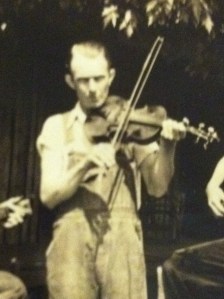
In Search of Ed Haley 1

24 Saturday Nov 2012

Posted by Brandon Ray Kirk in Ed Haley, John Hartford, Music

≈ 2 Comments

Tags

Alan Jabbour, Appalachia, Ashland, Bill Monroe, blind, Boulder, Cherokee Polka, Cherry River Rag, Colorado, Dunbar, Ed Haley, fiddler, fiddling, Flatt and Scruggs, Flower of the Morning, Forked Deer, history, Humphrey's Jig, John Hartford, Kentucky, Lawrence Haley, Library of Congress, Man of Constant Sorrow, music, Nashville, Parkersburg Landing, Ralph Haley, Signal Corps, Skillet Lickers, West Virginia

In 1981, roughly thirty years after Ed Haley’s death, my search to know everything about his life and music began at a second hand music store in Boulder, Colorado. While thumbing through a box of records by early radio stars and bluegrass artists with such familiar names as The Skillet Lickers, Bill Monroe and Flatt & Scruggs I saw this certain green and yellow album cover. On its front was a picture of a blind fiddler buttoned up in an overcoat. On its back was a drawing of a steamboat landed at a wharf. Nearby the drawing was a brief note: “This album consists of home recordings made in 1946 by Ed Haley, a blind Kentucky fiddler who never made a commercial record. The original discs were prepared by his family in order to preserve some of their father’s music and were never intended for public use.”

The album was titled Parkersburg Landing, an apparent geographical reference to the small city by that name on the Ohio River. “Even twenty-five years after his death, anyone researching fiddle music in West Virginia or eastern Kentucky is certain to learn of Ed Haley,” the album cover proclaimed. I had never heard of anyone named Ed Haley, but I bought the album and mailed it home to Nashville anyway. I knew that part of the country was a traditional hotbed of great musicians.

Some time later (I forget exactly when – it’s difficult to recall now), I rediscovered Parkersburg Landing filed away on one of the crowded shelves in my office. I put it on the record player and as soon as the title track started, I thought, “Uh oh. This is pretty good.” I turned up the volume knob and slumped down in my chair. I sat there stunned for the next twenty or so minutes listening to Haley plow through tunes with names like “Humphrey’s Jig”, “Cherokee Polka” and “Cherry River Rag”. By the time I reached out to flip the album to Side 2, my fingers were trembling and I was almost breathless. I tried to focus on every nuance as Haley played “Flower of the Morning”, “Man of Constant Sorrow” and “Dunbar”. Then, when he took off on “Forked Deer”, I almost fell out of my chair. It was a profound experience…the kind that pulls you away from everything you’ve done up to that moment and sends you off into another direction. I don’t even remember listening to the rest of the album, although I’m sure I did.

Where did these recordings come from?

“The present recordings were made by Ralph Haley, who also plays guitar on several selections,” I read in the album liner notes. “Ralph had served in the Signal Corps during the war and used a home disc-cutting machine of the Wilcox-Gay type. After Ralph’s death in the late forties, the collection of discs were evenly divided among the five remaining children. It is estimated that the 106 sides presently accounted for represent approximately one third of the original total. Most of these records were preserved by Lawrence Haley of Ashland, who kindly gave us permission to issue them here. The discs were transferred at the Library of Congress under the supervision of Larry Haley and Alan Jabbour and were remastered at Intermedia Studios in Boston.”

I spent the next several years glued to Parkersburg Landing. I talked about Haley constantly. Every now and then I would call up friends and play some of the album, saying, “Now, that’s how it’s supposed to go.” No one had a clue who Ed Haley was; most seemed unimpressed. But to me, the scratchy recordings were like old faded photographs and I was so excited by what I heard that the imperfections in recording technique quickly disappeared to my ear.

Newer posts →

Feud Poll 1

If you had lived in the Harts Creek community during the 1880s, to which faction of feudists might you have given your loyalty?

Categories

  • Adkins Mill
  • African American History
  • American Revolutionary War
  • Ashland
  • Atenville
  • Banco
  • Barboursville
  • Battle of Blair Mountain
  • Beech Creek
  • Big Creek
  • Big Harts Creek
  • Big Sandy Valley
  • Big Ugly Creek
  • Boone County
  • Breeden
  • Calhoun County
  • Cemeteries
  • Chapmanville
  • Civil War
  • Clay County
  • Clothier
  • Coal
  • Cove Gap
  • Crawley Creek
  • Culture of Honor
  • Dingess
  • Dollie
  • Dunlow
  • East Lynn
  • Ed Haley
  • Eden Park
  • Enslow
  • Estep
  • Ethel
  • Ferrellsburg
  • Fourteen
  • French-Eversole Feud
  • Gilbert
  • Giles County
  • Gill
  • Green Shoal
  • Guyandotte River
  • Halcyon
  • Hamlin
  • Harts
  • Hatfield-McCoy Feud
  • Holden
  • Hungarian-American History
  • Huntington
  • Inez
  • Irish-Americans
  • Italian American History
  • Jamboree
  • Jewish History
  • John Hartford
  • Kermit
  • Kiahsville
  • Kitchen
  • Leet
  • Lincoln County Feud
  • Little Harts Creek
  • Logan
  • Man
  • Matewan
  • Meador
  • Midkiff
  • Monroe County
  • Montgomery County
  • Music
  • Native American History
  • Peach Creek
  • Pearl Adkins Diary
  • Pecks Mill
  • Peter Creek
  • Pikeville
  • Pilgrim
  • Poetry
  • Queens Ridge
  • Ranger
  • Rector
  • Roane County
  • Rowan County Feud
  • Salt Rock
  • Sand Creek
  • Shively
  • Spears
  • Sports
  • Spottswood
  • Spurlockville
  • Stiltner
  • Stone Branch
  • Tazewell County
  • Timber
  • Tom Dula
  • Toney
  • Turner-Howard Feud
  • Twelve Pole Creek
  • Uncategorized
  • Warren
  • Wayne
  • West Hamlin
  • Wewanta
  • Wharncliffe
  • Whirlwind
  • Williamson
  • Women's History
  • World War I
  • Wyoming County
  • Yantus

Feud Poll 2

Do you think Milt Haley and Green McCoy committed the ambush on Al and Hollene Brumfield in 1889?

Blogroll

  • Ancestry.com
  • Ashland (KY) Daily Independent News Article
  • Author FB page
  • Beckley (WV) Register-Herald News Article
  • Big Sandy News (KY) News Article
  • Blood in West Virginia FB
  • Blood in West Virginia order
  • Chapters TV Program
  • Facebook
  • Ghosts of Guyan
  • Herald-Dispatch News Article 1
  • Herald-Dispatch News Article 2
  • In Search of Ed Haley
  • Instagram
  • Lincoln (WV) Journal News Article
  • Lincoln (WV) Journal Thumbs Up
  • Lincoln County
  • Lincoln County Feud
  • Lincoln County Feud Lecture
  • LinkedIn
  • Logan (WV) Banner News Article
  • Lunch With Books
  • Our Overmountain Men: The Revolutionary War in Western Virginia (1775-1783)
  • Pinterest
  • Scarborough Society's Art and Lecture Series
  • Smithsonian Article
  • Spirit of Jefferson News Article
  • The Friendly Neighbor Radio Show 1
  • The Friendly Neighbor Radio Show 2
  • The Friendly Neighbor Radio Show 3
  • The Friendly Neighbor Radio Show 4
  • The New Yorker
  • The State Journal's 55 Good Things About WV
  • tumblr.
  • Twitter
  • Website
  • Weirton (WV) Daily Times Article
  • Wheeling (WV) Intelligencer News Article 1
  • Wheeling (WV) Intelligencer News Article 2
  • WOWK TV
  • Writers Can Read Open Mic Night

Feud Poll 3

Who do you think organized the ambush of Al and Hollene Brumfield in 1889?

Recent Posts

  • Logan County Jail in Logan, WV
  • Absentee Landowners of Magnolia District (1890, 1892, 1894)
  • Charles Spurlock Survey at Fourteen Mile Creek, Lincoln County, WV (1815)

Ed Haley Poll 1

What do you think caused Ed Haley to lose his sight when he was three years old?

Top Posts & Pages

  • Halcyon 4.10.1919
  • Halcyon-Yantus 12.08.1911
  • Civil War Gold Coins Hidden Near Chapmanville, WV
  • Ran'l McCoy's Final Months (1914)
  • Buskirk Cemetery at Buskirk, KY (2015)

Copyright

© Brandon Ray Kirk and brandonraykirk.wordpress.com, 1987-2023. Unauthorized use and/or duplication of this material without express and written permission from this blog’s author and/or owner is strictly prohibited. Excerpts and links may be used, provided that full and clear credit is given to Brandon Ray Kirk and brandonraykirk.wordpress.com with appropriate and specific direction to the original content.

Archives

  • February 2025
  • January 2025
  • October 2023
  • September 2023
  • December 2022
  • November 2022
  • May 2022
  • April 2022
  • February 2022
  • November 2021
  • October 2021
  • September 2021
  • June 2021
  • May 2021
  • April 2021
  • March 2021
  • February 2021
  • January 2021
  • December 2020
  • November 2020
  • October 2020
  • July 2020
  • June 2020
  • May 2020
  • April 2020
  • March 2020
  • February 2020
  • January 2020
  • December 2019
  • November 2019
  • October 2019
  • September 2019
  • August 2019
  • July 2019
  • June 2019
  • May 2019
  • April 2019
  • March 2019
  • February 2019
  • January 2019
  • December 2018
  • November 2018
  • October 2018
  • September 2018
  • August 2018
  • July 2018
  • June 2018
  • May 2018
  • April 2018
  • March 2018
  • February 2018
  • January 2018
  • December 2017
  • November 2017
  • October 2017
  • September 2017
  • August 2017
  • July 2017
  • June 2017
  • May 2017
  • April 2017
  • March 2017
  • February 2017
  • January 2017
  • December 2016
  • November 2016
  • October 2016
  • September 2016
  • August 2016
  • July 2016
  • June 2016
  • May 2016
  • April 2016
  • March 2016
  • February 2016
  • January 2016
  • December 2015
  • November 2015
  • October 2015
  • September 2015
  • August 2015
  • July 2015
  • June 2015
  • May 2015
  • April 2015
  • March 2015
  • February 2015
  • January 2015
  • December 2014
  • October 2014
  • September 2014
  • August 2014
  • July 2014
  • June 2014
  • May 2014
  • April 2014
  • March 2014
  • February 2014
  • January 2014
  • December 2013
  • November 2013
  • October 2013
  • September 2013
  • August 2013
  • July 2013
  • June 2013
  • May 2013
  • April 2013
  • March 2013
  • February 2013
  • January 2013
  • December 2012
  • November 2012

Enter your email address to follow this blog and receive notifications of new posts by email.

Join 2,927 other subscribers

Tags

Appalachia Ashland Big Creek Big Ugly Creek Blood in West Virginia Brandon Kirk Cabell County cemeteries Chapmanville Charleston civil war coal Confederate Army crime culture Ed Haley Ella Haley Ferrellsburg feud fiddler fiddling genealogy Green McCoy Guyandotte River Harts Harts Creek Hatfield-McCoy Feud history Huntington John Hartford Kentucky Lawrence Haley life Lincoln County Lincoln County Feud Logan Logan Banner Logan County Milt Haley Mingo County music Ohio photos timbering U.S. South Virginia Wayne County West Virginia Whirlwind writing

Blogs I Follow

  • OtterTales
  • Our Appalachia: A Blog Created by Students of Brandon Kirk
  • Piedmont Trails
  • Truman Capote
  • Appalachian Diaspora

BLOOD IN WEST VIRGINIA is now available for order at Amazon!

Blog at WordPress.com.

OtterTales

Writings from my travels and experiences. High and fine literature is wine, and mine is only water; but everybody likes water. Mark Twain

Our Appalachia: A Blog Created by Students of Brandon Kirk

This site is dedicated to the collection, preservation, and promotion of history and culture in Appalachia.

Piedmont Trails

Genealogy and History in North Carolina and Beyond

Truman Capote

A site about one of the most beautiful, interesting, tallented, outrageous and colorful personalities of the 20th Century

Appalachian Diaspora

  • Subscribe Subscribed
    • Brandon Ray Kirk
    • Join 789 other subscribers
    • Already have a WordPress.com account? Log in now.
    • Brandon Ray Kirk
    • Subscribe Subscribed
    • Sign up
    • Log in
    • Report this content
    • View site in Reader
    • Manage subscriptions
    • Collapse this bar
 

Loading Comments...