• About

Brandon Ray Kirk

~ This site is dedicated to the collection, preservation, and promotion of history and culture in my section of Appalachia.

Brandon Ray Kirk

Category Archives: Ed Haley

In Search of Ed Haley 297

27 Sunday Apr 2014

Posted by Brandon Ray Kirk in Ed Haley, Music

≈ 2 Comments

Tags

Abe Keibler, banjo, Boatin' Up Sandy, Charley Keibler, Cold Frosty Morning, Cotton-Eyed Joe, fiddle, fiddlers, Germany, Girl With the Blue Dress On, guitar, history, Jim Keibler, John Keibler, Kentucky, Morris Allen, music, Ohio, Old Coon Dog, Parkersburg Landing, Portsmouth, Rye Whiskey, Sally Goodin, Sally Got Drunk on Irish Potatoes, South Shore, Stumptail Dolly, Susan's Gone to the Ball With Her Old Shoes On, We'll All Go to Heaven When the Devil Goes Blind, writing

Later that day, I went to see 88-year-old Abe Keibler in nearby South Shore, Kentucky. Abe was the last surviving member of the old fiddling Keiblers and a first cousin to fiddler Morris Allen, one of the sources for Parkersburg Landing.

“My grandfather, he was sixteen years old when he landed in here from Germany and he got a job out here at an old furnace,” Abe said. “He couldn’t even speak the language when he first come here, they said, and he didn’t play nothing.”

“Wow,” I said, “So fiddling started with your dad and uncles?”

“My uncles and dad, yeah,” Abe confirmed. “Jim was my dad’s name. He played a banjo — the old claw-hammer style.

Abe was raised up in a family of fiddlers, but he originally played the guitar. He began to play the fiddle at the age of 55. He wasted little time in showing me the old family fiddle, which he inherited from his uncle John Keibler. It was a good-looking instrument with a good tone, although the bridge was ready to collapse.

“Way back before I was born some fella came into Portsmouth when they had the old saloons in and he had this old fiddle and couldn’t play it,” Abe explained. “My uncle John, he seen that it was a good fiddle and he wanted to buy it and this guy wouldn’t talk about selling it. My uncle Charley, he was a left-handed fiddler. He said, ‘Now John, if you want that fiddle, I can buy it for ten dollars.’ So he bought it. It’s been in our family around ninety years or maybe close to a hundred.”

Abe said the old fiddle was hard to tune — it had seen some rough times.

“My uncle fell and busted the top all to pieces. I had a fella that made fiddles put that top off of another old fiddle on it. My uncle had patent keys put on it and I had them took out and wood keys put in it.”

I tuned the Keibler fiddle as best as I could, then reached it back with a request for a tune I’d heard Abe mention called “We’ll All Go to Heaven When the Devil Goes Blind”. He couldn’t remember it but said it was the same thing as “Stumptail Dolly”. He scratched out a melody in the key of G, then said, “Some of them called that the ‘Girl With the Blue Dress On’. ‘Old Coon Dog’ is all I ever heard it called.”

He also played “Boatin’ Up Sandy”, “Sally Goodin” (in G), “Rye Whiskey” (which he called “Cold Frosty Morning”), “Sally Got Drunk on Irish Potatoes”, “Cotton-Eyed Joe”, and “Susan’s Gone to the Ball With Her Old Shoes On” (key of G).

Every now and then, I joined in with my fiddle.

“I’m gonna learn you how to play a fiddle yet,” Abe said.

Clark Kessinger

26 Saturday Apr 2014

Posted by Brandon Ray Kirk in Ed Haley, Music

≈ Leave a comment

Tags

Appalachia, Clark Kessinger, fiddle, fiddler, fiddling, history, Kanawha County, Lincoln County, music, photos, West Virginia

Clark Kessinger

Clark Kessinger

In Search of Ed Haley 296

26 Saturday Apr 2014

Posted by Brandon Ray Kirk in Ed Haley, Music

≈ Leave a comment

Tags

Asa Neal, banjo, Birdie, blind, C&O Railroad, Charlie Mershon, Chet Rogers, Clark Kessinger, Clayt Fry, Community Common, Devil's Dream, Dinky Coffman, Dominique Bennett, Ed Haley, Ella Haley, Elmer Lohorn, fiddle, fiddlers, fiddling, Girl I Left Behind Me, Great Depression, Harry Frye, history, Jason Lovins, John Hartford, John Lozier, John Simon, Kentucky, Kid Lewis, music, Norfolk and Western Railroad, Ohio, Portsmouth, Portsmouth Airs, Portsmouth YMCA, Ragtime Annie, Roger Cooper, Roy Rogers, Russell, West End Jubilee, writing

A little later, I met John Lozier at Portsmouth. He was a real ball of energy. It was hard to believe that he was in his late eighties. I just sat back and listened to him talk about Ed.

“The first time I ever saw Ed Haley he was sitting on the street in a little old stool of a thing — him and his wife — had a little boy with him. They always kept a little boy with them — one of the kids that would lead them here and there and yander. And I didn’t know this but a fella by the name of Charlie Mershon was there and the Mershons are all fiddlers. They live over here in Ohio somewhere. And Charlie went home and told his dad, ‘I heard a man that could out-fiddle you.’ He went over and he had to take his hat off to Ed. But Ed had long, slim fingers like a woman and he played so soft you just had to listen. He was a great fiddler.”

I asked John to tell me about playing with Ed at the Portsmouth YMCA.

“A fella by the name of Dinky Coffman was the head of the entertainment committee at the N&W over here in Portsmouth,” he said. “Well, whenever Dink Coffman would want us to have a little shindig or whatever you want to call it he would take us over in the shops at the N&W at noon. They was about seven hundred people worked over there at one time. And nickels and dimes — whatever they could get — that’s the way Ed Haley made his living. It had to be a rough life. Of course, back in the twenties you make a dollar, honey, you could wrap it ’round a corncob and be nigger rich. And the last time I played with Ed Haley was at the YMCA at the C&O Russell yards.”

I asked John how Ed looked back then and he said, “Ed was a little old short pot-bellied feller. He had an old brown hat on as well as I can remember and just an old brown coat and a pair of britches. He didn’t dress like he was going out on vaudeville stage or anything. His wife would take Braille with her and read Braille for a little extra entertainment. She played a banjo-uke — eight string, short neck — but she just played chords. Mostly me and her would play and she would second after me. One time, we went up to the Russell yards at the YMCA up there and she accompanied me on the piano. I never knew any of the kids.”

John asked to see my fiddle, so I lifted it out of the case and reached it to him. He said to his wife, “Oh, Lord. Look at this. Isn’t that done pretty? My granddad made fiddles and he used three things: a wood chisel, a pocketknife, and a piece of window glass. All he bought was the fingerboard and the apron. And he made little wood clamps and wedges. He wouldn’t let me pick up the fiddle — afraid I’d drop it and break the neck out of it. And I started playing old fiddle tunes on a harp.”

Not long after that, John pulled out his harmonica and played “Devil’s Dream”, “Portsmouth Airs”, “Birdie”, “Girl I Left Behind Me”, and “Ragtime Annie”.

I joined in every now and then, which prompted him to say things like, “You’re putting something extra in there,” or “You missed a note. See that?”

To call him feisty would be a huge understatement.

At one point, he said, “I’m trying to tell you something. You’re gonna be here all day. This is my day.”

A little later he said, “I don’t know if you know what you’re doing or not, but you’re putting a few little slip notes in there. You put more notes in that than what Ed would have put in it. You’ve been listening to Clark Kessinger records.”

Uh-oh.

John opened up a whole new facet of our conversation by mentioning Clark Kessinger, who he’d heard play one time at the West End Jubilee on Market Street in Portsmouth.

“Clark Kessinger was a hard loser in a contest,” John said. “If he lost, he’d just stomp and carry on something awful.”

Clark came to Portsmouth and played a lot because of the great number of musicians in the town during the Depression.

“I come into Portsmouth about the time that Roy Rogers left here,” John said. “Now he had a cousin that was a better guitar player than he was: Chet. He had a little neck like a turkey. And him and Dominique Bennett, Clayt Fry, Elmer Lohorn… Elmer Lohorn was the only man I ever seen that played ‘companion time’ on the guitar. It was a double time — everything he done was doubled. And Harry Frye was a fine tenor banjo player. We had one guitar player by the name of Kid Lewis — was a smart-alec — and he could play classical stuff. But they just sat around and played cards and drank moonshine and got good. Asa Neal was, I’d say, our champion fiddler around here. Asa Neal bought ever record that Clark Kessinger ever put out.”

At that moment, John Simon, a local folklorist, showed up with Roger Cooper, a Buddy Thomas protégé. I got Roger to play the fiddle while I seconded him on my banjo. John Lozier jumped in when we weren’t playing something “just right.” At some point, Jason Lovins, a local newspaper reporter, dropped in with a camera and asked a few questions. He promised to plug my interest in Ed’s life in the Community Common.

Ed Haley

23 Wednesday Apr 2014

Posted by Brandon Ray Kirk in Big Harts Creek, Ed Haley, Lincoln County Feud, Whirlwind

≈ Leave a comment

Tags

Appalachia, blind, Ed Haley, Harts Creek, history, Imogene Haley, life, Logan County, Milt Haley, music, photos, U.S. South, West Virginia

James Edward "Ed" Haley, born August 1885, son of T. Milton and Imogene (Mullins) Haley, Harts Creek, Logan County, WV

James Edward “Ed” Haley, born August 1885, son of T. Milton and Imogene (Mullins) Haley, Harts Creek, Logan County, WV

In Search of Ed Haley 295

23 Wednesday Apr 2014

Posted by Brandon Ray Kirk in Ed Haley

≈ Leave a comment

Tags

Ashland, Big Sandy River, Bill Day, Canton, Clay Hicks, Durbin Creek, Ed Haley, Ella Haley, Florida, history, Jean Thomas, Jilson Setters, John Hartford, Kentucky, Lawrence Haley, Manuel Martin, Margaret Payne, Mona Haley, music, Ohio, Pat Haley, Ralph Haley, Ralph Payne, Rosie Day, Tampa, Wee House in the Wood, writing

We next discussed Jean Thomas, who wanted to feature Ed in her “Wee House in the Wood” production.

“I remember Pop and Mom didn’t care too much for Jean Thomas,” Mona said.

Pat said she had a run-in with Thomas later, long after Ed had died.

“Larry and I went to see Jean Thomas so we could take our cub scouts out there and as soon as she found out he was Ed Haley’s son, she didn’t want a thing to do with him. We never did take our troop out there. She said Pop was blasphemous — which I suppose was true — and he was a drunkard because he would not go along with her plans to be Jilson Setters.”

Mona said, “Bill Day…there was some controversy there between Jean Thomas and Pop and Mom. And I think Bill Day had a lot to do with it. I remember that. He was almost blind. He wasn’t quite blind. He wasn’t blind like Mom and Pop. I wouldn’t say they were friends, but they were acquaintances.”

Mona said Bill Day wasn’t much of a fiddler and seemed to enjoy telling me how his son Clay was cross-eyed and a little “off”.

Talking about Bill Day got us on the subject of his wife, “Aunt Rosie Day.” Mona had great memories of her.

“She kept house for us a lot and lived with us. She was rough. She’s whipped me home a lot of time with switches. She chewed bubble gum all the time and dipped snuff and she would stick bubble gum up all along the door facings and stuff and go back and get it later.”

Pat said, “I knew she dipped snuff. I used to go down and try to clean Aunt Rosie’s house, bless her heart.”

Mona said, “We never called her ‘Aunt Rosie’. We just called her ‘Rosie’. She fell down the steps one time from the landing. She was drunk. Her and Mom had been drinking apricot brandy. I remember it well. They was a stove in the corner and Rosie got down to the landing and missed a step and hit that stove with her head and made a big dent in that stove and never even hurt her. Mom fell down the steps too once, but she fell from the top to the landing. This time Mom fell down, Pop was playing music down in the living room and Mom was dancing upstairs to his music and danced right off the edge of those steps. It didn’t seem to hurt her, either. They could make the house come alive with music. When I would dance, Pop would say, ‘I hear you. I hear you.'”

Pat said Ed used to get drunk and fight with Aunt Rosie Day. He liked to drink with her son-in-law, Manuel Martin. Martin was a bootlegger. He and his wife lived on Durbin Creek up the Big Sandy River. In the 1960s, Manuel got drunk and shot his son at the kitchen table in Canton, Ohio. Lawrence went to see him in the penitentiary, Pat said.

Just before Mona left, I told her, “I can’t tell you how much I appreciate you coming over here and talking to me.”

“It’s my pleasure,” she said. “Anything I can do. I’m available.”

At the door, I gave her a big hug and she said, “It’s good seeing you, John. You seem like family.”

A few minutes later, just before I turned in to bed, I mentioned Ralph Haley’s importance in this story. It was Ralph, after all, who had the foresight to record Ed and Ella Haley’s music in the late forties. (Never mind that he wasn’t really Ed’s son or that he recorded him on a machine stolen from the army.) Pat said Ralph helped take care of the family when he was young, like stealing chickens when the kids were hungry. When he was older, he kind of distanced himself from the family by changing his last name from Haley to Payne — perhaps to protest Ed’s treatment of his mother. (This was the surname used on his tombstone in Cincinnati.) The Haleys tried to keep in touch with Ralph’s widow, Margaret, who remarried a younger man named Mel and moved to Florida to work a chicken farm. At some point, she had a grocery store in Tampa called “M&M’s”. In the late forties, Lawrence was stationed nearby and visited. When he went back, her husband put a pistol in his face and ran him off. Pat had no idea why.

In Search of Ed Haley 294

22 Tuesday Apr 2014

Posted by Brandon Ray Kirk in Ed Haley

≈ Leave a comment

Tags

Ashland, Catlettsburg, Catlettsburg Stock Yard, Doc Holbrook, Ed Haley, Ella Haley, Great Depression, history, John Hartford, Kentucky, Lawrence Haley, life, Mona Haley, Ohio, Pat Haley, Ralph Mullins, South Point, Ward Hollow, writing

Pat, slowly becoming the interviewer, asked Mona how far back she could remember and she said, “As far back as I can remember was Halbert Street. I can remember going out in the rain and standing out in the rain while Mom and Pop was fighting or Pop was fighting Mom — which that was probably the way it was. But it takes two to make a fight or an argument. I don’t remember whatever started it. I just remember Pop being mean to Mom, and that was on 45th Street. And the next memory I have is at Ward Hollow. 337 37th Street, that was Ward Hollow. And the next one was at 17th Street. And the next one was back up on 45th Street.”

Pat said, “When they lived on 45th Street that time had to be about ’48, ’49.”

Mona agreed: “It was, because Ralph was a baby. My Ralph.”

Pat said, “Good or bad memories are you talking about?”

Mona kind of laughed and said, “They’re all bad but there had to been some good ones.”

I said, “Bad stuff is easiest to remember. Most history and everything is told in terms of bad things instead of good things. Usually, if you go along a highway, most highway markers that you see commemorate battles and tragedies.”

Mona said, “I remember some good times with Mom. I remember seeing a lot of movies.”

Pat said, “That’s what Larry said. Said you’d see movies while they played.”

Mona said, “Yeah. I can imagine how Mom worried, too. I couldn’t sit there with her. They didn’t let us go too far away.”

Mona said she mostly traveled with Ella as a girl but remembered going with Ed to Doc Holbrook’s office where she watched him reach into her father’s mouth with something that looked like a giant spoon and take out his tonsils. Ed said, “How long do I have to do this?” and Doc answered, “It’s over…” and then they started playing music.

I said, “Did your mom and dad usually play around a movie theatre?” and Mona said, “Seems to me like it might have been a block or two away from the movies but that wasn’t very far.”

I asked what kind of places Ed usually looked for when he first came into a town and she said, “Pop always looked for a courthouse square or a YMCA — something where they’d be a lot of people around. He played at the Catlettsburg Stock Yard a lot, him and Mom.”

We made small talk for a few minutes — the kind that often signals the end of a conversation — when Pat said to Mona, “What do you remember about your childhood other than those bad memories?”

“I remember Mom playing with me and me getting a wash pan and washing her face and her hands and her arms,” Mona said. “Just with Mom, you know. Lawrence and I would take turns doing dishes and cooking for Mom and Pop. I remember playing cowboys and Indians with the boys and they didn’t like me playing with them.”

Mona was apparently quite the tomboy when she was a young girl.

Pat said, “I told John about how harsh they were with you about keeping your dress down and sitting property.”

Mona said, “Yeah, they were. They was rough on me. There wasn’t any ‘Come here, let me have you,’ or no love. Always ‘You do this’ or ‘You do that.'”

Pat said she figured Lawrence had been right in on all that and Mona said, “Why, I’d a whipped Lawrence. You remember Mom sent Lawrence to get me one time — I don’t know where I was – and he said, ‘I can’t.’ She said, ‘Why?’ He said, ‘She can whip me.'”

Pat said, “I’ve heard Mom tell that story. And he used to tattle on you.”

Mona said, “Yeah, he did. But I don’t know if I tattled on him or not. I don’t remember.”

A little later, when they were teenagers, Lawrence was so overprotective of Mona that he cut one of her boyfriends with a knife trying to run him away from the house. Ed was also hard on her boyfriends; he called one of them a “raggedy-ass-son-of-a-bitch.”

Mona told me about her memories of Ed in his later years.

“He retired from playing…period. I remember one time on 45th Street. I came over from South Point, where I lived, and I tried to get Pop to play some for me and Mom said, ‘He’ll never play no more. He’s quit.’ It was a long time after the divorce.”

I asked her if Ed had his beard at that time and she said, “Yes. I used to shave him with a straight razor under his beard. Trim it. He shaved hisself most of the time, but once in a while I’d shave him.”

She said Pop seldom took baths.

“He said it was a waste of water. He was like that guy that said too much bathing will weaken you.”

In Search of Ed Haley 293

21 Monday Apr 2014

Posted by Brandon Ray Kirk in Ed Haley

≈ Leave a comment

Tags

Ashland, blind, Ed Haley, Ella Haley, history, Jack Haley, Kentucky, Lawrence Haley, life, Luther Trumbo, Mona Haley, Nellie Muncy, Noah Haley, Pat Haley, The Waltons, West Virginia, Williamson, writing

The more I played for Mona, the more Pat’s little dogs barked at me — especially when I got up and danced. Their commotion caused Mona to say, “We always had an animal. We used to have an old blue-tick hound named King and every time Pop would play the fiddle he’d howl. Uncle Luther gave him to Pop when I was a baby. I don’t know if it was as much Pop as it was Mom, but they all loved King. All of us did. He was smart. He was a good hunter. He taught all the dogs in the neighborhood to hunt. Everybody wanted to hunt with him — they come from miles around to borrow him to go hunting — and someone stole him one time and he was gone about a week and when he came back blood was running out of all four paws and he just flopped on the front porch. He had a broken-like front paw right here in the first joint. He was young then. We had him till he died. He growed old and died. I was about fourteen when he died — maybe thirteen.”

I wondered if Ed ever used a seeing eye-dog and Pat said no, although Ella did. She said the family had a pet dog named “Jaybird” when she married Lawrence.

I could tell that Mona was in the mood to talk, so I put my fiddle away and told her about our recent research on Milt Haley. When I told her that Milt appeared to have been an illegitimate son of Nellie Muncy, she immediately told me how Ed visited a family of Muncys around Williamson, West Virginia. Her memories of such trips were vague.

“I remember a place we had to go in an automobile so far and then we had to cross the river in a boat to get to where we was a going — in a rowboat — but I don’t remember where it was. It had to be in West Virginia somewhere. I remember a store building where we went and we slept upstairs over that store building. I remember Pop getting real mean and mad at Mom up there one night and I wanted to crawl under the covers and pull it on me. He was getting real nasty with her.”

I asked Mona what they were into it over and she said, “Sex, I reckon. He wanted it and she didn’t want it and he said he had to have it. That’s how nasty he was — but he didn’t say it in those nice words. My dad happened to be drinking that time, too, so it made it that much worse.”

Trying to lighten the memory, I told her that sex had been a sore spot with married couples for thousands of years.

Pat said what was remarkable about Mona’s memories was the fact that Lawrence had never said a bad word about his father.

“He never talked bad about Pop,” she said. “Of course, he was Momma’s boy.”

Mona said Ed only whipped her once.

“It was on my birthday and I was getting ready to cry and he said, ‘Four, five, six.’ That’s the only time he ever whipped me. I do remember a time that Jack and Noah got into a fight and they was young men. And Pop jumped up — he wore suspenders — and he had them down. He jumped up to part them and got a hold of each of them and his pants fell down. The fight stopped and we all started laughing.”

Pat said that happened at 1040 Greenup after she’d married into the family — “right out on the front porch.”

Mona added, “But he had long underwear on.”

That fond memory caused her to say, “You know, The Waltons remind me a lot of the way we were brought up. We had a pretty good family life. We’d tell each other good night and stuff. Lawrence and I usually slept with Mom.”

Pat said, “Scratch each other’s backs,” and Mona said, “Yeah.”

I asked if Ed came around and kissed every one goodnight at bedtime and Mona said, “No, no. Mom did. Pop didn’t. If she’d tell him to go see about one of us, why, he would.”

For entertainment, the family gathered around the radio or listened to Ed’s “wild stories.”

In Search of Ed Haley 292

20 Sunday Apr 2014

Posted by Brandon Ray Kirk in Ed Haley, Music

≈ Leave a comment

Tags

Ashland, Blackberry Blossom, Calhoun County Blues, Cherry River Rag, Come Take A Trip in My Airship, Dunbar, fiddling, history, John Hartford, John Lozier, Kentucky, Lawrence Haley, Man of Constant Sorrow, Mona Haley, music, Parkersburg Landing, Pat Haley, Ragtime Annie, writing

“Pop put a lot of emotions in his music,” Mona said. “He was real excited with his playing. He would put things in there that no one else would.”

She described Ed’s music as loud and lively — contrary to testimony from John Lozier and others — and told how it generated a great deal of excitement. She re-iterated that Ed had very little body movements when playing and seemed a little bothered by my energy when I played the fiddle — all the facial and head gestures, loud tapping, leg movements.

I asked her if Ed played much around home and she said, “When he was sad or when he was drinking or when he was happy he played — especially when he was happy.”

I wondered what made Ed happy.

“I don’t know,” she said. “Maybe hearing about a place to play or some money to be made. Music was his life. There wasn’t much about the family that made him happy. I mean, we was always fighting.”

In no time at all, Mona and I slipped into a familiar routine: me playing and asking things like “Did Ed play this?” or “Did Ed play it like this?” I played a lot of tunes for her — mostly ones I knew Ed played but also ones I had heard or suspected him of playing based on talking with Ugee Postalwait and Wilson Douglas and reading notes in the Lambert Collection.

When I played “Cherry River Rag”, Mona said, “I always loved that. Now that’s one that Pop put the slurs and insults in.”

Lawrence Haley had spoken of the “slurs and insults”, but I had never really figured out what they were. I had this theory that they were when Ed used tiny chromatic slides to create a modal and “slidey” note, thereby broadening and helping to achieve more of a “human voice effect” — much like vibrato does. This concept goes way back into Celtic history and may be much more a source for Blues than anything African. (Scholars have, incidentally, found no historical precedent for the Blues in the music of the continent of Africa.) I figured that Ed hit a little “dead” grace note beforehand which helped separate the notes in his long bow style. It is what the Irish call a “cut:” the finger on the grace note barely touches the string so as to give a good stop or separation.

As for the “slurs and insults,” Mona couldn’t seem to explain them either. I suggested listening to “Cherry River Rag” on Pat’s copy of Parkersburg Landing and having Mona point them out to me. We went into the living room and gathered around the record player. As “Cherry River Rag” played, Mona pointed out the slurs and insults. Basically, she described them as being when Ed slid a note for emphasis.

“Sounded to me, John, like when he was getting tired,” she said, back in the kitchen. “He was just wanting to get out of it as easy as he could.”

I asked if there were ever times when Ed would play and just slide the notes a lot and she said, “No, not unless he was drinking. He’d slide those notes a lot when he was drinking. Screech a lot when he was drinking — especially on those high keys.”

Mona loved it when I played “Man of Constant Sorrow”, saying, “Beautiful. That reminds me of Pop being sad. I love it, though. I wanted to tell you, they made a lot of requests, people on the street. They’d say, ‘Ed, play ‘Blackberry Blossom’. If he knew it, he’d play it. He had people dancing on the street, John. He could play forever.”

I played a variety of tunes for Mona that I thought Ed might have played but she only recognized one called “Wilson’s Jig”. She said her father played “Dunbar” a lot and recognized the melody for “Run Here Granny”. She said he made up the tunes “You Can’t Blame Me for That” and “Come Take A Trip in My Airship”. She said “Ragtime Annie” was one of her father’s “main attractions,” while “Birdie” sounded “very familiar.” She said Ed played “Old Joe Clark” and “Money Musk” and fiddled “Done Gone” in B-flat. She said something in my version of “Wild Hog in the Red Brush” was familiar, although she said she never heard Ed play anything with that title. When I played “Uncle Joe”, she immediately recognized the melody but not the title.

“See, I know so many of the tunes I’ve heard but I don’t know the title,” she said.

It was probably a little confusing for her to sit and listen while I assaulted her with a whole barrage of tunes, but I was so excited about picking her brain that I just kept playing.

She remembered Ed playing “Waggoner” and “Paddy on the Turnpike”, as well as the very similar “Snowbird on the Ashbank”. She recognized “Pumpkin Ridge”, “Old Joe Clark”, and “Money Musk”. She didn’t know the melody for “Brownlow’s Dream” but recognized the title, while she knew the melody for “Indian Squaw” but not the title. She said Ed never played “Orange Blossom Special” but did play “Listen to the Mockingbird” and even “made the bird sounds, too.”

When I played “Calhoun County Blues”, she said, “I’ve heard him play that lots. You put a lot more notes in it than what he did.”

Ed Haley Bow Hold

18 Friday Apr 2014

Posted by Brandon Ray Kirk in Ed Haley, Music

≈ Leave a comment

Tags

Appalachia, art, Ed Haley, fiddling, history, John Hartford, Mona Haley, music

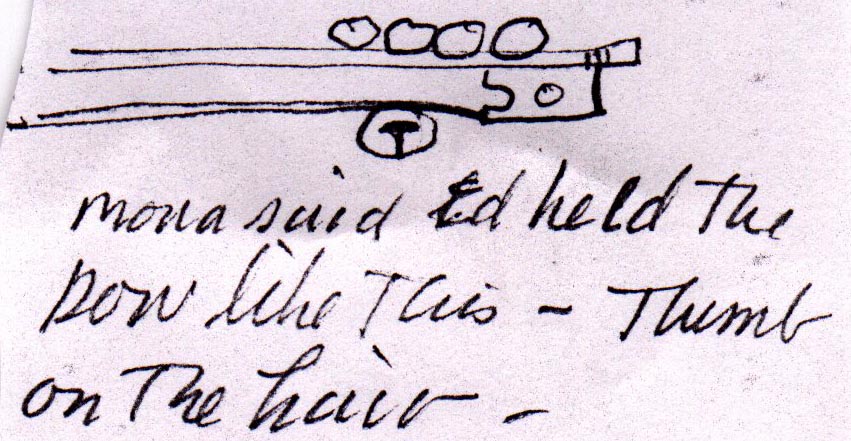
Ed Haley bow hold, according to Mona Haley

Ed Haley bow hold, according to Mona Haley

In Search of Ed Haley 291

18 Friday Apr 2014

Posted by Brandon Ray Kirk in Ed Haley, Music

≈ Leave a comment

Tags

Appalachia, Ashland, Curly Wellman, Dunbar, Ed Haley, Ella Haley, fiddling, Grand Ole Opry, history, John Hartford, Judge Imes, Kentucky, Mona Haley, music, Pat Haley, Ralph Haley, writing, You Can't Blame Me For That

After visiting Curly and Wilson, I went to Pat Haley’s and met Mona, who was waiting to see me. Mona and I sat down at the kitchen table, while Pat washed dishes. It was my first visit with Mona in some time. I told her about visiting Curly Wellman, hoping to stir a memory, but she didn’t even remember him. I pulled out his picture and she and Pat both really bragged on his looks.

“He must have been a hunk when he was young,” Mona said. “You know, I always fell in love with guitar players.”

We all laughed and things got kind of loud, which caused Pat’s two little housedogs, Shady and Josie, to bark furiously from under the table. A few seconds later, after Pat’s commands had calmed the dogs, Mona surprised me by saying that she had heard “all her life” that Curly was the person who taught her brother Ralph to play the guitar. (It was actually the other way around.)

I had a lot of questions for Mona, who was exuding an openness I had not seen up to that point. It was obvious that she was going to be more candid in Lawrence’s absence. Before I could ask anything, she apologized for having not been more helpful in my efforts to know about Ed. I quickly pointed out, though, that she had been helpful, especially in regard to “the family troubles.” That aspect of Ed’s life was really important because it likely helped to explain a lot of the rage and lonesomeness I heard in his music.

“I wasn’t really scared of Pop,” Mona said. “I loved Pop. I just didn’t like the way he done Mom. It hurt all of us kids, I guess. The earliest memories I got is of me running away from Pop fighting with Mom and that has a whole lot to do with me not getting close to him like I did my mother. I think my mother was a remarkable woman. She probably taught Pop a lot of that music, too.”

I told her what Lawrence had said about Ed and Ella getting a “bed and board divorce” and she said, “No, I remember Mom did divorce him because she got Judge Imes to do the divorce. I think she divorced him when we lived on 17th Street. I never looked at them as being divorced because they had long since stopped being man and wife before they divorced.”

I got some paper from Pat’s granddaughter and asked Mona to describe Ed’s residence at 17th Street. In addition to serving as Ed’s home at the time of his divorce from Ella, it was also the place where he made his recordings. Mona described the downstairs, then the upstairs where “there was two bedrooms and a bathroom. Large bedrooms.”

After I’d sketched everything out based on Mona’s memory, she said, “I was gonna tell you about that living room couch that you drew the picture of with the radio on the end of it. I went in one day and I was just a teenager or young kid and I turned on some jitterbug music. Pop was laying on the couch and he said, ‘Turn that off,’ and I said, ‘No Pop, I want to hear it.’ And he said, ‘Mona, I’ll cuss you all to pieces.'”

Speaking of radios, I wondered if Ed ever listened to the Grand Ole Opry.

“No, I don’t think so,” Mona said. “He listened to mysteries, like ‘The Shadow’ and ‘The Green Hornet’ and all that kind of stuff. And ‘Amos ‘n Andy’ and ‘Little Abner.’ ‘Lone Ranger’, I remember that. And those opera singers, he called them belly shakers.”

While I had the pen and paper in hand, I asked Mona to describe Ed’s house at Ward Hollow.

“Well, they was a porch, then a living room, dining room, and kitchen — straight back — and all the way down through here was another bedroom and hallway and another bedroom. Then in through here was a bathroom and back here was another bedroom. That’s where Pop slept. And right off the kitchen was another little porch.”

Mona said she could draw it better than describe it to me, so I gave her a pen and some paper. When she was finished, she seemed pleased with her effort, saying, “I might have a good memory after all.”

Satisfied, I got out my fiddle and played some tunes for Pat and Mona. After I finished “Dunbar”, I told them how I figured it was one that Ed made up.

“See,” I said, “I’ve got all these lists of tunes at home and lists of tunes on other tapes and so I look these tunes up and try to find out where they come from. And some of them you can research and some of them just ain’t there and those are the ones I think he wrote.”

Mona figured Ed made the tune “You Can’t Blame Me For That”:

My dog she’s always fighting, in spite of what she loves.

And when her little pups was born we all wore boxing gloves.

An old hen once was sitting on twelve eggs. Oh, what luck!

She hatched 11 baby chicks and the other was a duck.

But you can’t blame me for that, oh no, you can’t blame me for that.

If a felt hat feels bad when it’s felt, you can’t blame me for that.

 I got the impression in watching Mona sing those words to me that she was able to picture Ed playing.

In Search of Ed Haley 290

17 Thursday Apr 2014

Posted by Brandon Ray Kirk in Ed Haley, Music

≈ Leave a comment

Tags

Alphon Theater, Arthur Smith, Ashland, Ashland Vocational School, Bert Layne, blind, Blind Soldier, Catlettsburg, Cowboy Copas, Curly Wellman, David Miller, Ed Haley, Ella Haley, fiddling, Fleming County, Great Depression, Grimes Music Shop, Guyandotte Mockingbirds, Hawkshaw Hawkins, history, Horse Branch, Huntington, Kentucky, Logan, Logan Banner, music, Natchee the Indian, Old Shep, Red Foley, Riley Puckett, Rose Connelly, Skillet Lickers, Ward Hollow, West Virginia, Wilson Reeves, World War I, World War II, writing, WSAZ

Curly suggested that we visit Wilson Reeves, a local record collector, for more information about Ed. Wilson was glad to talk to us. He remembered seeing Ed and his family play on the streets of Ashland during World War II.

“This was in the early forties,” Wilson said. “I came up here to take training at the old Ashland Vocational School. I lived on Carter about 17th. There was a house there where I had a room upstairs. And every evening I’d cross over from Carter over to Winchester, go down Winchester, and on down to a little restaurant — what they call a ‘hole in the wall.’ Greasy food, but it was cheap. And she [meaning Ella] would be sitting in a chair there by the Presbyterian Church close to 16th Street. Most of the time she’d be playing the mandolin. Sometimes, I’d see her with the accordion. The little girl would stand on her side — I believe the 16th Street side — and she’d be holding the tin cup. I didn’t notice whether people put money in it or not.”

Where was Ed?

“Well, I don’t remember too much about them,” Wilson said. “I was twenty years old and other things to think about and on my way. Mr. Haley, I don’t remember whether he was sitting down or what. I’ve seen him over at the old Alphon Theater. He would sit right there. Best as I remember about him, he was by hisself. And there was times — and this is very vague in my memory — that I saw them get off the bus. They’d drag a chair out with them. Just a straight-backed chair, I believe. After the war was over, I went back to Fleming County for a while. Sometime in 1947 I came back up here, but I don’t recall ever seeing them any more.”

Wilson said he was never really acquainted with Ed or his family and was never at his home.

“Course I was in the house,” Curly said. “Poorly furnished. The family was rich in being family but very poor as far as living conditions. You might say if it was possible at that time, they would have been on food stamps.”

Curly was speaking of Ed’s home at Ward Hollow. I asked Wilson for some paper so I could sketch it out based on Curly’s memories. We started out with the living room.

“Just a square room,” Curly said. “No rug. A pine floor and a fireplace and a mantle and a little side table and his rocking chair and an old cane-backed straight chair. There was another doorway here that went into the next bedroom back. It was just an open door really. It was a shotgun house. I was never in their kitchen. They had about four rooms. But this was in a big building that there was a lot of apartments in — several apartments in this building — and Ed and his family lived downstairs in the first apartment as you went up the hollow. Big old community house — all wood — weather-boarded house. In my time, it mighta been sixty, seventy years old. They had a name for that building but it won’t come to me.”

When I’d finished my sketch of Ed’s home at Ward Hollow, I said to Curly, “Now what about his home at Horse Branch?”

“It was about a four room house — and one floor — and set up about six foot off a the ground because the creek run down through there and if they hadn’t a built it up on these sticks that it set on they woulda got flooded out every time it rained,” he said. “And you had to go up a long pair of steps to get up on their porch. Handrails down each side of the steps. Porch all the way across the front. I’d say the porch was six feet deep. I was never inside. In fact, the front room is as far as I was in the other house.”

Curly said he used to play music with Ed on the porch. Ed always sat to the right of everyone, probably so he wouldn’t have to worry about pulling his bow into them.

Wilson said Ed played with David Miller, a blind musician sometimes called “The Blind Soldier.” Miller (1893-1959) was originally from Ohio but settled at 124 Guyan Street in Huntington just prior to the First World War. He played on WSAZ, a Huntington station, with The Guyandotte Mockingbirds in the late 1920s and early 1930s. He also made it as far up the Guyan Valley as Logan where he hosted at least one fiddling contest.

“Saturday night, September 17th at 8 p.m., sharp at the court house, Logan, W.Va., David Miller, an old time recording artist, will open a real old time Fiddlers Contest, awarding three big cash prizes to contestants and one prize to best old time flat-foot dancer,” according a September 1927 article in the Logan Banner. “It is expected that this will be the season’s big meeting of old timers and lovers of old time music. See Miller at Grimes’ Music Shop Saturday afternoon.”

According to one source, Miller lost his radio job around 1933 after threatening to throw his manager through a window. Wilson heard that Ed taught Miller the tune “Rose Connelly”, as well as Red Foley’s “Old Shep”.

Aside from the Blind Soldier, there were several other well-known musicians working in Huntington during the Depression. In the mid-thirties, Riley Puckett and Bert Layne (two of the famous Skillet Lickers) spent a few months there, while Hawkshaw Hawkins, Cowboy Copas (a friend to Natchee the Indian), and Arthur Smith were featured acts during the World War II era.

Ed Haley’s grave

16 Wednesday Apr 2014

Posted by Brandon Ray Kirk in Ed Haley

≈ Leave a comment

Tags

Ashland, Boyd County, Ed Haley, genealogy, history, John Hartford, Kentucky, music, photos

Ed Haley's grave, Ashland, Kentucky

Ed Haley’s grave, Ashland, Kentucky, 1991

In Search of Ed Haley 289

16 Wednesday Apr 2014

Posted by Brandon Ray Kirk in Ed Haley, Music

≈ Leave a comment

Tags

Ashland, Big Foot Keaton, Blackberry Blossom, blind, Cartersville, Catlettsburg, Clayton McMichen, Curly Wellman, Ed Haley, fiddle, fiddling, Georgia, Georgia Wildcats, Great Depression, guitar, history, John Hartford, Kentucky, Maude Johnson, moonshine, music, Sweet Georgia Brown, Ward Hollow, WCMI, Winchester Avenue, writing

Curly said he lost contact with Ed Haley in the mid-thirties (other than seeing him on a street corner or at court days).

“When I got about fourteen, fifteen years old, I went to playing around with younger musicians and I left Catlettsburg and I come down to Ashland,” he said. “I started playing bars at fifteen.”

Curly told me all about how he “rediscovered” Ed toward the end of the decade.

Along about 1937, we were working WCMI and Mother and I was talking one day and I asked her, I said, “Well Mother, do you know anything about Ed Haley or the Haley family or where they’re at? I haven’t heard from them in years.” And my mother told me, said, “Why, they live right up there at Ward Hollow.” I said, “Well, I didn’t know that.” See, what I used to do, I’d get lonesome to hear him. And I knew him and he knew my voice and he knew my mother and my father and all my brothers and sisters and I’d get lonesome to play with him. And I’d get a pint of “moon” — bought it from old Maude Johnson down there at 29th Street — and walk all the way to Ward Hollow. The front door was never locked. And when I’d open the door — I’d know where he was gonna be, in that rocking chair — I’d say, “Uncle Ed?” “Well Curly, come in.” And I’d go in — wouldn’t even carry a guitar or nothing — and I’d go in and I’d sit down. He’d go get the straight chair when he played, but he would be sitting in there. A little old fireplace. I’d say, “How are you, Uncle Ed?” “Well, I don’t feel so good today. I’m not as pure as I should be.” And I’d say, “Well, do you think maybe a little hooter…?” And he’d say, “Well, uh, yes.” Talked loud then. I’d say, “Well, I brought one along.” Moonshine. I’d go out and get it and come in and give it to him and he’d hit it.

We’d sit there and talk a little more — about this and that and the weather and so forth and so on — and I’d say, “You better getcha another little drink there, Ed. Maybe if you got a cold it’ll help you.” He’d hit it again and he’d sit there and all at once he’d say, “Say, did I ever play ‘Blackberry Blossom’ for ya?” And while he was saying this, he was getting up… He knew exactly where his fiddle was on the mantle, he knowed where the bow was on the mantle, and he never touched a thing that was on that mantle — just them two things. I never saw him finger for the fiddle: he always picked it up by the neck and got the bow with his right hand. And then he’d throw that fiddle under there — the chin was holding it — and he never even had a chin-rest — then he’d sit down and he’d say, “Well, you brought your old box along, didn’t ya?” I’d say, “Yeah, it’s out there in the car.” I think it was a D-18 Martin. Sixty-five bucks. Go get the guitar, come in, sit down, tune up with him. And that’s another thing about that man. I often wondered how he kept the fiddle at 440 tuning. I know he didn’t use a pitch pipe.

Curly said it was during that time that Ed met Bernice “Sweet Georgia” Brown, who he called “Brownie.” He elaborated: “Brownie’s father owned a business here, which was in the making of tombstones, right down on Winchester Avenue, and his mother was from Cartersville, Georgia. And he was a tremendous old-time… The old English fiddle tunes and a lot of that stuff — the hornpipes. He was just marvelous on them. He would’ve loved to have played jazz fiddle, but he didn’t have it. Because he was from Georgia, Big Foot said, ‘I’ll teach you how to play ‘Sweet Georgia Brown’, so from then on that was his name. We had him and Big Foot playing twin fiddles. During the time that he was here, I wanted him to hear Ed Haley. Neither one of us had a car at that time, but we were in walking distance of Ward Hollow, which was just up the road from me about eight, nine blocks. We’d walk up there and take a little hooter along and finally get him started. Well, Georgia wouldn’t pull a bow in front of Ed Haley, but he would watch him awful close. Every move — even the way he tuned the fiddle with his chin and his knee mostly. He was an amazing man.”

I asked Curly if Ed played “Sweet Georgia Brown” and he said, “Never. I don’t think he woulda even rosined his bow to play a thing like that.”

Thinking back about that time in his life caused Curly to talk about his personal memories of Ed.

“I had a lot of experiences with that old man. I loved the old man. Really loved him. He was a swell old man. He was a dear friend. So timid. He was easy to be around and knew a joke as quick as he heard it. He wasn’t boastful or pushy — just a very little timid man that would sit in the corner for hours. He let everything out with the fiddle. He turned everything loose that was inside and he done it with the instrument. I think his first love really was his music.”

I asked Curly if Ed got along with other fiddlers like Clayton McMichen and he said, “I don’t think he woulda even talked to him. When Clayton mouthed off like he did — and was all mouth — I just think Ed would have set back and not taken any part in anything. Brassy and forward — Clayton was awful bad for that. I didn’t care for Clayton McMichen myself other than I appreciated the group he had together, The Georgia Wildcats.”

Ralph Haley

14 Monday Apr 2014

Posted by Brandon Ray Kirk in Ed Haley

≈ Leave a comment

Tags

Appalachia, genealogy, guitar, history, Kentucky, music, Ohio, photos, Ralph Haley, U.S. South

Ralph Haley, son of Ella (Trumbo) Haley

Ralph Haley, son of Ella (Trumbo) Haley

In Search of Ed Haley 288

14 Monday Apr 2014

Posted by Brandon Ray Kirk in Ed Haley, Music

≈ Leave a comment

Tags

Ashland, Big Foot Keaton, Bill Day, Catlettsburg, Coal Grove, Curly Wellman, Ed Haley, Ella Haley, fiddle, fiddling, history, Horse Branch, Jack's Auto, Jason Summers, John Hartford, Kentucky, Lawrence Drugs, mandolin, Mona Haley, Morehead, music, Ohio, Ralph Haley, The Rowan County Crew, writing

I wondered if Ed had other accompaniment aside from Curly.

“Most of the times that I saw Ed, why, he would be by hisself,” Curly said. “Ed played a whole lot by the church up at 16th Street and across from Lawrence Drugs. I don’t know of him ever playing in a bar. Ed was a fellow that would follow these big court days because there was a lot of people on the ground. Morehead, Kentucky, was one of the places where Ed never missed on court days and he wrote a song about Morehead, Kentucky. It was called ‘The Rowan County Crew’. ‘It was in the town of Morehead on one election day…’ It was like in English minors. And that’s the only song I ever heard him try to sing, and Ralph would be playing. Never heard him sing nothing other than that because he wrote it and because the people wanted to hear it.”

Well that was a new twist: I never heard that Ed wrote “The Rowan County Crew”. Actually, most attributed the song to Bill Day.

I asked if Ed composed any other tunes aside from “The Rowan County Crew” and Curly said he made “Catlettsburg”. He was sure of it.

“Well, Ralph and I talked, you know, later, and Ralph told me, he said, talking about ‘Dad playing so-and-so last night. Well, he wrote that tune,’ something like that,” Curly said. “I know that he wrote it without a doubt. He wrote that while he was on Horse Branch.”

I’d never considered that Ralph might have told Curly anything about Ed’s music. He and Curly were about the same age. I asked about Ralph. What was he like? Curly thought for a few seconds, then said, “Ah, Ralph was different from the rest of the family. Ralph was a little more… I don’t know how to put it. He wasn’t a bad person but he kindly drifted out. He wasn’t a homebody like the rest of the children, I’ll say that. I never remember Ralph being on the street with them.”

I told Curly that Ralph wasn’t really Ed’s son — that he was Ella’s by a previous relationship — and he said, “Oh, I never did know that. He left home pretty early.”

Curly didn’t remember Ed’s other kids very well, except for Mona.

“I do remember Mona but I think I remember Mona from being with her mother when she would play on the streets,” he said. “Mona was never with her father — just her mother — as far as I saw. She would stand beside of her while her mother played the mandolin. Mona held the cup but usually the cup was on the head of the mandolin with a piece of wire or something that hooked it on there.”

What about Ella?

“I used to watch Ella, that poor old soul, out here in town,” Curly said. “She always carried one of them little fold-out canvas bottomed chairs and played about every Saturday night at Jack’s Auto on the 13th Street block on Winchester Avenue. At that time Jack’s Auto handled material like Sears today. They had a variety of all different kinds of stuff and there was a lot of people on Saturday nights that went in and out of that place. And she played terrific chords on the mandolin. Her timing was good. And you know she didn’t sing or anything.”

I pressed Curly for more details about Ed’s music.

“Just about every fiddle player that I talk to — including Big Foot Keaton — they all talk about the long bow that he pulled and how many notes that he would get from the length of the bow,” Curly said. “How many notes was in there with the finger work. It’s very amazing to have watched him. It’s a shame that you didn’t get to see the man or hear him.”

I said, “Well, I stayed with Lawrence, you know, and we worked and talked and everything like that and we discovered quite a bit. I want to show you some of what we discovered and see if it rings bells.”

I got my fiddle out and started playing — holding the bow way out on the end and using the Scotch snap bowing. Curly got excited and said, “There you go. That’s it! Well, you’ve completely changed your bow arm from the last time I’ve saw you. Well now, you’ve got the bow arm down. It’s just like looking at him dragging the bow again.”

Curly added that Ed played a lot of double stops because they gave a tune “more volume, more life.”

I asked him what kind of guitar playing Ed liked behind his fiddling and he took his guitar and played something he called “Riley Puckett style.”

Curly said he remembered that Ed packed his fiddle in a case that looked like “a square box.”

His memories seemed to be right on target so I asked him very specific questions, like who repaired Ed’s fiddle.

“There was an old man here just about that time that did most of the work,” Curly said. “I don’t say that he did the maintenance on Ed’s fiddle. I’m trying to think of that old man’s name. He was supposed to have played for the king and queen of England.”

“Bill Day,” I suggested, even though I figured it unlikely.

“Bill Day worked on fiddles,” Curly confirmed. “Blind man. And there was another old man by the name of Jason Summers that made fiddles. He coulda done Ed’s work. And he lived in this area — either Coal Grove, Ohio, or over in here. That was before my time. I didn’t know Bill Day — never met him in my life — nor Jason Summers, either one.”

In Search of Ed Haley 287

13 Sunday Apr 2014

Posted by Brandon Ray Kirk in Ed Haley

≈ Leave a comment

Tags

Ashland, Catlettsburg, Curly Wellman, Ed Haley, Ella Haley, fiddling, Fort Gay, Great Depression, guitar, history, Horse Branch, John Hartford, Kentucky, Keystone, life, Logan County, Louisa, Madison, Man, music, Ralph Haley, Red Jacket, Wayne, Wayne County, West Virginia, writing

In the spring of 1996, I made my way back to Ashland where I dropped in on Curly Wellman. Curly was an old guitarist in town who grew up watching Ed Haley on Horse Branch. I hadn’t visited him since a trip with Lawrence Haley some four years earlier. Unlike last time, he was quick to comment on Ed’s poverty.

“Now this story about Ed Haley, this was during the thirties — right after the Great Depression started,” Curly said. “And of course all they had coming was, I guess, just a blind pension, which wouldn’t have been much. They had to play on the corners with the tin cups. Those people, they had to struggle for life. The winter months on Ed Haley and his family were very hard. My grandfather — he came down here with money out of the big timber country up around Louisa, Ft. Gay, Wayne — and he run a little grocery store. Well, he was fortunate enough and had money enough to be able to carry these type of people through the winter months when they couldn’t make money. And as quick as spring come and they went to work every one come right in and paid him ever dime they owed. And the Haley family a lot of winters survived under his care. A lot of times, clothes we would outgrow would be taken to the Haleys because Mother thought so much of them. They had a hard struggle to raise those children but they were good people and the kids all turned out good as far as I know.”

I asked Curly to tell me about playing the guitar with Ed on Horse Branch.

“I was just a beginner and my aunt was teaching me,” he said. “The Haleys lived just across the street from us and down maybe a couple of houses. In the evenings, there was nothing else to do; no radio, no television, no nothing like that. Well, Ed would get out on the porch and Ralph and the mother and they’d start playing. I was learning to play a little bit, so I’d sit in with the guitar. I was just a very mediocre guitar player at that time. I was so rank that he’d have to tell me when he was going into a minor. I’d say, ‘I don’t know that,’ and Ralph would say, ‘Get right in there and play it anyhow.’ Them little kids would get out there and jump up and down and dance. Quick as people heard music, they’d start coming down the hollow and off’n the hillsides and gather up. They even had horse and buggies to stop and real old model cars would stop. People would open up their windows and their doors that lived up high where I was at — they’d get out on their porch till they could hear it all.”

Later, when Curly got better on the guitar, he played with Ed at the Boyd County Courthouse in Catlettsburg. Ed sat on a wooden bench with his hat turned up on the ground.

“You could throw a dime or nickel or quarter in his hat and you could tell by the way he grinned he knew the amount that went in the hat,” Curly said. “He could tell by the way it hit.”

I asked if Ed ever talked between tunes and he said, “He told little stories behind the tunes, like where it came from. He’d say, ‘Here’s an old tune I learned in Red Jacket, West Virginia,’ or, ‘Here’s an old tune I heard down in Logan County.’ And he used to talk about Madison, West Virginia, a lot. And another town I’d hear him talk about was Man, West Virginia. Keystone, it’s right in that area, too.”

In Search of Ed Haley 286

11 Friday Apr 2014

Posted by Brandon Ray Kirk in Ed Haley, Music

≈ Leave a comment

Tags

Arkansas Traveler, Arthur Smith, Blackberry Blossom, Calhoun County, Clark Kessinger, Clendenin, Ed Haley, fiddlers, fiddling, French Mitchell, Getting Off the Raft, history, John Hartford, Laury Hicks, music, Parkersburg, Sugar Tree Stomp, West Virginia, Wilson Douglas, writing

Later during the winter months of 1996, I called Wilson Douglas in Clendenin, West Virginia. I wanted to know more about Ed’s trips to Laury Hicks’ house.

“Now what we done, John,” Wilson said, “he’d come to Calhoun County, West Virginia, about twice a year. And it depended on the money: sometimes he’d stay three weeks, sometimes he’d stay a month and a half. Well now, we all had to work like dogs to keep from starving to death. We’d send him word by that mail carrier that they was a gang of us a coming. We’d load up in that old ’29 Model-A Ford truck — a whole truck load of us — cab full, the bed full — and all of us together mighta had four dollars. Well, by the time we’d get there — especially in the fall of the year — it’d be maybe 4:30, 5:00, 6:00, and he’d say, ‘Well, we’ll move inside. It’s getting damp out here.’ And I’d pull my chair right up in front of him and I’d sit right there till he quit at three or four o’clock in the morning — and I’d give him all the change I had. Well, I’d sit there by God till I just got paralyzed on them old hard-bottom chairs.”

I asked Wilson, “Well now, would people suggest the names of tunes to Ed and he’d play them, or would he sit there and if nobody said something he’d say, ‘Well now, here’s an old tune,’ and play something?”

“Aw, he wouldn’t say stuff like that,” Wilson said. “They was always somebody had three or four in line requested ahead. Now my dad mentioned one tune to him, he said, ‘No, I don’t know it.’ Said, ‘Arthur Smith plays it.’ And that was ‘Sugar Tree Stomp’, you know. And that’s the only tune that ever I heard the man say that he didn’t know. People didn’t know about hornpipes then. They didn’t ask him to play no hornpipes. I’m sure he could have, you know.”

I asked Wilson about Ed playing “Getting Off the Raft” and he said, “Seems like he played that up around Parkersburg.”

I wanted to know about Laury Hicks, like whether or not he played with Ed, and Wilson said, “He’d sit there and never open his mouth. Sometimes Ed would talk him into playing two or three tunes, but he was as far behind Ed Haley as I was. Laury Hicks didn’t turn them on.” I told Wilson what Ugee said about Ed and her father playing tunes together and he said, “Haley couldn’t touch him on the ‘Blackberry Blossom’ – the old one. Haley’d get him to play that. He said, ‘Now, nobody can beat Laury Hicks on that, or nobody can beat him on the ‘Arkansas Traveler’. But he was rough. I can remember him well. He played a good rough fiddle, but he didn’t put any skill in it.”

Wow — that was something I just couldn’t picture based on Ugee’s memories.

I asked Wilson if Ed ever heard him play and he said, “Well, I’d saw around with it. Now Haley was a funny man. It didn’t matter how good you played or how bad you played, he’d sit and listen and work his fingers and not say a word. I heard him commend two men: Clark Kessinger and French Mitchell. French played a lot of fast fiddle tunes and he handled a waltz pretty good and Haley liked his waltzes. And he liked Arthur Smith, but he said Arthur Smith didn’t know over thirty tunes. But he said he was hell on them Blues.”

I asked Wilson if any of these old fiddlers ever competed in contests and he said, “Now in the old days when I was young, Carpenter and all them there fiddlers over in Calhoun County, now they’d call it a convention. They wouldn’t play against each other and they’d laugh and it was jolly. They’d say, ‘Now I believe they’s a note in there that you’re not a gettin’.’ It didn’t offend them. It was just a big get-together. One a seeing how lonesome he could play against the other. No, they wouldn’t contest against each other.”

In Search of Ed Haley 285

10 Thursday Apr 2014

Posted by Brandon Ray Kirk in Ed Haley, Music

≈ Leave a comment

Tags

Abe Keibler, Adams County, Asa Neal, banjo, Blue Creek, Charlie Fry, Clark Kessinger, Ed Haley, Ella Haley, fiddle, fiddling, Great Depression, Harry Frye, history, John Hartford, John Keibler, John Lozier, Kentucky, moonshine, music, Natchee the Indian, Norfolk and Western Railroad, Ohio, Portsmouth, Sam Cox, South Portsmouth, West End Jubilee, Winding Down the Sheets, writing

About two weeks later, I called John Lozier, the harp player in South Portsmouth, Kentucky. I wanted to hear more about his memories of Ed in Portsmouth, Ohio.

“That there’s where I met Ed Haley at — sitting on Market Street back in about ’28 or ’29 playing for nickels and dimes,” he said. “And his wife had a banjo-uke of some kind. It was about an eight-stringed instrument, but it wasn’t a ukelele and it wasn’t a banjo. And she was blind. They raised five children.”

I had some very specific questions about Ed’s fiddling, which John answered in short measure. I wondered, for instance, if he was a loud or soft fiddler.

“When Ed played, he played so soft and so low that you had to listen,” he said. “It was just like pouring water through a funnel.”

Where did Ed Haley put the fiddle?

“He put it up under his chin.”

Did he play a long bow or a short bow?

“I think he used all of his bow. In other words, he didn’t waste any of it. He played an awful lot of hornpipes.”

I asked John about Asa Neal, the great Portsmouth fiddler whose skill was preserved only on a few cassette tapes floating amongst an “underground” network of old-time music enthusiasts.

“Asa Neal was a good fiddler and he copied after Clark Kessinger,” John said. “He lived over here in Portsmouth and worked on a section on the N&W. I don’t know how he played as well as he did — fingers clamped around them old pick handles all day long. He was kindly rough and a little loud, but he could play a lot of fiddle. Lord, I’ve eat at his house many a time.”

I asked John if Ed knew Asa Neal and he said yes, then added, “Ed Haley and them used to get in a contest when they used to have the West End Jubilee down on Market Street in Portsmouth and Clark Kessinger would come down. Someone asked Charlie Fry one time, said, ‘What are you gonna play?’ and he told him. He said, ‘Well, Clark Kessinger’s gonna do that.’ He said, ‘That’s all right — I’ll use that rolling bow on him.’ Charlie Fry, he had a boy that was a tenor banjo player and he was good. His name was Harry Frye.”

John seemed to regard the Keiblers — who were apparently his kinfolk — as the best among local fiddlers.

“I remember Uncle John Keibler,” he said. “Uncle John Keibler was the best fiddler they was in the country. He was another Ed Haley — he played all of his life. ‘Winding Down the Sheets’, now there’s an old Keibler tune. Did you know there’s one of the Keibler boys up here yet left that plays? Abe Keibler. Lives right above me about four mile in a housing project up here at South Shore. He’s got sugar awful bad, but he’s one of the younger ones of the old set. He’s one of the boys of the seven I told you about and they all played. Now one of them has got the old fiddle that Grandpa brought over here from Germany. Made in 1620 or 1720. A Stradivarius. Abe’s boy’s got it.”

I asked John if Ed knew the Keiblers and he said, “I don’t know whether he did or not. He knew the Mershon boys that lived over on Pond Creek and around over in there. They was a bunch of Mershon boys that played fiddle and banjo there. Some of them were pretty good and some was rough. They was good for a square dance, but they couldn’t play with Ed Haley.”

John was on a roll: “At one time, they was more good musicians around Portsmouth — during the Depression — and they wasn’t no work and they just sat around and played cards and drank a little moonshine and got good. None of them ever went anyplace. And they was just some great fiddlers. Sam Cox, he was a banjo player. You know Natchee the Indian? He lived down around Blue Creek somewhere in Adams County. He’d play the bow over the fiddle and under and upside down and lay down… But Ed Haley never did do that. Ed Haley would just sit and roll it out just as smooth — just spit it right out on the street for ya. Smoothest fiddler I ever heard.”

Milt Ferrell cabin

10 Thursday Apr 2014

Posted by Brandon Ray Kirk in Big Ugly Creek, Ed Haley, Rector

≈ 1 Comment

Tags

Appalachia, Big Ugly Creek, Brandon Kirk, culture, history, life, Lincoln County, Mayme Ferrell, Milt Ferrell, photos, Rector, U.S. South, West Virginia

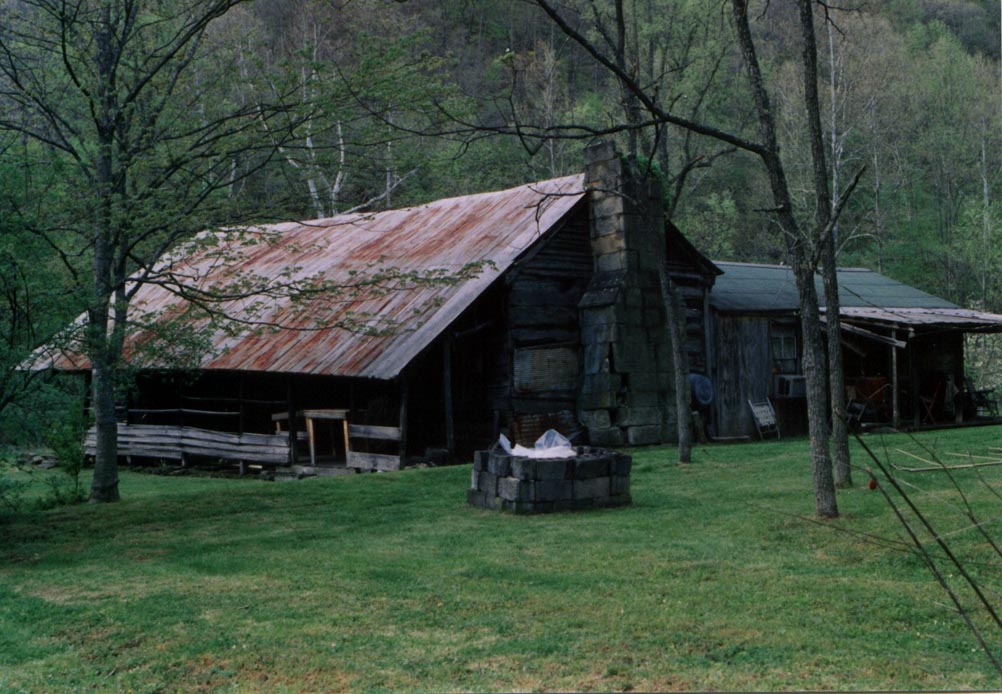
Milt Ferrell cabin, Rector, Big Ugly Creek, Lincoln County, WV, c.1998

Milt Ferrell cabin, Rector, Big Ugly Creek, Lincoln County, WV, c.1998

Monroe T. Fry

09 Wednesday Apr 2014

Posted by Brandon Ray Kirk in Ed Haley, Music

≈ Leave a comment

Tags

culture, guitar, history, life, Monroe Fry, music, photos, Spicie McCoy, Stiltner, Wayne County, West Virginia

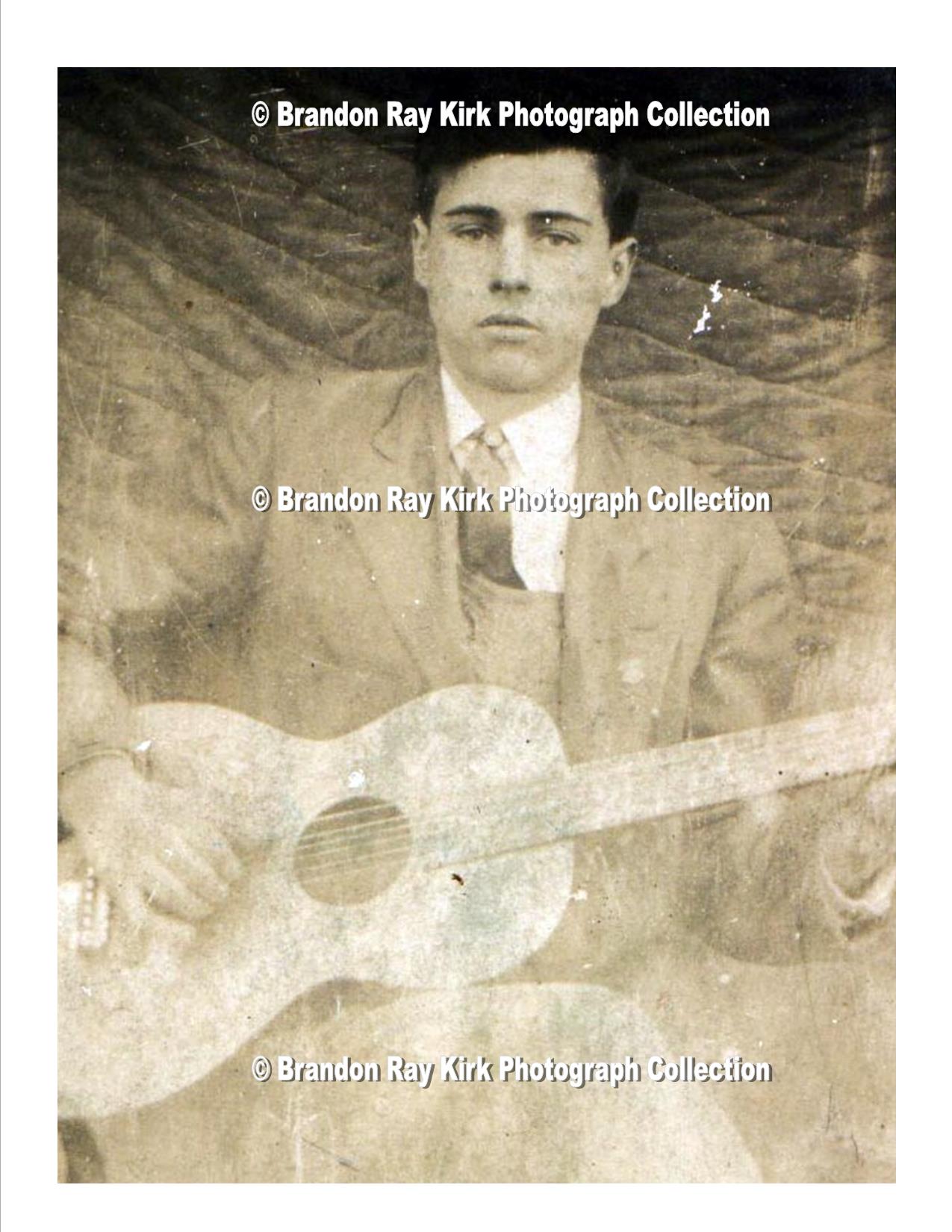
Monroe Taylor Fry, resident of Stiltner, Wayne County, WV

Monroe T. Fry (1897-1969), resident of Stiltner, Wayne County, WV

← Older posts
Newer posts →

Feud Poll 1

If you had lived in the Harts Creek community during the 1880s, to which faction of feudists might you have given your loyalty?

Categories

  • Adkins Mill
  • African American History
  • American Revolutionary War
  • Ashland
  • Atenville
  • Banco
  • Barboursville
  • Battle of Blair Mountain
  • Beech Creek
  • Big Creek
  • Big Harts Creek
  • Big Sandy Valley
  • Big Ugly Creek
  • Boone County
  • Breeden
  • Calhoun County
  • Cemeteries
  • Chapmanville
  • Civil War
  • Clay County
  • Clothier
  • Coal
  • Cove Gap
  • Crawley Creek
  • Culture of Honor
  • Dingess
  • Dollie
  • Dunlow
  • East Lynn
  • Ed Haley
  • Eden Park
  • Enslow
  • Estep
  • Ethel
  • Ferrellsburg
  • Fourteen
  • French-Eversole Feud
  • Gilbert
  • Giles County
  • Gill
  • Green Shoal
  • Guyandotte River
  • Halcyon
  • Hamlin
  • Harts
  • Hatfield-McCoy Feud
  • Holden
  • Hungarian-American History
  • Huntington
  • Inez
  • Irish-Americans
  • Italian American History
  • Jamboree
  • Jewish History
  • John Hartford
  • Kermit
  • Kiahsville
  • Kitchen
  • Leet
  • Lincoln County Feud
  • Little Harts Creek
  • Logan
  • Man
  • Matewan
  • Meador
  • Midkiff
  • Monroe County
  • Montgomery County
  • Music
  • Native American History
  • Peach Creek
  • Pearl Adkins Diary
  • Pecks Mill
  • Peter Creek
  • Pikeville
  • Pilgrim
  • Poetry
  • Queens Ridge
  • Ranger
  • Rector
  • Roane County
  • Rowan County Feud
  • Salt Rock
  • Sand Creek
  • Shively
  • Spears
  • Sports
  • Spottswood
  • Spurlockville
  • Stiltner
  • Stone Branch
  • Tazewell County
  • Timber
  • Tom Dula
  • Toney
  • Turner-Howard Feud
  • Twelve Pole Creek
  • Uncategorized
  • Warren
  • Wayne
  • West Hamlin
  • Wewanta
  • Wharncliffe
  • Whirlwind
  • Williamson
  • Women's History
  • World War I
  • Wyoming County
  • Yantus

Feud Poll 2

Do you think Milt Haley and Green McCoy committed the ambush on Al and Hollene Brumfield in 1889?

Blogroll

  • Ancestry.com
  • Ashland (KY) Daily Independent News Article
  • Author FB page
  • Beckley (WV) Register-Herald News Article
  • Big Sandy News (KY) News Article
  • Blood in West Virginia FB
  • Blood in West Virginia order
  • Chapters TV Program
  • Facebook
  • Ghosts of Guyan
  • Herald-Dispatch News Article 1
  • Herald-Dispatch News Article 2
  • In Search of Ed Haley
  • Instagram
  • Lincoln (WV) Journal News Article
  • Lincoln (WV) Journal Thumbs Up
  • Lincoln County
  • Lincoln County Feud
  • Lincoln County Feud Lecture
  • LinkedIn
  • Logan (WV) Banner News Article
  • Lunch With Books
  • Our Overmountain Men: The Revolutionary War in Western Virginia (1775-1783)
  • Pinterest
  • Scarborough Society's Art and Lecture Series
  • Smithsonian Article
  • Spirit of Jefferson News Article
  • The Friendly Neighbor Radio Show 1
  • The Friendly Neighbor Radio Show 2
  • The Friendly Neighbor Radio Show 3
  • The Friendly Neighbor Radio Show 4
  • The New Yorker
  • The State Journal's 55 Good Things About WV
  • tumblr.
  • Twitter
  • Website
  • Weirton (WV) Daily Times Article
  • Wheeling (WV) Intelligencer News Article 1
  • Wheeling (WV) Intelligencer News Article 2
  • WOWK TV
  • Writers Can Read Open Mic Night

Feud Poll 3

Who do you think organized the ambush of Al and Hollene Brumfield in 1889?

Recent Posts

  • Logan County Jail in Logan, WV
  • Absentee Landowners of Magnolia District (1890, 1892, 1894)
  • Charles Spurlock Survey at Fourteen Mile Creek, Lincoln County, WV (1815)

Ed Haley Poll 1

What do you think caused Ed Haley to lose his sight when he was three years old?

Top Posts & Pages

  • New Year's Raid (1888): Randolph McCoy's Testimony
  • Civil War Gold Coins Hidden Near Chapmanville, WV
  • Feudist Jim McCoy (1929)
  • Paw Paw Incident: Dan Whitt Deposition (1889)
  • Paw Paw Incident: Ellison Mounts Deposition (1889)

Copyright

© Brandon Ray Kirk and brandonraykirk.wordpress.com, 1987-2023. Unauthorized use and/or duplication of this material without express and written permission from this blog’s author and/or owner is strictly prohibited. Excerpts and links may be used, provided that full and clear credit is given to Brandon Ray Kirk and brandonraykirk.wordpress.com with appropriate and specific direction to the original content.

Archives

  • February 2025
  • January 2025
  • October 2023
  • September 2023
  • December 2022
  • November 2022
  • May 2022
  • April 2022
  • February 2022
  • November 2021
  • October 2021
  • September 2021
  • June 2021
  • May 2021
  • April 2021
  • March 2021
  • February 2021
  • January 2021
  • December 2020
  • November 2020
  • October 2020
  • July 2020
  • June 2020
  • May 2020
  • April 2020
  • March 2020
  • February 2020
  • January 2020
  • December 2019
  • November 2019
  • October 2019
  • September 2019
  • August 2019
  • July 2019
  • June 2019
  • May 2019
  • April 2019
  • March 2019
  • February 2019
  • January 2019
  • December 2018
  • November 2018
  • October 2018
  • September 2018
  • August 2018
  • July 2018
  • June 2018
  • May 2018
  • April 2018
  • March 2018
  • February 2018
  • January 2018
  • December 2017
  • November 2017
  • October 2017
  • September 2017
  • August 2017
  • July 2017
  • June 2017
  • May 2017
  • April 2017
  • March 2017
  • February 2017
  • January 2017
  • December 2016
  • November 2016
  • October 2016
  • September 2016
  • August 2016
  • July 2016
  • June 2016
  • May 2016
  • April 2016
  • March 2016
  • February 2016
  • January 2016
  • December 2015
  • November 2015
  • October 2015
  • September 2015
  • August 2015
  • July 2015
  • June 2015
  • May 2015
  • April 2015
  • March 2015
  • February 2015
  • January 2015
  • December 2014
  • October 2014
  • September 2014
  • August 2014
  • July 2014
  • June 2014
  • May 2014
  • April 2014
  • March 2014
  • February 2014
  • January 2014
  • December 2013
  • November 2013
  • October 2013
  • September 2013
  • August 2013
  • July 2013
  • June 2013
  • May 2013
  • April 2013
  • March 2013
  • February 2013
  • January 2013
  • December 2012
  • November 2012

Enter your email address to follow this blog and receive notifications of new posts by email.

Join 2,925 other subscribers

Tags

Appalachia Ashland Big Creek Big Ugly Creek Blood in West Virginia Brandon Kirk Cabell County cemeteries Chapmanville Charleston civil war coal Confederate Army crime culture Ed Haley Ella Haley Ferrellsburg feud fiddler fiddling genealogy Green McCoy Guyandotte River Harts Harts Creek Hatfield-McCoy Feud history Huntington John Hartford Kentucky Lawrence Haley life Lincoln County Lincoln County Feud Logan Logan Banner Logan County Milt Haley Mingo County music Ohio photos timbering U.S. South Virginia Wayne County West Virginia Whirlwind writing

Blogs I Follow

  • OtterTales
  • Our Appalachia: A Blog Created by Students of Brandon Kirk
  • Piedmont Trails
  • Truman Capote
  • Appalachian Diaspora

BLOOD IN WEST VIRGINIA is now available for order at Amazon!

Blog at WordPress.com.

OtterTales

Writings from my travels and experiences. High and fine literature is wine, and mine is only water; but everybody likes water. Mark Twain

Our Appalachia: A Blog Created by Students of Brandon Kirk

This site is dedicated to the collection, preservation, and promotion of history and culture in Appalachia.

Piedmont Trails

Genealogy and History in North Carolina and Beyond

Truman Capote

A site about one of the most beautiful, interesting, tallented, outrageous and colorful personalities of the 20th Century

Appalachian Diaspora

  • Subscribe Subscribed
    • Brandon Ray Kirk
    • Join 787 other subscribers
    • Already have a WordPress.com account? Log in now.
    • Brandon Ray Kirk
    • Subscribe Subscribed
    • Sign up
    • Log in
    • Report this content
    • View site in Reader
    • Manage subscriptions
    • Collapse this bar
 

Loading Comments...