Tags
Appalachia, blind, culture, Ed Haley, Ella Haley, fiddler, fiddling, history, life, music, photos, U.S. South

Ella and Ed Haley, 1925-1945
29 Saturday Dec 2012
Posted in Ed Haley
Tags
Appalachia, blind, culture, Ed Haley, Ella Haley, fiddler, fiddling, history, life, music, photos, U.S. South
Ella and Ed Haley, 1925-1945
29 Saturday Dec 2012
Posted in Ed Haley
Tags
Doc Holbrook, Ed Haley, fiddle, history, J P Fraley, John Hartford, Kentucky, Laury Hicks, Lawrence Haley, Maysville, music, Sherman Luther Haley, Ugee Postalwait, Wilson Douglas, writing
I met Lawrence a few weeks later at the Fraley Family Festival near Grayson, Kentucky. He gave me Ed’s newly located bridge and I showed him Ed’s fiddle — pointing out all of the things I had discovered about it. I specifically pointed out a “V-shape” pattern worn into the varnish on its back toward its bottom. At its top were what appeared to be “sweat marks” where Ed rotated the fiddle and slid his fingers up to get notes in second and third position (which contradicted what Snake Chapman had said about him rarely getting out of first position except when, every once in a while a finger would sneak and grab a note or two from the upper positions). As we talked about such things, J.P. Fraley showed up along with Nancy McClellan, a local folklorist.
After some small talk, I played “Half Past Four” for Lawrence on his dad’s fiddle.
“Where he got a name like that, I don’t know,” he said. “I think, though, it was possibly when my oldest brother Sherman Luther Haley was born. My mother went into labor about 4:30 in the morning. He was named after one of Mom’s brothers. It was the one that died.”
I said, “Now, I’m not totally used to these Black Diamond strings and I’m not playing it note for note the way Ed did. I’m just scratching the surface.”
Lawrence said, “I know. Them old records are hard to hear.”
“There is so much on them records you wouldn’t believe what’s in there,” I said. “Just all kinds of little things. Like his notes, he gets certain long notes and they’re like words. Some of them are moans. And he uses certain little tones.”
Lawrence said, “I notice a lot of you guys, it looks like it’s really hard work for you to do this. Pop never had a bit of trouble playing a fiddle. It wasn’t work to him. If he enjoyed the group he was with, you could absolutely hear it in his music. If he had good accompaniment, he’d stay all day.”
“I’m also curious about that bridge because I think he might have played with a little bit lower action than what I’ve got here,” I said.
Lawrence said, “Yeah, a little bit lower. You could look at that bridge I brought you.”
I said, “Yeah, I’ve already had it on and looked at it. The thing that’s interesting about that is if you look at that bridge, that bridge has been handled a lot because he would feel of it and that’s why all that finger grease is on it. I can just see him. What I may do, I may try that on but what I might do is carve a duplicate of that because sometimes when they get old, they’ll crack.”
Nancy McClellan asked Lawrence, “Were there other fiddlers in the family?” and he said, “No, I couldn’t play. I was left-handed and when I was a little tiny fella I nicked the whole end of this finger off and I didn’t have any meat on the end of it and that hindered me from picking a violin, see. I couldn’t work up a callus on it. Bone’s right underneath it.”
You know, I’d never really thought much about that — the fact none of the Haley children played the fiddle. Ralph, of course, was a guitar player — but he wasn’t actually Ed’s son. It was only natural that the kids — no matter how intense their exposure or no matter their possible distaste — would at some point pick up a fiddle and at least try it. This had been Lawrence’s confession — and his reason for not carrying it any further.
J.P. played a little on Ed’s fiddle and commented on the Black Diamond strings. “Have these strings been on there all that time?”
“No,” I said.
“Where’d you find them?”
I said, “I’ve got a friend that used to carry them and he had a couple of sets and he gave them to me.”
J.P. said, “I can remember when they was a quarter. Wonder what those fiddlers would have done if they’d had access to the strings and stuff that we can get now?”
There was a little pause then J.P. said, “Remember I was telling you about a tune called ‘Maysville’? It had to do with Maysville, Kentucky. I don’t know where the people in Elliott County learned it. They was a tobacco house down there and those people had to wagon tobacco from back in Elliott County plumb to Maysville to sell it.”
Lawrence said, “Pop played a lot of pieces named after…”
J.P. interrupted, “Now he played ‘Maysville’.”
Lawrence continued, “He played a piece of music that I really liked that he called ‘Catlettsburg’.”
Lawrence said to J.P., who still held Ed’s fiddle, “That isn’t as fine a fiddle as you played that used to belong to my dad that the Holbrooks got.”
J.P. said, “Paul’s got it. Well, what he done… That’s a good fiddle, too. He let me have it. I told him if he ever wanted it back… It was in the awfulest shape that ever was. But I had it fixed up. Not embellished now. Just restored. And suddenly Dr. Holbrook’s daughter was gonna take violin lessons. They took it. There’s something else he told me. See, I didn’t know the old Dr. Holbrook…”
Lawrence said, “He’s the one delivered me.”
J.P. said, “His son Paul — our doctor — told me that old man Holbrook went to fiddling, too. Well, Paul said that he supposedly took Ed and Ella to Columbus to do a record.”
Lawrence said, “That was that ‘Over the Waves’, I think. Big aluminum record.”
J.P. said, “It was the closest thing to a commercial record that Ed ever made.”
Lawrence spoke some about his father’s travels.
“Pop didn’t get all the way down into Old Virginia, I don’t think. He made it to Beckley and Bluefield and places like that. I can remember walking from Morehead to Farmers right down the railroad track. They went down there to somebody’s house to play — I was just a kid then — and seemed to me like they played all night.”
Nancy McClellan said, “Well, that’s what Wilson Douglas said happened up there in Calhoun County, West Virginia. He said a fiddler named Laury Hicks would ask for ‘The Black-Eyed Susan’ and said Laury Hicks would sit there and cry while Ed Haley played.”
I told about my recent visit with Laury’s daughter Ugee Postalwait and Lawrence said, “When Pop come around and they was playing, she’d get fiddle sticks and she’d just clog around Pop’s fiddle and every time he’d note it she beat the sticks on that. Dance right around him.”
27 Thursday Dec 2012
Posted in Big Harts Creek, Ed Haley, Spottswood
Tags
Appalachia, culture, genealogy, Harts Creek, history, Lawrence Haley, life, Liza Mullins, Logan County, photos, U.S. South, West Virginia

Lawrence Haley with Aunt Liza on Harts Creek, 1950-1953
27 Thursday Dec 2012
Posted in Ed Haley
Tags
Ed Haley, fiddle, Harts Creek, history, John Hartford, John Hedgecoth, Lawrence Haley, Logan County, music, Nashville, Noah Mullins, Steve Haley, U.S. South, West Virginia, writing
When I got back in Nashville, I ranted and raved over Haley’s fiddle before taking it downtown to John Hedgecoth, an instrument repairman. John and I went over its every detail. We fitted a bridge to it and put Black Diamond strings on it (the brand Haley supposedly used), then I brought it home and played on it for about two weeks. I focused on learning Ed’s version of a fabulous tune called “Half Past Four”.
“It just sounds like a dream,” I said to Lawrence when I called him. “You play on it real light and it’s got that sound in it.”
“Well, that’s great, John,” he said.
“Now I had to put a chin rest on it and I am using a shoulder rest with it because that’s what I’m used to and I had to put tuners on it because I like to keep it in tune,” I said.
“Okay. Well, that’s all right,” Lawrence laughed.
I said, “I tell you what’s interesting about it. It looks like at one time the back had been taken off and re-glued.”
Lawrence said, “Yeah, it got damp and the glue came loose on it and I guess that back warped or something. I don’t think it was completely off. Well, my son Steve had somebody down there in Nashville to repair it but that bridge — that thing looked real odd to me. I had an old bridge here. It’s in a drawer around here somewhere, I’d say, and I’ll look for it. I never really got it strung up since then. I just figured, well, there’s enough glue on that old fiddle that it ain’t gonna sound right anyway. If you use too much glue, you’re gonna lose a lot of the resonance in the wood.”
I said, “Now, it also looks like at one time the neck was broken out of it and reglued.”
Lawrence said, “Well now, it was not in the best of shape when Steve snuck it out of here. He took it out and had it repaired for me for a Christmas present. I just figured it’s gonna lay around here and just deteriorate again, maybe draw dampness some way or it’ll fall apart anyway. I just thought since you showed so much interest in it I’ll just let you have it.”
I said, “Well, I sure appreciate that. One of the things… The fingerboard, when you look at it straight on, lays over to the right in a funny kind of an angle.”
Lawrence said, “Yeah, that’s what I figured. I don’t remember it being like that. That fingerboard, it looked to me like it had some wear on it where my dad had fingered it so much. It looked like it had slight indentations from his fingers. I didn’t know whether it would fret right.”
I said, “And also, the sound post is an inch back from where it ought to be.” I wasn’t sure if Ed had kept it there or not; I felt it likely that it had fallen over in the decades after his death and been misplaced by some half-wit repairman.
I got Ed’s fiddle and played “Half Past Four” for Lawrence, who said, somewhat amused, “You’re trying to play one of his pieces. Sounds pretty good. Well, maybe some time down the line you’ll get that ‘Cacklin’ Hen’ down. It’s just working at it. And that fiddle does sound good from over the phone.”
I said, “It’s got a little overtone in it that none of these other fiddles have and when I go back and listen to those tapes I hear that overtone in there.”
Lawrence said, “Maybe you got a prize there. I don’t know. I think everybody agrees that you should have it. Steve seems to know more about you than what we do. I don’t know how he does but he’s a musician too, you know. He taught high school band for a while and he plays in a jazz band some. Plays the trumpet. His wife’s a musician. She’s a church organist — used to be. Two of the children… One of them’s in some kind of Nashville junior symphony. Plays the cello. The other plays the violin.”
I told Lawrence I wanted to be sure and go back to Harts Creek in the fall and find out more about his dad’s early years there.
“All right,” he said. “We’ll go back up there. I don’t think anybody up there, once they find out who you are will have any objections. One of my second cousins, Noah Mullins, he killed one of the revenuers that come up through there and that give Harts Creek a bad name, I guess. Those days are gone. I believe the second time up there everybody’d be glad to see you and talk to you like they were this last time. They won’t be any problem about that. People are a little suspicious if they don’t know who you are. But if they know you got a purpose and reason for being up there that isn’t detrimental to their causes they ain’t gonna jump you or anything or give you problems.”
27 Thursday Dec 2012
Posted in Ed Haley
Tags
Appalachia, culture, Ed Haley, Harts Creek, history, John Hartford, Lawrence Haley, life, Logan County, music, photos, Roxie Mullins, West Virginia, writing

Lawrence Haley (right) with Roxie Mullins and Family, 1991
27 Thursday Dec 2012
Tags
Black Sheep, David Haley, Ed Haley, fiddle, fiddling, history, John Hartford, Lawrence Haley, music, Nashville, Ohio, St. Clairsville, Steve Haley, writing
In Nashville, I spent several months working with Ed’s music and calling Lawrence Haley with questions and comments. I continued to study every intricate detail of Ed’s fiddling — supplementing it with recently learned facts about his life as well as devoting some attention to his songs. When I called Lawrence with questions about new “discoveries,” he said my visit to Ashland had inspired one of his granddaughters to take up the fiddle. I was very curious about that because of my belief in genetic memory. Who knew what secrets she had locked away inside her DNA? I told him I would bring her one of my fiddles the next time I saw him.
A few months later, I met Lawrence and his family at my show in St. Clairsville, Ohio. It was the first time Lawrence had seen me play on stage and I was ridiculously nervous. He listened intently from backstage and kept his criticisms to a minimum. He said his father played a lot faster than I did and really bragged on how Pop played the fiddle while singing, like with the tune “Black Sheep.”
In a quiet country town not very far away
There lived a rich and aging man whose hair was few and gray.
He had three sons, his only ones, Jack and Tom was sly.
Ted was honest as could be and could not tell a lie.
When we gathered on the bus, I gave Lawrence’s granddaughter one of my fiddles.
“Well I have something to give you, too,” Lawrence said before making a quick trip to his car. He returned with Ed’s fiddle, which he reached to me and said, “We brought something for you. We’re not using it and we know you would appreciate it and know its value.”
I carefully turned Ed Haley’s fiddle over in my hands.
It was a tremendously emotional experience.
“Are you sure you want to do this?” I asked.
Lawrence said he had talked about it with his sons Steve and David and every one agreed it was the right thing to do.
“I discussed it with the kids here,” he said. “David, he kind of showed a little bit of objection but I told him, ‘Well, John’s gonna bring a fiddle up here to Andrea. I just may as well turn loose of this one because it’s just gonna lay here and deteriorate. Why not let John have this one?’ He agreed to it. If anybody would’ve had any objections I think Steve would because his girls are both string instrumentalists. But they didn’t seem to mind too much so you got it and we won’t worry about it anymore.”
I immediately took Ed’s fiddle to my bedroom on the bus, put it in a case and laid it on the bed for safety.
26 Wednesday Dec 2012
Posted in Ed Haley
26 Wednesday Dec 2012
Posted in Ed Haley
Tags
Appalachia, blind, Calhoun County, Ed Haley, Ella Haley, Harts Creek, history, John Hartford, Kentucky, Lawrence Haley, Milt Haley, music, Ugee Postalwait, West Virginia, writing
The next thing I knew, Ugee was up at the stove cooking a big meal and singing “Maggie and Albert” — Haley’s version of “Frankie and Johnny”. When she was finished, she said, “Now that’s some old songs. Ed played them and when he played them, you’d be glad to sit and listen to them, too. And he patted his foot.”
During dinner, Ugee told me about her own musical experience.
“I started off on the five-string banjo then graduated myself to the guitar,” she said. “The first guitar that I ever seen, Howard Alexander brought it in the country. He’d been over to his mother-in-law’s around Rosedale and when he come back he brought a guitar. Howard didn’t play the guitar or banjo either. He come down and said, ‘Ugee, I brought you something. A guitar.’ And I said, ‘Well, I never tuned one of them things.’ I suppose I’d been playing the banjo about three or four years. Dad said, ‘Well, you tune the banjo. Go ahead and tune it up there.’ Howard said, ‘Aw, just keep it as long as you want to. I’m in no hurry fer it.’ He’d traded something for it. I forget what it was. I went to fooling with that guitar, you know, picking around with it, this that and another, running a knife down it. Well, I tuned it up like a banjo. First thing you know I found me a chord, and then Dad come in with a mandolin.”
“We went to play music around at the schoolhouse and places like that for pie suppers and cake walks,” Ugee said of herself and her father. “My dad thought there wasn’t nobody in the world like me. Nobody could do like I could. We went to a place and played for a schoolhouse and the teacher down there… He was a Glenville graduate — you know, went to college and everything — thought he knew it all. He said, ‘Mr. Hicks, play ‘Soldiers Joy’. So Dad played it for him. Just as soon as he got done playing it, he said, ‘Mr. Hicks, play ‘Soldiers Joy’. Dad played it for him again. I think he played it about five times. By that time, Dad was getting tired of it. And he come there and said, ‘Mr. Hicks would you please play ‘Soldiers Joy’? Dad said, ‘Hell, I’ve played it for you five times and you didn’t know it when you heard it.’ Made Dad mad. Every once in a while, me and Dad’d be a sitting playing, practicing, you know, and I’d look over, I’d say, ‘Dad, would you please play ‘Soldiers Joy’?’ He said, ‘I’ll mash you in the mouth.'”
Ugee said, “One time, a teacher taught at our school and he made me mad the way he treated me in school. He was having a doing going on at his school and Dad said, ‘I’m supposed to play at the White Oak School.’ And I went to the White Oak School. Well, me and Dad went over and I decided I wasn’t gonna play any music. When I sat down, the teacher said, ‘Oh, I’m so proud you come to play, Ugee,’ and just going on. I just reached down with my finger on that guitar and I broke that string. Dad reached down in his pocket and pulled out another one and said, ‘Now put that on and don’t you do that again, either.’ I never will forget it as long as I live. Jasper McCune was playing the five-string banjo. He was Dad’s first cousin. He said, ‘Why don’t you do that again, Ugee? Laury’ll slap your ears, too.'”
After supper, I asked Ugee what she knew about Ed’s blindness.
“They said Ed went blind when he was three or four years old. He had the measles. Well, he was sick and had a high fever. I don’t know whether you ever knowed it or not but the gypsies used to come around in the country and he had a high fever and they told his dad and them to take him down to the creek and throw him in the cold water and that would break the fever on him and he’d never have a fever again. And that’s what he done and it put him blind. But you know measles will put you blind because I almost went blind too when I had the measles. I was about twelve years old. And that’s what Ed said that put him blind. I asked him, I said, ‘Was you born blind?’ He wasn’t.”
Ugee said Ed occasionally talked about his father — a growing source of interest for me — although she didn’t remember much about it.
“I think his dad was a pretty mean man, the way he talked. And the way I understood him to say his mother got killed by some of them Hatfields and McCoys or some of them when that feud was going on. But I believe he said his dad was a pretty mean man. I don’t know what he meant by that. I never did hear what happened to his dad. I never heard him say about that. I believe he said he was raised by a aunt.”
I told Ugee about Lawrence and I going to Harts Creek and she said, “Lawrence, he was little all the way around. He thought an awful lot of his dad and mother. Larry’s the only one that turned out real good. Noah, he gambles and I don’t know what all. And Clyde, he’s been in a little bit of everything. Mona’s been the same way. Poor old Larry, he’s looked after all of them. He don’t care whether he hears from them or not because every time he hears from them it’s money or have to help them out or get them out of something. Jack died. Jack was a nice looking man, too. He was taller than Lawrence. He was a nice boy like Larry.”
I asked Ugee if she thought maybe some of Ed’s kids took after his father Milt, who she called “a pretty bad feller.” She said, “I have an idea they did. And I heard Ed say one time that Ella had some awful mean people on her side. He said Noah was turned just exactly like his mother’s people. They was a lot of mean people down there in Kentucky. Lot of murdering and lot of killing.”
25 Tuesday Dec 2012
Posted in Ed Haley
Tags
Black Sheep, Blackberry Blossom, Buttermilk Mountain, Calhoun County, Ed Haley, Ella Haley, fiddling, Fire on the Mountain, Florene, Harvey Hicks, history, John Hartford, Laury Hicks, McKinley, music, Old Zed Tanner, Parkersburg Landing, Pat Malone, Stacker Lee, Sweet Florena, Ugee Postalwait, West Virginia, writing
I reached Ugee my Parkersburg Landing album, hoping it might rekindle the names of more Haley tunes.
“Ed had a habit of changing the name if he was in a different town,” she said. “Now just like this ‘Parkersburg Landing’, that’s another song that he always played.”
Ugee remembered Haley’s singing ability more than his fiddling.
“He had a beautiful voice,” she said. “It’d bring tears to anybody’s eyes. He could sing low, he could sing high. He sang ‘Stacker Lee’ and he didn’t lay his fiddle down when he sung. He played his own music and sang at the same time. I never heard nothing like him and I’ve heard a lot of them, Mr. Hartford, because they used to come to my dad’s house. Anybody come in anyplace close, they’d come to our place. They didn’t stay all night — they stayed a week or month. Banjos, guitars, whoever played music come to my dad’s. They wasn’t nobody in the world loved it any better than he did.”
Ugee went through some other tunes — like “McKinley” and “Old Zed Tanner” — but only remembered pieces of them. There was also “Fire on the Mountain” and “Buttermilk Mountain”.
Going on Buttermilk Mountain to see my old girlfriend again.
When I come out, there’ll be no Buttermilk girlfriend to meet me again.
When I come back, I’ll bring my girl from old Buttermilk Mountain.
I’m a goin’ away, I’m a goin’ to stay, I’m a goin’ to Buttermilk Mountain.
“Ella didn’t like that song,” Ugee said. “She’d say, ‘I hate that song. I don’t want to hear that old thing.’ She thought it was some girl Ed used to go with that he was talking about. Harvey my brother would get around and have Ed to sing it.”
Ugee said Harvey would come around with whisky and get Ed to play what he wanted, usually songs that made Ella jealous, like “Florene”.
I’m leavin’ you sweet Florena.
I’m leavin’ you sweet Florene.
I’m goin’ away, I’m goin’ to stay.
I’m a leavin’ you sweet Florene.
Oncest I bought your clothes sweet Florena.
Oncest I bought your clothes sweet Florene.
Oncest I bought your clothes
But now I ain’t got no dough
Now I have to travel on, sweet Florene.
Down in the pen sweet Florena.
I’m down in the pen sweet Florene.
I’m down in the pen, but for you I’d go again
I’m a leavin’ you sweet Florene.
“Harvey was a good man but he’d slip Ed a little shot of whiskey,” Ugee said. “He’d say, ‘Ed, it’s about time for you to have a little drink of water, ain’t it?’ Oh, it wouldn’t be but about a few minutes till old Ed was playing like crazy. You give him a shot and boy you oughta heard him. Then he’d say, ‘Ed, I’d like to hear that old Florene song.’ Ella would shake her head — ‘I don’t like that song. That’s about some of his old women that he used to run around with probably.’ And that’s all she’d say about it, but she’d shut her eyes tight and shake her head.”
She remembered Ed playing ‘Blackberry Blossom’ but couldn’t quite remember the story behind it.
“And then there was a song called ‘Pat Malone’,” she said. “Did you ever hear that song?”
Before I could answer, she started singing:
Times are hard in an Irish town. Everything was a going down
And Pat Malone was short for any cash.
He for life insurance spent all his money to a cent
And the most of his affairs had gone to smash.
Pat’s wife spoke up and said, “Oh dear Pat, if you were dead
There’s twenty thousand dollars we could get.”
So old Pat laid down and tried to make out that he had died
Until he smelt the whiskey at the wake.
Then Pat Malone forgot that he was dead.
Oh, he raised right up and shouted from his bed.
“If the wake goes on a minute, the corpse’ll sure be in it.
You gotta get me drunk to keep me dead.”
So they gave the corpse a sup.
After they had filled him up
And they laid him back upon his bunk again.
Then before the break of day everybody felt so gay
That they all forgot that he was dead.
So they took him from his bunk, still alive but he’s awful drunk.
And they laid him in his coffin with a prayer.
Then the driver swore by dad that he’d never start ahead
Until he seen that someone paid the fare.
And Pat Malone forgot that he was dead.
He raised right up in the coffin and he said,
“If you dare to doubt my credit, you’ll be sorry that you said it.
Drive on or this corpse will smash your head.”
So the driver started out on the cemetery route
And the people tried that widow to console.
Then near the churchyard lot, Pat Malone’s last resting spot,
They begin to lower the dummy in the hole.
When the clods begin to drop, Pat burst off the coffin top
And quickly to the earth he did ascend.
Then Pat Malone forgot that he was dead.
He quickly from that cemetery fled.
Pat come near a goin’ under, what a lucky thing by thunder,
Old Pat Malone forgot that he was dead.
I was blown away. I said to Ugee, “That’s great! Where in the world did that come from?”
“Oh,” she said, “that was from back in the hills there. That’s an old song. Just like that ‘Black Sheep’ song. You ought to have heard Ed play that.”
In a quiet country town not so very far away
Lived a rich and aging man whose hair was silvery gray.
He had three sons, his only ones, Jack and Tom were sly.
Ted was as honest as he could be and he would not tell a lie.
They both began to ruin him within the old man’s eyes.
Then the poison began its work and Ted was most despised.
One day the father said to him, “Be gone ye to the poor,”
And these words the Black Sheep said while standing in the door:
“Don’t be angry with me Dad. Don’t turn me from your door.
I know that I’ve been a worry, but I’ll worry you no more.”
Give to me one other chance and put to me the test
And you’ll find the Black Sheep loves you Dad far better than the rest.”
Year by year passed by and the father he grew old.
He called in both Jack and Tom and he gave to them his gold.
“All I want is a little room, just a place by your fireside.”
Jack returning home one night and he brought with him a bride.
The bride begin to hate the father more and more each day
Until one night she declared, “That old fool is in our way.”
They decided to send him to the poor house which was near.
And like a flash that Black Sheep’s words went ringing in his ear:
“Don’t be angry with me Dad. Don’t turn me from your door.
You know that I’ve been a worry worry, but I’ll worry you no more.
Give to me one other chance and put to me the test
And you’ll find the Black Sheep loves you Dad far better than the rest.”
Well a wagon drove up to the door, it was the poor house van.
The boys laughed and pointed to their dad and they says, “There is your man.”
Just then a rich and a manly form came pressing through the crowd.
“Stop you brutes,” the stranger said, “This will not be allowed.
You’ve taken the old man’s property and all that he could save.
You’ve even sold that little lot containing his wife’s grave.
I am his son but I’m not your kin from now till Judgement Day.”
The old man clasped the Black Sheep’s hand and the crowd all heard him say:
“Don’t be angry with me lad. Don’t turn me from your door.
I know that I was foolish, but I’ve repented o’er and o’er.
I should have gave to you my gold ’cause you have stood the test.
Now I find the Black Sheep far better than all the rest.”
Ugee apologized for her voice, saying, “Now, that’s not sung right. You oughta heard Ed Haley sing that to you. The first time I ever sung that, I sung a little bit of it to Ed, and when he come back again he was playing and singing that. It’d raise the hair on your head.”
I wondered if Laury was a singer and she said, “My dad couldn’t carry a tune but he could play that fiddle. My dad could whistle.”
24 Monday Dec 2012
Posted in Ed Haley
Tags
Appalachia, Ed Haley, Ella Haley, genealogy, history, Kentucky, life, photos, Ralph Haley, U.S. South
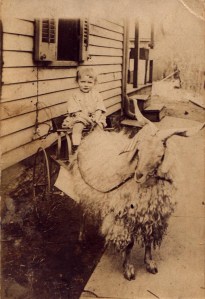
Ralph Haley, circa 1916
24 Monday Dec 2012
Posted in Ed Haley
Tags
Akron, Calhoun County, Ed Haley, Ella Haley, history, John Hartford, Laury Hicks, music, Ohio, Ralph Haley, Spencer, Ugee Postalwait, West Virginia, writing
A little later, Ugee saw Ed and Ella at Spencer, the county seat of Roane County.
“I lived three miles below Spencer one year and come up to town to get some groceries or something and Ed and Ella was there at the courthouse playing music. Well I went over to talk to Ed and Ella. Nothing else would do but for us to go down to eat at the hotel. Well, there was just a whole bunch of big shots over for that stock sale and Roane County was a Republican county. And they put us up to eat. That’s when they had that WPA and were giving out rations, like meat. My son Harold was up at the end of the table and they said, ‘Well, what do you want?’ He said, ‘I think I’ll have some of that Roosevelt dog meat.’ Aw, you ought to heard them good ole Republicans get up and just clap their hands. ‘Oh, that’s the smartest little boy I ever seen,’ he said and throwed him a dollar. Ed just throwed back his head. I can see him now – ‘Ha! Ha! Ha! That wasn’t a Republican said that, though.’ Me and Ella laughed about that.”
In later years, Ugee’s brother Harvey took Ed and Ella to Akron, Ohio where he worked at the B.F. Goodrich factory. Ugee said, “Ed drawed such a big crowd at the B.F. Goodrich they passed a law that people had to keep moving on the streets. Harvey got so mad. At Goodyear, it was the same way. People couldn’t get by. Traffic was that bad.”
I tried to explain to Ugee what I had learned about Haley’s fiddling and she said, “He was one of the smoothest fiddlers I ever heard. He’d put his fiddle right along here — he didn’t put it under his chin — and if somebody’d make him mad when they’d ask him to play something he’d almost make that fiddle insult that person. I don’t know how he’d do it, but I’ll tell you what: he could almost insult you with it. He’d make it squawl at them and squeal at them. Just like that ‘Wild Hogs in the Red Brush’ — the way he’d hit that fiddle somehow or other it’d sound just like hogs squealing.”
I played some of Ed’s recordings for Ugee, who quickly pointed out that they didn’t compare to hearing him in person.
“I’d give anything in the world if they could get some of Ed’s music out,” she said. “Now I had a nephew that went down to Kentucky after World War II and got two or three records of Ed’s. He give them five dollars. I tried to buy one off of him and he said, ‘I wouldn’t take a million dollars for them.’ That’s just how much we thought of Ed and Ella and them.”
More Ed Haley records?
“My nephew’s dead but his son is living in Parkersburg and I don’t know whether he’s throwed them away or what he’s done with them,” Ugee said. “They shouldn’t be scratched up. They took care of them.”
Ugee said her nephew was James Russell Shaver, who lived just off of 7th Avenue.
Turning my thoughts to music, I got my fiddle out to probe Ugee’s mind about Ed’s technique. She said, “Him and Dad both — that wrist done the work for them.”
Did he always sit down when he played?
“Most of the time. He could stand up and play but he didn’t like to.”
Did he pat his foot pretty hard when he played?
“Patted this one,” Ugee said. “The other one came down like you’re dancing. Whenever he began to pat that foot you could say he was bringing out some good music somewhere.”
I asked if fiddlers ever questioned Ed about how to play and she said, “Well he wouldn’t a showed one how to play. He learned it like I did — the hard way — just fooling with the fiddle.”
I told Ugee, “Now Lawrence said Ed played the banjo,” and she said, “Ed could play a guitar like crazy, too. He could play any kind of string music. Now Dad could thump a banjo a little but he wasn’t what you call a banjo player. Ed could play a mandolin, too. He could play a guitar, too. There’s where Ralph learned to play a guitar — Ed learned him.”
I told her about working on Ed’s music with Lawrence and about my theory regarding genetic memory and she said, “I don’t think I ever seen Lawrence even pick up a music box and try to play anything,” kind of dismissing the entire notion. She didn’t know much about Ralph’s musical ability. “I never was around him too much — just there at home,” she said. “He played with his pick or fingers either one.”
She was aware that Ella had Ralph before she married Ed.
“I forget how old he was when Ed and Ella got married but he’s just a half-brother to them.”
I asked Ugee if Ella ever talked about her first husband and she said, “No. They always made out like Ralph was Ed’s boy. Ed just called him his boy.”
I was very curious to see what Haley tunes Ugee might remember.
“I can remember a lot of his tunes,” she said, “but I can’t sing them any more: ‘Sourwood Mountain’, ‘Cripple Creek’ and ‘Wild Hogs in the Red Brush’. He played one — ‘The blue-eyed rabbit’s gone away. The blue-eyed rabbit’s gone to stay.’ Probably old fiddle tunes, all of them. You couldn’t mention one of them he couldn’t play. ‘Marching Through Georgia’, ‘Red Wing’. ‘Old Jimmy Johnson’ — you’ve heard that. ‘Old Jimmy Johnson, bring your jug around the hill. If you don’t have a jug, bring a ten dollar bill.'”
I asked if her father and Ed played most of the same tunes and she said, “Oh, yeah. Dad knowed some that Ed didn’t but Ed would learn them when he’d get in there, and if Ed knowed some, why Dad’d learn them, too.”
22 Saturday Dec 2012
Posted in Ed Haley
Tags
Appalachia, Calhoun County, Ed Haley, fiddler, genealogy, history, John Hartford, Laury Hicks, music, photos, U.S. South, West Virginia
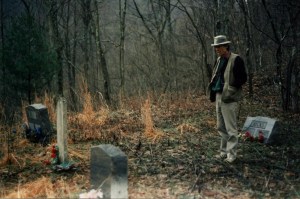
John Hartford at the Laury Hicks Grave, 1996
22 Saturday Dec 2012
Posted in Ed Haley
Tags
Appalachia, Arnoldsburg, Calhoun County, Ed Haley, Ella Haley, Harvey Hicks, history, John Hartford, Laury Hicks, music, Natchee the Indian, Spencer, Ugee Postalwait, West Virginia, writing
Ugee said Ed seldom had a fiddle case with him when he traveled into Calhoun County, West Virginia.
“Most of the time Ed had his fiddle in a twenty-four pound flour poke,” she said. “Sometimes he’d put it under his coat and sometimes up under his arm — just whichever way he felt best about it. He was very careful with it under there. Dad told him one time, ‘Why don’t you get a case so you can carry that bow without tearing it up all the time?’ Ed said he didn’t want to bother with carrying that case in his hand. Some times he might take a notion to stop and play some music somewhere on the road.”
At that instant, I had this image of Ed being so attached to his fiddle, with such an addiction, that the two were virtually inseparable. To not even want to put it away in a case made me think he always had it in his hands, feeling it, tinkering with it, trying new ways to make it work — all the time. You know, a person can get really attached to feeling an object — a ball or a pen — to where it doesn’t seem comfortable to not have it in hand. I imagine for a blind person this feeling is most intense. There’s a real comfort level to consider. This fiddle would’ve been his entire life — his passion, his breadbasket, his ticket to daily comforts and a better life in general. Then, I also pictured horrible images of him stumbling or even falling with it in his hands or tucked under his coat as he scooted along bumpy country roads.
Ugee said Ed ordered his strings from “Sears & Roebuck and places like that. You could buy strings out in them country stores. Used to be you could buy them all in a drug store.”
How did he get his bows haired?
“Horse’s tail. Dad haired it for him.”
Ugee said Ed and Laury played music at little towns called Rosedale, Grantsville and Webster Springs. I asked if Ed put a box or cup out to catch money and she said, “Oh, no. Maybe Dad would put a cigar box down. When Ed was some place and Dad was around, he’d just step up after they’d get to playing and Dad’d say, ‘If you fellers like that how about putting some money in this cigar box? This man’s got six kids. Don’t make him play for nothing’.”
Ugee had faint memories of Ed fiddling in contests with her father. One time, she said, he lost a contest in Charleston to an Indian — no doubt Natchez the Indian, the famous show fiddler. “Ed got so mad at hisself,” Ugee said, “he just about blowed up over it because he knowed the feller couldn’t play but they give it to him. He was the world champion fiddler but he couldn’t play. Ed said, ‘It’s already cut and dried.’ Ed cut a shine and said that his music wasn’t worth a damn. You never heard such cussing.”
The first time Ugee saw Ella, she was pregnant with Lawrence (circa 1927). At that time, Ella did not play the mandolin — an important thing to note considering how it was so prominently featured on the home recordings of the mid-40s.
“Now Ella, when she first come in there, she played the accordion. Dad told Ed, he said, ‘I don’t like the accordion. It drowns out your music. I’d ruther hear the fiddle.’ He said, ‘Why don’t you teach her to play the guitar or the mandolin?’ Ed laughed. He said, ‘Hell, you can’t teach her nothing.’ Ella — I can see her shut her eyes yet — said, ‘Laury, don’t you like the accordion?’ He said, ‘Oh, I like it. Ella, you’re the best in the world, but I like string music.’ Next time she come back, she was playing mandolin. Ed learned her how to second and buddy she could keep time with it, too. Dad said, ‘I like that a whole lot better, just hearing that time.'”
Ugee said, “Well, they had Lawrence and they named him after Dad. Then when they come back they had a little girl and they named her Monnie after my mother, Minnie. Ella wrote and told Mom, ‘Well, I had my baby and it’s a girl. Instead of calling her Minnie, I’m calling her Monnie, but it’s still your namesake.”
I wondered if Ed and Ella played at courthouses in that part of West Virginia and Ugee said, “Yes, yes. They played at every courthouse there was in West Virginia down there: Grantsville, Clay County, Glenville and back through that way. Gassaway, West Virginia. Sutton, West Virginia. Just any place around — all the churches and all the schoolhouses. The old Roane County Courthouse in Spencer, it used to have great big shade trees. Then they had the stock market up on the Spencer Hill back towards Arnoldsburg and Ed and them’d go over there. And they had a boarding house just before you crossed the bridge — state hospital’s across over there — and then there’s the big Miller Hotel and everybody went in there to eat. And they’d be over there playing music and people would take Ed and Ella down there to eat.”
Ugee said Ed and Ella were regulars at Arnoldsburg, a little town north of the Hicks home on Route 33 in Calhoun County. It was the first of many stories where she became the hero of her own narrative.
“My brother, Harvey, he took me down to Arnoldsburg and Ed and Ella was playing music. They had a platform to dance on and Dad was down there. Harvey said, ‘Well, let’s sit back over here and listen to them a while.’ There was some girls trying to dance. They wasn’t keeping time. You could tell right then that Ed didn’t like the noise they were making. They was some way about twisting his shoulders that he didn’t like something that was going on. I looked at Harold and said, ‘He’s gonna quit playing in a little bit.’ Me and him sat over there in the car and was laughing about it. And Ed and them wasn’t making very much money there at the time.
“So Dad happened to see us over there. He come over and said, ‘Won’t you go over and dance some?’ I said, ‘I don’t want to go over and dance.’ He went back and he told Uncle Jerry — that was Aunt Susan’s man — he said, ‘I’ll give you ten dollars if you’ll say something like, I’ll give ten dollars to see Ugee Hicks dance.’ Jerry said, ‘You give me ten dollars and I’ll put it in the box.’ Uncle Jerry said, ‘I’ll give ten dollars to see Ugee Hicks dance.’ Ed perked up like that — he’d give ten dollars too almost to hear me dance. And old Carey Smith, I never will forget it. Carey and old John both was there and they had money. ‘Well,’ Carey said, ‘I’d give a twenty-dollar bill to see Ugee Hicks come in there on that board and show them girls a few things.’ I just walked over to Uncle Jerry and I said, ‘Uncle Jerry, just put your ten where your mouth is.’ And I looked down at Carey Smith and I said, ‘Carey, you put your twenty where your mouth is. Throw it in that cigar box.’
“Well, Ed went to playing ‘Carroll County Blues’. I had a pair of shoes on that had like a wooden heel on them. I hit that floor and I wanna tell you right now, you oughta heard Ed play. He just brightened up so. I don’t think I ever heard him play it better in my life. And Uncle Jerry turned around to old John, he said, ‘Well, you better put your twenty in here.’ Well, Ed made fifty dollars. Old Ed and Ella, you know they had a family. I was a pretty good dancer then. Them two girls quit. One girl stepped back and said, ‘Well, she can’t do the Charleston.'”
Ugee told me more about the pact made between her father and Ed in the early thirties.
“Now they made that pact a long time ago and they renewed it when Ed was back again. Dad told him he wanted him to play ‘When Our Lord Shall Come Again’ and he said, ‘I don’t care what you play before, fiddling pieces or anything, but when you play ‘When Our Lord Shall Come Again’, that’s when I’ll meet my Lord.’ And he said, ‘I’ll be a laying there in that grave until you sing that.'”
Ed asked Laury to play “What A Friend We Have in Jesus” and a few fiddle tunes at his funeral.
“I’ll lay there in that grave and won’t hear nothing,” Laury joked.
Ed was “kindly acting a fool” about it too and told him to let Ugee sing since he was such a horrible singer.
“Laury, we’re getting a little serious with this stuff,” Ed finally said. “I don’t know whether I can play anything or not.”
“I know,” Laury said. “I don’t know whether I can sing over you, either.”
Ugee said her father died of leukemia and stomach cancer in January of 1937 at the age of 56 years. About a month later, Ed made it to Calhoun County and played “When Our Lord Shall Come Again” at his grave. The famous Ohio River flood of ’37 delayed his trip. According to one publication, the flood crested in Ashland at 74.3 feet — nearly 20 feet above flood stage. It took one month and a half to play out, leaving residents with a large cleanup effort that lasted for six months.
“Ed went up to the grave — it’s right up on the hill from the house — and he stayed and played music all day,” Ugee said. “He played fast fiddle tunes and he played slow ones and then he’d sing. That evening, back at the house, nobody said a thing. You coulda dropped a pin in our house. Ed just come down on the fiddle and went to playing that ‘Carroll County Blues’ and I just jumped up in the floor and went to dancing. I said, ‘Well, if my dad was a living, that’s what he’d wanted me to do because I can’t hold my feet.’ Ed told me the next day, ‘If you hadn’t done that I’d a choked to death right there.’ Ella said, ‘When you hit that floor I knowed you was gonna be all right.'”
21 Friday Dec 2012
Tags
Appalachia, Calhoun County, fiddler, genealogy, history, Laury Hicks, Minnie Hicks, music, photos, U.S. South, West Virginia, writing
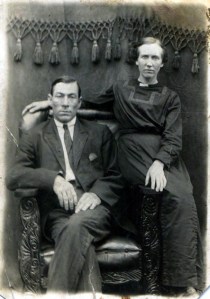
Laury and Minnie Hicks of Calhoun County, WV, 1920s
21 Friday Dec 2012
Posted in Ed Haley
Tags
Appalachia, Calhoun County, Ed Haley, fiddler, history, John Hartford, Johnny Hager, Laury Hicks, Logan County, music, U.S. South, Ugee Postalwait, West Virginia, writing
A few weeks later, I met Ugee Postalwait at her home in Akron, Ohio. An energetic, feisty woman with a band-aid on her nose, she didn’t look nearly as old as she said she was (eighty-something). She was very anxious to talk about Ed Haley and her memories seemed sharper than when I’d first called her. She bragged about him right away.
“He had the brain of music,” she said. “He’s one of the best I ever heard. You could name a tune and if he didn’t know it and you sang it to him one time he knowed it then, and when you heard it the next time he’d blow your stack.”
“Now they is some people’ll tell you my dad was better — Laury Hicks,” she continued, wasting no time in bragging on her father. “He and Ed was about the same age. Both born in about 1880.”
I asked Ugee to recall her childhood, when she first saw Ed Haley.
“The first time I ever seen Ed Haley, I was about five years old,” she said. “Dick Joblin told him that he wanted him to hear a boy that he knowed played music and he brought him there to Dad. Ed was about — oh, he must’ve been around twenty maybe, something like that. He was a young man. Dick had my dad to play the fiddle and he played three pieces: ‘Arkansas Traveler’ and another’n I can’t remember right now and ‘Sally Goodin’. Ed said, ‘If that next’n had come up as strong as the first few I heard, I’d never pulled my bow across that fiddle as long as I lived.’ And Dad at the time had his first fiddle. My dad made his first fiddle out of a cigar box and that’s what he learned on and he had that up till I was about ten or twelve years old.”
Ugee said, “Then the next time I seen Ed, he come there with John Hager.”
I asked her how Ed looked and she said he had on a suit and plug hat and had his fiddle in a flour sack.
“They stayed all winter, and they left on the first day of spring,” she said. “I’ll never forget that. There was a little narrow country road and as long as I live I’ll always see Ed, and Johnny leading him around a mud hole. We went out on the bank and watched them as they left and I stood there and cried after him and just cut a shine. Well, Ed then sent back a card — I think I still got it. ‘I love your wife, but oh your kids’ — from White Sulphur Springs.”
I asked Ugee if she had seen the picture of Ed and Johnny at White Sulphur Springs.
“Oh, yeah, I got that someplace in a box with a bunch of my pictures,” she said, before correcting herself. “Well, I think I give Larry all the pictures I had of Ed and Ella.”
When I pulled out the one of Ed and Johnny, she said, “Yeah, that’s John Hager. He was a little fella. That banjo had the longest neck I ever seen.”
She then pointed to Ed and said, “That looks just exactly like him. He wore dark glasses then. After he got married he stopped wearing dark glasses. Ed was six foot or something like that. Well Dad was a real little skinny guy like Ed Haley when he was young. He weighed about 144 pounds and then he had pneumonia fever and come near to dying. When he got over that, he gained weight. Went up to 175 pounds. But he weighed about 200 pounds. Dad was tall.”
Ugee said Ed stopped wearing his derby and gained a little weight after marrying Ella. I was surprised to hear her describe him as a “little skinny guy” but she insisted, “Yeah, looked like you put a pair of britches up on a fence rail. Ed said to me one day, ‘Ugee, can you make a shirt?’ I said, ‘Well sure I can make a shirt.’ Well, he come back from the store with material and I made him three shirts. He laughed about it. He said, ‘I want long tails. They won’t slip out of my pants.'”
Ugee said, “Yeah, I’ve seen these pictures.”
“This one,” she said, pointing to the picture of Ed used on the cover of Parkersburg Landing, “I don’t remember ever seeing that one of Ed. He looks to me like he’s been on a drunk.”
Ugee tried to describe the way things were when she was a girl in Calhoun County.
“When I was growing up and in the cornfield hoeing corn, you could hear singing on the mountains,” she said. “There was music in that country and very few people didn’t play some kind of music. My brother Russell played the banjo. My brother Shirley played the guitar and would’ve made a good fiddle player if he’d went ahead at it. I used to pick up the fiddle and see-saw a little bit. I can’t any more. We had a string band at our house, you might say. Mom played the organ and I went to playing the guitar. Anyway, they was nobody that come in that country that played the fiddle within thirty, forty or fifty miles away that wouldn’t come to our place and play music.”
The Hicks home took on a party atmosphere when Haley arrived.
“When Ed Haley was in the country, they come from miles around to our house,” Ugee said. “Dad would get out and tell everybody that Ed was there or Ed was gonna be there a certain day. They’d come through the day. Everybody did. Dad and them would play music all day — half a night.”
Ugee said she used to get up around two o’clock in the morning to see who’d be eating breakfast in a few hours.
Some of her happiest memories were of Haley’s visits to her father’s home.
“Dad’d go out there on the porch and if Ed was a playing music and if I was in the kitchen a cooking he’d go out and tell Ed to play ‘Carroll County Blues’,” she said. “Oh, I’d come out of that kitchen just a hitting that floor and a dancing all the way out there on the porch. I’d say, ‘Ed, don’t do that. You’ll not get no dinner ’cause I can’t hold my feet when you play that.’ Every time he played that, I’d dance. And Dad, when he played ‘Sally Goodin’, that’s when I’d dance for him. Mom didn’t want me to dance. She tried to keep me from it but I’d go out under them old oak trees out there on them old flat rocks and just dance, you know.”
I asked how far the Hicks home was from Harts Creek and Ugee said, “I would say that’s pretty close to a hundred mile. I never was in around Logan. I always wanted to go because Nora and Aunt Rosie lived up there. Dad and the boys, they used to go see them.” Aunt Rosie, she said, was Bill Day’s wife, while Nora was her daughter. I never knew the Days lived around Logan, West Virginia.
20 Thursday Dec 2012
Posted in Ed Haley
Tags
Akron, Calhoun County, Ed Haley, history, John Hartford, Johnny Hager, Laury Hicks, Lawrence Haley, music, Ohio, Rector Hicks, Ugee Postalwait, West Virginia, writing
By some accounts, Dr. Lawrence Hicks was Ed Haley’s best friend. Hicks was a well-known fiddler who practiced veterinary medicine in Calhoun County, West Virginia. Ed thought enough of Hicks to name his youngest son after him and, according to Parkersburg Landing, came to play the fiddle at his grave when he died in 1937. With Lawrence Haley’s encouragement, I telephoned Ugee Postalwait, a widow of advanced age and the only daughter of Dr. Hicks. Ugee (pronounced “you-gee”) was a resident of Akron, Ohio — one of those industrial towns flooded by job-seeking mountaineers some four decades ago.
“I’m a friend of Lawrence Haley’s in Ashland and I’m very much interested in his father, Ed Haley,” I told her. “I was just visiting with Lawrence and he said you knew him real well. I was wondering if you would tell me about him.”
“Well, I don’t know what you want me to tell you about,” Ugee said. “My dad and him was two of the finest fiddlers I ever heard. My dad’s name was Laury Hicks. Well, Lawrence was his name but they called him Laury. A lot of them called him Dr. L.A. He was a veterinarian, but he was a fine fiddler. Him and Ed were very close friends for years and years — ever since I was a little girl. They was both born in 1880. They loved each other. And Mom and Ella got along the same way. Mom was born in 1882. She lived to be a hundred years old. She played the organ. She was a good singer.”
I said, “Now, there’s a story on that album where Ed went to this grave and played over it. Was that your dad?”
“Yes,” she said. “They was talking one time, whichever one died first the other one was supposed to play the fiddle at their funeral. Dad requested that he play ‘When Our Lord Shall Come Again’ and said that he wouldn’t meet his Lord in the air until Ed played. Dad died on the 18th day of January in ’37 but Kentucky and Ashland was under water. The water was up so high in ’37 that Ed and Ella couldn’t get there until after that and they played the song that dad requested.”
I asked Ugee where all that went down and she said, “Dad’s buried up there at the home place on Route 16 in Calhoun County between Chloe and Stinson — as you come up from Arnoldsburg. Him and Mom and my brothers.”
Calhoun County, I discovered, is a rural spot wedged in the backcountry between the Little Kanawha and Elk rivers northeast of Charleston, the state capitol. It is some 75 miles away from Haley’s birthplace on Harts Creek, at least as the crow flies. In Ed Haley’s time, it was a real hot bed of musicians.
I wondered if Laury Hicks made any recordings. No, Ugee said, although his fiddle was still around. She gave it to Harold Postalwait, her son in Rogersville, Alabama.
“He just had it refinished and everything,” she said.
Ugee’s memories were warming up: “Ed and Ella and all the family used to come stay at our home — not for days — but for maybe months. We had some beautiful music there. I tell you, they ain’t nothing that I’ve ever heard on the TV or any place else to beat Ed Haley and my dad playing the fiddle. Ed Haley was one of the best I ever heard. Well, I thought my dad was too, but Ed was smoother. I’m always glad to talk about Ed Haley. He’s the only one that I ever heard where my dad would play and he’d second on the fiddle. Like, you’re singing a song and somebody singing alto behind it.”
I told Ugee what Lawrence said about Ed being able to play the banjo and she agreed. “Ed could play a guitar like crazy, too. There’s where Ralph learned to play a guitar — Ed learned him. And Ed could play a mandolin, too. He could play any kind of music, anything that had a string. Now Dad could thump a banjo a little but he wasn’t what you’d call a banjo player.”
Ugee said, “I wish you coulda been around through that country back when I was a girl a growing up so you coulda heard the music that was in that country. They really had good musicians. Rector Hicks, he was a cousin of mine, born and raised right across the hill. That was Clay Hicks’ boy. He used to come over and Dad would learn him to play. He lived across the hill on White Oak and there’s where Ed and Ella went all the time to visit.”
I wondered if Rector was still around and she said no — that he had died a few years ago in 1989. She promised to talk with his widow in Akron, who supposedly had recordings of his music. Maybe such recordings would provide clues about Ed’s fiddling.
I asked Ugee if she ever met John Hager, the banjo-player shown with Ed in the White Sulphur Springs photograph.
“Oh, I sure did,” she said. “Played the banjo. They stayed at our house one whole winter, Ed and John, and then the next time that Ed come back he had a fella playing the guitar with him. I can’t think of his name but I can see his face. Ed was a tall slender fella then.”
I invited Ugee to my upcoming show in Akron but all I could get out of her was, “I’m always glad to talk about Ed Haley. And Lawrence, you can’t meet a nicer person. He was named after my dad. And his wife is an awful nice person. I hope I can get down to see them this year. Nice talking to you because nobody loves to watch you any more than I do on TV.”
18 Tuesday Dec 2012
Tags
Appalachia, culture, Harts Creek, history, life, Logan County, photos, U.S. South, West Virginia
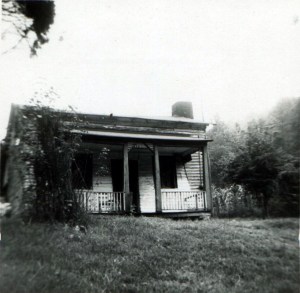
Mullins Cabin on Trace Fork, 1945-1955
18 Tuesday Dec 2012
Posted in Ed Haley
Tags
American Rolling Mill Corporation, Appalachia, Armco Steel Corporation, Ashland, Ashland Culvert Works, Ashland Oil and Refining Company, Ashland Steel Company, Ashland Tomcats, Ashland YMCA, C&O Railroad, Ed Haley, Ella Haley, Frogtown, Henry Clay, history, Kentucky, Midland Trail, National Dixie Highway, Norton Iron Works, Open Hearth Furnace Company, Paramount Arts Center, Poage Settlement, Sanitary Milk Company, Sherman Luther Haley, West Ashland
Ashland, Kentucky — originally named Poage Settlement but renamed “Ashland” in 1854 in honor of Henry Clay’s home — was a thriving spot of business activity when Ed Haley settled there after the Great War. It was an “iron and steel town” free of labor troubles with untapped natural resources situated at the intersection of the National Dixie Highway and the Midland Trail and accessed by at least five railroads. Its primary business was the Open Hearth Furnace Company, which according to a 1917 business directory, was the “largest in the world.” It also had the largest fire brick plant and the largest tannery and leather company in the world. By 1920, its population was 15,000 — almost twice what it had been in 1910.
In 1923, the American Rolling Mill Company (later Armco Steel Corporation) located in the western section of Ashland and constructed the world’s first continuous sheet mill. This new technology was revolutionary: it created thousands of jobs and improved the quality of sheet metal while also reducing its cost so that average Americans could afford refrigerators and other modern conveniences. Shortly thereafter, in what one local history referred to as “the greatest single event in Ashland’s history,” American Rolling Mill Company acquired Ashland Steel Company and the Norton Iron Works. In 1924, Ashland Oil & Refining Company was formed, helping to fuel an economic and population explosion, and the Sanitary Milk Company built a new plant at 34th and Winchester. The following year, Ashland Culvert Works located in town and the Chesapeake & Ohio Railway built a new passenger station. At that time, the population was estimated at 29,000.
During the early twenties, Ed and Ella Haley lived at “Frogtown” in West Ashland, a somewhat low-income area near the Armco plant. In 1920, Ed’s oldest son, Sherman Luther Haley, was born on March 17. He died, according to Kentucky death records, on April 5, not quite one month old. In the census for that year, Ed was listed as a thirty-five-year-old married musician. Ella was listed as thirty years old. Her son Ralph was not listed in census records with them, indicating that he was perhaps with the Trumbos in Morehead. In a 1924 business directory, Ed’s address was given as 618 ½ West Greenup Avenue. Today, this spot is at a floodwall near the city mall and a music store-turned-Chinese restaurant.
In those days, Ashland was not just an industrial site — it also favored the arts and recreation. The eastern edge of town offered a fifty-acre amusement park with a concert hall and dancing pavilion, as well as boating and swimming facilities. There was a YMCA and five theatres and “moving picture houses”, as well as a racetrack and a yearly agricultural fair. Its local high school, the Ashland Tomcats, was the national basketball champion in 1928, having edged Canton, Illinois, 15-10. Ashland seems to have retained its zest for the arts. Today it offers a beautiful park in the center of town, a community college, the Paramount Arts Center, a library, and a museum.
17 Monday Dec 2012
Posted in Ed Haley
Tags
Al Brumfield, Appalachia, Charles Wolfe, Ed Haley, Green McCoy, Harts Creek, history, John Hartford, Kentucky, Lawrence Haley, Milt Haley, music, Paris Brumfield, West Virginia, writing
I was elated the entire trip home. As soon as I got back in Nashville, I called Dr. Wolfe and said, “I don’t even know where to begin to start telling you everything. I’ve got records and I got leads on where the rest of the recordings are. They just took me in and everything and as I got ready to go they gave me one of his canes for a souvenir. I’ve held one of his fiddles in my hand and looked at it. Now the other thing that Lawrence let me bring back are his reel-to-reel dubs of everything the Library of Congress has. There’s a bunch of tunes on there we haven’t heard: ‘Sourwood Mountain’ and ‘Dora Dean’.
“Yesterday we went up to Harts Creek in West Virginia, his birthplace. He’s a West Virginian; he’s not a Kentuckian. And in fact, Lawrence, because of the way his dad was treated when he was alive around Ashland, says he prefers to think of him as being a West Virginian. Lawrence, being the youngest of the five brothers, he’s kind of the keeper of the flame more or less. I think being around him I really get a flavor of what the old man was like. Even when we went up into Harts Creek, why the old-timers up there said he talked just like Ed.”
Dr. Wolfe asked me what my intentions were and I said, “I think what it amounts to is doing everything we can to preserve the music and the history because the story is incredible.”
I wasted little time in listening to all of Ed’s recordings on a reel-to-reel player borrowed from Doug Dillard. It was an incredible experience. I thought I’d died and gone to heaven. I immediately focused in on Ed’s recording of “Brownlow’s Dream”, the tune Roxie Mullins said was Milt Haley’s last tune. It was an amazing four part version of a tune I had learned from Elmer Bird called “Jimmy Johnson”. Lawrence had recalled his father singing, “Old Jimmy Johnson bring your jug around the hill. If you can’t bring your jug, bring your still if you will.” Not long after going through the reels, I took them to Bruce Nemerov at the Center for Popular Culture in Murfreesboro. I had promised Lawrence I would get him good copies.
A few weeks later, Dr. Wolfe called me with news of an old West Virginia ballad that mentioned the name of Milt Haley. It was titled “A West-Virginia Feud Song” and published in Professor J.H. Cox’s Folk-Songs of the South (1924). T.M. Martin of Marlinton, Pocahontas County, West Virginia, informed Cox about the tune in 1916, while S.S. Workman of Seebert, West Virginia, was the source for events surrounding it.
“The fight, out of which this song grew, occurred, as near as he could remember, in 1890, at the house of George Fries, eleven miles east of Hamlin, Lincoln County, and the trial took place at Hamlin,” Cox wrote. “The trouble between the factions was of long standing. The McCoy mentioned was a close relative of the McCoys that fought with the Hatfields. George Pack helped Mr. Workman get this song together. They never saw it in print.”
Events chronicled in the song lyrics seemed to be about Ed’s father, who was reportedly killed with a McCoy, but the account was so confusing that I really wasn’t sure.
Come all you men and ladies, and fathers and mothers too;
I’ll relate to you the history of the Lincoln County crew;
Concerning bloody rowing, and a many a threatening deed;
Pray lend me your attention, and remember how it reads.
It was all in the month of August, all on a very fine day,
Ale Brumfield he got wounded, they say by Milt Haley;
But Brumfield he recovered; he says it was not so,
He says it was McCoy that fired that fatal shot.
Two months have come and passed, now those men have met at last,
Have met at George Fries’ house, at George Fries’ house at last;
McCoy and Milt Haley, it’s through the yard did walk,
They seemed to be uneasy, with no one wished to talk.
They went into the house, sit down by the fire,
But little did they think they had met their fatal hour.
As the mob came rushing on them, the ladies left the room;
A ball from some man’s pistol lay McCoy in his tomb.
They shot and killed Boney Lukes, a sober and innocent man,
And left his wife and children to do the best they can;
They wounded old Ran Sawyers, although his life was save[d];
He seems to shun the drugshops, since he stood so near the grave.
Tom Feril was soon arrested and confined in jail;
He was put in jail in Hamlin to bravely stand his trial;
The Butchers threatened to lynch him, and that was all his fears;
The trial day it came on, Tom Feril he came clear.
There is poor old Perries Brumfield, he died among the rest;
He got three balls shot through him, they went through his breast.
The death of poor old Parris so lately has been done,
They say it was a hired deed, it was done by his son.
So go tell the nation around you it will never, never cease;
I would give this whole world around me to reach my home in peace;
In the bottom of a whiskey glass there is a lurking devil dwells,
It burns the breath of those who drink it and sends their souls to hell.
16 Sunday Dec 2012
Posted in Ed Haley
Tags
Appalachia, Arthur Smith, Ashland, Cincinnati, Clyde Haley, Ed Haley, Ella Haley, Hamilton, history, John Hartford, Kentucky, Lawrence Haley, life, love, Milt Haley, music, Ohio, Pat Haley, ragtime, Ralph Haley, Roxie Mullins, Scott Joplin, Sugar Foot Rag, writing
Back in Ashland, Lawrence and I told Pat all about our trip to Harts Creek. We had some great photographs — including the one of Ed’s mother — and all kinds of new information. One of the first things Lawrence did was joke Pat about seeing “that funny boy” who nearly scared her to death forty years ago. I told her about Milt Haley’s murder, the possibility of Milt having been a fiddler and about our interview with Roxie Mullins. Lawrence liked the story about his father breaking a fiddle over someone’s head, although it kind of bothered me to think he would do such a thing.
At some point during the evening, Pat suggested showing me Ella’s postcards, but Lawrence quickly dismissed the idea. I could tell there was something in those postcards he didn’t want me to see, which of course only peaked my curiosity. It was clear by his negative response, though, that the issue was closed so I didn’t mention it again.
Instead, I pelted him with very specific questions about his father. I wanted to know how Ed Haley felt about different types of music.
Did your dad like the Blues? I asked.
“I guess he liked, uh, Joplin,” Lawrence said. “He liked a lot of that ragtime. ‘Sugar Foot Rag’, he liked that.”
What about something like Hank Williams?
“No, I don’t think he cared too much for that.”
Otis Redding?
“Well, he might have liked some of it.”
How about Dixieland Jazz, somebody like Louis Armstrong?
“No, not too much of that.”
How about bluegrass?
“No, he didn’t like that.”
How about Arthur Smith?
“That was a fiddler, and he had nothing for him, I reckon.”
Clayton McMichen?
“Well, I never have heard him mention him.”
How about Georgia Slim Rutland?
“I really can’t remember him ever mentioning that guy, either.”
Did he ever know about Benny Thomasson or Major Franklin or any of those Texas fiddle players?
“John, I wouldn’t say one way or the other,” Lawrence finally said. “It’s just like you keep asking me, did he play this tune, did he play that tune? I guess my best answer whenever you started that shoulda been what didn’t he play in the way of this old-time music. And that’s the same way, who didn’t he know if they was into that and they was around this area he probably found out about them.”
Early the next morning, Lawrence and I went to see Ed and Ella’s graves in Ashland. Along the way, I asked him if he remembered all the places where his father had lived in town.
“Aw, we lived in half a dozen different places,” he said. “All we did was rent. We lived in a couple down on Greenup Avenue, 10th Street, 22nd Street. Then we lived in one on Halbert and about three different ones on 45th Street and one up on 37th Street. That’s about it.”
None of Ed’s former dwellings were still standing.
Lawrence told me about the time his brother Clyde almost got married: “That’s one of those deals where I told you he was afraid of women. He was courting a lady up in Detroit or somewhere and she told my sister-in-law, Patsy — Jack’s wife — said, ‘He run off and left me practically at the alter. We had made all the plans and everything.’ Next thing we knew, he was working on a platform out in the Gulf of Mexico out of Louisiana. I don’t know where he was when Mom passed away.”
After we got back to the house, Lawrence explained why he’d ruled out showing me his mother’s postcards the night before.
“Some of the old postcards that Mom used to receive kinda had a flavor of real broken love,” he said.
They also revealed that Ralph Haley actually belonged to Ella by a previous marriage.
“I don’t know what his name was, her first husband,” Lawrence said. “Apparently it was somebody that she met either in school or after she come out of school and went back to Morehead. I think Ralph was born around 1914, ’15, somewhere along in there, ’16. He was approximately ten years older than me, twelve at the most.”
For the first time, I thought, Lawrence was opening up about his mother. He said she used to type letters to her friends.
“She had a friend, I guess she must have been pretty well Irish. Her first name was Bridget. I don’t remember her last name. She never married. She went into a home and kept people up at Hamilton, Ohio. Every time we went to Cincinnati, Mom wanted to go see her.”
I listened quietly before saying, “I wonder what happened to your mom’s letters? I bet they would tell a lot of history.”
Pat said, “They probably would but it would mostly be my mother-in-law’s. You know, her life.”
I said, “But women invariably talk about their husbands a lot,” and Lawrence agreed.
“Women can pass along more information between them in five minutes than two men can all day long,” he said.
Still, he never offered to show the cards so I just kind of left it at that.
Just before I headed back to Nashville, Lawrence reached me his father’s walking stick. “Here’s something I think you’d like to have,” he said. He also loaned me the four Library of Congress reel-to-reel tapes, containing over 100 recordings.
Writings from my travels and experiences. High and fine literature is wine, and mine is only water; but everybody likes water. Mark Twain
This site is dedicated to the collection, preservation, and promotion of history and culture in Appalachia.
Genealogy and History in North Carolina and Beyond
A site about one of the most beautiful, interesting, tallented, outrageous and colorful personalities of the 20th Century
 Brandon Ray Kirk