• About

Brandon Ray Kirk

~ This site is dedicated to the collection, preservation, and promotion of history and culture in my section of Appalachia.

Brandon Ray Kirk

Category Archives: Ed Haley

In Search of Ed Haley 99

29 Monday Apr 2013

Posted by Brandon Ray Kirk in Ed Haley

≈ Leave a comment

Tags

Appalachia, Calhoun County, fiddler, history, music, U.S. South, West Virginia, Wilson Douglas, World War II, writing

     I played a little for Wilson over the telephone to see what he thought of my bow stroke and he said, “You’ve got a lot of nice bow technique there. Now, that’s very close to Haley. Now, he plays a longer bow, but now you’re right on it as well as I remember. That’s the first time I’ve been reminded of him since ’55. You know, he died in ’55.” Hearing that made me feel good about my Scotch snap theory regarding Ed’s bowing, which I had been wearing out at home, although I noted that Wilson was off four years on Ed’s death date.

     Wilson said Ed played for dances all over Calhoun County.

     “Now when he got in a square dance where they was wound up, he played ‘Pigeon on the Gate’. That was a odd fiddle tune. He said it came out of Missouri somewhere. He’d play all night, you know. I believe he had more endurance at a dance than I used to have when I was younger. I’ve been around him when he would play for hours and never play the same tune twice, unless it was requested by somebody. But now what amazed me, he would play all night and maybe not play the same tune twice. And he told me, he said, ‘I know over a thousand fiddle tunes’.”

     I wondered if Ed drank at those dances, as Mona had said he was wont to do.

     “Now, if anybody had any alcoholic beverages around them places, they always kept that hid until after the fiddling session was over,” Wilson said. “If Haley took one drink of liquor, he could not play a bit. He would sort of get a chip on his shoulder and then he’d become violent, too. However, I could understand that. The man was blind and maybe he would go through a depressing stage.”

     Ed was deeply depressed during World War II, Wilson said, because his sons were away in the fighting.

     “We would go over to this place to hear him fiddle and he would not play one bit till I informed him what all Hitler was a doing, what the U.S. was doing, where all they were invading.”

     Wilson’s memories of Ed’s family were limited.

     “I saw one of his boys one time and I didn’t talk to him too much. He didn’t seem interested in music.”

     I asked Wilson if Ed ever told any stories and he said, “Na, he wouldn’t tell you nothing or he wouldn’t show ya nothing. He was real touchy, you know. You had to be careful not to punch the wrong buttons. He did not have the patience to show you anything on the violin. He wouldn’t show you where to slow up and show you no notes. He just wanted you to listen and think about it. He said a man ought to comprehend a tune and if he heard it a few times he ought to start at the outer edge of it and then finally it will dawn on you what to do. He said, ‘If you’re determined enough, you’ll finally get it.’ And in them days, you know, there was no tape recorders, so you just had to hear it over and over and do the best you could. I kind of believe his theory: I think fiddle playing is a gift and if you ain’t got a little of the gift, I don’t think you’ll get it.”

In Search of Ed Haley

28 Sunday Apr 2013

Posted by Brandon Ray Kirk in Ed Haley

≈ Leave a comment

Tags

Appalachia, Harts Creek, history, life, Logan County, Peter Mullins, photos, U.S. South, West Virginia, writing

Ed Haley Note, 1915

Ed Haley Property Tax Note, Trace Fork of Harts Creek, Logan County, West Virginia, 1915

In Search of Ed Haley 98

28 Sunday Apr 2013

Posted by Brandon Ray Kirk in Ed Haley

≈ Leave a comment

Tags

Appalachia, Calhoun County, Doc White, fiddler, French Carpenter, history, Ivydale, Laury Hicks, music, West Virginia, Wilson Douglas, writing

After some thought, I called Wilson Douglas, whose voice sounded “robotic,” like someone singing through an electric shaver. He said he had to talk through one of those little buzz boxes because he had lost his vocal chords to throat cancer several years ago. I asked him what he remembered about Ed coming to Laury Hicks’ house and he repeated a lot of what I had already read.

“Well now that’s a pretty long story,” Wilson began. “I knew him way back in ’38, ’39. As you know, he was a resident of Ashland, Kentucky, and he was born in Logan County, West Virginia. Well, he would come up to Ivydale, West Virginia, by train and then he would ride over on up into Calhoun County with the mail carrier. And he would get a ride with somebody over to Laury Hicks’, like with an old gentleman who used to be a country doctor, Dr. White. And while he was up in Calhoun County and Clay County, we’d go ever night — if we could get there anyway — and he’d play that fiddle about four or five hours at a time. Well, he’d go back to Ashland and stay a couple of months. I guess he was playing somewhere around in Kentucky. And then along in the fall he’d come back and maybe stay a month and then he’d catch the train to Logan County.”

I asked Wilson if he played a lot with Ed and he said, “Oh, well. No, I didn’t play a lot with him. I was just beginning to fiddle, you know, and he was my idol of a fiddler player. He mostly inspired me to fiddle, him and David French Carpenter of Clay County, West Virginia. I’m going to tell you, that there album [Parkersburg Landing] don’t give him credit.”

I asked Wilson if he remembered any of Ed’s tunes and he said, “Oh god, he played all the old tunes. Well, as you know, they all played the ‘Billy in the Lowground’, the ‘Tennessee Wagner’. I play one of Haley’s tunes: he called it the ‘Morning Flower’. Played in the key of A. I’ll have to think. Well, as you know, he called the ‘Stony Point’, the ‘Gilroy’. I learned that off of him. You know, all these tunes has got four or five different titles. And I played a little bit of his ‘Devil’s Dream’. He would play that to get warmed up.”

Did you ever hear him play “Blackberry Blossom”? I asked.

“Oh, by god yeah,” he said. “I remember him playing that. You know, Ed Haley told me he could hear a tune twice and play it, and I believe it.”

I said to Wilson, “Now, Ed Haley improvised a lot, didn’t he? Like take a tune and play it different kinda ways.”

“Well, he could play it about any way,” he said. “I’ll tell you what. He’d do a lot of that to show his skill, I think, but when you settled him down he didn’t vary the bow from one time to another. Now where they’s a gang of fiddlers around, you know, a little distant to him, trading tunes and messing around, he would show them up. I don’t think he did it just to be smart: he did it to show them that he could do it, you know. And what I liked about him: if he heard somebody play a tune, they’d say, ‘Well now Ed, am I getting it?’ And he’d say, ‘No, you’re not getting it.’ And if you were to get it, he’d say, ‘Yeah, that’s good enough. Drop it. Don’t try to do it no better than that.’ I liked that. He went straight to the point, and he told it like it was. If a fiddler got to fiddling too fast, he’d say, ‘Well, you’re losing the soul.’ Oh, he’d just cuss. Only tune to my knowledge that he really played fast was ‘Forked Deer’.”

I asked Wilson what he remembered about Ed’s bowing and he said, “Now, he played a long straight bow, but he put in the bow whatever the tune required. Every tune requires a different bow technique, as you know. Oh God, he played a long shuffle bow. I always thought he had the longest fiddle bow I’d ever seen. You know, he could tell if a fiddler was playing the short bow. He’d say, ‘Well son, don’t hold your bow up in the middle. Catch back on the frog of the bow. By god, you need to have bow if you’re gonna play that kind of music.'”

I asked Wilson if he thought Vassar Clements’ bowing was anything like Ed’s and he said, “No, no. By god, no. No, not in my book. Now, you know everybody’s entitled to his own opinion.”

Did Ed play with a tight or loose bow?

“He played a half-tight bow. He didn’t want any bouncing or want any wobbling.”

Wilson Douglas

27 Saturday Apr 2013

Posted by Brandon Ray Kirk in Clay County, Ed Haley, Music

≈ 4 Comments

Tags

Appalachia, Clay County, culture, fiddle, fiddler, history, life, music, photos, U.S. South, West Virginia, Wilson Douglas

Wilson Douglas, Clay County fiddler

Wilson Douglas, West Virginia fiddler

In Search of Ed Haley 97

27 Saturday Apr 2013

Posted by Brandon Ray Kirk in Ed Haley

≈ Leave a comment

Tags

Calhoun County, Clay County, Doc White, fiddler, guitar, history, Laury Hicks, music, West Virginia, Wilson Douglas, writing

     Around that time, I read up on Wilson Douglas, an old-time fiddler who remembered Ed Haley visiting Laury Hicks during the Depression. I had first heard of him several months earlier from J.P. Fraley’s circle of friends. Wilson came from a family of musicians in the Elk River Valley north of Charleston, West Virginia.

     “I was born October 22, 1922 in Clay County,” Wilson said in one published interview. “My grandfather, Martin Stephenson Van Buren Douglas was one of the greatest ballad singers of all times. My dad was Shirley Andrew Douglas and he was a beautiful banjoist! And my Grandmother Morris was an old-time square dance fiddler and all her brothers were top fiddlers on my mother’s side, the Morris side.”

     Wilson started playing music at a young age, first the guitar, then the fiddle.

     “I started on the guitar when I was nine years old and I played the guitar Carter-fashion,” he said. “And 1935-36 was a severe cold winter. I was 13 years old. I had played the guitar up until that time for various fiddlers. During that winter I lived about a mile from my grandmother’s. At that time she had the only old fiddle in the country to my knowledge. The old instrument was patched with solder, carpet tacks, and various other things. Every night I would take my guitar over there and play. She would play hoedown fiddle tunes half the night. She played mostly dance tunes on two or three strings. She seldom played the bass. The following winter her health failed and she began to lose interest in the violin. However, that fiddle began to sound good to me. Then I suddenly decided that I would quit playing the guitar and try to make some kind of fiddler out of myself. So I started saving my money to buy me a fiddle.”

     In a short time, Wilson found himself visiting at the home of Laury Hicks, where he first saw Haley.

     “There was an old gentleman that lived in Calhoun County joining Clay County by the name of Laury Hicks,” Wilson said. “He was a good old-time rough fiddler. I would ride a bicycle over to his home to hear him play the fiddle. Then somehow Laury Hicks contacted Ed Haley in Ashland, Kentucky. In about a month Haley came to Calhoun County. So the news got around through the country that Ed Haley was at Laury Hicks’. Everybody around went to hear him play. It was 12 miles from where I was raised over to Laury Hicks’ where Ed Haley’d come to. And if a gang didn’t gather up to go in an old ’29 Model-A Ford truck, we’d start walking. Maybe somebody’d come along in an old car and pick us up. And it was just like a dang carnival, you know. We just sat and never opened our mouth and he’d scare them fellers. Them fellers never tried to play. I was just dazed with that fiddle. He’d play until about 12 o’clock at night, and when he got tired, he’d quit. I was really not conscious of coming back home.””

     According to Wilson, the locals tried to keep Haley in that part of the country as long as possible.

     “Well, when he’d take a notion to go back to Kentucky, we’d all beg him to stay another week,” he said. “Doc White would say, ‘Ed, now listen. They’s a gang of people coming from Roane County, you can make some money. Now, you stay another week.’ Ed was bad to swear. Well, they’d talk him into it. Maybe some of these old farmers would come along. They’d had a tune and maybe their father played or some of their ancestors and they’d heard it. They’d say, ‘Well, Ed, play me this tune,’ and they’d hand him a dollar. Well, he’d play it for 15 minutes! They’d sit there with big tears. Well, he’d play till the money ran out and he’d quit!”

     Wilson told about the last time he saw Haley play at the Hicks home.

     “The last night, the last time I seen him, I was a big boy and I’d got over there,” he said. “I was sitting in this old split-bottom chair. Sleepy, you know. But every time he’d play a tune, I’d survive. And he said, ‘Son, what’s your name?’ I didn’t know that he knew that I’d been sitting in front of him. I told him. He said, ‘You’ve been over here every night, haven’t you?’ I said, ‘Yeah,’ and I said, ‘Mr. Haley, you’ve played tunes for everybody and I don’t have no money. I’m saving up to buy me a fiddle.’ He laughed! I said, ‘How about you playing me a tune?’ ‘All right. What is it?’ I said, ‘Play the ‘Black-Eyed Susie’.’ ‘Well, that’s really no tune. It’s just a little old thing.’ ‘Well,’ he said, ‘Damn it, I’ll play it. I don’t like to play it. Them’s single-line tunes, but I’ll play it for you.’ And he did, because I was interested, you see?”

In Search of Ed Haley 96

27 Saturday Apr 2013

Posted by Brandon Ray Kirk in Ed Haley, John Hartford, Music

≈ Leave a comment

Tags

Appalachia, Catlettsburg, Clyde Haley, Ed Haley, Ella Haley, fiddle, fiddlers, fiddling, Harts Creek, history, Irish lilt, Kenova, Kermit, Kevin Burke, Lawrence Haley, music, Nashville, Noah Mullins, Norfolk and Western Railroad, Patsy Haley, snap bowing, West Virginia, Williamson, writing

Nestled in Nashville, I worked obsessively on Ed Haley’s music. First, I made a real effort to transcribe it note for note and break it down “under the microscope.” Initially, I had tried to play it generally the way he did while keeping its spirit — with my own twists, of course, which is nearly impossible not to do. This time, though, I wanted to study it as you might a fabulous book — break it down, look at it mechanically… I made a huge discovery regarding Ed’s bowing during that time. With Lawrence’s help via telephone conversations, I deduced that Ed used what Scotch fiddlers call “snap bowing,” which is when you separate notes by applying pressure (“little stops”) with the bow — not by changing its direction. Of course, Ed didn’t use those patterns exclusively and mixed them with more conventional strokes.

I also spent a lot of time listening to Ed’s recordings and playing my versions of his songs into a tape recorder. One of the first things I figured out was that he used what fiddler Kevin Burke calls the “Irish lilt” to give his music a “dotted note feel.” It would be like playing a tune in triplets with the middle note taken out.

I also discovered that Lawrence was right about Ed not playing so many notes; instead, he created the illusion of doing so by phrasing his tunes in a way that gave them a nice “crooked” flavor.

Throughout these discoveries, Lawrence continued his role as my brutally honest fiddle teacher. His comments were surprisingly musical for someone who kept reminding me that he didn’t even play anything. When I played “Yellow Barber” for him over the telephone, he said, “That sounded right except when you get down to that low end, you’re doing a little skipping in there and it seemed to me like Pop played that a little bit smoother. Like he had a roll to his… And I noticed you had a few jumping notes in there that really I don’t remember hearing. Maybe you can hear them. Other than that, it sounded great to me.”

Lawrence seemed pleased with my playing of Ed’s “Catlettsburg”.

“That was good, John,” he said. “That was really good.”

I told him I didn’t know how Ed was able to get up into second position on that tune with the fiddle sitting at his shoulder.

“I always thought that he kinda controlled the violin with his thumb and the meaty part of his hand between his finger and thumb,” Lawrence said. “He could relax that up and down the neck of the violin or he could tighten that and he could still have the flexibility of his fingers, plus that give him the ability to rock that violin body underneath the bow, too.”

I was trying that and eventually got to where I could will my fingers into third position still holding the fiddle at my shoulder, which if you have to play for a long time is sure easier on the neck of the player.

I told Lawrence about talking with Clyde, especially about his memories of Ed mistreating him as a child.

“I don’t know, maybe my dad was mean to him when he was a young’n,” Lawrence said. “But I can’t remember my dad ever laying a hand on me to hurt me. I musta been a rowdy little kid ’cause it seemed like whenever Pop’d pick me up he’d call me ‘muddy duck’ because I was always dirty, I reckon, whenever he’d get a hold of me. He’d just rub my head or something like that and call me his ‘muddy duck.’ I don’t know where Clyde got his story from.”

Lawrence agreed that his dad sometimes abused his mother, although he placed a lot of blame for their marital problems on her.

“Well, he could be temperamental with my mother at times, but I think she was temperamental, too. I think my mother’s people had higher tempers than Dad’s people did. They seemed to be kinda quiet people. Noah Mullins was supposed to killed a revenuer up there at Harts. They waylaid a revenuer and they laid it on Noah, but Noah Mullins always seemed to me like just as quiet and as calm a fella as could be. But I had some of my uncles on my mother’s side, they were a little bit of a temperamental type of people. So I’d put some of the blame on my mother for her treatment of my dad. You know, a woman can upset a man and whip him quicker with words than he can whip her with his fists.”

I totally agreed, then asked Lawrence if he knew anything about the Muncys from Patsy’s genealogy.

“We’d ride the Norfork and Western train up from Kenova and stop at Kermit and stay there with Muncy people,” he said. “They lived in an apartment up over their store and filling station-type thing and they had one of them small monkeys. I went up there one day and got right at the top of the steps and was playing with that monkey and I musta made it mad and it made a rush at me and I musta jumped back and I went to the bottom of them steps. That made me remember it more than anything else. I can’t even remember that Pop played music while he was there for them. They mighta just talked. We used to stop there maybe and stay all night and Pop and Mom and me would go on to Williamson and they’d play at courthouse days or something there. Pop musta had people up in there, but he never said anything to me about it.”

In Search of Ed Haley 95

25 Thursday Apr 2013

Posted by Brandon Ray Kirk in Ed Haley

≈ Leave a comment

Tags

Asa Neal, Ashland, Ben Haley, Clark Kessinger, Clyde Haley, Kentucky, Lucian Muncy, music, Natchee the Indian, Nellie Muncy, Sam Vie, writing

I called Clyde Haley to ask him about Patsy’s genealogical information. Trying to prompt his memory, I asked, “Your grandfather’s father was named Benjamin Haley and his wife’s name was Nellie Muncy.” He said, “Muncy? Well I knew some Muncys when I was back up there, you know. They were in West Virginia. Down around Huntington and down in that area. Luce Muncy had a store and filling station, and that’s the most I can remember about them. Lucian Muncy.”

Clyde went from sketchy memories of the Muncys to asking me, “Did you ever know a guy named Clark Kessinger? He was a fiddler, too, you know.” I asked Clyde if he thought Kessinger tried to play like his dad and he said, “I don’t think so. I just come up with that name from somewhere. You know my dad used to take me out on those contests when he’d go and I remember some of those people — like Natchee the Indian. Sam Vie, he was a blind fiddler. He could play a guitar pretty good, too.”

What about Asa Neal? “Asa Neal? I think I went with my dad when we saw him one or two times. I’ll tell you somebody else that was close to our family — those Judds. They lived on the hollow where I lived, called 37th Street in Ashland, Kentucky. We didn’t know them back in those days.”

Clyde seemed to really enjoy my calls. He asked, “When are you coming this a way?” — as if I were just down the road. I told him it would be in the spring and he said, “Well, why don’t you check on me here if you come this a way and we could get us a day off and go somewhere and sit down and just talk all day? I don’t know what you’re doing with this information but I’d like to hear you say it’s going in the news some way. Maybe write a book about his history. That would make me happy. At least he would be remembered.”

Clyde paused, then said, “I’ve been all over the country in different forms and manners and ways. I’ve been a roamer all of my life, but I’ve got this damned arthritis and it’s pretty well got me pinned down.”

In Search of Ed Haley 94

24 Wednesday Apr 2013

Posted by Brandon Ray Kirk in Ashland, Ed Haley, Music

≈ 2 Comments

Tags

Appalachia, Ben Haley, Chloe Mullins, Cleveland, Clyde Haley, Ed Haley, Ella Haley, genealogy, history, Imogene Haley, Jack Haley, Jackson Mullins, Janet Haley, Laura Belle Trumbo, Lawrence Haley, Margaret Ryan, Milt Haley, Mona Haley, music, Nellie Muncy, Noah Haley, Pat Haley, Patsy Haley, Ralph Payne, Sherman Luther Haley, William Trumbo, Wilson Mullins

Not too long after talking with Patsy, her son Scott sent me a copy of Ed’s genealogy, most of which came directly from Ed and Ella. “James Edward Haley was born in August and was the son of Milt and Imogene (Mullins) Haley,” the notes began. “He died February 4, 1951 in Ashland, KY. He married Martha Ella Trumbo, a daughter of William A. and Laura Belle (Whitt) Payne Trumbo. She was born July 14, 1888 and died November 26, 1954 in Cleveland, OH. At the time of their marriage, Ella had one child from a previous relationship: Ralph A. Payne who married Margaret Ryan and who died on May 22, 1947.”

Patsy listed Milt Haley’s parents as Benjamin Haley and Nellie Muncy, and Emma Jean (Imogene) Haley’s parents as Andrew Jackson Mullins and Chloe Ann Gore.

There was detailed information on Ed and Ella’s children.

“Sherman Luther Haley, the oldest, died as an infant. Clyde Frederick Haley was born on June 13, 1921 and never married. Noah Earl Haley was born on October 26, 1922 and married Janet J. Fried in September of 1951. Allie Jackson Haley was born on April 6, 1924. He married Patsy J. Cox on October 25, 1946 and died on March 23, 1982. Lawrence Alfred Haley was born on January 8, 1928. He married Patricia M. Hulse in February of 1949. Monnie May Haley was born on May 5, 1930 and married in 1945 to Wilson Mullins.”

In Search of Ed Haley 93

22 Monday Apr 2013

Posted by Brandon Ray Kirk in Ed Haley

≈ Leave a comment

Tags

Ashland, banjo, Ella Haley, fiddle, Kentucky, Lawrence Haley, Molly O Day, Mona Haley, music, Patsy Haley, Ralph Haley, Wilson Mullins

After securing Patsy’s telephone number from Lawrence Haley, I called her up with questions about Ed’s background. Patsy said she first met Ed just after Thanksgiving in 1946 when she and Jack moved in with the family at 105 17th Street in Ashland. At the time, Mona and her husband Wilson Mullins lived there, as did Mona’s son, “little Ralph.” She was in daily contact with Pop for the next three months.

I asked if Ed drank a lot in those days. “Sir, I never saw the man drunk,” she said, in a very pronounced Cleveland accent. “I know one time he went off with his son to play for some people that were having a party and I guess he got kinda high on the horse then, but he never came home.”

Patsy said Ed never played on the street after she came into the family but would play around the house for the kids. She remembered Ed putting the fiddle on his shoulder and playing tunes like “Black Jet” and “Lightning Express”.

“Pop had one special song for me,” she said. “It was, ‘I took a fat gal by the hand the other afternoon and someone yelled out where’s the string that goes with your balloon?’’ because I was a little on the chubby side. Oh, that man could play anything. He could listen to the radio and play popular music. He played the guitar. Beautiful banjo. I don’t think he used a pick.”

Around 1948, Molly O’Day came to see Ed at his home on 45th Street in Ashland. She brought her husband and fiddling brother — and a lot of recording equipment. Everyone settled in the living room, where Ed played the fiddle, “long neck” banjo and mandolin. Patsy said it seemed like they were just “horsing around,” although there was one song that Molly wanted to hear “real bad.” She didn’t recall much else about the visit because she mostly stayed with Ella and little Ralph in the kitchen.

Patsy said Ed never told any stories but she heard from Ella how his parents were killed on Harts Creek. It was a totally different account from anything I’d heard. “Mom Haley told me that they were both murdered in the log cabin,” she said. “Now, that’s not what happened according to what everybody has been telling me from down in Kentucky.”

I asked Patsy why she thought Ella would have told her something that was apparently untrue and she said, “Well, they might’ve just not wanted me to know everything. They thought I was just one of them big city girls from Los Angeles.”

She had also heard how Ed came to be blind.

It was measles that did it — that’s what Mom Haley told me — and that they left him out in his buggy in the sun.”

In Search of Ed Haley 92

18 Thursday Apr 2013

Posted by Brandon Ray Kirk in Ed Haley

≈ Leave a comment

Tags

Clyde Haley, Ella Haley, Frank Creech, Harts Creek, Kentucky, music, Noah Mullins, Patsy Haley, Peter Mullins, Ralph Haley, Sherman Luther Haley, writing

Clyde said, “My brother Ralph, he was my dad’s favorite because Ralph was smarter than I was. He wouldn’t ever beat up on Ralph. Well, Ralph was bigger than he was. Did you ever know a guy from this part of the area named Frank Creech? Well, he was one of the bad boys around my area when I was growing up. And he come and borrowed Ralph’s guitar from my dad. Ralph had a great big Martin guitar. He’d bought it from one of those Ruffner boys, I think. He worked. But this guy Frank Creech borrowed Ralph’s guitar and took it somewhere and had a truck run over it — smashed it up. So Frank Creech come to the house and told my dad about it and my dad wasn’t saying a word about it. I was there in the house when this happened. And my mother didn’t like to hear anybody cuss. She was a Puritan about things like that. She didn’t allow any of that in her house.”

Clyde’s memories trailed off at that point, but I knew he was telling more about Ed’s attack on Frank Creech, an event which I’d first heard about while watching a Christmas video at Lawrence’s house.

Clyde said Ed and Ella argued sometimes about music.

“He’d want to play it one way and she’d want to play it the other,” he said. “But a mandolin and a fiddle are tuned up the same way — got the same pitch on the strings — but it’s a different kind of music.”

I asked him who usually won the arguments and he said, “Well she did because he’d give up on her.”

Clyde laughed, “He was mean. If he didn’t win with his talking, he’d do it with his fists to my mother.”

So Ed beat on his wife? I knew that was something Lawrence would have never told.

“He was a mean devil,” Clyde continued. “The worst I ever done him in my life, we was up on Harts Creek at Uncle Peter’s house. And he wanted to go somewhere and she didn’t want to go at that particular minute [and he started hitting her with his fists, so I got a hold of a plowpoint] and hit him in the head with it. Knocked a pretty good-sized hole in the head. Noah Mullins and the other Mullins boy Tennis chased me all over that mountain with a great big piece of a hoe-club. He never did catch me because I was pretty fast on my feet, too, running through those mountains and I could really get over the land. I was a boy then — a minor, you know — and they took us all down to Catlettsburg to the city jail and they threatened him with putting him in the penitentiary for beating on my mother that way and after that he never did beat her up too much.”

I asked Clyde if Ed did a lot of jail time and he said, “Just for minutes, like to hold him over for a few hours. Let him get sobered up a little bit. They weren’t mean to him, but they were mean to us boys, the police were. We deserved it.”

When I mentioned Ed’s oldest son, the boy who had died young, Clyde said, “He was born before I was. His name was Sherman Luther. Sherman was between me and Ralph.”

I said, “Now Ralph was your mother’s boy by somebody else.”

“Well, I didn’t know that,” Clyde said, kind of rattled. “See, you’re telling me things I don’t know and that kinda shakes me around a little bit and I don’t know what to say.”

I tried to smooth things up by saying, “Well I heard that but I wasn’t sure.”

Clyde said, “Well it seems to me like it could be, because my mother was a woman just like all the rest of the women. She had her good points about her. She was a Christian. I think that in my heart. But my dad wasn’t. He was just an ornery, old mean man. I hate to keep saying that about him because I… I hated him for a long time for the way he treated my mother and I finally got out of that hate and I got so I could talk about it to people who had business a knowing about it. I’m telling you things that I wouldn’t say to anybody else because I believe in you and I believe you’re being honest about what you’re doing. I wish it could be known widely about what he did for a living.”

Clyde promised if I’d come and see him, he’d tell me a lot more about Ed that he didn’t “dare mention over the telephone.” He said, “You know, I had a skull fracture here about a year ago and I can’t think real properly like I could if I set down. I’ve had my head broke, my brains knocked out a couple of times, and that affected me, too. If I saw you… Maybe if I could be prodded a little bit, I might could recall some things that might go good in a book.”

In the meantime, he said I should contact his sister-in-law, Patsy (Cox) Haley, who’d done some research on Ed’s family years ago.

“That was Jack’s wife,” Clyde said. “Her husband Jack, he blew up with a heart attack. You ought to get in touch with her. She can tell you more about that than any of us boys could ’cause she was a genealogist. She took that up as a hobby and she got into it and she couldn’t get out of it.”

In Search of Ed Haley 91

17 Wednesday Apr 2013

Posted by Brandon Ray Kirk in Ed Haley

≈ Leave a comment

Tags

Asa Neal, Bill Day, blind, Bus Johnson, Calhoun County, Camp Crowder, Cincinnati, Clyde Haley, Doc Holbrook, fiddle, fiddler, history, Laury Hicks, Lawrence Haley, Minnie Hicks, Missouri, Mona Holbrook, music, Ohio, Ralph Haley, Ralph Payne, Rosie Day, Sam Vie, Signal Corps, West Virginia, WLW, writing

Clyde said Ed never said “too much” about where he learned to play the fiddle.

“Well, he was blind all his life, since he was a small boy, and he started with a cornstalk.”

Ed did talk about other fiddlers, though.

“Oh, yes,” Clyde said. “He knew Sam Vie and Asa Neal, and all those old-timers. Did you know Bill Day? Well, my dad used to play with him a lot. But Bill Day couldn’t play the fiddle as far as I’m concerned.”

Bill Day’s wife Rosie was a sister to Laury Hicks, Haley’s veterinarian friend in Calhoun County, West Virginia.

“Well, Rosie was Laury’s sister, as I remember,” Clyde said. “Rosie stayed with my mother and helped take care of Mom because my Mom didn’t like to cook in the summertime because of the flies. I got in trouble one time and I had to go stay with Laury and Aunt Minnie. And I stayed with them in my growing up years. Laury was a doctor, you know, and so was Minnie. She’d just go on a horse, travel miles and miles and miles on a horse, to go deliver a baby or something like that.”

Clyde also remembered Doc Holbrook, Ed’s friend in Greenup, Kentucky.

“Yeah, yeah,” he said. “Monnie, my sister, was named after Dr. Holbrook’s wife: M-O-N-N-I-E.”

Clyde was well aware of Ed’s suspicions toward the commercial music industry.

“My dad didn’t ever want his music recorded and it was difficult to get him to get in a position where he would let anybody record his music,” he said. “There was a guy named Bus Johnson in Cincinnati that wanted my dad — I remember — he wanted my dad to come down there to Cincinnati to WLW and get some music recorded for him but he wanted to commercialize it, you know, which I wish he had’ve now. My dad and mother would’ve had a lot better life with the money they could’ve made off the music. I always did tell my dad, ‘Pop, you ought to get those things recorded because you got money laying around in the fiddle case.'”

Talking about Ed’s refusal to make commercial records caused me to ask about his home recordings.

“Him and my mother had over six hundred records,” Clyde said. “Them old records that Ralph sent home out of the Army. He was in the Signal Corps at Camp Crowder, Missouri, and he took a lot of the equipment home — borrowed it from the Army — and my dad and my mother was in on some of the records, too, you know. And Lawrence has got all that kind of information; more than I would have because I’ve been gone from home. I’ve been a roamer, you know. And I used to drink a lot. I don’t think I’ll ever take another drink, but that’s neither here nor there. I’m in this hospital and it’s what it’s for. I had strokes. It’s not a nut-house hospital or anything. It takes care of people like me. I used to drink quite a bit myself, but I’ve made up my mind since I had the strokes that I’ll let that stuff alone when I get out of this place. I talk like it’s a jailhouse, but it’s not. It’s full of women.”

In Search of Ed Haley 90

16 Tuesday Apr 2013

Posted by Brandon Ray Kirk in Big Harts Creek, Ed Haley, Lincoln County Feud, Music

≈ Leave a comment

Tags

Appalachia, Clyde Haley, Ewell Mullins, fiddler, Harts Creek, Harts Mountain, history, Hollene Brumfield, John Hartford, Liza Mullins, Logan County, Milt Haley, music, Peter Mullins, West Virginia, Zack Williams

I asked Clyde if Ed ever talked about his early life on Harts Creek and he said, “He didn’t talk to us kids too much. My dad’s folks were from all around Logan County, West Virginia. I didn’t know who they were. I remember his Aunt Liza and Uncle Peter Mullins. ‘Club-Footed Peter’ Mullins, they called him, and ‘Reel-Footed Peter’ Mullins. That was his uncle. I remember them because I was the one that went with him when he went up that way. As a matter of fact, I went up there one time and stayed just for a whole year.”

I said, “Your grandfather Milt Haley was involved in an attempted murder…” before being cut off. “Yeah, Hollene Brumfield. I know about that. I know things about it, because I’ve been up there. He killed this guy and in the process of trying to kill this guy, he shot Hollene Brumfield in the face and mutilated her pretty bad. It was a accident. Hollene was riding behind her husband on a horse down Harts Creek. He missed him and shot Hollene — killed her. That’s the way I always got the story from my dad.”

Clyde seemed to have Milt’s story down better than any of Ed’s other kids, so I pressed him for more details about Harts Creek. I asked him about the musicians in that vicinity and he said, “They didn’t play the kind of music my dad played. There was one old fiddler up there, lived up in the head of Harts Creek. Not off on one of the branches — right straight up Harts Creek past Ewell Mullins’ store. This guy’s name was Zack Williams. Him and my dad used to fiddle together. Never went out on big sprees or anything like that, but he’d go up to Zack Williams’ house up on the top of the mountain — head of Harts Mountain — and they’d make music up there. Zack was a pretty good fiddle player.”

In Search of Ed Haley 89

14 Sunday Apr 2013

Posted by Brandon Ray Kirk in Ed Haley, Music

≈ Leave a comment

Tags

Appalachia, Armco, Ashland, banjo, Billy in the Lowground, Blackberry Blossom, Brownlow's Dream, Cacklin Hen, Clyde Haley, Dill Pickle Rag, Ella Haley, fiddle, fiddler, fiddling, Flop-Eared Mule, history, John Hartford, Kentucky, music, Roy Clark

Clyde’s memories of Ed playing in contests were much more detailed than anything I had heard from the other kids.

“I’ve seen him go to contests and look like a farmer and he won every one he ever got into,” he said. “He’d go down to the Armco there in Ashland — they’d put up a bandstand up there — and when they’d have contests they had these eight or ten fiddlers up on the stage and he’d be up in all that mess. He fiddled with some of the best that there was in that country in that particular part of the time. I know he had a lot of people used to come to the house and play music with him.”

I asked Clyde what tunes Ed won contests with and he said, “Well, ‘Cacklin’ Hen’, ‘Billy in the Lowground’ and tunes like that. Not any particular ones. He could play any kind of music if he knew it. If he knew the words, he could make music like nobody you ever heard in your life. He had one tune called the ‘Flop-Eared Mule’. I remember ‘Brownlow’s Dream’, ‘Blackberry Blossom’ and ‘Dill Pickle Rag’.”

Gradually easing into specifics, I wondered if Ed held the bow in the middle or out on the end.

“It would depend on what kind of music he was playing,” Clyde said matter-of-factly. “I’ve seen him hold a fiddle bow down at the end, where the hair hooks up. Depending on the tune, the fastness of the tune, he could hold a bow anywhere he wanted to.”

Did he bow with short strokes or long strokes?

“Well, it would depend on which way he was sitting,” Clyde said. “If he was sitting on a chair with his right leg put out far… He never held the fiddle like anybody else I ever saw. He held it way low on his chest, almost down to his belt-line. My dad had long arms, you know. He was a long, thin man. We have a tendency to want to exaggerate a little bit and say he was bigger than he was, but I knew him pretty well. His hands were real thin — looked like a piano player. He could finger that fiddle like nobody you ever heard or saw.”

I asked if Ed picked the banjo and Clyde said, “Oh, yes. He was better with a banjo than he was with his fiddle. It didn’t have a thumb-string on it. I tried to learn how to play the banjo, too, but I never could do any good at it. Well, my mother bought me a fiddle in the store somewhere and she tried to get me to learn how to play the fiddle because she knew she was gonna be dead one of these days and him too and she wanted to have all that music made for posterity. My mom didn’t want me to do it, but my dad wanted me to. He called me his favorite son and said he wanted me to carry on his tradition. I tried, but I got my fingers cut off when I was a lot younger — two-thirds of my first and second fingers on my left hand — and that messed me up from noting. Ralph was the one that played with my dad a lot. He played the guitar like Roy Clark played. He had a big Martin guitar that was a double-header and he could play on both necks of it at the same time. Ralph was a good musician. He died in 1945.”

Clyde talked a lot about Ed being a drinker, which was something Lawrence kind of kept “under wraps”.

“He was a rip-snorter, don’t think he wasn’t,” he said. “You know, he could be pretty boisterous when he wanted to be. Ed Haley was a mean person — believe me he was. I loved him… He used to take me because he knew I liked to go with him. He would give me a drink every once in a while. He knew I got to liking that and he’d take me with him just about everywhere he went. I think he was the one who got me to drinking too when I was a kid and it’s the worst thing I could’ve done. Course I had no control over it then.”

I asked Clyde what Ed’s drink of choice was and he said, “Whiskey. He wasn’t a beer drinker much, or wine. He didn’t go much for that kind of stuff. He drank moonshine when he could get it, and he generally got it.”

Clyde had seen Ed drunk but said it didn’t hurt his fiddle playing.

“I think if anything, it made it better.”

In Search of Ed Haley 88

12 Friday Apr 2013

Posted by Brandon Ray Kirk in Ed Haley, John Hartford, Music

≈ Leave a comment

Tags

8th of January, banjo, Battle of New Orleans, Black and Jet, blind, Clyde Haley, Ed Haley, Ella Haley, fiddle, history, Indian Squaw, John Hartford, Lawrence Haley, Lost Indian, mandolin, Matilda Ziegler Magazine for the Blind, measles, moonshine, music, Paddy on the Turnpike, Pigeon on the Gate, Portsmouth, Reader's Digest, The Lightning Express, U.S. Army

Clyde paused, then asked, “Did Lawrence show you them pictures of my dad? Did you ever see him in that big coat?”

Before I could answer, he took off again, “He wore that long as I remember about him, and he’d go to the bootlegger and get him a pint of moonshine — one in each pocket in that overcoat — and he’d go over to Portsmouth. I’ve seen him have an old clay pipe in his coat pocket and he smoked that when he was out playing anywhere. He smoked Strader’s Natural Leaf Tobacco. He’d take out his pocketknife and chop it up real fine and put it in his pipe. He also chewed Brown Mule tobacco and he carried a tobacco can in his pocket to spit in. He always had a cane with him. Always. He’d feel with it. That was his ‘seeing eye-dog.’ And if anybody’d look him in the eyes, his eyeballs were real messed up from the measles. That’s exactly what put him blind. My mother had a accident with her daddy’s wagon. He had a carnival wagon. I think she started out in her life teaching kids, but then she had so many kids herself she got away from that. She could’ve been a music teacher.”

Clyde said, “I wish you could’ve known him personally. He could pin you down somewhere and tell you stories that you wouldn’t believe could happen. And I’ve thought a lot of times about things he told, and it had to be true ’cause how else could they happen without somebody really knowing it?”

I kept hearing these references to Ed’s story-telling abilities and was becoming somewhat fascinated. “What kind of stories did he tell?” I asked Clyde.

“Well, just like a hillbilly mountaineer, you’d get him started on a story and he wouldn’t quit,” Clyde said. “He was a storyteller’s storyteller. I tell you, he could tell some big ones. My dad could walk you down talking the Bible and he wasn’t a religious man. Well, my mother would read that Ziegler Magazine, you know, and that was a lot like blind people’s Reader’s Digest. My mother would read to him. They’d sit for hours and hours at a time and he’d drink and she’d read the magazine to him. Used to be so much of it, it would get monotonous.”

Right away, I thought Clyde’s memory of Ella reading to Ed for hours as he drank was one of the best lines I’d heard up to that point. I mean, it really told an incredible amount about their life at home. As I thought about that image, Clyde told about his father playing music on the streets.

“My dad done most of his street playing over there in Ironton,” he said. “And he didn’t like to go out on the street and play with my mother. He didn’t like to go anywhere with her. It made him feel lower than he was. My mother played a mandolin. She had an old five-string Gibson banjo, too. One of them short ones. Banjo-mandolin, they called it.”

Clyde said Ed sometimes put out a hat for money when he was playing on the street, but never a tin cup. Ella did that.

“She had a Army drinking cup — one of those old-time tin cups,” he said. “My mother would put it out because my mother played an accordion, too. Things like ‘Stackolee’, ‘Black and Jet’… My mother and my father sang that. They had a duo, you know. Did you ever hear ‘The Lightning Express’? About the conductor on the railroad and he got run over by that train in the end of it?”

I hadn’t, so I asked Clyde to name more of his father’s tunes.

“‘Forked Deer’, and all the old-timers,” he said. “He was real well-versed in most of them.”

What about “Indian Squaw”?

“‘Indian Squaw’?” he said. “Yeah, yeah. He knew ‘The Lost Indian’ and all the old tunes like ‘Paddy on the Turnpike’ and ‘Pigeon on the Gate’. And he even made one tune for my brother Lawrence called ‘8th of January’ and that was one of the best tunes I ever heard him play.”

Of course, “8th of January” was an old fiddle tune commemorating Andrew Jackson’s victory against the British at the Battle of New Orleans — not Lawrence Haley’s birthday — but it sure was interesting that Clyde made the correlation.

How about waltzes? I asked.

“Well, he knew quite a few of them, you know,” Clyde said. “He was a fiddler’s fiddler. Most of his tunes that he played, my mother played with him on piano or an accordion. And my dad, you could call the name of a tune, and he knew it by heart. He didn’t have to study about it, he just played it.”

In Search of Ed Haley 87

11 Thursday Apr 2013

Posted by Brandon Ray Kirk in Ed Haley

≈ Leave a comment

Tags

California, Clyde Haley, Dingess, Ed Haley, Ella Haley, fiddler, Harts Creek, John Hartford, Lawrence Haley, Logan County, Mona Haley, music, Nashville, Ralph Haley, Stockton, Wayne County, West Virginia, writing

In January of 1994, Lawrence put me in touch with his brother Clyde Haley, an old bachelor who had spent most of his life roaming the country, working here and there and always managing to get into some kind of trouble. Lawrence called Clyde “the black sheep of the family,” while Mona laughingly dubbed him as a “rogue.” He was Ed Haley’s oldest son and some seven years older than Lawrence. Each time I went to Harts Creek, people had asked about Clyde. Apparently, he made quite an impression.

When I first called Clyde, he lived in a minimum-security nursing home in Stockton, California. Our conversation started like this:

“Hello, John!”

     Hey, Clyde.  How’re you doing?

“Well, I’m still in the hospital.”

     Well, all right. I been wanting to talk to you for two years now.

“Who is this?”

     This is John Hartford in Nashville.

“Well, I don’t know whether I know you personally, do I?”

     Well, you may not. I’m a real good friend of Lawrence and Pat’s. And I play the fiddle myself and I’m on television. I wear a little derby hat and I dance while I play the fiddle.

Clyde laughed.

     But the reason I want to talk to you is I think your father was the greatest old-time fiddler that ever lived.

“I do, too,” he said.

Apparently, Clyde spent a lot of time bragging on Ed’s music at the nursing home. I told him I would send him copies of his father’s music and he got really excited.

“Okay,” he said. “We do a lot of little dancing here in our recreation periods. I think I’ll be outta here in March. It’s not a jail or anything — it’s a hospital.”

I told him I would be touring California in June and he said, “Well, you’ve got my address. Drop by and see me. I’m in Stockton.”

In the meantime, there were a lot of things we could talk about over the telephone. I could tell early in our conversation that Clyde was sometimes right on with his stories, while at other times he was completely out to lunch. His memories were sporadic — in no particular order — like bits of broken glass in a huge pile of garbage that you have to sort through and put back together.

I knew Clyde was Lawrence’s oldest living brother, but wasn’t exactly sure of his age.

“I was born in 1921,” he said. “That’d make me about 73.”

Clyde said he went with his father on trips more than any of the other Haley children.

“When my dad wanted to leave Mom and get away from her for a change, he’d always take me as his crutch,” he said. “I was his favorite son outside of Ralph. He called me ‘Reecko’. That was his nickname for me. I used to carry the fiddle case for him. And I went with him when he’d go to Logan County and go up on Harts Creek and up in Dingess and up that way. And he’d go over around Wayne County. He knew people up there.”

I asked Clyde to describe his father and he said, “My dad, he was about 6’2″ and he had real small feet. He had feet like a dancer would have and he wore a size six shoe. I remember that because I used to wear his shoes. I never saw him with a suit on in my life.”

In Search of Ed Haley 86

07 Sunday Apr 2013

Posted by Brandon Ray Kirk in Ed Haley

≈ 2 Comments

Tags

Brandon Kirk, Charles Wolfe, Green McCoy, Harts Creek, history, Huntington, John Hartford, Lawrence Haley, Marshall University, Milt Haley, timbering, West Virginia, writing

Around that same time, I called Brandon Kirk, a great-nephew to Lawrence Kirk. Brandon was into genealogy and local history; for the past several years, he had been heavily researching the Brumfields. A college student and library assistant at Marshall University in Huntington, West Virginia, he spent his weekends at Harts interviewing neighbors, gathering up old photographs and documenting cemeteries. He said his family had told him about my recent trip to Harts; he was eager to make contact and compare notes on the story of Al Brumfield’s trouble with Milt Haley, especially since I represented a “non-Brumfield, non-Harts Creek” perspective.

After my initial call, Brandon sent me detailed letters in giant manila envelopes full of information about the Brumfields, the death of Milt Haley and the Adams and Mullins families on Harts Creek. It went a long way in explaining who some of the people were in the stories Lawrence and I had been hearing. It was clear that Brandon had a lot of information to offer. He knew all the genealogies, geography, and chronology that we’d been lacking to completely understand the story of Milt Haley and Ed’s connection to Harts Creek.

At the time of the Haley-McCoy murders, according to Brandon, Harts was in the midst of a timber boom. It was a tumultuous time: a whole new economic system had descended on locals who’d previously been primarily small farmers. Competition and the desire to accumulate wealth and status had created a lot of jealousy among and within local families. This new way of life was made worse by the arrival of “new faces” in town, many of whom were transients from Kentucky looking for work. Brandon figured that Milt Haley and Green McCoy were among these immigrants, as their family names were absent from the old records around Harts Creek. In his estimation, Milt and Green may have been like so many of the new arrivals: outlaws trying to escape a seedy past in a somewhat isolated but moderately booming town. He cited at least one such example in his own family tree.

As for the Haley-McCoy murders, Brandon and I seemed to have traced down roughly the same versions of the story. He said it was just one of many murder stories in Harts’ past that had caught his interest — and only one of several involving his ancestors. As a result, he had neglected to hunt down many possible leads regarding it. It was one of probably a hundred incredible stories pertaining to Harts.

I told Brandon about my recent trip, how I had gone to Milt and Green’s grave with Lawrence Kirk. He said he had never been to the grave but had heard that Milt and Green were buried together in a single hole. I wondered why they were buried together and he suggested that if they were handcuffed together at the time of the murders maybe it was a practical decision; or maybe their mutilated bodies warranted a “rushed job.” There may have also been a customary aspect to the burial: in 1882, during the Hatfield-McCoy feud, three of Randolph McCoy’s sons were buried together after their single-night execution.

Around that time, I compiled Xerox versions of my notes on Ed’s life and sent it to Lawrence Haley and Dr. Wolfe. Dr. Wolfe showed his copy to Judy McCollough of the University of Illinois Press who immediately called and told me that I had a book in the works and that she wanted to print it. It was the first time I had really thought about my research regarding Ed Haley as anything more than an obsession to totally immerse myself in his life. I told her that it wasn’t a book yet, but if it was gonna be there was a tremendous amount of work that needed to be done.

Jackson Mullins Home, Drawn by John Hartford (1993)

04 Thursday Apr 2013

Posted by Brandon Ray Kirk in Big Harts Creek, Ed Haley, John Hartford, Spottswood

≈ Leave a comment

Tags

Appalachia, art, genealogy, Harts Creek, history, Jackson Mullins, John Hartford, Logan County, Milt Haley, Turley Adams, West Virginia

Jackson Mullins Cabin Floorplan 1

Jackson Mullins Home, Sketch by John Hartford, 1993

In Search of Ed Haley 85

04 Thursday Apr 2013

Posted by Brandon Ray Kirk in Big Harts Creek, Ed Haley, Harts, John Hartford

≈ Leave a comment

Tags

Appalachia, Bill Mullins, Chloe Mullins, Ed Haley, Imogene Haley, Jackson Mullins, Joe Mullins, John Hartford, Lawrence Haley, Liza McKenzie, Nashville, Peter Mullins, photos, Turley Adams, Violet Adams, West Virginia

I returned to Nashville talking not so much about new musical developments but rambling on to my wife about murders and the people I’d met in Harts. I spent a lot of time studying over Joe’s photographs, especially the faded family group shot. One of the boys in the picture was propped inside a young woman’s arms and appeared very much to be blind. Was it Ed and his mother? Unfortunately, since the woman was almost completely faded away I couldn’t make a positive identification of her, even when I compared it to the photo of Emma Jean found by Lawrence and I on our first trip to Harts.

There was another interesting development: when I removed the picture of Bill and Peter Mullins from its frame, another equally large picture of the “old couple” kind of popped out from behind it. That made three pictures of those folks and it sure seemed logical to me that Joe Mullins would’ve had three pictures of his grandparents — meaning Ed’s grandparents — and not of an uncle and an aunt.

I sent copies of Joe’s old pictures to Turley and Violet Adams to see if they could show them around for identification. A few weeks later, we spoke over the telephone and they said Liza McKenzie had fingered Ed as the child to the right in the faded group picture. She also said the old folks in the back row were Jackson Mullins and his wife, Chloe.

Bill and Peter Mullins (c.1900)

01 Monday Apr 2013

Posted by Brandon Ray Kirk in Big Harts Creek, Ed Haley, Spottswood

≈ Leave a comment

Tags

Appalachia, Bill Mullins, Harts Creek, history, Logan County, Peter Mullins, photos, West Virginia

Bill Mullins and Peter Mullins (right)

Bill Mullins and Peter Mullins, 1900-1910. Courtesy of Joe Mullins.

In Search of Ed Haley 84

01 Monday Apr 2013

Posted by Brandon Ray Kirk in Ed Haley

≈ 2 Comments

Tags

Clifton Mullins, Harts Creek, Jackson Mullins, John Hartford, Lawrence Haley, Liza Mullins, Logan County, Milt Haley, Peter Mullins, Turley Adams, Weddie Mullins, West Virginia, writing

     Lawrence, Clifton, and I headed back down to Joe’s in order to see more of his pictures. We first looked in a smokehouse near Joe’s trailer. As Clifton took hold of the door, he proudly mentioned that it had come from Uncle Peter’s old log home. Almost as soon as I stepped inside, just back of an ancient spinning wheel, piles of rotting furniture and bags of god-knows-what, I spotted the large framed photograph of Bill and Peter Mullins — two very serious young men with thick mustaches. Thinking that the picture showed Peter and his brother Weddie, Clifton began to tell of Weddie’s death.

     “They went over to Dingess and they got into a fight about an election or something and one of them got shot over there and they brought him back across the mountain, you know, on the horses. Weddie, he got killed.”

     Nearby this picture was a faded one of equal size featuring what appeared to be a whole family of people. My first inclination was to assume it was the Jackson Mullins family, maybe even showing Milt Haley and Ed somewhere in the shadows.

     Clifton said we were welcome to borrow the two large pictures. He then fetched a box from which we borrowed 22 small photographs. Satisfied, we headed down to Turley’s for his input on their identification.

     Turley was very interested in the large photo of what we thought was Weddie and Peter Mullins, since Weddie was his grandfather.

     “They shot and wounded a constable or sheriff or something another over at Dingess,” he said. “John Dillon was the sheriff over there, or deputy-sheriff. He killed Weddie, and Peter, he got away. Peter come home and Uncle John went back over there and Peter went with him but he didn’t go in, I don’t think. He went in, said this guy was laying there dying, said he asked him how he was. They said, ‘Well, seems to me like he’s a dying.’ Said he just pulled a gun there and shot him and said, ‘He’s dead now.'”

     I was most interested in the large faded photo of what I presumed to be the Jackson Mullins family. The picture showed a very old couple, who I figured to be Jackson and Chloe, Ed’s grandparents. There was another smaller picture of the couple, which we had borrowed from Joe’s box. Turley, though, didn’t think it was Jackson and Chloe Mullins.

     “I can tell you who I think that is,” he said. “Lude and Van Mullins.”

     Van Mullins, he said, was a brother to Peter’s wife Liza.

     “So Aunt Liza was a Mullins before she married Peter Mullins?” I asked.

     “Yeah, I guess so,” Turley said, as if he’d never thought of it before.

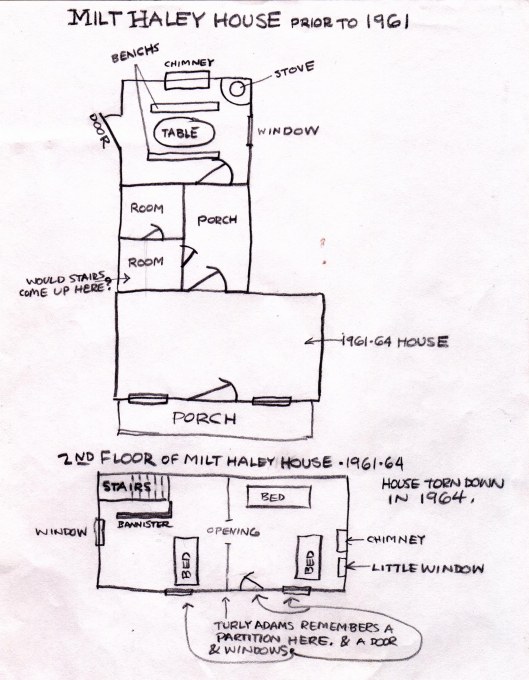
     After looking at more of Joe’s pictures, I asked Turley about the location of the old Milt Haley house. He said it used to sit at the site of his present-day home.

     “When I was a little boy I could remember it,” he said. “They was a big old log house front and they was a big long porch. And they had guest rooms. And then the kitchen was back there. Had a big chimney in it. And then they had that porch and everything back through there. Had that big kitchen in it and big fireplace. They could just put a big kettle in there and make a whole big kettle of stuff.”

     It resembled the old Stonewall Workman home, Turley said, although I had no idea what that meant.

     “The year I was six years old is when they remodeled that house — seven,” he said. “I remember after they took a part of it off the top, made it a story and a half.”

     I drew out a floor plan of “The Milt Haley House” based on Turley’s memories.

← Older posts
Newer posts →

Feud Poll 1

If you had lived in the Harts Creek community during the 1880s, to which faction of feudists might you have given your loyalty?

Categories

  • Adkins Mill
  • African American History
  • American Revolutionary War
  • Ashland
  • Atenville
  • Banco
  • Barboursville
  • Battle of Blair Mountain
  • Beech Creek
  • Big Creek
  • Big Harts Creek
  • Big Sandy Valley
  • Big Ugly Creek
  • Boone County
  • Breeden
  • Calhoun County
  • Cemeteries
  • Chapmanville
  • Civil War
  • Clay County
  • Clothier
  • Coal
  • Cove Gap
  • Crawley Creek
  • Culture of Honor
  • Dingess
  • Dollie
  • Dunlow
  • East Lynn
  • Ed Haley
  • Eden Park
  • Enslow
  • Estep
  • Ethel
  • Ferrellsburg
  • Fourteen
  • French-Eversole Feud
  • Gilbert
  • Giles County
  • Gill
  • Green Shoal
  • Guyandotte River
  • Halcyon
  • Hamlin
  • Harts
  • Hatfield-McCoy Feud
  • Holden
  • Hungarian-American History
  • Huntington
  • Inez
  • Irish-Americans
  • Italian American History
  • Jamboree
  • Jewish History
  • John Hartford
  • Kermit
  • Kiahsville
  • Kitchen
  • Leet
  • Lincoln County Feud
  • Little Harts Creek
  • Logan
  • Man
  • Matewan
  • Meador
  • Midkiff
  • Monroe County
  • Montgomery County
  • Music
  • Native American History
  • Peach Creek
  • Pearl Adkins Diary
  • Pecks Mill
  • Peter Creek
  • Pikeville
  • Pilgrim
  • Poetry
  • Queens Ridge
  • Ranger
  • Rector
  • Roane County
  • Rowan County Feud
  • Salt Rock
  • Sand Creek
  • Shively
  • Spears
  • Sports
  • Spottswood
  • Spurlockville
  • Stiltner
  • Stone Branch
  • Tazewell County
  • Timber
  • Tom Dula
  • Toney
  • Turner-Howard Feud
  • Twelve Pole Creek
  • Uncategorized
  • Warren
  • Wayne
  • West Hamlin
  • Wewanta
  • Wharncliffe
  • Whirlwind
  • Williamson
  • Women's History
  • World War I
  • Wyoming County
  • Yantus

Feud Poll 2

Do you think Milt Haley and Green McCoy committed the ambush on Al and Hollene Brumfield in 1889?

Blogroll

  • Ancestry.com
  • Ashland (KY) Daily Independent News Article
  • Author FB page
  • Beckley (WV) Register-Herald News Article
  • Big Sandy News (KY) News Article
  • Blood in West Virginia FB
  • Blood in West Virginia order
  • Chapters TV Program
  • Facebook
  • Ghosts of Guyan
  • Herald-Dispatch News Article 1
  • Herald-Dispatch News Article 2
  • In Search of Ed Haley
  • Instagram
  • Lincoln (WV) Journal News Article
  • Lincoln (WV) Journal Thumbs Up
  • Lincoln County
  • Lincoln County Feud
  • Lincoln County Feud Lecture
  • LinkedIn
  • Logan (WV) Banner News Article
  • Lunch With Books
  • Our Overmountain Men: The Revolutionary War in Western Virginia (1775-1783)
  • Pinterest
  • Scarborough Society's Art and Lecture Series
  • Smithsonian Article
  • Spirit of Jefferson News Article
  • The Friendly Neighbor Radio Show 1
  • The Friendly Neighbor Radio Show 2
  • The Friendly Neighbor Radio Show 3
  • The Friendly Neighbor Radio Show 4
  • The New Yorker
  • The State Journal's 55 Good Things About WV
  • tumblr.
  • Twitter
  • Website
  • Weirton (WV) Daily Times Article
  • Wheeling (WV) Intelligencer News Article 1
  • Wheeling (WV) Intelligencer News Article 2
  • WOWK TV
  • Writers Can Read Open Mic Night

Feud Poll 3

Who do you think organized the ambush of Al and Hollene Brumfield in 1889?

Recent Posts

  • Logan County Jail in Logan, WV
  • Absentee Landowners of Magnolia District (1890, 1892, 1894)
  • Charles Spurlock Survey at Fourteen Mile Creek, Lincoln County, WV (1815)

Ed Haley Poll 1

What do you think caused Ed Haley to lose his sight when he was three years old?

Top Posts & Pages

  • Civil War Gold Coins Hidden Near Chapmanville, WV
  • Red Rock Cola in Logan, WV (1939)
  • George Fry Last Will and Testament (1793)
  • About
  • Lincoln Court House (1911)

Copyright

© Brandon Ray Kirk and brandonraykirk.wordpress.com, 1987-2023. Unauthorized use and/or duplication of this material without express and written permission from this blog’s author and/or owner is strictly prohibited. Excerpts and links may be used, provided that full and clear credit is given to Brandon Ray Kirk and brandonraykirk.wordpress.com with appropriate and specific direction to the original content.

Archives

  • February 2025
  • January 2025
  • October 2023
  • September 2023
  • December 2022
  • November 2022
  • May 2022
  • April 2022
  • February 2022
  • November 2021
  • October 2021
  • September 2021
  • June 2021
  • May 2021
  • April 2021
  • March 2021
  • February 2021
  • January 2021
  • December 2020
  • November 2020
  • October 2020
  • July 2020
  • June 2020
  • May 2020
  • April 2020
  • March 2020
  • February 2020
  • January 2020
  • December 2019
  • November 2019
  • October 2019
  • September 2019
  • August 2019
  • July 2019
  • June 2019
  • May 2019
  • April 2019
  • March 2019
  • February 2019
  • January 2019
  • December 2018
  • November 2018
  • October 2018
  • September 2018
  • August 2018
  • July 2018
  • June 2018
  • May 2018
  • April 2018
  • March 2018
  • February 2018
  • January 2018
  • December 2017
  • November 2017
  • October 2017
  • September 2017
  • August 2017
  • July 2017
  • June 2017
  • May 2017
  • April 2017
  • March 2017
  • February 2017
  • January 2017
  • December 2016
  • November 2016
  • October 2016
  • September 2016
  • August 2016
  • July 2016
  • June 2016
  • May 2016
  • April 2016
  • March 2016
  • February 2016
  • January 2016
  • December 2015
  • November 2015
  • October 2015
  • September 2015
  • August 2015
  • July 2015
  • June 2015
  • May 2015
  • April 2015
  • March 2015
  • February 2015
  • January 2015
  • December 2014
  • October 2014
  • September 2014
  • August 2014
  • July 2014
  • June 2014
  • May 2014
  • April 2014
  • March 2014
  • February 2014
  • January 2014
  • December 2013
  • November 2013
  • October 2013
  • September 2013
  • August 2013
  • July 2013
  • June 2013
  • May 2013
  • April 2013
  • March 2013
  • February 2013
  • January 2013
  • December 2012
  • November 2012

Enter your email address to follow this blog and receive notifications of new posts by email.

Join 2,925 other subscribers

Tags

Appalachia Ashland Big Creek Big Ugly Creek Blood in West Virginia Brandon Kirk Cabell County cemeteries Chapmanville Charleston civil war coal Confederate Army crime culture Ed Haley Ella Haley Ferrellsburg feud fiddler fiddling genealogy Green McCoy Guyandotte River Harts Harts Creek Hatfield-McCoy Feud history Huntington John Hartford Kentucky Lawrence Haley life Lincoln County Lincoln County Feud Logan Logan Banner Logan County Milt Haley Mingo County music Ohio photos timbering U.S. South Virginia Wayne County West Virginia Whirlwind writing

Blogs I Follow

  • OtterTales
  • Our Appalachia: A Blog Created by Students of Brandon Kirk
  • Piedmont Trails
  • Truman Capote
  • Appalachian Diaspora

BLOOD IN WEST VIRGINIA is now available for order at Amazon!

Blog at WordPress.com.

OtterTales

Writings from my travels and experiences. High and fine literature is wine, and mine is only water; but everybody likes water. Mark Twain

Our Appalachia: A Blog Created by Students of Brandon Kirk

This site is dedicated to the collection, preservation, and promotion of history and culture in Appalachia.

Piedmont Trails

Genealogy and History in North Carolina and Beyond

Truman Capote

A site about one of the most beautiful, interesting, tallented, outrageous and colorful personalities of the 20th Century

Appalachian Diaspora

  • Subscribe Subscribed
    • Brandon Ray Kirk
    • Join 787 other subscribers
    • Already have a WordPress.com account? Log in now.
    • Brandon Ray Kirk
    • Subscribe Subscribed
    • Sign up
    • Log in
    • Report this content
    • View site in Reader
    • Manage subscriptions
    • Collapse this bar
 

Loading Comments...