Tags
Appalachia, culture, genealogy, Harts, Johnny Golden Adkins, life, Lincoln County, photos, West Virginia
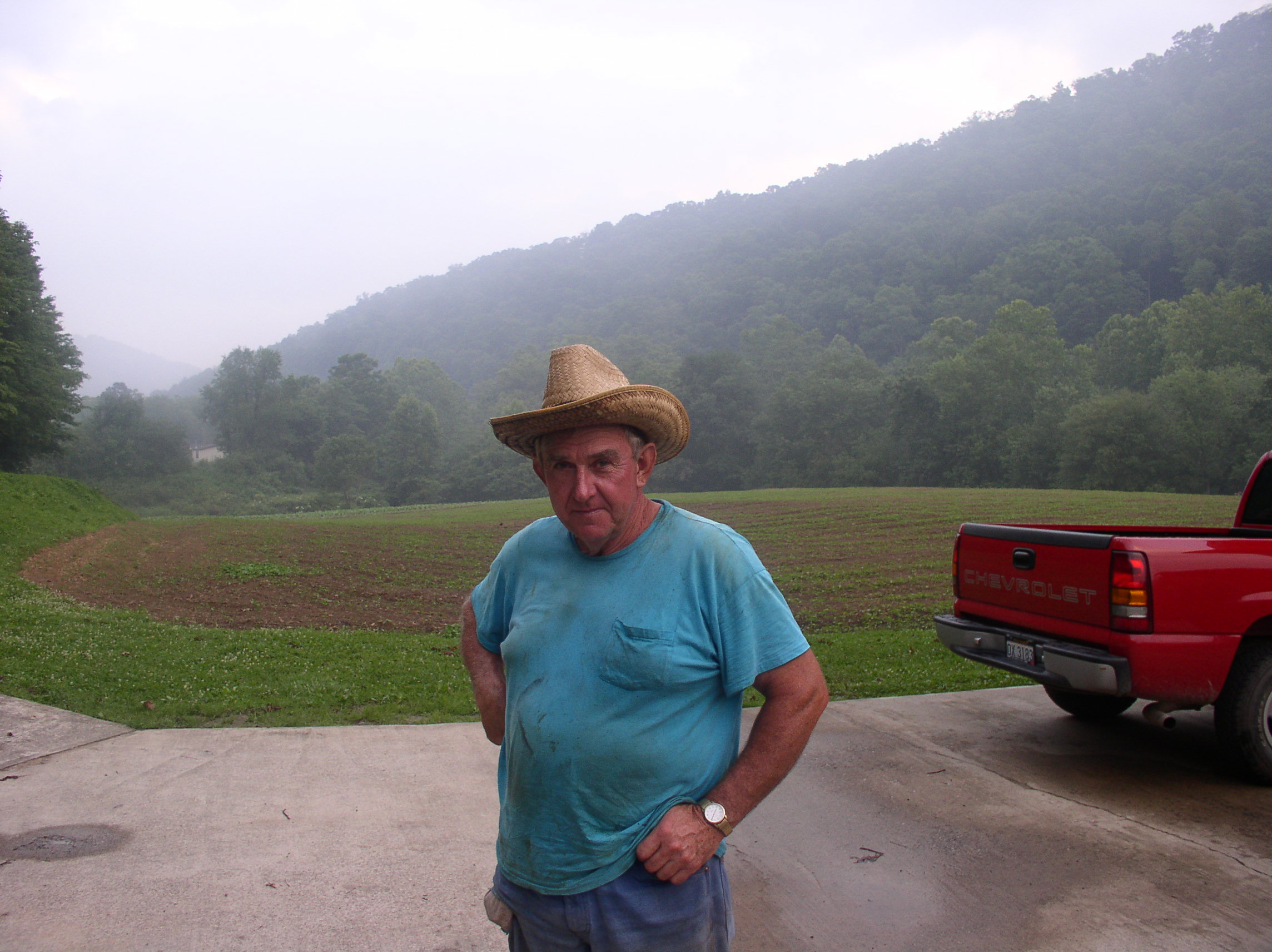
Johnny Golden Adkins of Harts, Lincoln County, WV

22 Wednesday Jan 2014
Tags
Appalachia, culture, genealogy, Harts, Johnny Golden Adkins, life, Lincoln County, photos, West Virginia
Johnny Golden Adkins of Harts, Lincoln County, WV
22 Wednesday Jan 2014
Posted in Ed Haley, Lincoln County Feud
Tags
Ben Adams, Bert Dingess, Billy Adkins, Cat Fry, crime, Ferrellsburg, feud, Fisher B. Adkins, Garnet Adkins, Green McCoy, history, Hollene Brumfield, Hugh Dingess, Johnny Golden Adkins, Milt Haley, writing
As we stood at Runyon’s Branch staring at weeds and trying to imagine John Runyon’s 1889 spread, Billy said Garnet Adkins and her son Johnny lived nearby. Garnet was a granddaughter of Hugh Dingess and had been raised at Huey Fowler Hollow just off the hill from the Haley-McCoy grave. Perhaps more interesting, her son Johnny had told Billy recently that his grandfather Adkins used to talk about John Runyon being his neighbor.
We quickly drove to Garnet’s where Billy spotted Johnny working with a mule in the yard. In no time, we were in the living room listening to Garnet talk about the Haley-McCoy murders.
“Well, I’ve heard Mommy talk about it, but it’s been so long ago I’ve about forgot about it,” she said. “She said her and Cat Adkins got in there and got in under the bed — or behind the bed or something — when they was a doing that.”
Your mother was there?
“Yeah, she was just a young’n, though,” Garnet said. “She said one of them said to the other… One had the headache and he said, ‘I can’t eat no supper.’ And he said, ‘You better eat your supper. This’ll be the last supper you’ll ever eat.’ And they just took them out there and killed them. I guess they shot them, I don’t know.”
I asked Garnet if she thought the mob might have shot Milt and Green at the table right after they ate and she said, “No, they took them outside, I think. I’ve heard Mommy talk about it. See Cat lived there in that house where Mommy was at. That’s where they killed them at.”
Garnet said she had seen the house.
“Yeah, I’ve saw it,” she said. “It’s up here across from Fry.”
Wait a minute. That was the same side of the river as what Lawrence Kirk had shown me in 1993.
Milt and Green were killed on the other side of the river, right?
“No,” Garnet said.
Her son Johnny, however, agreed with the popular notion that the killings took place at the Fry house on Green Shoal.
“That’s what Granddad Aaron said,” Johnny said. “An old hued log house is what Granddad said. He said it sat there at Fry. There where Lon Lambert lives.”
Garnet insisted otherwise: “It was on this side of the river, just an old flat house.”
Perhaps sensing that we were not going to agree on the location of the murders, Garnet changed the direction of the conversation.
“You know, that was a mighty cruel thing to take them men out and kill them,” she said. “They claimed my granddaddy Hugh Dingess was in on that but I don’t believe he was. Course Aunt Hollene was his sister, you know. Aunt Hollene came up there to his house one Sunday and lord it scared me to death when I seen her face. I run off and hid. She was mean as a hound dog. She carried a pistol and a watch and pocketbook and all kinds of stuff in a big apron pocket swinging down on her.”
Billy said to Johnny, “Down here on this end of the creek, we’d never heard about Ben Adams a being in on it, had we?”
Johnny answered, “Yeah, oh yeah. Well he knowed them Adamses. That’s the reason they brought them in this other way ’cause they was supposed to been, Granddad told me, men a waiting to take them away from them fellers when they brought them back in here. But they come this other way — the back way — on horses. Come back in through Chapmansville and down this a way. They thought they’d be a coming down Harts Creek but they didn’t come that way. They brought them down around the river way.”
Garnet said Milt and Green’s grave wasn’t marked when she was a little girl.
“They just threw them in a hole really,” she said. “Somebody said Ben Walker buried them.”
Johnny said, “Well now Mother. didn’t they come over there and visit that grave after you was a great big girl?”
“Yeah, I was a young woman,” she said. “Now I don’t know where she was from. I just heard them talk about their uncle living over there in Fisher’s place where Irv Workman lives. They went up that hill a crying and carrying on and I didn’t know what to think. I was just an old big young’n there with the young’ns. Mommy and Poppy both was gone. And I’d think, ‘Lord, who in the world is that coming up through there carrying on like that?’ And I kept seeing them motioning over there across the creek to where Fisher’s place was talking about… Seems to me the man’s name was Ben. Ben Adkins.”
To get an idea of when it was that people used to come to the grave I asked Garnet what year she was born.
“I was born in 1909,” she said. “June 26th. I was born up here at Ferrellsburg.”
22 Wednesday Jan 2014
Posted in Ed Haley, John Hartford, Music
Tags
Carol Hardway, Cliff Top, culture, fiddlers, fiddling, history, John Hartford, life, music, photos, West Virginia, Wilson Douglas

Carol Hardway, Wilson Douglas, and John Hartford at the Appalachian String Band Festival in Cliff Top, West Virginia, 1995
21 Tuesday Jan 2014
Posted in Ed Haley
Tags
Al Brumfield, Ben Walker, Billy Adkins, Brandon Kirk, Burl Adkins, Cain Adkins, Fed Adkins, Harts, history, John Hartford, John W Runyon, Mose Adkins, timbering, writing
The next day, Billy directed Brandon and I up Walker Gap to the old Ben Walker farm. Walker was the man who reportedly organized the Haley-McCoy burial party in 1889. Once there, we found no buildings remaining so we stopped at the family cemetery, which was just off the hill from the Haley-McCoy grave. Ben’s grave was marked by a simple rock.
From there we headed to “Runyon’s Branch,” a small stream emptying into the Guyandotte River just above the mouth of Harts Creek. Supposedly, John Runyon once lived near the mouth of this branch while operating a sawmill at its head. It was a great set-up: Runyon owned his own hollow and could float his timber directly into the Guyan River, thus avoiding Al Brumfield’s boom and tax. Nearby on a bluff was the probable site of his “blind tiger,” where he would’ve had a great view of Brumfield’s timber operations just across the mouth of Harts Creek. At this location, Runyon was surrounded by members of the Adkins family. Some of his neighbors were Burl Adkins (a brother-in-law to Fed Adkins), Mose Adkins (Fed Adkins’ brother), Ben Walker, and Cain Adkins.
19 Sunday Jan 2014
Posted in Big Harts Creek, Ed Haley
Tags
Al Brumfield, Ben Adams, Billy Adkins, Bob Dingess, Burl Farley, Cat Fry, Ferrellsburg, feud, French Bryant, Green McCoy, history, Hugh Dingess, John Hartford, Milt Haley, Ross Fowler, Ward Brumfield, writing
Bob said the Brumfields left Hugh’s with Milt and Green when they heard about the existence of an Adams mob nearby.
“They took them up over the ridge and down and crossed into Ferrellsburg up at Fry,” he said.
They went to the home of Tucker Fry, who took all of the women away from the place.
“I think maybe they stayed there a day and night or something like that a trying to make them tell who hired them to do that,” Bob said. “They was a trying to get them men to tell who hired them to kill Al Brumfield. And they took one of them outside and lectured him while the other was inside. When they took him back in, they said, ‘He won’t talk.'”
Bob said the mob even took Milt and Green into different rooms trying to get a confession but they just blamed the shooting on each other. Finally, French Bryant “blew Haley’s brains out with a gun.” Burl Farley hollered and everyone shot Haley and McCoy “all to pieces.” Cat Fry, who was about ten years old at the time, hid in a corner or in the fireplace and witnessed their deaths. “It was very cruel,” Bob said.
The mob returned to their homes after killing Milt and Green and it wasn’t long until the “murder house” was burned to the ground so there’d be no evidence against them.
I asked Bob if he remembered the house and he said, “Aunt Cat, she told me it was a two-room log house. One of them old-timers, big ones. They all slept in one room. Big fireplace in the other one. I never was in that house.”
Bob said that hard feelings over the feud lingered for years, especially toward Ben Adams. “After Haley and them was killed, old man Ben Adams never done no good at timber,” he said. “He run a mountain still up there — moonshine — and he had cabins built and he had men there and ever man had a Winchester and you couldn’t do much a bothering him ’cause old man Ben was a mean man.”
So what happened to Ben, we wondered.
“Ben died in 1912,” Bob said rather undramatically, “and was buried up yonder on the hill.”
According to Bob, the 1889 feud eventually ended because most of the participants were related and ultimately wanted to see it put to rest. “Here’s the thing,” Bob said. “The Adamses and Dingesses all married through each other and the Brumfields married into the Dingess clan. Everybody was kindly keeping a steel tongue because they didn’t want no more feuding more’n what they had and they didn’t want the young people to really know anything about it — how cruel it was. Dad up here never would talk about it. Nobody talked. Years and years and years in here it was just gossip. People a talking that didn’t know a thing on earth about it. It was a rumor. Someone would tell one story and someone would tell another.”
Every now and then a bit of the story leaked out, mostly from eyewitness Cat Fry. “Aunt Cat down here, now, was a little eight-year-old girl in the same house when they was killed,” Bob said. “She would very seldom talk about it but once in a while if nobody was around sometimes she’d start off a telling me about it some. She wouldn’t hardly tell you names. Nobody wanted to hear it. They wanted to let it die down and forget all about it.”
Bob remembered French Bryant well. “He was a big 200-pound 6’4″ tall mean man,” Bob said. “He’d carry a pistol on him that hung on his hip — one of these cap ‘n balls. He lived just over the hill up yonder and he made liquor and sold it all the time up that holler. Nobody lived up there. He had two miles of a hollow there to himself and he had a big dapple gray stud horse about fourteen, fifteen hundred pounds. He’d get on that horse and go to Ferrellsburg and if the river wasn’t too big he’d swim him across that river and he’d get him a load of groceries and put them on his back and then swim that horse back.” Bob told Billy, “People didn’t fool with that old man, either. Right when you leave the mouth of Hart and come up there at the schoolhouse — just across the creek starting up West Fork — there was a big house there and old man Ross Fowler lived there. I never did know what Ross done, but old man French went there… They didn’t have no lamp oil, they had pine knots. He took a sack full of pine knots there and set them afire and burnt creation up — burnt them out of house and home. Nobody ever knowed he did it, of course. He was a mean old cuss but he didn’t bother nobody in his last days. He made a little liquor and sold it and that’s the only way the old man could make it.”
Just before we left Bob’s, he told us a very important bit of information about Ed’s relationship with Al Brumfield’s oldest son, Ward. “Like I started to say a while ago, they was a feud between the Brumfields and the McCoys,” he said. “But remember, Ward Brumfield was a very fine man. He was a handsome man. Ward was a wonderful person. He was a first cousin to me and I have to congratulate him. He’d get up and him and Ed Haley’d hug each other and they’d prance and dance on the floor and just love each other. They’d both sit down at the table to eat together. Ward and him forgot all the past. Ward and Ed Haley was good friends.”
17 Friday Jan 2014
Posted in Ed Haley
Tags
Al Brumfield, Ben Adams, Bob Dingess, Brooke Dingess, Burl Farley, Cat Fry, Dave Dingess, feud, French Bryant, genealogy, history, Hollene Brumfield, Hugh Dingess, John W Runyon, Milt Haley, moonshine, Peter Mullins, timbering, writing
I asked Bob about Milt and he said, “I don’t know too much about the first Haley. I think he was a rambler and just traveled here and there and got in with them Mullinses up there making liquor and moonshine and stuff. I’ve been told that he married Peter Mullins’ sister and he stayed there among them a long time. They was two or three clans of them Mullinses. They was a bunch of horse-thieves and stealers who come out of Kentucky. Well, they run them out of Kentucky. They aimed to kill them and they got into Harts Creek in that wilderness section back in there. They was gamblers, they was moonshiners and they was always in a fight and trouble with each other. They couldn’t trust each other. The men wouldn’t work a lick and the poor old women did the work and the men just sat in the yard or played cards or drunk liquor and that was the way they done it.”
Talking about Milt got us into the story of his feud with the Brumfields.
“See, that all happened before I was born,” Bob said. “That happened in ’89 you see and all I know is what my mother and what Aunt Cat down at Hart told me. Now, I was told this: that Al Brumfield controlled all timber that went out of Harts Creek down there and he had an apparatus put in right above the mouth of the creek to catch the timber and not let them go in the river. All right. Ben Adams up here was a millionaire nearly at that time and had all of this big poplar timber in this creek for miles up and down here. Ben Adams had a lot of timber down there and the way I got it some logs got lost. Well, he undertook to make Al pay for the timber since Al was responsible for it and taking the ten-cents-a-log to hold it in the creek for them till they got it rafted and Al wouldn’t do it. And Al went to get a gun to kill him and Ben Adams run up Harts Creek and took the Big Branch and took that ridge on back home. He got away from Al. Well, it was always figured that Ben Adams hired these two men to kill Al so he could get that timber out of here. Now, I’ve been told that.”
I asked Bob about John Runyon and he said, “I never heard of John Runyon. But, somehow, down yonder in that curve… You see, these men had done gone there and planted themselves waiting for these people to come.”
Bob said Milt and Green were laying in ambush when Al and Hollena Brumfield came riding along. Al rode one horse, while Hollena and Bob’s father Dave rode another.
“My dad was a riding behind Aunt Hollene and Al was in front and somehow when them men started he saw the gun and he fell over on the other side of his horse and hung to the saddle till he got around that point. He put his arms around the horse’s neck and had his leg up so they couldn’t… They was two shots fired. I don’t know which one of them was shot first but they shot Aunt Hollene right through the cheek. The bullet went in right on the left side of her cheek right at her ear and come out right above her nose. Dad jumped off the horse when they shot her and throwed his hand up and they shot him through his hand then they got away. And Dad took part of his shirt and tore it up and tied it and put it around her head to keep her from bleeding to death. I don’t guess he paid too much attention to that hand as long as he got her took care of.”
I said to Bob, “So, did Al gallop off at that point?” and he answered, “As far as I know, he made a get-away. He went on down the hollow, fast speed I imagine. He knowed they was a gonna kill him.”
“Well now, what about Haley and McCoy?” I asked.
“So far as we know, they run and took the mountain,” Bob said. “They was hid in the bushes, see? But Dad recognized them and knowed who they was. Aunt Hollene did, too. They never did get along in here after that. They run them men back through that country back yonder and caught them almost at Dingess on the N&W. And they was a clan of Dingesses back in there and they headed them off for them and they caught them. Ah, they was a mean bunch of men in here, then. Of course, I knew old man French Bryant — he was a ringleader in it. Old man Burl Farley. A lot of Brumfields and Dingesses and everything else involved in it. And they brought them back to Uncle Hugh’s up here.”
17 Friday Jan 2014
Tags
Appalachia, culture, East Lynn, guitar, history, life, music, photos, Ralph McCoy, Spicie McCoy, Wayne County, West Virginia

McCoy Time Quartet of Wayne County, West Virginia, c.1940
16 Thursday Jan 2014
Posted in Big Harts Creek, Ed Haley
Tags
Alice Dingess, Andy Thompson, Bill Brumfield, Billy Adkins, blind, Bob Dingess, Ed Haley, Ella Haley, Ferrellsburg, fiddling, Harts, Harts Creek, history, John Hartford, Wash Farley, writing
Billy recommended that we visit Bob Dingess, a man of advanced age who was related to and personally remembered almost everyone in Ed’s story. His father was Dave Dingess, a younger brother to Hollena Brumfield, while his mother was a daughter to Anthony Adams. His first wife was a daughter to Charley Brumfield, while his current wife was Robert Martin’s niece. Bob was a close cousin to Bob Adkins and Joe Adams, as well as many of the Brumfields. He was a fine old man — a retired schoolteacher and elementary principal — who could probably tell us more about Harts Creek history than any one alive.
We drove to Bob’s small white house, which sat just below the mouth of Smoke House on Big Harts Creek, and knocked at his back door, where a nurse met us. She knew Billy and invited us inside, through the kitchen and into a dark stuffy living room. There, we met Bob and his wife. Bob was bundled up in a light black jacket, oblivious to the enormous August heat. A somewhat tall man, he had an alertness to his movements that was surprising and enviable. He was very friendly. We all sat down on couches to talk about Ed Haley. I was sure that Bob’s heater was running; in no time at all, my sinuses were ready to explode.
When Billy told him that we were interested in finding out about Ed Haley, he said, “You have to give me a little time on this. My memory jumps on me. I’m no spring chicken and I have to think.”
But it was obvious that his mind was sharp as a tack when he started telling about his memories of Ed.
“Now Ed Haley, he left here after so long,” Bob said. “He went to Kentucky and he married there. He had a blind woman and she played the mandolin and he played the violin and they had a lot of the meanest boys you ever saw. I first saw him in 1918, during the First World War. Well on Saturday I’d go to Ferrellsburg to haul groceries. That’s the only way to get them. No bridge at Hart. And bless your heart, here that man and them four children come off’n that train, and that old woman, and I got a wagon load of groceries and set them on it and them boys fought and that old man he just slapped and knocked and kicked among them. And the old man, he wouldn’t tell them nothing — he was blind — and she couldn’t tell them nothing, either. And I finally got them up here at the house, and when I got them there Mom made me unload the wagon and says, ‘Get ’em away from here.’ And we took them up yonder to old man John Adams’ then, and let them go. They stayed a month up there.”
I asked how Ed dressed.
“Well, he was all right now, boys,” Bob said. “Don’t worry about him. He took care of everything. He’d laugh and talk, too. You’d think he could see. After you’d get him located and get him in the house, you know, he could get up and walk about through the house.”
Bob didn’t think Ed was the best fiddler he ever heard.
“Nah,” he said. “He couldn’t play this fancy music like Bill Monroe and them played. The old-time fiddle, he was good…old-time music. ‘Comin’ Around the Mountain’. He had a dozen songs.”
Bob said Ed used to play at the old pie suppers on Harts Creek.
“See, I was born in ’04, and I went to these frolics where they had pie suppers and socials and all these gals gathered and these men,” he said. “About every weekend the girls’d go to one home and they’d kill chickens and bake cakes and bake pies and everything and they’d auctioneer them off. If you had a pretty girl, buddy you’d better have a little pocketbook because somebody’s gonna eat with her and knock you out. Mother always give me a little money and I’d just pick me out one and get her. Yeah, planned all week, the girls would. We did that once a week unless they was some special occasion. We’d start at Bill Brumfield’s down yonder. From Bill’s, we’d come to Andy Thompson’s, come from Andy Thompson we went to Rockhouse to Uncle Wash Farley’s. Uncle Sol over here, he wouldn’t let them have it but just once in a while. Mom would let them have it about every three or four months up here. But on up the hollow up yonder it was a regular thing. Them days is gone, though. You couldn’t have that now. No fighting, no quarreling, everybody got along happy.”
I wanted to know more about Ed.
“Ed Haley, here’s what they’d do,” Bob said. “They’d put him and her on a mule and he’d be in front and she’d ride astraddle behind and hold him. And somebody else’d have to carry their musical instruments, see? And when they got them up there then they had to lead them and get them in the house and get them located. And somebody’d slip around and give him a big shot of liquor and her and they’d say, ‘All right, old-man, let ‘er go.’ ‘Big Rock Candy Mountain’, boy here she’d go. He’d sing it. He was a good singer. And his old woman, she didn’t look like she was very much, but she was a singer. She was a little woman, blind. But she’d sing right with him. Yeah, ‘Turkey in the Straw’. Ah, that ‘Grapevine twist,’ man, ‘circle eight and all get straight.’ Ah man, them girls had them old rubber-heeled shoes and they’d pop that floor. It was an all-night affair. He’d play a while, then he’d rest a while, then he’d start again. Along about midnight, they’d drink that liquor in them half a gallon jugs. You know, I was a boy and I wasn’t allowed to drink too much but now them old-timers they would drink that liquor. ‘Bout one o’clock, she’d start again, and when the chickens was a crowing and daylight was coming still they were on the floor. They would lay all day and sleep.”
15 Wednesday Jan 2014
Posted in Big Harts Creek, Ed Haley, Whirlwind
Tags
Billy Adkins, Creed Conley, Ed Haley, fiddling, Harts Creek, history, John Hartford, Logan, Minnie Smith, Sherman Smith, Sol Adams, West Virginia, Whirlwind, writing
After lunch, Billy suggested that we go see Sherman and Minnie Smith, who lived a little further up the creek at the old Whirlwind Post Office. Minnie was the granddaughter of Solomon Adams and a great-granddaughter to Anthony Adams. Her father was a nephew to Melvin Kirk, who helped bury Milt and Green.
We soon pulled up to an incredible two-story log home with a remodeled front. We first spoke with Minnie’s husband Sherman who was busy dismantling a chimney labeled “S.A. 1875.” Minnie came out of the house, recognized Billy and started talking to us like we were neighbors. We raved over her log house for several minutes, which caused her to tell us how her grandfather Sol Adams had built it of yellow poplar in 1869. We later discovered that he was born in that year.
We gathered in chairs and sofas in a dimly lit living room with a low ceiling, while Sherman stood nearby in a doorway leading into the kitchen. We told them about my interest in Ed Haley, which caused Sherman to tell about seeing him in Logan when he was a boy. He said Ed was usually by himself but sometimes had a banjo-picker with him.
“Ed Haley used to play here when I was a girl,” Minnie said, adding that she was born in 1933. According to Minnie, Ed played for dances in the Workman home. Her parents would clear all of the furniture out of the living room and an adjacent room on Saturday. Ed came before the dance started and was fed properly, then as people started showing up he was “set up” on a stool in the doorway between the two cleared rooms. From there, he could entertain two rooms of people instead of just one. Minnie remembered him playing tunes like “Blind Man Stackolee” and “Fire on the Mountain”. Creed Conley was usually the caller and would have people dancing so wildly that they’d bump heads. Most were drunk. Minnie said someone passed a hat around for Ed’s pay toward the end of the dance.
14 Tuesday Jan 2014
Posted in Big Harts Creek, Ed Haley, Lincoln County Feud
Tags
Anthony Adams, Appalachia, culture, feud, genealogy, Harts Creek, history, life, Logan County, photos, West Virginia
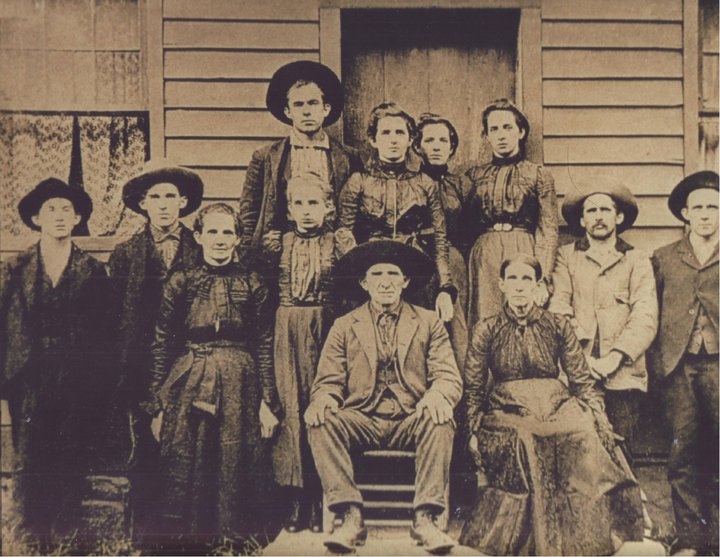
Anthony Adams family, Harts Creek, Logan County, West Virginia, 1890
14 Tuesday Jan 2014
Posted in Ed Haley
Tags
Al Brumfield, Alifair Adams, Anthony Adams, Ben Adams, Billy Adkins, Brandon Kirk, Ernest Adams, Ewell Mullins, George Mullins, Greasy George Adams, Harts Creek, history, Jay Queen, Joe Adams, John Hartford, Lewis Maynard, Mag Farley, Major Adams, Milt Haley, Mountaineer Missionary Baptist Church, Peter Mullins, rafting, writing
I asked Joe if he ever heard any stories about Milt being a fiddle player and he said, “They was having a square dance up there at Peter’s once and I heard them a talking about his father playing the fiddle but that was all. They never said what he played or how much or nothing about it. They just said he was a musician. I’ve heard talk of him but I didn’t know him personally. I know about the trouble they had up here. I heard them talking about that up at George Greasy’s. Said they followed them over yonder at Green Shoal or someplace somebody said and killed them. I heard my dad a talking about that.”
Brandon mentioned that Milt and Green had supposedly been hired by Ben Adams to kill Al Brumfield, which caused Joe to say, “Well, I don’t know whether it was Ben Adams or… Well, Al and Ben were both head strong, let’s put it that way. I don’t know what was wrong with the families back then, but they seemed like they wanted to fight each other. They didn’t want to fight no strangers. They was all fighting through each other all the time. They’d burn each other’s barn and shoot their mules and cows in the field and everything on earth. All of them first cousins. I said, ‘That don’t make no sense to me.’ But back then if somebody needed something, it didn’t matter how mean they were, people’d go help them. If somebody was sick, people’d go sit up with them.”
Talking about the old Adamses around Harts Creek caused Joe to reminisce about his grandparents, Solomon and Anthony Adams.
“Grandpaw Anthony was from Hazard, Kentucky. He cut timber and built splash dams through here. Them old Adamses — Anthony, Ben, Sol — they’d float logs down to Hart and raft them to Huntington. I heard them tell about them Robinsons down there helping them raft them. Grandpaw Anthony, he didn’t let nobody put nothing on him. Them old fellas, 90-percent of them carried a pistol all the time. Most of them had ten or twelve children. Grandpaw Anthony, he acquired that place in the Forks of Hoover and he traded that place in Hoover for this place out here. He built a little house right out here on thirty-five acres in 1908. He ran a store at one time, too. They sold riggings, shoes, groceries, plow stocks, shovels…
“I can’t remember my grandpaw Sol nor his wife Dicy nor my Grandpaw Anthony but I can remember my Grandmaw Alifair well. She was from Missouri. She’d stay a while with us and she’d go up George Mullins’ and stay a while and she’d go down to Aunt Alice’s and stay a while. All the women smoked them old stone pipes and they wore them big gingham aprons that had two big pockets on them and they carried their tobacco and pipe and stuff in their pocket. They always had these old-time fireplaces and she’d go out in the chip-yard where they made ties and stuff and she’d pick her up a bunch of splinters and she’d sit them up in the chimney corner to light her pipe with and you’d better not bother them either.”
Joe’s father was Major Adams (1885-1944), the youngest son of Anthony Adams. He was a hammer-style banjoist.
“My daddy had a .32 Smith & Wesson with a shoulder holster with red leather and he kept that a hanging on the head of the bed,” Joe said. “They had these old iron beds with big, high headboards and stuff on them. And he kept that a hanging on the head of the bed all the time fully loaded in the belt and we knowed better than to tip it. Now, you might hang something up like that and a child take it down and shoot your brains out with it.”
Joe said Trace Fork had changed quite a bit since his childhood days. In the thirties, Ewell Mullins, Ed’s first cousin, had a store on the creek, as did Ernest Adams and Joe Mullins and Lewis Maynard. At one time, there were four stores on the creek; today, there are none. In 1938, the same year that electricity arrived on Trace, the Mountaineer Missionary Baptist Church was constructed at the mouth of the creek. Now an impressive brick building, it was originally a 24′ X 20′ structure. Prior to its construction, people met at Anthony Adams’ store or at the lower Trace Fork School. Joe said he bought the creek’s first television set from Jay Queen’s Bluegrass Hardware in Chapmanville in 1955. The roads were paved on Trace about that time.
Joe said we might find out more about Ed from Ewell Mullins’ daughter, Mag Farley. Billy said she ran a store just up Harts Creek near a fire department and playground. We found Mag working behind the checkout counter. She was a granddaughter to Uncle Peter but didn’t look very much like him. She got a little excited when we showed her pictures of her family but became suspiciously quiet when we inquired about Emma Haley. All we could get out of her was that Ed’s mother never remarried after Milt’s death and died around Harts. Maybe that was so, but we felt there might be more to her story; Mag’s version was almost too dull. We gathered back toward a cooler where we talked and ate bologna sandwiches and potato chips.
13 Monday Jan 2014
Posted in Big Harts Creek, Ed Haley
Tags
Appalachia, culture, Great Depression, Harts Creek, history, life, Liza Mullins, Logan County, Peter Mullins, photos, West Virginia

Peter Mullins family, Trace Fork of Big Harts Creek, Logan County, WV, 1940s
13 Monday Jan 2014
Posted in Ed Haley
Tags
Alice Dingess, Clifford Belcher, Ed Haley, Ewell Mullins, Frank Farley, Geronie Adams, Great Depression, history, Jeff Mullins, Joe Adams, Logan, moonshine, Peter Mullins, Sewell Adams, Tennis Mullins, Ticky George Adams, Virgil Farley, Will Farley, writing
After talking for some time about Ed’s music, our conversation drifted toward his family on Harts Creek.
“Old man Peter Mullins, everybody called him ‘Reel-foot Peter’ cause he had his foot cut off here and had a special shoe made,” Joe said, referencing Ed’s uncle. “He walked kindly on his heel. He worked on log jobs but he couldn’t do much. He gathered ginseng. He made most of his money on moonshine. He hauled it up to Black Bottom in Logan and sold it. He liked to drink. They drunk moonshine most of the time. They were good old people.”
Now would Ed drink a lot with Uncle Peter when he was around Harts?
“Old man Ed every now and then he’d take a few drinks of it,” Joe said. “I’ve seen him pretty high. It didn’t take much of that moonshine to get in your hair. I’ve seen it just as clear as a crystal. You could look through the bottle just like looking right on in a looking glass and you could shake it and about seven beads’d pop up there on top of it and they’d just roll around and around. And you couldn’t smell it. I’ve seen some that you’d look at and it’d look like muddy water and you could smell it through the bottles. But they made good whiskey. They generally made it out of chop or corn and if they’d double it back and use good clear water it was good. You could just turn it up and it wouldn’t take your breath.”
Brandon asked what Ed was like when he was “feeling high” and Joe said, “He seemed like he was in a good mood about all the time. When I was around him I never did hear him say nothing out of the way to nobody. Old man Ed, he was a fine old man but he got over here at a beer garden. Clifford Belcher had a beer garden on this mountain — it was the meanest place that ever was — and he was over there playing one night and they was a big bunch of them a playing cards and the law come in to arrest them all. Some of them boys jumped out the window. And Ed got into it with somebody in there and they said that fellow said something and Ed just come over and took that fiddle by the neck and busted it all to pieces over that fellow’s head. I don’t know what he said to him but I come along there after it happened. They arrested a whole bunch of them fellows and put them in a cattle truck, the state police did, and took them to jail. They was about fifteen or twenty of them. They was Geronie Adams and Virgil Farley and Frank Farley. They loaded them up and hauled them to Logan and them fellows a cussing. They said, ‘You just might as well keep quiet. You’re going to jail.’ I think they took Ed to jail, too.”
Brandon said he’d heard several old-timers talk about how people used to play jokes on Ed when he was at Trace and Joe agreed.
“They played all kinds of tricks on him,” he said. “They was an old man stayed up here, old man Jeff Mullins. He was Peter’s wife’s brother. They called him dumb, but now he wasn’t as dumb as they thought he was. He stayed up there when Ed and them was up there and they was all the time playing pranks on Ed and him. Tennis Mullins, Ewell’s boy, he was big and fat and he run the store all the time. He was all the time fooling with Ed and old man Jeff.”
I asked how Ed took it when people joked with him and Joe said, “He was good about it. He never got mad. I know up there one time they was out there at old man Peter’s where they was a bridge there and they was a bunch of trees there. And old man Ewell Mullins, he was all the time fooling with Ed. He told Ed, he said, ‘We’ll climb a tree here to the top and let them cut it down.’ Well, Ed couldn’t see. Ewell, he climbed up the first limb about ten feet high and said, ‘Cut ‘er down boys!’ He jumped off about the time it started to fall. And Ed climbed right in the top of it. I bet he was forty feet up there. And they cut it and it fell and skinned him all over and liked to killed him. Ewell never would tell him though that he was just up a little bit on the tree.”
Joe said he also remembered Ed’s uncle Ticky George Adams.
“The old man as far as I know he never did work on no public works of no kind or draw no release or nothing,” he said. “He kept his family… He went from house to house — and everybody raised all kind of stuff and had cattle and plenty of milk and butter and eggs and everything — and every place he stopped they give him something. He had a little pole on his back with a sack on it. You’d see him a going bent over just kindly in a long run. He’d go up Trace and go through the head of Trace. And old man George would go around that a way and come down Rockhouse by Will Farley’s and back up through my Uncle Sewell’s and Aunt Alice’s down here. Everybody’d give him something. They’d give him a stick of butter or give him some milk or give him some meat or give him some eggs or something another. That’s the way he raised his family. Those Hoover times was hard.”
11 Saturday Jan 2014
Posted in Ed Haley
Tags
Cary Mullins, Ed Belcher, Ed Haley, fiddle, fiddling, Harts Creek, history, Joe Adams, Logan County, music, Noah Mullins, West Virginia, writing
When I pressed Joe for specific details about Ed’s technique he said, “He’d play up on the bow about four or five inches, but he played the full stroke with the bow all the time. He didn’t jiggle it.”
I asked if he always sat down when he played and Joe said, “I’ve seen him sitting down and standing up both. They said he danced, but I never did see him dance none. He pat his foot when he played. You’d never hardly know he was patting it. He just patted one foot. He had that chin rest…”
“So Ed put the fiddle up under his chin?” I interrupted.
“He put it up under his chin and played,” Joe confirmed. “Ed Belcher, he played with it under his chin, too. Now Robert Martin, sometimes he’d have it under his chin, sometimes he’d have it down here on his chest.”
Brandon asked if Ed packed his fiddle in a case and Joe said, “Yeah, he had a case. If it was raining or something, I’ve seen him with it under his coat. He had two or three bows. I’ve seen him take the bow loose… He took the end of it loose and put it under the string and played some kind of a tune. They was just one tune he played like that. I believe it was some kind of a religious song. I don’t know how he done it.”
I asked Joe if Ed sang any and he said, “I heard him sing a little bit one or two times on one or two tunes. He’d play a verse and then he’d sing a little bit but not much. Seems to me like that his wife sung a little bit with him on some of them but they didn’t do too much singing. He’d play a little bit, then sing a little bit. They was just a few tunes that he done like that. He didn’t play none of this modern music or nothing like that. He played old-time tunes, like ‘The Arkansas Traveler’. He’d play that and some of them boys’d be sitting off someplace and talking about the big rock in the field and all about the feller digging the taters out and that old sow rooting them out. Ed would play the music and they’d put that in. They’re all dead now, them boys that used to do that. Noah Mullins and my brother Howard and Burl Mullins and Cary and them.”
Joe’s memories seemed to stretch back fondly to that time.
“Yeah, it was all right,” he said. “Every time I played with him he played ‘Lady of the Lake’. Real old tunes.”
Joe said Ed played “Love Somebody”, “Birdie”, “Brownlow’s Dream”, “Hell Up Coal Hollow”, “Hell Among the Yearlings”, “Wild Hog in the Red Brush”, and “Jenny’s Creek”. He also played “Mockingbird” with “everything in it.”
“He’d make the bird holler and everything else,” Joe said.
I asked Joe if Ed played a tune for a long time and he said, “Well, some of his tunes he played a long time and some of them were just short and sweet. He put a lot extra in them sometimes. It went along with it but if you didn’t know him pretty well and watch what you was doing you’d get off. It just come natural for me to follow him because he played good time.”
10 Friday Jan 2014
Posted in Ed Haley
Tags
Appalachia, banjo, Boone County, culture, fiddle, fiddler, fiddling, history, Johnny Hager, life, music, photos, U.S. South, West Virginia
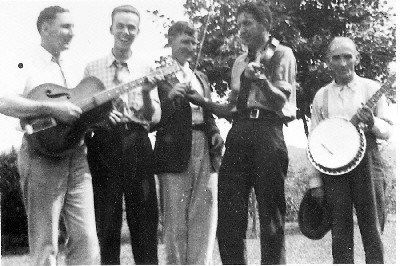
Johnny Hager on extreme right holding a banjo, Boone County, WV, 1950s.
10 Friday Jan 2014
Posted in Ed Haley
Tags
Appalachia, Arthur Smith, banjo, Ed Belcher, Ed Haley, fiddlers, George Mullins, Geronie Adams, Grand Ole Opry, Harts Creek, history, Joe Adams, Johnny Hager, Logan County, music, Robert Martin, West Virginia, writing
I wondered if people around Trace listened to the radio, especially the Grand Ole Opry, in the early days.
“They was a few radios,” Joe said. “We had one here. We ordered it from a company called Jim Brown. It had five batteries. And like Jerry Clower said, you’d take them and set them in front of the fire and get them hot and then plug them in, they’d play. They was kindly hard to get — they didn’t cost much. I think they was about ten or twelve dollars for all of them. But Robert Martin had one on top of that hill and my brother had one on Twelve Pole, and on Saturday night when the Grand Ole Opry come on, it was a sight to watch these people a going. It come in good and clear. Robert learned a lot of Arthur Smith tunes off the radio. Yeah, Arthur Smith come down there at Branchland and stayed a week with him and I was talking to Robert after he left and he said, ‘I wish you boys’d come down.’ I said, ‘Well, if you’d a let us know, we woulda come.'”
Brandon said to Joe, “I remember you were telling me last time I talked to you that you thought Robert Martin was about the best around.”
Joe said, “In the modern music. Now, in the old-time music, you’d take Ed Haley and Johnny Hager and Ed Belcher. Ed Belcher, he stayed at George Mullins’ and he was like my brother: he was an all around musician. He could tune a piano and play it, he could play an organ. He could play anything he picked up. I never did hear him play a banjo but he could play anything on the fiddle or guitar. He’d note the guitar all the time. He played like these fellers play on Nashville. They was several people around here had banjos and played. Geronie Adams — Ticky George’s boy — he played a banjo a little bit. And they was a fella — Johnny Johnson — played with Robert Martin out on that hill. He was from someplace in Kentucky.”
I asked Joe what kind of banjo style Johnny Hager played.
“He played the old…,” he started. “They’s some of them calls it the ‘overhand’ and some of them call it just ‘plunking’ the banjo. They was several people played like that. Bob Dingess down here, he played that a way a little bit. My dad, he played the banjo and he played that.”
I asked Joe how Ed dressed in the early forties.
“Well, he wore dress pants most of the time,” he said. “He wore mostly colored shirts — blue or green or just any color. Work shirts. Most of the time he wore suspenders with them. And had buttons sewed on them to buttom them with. Buttons on the inside. Mostly he wore slippers. They was a lace-up slipper. Three laces. He could tie his shoes just as good as you could tie yorn. He wasn’t a big man — he was a little small man. About 5’4″, 5’5″.”
Brandon asked what Ed was like when he wasn’t playing and Joe said, “Well, he’d just sit around and talk and tell tales about first one thing and then another. They’d just talk about how hard they was raised and how they come up.”
Did the ladies like him?
Joe said, “They all liked him but they wasn’t girlfriends. If he went into a place to play, they’d all come around and hug him and talk to him.”
08 Wednesday Jan 2014
Posted in Ed Haley
Tags
art, Billy Adkins, crime, Don Morris, drawing, George Fry, history, John Hartford, murder

John Hartford’s Sketch of the “Murder Table,” 1995.
08 Wednesday Jan 2014
Posted in Ed Haley
Tags
Billy Adkins, crime, Ed Haley, fiddlers, fiddling, George Mullins, Harts Creek, history, Joe Adams, Johnny Hager, music, Peter Mullins, Robert Martin, Ticky George Adams, writing
The next day, Billy and Brandon suggested that we visit 70-year-old Joe Adams on Trace Fork. Joe had all the right genealogical connections to know about many of the major characters in Ed and Milt’s story. According to Billy’s records, both of Joe’s grandfathers were brothers to Ben Adams, a key player in the 1889 feud. Joe’s grandmother was a Mullins, while the other was a half-sister to Burl Farley. (Burl Farley of course was in the Brumfield mob and even “gave the order to shoot” Milt and Green, according to some sources.) Brandon reminded me that he had talked with Joe earlier in the summer and heard him speak about having played music with Ed in his younger days.
As we pulled up to Joe’s nice house at the mouth of Trace, he and his wife met us at the end of their driveway. Joe, I noticed right away, looked a lot like Kenny Baker and was dressed in work clothes, indicating that he was probably in the middle of some project (a garden, working under a truck hood…). When we got out of the car, Mrs. Adams laughed and jokingly said, “Billy, is that you? What are you a doing up here?” Billy told them who I was and the reason for our visit and Joe basically said, “Well, come up to the porch and I’ll tell you boys all I can.” We gathered in chairs and swings under Joe’s carport where the conversation just took off. Joe was born in 1925.
I asked Joe when he first played with Ed and he said, “I’d say that was around ’40 up to ’43. It was before I went in the Army. We was down there at old man Peter Mullins’ — just out in the yard up there. They had a big old porch and they had a bunch of seats out under a bunch of big apple trees and stuff. Big shade. Had a swing out there. And I said, ‘How about bringing your fiddle out and playing a few tunes?’ And he told one of them boys — I forgot which one it was — said, ‘Go in there and bring my fiddle out here.’ He didn’t have it in a case that day but they brought it out and he played ‘Red Wing’ and he played ‘Soldiers Joy’ and he played ‘The Arkansas Traveler’ and he said, ‘Well, I’m tired now,’ and he just laid the fiddle down and we just quit. Sat around and talked a few minutes. He had some of them boys take it back and put it back in the house when he got through playing it. He took good care of his fiddle.”
“Now after I come out of the Army in ’46 and it seems to me like I seen Ed once after that and he left here and I never did see him anymore,” Joe said.
Brandon asked Joe where he remembered Ed staying on Harts Creek.
“I remember him staying up there with old man Peter and Liza and he stayed there off and on for years,” he said. “His wife and some of the children were there. Aunt Rosie married George Mullins on Buck Fork — he stayed up there a lot, too. Johnny Hager stayed with Ticky George Adams — old man George and Vic — that lived up in that holler up here at this store. Greasy George lived across the creek. And old man Ed, he’d go up there.”
What about Johnny Hager?
“Johnny Hager, he played a fiddle, too,” Joe said. “He didn’t play much. Just once in a while maybe he’d pick it up and play one tune. I had an older brother that’s dead, Howard — he played with them a lot. He played a fiddle, a guitar, mandolin, accordion, anything. He played anything he picked up. And we played around here for years.”
Joe said, “I played with a man lived right up in the head of this creek — I don’t know whether you ever heard tell of him — Robert Martin. He lived on top of the hill back there. Him and John Martin was the only two houses back there. He was a good fiddler. Robert played like ‘Lady of the Lake’ and ‘Blackberry Blossom’ and ‘Sugar Tree Stomp’. He had one he said he made it hisself and he made it for old man Will Farley — he called ‘Possom Creek’.”
Robert Martin left Harts, Joe said, after his brother John was murdered at Big Branch.
“You may have heard something about that,” he elaborated. “When they got in that trouble and his brother got killed down here at Big Branch they claimed that Robert cut him, but I don’t think so. I think it was somebody else. And he moved down here at Branchland and me and my brother’d go down there and play with him. He lived on that riverbank and he’d come out there and play with the fiddle till the bow got plum wet and he’d take it in and hang it up and go get another one. We played lots of times till three or four o’clock in the morning with him and then we’d come back to the house.”
07 Tuesday Jan 2014
Posted in Ed Haley
Tags
art, crime, Don Morris, drawing, history, John Hartford, murder, photos

John Hartford’s Sketch of the “Murder Table,” 1995.
07 Tuesday Jan 2014
Posted in Ed Haley, Green Shoal, Harts, Lincoln County Feud, Music, Toney
Tags
Appalachia, banjo, Bell Morris, Billy Adkins, Brandon Kirk, Bud Workman, Bumble Bee, Charley Davis, crime, Dave Dick, Don Morris, Ed Haley, Greasy George Adams, Green McCoy, Green Shoal, Harts, history, Hollena Brumfield, Hollene Brumfield, Hugh Dingess, Irvin Workman, Milt Haley, Peter Mullins, Ranger, Route 10, Toney, writing
Back at Billy’s, the subject of the “murder table” came up again. Supposedly, the table upon which Milt and Green had eaten their last meal somehow eventually ended up in the possession of Billy’s family. He suggested visiting his aunt Don Morris, who as a child had eaten from the table many times. Taking the cue, we loaded in the car and drove up Route 10 to Don’s house. Don lived at Toney, a small residential settlement just upriver from Green Shoal.
Don was a pleasant lady — very eager to help — and was aged probably in her seventies. After all the introductions, I asked her about the table. She said her grandfather Irvin Workman must have gotten it soon after the 1889 troubles. “He had it way back when he was raising his family,” Don said. “Then my dad, Bud Workman, when he moved out with my mother, they took the table with them.”
I asked, “Who told you that table was the Haley-McCoy table?” and she said, “My dad. It was in his father’s house before it was in his.”
“And you said that people would come by to see it?” I asked. “Who would come to see it?”
Don said, “I imagine it was relatives of the people that was involved in it.”
Don seemed to remember the table well, so I asked her for some paper so I could try to sketch it based on her memories. I started out asking about the length of the table, the style of its legs, and so forth…estimating everything by comparing it to Don’s current table. It was like doing a police sketch. After I had a rough drawing of the table, I asked her about the size and angle of the bullet holes.
Satisfied, I asked Don if she’d heard anything about Milt and Green’s death.
“It was pretty complicated,” she said. “Well, they got those men in and fed them. They knew they was gonna kill them all the time and they let them eat first. I can’t remember too much about the actual thing, because they didn’t talk too much about it in the family. Grandpa did sometimes. Well, I understood they shot them around the table after they ate. But it was execution style. Now, I couldn’t swear to it.”
Don figured the only light in the room was a kerosene lamp in the middle of the table. There was a story, Brandon said, that Hugh Dingess “shot out the lights” just before the murders — which presumably meant this lamp. While this may have occurred (perhaps so no one could witness the subsequent murders and thus testify in a future trial), it seemed unlikely. I mean, the room was probably really crowded if only half the people supposedly there were actually there and shooting in the room would have seemed dangerous. Of course, shooting a kerosene lamp could have set the whole house on fire.
“Well, I have heard they did, and I’ve heard they didn’t, so I couldn’t say which is true,” Don said of the lights. “I don’t think they could have without burning down the table.”
Brandon asked, “Was one of the men supposed to have played music before they killed him?” and she said, “He sang, didn’t he? It seems to me he played the banjo and sang a song. I guess they thought since they was going out anyway they might as well go out in style.”
I said, “Now, I heard that the wives went down there to try to plead for their lives and they turned them away. Have you ever heard that?”
Don answered, “Yes, I’ve heard that, but whether or not it’s true I’m not sure. My husband’s mother Bell Morris was related to the McCoys.”
I said, “Just for the record, what happened to that old house?” and she said, “I bet it burned.”
Don wondered why I was so interested in Milt Haley and I explained that I was researching the story of his son, Ed Haley, of which he was a very important part. I asked if she ever heard Ed play and she said, “I’m not sure, seems that maybe I did a long time ago. I think Haley played with Dave Dick. Dave played banjo. He was blind.” Brandon said Charley Davis had described Dick as a “pretty good” banjo-picker who mostly played “little ditties” like “Bumble Bee”. He lived downriver around Ranger but stayed in Harts for a week or so at a time with different families, sometimes playing for dances. Kids used to imitate him by bumping into things.
After mentioning Ed’s name to Don our conversation dwindled off to me asking if she knew people like Peter Mullins, Greasy George, or Hollena Brumfield. She gave answers like, “Well, I used to know a Peter Mullins. His foot was turned back. I remember watching him go up the hill there at the house.” As for Hollena Brumfield: “I knew one down here at this big old house at Hart. They put in a restaurant and you know it didn’t do too well. She said, ‘We got hotdogs on ice.’ Yeah, I knew those people.”
Writings from my travels and experiences. High and fine literature is wine, and mine is only water; but everybody likes water. Mark Twain
This site is dedicated to the collection, preservation, and promotion of history and culture in Appalachia.
Genealogy and History in North Carolina and Beyond
A site about one of the most beautiful, interesting, tallented, outrageous and colorful personalities of the 20th Century
 Brandon Ray Kirk