• About

Brandon Ray Kirk

~ This site is dedicated to the collection, preservation, and promotion of history and culture in my section of Appalachia.

Brandon Ray Kirk

Tag Archives: United Mine Workers of America

Don Chafin: The Most Famous Sheriff in the United States (1925)

26 Saturday Jun 2021

Posted by Brandon Ray Kirk in Battle of Blair Mountain, Matewan, Williamson

≈ Leave a comment

Tags

Appalachia, Battle of Blair Mountain, Democratic Party, Don Chafin, Ed Chambers, Ephraim Morgan, history, Logan Banner, Logan County, Matewan, Mingo County, Mingo Republican, politics, sheriff, Sid Hatfield, United Mine Workers of America, West Virginia, Williamson

From the Logan Banner of Logan, WV, comes this item about Don Chafin, sheriff of Logan County during the Armed March. The story is dated November 6, 1925.

Don Chafin Renowned as Sheriff of Logan

His Prowess During Threatened Invasion of Union Miners is Recalled in Mingo Republican

Bids Friends Goodbye

Don Chafin, former sheriff of Logan county, paid what might be his farewell visit to Williamson for a long time on Tuesday. While here he expressed to many his appreciation of their concern for him in his present plight.

Chafin was the most famous sheriff in the United States during his regime in Logan county, where he ruled with an iron hand. He was the main prop in the Democratic machine there and a prominent figure in the life of the county.

Sheriff Chafin won his greatest fame during the threatened invasion of Logan county by the armed march of 5,000 or more miners bent on destroying the Logan court house and finally reaching Williamson to release from the local jail a number of union men charged with violations of Gov. Morgan’s martial law.

Sid Hatfield and Ed Chambers, two well known union men of Matewan, had just been killed on the court house steps at Welch and the passions of the miners were thoroughly aroused. The armed march was once halted but was resumed after a midnight battle between the officers and miners on the county road near Sharples.

The invasion then began with forts and vigor. The defenders of Logan under the leadership of Sheriff Chafin were intrenched along a wide front and several clashes took place. The fame of the the doughty sheriff caused many from the outside to rally to his banner.

Mr. Chafin has numerous relatives and friends here to whom the parting was one of real regret. They are steadfast in their belief in his innocence, claiming that he is the victim of a frameup. Chafin was profuse in his expressions of gratitude over the loyalty of his friends on this side of the Logan line.

Strange Miners in Logan (1913)

13 Saturday Mar 2021

Posted by Brandon Ray Kirk in Coal

≈ Leave a comment

Tags

Appalachia, coal, history, Island Creek, Logan, Logan Banner, Ramage, Spruce River Coal Company, U.S. Coal and Oil Company, United Mine Workers of America, West Virginia

From the Logan Banner, of Logan, WV, comes this editorial about unionization, dated March 21, 1913:

STRANGE MINERS cannot get work at all in the principal Logan County mines, it is said, and even in the smaller mines an applicant has to run the gauntlet of a series of “family-history-cross-examination-questions” that would stagger a Philadelphia lawyer before one gets a job–and then like as not get turned down because he is not of Logan county. The precaution is fully warranted. The United Mine Workers hope to control the Guyan Valley field, if they ever DO–and THEY NEVER WILL–by first “organizing” the smaller, isolated mines by “smuggling in” an agitator or two now and then and finally with one “grand sweep” capture the big works. If the labor leaders actually KNEW certain conditions and “inside workings” now effective even in the small works half so well as they THINK they know them, they’d give up as a bad job their idea of “organizing” Logan county and go to honest work shoveling coal for a living themselves. During the past year, more than one “undesirable miner” has been shipped “bag and baggage” out of the valley because he let his agitation fever break out too strong, prematurely spoiling his little game. In another column will be found a news item of the shut-down of the Ramage works of the Spruce River Coal Co. We predict that some of Logan’s mines will turn off their power and “lock out” their employees before they will let the United Mine Workers conduct their business for them. So far as the corporation’s finances are concerned, the U.S. Coal & Oil Co. can shut down all of its Island Creek mines, burn its tipples, and dump its cash into Guyan river. And that’s what would best suit the competitive coal operators of other States! Likewise the miners’ union agitators and leaders! But there’s another side of the story–the miner and his family need the work in the coal-bank, the merchant needs some of the money he earns, Logan county needs its merchants and the outside world needs West Virginia coal–the BEST that “old mother earth” ever produced!

Huntington Editorial about the UMWA (1925)

05 Friday Feb 2021

Posted by Brandon Ray Kirk in Coal, Huntington, Logan, Williamson

≈ 1 Comment

Tags

Appalachia, Charleston, coal, Herald-Dispatch, history, Huntington, John L. Lewis, John Mitchell, Kanawha Field, labor, Logan, Logan County, Mingo County, New River Field, Ohio, Portsmouth, Samuel Gompers, United Mine Workers of America, West Virginia, Williamson

From the Logan Banner of Logan, WV, comes this editorial regarding a visit to the region by UMWA officials in 1925. The story is dated September 4, 1925.

A STATEMENT OF INDISPUTABLE FACTS

The Sunday issue of the Huntington Herald-Dispatch contained a most interesting editorial which told the unvarnished truth about the recent visit the officials of the United Mine Workers to the Logan and Williamson coal fields. The editorial follows.

Disappointed Visitors

Within the past three days officials of the United Mine Workers of America have visited Logan and Williamson and some of the mining operations near these prosperous West Virginia cities. Up to the hour of this writing the visitors have made no statement either as to the purpose of their visit or the impressions they have gained from the conditions encountered.

It may be taken for granted, however, that the gentlemen representing the United Mine Workers are not highly pleased. They did not find in the miners of the Logan and Williamson fields the “serfs” and downtrodden creatures professional agitators have described. They did not find beleaguered camps of concentrados crying out for release through the medium of membership in the U.M.W. They did not find gunmen and desperadoes awaiting them at the train to turn them back with broken heads and verbal abuses. The absence of these things were disappointing.

But for the purpose of the U.M.W. the things these visitors did find were even more disappointing. They found for example miners who earn more dollars per year than any others in the bituminous fields in the world. They found more miners living in better houses than are to be found in any of the mining camps of Pennsylvania, Ohio, Indiana or Illinois. They found miners and their wives and children better fed, better clothed and with better living conditions surrounding them than any others in the United States.

They found in Logan and Williamson fields men who are content and who are unwilling to leave steady employment, good wages, and good homes with all the comforts of life, to take up a miserable existence in the tents of professional strikers there to subject their wives and children to unwanted hardships and deprivations.

In short, they were not welcomed as needed deliverers. The miners in these fields know that it is not the purpose of these gentlemen to bring about a betterment of the conditions under which they live, but to create a condition which will cause coal production to cease. Organization is a fine thing and should be encouraged when it is for the good of the organized. But the proposal of the United Mine Workers, as it affects these miners and the business and labor interests of this section in general, is sinister and destructive. The unionization at this time of any considerable part of the Williamson and Logan fields would mean a strike. A strike, if effective, would paralyze business in all of Logan county, and in Huntington the result would be almost disastrous. An effective strike in these fields would paralyze Huntington’s wholesale and jobbing business. It would close many of the factories and worst of all would almost immediately result in unemployment for hundreds of railway shop workers and scores of train crews all the way from Charleston to Portsmouth with the brunt of the blow falling upon Huntington.

The United Mine Workers is no longer the helpful, constructive organization it was twenty years ago. Its ranks have been decimated and its policies have been so radical and unreasonable in many cases as to bring it into disrepute with the public, including the legitimate labor organizations whose members are ruled by reason. In West Virginia dues paying members have dwindled to almost the vanishing point. In strikes, fomented in an effort to destroy West Virginia coal in the interest of Ohio, Indiana and Illinois mines and the mine workers in those states, West Virginia has cost the U.M.W. millions and the officials now face the impending anthracite strike with a sadly depleted treasury.

The desperate plight of Mr. Lewis, his organizers, and well paid cabinet naturally produces its own results. The strike in northern West Virginia has had no effect other than to keep some thousands of men out of employment and deprive thousands of women and children of the comforts the pay envelope would provide. The mining of coal in the Kanawha and New River fields the Miners Union has, to use a baseball term, “struck out.” Attempts to force upon the operators a wage scale which prohibited the mining and marketing of coal at a price less than a ruinous loss have resulted in strike after strike in those fields until the union is but a band of disorganized stragglers whose representatives, when they bolted the State Federation of Labor convention in this city two weeks ago, went away unwept and were not urged to return.

If the miners of this district had any prospect, even remote, of gaining anything by organization, no self-respecting man could afford to oppose or discourage the movement. But the weight is all on the other side. If they needed the union, public sentiment would see that they got it. We are living like that today. But since they do not need it, since the movement is directed against their welfare and against the thousands of legitimate unionists and all business and all industry in this great tri-state area, the organization effort, if it is being seriously contemplated–which we very greatly doubt–has no appeal either to the miners or to public sentiment.

The Logan and Williamson miners do not want to exchange the well filled pay envelope for the miserable weekly doe from the U.M.W. treasury. They do not want to trade their comfortable, well furnished and well lighted homes for leaky tents with tallow candles. They do not want to take their families from places and stations of comfort and respectability to sloth and degradation.

Organization means strike. Strike means starvation and, if the bloody history of Mingo’s experience with the United Mine Workers is to be repeated, bloodshed, terror, and bold assassination. Mr. Lewis, by a blind and unreasoning insistence upon the impossible Jacksonville agreement, has gotten himself into a dilemma of the most embarrassing kind. He is at end of his tether. The treasury is low. The organization is in a state of decay, with miners every day discovering they are better off without it than with it.

If, instead of uttering strike threats; if, instead of trying to enforce a wage scale which is a grotesque economic absurdity and rank impossibility; if, instead of leading the miners into hardship and strike, he would lead them in the ways of peace by consenting to wage adjustments in keeping with the state of the coal market, the organization might regain public confidence, recover its vitality, and reclaim its usefulness. And Mr. Lewis himself, instead of facing the imminent danger of becoming a discredited industrial adventurer, would be acclaimed a leader, as was John Mitchell, and as was Samuel Gompers.

United Mine Workers of America (1925)

02 Saturday Jan 2021

Posted by Brandon Ray Kirk in Coal

≈ Leave a comment

Tags

Barrackville, Charleston, District 17, Harold Houston, Henry Warrum, history, Indiana, Indianapolis, labor, Logan, Logan Banner, Philadelphia, secretary, Sullivan, United Mine Workers of America, West Virginia, William C. Thompson, William Petry

From the Logan Banner of Logan, WV, comes this story dated August 28, 1925 regarding the United Mine Workers of America:

OFFICERS RECEIVE LION’S SHARE OF UNION CHECK OFF

Report Shows 35 Cents of Every Union Miner’s Dollar Goes to Pay Overhead Costs

Virtually 35 cents of every dollar paid into the United Mine Workers of America treasury at Indianapolis goes for overhead expenses, chief of which is salaries, according to the report of the auditors who went over the books of the international’s accounts from January 10 to June 1 of this year. They report that the union had $1,191.991.64 on deposit on various banks on the latter date, despite the payment of some very large sums of money about which little is said.

West Virginia ranks high in the list of expenditures with the statement made that $411,475 was given somebody in connection with the Charleston headquarters of district 17, for the relief of Kanawha miners, for the relief of men who declined to work under the American plan of mining. As this was for 110 days, according to the report, it amounts to virtually $3,750 a day for every day reported. This sum was in addition to the $124,000 given somebody in the Fairmont field, for the aid of strikers there.

Administration Costs High

The “aid” money was also aside and apart from administration expenses in Charleston, because the audit shows the payment of $22,849.05 to William C. Thompson, secretary of District 17, for administrative expenses. Legal salaries were also apart from both of these figures, as the payment of $8.606.57 to Thomas Townsend for work during that period, and $602.11 to Harold Houston, another Charleston attorney, were listed separately. The settlement of claims for back salary, made by William Petry, former vice president of the district is also listed separately, the settlement being made for $500 cash.

The salaries and expenses of officers are lumped in one sum as $254,808.94, or 20.9 per cent of the disbursements for the 110 day period. These salaries and expenses are clear entirely of any incidental office expenses, supplies, etc. Mr. Townsend, the Charleston attorney, received the largest salary of the few listed separately, as Henry Warrum, the Philadelphia attorney received $4.672.73 during the 110 days and John Campbell but $4,250. Several other lawyers received from $2,000 to 3,000 fees.

Gift to Sufferers

Gifts of $250 to the tornado sufferers in Indiana; $500 to the victims of the Barrackville mine disaster; $500 to Illinois tornado sufferers and $1000 to sufferers in the Indiana explosion at Sullivan are also reported, being a very small portion of the disbursements listed.

Recapitulation of the figures show that the balance on hand January 16, 1924 was $1,048,044.40. The incoming from members of the union for the 110 days was $1,362,201.28. This made a total of $2,410,245.78. From this is deducted expenditures of $1,216,254.14 for the 110 days, leaving a balance June 1, of $1,191,991.64.

State v. Edgar Combs (1923): Statement of W.H. Moss, No. 28

15 Tuesday Dec 2020

Posted by Brandon Ray Kirk in Battle of Blair Mountain, Coal

≈ Leave a comment

Tags

Appalachia, Battle of Blair Mountain, Bevill Hardware Company, crime, genealogy, history, Logan, Logan County, Lola Herald, United Mine Workers of America, W.H. Moss, West Virginia

State v. Edgar Combs (1923): Statement of B.C. Harris, No. 24

09 Wednesday Dec 2020

Posted by Brandon Ray Kirk in Battle of Blair Mountain, Coal, Logan

≈ Leave a comment

Tags

B.C. Harris, Battle of Blair Mountain, Edgar Combs, history, Logan, Logan County, Lola Herold, merchant, United Mine Workers of America, West Virginia

George Wolfe Answers John L. Lewis (1925)

07 Monday Dec 2020

Posted by Brandon Ray Kirk in Coal

≈ Leave a comment

Tags

Beckley, Central Competitive Field, coal, Fayette County, George Wolfe, Illinois Department of Mines, Indianapolis, Jacksonville Wage Scale, John L. Lewis, Logan, Logan Banner, R.M. Lambie, Raleigh County, secretary, United Mine Workers of America, West Virginia, West Virginia Department of the Mines, Winding Gulf Operators Association

From the Logan Banner of Logan, WV, comes this bit of history about John L. Lewis and the United Mine Workers of America. The story is dated May 15, 1925.

WOLFE ANSWERS LEWIS’ BARRAGE; QUOTES FIGURES

Points out That Miners of Central Competitive Field Always Opposed Aims of West Virginia Miners–Tells How American Plans Gets Results

The statement of John L. Lewis, president of the United Mine Workers of America, to the effect that it would make no difference to the coal mining industry if the wages of the miners ________________ time scale “as the public burns 500,000,000 tons of coal annually anyway” was characterized as “ridiculous rubbish” by George Wolfe, Secretary of the Winding Gulf Operators Association, of Beckley. He said that Lewis is not looking at the industry from a practical business standpoint, when he makes such a statement, but is merely blustering to hear himself talk.

“There are 24 states in the union that are producing coal and that means there is competition,” said Mr. Wolfe. “The union miners in the Central Competitive Field are banded together in an effort to keep the ‘outlying fields’ out of the market and already have an unwarranted advantage for the inferior coal mined by them in the matter of widened freight differentials. The Central Competitive Field employs the vast majority of union miners and contributes the major share of the Indianapolis organization’s finances.

“Even when West Virginia had a large union delegation its delegates had nothing to do with making the scale and passed it over to the West Virginia delegation to enforce. West Virginia is mentioned especially as one of the most affected outlying fields against which the union is fighting. It isn’t a question of union or non-union but it is a case where the miners of the Central Competitive Field led by Lewis are seeking to curtail the production of this state, which produces one fifth of the nation’s best coal.

“That’s why Lewis is lending his personal influence and sending scores of agitators into West Virginia to try and coerce satisfied miners into joining his organization. They can either work and receive satisfactory pay or join the union and strike–in the interests of the union miners of other states who want to sell their coal instead of the West Virginia fuel. They have had the nerve to say that West Virginia should never have been developed until the other older fields that now produce a coal inferior to ours had been completely exhausted. Then they could have moved down to West Virginia and done the mining that was necessary, they say. But since they can’t come right away they want to hold up West Virginia’s progress, blight the prosperous mining villages and towns that exist today, and stay the wheels of time until such time as they can come to West Virginia and handle the situation. But the miners of West Virginia are wise enough to see this and the scheme is getting them nowhere.

“One needs look no further than the annual report of R.M. Lambie, chief of the West Virginia Department of the Mines, to see that these schemes of mice and men are ganging aft agles. Not only did the West Virginia mines ship more coal last year but the tonnage per man has increased–and thus the cost of mining is being reduced, instead of being saddled with the extra costs and working conditions imposed by the Indianapolis organization. The men of Southern West Virginia are perfectly satisfied with the American plan of mining, which implies that the miners are human beings capable of making their own agreements, and not dumb driven cattle herded together by organizers.

“The miners of West Virginia have been misled before and now they alone are the ones to take an interest in their own welfare. Their jobs are the things that support their wives and families and they mean to make the most of them. They are working more consistently and turning out more coal per man. In turn getting bigger pay checks. This in turn keeps the coal moving, and they then get a bigger share of work than those mines dominated by Lewis and his Indianapolis lieutenant.

“In 1923 West Virginia operation gave employment to 121,280 miners who worked an average of 158 days a year to mine 37,475,177 tones of coal, according to Mr. Lambi’s report. Before 1924 the American plan had spread through the industry and it only took 115,964 miners, working an average of 155 days a year to mine 103,325,960 tons of coal. In other words, with fewer working days and 5,000 fewer men in the mines, the state produced 6,000,000 tons more coal in 1924.

“Compare that with the annual report of the Illinois Department of Mines. Due to the Jacksonville Wage Scale, which is so high that it closes many markets to mines operating it despite the exceptional freight rate handicaps accorded them, the union miners were not nearly as well off as the West Virginia miners working under the American plans. The Illinois men average but 140 days work during the year. The report shows that __,765 miners in Illinois produced 72,308,665 tons of coal during 1924, which was 3,205,430 tons less than was mined in 1923. And the average tonnage per man was about one-fourth of a ton less per day.

“It isn’t necessary to answer Lewis’ statement regarding ‘starvation wages’ paid miners in West Virginia. You don’t have to give a theoretical answer to that. Just note the scores of loaders and cutlers who are making from $15 to $18 a day. Note those men to Raleigh and Fayette counties who claim championships in loading, who have averaged better than $20 a day–not for one or two days but for months at a time. Then figure out what $20 a day means, in fair weather and foul because there isn’t any rain underground, and you’ll see why Southern West Virginia doesn’t have to advertise outside of West Virginia to get all the miners it needs to produce the record tonnages from this state. All we need is a chance to get to the markets under a reasonable freight rate, and our coal will do the rest, backed by thousands of satisfied miners who are making new production records daily.”

Rotary Club Offers Cool Reception to UMWA Officials (1925)

02 Wednesday Dec 2020

Posted by Brandon Ray Kirk in Coal, Logan

≈ Leave a comment

Tags

C.B. Morris, Chamber of Commerce, coal, Elizabeth Thurmond, First Baptist Church, history, Logan, Logan Banner, Logan County, Marrella Downs, pastor, R.B. Hayes, Rotary Club, United Mine Workers of America, W.H. Moss, W.S. Bradshaw, West Virginia

From the Logan Banner of Logan, WV, comes this bit of history about a visit to Logan by United Mine Workers of America officials in 1925. The story is dated August 28, 1925.

ROTARY CLUB OPPOSES ACTIVITY OF U.M. OFFICERS

Are Worried of the Dangers of Constitution Tampering; Urged to Watch Coming Sessions of Congress

Wednesday’s luncheon of the Rotary Club proved not only important but decidedly interesting and enjoyable. Rev. W.S. Bradshaw, of Alcolu, S.C., formerly pastor of the First Baptist church of this city, told convincingly of his mammoth potatoes and wonderful chickens and then in a more serious vein commented on action taken by the Chamber of Commerce in connection with the visit here of the United Mine Workers officials and also warned against constitution tampering and asked that much thought be given the proposed child labor amendment and education bill coming before the next session of Congress. Miss Elizabeth Thurmond and Miss Marrella Downs were guests of the club at luncheon. Dr. C.B. Morris was in charge of the boy’s work program for the day.

The following resolutions were presented and unanimously adopted:

“We the Rotary Club of Logan condemn the sporadic attempts of the United Mine Workers of America to unionize the Logan field as the pernicious efforts of non-West Virginians to disturb the stability of our industry to the advantage of other coal-producing states; we further condemn the activities of the United Mine Workers of America as inimical to the public good and delusive to the workers whose espousal of the unionist cause results in unemployment, destitution and misery.

“We pledge ourselves whole-heartedly and unreservedly to the maintenance of the business integrity of our community and of the economic position of our citizens against the assaults of industrial parasites.”

THE LOGAN ROTARY CLUB

R.B. Hayes, President

W.H. Moss, Secretary

State v. Edgar Combs (1923): Statement of Ed Cook and Others, No. 22

02 Wednesday Dec 2020

Posted by Brandon Ray Kirk in Battle of Blair Mountain, Coal, Logan

≈ Leave a comment

Tags

A.M. Dial, Appalachia, Battle of Blair Mountain, Charles L. Estep, Claude Gore, coal, Coal River, crime, Ed Cook, Edgar Combs, Elmer Gore, Everett Wellman, George Chafin, H.E. Keadle, history, Isaac Brewer, Joe Blair, John Browning, John C. Gore, John Cafelgo, Lawrence Adkins, Lee Belcher, Logan County, Simp Thompson, United Mine Workers of America, W.F. Butcher, West Virginia

Logan Chamber of Commerce Offers Cool Reception to UMWA Officials (1925)

18 Wednesday Nov 2020

Posted by Brandon Ray Kirk in Battle of Blair Mountain, Boone County, Logan

≈ Leave a comment

Tags

Aracoma Hotel, Boone County, C.A. Brubeck, Chamber of Commerce, Herrin, history, Illinois, Kanawha County, Logan, Logan Banner, Logan County, Mingo County, Ohio, Pomeroy, United Mine Workers of America, West Virginia

From the Logan Banner of Logan, WV, comes this bit of history about a visit to Logan by United Mine Workers of America officials in 1925. The story is dated August 28, 1925.

Local Citizens Resent Visit of Union Officials

Chamber of Commerce Adopts Resolutions At Special Meeting, and Informs Visitors That They Are Unwelcome Guests

Just how thoroughly the citizens generally of this community are opposed to the activities and methods of the United Mine Workers of America was amply demonstrated this week when officials of the organization were frankly and almost bluntly told by committees waiting on them that their presence here was not desired and they were invited to make themselves conspicuous by their absence.

Two weeks ago eight officials prominent in the affairs of the organization paid a visit to this city and cloaked their activities with a secrecy which tended to excite suspicion. After a stay of a little over a day they departed for an unknown destination, leaving behind the information that they would return shortly. Tuesday four of them again made their appearance and immediately matters began to move with startling rapidity.

A special meeting of the Chamber of Commerce was hurriedly called. Before the visitors had been in the city a half hour members of the Chamber were being summoned by telephone and by messenger to assemble in special session. The response to the call was quite general for the business men of the community realized what the future promised where United Mine Workers methods prevailed. Pomeroy, Ohio and Herrin, Illinois, did not appeal to them as a possible future for Logan, so all other affairs were dropped and the meeting was promptly in session.

The subject of the visit was thoroughly discussed and it was unanimously decided that the best interests of the community demanded that unquestioned action should be taken. The experiences of other cities and communities where United Mine Workers methods prevailed were gone into thoroughly and in detail and the members went on record by unanimously adopting the following resolutions:

WHEREAS, it has come to the attention of the Chamber of Commerce of the City of Logan that certain officials of the United Mine Workers of America have made a recent visit to our city and are now back again, and

WHEREAS, we believe it is their desire and intention to stir up industrial strife in attempting to form an organization of the miners in this field, and,

WHEREAS, we have a peaceful, quiet community of good law-abiding citizens, and the miners in our section are now doing well and everything is peaceful and pleasant and that the relations between the coal operators and the miners is pleasant and agreeable, which is conducive to the peace and prosperity of our county; and

WHEREAS, the results and experiences in sections where efforts towards organization on the part of the United Mine Workers of America have been so destructive and disastrous to the industrial success of such communities such as Pomeroy, Ohio, Herrin, Ill., Northern West Virginia and Kanawha, Boone and Mingo Counties, which communities are still suffering from the effects of such attempted organization, and believing that the usual tactics would be pursued in this field if such organization is attempted.

THEREFORE BE IT RESOLVED, that this body in meeting assembled, unanimously deplores the fact of any such attempted organization and go on record as being unqualifiedly opposed to say activities towards such attempted organization on the part of the United Mine Workers of America, or any of their agents, servants or employees.

AND, BE IT FURTHER RESOLVED, that a copy of this resolution be spread on the minutes of this meeting and also delivered to the press.

This resolution unanimously adopted this the twenty-fifth day of August, One Thousand Nine Hundred and Twenty Five.

Logan Chamber of Commerce.

H.A. DAVID, chairman

C.A. BRUBECK, secretary

***

It was decided that a committee be appointed to wait on the visitors and in plain language inform them that their presence here was not desired and inviting them to transfer their activities to some other territory remote from Logan.

Shortly after the meeting adjourned, a committee of some twenty-five or thirty members paid a visit to the Aracoma hotel, where the officials were making their headquarters, and conveyed to them the feelings and decisions of the business men of the community. When the officials entered the parlor, where the committee had gathered, the spokesman conveyed to the visitors the reason for their interview in substantially the following words:

Men: Those assembled represent the business interests of the community members of the Chamber of Commerce. We know that you are not here for any good purpose, either for the good of the business interests or the good of the citizens of Logan county or its interests. We know your history in the past. We know what you did to Boone county and we…

Image

State v. Edgar Combs (1923): Statement of Simp Thompson, No. 21

17 Tuesday Nov 2020

Tags

Appalachia, Battle of Blair Mountain, Blair Mountain, Charles L. Estep, Chauncey, Edgar Combs, history, Litz-Smith Coal Company, Logan County, Simp Thompson, United Mine Workers of America, West Virginia

Posted by Brandon Ray Kirk | Filed under Battle of Blair Mountain

≈ Leave a comment

Armed March: Federation of Labor Seeks Pardon for Killer (1925)

13 Friday Nov 2020

Posted by Brandon Ray Kirk in Battle of Blair Mountain

≈ Leave a comment

Tags

Appalachia, Battle of Blair Mountain, Blair Mountain, Charleston, crime, deputy sheriff, Edgar Combs, Ephraim Morgan, genealogy, governor, Harold Houston, history, Howard Gore, Huntington, J.E. Wilburn, John Gore, John Wilburn, labor, Logan, Logan Banner, Logan County, Moundsville, prosecuting attorney, United Mine Workers of America, West Virginia, West Virginia Federation of Labor, Wheeling Metal and Manufacturing Company

From the Logan Banner of Logan, WV, in a story dated August 14, 1925, comes this bit of history relating to the “armed march” on Logan and Mingo counties in 1921:

FEDERATION ASKS PARDON FOR MAN WHO KILLED GORE

The West Virginia Federation of Labor has been holding its annual convention in Huntington during the past week.

On Tuesday morning the convention unanimously passed a resolution calling upon Governor Howard M. Gore to pardon or parole Edgar Combs who is serving a sentence imposed in connection with the murder of John Gore who was killed on Blair mountain when the “Red Necks” made their famous “armed march” in an attempt to invade Logan and unionize this field.

The resolution was presented Monday by Attorney Harold Houston, of Charleston, counsel for the United Mine Workers in District 17.

The resolution was as follows:

“Whereas Edgar Combs is now confined in the state penitentiary at Moundsville serving a life sentence imposed by the circuit court of Logan county for the alleged murder of John Gore, killed on Blair mountain during a clash between members of the ‘armed march’ of 1921 and a posse of Logan county; and

“Whereas he is now the only person serving in the penitentiary for an offence connected with said uprising, the Rev. J.E. Wilburn and John Wilburn, his son, having turned so-called ‘state’s evidence’ and been pardoned by Governor Ephraim H. Morgan, the said pardon to take effect early in the year 1926; and

“Whereas all of the many hundreds of prosecutions growing out of said trouble have been dismissed and abandoned by the prosecuting attorney of Logan county; and

“Whereas Edgar Combs has a wife and five infant children dependent upon him for maintenance and support, his wife at the present time working for the Wheeling Metal and Manufacturing company in an effort to keep her family together.

“Therefore, be it resolved by the eighteenth annual convention of the West Virginia Federation of Labor assembled at the city of Huntington W.Va. that we earnestly petition the Honorable Howard M. Gore, Governor of West Virginia, to grant and extend executive clemency to Edgar Combs, and either pardon or parole him for said alleged offense.

“And be it further resolved, that a copy of this resolution be immediately forwarded to Governor Gore for its consideration.”

Image

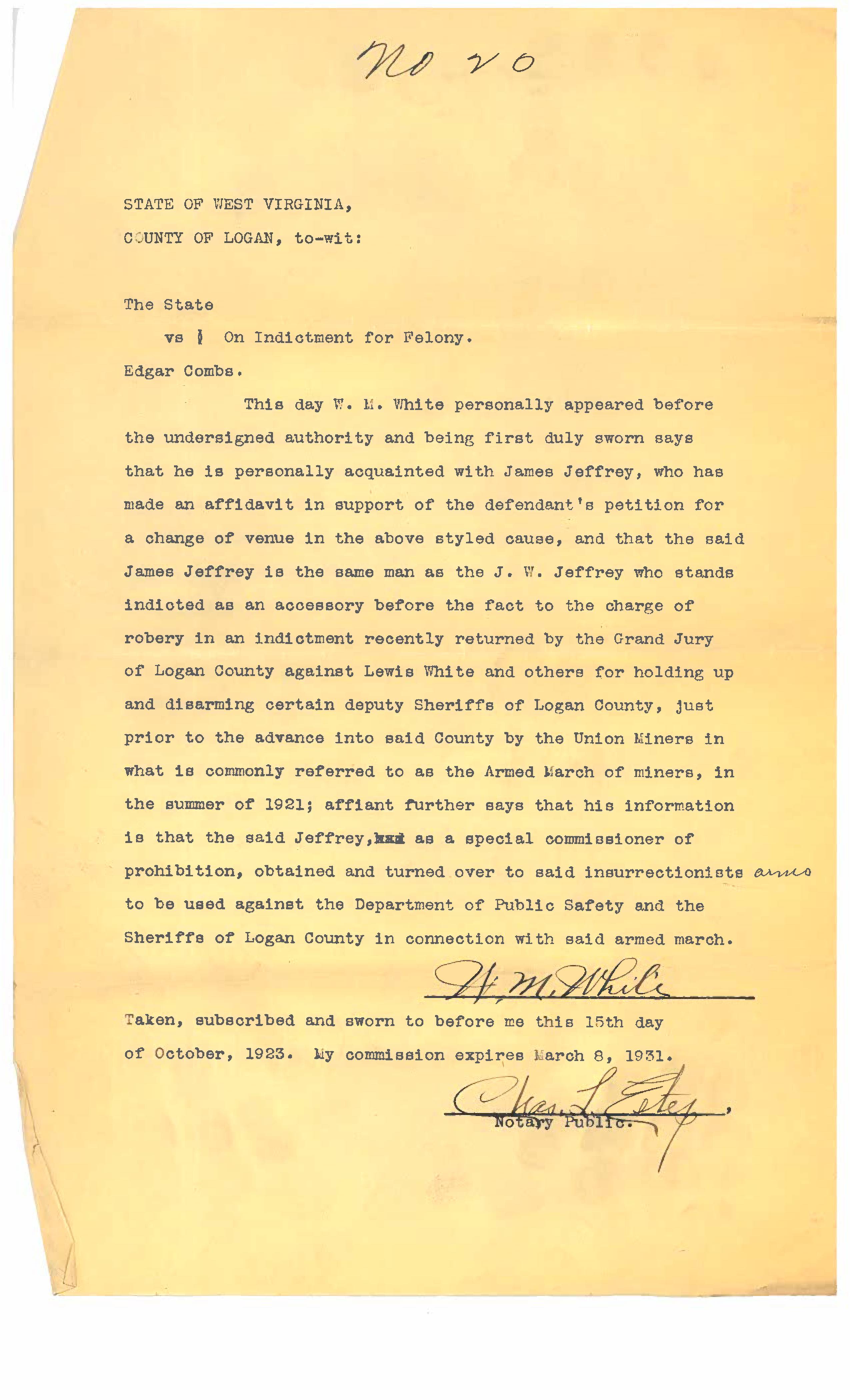
State v. Edgar Combs (1923): Statement of W.M. White, No. 20

08 Sunday Nov 2020

Tags

Appalachia, Charles L. Estep, Department of Public Safety, history, James Jeffrey, Lewis White, Logan County, sheriff, United Mine Workers of America, W.M. White, West Virginia

Posted by Brandon Ray Kirk | Filed under Battle of Blair Mountain

≈ Leave a comment

Image

State v. Edgar Combs (1923): Statement of Thomas West

08 Sunday Nov 2020

Tags

Appalachia, attorney, Cabell County, coal, H.W. Houston, Huntington, Logan County, Thomas West, United Mine Workers of America, West Virginia

Posted by Brandon Ray Kirk | Filed under Battle of Blair Mountain, Huntington

≈ Leave a comment

Battle of Blair Mountain (1921)

27 Tuesday Oct 2020

Posted by Brandon Ray Kirk in Battle of Blair Mountain, Logan

≈ Leave a comment

Tags

Appalachia, Battle of Blair Mountain, Bilton McDonald, C.S. Minter, crime, Don Chafin, F.O. Woerner, F.R. Remlinger, F.S. Schuster, First National Bank, Fulton Mitchell, H.C. Hill, history, justice of the peace, labor, Logan, Logan Banner, Logan County, Mine Wars, Naaman Jackson, sheriff, Sidney B. Lawson, true crime, United Mine Workers of America, W.S. Bradshaw, West Virginia

From the Logan Banner of Logan, WV, comes this item dated September 9, 1921 about the “armed march” on Logan County by union miners:

TROOPS END GREAT CONFLICT

CITIZENS MEET TO SEND THANKS TO SISTER COUNTIES WHO SO NOBLY HELPED

The war is over!

With the arrival of federal troops Saturday and the relieving of the boys along the battle sector Sunday morning Logan citizens started to regain rest which has been denied for two weeks. All Sunday afternoon special trains were speedily filled up and started on their way with tired but happy men, for their homes up and down the county and to our neighboring counties who so willingly came to our help at a time when days looked very black for the future of our beautiful county.

Every man a volunteer and every one ready for action as soon as he arrived in Logan. Logan will never forget the sacrifice made.

Monday evening in answer to a call issued, the circuit court room filled with citizens of Logan to give thanks and offer resolutions to those helping us and to the counties who so nobly responded to our calls for help.

The meeting was opened by Clarence McD. England and Naaman Jackson, president of the First National Bank was elected chairman. Committees were immediately appointed to draw up the resolutions. During the time the committees were preparing the resolutions several impromptu speeches were made. The speakers included Attorney Lilly and Chafin. Mr. Chafin emphasized the fact that it was due to Kanawha county’s failure to properly cope with the situation at the time when it could have been handled without bloodshed that it become necessary for Logan to mobilize an army under arms to protect its rights as a county. He brought forth rousing cheers when he stated that Logan county has a sheriff who had made the statement that “they shall not pass” and now they could say “THEY DID NOT PASS!” The fighting parsons were called for. They were the Reverends Coffey and Dodge.

Rev. Dodge said we had taught the rednecks the meaning of “Love” as it had been taught to him when a child–that of the application of a slipper to a part of his anatomy. He said it was in this manner he preached the meaning of the word and felt in this way Logan had showed her love for those who were fighting under the red flag through ignorance but who have now laid down their arms to resume the more peaceful pursuit of “live and let live.”

Justice of the Peace Fulton Mitchell was called on for a speech relative to the treatment received at the hands of the enemy when he and his three companions were captured and held for more than a week. His remarks were of the same content as will be found in another column of this issue.

In due time the resolutions had been prepared and read to those present and were speedily adopted and have been sent to the counties specified.

They are as follows:

Logan, Logan County, West Va.,

September 5, 1921

To the Officials and Citizens of our Neighboring West Virginia Counties, and the Western Counties of Virginia, whose Aid and Counsel was so Freely and Generously given to us at the time of the threatened invasion of our boundaries:

GREETING:

The representative citizenship of Logan county, West Virginia, in mass meeting on this day assembled, do hereby earnestly and publicly express to you and each of you, our sincere and hearty thanks and appreciation for the substantial, timely and very valuable aid and assistance rendered to our county and our citizenship during the recent attempted invasion of our boundaries by a misguided and hostile mob, imbued with the spirit of anarchy and fighting under the red flag.

The value of the help brought by the men who came to us from your counties cannot be overestimated. The organization was soon perfected and proved effective in holding back the invaders.

While your men were with us they showed fine courage and devotion to duty; their bearing was always that of courteous gentlemen, and the citizens of Logan county most heartily thank you and your gallant men for the splendid help given.

We hope the occasion will never arise when you will need similar assistance, but, if such a crisis should occur, our men will be found ready to respond.

Respectfully,

REV. W.S. BRADSHAW

F.S. SCHUSTER

F.O. WOERNER

C.S. MINTER

DR. H.C. HILL

Resolutions Committee.

The foregoing resolution was unanimously adopted at a mass meeting held in the City of Logan, September 5, 1921.

NAAMAN JACKSON, Chairman.

F.S. SCHUSTER, Sec’y.

In mass meeting assembled at County Court House in Logan, September 5th, 1921:

The citizens of Logan county–

RESOLVED: That the actions and efforts of the Logan county officials as well as those of the loyal men and women, are most heartily commended and approved, and it is further

RESOLVED: That the final results of such are most gratefully acknowledged and appreciated, and be it

RESOLVED: That a copy of these resolutions be printed in our local newspapers.

DR. S.B. LAWSON

F.R. REMLINGER

BILTON McDONALD

Committee.

Armed March: Kanawha County Sheriff H.A. White (1921)

16 Friday Oct 2020

Posted by Brandon Ray Kirk in Battle of Blair Mountain, Logan

≈ Leave a comment

Tags

Appalachia, Battle of Blair Mountain, crime, Don Chafin, H.A. White, Kanawha County, Logan, Logan County, Mine Wars, Mingo County, sheriff, United Mine Workers of America, West Virginia

From the Logan Banner of Logan, WV, comes this item dated September 2, 1921 about Kanawha County sheriff H.A. Walker and his role in the “armed march” on Logan County, WV, by UMWA miners:

IS KANAWHA PROUD OF HER SHERIFF?

We presume the citizens of Kanawha county are justly proud of their sheriff, H.A. Walker.

When Kanawha county citizens, all miners, last week decided that since Logan county was enjoying an unbroken peace of seventeen years, or from the time coal operations began, it would probably overlook the state pistol toting law and the United States treason laws and remain peacefully subservient thus allowing them to pass as quietly through Logan county as possible which might include pillaging a few homes and only a murder or two. Did Logan’s sheriff permit it? Let’s see.

This mob was allowed to gather in Kanawha county by their sheriff who visited their camp, saw armed sentinels and is said to have received authentic information of pillaging and looting and auto holdups in his county yet sends in the report of “everything orderly.” This then means that a person or several hundred persons may carry arms in Kanawha county so long as they are orderly even though he or they should hold up an auto or two “to see if the driver was carrying whiskey to the campers along the road.”

For shame, Kanawha. You permit a man to hold this high office who allows all of this in violation of his sacred oath, because he fears to disarm these men who came down through Boone leaving a trail of blood along the way, into Logan where families forsake their homes at two o’clock in the morning and drive to Logan city for protection; where every available man is pressed into service for fighting while his mother, wife, daughter and sister spend sleepless days and nights preparing food for him.

You should be pleased, Kanawha, that some of your citizens have produced this reign of terror, but it remained for Logan county’s sheriff to uphold the laws of the State of West Virginia and the laws of the United States and stop this mad rush of Kanawha county citizens into Mingo which would have ended in a manner which God alone knows.

There is no place in modern civilization for the Kanawha demonstration. It is wrong in principle, subservient to anarchy and flagrantly outrageous in the reputation it gives the state. It is the fault of Sheriff Walker that the name of West Virginia is once again disgraced as one of the United States, but thanks to Sheriff Don Chafin and Logan county citizens, the laws are upheld before the more serious encounters ensued.

J.T. Morris Addresses Kiwanis about Blair Mountain (1923)

05 Sunday Jul 2020

Posted by Brandon Ray Kirk in Battle of Blair Mountain, Coal, Logan

≈ Leave a comment

Tags

American Civil Liberties Union, Appalachia, Battle of Blair Mountain, Frank Keeney, history, J.T. Morris, Kiwanis Club, Logan, Logan Banner, Macbeth, Morgan County, Raleigh Register, Rotary Club, United Mine Workers of America, West Virginia

From the Logan Banner of Logan, WV, comes this bit of history regarding the Armed March, or the Battle of Blair Mountain, dated March 30, 1923:

Morris Tells of Logan’s Invasion

Speaking before the Kiwanis club at its luncheon last Friday noon, J.T. Morris, who is now located at MacBeth, Logan county, told in some detail of the visit to Logan county on Sunday, March 4th, of the emissaries of the American Civil Liberties Union, characterizing the “invasion” as a “fizzle,” and stating that free speech was as free in Logan county as anywhere else in the country, but that both the mine workers and mine operators of the county were unalterably opposed to the United Mine Workers of America, and were in solid compact against it.

Mr. Morris stated that every mine worker in the Logan field was bound by his contract of employment to resist encroachment of the U.M.W.A., and that the employers in turn were bound in the same way and would resist to the last ditch. It was under these contracts, approved by a decision of the United States supreme court, the speaker said, that the recent injunctions against the United Mine Workers of America had been secured, and that these injunctions covered every means of attack except that brought about through the American Civil Liberties Union; which has also been busy with propaganda in the interest of C. Frank Keeney in Morgan county.

Their method of approach, widely advertised by inflammatory statements, Mr. Morris described as an insult to the people of Logan county. What was actually said at the meeting was very tame in comparison, he said. They merely generalized on the subject of free speech, and that didn’t worry Loganites, for any man can come into Logan and speak without hindrance so long as he stays within the limits of the law, of common decency and of the public interest.

Mr. Morris read extracts from the addresses of what he dubbed the “wise men of the east.”

Logan county is a unit in its resentment against its defamers. The bar association, the clergy, the chamber of commerce, the Rotary club–all have passed stirring resolutions condemning the insults heaped on the community.

Reprinted from the Raleigh Register

Union Miner Fugitive Shoots State Witnesses in Ohio (1923)

28 Sunday Jun 2020

Posted by Brandon Ray Kirk in Battle of Blair Mountain, Coal

≈ Leave a comment

Tags

A.M. Belcher, Appalachia, Battle of Blair Mountain, David Moore, Edward Reynolds, Elmer Ashworth, history, J.E. Miller, J.W. Swanner, L.C. Davis, Logan Banner, Ohio, Pomeroy, prosecuting attorney, United Mine Workers of America, Vulcan, West Virginia

On May 11, 1923, the Logan Banner printed this item relating to the “Armed March” or the Battle of Blair Mountain:

STATE’S WITNESSES ARE SHOT TO DEATH IN OHIO BY MARCHER

J.W. Swanner and Edward Reynolds, Chief Witnesses in Houston Trial, Murdered By Fugitive

POMEROY, O., May 9.–J.W. Swanner and Edward Reynolds, West Virginia miners, were shot and killed in the mining camp of Vulcan, near here, at 10 o’clock this morning by J.E. Miller, a coal miner. Miller gave as his reason that he feared the two men had come to kidnap him and take him back to West Virginia in connection with the Logan armed march.

Miller’s wife went to the door of their house when Swanner knocked. She closed the door and called to Miller who came to the door with his revolver. He fired through the glass at Swanner, shooting him in the left breast. Reynolds, who was a lame man, attempted to run away and Miller stepped outside the door and fired three shots into Reynolds’ back. Both men died almost instantly.

Were Unarmed

Persons who saw the shooting telephoned to the sheriff’s office at Pomeroy and Deputy Sheriffs Elmer Ashworth and David Moore responded and arrested Miller at his house.

Search of the bodies of Swanner and Reynolds disclosed that they were unarmed. Swanner had in his pocket a letter from A.M. Belcher, offering Miller immunity if the latter would return to West Virginia to testify in the armed march trials.

Swanner and Reynolds had both turned state’s evidence in these cases. When this fact became known the feeling expressed in the mining camp was that both men had got what they deserved. This section is very strongly union in sentiment.

Prosecuting Attorney L.C. Davis…

[I cropped the story here by mistake.]

Union Miners Shoot State Trooper in Mingo County, WV (1921)

24 Wednesday Jun 2020

Posted by Brandon Ray Kirk in Coal, Williamson

≈ Leave a comment

Tags

Alexander Breedlove, Appalachia, Baldwin-Felts Detective Agency, Charleston, crime, history, James Bolles, Lick Creek, Logan Banner, Matewan Massacre, Mine Wars, Mingo County, United Mine Workers of America, Welch, Williamson

The following story appeared in the Logan Banner on July 8, 1921, providing some history for events in Mingo County, WV, after the murder of Baldwin-Felts agents in Matewan and before the killing of Sid Hatfield at Welch:

Union People Fire on State Trooper LB 07.08.1921 5

TROOPER SHOT IN MINGO FRAY

WOUNDED MAN MAY LOSE USE OF ARM AS RESULT OF THE AFFAIR

Trooper James A. Bolles, of Charleston, who was shot June 14 while engaged in searching for arms in the Lick Creek tent colony near Williamson, Mingo county, may lose the use of his right arm as a result of the injury. The search followed a complaint that automobiles passing on the public highway had been fired upon from the tent colony.

A detachment of state police, assisted by some 10 citizens who had volunteered and been sworn in as special state police, went to the camp to seize arms found there in order to prevent further shooting, the identification of any person using his rifle viciously and recklessly being impossible while many of the residents of the colony had arms.

With a party of 15 special state police, Trooper Bolles came upon a group of armed men. He ordered them to put down their weapons but was answered by a number of shots. The trooper and the citizens with him returned the fire with the result that Alexander Breedlove, on of the armed group, was killed.

Shot From Hillside

Some person hidden away on the wooded hillside opened fire and Trooper Bolles was struck in the back, the bullet breaking several bones and severing a number of nerves. Although severely wounded, the state police officer attempted to lift his rifle. He fell to the ground and was guarded by two armed civilians while others attempted vainly to locate the man who had shot him.

When first taken to hospital, Bolles’ chances of recovery appeared slight but the doctors later announced that he would get well but might lose the use of his right arm. The popularity of the injured trooper was such that many citizens of Williamson called upon him daily in the hospital.

Mingo Miners on Strike (1922)

03 Tuesday Mar 2020

Posted by Brandon Ray Kirk in Coal, Williamson

≈ Leave a comment

Tags

Appalachia, coal, David Fowler, history, Logan Banner, Logan County, Mingo County, United Mine Workers of America, West Virginia, Williamson

From the Logan Banner of Logan, WV, comes this bit of news relating to coal miners on strike in Mingo County, dated March 31, 1922:

Mine Workers Cut Mingo Miners’ Wage

Will Reduce Strike Benefits to $3 to Men in Mingo Field, According to Letter

WANT AND FAMINE SURE TO INCREASE RAPIDLY

Fight Has Been a Losing One for Many Weeks and as Big Strike Looms Further Aid is Gone

The miners who have been fighting and striking in Mingo county for recognition of the union have just received word that their schedule of relief had been cut to $3 a week which would show that their fight has been a losing one.

This long story of suffering, want and privation in Mingo county will now be added to with additional misery, for the coming strike cannot be reckoned in days. Surely we of Logan county should be glad of the fact that our miners are working with their employers and not against them, and the first man who would suggest the Mingo conditions as better than the ones we are now enjoying should be properly dealt with by his fellow workers who are sure of year around employment at good wages to the $3 a week or less that is given to the strikers in Mingo. Surely the union officials will realize some day the suffering their greed is causing and stop this movement toward anarchy.

The following is the letter sent to miners on strike in Mingo county:

Williamson, W.Va., Mar. 20, 1922

Dear Sir and Brother:–

As you well know the drain upon the International Treasury for sometime has been very great. Notwithstanding that we have continued to supply the miners of Mingo county with a very liberal amount of relief. The amount of relief issued in the Williamson field has been greater than that in any strike in the history of the organization. The miners have been working on slack time throughout the country and on March 31, 1922, the present working agreement will expire and the miners of Mingo county will be standing side by side with the other miners of the country. The other miners of the country have given you more consideration than they have given themselves and are still willing to give further consideration through the long duration of your strike.

It will require a considerable amount of money to carry on negotiations so that it will be necessary for us to reduce the relief at this time.

I am therefore advising you that beginning with the week of March 27th, the schedule of relief will be men $3, women $1, child 50 cents a week. I am not sure that I can continue to pay even this amount if the general suspense of mining should last any length of time. However the miners of this country will do the best they can and continue to send in the liberal relief amount as long as possible.

With every good wish, I am,

Very truly yours,

DAVID FOWLER

International representative and financial agent

United Mine Workers of America

← Older posts

Feud Poll 1

If you had lived in the Harts Creek community during the 1880s, to which faction of feudists might you have given your loyalty?

Categories

  • Adkins Mill
  • African American History
  • American Revolutionary War
  • Ashland
  • Atenville
  • Banco
  • Barboursville
  • Battle of Blair Mountain
  • Beech Creek
  • Big Creek
  • Big Harts Creek
  • Big Sandy Valley
  • Big Ugly Creek
  • Boone County
  • Breeden
  • Calhoun County
  • Cemeteries
  • Chapmanville
  • Civil War
  • Clay County
  • Clothier
  • Coal
  • Cove Gap
  • Crawley Creek
  • Culture of Honor
  • Dingess
  • Dollie
  • Dunlow
  • East Lynn
  • Ed Haley
  • Eden Park
  • Enslow
  • Estep
  • Ethel
  • Ferrellsburg
  • Fourteen
  • French-Eversole Feud
  • Gilbert
  • Giles County
  • Gill
  • Green Shoal
  • Guyandotte River
  • Halcyon
  • Hamlin
  • Harts
  • Hatfield-McCoy Feud
  • Holden
  • Hungarian-American History
  • Huntington
  • Inez
  • Irish-Americans
  • Italian American History
  • Jamboree
  • Jewish History
  • John Hartford
  • Kermit
  • Kiahsville
  • Kitchen
  • Leet
  • Lincoln County Feud
  • Little Harts Creek
  • Logan
  • Man
  • Matewan
  • Meador
  • Midkiff
  • Monroe County
  • Montgomery County
  • Music
  • Native American History
  • Peach Creek
  • Pearl Adkins Diary
  • Pecks Mill
  • Peter Creek
  • Pikeville
  • Pilgrim
  • Poetry
  • Queens Ridge
  • Ranger
  • Rector
  • Roane County
  • Rowan County Feud
  • Salt Rock
  • Sand Creek
  • Shively
  • Spears
  • Sports
  • Spottswood
  • Spurlockville
  • Stiltner
  • Stone Branch
  • Tazewell County
  • Timber
  • Tom Dula
  • Toney
  • Turner-Howard Feud
  • Twelve Pole Creek
  • Uncategorized
  • Warren
  • Wayne
  • West Hamlin
  • Wewanta
  • Wharncliffe
  • Whirlwind
  • Williamson
  • Women's History
  • World War I
  • Wyoming County
  • Yantus

Feud Poll 2

Do you think Milt Haley and Green McCoy committed the ambush on Al and Hollene Brumfield in 1889?

Blogroll

  • Ancestry.com
  • Ashland (KY) Daily Independent News Article
  • Author FB page
  • Beckley (WV) Register-Herald News Article
  • Big Sandy News (KY) News Article
  • Blood in West Virginia FB
  • Blood in West Virginia order
  • Chapters TV Program
  • Facebook
  • Ghosts of Guyan
  • Herald-Dispatch News Article 1
  • Herald-Dispatch News Article 2
  • In Search of Ed Haley
  • Instagram
  • Lincoln (WV) Journal News Article
  • Lincoln (WV) Journal Thumbs Up
  • Lincoln County
  • Lincoln County Feud
  • Lincoln County Feud Lecture
  • LinkedIn
  • Logan (WV) Banner News Article
  • Lunch With Books
  • Our Overmountain Men: The Revolutionary War in Western Virginia (1775-1783)
  • Pinterest
  • Scarborough Society's Art and Lecture Series
  • Smithsonian Article
  • Spirit of Jefferson News Article
  • The Friendly Neighbor Radio Show 1
  • The Friendly Neighbor Radio Show 2
  • The Friendly Neighbor Radio Show 3
  • The Friendly Neighbor Radio Show 4
  • The New Yorker
  • The State Journal's 55 Good Things About WV
  • tumblr.
  • Twitter
  • Website
  • Weirton (WV) Daily Times Article
  • Wheeling (WV) Intelligencer News Article 1
  • Wheeling (WV) Intelligencer News Article 2
  • WOWK TV
  • Writers Can Read Open Mic Night

Feud Poll 3

Who do you think organized the ambush of Al and Hollene Brumfield in 1889?

Recent Posts

  • Logan County Jail in Logan, WV
  • Absentee Landowners of Magnolia District (1890, 1892, 1894)
  • Charles Spurlock Survey at Fourteen Mile Creek, Lincoln County, WV (1815)

Ed Haley Poll 1

What do you think caused Ed Haley to lose his sight when he was three years old?

Top Posts & Pages

  • Early Coal Mines in Logan County, WV
  • History for Boone County, WV (1928)
  • Early Anglo Settlers of Logan, WV (1937)
  • Origin of Place Names in Logan County, WV (1937)
  • Big Harts Creek Post Offices

Copyright

© Brandon Ray Kirk and brandonraykirk.wordpress.com, 1987-2023. Unauthorized use and/or duplication of this material without express and written permission from this blog’s author and/or owner is strictly prohibited. Excerpts and links may be used, provided that full and clear credit is given to Brandon Ray Kirk and brandonraykirk.wordpress.com with appropriate and specific direction to the original content.

Archives

  • February 2025
  • January 2025
  • October 2023
  • September 2023
  • December 2022
  • November 2022
  • May 2022
  • April 2022
  • February 2022
  • November 2021
  • October 2021
  • September 2021
  • June 2021
  • May 2021
  • April 2021
  • March 2021
  • February 2021
  • January 2021
  • December 2020
  • November 2020
  • October 2020
  • July 2020
  • June 2020
  • May 2020
  • April 2020
  • March 2020
  • February 2020
  • January 2020
  • December 2019
  • November 2019
  • October 2019
  • September 2019
  • August 2019
  • July 2019
  • June 2019
  • May 2019
  • April 2019
  • March 2019
  • February 2019
  • January 2019
  • December 2018
  • November 2018
  • October 2018
  • September 2018
  • August 2018
  • July 2018
  • June 2018
  • May 2018
  • April 2018
  • March 2018
  • February 2018
  • January 2018
  • December 2017
  • November 2017
  • October 2017
  • September 2017
  • August 2017
  • July 2017
  • June 2017
  • May 2017
  • April 2017
  • March 2017
  • February 2017
  • January 2017
  • December 2016
  • November 2016
  • October 2016
  • September 2016
  • August 2016
  • July 2016
  • June 2016
  • May 2016
  • April 2016
  • March 2016
  • February 2016
  • January 2016
  • December 2015
  • November 2015
  • October 2015
  • September 2015
  • August 2015
  • July 2015
  • June 2015
  • May 2015
  • April 2015
  • March 2015
  • February 2015
  • January 2015
  • December 2014
  • October 2014
  • September 2014
  • August 2014
  • July 2014
  • June 2014
  • May 2014
  • April 2014
  • March 2014
  • February 2014
  • January 2014
  • December 2013
  • November 2013
  • October 2013
  • September 2013
  • August 2013
  • July 2013
  • June 2013
  • May 2013
  • April 2013
  • March 2013
  • February 2013
  • January 2013
  • December 2012
  • November 2012

Enter your email address to follow this blog and receive notifications of new posts by email.

Join 2,925 other subscribers

Tags

Appalachia Ashland Big Creek Big Ugly Creek Blood in West Virginia Brandon Kirk Cabell County cemeteries Chapmanville Charleston civil war coal Confederate Army crime culture Ed Haley Ella Haley Ferrellsburg feud fiddler fiddling genealogy Green McCoy Guyandotte River Harts Harts Creek Hatfield-McCoy Feud history Huntington John Hartford Kentucky Lawrence Haley life Lincoln County Lincoln County Feud Logan Logan Banner Logan County Milt Haley Mingo County music Ohio photos timbering U.S. South Virginia Wayne County West Virginia Whirlwind writing

Blogs I Follow

  • OtterTales
  • Our Appalachia: A Blog Created by Students of Brandon Kirk
  • Piedmont Trails
  • Truman Capote
  • Appalachian Diaspora

BLOOD IN WEST VIRGINIA is now available for order at Amazon!

Blog at WordPress.com.

OtterTales

Writings from my travels and experiences. High and fine literature is wine, and mine is only water; but everybody likes water. Mark Twain

Our Appalachia: A Blog Created by Students of Brandon Kirk

This site is dedicated to the collection, preservation, and promotion of history and culture in Appalachia.

Piedmont Trails

Genealogy and History in North Carolina and Beyond

Truman Capote

A site about one of the most beautiful, interesting, tallented, outrageous and colorful personalities of the 20th Century

Appalachian Diaspora

  • Subscribe Subscribed
    • Brandon Ray Kirk
    • Join 787 other subscribers
    • Already have a WordPress.com account? Log in now.
    • Brandon Ray Kirk
    • Subscribe Subscribed
    • Sign up
    • Log in
    • Report this content
    • View site in Reader
    • Manage subscriptions
    • Collapse this bar
 

Loading Comments...