Tags
Appalachia, Boone County, culture, genealogy, history, John P Fowler, life, Lincoln County, photos, timbering, U.S. South, West Virginia, writing

John P. Fowler of Lincoln and Boone counties

07 Friday Dec 2012
Posted in Timber
Tags
Appalachia, Boone County, culture, genealogy, history, John P Fowler, life, Lincoln County, photos, timbering, U.S. South, West Virginia, writing
John P. Fowler of Lincoln and Boone counties
07 Friday Dec 2012
Posted in Big Harts Creek, Ed Haley, Spottswood, Whirlwind
Tags
Appalachia, Ashland, Harts Creek, history, Jack Haley, Joe Mullins, John Hartford, Kentucky, Lawrence Haley, Liza Mullins, Liza Napier, music, Pat Haley, Sherman Baisden, Stella Mullins, U.S. South, West Virginia
Later that night, Lawrence, Pat and I talked more at the kitchen table. For reasons I cannot remember — but possibly because I was so determined to get at the root of the music — our conversation kept returning to the subject of Ed’s childhood and birthplace in West Virginia.
Pat said she first went to Harts Creek with Lawrence, Jack and Jack’s wife Patsy in the summer of 1951. Noah and his wife Janet also made the trip.
“We went up in Jack’s Packard,” she said. “Three in the front and three in the back, plus Beverly and two babies. It was a horrible ride and it was at night and all the way up there the boys was telling us what to expect. They was telling us that you better be careful because going up to Harts like that at night — strangers — they could shoot you in a minute. They told us there was a headless horseman that rode up and down that hollow and a screaming banshee and they told us if the creek was up we’d have to walk it. Patsy and I was scared to death.”
I asked about Aunt Liza, the lady who raised Ed.
“When we went up there the first time, Aunt Liza was living in the old log homeplace,” Pat said. “Aunt Liza, Little Liza, Joe and Stella lived there.”
Aunt Liza was Ed’s aunt, Lawrence said, while Joe was his first cousin. Joe was married to Stella and was a close relative to Little Liza.
The Haley trip was a real experience for Pat and her sisters-in-law.
“When we went up there, Joe had a couple of kids,” Pat said. “One was about two maybe and it was wearing a little gown and had this beautiful blonde curly hair. I picked it up and said, ‘Oh, what a beautiful girl you are,’ but when I raised it up I saw that it didn’t have a diaper on and was a little boy. Aunt Liza said Stella had just had a baby the day before and was ‘feeling puny.’ That was a new word to me. Oh, we asked to see the baby and they said it was in the bed. Well, we couldn’t find that baby because it was down in the feather bed. And what surprised us was that Stella was up and about.”
Pat remembered the trip fondly.
“They were very down-to-earth people and I’m assuming that very little had changed from the time Pop grew up there,” she said. “It was like the cowboy movies where they cooked on those wood stoves and the way they served it at that great, big wooden table. Little Liza and Aunt Liza cooked us a meal. The food was good.”
Pat said she and the rest of the Haley wives probably made a big impression on Aunt Liza and company as well.
“We were outside on the porch and Aunt Liza said she’d never seen anybody dressed like us,” she said, laughing. “I guess we looked like painted jezebels. We had make-up on and modern hairdos. Janet was wearing a white blouse and a black skirt. I had a short-sleeved yellow dress on. Patsy’s was blue. Patsy used to wear a lot of make-up, always painted her fingernails. Janet didn’t wear too much make-up but she always dressed nice. She loved to wear those silk blouses, and they tied at the neck. I think something else that fascinated them: we weren’t smoking a pipe. Aunt Liza smoked a pipe.”
At one point, Pat said she was standing outside with the girls when this “funny boy” came up and scared them nearly to death. “We were outside when this boy came up through the yard making funny noises,” she said. “He got so excited — moreso than when we saw him — and touched Janet’s shoulder and she screamed bloody murder. Poor old Aunt Liza didn’t know what happened. And of course, Jack and Larry thought it was the funniest thing they’d ever heard.”
Pat made another trip to Harts a short time later with Jack and Lawrence.
“Jack took a movie camera and filmed everybody,” she said. “It seems like Jack took some pictures inside the cabin but I’m not sure. I know he was taking pictures outside of Aunt Liza and Little Liza and Liza’s daughter. I believe they thought he was just taking pictures. When he got back to Cleveland, he had the film developed.”
Later, in 1956, Pat made another trip to Harts Creek with Lawrence, Jack and Patsy. At that time, Joe Mullins was living in the old log cabin and Aunt Liza had moved into her daughter’s home just down the creek. Next door was an old log home covered in dilapidated paneling, which was supposedly built by Ed’s father, Milt Haley.
“And then when we went back the third time, Jack had brought the film from the previous visit,” Pat said. “I can almost hear him now saying, ‘Now Aunt Liza, I’ve got something I want you to see.’ They put a sheet over a mirror that was on the side wall and when the movie started Aunt Liza got real excited and started pointing toward Little Liza and saying, ‘There’s you. That’s me.’ You could see their lips moving in the movie but there wasn’t any sound. And Little Liza got excited too.”
A highlight of the trip occurred when Pat found herself in a conversation with Aunt Liza. “I suppose listening to Aunt Liza and Little Liza and me trying to talk was like a foreign language. Old Aunt Liza was telling me all about her property and I’m talking to her and I’m thinking she is talking about land but she isn’t. She’s talking cattle, dogs, and the oxen. And Little Liza was talking about her daughter going to school. And we got on the subject of the meals and what did she take for lunch. ‘Oh,’ she said, ‘she takes her lunch in the lard bucket and she put biscuits and cornbread and different things in it.’ And I asked her about her husband and she said, ‘We’re not certified,’ and I wasn’t really sure what that meant so I said, ‘Oh, Lawrence and I aren’t, either.'” On the way home, Lawrence asked her if she knew what she’d meant to say because Little Liza had meant that she and the girl’s father weren’t married.
Lawrence could tell that I was really interested in his father’s birthplace so he asked me if I would like to see it. I said I would love to — and was more than happy to provide the car and gasoline for such a trip.
07 Friday Dec 2012
Posted in Pearl Adkins Diary
Tags
Appalachia, culture, Harts Creek, history, inspiration, life, love, Pearl Adkins, thoughts, U.S. South, West Virginia, writers, writing
The latter portion of Pearl’s second diary closes with a cluster of entries dated from February until June for an unknown year. Thereafter is a smattering of monthly entries.
“No sadder or lonelier day ever passed over my old head,” Pearl wrote on February 7. “It will long be remembered by me. I never have hardly suffered as I did to day. My very heart was breaking. My yearning for what I knew not.”
Pearl was obviously inspired to write by some misfortune, although she never specified the source of her troubles.
“Oh God, what I suffered last night,” she continued the following day. “I cried till I couldn’t cry. No one seemed to notice my sorrow. Physical pain would be better than this some times.”
Pearl’s happiness was at an all time low.
“If I could have courage to go through with what I think of doing so often,” she wrote. “It’s a terrible thing to think of doing but I can’t. That would be far better than to suffer for maybe years on this old world of pain and woe. Lord help me to overcome my weakness of courage. Make me, dear Jesus, have something to want to live for. Oh Lord, help me to bear my troubles.”
It seems, based on the above entry, that Pearl was perhaps contemplating suicide at that point in her life.
“What a storm is brewing,” she wrote later in February. “The wind is roaring in the trees on top of the hill. The storm is on. The rain is pouring but the tempest out side is not much greater than the tempest in my breast. The storm is over. It is the beginning and ending of everything. Now, if I could only walk, my cup of happiness would be running over.”
“Oh, the troubled sleep I had last night,” she wrote the following day, on a Wednesday. “The snow is falling so fast and the ground is covered every where. The beautiful snow. This reminded me of a day some years ago, those short fleeing years for me. I was just a kid then and with a kid’s thoughts my future was beautifully paved then but that was short lived.”
“Today I was sitting alone in the kitchen by the stove with the odor of soup beans going up my nose,” Pearl next wrote in an undated entry. “Mama’s voice floats in on my hearing, singing ‘Shady Grove’ to the baby. Cora is over at Inez’s in bed a groaning with her side. Marg’s wanting a new hat. All of these things is passing through my jumbled up brain. I only wish my good old Friend would come for a talk to me so much. I can’t think.”
07 Friday Dec 2012
Posted in Ed Haley
Tags
Appalachia, Arkansas Traveler, Ashland, Blackberry Blossom, blind, Chillson Leach, Ella Haley, fiddler, fiddlers, fiddling, Fisher's Hornpipe, J P Fraley, John Hartford, Kentucky, Lawrence Haley, Mt. Sterling, music, Ralph Haley, Turkey in the Straw, U.S. South, Virgil Alfrey, West Virginia, Williamson
Later that evening, Lawrence and I went to see J.P. Fraley. On the way, he told me more about his father’s recordings.
“Well, he depended on my brother Ralph to tap him on the shoulder when he wanted him to start, and when he was getting near the end of the disc he’d tap him again, see? And Pop, sometimes he’d stop right then, cut it off real short, and then sometimes he’d go to the end of that run and hit that shave and a haircut at the end of it. Sometimes it sounded like he was gonna quit, see? Ralph hadn’t give him the signal that they was close to the end of the recording, so you can hear a little bit of hesitation at times. I thought Mom was getting ready to stop, too.”
Lawrence figured the records were made in the daytime but wasn’t sure of the time of year. “I guess the good part of maybe one spring or something because I was in the service and I wasn’t home.”
At the time of the recordings, Ed was no longer playing professionally. “He’d go out, like I say, a few times. Somebody’d come and get him, take him somewhere. He thought, ‘Well, if they’re gonna have a good time, I’ll go up and play for them and have a good time with them.’ As time went on, the older he got, the harder it was to get him to go. I guess he was having more trouble with his circulatory system.”
At J.P.’s, we met Virgil Alfrey and Chillson Leach, two old-time fiddlers from around Ashland. Virgil began playing the fiddle as a boy of twelve in the early thirties, around the time he used to see Ed in Williamson, West Virginia. The last time he saw him there he reached Ed a dollar and requested “Fisher’s Hornpipe”. Haley recognized his voice, played the tune then tried to give his dollar back because he liked him.
Chillson Leach, an 83-year-old retired rigger from Mt. Sterling, Kentucky, had been playing the fiddle since he was nine years old.
“Uncle Ed was one of the best fiddlers in this country,” he said. “He would get an audience in front of him and he kinda knowed that they was a lot of people by the sound of the money they throwed in his cup. And he’d say, ‘People, they’s a mental strain and a physical strain on playing the violin.’ Now that’s what he would tell them. He wanted them to know that he was earning his money when he was a playing that violin. And lord, when he would pull that bow across that fiddle he’d get some of the prettiest notes that ever you heard in your life. His fingers was long and slim and as nimble right up I reckon till he died.”
Lawrence, who was taking all of this in, said, “Pretty close. He slowed down the last five or six years.”
Chillson said, “Yeah but when I knowed him, my goodness, he’d get way down on that neck. Any position you wanted him to play. He was wonderful. It’s a shame that a person has to die. I’d give him a quarter and I’d say, ‘Play that ‘Blackberry Blossom’ and he played that for me and man he could just make your hair stand on your head. And then he played a lot of reels, you know. He could play anything you’d ask him: ‘Turkey in the Straw’, ‘Arkansas Traveler’.”
Chillson was obviously a fan.
“I just thought the world of him because he entertained everybody in Ashland,” he said. “He had a blind fellow that played the guitar with him and this blind fellow would sit there and man they’d make some pretty music.”
On the way home, Lawrence told me that his father hated to play “Turkey in the Straw”.
06 Thursday Dec 2012
Posted in Pearl Adkins Diary
Tags
Appalachia, culture, Harts Creek, history, inspiration, life, love, Pearl Adkins, thoughts, U.S. South, West Virginia, writers, writing
In August 1925, Pearl’s diary resumed, at first with a small upbeat entry.
“Pearl and I all alone talking our secrets,” wrote sister-in-law Inez Adkins on the evening of August 3. “Best friends on earth.”
Following this happy note, Pearl’s writings turned depressingly morbid.
“My last request,” she wrote on August 14. “I don’t feel that I shall be here so very long at the longest. Friends or relatives, when I die, I want to be buried anywhere where the rest of the family is buried. I want a white casket (a coffin will do). Cover it with white satin if you can’t get white. Any other nice white good will do but I would rather have it satin. I want a white shadow lace dress with a narrow white ribbon — not more than four of them. I want a light blue princess slip. If you can’t get the lace dress, get a georgetta crepe. If you can’t get crepe, get white satin. Put two rows of lace up the front and small bows of ribbon up the front too, or you can have streamers at the neck. Get them as near as you can if you are able to buy them. Buy what I said. Buy as near to it as you can. Comb my hair like I wear it in life. Powder me first a little bit. Remember Pearl.”
Then came one of the more powerful entries in the entire diary.
“No, there is not the slightest hope I shall ever be any better than I am now. It is not a pleasant prospect. It is just the thought of it at times that makes me worse. There is days and weeks at a time I don’t want to see any one. My sister tells me it is more my temper than my misfortune that afflicts me and perhaps she is right. I hate people because they expect me to see a blessing direct from God. In fact I am nothing more than a miserable clod on the face of the earth. I wish I could have a house all to myself where I could do as I please. None of them don’t seem to understand me or my way and I need some one to stay with me that could really understand me.”
“We could live an ideal existence,” Pearl continued, shifting the direction of her thoughts toward the object of her affections. “Nothing would please me better. I am sort of death’s head at home. I’m nothing but an annoyance and a burden to mother. I expect they would be glad if I could make a change like that. I could never be with out you. I don’t know how I ever did get along with out you as long as I did. It seems to me my life must have been cruelly empty. I love you very dearly — you have done more for me than talked with me. I think you have very near saved my soul for I was becoming very hard and bitter when you came. God has surely sent us to each other. You must think that my deformety is all I have to bear.”
“When God made the cripple he made the mistake of implanting in the poor deformed breast a heart like that which other people have — a heart to love,” Pearl wrote. “Hush, that is something that ought to be buried as deeply from sight as the heart itself. I am a fool to even give it a breath of air to feed upon. Does one think there is no design in that? Do you believe that I shut myself in these four walls because I despise all the world for its strength and beauty? I am not quite as bad as that. Perhaps it is my physical condition that makes me so very weak…; but I can not endure to look upon his face, to hear him speak in his kindly tone to me to know that the only feeling in his soul is pity; and but for that I should be less to him than the very dirt beneath his feet. Oh God! Do you think there is nothing in such suffering as mine? Can you see no further into it than the mere pain that rocks my wretched body? I can tell you it is ghostly. I cannot bear even to look into his face because I know that I shall see there the pitying smile that has grown hideous to me. To know that it can never be different! That I must be like an accursed log until I die, arousing nothing more than pity in the breast of any one. I should at least have the memories of the past — happiness to feed my empty heart. I could look back and say, ‘I was happy then.’ Oh it would be so much! So much! My life.”
06 Thursday Dec 2012
Posted in Timber
Tags
Appalachia, culture, history, life, photos, timbering, U.S. South, West Virginia, writers, writing

West Virginia timber job, 1890-1915
06 Thursday Dec 2012
Tags
Appalachia, Ashland, blind, California, Clyde Haley, culture, Cumberland Gap, Ed Haley, fiddler, fiddling, Halbert Street, history, Ida Red, John Hartford, Kentucky, Lawrence Haley, life, music, Pat Haley, square dances, Stockton, U.S. South
On the way home in the car, Lawrence told a story about his father getting drunk and trying to find his way home one winter night.
“We lived on Halbert Street,” he said. “The Prices down the street took Pop off somewhere or brought him back to their house and turned him loose after he got real good and drunk. Well, he was coming home by himself. It might have been two or three city blocks. He was walking on this blacktop street but he was so drunk and it was pretty cold weather, too, and he just fell over in the ditch and went to sleep. They found him the next day at daylight. They said if he hadn’t been drunk he would’ve froze to death. That was way back I guess when I was a baby.”
A hard picture began to emerge: alcohol, music, meanness and the desolation it produces. Lawrence, however, emphasized that his father was actually a happy person who lived an eventful life.
“These people that put these jackets on these albums and things, they take a tune like ‘Man of Constant Sorrow’ and make it out like my dad should play a piece of music like that because that was his place in life: being a poor old down-and-out blind man — that he lived the life of ‘constant sorrow,'” he said. “That’s the way they make these tunes seem: that should be maybe my dad’s signature tune or something, playing a dirge like that. When really he enjoyed life and had a good time whenever it could be had. If he had somebody to carouse with, he’d carouse as long as they would and probably wear three or four people out.”
I said, “I get the feeling that as well as he played the dirges, that his favorite stuff was like ‘Cumberland Gap’ and ‘Ida Red’.”
Lawrence agreed, “Yeah, and he enjoyed people dancing. My brother Clyde, I guess he stayed around Pop a lot and he could call any of those ‘birdie in the cage’-type clogging square dance. The old hoedown square dance. He lives in California. He’s in Stockton somewhere out there, or was the last time I heard.”
I wondered if it would be okay to call him.
“Yeah,” Lawrence said, “if Pat has his number at the house.”
06 Thursday Dec 2012
Tags
Appalachia, Ashland, blind, culture, Ed Haley, fiddler, history, John Hartford, Kentucky, life, music, photos, U.S. South

Ed Haley (1885-1951)
05 Wednesday Dec 2012
Posted in African American History, Ferrellsburg
Tags
Appalachia, culture, Ferrellsburg, history, life, Lincoln County, photos, U.S. South, West Virginia, writing

Ferrellsburg Ferry, 1900-1915
05 Wednesday Dec 2012
Posted in Ed Haley
Tags
Appalachia, Ashland, blind, Charleston, Clark Kessinger, Ed Haley, fiddler, fiddlers, fiddling, history, John Hartford, Kentucky, Lawrence Haley, music, U.S. South, West Virginia
Lawrence and I drove to an Ashland restaurant where I asked more about Haley’s background between bites of seafood. I was desperate for clues about his early musical experience.
Just where did he learn to play?
Lawrence said his dad was like other mountain folks: music “absolutely come freely to these people.” He said, “A lot of people think old-time music is a simple art form because so many people that play it have a poor educational background. These people think, ‘If they can learn to play it, it has to be a simple thing to do.’ But it’s actually a complicated business.”
A little later, I asked him about Clark Kessinger and Charleston, West Virginia.
“I been to Charleston with Pop a few times, but if Clark Kessinger was around he never let Pop know,” he said. “He’d probably request a tune from him. Of course, Pop was pretty sharp on voices, too. He recognized a lot of people just by their voice. If Clark come up and requested a piece of music from him, Dad probably knew it. He never said anything to me about it. We were just kids.”
I said, “Well, Clark Kessinger studied your dad close. Of course, he knew what good fiddling was.”
“You have to give him credit for that,” Lawrence said, taking a bite of fish.
04 Tuesday Dec 2012
Posted in Pearl Adkins Diary
Tags
Appalachia, books, culture, Harts Creek, inspiration, life, love, Pearl Adkins, poetry, thoughts, U.S. South, West Virginia, writers, writing
The second volume of Pearl’s diary is filled with entries that specify a month but not a year. Chronologically, it appears a hopeless case, however there are two main clusters of writing periods, from February to March and from February to June. It’s not clear if these are overlapping time frames or if they refer to spring months for different years.
The bulk of the material seems to take place in 1925.
Volume 2 begins on January 30, 1925 when Pearl wrote this: “My heart is just as heavy as on that sad day. I’ve lost almost all interest in life.”
Her dissatisfaction with life more than likely had something to do with her inability to find a companion, which she blamed on her handicap.
“Sunday morning dawned cold and blue,” she wrote in February. “I had a feeling he was coming. I had not long to wait for he came real early. To my surprise he came in and set down so near me that I could have kicked him with my foot. He got up for some thing and when he set down again he set down on a bed that my chair was tilted back again. He was so clost that time his knee was against my knee. If he had only knew how I loved him and how his nearness caused my heart to beat wildly, he might not have set so clost to me and caused me to suffer untold misery. He got up to spit and motioned for a girl that was there to get in his place. Of course, I would have much rather for my darling boy to sit there as her but I couldn’t stand it no longer. I was afraid Cora would come in and see my confused look and guess the cause of my blushed face. As I have said she didn’t like him. Probably would talk about him. I would rather for them all to talk about him than her for she can say such hurtful things. No body likes to hear some one they love talked about. I love him and I can’t help it. Oh Lord, grant my earnest prayer. Cause him, oh Lord, to love me as I love him.”
The mysterious object of Pearl’s affection was clearly the primary motive for her taking up a pencil and recording her thoughts.
“Sunday morning all gone but just mother, Inez and me,” Pearl wrote in March. “I was primping up a little. I had one shoe on and one off when some one knocked at the door. Inez jumped to open it and who should it be but my sweet dream boy who came in smiling so happily and as always sit down facing me again and what causes him to sit down facing me always so clost too I can’t tell. It all happens just as if I had planned it out with him but a higher power rules our feeling. It must be the Lord’s will. I should love [name omitted] but he never speaks to me no more than if I wasn’t in miles of him but I would rather that than pity from my dear for I couldn’t stand it. Well, he didn’t stay long.”
“News of a joyous nature but not satisfying,” Pearl wrote later in March, “but it will be after while. Every little drought is sweetened by… Aw, I don’t know what.”
“Diary dear, you are the only thing I can tell my days and sorrows to,” Pearl wrote even later in March, “but it has been some time since I have told you any thing much of interest.”
In the subsequent months of early summer, Pearl took a break from her diary-keeping, preferring instead to scribble down various items of interest.
“The happier persons are those who don’t have much sense and don’t seem to know it,” Pearl wrote.
Poems followed.
“If to me your heart is true, send me back my bow of blue. If of me you sometimes think, send me back my bow of pink. If for me your love is dead, send me back my bow of red. If you do not wish me back, then send this bow of black.”
04 Tuesday Dec 2012
Posted in Ed Haley
Tags
Appalachia, Ashland, banjo, Chapmanville, Charley Gore, East Tennessee Blues, Ed Haley, Ethel, fiddle, fiddler, fiddling, Fire on the Mountain, Great Depression, Harts, Harts Creek, Hell Among the Yearlings, history, Ira Gore, John Hartford, Johnny Hager, Kentucky, Lawrence Haley, Lee Trick Gore, Liza Mullins, Logan County, Mag Gore, Mona Haley, music, Ode Curry, Peter Mullins, Stoney Ferrell, The Dying Californian, U.S. South, West Fork, West Virginia, Wild Horse
Later in the evening, Pat put me in touch with Lee “Trick” Gore, an Ashland preacher and musician who remembered Ed Haley from his childhood days on Harts Creek. We met Gore the following day at his home in what was my first meeting with someone from Ed’s birthplace. He was a polite man with a loud clear voice, somewhat thick in stature and decked out in a tie and button-up sweater.
“I understand what you’re trying to do,” Gore said right away.
It wasn’t long until he and Lawrence were in a deep discussion about the people and places in and around Harts.
“We used to spend a week or two with Aunt Liza or Uncle Peter,” Lawrence said, prompting Gore. “Most of the time we’d ride the train up there and get off at Harts. They run passenger trains up into coalfields then. We’d get off there at the mouth of Hart and walk up and it was nothing but creek. You’d ford that creek a dozen times trying to stay close to the road and the road was in the creek half the time. You had to wade the creek half the way up through there. It’d take us half the day it seemed like.”
Lawrence said his father spent some time in Chapmanville, a town upriver from Harts about nine miles.
“I remember staying in Chapmanville, too. There was a beer joint or something that Pop wanted to stop at. They was some guy in there got to down-mouthing Pop. Stoney Ferrell, that’s exactly who it was. This guy kept aggravating him and Pop just edged toward his voice, you know. Instead of carrying a blind man’s cane, Pop carried a big heavy cattle cane. He got pretty close to him and he reached out and grabbed him around the neck with that cane.”
Gore said Ed used to come see his uncle Charley Gore at Ferrellsburg, a settlement about two miles upriver from Harts.
“Uncle Charley was a fiddler,” he said. “Charley was the principal of the school and Ed stayed with him. Well, once a year he’d happen by. That was right on the heels of the Depression. I was twelve. I was just learning to play the guitar then.”
Gore looked at Lawrence and said, “Either you or Mona was leading him.”
I asked Gore what Ed looked like at that time and he said, “He just dressed ordinary. He never dressed up, but he wasn’t dirty looking or nothing like that — just old-fashioned.”
He stopped for a moment, lost in thought, then said, “He was just something else. He was far ahead of a lot of fiddlers, buddy. There wasn’t none of this grinding on that violin. When he played it, it was just as smooth in that bow hand. I know he played ‘Hell Among the Yearlings’, ‘Fire on the Mountain’ and ‘The Wild Horse’. Uncle Charley played those tunes, too. I guess he learned them from Ed Haley.”
“I wish my daddy was alive,” Gore said. “Boy, he could tell you about Ed Haley because he loved him. Uncle Charley loved him dearly. And Ed knew that he was welcome at our house and that’s where he hung his hat buddy — where he was welcome. Do you know how I think of him? I think of him as kind of a mountain poet. He sung religious songs and them old mournful mountain tunes. It seems to me like he sung a song called ‘The Dying Californian’. I can’t remember the poetry to it, but it was a mile long.”
Ed sang while fiddling it.
Gore said Ed sometimes traveled with “Little Johnny” Hager, a banjo player who used to stay weeks at a time with his family when he was a boy. Lawrence Haley had shown me a picture earlier of Ed with Johnny Hager in Webster Springs in 1914.
I asked Gore if he knew that Ed could play the banjo and he said, “Seems like I heard him play it when him and Johnny was together. No doubt he could play it.”
Gore asked Lawrence if he remembered a man his father used to play with named Ode Curry (he didn’t), then said, “Ode Curry was just a fella that played the banjo and sang and he had a big nose, as well as I remember, and it’d vibrate when he’d sing because he sung through his nose. But let me tell you something: they would give him all he could drink to play and Ode knew some of the lonesomest, heart-breaking songs you ever listened to.”
Gore got his guitar and sang several songs for me, then whistled the melody for “East Tennessee Blues” and named it as one of Haley’s tunes. He said, “That’s funny how things come back to you when you sit down and get to talking about it, and reminiscing.”
I encouraged him to “play another tune and see what it stirs up,” so he strummed and whistled out a few more melodies.
At some point, Gore’s wife said she remembered seeing Haley play at Logan Court House and in a nearby coal town named Ethel.
Just before Lawrence and I left, Gore called his 85-year-old aunt, Mag Gore, about Haley. “Mag was a singer,” he said. “She married Ira Gore, her third cousin. She couldn’t get out of the Gore family.” He spoke with her briefly on the phone, then told us: “The only thing she remembers was that her husband Ira went to town one day and Ed Haley come home with him because Ira had a little bit of that good ol’ ‘moon’ they make over on the West Fork. They was a sipping that a little bit.”
West Fork, Gore said, was a tributary of Harts Creek with its headwaters in Logan County.
04 Tuesday Dec 2012
Posted in Ed Haley
Tags
Appalachia, Ashland, blind, Clyde Haley, culture, Ed Haley, Ella Haley, fiddler, Great Depression, history, Jack Haley, Kentucky, Lawrence Haley, life, music, Noah Haley, photos, Ralph Haley, U.S. South

Ed Haley family, circa 1929
03 Monday Dec 2012
Posted in Ed Haley
Tags
Appalachia, Arkansas Traveler, Ashland, Battle of New Orleans, Beautiful Ohio, Birdie, blind, culture, Down Yonder, Dry and Dusty, Ed Haley, fiddler, fiddling, Fire on the Mountain, Flop-Eared Rule, genetic memory, Goin' Up the River, history, John Hartford, Kentucky, Lawrence Haley, Midnight Serenade, Mississippi Sawyer, music, Sally Will You Marry Me, Soldiers Joy, U.S. South, Wagner, Whispering Hope
Hoping to stir Lawrence’s memory further, I got my fiddle out and played some tunes. He said Ed played something like my version of “Dry and Dusty”. He whistled a tune his dad played that resembled “Goin’ Up the River”. I asked him how many of Pop’s tunes he could name from memory and he called out several titles (many of them not among the records): “Mississippi Sawyer”, “Arkansas Traveler”, “Soldier’s Joy”, “Down Yonder”, “Midnight Serenade”, “Beautiful Ohio”, “Sally Will You Marry Me”, “Battle of New Orleans”, “Flop-Eared Mule”, “Wagner”, “Fire on the Mountain”, “Birdie” and “Whispering Hope”.
At some point, I asked him if there was anything in my fiddling that reminded him of his father and he said rather dryly that I sounded pretty good but, if I really wanted the truth, I didn’t play at all like him. Not even a little bit. My bowing was all wrong, he said, and I played way too many notes.
I really wanted to pick his brain about Ed’s technique, so I spent an hour just playing and asking, “Well, did he do this?” or “How about this?” He’d just shake his head no and tell me the difference between what I was doing and what Ed did. At times, I tried to triangulate the answer by asking the same questions in many different ways. It was somewhat frustrating for Lawrence. He kept pointing out that he had never been a musician and would never really be able to describe how his dad played.
I disagreed, though, based on my belief in what I call “genetic memory” — that we inherit our ancestors’ memories in our DNA or in our body’s chemicals somehow. Little commonplace clues and reminders can jar this knowledge loose or make it pop out like deja-vu. It made perfect sense to me that in addition to all of Lawrence’s conscious memory of Ed playing the fiddle, he might also have a genetic memory of it. I told him how I thought he had a lot of secrets locked away back in his mind that he didn’t even know he had and that with the right signals and clues maybe we could access that information. He had an “okay, whatever” attitude about the whole thing.
Lawrence and I mostly discussed Ed’s bowing. He said Pop held the bow at its very end and sometimes used so much of it (“one end to the other”) that it appeared as if he might “draw it right off and shove the tip end of it under the strings.” He “used every bit of that bow,” except when he wanted to “put a little force or drive into it or a slur” — then he “might work the bow.” Lawrence said, “Not many people can get that kind of music and do it at the speed and the purity that my dad played. I don’t think he was trying to make a big show of it. He was just trying to play the music and get it done.” Lawrence figured that his dad had to use his imagination in developing his style of bowing, since he “couldn’t see anybody else’s bow.”
03 Monday Dec 2012
Posted in Pearl Adkins Diary
Tags
Appalachia, Harts Creek, history, inspiration, life, love, Pearl Adkins, thoughts, U.S. South, West Virginia, writers, writing
“I got up with a bad tooth ache,” Pearl wrote in August or September, probably in 1924. “Mother got a good dinner and I could feel that he was coming but you see I couldn’t tell. They were all gone but Inez and Watson for Watson is married now. Inez and I are very good chums but I can’t tell her this secret of him, for she don’t like him to very well no how. If she was to know I’m in love with him, she would get real angry and maybe tell Cora and mother. Cora just hates him and she would say things that hurt my very heart, so I had better keep it a secret from all. Mother wouldn’t say any thing but I would feel so ashamed to be where he is at if she knew I love him. Such a thing never entered her mind that I might love some body. If she ever thought of such a thing she never said any thing about it. To go back to my story. As I said, Mother had a good dinner but he never came till evening but he did look good in his blue suit but he never stayed long to my sorrow. Oh my tooth did hurt and so did my heart.”
“Me and Inez have kept house,” Pearl wrote early in November. “They all have been gone all day but the children. I have a tooth ache again. My jaw is all swollen up. Oh Lord, my tooth and jaw. Won’t I be pretty when he comes for I feel he is coming. I do hate to look like this for he won’t think I’m pretty I know — but I do love him so much.”
“He came last night and stayed all night,” Pearl wrote the following day. “It was after supper. We were all sitting around the fire. I was sitting on the bed. He came in and set down beside me just as if he knew I wanted him to. Of course I wanted him to but I blushed to the roots of my hair to have him so near me. None of them ever dreamed I loved him and I don’t guess he did either. I guess God led him to come and to sit down beside me for God alone knew how much I loved him.”
“Thank God my prayer has been answered,” Pearl wrote on Tuesday, November 11. “I see him now coming. Oh Lord, just a glimpse that was all. My sorrow is too deep for me ever to tell. I have loved you dear so long that you shall never know it by me telling it. The wound you have caused on my heart is always about to heal, but if I live and get till I can’t walk I’ll get even with you.”
“All is over and for ever,” Pearl wrote on Wednesday. “Prayers are answered to some extent,” she wrote the following day. “Friday evening is the same.”
“It is a rainy and dreary day,” Pearl wrote on Saturday morning, November 15. “Oh, how heavy the fog is hanging over the field but it isn’t as heavy as my heart.”
“He was passing by and Cora ran to the door and invited him in,” Pearl wrote in December. “She didn’t know how much it pleased me for her to ask him in for I couldn’t do it myself. It seemed that she should like every one but the one I loved. Well, I hope she will like him better in the future for I hate to love some one they all hate but that’s what I’ve done but I can’t help it. I loved him before I knew it. We don’t love or hate as we will but we love as divine power makes us love.”
03 Monday Dec 2012
Tags
Appalachia, Ashland, Bill Day, Blind Frailey, Bonaparte's Retreat, Clyde Haley, Ed Haley, Ella Haley, fiddler, fiddling, history, Ironton, Jack Haley, Jesse Stuart, John Hartford, Kentucky, Lawrence Haley, Library of Congress, life, Mona Haley, music, Noah Haley, Ohio, Pat Haley, U.S. South, Washington's March
Pat said, “My mother-in-law used to worry about Pop — whether Pop would go to heaven, because Pop would curse and I guess Pop was a rough man when he was growing up.” Lawrence added, “A drinker and a swarper, I guess.” Pat went on: “My father-in-law used to wear these big Yank work clothes — the dark green and navy blue, he liked those — and I would tell him, ‘Pop, time to change your clothes.’ Pop had been dead, I guess, about two years and one night I had a dream. And I saw my father-in-law on this cloud and he had an almost brand new set of big Yank work clothes on. He was chewing his tobacco and he had his pipe, and he said, ‘Patricia, I don’t have to worry about it anymore. I can chew my tobacco all I want and spit anywhere I want.’ I got up and my mother-in-law got up and I said, ‘Mom, you don’t have to worry about Pop anymore. I had a dream about him.'”
Hearing this caused me to think about how Jesse Stuart, the famous Kentucky writer, wrote about Haley — who he called “Blind Frailey” — playing in Heaven.
This is a fiddler when he gets to Heaven
As people say “Blind” Frailey’s sure to do —
He’d go up to the golden gates of Heaven,
“Blind” Frailey would, and fiddle his way right thru.
He’d fiddle all round God’s children with harps,
“Blind” Frailey doesn’t know the flats and sharps,
But all God’s children will throw down their harps
And listen to a blind man fiddling thru.
“Blind” Frailey will fiddle on the golden street
Till dancers will forget they are in Heaven,
And they’ll be swept away on dancing feet
And dance all over golden streets of Heaven.
“Blind” Frailey will fiddle for the dancers there
Up where the Lord sits in his golden chair,
He will sit down to jolly fiddling there.
And if one Plum Grove man has gone to Heaven
And if he hears this fiddle by a chance,
He will call out the angels here in Heaven;
The sweet fair maids here all white-robed in Heaven,
And they’ll renew again the old square dance —
The old Kentucky mountain “Waltz the Hall” —
The most Kentuckian of all dance calls —
The Lord will sit in his high golden chair
And watch “Blind” Frailey from Kentucky there,
The Lord will sit wistfully a-looking on
But the Lord will never say a word at all,
Not when he sees his angels “Waltz the Hall — “
And when he hears Frailey from Kentucky there
He will sit back and laugh from his golden chair.
And if “Blind” Frailey finds rest in Heaven
And if the Plum Grove folks knew it back here,
I’m sure these folks would try harder for Heaven
To follow the “Blind” Frailey fiddler there —
They love to dance to his magic fiddle —
They could dance all the night and all the day —
And if they would become light spirits in Heaven
And get all the thirst and hunger away
Their light spirits then could dance till Doomsday —
There’s danger that they would forget to pray —
But when “Blind” Frailey starts sawing his fiddle
Only he stops long enough to resin his bow —
When he does this, spry dancers will jig a little —
Jig on till Frailey says: “Boys, let ‘er go!”
I wondered if Ed was a religious man.
“A lot of preachers, he was with them like he was the record companies,” Lawrence said. “He took about half of what they said as truth. But he believed in a heaven and hell, I’m pretty sure, because his hell was if he had to play music with people like Bill Day or some other half-assed musician. And that would be his hell, and that’s the way he felt about it.”
Not long after Ed’s death, Ella divided their home recordings among the kids. Lawrence showed me his share — some were aluminum-based, while others were paper-based. Most had been scratched. Others were warped or had the disc holes entirely off center. But in spite of their poor condition, I could tell that Lawrence had faithfully guarded them with a passion and a stubborn resolve that his dad’s music would survive. (Back in the fifties or sixties, he’d refused a $5,000 offer for them by a Gospel singer from Nashville.) His dedication seemed to stem from a deep love for Ed and Ella, as well as an unyielding pride in their music. When I told him that Ed was a musical genius, he wasn’t surprised or flattered — it was something he already knew. He took it all in stride. If I started bragging on Ed too much, he joked about how I never did see his “mean side.”
Lawrence didn’t know much about the circumstances surrounding Ed’s records, because they were made during his years in the Air Force.
“I was in the service, and they give me what they thought I’d like. They mighta duplicated some of the same records they gave me and gave them to some of the other children. Like ‘Old Sledge’, maybe one of my other brothers or somebody liked that piece of music, so they’d make one for me and one for them. Maybe a fifth of those were duplicated.”
Most of the records featured Ella on the accordion or singing.
“Mom would sing things like ‘Me and my wife and an old yellow dog, we crossed the creek on an old hollow log.’ She would come up with that mostly. Maybe one little thing like that through the whole tune.”
In addition to Haley’s home recordings, Lawrence showed me the four reel-to-reel tapes of his dad’s music, which the Library of Congress had made for him in the early 1970s.
I asked him about the other kids’ records and he said, for starters, his brother Clyde sold his to “a guy by the name of Brickey that run a store down on 12th Street and Winchester. Pop used to go around and play with Brickey — sit around the store with him and play music. I think this guy was from out in Carter County originally. But Clyde sold him all of his records, just for enough money for him to take off on one of his wild jaunts. He’d start out and take off and be gone two or three years at a time.”
Lawrence didn’t think any of the Brickeys were still around Ashland.
“I think this old gentleman died. I got some of the records back from him, but I know he didn’t turn loose of all of them.”
Lawrence’s sister Mona lost her records when she got behind on her rent.
“I know my sister, she lived over in Ironton, and she got in back on her rent some way and moved out. She took one of them ‘midnight flights’ you know, and didn’t take this trunk — she had a big trunk — and all those records was in that and where they went to from there nobody knows.” Pat said, “She never could get the trunk. The woman later told her that she discarded it. We also know for a fact that my sister-in-law trashed a bunch of the records because she was angry at her husband and threw them at him.”
Oh Lord.
Lawrence’s brother Jack apparently lost most of his records, too.
“Jack and his family, they probably just wore a lot of theirs out and discarded them,” Lawrence said. “They didn’t take care of them right. They just played them to death, I guess.” Pat agreed, “Jack said they didn’t take care of them. They let the kids play with them.”
Noah, Lawrence’s older brother, lost his records when his ex-wife threw them at him in various arguments.
Lawrence sorta dismissed their destruction.
“They went. We all had our share of them — just one of the gifts that Mom and Pop gave us.”
As our conversation turned away from Ed’s life and toward his music, Lawrence almost immediately mentioned his father’s version of “Bonaparte’s Retreat”.
“Well, they call the first part of it ‘Washington’s March’,” he said. “My dad would tune the low string way down and you could hear the real fast march, like the men marching at a pretty good pace, and all at once he’d lift that bow up and hit that low string and it’d sound like a cannon booming. And he’d go into this real fast finger-work that had to do with the troops moving out of Russia as fast as they could and then there’d be a small section that was slow, like it was a sad, sad situation for these French soldiers coming back out of Russia. You can picture it, I guess. A bunch of soldiers coming out with their shoulders stooped and rags around their feet and just barely able to move. Pop would play part of that real slow like a funeral dirge and then he’d go back to the fast march with the cannons booming.”
02 Sunday Dec 2012
Posted in Ed Haley
Tags
Appalachia, Ashland, Ed Haley, fiddler, history, John Hartford, Kentucky, Lawrence Haley, music, photos, U.S. South, writers, writing
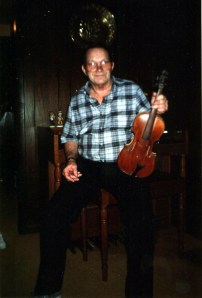
Lawrence Haley, 1991
02 Sunday Dec 2012
Posted in Pearl Adkins Diary
Tags
Appalachia, Harts Creek, history, inspiration, life, love, Pearl Adkins, thoughts, U.S. South, West Virginia, writers, writing
The latter part of Pearl’s first diary is filled with vaguely dated entries spanning from January until July, probably for the year of 1924. Early entries for her second diary seem to fill the summer and fall months of that same time period. Subsequent entries, dated in November and recorded in the first diary, are clearly for 1924.
“Oh dear, it seems that my dreams are coming true,” she wrote one Sunday morning in January. “Aw, how my heart beats with joy to look from my window and see the one I love with all my heart coming after what had happened. Oh, the day is fleeting. Now, it’s gone and he has gone with it. My heart is gone, too.”
“He’s here again,” Pearl wrote on a Saturday and Sunday in March. “It makes my lonely life a few sparks brighter to have him near me if I can’t be nothing more to him.”
“April is here with its birds and its flowers but they don’t make my burdens any lighter,” she wrote the following month. “If any thing, a little heavy to bear.”
“It is raining this morning,” Pearl wrote on a Sunday in May, “making the day dark and dreary for me. I guess my heart is just as heavy as the rainy air. I am alone and thinking of the one that’s dearer to me than my own life.”
“Shadows of the night is gathering dear,” Adkins wrote on a July Saturday. “Alone am I thinking of you. My love will never die for you. It’s all true that I love you. You are my sole thought. If something awful happens I will love you still more fondly for my heart yearns for your presence now while the darkness is gathering fast just as my thoughts are still forming my love still deeper for you. Aw, it’s raining. That don’t make me love you any less for I have loved you for months — might have slipped into years. I’m not saying how many years it has been. I think my love is of too long a standing for me ever to forget now. I’ve tried to but all in vain.”
“Things are just the same as ever,” Adkins wrote later in July. “God grant my prayer that I may see him, my darling, in my sweet dreams. Aw, but he’s nothing more to me than a dream. How my heart yearns for just one look on his handsome face and to hear his sweet voice. I barely see these lines for tears is gathering so fast. Just ready to fall any minute. Jesus, blessed Jesus, stand by me now. Make him love me, oh Lord. Aw, it’s all sad, and the saddest of it all is what it might have been if I only could have walked. Oh God, grant that I may enjoy the pleasures of life that the other girls enjoy. My life has been only one long dark empty dream. Oh, Lord, will my life always be like this? If I could only have died when but a baby. Now, if I had some one to talk to but like always I’m alone. No one cares for me. No one but mother. The rest seeks each others’ company and leaves me alone. Oh God, help me to bear it all. My heart is almost breaking now. Aw, I can’t write any more for my tears are falling on my paper, Shucks, this is all nonsense but I can’t help it.”
Later in the summer, Inez Adkins, a friend and sister-in-law to Pearl, made a couple of entries.
“This sad and lonesome evening finds us alone and together thinking of the past,” wrote Inez on Friday, July 11, 1924, “and God bless Margret, Edward and Wetzel at our feet playing.”
02 Sunday Dec 2012
Posted in Ed Haley
Tags
2144 Greenup Avenue, Appalachia, Ashland, Ashland Cemetery, Bake Lee, Bill Bowler, Charlie Ferguson, Ed Haley, Ella Haley, fiddle, fiddler, fiddling, Freeman's Shoe Store, Ghost Riders in the Sky, guitar, history, Imogene Haley, Ironton, John Hartford, Kentucky, Lawrence Colliver, Lawrence Haley, Lazear Funeral Home, Logan County, Milt Haley, music, Noah Haley, Ohio, Over the Waves, Pat Haley, Patsy Haley, radio, Steve Haley, The Shadow, U.S. South, West Virginia, Winchester Avenue, writers, writing
I asked about Ed during that time period. Lawrence said he stayed in a little room just back of the kitchen, which was furnished with a chair, cot, wardrobe and small radio. His fiddle was always on top of the wardrobe, although he seldom played it.
“He listened to the radio quite a bit,” Lawrence said. “You surely have heard of Vaughn Monroe, his version of ‘Ghost Riders in the Sky’. Pop had a transistor radio he carried up to his ear. ‘Goddamn,’ he’d let out, ‘That’s some tune.’ Cause he felt hell was a place where you had to do something you done all your life. I never heard him try to play it but he’d listen to it and listen to it. He’d say, ‘That’s some hell, ain’t it?'”
Pat said, “Pop would shiver when he would hear ‘Ghost Riders in the Sky’. Pop heard it once or twice on that little radio he carried, and he kept his ear right to it.”
I found it strangely odd that Haley had such a high opinion of the tune — maybe he just liked the words.
The cowpokes loped on past him and he heard one call his name,
If you want to save your soul from hell a-riding on our range,
Then, cowboy, change your ways today, or with us you will ride,
A-trying to catch the devil’s herd across these endless skies.
Yippee-yi-ya, yippee-yi-yo, ghost riders in the sky.
Lawrence said Ed eventually gave up on music broadcast over the radio and started tuning in to programs like “The Shadow.”
“We had a great old big crank-up record player and we had a great old big stack of thick RCA records a quarter of an inch thick, I guess,” he said. “They played a lot of them. I guess they learned some pieces of music off of that. ‘Over the Waves’, I guess that’s been around for a hundred years. Pop was pretty good at those slow pieces, too.”
Pat said she never had a real conversation with Ed, so I guess he kind of kept to himself. She remembered him having a white, foot-long beard, which he was very proud of and combed out every day. She said she had a picture of him with Lawrence and Ella in the back yard at 2144 Greenup but couldn’t find it. It was taken in the fall of 1950, when Lawrence was called back into the service.
Around that time, Bill Bowler, a blind guitar player in town, came and asked Ed to play a gig for the grand opening of Freeman’s Shoe Store in Ironton, Ohio. It was kind of a big deal — there was some type of parade going on. Pat said, “We were so happy somebody had finally got him out because he just all of a sudden stopped playing.” Lawrence drove the two over in his brother Noah’s car, then came home. Pat said, “Larry had hardly got back and was telling his mother, ‘Yes, he sat Pop down with Bill Bowler,’ and the next thing we knew Pop came through the front door just cursing a blue streak.” Something had really upset Ed at the shoe store, but the family never did know what happened or how he made it home. Lawrence said, “He just saw that they wasn’t nothing over there for him. He didn’t tell me that I done wrong by taking him over there or anything. He just wasn’t happy, so he didn’t stay.”
Not long afterwards, Lawrence saw his dad play for the last time at Charlie Ferguson’s. He said Noah got him so drunk that he sat down on the floor and played until he fell over. I wanted Lawrence to show me how Ed was playing at Ferguson’s, which he did after joking, “Now John, I don’t want you to involve me in what my dad did.” As he sat there in the floor with my fiddle, Pat laughed and said, “Oh boy, this was a good idea.”
Pat told me about February 3, 1951, the snowy day Ed passed away at home.
“It was very, very cold. My son Stephen was born January 27th, and it was exactly a week later. Pop was in the front room listening to the radio and he came through our bedroom around three o’clock. He had my daughter Beverly on his shoulders and he took her off and he rubbed his head in her tummy and he said, ‘Mmm, you smell so good. You don’t smell like those pissy-ass babies out in the country.’ The children in the country apparently didn’t wear diapers a lot of times and we always kept rubber pants on Beverly and of course the baby powder. After my father-in-law had played with my little girl, he went through and asked my sister-in-law, ‘Patsy, when will supper be ready?’ She was fixing dinner and she said, ‘Aw shortly, Pop.’ And he said, ‘Well I’m going to take a nap.’ He had a room in the back of the house. And we had a nephew Ralph Mullins living with us. He was born in 1946, so he was about five years old. And he took little cars and he was running them up and down while Poppy was napping.”
Pat said, “And when Patsy got dinner ready, she called for Pop to come to the table. My mother-in-law got a little bit irritated because Pop didn’t come. Larry and his brother Jack had been working on a car outside and they went in to check Pop.” Lawrence said, “Mom went in and lifted up his hand and said, ‘Ed.’ Shook his hand, you know. She said, ‘I can’t get him awake. I know he’s alive. I can hear him breathe.’ Well, when she was lifting up his hand, you know, she was pumping out his last breath of air.” Pat said, “And the boys told their mother then that Pop was dead. But the whole time Ralphy had been playing with his cars, so Pop apparently did not cry out in pain. That was it. He just passed away. It was a massive coronary that took him.”
“Pop died just as peaceful a death as could be, I reckon,” Lawrence said. “He died in his sleep.”
When the Ashland newspaper ran Ed’s obituary on Sunday, February 4, 1951, it mistakenly referred to him as the “flower huckster” of Winchester Avenue. Much to the embarrassment of the family, the newspaper had confused Ed with Bake Lee, a blind man in the area who sold pencils and flowers on sidewalks. Bake usually worked the streets with his wife, Lula Lee, an old schoolmate of Ella’s who played the mandolin and French harp.
“Mr. Haley, who had been blind for 65 years, was a familiar figure on Ashland’s streets, having sold flowers in the 1400 block on Winchester Avenue for several years,” the paper partially read. “A resident of Ashland for 35 years, he was born in Logan County, W.Va., a son of Milton and Emma Mullins Haley.”
Lawrence showed me a copy of his father’s corrected obituary: “HALEY: Funeral services for James Edward Haley, 67, retired musician, who died Saturday at his home, 2144 Greenup Avenue, will be conducted at 2 p.m. tomorrow at the Lazear Funeral Home with the Rev. Lawrence Colliver officiating. Burial will be in AshlandCemetery. The body is at the funeral home.”
No one played the fiddle at Ed’s funeral.
“Had a little organ music,” Lawrence said. “I don’t reckon they was anybody he’d care for playing at his funeral.”
Pat said she heard that Ed didn’t look “natural” because the funeral home had shaved off his white beard. Ella had his favorite flower, morning glory, carved on his tombstone.
02 Sunday Dec 2012
Posted in Ed Haley
Tags
Appalachia, blind, culture, Ed Haley, Ella Haley, fiddler, history, John Hartford, Kentucky, music, photos, U.S. South, writers, writing

Ed Haley and family, circa 1927
Writings from my travels and experiences. High and fine literature is wine, and mine is only water; but everybody likes water. Mark Twain
This site is dedicated to the collection, preservation, and promotion of history and culture in Appalachia.
Genealogy and History in North Carolina and Beyond
A site about one of the most beautiful, interesting, tallented, outrageous and colorful personalities of the 20th Century
 Brandon Ray Kirk