Tags
Appalachia, blind, culture, Ed Haley, Ella Haley, fiddler, fiddling, history, life, music, photos, U.S. South

Ella and Ed Haley, 1925-1945

29 Saturday Dec 2012
Posted in Ed Haley
Tags
Appalachia, blind, culture, Ed Haley, Ella Haley, fiddler, fiddling, history, life, music, photos, U.S. South
Ella and Ed Haley, 1925-1945
27 Thursday Dec 2012
Posted in Music
Tags
Appalachia, culture, guitar, Harts Creek, history, Joe Adams, life, Logan County, music, photos, U.S. South, West Virginia

Joe Adams of Harts Creek, 1945-1955
27 Thursday Dec 2012
Posted in Big Harts Creek, Ed Haley, Spottswood
Tags
Appalachia, culture, genealogy, Harts Creek, history, Lawrence Haley, life, Liza Mullins, Logan County, photos, U.S. South, West Virginia

Lawrence Haley with Aunt Liza on Harts Creek, 1950-1953
27 Thursday Dec 2012
Posted in Ed Haley
Tags
Ed Haley, fiddle, Harts Creek, history, John Hartford, John Hedgecoth, Lawrence Haley, Logan County, music, Nashville, Noah Mullins, Steve Haley, U.S. South, West Virginia, writing
When I got back in Nashville, I ranted and raved over Haley’s fiddle before taking it downtown to John Hedgecoth, an instrument repairman. John and I went over its every detail. We fitted a bridge to it and put Black Diamond strings on it (the brand Haley supposedly used), then I brought it home and played on it for about two weeks. I focused on learning Ed’s version of a fabulous tune called “Half Past Four”.
“It just sounds like a dream,” I said to Lawrence when I called him. “You play on it real light and it’s got that sound in it.”
“Well, that’s great, John,” he said.
“Now I had to put a chin rest on it and I am using a shoulder rest with it because that’s what I’m used to and I had to put tuners on it because I like to keep it in tune,” I said.
“Okay. Well, that’s all right,” Lawrence laughed.
I said, “I tell you what’s interesting about it. It looks like at one time the back had been taken off and re-glued.”
Lawrence said, “Yeah, it got damp and the glue came loose on it and I guess that back warped or something. I don’t think it was completely off. Well, my son Steve had somebody down there in Nashville to repair it but that bridge — that thing looked real odd to me. I had an old bridge here. It’s in a drawer around here somewhere, I’d say, and I’ll look for it. I never really got it strung up since then. I just figured, well, there’s enough glue on that old fiddle that it ain’t gonna sound right anyway. If you use too much glue, you’re gonna lose a lot of the resonance in the wood.”
I said, “Now, it also looks like at one time the neck was broken out of it and reglued.”
Lawrence said, “Well now, it was not in the best of shape when Steve snuck it out of here. He took it out and had it repaired for me for a Christmas present. I just figured it’s gonna lay around here and just deteriorate again, maybe draw dampness some way or it’ll fall apart anyway. I just thought since you showed so much interest in it I’ll just let you have it.”
I said, “Well, I sure appreciate that. One of the things… The fingerboard, when you look at it straight on, lays over to the right in a funny kind of an angle.”
Lawrence said, “Yeah, that’s what I figured. I don’t remember it being like that. That fingerboard, it looked to me like it had some wear on it where my dad had fingered it so much. It looked like it had slight indentations from his fingers. I didn’t know whether it would fret right.”
I said, “And also, the sound post is an inch back from where it ought to be.” I wasn’t sure if Ed had kept it there or not; I felt it likely that it had fallen over in the decades after his death and been misplaced by some half-wit repairman.
I got Ed’s fiddle and played “Half Past Four” for Lawrence, who said, somewhat amused, “You’re trying to play one of his pieces. Sounds pretty good. Well, maybe some time down the line you’ll get that ‘Cacklin’ Hen’ down. It’s just working at it. And that fiddle does sound good from over the phone.”
I said, “It’s got a little overtone in it that none of these other fiddles have and when I go back and listen to those tapes I hear that overtone in there.”
Lawrence said, “Maybe you got a prize there. I don’t know. I think everybody agrees that you should have it. Steve seems to know more about you than what we do. I don’t know how he does but he’s a musician too, you know. He taught high school band for a while and he plays in a jazz band some. Plays the trumpet. His wife’s a musician. She’s a church organist — used to be. Two of the children… One of them’s in some kind of Nashville junior symphony. Plays the cello. The other plays the violin.”
I told Lawrence I wanted to be sure and go back to Harts Creek in the fall and find out more about his dad’s early years there.
“All right,” he said. “We’ll go back up there. I don’t think anybody up there, once they find out who you are will have any objections. One of my second cousins, Noah Mullins, he killed one of the revenuers that come up through there and that give Harts Creek a bad name, I guess. Those days are gone. I believe the second time up there everybody’d be glad to see you and talk to you like they were this last time. They won’t be any problem about that. People are a little suspicious if they don’t know who you are. But if they know you got a purpose and reason for being up there that isn’t detrimental to their causes they ain’t gonna jump you or anything or give you problems.”
26 Wednesday Dec 2012
Posted in Music
Tags
Appalachia, culture, Ed Zane Adkins, genealogy, guitar, history, life, Lincoln County, music, photos, U.S. South, Watson Adkins Jr., West Virginia
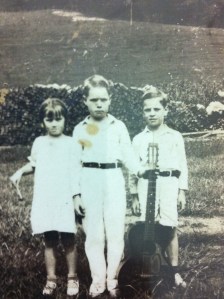
Adkins Family in Harts, about 1932
26 Wednesday Dec 2012
Posted in Harts, Pearl Adkins Diary, Women's History
Tags
Appalachia, Cora Adkins, culture, Dr. Guthrie, Fed Adkins, history, inspiration, life, Lincoln County, Pearl Adkins, thoughts, U.S. South, West Virginia, writing
“Well, it seems that after all I might have a chance to get well,” Pearl happily wrote the following May. “Cora went to Huntington to Dr. Guthrie and told him my history. He said it was a strange case — that he couldn’t tell whether there could be any thing done with me without he could see me. He told her a certain time a board of doctors met at his hospital and, if they would bring me down there when they met, it would be a good chance to have my case studied. And among so many doctors some ought to learn what was the matter with my back. They took me under examination for three days. They took Xray pictures but all of it didn’t bring to light the cause of my troubles. Doctor Guthrie told Papa he could on the third day evening take me home and he was going to study a while longer on my case. The doctor told me to come home and whistle, sing and be a happy girl that he might have good news for me in a few days.
“I came home but I wasn’t happy, but prayed to the Heavenly Father has I never prayed before. I prayed to him to give the doctor’s knowledge to learn the cause of my troubles so they could doctor me and by the help of God I would get so I could walk. I prayed with all the knowledge the Lord give me to pray with, but my prayers were in vain. At last, my verdict was read. It read me a cripple for life. Oh that terrible news. I remember the morning I received the news. It was such a bright sunny morning and to receive such news on such a bright day I would just about as soon it would have been my death sentence for it wouldn’t have been much worse to think of leading a life so hapless as mine. Oh God, I don’t know how I ever went through that day with such sorrow as mine, for all hopes of happiness were blotted out forever. Dr. Guthrie went so far as to advise Papa not to spend any more money for he didn’t think there was any use to while I was as well off as I was, for some doctors would experiment on me. Where they might do me good they could do me a lot of harm. While it was bad, it wouldn’t be any thing to compare with a wracking body of pain. While I don’t hurt, let me be, he said. That all seems like a dream now. I only wish to my Lord above it had been a dream.”
25 Tuesday Dec 2012
Tags
banjo, Banjo News Letter, bluegrass, fiddler, Fiddler Magazine, history, John Hartford, magazines, Mississippi River, music, Nashville, photos, Tennessee, Tennessee Folklore Society, The Devil's Box, U.S. South
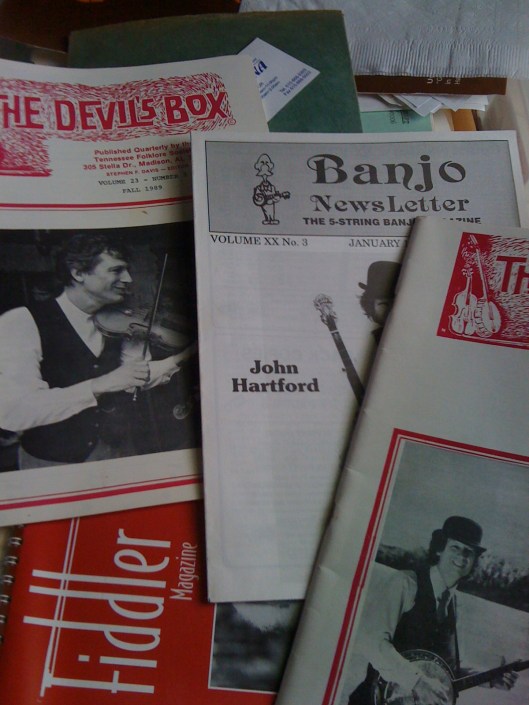
Posted by Brandon Ray Kirk | Filed under John Hartford, Music
25 Tuesday Dec 2012
Posted in Harts, Pearl Adkins Diary, Women's History
Tags
Appalachia, culture, genealogy, history, life, Lincoln County, Margaret Adkins, photos, U.S. South, West Virginia

“Aunt Marg,” 1870s
24 Monday Dec 2012
Posted in Culture of Honor
Tags
Appalachia, crime, culture, Fed Adkins, Harts Creek, history, life, Lincoln County, photos, U.S. South, West Virginia

Fed Adkins, 1870s
24 Monday Dec 2012
Posted in Ed Haley
Tags
Appalachia, Ed Haley, Ella Haley, genealogy, history, Kentucky, life, photos, Ralph Haley, U.S. South
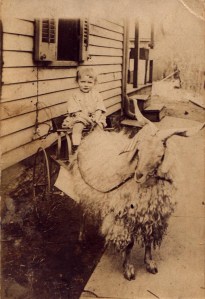
Ralph Haley, circa 1916
22 Saturday Dec 2012
Posted in Ed Haley
Tags
Appalachia, Calhoun County, Ed Haley, fiddler, genealogy, history, John Hartford, Laury Hicks, music, photos, U.S. South, West Virginia
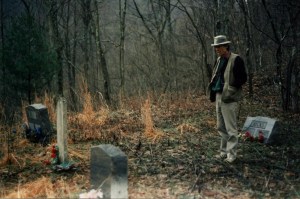
John Hartford at the Laury Hicks Grave, 1996
21 Friday Dec 2012
Tags
Appalachia, Calhoun County, fiddler, genealogy, history, Laury Hicks, Minnie Hicks, music, photos, U.S. South, West Virginia, writing
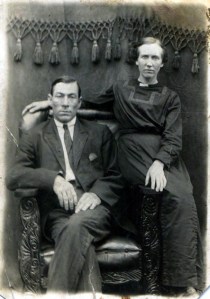
Laury and Minnie Hicks of Calhoun County, WV, 1920s
21 Friday Dec 2012
Posted in Ed Haley
Tags
Appalachia, Calhoun County, Ed Haley, fiddler, history, John Hartford, Johnny Hager, Laury Hicks, Logan County, music, U.S. South, Ugee Postalwait, West Virginia, writing
A few weeks later, I met Ugee Postalwait at her home in Akron, Ohio. An energetic, feisty woman with a band-aid on her nose, she didn’t look nearly as old as she said she was (eighty-something). She was very anxious to talk about Ed Haley and her memories seemed sharper than when I’d first called her. She bragged about him right away.
“He had the brain of music,” she said. “He’s one of the best I ever heard. You could name a tune and if he didn’t know it and you sang it to him one time he knowed it then, and when you heard it the next time he’d blow your stack.”
“Now they is some people’ll tell you my dad was better — Laury Hicks,” she continued, wasting no time in bragging on her father. “He and Ed was about the same age. Both born in about 1880.”
I asked Ugee to recall her childhood, when she first saw Ed Haley.
“The first time I ever seen Ed Haley, I was about five years old,” she said. “Dick Joblin told him that he wanted him to hear a boy that he knowed played music and he brought him there to Dad. Ed was about — oh, he must’ve been around twenty maybe, something like that. He was a young man. Dick had my dad to play the fiddle and he played three pieces: ‘Arkansas Traveler’ and another’n I can’t remember right now and ‘Sally Goodin’. Ed said, ‘If that next’n had come up as strong as the first few I heard, I’d never pulled my bow across that fiddle as long as I lived.’ And Dad at the time had his first fiddle. My dad made his first fiddle out of a cigar box and that’s what he learned on and he had that up till I was about ten or twelve years old.”
Ugee said, “Then the next time I seen Ed, he come there with John Hager.”
I asked her how Ed looked and she said he had on a suit and plug hat and had his fiddle in a flour sack.
“They stayed all winter, and they left on the first day of spring,” she said. “I’ll never forget that. There was a little narrow country road and as long as I live I’ll always see Ed, and Johnny leading him around a mud hole. We went out on the bank and watched them as they left and I stood there and cried after him and just cut a shine. Well, Ed then sent back a card — I think I still got it. ‘I love your wife, but oh your kids’ — from White Sulphur Springs.”
I asked Ugee if she had seen the picture of Ed and Johnny at White Sulphur Springs.
“Oh, yeah, I got that someplace in a box with a bunch of my pictures,” she said, before correcting herself. “Well, I think I give Larry all the pictures I had of Ed and Ella.”
When I pulled out the one of Ed and Johnny, she said, “Yeah, that’s John Hager. He was a little fella. That banjo had the longest neck I ever seen.”
She then pointed to Ed and said, “That looks just exactly like him. He wore dark glasses then. After he got married he stopped wearing dark glasses. Ed was six foot or something like that. Well Dad was a real little skinny guy like Ed Haley when he was young. He weighed about 144 pounds and then he had pneumonia fever and come near to dying. When he got over that, he gained weight. Went up to 175 pounds. But he weighed about 200 pounds. Dad was tall.”
Ugee said Ed stopped wearing his derby and gained a little weight after marrying Ella. I was surprised to hear her describe him as a “little skinny guy” but she insisted, “Yeah, looked like you put a pair of britches up on a fence rail. Ed said to me one day, ‘Ugee, can you make a shirt?’ I said, ‘Well sure I can make a shirt.’ Well, he come back from the store with material and I made him three shirts. He laughed about it. He said, ‘I want long tails. They won’t slip out of my pants.'”
Ugee said, “Yeah, I’ve seen these pictures.”
“This one,” she said, pointing to the picture of Ed used on the cover of Parkersburg Landing, “I don’t remember ever seeing that one of Ed. He looks to me like he’s been on a drunk.”
Ugee tried to describe the way things were when she was a girl in Calhoun County.
“When I was growing up and in the cornfield hoeing corn, you could hear singing on the mountains,” she said. “There was music in that country and very few people didn’t play some kind of music. My brother Russell played the banjo. My brother Shirley played the guitar and would’ve made a good fiddle player if he’d went ahead at it. I used to pick up the fiddle and see-saw a little bit. I can’t any more. We had a string band at our house, you might say. Mom played the organ and I went to playing the guitar. Anyway, they was nobody that come in that country that played the fiddle within thirty, forty or fifty miles away that wouldn’t come to our place and play music.”
The Hicks home took on a party atmosphere when Haley arrived.
“When Ed Haley was in the country, they come from miles around to our house,” Ugee said. “Dad would get out and tell everybody that Ed was there or Ed was gonna be there a certain day. They’d come through the day. Everybody did. Dad and them would play music all day — half a night.”
Ugee said she used to get up around two o’clock in the morning to see who’d be eating breakfast in a few hours.
Some of her happiest memories were of Haley’s visits to her father’s home.
“Dad’d go out there on the porch and if Ed was a playing music and if I was in the kitchen a cooking he’d go out and tell Ed to play ‘Carroll County Blues’,” she said. “Oh, I’d come out of that kitchen just a hitting that floor and a dancing all the way out there on the porch. I’d say, ‘Ed, don’t do that. You’ll not get no dinner ’cause I can’t hold my feet when you play that.’ Every time he played that, I’d dance. And Dad, when he played ‘Sally Goodin’, that’s when I’d dance for him. Mom didn’t want me to dance. She tried to keep me from it but I’d go out under them old oak trees out there on them old flat rocks and just dance, you know.”
I asked how far the Hicks home was from Harts Creek and Ugee said, “I would say that’s pretty close to a hundred mile. I never was in around Logan. I always wanted to go because Nora and Aunt Rosie lived up there. Dad and the boys, they used to go see them.” Aunt Rosie, she said, was Bill Day’s wife, while Nora was her daughter. I never knew the Days lived around Logan, West Virginia.
20 Thursday Dec 2012
Posted in Music
Tags
Appalachia, Cary Mullins, culture, guitar, Harts Creek, life, Logan County, music, photos, U.S. South, West Virginia, writing
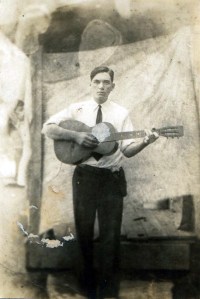
Cary Mullins of Harts Creek, 1930s
18 Tuesday Dec 2012
Tags
Appalachia, culture, Harts Creek, history, life, Logan County, photos, U.S. South, West Virginia
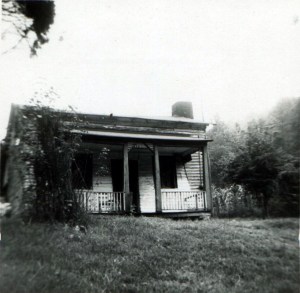
Mullins Cabin on Trace Fork, 1945-1955
18 Tuesday Dec 2012
Posted in Harts, Pearl Adkins Diary, Women's History
Tags
Appalachia, Cora Adkins, culture, Harts, Harts Creek, history, life, Lincoln County, photos, U.S. South, West Virginia
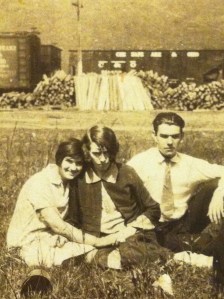
Cora Adkins (center), 1920-1925
18 Tuesday Dec 2012
Posted in Pearl Adkins Diary
Tags
Appalachia, Cora Adkins, Harts, history, life, Lincoln County, love, Pearl Adkins, thoughts, U.S. South, West Virginia, writers, writing
“This has been a very nice day,” Pearl wrote on Saturday in the spring or summer. “I have been at home all day by my self. They all have been gone for the longest time. I guess I would have had to stayed the whole time by my self if it hadn’t been for a girl friend who dropped in for a few minutes chat. She has gone and I have been dreaming of my love and his sweet looks when another face broke in on my meditation and said, ‘I see [name omitted] is back again.’ I asked, ‘Where is he at?’ She said, ‘I seen him out at the store. He’s a lot better looking than he used to be.’ But I never got a glimpse of him at all.”
“Our company began to come in,” Pearl wrote the following day, a Sunday. “Cora was primping up to go out with some of them. I was laying on the bed lost in deep thoughts of my afflictions. That caused me to be so sorrowful and sad, for I couldn’t go with them. I was nursing my misery to its fullest heights when some one came in the next room. All at once a calmness came over me. I was thinking of my sweet lipped honey and wishing he was here. But I felt his presence before he entered the room. I was so astonished and dumbfounded that I couldn’t speak for several seconds when he smiled one of his smiles and said, ‘Why hello, Pearl. How are you?’ I hardly remember what I said for I was still under the shock of it all, for this was the first time I had seen him since I discovered I loved him so dearly. I know I blushed from my neck to the roots of my hair. I was so overjoyed and thankful for his return that I hardly knew what to do. Aw shucks, what could I do? I couldn’t do any thing — only lay there and smile too myself. They all left out and he stayed on. But he didn’t stay in there for long where I was, but sit in the next room nursing his misery too, I guess. But I’m not telling what it was and he wouldn’t eat no dinner and stayed till late in the evening and then was gone and left me to suffer it out by my self. No one ever guessed that I too suffered like others do. I don’t guess he ever dreamed I could love him but I do just the same and I mean that he shall know by and by.”
17 Monday Dec 2012
Posted in Music
Tags
Appalachia, culture, guitar, Harts Creek, history, life, Lola Gore, music, photos, U.S. South, West Virginia

Lola Gore of Harts Creek, 1928-1932
16 Sunday Dec 2012
Posted in Harts
Tags
Appalachia, blind, Cat Fry, culture, genealogy, Harts Creek, history, life, Lincoln County, photos, U.S. South, West Virginia, writing
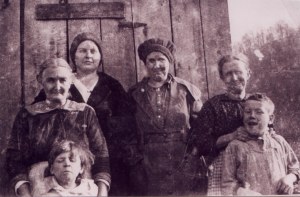
Adkins Women with Children, 1910-1920
15 Saturday Dec 2012
Posted in Culture of Honor
Tags
Appalachia, crime, culture, Harts Creek, history, life, Logan County, photos, U.S. South, West Virginia

Harts Creek men with guns, 1905-1940
Writings from my travels and experiences. High and fine literature is wine, and mine is only water; but everybody likes water. Mark Twain
This site is dedicated to the collection, preservation, and promotion of history and culture in Appalachia.
Genealogy and History in North Carolina and Beyond
A site about one of the most beautiful, interesting, tallented, outrageous and colorful personalities of the 20th Century
 Brandon Ray Kirk