• About

Brandon Ray Kirk

~ This site is dedicated to the collection, preservation, and promotion of history and culture in my section of Appalachia.

Brandon Ray Kirk

Tag Archives: Texas

History for Boone County, WV (1928)

15 Sunday Jul 2018

Posted by Brandon Ray Kirk in Boone County, Huntington, Logan

≈ 2 Comments

Tags

Appalachia, Boone County, Camp Creek, Charles L. Estep, civil war, Coal River, Coal Valley News, Cumberland Gap, Danville, education, Hadalton, history, Huntington, Isaac Barker, Jackie Dolin, John E. Kenna, John Halstead, John Morris, Kanawha River, Kentucky, Kinder Hill, Little Coal River, Logan, Logan Banner, Madison, Marshall A. Estep, Maysville, Mud River, North Carolina, Ohio River, Olive Branch Baptist Church, Spruce Fork, Spruce Ridge, Texas, Thomas Price, Turtle Creek, W.H. Turley, W.W. Hall, West Virginia, White Oak Creek, Wilderness Road

A story titled “Old Times in Boone County Told About By Historian” and printed in the Logan Banner in Logan, WV, on April 20, 1928 provides some history for Boone County:

Old-timers and students of local history should be interested in the following excerpt from the history of Boone county by Prof. W.W. Hall. The family names mentioned are familiar ones.

What is here reproduced was taken from the Coal Valley News:

About the year of 1798 Isaac Barker reared a pole cabin on the brow of the hill on the lower side of White Oak Creek, near old lock seven. This was the first white man’s home established in Boone county. The second settler in the county was Johnson Kinder, a brother-in-law of Barker. He settled on Kinder Hill a few months after Barker came. The first settler on Little Coal River was John Halstead, who settled at the mouth of Camp creek about 1800. A few months later Jackie Dolin was married to Isaac Barker’s daughter and led his blushing bride, attired in her homespun, through the trackless forest up Brush creek and over the hill to a scantily furnished home on Camp creek. Not long after this Thomas Price, a daring hunter from North Carolina, wandered over the Wilderness Road through Cumberland Gap to Maysville, Kentucky, where he embarked in a canoe, ascended the Ohio, the Kanawha, the Coal and the Little Coal rivers to the present site of the town of Danville, and became the first settler there.

For some years after the coming of the white men there were no churches, but when an Old Baptist or Methodist preacher would arrive in the settlement, word was passed around to the neighbors and that night earnest prayers, exhortations and hallelujahs would ascend from those rude homes. The first church erected in the county was the Olive Branch Baptist church at the mouth of Turtle creek. The first term of the circuit court held in the county after its organization in 1847 was held in this church. The grand jury made its investigations while seated on the framing in Ballard’s old water mill near by, and the petit jury retired to the paw paw bushes below to consider their verdicts.

The daring hunters, adventurous pioneers and brave soldiers who came from the best families in the east to establish home in the wilderness, were not contented to let their children grow up without the rudiments of an education, so they established Old Field schools in the slave cabins, tanneries, country churches and abandoned dwellings, when an itinerant teacher who could read, write and cipher a little came along. The first free school in the county was taught by John Morris, just after the Civil War, in an old house abandoned by Dr. Church. The old house stood across the hollow from W.H. Turley’s present residence in Madison. Within the next year or two a log school house was erected near the upper end of Danville and another on the point across the river from Hadalton. The children of Madison had to go to Danville or Hadalton to school until 1885, when the people of Madison, by mandamus, compelled the board of education to give them a school. The first school house erected in Madison is now used by Dr. Smoot for a barn. While the course of study in these early schools was meager and the work crude, yet they did succeed in inspiring a few boys to strive for higher education. Former United States Senator John E. Kenna was born in Boone county and attended his first schools in a log house on Big Coal river. Dr. Marshall A. Estep, an eminent physician of Texas, and his brother, Judge Charles L. Estep, of Huntington and Logan, were reared in the “Promised Land,” the name of their father’s mountain home on the summit of Spruce Ridge, and attended their first schools in a log house on the Spruce Fork. One of these early log school houses still stands on the head of Mud river, remote from the highways frequented by trade and travelers. Two of the most recent prosecuting attorneys of the county, two clerks of the circuit court, two of the clerks of the county court, four county superintendents of schools, chief U.S. Marshal for the southern district of West Virginia, and two prosperous dental surgeons attended school when boys in that little log school house on the head of Mud. The attendance in it was never large.
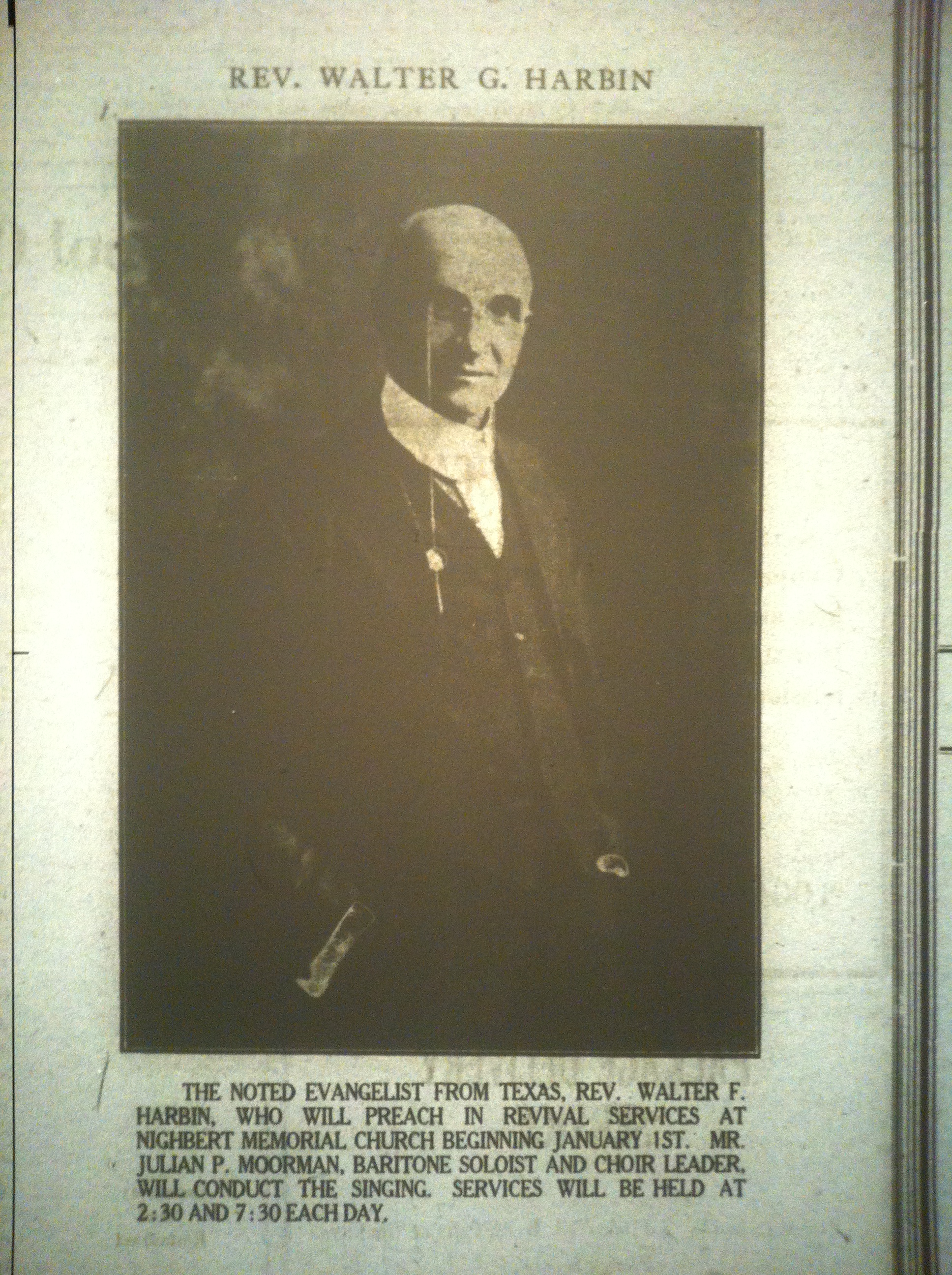
Rev. Walter G. Harbin (1921)

07 Sunday Jan 2018

Posted by Brandon Ray Kirk in Logan

≈ Leave a comment

Tags

Appalachia, genealogy, history, Julian P. Moorman, Logan, Logan Banner, Logan County, Nighbert Memorial Church, photos, Texas, Walter G. Harbin, West Virginia

Noted Evangelist to Appear in Logan LB 12.23.1921.JPG

Logan (WV) Banner, 23 December 1921. For more information about Mr. Harbin, follow this link: https://www.findagrave.com/memorial/48625430

Chapmanville News 04.19.1927

03 Sunday Dec 2017

Posted by Brandon Ray Kirk in Chapmanville

≈ Leave a comment

Tags

Appalachia, Carrie Raines, Chapmanville, Clinton Ferrell, genealogy, history, Junior Ferrell, Leonza Vanover, Logan Banner, Logan County, Mittie Ballard, Morgan Garrett, Peach Creek, Texas, West Virginia, Willa Lowe

An unknown correspondent from Chapmanville in Logan County, West Virginia, offered the following items, which the Logan Banner printed on April 19, 1927:

Rev. Shreves preached at the Church of Christ Sunday night. A large crowd attended.

Misses Carrie Raines and Willa Lowe were calling on friends at Peach Creek Thursday.

Clinton Ferrell and son Junior spent the weekend with home folks.

Morgan Garrett has returned from his business trip to Texas.

Mrs. Mittie Ballard’s mother is visiting her.

Sorry to say Mrs. Leonza Vanover is on the sick list.

Good luck to The Banner.

Major William Straton

04 Sunday Oct 2015

Posted by Brandon Ray Kirk in Civil War, Logan

≈ Leave a comment

Tags

34th Battalion Virginia Cavalry, Allen B. Straton, Battle of Beech Creek, circuit clerk, civil war, Confederate Army, county clerk, David Straton, genealogy, Guadalupe County, Henry H. Hardesty, history, House of Delegates, Ireland, Joseph Straton, lawyer, Logan County, Logan Court House, Mary A. Straton, Mary B. Straton, Minnie Straton, Polly Straton, R.A. Brock, Richmond, Sequin, Texas, U.S. South, Vicie Straton, Victoria Straton, Virginia, Virginia and Virginians, West Virginia, William Straton

From “Virginia and Virginians, 1606-1888,” published by H.H. Hardesty, we find this entry for Major William Straton, who resided at Logan Court House in Logan County, West Virginia:

Was born in Logan county, W.Va., April 14, 1821. His wife, Mary A. Perry, was born in the same county June 1, 1831, and there they were united in marriage Sept. 13, 1849. Of the offspring of this marriage the following is the record: David, born Jan. 4, 1853, married, died May 15, 1890; Victoria, born Dec. 23, 1857, died April 23, 1858; Minnie, born June 12, 1859, married, died Sept. 17, 1886; Allen B., born June 7, 1855, married; Vicie, born Dec. 9, 1861, married; Mary B., born Mar. 20, 1864, married. The subject of this sketch was elected clerk of the county court in March, 1845, and was elected clerk of circuit court in Logan county in 1849, and served until 1852; was re-elected county and circuit clerk in 1852 and 1858, which office he retained until 1865. In the civil war he supported the Southern cause, in which he volunteered in 1861, and was commissioned major of the 34th Va. V.C.; In this regiment he served nobly until the close of the struggle. At the battle of Beech Creek, Logan county, W.Va., Aug. 7, 1862, he was severely wounded in the arm and breast; the last was almost a mortal wound, but recovering he again entered the Confederate army, and was one of its most gallant and efficient officers. When the war ended he came back to his family, and in his native county since has held many offices of trust and honor, esteemed and respected by all who have ever known him. His father, Joseph Straton, was born in Ireland March 4, 1794, emigrated to America in 1800, and died in Logan county, W.Va., Jan. 3, 1846; his wife, Polly Henderson, mother of Major William Straton, was born in Monroe county, Va., March 27, 1803, and died in Sequin, Guadalupe county, Texas, April 22, 1890. Major William Straton now practices law at Logan Court House, W.Va.; he was a member of the House of Delegates from 1871 to 1877.

Source: Dr. R.A. Brock, Virginia and Virginians, 1606-1888 (Richmond, VA: H.H. Hardesty, Publisher, 1888), p. 842.

Wyatt Harless kills Maude Pauley 1901

26 Monday May 2014

Posted by Brandon Ray Kirk in Culture of Honor

≈ Leave a comment

Tags

Appalachia, Boone County, Brownstown, Burrell Harless, Charleston, crime, Dr. Thompson, Dr. Walker, history, Lens Creek, Logan County Banner, love, Maude Pauley, Texas, West Virginia, Wyatt Harless

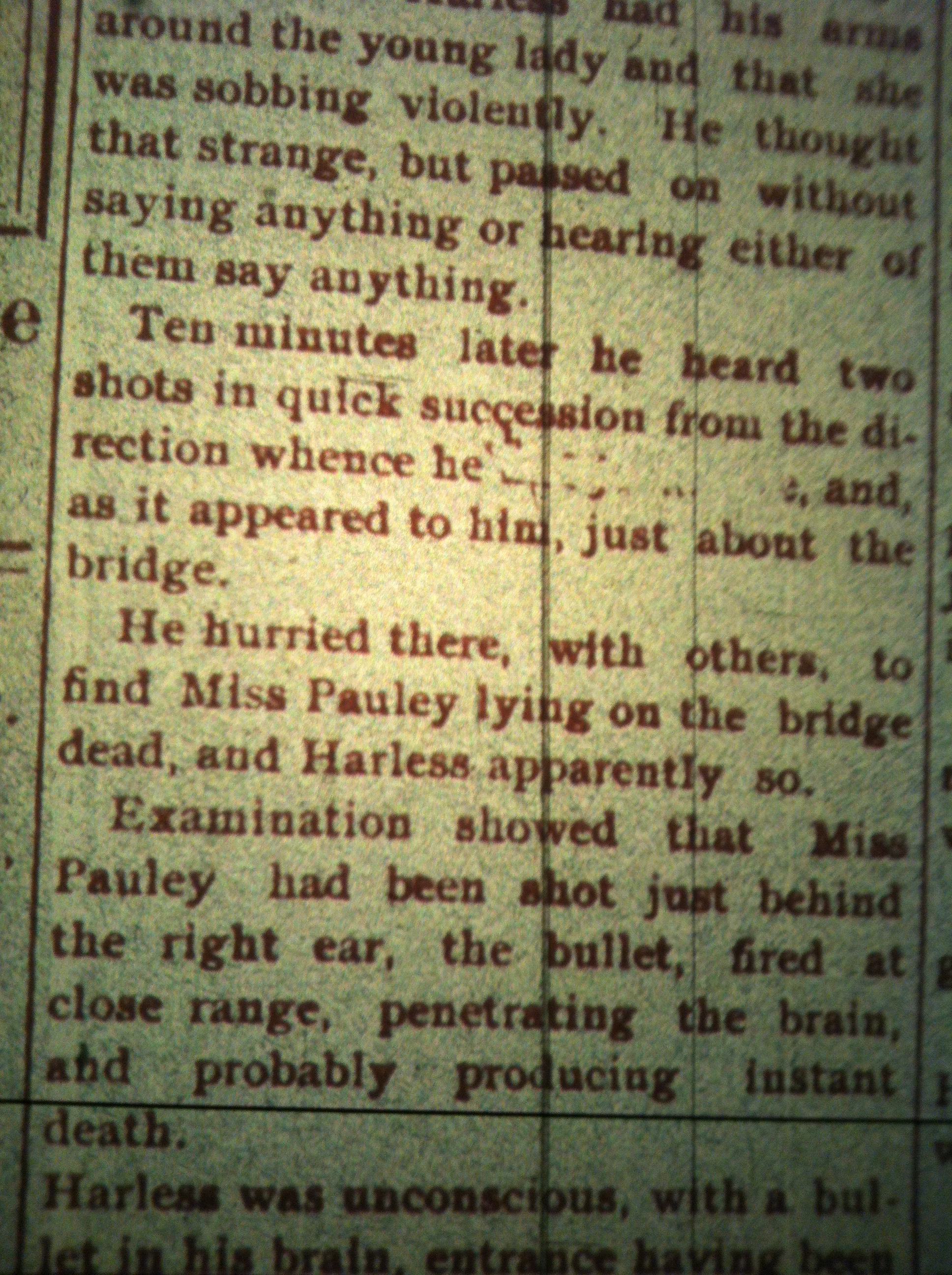
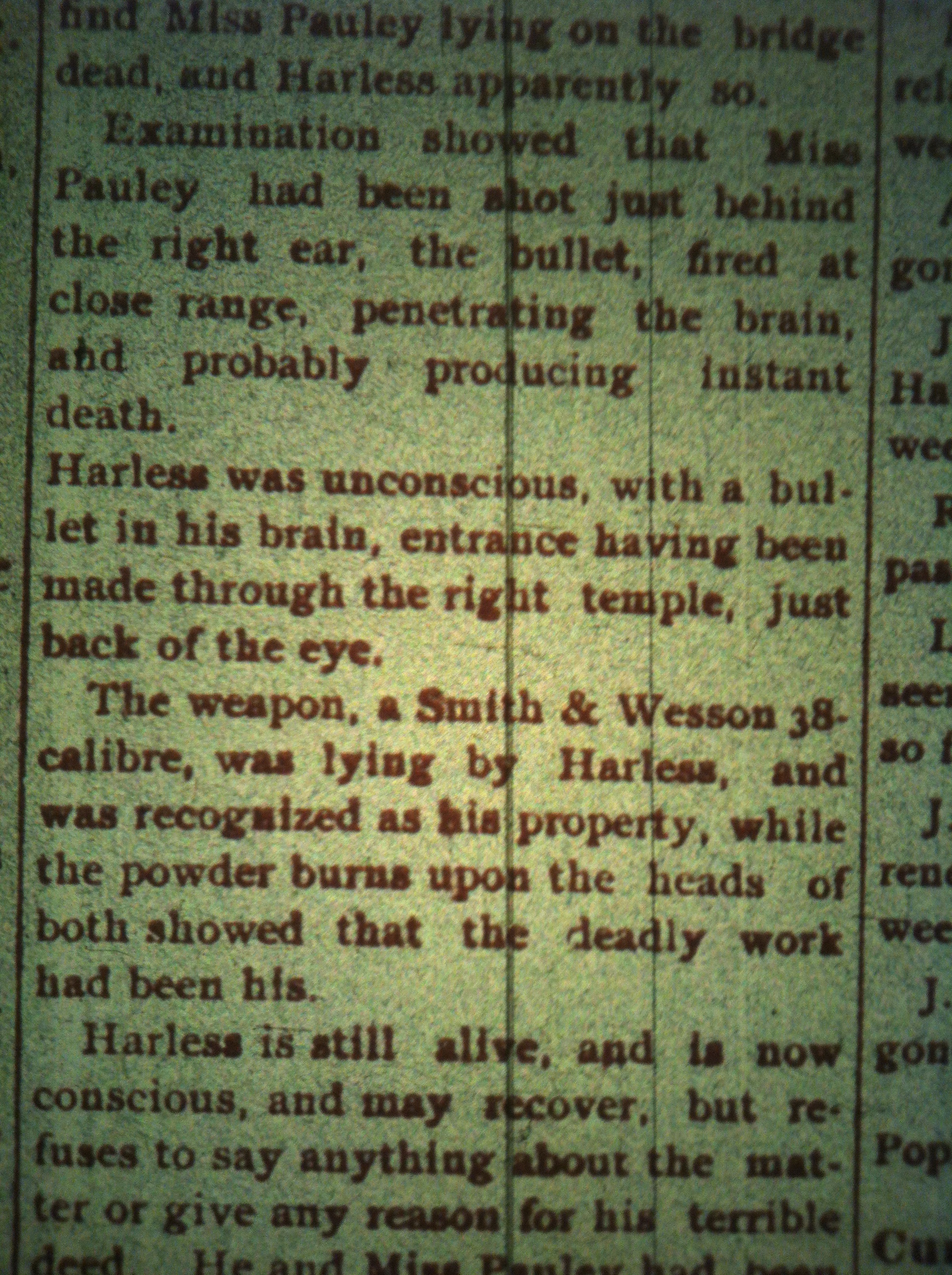
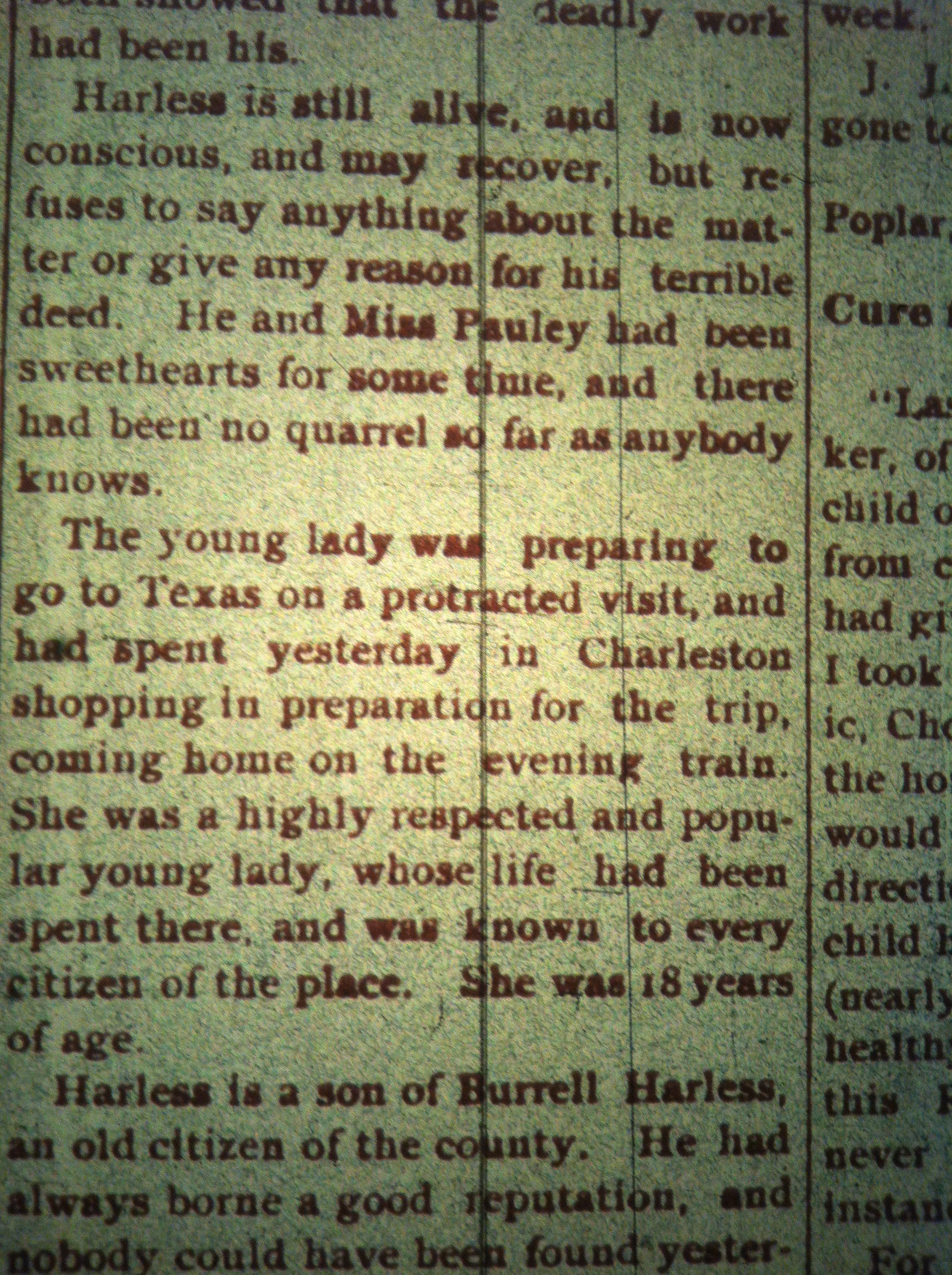
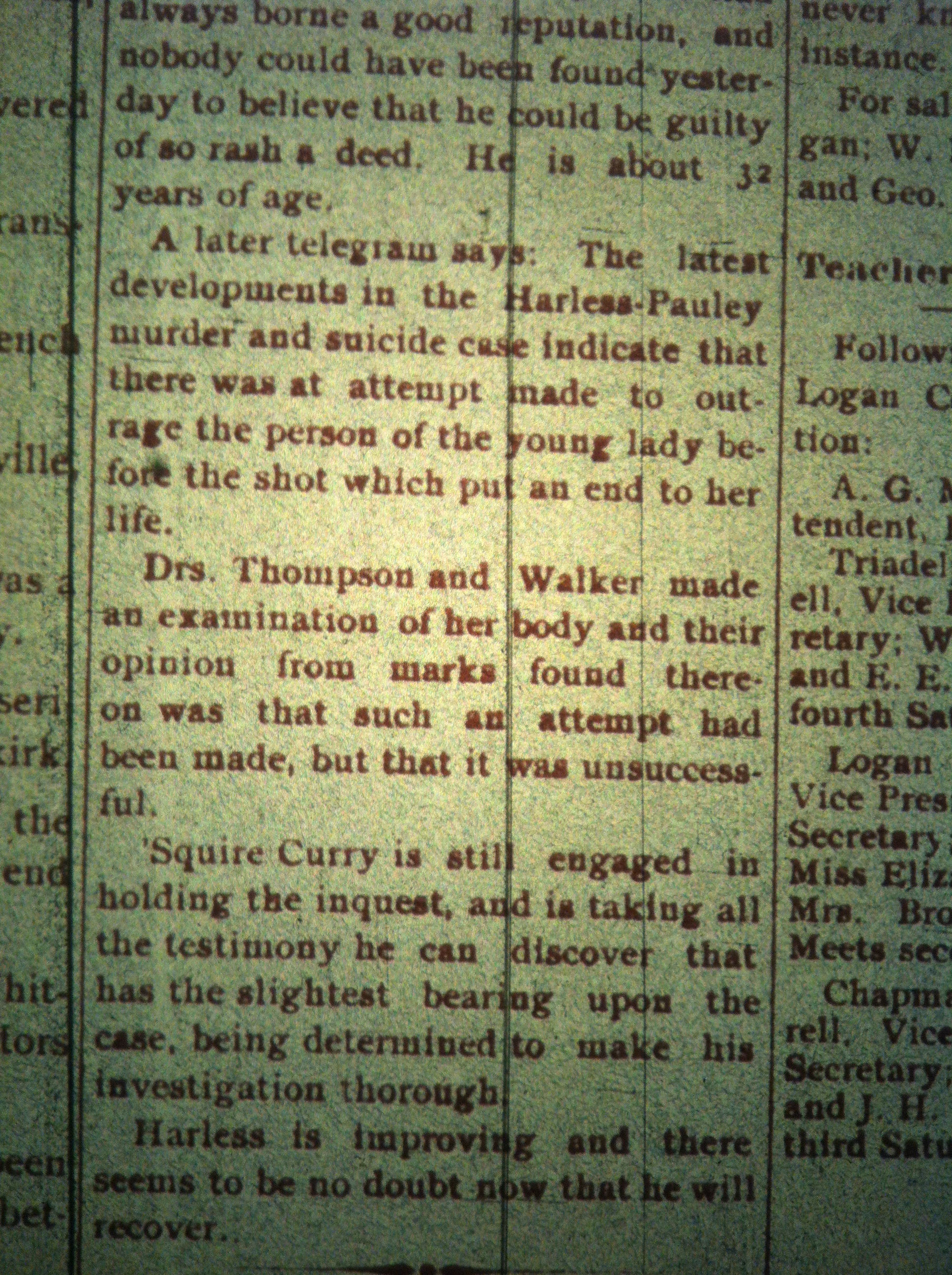
Wyatt Harless kills Maude Pauley, Logan County Banner, August 1, 1901

Wyatt Harless kills Maude Pauley, Logan County (WV) Banner, Thursday, August 1, 1901

Wyatt Harless kills Maude Pauley LCB 8.1.01 2 Wyatt Harless kills Maude Pauley LCB 8.1.01 3 Wyatt Harless kills Maude Pauley LCB 8.1.01 4 Wyatt Harless kills Maude Pauley LCB 8.1.01 5 Wyatt Harless kills Maude Pauley LCB 8.1.01 6 Wyatt Harless kills Maude Pauley LCB 8.1.01 7

Boone County’s “Little Johnny” Hager 2

13 Tuesday May 2014

Posted by Brandon Ray Kirk in Big Creek, Big Harts Creek, Big Ugly Creek, Calhoun County, Music

≈ Leave a comment

Tags

Akron, Arthur Smith, banjo, Bertha Bias, Big Creek, blind, Boone County, Boone County Genealogical Society, Broad Branch, Calhoun County, Chapmanville, Clay County, Dave Brumfield, Dicy Thomas, Dolly Bell, Ed Belcher, Ed Haley, Ella Haley, fiddle, fiddler, Garretts Fork, genealogy, Greenview, Harts Creek, Harvey Hicks, Hewetts Creek, history, Hubert Baisden, Irene Hager, Jeff Baisden, Jeff Duty, Jess Chambers, Johnny Hager, Kanawha County, Kansas, Kentucky, Kith and Kin, Laury Hicks, life, Little Coal River, Logan County, Lydia Johnson, Madison, Mary Baisden, Morehead, music, North Fork, Ohio, Powderly, Riland Bias, Robert Martin, Rowan County, Sampson Thomas, Simon Bias, Spruce Fork, Texas, Trace Fork, Turley Adams, Ugee Postalwait, Victoria Adams, West Virginia, Wilson Craddock, writing

After his return to West Virginia, Johnny Hager took immediate notice of the large number of musicians who lived in the head of Big Harts Creek. His first cousin, Jefferson “Jig-Toe” Baisden (1879-1970), was a dancer and banjo-picker. J. E. “Ed” Belcher (1889-1970), who played several instruments, and Robert Martin, an Arthur Smith-style fiddler, were other significant musicians in the area. Ed Haley (1885-1951), a blind fiddler from Trace Fork, particularly caught Hager’s attention. Johnny’s desire to absorb Haley’s music was understandable because, as Jess Chambers stated, “It was a badge of honor to have played with Ed Haley.” Jeff Baisden, a cousin to both men, may have introduced the pair.

Johnny could supposedly play any instrument and his trip out to Kansas allowed him to soak up a variety of western tunes and playing styles which were completely new to folks in Logan County. Both of these qualities, his diverse musical capabilities and his unique musical background, ensured that he an Ed Haley had many intense music sessions. According to Turley Adams, Johnny’s great-nephew, Hager encouraged Ed to take his show on the road and volunteered to serve as Haley’s “eyes” on such trips. This willingness to travel, coupled with his apparent competence as a musician, made Johnny a perfect sidekick to Ed. Haley and Hager were both unmarried, a convenience which allowed them to roam the country with few cares or responsibilities.

Johnny and Ed traveled to various places in West Virginia but are particularly remembered up around the Calhoun-Clay County area north of Kanawha County. Aside from being populated with rural folks similar to Hager’s neighbors in Logan and Boone Counties, the area was also endowed with a host of great musicians. Haley and Hager wintered there as young men with a fiddler named Lawrence “Laury” Hicks (1880-1937). Ugee (Hicks) Postalwait of Akron, Ohio, a daughter of Laury Hicks, said that Ed and Johnny first came and visited her father in the early 1910s. Hager was a tall, slim banjo-picker. When Ed and Johnny left Laury’s home in the spring, with Johnny leading the way, Ugee and her brother stood on the bank by the house and “hollered and cried after them.”

Most agree that Johnny’s travels with Ed Haley ended around 1914 when Haley married Ella Trumbo, a blind music instructor from Morehead in Rowan County, Kentucky. Haley’s habit of cursing and drinking also helped end the partnership. Hager did not care for it.

For the most part, Johnny spent the remainder of his life playing music while boarding with his Baisden kinfolk on the North Fork of Big Creek. Irene Hager, a daughter of Hubert E. and Mary (Pauley) Baisden, remembered Johnny playing music on her father’s front porch in the late 1920s. Her father, a banjo-picker, lived at Greenview and the Big Branch of Spruce Fork of Little Coal River in Boone County. Hubert Baisden was Johnny’s first cousin. Hager boarded with him for several weeks at a time. One of Hager’s chores at the Baisden home was to keep wood in the stove. Irene said that Johnny often talked about his early travels with Ed Haley.

Johnny Hager was a man with little roots and family, a fellow who never had a real home. Many from Harts Creek remember that Hager was simply from the “the North Fork of Big Creek.” Dave Brumfield, a great-nephew, said that Hager stayed in that vicinity with a Thomas family. No doubt, this Thomas family was headed by Sampson Thomas who married Dicy Adams, a sister-in-law to Johnny’s sister Victoria Adams. Incidentally, just over the mountain from North Fork was the Broad Branch of Big Ugly Creek where lived a fiddler named Jefferson “Jeff” Duty (born about 1877). During Hager’s stay on the North Fork, he probably visited this musician (and any others in this locality) to learn a few new licks.

Hager also stayed with Simon and Bertha (Baisden) Bias on Bias Branch in Boone County. Mrs. Bias’ grandfather, Riland Baisden, was a brother to Johnny Hager’s mother. He spent a lot of time on the Garretts Fork of Big Creek with the Barkers before leaving them to stay with Wilson Craddock’s family on Hewitts Creek in Boone County. Mr. Craddock’s widow has a necklace which Johnny gave her during his time there. Lydia (Adkins) Johnson of Powderly, Texas, recalled that Hager lived with her mother and father during her “growing up years at home” in the late 1920s and 1930s. Johnson “was born (around 1923) and raised in Boone Co. just over the hill from Chapmanville.” Hager was a hard worker and was very efficient at “old-time” carpentry jobs and such tasks as digging wells. According to Johnson: “[Johnny] was a handy man, & a fiddle player. (Sometimes) a neighbor would need him to come live with them, to build them an out house for them. He was noted for the best out houses, he earned his keep by living with & helping others.”

Lydia Johson described Johnny as “a very neat man” and Dolly Bell agreed, stating that he always kept his hair cut and his face shaved. He never wore suits and never dated women so far as any of his family knew. In Irene Hager’s words, he “was a pretty straight fellow” and Dave Brumfield said he never drank when visiting his father’s home on Harts Creek.

NOTE: Originally published in “Kith and Kin of Boone County, West Virginia” Volume XXII

Published by Boone County Genealogical Society

Madison, West Virginia, 1997

Dedicated to the late Dolly (Hager) Bell

In Search of Ed Haley 64

12 Tuesday Feb 2013

Posted by Brandon Ray Kirk in Ashland, Big Sandy Valley, Ed Haley, Music

≈ 1 Comment

Tags

Ashland, Big Sandy River, Blackberry Blossom, Blaze Starr, Bluegrass Meadows, Boyd County, Clark Kessinger, Dave Peyton, Delbarton, Duke Williamson, Ed Haley, fiddle, fiddler, fiddlers, fiddling, Georgia Slim Rutland, Grand Ole Opry, Hank Williams, Herald-Dispatch, history, Huntington, Jennies Creek, John Fleming, John Hartford, Kentucky, Lawrence Haley, Lynn Davis, McVeigh, Mingo County, Minnie Pearl, Molly O Day, Molly O'Day, music, Parkersburg Landing, Pike County, Pond Creek, Short Tail Fork, Shove That Hog's Foot, Skeets Williamson, Snake Chapman, Texas, West Virginia, Williamson

Early that summer, I was back at Lawrence Haley’s in Ashland with plans to visit Lynn Davis in Huntington, West Virginia. Lynn had been mentioned in the Parkersburg Landing liner notes as a source for Haley’s biographical sketch and was the widower of Molly O’Day, the famous country singer. Snake Chapman had told me that Molly and her family were close friends to Haley, who visited their home regularly in Pike County, Kentucky. I was sure Lynn would have a lot of great stories to tell about Ed. At our arrival, he was incredibly friendly — almost overwhelming us with the “welcome mat.” All we had to do was mention Ed’s name and he started telling us how he and Molly used to pick him up in Ashland and drive him up the Big Sandy Valley to see Molly’s father in southeastern Kentucky.

“That was back in the early forties,” he said. “We’d come to Ashland and get him at his home up on Winchester about 37th Street. They was a market there or something you turned up by and we’d go there and pick him up and take him up to Molly’s dad and mother up in Pond Creek, Kentucky — above Williamson. There’s an old log house up there — it’s been boarded up and sort of a thing built around it so people couldn’t get in and tear it up or something — but it’s falling down. He’d stay up there with Molly’s dad and mother for several days. They’d take him to Delbarton, a coal town over there from Williamson, and they’d just drive him around, buddy. Now Molly’s brother, he really loved Ed’s fiddling.”

Lynn was referencing Skeets Williamson, Molly’s older brother and a good fiddler by all accounts. Lynn showed me an album titled Fiddlin’ Skeets Williamson (c.1977), which referenced him as “one of country music’s more skilled fiddlers during the 1940’s — one of the best in his day.”

Skeets was born in 1920 at McVeigh, Kentucky, meaning he was approximately 35 years younger than Haley. As a child, he played music with Molly and his older brother Duke Williamson, as well as Snake Chapman. “During these years, the famous fiddler of Eastern Kentucky, Blind Ed Haley, became a tremendous influence on him,” the album liner notes proclaimed. “Skeets (along with Clark Kessinger) still contend that Haley was the greatest fiddler who ever played.” During a brief stint on Texas radio, Skeets met Georgia Slim Rutland, the famous radio fiddler who spent a year listening to Haley in Ashland.

I asked Lynn more about his trips to Haley’s home on 37th Street.

“We used to go down to his house and Molly’d say, ‘Uncle Ed, I’d just love to hear you play me a tune.’ Well he’d be sitting on the couch and he’d just reach over behind the couch — that’s where he kept his fiddle. He always had it in hand reach. So he would get it out of there, man, and fiddle.”

Sometimes Lynn and Molly would join in, but they mostly just sat back in awe.

“You’ve seen people get under the anointing of the Holy Ghost, John,” Lynn said. “Well now, that’s the way he played. I mean, I’ve seen him be playing a tune and man just shake, you know. It was hitting him. I mean, it was vibrating right in his very spirit. Molly always said, ‘I believe that fiddlers get anointed to the fiddle just like a preacher gets anointed to preach.’ They feel it. Man, he’d rock that fiddle. He’d get with rocking it what a lot of people get with bowing. It was something else. But he got into it man. He moved all over.”

Lynn said Ed was a “great artist” but had no specific memories of his technique. He didn’t comment on Ed’s bowing, fingering or even his fiddle positioning but did say that he mostly played in standard tuning. Only occasionally did Ed “play some weird stuff” in other tunings.

Lynn’s memories of Haley’s tunes seemed limited.

“Well, he played one called ‘Bluegrass Meadows’,” he said. “He had some great names for them. Of course one of his specials was ‘Blackberry Blossoms’. He liked that real good, and he’d tell real stories. He would be a sawing his fiddle a little while he was telling the story, and everybody naturally was just quiet as a mouse. You know, they didn’t want to miss nothing.”

What kind of stories?

“Well, I know about the hog’s foot thing. He said they went someplace to play and they didn’t have anything to eat and those boys went out and stole a hog and said they brought it in and butchered it and heard somebody coming. It was the law. They run in and put that hog in the bed and covered it up like it was somebody sleeping. And Ed was sitting there fiddling and somebody whispered to him, said, ‘Ed, that hog’s foot’s stickin’ out from under the cover there.’ So he started fiddling and singing, ‘Shove that hog’s foot further under the cover…’ He made it up as he went.”

The next thing I knew, Lynn was telling me about his musical career. He’d been acquainted with everybody from country great Hank Williams to Opry star Minnie Pearl. We knew a lot of the same people — a source of “bonding” — and it wasn’t long until he started handing me tapes and records of Molly O’Day and Georgia Slim Rutland. He said he had a wire recording of Ed and Ella somewhere, but couldn’t find it. He promised me though, “When I find this wire — and I will find it — it’s yours.”

Sometime later, he called Dave Peyton, a reporter-friend from the Huntington Herald-Dispatch, to come over for an interview. With Peyton’s arrival, Lynn (ever the showman) spun some big tales.

“Now, Molly’s grandfather on her mother’s side was the king of the moonshiners in West Virginia and he was known as ‘Twelve-Toed John Fleming’,” Lynn said. “He had six toes on each foot. Man, he was a rounder. Little short fella, little handlebar mustache — barefooted. He was from the Short Tail Fork of Jenny’s Creek. And the reason they called it that, those boys didn’t have any britches and they wore those big long night shirts till they was twelve or fourteen years old.”

Lynn was on a roll.

“I preached Molly’s uncle’s funeral. Her uncle is the father of Blaze Starr — the stripper. That’s Molly’s first cousin. In her book, she said she would walk seven miles through the woods to somebody that had a radio so she could hear her pretty cousin Molly sing. She was here in town about three or four months ago. We had breakfast a couple times together. She’s not stripping anymore. She makes jewelry and sells it. She’s about 60 right now.”

In Search of Ed Haley 9

28 Wednesday Nov 2012

Posted by Brandon Ray Kirk in Ed Haley

≈ Leave a comment

Tags

Appalachia, Arthur Smith, Benny Thomasson, books, Cacklin Hen, Clark Kessinger, Clayton McMichen, Dr. Charles Wolfe, Earl Spielman, Eck Robertson, Ed Haley, fiddler, Forked Deer, Georgia Slim Rutland, history, J P Fraley, John Hartford, Ladies on the Steamboat, music, Nashville, National Folklore Festival, Parkersburg Landing, Skeets Williamson, Snake Chapman, Tennessee, Texas, The Devil's Box, Tug Boat, U.S. South, writers, writing

Back in Nashville, I thought a great deal about Ed Haley’s place in relation to other fiddlers of his time. I’m not much on categorizing people but I agreed with Dr. Wolfe, who put Ed in a “creative” class of fiddlers that included Eck Robertson, Clark Kessinger, Arthur Smith and Clayton McMichen. These fiddlers, according to Dr. Wolfe, felt that technique was just as important as repertoire – one of the trademarks of the Texas contest fiddling style so popular today.

“I like to flavor up a tune so that nobody in the world could tell what I’m playing,” Haley once told Skeets Williamson.

For creative fiddlers, writes forensic musicologist Earl Spielman in The Devil’s Box, “a fiddle tune is not just an ornamented melody; a melody is merely the raw, undeveloped, unprocessed material out of which a tune can grow and reach maturity. In Texas, instead of playing a repetition of the melody, the fiddler plays a variation of the original material. Each new variation can be radically different from the preceding one. The object of the fiddler is to avoid duplication and to be as innovative as possible within the limits of what is acceptable. As might be expected, any regular pattern of bowing is avoided. The bowing characteristic of Texas fiddling consists of fairly long bow strokes executed very smoothly with the bow rarely leaving the strings and with the number of notes played on each stroke varying from a single note to as many as seven or eight.”

Creation of the Texas contest style is accredited to Benny Thomasson, who competed with rival Major Franklin to such a fierce degree that he started improvising tunes and adding new parts onto them.

“Back when I started they had only two part tunes, and that was it,” Thomasson said in a 1982 interview. “In the older days when I began to come up I took these old tunes and began to build different sections to them. Like there would be two parts. Well, I’d add another. It would be the same part but in a different position. The old-timey fiddling that they try and hang onto nowadays, it’s all right. It’s good to listen to but we take those same tunes and just weave a web around them and make it come out real pretty.”

Many fiddle scholars agree that Benny Thomasson got his ideas about adding onto tunes from Texas fiddler, Eck Robertson. He was inspired enough by Robertson’s multi-part version of “Sally Gooden” (recorded in 1922) to say that Eck played it “better than anyone else in the world.” Haley was also proficient at adding parts; his “Forked Deer” had four parts, while his “Cacklin’ Hen” had eleven.

While there is no documented evidence that Ed Haley ever met Eck Robertson or Benny Thomasson, there is a link between Thomasson and Ed through Clark Kessinger and Georgia Slim Rutland. Benny borrowed heavily from Kessinger’s Haley-like early records, particularly “Tug Boat”, which Kessinger had gotten from Haley’s “Ladies on the Steamboat”. Likewise, Georgia Slim Rutland – one of radio’s top fiddlers in the 1940s – “allegedly spent one year in Ashland listening to Ed Haley play,” according to Parkersburg Landing, and was personally acquainted with Thomasson.

Because of Haley’s connection to Clark Kessinger and Georgia Slim, and their subsequent influence on Benny Thomasson, I began to formulate a theory that Haley was a “grandfather” of the Texas contest fiddling style. I must have been onto something because when I later mentioned it to J.P. Fraley, he said, “Well see, I knew Benny Thomasson and he knew about Ed Haley because I was playing at the National Folklore Festival and he wanted to know about that fella.”

Aside from such speculation, I also tried to discover more about Haley’s music from Parkersburg Landing. Hearing Snake Chapman and J.P. Fraley’s account of their experiences with him made my thirst to know more about his life and music overwhelming. I hated that I would never be able to see him play or talk to him. My family kidded me about trying to make up for that impossibility by doing everything short of digging him up and screwing him back together. They were aware – even before I – that I was obsessed with his story. My wife often poked her head into my office thinking I’d gone crazy listening to his recordings over and over. To her, they were nothing more than a bunch of surface noise and static, but the music was there and the feelings and pictures it made were unforgettable.

Feud Poll 1

If you had lived in the Harts Creek community during the 1880s, to which faction of feudists might you have given your loyalty?

Categories

  • Adkins Mill
  • African American History
  • American Revolutionary War
  • Ashland
  • Atenville
  • Banco
  • Barboursville
  • Battle of Blair Mountain
  • Beech Creek
  • Big Creek
  • Big Harts Creek
  • Big Sandy Valley
  • Big Ugly Creek
  • Boone County
  • Breeden
  • Calhoun County
  • Cemeteries
  • Chapmanville
  • Civil War
  • Clay County
  • Clothier
  • Coal
  • Cove Gap
  • Crawley Creek
  • Culture of Honor
  • Dingess
  • Dollie
  • Dunlow
  • East Lynn
  • Ed Haley
  • Eden Park
  • Enslow
  • Estep
  • Ethel
  • Ferrellsburg
  • Fourteen
  • French-Eversole Feud
  • Gilbert
  • Giles County
  • Gill
  • Green Shoal
  • Guyandotte River
  • Halcyon
  • Hamlin
  • Harts
  • Hatfield-McCoy Feud
  • Holden
  • Hungarian-American History
  • Huntington
  • Inez
  • Irish-Americans
  • Italian American History
  • Jamboree
  • Jewish History
  • John Hartford
  • Kermit
  • Kiahsville
  • Kitchen
  • Leet
  • Lincoln County Feud
  • Little Harts Creek
  • Logan
  • Man
  • Matewan
  • Meador
  • Midkiff
  • Monroe County
  • Montgomery County
  • Music
  • Native American History
  • Peach Creek
  • Pearl Adkins Diary
  • Pecks Mill
  • Peter Creek
  • Pikeville
  • Pilgrim
  • Poetry
  • Queens Ridge
  • Ranger
  • Rector
  • Roane County
  • Rowan County Feud
  • Salt Rock
  • Sand Creek
  • Shively
  • Spears
  • Sports
  • Spottswood
  • Spurlockville
  • Stiltner
  • Stone Branch
  • Tazewell County
  • Timber
  • Tom Dula
  • Toney
  • Turner-Howard Feud
  • Twelve Pole Creek
  • Uncategorized
  • Warren
  • Wayne
  • West Hamlin
  • Wewanta
  • Wharncliffe
  • Whirlwind
  • Williamson
  • Women's History
  • World War I
  • Wyoming County
  • Yantus

Feud Poll 2

Do you think Milt Haley and Green McCoy committed the ambush on Al and Hollene Brumfield in 1889?

Blogroll

  • Ancestry.com
  • Ashland (KY) Daily Independent News Article
  • Author FB page
  • Beckley (WV) Register-Herald News Article
  • Big Sandy News (KY) News Article
  • Blood in West Virginia FB
  • Blood in West Virginia order
  • Chapters TV Program
  • Facebook
  • Ghosts of Guyan
  • Herald-Dispatch News Article 1
  • Herald-Dispatch News Article 2
  • In Search of Ed Haley
  • Instagram
  • Lincoln (WV) Journal News Article
  • Lincoln (WV) Journal Thumbs Up
  • Lincoln County
  • Lincoln County Feud
  • Lincoln County Feud Lecture
  • LinkedIn
  • Logan (WV) Banner News Article
  • Lunch With Books
  • Our Overmountain Men: The Revolutionary War in Western Virginia (1775-1783)
  • Pinterest
  • Scarborough Society's Art and Lecture Series
  • Smithsonian Article
  • Spirit of Jefferson News Article
  • The Friendly Neighbor Radio Show 1
  • The Friendly Neighbor Radio Show 2
  • The Friendly Neighbor Radio Show 3
  • The Friendly Neighbor Radio Show 4
  • The New Yorker
  • The State Journal's 55 Good Things About WV
  • tumblr.
  • Twitter
  • Website
  • Weirton (WV) Daily Times Article
  • Wheeling (WV) Intelligencer News Article 1
  • Wheeling (WV) Intelligencer News Article 2
  • WOWK TV
  • Writers Can Read Open Mic Night

Feud Poll 3

Who do you think organized the ambush of Al and Hollene Brumfield in 1889?

Recent Posts

  • Logan County Jail in Logan, WV
  • Absentee Landowners of Magnolia District (1890, 1892, 1894)
  • Charles Spurlock Survey at Fourteen Mile Creek, Lincoln County, WV (1815)

Ed Haley Poll 1

What do you think caused Ed Haley to lose his sight when he was three years old?

Top Posts & Pages

  • About
  • Perry A. Cline Deed to Anderson Hatfield (1877)
  • Tom Dula: Dula Cemetery (2020)
  • Tom Dula: Ann Melton Grave (2020)
  • Hugh Dingess Family Cemetery (2014)

Copyright

© Brandon Ray Kirk and brandonraykirk.wordpress.com, 1987-2023. Unauthorized use and/or duplication of this material without express and written permission from this blog’s author and/or owner is strictly prohibited. Excerpts and links may be used, provided that full and clear credit is given to Brandon Ray Kirk and brandonraykirk.wordpress.com with appropriate and specific direction to the original content.

Archives

  • February 2025
  • January 2025
  • October 2023
  • September 2023
  • December 2022
  • November 2022
  • May 2022
  • April 2022
  • February 2022
  • November 2021
  • October 2021
  • September 2021
  • June 2021
  • May 2021
  • April 2021
  • March 2021
  • February 2021
  • January 2021
  • December 2020
  • November 2020
  • October 2020
  • July 2020
  • June 2020
  • May 2020
  • April 2020
  • March 2020
  • February 2020
  • January 2020
  • December 2019
  • November 2019
  • October 2019
  • September 2019
  • August 2019
  • July 2019
  • June 2019
  • May 2019
  • April 2019
  • March 2019
  • February 2019
  • January 2019
  • December 2018
  • November 2018
  • October 2018
  • September 2018
  • August 2018
  • July 2018
  • June 2018
  • May 2018
  • April 2018
  • March 2018
  • February 2018
  • January 2018
  • December 2017
  • November 2017
  • October 2017
  • September 2017
  • August 2017
  • July 2017
  • June 2017
  • May 2017
  • April 2017
  • March 2017
  • February 2017
  • January 2017
  • December 2016
  • November 2016
  • October 2016
  • September 2016
  • August 2016
  • July 2016
  • June 2016
  • May 2016
  • April 2016
  • March 2016
  • February 2016
  • January 2016
  • December 2015
  • November 2015
  • October 2015
  • September 2015
  • August 2015
  • July 2015
  • June 2015
  • May 2015
  • April 2015
  • March 2015
  • February 2015
  • January 2015
  • December 2014
  • October 2014
  • September 2014
  • August 2014
  • July 2014
  • June 2014
  • May 2014
  • April 2014
  • March 2014
  • February 2014
  • January 2014
  • December 2013
  • November 2013
  • October 2013
  • September 2013
  • August 2013
  • July 2013
  • June 2013
  • May 2013
  • April 2013
  • March 2013
  • February 2013
  • January 2013
  • December 2012
  • November 2012

Enter your email address to follow this blog and receive notifications of new posts by email.

Join 2,925 other subscribers

Tags

Appalachia Ashland Big Creek Big Ugly Creek Blood in West Virginia Brandon Kirk Cabell County cemeteries Chapmanville Charleston civil war coal Confederate Army crime culture Ed Haley Ella Haley Ferrellsburg feud fiddler fiddling genealogy Green McCoy Guyandotte River Harts Harts Creek Hatfield-McCoy Feud history Huntington John Hartford Kentucky Lawrence Haley life Lincoln County Lincoln County Feud Logan Logan Banner Logan County Milt Haley Mingo County music Ohio photos timbering U.S. South Virginia Wayne County West Virginia Whirlwind writing

Blogs I Follow

  • OtterTales
  • Our Appalachia: A Blog Created by Students of Brandon Kirk
  • Piedmont Trails
  • Truman Capote
  • Appalachian Diaspora

BLOOD IN WEST VIRGINIA is now available for order at Amazon!

Blog at WordPress.com.

OtterTales

Writings from my travels and experiences. High and fine literature is wine, and mine is only water; but everybody likes water. Mark Twain

Our Appalachia: A Blog Created by Students of Brandon Kirk

This site is dedicated to the collection, preservation, and promotion of history and culture in Appalachia.

Piedmont Trails

Genealogy and History in North Carolina and Beyond

Truman Capote

A site about one of the most beautiful, interesting, tallented, outrageous and colorful personalities of the 20th Century

Appalachian Diaspora

  • Subscribe Subscribed
    • Brandon Ray Kirk
    • Join 787 other subscribers
    • Already have a WordPress.com account? Log in now.
    • Brandon Ray Kirk
    • Subscribe Subscribed
    • Sign up
    • Log in
    • Report this content
    • View site in Reader
    • Manage subscriptions
    • Collapse this bar
 

Loading Comments...