• About

Brandon Ray Kirk

~ This site is dedicated to the collection, preservation, and promotion of history and culture in my section of Appalachia.

Brandon Ray Kirk

Tag Archives: Stephen Hart

Stephen Hart and Harts Creek (1937)

14 Sunday Jul 2019

Posted by Brandon Ray Kirk in Big Creek, Big Harts Creek, Civil War, Hamlin, Harts, Logan, Midkiff, Ranger, Spurlockville, Toney

≈ 5 Comments

Tags

Appalachia, assistant postmaster, Big Creek, Cabell County, Charles Spurlock, Cheat River, Cincinnati, civil engineer, civil war, doctor, genealogy, gunsmith, Hamlin, history, Jane Spurlock, John Spurlock, Lifas Spurlock, Lincoln County, Logan Banner, Logan County, Logan Post Office, Marshall Spurlock, Midkiff, Montgomery County, Omar, Pete Spurlock, preacher, Ranger, Robertson Spurlock, Seth Spurlock, Sheridan, sheriff, Spurlockville, Stephen Hart, surveyor, Union Army, Virginia, West Virginia

From the Logan Banner of Logan, WV, comes this bit of history about Stephen Hart and Harts Creek in Lincoln and Logan counties, West Virginia. The story is dated April 14, 1937.

Stephen Hart Settled at Cheat River, Pete Spurlock, A Great Grandson, Reveals

P.A. (Pete) Spurlock, assistant postmaster at the Logan post office, this morning revealed the destination of Stephen Hart, who went went after he had lived for a short time at the forks of the creek in the lower end of Logan county which now bears his name.

Spurlock said that Hart went to the Cheat River and settled permanently there to hunt deer and rear a family. He said the family name of Hart is as familiar there as the name Dingess is familiar in Logan county.

A daughter of Stephen, Jane, was Spurlock’s grandmother. She lived until 1913 and told her grandson much of the early history of the family which made its home in and around Spurlocksville, Sheridan, Ranger, and Midkiff.

Charles Spurlock, the progenitor of the Spurlock family, came to what used to be the Toney farm below the mouth of Big Creek in 1805 from Montgomery county, Virginia.

“Uncle Charley was a funny old cuss,” his great grandson Pete said this morning. “The story is told that a sheriff of Cabell county was given a capias to serve on the old codger for some minor offense when he was growing old and rather stout.

“Meeting him in the road one day, the sheriff informed Uncle Charley he had a capias to serve on him.

“None abashed, the old man informed the sheriff he was a law-abiding citizen and laid down in the middle of the road and told the sheriff to take him to jail.

“The ruse worked, for the sheriff chose to look for less obstinate prisoners,” Uncle Charley’s grandson said, chuckling.

Another story about the eccentric “Uncle Charley Spurlock” which has gone down in history, whether true or not, was that he lived for a short time below Big Creek under a rock cliff (known as a rockhouse) during the early summer while he was getting his cabin in shape for winter.

The tale is out that “Uncle Charley” explained his strange dwelling place in this way to his neighbors:

“Well I took Sarah (his wife) in a good substantial frame house in Virginia and she wasn’t quite satisfied. I took her to a log house and she wasn’t satisfied. I took her to a rail pen and still she grumbled. Then I took her to a rock house built by God Almight and still she wasn’t satisfied.

“I don’t know what I’m going to do with Sarah.”

Sarah evidently became accustomed to “Uncle Charley” for the couple reared four sons. They were John, Seth, Lifas and Robertson. There were no daughters.

Seth was P.A. Spurlock’s grandfather. His father, Marshall, is 78 and lives on his farm near Cincinnati.

Spurlock says “Uncle Charley” is buried on a point at Spurlocksville overlooking the haunts of his early manhood.

Robertson was a gunsmith and lived near Hamlin. Seth was a civil engineer and helped survey much of Logan county. He was a Union soldier. John was a country doctor who practiced at Ranger.

Lifas was a preacher for sixty years and lived at Sheridan.

Charles Spurlock, of Omar, is a distant cousin, the assistant postmaster said. He is the only relative that lives in this section of Logan county, Spurlock said.

Spurlock, at Omar, was born at Spurlocksville and is a grandson of one of the original “Charley’s” boys.
Stephen Hart: Origins of Harts Creek (1896/1937)

07 Thursday Feb 2019

Posted by Brandon Ray Kirk in Big Harts Creek, Boone County, Crawley Creek, Native American History, Roane County

≈ 1 Comment

Tags

Appalachia, Boone County, Crawley Creek, Dick Johnson, Elizabeth Hart, Fred B. Lambert, genealogy, Harts Creek, Henderson Dingess, Henry Clay Ragland, history, Jacob Stollings, James Hart, John Baker, Lincoln County, Little Harts Creek, Logan Banner, Logan County, Logan County Banner, Mud River, Native Americans, Roane County, Smokehouse Fork, Stephen Hart, West Virginia

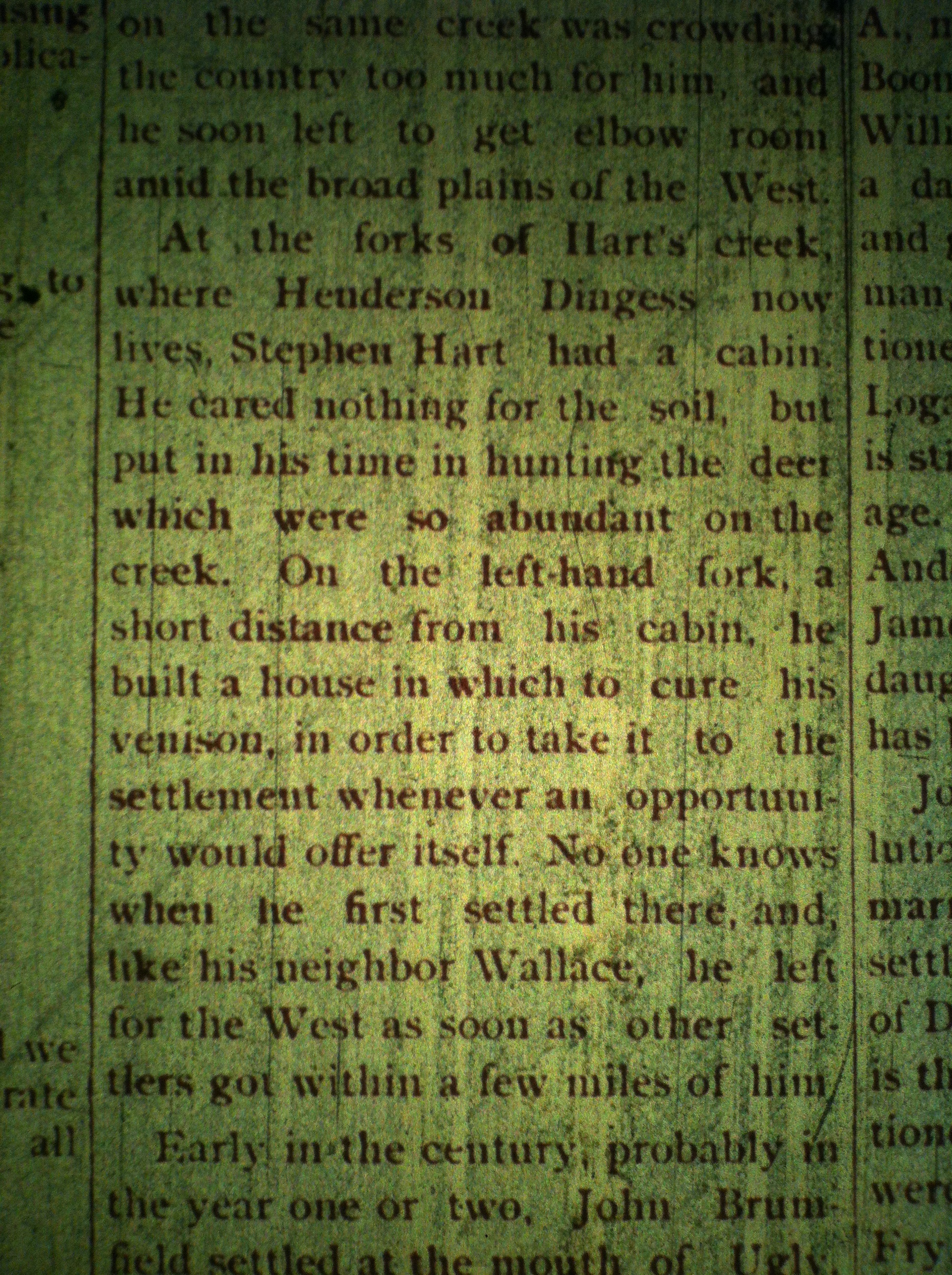
From the Logan County Banner of Logan, WV, comes this bit of history written by amateur historian Henry Clay Ragland relating to Stephen Hart and the naming of Harts Creek in Lincoln and Logan counties, West Virginia, dated 1896:

Stephen Hart Ragland LCB 04.08.1896.JPG

Logan County (WV) Banner, 8 April 1896.

***

On 13 April 1937, the Logan Banner printed another story about Hart and his relationship to Harts Creek. This latter story was generally derived from Ragland’s 1896 history.

Harts Creek Named After Stephen Hart—A Wanderer And Famous Deer Hunter

Much has been told about Harts Creek in late years, but little is known about the first settler who built his home in the long hollow and gave it a name.

Stephen Hart built a cabin on the farm which Henderson Dingess later owned at the forks of Hart’s Creek. He cared nothing for the soil, but spent his time hunting deer and curing the meat. He didn’t stay long in one place.

Near his cabin he built a house in which to store his cured venison between his infrequent trips to the settlements down the river and was altogether self-sufficient. His neighbors knew little about the man. There is no record of a family reared by him and he told neighbors little of his past history.

His was a roaming nature. He, like the Arabs, pitched his tent where the water was clearest, the game gamest, and the soil most fertile.

To commemorate his short stay at the forks of Harts, neighbors named the creek for him after he had loaded his gun, food stores and skins on a pack mule, and started west.

His few friends heard no more about him, but they remembered him as a “quiet man, a good shot, and a good neighbor.”

Just “around the bend and over the ridge,” Jacob Stollings, John Baker, and Dick Johnson brought their families and built their homes. From descendants of this family comes much of the record of Stephen Hart who gave the creek a name.

Hart’s venison was known for miles around as the tenderest, the most delicately cured meat in the Hart’s section and Stollings, Baker, and Johnson always put in a small supply of Hart’s meat for the winter, sometimes to take an unusually large supply off the hunter’s hands but most times just because they liked the venison.

John Baker married a daughter of Jacob Stollings, and Dick Johnson married a sister of Baker’s. Both men reared large families whose names are familiar in the county’s history.

But Hart left only the name of his beloved deer hunting grounds as a reminder that he had first set foot on Hart’s Creek.

MY NOTE: Of importance, much confusion remains regarding the source for the naming of Harts Creek, essentially relating to the fact that Stephen Hart was born too late to have inspired the naming of the stream. I first attempted to unravel this story when I published a profile of Stephen Hart in a Lincoln County newspaper in 1995/6. Stephen Hart, son of James and Elizabeth Hart, was born c.1810 in North Carolina; Harts Creek appears on a map printed prior to 1824 (Hart was still quite young). In the early 1900s, amateur historian Fred B. Lambert noted that Hart’s father had been killed by Native Americans at the mouth of present-day Little Harts Creek (according to a Hart descendant). Possibly it is Mr. Hart’s father who inspired the naming of the local stream. Problematic to this possibility is the fact that, based on Stephen Hart’s estimated year of birth, his father would have been killed in 1809-1811, which is about fifteen to twenty years too late for an Indian attack in the Guyandotte Valley. Stephen Hart did settle locally. He may well have squatted on Harts Creek land, as Ragland reported in 1896. Based on documentary evidence, he acquired 50 acres on Crawley Creek in 1839. He appears in the 1840 Logan County Census and the 1850 Boone County Census. By 1860, he had settled in Roane County, where he died in 1896–the same year that Ragland published his history. He also left plenty of local descendants in the Mud River section of Lincoln County. How did Ragland garble this section of his history so badly? For those who wish to avoid sorting out this confusing tale, consider this version: at least one early account states the creek was named “hart” due to the prevalence of stags in its vicinity.

Chapmanville District Schools (1927) 2

15 Thursday Jun 2017

Posted by Brandon Ray Kirk in Big Harts Creek, Civil War, Halcyon, Native American History, Queens Ridge, Shively, Spottswood, Stone Branch, Warren, Whirlwind, Yantus

≈ Leave a comment

Tags

Albert Thornton, Alice Dingess, Alonzo, Anna Adams, Appalachia, Battle of Cloyd's Mountain, Beatrice Adams, Ben Adams, Bob Dingess, Brown's Run, Browns Run School, Buck Fork, Buck Fork School, Bud Dingess School, Bulwark School, Chapmanville District, civil war, Cole Adams, Confederate Army, Conley School, Crawley Creek, Daisy Dingess, Dalton School, Dave Dingess School, Dixie Mullins, E. Burton, East Fork, Ed Dalton, education, Edward Chapman, F.M. McKay, Fisher B. Adkins, Fisher Thompson, genealogy, George Doss, George Mullins School, Harts Creek, history, Hoover School, Howard Adams, Hugh Dingess School, Ina Dingess, Ivy Branch School, J.A. Vickers, J.L. Thomas, John Conley, John Dingess, L.D. Stollings, Lee Dingess School, Limestone Creek, Local History and Topography of Logan County, Logan County, Lower Trace School, Manor School, Marsh Fork, Melvin Plumley, Middle Fork, Native Americans, Pigeon Roost, Piney School, Reuben Conley, Road Fork, Rocky School, Sallie Dingess, Smokehouse Fork, Stephen Hart, Striker School, T. Doss, Thelma Dingess, Three Fork School, Tim's Fork, Timothy Dwight, Twelve Pole Creek, Ula Adams, Union Army, West Fork, West Virginia, White Oak School, Workman School, World War I

Teachers identified the following schools in Chapmanville District of Logan County, WV, and offered a bit of local history in 1927:

Dave Dingess School, est. 1814

Ula Adams, teacher

One room frame school

“Harts Creek derived its name from Steven Harts, said to have been killed by Indians on the creek.”

Striker School, est. about 1874

Edward Chapman, teacher

One room frame building

Three Fork School, est. 1878

One room frame building, originally a log house

Nine Confederate veterans live here: George Doss, T. Doss, L.D. Stollings, Ed Dalton, Ruben Conley, John Conley, Ben Adams, E. Burton, Melvin Plumley. A Union veteran lives here; he originated elsewhere. Three branches of Crawley Creek are Road Fork, Middle Fork, and Pigeon Roost. Alonzo is the local post office.

Bulwark School, est. 1880

Robert Dingess, teacher

One room frame building

“All fought on the Confederate side” during the Civil War. One man gained great merit from our district as a marksman with the American marines during World War I.

Lee Dingess School, est. 1891

Cole Adams, teacher

One room frame

Five local men served in the Confederate Army.

Browns Run School, est. 1892

Ina Dingess, teacher

One room frame building

“Sent several soldiers to help the South.” The fork is named for a Brown who lived at its mouth.

Buck Fork School, est. 1894

No teacher given

One room frame building

A Church of Christ exists nearby. Three local men served in the Confederate Army. One local soldier lost both hands in World War I.

Ivy Branch School, est. 1895

Anna Adams, teacher

Albert Thornton was the first teacher here. “Trace Fork received its name from the original road leading to Twelve Pole Creek.”

Hugh Dingess School, est. 1897

Sallie Dingess, teacher

One room frame building

Conley School, est. 1897

J.L. Thomas, teacher

One room frame building

The first house built on Smoke House Fork at its mouth had no chimney for quite a while and smoked badly.

Dalton School, est. 1897

Thelma Dingess, teacher

One room frame building

“This district furnished a lot of Civil War veterans and played her part.”

Bud Dingess School, est. 1904

Beatrice Adams, teacher

One room frame building

“East Fork named on account of its being the most Eastern fork of Harts Creek.” One local soldier served in the Confederate Army.

Hoover School, est. 1910

Howard Adams, teacher

One room frame building

A Christian Church exists in the vicinity. Four local men served in the Confederate ARmy. “Harts Creek named from Steven Harts murdered by Indians.” Three boys went from here and one was wounded at the battle of Argonne.

George Mullins School, est. 1910

Dixie Mullins, teacher

One room frame building

“Buck Fork named from large number of male deer on creek.”

Rocky School (no date)

Daisy Given Dingess, teacher

References an Indian mound on Pigeon Roost where tomahawks, arrowheads, etc. can be found. Indian burial ground.

Under the Tim’s Fork entry, it says that John Dingess was killed in battle at Cloyd’s farm. Tim’s Fork is named for Timothy Dwight, who lived there.

Lower Trace School, est. 1919

Alice Dingess, teacher

Two room frame building

“Sent several soldiers to help the South.” Also, “Harts Creek named from Steven Harts.”

Piney School, est. 1921

F.M. McKay, teacher

One room building

No permanent churches exist locally; people meet occasionally in one of the school houses. Four local men served in the Confederate Army. “Piney was named because of so much pine growing there.”

White Oak School, est. 1922

Fisher Thompson, teacher

One room rented frame building

Manor School, est. 1923

Located at Limestone

Workman School, est. 1924

Fisher B. Adkins, teacher

One room frame building

Marsh Fork derived its name from the marshy land near its mouth.

Source: Local History and Topography of Logan County by J.A. Vickers (Charleston, WV: George M. Ford, State Superintendent, 1927).

Stephen Hart (1896)

31 Friday Mar 2017

Posted by Brandon Ray Kirk in Big Harts Creek

≈ Leave a comment

Tags

Appalachia, genealogy, Harts Creek, Henderson Dingess, Henry Clay Ragland, history, Logan, Logan County, Logan County Banner, Smokehouse Fork, Stephen Hart, West Virginia

Stephen Hart Ragland LCB 04.08.1896

Logan County Banner (Logan, WV), 8 April 1896.

In Search of Ed Haley 144

29 Monday Jul 2013

Posted by Brandon Ray Kirk in Ed Haley

≈ Leave a comment

Tags

Appalachia, Ed Haley, Guyandotte River, Harts Creek, history, James White, Joseph Gore, Logan County, Richard Elkins, Stephen Hart, West Virginia, William West, writing

As far as can be ascertained, Harts — the place of Ed Haley’s birth — first appeared in written history as “Heart Creek” on a John Wood map sketched some time between 1809 and 1824. Reportedly, the creek was named for Stephen Hart — an early settler — or perhaps for his father, who was reportedly scalped by Indians at the mouth of Little Harts Creek. Stephen Hart first appeared in Logan County records in the late 1830s, settling on Crawley Creek, near Harts. Some claim that he lived at the mouth of Harts Creek on a hill in a rock cave, while others say he lived in Dock Bottom near the mouth of Smoke House Fork. More than likely, he had shanties constructed along various creeks at different times used for hunting camps. All historians agree that the Smoke House Fork of Harts Creek was so named because it contained Hart’s smoke house.

“At the forks of Hart’s Creek, where Henderson Dingess now lives, Stephen Hart had a cabin,” writes Henry Clay Ragland in his 1896 Logan County history. “He cared nothing for the soil, but put in his time hunting the deer which were so abundant on the creek. On the left-hand fork, a short distance from his cabin, he built a house in which to cure his venison, in order to take it to the settlement whenever an opportunity would offer itself.”

According to written record, the first settler of present-day Harts was Richard Elkins, a hunter, farmer and ginseng digger. Elkins migrated to the mouth of the creek from “The Islands of Guyandotte” (Logan) in 1809 or 1815, some fifteen years after the last Indian had roamed the valley. At that time, Harts Creek was in Cabell County, Virginia. Jacob Stollings, who was granted 185 acres in the lower section of the creek by the State of Virginia in 1812, soon joined Elkins. Other neighbors along the Guyan River were William W. Brumfield, who lived at the mouth of Ugly Creek, and Squire Toney, who lived in the bottoms above Douglas Branch. Brumfield was the grandfather of Paris Brumfield.

“At the coming of white men, this region was a wilderness inhabited only by wild animals,” wrote Fred B. Lambert, an early local historian. “There was a buffalo trail extending in the general direction from the Guyan Valley to Mud River and buffalo passed up the valleys in the summer. Wild game was plentiful — deer, turkey, bear and also such animals as panthers, wild cats, and wolves. The otter and beaver were found on Guyan River at an early day. Wild hogs roamed the woods. At times in the early morning the air would be darkened by pigeons. There were elk in this region, but they were exterminated as early as 1815.”

During the later teens, Peter Dingess, Garland Conley, Charles Spurlock, Abner Vance, and Richard Vance settled in the vicinity of Harts Creek. These men were the ancestors of many persons involved in the Milt Haley story.

“The first settlers to find homes in Hart’s District were from the counties of northern Virginia,” according to Kile Topping, an early historian. “Many of these settlers belonged to the hardy class of hunters and ginseng diggers, who later gave up this occupation to become timbermen. They came here from Virginia through the mountains on foot, or down the Kanawha Valley in covered wagons. Some came in push boats from nearby counties and Ohio. Most of the traveling was done on horseback. There was no salt here and the old settlers dug their ‘seng’ and carried it on horses to the Salt Licks of the great Kanawha River, where they exchanged it for salt and other merchandise.”

During the early 1820s, there were minor improvements locally. James White built the first grist mill around 1821. “It was a small tub-wheel mill, water being the propelling power,” according to Hardesty’s History of Lincoln County, West Virginia (c.1884). In 1823, a Methodist minister named William West preached the first sermon in Harts (and became the namesake for West Fork). In 1824, Harts was incorporated into the new county of Logan. By that time, William Thompson lived in the head of West Fork, Isham Tomblin lived on Harts Creek, Joseph Gore (Ed Haley’s great-great-grandfather) lived on West Fork and Isaac Brown lived across the Guyandotte River from Green Shoal. Moses Workman and John Abbott were perhaps in the area as well, the latter located near Isaac Brown.

Feud Poll 1

If you had lived in the Harts Creek community during the 1880s, to which faction of feudists might you have given your loyalty?

Categories

  • Adkins Mill
  • African American History
  • American Revolutionary War
  • Ashland
  • Atenville
  • Banco
  • Barboursville
  • Battle of Blair Mountain
  • Beech Creek
  • Big Creek
  • Big Harts Creek
  • Big Sandy Valley
  • Big Ugly Creek
  • Boone County
  • Breeden
  • Calhoun County
  • Cemeteries
  • Chapmanville
  • Civil War
  • Clay County
  • Clothier
  • Coal
  • Cove Gap
  • Crawley Creek
  • Culture of Honor
  • Dingess
  • Dollie
  • Dunlow
  • East Lynn
  • Ed Haley
  • Eden Park
  • Enslow
  • Estep
  • Ethel
  • Ferrellsburg
  • Fourteen
  • French-Eversole Feud
  • Gilbert
  • Giles County
  • Gill
  • Green Shoal
  • Guyandotte River
  • Halcyon
  • Hamlin
  • Harts
  • Hatfield-McCoy Feud
  • Holden
  • Hungarian-American History
  • Huntington
  • Inez
  • Irish-Americans
  • Italian American History
  • Jamboree
  • Jewish History
  • John Hartford
  • Kermit
  • Kiahsville
  • Kitchen
  • Leet
  • Lincoln County Feud
  • Little Harts Creek
  • Logan
  • Man
  • Matewan
  • Meador
  • Midkiff
  • Monroe County
  • Montgomery County
  • Music
  • Native American History
  • Peach Creek
  • Pearl Adkins Diary
  • Pecks Mill
  • Peter Creek
  • Pikeville
  • Pilgrim
  • Poetry
  • Queens Ridge
  • Ranger
  • Rector
  • Roane County
  • Rowan County Feud
  • Salt Rock
  • Sand Creek
  • Shively
  • Spears
  • Sports
  • Spottswood
  • Spurlockville
  • Stiltner
  • Stone Branch
  • Tazewell County
  • Timber
  • Tom Dula
  • Toney
  • Turner-Howard Feud
  • Twelve Pole Creek
  • Uncategorized
  • Warren
  • Wayne
  • West Hamlin
  • Wewanta
  • Wharncliffe
  • Whirlwind
  • Williamson
  • Women's History
  • World War I
  • Wyoming County
  • Yantus

Feud Poll 2

Do you think Milt Haley and Green McCoy committed the ambush on Al and Hollene Brumfield in 1889?

Blogroll

  • Ancestry.com
  • Ashland (KY) Daily Independent News Article
  • Author FB page
  • Beckley (WV) Register-Herald News Article
  • Big Sandy News (KY) News Article
  • Blood in West Virginia FB
  • Blood in West Virginia order
  • Chapters TV Program
  • Facebook
  • Ghosts of Guyan
  • Herald-Dispatch News Article 1
  • Herald-Dispatch News Article 2
  • In Search of Ed Haley
  • Instagram
  • Lincoln (WV) Journal News Article
  • Lincoln (WV) Journal Thumbs Up
  • Lincoln County
  • Lincoln County Feud
  • Lincoln County Feud Lecture
  • LinkedIn
  • Logan (WV) Banner News Article
  • Lunch With Books
  • Our Overmountain Men: The Revolutionary War in Western Virginia (1775-1783)
  • Pinterest
  • Scarborough Society's Art and Lecture Series
  • Smithsonian Article
  • Spirit of Jefferson News Article
  • The Friendly Neighbor Radio Show 1
  • The Friendly Neighbor Radio Show 2
  • The Friendly Neighbor Radio Show 3
  • The Friendly Neighbor Radio Show 4
  • The New Yorker
  • The State Journal's 55 Good Things About WV
  • tumblr.
  • Twitter
  • Website
  • Weirton (WV) Daily Times Article
  • Wheeling (WV) Intelligencer News Article 1
  • Wheeling (WV) Intelligencer News Article 2
  • WOWK TV
  • Writers Can Read Open Mic Night

Feud Poll 3

Who do you think organized the ambush of Al and Hollene Brumfield in 1889?

Recent Posts

  • Logan County Jail in Logan, WV
  • Absentee Landowners of Magnolia District (1890, 1892, 1894)
  • Charles Spurlock Survey at Fourteen Mile Creek, Lincoln County, WV (1815)

Ed Haley Poll 1

What do you think caused Ed Haley to lose his sight when he was three years old?

Top Posts & Pages

  • About
  • Perry A. Cline Deed to Anderson Hatfield (1877)
  • Tom Dula: Dula Cemetery (2020)
  • Tom Dula: Ann Melton Grave (2020)
  • Hugh Dingess Family Cemetery (2014)

Copyright

© Brandon Ray Kirk and brandonraykirk.wordpress.com, 1987-2023. Unauthorized use and/or duplication of this material without express and written permission from this blog’s author and/or owner is strictly prohibited. Excerpts and links may be used, provided that full and clear credit is given to Brandon Ray Kirk and brandonraykirk.wordpress.com with appropriate and specific direction to the original content.

Archives

  • February 2025
  • January 2025
  • October 2023
  • September 2023
  • December 2022
  • November 2022
  • May 2022
  • April 2022
  • February 2022
  • November 2021
  • October 2021
  • September 2021
  • June 2021
  • May 2021
  • April 2021
  • March 2021
  • February 2021
  • January 2021
  • December 2020
  • November 2020
  • October 2020
  • July 2020
  • June 2020
  • May 2020
  • April 2020
  • March 2020
  • February 2020
  • January 2020
  • December 2019
  • November 2019
  • October 2019
  • September 2019
  • August 2019
  • July 2019
  • June 2019
  • May 2019
  • April 2019
  • March 2019
  • February 2019
  • January 2019
  • December 2018
  • November 2018
  • October 2018
  • September 2018
  • August 2018
  • July 2018
  • June 2018
  • May 2018
  • April 2018
  • March 2018
  • February 2018
  • January 2018
  • December 2017
  • November 2017
  • October 2017
  • September 2017
  • August 2017
  • July 2017
  • June 2017
  • May 2017
  • April 2017
  • March 2017
  • February 2017
  • January 2017
  • December 2016
  • November 2016
  • October 2016
  • September 2016
  • August 2016
  • July 2016
  • June 2016
  • May 2016
  • April 2016
  • March 2016
  • February 2016
  • January 2016
  • December 2015
  • November 2015
  • October 2015
  • September 2015
  • August 2015
  • July 2015
  • June 2015
  • May 2015
  • April 2015
  • March 2015
  • February 2015
  • January 2015
  • December 2014
  • October 2014
  • September 2014
  • August 2014
  • July 2014
  • June 2014
  • May 2014
  • April 2014
  • March 2014
  • February 2014
  • January 2014
  • December 2013
  • November 2013
  • October 2013
  • September 2013
  • August 2013
  • July 2013
  • June 2013
  • May 2013
  • April 2013
  • March 2013
  • February 2013
  • January 2013
  • December 2012
  • November 2012

Enter your email address to follow this blog and receive notifications of new posts by email.

Join 2,925 other subscribers

Tags

Appalachia Ashland Big Creek Big Ugly Creek Blood in West Virginia Brandon Kirk Cabell County cemeteries Chapmanville Charleston civil war coal Confederate Army crime culture Ed Haley Ella Haley Ferrellsburg feud fiddler fiddling genealogy Green McCoy Guyandotte River Harts Harts Creek Hatfield-McCoy Feud history Huntington John Hartford Kentucky Lawrence Haley life Lincoln County Lincoln County Feud Logan Logan Banner Logan County Milt Haley Mingo County music Ohio photos timbering U.S. South Virginia Wayne County West Virginia Whirlwind writing

Blogs I Follow

  • OtterTales
  • Our Appalachia: A Blog Created by Students of Brandon Kirk
  • Piedmont Trails
  • Truman Capote
  • Appalachian Diaspora

BLOOD IN WEST VIRGINIA is now available for order at Amazon!

Blog at WordPress.com.

OtterTales

Writings from my travels and experiences. High and fine literature is wine, and mine is only water; but everybody likes water. Mark Twain

Our Appalachia: A Blog Created by Students of Brandon Kirk

This site is dedicated to the collection, preservation, and promotion of history and culture in Appalachia.

Piedmont Trails

Genealogy and History in North Carolina and Beyond

Truman Capote

A site about one of the most beautiful, interesting, tallented, outrageous and colorful personalities of the 20th Century

Appalachian Diaspora

  • Subscribe Subscribed
    • Brandon Ray Kirk
    • Join 787 other subscribers
    • Already have a WordPress.com account? Log in now.
    • Brandon Ray Kirk
    • Subscribe Subscribed
    • Sign up
    • Log in
    • Report this content
    • View site in Reader
    • Manage subscriptions
    • Collapse this bar
 

Loading Comments...