• About

Brandon Ray Kirk

~ This site is dedicated to the collection, preservation, and promotion of history and culture in my section of Appalachia.

Brandon Ray Kirk

Tag Archives: Ralph Haley

In Search of Ed Haley 149

12 Monday Aug 2013

Posted by Brandon Ray Kirk in Ed Haley

≈ Leave a comment

Tags

Appalachia, Clay County, Ed Haley, fiddling, history, life, Lindsay Morris, Maxine McClain, music, Ralph Haley, Roane County, West Virginia, writing

During the time I was in touch with Lawrence Haley, I received a letter in the mail from Maxine McClain of Newton, West Virginia.

“When I was 12 yrs. old there was a blind Ed Haley and blind wife Ella, would travel from Ashland, Ky. to our region in Roane Co. and spend a lot of time with my family,” she wrote. “They were wonderful people and we loved them dearly. They had a son Ralph who traveled with them. I am 76 years old now so that has been a long time ago but I remember them very well.”

I gave Maxine a call and she said, “I always loved music and I do still. My daddy, Lindsay Morris, was a musician and he used to travel in Clay County and he fiddled at what they called fiddlers’ contest.”

I asked her if Ed ever played with her father and she said, “Yes, he would play with him there at home. Ed would have me to sit down by him and he’d want to feel my fingers and he always told me I had fiddling fingers, but I don’t believe I did for I never could fiddle very much. They’d stay for days you know and my dad and mom would take them around. Back then, people would gather at the old country store at a place called Elana. People would come for miles to hear them because it was just sort of unusual to have someone that way in the neighborhood. They wasn’t room in the store to dance. I remember Ella singing ‘Are You From Dixie’? We was kinda raised up with music.”

In Search of Ed Haley 134

25 Tuesday Jun 2013

Posted by Brandon Ray Kirk in Ed Haley

≈ Leave a comment

Tags

Ashland, Ed Haley, Ella Haley, history, John Hartford, Kentucky, Lawrence Haley, life, Margaret Arms, music, Pat Haley, Ralph Haley, writing

Later that night, Lawrence, Pat and I looked through a box of family photographs. Most were “modern” pictures featuring side burns, bellbottoms, or trendy 80s sweaters, but there were a few treasures. Early in our dig, I came across an old postcard with Ed, Ella, and Ralph pictured on it. Toward the bottom of the box was a small, dark picture of Ed in between Ella and someone named Margaret Arms. Lawrence said Margaret was Ed’s cousin, originally from around Paintsville, Kentucky, “or somewhere,” who ran a barbershop on Court Street in Cincinnati. Mona later told me that Margaret used the last name of Thomas because she was married to or lived with a man by that name. Margaret used to give her jewelry.

At the bottom of the cardboard box, under the flaps, was a dark, faded picture of Ed and Ella sitting on the street with their instruments. The photo was small and blurred, but I could make out that Ed wore some kind of a billed cap and was getting ready to play a tune.

“Pop looks like he might have been getting ready to play a piece and was letting my mother know without coming right out and saying what piece of music he was gonna play,” Lawrence said of the picture. “He was maybe hitting a lick with the fiddle bow, sort of like a ‘tune-up lick’ or two.”

Lawrence pointed to his mother, who had her right arm behind the mandolin, and said, “They kept a cup on the street in front of them or some kind of place where people could put change and my mother would take that up and she would put it behind her mandolin and count the take for their piece of music. And that’s what she’s doing right there.”

In the photograph, Ed obviously had the fiddle placed against his chest, and it appeared as if he held the bow as far to the end of the frog as possible. I practiced the hold in front of the mirror in the living room, then showed it to Lawrence, who said, “That’s it. That looks right.” I could tell right away this bow hold allowed for greater leverage in playing close to the frog as well as for pulling an extremely long bow. It was very similar to a bow hold I’d learned as a boy from Gene Goforth and Benny Martin, but the emphasis was never as far back as Ed was holding it. In fact, when I first saw this picture I even thought Ed might be holding it by the “frog screw.”

In Search of Ed Haley 133

23 Sunday Jun 2013

Posted by Brandon Ray Kirk in Ed Haley

≈ 1 Comment

Tags

Ashland, Clyde Haley, Ella Haley, history, Jack Haley, Lawrence Haley, life, Mona Haley, music, Noah Haley, Pat Haley, Peter Mullins, Ralph Haley

Later in the day, Pat told me more about the Haley family when we were away from Lawrence.

“I only knew Larry three months before we were married,” she said. “I knew he had a sister that he didn’t like to talk about. He talked mainly about his brother Ralph and Jack. I had no idea that Clyde was in San Quentin. And about a week before Beverly was born, I was ironing at 1040 Greenup and his face was looking at me through the window and I screamed bloody murder. Clyde’s got a funny laugh and he laughed. He didn’t know me. Larry was gone taking a class at the time. And Clyde came in and all of his luggage had EDWARDS on it. It was stolen and he was giving things away out of it. Then Larry told me about Clyde — that he was scitzofrenic. But he was a very intelligent man. I guess he did a lot of reading. He had a brain and he could work it, too, when he wanted to. He could always find a job when nobody else could. Then Noah came home from the service that Christmas. Beverly was about three weeks, four weeks old. And Noah came in his uniform and from the very beginning him and I disliked each other. I don’t know why. I irritated him and he irritated me. And then we moved right after that to 2144 Greenup Avenue.”

Pat said Ella — who she called “Mom” — was great, that she was very emotional with her children.

“Mom always regretted leaving the kids somewhere when she and Pop were off playing music together,” she said. “Larry’s told me that Noah didn’t like it at Harts and he would go down to the mouth of the hollow a ways from where Uncle Peter and Aunt Liza lived and he would sit and cry wanting his mother to come back. Where Larry and Jack could play — and half the time I would assume Clyde was in trouble — Noah would cry for his momma. It must have been very heart-wrenching for her. And I know she hated to leave Larry because even Mona will tell you: he was her favorite. She loved her boy Ralph more than anything and Larry came next.”

What about Ed? How did he treat the children?

“I’m sure Pop had genuine feelings for his kids but he didn’t know how to express it,” Pat said. “I remember Larry telling me about Pop rocking him because he had such terrible ear-aches and Pop took him to the doctor to get ear medicine and then when he took him home he rocked him. And that’s the only memory of his dad showing him any love. And Mona doesn’t have anything like that.”

How did Ed treat you?

“Pop was always very nice to me,” Pat said. “The only problem Pop and I had was his chewing tobacco and spitting it around toilets. And he was kinda dirty. The boys would have to make him bath. But my mother-in-law, she was always sad the way Mona behaved and the sad part is she never got to see Mona settle down. And Mona regrets that now, too. But Mom had three sons that had been good to her — that was Ralph, Jack, and Lawrence. Noah was never bad to Mom — he thought the world of his Mom — but Noah was much like Pop: he didn’t know how to express his feelings.”

Pat told me a little more about Clyde’s deviancies at the end of Ed’s life.

“Mom had this radio in her bedroom and this Electrolux sweeper and Clyde came through my bedroom, got that sweeper, and took Mom’s radio and was picked up on Greenup Avenue at 3 o’clock in the morning trying to sell those things,” she said. “That must have been the week before his daddy died because he was in jail when his daddy died and we could not get him out of jail to attend his daddy’s funeral.”

Later when Ella was sick in bed Clyde stole money from beneath her pillow.

“He was in prison in Michigan when his mother died,” Pat said. “And Larry tried to get him home for that but he would’ve had to’ve paid the way for two guards to bring him home and he just couldn’t afford it. And he was in Michigan for quite some time.”

In Search of Ed Haley 132

18 Tuesday Jun 2013

Posted by Brandon Ray Kirk in Ed Haley

≈ 2 Comments

Tags

Eddy, Ella Haley, John Hartford, Laury Hicks, Lawrence Haley, life, Minnie Hicks, Montana, Pat Haley, Ralph Haley, Ralph Mullins, Shirley Hicks, writing

The next day, Steve and I told Lawrence about our visit with Wilson. He listened with great interest to every detail, ever the guardian of his father’s legacy. When I mentioned something about Ed running around with Doc White, he said he was well aware of his father carrying on some in that part of the country. He remembered  Ed goofing around with a gun one time at Laury’s and accidentally shooting himself. Luckily, it was loaded with blanks.

“That ended some of his foolishness,” he said.

Taking a little inspiration from our stories of Ed’s experience with Laury Hicks, Lawrence fetched a letter from his widow, Minnie, dated March 4, 1953. By that time, Minnie had remarried and moved to Eddy, Montana. It read:

Dear Ella and all Lawrence family and little Ralph. I arrived Home the 1 Day of Mar. at 6:30 pm. Hope you are much better. also Hope the rest are all well. Did Ralph get in? tell him I would of loved to seen him. I would of loved to seen Lawrence. he sure Has a lovely wife and children. Shirley told all of them at Home that Little Girl was the Prettiest and Smartest little Girl he ever Saw. Well Ella I so glad I found you. I do wish you were here with me. You would get Stout and you would love it so much. Well I will see you all in the future if we all live and I am going to arrange so you and I can travel Some places to visit a little. but Vanie is not well. he had the Flue. Well Ella if you get this OK I will send you Some Money in your next Letter so love to you all. I love all of you. Your old faithful pal. Minnie

In Search of Ed Haley 121

31 Friday May 2013

Posted by Brandon Ray Kirk in Ed Haley

≈ Leave a comment

Tags

Appalachia, Ed Haley, Ella Haley, fiddler, Forked Deer, guitar, history, Kentucky, Lawrence Haley, music, Pat Haley, Ralph Haley, writing

I kept in close touch with Lawrence, who Pat said always perked up at my calls.  His comments about his father’s music were very helpful. At times, I felt as if I might be talking to Ed.

“I guess Pop learned any time he was sitting around jamming. Anytime he was just sitting around making music with a bunch of friends, they was practicing and learning new pieces. How it would sound this a way and how it would sound that a way. You try different styles and things or you just try for speed. I’ve watched Bill Monroe and some of his stuff and it seems like that’s part of his aim is to see how fast he can play sometimes. Well, that might have been my dad’s. I know in that piece of music, ‘Forked Deer’, I think there’s a certain spot in it Pop changes his speed right there at the last a little bit. And I guess that’s the way most fiddlers do to see if people can keep up with them.”

I said to Lawrence, “Well, you know, a lot of that fiddling and everything, it was a competition. I bet if somebody came along that thought they could beat your dad, I bet your dad threw them a few loops to let them know who’s boss.”

Lawrence agreed.

“Yeah, I guess he did. He’d probably set and help somebody. Say, ‘Now you’d better do it this way,’ or something. If he liked who he was with, that’s the way he’d be. He’d play with them, and if the guitar player wasn’t doing it right… I’ve heard him a lot of times when Ralph — him and Mom would be a playing — he’d tell Ralph to change chord ‘so-and-so.’ And Ralph finally got to the point where he could chord it properly, but then he wanted to make those runs between chords. Pop would tell him how to get to a certain place, or what chord to be at. He’d tell him to change chords, so I guess he told everybody that if they wasn’t getting to where they should be at the right times. He’d let them know, if he wanted to teach anybody. If he played with you for a little while and saw that you weren’t going to make it, he’d probably tell you, ‘You just might as well put it up.’ That’s the way I think about my dad. I’m maybe like Clyde: I didn’t know him enough really to know what kind of a man he was. A lot of my knowledge of him is hearsay, too.”

In Search of Ed Haley 93

22 Monday Apr 2013

Posted by Brandon Ray Kirk in Ed Haley

≈ Leave a comment

Tags

Ashland, banjo, Ella Haley, fiddle, Kentucky, Lawrence Haley, Molly O Day, Mona Haley, music, Patsy Haley, Ralph Haley, Wilson Mullins

After securing Patsy’s telephone number from Lawrence Haley, I called her up with questions about Ed’s background. Patsy said she first met Ed just after Thanksgiving in 1946 when she and Jack moved in with the family at 105 17th Street in Ashland. At the time, Mona and her husband Wilson Mullins lived there, as did Mona’s son, “little Ralph.” She was in daily contact with Pop for the next three months.

I asked if Ed drank a lot in those days. “Sir, I never saw the man drunk,” she said, in a very pronounced Cleveland accent. “I know one time he went off with his son to play for some people that were having a party and I guess he got kinda high on the horse then, but he never came home.”

Patsy said Ed never played on the street after she came into the family but would play around the house for the kids. She remembered Ed putting the fiddle on his shoulder and playing tunes like “Black Jet” and “Lightning Express”.

“Pop had one special song for me,” she said. “It was, ‘I took a fat gal by the hand the other afternoon and someone yelled out where’s the string that goes with your balloon?’’ because I was a little on the chubby side. Oh, that man could play anything. He could listen to the radio and play popular music. He played the guitar. Beautiful banjo. I don’t think he used a pick.”

Around 1948, Molly O’Day came to see Ed at his home on 45th Street in Ashland. She brought her husband and fiddling brother — and a lot of recording equipment. Everyone settled in the living room, where Ed played the fiddle, “long neck” banjo and mandolin. Patsy said it seemed like they were just “horsing around,” although there was one song that Molly wanted to hear “real bad.” She didn’t recall much else about the visit because she mostly stayed with Ella and little Ralph in the kitchen.

Patsy said Ed never told any stories but she heard from Ella how his parents were killed on Harts Creek. It was a totally different account from anything I’d heard. “Mom Haley told me that they were both murdered in the log cabin,” she said. “Now, that’s not what happened according to what everybody has been telling me from down in Kentucky.”

I asked Patsy why she thought Ella would have told her something that was apparently untrue and she said, “Well, they might’ve just not wanted me to know everything. They thought I was just one of them big city girls from Los Angeles.”

She had also heard how Ed came to be blind.

It was measles that did it — that’s what Mom Haley told me — and that they left him out in his buggy in the sun.”

In Search of Ed Haley 92

18 Thursday Apr 2013

Posted by Brandon Ray Kirk in Ed Haley

≈ Leave a comment

Tags

Clyde Haley, Ella Haley, Frank Creech, Harts Creek, Kentucky, music, Noah Mullins, Patsy Haley, Peter Mullins, Ralph Haley, Sherman Luther Haley, writing

Clyde said, “My brother Ralph, he was my dad’s favorite because Ralph was smarter than I was. He wouldn’t ever beat up on Ralph. Well, Ralph was bigger than he was. Did you ever know a guy from this part of the area named Frank Creech? Well, he was one of the bad boys around my area when I was growing up. And he come and borrowed Ralph’s guitar from my dad. Ralph had a great big Martin guitar. He’d bought it from one of those Ruffner boys, I think. He worked. But this guy Frank Creech borrowed Ralph’s guitar and took it somewhere and had a truck run over it — smashed it up. So Frank Creech come to the house and told my dad about it and my dad wasn’t saying a word about it. I was there in the house when this happened. And my mother didn’t like to hear anybody cuss. She was a Puritan about things like that. She didn’t allow any of that in her house.”

Clyde’s memories trailed off at that point, but I knew he was telling more about Ed’s attack on Frank Creech, an event which I’d first heard about while watching a Christmas video at Lawrence’s house.

Clyde said Ed and Ella argued sometimes about music.

“He’d want to play it one way and she’d want to play it the other,” he said. “But a mandolin and a fiddle are tuned up the same way — got the same pitch on the strings — but it’s a different kind of music.”

I asked him who usually won the arguments and he said, “Well she did because he’d give up on her.”

Clyde laughed, “He was mean. If he didn’t win with his talking, he’d do it with his fists to my mother.”

So Ed beat on his wife? I knew that was something Lawrence would have never told.

“He was a mean devil,” Clyde continued. “The worst I ever done him in my life, we was up on Harts Creek at Uncle Peter’s house. And he wanted to go somewhere and she didn’t want to go at that particular minute [and he started hitting her with his fists, so I got a hold of a plowpoint] and hit him in the head with it. Knocked a pretty good-sized hole in the head. Noah Mullins and the other Mullins boy Tennis chased me all over that mountain with a great big piece of a hoe-club. He never did catch me because I was pretty fast on my feet, too, running through those mountains and I could really get over the land. I was a boy then — a minor, you know — and they took us all down to Catlettsburg to the city jail and they threatened him with putting him in the penitentiary for beating on my mother that way and after that he never did beat her up too much.”

I asked Clyde if Ed did a lot of jail time and he said, “Just for minutes, like to hold him over for a few hours. Let him get sobered up a little bit. They weren’t mean to him, but they were mean to us boys, the police were. We deserved it.”

When I mentioned Ed’s oldest son, the boy who had died young, Clyde said, “He was born before I was. His name was Sherman Luther. Sherman was between me and Ralph.”

I said, “Now Ralph was your mother’s boy by somebody else.”

“Well, I didn’t know that,” Clyde said, kind of rattled. “See, you’re telling me things I don’t know and that kinda shakes me around a little bit and I don’t know what to say.”

I tried to smooth things up by saying, “Well I heard that but I wasn’t sure.”

Clyde said, “Well it seems to me like it could be, because my mother was a woman just like all the rest of the women. She had her good points about her. She was a Christian. I think that in my heart. But my dad wasn’t. He was just an ornery, old mean man. I hate to keep saying that about him because I… I hated him for a long time for the way he treated my mother and I finally got out of that hate and I got so I could talk about it to people who had business a knowing about it. I’m telling you things that I wouldn’t say to anybody else because I believe in you and I believe you’re being honest about what you’re doing. I wish it could be known widely about what he did for a living.”

Clyde promised if I’d come and see him, he’d tell me a lot more about Ed that he didn’t “dare mention over the telephone.” He said, “You know, I had a skull fracture here about a year ago and I can’t think real properly like I could if I set down. I’ve had my head broke, my brains knocked out a couple of times, and that affected me, too. If I saw you… Maybe if I could be prodded a little bit, I might could recall some things that might go good in a book.”

In the meantime, he said I should contact his sister-in-law, Patsy (Cox) Haley, who’d done some research on Ed’s family years ago.

“That was Jack’s wife,” Clyde said. “Her husband Jack, he blew up with a heart attack. You ought to get in touch with her. She can tell you more about that than any of us boys could ’cause she was a genealogist. She took that up as a hobby and she got into it and she couldn’t get out of it.”

In Search of Ed Haley 91

17 Wednesday Apr 2013

Posted by Brandon Ray Kirk in Ed Haley

≈ Leave a comment

Tags

Asa Neal, Bill Day, blind, Bus Johnson, Calhoun County, Camp Crowder, Cincinnati, Clyde Haley, Doc Holbrook, fiddle, fiddler, history, Laury Hicks, Lawrence Haley, Minnie Hicks, Missouri, Mona Holbrook, music, Ohio, Ralph Haley, Ralph Payne, Rosie Day, Sam Vie, Signal Corps, West Virginia, WLW, writing

Clyde said Ed never said “too much” about where he learned to play the fiddle.

“Well, he was blind all his life, since he was a small boy, and he started with a cornstalk.”

Ed did talk about other fiddlers, though.

“Oh, yes,” Clyde said. “He knew Sam Vie and Asa Neal, and all those old-timers. Did you know Bill Day? Well, my dad used to play with him a lot. But Bill Day couldn’t play the fiddle as far as I’m concerned.”

Bill Day’s wife Rosie was a sister to Laury Hicks, Haley’s veterinarian friend in Calhoun County, West Virginia.

“Well, Rosie was Laury’s sister, as I remember,” Clyde said. “Rosie stayed with my mother and helped take care of Mom because my Mom didn’t like to cook in the summertime because of the flies. I got in trouble one time and I had to go stay with Laury and Aunt Minnie. And I stayed with them in my growing up years. Laury was a doctor, you know, and so was Minnie. She’d just go on a horse, travel miles and miles and miles on a horse, to go deliver a baby or something like that.”

Clyde also remembered Doc Holbrook, Ed’s friend in Greenup, Kentucky.

“Yeah, yeah,” he said. “Monnie, my sister, was named after Dr. Holbrook’s wife: M-O-N-N-I-E.”

Clyde was well aware of Ed’s suspicions toward the commercial music industry.

“My dad didn’t ever want his music recorded and it was difficult to get him to get in a position where he would let anybody record his music,” he said. “There was a guy named Bus Johnson in Cincinnati that wanted my dad — I remember — he wanted my dad to come down there to Cincinnati to WLW and get some music recorded for him but he wanted to commercialize it, you know, which I wish he had’ve now. My dad and mother would’ve had a lot better life with the money they could’ve made off the music. I always did tell my dad, ‘Pop, you ought to get those things recorded because you got money laying around in the fiddle case.'”

Talking about Ed’s refusal to make commercial records caused me to ask about his home recordings.

“Him and my mother had over six hundred records,” Clyde said. “Them old records that Ralph sent home out of the Army. He was in the Signal Corps at Camp Crowder, Missouri, and he took a lot of the equipment home — borrowed it from the Army — and my dad and my mother was in on some of the records, too, you know. And Lawrence has got all that kind of information; more than I would have because I’ve been gone from home. I’ve been a roamer, you know. And I used to drink a lot. I don’t think I’ll ever take another drink, but that’s neither here nor there. I’m in this hospital and it’s what it’s for. I had strokes. It’s not a nut-house hospital or anything. It takes care of people like me. I used to drink quite a bit myself, but I’ve made up my mind since I had the strokes that I’ll let that stuff alone when I get out of this place. I talk like it’s a jailhouse, but it’s not. It’s full of women.”

In Search of Ed Haley 87

11 Thursday Apr 2013

Posted by Brandon Ray Kirk in Ed Haley

≈ Leave a comment

Tags

California, Clyde Haley, Dingess, Ed Haley, Ella Haley, fiddler, Harts Creek, John Hartford, Lawrence Haley, Logan County, Mona Haley, music, Nashville, Ralph Haley, Stockton, Wayne County, West Virginia, writing

In January of 1994, Lawrence put me in touch with his brother Clyde Haley, an old bachelor who had spent most of his life roaming the country, working here and there and always managing to get into some kind of trouble. Lawrence called Clyde “the black sheep of the family,” while Mona laughingly dubbed him as a “rogue.” He was Ed Haley’s oldest son and some seven years older than Lawrence. Each time I went to Harts Creek, people had asked about Clyde. Apparently, he made quite an impression.

When I first called Clyde, he lived in a minimum-security nursing home in Stockton, California. Our conversation started like this:

“Hello, John!”

     Hey, Clyde.  How’re you doing?

“Well, I’m still in the hospital.”

     Well, all right. I been wanting to talk to you for two years now.

“Who is this?”

     This is John Hartford in Nashville.

“Well, I don’t know whether I know you personally, do I?”

     Well, you may not. I’m a real good friend of Lawrence and Pat’s. And I play the fiddle myself and I’m on television. I wear a little derby hat and I dance while I play the fiddle.

Clyde laughed.

     But the reason I want to talk to you is I think your father was the greatest old-time fiddler that ever lived.

“I do, too,” he said.

Apparently, Clyde spent a lot of time bragging on Ed’s music at the nursing home. I told him I would send him copies of his father’s music and he got really excited.

“Okay,” he said. “We do a lot of little dancing here in our recreation periods. I think I’ll be outta here in March. It’s not a jail or anything — it’s a hospital.”

I told him I would be touring California in June and he said, “Well, you’ve got my address. Drop by and see me. I’m in Stockton.”

In the meantime, there were a lot of things we could talk about over the telephone. I could tell early in our conversation that Clyde was sometimes right on with his stories, while at other times he was completely out to lunch. His memories were sporadic — in no particular order — like bits of broken glass in a huge pile of garbage that you have to sort through and put back together.

I knew Clyde was Lawrence’s oldest living brother, but wasn’t exactly sure of his age.

“I was born in 1921,” he said. “That’d make me about 73.”

Clyde said he went with his father on trips more than any of the other Haley children.

“When my dad wanted to leave Mom and get away from her for a change, he’d always take me as his crutch,” he said. “I was his favorite son outside of Ralph. He called me ‘Reecko’. That was his nickname for me. I used to carry the fiddle case for him. And I went with him when he’d go to Logan County and go up on Harts Creek and up in Dingess and up that way. And he’d go over around Wayne County. He knew people up there.”

I asked Clyde to describe his father and he said, “My dad, he was about 6’2″ and he had real small feet. He had feet like a dancer would have and he wore a size six shoe. I remember that because I used to wear his shoes. I never saw him with a suit on in my life.”

In Search of Ed Haley 76

05 Tuesday Mar 2013

Posted by Brandon Ray Kirk in Ed Haley, John Hartford, Music

≈ Leave a comment

Tags

Ashland, blind, Charles Dickens, Cleveland, Ed Haley, Ella Haley, England, Freddie Smith, Great Expectations, Harts Creek, history, Jack Haley, James Hager, John Hartford, Kenny Smith, Kenny Smith Jr., Kentucky, Kentucky School for the Blind, Lawrence Haley, Michigan, Mona Haley, Mona Lisa Hager, Morehead Normal School, Morehead University, music, Noble Boatsman, Ohio, Pat Haley, Patsy Haley, Ralph Haley, Ralph Mullins, Raymond Willis, Robin Hood, Scott Haley, Washington DC, Wilson Mullins, writing

That evening, back at Lawrence’s, I was full of questions about Mona. She had made a real impression. As I spoke about her, I could sense a little hostility from Pat, as if there were years of family trouble between them, barely hidden away.

“Mona was married to Wilson Mullins,” Pat said. “He was from Harts. Mona was fourteen, I guess, when she married and he was 23 years older than her. She had one boy by Wilson Mullins — Ralph Andrew, who was named after Ralph Andrew Haley. When I came over here in 1949, Mona was divorced from Wilson and she was married to a Kenny Smith. She had two boys by Kenny Smith. Freddie lives in Michigan and Kenny Jr. lives in Ohio. Kenny Sr. is dead. Had a heart attack in Cleveland.”

After a brief marriage to Raymond Willis, a railroad engineer in Ashland, Mona married James Hager.

Pat said, “We met him once. I think they lived in Ohio.”

Mona had a daughter by Mr. Hager named Mona Lisa.

Pat seemed to think the most of Lawrence’s brother, Jack.

“Jack was a very devoted husband and father and had a beautiful home,” she said. “He worked very hard. Larry and Jack were very, very close. Jack was five years older than Lawrence.”

Jack’s wife Patsy had done a lot of family research “but found nothing beyond Uncle Peter and Aunt Liza.”

I asked if Patsy had any pictures of Ed and Pat said, “No more than what we have, because when Rounder Records came to Larry and we was getting pictures for them we went up to Pat’s and Larry got records from them. Jack had four or five records left and their son Scott brought those to Washington and whatever pictures they had.”

Pat promised to ask Patsy if she had anything.

Later that night, Lawrence told me more about his mother. He said Ella was a very small person, only about five feet tall. As a young woman, she attended the Kentucky School for the Blind at Louisville and earned a piano teaching certificate at the Morehead Normal School (now Morehead University).

“Mom was very refined,” Pat said. “No matter where she went, you could always tell she was an educated lady. Mom had very good manners. She was very good at speaking. And when you saw her and Pop together, and listening to both of them, you could tell there was a vast difference in the way they were raised.”

“Mom would read Dickens to us,” Lawrence said. “Robin Hood, Great Expectations — all them classical stories that came out of England and places at that time.”

When young, Ella was proficient at playing the piano and organ. After marrying Ed, she learned to play the mandolin and banjo-mandolin so that she could play “his type of music.”

“She used to sing more of the old English-type music,” Lawrence said. “Little nonsense stuff. We’d ask for it a lot of times ’cause we didn’t have anything else but the radio. I remember her singing one that had to do with a sea captain and it went something like this:

There was a noble boatsman.

Noble he did well.

He had a lovin’ wife

But she loved the tailor well.

And then it went on to state that the sea captain had to take his boat and go on a trip and he left his house and kissed his wife and started out. And the local tailor came in. And it just so happened the captain had forgot his sea chest so he came back and when he knocked on the door the wife was trying to find a place for him to hide. Guess where he hid? In the sea chest. And what happened to the tailor, he got chucked into the sea sometime or another on that cruise.”

In Search of Ed Haley 74

28 Thursday Feb 2013

Posted by Brandon Ray Kirk in Ed Haley

≈ 2 Comments

Tags

Ashland, Bill Bowler, Clyde Haley, Dorothy Bates, Ed Haley, history, Jesse Stuart, Judge Imes, Kentucky, Manual Martin, Mona Haley, music, Natchee the Indian, Ralph Haley, writing

     Mona said Ed loved playing for square dances because he could have a few drinks. If he drank too much he “slid” a lot of screeching notes, seldom finished a tune and cursed like he was “disgusted with the whole world.”

     Noah, who had been sitting quietly by, said Ed didn’t play “real good” when he was drunk — that he played “real slow.”

     Lawrence said, “I was telling John that Pop could cuss a man all to pieces with his fiddle if he wanted to.”

     Mona laughed, “Yeah, or with his mouth either. Pop could cuss the hat off your head. One time we lived there on 17th Street. The railroad trains went by and there was a crossing there, of course. They blew at every crossing. He’d get so mad sometimes, he’d say, ‘Them god almighty goddamn trains just stick their horns in these windows and blow as loud as they can.’ And that was his kind of talk.”

     Mona had terrible memories of Ed mistreating her mother. It was a tense moment as Lawrence listened to her reminisce about a part of Ed’s life that he would have probably rather kept secret.

     “That’s what I remember about him,” Mona said. “Not his music and not him — just how he treated Mom.”

     I told her that I liked a man who wasn’t perfect and she said, “Well, he was far from being perfect. He was a perfect fiddler, I think.”

     She looked at Lawrence and said, “He knows Mom and Pop was divorced, don’t he?”

     No, I said.

     “Well, they were,” she said. “What year was it, Lawrence? 1943 or ’44. We still lived on 17th Street.”

     Lawrence thought his parents had only separated but Mona was sure that Judge Imes actually granted a divorce. Afterwards, Ed went back to Logan County, West Virginia, where he played music and saved up a whole change-purse full of money. After Mona had convinced him to come home, he rattled his change-purse to Ella and said, “I’ve got this plumb full of fifty-cent pieces and I’ll give them all to you if you’ll just let me sit by your fire this winter.”

     “It was just pitiful,” Mona said. “I’m glad I took him home.”

     I asked if Ed and Ella ever remarried and Lawrence said no, that there was a “bed and board” arrangement where Ed only slept and ate in the home. Mona felt her parents got along better after their divorce, implying some sort of reconciliation, while Lawrence remembered Ed giving young women small bottles of “Radio Girl” perfume he bought at a five and dime store.

     Not long after Ed’s return to Ashland, he made the home recordings.

     “Ralph made all those original records, you know,” Mona said. “I can see that now. He was cutting them and his wife Margaret was taking a brush and brushing that plastic off as that needle was cutting. He had to touch Pop on the shoulder when to start and when to quit.”

     “I guess you heard me in some of those records, didn’t you?” she asked me. “I was strumming a flat-back mandolin. Mom was playing on accordion, Ralph guitar, Pop the fiddle.”

     I asked Mona which tunes she liked the best from Ed’s repertoire.

     “I liked those fast ones that Pop and Ralph played, like ‘Down Yonder’ and ‘Dill Pickle Rag’,” she said. “And there’s a lot of them not on record that they sang, like ‘Little White-washed Chimney’. He played ‘Kentucky Waltz’ and ‘The Waltz You Saved For Me’ and ‘Beautiful Ohio’. He played a lot of Irish tunes — jigs. ‘Humphrey’s Jig’ was on that album wasn’t it? He played ‘Sailor’s Hornpipe’. He played ‘Take Me Home Again Kathleen’ and sang it. And another one he played was ‘When I’m Gone You’ll Soon Forget Me’.”

     Just as I thought we were about to get into some heavy music dialogue, Mona said, “Oh, I didn’t tell you about that time we went up Durbin Creek in the flood. Jack was home on leave from the Navy and it flooded up 37th Street and we went up Durbin to Manuel Martin’s. That’s Nora Martin’s husband. Lived up there then. We had to walk up the Big Sandy Railroad then over a mountain. Pop had brought some eggs from the house in his pocket and he fell down and broke his eggs and he just set there and cried. He said, ‘Oh god.’ And Mom just trudged along like a trooper.”

     In Ed’s later years, he grew a beard and didn’t bath because “it was a waste of water.” He would seldom play the fiddle for Mona when she visited from South Point, Ohio. He was pretty bitter about music, especially what was broadcast over the radio in those days.

     “Did your daddy like Bill Monroe?” I asked.

     “I don’t think so,” she said.

     “He didn’t like too much bluegrass,” Lawrence said.

     “Did your Dad ever talk about or listen to anybody like Roy Acuff or did he ever listen to the Grand Ole Opry?” I asked.

     “I don’t think he’d have much to do with Roy Acuff,” Lawrence said.

     Mona said, “He listened to the Grand Ole Opry some and he said that if he’d been a showman like Natchee the Indian — playing under his leg and behind his back and all that — he could’ve made it.”

     “He didn’t much care for Natchee, did he?” I asked.

     “No, he didn’t like Natchee,” Mona said. “He didn’t like the show-offs. He was a straight fiddler. But a lot of people thought he was great. That Jesse Stuart wrote that poem about him. I guess he thought he was great, too.”

     Mona thought the last time Pop played was with Bill Bowler in Ironton, Ohio. He died not too long afterward at 2144 Greenup Avenue.

     “When he was in the funeral home, somebody took Mom up to say her last goodbye,” Mona said. “She put her hand on him and she said, ‘Well goodbye, Ed. I’ll see you sometime, somewhere.'”

     After Ed’s death, Ella gave their records, which had been wrapped and put in storage, to the children. Mona lost a few of hers when she sent them to Clyde, who was incarcerated at San Quentin in California (“he never brought them back with him”). Around 1956, she lost the rest after leaving them in a trunk at the home of a good friend Dorothy Bates in Ironton. She later came back to get the trunk but Dorothy had moved away.

     “I was young and full of, you know, whatever,” she said. “Going here and there. Traipsing around the country and leaving everything. I lost pictures and I lost those records and I lost a lot of stuff by just leaving it here and there. I would have never sold mine, or pawned them, or whatever. I treasured mine, but evidently not well enough.”

     I asked Mona if she thought Dorothy Bates had kept her things, and she said she doubted it because “she was flighty.”
In Search of Ed Haley 71

23 Saturday Feb 2013

Posted by Brandon Ray Kirk in Ed Haley

≈ Leave a comment

Tags

Ashland, Ella Haley, fiddler, Harts Creek, history, Joe Mullins, John Hartford, Kentucky, Lawrence Haley, Milt Haley, music, Noah Haley, Ralph Haley, West Virginia, writing

     The next day, Lawrence and I dropped in on Noah and told him about our intentions to find Milt Haley’s grave on Harts Creek. He said he had gone to Harts some time ago only to find that everyone who ever knew his father had passed away. Lawrence said Joe Mullins was still around so far as he knew. Joe was a first cousin to Ed and the son of Uncle Peter Mullins…as well as Lawrence’s major source of information about his father’s early life.

     “Well, he should know quite a bit about Pop,” Noah said. “He sure defended him.”

     He looked at me and said, “Pop would get drunk — drunker’n dickens. He’d start on Mom and us kids would take up for Mom. Then Joe would jump all over us. Joe and Noah both would.”

     Noah, Lawrence explained, was referring here to Noah Mullins, a first cousin to his dad and a brother to Joe. Noah Haley was named after him, although it seemed apparent to me he thought more of his mother’s people than his father’s on Harts Creek.

     “Joe should know a lot about those things,” Noah continued. “He knows when we used to get moonshine out of them hills.”

     Well, that was an interesting subject to open with — very different from my talks with Lawrence. I could sense that Noah had brought up a touchy subject with Lawrence — domestic problems and alcohol — but I wanted to know a little more. I asked Noah if Ed drank a lot in his early days and he said, “Well, if somebody’d give it to him, he’d drink, yeah. He’d get stone drunk. But he didn’t drink unless somebody’d give it to him. He was meaner than hell when he was drinking.”

     Unlike Lawrence and Mona, Noah seemed to have no musical inclination whatsoever.

     “Well, the only thing I can show you, he never held the fiddle under his neck. He held it right here,” he said, motioning toward his arm. “That’s about all I can tell you about him holding the fiddle. Of course, when he’d come across this way with the bow, he’d make two chords instead of one with one streak across the bow.”

     Make two notes in other words?

     “Yeah, two chords or notes or whatever you call them.”

     Lawrence said, “I was telling John that Pop could play the banjo real good, too.”

     Noah quickly agreed, “Yeah, he could play the banjo, he could play guitar, he could play a mandolin — any kind of a stringed instrument, just about.”

     Noah remembered Ed living at several different places around Ashland.

     “I was born on Horse Branch,” he said. “We lived in three different places on Keyes Creek — maybe four. Then we lived at Ward Hollow. Then we lived on 17thStreet. We lived in two places on Greenup.”

     Noah told me about Ed and Ella going downtown to play on the streets.

     “Soon as they could get a ride downtown, that’s when they’d go. It would be kinda early, before two o’clock. Sometimes the’d have quite a few people standing around listening to them. And of course, they played for just change that people’d give them. Sometimes they’d have ten, fifteen people standing around wanting them to play a piece of music. He’d never play the same song unless somebody would, you know, give him a quarter or a dime or a nickel or something to suggest a song for him to play, then he might play the same one he just played. Sometimes they would play a couple three hours and then they’d go eat or go to the restroom or whatever. And then they’d come back and play another two or three hours.”

     Lawrence said his oldest brother Ralph was a part of the act during the First World War.

     “There’s a picture of Ralph in a little jumpsuit type of thing and they said he’d be up on a stage,” he said. “Pop and Mom might be playing and he would dance around up here on that stage with them and then when he’d get ready to come off of it he’d stand on the edge and do a flip and come off on his feet.”

     Noah said, “Yeah, Ralph always was acrobatic.”

     I said, “Well that’s what got him, wasn’t it?” and Noah said, “Yeah, hanging by his toes from a tree about two feet from the ground. He slipped and broke his neck. But he always was acrobatic. He could run and make a complete turnover. His whole body.”

     Noah said Ed never played on the street at night, allotting that time for square dances. I asked him how much he made per dance and he said, “I don’t know, maybe he’d go play at a dance, he’d get, sometimes, maybe five dollars. He wouldn’t get a whole lot. Hell, a dollar a day then did what ten does today. I remember Ralph, our brother, going out and working for a dollar a day. If they made a dollar a day — or two dollars a day — they was doing good enough to keep us surviving.”

     I said, “So, by today’s standards, it would’ve been like making twenty dollars a day?” and Noah agreed, “I would guess so, yeah.”

     Lawrence added, “It was according to economic times.”

     Noah didn’t hesitate to brag on his father.

     “I think they come there one time from the Grand Ole Opry and wanted him to come play on it and he wouldn’t go,” he said. “I went with them a lot of times when they was playing at the courthouses. They worked all over West Virginia — Beckley. Well, they went downtown here in Ironton. You know we’d take a bus everywhere we’d go. We didn’t have no car. We’d generally stay with friends there up around Logan or Harts Creek.”

     Speaking of Harts Creek, I wondered if Ed had ever talked about learning to play the fiddle from anyone around there. Noah said no — “he just took it up hisself when he was a kid.” He and Lawrence both agreed that Ed never talked about his early life and only seldom mentioned his parents.

     “The only thing I know about my grandfather on my father’s side is about him shooting this guy and they killed him,” Noah said. “Shot his wife through the mouth, I think it was. I think Pop said it was. And then his dad went after this guy with a pistol, killed him, and somebody killed his dad, is the way I heard it. But he never did confide much in anything like that with us.”

     Well, that sure was a different version of things from what Lawrence had initially heard from his dad — and it was much closer to the truth.

Parkersburg Landing 70

22 Friday Feb 2013

Posted by Brandon Ray Kirk in Ed Haley

≈ Leave a comment

Tags

blind, Clyde Haley, Ella Haley, Frank Creech, genealogy, history, Kentucky, Lawrence Haley, life, Mona Haley, Noah Haley, Pat Haley, Ralph Haley, writers, writing

     Later that evening, Lawrence showed a 1989 home movie of him reminiscing with Clyde, Noah and Mona about their father at Christmas. I immediately focused in on Clyde, a natural storyteller who swooped his arms at just the right moments and embellished every detail. He mostly talked about Ed getting into a fight with someone named Frank Creech.

     “Frank’s the one that Pop put the chair rungs down around his head and was choking him to death till Ralph got him,” Clyde said. “Frank said something pretty nasty to Mom about keeping her mouth shut. Boy, he no sooner got it outta his mouth than Pop had that cane-bottom chair right down across the top of his head. Pop reached through there with his left hand — I’ll remember it just as plain as if it was happening right now — and got his throat with his left hand, and then he was reaching for his Barlow knife in the pocket of his old coat and Ralph got the knife out of his hand.”

     Pat said Clyde reminded her of Ed the most on the tape but pointed out that “Pop was a bigger man than Clyde. He had a heavier face. When he died, I would say he weighed about 180. He was a tall man — 5’11”, something like that. He had very blue eyes. They were very cloudy. If you were speaking to him, you would think he was looking at you. He had peculiar facial expressions.”

     Pat said she and Lawrence had told Clyde about me — that he was somewhere near Stockton, California.

     “Well, he was there for, I would say, eighteen months and he hangs around all the rough, low-down places,” she said.

     What about Noah?

     “Noah is an eccentric,” Pat said, a little later when Lawrence was out of ear shot. “Noah is a gambler. He has a very good income every month and it makes me angry because he draws twice as much as Larry and he blows it all away and when they’re in trouble they come to Larry. Of course, he won’t turn them down. He just doesn’t want to know anything about them. Noah will stop in here once in a while. I think Noah looks a lot like Pop.”

Parkersburg Landing 56

22 Tuesday Jan 2013

Posted by Brandon Ray Kirk in Ed Haley

≈ Leave a comment

Tags

Ashland, culture, Ed Haley, history, Ironton, John Hartford, Kentucky, life, Mona Haley, music, Ohio, Ralph Haley, U.S. South, writing

     Mona was about fourteen years old when Ed made the dining room recordings at 17th Street. I had some detailed questions for her, since — unlike Lawrence, who was away in the service — she had first-hand memories of the whole experience.

Mona: My brother played a guitar…

Me: And you played the mandolin on some of them?

Mona: I don’t remember which one. I don’t remember but you can hear it in the background.

Me: What kind of room were those records made in?

Mona: Dining room.

Me: How big a room was it?

Lawrence: Not very big. Twelve feet by twelve feet, I guess.

Me: You put the recorder on the table and he’d sit up next to the table and play?

Mona: Yeah, it was on the table. It was an old one where they had to brush the curls off the record. He wasn’t holding the fiddle over the table.

Me: What time of the day were they made in?

Mona: Different times. He didn’t make them all in one day.

Lawrence: It mostly depended on when Ralph had the time, I guess.

Mona: Yeah and — again — it depended on whether Pop felt like it.

Me: Was he drinking during any of those records?

Mona: No.

Me: Do you think those records were a pretty good representation of how he played or do you think he played a lot better than what’s on those records?

Mona: He played a lot better than what was on the records because some of them was a little too fast. You know, the speed on them. When he was in a good mood you could just hear the happiness in it.

Me: So a lot of that’s not on the records?

Mona: No, a lot of it’s lost forever.

     In the car on the way home, Lawrence told me more about why he thought Ed never recorded commercially. “He was a kind of a proud man. But I’m like Curly Wellman: if he’d been alive back when these people first started coming to me back thirty years ago he could’ve made a bundle of money if he’d a wanted to. If he hadn’t been afraid of being taken by recording companies and things.”

     As we made our way through town, Lawrence pointed out a spot on Greenup Avenue where Pop used to play: “Right here on this empty corner there used to be a two or three story building. It was a big restaurant called Russ’ place. Pop used to play on the sidewalk out here on his own when he felt like it, if the weather was good. He’d go in there and stay all day and play a while and drink a while and talk a while and go back and play a while.”

In Search of Ed Haley 54

20 Sunday Jan 2013

Posted by Brandon Ray Kirk in Ed Haley

≈ Leave a comment

Tags

Appalachia, Ashland, Big Sandy River, Bill Bowler, blind, Cabell County, Ed Haley, Ella Haley, Field Furniture Store, Gibson's Furniture Store, Green McCoy, guitar, Harts Creek, history, Ironton, John Hartford, Kentucky, Lawrence County, Lawrence Haley, life, Logan, Milt Haley, Mona Haley, music, Noah Haley, Ohio, Paintsville, Peter Mullins, Portsmouth, Ralph Haley, Route 23, Route 60, Russell, South Point, West Virginia, writing

Lawrence said we could go see Mona if Noah would show us the way. Apparently, Lawrence didn’t know where his own sister lived. Noah agreed to guide us there, but drove a separate car so he could leave right away. He and Mona weren’t getting along. On the way, I said to Lawrence, “Now this sister is the youngest one?” and he said, “Yeah, she’s the baby.” I said, “She’s the only sister you have, and her name is?” “Mona,” he finished. “M-O-N-A. That wasn’t what she was intended to be named. Mother intended her to be named after old Doc Holbrook’s wife — her name was Monnie.”

Mona was staying with her daughter in nearby Ironton, Ohio. At the door, before Lawrence could tell her who I was or the reason for our visit, she looked right at me and said, “Well I know you. I’ve seen you on television.” It was an instant connection. I noticed that she had a high forehead just like her father.

We went on out in the yard where she showed a little surprise that Noah had led us to her house.

“He’s mad at me,” she said before sighing, “I feel sorry for poor old Noah. So lonely. Has to buy his friendship.” Right away, she dispelled our hopes that she had any of Ed’s records.

“No, I don’t have any,” she said. “I let my part of the records get away from me. I lost mine in my travels. I left them somewhere and never did get them back. It was around ’56. I went back to get them and the lady — Dorothy Bates — had moved. And I think she’s dead. I was living here in Ironton.”

Mona seemed a little emotionless — her voice was hollow, distant, as if her mind was a million miles away. She didn’t seem to show much remorse about losing her father’s records — “I’m sorry that I did, but you know hindsight’s 20/20.”

I asked her if Ed ever talked about his father or mother and she said, “He talked about his dad getting killed. He said that he was in the Hatfield-McCoy feud and he got killed with Green McCoy. He was a friend to the McCoys, I guess. And that’s all I can tell you about that. And he never talked about his mother at all.” Mona had no idea who Ed’s mother was and knew nothing about her connection with Uncle Peter Mullins on Harts Creek. She didn’t even remember what year her father died, saying, “My memory is failing me. I was married and living at South Point.”

I noticed again how much Mona looked like her dad.

I asked her if she ever had any long talks with him and she said, “My mother and I were very close but we didn’t talk much about my dad. I’ll tell you, I loved my dad but I didn’t like him very much because he was mean.”

She laughed and said to Lawrence, “Wasn’t he?”

“Yeah, if you struck him the wrong way,” Lawrence admitted. “He never was mean to me. I can’t even remember Pop whipping me.”

Mona insisted, “He wasn’t ever mean to me either but he was mean to Mom.”

I asked her what Ed did to her mother and Lawrence said (somewhat agitated), “He was a little bit mean to Mom. He’d fight with her sometimes and we’d have to stop things like that.”

It got a little quiet — a whole new facet of Ed’s life had just opened up to me.

“Maybe I shouldn’t have said that,” Mona said, “but that’s how I feel. I sympathize with him now but he was a mean man.”

Lawrence tried to smooth it over by saying, “I put that down, part of it, to frustration with his condition. Really, I do.”

Sensing Lawrence’s dislike of the topic, I got the conversation directed back toward Ed’s music. He and Mona remembered Pop playing frequently on the streets of Ashland at Gibson’s Furniture Store, Field Furniture Store (later Sears) on 17th and Winchester and at the Ashland (later Second) National Bank on 16th and Winchester. It made sense that Ed often played on Winchester Avenue, the main east-west thoroughfare through town, currently merged with Route 60 and Route 23. I asked if Ralph ever played with Ed and Ella on the street and Mona said no — that he only played with them at home. Bill Bowler, a blind guitarist, was the person she remembered playing with her father on the street.

“He wasn’t very good,” Mona said. “When they’d get ready to set down and make music Pop would have to tune up his guitar for him.”

Ed hung around Ashland through the winter, Lawrence said, then took off around February. There was not a particular place he went first; it just depended on his mood. Mona said he was in Greenup County, Kentucky, often.

“He played in front of the courthouse there,” she said. “I’ve seen them have that whole front of the courthouse with people standing around dancing.”

She and Lawrence also remembered Pop playing in Portsmouth, Ohio; Cabell County, West Virginia; Logan, West Virginia; Lawrence County, Kentucky; Paintsville, Kentucky; and “all up and down the Big Sandy River.”

“They’d play around railroad YMCAs, too,” Lawrence said. “They had one in Ashland, one in Russell. And down on the N&W they had a big railroad YMCA in Portsmouth — New Boston, I guess. And there was a big steel mill at New Boston. Mom used to play there more than Pop, I guess. Mom used to play at the main gate.”

Mona and Lawrence gave me a great idea of how Ed dressed when on the road. She said he wore “moleskin pants and a long-sleeve shirt — sometimes a top coat when it was cold.” Lawrence said his dad always buttoned his shirt “all the way to the top button” but never wore a tie and mostly wore blue pants. For shoes, he preferred some type of slipper, although he sometimes wore “high top patent leather shoes” — what I call “old man comfort shoes.” Mona said he always donned a hat, whether it was a Panama hat, straw hat or felt hat. He also packed his fiddle in a “black, leather-covered case” — never in a paper sack as Lawrence remembered. “No,” she stressed, seeming amused at the idea of Ed having anything other than a case. Lawrence disagreed, clearly recalling to the contrary — “Buddy, I have.” He said Ed seldom had his fiddle in a case when he went through the country, usually just tucking it under his arm. “Same way with Mom. She didn’t have a case for her mandolin a lot of times. I guess that’s the reason he wore out so many, reckon?”

Parkersburg Landing

01 Tuesday Jan 2013

Posted by Brandon Ray Kirk in Ed Haley

≈ Leave a comment

Tags

Appalachia, culture, family, genealogy, history, Kentucky, life, Morehead, music, photos, Ralph Haley, U.S. South

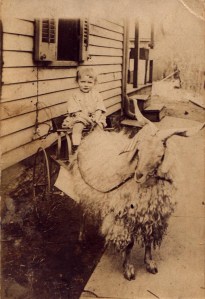
Ralph Haley, 1915-1920

Ralph Haley, 1915-1920

Ralph Haley on ram

24 Monday Dec 2012

Posted by Brandon Ray Kirk in Ed Haley

≈ Leave a comment

Tags

Appalachia, Ed Haley, Ella Haley, genealogy, history, Kentucky, life, photos, Ralph Haley, U.S. South

Ralph Haley, circa 1916

Ralph Haley, circa 1916

Parkersburg Landing 37

24 Monday Dec 2012

Posted by Brandon Ray Kirk in Ed Haley

≈ Leave a comment

Tags

Akron, Calhoun County, Ed Haley, Ella Haley, history, John Hartford, Laury Hicks, music, Ohio, Ralph Haley, Spencer, Ugee Postalwait, West Virginia, writing

     A little later, Ugee saw Ed and Ella at Spencer, the county seat of Roane County.

     “I lived three miles below Spencer one year and come up to town to get some groceries or something and Ed and Ella was there at the courthouse playing music. Well I went over to talk to Ed and Ella. Nothing else would do but for us to go down to eat at the hotel. Well, there was just a whole bunch of big shots over for that stock sale and Roane County was a Republican county. And they put us up to eat. That’s when they had that WPA and were giving out rations, like meat. My son Harold was up at the end of the table and they said, ‘Well, what do you want?’ He said, ‘I think I’ll have some of that Roosevelt dog meat.’ Aw, you ought to heard them good ole Republicans get up and just clap their hands. ‘Oh, that’s the smartest little boy I ever seen,’ he said and throwed him a dollar. Ed just throwed back his head. I can see him now – ‘Ha! Ha! Ha! That wasn’t a Republican said that, though.’ Me and Ella laughed about that.”

     In later years, Ugee’s brother Harvey took Ed and Ella to Akron, Ohio where he worked at the B.F. Goodrich factory. Ugee said, “Ed drawed such a big crowd at the B.F. Goodrich they passed a law that people had to keep moving on the streets. Harvey got so mad. At Goodyear, it was the same way. People couldn’t get by. Traffic was that bad.”

     I tried to explain to Ugee what I had learned about Haley’s fiddling and she said, “He was one of the smoothest fiddlers I ever heard. He’d put his fiddle right along here — he didn’t put it under his chin — and if somebody’d make him mad when they’d ask him to play something he’d almost make that fiddle insult that person. I don’t know how he’d do it, but I’ll tell you what: he could almost insult you with it. He’d make it squawl at them and squeal at them. Just like that ‘Wild Hogs in the Red Brush’ — the way he’d hit that fiddle somehow or other it’d sound just like hogs squealing.”

     I played some of Ed’s recordings for Ugee, who quickly pointed out that they didn’t compare to hearing him in person.

     “I’d give anything in the world if they could get some of Ed’s music out,” she said. “Now I had a nephew that went down to Kentucky after World War II and got two or three records of Ed’s. He give them five dollars. I tried to buy one off of him and he said, ‘I wouldn’t take a million dollars for them.’ That’s just how much we thought of Ed and Ella and them.”

     More Ed Haley records?

     “My nephew’s dead but his son is living in Parkersburg and I don’t know whether he’s throwed them away or what he’s done with them,” Ugee said. “They shouldn’t be scratched up. They took care of them.”

     Ugee said her nephew was James Russell Shaver, who lived just off of 7th Avenue.

     Turning my thoughts to music, I got my fiddle out to probe Ugee’s mind about Ed’s technique. She said, “Him and Dad both — that wrist done the work for them.”

     Did he always sit down when he played?

     “Most of the time. He could stand up and play but he didn’t like to.”

     Did he pat his foot pretty hard when he played?

     “Patted this one,” Ugee said. “The other one came down like you’re dancing. Whenever he began to pat that foot you could say he was bringing out some good music somewhere.”

     I asked if fiddlers ever questioned Ed about how to play and she said, “Well he wouldn’t a showed one how to play. He learned it like I did — the hard way — just fooling with the fiddle.”

     I told Ugee, “Now Lawrence said Ed played the banjo,” and she said, “Ed could play a guitar like crazy, too. He could play any kind of string music. Now Dad could thump a banjo a little but he wasn’t what you call a banjo player. Ed could play a mandolin, too. He could play a guitar, too. There’s where Ralph learned to play a guitar — Ed learned him.”

     I told her about working on Ed’s music with Lawrence and about my theory regarding genetic memory and she said, “I don’t think I ever seen Lawrence even pick up a music box and try to play anything,” kind of dismissing the entire notion. She didn’t know much about Ralph’s musical ability. “I never was around him too much — just there at home,” she said. “He played with his pick or fingers either one.”

     She was aware that Ella had Ralph before she married Ed.

     “I forget how old he was when Ed and Ella got married but he’s just a half-brother to them.”

     I asked Ugee if Ella ever talked about her first husband and she said, “No. They always made out like Ralph was Ed’s boy. Ed just called him his boy.”

     I was very curious to see what Haley tunes Ugee might remember.

     “I can remember a lot of his tunes,” she said, “but I can’t sing them any more: ‘Sourwood Mountain’, ‘Cripple Creek’ and ‘Wild Hogs in the Red Brush’. He played one — ‘The blue-eyed rabbit’s gone away. The blue-eyed rabbit’s gone to stay.’ Probably old fiddle tunes, all of them. You couldn’t mention one of them he couldn’t play. ‘Marching Through Georgia’, ‘Red Wing’. ‘Old Jimmy Johnson’ — you’ve heard that. ‘Old Jimmy Johnson, bring your jug around the hill. If you don’t have a jug, bring a ten dollar bill.'”

     I asked if her father and Ed played most of the same tunes and she said, “Oh, yeah. Dad knowed some that Ed didn’t but Ed would learn them when he’d get in there, and if Ed knowed some, why Dad’d learn them, too.”

In Search of Ed Haley 31

16 Sunday Dec 2012

Posted by Brandon Ray Kirk in Ed Haley

≈ Leave a comment

Tags

Appalachia, Arthur Smith, Ashland, Cincinnati, Clyde Haley, Ed Haley, Ella Haley, Hamilton, history, John Hartford, Kentucky, Lawrence Haley, life, love, Milt Haley, music, Ohio, Pat Haley, ragtime, Ralph Haley, Roxie Mullins, Scott Joplin, Sugar Foot Rag, writing

Back in Ashland, Lawrence and I told Pat all about our trip to Harts Creek. We had some great photographs — including the one of Ed’s mother — and all kinds of new information. One of the first things Lawrence did was joke Pat about seeing “that funny boy” who nearly scared her to death forty years ago. I told her about Milt Haley’s murder, the possibility of Milt having been a fiddler and about our interview with Roxie Mullins. Lawrence liked the story about his father breaking a fiddle over someone’s head, although it kind of bothered me to think he would do such a thing.

At some point during the evening, Pat suggested showing me Ella’s postcards, but Lawrence quickly dismissed the idea. I could tell there was something in those postcards he didn’t want me to see, which of course only peaked my curiosity. It was clear by his negative response, though, that the issue was closed so I didn’t mention it again.

Instead, I pelted him with very specific questions about his father. I wanted to know how Ed Haley felt about different types of music.

Did your dad like the Blues? I asked.

“I guess he liked, uh, Joplin,” Lawrence said. “He liked a lot of that ragtime. ‘Sugar Foot Rag’, he liked that.”

What about something like Hank Williams?

“No, I don’t think he cared too much for that.”

Otis Redding?

“Well, he might have liked some of it.”

How about Dixieland Jazz, somebody like Louis Armstrong?

“No, not too much of that.”

How about bluegrass?

“No, he didn’t like that.”

How about Arthur Smith?

“That was a fiddler, and he had nothing for him, I reckon.”

Clayton McMichen?

“Well, I never have heard him mention him.”

How about Georgia Slim Rutland?

“I really can’t remember him ever mentioning that guy, either.”

Did he ever know about Benny Thomasson or Major Franklin or any of those Texas fiddle players?

“John, I wouldn’t say one way or the other,” Lawrence finally said. “It’s just like you keep asking me, did he play this tune, did he play that tune? I guess my best answer whenever you started that shoulda been what didn’t he play in the way of this old-time music. And that’s the same way, who didn’t he know if they was into that and they was around this area he probably found out about them.”

Early the next morning, Lawrence and I went to see Ed and Ella’s graves in Ashland. Along the way, I asked him if he remembered all the places where his father had lived in town.

“Aw, we lived in half a dozen different places,” he said. “All we did was rent. We lived in a couple down on Greenup Avenue, 10th Street, 22nd Street. Then we lived in one on Halbert and about three different ones on 45th Street and one up on 37th Street. That’s about it.”

None of Ed’s former dwellings were still standing.

Lawrence told me about the time his brother Clyde almost got married: “That’s one of those deals where I told you he was afraid of women. He was courting a lady up in Detroit or somewhere and she told my sister-in-law, Patsy — Jack’s wife — said, ‘He run off and left me practically at the alter. We had made all the plans and everything.’ Next thing we knew, he was working on a platform out in the Gulf of Mexico out of Louisiana. I don’t know where he was when Mom passed away.”

After we got back to the house, Lawrence explained why he’d ruled out showing me his mother’s postcards the night before.

“Some of the old postcards that Mom used to receive kinda had a flavor of real broken love,” he said.

They also revealed that Ralph Haley actually belonged to Ella by a previous marriage.

“I don’t know what his name was, her first husband,” Lawrence said. “Apparently it was somebody that she met either in school or after she come out of school and went back to Morehead. I think Ralph was born around 1914, ’15, somewhere along in there, ’16. He was approximately ten years older than me, twelve at the most.”

For the first time, I thought, Lawrence was opening up about his mother. He said she used to type letters to her friends.

“She had a friend, I guess she must have been pretty well Irish. Her first name was Bridget. I don’t remember her last name. She never married. She went into a home and kept people up at Hamilton, Ohio. Every time we went to Cincinnati, Mom wanted to go see her.”

I listened quietly before saying, “I wonder what happened to your mom’s letters? I bet they would tell a lot of history.”

Pat said, “They probably would but it would mostly be my mother-in-law’s. You know, her life.”

I said, “But women invariably talk about their husbands a lot,” and Lawrence agreed.

“Women can pass along more information between them in five minutes than two men can all day long,” he said.

Still, he never offered to show the cards so I just kind of left it at that.

Just before I headed back to Nashville, Lawrence reached me his father’s walking stick. “Here’s something I think you’d like to have,” he said. He also loaned me the four Library of Congress reel-to-reel tapes, containing over 100 recordings.

Parkersburg Landing 30

15 Saturday Dec 2012

Posted by Brandon Ray Kirk in Ed Haley

≈ Leave a comment

Tags

Ed Haley, feud, Harts Creek, history, John Hartford, Lawrence Haley, Milt Haley, music, Peter Mullins, Ralph Haley, Roxie Mullins, Ticky George Adams, West Virginia, writing

     It was clear to Lawrence and I that Roxie really knew her stuff. Her memories went back to the Bull Moose era — some twenty years before Lawrence’s — and while they were a little hazy they were clearer than anything else we had heard up to that point. I think Lawrence was satisfied with Roxie’s stories but maybe a little intimidated because she just knew things about his father that went beyond his years. He really wanted to keep everything we heard about his dad in this certain context and someone like Roxie could really just carry it outside of his realm of knowledge.

     “John keeps asking me about my dad,” he said. “I told him I couldn’t tell him too much about my dad, because half of his life was over before I was ever born.”

     That got Roxie going again.

     “All of his fun days was all over. I know he played music right on, but I mean all of his fun — when he married, he laid down part of it.”

     Roxie caught Lawrence and I off-guard when she said Ed tried to get a local preacher to baptize him one time. “He joined the church once down on the hill with Cecil. And Uncle Charley Curry said, ‘Ed, will you lay down your music?’ and Ed said, ‘No, Uncle Charley. That’s the only way I’ve got to live is my music, but I can just play sacred songs, good songs.’ And Uncle Charley said, ‘Now listen, you’re drunk. You go off and get sober and come back to me tonight. I’ll take you in but I can’t take you in like you are.’ Sure did. Ed shook hands with him but I don’t guess he ever went back.”

     Lawrence said, “Well, that’s news to me. I’m not sure he was ever baptized. The only baptism he got was Milt Haley’s baptism, and that didn’t amount to much.”

     That got us to talking about Ed’s father again. I really wanted to know why he was killed, but Roxie had no idea.

     “I don’t know why they killed him, son. They was just all into it. Now, Aunt Liza coulda told you all about it.”

     She looked at Lawrence and said, “You’re like me. You waited too long to come to talk to any of his people to find out anything about it. All the old people’s dead, you see, and gone. My mother, she was a Hager, and her mother went to the Western States and died there and was buried on the banks of the Wabash River. Uncle John told us — he was with her. He said she just lived there six months till she died. I know who my grandmother was — she was a Baisden — but I don’t know a thing on earth about my grandmother, and I don’t know nothing about Joe — that’s my grandpa — nothing about who he was, who his brothers was. Daddy died in ’40 and my mother died in ’42. I’m the only one that’s living. I can’t go ask nobody nothing. People never ask nobody nothing when they’re young.”

     Lawrence agreed, “That’s right. That’s exactly why I didn’t find anything out. You’re just young, happy to be alive.”

     Roxie’s mind was still on her father, Ticky George Adams.

     “My dad could play the accordion,” she said. “He could play ‘The Golden Slipper’ and he could play ‘John Morgan’. He could play ‘John Henry’. He could play just anything he wanted to play and how he learned it I just don’t know. And ‘Old Joe Clark’, that’s another one he could play. ‘Nelly Gray’, that’s another one he played. He could make them ring.”

     I asked Roxie if Ticky George ever played with Ed.

     “No, he never played with Ed. He wouldn’t let Ed hear him play, I guess. He could really play and sing. He had a song he sung. ‘Nothing Between My Soul and Heaven’ is the name of the song. They was four verses to that and buddy he could sing every word of that, and how he learnt that I don’t know. He couldn’t read. He didn’t know his letters.”

     Roxie told us about her uncle Peter, saying, “Uncle Peter, you know, was a crippled man. His foot was turned backwards. When he bought him a pair of shoes, he had to cut the toe off here and sew it up, and his foot turned back in here.”

     I said to her, “And that’s the man that raised up Ed Haley?” and she said, “Yeah, he helped raise him. He stayed with Uncle Peter’s fellers and Grandma and Grandpa Jackson. See, she was married twice. When John Adams was killed, she married Andrew Jackson Mullins, and he kept Ed a long time, him and her. And he stayed with us. He just stayed with first one and then another. Wherever he wanted to go, he went. He was just his own boss.”

     Okay, so the Jackson Mullins I’d heard about from Bum was Ed’s grandfather and the John Adams involved in Weddie Mullins’ death must have been a Jr.

     I asked Roxie if she knew how old Ed was when he stayed with his grandparents and she said, “Well, when he was with Grandpa and Grandma Jackson, he was a young man. I guess he was twenty years old, maybe more. Grandpa and Grandma kept him a long time, and then he stayed with Uncle Peter and Aunt Liza. And he stayed with us some every now and then. He come and stayed with us two or three days at a time — with John and the boys. He musta left here about the age of thirty and went to Ashland, Kentucky. West Greenup, Kentucky, is where I wrote to them. I wrote to Ralph, Ralph wrote to me. Man he was smart, I’ll tell you that. Take anything you wanted to ask him about the books.”

     Roxie bragged on how smart Ella was, saying she tried to get her to move to Kentucky with the Haleys.

     “She graduated from college, she told us. She said The Pied Piper of Hamlin – they’s eight pages of it, on both sides. She’d beg me and Annie to go home with her and said she would learn us to play the piano. Man she could make that harmonica… Listen, she could put it in her mouth and she had things fastened under here. She didn’t have to have her hands on it. Man she’d just run that mouth over that the best you ever heard in your life. She played that mandolin right along with her fingers and then had that harp in her mouth.”

     Right before Lawrence and I left Roxie’s, she asked my name again and said she’d be watching for me on Hee Haw. She said Roy Clark used to come through “back when he was a chunk of a boy,” but Violet said she was confused — that it had been Roy Acuff.

     “That was back when he traveled through here some. He had some people or something that lived up on Buck Fork.”

     To say that Lawrence and I were blown away by our experience with Roxie would be a huge understatement. Lawrence had never heard anything about his grandfather being murdered. Maybe Ed had wanted to distance his kids from that part of his painful past on Harts Creek.

← Older posts
Newer posts →

Feud Poll 1

If you had lived in the Harts Creek community during the 1880s, to which faction of feudists might you have given your loyalty?

Categories

  • Adkins Mill
  • African American History
  • American Revolutionary War
  • Ashland
  • Atenville
  • Banco
  • Barboursville
  • Battle of Blair Mountain
  • Beech Creek
  • Big Creek
  • Big Harts Creek
  • Big Sandy Valley
  • Big Ugly Creek
  • Boone County
  • Breeden
  • Calhoun County
  • Cemeteries
  • Chapmanville
  • Civil War
  • Clay County
  • Clothier
  • Coal
  • Cove Gap
  • Crawley Creek
  • Culture of Honor
  • Dingess
  • Dollie
  • Dunlow
  • East Lynn
  • Ed Haley
  • Eden Park
  • Enslow
  • Estep
  • Ethel
  • Ferrellsburg
  • Fourteen
  • French-Eversole Feud
  • Gilbert
  • Giles County
  • Gill
  • Green Shoal
  • Guyandotte River
  • Halcyon
  • Hamlin
  • Harts
  • Hatfield-McCoy Feud
  • Holden
  • Hungarian-American History
  • Huntington
  • Inez
  • Irish-Americans
  • Italian American History
  • Jamboree
  • Jewish History
  • John Hartford
  • Kermit
  • Kiahsville
  • Kitchen
  • Leet
  • Lincoln County Feud
  • Little Harts Creek
  • Logan
  • Man
  • Matewan
  • Meador
  • Midkiff
  • Monroe County
  • Montgomery County
  • Music
  • Native American History
  • Peach Creek
  • Pearl Adkins Diary
  • Pecks Mill
  • Peter Creek
  • Pikeville
  • Pilgrim
  • Poetry
  • Queens Ridge
  • Ranger
  • Rector
  • Roane County
  • Rowan County Feud
  • Salt Rock
  • Sand Creek
  • Shively
  • Spears
  • Sports
  • Spottswood
  • Spurlockville
  • Stiltner
  • Stone Branch
  • Tazewell County
  • Timber
  • Tom Dula
  • Toney
  • Turner-Howard Feud
  • Twelve Pole Creek
  • Uncategorized
  • Warren
  • Wayne
  • West Hamlin
  • Wewanta
  • Wharncliffe
  • Whirlwind
  • Williamson
  • Women's History
  • World War I
  • Wyoming County
  • Yantus

Feud Poll 2

Do you think Milt Haley and Green McCoy committed the ambush on Al and Hollene Brumfield in 1889?

Blogroll

  • Ancestry.com
  • Ashland (KY) Daily Independent News Article
  • Author FB page
  • Beckley (WV) Register-Herald News Article
  • Big Sandy News (KY) News Article
  • Blood in West Virginia FB
  • Blood in West Virginia order
  • Chapters TV Program
  • Facebook
  • Ghosts of Guyan
  • Herald-Dispatch News Article 1
  • Herald-Dispatch News Article 2
  • In Search of Ed Haley
  • Instagram
  • Lincoln (WV) Journal News Article
  • Lincoln (WV) Journal Thumbs Up
  • Lincoln County
  • Lincoln County Feud
  • Lincoln County Feud Lecture
  • LinkedIn
  • Logan (WV) Banner News Article
  • Lunch With Books
  • Our Overmountain Men: The Revolutionary War in Western Virginia (1775-1783)
  • Pinterest
  • Scarborough Society's Art and Lecture Series
  • Smithsonian Article
  • Spirit of Jefferson News Article
  • The Friendly Neighbor Radio Show 1
  • The Friendly Neighbor Radio Show 2
  • The Friendly Neighbor Radio Show 3
  • The Friendly Neighbor Radio Show 4
  • The New Yorker
  • The State Journal's 55 Good Things About WV
  • tumblr.
  • Twitter
  • Website
  • Weirton (WV) Daily Times Article
  • Wheeling (WV) Intelligencer News Article 1
  • Wheeling (WV) Intelligencer News Article 2
  • WOWK TV
  • Writers Can Read Open Mic Night

Feud Poll 3

Who do you think organized the ambush of Al and Hollene Brumfield in 1889?

Recent Posts

  • Logan County Jail in Logan, WV
  • Absentee Landowners of Magnolia District (1890, 1892, 1894)
  • Charles Spurlock Survey at Fourteen Mile Creek, Lincoln County, WV (1815)

Ed Haley Poll 1

What do you think caused Ed Haley to lose his sight when he was three years old?

Top Posts & Pages

  • U.B. Buskirk of Logan, WV (1893-1894)
  • Vance Homeplace and Cemetery on West Fork (2017)
  • Tice Elkins in Ferrellsburg, WV
  • Early Anglo Settlers of Logan, WV (1937)
  • Alice Dingess piano

Copyright

© Brandon Ray Kirk and brandonraykirk.wordpress.com, 1987-2023. Unauthorized use and/or duplication of this material without express and written permission from this blog’s author and/or owner is strictly prohibited. Excerpts and links may be used, provided that full and clear credit is given to Brandon Ray Kirk and brandonraykirk.wordpress.com with appropriate and specific direction to the original content.

Archives

  • February 2025
  • January 2025
  • October 2023
  • September 2023
  • December 2022
  • November 2022
  • May 2022
  • April 2022
  • February 2022
  • November 2021
  • October 2021
  • September 2021
  • June 2021
  • May 2021
  • April 2021
  • March 2021
  • February 2021
  • January 2021
  • December 2020
  • November 2020
  • October 2020
  • July 2020
  • June 2020
  • May 2020
  • April 2020
  • March 2020
  • February 2020
  • January 2020
  • December 2019
  • November 2019
  • October 2019
  • September 2019
  • August 2019
  • July 2019
  • June 2019
  • May 2019
  • April 2019
  • March 2019
  • February 2019
  • January 2019
  • December 2018
  • November 2018
  • October 2018
  • September 2018
  • August 2018
  • July 2018
  • June 2018
  • May 2018
  • April 2018
  • March 2018
  • February 2018
  • January 2018
  • December 2017
  • November 2017
  • October 2017
  • September 2017
  • August 2017
  • July 2017
  • June 2017
  • May 2017
  • April 2017
  • March 2017
  • February 2017
  • January 2017
  • December 2016
  • November 2016
  • October 2016
  • September 2016
  • August 2016
  • July 2016
  • June 2016
  • May 2016
  • April 2016
  • March 2016
  • February 2016
  • January 2016
  • December 2015
  • November 2015
  • October 2015
  • September 2015
  • August 2015
  • July 2015
  • June 2015
  • May 2015
  • April 2015
  • March 2015
  • February 2015
  • January 2015
  • December 2014
  • October 2014
  • September 2014
  • August 2014
  • July 2014
  • June 2014
  • May 2014
  • April 2014
  • March 2014
  • February 2014
  • January 2014
  • December 2013
  • November 2013
  • October 2013
  • September 2013
  • August 2013
  • July 2013
  • June 2013
  • May 2013
  • April 2013
  • March 2013
  • February 2013
  • January 2013
  • December 2012
  • November 2012

Enter your email address to follow this blog and receive notifications of new posts by email.

Join 2,925 other subscribers

Tags

Appalachia Ashland Big Creek Big Ugly Creek Blood in West Virginia Brandon Kirk Cabell County cemeteries Chapmanville Charleston civil war coal Confederate Army crime culture Ed Haley Ella Haley Ferrellsburg feud fiddler fiddling genealogy Green McCoy Guyandotte River Harts Harts Creek Hatfield-McCoy Feud history Huntington John Hartford Kentucky Lawrence Haley life Lincoln County Lincoln County Feud Logan Logan Banner Logan County Milt Haley Mingo County music Ohio photos timbering U.S. South Virginia Wayne County West Virginia Whirlwind writing

Blogs I Follow

  • OtterTales
  • Our Appalachia: A Blog Created by Students of Brandon Kirk
  • Piedmont Trails
  • Truman Capote
  • Appalachian Diaspora

BLOOD IN WEST VIRGINIA is now available for order at Amazon!

Blog at WordPress.com.

OtterTales

Writings from my travels and experiences. High and fine literature is wine, and mine is only water; but everybody likes water. Mark Twain

Our Appalachia: A Blog Created by Students of Brandon Kirk

This site is dedicated to the collection, preservation, and promotion of history and culture in Appalachia.

Piedmont Trails

Genealogy and History in North Carolina and Beyond

Truman Capote

A site about one of the most beautiful, interesting, tallented, outrageous and colorful personalities of the 20th Century

Appalachian Diaspora

  • Subscribe Subscribed
    • Brandon Ray Kirk
    • Join 787 other subscribers
    • Already have a WordPress.com account? Log in now.
    • Brandon Ray Kirk
    • Subscribe Subscribed
    • Sign up
    • Log in
    • Report this content
    • View site in Reader
    • Manage subscriptions
    • Collapse this bar
 

Loading Comments...