• About

Brandon Ray Kirk

~ This site is dedicated to the collection, preservation, and promotion of history and culture in my section of Appalachia.

Brandon Ray Kirk

Tag Archives: Parkersburg Landing

Parkersburg Landing Album (2015)

04 Sunday Oct 2015

Posted by Brandon Ray Kirk in Ashland, Ed Haley, Music

≈ Leave a comment

Tags

Appalachia, Ashland, blind, Ed Haley, Ed Haley Memorial Fiddle Contest, fiddle, fiddler, fiddling, Kentucky, life, music, Parkersburg Landing, photos, Rounder Records

Parkersburg Landing album, Ed Haley Memorial Fiddle Contest, Ashland, Kentucky, 19 September 2015

Parkersburg Landing album, Ed Haley Memorial Fiddle Contest, Ashland, Kentucky, 19 September 2015

In Search of Ed Haley 343

25 Friday Jul 2014

Posted by Brandon Ray Kirk in Calhoun County, Ed Haley, John Hartford, Music

≈ Leave a comment

Tags

Akron, Banjo Tramp, Black Sheep, Calhoun County, Canton, Chloe, Ed Haley, fiddle, fiddlers, fiddling, Gus Meade, harp, Jo LaRose, John Hartford, Kerry Blech, Laury Hicks, Lawrence Haley, music, Ohio, Parkersburg Landing, Ragpicker Bill, Rector Hicks, Rounder Records, Stackolee, Sugar in the Morning, Tommy Jarrell, Traditional Music and Dance in Northeast Ohio, West Virginia

Not long after visiting Ugee, I received some great information in the mail regarding Rector Hicks, a fiddler and nephew to Ed’s friend Laury Hicks. Rector grew up watching his uncle Laury play the fiddle.

“Rector was born out in the country around Chloe, Calhoun County, West Virginia, in 1914,” Joe LaRose wrote in Traditional Music and Dance in Northeast Ohio (March 1985). “His father was a good mouth harp player, but no one else in his family played music. Rector learned from fiddlers who lived in his area, beginning to play the instrument when he was around ten years old. Rector learned a lot from time spent with a distant cousin, Laury Hicks, a generation older than Rector and one of the foremost fiddlers in the area. ‘I don’t know of a fiddle player, really, that played like him. Ed Haley said Laury was the best fiddler he ever heard on the old time tunes, you know, and old fast ones. Hisself, he said that. And I always thought he was.'”

While at Laury’s, Rector Hicks also had the opportunity to see Ed.

“He was hard to figure out,” Rector told LaRose. “When I was around him most I didn’t know too much about fiddling, and a lot of that stuff I could pick up now if I was around him. How he got all that in there with his bow like he did you’d never believe it. He just set there this way (passes the length of the bow back and forth across the strings) but everything seemed like it just come in there. If you’d hear him play… Now that record, that’s not Ed Haley. That’s him, but that’s no good. You don’t get a lot of what he puts in. But he puts every note in that thing. His left hand, his fingers just flew. But his right hand… He just set there and his fiddle laid on his arm, set there and rocked. That’s the way he played. All them fastest tunes he played, didn’t seem like he put any of the bow in hardly. But it was all in there.”

Rector seemed to idolize Haley, at least according to Kerry Blech, a fiddling buff and friend of mine.

“Rector, when he was a teenager, had saved up some money and got him a pretty good fiddle and when Ed would come and stay at Laury’s house Rector would always come over,” Kerry wrote. “For a couple of years, Ed would tease him and say, ‘Well, I really like that fiddle you got, Rector. We should swap.’ And once he did and went off and played in some other town, then came back through about a week later and got his fiddle back. Rector said he was just really thrilled to’ve had Ed’s fiddle for even a week.”

As Rector got older and learned more about the fiddle, he really patterned after Haley’s style.

“Rector’s approach to playing has much in common with Haley’s,” LaRose wrote of Hicks. “Like Haley, Rector holds his fiddle against his upper arm and chest and supports it with his wrist (he does not rock the fiddle under the bow, though, like Haley did.) Rector uses a variety of bow strokes. Like Haley, he uses the length of the bow, sometimes playing a passage of several notes with one long stroke, deftly rocking the bow as he plays. He will accent the melody at chosen times with short, quick strokes. Rather than overlay the melody with a patterned or constant bow rhythm as some dance-oriented fiddlers do, Rector adapts his bowing to the melody of the particular tune he’s playing. Much of the lilt and movement of his tunes is built into the sequence of notes played with his left hand.”

Rector apparently kept in touch with Ed’s family, who he sometimes visited long after Haley’s death, and was very disappointed with the quality of fiddling on the Parkersburg Landing album.

“When I met Rector in the mid-70s, the Haley LP had just come out and Rector called me up to tell me it was awful,” Kerry wrote. “He said it was not representative of the man’s genius. He told me that he knew the man, and although many years had passed, the Haley genius was still in his mind’s eye. He also said that there were many other home recordings beyond what Gus Meade had copied. He said that Haley’s children had split up the recordings, that Lawrence had a number of them, and that a daughter, who lived in the Akron-Canton area, had over a hundred of them, and that Rector occasionally went over there and listened. He said that the family was irritated by how the Rounder record came to be and did not want to be involved with any of us city folk any more, afraid that someone would exploit their father’s music.”

At that time in his life, Rector mostly played Tommy Jarrell tunes but also several Ed Haley tunes, like “Birdie”, “Sugar in the Morning” (“Banjo Tramp”), “Ragpicker Bill”, “Black Sheep”, and “Staggerlee”.

In Search of Ed Haley 297

27 Sunday Apr 2014

Posted by Brandon Ray Kirk in Ed Haley, Music

≈ 2 Comments

Tags

Abe Keibler, banjo, Boatin' Up Sandy, Charley Keibler, Cold Frosty Morning, Cotton-Eyed Joe, fiddle, fiddlers, Germany, Girl With the Blue Dress On, guitar, history, Jim Keibler, John Keibler, Kentucky, Morris Allen, music, Ohio, Old Coon Dog, Parkersburg Landing, Portsmouth, Rye Whiskey, Sally Goodin, Sally Got Drunk on Irish Potatoes, South Shore, Stumptail Dolly, Susan's Gone to the Ball With Her Old Shoes On, We'll All Go to Heaven When the Devil Goes Blind, writing

Later that day, I went to see 88-year-old Abe Keibler in nearby South Shore, Kentucky. Abe was the last surviving member of the old fiddling Keiblers and a first cousin to fiddler Morris Allen, one of the sources for Parkersburg Landing.

“My grandfather, he was sixteen years old when he landed in here from Germany and he got a job out here at an old furnace,” Abe said. “He couldn’t even speak the language when he first come here, they said, and he didn’t play nothing.”

“Wow,” I said, “So fiddling started with your dad and uncles?”

“My uncles and dad, yeah,” Abe confirmed. “Jim was my dad’s name. He played a banjo — the old claw-hammer style.

Abe was raised up in a family of fiddlers, but he originally played the guitar. He began to play the fiddle at the age of 55. He wasted little time in showing me the old family fiddle, which he inherited from his uncle John Keibler. It was a good-looking instrument with a good tone, although the bridge was ready to collapse.

“Way back before I was born some fella came into Portsmouth when they had the old saloons in and he had this old fiddle and couldn’t play it,” Abe explained. “My uncle John, he seen that it was a good fiddle and he wanted to buy it and this guy wouldn’t talk about selling it. My uncle Charley, he was a left-handed fiddler. He said, ‘Now John, if you want that fiddle, I can buy it for ten dollars.’ So he bought it. It’s been in our family around ninety years or maybe close to a hundred.”

Abe said the old fiddle was hard to tune — it had seen some rough times.

“My uncle fell and busted the top all to pieces. I had a fella that made fiddles put that top off of another old fiddle on it. My uncle had patent keys put on it and I had them took out and wood keys put in it.”

I tuned the Keibler fiddle as best as I could, then reached it back with a request for a tune I’d heard Abe mention called “We’ll All Go to Heaven When the Devil Goes Blind”. He couldn’t remember it but said it was the same thing as “Stumptail Dolly”. He scratched out a melody in the key of G, then said, “Some of them called that the ‘Girl With the Blue Dress On’. ‘Old Coon Dog’ is all I ever heard it called.”

He also played “Boatin’ Up Sandy”, “Sally Goodin” (in G), “Rye Whiskey” (which he called “Cold Frosty Morning”), “Sally Got Drunk on Irish Potatoes”, “Cotton-Eyed Joe”, and “Susan’s Gone to the Ball With Her Old Shoes On” (key of G).

Every now and then, I joined in with my fiddle.

“I’m gonna learn you how to play a fiddle yet,” Abe said.

In Search of Ed Haley 292

20 Sunday Apr 2014

Posted by Brandon Ray Kirk in Ed Haley, Music

≈ Leave a comment

Tags

Ashland, Blackberry Blossom, Calhoun County Blues, Cherry River Rag, Come Take A Trip in My Airship, Dunbar, fiddling, history, John Hartford, John Lozier, Kentucky, Lawrence Haley, Man of Constant Sorrow, Mona Haley, music, Parkersburg Landing, Pat Haley, Ragtime Annie, writing

“Pop put a lot of emotions in his music,” Mona said. “He was real excited with his playing. He would put things in there that no one else would.”

She described Ed’s music as loud and lively — contrary to testimony from John Lozier and others — and told how it generated a great deal of excitement. She re-iterated that Ed had very little body movements when playing and seemed a little bothered by my energy when I played the fiddle — all the facial and head gestures, loud tapping, leg movements.

I asked her if Ed played much around home and she said, “When he was sad or when he was drinking or when he was happy he played — especially when he was happy.”

I wondered what made Ed happy.

“I don’t know,” she said. “Maybe hearing about a place to play or some money to be made. Music was his life. There wasn’t much about the family that made him happy. I mean, we was always fighting.”

In no time at all, Mona and I slipped into a familiar routine: me playing and asking things like “Did Ed play this?” or “Did Ed play it like this?” I played a lot of tunes for her — mostly ones I knew Ed played but also ones I had heard or suspected him of playing based on talking with Ugee Postalwait and Wilson Douglas and reading notes in the Lambert Collection.

When I played “Cherry River Rag”, Mona said, “I always loved that. Now that’s one that Pop put the slurs and insults in.”

Lawrence Haley had spoken of the “slurs and insults”, but I had never really figured out what they were. I had this theory that they were when Ed used tiny chromatic slides to create a modal and “slidey” note, thereby broadening and helping to achieve more of a “human voice effect” — much like vibrato does. This concept goes way back into Celtic history and may be much more a source for Blues than anything African. (Scholars have, incidentally, found no historical precedent for the Blues in the music of the continent of Africa.) I figured that Ed hit a little “dead” grace note beforehand which helped separate the notes in his long bow style. It is what the Irish call a “cut:” the finger on the grace note barely touches the string so as to give a good stop or separation.

As for the “slurs and insults,” Mona couldn’t seem to explain them either. I suggested listening to “Cherry River Rag” on Pat’s copy of Parkersburg Landing and having Mona point them out to me. We went into the living room and gathered around the record player. As “Cherry River Rag” played, Mona pointed out the slurs and insults. Basically, she described them as being when Ed slid a note for emphasis.

“Sounded to me, John, like when he was getting tired,” she said, back in the kitchen. “He was just wanting to get out of it as easy as he could.”

I asked if there were ever times when Ed would play and just slide the notes a lot and she said, “No, not unless he was drinking. He’d slide those notes a lot when he was drinking. Screech a lot when he was drinking — especially on those high keys.”

Mona loved it when I played “Man of Constant Sorrow”, saying, “Beautiful. That reminds me of Pop being sad. I love it, though. I wanted to tell you, they made a lot of requests, people on the street. They’d say, ‘Ed, play ‘Blackberry Blossom’. If he knew it, he’d play it. He had people dancing on the street, John. He could play forever.”

I played a variety of tunes for Mona that I thought Ed might have played but she only recognized one called “Wilson’s Jig”. She said her father played “Dunbar” a lot and recognized the melody for “Run Here Granny”. She said he made up the tunes “You Can’t Blame Me for That” and “Come Take A Trip in My Airship”. She said “Ragtime Annie” was one of her father’s “main attractions,” while “Birdie” sounded “very familiar.” She said Ed played “Old Joe Clark” and “Money Musk” and fiddled “Done Gone” in B-flat. She said something in my version of “Wild Hog in the Red Brush” was familiar, although she said she never heard Ed play anything with that title. When I played “Uncle Joe”, she immediately recognized the melody but not the title.

“See, I know so many of the tunes I’ve heard but I don’t know the title,” she said.

It was probably a little confusing for her to sit and listen while I assaulted her with a whole barrage of tunes, but I was so excited about picking her brain that I just kept playing.

She remembered Ed playing “Waggoner” and “Paddy on the Turnpike”, as well as the very similar “Snowbird on the Ashbank”. She recognized “Pumpkin Ridge”, “Old Joe Clark”, and “Money Musk”. She didn’t know the melody for “Brownlow’s Dream” but recognized the title, while she knew the melody for “Indian Squaw” but not the title. She said Ed never played “Orange Blossom Special” but did play “Listen to the Mockingbird” and even “made the bird sounds, too.”

When I played “Calhoun County Blues”, she said, “I’ve heard him play that lots. You put a lot more notes in it than what he did.”

In Search of Ed Haley 201

20 Wednesday Nov 2013

Posted by Brandon Ray Kirk in Ed Haley

≈ Leave a comment

Tags

Bruce Nemerov, Ed Haley, fiddling, history, John Hartford, Lee Hazen, Lynn Davis, Mark Wilson, music, Nashville, Parkersburg Landing, writing

When I got back to Nashville, I had this boxed package in the mail from Mark Wilson, the folklorist who co-produced Parkersburg Landing. Inside the box was a pile of wire recordings, looking very much like a gossamer bird’s nest, which Mark said were Lynn Davis’ recordings of Ed Haley from the forties. I had no idea why Mark had these wires, or really why he had sent them to me. Some years before, I had called him about Ed and received a cool reception, sort of like, “Why don’t you leave all of this to the real folklorists?”

I took the wire recordings to Lee Hazen, a studio engineer and friend whose life-long hobby was wire recordings, and he told me right away that they were way beyond hope. “Even if you took pieces of them and run them through and taped them and then assembled the tape?” I asked.

Nope.

He said it would require someone with enough patience to spend the rest of their life untangling them. I decided to keep them safe though and maybe someday, who knows? But wouldn’t it be awful to get them all together and discover that they were not even of Ed?

Later that spring, Bruce Nemerov notified me that he’d completed his work on Ed Haley’s recordings. I got a hold of the new copies, which included an audio log. There were several records that Bruce didn’t copy.

In Search of Ed Haley 64

12 Tuesday Feb 2013

Posted by Brandon Ray Kirk in Ashland, Big Sandy Valley, Ed Haley, Music

≈ 1 Comment

Tags

Ashland, Big Sandy River, Blackberry Blossom, Blaze Starr, Bluegrass Meadows, Boyd County, Clark Kessinger, Dave Peyton, Delbarton, Duke Williamson, Ed Haley, fiddle, fiddler, fiddlers, fiddling, Georgia Slim Rutland, Grand Ole Opry, Hank Williams, Herald-Dispatch, history, Huntington, Jennies Creek, John Fleming, John Hartford, Kentucky, Lawrence Haley, Lynn Davis, McVeigh, Mingo County, Minnie Pearl, Molly O Day, Molly O'Day, music, Parkersburg Landing, Pike County, Pond Creek, Short Tail Fork, Shove That Hog's Foot, Skeets Williamson, Snake Chapman, Texas, West Virginia, Williamson

Early that summer, I was back at Lawrence Haley’s in Ashland with plans to visit Lynn Davis in Huntington, West Virginia. Lynn had been mentioned in the Parkersburg Landing liner notes as a source for Haley’s biographical sketch and was the widower of Molly O’Day, the famous country singer. Snake Chapman had told me that Molly and her family were close friends to Haley, who visited their home regularly in Pike County, Kentucky. I was sure Lynn would have a lot of great stories to tell about Ed. At our arrival, he was incredibly friendly — almost overwhelming us with the “welcome mat.” All we had to do was mention Ed’s name and he started telling us how he and Molly used to pick him up in Ashland and drive him up the Big Sandy Valley to see Molly’s father in southeastern Kentucky.

“That was back in the early forties,” he said. “We’d come to Ashland and get him at his home up on Winchester about 37th Street. They was a market there or something you turned up by and we’d go there and pick him up and take him up to Molly’s dad and mother up in Pond Creek, Kentucky — above Williamson. There’s an old log house up there — it’s been boarded up and sort of a thing built around it so people couldn’t get in and tear it up or something — but it’s falling down. He’d stay up there with Molly’s dad and mother for several days. They’d take him to Delbarton, a coal town over there from Williamson, and they’d just drive him around, buddy. Now Molly’s brother, he really loved Ed’s fiddling.”

Lynn was referencing Skeets Williamson, Molly’s older brother and a good fiddler by all accounts. Lynn showed me an album titled Fiddlin’ Skeets Williamson (c.1977), which referenced him as “one of country music’s more skilled fiddlers during the 1940’s — one of the best in his day.”

Skeets was born in 1920 at McVeigh, Kentucky, meaning he was approximately 35 years younger than Haley. As a child, he played music with Molly and his older brother Duke Williamson, as well as Snake Chapman. “During these years, the famous fiddler of Eastern Kentucky, Blind Ed Haley, became a tremendous influence on him,” the album liner notes proclaimed. “Skeets (along with Clark Kessinger) still contend that Haley was the greatest fiddler who ever played.” During a brief stint on Texas radio, Skeets met Georgia Slim Rutland, the famous radio fiddler who spent a year listening to Haley in Ashland.

I asked Lynn more about his trips to Haley’s home on 37th Street.

“We used to go down to his house and Molly’d say, ‘Uncle Ed, I’d just love to hear you play me a tune.’ Well he’d be sitting on the couch and he’d just reach over behind the couch — that’s where he kept his fiddle. He always had it in hand reach. So he would get it out of there, man, and fiddle.”

Sometimes Lynn and Molly would join in, but they mostly just sat back in awe.

“You’ve seen people get under the anointing of the Holy Ghost, John,” Lynn said. “Well now, that’s the way he played. I mean, I’ve seen him be playing a tune and man just shake, you know. It was hitting him. I mean, it was vibrating right in his very spirit. Molly always said, ‘I believe that fiddlers get anointed to the fiddle just like a preacher gets anointed to preach.’ They feel it. Man, he’d rock that fiddle. He’d get with rocking it what a lot of people get with bowing. It was something else. But he got into it man. He moved all over.”

Lynn said Ed was a “great artist” but had no specific memories of his technique. He didn’t comment on Ed’s bowing, fingering or even his fiddle positioning but did say that he mostly played in standard tuning. Only occasionally did Ed “play some weird stuff” in other tunings.

Lynn’s memories of Haley’s tunes seemed limited.

“Well, he played one called ‘Bluegrass Meadows’,” he said. “He had some great names for them. Of course one of his specials was ‘Blackberry Blossoms’. He liked that real good, and he’d tell real stories. He would be a sawing his fiddle a little while he was telling the story, and everybody naturally was just quiet as a mouse. You know, they didn’t want to miss nothing.”

What kind of stories?

“Well, I know about the hog’s foot thing. He said they went someplace to play and they didn’t have anything to eat and those boys went out and stole a hog and said they brought it in and butchered it and heard somebody coming. It was the law. They run in and put that hog in the bed and covered it up like it was somebody sleeping. And Ed was sitting there fiddling and somebody whispered to him, said, ‘Ed, that hog’s foot’s stickin’ out from under the cover there.’ So he started fiddling and singing, ‘Shove that hog’s foot further under the cover…’ He made it up as he went.”

The next thing I knew, Lynn was telling me about his musical career. He’d been acquainted with everybody from country great Hank Williams to Opry star Minnie Pearl. We knew a lot of the same people — a source of “bonding” — and it wasn’t long until he started handing me tapes and records of Molly O’Day and Georgia Slim Rutland. He said he had a wire recording of Ed and Ella somewhere, but couldn’t find it. He promised me though, “When I find this wire — and I will find it — it’s yours.”

Sometime later, he called Dave Peyton, a reporter-friend from the Huntington Herald-Dispatch, to come over for an interview. With Peyton’s arrival, Lynn (ever the showman) spun some big tales.

“Now, Molly’s grandfather on her mother’s side was the king of the moonshiners in West Virginia and he was known as ‘Twelve-Toed John Fleming’,” Lynn said. “He had six toes on each foot. Man, he was a rounder. Little short fella, little handlebar mustache — barefooted. He was from the Short Tail Fork of Jenny’s Creek. And the reason they called it that, those boys didn’t have any britches and they wore those big long night shirts till they was twelve or fourteen years old.”

Lynn was on a roll.

“I preached Molly’s uncle’s funeral. Her uncle is the father of Blaze Starr — the stripper. That’s Molly’s first cousin. In her book, she said she would walk seven miles through the woods to somebody that had a radio so she could hear her pretty cousin Molly sing. She was here in town about three or four months ago. We had breakfast a couple times together. She’s not stripping anymore. She makes jewelry and sells it. She’s about 60 right now.”

In Search of Ed Haley 62

06 Wednesday Feb 2013

Posted by Brandon Ray Kirk in Ed Haley, Music

≈ 2 Comments

Tags

Brooks Hardway, Calhoun County, Chicken Reel, Clark Kessinger, Ed Haley, Emery Bailey, fiddler, fiddling, Frank Santy, Gerry Milnes, history, Homer Bailey, John McCune, Laury Hicks, music, Parkersburg Landing, Roane County, Senate Cottrell, Spencer, Stinson, Ward Jarvis, West Virginia, writing

At that point, Gerry asked Brooks about Ed Haley, and it was clear from his remarks that he thought he was an incredible fiddler.

“I’ve saw Ed Haley and stood and listened to him and sat in houses and listened to Ed Haley play,” he said. “Ed Haley is the best fiddler I ever listened to and I’ve heard a lot of them. And I’m a pretty good judge of what good fiddling is. And Ed Haley was the slickest, hottest… He bluegrassed it — he’s another fellow that was 50 years ahead of his time, like I mentioned about Emery Bailey. Ed Haley could lay the leather on that fiddle bow and so smooth it was out of this world.”

Brooks told Gerry about seeing Ed at the Roane County Courthouse in West Virginia before the Depression.

     I walked up in the courthouse at Spencer one time back in the 20s and there was a crowd in the courthouse yard and there sat Ed Haley fiddling. He had a tin cup sitting there on a little stand. Ed Haley wouldn’t play unless that tin cup kept rattling with nickels and dimes. A dollar bill was out of this world in them days. I listened to Ed Haley play and Homer Bailey, Emery’s brother, was at the stock pen. The stock pen was just across the stream from the courthouse and I hurried to tell Homer. I wanted Homer to hear Ed Haley. I said, “Homer, Ed Haley’s over here at the courthouse yard playing the fiddle. Let’s go over and hear him play a tune or two.” And as we was crossing the bridge going back over the courthouse Homer said, “Plum honor, Brook. I wonder if he can fiddle ‘Chicken Reel’ as good as Emery can?” I said, “I don’t know but we’ll find out pretty soon now and you be the judge.”

     And we walked up close to Ed. Ed wasn’t playing — there wasn’t no nickels going in the cup. I put a big Bull Moose nickel in the cup and rattled it and I said, “Ed, I’d like to hear you play ‘Chicken Reel’.” And he reared back and leveled off on that fiddle and you never heard such a ‘Chicken Reel’ in all my life. Homer turned sideways and bent over and held his head right forward towards Ed Haley and took that tune in. Shortly, when Ed quit playing, Homer looked at me with a big gold-toothed smile and said, “Plum honor, Emery can’t play it can he, Brook?” So he really took a spell over Ed Haley. But Emery was good on it but that was what Ed Haley would do for a fiddler. When you heard Ed play, that was it.

Brooks said to Gerry, “Now Emery Bailey never did see Ed Haley but Clark Kessinger copied Ed Haley fiddling. Ed Haley made a statement before he died. He said he hoped that his type of fiddling had rubbed off on somebody that could carry the thing along and keep it going. Well now, Clark Kessinger was the man. He could imitate Ed Haley’s stroke. But I had the privilege of seeing and hearing Ed Haley play. Nobody could fiddle as good as Ed Haley could, but Clark Kessinger could come close to him.”

Gerry asked Brooks what brought Ed into the Calhoun County area of West Virginia.

“I would say it was Laury Hicks,” Brooks said. “Laury Hicks was another fiddler. Laury Hicks had his own stroke. He never copied nobody. Laury Hicks was rough as a cob but my my he could put stuff on a fiddle that was out of this world. They lived on Stinson, over in that Nebo country. And he would go down to Charleston and bring Ed Haley up and keep him a week — maybe two. Ed enjoyed that. That was free board for Ed, you see. That day and time, it was nippity tuck to make a living if a man didn’t live on a patch of land somewhere. And Laury picked up a lot of his stuff, too.”

Brooks told about a time when Ed was staying with Hicks and visited John McCune, an old fiddler who lived “in that Nebo country” a half-mile below Hicks.

   Now, Frank Santy told me this and Ward Jarvis and Senate Cottrell. They fiddled till midnight and Laury thought of old John McCune. He couldn’t play much but he had one tune that they said he was out of this world on. Laury thought of that and he said, “Ed, if you ain’t too tired I’d like to go down to John McCune’s and have him fiddle a tune for you.” Ed was going home the next morning and he said, “We may not have time to do that tomorrow.” And they went down to old John McCune’s John got out of the bed and fiddled that tune. And Ed Haley sat there and listened to it. When John got through, Ed Haley said, “Mr. McCune, you never need to hesitate to play that tune for anybody. There’s nobody living that can beat you playing that tune.” So that was an honor to John McCune on his number.

Brooks knew a little about Ed playing over Laury’s grave, which I had first read about on the Parkersburg Landing liner notes.

“When Laury Hicks was on his dying bed, he said, ‘I would like to have Ed Haley play a few tunes over my grave when I’m dead and gone.’ And Ed Haley made a special trip up to Stinson and fiddled over Laury Hicks’ grave. They said he played some of the sweetest tunes they ever listened to. He took a little group with him and he played the fiddle over Laury’s grave. That’s a true story.”

In Search of Ed Haley 38

25 Tuesday Dec 2012

Posted by Brandon Ray Kirk in Ed Haley

≈ Leave a comment

Tags

Black Sheep, Blackberry Blossom, Buttermilk Mountain, Calhoun County, Ed Haley, Ella Haley, fiddling, Fire on the Mountain, Florene, Harvey Hicks, history, John Hartford, Laury Hicks, McKinley, music, Old Zed Tanner, Parkersburg Landing, Pat Malone, Stacker Lee, Sweet Florena, Ugee Postalwait, West Virginia, writing

I reached Ugee my Parkersburg Landing album, hoping it might rekindle the names of more Haley tunes.

“Ed had a habit of changing the name if he was in a different town,” she said. “Now just like this ‘Parkersburg Landing’, that’s another song that he always played.”

Ugee remembered Haley’s singing ability more than his fiddling.

“He had a beautiful voice,” she said. “It’d bring tears to anybody’s eyes. He could sing low, he could sing high. He sang ‘Stacker Lee’ and he didn’t lay his fiddle down when he sung. He played his own music and sang at the same time. I never heard nothing like him and I’ve heard a lot of them, Mr. Hartford, because they used to come to my dad’s house. Anybody come in anyplace close, they’d come to our place. They didn’t stay all night — they stayed a week or month. Banjos, guitars, whoever played music come to my dad’s. They wasn’t nobody in the world loved it any better than he did.”

Ugee went through some other tunes — like “McKinley” and “Old Zed Tanner” — but only remembered pieces of them. There was also “Fire on the Mountain” and “Buttermilk Mountain”.

Going on Buttermilk Mountain to see my old girlfriend again.

When I come out, there’ll be no Buttermilk girlfriend to meet me again.

When I come back, I’ll bring my girl from old Buttermilk Mountain.

I’m a goin’ away, I’m a goin’ to stay, I’m a goin’ to Buttermilk Mountain.

“Ella didn’t like that song,” Ugee said. “She’d say, ‘I hate that song. I don’t want to hear that old thing.’ She thought it was some girl Ed used to go with that he was talking about. Harvey my brother would get around and have Ed to sing it.”

Ugee said Harvey would come around with whisky and get Ed to play what he wanted, usually songs that made Ella jealous, like “Florene”.

I’m leavin’ you sweet Florena.

I’m leavin’ you sweet Florene.

I’m goin’ away, I’m goin’ to stay.

I’m a leavin’ you sweet Florene.

Oncest I bought your clothes sweet Florena.

Oncest I bought your clothes sweet Florene.

Oncest I bought your clothes

But now I ain’t got no dough

Now I have to travel on, sweet Florene.

Down in the pen sweet Florena.

I’m down in the pen sweet Florene.

I’m down in the pen, but for you I’d go again

I’m a leavin’ you sweet Florene.

“Harvey was a good man but he’d slip Ed a little shot of whiskey,” Ugee said. “He’d say, ‘Ed, it’s about time for you to have a little drink of water, ain’t it?’ Oh, it wouldn’t be but about a few minutes till old Ed was playing like crazy. You give him a shot and boy you oughta heard him. Then he’d say, ‘Ed, I’d like to hear that old Florene song.’ Ella would shake her head — ‘I don’t like that song. That’s about some of his old women that he used to run around with probably.’ And that’s all she’d say about it, but she’d shut her eyes tight and shake her head.”

She remembered Ed playing ‘Blackberry Blossom’ but couldn’t quite remember the story behind it.

“And then there was a song called ‘Pat Malone’,” she said. “Did you ever hear that song?”

Before I could answer, she started singing:

Times are hard in an Irish town. Everything was a going down

And Pat Malone was short for any cash.

He for life insurance spent all his money to a cent

And the most of his affairs had gone to smash.

Pat’s wife spoke up and said, “Oh dear Pat, if you were dead

There’s twenty thousand dollars we could get.”

So old Pat laid down and tried to make out that he had died

Until he smelt the whiskey at the wake.

Then Pat Malone forgot that he was dead.

Oh, he raised right up and shouted from his bed.

“If the wake goes on a minute, the corpse’ll sure be in it.

You gotta get me drunk to keep me dead.”

So they gave the corpse a sup.

After they had filled him up

And they laid him back upon his bunk again.

Then before the break of day everybody felt so gay

That they all forgot that he was dead.

So they took him from his bunk, still alive but he’s awful drunk.

And they laid him in his coffin with a prayer.

Then the driver swore by dad that he’d never start ahead

Until he seen that someone paid the fare.

And Pat Malone forgot that he was dead.

He raised right up in the coffin and he said,

“If you dare to doubt my credit, you’ll be sorry that you said it.

Drive on or this corpse will smash your head.”

So the driver started out on the cemetery route

And the people tried that widow to console.

Then near the churchyard lot, Pat Malone’s last resting spot,

They begin to lower the dummy in the hole.

When the clods begin to drop, Pat burst off the coffin top

And quickly to the earth he did ascend.

Then Pat Malone forgot that he was dead.

He quickly from that cemetery fled.

Pat come near a goin’ under, what a lucky thing by thunder,

Old Pat Malone forgot that he was dead.

I was blown away. I said to Ugee, “That’s great! Where in the world did that come from?”

“Oh,” she said, “that was from back in the hills there. That’s an old song. Just like that ‘Black Sheep’ song. You ought to have heard Ed play that.”

In a quiet country town not so very far away

Lived a rich and aging man whose hair was silvery gray.

He had three sons, his only ones, Jack and Tom were sly.

Ted was as honest as he could be and he would not tell a lie.

They both began to ruin him within the old man’s eyes.

Then the poison began its work and Ted was most despised.

One day the father said to him, “Be gone ye to the poor,”

And these words the Black Sheep said while standing in the door:

“Don’t be angry with me Dad. Don’t turn me from your door.

I know that I’ve been a worry, but I’ll worry you no more.”

Give to me one other chance and put to me the test

And you’ll find the Black Sheep loves you Dad far better than the rest.”

Year by year passed by and the father he grew old.

He called in both Jack and Tom and he gave to them his gold.

“All I want is a little room, just a place by your fireside.”

Jack returning home one night and he brought with him a bride.

The bride begin to hate the father more and more each day

Until one night she declared, “That old fool is in our way.”

They decided to send him to the poor house which was near.

And like a flash that Black Sheep’s words went ringing in his ear:

“Don’t be angry with me Dad. Don’t turn me from your door.

You know that I’ve been a worry worry, but I’ll worry you no more.

Give to me one other chance and put to me the test

And you’ll find the Black Sheep loves you Dad far better than the rest.”

Well a wagon drove up to the door, it was the poor house van.

The boys laughed and pointed to their dad and they says, “There is your man.”

Just then a rich and a manly form came pressing through the crowd.

“Stop you brutes,” the stranger said, “This will not be allowed.

You’ve taken the old man’s property and all that he could save.

You’ve even sold that little lot containing his wife’s grave.

I am his son but I’m not your kin from now till Judgement Day.”

The old man clasped the Black Sheep’s hand and the crowd all heard him say:

“Don’t be angry with me lad. Don’t turn me from your door.

I know that I was foolish, but I’ve repented o’er and o’er.

I should have gave to you my gold ’cause you have stood the test.

Now I find the Black Sheep far better than all the rest.”

Ugee apologized for her voice, saying, “Now, that’s not sung right. You oughta heard Ed Haley sing that to you. The first time I ever sung that, I sung a little bit of it to Ed, and when he come back again he was playing and singing that. It’d raise the hair on your head.”

I wondered if Laury was a singer and she said, “My dad couldn’t carry a tune but he could play that fiddle. My dad could whistle.”

In Search of Ed Haley 11

29 Thursday Nov 2012

Posted by Brandon Ray Kirk in Ed Haley

≈ Leave a comment

Tags

Akron, Appalachia, Asa Neal, Ashland, books, Calhoun County, Catlettsburg, Clay County, Clyde Haley, Columbus, Doc Holbrook, Doc White, Ed Haley, Ella Haley, feud, fiddle, fiddler, fiddlers, fiddling, Greasy George Adams, Greenup, Greenup County, Harts Creek, Ivydale, J P Fraley, Jack Haley, John Hartford, Kentucky, Laury Hicks, Lawrence Haley, Minnie Hicks, music, Noah Haley, Ohio, Over the Waves, Parkersburg Landing, Pat Haley, Ralph Haley, Sanitary Dairy, Ugee Postalwait, West Virginia, writing

Eight days later, I was with Lawrence Haley in Ashland looking at Ed Haley’s fiddle and holding old family photographs while he talked as if he’d just seen his father the day before. Pat was gone for the day, so it was just Lawrence and I, talking carefully in the kitchen with funeral home silence in the background. Lawrence — or Larry, as his wife called him — was a short, stocky man with thinning hair and a very straightforward manner. I could tell that he was a no-nonsense kind of guy and that it would serve me best to walk on pins and needles for a while. I also had the impression that in talking with me he hoped to correct some of the errors in the Parkersburg Landing liner notes. He was very careful with his words. Occasionally one of the Haley grandchildren would come in and sit nearby as quiet as a mouse before leaving to play in the yard.

In the initial small talk, I looked over Ed Haley’s fiddle, which appeared to be of an inexpensive Czech variety. It was stained brown and was without strings and a bridge. According to Lawrence, his father acquired it during the early 1940s. He confirmed that it was the one used to make the home recordings featured on Parkersburg Landing but was not the one pictured on Parkersburg Landing. He said Ed used “regular old steel strings — no cat-gut at all” and remembered that he always kept his fiddle on an old “pump-type” organ at home. He had the bridge somewhere around the house in a drawer, which he promised to find.

“If you ever find that bridge, we ought to rig that thing up and put some strings on it,” I said.

Lawrence reached me Ed’s bow, which he said was the same one he used the last ten years of his life. “He just used the same bow,” he said. “Whenever he got another fiddle, he’d change the bow.” I looked it over and noticed that it was as heavy as a log.

I started questioning Lawrence slowly with important but seemingly mundane questions about Ed’s music. I wondered if Ed knew what key he was playing in and Lawrence said, “Sure. Well, when my brother Ralph first started playing, Pop’d tell him which key to change to in a piece of music. He’d just lean over to Ralph and tell him.”

I asked Lawrence if he remembered the names of Ed’s favorite fiddle players and he said, “I couldn’t tell you, John. He’s mentioned a few fiddle players but I couldn’t tell you their name now.” Lawrence said he didn’t even remember many of Ed’s local fiddling buddies because he was a kid “wanting to get out and do something else.”

“I don’t even remember Doc White as far as that goes,” he said. “But I remember Laury Hicks up in Calhoun County, which is the next county right against Clay County there.”

I had read about Haley’s friendship with fiddler Laury Hicks on Parkersburg Landing. Hicks was a veterinarian in Calhoun County, West Virginia.

“One of Ed’s lifelong friends was an Ivydale physician named Laury Hicks,” it read. “Shortly before he died, Hicks requested that he be able to hear Ed Haley one more time. Ed arrived too late and it is said that he played over Laury’s grave for hours into the night.”

I asked about Asa Neal, the great Portsmouth fiddler. “Yeah, Asa Neal,” Lawrence said. “I’ve heard my dad talk about him. But I never seen the guy to my knowledge.”

He seemed to know the most about a local physician and casual fiddler named Doc Holbrook, whose name J.P. Fraley had mentioned to me. “They was long-time friends,” Lawrence said. “Doc Holbrook was a physician that practiced medicine in the county seat of Greenup County, which is also named Greenup. He was a fiddle buff and apparently a pretty good one because my dad wouldn’t a fooled with him if he hadn’t showed a lot of promise in playing the violin.”

This was a little confusing. Ed apparently had several doctor friends: Doctor Laury Hicks, Doc White and Doc Holbrook.

“They tell a tale about how Pop would come down to Greenup County and he’d go to where Doctor Holbrook had his practice. He had it in part of his home — had a riverfront home there. When Dad would go over to visit Doctor Holbrook, regardless of how many patients Doctor Holbrook had in his office, he’d shut his office up — he might have a half a dozen patients sitting out there — and him and Pop’d go in and play the fiddle half the day. That’s hear-say, but that’s what they tell me.”

I really liked that image.

Lawrence said his father made a recording for Doc one time, which he assumed was in the hands of Holbrook family descendants.

“Doctor Holbrook wanted this particular piece of music called ‘Over the Waves’ and he bundled my dad and mother up one day and, since there was no recording studios around this area, he took them to Columbus, Ohio where they had a good soundproof recording studio and had them make this piece of music. Now, whether they was other pieces of music made at the same time, I really don’t know. There probably was.”

In addition to giving Doc records, Ed also gave him a fiddle. “Pop had a real good copy of a Stradivarius, and it had a real good mellow tone and a real good solid deep resonance to it,” Lawrence said. “I think it was the one that he give to Doc Holbrook.” Lawrence said it was also still in the Holbrook family. “Doc had a son who had an office down at the Second National Bank Building and he inherited that fiddle,” he said. “J.P. Fraley was supposed to’ve taken that fiddle to the Smithsonian or at some kind of a centennial or something. But that was Pop’s fiddle.”

I asked Lawrence if his father had perfect pitch.

“Yes,” he said. “He never used a pitch pipe or anything. He tuned the fiddle by ear. One of his fiddles, I think had that little tuner on that high key. I never seen one on every string, though. It took him maybe four or five thumps on his strings to get them in tune. You know, them keys would get awful dry and squeaky in their pegs — in their holes — and they’d strip a lot of times and if it was a real dry season or something and it wasn’t holding in tune, he’d blow moist breath on them pegs to get them to hold in place.”

Lawrence had no idea where Ed got any of his tunes, except for one song.

“My dad and mother used to say they played a certain piece of music they heard from this old fella by the name of Greasy George. I won’t say his last name. Greasy George had apparently stolen a pig from somebody and had put it in a small pen close to the house. And two or three days later, he was sitting on the porch playing the fiddle and he saw the sheriff coming up the drive and he began to play a piece of music my dad plays. I don’t know the name of it, except that it went something like this: ‘Shove that hog’s foot further in the bed, further in the bed, further in the bed. Shove that hog’s foot further in the bed. Katy, can’t you understand me now?’ And his purpose in singing those words was trying to get his wife to hide that pig under a blanket, I think. Or that’s what my dad and mother inferred to me — that he wanted his wife to hide that pig somewhere. Mom was telling me about it.”

I asked Lawrence how Ed met his mother.

“I really don’t know,” he said. “Pop was either in Catlettsburg or somewhere around here close. My grandfather on my mother’s side, he moved from Morehead up here to Ashland. People followed work wherever they could get it. My granddad was an old timber man, I guess. They mighta been some work around here for him. In fact, I’m pretty sure at the time my dad met my mother, my grandfather was working at an old stave mill over here — where they make barrel staves. I guess Pop was playing and somebody heard him and told my mother that she ought to come hear him play. Somebody thought that my mother — which was supposed to be a trained musician — they wanted her to hear this old fiddle player. And they got them together that-a-way, I guess. Just a chance-type meeting. They got together and raised a family.”

Lawrence tried to describe the extent of Pop’s travels, a crucial detail in ascertaining the extent of his influence as he was primarily a non-recording, non-radio fiddler. “His travels, as far as being too enormously wide, was restricted to about a three state area, I guess. But apparently his influence got around eventually. Like you say, he might be the granddaddy of Texas style contest music. Far be it from me to dispute it. I really think if he’d been around during the sixties when old-time fiddling was coming back and everybody was wanting to hear this fiddle music, I think he could’ve been worth something. I think he could’ve made a little bit of money at that time. And he might not’ve wanted to do that, see. He didn’t want to do it back in the twenties when they was making recordings around.”

I said, “Well, he’d been on the street. He knew what was going on out there. That’s where life is lived.”

Lawrence said, “Well, that’s why he always steered away from these commercial record companies. The way I feel about my dad, if somebody wants to learn about his music or play it, maybe it might not be completely forgotten. I don’t want to make a dime out of it. If there’s any money anywhere to be made out of it that might come to Pop, turn it over to the Foundation for the Blind. I don’t want to make anything off of my dad. He brought me into this world and raised me up and I’ve had a pretty good life.”

I asked Lawrence what Ed did when he was sitting around home and he said, “He liked to chew tobacco. He’d take this old twist — Stader’s twist, they called it — and he’d take his pocketknife and cut that up and put it down in his pocket. It was picked right off a farm. In fact, that picture of him on the front of that album, I think he had a chew of tobacco in his mouth then. He always carried a vegetable can with him to spit in. Mom never did like it but it was just almost a part of him when he was around the house, except when he’d get out on the porch — then he’d spit out in the yard.”

Lawrence said his dad liked to play music on the porch.

“We lived down on 17th Street and he’d get out on the front porch with that banjo or fiddle and he’d sit on the front porch and play. He’d cross his legs and sit up on the banister where he could spit easy or he’d just sit down with a banjo and play it.”

Lawrence had no clue what happened to Ed’s banjo. “It was one of those things that left when I was in the service, I guess. And Mom’s mandolin disappeared. The accordion my mother had, she let Aunt Minnie have it because Aunt Minnie played the organ some and she wanted to try that accordion. They took it up there and she left it up there for Aunt Minnie and then the house burnt down. It was not a very expensive accordion.”

Aunt Minnie, Lawrence said, was Laury Hicks’ widow in Calhoun County, West Virginia. Lawrence mentioned that I should get in touch with their daughter, Ugee (Hicks) Postalwait, in Akron, Ohio. “I guess she must be close to 81 or 82,” he said. “She was a young woman when I was just a kid. She would dance around Pop when he played and while he was noting the fiddle she’d be up there hitting them strings that he was noting. It had a real nice little ring to it. She heard him like these people hear you right now. She heard him live, danced around it and played on it and everything else. She said all that scratch on the records didn’t sound like Ed Haley. It’s not the same.” I said I would call Ugee when I got back to Nashville.

Lawrence told me a little about his childhood trips to Harts Creek — the place of Ed’s birth. “Most of the time we’d ride the train up there and get off at Harts and then maybe walk and it seemed to me like it took us half the day to get up Harts Creek. You’d ford that creek half a dozen times and the road was in the creek half time time.”

I asked him if Ed carried his fiddle all the way up there and he said, “Most of the time he carried the fiddle. I’ve seen him carry nothing but a fiddle — not even a case a lot of times. He’d carry it out in the open.” He said Ed never played it or thumped on it while walking — “he’d tuck it under his arm and go.” What if it rained? “That’s another thing,” he said. “I can’t remember any instance like that, but I imagine he’s had instances like that. But I know he has went around with a fiddle with no case — just a fiddle and a bow. Same way with Mom. She didn’t have a case for her mandolin.”

At that point, Lawrence showed me several family photographs, including a wonderful picture of his family just before his birth in 1928.

“I was born just a year before the Depression hit,” he said. “They was two of us just babies when the Depression started. Ralph, Clyde, Noah and Jack were stepped from five to fifteen. A lot of times it was skimpy eating and at other times it was pretty good. We never starved or anything. We’d go down to an old dairy just below us called Sanitary Dairy and get a big lard bucket full of buttermilk for a dime, and I could take a piece of cornbread and a glass of buttermilk and make a meal out of it. I’ve done that a lot. I’ve taken ten cents when Mom could scrape up a dime and us kids would all walk downtown to one of them ten-cent movies and stay all day and be starving to death when we came home and there wouldn’t be nothing but cold cornbread and pinto beans or something like that. That’s the way our life went, during the Depression anyway.”

There was another remarkable photo of Ed and his family just after the Depression started. “Everybody can tell you about hard times in the Depression,” Lawrence said. “I know in my second summer Mom said she fed me fresh corn and I took the trots and liked to wasted away from diarrhea. That was about 1930. We made it anyway.”

As Lawrence showed me a few family pictures, his wife Pat showed up with a few of her “bingo buddies.” Pat was a very polite English lady with dark hair and a small frame who wore large glasses. We said our “hellos” and I played a few tunes.

Once the guests left, I spoke more about Ed Haley with Pat and Lawrence in the kitchen. With Pat’s presence, Lawrence’s demeanor was a little different. I could tell that he wanted to present his dad to me in just such a way and he almost openly resented any input from Pat. There was a slight tension in the air. At one point, Lawrence said to Pat, “Go ahead Pat. You tell it. You know more about it than I do.” Pat took it all in stride. She just wanted to be helpful. In any case, Lawrence gave me the impression — and this was very important — that if I did or said anything to his disfavor I would be more than welcome to hit the road. Ironically, and contrary to what I had heard, he seemed more over-protective of his father’s story than his music. Needless to say, it took me a while to get up enough nerve to pull out my tape recorder and record his memories.

In Search of Ed Haley 10

28 Wednesday Nov 2012

Posted by Brandon Ray Kirk in Ed Haley

≈ Leave a comment

Tags

Annadeene Fraley, Appalachia, Ashland, banjo, Benny Thomasson, blind, books, Catlettsburg, Charleston, Cherry River Rag, Clark Kessinger, Cripple Creek, DC, Dunbar, Ed Haley, fiddler, fiddling, Georgia Slim Rutland, Gus Meade, Harts Creek, history, J P Fraley, John Hartford, Kentucky, Lawrence Haley, Library of Congress, life, Liza Mullins, Logan County, Marietta, music, Ohio, Ox in the Mud, Parkersburg, Parkersburg Landing, Pat Haley, Ralph Haley, Rouder Records, Sourwood Mountain, Steve Haley, Washington, West Virginia, Wilcox-Gay, writing

I spent the next two months thinking about the best way to approach Lawrence Haley. It was imperative that I made the right impression — should I call or write? Should I ease into the situation or just tell him how great I thought his father was? It was a fantastic moment — a period of time just before “contact” when I was mostly daydreaming and not nearly so swept away. In that instant, I was content to just talk with Ed Haley’s son and find out as much as I could about one of the world’s greatest fiddlers.

I finally decided to write Lawrence a letter, a perfectly natural thing to do since he was a retired postman. I had a million questions but limited myself to this:

Dear Mr. Haley,

 I am deeply inspired by your father and his music. I’ve almost completely worn out the Parkersburg Landing album and have become very interested in him. I believe him to be the best as well as the most important fiddler of our time. Through his influence on Clark Kessinger and Georgia Slim who in turn influenced Benny Thomasson he could be considered the grandfather of the present Texas contest fiddling style.

 I would have given anything to have heard him and seen him. I’ve read everything I can find and have talked to J.P. and Annadene Fraley at length for any little tidbit about him. I would love to meet you and hear you talk of him.

Yours very truly,

John Hartford

Because of my promise to Gus Meade, I was careful not to divulge the fact that I had heard any of Ed’s tunes not featured on Parkersburg Landing and had resolved that if I should be so lucky that Lawrence would at some future time play some of them I would act surprised.

A few days later, after getting the “go-ahead” from Annadeene Fraley by telephone, I gave Lawrence a call. He was extremely nice and seemed happy that I was interested in his father. He said he used to watch me on TV years ago.

“You’re the guy with the derby that danced and played the fiddle at the same time,” he said in a somewhat raspy voice.

I hesitantly asked about his father’s records. He said he had most of his dad’s original home recordings, as well as reel-to-reel copies made by the Library of Congress.

“I got four little seven-inch tapes here with some music on them,” he said, before reading the titles. I carefully wrote each title down, taking special note of the ones I had never heard of. Lawrence said his father sometimes named tunes after places where he played, like with “Catlettsburg”, a small river town near Ashland, or with “Parkersburg Landing”, a West Virginia city just below Marietta, Ohio.

“I don’t know where Pop gets all these names from,” Lawrence said, as if Ed were still alive to name them. “I think when my dad went somewhere and played, and if people liked what they heard, that’s the way he named them. Like that ‘Parkersburg Landing’, he was probably up in Parkersburg, West Virginia, playing and people liked it so that’s what he called it. I’m not sure how they got named but that’s what I’d say.”

There were other tunes like “Dunbar”, named for a small town near Charleston, West Virginia, and “Cherry River Rag”, named after a river in eastern West Virginia.

After reading Ed’s titles, Lawrence said, “Pop played quite a few more pieces than that, of course. It’s really hard to say how many of his records are out there that I don’t know about. Several years ago, this guy brought me one of his records with a tune on it called ‘Ox in the Mud’. He said he had wanted it on a record so bad he took Pop to one of these recording studios and had it made. Well, I traded him one of those Parkersburg Landing albums for it and I guess he was satisfied with that because he got quite a bit more music.”

Wow – the prospect of finding more Ed Haley records was exciting. I could just imagine digging through a box in some antique store along the Ohio River and finding Haley records mixed in with old Big Band orchestra albums and selling at a quarter each.

Putting such thoughts aside, I turned my mind back to Lawrence, who was actually holding Ed Haley records at that moment in Ashland, Kentucky. I asked him about the type of records and their general condition.

“The records are mostly Wilcox-Gay plastic records,” he said. “When I took them to the Library of Congress in Washington, some of them was in pretty bad shape. The hole where the spindle was, some of them was wore oblong and they had to put weights and everything else on them and they come up with a flutter in them. I allowed Rounder Records to make a copy of them because they said they was gonna put out a couple of albums.”

I said, “Well, I’ll tell you what. I’ve never heard anything like it. I’ve heard a lot of fiddling that was made on old records at that time and your dad was so far ahead of any of them it’s not funny. In the one sense, he’s an old-time musician. In the other, he’s modern. That knocked me out. He may be the heaviest musician I ever heard. His syncopation and his timing and his intonation… Because them old-timey notes, you know, you can’t hit them right on the head. You’ve got to shade them. And to shade them, you’ve got to really know if they’re in tune or not and not just anybody can do that. And boy, he is a master of it.”

I was obviously a little carried away and caught up in the moment.

Lawrence sort of laughed and said, “I know he was a good, fine fiddler. My dad held the fiddle out onto his left side right at the top of his bicep where his arm and chest met – the armpit, just about. It was more of a classical violinist’s stance than the old mountain fiddler holding it down towards his knee or close to his knee and right in front of him. I’ve seen him lean his chin over on the base of the violin at times. You know, like people trying to hold that fiddle up there on their shoulder and under their chin, they can’t get their fingers right if they don’t let go of the fiddle on the neck of it. Well, Pop didn’t have to dip the bow a lot of times. What he did, he’d rock the fiddle to that string to meet the bow, see? And that was tricky, too.”

I said, “I’ll tell you what, he’s got one of the best bow arms I’ve ever heard. He gets those notes out so clear.”

Lawrence interjected, “He used all the bow, too. A lot of people, they’ve got to saw the bow back and forth. My dad used every inch of the bow from one end to the other. He didn’t grab the bow up on the strings like a lot of fiddlers. You know, half way up the bow. He got right back on the bow where you tighten the string and his finger was on that tightening fret. His little finger was wrapped around that, more or less.”

I said, “It sounds like he long-bowed a lot, where he’d pull that bow down and get four or five notes on a bow stroke.”

“Yes he did,” Lawrence said without hesitation. “Pop would use every bit of that bow to get it.”

Discussing Ed’s bowing prompted me to think about Ed’s fiddle. I had looked at it many times in the Parkersburg Landing picture and wondered if it survived fifty years after his death.

“I’ve got the old fiddle,” Lawrence said, “but it’s really not playable. We lived at a place one time where we had an excess of moisture and it got to this old fiddle and it started coming apart. My son Steve took it and had some instrument re-builder to put it back together but they never could get it back together right so it’s lost all of its intonation. I’ve got it but it’s not really worth playing because it hasn’t got the resonance to it.”

I told Lawrence I was hoping to be back in Ashland in a few days and would love to visit him and see his father’s records.

“Well, if you come up and you can get a hold of some kind of portable tape player I don’t care to let you copy Pop’s records,” he said. “They will probably just set here till some kind of magnetism comes along and takes all the information off of them. But they’re here and I hope nothing happens to them.”

Well, this was an unexpected offer from someone who was reportedly so over-protective of his father’s music.

I asked Lawrence how old Ed was when he passed away and he said, “Let’s see. I was about 23 or 24. Right now, I’m an old man. I’ve had quite a bit of heart problems. I spent the biggest part of November in the hospital on a ventilator. I was having congestive heart failure. I guess you hear how my voice sounds. They rammed something down my vocal box between my vocal chords and I’ve never got my voice back right. Well, I’m more or less living one day at a time. I’m 63 now.”

I said, “Well, you’re exactly ten years older than I am.”

“Well, you’re getting up there, too, aren’t you? Not the young man we remember on TV,” Lawrence said.

Hoping to get more at the source of Ed’s music, I asked Lawrence if his dad talked about where he learned to play.

“Not to me, no,” he said. “I’ve heard some stories but just like all other legendary people whenever a story is told twice it’s been embellished quite a bit. One fella said to keep from starving to death my dad sat out and eat wild onions with a piece of cold cornbread that he’d take out of the kitchen of my great-aunt Liza’s house, who raised him. But that wasn’t true. I’ve heard Pop tell me personally that he’d take a salt-shaker and a big onion and something like that and a piece of cornbread and go out in the garden and get him a tomato and eat that. I’ve never heard him talk about eating wild onions.”

I had given little thought to Ed’s childhood and birthplace.

“Where he was raised it was kind of rough country up in West Virginia,” Lawrence said. “He come out of Logan County, West Virginia, out in a country called Harts Creek. We used to go up there quite often until I was about nine or ten years old because my dad would go back there. He’d go around courthouse days and play music out in the courthouse lawn for change and things and that’s the way he made his living. He’d go to fairs and any other activities that might draw a crowd where he could play music. That’s how him and my mother made their money and raised us kids.”

How many kids were there in the family?

“They was seven of us all together,” Lawrence said. “I was the youngest boy and then I had a sister younger than me. But I had one brother to die when he was in infancy so really there was only five boys and one girl they raised. They got us up one way or the other without jerking us too hard.”

I asked Lawrence if he remembered his father playing for dances.

“I remember one afternoon we walked from Morehead, Kentucky down to Farmers,” he said. “That’s four or five miles. At that time they didn’t have too good a roads through there so we walked the railroad tracks. I was just a kid. We went to these people’s house and they rolled back the rugs and things and Pop sat there and played all night until the sun come up. I don’t know when Pop made the arrangements. Just him and my mother.”

For the next minute or so, I really bragged on Ed’s music. I had listened to it for years and had a lot of emotion about it. Finally, Lawrence said, “Well, I’ve heard him make a sour note on a few of these records but I think he learned his violin real good.”

Lawrence said his father played the fiddle from the time he was a small child.

“The way I understood it, he become blind when he was a couple of years old and they couldn’t figure out what to do with my dad,” he said. “He was blind and living out on the farm and somebody made him a violin out of a cigar box and he started out from there and just self-taught hisself, I reckon. As he went along, he got a hold of old instruments, I guess, and showed some promise and somebody looked after him and saw that he got the right things any way.”

I was very interested in Haley’s early travels, particularly before he married and settled in Ashland.

“I guess by the time Pop was eighteen, nineteen years old — that’s back at the turn of the century — he was traveling all over West Virginia and eastern Tennessee and western Old Virginia and parts of Ohio and eastern Kentucky,” Lawrence said. “He went to White Sulphur Springs and Webster Springs — these places that were pretty well known as spas and health resorts. He went to the state capital around Charleston. I’ve heard Pop talk about when he’d be in Charleston. He said he’d guarantee if he was at the Capitol building or somewhere playing music, Clark Kessinger would be there a listening trying to learn his style. I think that’s the way that Clark Kessinger got his style of Ed Haley, just watching him around Charleston, West Virginia.”

I told Lawrence that Kessinger was a great fiddle player but that he wasn’t even close to his dad.

That seemed to delight Lawrence, who was quiet for a moment before saying, “I’m glad to hear somebody say that. That’s one reason I agreed to let Rounder Records make an album or two. I thought there might be somebody out there that would appreciate that type of music and want to preserve it some way or the other. Once bluegrass and country rock and all that took off the old mountain-type music that came over from England and Ireland and Scotland and some of the Dutch and Scandinavian countries has just about been lost.”

Easing into more musical dialogue, I told Lawrence about my theory that Haley was a grandfather of the modern Texas contest fiddling style.

“Well, I don’t know about all of that John,” he said, “but when he’d start a piece over — he’d play each piece about four or five times — he had a different variation. It would still be the same piece of music but it always seemed to vary some from the first run through to the second run through. Well, I’ve seen him vary the speed even. When he is getting toward the end — maybe the last run — he’ll speed up the tempo and things like that or make some different finger work. And that was some of the difficulties my brother had about making records with him. My brother played the mandolin or guitar and my mother played the mandolin some.”

Lawrence said his father’s blindness, as well as his distaste for the up-and-coming commercial music industry, hindered his willingness to record music.

“When radio first took off they tried to get my dad to make records, but he always felt he couldn’t do it because they had to cue him in as to when to start,” he said. “My brother had quite a bit of problems like that when he made those home-made records with my dad. And on top of that, my dad felt that recordings were just some way for somebody to take him. After so many records had been sold over a thousand, he might get two cents on the record or something like that. He felt like he’d rather get out on the street and play it for free among friends. I’ve come to the conclusion, Why not?”

I asked Lawrence if Ed played around the house and he said, “Yeah, he’d practice sometimes. I’ve seen him get out the fiddle and just play for himself. He’d listen to a piece of music… One that I can think of real good, but I don’t think he ever really come out and made any version of it for hisself was Vaughn Monroe’s ‘Ghost Riders in the Sky’. I think he figured the afterlife was about like Vaughn Monroe’s ‘Ghost Riders in the Sky’: what you did all your life was gonna be your hell if you didn’t do it right, if you didn’t enjoy it.”

While crediting some of Ed’s contemporaries, Lawrence seemed to regard his father as a highly gifted prodigy surrounded by mediocrity. He implied that his father humbly felt the same way, although it was an occasional source of aggravation, especially in his later years. “A lot of guys would get around Pop and aggravate him,” Lawrence said, “but I think he enjoyed music.”

I told Lawrence I would give almost anything to have seen his father play.

“Well, it’s a shame there’s no kind of video of Pop because he had an easy style of violin playing. It didn’t look strenuous to him.”

Ever conscious of genetics, I asked Lawrence if any of his family played music. He said his son Steve Haley — who lived just north of me in Hendersonville — was a former band instructor.

“He graduated from Morehead as a music major and taught high school band in Knoxville. His two daughters are taking violin lessons and are in whatever little junior symphony they have there in Hendersonville. They play semi-classical stuff.”

I asked Lawrence if Ed played any instruments aside from the fiddle and he said, “My dad was an old hammer-thumb banjo-picker like Pappy Jones. He played ‘Cripple Creek’ and ‘Sourwood Mountain’ — really just about anything he played on the fiddle. And he put just about as many notes in on the banjo as he did on the fiddle. I’m not a bragger about my dad but he was a good banjo player, too.”

This was a new twist: I hadn’t even considered that Haley might have been a multi-instrumentalist.

“I never seen Pop play a piano,” Lawrence said, “but he could set down and play a piece of music on our old pump organ. And he taught my older brother Ralph how to play the guitar. Sometimes my dad would be playing the fiddle and my brother would be trying to pick up a piece of music with him and he’d tell Ralph what chords to hit, how to change chords and all that. He could make a run between notes and my dad could, too. Yeah, Pop could play any instrument, or I guess a little bit on anything that was handy to him anyway.”

I wondered if there were any recordings of Haley playing the banjo.

“No, not a thing on the banjo. My brother Ralph, when he come out of the service — in 1946, I guess it was — he got a hold of one of these Army surplus machines that had a cutting needle on it that cut the grooves and that’s what he made all these records on. Some of them are paper with a plastic coat on them. Others are a solid plastic. But most of them are all scratched and some of the paper ones are wore completely through the plastic into the paper. I’ve tried to keep them here at home. Some parts of the records are good.”

Just before hanging up, Lawrence said, “It was kind of a surprise to us to have got your letter. Annadeene called here and told us that you’ve been trying to get a hold of us. Our daughter, when you was here, she’d just had her operation, I guess. I think they’re gonna give her some radiation treatment and we will be making some trips back up there to Ohio but we’ll try to be here if you come.”

At that point, Lawrence turned the telephone over to his wife Pat who said in a pleasant British accent, “I do invite you and whoever you’re bringing with you to stay with us overnight or whatever. I have a front bedroom with two double beds and it’s just Larry and I that live here and we appreciate you showing an interest.”

In Search of Ed Haley 9

28 Wednesday Nov 2012

Posted by Brandon Ray Kirk in Ed Haley

≈ Leave a comment

Tags

Appalachia, Arthur Smith, Benny Thomasson, books, Cacklin Hen, Clark Kessinger, Clayton McMichen, Dr. Charles Wolfe, Earl Spielman, Eck Robertson, Ed Haley, fiddler, Forked Deer, Georgia Slim Rutland, history, J P Fraley, John Hartford, Ladies on the Steamboat, music, Nashville, National Folklore Festival, Parkersburg Landing, Skeets Williamson, Snake Chapman, Tennessee, Texas, The Devil's Box, Tug Boat, U.S. South, writers, writing

Back in Nashville, I thought a great deal about Ed Haley’s place in relation to other fiddlers of his time. I’m not much on categorizing people but I agreed with Dr. Wolfe, who put Ed in a “creative” class of fiddlers that included Eck Robertson, Clark Kessinger, Arthur Smith and Clayton McMichen. These fiddlers, according to Dr. Wolfe, felt that technique was just as important as repertoire – one of the trademarks of the Texas contest fiddling style so popular today.

“I like to flavor up a tune so that nobody in the world could tell what I’m playing,” Haley once told Skeets Williamson.

For creative fiddlers, writes forensic musicologist Earl Spielman in The Devil’s Box, “a fiddle tune is not just an ornamented melody; a melody is merely the raw, undeveloped, unprocessed material out of which a tune can grow and reach maturity. In Texas, instead of playing a repetition of the melody, the fiddler plays a variation of the original material. Each new variation can be radically different from the preceding one. The object of the fiddler is to avoid duplication and to be as innovative as possible within the limits of what is acceptable. As might be expected, any regular pattern of bowing is avoided. The bowing characteristic of Texas fiddling consists of fairly long bow strokes executed very smoothly with the bow rarely leaving the strings and with the number of notes played on each stroke varying from a single note to as many as seven or eight.”

Creation of the Texas contest style is accredited to Benny Thomasson, who competed with rival Major Franklin to such a fierce degree that he started improvising tunes and adding new parts onto them.

“Back when I started they had only two part tunes, and that was it,” Thomasson said in a 1982 interview. “In the older days when I began to come up I took these old tunes and began to build different sections to them. Like there would be two parts. Well, I’d add another. It would be the same part but in a different position. The old-timey fiddling that they try and hang onto nowadays, it’s all right. It’s good to listen to but we take those same tunes and just weave a web around them and make it come out real pretty.”

Many fiddle scholars agree that Benny Thomasson got his ideas about adding onto tunes from Texas fiddler, Eck Robertson. He was inspired enough by Robertson’s multi-part version of “Sally Gooden” (recorded in 1922) to say that Eck played it “better than anyone else in the world.” Haley was also proficient at adding parts; his “Forked Deer” had four parts, while his “Cacklin’ Hen” had eleven.

While there is no documented evidence that Ed Haley ever met Eck Robertson or Benny Thomasson, there is a link between Thomasson and Ed through Clark Kessinger and Georgia Slim Rutland. Benny borrowed heavily from Kessinger’s Haley-like early records, particularly “Tug Boat”, which Kessinger had gotten from Haley’s “Ladies on the Steamboat”. Likewise, Georgia Slim Rutland – one of radio’s top fiddlers in the 1940s – “allegedly spent one year in Ashland listening to Ed Haley play,” according to Parkersburg Landing, and was personally acquainted with Thomasson.

Because of Haley’s connection to Clark Kessinger and Georgia Slim, and their subsequent influence on Benny Thomasson, I began to formulate a theory that Haley was a “grandfather” of the Texas contest fiddling style. I must have been onto something because when I later mentioned it to J.P. Fraley, he said, “Well see, I knew Benny Thomasson and he knew about Ed Haley because I was playing at the National Folklore Festival and he wanted to know about that fella.”

Aside from such speculation, I also tried to discover more about Haley’s music from Parkersburg Landing. Hearing Snake Chapman and J.P. Fraley’s account of their experiences with him made my thirst to know more about his life and music overwhelming. I hated that I would never be able to see him play or talk to him. My family kidded me about trying to make up for that impossibility by doing everything short of digging him up and screwing him back together. They were aware – even before I – that I was obsessed with his story. My wife often poked her head into my office thinking I’d gone crazy listening to his recordings over and over. To her, they were nothing more than a bunch of surface noise and static, but the music was there and the feelings and pictures it made were unforgettable.

In Search of Ed Haley 7

26 Monday Nov 2012

Posted by Brandon Ray Kirk in Ed Haley

≈ Leave a comment

Tags

Appalachia, Ashland, Billy in the Lowground, Birdie, Blackberry Blossom, blind, books, Catlettsburg, Charleston, Clovis Hurt, Columbus, Doc Holbrook, Ed Haley, fiddle, fiddler, Flannery's Dream, Forked Deer, Grayson, Greenup, history, J P Fraley, James A Garfield, John Hartford, Kentucky, Lawrence Haley, logging, Morehead, music, Ohio, Old Sledge, Parkersburg Landing, Portsmouth, Ralph Haley, Rounder Records, Route 60, Snake Chapman, Soldiers Joy, Tennessee Wagner, The Wild Rose of the Mountain, West Virginia, Wild Wagner, writing

A few days later, while re-reading the liner notes for Parkersburg Landing, I focused in on the name of J.P. Fraley as one of the informants for Ed’s biographical information. Encouraged by my success in contacting Snake, I got J.P.’s telephone number from a mutual friend and just called him up. He lived near Grayson, Kentucky, a small town southwest of Ashland and roughly mid-way between Ashland and Morehead on Route 60. I could tell right away that Ed Haley was one of his favorite subjects.

As soon as I mentioned Haley’s album, J.P. just took off. “You know, he never did make a commercial record. Those little old things, they had a cardboard center. They was home recordings. At the time, Rounder was a making the record that I did, The Wild Rose of the Mountain, and I told them about Ed Haley. And we was lucky with Lawrence, one of his boys…”

J.P. stopped.

“John, I’ll tell you quickly the story of it. Lawrence was really proud of his daddy, but people around Ashland would say, ‘Aw, he was just a bum.’ Well, he wasn’t a bum. Anyway, I got a hold of Lawrence and he was dubious about even letting us make an album of the records. He was pretty well put out because his daddy never did get recognition, but I told him Rounder was legitimate. He said, ‘I’ll go with you and take them records.’ He insisted on it. He was on the verge of being a retired postman. So he went to the Smithsonian and finally come out with the album. It tickled me to death that they did it.”

J.P. paused and then said, “Well, so much for that. I’m on your nickel,” – as if what he’d just told me was something I didn’t really care to hear.

I asked him to tell me more, specifically about his memories of seeing Haley on the street. He said, “You know, he fascinated me. When I was just a kid learning to fiddle, my daddy was a merchant. He’d take me into Ashland and stand me on the street just to listen to this blind fiddler and his boy play. I was about twelve or fourteen. Well, even earlier than that I was listening to him on the street – watching him – and I swear to god, his fingers, when he played the fiddle just looked like they was dancing. It was out of this world. Now, I don’t know which world’s fair it was, but they picked him up – I think it was Mr. Holbrook, the doctor – and took him to the world’s fair and the critics in New York – might have been ’35 or somewhere in there – wrote about him. Said he was a ‘fiddling genius.’ Just what I already knew, and I was just a kid.”

In the 1940s, one of J.P.’s friends, Clovis Hurt, had a run-in with Haley at Murphy’s Ten Cent Store in Ashland. “Clovis Hurt played fiddle in a band. He discovered Ed playing on the street and it just had him washed away. So Clovis told Ed that he was a fiddler. Ed said, ‘Have you got a fiddle?’ He said, ‘Yeah.’ Ed said, ‘Where’s it at?’ He said, ‘It’s in the car.’ Ed said, ‘Get it and play me a tune.'” J.P. chuckled. “Now, this happened. They was several of us around there when this took place. Clovis never did like Ed after what happened. He got his fiddle out and he played a tune called ‘Grandmaw’s Chickens’. It sounded like a whole flock of them – scared chickens. Ed said, ‘Listen, I wanna tell you something. Don’t you play the fiddle in public anymore. You’re just a learning it a little bit.’ Clovis hated him. Well, I mean he didn’t hate him, but he said he didn’t like him. Said he didn’t have any personality. I said, ‘Well, Clovis, he didn’t have to have. He made it with the fiddle.’ But he was nice enough.”

So Ed wasn’t afraid to speak his mind, even though he was blind?

“Oh, no,” J.P. said. “I’ve heard him get loud. He would actually try to fight if somebody bothered him. He’d tell them, ‘Come around here.'”

Haley apparently had a cranky side: according to Parkersburg Landing, he “was known for his irascible moods and anyone who did not properly appreciate music was liable to his scorn.

I asked J.P. about Haley’s fiddle and he said, “Well, Ed wouldn’t fool with a cheap instrument. Over the years, he had several fiddles. This doctor I told you about – Doc Holbrook – he had one of Ed’s fiddles and I got to keep it for two or three years.”

As for Haley’s technique, J.P. said he “leaned” the fiddle against his chest when playing and held the bow at its end. I wondered if he played long or short bow strokes. “He done it both. I know when he played for his own benefit he used more bow. But he played a lot for dances and as they used to say they had to play ‘quick and devilish.'”

Did he play in cross-key?

“Oh Lord, yeah.”

What about bluegrass music? Did he like it?

“I honestly don’t think Ed woulda fooled with it. He didn’t do a whole lot of double-stopping or too many minors and stuff.”

Being an avid collector of fiddle tunes, I was very curious about Haley’s repertoire. J.P. said, “Oh, Lord. I play some of his tunes: ‘Birdie’ and ‘Billy in the Lowground’. And he played tunes like ‘Old Sledge’. He played all the standards like ‘Soldiers Joy’ and ‘Forked Deer’ and all of that. ‘Wagner’. He didn’t call it ‘Tennessee Wagner’, but he called it ‘Wild Wagner’. He played a tune that I woulda loved to learned – one called ‘Flannery’s Dream’. He was limited but now he would play hymns, too – especially on the street, on account of this is the whole Bible Belt. He played some waltzes. They were crudely pretty. I don’t remember him a singing at all, but now I have heard his wife sing and him backing her on the fiddle.”

I asked J.P. if he remembered Haley playing the eastern Kentucky version of “Blackberry Blossom” and he said yes – that he played it, too. He knew a little bit about the tune’s history: “Well, General Garfield was a fiddler. A lot of people didn’t know it. I guess it had to be in the Civil War. The ‘Blackberry Blossom’ – the old one – was General Garfield’s favorite tune. Ed – I never will forget it – he told me that that was General Garfield’s ‘Blackberry Blossom’.” This “Garfield’s Blackberry Blossom”, J.P. said, was a different tune entirely than the one made famous by Arthur Smith. J.P. said local fiddler Asa Neal also played the tune. “He was from around the Portsmouth area. He’s dead, and he was quite a fiddler. Now, he knew Ed. Fact of the matter, he learned a lot from Ed, but he was about Ed’s age.”

J.P. said Haley never talked about where he learned to play. “I have an idea that it was probably a lot like I learned. See Catlettsburg was a jumping off place, I call it, for loggers and coal miners and rousters and so forth, and they was always some musicians in them. And Ed had this ability – he couldn’t read – but he had an ear like nobody’s business. If he heard a tune and liked it, he’d play it and he’d just figure out his own way to do it.”

J.P. was on a roll: “See, Ed has become more or less of a legend now…and rightfully so. His range was from, say, Portsmouth, Ohio to Ashland, Catlettsburg, and up to Charleston, West Virginia. I think he was at Columbus, Ohio, and then he went to the world’s fair. He played consistently up and down the river. He made good money on the boats.”

I asked J.P. how Haley got around to all of those places and he said, “What he would do, especially when that boy was living… He drank all the time and it was easy for him with his cronies. Somebody would move him here or yonder in a car. But now, like if he was a going to Portsmouth or someplace, usually Mr. Holbrook – he lived down at Greenup – he’d take him anywhere he wanted him to. And doctored him. I mean, if he got sick or anything, he took care of him.”

Doc Holbrook “was a pretty famous doctor in the area. He was known pretty well for a pneumonia doctor, which was hard to find then.”

J.P. kept mentioning “that boy” – meaning one of Haley’s sons – so I asked him about Haley’s family, particularly Lawrence. He said, “Fact of the matter, I didn’t know Lawrence at all. I had done something. I don’t know what it was. I think I’d played at the Smithsonian and had given Ed credit for some of the tunes and Lawrence read about it. And he called me and he almost cried thanking me for recognizing his daddy for what he could do. You see, when it comes to his daddy, he’s got up like a shield. He’ll say, ‘You can come this far, but you ain’t gonna go no farther.’ But once you know him, well, he became a good friend of mine. Now Annadeene, my wife, she worked with his wife a little while at a sewing factory and she broke a lot of ice, too. They’re on good terms with us.”

I told J.P. how much I’d like to meet Lawrence and his family sometime and he said, “Well, I’ll tell you, John. You’re welcome to yell at us anytime you want to and we’ll get you in contact with them.”

In Search of Ed Haley 6

26 Monday Nov 2012

Posted by Brandon Ray Kirk in Ashland, Big Sandy Valley, Ed Haley, Matewan, Music, Pikeville, Williamson

≈ 1 Comment

Tags

Appalachia, Art Stamper, Arthur Smith, Ashland, Big Sandy River, Billy Lyons, Blackberry Blossom, blind, Charles Wolfe, Clark Kessinger, Clayton McMichen, Duke Williamson, Ed Haley, fiddle, fiddler, fiddlers, fiddling, Fox in the Mud, Frazier Moss, Fred Way, Ft. Gay, Grand Ole Opry, history, Huntington, Joe Williamson, John Hartford, Kentucky, Kermit, Kirk McGee, Levisa Fork, Louisa, Mark Howard, Matewan, Mississippi River, Molly O'Day, music, Nashville, Natchee the Indian, Ohio River, Old Sledge, Packet Directory, Paintsville, Parkersburg Landing, Pikeville, Prestonsburg, Red Apple Rag, River Steamboats and Steamboat Men, Robert Owens, Roy Acuff, Sam McGee, Skeets Williamson, Snake Chapman, square dances, St. Louis, Stacker Lee, Stackolee, steamboats, Tennessee Valley Boys, Tri-State Jamboree, Trouble Among the Yearlings, Tug Fork, West Virginia, Williamson, WSAZ

Back in Nashville, I was knee-deep in Haley’s music, devoting more time to it than I care to admit. I talked so much about it that my friends began to tease me. Mark Howard, who was producing my albums at the time, joked that if Ed’s recordings were of better quality, I might not like them so much. As my obsession with Haley’s music grew, so did my interest in his life. For a long time, my only source was the liner notes for Parkersburg Landing, which I had almost committed to memory. Then came Frazier Moss, a fiddling buddy in town, who presented me with a cassette tape of Snake Chapman, an old-time fiddler from the Tug Fork of the Big Sandy in eastern Kentucky. On the tape, Snake said he’d heard Haley play the “old original” version of “Blackberry Blossom” after he “came in on the boats” at Williamson, West Virginia.

The boats?

This was making for a great story. I was already enthralled by Haley’s fiddling…but to think of him riding on “the boats.” It was the marriage of my two loves. I immediately immersed myself in books like Captain Fred Way’s Packet Directory 1848-1983: Passenger Steamboats of the Mississippi River System Since the Advent of Photography in Mid-Continent America (1983) to see which boats ran in the Big Sandy Valley during Haley’s lifetime. Most of the boats were wooden-hulled, lightweight batwings – much smaller than the ones that plied the Mississippi River in my St. Louis youth – but they were exciting fixtures in the Big Sandy Valley culture.

“I have seen these boats coming down the river like they were shot out of a cannon, turning these bends, missing great limbs hanging over the stream from huge trees, and finally shooting out of the Big Sandy into the Ohio so fast that often they would be nearly a mile below the wharf boat before they could be stopped,” Captain Robert Owens wrote in Captain Mace’s River Steamboats and Steamboat Men (1944). “They carried full capacity loads of sorghum, chickens and eggs. These days were times of great prosperity around the mouth of Sandy. Today, great cities have sprung up on the Tug and Levisa forks. The railroad runs on both sides, and the great activity that these old-time steamboats caused has all disappeared.”

During the next few weeks, I scoured through my steamboat photograph collection and assembled pictures of Big Sandy boats, drunk with images of Haley riding on any one of them, maybe stopping to play at Louisa, Paintsville, Prestonsburg and Pikeville, Kentucky on the Levisa Fork or on the Tug Fork at Ft. Gay, Kermit, Williamson, and Matewan, West Virginia.

Finally, I resolved to call Snake Chapman and ask him about his memories. It was a nervous moment – for the first time, I was contacting someone with personal memories of Ed Haley. Snake, I soon discovered, was a little confused about exactly who I was and why I was so interested in Haley’s life and then, just like that, he began to offer his memories of Ed Haley.

“Yeah, he’s one of the influences that started me a fiddling back years ago,” Snake said, his memories slowly trickling out. “I used to go over to Molly O’Day’s home – her name was Laverne Williamson – and me and her and her two brothers, Skeets and Duke, used to play for square dances when we first started playing the fiddle. And Uncle Ed, he’d come up there to old man Joe Williamson’s home – that’s Molly’s dad – and he just played a lot for us and then us boys would play for him, me and Cecil would, and he’d show us a lot of things with the bow.”

Molly O’Day, I knew, was regarded by many as the most famous female vocalist in country music in the 1940s; she had retired at a young age in order to dedicate her life to the church.

“And he’s the one that told me all he could about old-time fiddling,” Snake continued. “He said, ‘Son, you’re gonna make a good fiddler, but it takes about ten years to do it.'”

I told Snake about reading in the Parkersburg Landing liner notes how Haley reportedly wished that “someone might pattern after” him after his death and he totally disagreed. He said, “I could have copied Uncle Ed – his type of playing – but I didn’t want to do it because he told me not to. He told me not to ever copy after anyone. Said, ‘Just play what you feel and when you get good, you’re as good as anybody else.’ That was his advice.”

I didn’t really know what to make of that comment. I mean, was Haley serious? Was he speaking from personal experience or was it just something he told to a beginning fiddler for encouragement?

After that, my conversation with Snake consisted of me asking questions – everything from how much Haley weighed to all the intricate details of his fiddling. I wondered, for instance, if Ed held the bow at the end or toward the middle, if he played with the fiddle under his chin, and if he ever tried to play words in his tunes. I wanted to know all of these things so that I could just inhabit them, not realizing that later on what were perceived as trivial details would often become major items of interest.

Snake answered my questions precisely: he said Haley held the bow “up a little in the middle, not plumb on the end” and usually played with the fiddle at his chest – “just down ordinarily.” He also said Haley “single-noted” most of his bow strokes, played frequently in cross-key, hated vibrato and used a lot of “sliding notes.” He seldom got out of first position, only occasionally “going down and getting some notes” that he wanted to “bring in the tune” and he definitely tried to play words in his music.

“The old fiddlers through the mountains here – and I guess it’s that way everywhere – they tried to make the fiddle say the words of the old tunes,” Snake said.

“Uncle Ed, he was a kind of a fast fiddler,” he went on. “Most old-time fiddlers are slow fiddlers, but he played snappy fiddling, kindly like I do. Ah, he could do anything with a fiddle, Uncle Ed could. He could play a tune and he could throw everything in the world in it if he wanted to or he could just play it out straight as it should be. If you could just hear him in person because those tapes didn’t do him justice. None of them didn’t. To me, he was one of the greatest old-time fiddlers of all time. He was telling me, when I was young, he said, ‘Well, I could make a fiddle tune any time I want to,’ but he said he just knowed so many tunes he didn’t care about making any more. He played a variety of tunes that a lot of people didn’t play, and a lot of people couldn’t play. He knew so many tunes he wouldn’t play one tune too long.”

I asked Snake about Haley’s repertoire and he said, “He played an old tune called ‘Old Sledge’ and it was one of his good ones. He played tunes like ‘Trouble Among the Yearlings’, but when he was gonna play it he called it ‘Fox in the Mud’. He made that up himself. One of the favorite tunes of mine he played was the old-time way of playing ‘Blackberry Blossom’ and he played it in G-minor. Ed could really play it good. They was somebody else that made the tune. Uncle Ed told me who it was – Garfield. He said he was a standing fiddling near a big blackberry patch and it was in bloom at the mouth of the hollow one time and this fella Garfield played this tune and he asked this fella Garfield what the name of the tune was. He said, ‘Well, I ain’t named it, yet,’ and he turned around and spit in that blackberry patch with a big bunch of ambeer and said, ‘We’ll just call it ‘Blackberry Blossom’.”

Snake laughed.

“Yeah, Uncle Ed, he had tales behind every one of them like that, but that’s where he said he got the name of it. He said he named it there…spitting in the blackberry blossom.”

Snake only remembered Haley singing “Stacker Lee”, a tune I’d heard him fiddle and sing simultaneously on Parkersburg Landing:

Oh Stacker Lee went to town with a .44 in his hand.

He looked around for old Billy Lyons. Gonna kill him if he can.

All about his John B. Stetson hat.

Stacker Lee entered a bar room, called up a glass of beer.

He looked around for old Billy Lyons, said, “What’re you a doin’ here?

This is Stacker Lee. That bad man Stacker Lee.”

Old Billy Lyons said, “Stacker Lee, please don’t take my life.

Got a half a dozen children and one sweet loving wife

Looking for my honey on the next train.”

“Well God bless your children. I will take care of your wife.

You’ve stole my John B. Stetson hat, and I’m gonna take your life.”

All about that broad-rimmed Stetson hat.

Old Billy Lyons said, “Mother, great God don’t weep and cry.”

Oh Billy Lyons said, “Mother, I’m bound to die.”

All about that broad-rimmed Stetson hat.

Stacker Lee’s mother said, “Son, what have you done?”

“I’ve murdered a man in the first degree and Mother I’m bound to be hung.”

All about that John B. Stetson hat.

Oh Stacker Lee said, “Jailor, jailor, I can’t sleep.

Old Billy Lyons around my bedside does creep.”

All about that John B. Stetson hat.

Stacker Lee said, “Judge, have a little pity on me.

Got one gray-haired mother dear left to weep for me.”

All about that broad-rimmed Stetson hat.

That judge said, “Old Stacker Lee, gonna have a little pity on you.”

I’m gonna give you twenty-five years in the penitentiary.”

All about that John B. Stetson hat.

It was one awful cold and rainy day

When they laid old Billy Lyons away

In Tennessee.  In Tennessee.

Snake said Haley used to play on the streets of Williamson, West Virginia where he remembered him catching money in a tin cup. In earlier years, he supposedly played on the Ohio River and Big Sandy boats and probably participated in the old fiddlers’ contests, which Snake’s father said was held on boat landings. These impromptu contests were very informal and usually audience-judged, meaning whoever got the most applause was considered the winner. Sometimes, fiddlers would just play and whoever drew the biggest crowd was considered the winner.

I asked Snake if he ever heard Ed talk about Clark Kessinger and he said, “Skeets was telling me Ed didn’t like Clark at all. He said, ‘That damned old son-of-a-gun stands around and tries to pick up everything he can pick up from you.’ And he did. Clark tried to pick up everything from Uncle Ed. He was a good fiddler, too.”

Snake said Clayton McMichen (the famous Skillet Licker) was Haley’s favorite fiddler, although he said he knew just how to beat him. This made me think of the line from Parkersburg Landing, “In regard to his own fiddling, Haley was not particularly vain, although he was aware that he could put ‘slurs and insults’ into a tune in a manner that set him apart from all other fiddlers.” (I wasn’t exactly sure he meant by slurs and insults.)

Snake could tell that I was really into Haley.

“Try to come see me and we’ll make you as welcome as we possibly can,” he said. “I tell you, my wife is poorly sick, and I have a little trouble with my heart. I’m 71. Doctors don’t want me to play over two or three hours at a time, but I always like to meet other people and play with them. I wouldn’t have no way of putting you up, but you can come any time.”

Just before hanging up, I asked Snake if he had any Haley recordings. He said Skeets Williamson had given him some tapes a few years back and “was to bring more, but he died two years ago of cancer.” Haley had a son in Ashland, Kentucky, he said, who might have more recordings. “I don’t know whether he’s got any of Uncle Ed’s stuff or not. See, most of them old tapes they made, they made them on wire recordings, and I don’t know if he’s got any more of his stuff than what I’ve got or not.”

I told Snake I would drive up and see him in the spring but ended up calling him a week later to ask him if he knew any of Ed’s early influences. He said Ed never talked about those things. “No sir, he never did tell me. He never did say. Evidently, he learned from somebody, but I never did hear him say who he learned from.” I felt pretty sure that he picked up tunes from the radio. “Ed liked to listen to the radio, preferring soap operas and mystery chillers, but also in order to hear new fiddle tunes,” the Parkersburg Landing liner notes read. “A good piece would cause him to slap his leg with excitement.” I asked Snake if he remembered Haley ever listening to fiddlers on the radio and he said, “I don’t know. He must have from the way he talked, because he didn’t like Arthur Smith and he liked Clayton McMichen.”

What about pop tunes? Did he play any of those?

“He played ragtime pretty good in some tunes,” Snake said. “Really you can listen to him play and he slides a little bit of ragtime off in his old-time fiddling – and I never did hear him play a waltz in all the time I ever heard him play. He’d play slow songs that sound old lonesome sounds.”

Snake quickly got into specifics, mentioning how Haley only carried one fiddle around with him. He said, “He could tune right quick, you know. He didn’t have tuners.  He just had the keys.”

Did fiddlers tune low back in those days?

“I’d say they did. They didn’t have any such thing as a pitch-pipe, so they had to tune just to whatever they liked to play.”

Haley was the exception.

“Well, it seemed like to me he tuned in standard pitch, I’m not sure. But from hearing his fiddling – like we hear on those tapes we play now – I believe he musta had a pitch-pipe at that time.”

I wondered if Haley spent a lot of time messing around with his fiddle, like adjusting the sound post, and Snake said, “No, I never did see him do that. He might have did it at home but when he was out playing he already had it set up the way he wanted to play.”

Surprisingly, Snake didn’t recall Haley playing for dances. “I don’t think he did because I never did know of him playing for a dance. He was mostly just for somebody to listen to, and what he did mostly was to make money for a living playing on the street corner. I seen him at a fiddling contest or two – that was back before I learned to play the fiddle. That’s when I heard him play ‘Trouble Among the Yearlings’. He won the fiddling contest.”

What about playing with other fiddlers?

“Well, around in this area here he was so much better than all the other fiddle players, they all just laid their fiddles down and let him play. The old fiddlers through here, they wasn’t what I’d call too good fiddlers. We had one or two in the Pikeville area over through there that played a pretty good fiddle. Art Stamper’s dad, he was a good old-time fiddler, and so was Kenny Baker’s dad.”

After hanging up with Snake, I gave a lot of thought to Haley reportedly not liking Arthur Smith. His dislike for Smith was documented on Parkersburg Landing, which stated plainly: “Another fiddler he didn’t care for was Arthur Smith. An Arthur Smith record would send him into an outrage, probably because of Smith’s notoriously uncertain sense of pitch. Cecil Williamson remembers being severely lectured for attempting to play like ‘that fellow Smith.'”

Haley probably first heard Smith over the radio on the Grand Ole Opry, where he debuted in December of 1927. Almost right away, he became a radio star, putting fiddlers all over the country under his spell. His popularity continued to skyrocket throughout the 1930s, during his collaboration with Sam and Kirk McGee. In the late thirties, Haley had a perfect chance to meet Smith, who traveled through southern West Virginia and eastern Kentucky with the Tennessee Valley Boys. While unlikely, Haley may have met him at fiddling contests during the Depression. “In the thirties, Haley occasionally went to fiddle contests to earn money,” according to Parkersburg Landing. At that same time, Smith was participating in well-publicized (usually staged) contests with Clark Kessinger, Clayton McMichen and Natchee the Indian. Haley, however, tended to avoid any contest featuring Natchee the Indian, who “dressed in buckskins and kept his hair very long” and was generally a “personification of modern tendencies toward show fiddling.”

In the early 1940s, Haley had a perfect opportunity to meet Smith, who appeared regularly on WSAZ’s “Tri-State Jamboree” in Huntington, West Virginia. Huntington is located several miles up the Ohio River from Ashland, Kentucky and is West Virginia’s second largest city.

In the end, Haley’s reported low opinion of Smith’s fiddling was interesting. Arthur Smith was one of the most influential fiddlers in American history. Roy Acuff regarded him as the “king of the fiddlers,” while Dr. Wolfe referred to him as the “one figure” who “looms like a giant over Southern fiddling.” Haley even had one of his tunes – “Red Apple Rag” – in his repertoire. Maybe he got a lot of requests for Smith tunes on the street and had to learn them. Who knows how many of his tunes Haley actually played, or if his motives for playing them were genuine?

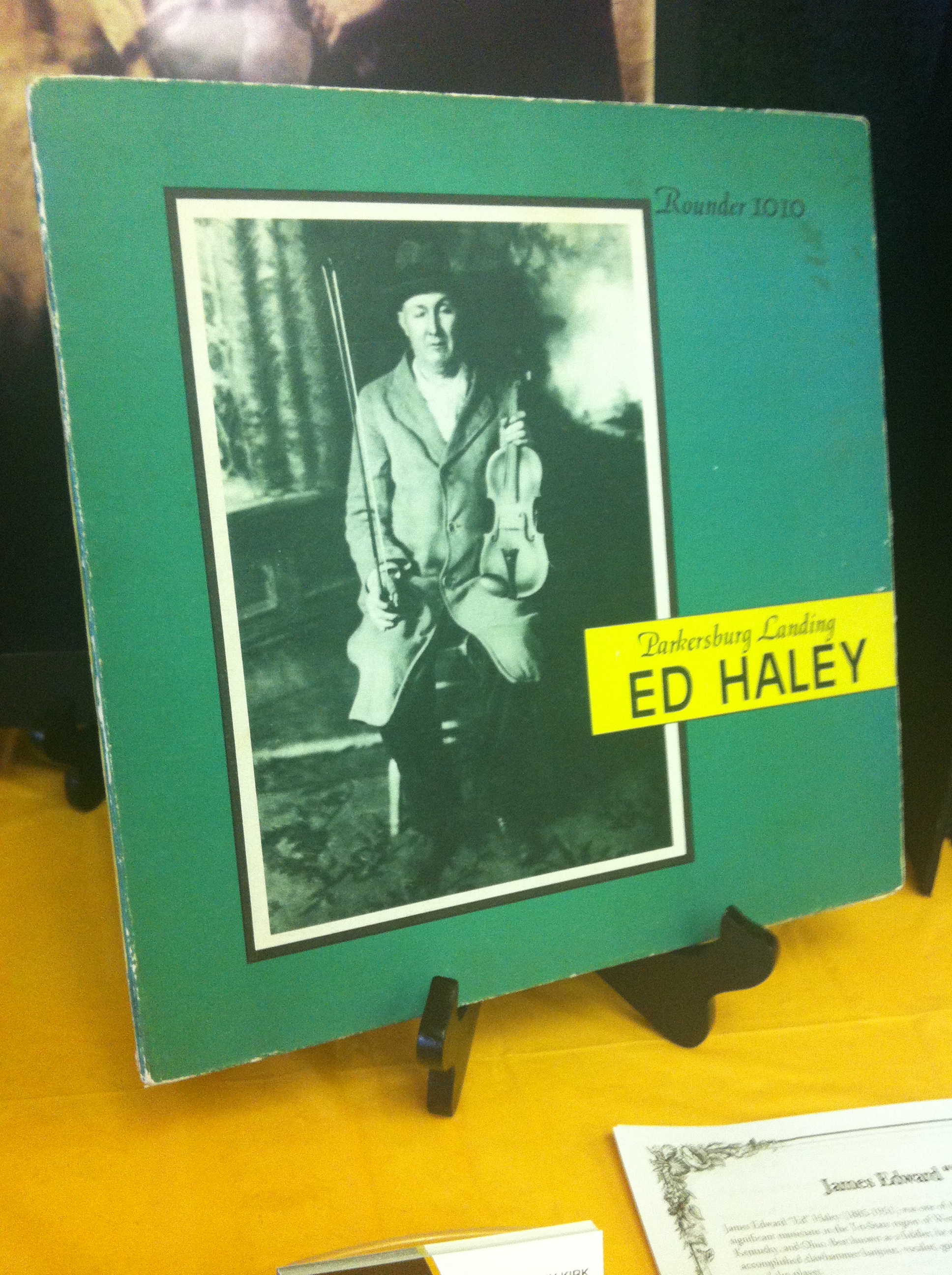
In Search of Ed Haley 5

25 Sunday Nov 2012

Posted by Brandon Ray Kirk in Ed Haley, Logan

≈ 2 Comments

Tags

accordion, Alan Jabbour, American Folklife Center, Appalachia, Ashland, Blackberry Blossom, blind, books, Charles Wolfe, Charleston, Clark Kessinger, Dick Burnett, Ed Haley, Ella Haley, fiddler, Fire on the Mountain, Forks of Sandy, Great Depression, guitar, Gus Meade, history, John Hartford, Kentucky, Ladies on the Steamboat, Lawrence Haley, Leonard Rutherford, Library of Congress, Logan, Man of Constant Sorrow, mandolin, Mark Wilson, Money Musk, Monticello, Murfreesboro, music, Nashville, National Fiddlers Association, Ohio, Parkersburg Landing, Ralph Haley, Rounder Records, Salt River, Tennessee, Tommy Magness, Washington DC, West Virginia, writers, writing

In the early days of my interest in Ed Haley, I did locate one enthusiast of his music. Dr. Charles Wolfe, a foremost country music historian at Murfreesboro, Tennessee regarded Haley as “a misty legend – perhaps the most influential of all the early eastern Kentucky traditional fiddlers…whose contributions [to country music has] been little known or appreciated.” Of the Haley recordings he had written: “The quality of the fiddling comes through even on these scratchy home recordings, and makes us wonder what this man might have sounded like in his twenties or thirties.”

Dr. Wolfe said Clark Kessinger, the famous fiddler from Charleston, West Virginia was a huge fan of Haley’s music. “Ed Haley, an old blind fellow, he was from over around Logan, close to the Kentucky-West Virginia line,” Kessinger said in an interview several years before his 1975 death. “Yeah, he was a great fiddler…he was a smooth fiddler. Oh, that Haley I thought was the best. Him and Tommy Magness used to play around Nashville, Grand Ole Opry.” There was a reference on Parkersburg Landing to Haley liking Kessinger’s fiddling, although he “once complained that Kessinger always shied away from playing in front of him.”

Clark Kessinger, born in 1896, was only slightly younger than Haley. He took up the fiddle at the age of five and was playing for dances when he was ten. By the twenties, he was a local radio star and recording artist. His career fizzled during the Great Depression, although the National Fiddlers Association declared him as the “fiddling champion of the East” in 1936. All of these accolades were in sharp contrast to Haley, who refused to make a commercial record for fear of having his music “stolen” and who sometimes shied away from contests because they were often rigged.

“Ed was always afraid the companies would take advantage of a blind man,” Parkersburg Landing claimed. “This suspicion also kept him from the folklorists recording in Ashland.”

In time, Kessinger was rediscovered. During the folk music revival of the sixties and seventies, he made appearances on the Today show, at the White House and even at the Grand Ole Opry.

Dr. Wolfe also mentioned Dick Burnett, the blind minstrel of Monticello, Kentucky. Burnett traveled extensively through the South with Leonard Rutherford during the early decades of the twentieth century. Haley played Burnett’s “Man of Constant Sorrow”, while Burnett credited him as his source for “Ladies on the Steamboat” and “Blackberry Blossom”.

“Ed Haley was the first man to play that in the State of Kentucky that I know of,” Burnett said, referencing the latter tune. “He was a blind fiddler in Ashland, Kentucky. I played in Ashland different times. He’d go down every day to meet the crowds comin’ in at the river. He was a good fiddler. He played that, and Bob Johnson of Paintsville, Kentucky, he learned it. I never heard any words to it. It’s just an old time hillbilly piece.”

Dr. Wolfe told me about Mark Wilson and Gus Meade, the two scholars who had produced Parkersburg Landing in the mid-seventies. He said they first heard about Haley from older fiddlers in the Tri-State region of West Virginia, Kentucky and Ohio. Inspired by stories of his greatness, they located Haley’s son Lawrence in Ashland, Kentucky. Lawrence Haley had most of his father’s home recordings and he agreed to allow the Library of Congress to copy them. This led to the release of Parkersburg Landing in 1976 by Rounder Records. Since then, Lawrence had made it clear that he wanted to keep his father’s records only in the family. Dr. Wolfe suggested I contact him for more information on Haley’s life and music.

The next time I was in Washington, DC, I visited Gus Meade at his home near Alexandria, Virginia. Gus had spent years of his spare time at the Library of Congress making lists of fiddle tunes, fiddlers, and old-time recordings, scanning newspapers, documenting fiddlers’ contests, studying the evolution of tunes, and going on expeditions with fiddle-buffs John Harrod and Mark Wilson. I spent much of my visit looking through various manifestations of his research, most of which was congested in the basement of his home. He had more copies of Haley’s recordings than what was used on Parkersburg Landing, which he agreed to share with me so long as I didn’t tell anyone about it.

I next went to the Library of Congress to access its complete archive of Haley’s home recordings. I initially spoke with Alan Jabbour, head of the American Folklife Center. Alan had supervised the original copying of the records with Lawrence Haley. Within a few minutes, I was given a mimeographed list of Haley’s recordings, which included the following introductory notes:

Three 10″ reels of tape double-track at 7.5 ips.  Copy of 54 original discs of Ed Haley, fiddle and vocal, Mrs. Haley, mandolin, accordion, and vocal, and their son Ralph Haley, guitar. Recorded April and September 1946 and (probably) other occasions by Ralph Haley. Lent for duplication by Lawrence Haley (son of Mr. and Mrs. Ed Haley), May 23-25, 1973. An interview of Lawrence Haley by Alan Jabbour (May 25, 1973) concludes the B-side of tape 3. The interview concentrates on the musical life of his parents, who were traveling professional musicians throughout eastern Kentucky and southern and central West Virginia during the first half of the 20th century. They were both blind and relied upon music for their livelihood.

     Just before giving me access to the recordings, Alan warned me of their poor sound quality. He said the Library had secured the best copies possible by playing them on a special turntable with weighted tone arms and hi-tech filters and equalization but had been unable to overcome their general overuse and fragility.

A few minutes later, I was lightly searched – no recording equipment was allowed – and placed in a booth with a volume knob, where I communicated with an engineer on the other side of a wall by use of a talkback switch. Referencing the mimeographed list, I called out the names of Ed’s tunes one by one: “Forks of Sandy”, “Money Musk”, “Salt River”, “Fire on the Mountain”… As they played back to me, it seemed like they were coming through the radio on a distant station during a rainstorm.

In Search of Ed Haley 1

24 Saturday Nov 2012

Posted by Brandon Ray Kirk in Ed Haley, John Hartford, Music

≈ 2 Comments

Tags

Alan Jabbour, Appalachia, Ashland, Bill Monroe, blind, Boulder, Cherokee Polka, Cherry River Rag, Colorado, Dunbar, Ed Haley, fiddler, fiddling, Flatt and Scruggs, Flower of the Morning, Forked Deer, history, Humphrey's Jig, John Hartford, Kentucky, Lawrence Haley, Library of Congress, Man of Constant Sorrow, music, Nashville, Parkersburg Landing, Ralph Haley, Signal Corps, Skillet Lickers, West Virginia

In 1981, roughly thirty years after Ed Haley’s death, my search to know everything about his life and music began at a second hand music store in Boulder, Colorado. While thumbing through a box of records by early radio stars and bluegrass artists with such familiar names as The Skillet Lickers, Bill Monroe and Flatt & Scruggs I saw this certain green and yellow album cover. On its front was a picture of a blind fiddler buttoned up in an overcoat. On its back was a drawing of a steamboat landed at a wharf. Nearby the drawing was a brief note: “This album consists of home recordings made in 1946 by Ed Haley, a blind Kentucky fiddler who never made a commercial record. The original discs were prepared by his family in order to preserve some of their father’s music and were never intended for public use.”

The album was titled Parkersburg Landing, an apparent geographical reference to the small city by that name on the Ohio River. “Even twenty-five years after his death, anyone researching fiddle music in West Virginia or eastern Kentucky is certain to learn of Ed Haley,” the album cover proclaimed. I had never heard of anyone named Ed Haley, but I bought the album and mailed it home to Nashville anyway. I knew that part of the country was a traditional hotbed of great musicians.

Some time later (I forget exactly when – it’s difficult to recall now), I rediscovered Parkersburg Landing filed away on one of the crowded shelves in my office. I put it on the record player and as soon as the title track started, I thought, “Uh oh. This is pretty good.” I turned up the volume knob and slumped down in my chair. I sat there stunned for the next twenty or so minutes listening to Haley plow through tunes with names like “Humphrey’s Jig”, “Cherokee Polka” and “Cherry River Rag”. By the time I reached out to flip the album to Side 2, my fingers were trembling and I was almost breathless. I tried to focus on every nuance as Haley played “Flower of the Morning”, “Man of Constant Sorrow” and “Dunbar”. Then, when he took off on “Forked Deer”, I almost fell out of my chair. It was a profound experience…the kind that pulls you away from everything you’ve done up to that moment and sends you off into another direction. I don’t even remember listening to the rest of the album, although I’m sure I did.

Where did these recordings come from?

“The present recordings were made by Ralph Haley, who also plays guitar on several selections,” I read in the album liner notes. “Ralph had served in the Signal Corps during the war and used a home disc-cutting machine of the Wilcox-Gay type. After Ralph’s death in the late forties, the collection of discs were evenly divided among the five remaining children. It is estimated that the 106 sides presently accounted for represent approximately one third of the original total. Most of these records were preserved by Lawrence Haley of Ashland, who kindly gave us permission to issue them here. The discs were transferred at the Library of Congress under the supervision of Larry Haley and Alan Jabbour and were remastered at Intermedia Studios in Boston.”

I spent the next several years glued to Parkersburg Landing. I talked about Haley constantly. Every now and then I would call up friends and play some of the album, saying, “Now, that’s how it’s supposed to go.” No one had a clue who Ed Haley was; most seemed unimpressed. But to me, the scratchy recordings were like old faded photographs and I was so excited by what I heard that the imperfections in recording technique quickly disappeared to my ear.

Feud Poll 1

If you had lived in the Harts Creek community during the 1880s, to which faction of feudists might you have given your loyalty?

Categories

  • Adkins Mill
  • African American History
  • American Revolutionary War
  • Ashland
  • Atenville
  • Banco
  • Barboursville
  • Battle of Blair Mountain
  • Beech Creek
  • Big Creek
  • Big Harts Creek
  • Big Sandy Valley
  • Big Ugly Creek
  • Boone County
  • Breeden
  • Calhoun County
  • Cemeteries
  • Chapmanville
  • Civil War
  • Clay County
  • Clothier
  • Coal
  • Cove Gap
  • Crawley Creek
  • Culture of Honor
  • Dingess
  • Dollie
  • Dunlow
  • East Lynn
  • Ed Haley
  • Eden Park
  • Enslow
  • Estep
  • Ethel
  • Ferrellsburg
  • Fourteen
  • French-Eversole Feud
  • Gilbert
  • Giles County
  • Gill
  • Green Shoal
  • Guyandotte River
  • Halcyon
  • Hamlin
  • Harts
  • Hatfield-McCoy Feud
  • Holden
  • Hungarian-American History
  • Huntington
  • Inez
  • Irish-Americans
  • Italian American History
  • Jamboree
  • Jewish History
  • John Hartford
  • Kermit
  • Kiahsville
  • Kitchen
  • Leet
  • Lincoln County Feud
  • Little Harts Creek
  • Logan
  • Man
  • Matewan
  • Meador
  • Midkiff
  • Monroe County
  • Montgomery County
  • Music
  • Native American History
  • Peach Creek
  • Pearl Adkins Diary
  • Pecks Mill
  • Peter Creek
  • Pikeville
  • Pilgrim
  • Poetry
  • Queens Ridge
  • Ranger
  • Rector
  • Roane County
  • Rowan County Feud
  • Salt Rock
  • Sand Creek
  • Shively
  • Spears
  • Sports
  • Spottswood
  • Spurlockville
  • Stiltner
  • Stone Branch
  • Tazewell County
  • Timber
  • Tom Dula
  • Toney
  • Turner-Howard Feud
  • Twelve Pole Creek
  • Uncategorized
  • Warren
  • Wayne
  • West Hamlin
  • Wewanta
  • Wharncliffe
  • Whirlwind
  • Williamson
  • Women's History
  • World War I
  • Wyoming County
  • Yantus

Feud Poll 2

Do you think Milt Haley and Green McCoy committed the ambush on Al and Hollene Brumfield in 1889?

Blogroll

  • Ancestry.com
  • Ashland (KY) Daily Independent News Article
  • Author FB page
  • Beckley (WV) Register-Herald News Article
  • Big Sandy News (KY) News Article
  • Blood in West Virginia FB
  • Blood in West Virginia order
  • Chapters TV Program
  • Facebook
  • Ghosts of Guyan
  • Herald-Dispatch News Article 1
  • Herald-Dispatch News Article 2
  • In Search of Ed Haley
  • Instagram
  • Lincoln (WV) Journal News Article
  • Lincoln (WV) Journal Thumbs Up
  • Lincoln County
  • Lincoln County Feud
  • Lincoln County Feud Lecture
  • LinkedIn
  • Logan (WV) Banner News Article
  • Lunch With Books
  • Our Overmountain Men: The Revolutionary War in Western Virginia (1775-1783)
  • Pinterest
  • Scarborough Society's Art and Lecture Series
  • Smithsonian Article
  • Spirit of Jefferson News Article
  • The Friendly Neighbor Radio Show 1
  • The Friendly Neighbor Radio Show 2
  • The Friendly Neighbor Radio Show 3
  • The Friendly Neighbor Radio Show 4
  • The New Yorker
  • The State Journal's 55 Good Things About WV
  • tumblr.
  • Twitter
  • Website
  • Weirton (WV) Daily Times Article
  • Wheeling (WV) Intelligencer News Article 1
  • Wheeling (WV) Intelligencer News Article 2
  • WOWK TV
  • Writers Can Read Open Mic Night

Feud Poll 3

Who do you think organized the ambush of Al and Hollene Brumfield in 1889?

Recent Posts

  • Logan County Jail in Logan, WV
  • Absentee Landowners of Magnolia District (1890, 1892, 1894)
  • Charles Spurlock Survey at Fourteen Mile Creek, Lincoln County, WV (1815)

Ed Haley Poll 1

What do you think caused Ed Haley to lose his sight when he was three years old?

Top Posts & Pages

  • Baisden Family Troubles
  • Winchester Advertisement (1914)
  • Stephen Hart: Origins of Harts Creek (1896/1937)
  • President Harding's Proclamation Relating to Blair Mountain (1921)
  • Cotton Production in Antebellum Pike County, KY

Copyright

© Brandon Ray Kirk and brandonraykirk.wordpress.com, 1987-2023. Unauthorized use and/or duplication of this material without express and written permission from this blog’s author and/or owner is strictly prohibited. Excerpts and links may be used, provided that full and clear credit is given to Brandon Ray Kirk and brandonraykirk.wordpress.com with appropriate and specific direction to the original content.

Archives

  • February 2025
  • January 2025
  • October 2023
  • September 2023
  • December 2022
  • November 2022
  • May 2022
  • April 2022
  • February 2022
  • November 2021
  • October 2021
  • September 2021
  • June 2021
  • May 2021
  • April 2021
  • March 2021
  • February 2021
  • January 2021
  • December 2020
  • November 2020
  • October 2020
  • July 2020
  • June 2020
  • May 2020
  • April 2020
  • March 2020
  • February 2020
  • January 2020
  • December 2019
  • November 2019
  • October 2019
  • September 2019
  • August 2019
  • July 2019
  • June 2019
  • May 2019
  • April 2019
  • March 2019
  • February 2019
  • January 2019
  • December 2018
  • November 2018
  • October 2018
  • September 2018
  • August 2018
  • July 2018
  • June 2018
  • May 2018
  • April 2018
  • March 2018
  • February 2018
  • January 2018
  • December 2017
  • November 2017
  • October 2017
  • September 2017
  • August 2017
  • July 2017
  • June 2017
  • May 2017
  • April 2017
  • March 2017
  • February 2017
  • January 2017
  • December 2016
  • November 2016
  • October 2016
  • September 2016
  • August 2016
  • July 2016
  • June 2016
  • May 2016
  • April 2016
  • March 2016
  • February 2016
  • January 2016
  • December 2015
  • November 2015
  • October 2015
  • September 2015
  • August 2015
  • July 2015
  • June 2015
  • May 2015
  • April 2015
  • March 2015
  • February 2015
  • January 2015
  • December 2014
  • October 2014
  • September 2014
  • August 2014
  • July 2014
  • June 2014
  • May 2014
  • April 2014
  • March 2014
  • February 2014
  • January 2014
  • December 2013
  • November 2013
  • October 2013
  • September 2013
  • August 2013
  • July 2013
  • June 2013
  • May 2013
  • April 2013
  • March 2013
  • February 2013
  • January 2013
  • December 2012
  • November 2012

Enter your email address to follow this blog and receive notifications of new posts by email.

Join 2,925 other subscribers

Tags

Appalachia Ashland Big Creek Big Ugly Creek Blood in West Virginia Brandon Kirk Cabell County cemeteries Chapmanville Charleston civil war coal Confederate Army crime culture Ed Haley Ella Haley Ferrellsburg feud fiddler fiddling genealogy Green McCoy Guyandotte River Harts Harts Creek Hatfield-McCoy Feud history Huntington John Hartford Kentucky Lawrence Haley life Lincoln County Lincoln County Feud Logan Logan Banner Logan County Milt Haley Mingo County music Ohio photos timbering U.S. South Virginia Wayne County West Virginia Whirlwind writing

Blogs I Follow

  • OtterTales
  • Our Appalachia: A Blog Created by Students of Brandon Kirk
  • Piedmont Trails
  • Truman Capote
  • Appalachian Diaspora

BLOOD IN WEST VIRGINIA is now available for order at Amazon!

Blog at WordPress.com.

OtterTales

Writings from my travels and experiences. High and fine literature is wine, and mine is only water; but everybody likes water. Mark Twain

Our Appalachia: A Blog Created by Students of Brandon Kirk

This site is dedicated to the collection, preservation, and promotion of history and culture in Appalachia.

Piedmont Trails

Genealogy and History in North Carolina and Beyond

Truman Capote

A site about one of the most beautiful, interesting, tallented, outrageous and colorful personalities of the 20th Century

Appalachian Diaspora

  • Subscribe Subscribed
    • Brandon Ray Kirk
    • Join 787 other subscribers
    • Already have a WordPress.com account? Log in now.
    • Brandon Ray Kirk
    • Subscribe Subscribed
    • Sign up
    • Log in
    • Report this content
    • View site in Reader
    • Manage subscriptions
    • Collapse this bar
 

Loading Comments...