• About

Brandon Ray Kirk

~ This site is dedicated to the collection, preservation, and promotion of history and culture in my section of Appalachia.

Brandon Ray Kirk

Tag Archives: music

In Search of Ed Haley 161

28 Wednesday Aug 2013

Posted by Brandon Ray Kirk in Ed Haley

≈ 2 Comments

Tags

Ashland, Calhoun County, Ed Haley, Ella Haley, history, John Hartford, Kentucky, Laury Hicks, Manuel Martin, music, Ugee Postalwait, West Virginia, writing

After hanging up with Pat, I called Ugee Postalwait — Laury Hicks’ daughter in Akron, Ohio — to tell her about getting the picture of Ed from Maxine McClain. Ugee was full of energy. Her memory was obviously working in overdrive.

“I used to know all of them,” she said of the old musicians in her part of the country. “They was all to our house. They’d come from miles around to hear Dad play, especially when Ed was in the country. Maybe they’d stay two or three days at our house. I’d get up of a morning to look see who was in the house asleep and who all I was gonna have to cook breakfast for, when I was a girl growing up. The young men would sleep in the boys’ room and they’d sleep in the floor. Then they’d sleep four crossways in the bed, too. As I get old, I get to thinking about all of them and wonder how in the world my dad ever fed them all. I been a cooking ever since I was nine years old for workhands and people like that. One morning — I never will forget I wasn’t very old, then — got up and got breakfast. We’d had cabbage the day before for supper. A big pot of cabbage. And Ed and Ella was there. I never put cabbage on the table for breakfast. Ed looked at me and he said, ‘Ugee, what did you do with that cabbage last night?’ I said, ‘It’s in there.’ ‘Well why didn’t you put it on the table for breakfast?’ I said, ‘Well who eats cabbage for breakfast?’ He said, ‘I do.’ Now I never seen anyone eat such a mess of cabbage for breakfast. Him and Ella did. Ella said, ‘Oh, we always eat the same thing we had for supper.’ I never will forget that. From that time on, whatever was left over from supper, I’d warm it up, you know, and fix it for their breakfast ’cause they would eat it. They liked cabbage or kraut.”

Ugee really laughed telling about that, then started in with another tale.

“One time they was some Baileys there and I believe they was some of them McClain boys, and I was peeling tomatoes for supper — you know, slicing them and putting them on the plate — and I had a plate on one end [of the table] and one on the other end. And Manuel Martin was there too, and Commodore Cole. And I looked in both places and them tomatoes was gone. ‘What in the world? Some of them’s come in and hid my tomatoes.’ I looked out and Ed was standing there sitting on the walk — I never will forget — a laughing, and he said, ‘Wait till she finds out.’ I said, ‘Ed did you get them tomatoes in there?’ He said, ‘We ate every one of them.’ I said, ‘If I could find the plate, I’d break it over your head.’ That Commodore Cole, he said, ‘You wouldn’t dare do that.’ Ed said, ‘Don’t dare her too much, Commodore. I know her.’ And they was a eating them tomatoes as fast as I was a peeling them. Them ornery birds, I never will forget that.”

“The last time I ever seen Ed was at his house,” Ugee said. “He looked at me and he said, ‘Ugee, can you still make a rhubarb pie?’ I said, ‘Why lord yes, I reckon I can. Why?’ He said, ‘Well, I want a rhubarb pie.’ And I made four and I never seen no such eating as he done that evening, him and Ella, on them rhubarb pies while they was hot — with milk cream over them. I can see them yet. I went down to Ashland, Kentucky. They lived on 45th Street.”

In Search of Ed Haley 159

26 Monday Aug 2013

Posted by Brandon Ray Kirk in Ed Haley

≈ Leave a comment

Tags

Appalachia, blind, Ed Haley, feud, fiddling, history, Kentucky, Lawrence Haley, Milt Haley, Mona Haley, music, U.S. South, writing

In one of those “passing the torch moments,” Lawrence reached the telephone to his sister, Mona. I told her about Milt Haley being a fiddler, and she said, “Really? Well we didn’t never know that.”

I figured that Ed had kept all of the details about Milt hidden from his kids, but Mona said, “Well, he talked about it some, because I wouldn’t know what I know about it if he hadn’t. You did find out what I told you was true, didn’t you? It wasn’t my dad’s mother that was killed, the way I heard it. It was one of the Hatfield women. Got half her face shot away and it killed her. That’s why they retaliated against Green McCoy and my grandfather. That’s only hearsay, but it had to come from Pop. I do remember him saying that.”

Pat seemed pleased that Mona was visiting Lawrence.

“He asks for her a lot,” she said.

I wanted to know more about Lawrence’s condition.

“He sits with his eyes closed and he found a pair of sunglasses that look exactly like the ones his daddy wore,” Pat said. “These are a pair that one of the kids bought. They were laying on the dining room table and he picked them up and said, ‘There’s my glasses.’ He insists on wearing them and you would think it was Ed Haley back many years ago. He talks about horse and buggies a lot. He sits with your book constantly. He does not like to look at the picture of his mother’s tombstone. What keeps you in his mind a lot, he listens to the tapes and he knows he gave you the records. Beverly was here this past weekend. He knew who she was but he was still talking in riddles. But today he’s pretty much himself. He got up and got dressed about 5:30 and he’s been roaming ever since.”

In Search of Ed Haley 158

25 Sunday Aug 2013

Posted by Brandon Ray Kirk in Ed Haley

≈ Leave a comment

Tags

Appalachia, Ed Haley, Ella Haley, fiddling, history, Lawrence Haley, Mona Haley, music, writing

I called Lawrence and Pat to tell them about this new discovery. Pat put me on the telephone with Lawrence, who seemed to be doing better. I asked him why he thought none of the Haley kids ever learned the fiddle.

“I think Pop took interest in us as far as he knew how to take interest in us,” he said. “Whatever he could’ve taught us he most certainly would have. But we’d ruther be out running in the woods than sitting at a table trying to learn ‘Forks of Sandy’ or something like that. He would ruther teach it to the ones who could and who showed interest in it, and let it go at that. Pop never did try to get me to learn the fiddle because I was left-handed. I guess he figured that would be too much of a challenge for him even, to try to teach violin to a left-handed violin player.”

I told Lawrence he knew more about the fiddle than a lot of professional musicians and he said, “Well, I guess I learned just about as much of it as he did. I appreciate any good words that can be said about me and the violin. My sister’s here and if you could get her interested, she might be able to tell you as much about it as I can. She took more interest in the music of our mother, I know that. But she could pick up the fiddle and play the fiddle and play the mandolin and the piano and other instruments.”

Lawrence said, “Now if you want to talk to my sister a minute, maybe she can tell you something. If she can’t, I don’t know who else to tell you. She could probably tell you as much about it as any of us.”

John Hartford’s banjo

24 Saturday Aug 2013

Posted by Brandon Ray Kirk in John Hartford, Music

≈ Leave a comment

Tags

Appalachia, banjo, bluegrass, culture, history, John Hartford, life, Museum of Appalachia, music, Norris, photos, Tennessee

John Hartford banjo, Museum of Appalachia, Norris, TN. 15 May 2012

John Hartford banjo, Museum of Appalachia, Norris, TN. 15 May 2012

In Search of Ed Haley 154

20 Tuesday Aug 2013

Posted by Brandon Ray Kirk in Ed Haley

≈ Leave a comment

Tags

Bruce Nemerov, Clyde Haley, Ed Haley, fiddling, history, Jack Haley, John Hartford, Kentucky, Lawrence Haley, Mona Haley, music, Noah Haley, writing

Not long after my call to Wilson, I received word from Bruce Nemerov that he’d finished dubbing about a third of Haley’s recordings. He sent me cassette copies, along with an audio log (which gave detailed information about the records). I listened extra close to the Nemerov copies and noticed how Ed’s playing gave the impression of being very notey, as I had originally interpreted it. This was, I determined, somewhat of an illusion.

“I don’t think your dad played as many notes as he sounds like he’s playing,” I said to Lawrence by telephone. “It sounds to me like he’s putting so much into some of those notes that they sound like they’re more than one note.”

Lawrence said, “He might be doing that, I really don’t know. The only thing I’ll go on is what it sounds to me like. I’ve seen and heard some fiddlers that it just seems like they draw a bow completely just to get one little note. Pop could get a dozen or two out of a draw of the bow. It seemed to me like that his fingers was all the time moving. He was probably touching the strings so lightly a lot of people might not have even heard some of the notes. That’s just my speculation. Pop knew how to use that bow to get force whenever he needed it and when to let up on it and to let a general sweet note come through.”

Lawrence continued, “I guess that’s what helped him in his technique that nobody else seemed to a been able to master. They might have been seeing him make the notes, but how he was pressuring the bow they might not have paid that much attention. You would have to have, I guess, a camera of some sort on it so you could go back and study what was done. You’d hear a note then you’d watch the finger and then you’d go back and hear the note and watch the bow. Maybe the little change in the muscles in his fingers or hand or wrist or something. You’d have to watch all of that and just keep going back and just keep going over it and going over it. But he got them in there, I know that. All of them wasn’t exactly crisp and clear. You could probably hear it in some of the records. I wish you’d been able to have met my dad. I think he’d a liked you and I think he’d a taught you all he could — all you was capable of or all he was capable of teaching you anyway.”

Lawrence said, “I don’t know how many fiddlers that I wouldn’t even have an idea of their names that used to come around to watch Pop play. They wasn’t there all the time, I don’t think, for the entertainment. They was there to learn some of the stuff, too. We used to go out on Route 5 about eight or ten miles. They was an old man out there that played and he said, ‘Ed, come see me whenever you can.’ He had a boy that had polio or something — had a short leg. It was a typical Kentucky hillside home. It had a big banistered front porch. And we used to go out there and maybe spend the weekend with these people. They’d just sit out there and play on the front porch. I can’t remember their name. I remember seeing the boy — he was quite a bit older than me at the time. He was almost a full-grown man. He’d walk with his hand on his knee a lot to keep that leg from giving way. That’s about all I can remember. Course I was probably eating better than I was if I had been home. People out in the country like that have usually got a cow and a good garden or good canned stuff anyway. These people were good people. They liked my dad, too.”

I asked Lawrence how things were going in his family and he seemed a little down about Mona and Noah.

“Mona passes our house just about every day — at the foot of the hill down here — and won’t even stop by,” he said. “Noah, whenever he’s in town, he’ll usually stop by. He’s back in Cleveland and got him an apartment and he likes it back up there. See, Noah gets in trouble every now and then; he has to move. I think he gets in gambling debts. He got down in Newport one year — it might have been eight or ten years after he got married — and got down there on a three or four day drinking and gambling spree and they liked to beat him to death down there, I think, ’cause he couldn’t come up with his tab on his gambling. So I think he gets in that condition every now and then and he has to take off somewhere else.”

I asked if Mona was a gambler and Lawrence said, “Now Mona, she goes over in Catlettsburg and she plays Soda Rum or something like that and gambles on that. I quit gambling of all sorts before I was married. Whenever Noah and Clyde and Jack would come around and want to play nickel-and-dime poker, I’d say, ‘Well, Pat will give you a blanket. You guys go right on outside, spread it out on the lawn, and play your nickel-and-dime poker out there.’ I wouldn’t let them play it in the house.”

A few days after speaking with Lawrence, I received word from Pat that he’d suffered a massive heart attack. It came as quite a shock, even though his health had been failing since my last trip to Ashland. Pat said the doctors didn’t give him long to live.

In Search of Ed Haley 153

19 Monday Aug 2013

Posted by Brandon Ray Kirk in Ed Haley

≈ 1 Comment

Tags

Appalachia, Doc Holbrook, Ed Haley, fiddler, fiddling, history, John Hartford, Laury Hicks, music, West Virginia, Wilson Douglas, writing

I called Wilson Douglas a few weeks later, still blown away by Ed’s incredibly fast fiddling on the Holbrook recordings. I raved about it to Wilson — how it was like a “rush of music” — who showed no surprise that he fiddled with so much of what he called “drive.”

“Now, they’s another tune I thought about that Haley played, he called it ‘Dance Around Molly’,” he said. “My god, Haley could play that. It’s a real good tune. Got a lot of drive about it. ‘They’s so many tunes,’ Ed said, ‘a man can’t learn them all, but I guess he can keep trying.'”

I played Ed’s recording of “Fifteen Days in Georgia” for Wilson and asked him if he played that fast at Laury Hicks’ house.

“About the same, John,” he said. “He was a great hand to play a tune in whatever time it was pitched in. He didn’t overplay his notes. And he played the solid driving note. He didn’t skip over it like skipping over with a motor boat.”

Wilson said one of the tunes that Ed played at Laury Hicks’ grave was “Arkansas Traveler”.

In Search of Ed Haley 152

17 Saturday Aug 2013

Posted by Brandon Ray Kirk in Ed Haley

≈ Leave a comment

Tags

Ashland, banjo, Brown Mule, Ed Haley, Ed Morrison, Ella Haley, fiddling, history, John Hartford, Kentucky, Lawrence Haley, music, writing

I asked Lawrence about Ed’s friends — if he remembered any of the fiddlers who came to see his father.

“I may have met a bunch of them and seen more than what you’ve got named, but as far as knowing them by name I wouldn’t know them by name,” he said. “And I probably wouldn’t recognize 90-percent of them by sight, either. Well Ed Morrison, I know Pop knew him. I didn’t know he was a fiddler, though. I just knew he was somebody that’d come around Pop every now and then. It slowed down quite a bit in my teenage years when we moved down close to town. Now, I don’t know if that was because of his heart condition or what John, I really don’t know. I think Pop had got a little bit grouchy about some things. If it was somebody he appreciated and liked he might play with them, but a lot of times, ‘I just don’t feel like it.’ If they come, they come to get him to get him to go somewhere. It might be 50 miles away or it might be two houses away. That was usually the way it was.”

I wondered if there was a big difference in Ed’s fiddling as he got older.

“Well, not really too much in his fiddling,” Lawrence said. “You know he’d just get tired. He wouldn’t play quite as much a lot of times. I know the last time we took him anywhere my brother Noah wanted him to play for one of his friend’s wedding. I think it was just get-together afterwards — sort of like a reception — only these kids just had a bunch of friends and some beer and stuff. And Pop sat there and he played and played and played and finally — they was giving him beer, I think — and it must’ve worked on him and he just fell over asleep, almost in a semi-doze. You could talk to him and he’d answer you, but he couldn’t hold a bow up any longer. He just more or less sat there in a sleepy daze. And me and my wife took him home, and that was it. He’d play some, but he wouldn’t play much for anybody after that.”

I asked Lawrence if Ed ever just sat around the house and played by himself and he said, “Well, I’ve seen him do that. He’d sit out on the front porch… There at 17th Street, we had a great wide banister and he’d sit up on that banister and play. It was pretty wide. He’d sit on that banister where he could spit out off a the porch and chew his tobacco and play for his own satisfaction. He might’ve been listening to something on the radio and come out and try it a few times and maybe play something he thought he might’ve got rusty on or some of his own music that he thought he needed to practice up on. I’ve seen him do that maybe for two or three hours at a time. The last time I reckon I seen him out like that, he was playing the banjo, though. He wasn’t playing the fiddle.”

Lawrence reminded me that his father liked to chew tobacco.

“He usually carried a can around the house like a brown coffee can as a spittoon,” he said. “He’d go out to farmers he knew and get him a few leaves of tobacco and make him a few twists, you know. It was twisted up like a double roll and he’d cut him off a piece of that and it just dry as a bone and stick that in his jaw. He always carried a little plug of Brown Mule or something like that to kinda take the dryness out of that twist or put a little sweetening in it or something. He would cut him off a little bit of sweetener and use that dry twist he’d twisted up hisself. In fact, he had a little chest he kept most of his tobacco products in. He might have 50 or 75 twists of tobacco and, you know, other products of tobacco. He smoked a pipe too, so he would have crumbled tobacco in cans and things. And he would put slices of apple — certain types of apple — in with it to kinda flavor it and things, and he kept it all in this one chest he had.”

Wow — I’d never heard or thought about Ed having a chest (or really anything else) before. I asked Lawrence if Ed had many possessions and he said, “Not a great deal, John. Just his clothes and just his violin and just his dinner table and I guess a bed to sleep in. What really would a blind man want other than that? Pop carried a good sharp knife. Did his own honing of his knife and things like that. He would whet it on a concrete banister if he couldn’t find a regular rock. He might’ve had a rock in that chest, I don’t know.”

Back to Ed’s chest — how big was it?

“Ah, it was about the size of an Army footlocker,” Lawrence said. “Just a little bit smaller than that, only it was just made out of wood. It wasn’t made out of plywood. It was made out of tongue-and-groove board. It’s long gone.”

I asked Lawrence how many fiddles his father owned in his life and he said, “I really don’t know. I imagine he had four or five dozen somebody had give him, or he’d bought or ordered. The fancy fiddles with all the inlay and all that stuff, I don’t think he’d a cared for that at all. It wouldn’t a made a bit of sense to him to have that. If he could just get the mellow sound or the sound that he liked out of it… Now, I don’t know whether it was mellow he liked or what. It was kind of a harsh music he played, I guess. I know he could get mellow music whenever he wanted it and he could make a fiddle slur or do whatever he wanted to with it.”

Lawrence paused and said, “I’m trying to tell you: a lot of stuff I don’t know about my dad. About the only thing that I really know, they was no fiddler around this area that could come any ways close to him that I ever heard. Other than that, he got out amongst his friends I guess and he came home with stories to tell and stuff, and I guess he told Mom if she wanted to hear them and if he didn’t want to tell her anything he didn’t tell her anything. Sometimes he’d come home with money, sometimes he might not come home with any money in his pockets.”

In Search of Ed Haley 151

15 Thursday Aug 2013

Posted by Brandon Ray Kirk in Ed Haley

≈ Leave a comment

Tags

blind, Bruce Nemerov, Cincinnati, Ed Haley, Ella Haley, fiddling, Jack Haley, Kentucky, Kentucky School for the Blind, Lawrence Haley, Minnie Hicks, music, Patsy Haley

A few weeks later, I gave Lawrence another call. I wanted to update him on Bruce Nemerov’s work with Ed’s records. I’d heard some of the cleaned-up tracks and noticed that Ella’s mandolin was extremely loud at times. I asked Lawrence if it was because she was seated closest to the microphone.

“I’m pretty sure my brother did it all on one microphone,” he said. “But I guess it was placement of the microphone. She was just there to keep a good solid beat going. It wasn’t anybody trying to hog the music someway.”

I really bragged on Ed’s “Fifteen Days in Georgia” and “Over the Waves” — two of the “new” tunes from the Holbrook records. I played Ed’s recording of “Over the Waves” for Lawrence; it was an incredible, up-tempo version with Ella seconding him on the mandolin.

“Well you see, the record I’ve got of that tune she was playing the piano, so they had to be in a studio somewhere for that,” he said, after the recording ended.

“It’s amazing how fast he played back then,” I said.

Lawrence agreed, “Yeah, yeah, it sure was. That was a waltz, and you’d have to waltz the hall if you waltzed that one.”

Lawrence stressed that I had “a lifetime of stuff to study in there.”

I asked him if his father ever listened to the home recordings much and he said, “No, I think Mom put them up and left them up until Pop was dead and then she started dividing them out. You know, letting the kids come in and get pieces that they enjoyed. I had 45 or 50 records that I know of. One or two of them kind of got lost. I think I know who lost them for me. That’s the way things go, I guess. You can’t hold onto every little scrap of treasure all the time. It eventually goes. My mom used to have a whole library — I mean it took up quite a bit of space — ’cause these blind books, the letters had to be big enough to finger them, and they was pretty good size books. When I went into the service, they all left, and her mandolin left, and I guess her accordion went up to Aunt Minnie’s and got burnt up, and some of Pop’s stuff left. They just got rid of it, I guess, just stuff that was in the way for my brother Jack and his wife Patsy. Things like the mandolin and his fiddle I woulda kept.”

I got the impression that Lawrence was satisfied that he had told me all he could about his father, and that his father’s music would have to speak for itself. He was more in the mood to talk about his mother.

“I’m not sure, but I think they put her in school when she’s about four,” he said of Ella. “I think she come out of school when she was nineteen or 20 years old. They must’ve kept them segregated or something. You know, she was in with mostly girls. She had quite a few friends she made while she was at school. I guess they was times when she had bad times, too. Missed her family and missed her friends back at Morehead, Kentucky. She was pretty well-educated. She would read old Chaucer’s English. She’d come out with that on us every now and then when she wanted to really stress something to us. To let us know that she didn’t approve of what we was doing. I don’t know, she was just a wonderful woman to me. She’d sit down and read. You know we’d be laying in a bed in a room pitch black and she’d be a reading that story to us. It didn’t take long to put us to sleep like that. She read the whole Robin Hood stories and Jungle Boy. Stories like that she’d read to us. That was all we had for entertainment. It was a different life for the whole Haley bunch I guess from what most people would realize.”

“I know she had a bunch of friends,” Lawrence continued. “They was one — all I knew her name was was Bridget — and she come right out of school and went to a home-type thing that they had in Mt. Healthy, Ohio. Mt. Healthy is just more or less an outlying suburb of Cincinnati. When Mom would be down in Cincinnati visiting her sister or running her newsstand or something, she’d always go to Mt. Healthy to see Bridget. I think we’d ride a trolley bus or something out there. We’d spend the day out there with Bridget. It was a nice home — great big mansion-type home — plenty of grounds and things. And I’d get out in the grounds the biggest part of the time. I’d be out checking things out on the grounds — fishes in the ponds — and I’d check on Mom every now and then and find out when she wanted to leave or something. But we’d spend that day up there just about every time she went up there till I guess Bridget died.”

In Search of Ed Haley

13 Tuesday Aug 2013

Posted by Brandon Ray Kirk in Ed Haley

≈ Leave a comment

Tags

Appalachia, Edden Hammons, fiddler, history, life, music, photos, West Virginia

Edden Hammons, West Virginia fiddler

Edden Hammons (1875-1955), West Virginia fiddler

In Search of Ed Haley 149

12 Monday Aug 2013

Posted by Brandon Ray Kirk in Ed Haley

≈ Leave a comment

Tags

Appalachia, Clay County, Ed Haley, fiddling, history, life, Lindsay Morris, Maxine McClain, music, Ralph Haley, Roane County, West Virginia, writing

During the time I was in touch with Lawrence Haley, I received a letter in the mail from Maxine McClain of Newton, West Virginia.

“When I was 12 yrs. old there was a blind Ed Haley and blind wife Ella, would travel from Ashland, Ky. to our region in Roane Co. and spend a lot of time with my family,” she wrote. “They were wonderful people and we loved them dearly. They had a son Ralph who traveled with them. I am 76 years old now so that has been a long time ago but I remember them very well.”

I gave Maxine a call and she said, “I always loved music and I do still. My daddy, Lindsay Morris, was a musician and he used to travel in Clay County and he fiddled at what they called fiddlers’ contest.”

I asked her if Ed ever played with her father and she said, “Yes, he would play with him there at home. Ed would have me to sit down by him and he’d want to feel my fingers and he always told me I had fiddling fingers, but I don’t believe I did for I never could fiddle very much. They’d stay for days you know and my dad and mom would take them around. Back then, people would gather at the old country store at a place called Elana. People would come for miles to hear them because it was just sort of unusual to have someone that way in the neighborhood. They wasn’t room in the store to dance. I remember Ella singing ‘Are You From Dixie’? We was kinda raised up with music.”

In Search of Ed Haley 148

11 Sunday Aug 2013

Posted by Brandon Ray Kirk in Ed Haley

≈ Leave a comment

Tags

Clay County, Ed Haley, Ella Haley, fiddling, Harts Creek, history, Kentucky School for the Blind, Lawrence Haley, Liza Mullins, Minnie Hicks, music, West Virginia, writing

Ella provided most of the family entertainment.

“Pop never tried to sing any songs to us,” Lawrence said. “Mom sang songs. She had one she called ‘The Coo Coo’s Nest’. A lot of religious songs, little nonsense songs and rhymes, like ‘The Watermelon’. She had a principal, I guess, or the headmaster of the school — Dr. Huntington, or something like that — he’d come into the class and he’d have a reading session with them. Read them a story and he would read all the parts in different voices. And my Mom kinda got to using inflections a lot more than any of us would. Like, she used to read us Robin Hood from her Braille magazine.”

I wondered if Ed ever entertained the kids with stories.

“Ah, maybe a ghost story or two,” Lawrence said. “He’s telling one time about somebody a riding a… I guess it was a story he heard when he was a kid, too. Somebody was coming down Trace Fork from somewhere riding a horse way up above where Aunt Liza and them lived. Said they began to hear this rattling kind of sound, this guy did. And they said he began to speed up his horse a little bit, and this rattling kept getting louder and louder and he’s a going faster and faster. Said all at once this thing jumped right up on the horse behind him and locked its arms up around him and just stayed with him forever it seemed like. And just all at once got off. Pop could tell stories like that, now. Those stories kinda filled our lonely days, too. That was the thing that they did back in them days, I guess, was tell stories, but Aunt Liza never told any stories like that, or Uncle Peter didn’t.”

I asked Lawrence if Ed “worked on” tunes at home and he said, “Well, yeah, he’d kinda play the general outline and then maybe start working on some of the real, I guess, it would be the depth of a piece of music that he wanted to put in there. Depth or body to it. He’d add to it. But mostly he might just hear a piece of music and maybe just hit every fifth or sixth note or something just to get an outline of how he wanted to play it.”

I don’t think Lawrence realized what an important and sophisticated piece of musical insight that was. What he meant by saying that Ed hit “every fifth or six note” was that he was coming down on the big accent notes that made up the “spine” of the tune. I later wondered if Lawrence’s statement was based on observations or genetic memory or both.

I asked him about Ed playing for dances, but he said those memories had left his mind years ago.

“I was walking from Clay over to Clay Junction there that one night and there was nothing but the moon — it was a full moon — but it was a hazy… It had a big ring around the moon. It was the first time I ever noticed that. Now I can’t remember where we came from, but I know that they had their instruments with them. I guess we’s a gonna go back up on Stinson up there to Aunt Minnie’s. I think this was after the time of Laury’s death, so I guess we’s heading back that way. And if we could get to Clay Junction there, we’s supposed to get a ride or something, I think. Like I say, I can’t remember what kind of function we’d come from, and what we did after that. My recollection of that was walking down this highway — a dark night, except for a hazy, ringed moon. Now that hazy ringed moon kept that in my mind all these years. The rest of it I don’t know. So there’s a lot of stuff that you forget and you never remember.”

In Search of Ed Haley 143

16 Tuesday Jul 2013

Posted by Brandon Ray Kirk in Ed Haley

≈ 2 Comments

Tags

Ashland, Bake Lee, blind, Ed Haley, Ella Haley, fiddling, history, John Hartford, Kentucky, Lawrence Haley, Lula Lee, music, writing

After talking with Ugee, I called Lawrence Haley, who’d been “laid up” since my trip to Ashland. He and I talked more about finding the photograph of Ed and Ella getting ready to play music on the street. In no time at all, he was revealing new details about his father’s “street life,” first telling how he’d get a crowd together.

“He might just bow the fiddle a little bit and get a few sweet notes out of it. Stop. And if it looked too dead to him, he’d just get up and leave. ‘There’s no use of staying here.’ Pop wouldn’t play if it wasn’t something that he knew he could make money at. He wouldn’t get out and work for nickel and dime stuff all day long. Maybe ten, twelve cents an hour, just sitting there playing music, and taking requests or something and sitting on the street. But my mother did. She’d get out… I’ve seen her go in times so cold she’d cut the fingers out of gloves so she could play the mandolin, and have a harp and I know that thing’d almost freeze to her lips in weather like that. But Pop, he wouldn’t do that. Of course, I don’t guess a violin player could do too well outside. His fingers’d get stiff as they could be.”

When Ed wasn’t playing on the street in the winter, he would go inside public buildings.

“Well, I’ve seen them inside the courthouse main lobby some,” Lawrence said of his parents. “They played in theaters. Concourses of train stations, and places like that. Anywhere where they’s a lobby big enough to they didn’t interfere… You know, they could get over out of the way of main traffic flow, of pedestrian traffic. Sometimes they’d let them play and sometimes they wouldn’t. He was pretty well known in some places, and they tolerated him — if they didn’t outright appreciate it. They tolerated it anyway, because they knew that that’s how they had to make their living.”

Lawrence gave me more information on Bake and Lula Lee, the “other” blind husband-wife team working on the streets of Ashland.

“Lula Lee was blind and Bake Lee was blind,” he said. “They lived in Catlettsburg, Lula and Bake did, as long as I can remember. They raised two or three kids. Bake Lee was the flower huckster that Pop got accused of being when he died. ‘The Flower Huckster of Winchester Avenue.’ Lula Lee went to school with my mother at the School for the Blind. She played the mandolin and the harp. She had a harmonica rack. My mother played one like that, too. She did a lot of street work like that on her own, too. Pop might be in Logan, she might be in Gallipolis, Ohio, or Ironton or Portsmouth. And Pop might be off somewhere with a bunch of his cronies learning new music up in West Virginia or Kentucky. If the need for money come up, somebody had to bring it in. We didn’t eat quite as good for a day or two or something, but none of us would ever starve.”

In Search of Ed Haley 138

30 Sunday Jun 2013

Posted by Brandon Ray Kirk in Ed Haley

≈ Leave a comment

Tags

Appalachia, Ashland, Bonaparte's Retreat, Ed Haley, fiddler, history, John Hartford, Kentucky, Lawrence Haley, Lost Indian, music, Napoleon Bonaparte, writing

Later that evening, back in Ashland, Lawrence and I talked about Haley’s tunes. Ed told him all about “Bonaparte’s Retreat”.

“When the French first went in, they was pushing the Russians pretty hard,” Lawrence said. “The high string going in. The Russians were retreating. When they got to a certain point, the cannons started booming and the Russians started turning the tide on them. Part of the highs, I guess, was the French Napoleon troops coming out in a hurry and the Russians right behind them and then they’d be a spell of like an old dirge or something, like they was coming out defeated. They was slacking off on ’em and letting them retreat back out of there. They knew they wasn’t gonna make it on account of the weather. Just gonna let them freeze to death. Then they’d boom the cannon and push them a little bit faster. Then the dirge come up again. That’s the way Pop kinda explained it to me. He’d say, ‘Now you listen to these cannons boom. The Russians are getting ready to turn the tide on Napoleon’s troops’.”

Lawrence had no idea where Ed heard that story.

“Same way with ‘Lost Indian’,” he said. “It seemed like, the way he explained it, this old Indian would look at something and see a far off peak that he recognized and he’d be happy and hooping and hollering and trying to get over to it and then whenever he’d get over there he would find out it wasn’t the place he thought it was. And he’d sit down and kind of reminisce, I guess, and feel bad towards his self because he wasn’t where he thought he was at so he could get home. He’d stand up and look around again and maybe see another peak or familiar point as being close to his tribe and he’d go to it with a little bit of enthusiasm and glee because he thought he’s getting home and it’d turn out the same way. He wasn’t getting no where. He was still a ‘lost Indian’.”

In Search of Ed Haley

29 Saturday Jun 2013

Posted by Brandon Ray Kirk in Ed Haley

≈ Leave a comment

Tags

fiddler, history, John Hartford, Kim Johnson, music, photos, West Virginia, Wilson Douglas

Wilson Douglas, Kim Johnson, and John Hartford, 1994

Wilson Douglas, Kim Johnson, and John Hartford, 1994

In Search of Ed Haley

27 Thursday Jun 2013

Posted by Brandon Ray Kirk in Ed Haley

≈ Leave a comment

Tags

culture, Doc Holbrook, Ed Haley, fiddle, history, John Hartford, life, music, Paul Holbrook

Ed Haley fiddle, given to Doc Holbrook many years ago

Ed Haley fiddle, given to Doc Holbrook many years ago

In Search of Ed Haley

25 Tuesday Jun 2013

Posted by Brandon Ray Kirk in Ed Haley

≈ Leave a comment

Tags

Appalachia, art, Ed Haley, fiddler, fiddling, history, Kentucky, music

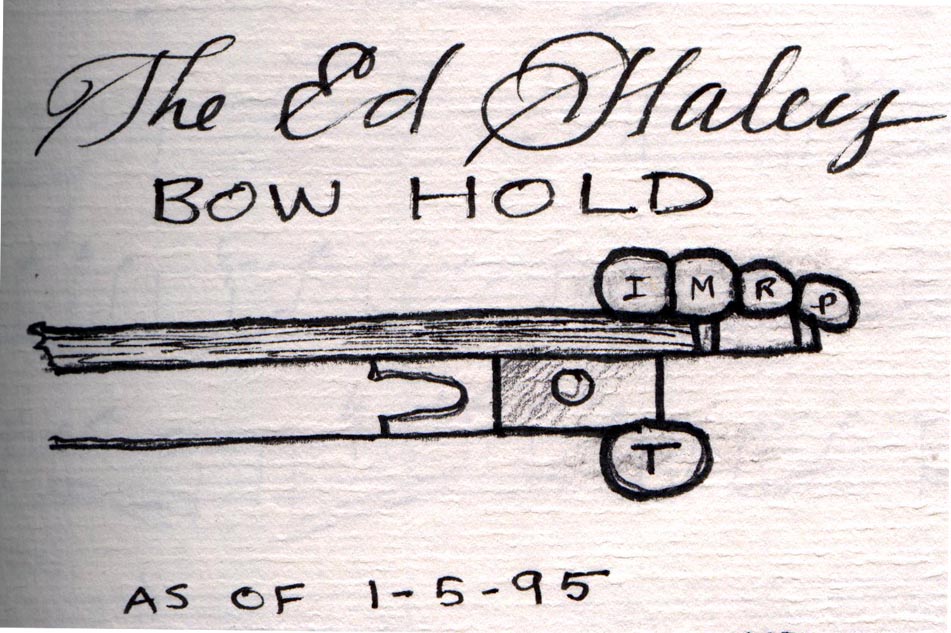
Ed Haley bow hold, 1995

Ed Haley bow hold, 1995

In Search of Ed Haley 134

25 Tuesday Jun 2013

Posted by Brandon Ray Kirk in Ed Haley

≈ Leave a comment

Tags

Ashland, Ed Haley, Ella Haley, history, John Hartford, Kentucky, Lawrence Haley, life, Margaret Arms, music, Pat Haley, Ralph Haley, writing

Later that night, Lawrence, Pat and I looked through a box of family photographs. Most were “modern” pictures featuring side burns, bellbottoms, or trendy 80s sweaters, but there were a few treasures. Early in our dig, I came across an old postcard with Ed, Ella, and Ralph pictured on it. Toward the bottom of the box was a small, dark picture of Ed in between Ella and someone named Margaret Arms. Lawrence said Margaret was Ed’s cousin, originally from around Paintsville, Kentucky, “or somewhere,” who ran a barbershop on Court Street in Cincinnati. Mona later told me that Margaret used the last name of Thomas because she was married to or lived with a man by that name. Margaret used to give her jewelry.

At the bottom of the cardboard box, under the flaps, was a dark, faded picture of Ed and Ella sitting on the street with their instruments. The photo was small and blurred, but I could make out that Ed wore some kind of a billed cap and was getting ready to play a tune.

“Pop looks like he might have been getting ready to play a piece and was letting my mother know without coming right out and saying what piece of music he was gonna play,” Lawrence said of the picture. “He was maybe hitting a lick with the fiddle bow, sort of like a ‘tune-up lick’ or two.”

Lawrence pointed to his mother, who had her right arm behind the mandolin, and said, “They kept a cup on the street in front of them or some kind of place where people could put change and my mother would take that up and she would put it behind her mandolin and count the take for their piece of music. And that’s what she’s doing right there.”

In the photograph, Ed obviously had the fiddle placed against his chest, and it appeared as if he held the bow as far to the end of the frog as possible. I practiced the hold in front of the mirror in the living room, then showed it to Lawrence, who said, “That’s it. That looks right.” I could tell right away this bow hold allowed for greater leverage in playing close to the frog as well as for pulling an extremely long bow. It was very similar to a bow hold I’d learned as a boy from Gene Goforth and Benny Martin, but the emphasis was never as far back as Ed was holding it. In fact, when I first saw this picture I even thought Ed might be holding it by the “frog screw.”

In Search of Ed Haley 133

23 Sunday Jun 2013

Posted by Brandon Ray Kirk in Ed Haley

≈ 1 Comment

Tags

Ashland, Clyde Haley, Ella Haley, history, Jack Haley, Lawrence Haley, life, Mona Haley, music, Noah Haley, Pat Haley, Peter Mullins, Ralph Haley

Later in the day, Pat told me more about the Haley family when we were away from Lawrence.

“I only knew Larry three months before we were married,” she said. “I knew he had a sister that he didn’t like to talk about. He talked mainly about his brother Ralph and Jack. I had no idea that Clyde was in San Quentin. And about a week before Beverly was born, I was ironing at 1040 Greenup and his face was looking at me through the window and I screamed bloody murder. Clyde’s got a funny laugh and he laughed. He didn’t know me. Larry was gone taking a class at the time. And Clyde came in and all of his luggage had EDWARDS on it. It was stolen and he was giving things away out of it. Then Larry told me about Clyde — that he was scitzofrenic. But he was a very intelligent man. I guess he did a lot of reading. He had a brain and he could work it, too, when he wanted to. He could always find a job when nobody else could. Then Noah came home from the service that Christmas. Beverly was about three weeks, four weeks old. And Noah came in his uniform and from the very beginning him and I disliked each other. I don’t know why. I irritated him and he irritated me. And then we moved right after that to 2144 Greenup Avenue.”

Pat said Ella — who she called “Mom” — was great, that she was very emotional with her children.

“Mom always regretted leaving the kids somewhere when she and Pop were off playing music together,” she said. “Larry’s told me that Noah didn’t like it at Harts and he would go down to the mouth of the hollow a ways from where Uncle Peter and Aunt Liza lived and he would sit and cry wanting his mother to come back. Where Larry and Jack could play — and half the time I would assume Clyde was in trouble — Noah would cry for his momma. It must have been very heart-wrenching for her. And I know she hated to leave Larry because even Mona will tell you: he was her favorite. She loved her boy Ralph more than anything and Larry came next.”

What about Ed? How did he treat the children?

“I’m sure Pop had genuine feelings for his kids but he didn’t know how to express it,” Pat said. “I remember Larry telling me about Pop rocking him because he had such terrible ear-aches and Pop took him to the doctor to get ear medicine and then when he took him home he rocked him. And that’s the only memory of his dad showing him any love. And Mona doesn’t have anything like that.”

How did Ed treat you?

“Pop was always very nice to me,” Pat said. “The only problem Pop and I had was his chewing tobacco and spitting it around toilets. And he was kinda dirty. The boys would have to make him bath. But my mother-in-law, she was always sad the way Mona behaved and the sad part is she never got to see Mona settle down. And Mona regrets that now, too. But Mom had three sons that had been good to her — that was Ralph, Jack, and Lawrence. Noah was never bad to Mom — he thought the world of his Mom — but Noah was much like Pop: he didn’t know how to express his feelings.”

Pat told me a little more about Clyde’s deviancies at the end of Ed’s life.

“Mom had this radio in her bedroom and this Electrolux sweeper and Clyde came through my bedroom, got that sweeper, and took Mom’s radio and was picked up on Greenup Avenue at 3 o’clock in the morning trying to sell those things,” she said. “That must have been the week before his daddy died because he was in jail when his daddy died and we could not get him out of jail to attend his daddy’s funeral.”

Later when Ella was sick in bed Clyde stole money from beneath her pillow.

“He was in prison in Michigan when his mother died,” Pat said. “And Larry tried to get him home for that but he would’ve had to’ve paid the way for two guards to bring him home and he just couldn’t afford it. And he was in Michigan for quite some time.”

In Search of Ed Haley

17 Monday Jun 2013

Posted by Brandon Ray Kirk in Ed Haley

≈ Leave a comment

Tags

art, Billy in the Lowground, Ed Haley, John Hartford, music, Wilson Douglas

Ed's double windup

Ed’s double windup

In Search of Ed Haley 131

17 Monday Jun 2013

Posted by Brandon Ray Kirk in Ed Haley

≈ Leave a comment

Tags

Appalachia, culture, Ed Haley, fiddler, French Carpenter, history, John Hartford, Kim Johnson, music, Steve Haley, West Virginia, Wilson Douglas, writing

That evening, we all gathered in Wilson’s kitchen and played music. It was clear in watching Wilson play that his style was different from Ed’s, but he knew all kinds of great tunes: “Abe’s Retreat”, “Coo Coo’s Nest”, “Fourteen Days in Georgia”, “Walkin’ in the Parlor”, “Boatin’ Up Sandy”, and “Brushy Run”. He had a real sense of humor. When I played “Stony Point”, he just kinda looked at me laughing, then said, “John, that ain’t ‘Stony Point’. Can I kid you a little? Now, Ed Haley wouldn’t like that.”

Every now and then, between tunes, Wilson told me more little things about Ed. He said Ed wouldn’t change his style for anyone and hated when someone asked him to play fast. He said Ed used to tell him to sometimes play it “lazy” and slow a piece down for different effects, such as at the end of “Birdie”. Wilson remembered that he played “Billy in the Lowground” with a double wind-up.

Wilson really bragged on Ed’s version of “Forked Deer”.

“Anybody that tried to play ‘Forked Deer’ with Ed Haley had to be crazy,” he said. “Oh god, he’d put that B-flat in there and he’d have a little grin on his face. He didn’t laugh very much. I’d watch that fiddle like a hawk. I’d watch them notes but god they were fast. And he;d play that ‘Sweet Sixteen’…”

Now, what was “Sweet Sixteen”?

“Well now, that’s got three titles,” Wilson said. “‘Too Young to Marry’, ‘Chinky Pin’, and all that. Ed said most people just smothered it to death on the bass, but he didn’t. Him and Clark Kessinger both played it about the same. Now John, he just used two notes on that bass.”

Wilson said Ed played “Callahan” in the key of A, then said, “And he played ‘Charleston Number One’ but he called it ‘Goin’ to Charleston’. I tell you where he got it from. He borrowed it from them old Possum Hunters in Nashville way back in ’37 and ’38.”

Wilson said Ed also got a lot of tunes from French Carpenter, the last of the old-time Carpenter fiddlers (and Wilson’s distant cousin) in central West Virginia. Ed used to spend a week or two at a time with French listening to him play cross-key tunes, like “Camp Chase”.

“There was one thing about Carpenter,” Wilson said. “Now Ed Haley was a better fiddler all around, but what Carpenter played he was good. He didn’t have no inferiority complex. He done a good job playing in front of Ed Haley. He’d say, ‘Well, now Ed, if you want to hear me, fine. I’ll give you what I’ve got.'”

I asked Wilson if Ed played “Shelvin’ Rock” and he said, “He liked it, but he never did play it. He liked to get French to play it. He’d sit, you know, and grin. He’d say, ‘By god, you got the bow, Carpenter, to play that tune.'”

Ed and French played “Devil in Georgia”, although Haley called it “Deer Walk”.

Over the next few hours, Wilson played me a lot of tunes, many of which he’d heard Ed play. The tunes had strange names, some familiar but most not: “Elzic’s Farewell”, “Little Rose”, “Mouth of Old Stinson”, “Old Aunt Jenny With Her Nightcap On”, “Run Here Granny”, and “What Are We Gonna Do With the Baby-O” (in the key of E).

There were other tunes that he only remembered Ed playing, like “Bostony”, “Brickyard Joe”, “Dusty Miller”, “Jimmy in the Swamp”, “Katy Hill”, “Lost Indian”, “Old Joe”, “Pumpkin Ridge”, “Snowbird on the Ashbank”, “Sweet Georgia Brown”, “Twinkle Twinkle Little Star”, and “Waynesboro Reel”.

Wilson thought Ed fiddled “Red-Haired Boy” in the key of A, “Mississippi Sawyer” in G, and “Coo Coo’s Nest” in A or G, and said he played “Running Up the Stairs” so well “it’d make a person cry.”

Wilson remembered that Ed had some strange titles for his tunes. He said he used to call some tune with a common name “Dance Around Molly”, then added, “And he played another tune, I never could get it in my mind. Ed called it ‘Raccoon in a Pine Top’. I’ll be danged if he wouldn’t break that bass out — it’d sound like ‘Over the Waves’ or something.”

Wilson said, “You know, John, if I had a lot of time, like a week, I could tell you a lot of things about Ed Haley. When you get old, all that stuff comes to you, then you forget it.”

Hoping to pull something from his memory, I played tunes I knew from long ago and asked, “Did Ed play anything like this?”

He came up with something almost every time.

Ed also played “Fine Times at Our House” but called it “George Booker”, which is interesting in that the old-time Texas fiddlers also call it that.

I told Wilson what Lawrence Haley had said about Ed loving Scott Joplin and ragtime. He thought for a moment, then said, “Well, he may’ve done it, but now, he stayed with hoedowns all the time I heard him. Course he’s afraid to play anything else: them old people didn’t know what that kind of music was.”

In other words, he played what they wanted to hear.

“Absolutely. And he made money by it. And he played straight. He didn’t fancy it up no way. He didn’t want you to change a tune one note. He wanted it like it was. He said, ‘Cut it off at the stump like it is.'”

I said, “He didn’t take tunes and add stuff to it?” and Wilson said, “If he thought it was appropriate he would. The man had enough skill, he could play anything he wanted to.”

Steve and I hung around with Wilson until late that night, talking more about Ed’s music and playing tunes. We eventually pried ourselves away and headed back to Lawrence’s in Ashland.

← Older posts
Newer posts →

Feud Poll 1

If you had lived in the Harts Creek community during the 1880s, to which faction of feudists might you have given your loyalty?

Categories

  • Adkins Mill
  • African American History
  • American Revolutionary War
  • Ashland
  • Atenville
  • Banco
  • Barboursville
  • Battle of Blair Mountain
  • Beech Creek
  • Big Creek
  • Big Harts Creek
  • Big Sandy Valley
  • Big Ugly Creek
  • Boone County
  • Breeden
  • Calhoun County
  • Cemeteries
  • Chapmanville
  • Civil War
  • Clay County
  • Clothier
  • Coal
  • Cove Gap
  • Crawley Creek
  • Culture of Honor
  • Dingess
  • Dollie
  • Dunlow
  • East Lynn
  • Ed Haley
  • Eden Park
  • Enslow
  • Estep
  • Ethel
  • Ferrellsburg
  • Fourteen
  • French-Eversole Feud
  • Gilbert
  • Giles County
  • Gill
  • Green Shoal
  • Guyandotte River
  • Halcyon
  • Hamlin
  • Harts
  • Hatfield-McCoy Feud
  • Holden
  • Hungarian-American History
  • Huntington
  • Inez
  • Irish-Americans
  • Italian American History
  • Jamboree
  • Jewish History
  • John Hartford
  • Kermit
  • Kiahsville
  • Kitchen
  • Leet
  • Lincoln County Feud
  • Little Harts Creek
  • Logan
  • Man
  • Matewan
  • Meador
  • Midkiff
  • Monroe County
  • Montgomery County
  • Music
  • Native American History
  • Peach Creek
  • Pearl Adkins Diary
  • Pecks Mill
  • Peter Creek
  • Pikeville
  • Pilgrim
  • Poetry
  • Queens Ridge
  • Ranger
  • Rector
  • Roane County
  • Rowan County Feud
  • Salt Rock
  • Sand Creek
  • Shively
  • Spears
  • Sports
  • Spottswood
  • Spurlockville
  • Stiltner
  • Stone Branch
  • Tazewell County
  • Timber
  • Tom Dula
  • Toney
  • Turner-Howard Feud
  • Twelve Pole Creek
  • Uncategorized
  • Warren
  • Wayne
  • West Hamlin
  • Wewanta
  • Wharncliffe
  • Whirlwind
  • Williamson
  • Women's History
  • World War I
  • Wyoming County
  • Yantus

Feud Poll 2

Do you think Milt Haley and Green McCoy committed the ambush on Al and Hollene Brumfield in 1889?

Blogroll

  • Ancestry.com
  • Ashland (KY) Daily Independent News Article
  • Author FB page
  • Beckley (WV) Register-Herald News Article
  • Big Sandy News (KY) News Article
  • Blood in West Virginia FB
  • Blood in West Virginia order
  • Chapters TV Program
  • Facebook
  • Ghosts of Guyan
  • Herald-Dispatch News Article 1
  • Herald-Dispatch News Article 2
  • In Search of Ed Haley
  • Instagram
  • Lincoln (WV) Journal News Article
  • Lincoln (WV) Journal Thumbs Up
  • Lincoln County
  • Lincoln County Feud
  • Lincoln County Feud Lecture
  • LinkedIn
  • Logan (WV) Banner News Article
  • Lunch With Books
  • Our Overmountain Men: The Revolutionary War in Western Virginia (1775-1783)
  • Pinterest
  • Scarborough Society's Art and Lecture Series
  • Smithsonian Article
  • Spirit of Jefferson News Article
  • The Friendly Neighbor Radio Show 1
  • The Friendly Neighbor Radio Show 2
  • The Friendly Neighbor Radio Show 3
  • The Friendly Neighbor Radio Show 4
  • The New Yorker
  • The State Journal's 55 Good Things About WV
  • tumblr.
  • Twitter
  • Website
  • Weirton (WV) Daily Times Article
  • Wheeling (WV) Intelligencer News Article 1
  • Wheeling (WV) Intelligencer News Article 2
  • WOWK TV
  • Writers Can Read Open Mic Night

Feud Poll 3

Who do you think organized the ambush of Al and Hollene Brumfield in 1889?

Recent Posts

  • Logan County Jail in Logan, WV
  • Absentee Landowners of Magnolia District (1890, 1892, 1894)
  • Charles Spurlock Survey at Fourteen Mile Creek, Lincoln County, WV (1815)

Ed Haley Poll 1

What do you think caused Ed Haley to lose his sight when he was three years old?

Top Posts & Pages

  • Chasing John Runyon (1996)
  • 1st Annual Ed Haley Fiddle Contest
  • Stephen Hart: Origins of Harts Creek (1896/1937)
  • Old Hinchman Book at Pecks Mill in Logan County, WV (1936)
  • The McCoy Time Singers

Copyright

© Brandon Ray Kirk and brandonraykirk.wordpress.com, 1987-2023. Unauthorized use and/or duplication of this material without express and written permission from this blog’s author and/or owner is strictly prohibited. Excerpts and links may be used, provided that full and clear credit is given to Brandon Ray Kirk and brandonraykirk.wordpress.com with appropriate and specific direction to the original content.

Archives

  • February 2025
  • January 2025
  • October 2023
  • September 2023
  • December 2022
  • November 2022
  • May 2022
  • April 2022
  • February 2022
  • November 2021
  • October 2021
  • September 2021
  • June 2021
  • May 2021
  • April 2021
  • March 2021
  • February 2021
  • January 2021
  • December 2020
  • November 2020
  • October 2020
  • July 2020
  • June 2020
  • May 2020
  • April 2020
  • March 2020
  • February 2020
  • January 2020
  • December 2019
  • November 2019
  • October 2019
  • September 2019
  • August 2019
  • July 2019
  • June 2019
  • May 2019
  • April 2019
  • March 2019
  • February 2019
  • January 2019
  • December 2018
  • November 2018
  • October 2018
  • September 2018
  • August 2018
  • July 2018
  • June 2018
  • May 2018
  • April 2018
  • March 2018
  • February 2018
  • January 2018
  • December 2017
  • November 2017
  • October 2017
  • September 2017
  • August 2017
  • July 2017
  • June 2017
  • May 2017
  • April 2017
  • March 2017
  • February 2017
  • January 2017
  • December 2016
  • November 2016
  • October 2016
  • September 2016
  • August 2016
  • July 2016
  • June 2016
  • May 2016
  • April 2016
  • March 2016
  • February 2016
  • January 2016
  • December 2015
  • November 2015
  • October 2015
  • September 2015
  • August 2015
  • July 2015
  • June 2015
  • May 2015
  • April 2015
  • March 2015
  • February 2015
  • January 2015
  • December 2014
  • October 2014
  • September 2014
  • August 2014
  • July 2014
  • June 2014
  • May 2014
  • April 2014
  • March 2014
  • February 2014
  • January 2014
  • December 2013
  • November 2013
  • October 2013
  • September 2013
  • August 2013
  • July 2013
  • June 2013
  • May 2013
  • April 2013
  • March 2013
  • February 2013
  • January 2013
  • December 2012
  • November 2012

Enter your email address to follow this blog and receive notifications of new posts by email.

Join 2,927 other subscribers

Tags

Appalachia Ashland Big Creek Big Ugly Creek Blood in West Virginia Brandon Kirk Cabell County cemeteries Chapmanville Charleston civil war coal Confederate Army crime culture Ed Haley Ella Haley Ferrellsburg feud fiddler fiddling genealogy Green McCoy Guyandotte River Harts Harts Creek Hatfield-McCoy Feud history Huntington John Hartford Kentucky Lawrence Haley life Lincoln County Lincoln County Feud Logan Logan Banner Logan County Milt Haley Mingo County music Ohio photos timbering U.S. South Virginia Wayne County West Virginia Whirlwind writing

Blogs I Follow

  • OtterTales
  • Our Appalachia: A Blog Created by Students of Brandon Kirk
  • Piedmont Trails
  • Truman Capote
  • Appalachian Diaspora

BLOOD IN WEST VIRGINIA is now available for order at Amazon!

Blog at WordPress.com.

OtterTales

Writings from my travels and experiences. High and fine literature is wine, and mine is only water; but everybody likes water. Mark Twain

Our Appalachia: A Blog Created by Students of Brandon Kirk

This site is dedicated to the collection, preservation, and promotion of history and culture in Appalachia.

Piedmont Trails

Genealogy and History in North Carolina and Beyond

Truman Capote

A site about one of the most beautiful, interesting, tallented, outrageous and colorful personalities of the 20th Century

Appalachian Diaspora

  • Subscribe Subscribed
    • Brandon Ray Kirk
    • Join 789 other subscribers
    • Already have a WordPress.com account? Log in now.
    • Brandon Ray Kirk
    • Subscribe Subscribed
    • Sign up
    • Log in
    • Report this content
    • View site in Reader
    • Manage subscriptions
    • Collapse this bar
 

Loading Comments...