Tags
Anheuser-Busch, Appalachia, Budweiser, history, J.P. Hager & Company, Logan, Logan Banner, Logan County, St. Louis, West Virginia
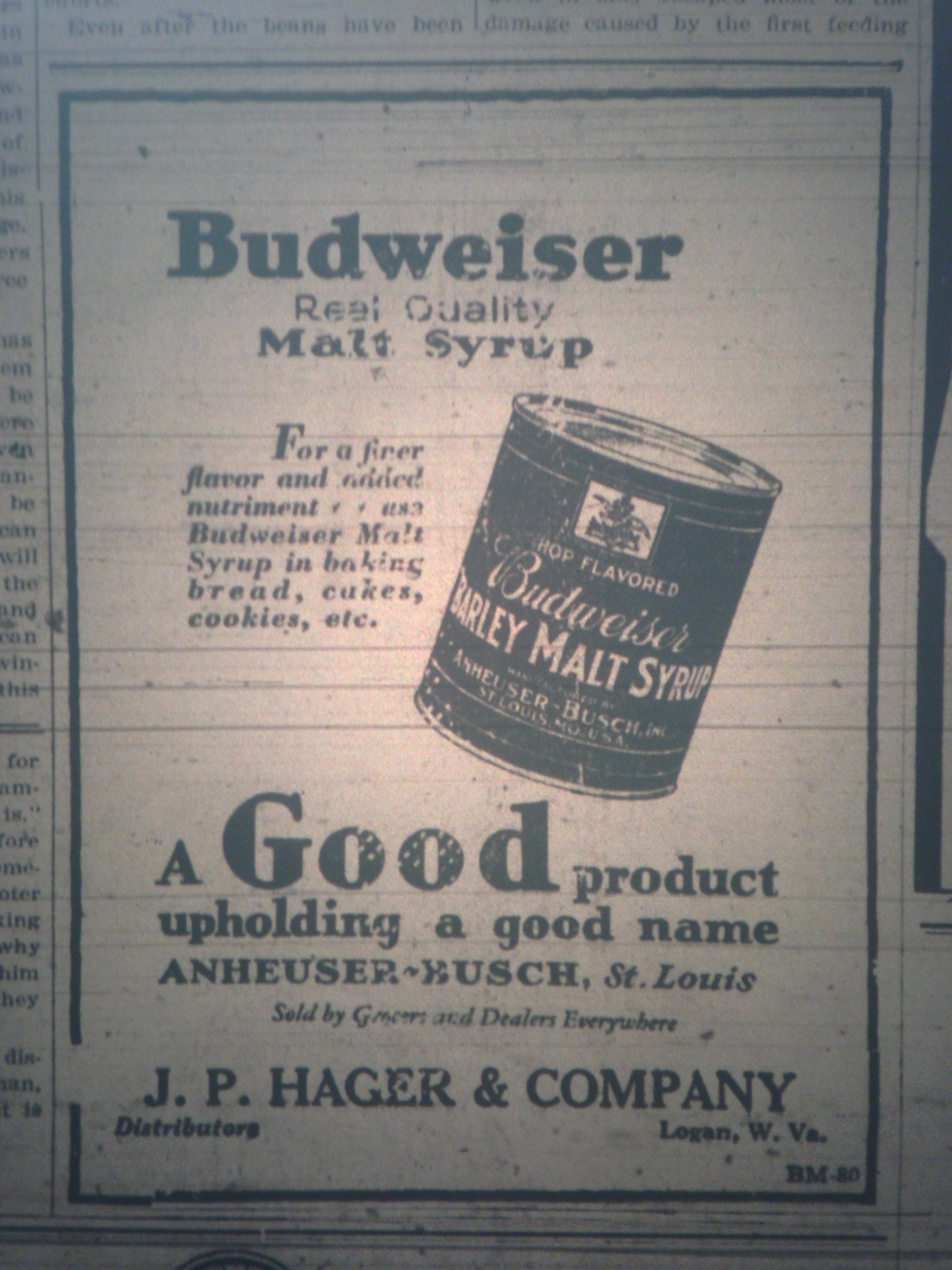
Logan (WV) Banner, 8 June 1928.

23 Monday Jul 2018
Posted in Logan
Tags
Anheuser-Busch, Appalachia, Budweiser, history, J.P. Hager & Company, Logan, Logan Banner, Logan County, St. Louis, West Virginia
Logan (WV) Banner, 8 June 1928.
23 Monday Jul 2018
Posted in Coal, Native American History, Wyoming County
Tags
A.F. Wysong, Appalachia, architecture, Baileysville District, Barkers Ridge District, Center District, Charleston, Clear Fork District, coal, crime, Early Brothers, Gertrude of Wyoming, Guyan Heating and Plumbing Company, history, Huff's Creek District, Logan, Logan Banner, Logan County, Maughwaiwama, Mingo County, Mullens, Native American History, Native Americans, Oceana, Oceana District, Pineville, Princeton, Slab Fork District, Thomas Campbell, West Virginia, Wyoming County, Wysong & Bengston
From the Logan Banner of Logan, WV, comes this bit of history about Wyoming County, dated 1927 and 1928:
Wyoming County In the Public Eye
Now that three railroads are contesting for the authority to build a branch line across Wyoming county, increased interest is shown in the probable early development in that bailiwick.
Wyoming has coal resources equal to those of any other county in the state, it is said, and it has wide valleys of fine farming land, and an unusually picturesque mountain country. Like Mingo, it was carved out of Logan territory, its formation having been authorized by an act of the general assembly passed January 26, 1850. With an area of 507.30 square miles it is more than 50 miles larger than this county, yet its population in 1920 was only 15,180.
That county’s valuation for taxation purposes exceeded $28,000,000 last year.
Wyoming county is divided into seven magisterial districts, as follows: Baileysville, Barkers Ridge, Center, Clear Fork, Huff’s Creek, Oceana and Slab Fork districts.
Wyoming county was stricken off from the older county of Logan, which took its name from a celebrated Indian chief. Another county was formed from Logan, many years later, and to this was given the name of Mingo, the tribe to which Logan belonged. Logan, Mingo and Wyoming are the three counties in West Virginia whose names are derived from the original settlers.
Wyoming county bears the name of an Indian tribe, and this tribe was later honored by having its name adopted by one of our great western States. While the derivation of the name, in its application to the county, seems to be clear, the origin of the name itself is veiled in obscurity. By some authorities it is said to be a corruption of the Indian Maughwaiwama, signifying a plain, or open space. Others assert that it is a creation of Thomas Campbell, the poet, and author, of “Gertrude of Wyoming.”
Pineville, the present county seat, is located near the center of the county. It has an elevation of 1,323 feet above the level of the sea and had a population of 304 in 1920. Later estimates do not greatly increase this figure. Pineville became the county seat years ago, having secured the removal of the seat of justice from the older town of Oceana.
Mullens, a prosperous town and center of the coal industry, had a population of 1,425 in 1920.
Oceana, long the county seat before its removal to Pineville, had at the last census a population of 90.
Source: Logan (WV) Banner, 25 November 1927.
***
WYOMING COUNTY HAS NEW JAIL–NATIVE STONE USED–COST $150,000
Wyoming county’s new jail at Pineville has been accepted by the architects and will be formally turned over within the next few days.
Erected at a cost of approximately $150,000, the new bastille is perhaps one of the finest buildings of its kind in the southern part of the state. It is built of native stone throughout, and is a most imposing and beautiful building and one of which the county may well pride itself, says the Mullins Advocate.
It is three full stories high above the basements, heated by vapor, containing room for 70 prisoners with comfort, and can accommodate twice that number, if necessary. The cells and jail construction is of tool proof steel, equipped with the latest locking devices. A prisoner when confined in a cell, must go through three sets of tool proof steel bars to make an escape.
The building contains a large and comfortable residence for the jailer, including a large, well furnished and equipped kitchen, is supplied with hot and cold water throughout, including shower baths on the inside corridors of the jail, padded cells for the insane, hospitals for the sick and detention rooms for juveniles of both sexes.
In the basement there is an incinerator, together with a laundry and large supply rooms.
The building was formally approved on January 9th by A.F. Wysong of the firm of Wysong & Bengston architects, of Charleston, who had the construction of this building in charge. Early Brothers, of Mullens, contractors, constructed the building, while the heating system was installed by the Guyan Heating and Plumbing company, of Mullens. The plumbing was done by Wickline of Princeton. Mr. Wysong, after going over the jail carefully, approved the construction and recommended payment of the balance due on the several contracts.
Source: Logan (WV) Banner, 17 January 1928.
20 Friday Jul 2018
Posted in Huntington, Logan, Matewan, Tazewell County
Tags
Albermarle, Appalachia, Bluefield, Buchanan, Collier's Weekly, Dry Fork, genealogy, George A. Dean, Henry Clay Ragland, Herald-Dispatch, history, Huntington, Iaeger, Imperial Order of Redmen, J.B. ellison, Jefferson Hotel, Kentucky, Keyes Sisters, LaRoy Stock Company, Lena Boyd Nelson, Lena Gross, Logan, Logan Banner, Logan County, Logan Democrat, Logan Nest 1442, Matewan, Modern Maccabees, Norfolk and Western Railroad, North Carolina, Order of Owls, Sayersville, Silver Cloud Tribe 138, Tazewell County, Virginia, W.L. Richardson, West Virginia, Williamson
In 1912, Logan Banner editor George A. Dean married the former Lena Gross, who soon thereafter disappeared. Here are a few stories about the event:
Editor Dean Married
On Monday, Nov. 11 in the minister’s study, Geo. A. Dean and Miss Lena Gross of Virginia, were united in marriage by Rev. W.L. Richardson.
Mr. Dean is the hustling editor of the Logan Banner and is well-known in this city and surrounding country as a man of push and energy, while the bride was one of the charming dining room girls at the Hotel Jefferson.
Mr. and Mrs. Dean will be at home to their friends after Nov. 18.
Source: Logan (WV) Democrat, 14 November 1912.
***

Logan (WV) Banner, 24 January 1913.
***
Editor of “Most Fearless Weekly” on the Trail
West Virginia editors who have failed to receive the Logan Banner on their exchange tables during the past three weeks, no doubt, marveled at its absence. But there is a reason–a tragic, gnawing reason which has caused the editor, Geo. A. Dean to suspend temporarily editorial duties and to embark upon a quest which means more to him than journalistic honors or the mere touch of hollow gold.
Readers of the Banner will remember that there appeared graven upon its front page four months ago Mr. Dean’s and his wife’s own announcement of their marriage. The paragraph attracted more than usual attention, partly because of its unique construction and partly because of the unusual manner of its presentation, but more than all because Mr. Dean was very prominently in the editorial limelight because of recent rather prominent mention in Collier’s Weekly. But that is history, and in mere prelude to the situation which now confronts him: to-wit: that of a married man, wifeless, disconsolate, yearning for the things that were.
Mr. Dean, who has been in Huntington and vicinity for two days seeking a trace of his evanished spouse, speaks frankly of his bereavement, and is importunate that the home-loving public shall, if possible, assist him in finding and restoring his lost treasure. In brief, Lena Boyd Nelson Dean has gone away and, some fear, forever departed. She went without the tender formality of a farewell husband’s kiss. She went away surreptitiously, mysteriously. She went, and Mr. Dean, who has sounded the very depths of heaven and earth, is no whit the wiser whither. Descriptive circulars, telling her height, weight, complexion, color of eyes and hair, manner of dress, and all that pertains to accurate and dependable description have been scattered broadcast all over the territory in which it might be surmised that she would be obscuring herself from the eyes of love and yearning. Mr. Dean stated last night, in conversation with the Herald-Dispatch, that he had absolutely no heart for business, that he had known no rest, no surcease from the terrible heart-longing that had seized upon him and held with tenacious grip from the morning of his wife’s departure. He has searched high and low. He has communicated with every known relative of his wife, without being able to get even the shadow of a clue tending to lead to the discovery of her whereabouts. He gives the following verbal photograph, which is almost as good as the ordinary studio product, and much better than a tintype:
Lena Boyd Nelson Dean, formerly of Williamson and Matewan and Bluefield. Four months ago she served as waitress, cook, and house girl at Logan, W.Va. Last seen at Kenova on Sunday morning, March 2. Physical description: Age 26. Height 5 ft. 2. Coal-black eyes given to starry twinkle. Raven black hair. Rather full lips. Gold filling in front teeth. Deep, well modulated musical voice, with a tendency to coarseness in time of cold. Can not read or write much as her early education was neglected. Her costume is described as being strict in the style of today. Raincoat, drab-colored; blue-serge, two piece coat suit. Beaver hat, embellished with four black ostrich plumes. Leather suitcase, canvass trunk and gold-headed umbrella.
Mr. Dean feels that his wife may have returned to one of the three occupations ascribed to her in the opening paragraphs.
He has important mail for her, both registered and ordinary, and is awaiting anxiously any news of her, and his arms are open to her return. The Logan editor’s plight is positively pitiful. He has grown emaciated, hollow-eyed, faded, wan. The tireless vigil, the ceaseless search, the anxious waiting hours, have all played their part in preying upon his splendid vitality. He is discouraged but not defeated, and will continue the search as long as human endurance will permit, or else sooner find the partner of his joys and immediate cause of his great and overpowering grief. His plight has elicited much sympathy. For what is life without a partner?
Source: Huntington (WV) Herald-Dispatch via Logan (WV) Democrat, 13 March 1913.
***
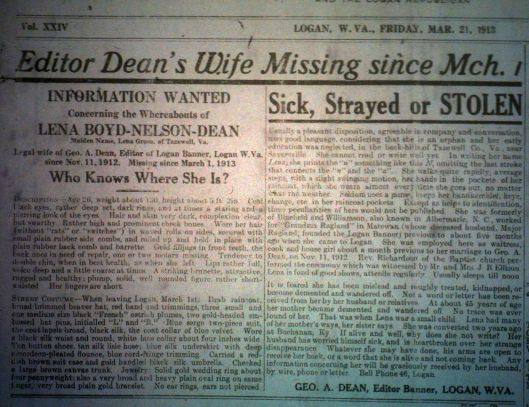
Logan (WV) Banner, 21 March 1913.

Logan (WV) Banner, 21 March 1913.
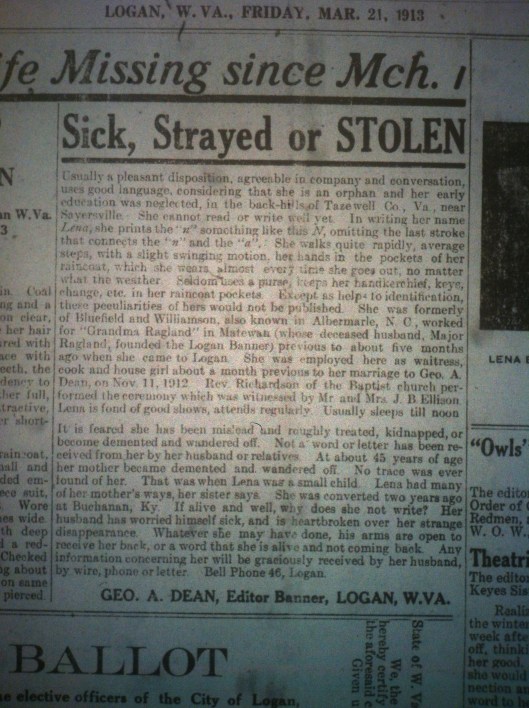
Logan (WV) Banner, 21 March 1913.
Logan (WV) Banner, 21 March 1913.

Logan (WV) Banner, 21 March 1913.
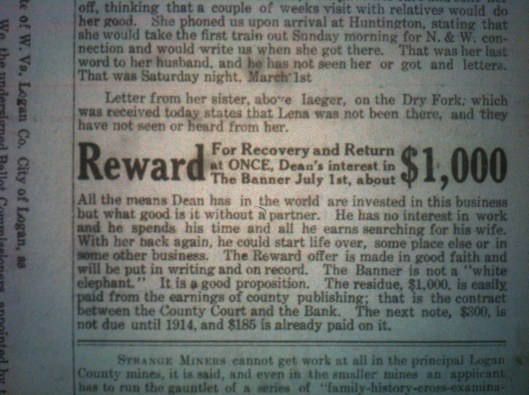
Logan (WV) Banner, 21 March 1913.
15 Sunday Jul 2018
Posted in Boone County, Huntington, Logan
Tags
Appalachia, Boone County, Camp Creek, Charles L. Estep, civil war, Coal River, Coal Valley News, Cumberland Gap, Danville, education, Hadalton, history, Huntington, Isaac Barker, Jackie Dolin, John E. Kenna, John Halstead, John Morris, Kanawha River, Kentucky, Kinder Hill, Little Coal River, Logan, Logan Banner, Madison, Marshall A. Estep, Maysville, Mud River, North Carolina, Ohio River, Olive Branch Baptist Church, Spruce Fork, Spruce Ridge, Texas, Thomas Price, Turtle Creek, W.H. Turley, W.W. Hall, West Virginia, White Oak Creek, Wilderness Road
A story titled “Old Times in Boone County Told About By Historian” and printed in the Logan Banner in Logan, WV, on April 20, 1928 provides some history for Boone County:
Old-timers and students of local history should be interested in the following excerpt from the history of Boone county by Prof. W.W. Hall. The family names mentioned are familiar ones.
What is here reproduced was taken from the Coal Valley News:
About the year of 1798 Isaac Barker reared a pole cabin on the brow of the hill on the lower side of White Oak Creek, near old lock seven. This was the first white man’s home established in Boone county. The second settler in the county was Johnson Kinder, a brother-in-law of Barker. He settled on Kinder Hill a few months after Barker came. The first settler on Little Coal River was John Halstead, who settled at the mouth of Camp creek about 1800. A few months later Jackie Dolin was married to Isaac Barker’s daughter and led his blushing bride, attired in her homespun, through the trackless forest up Brush creek and over the hill to a scantily furnished home on Camp creek. Not long after this Thomas Price, a daring hunter from North Carolina, wandered over the Wilderness Road through Cumberland Gap to Maysville, Kentucky, where he embarked in a canoe, ascended the Ohio, the Kanawha, the Coal and the Little Coal rivers to the present site of the town of Danville, and became the first settler there.
For some years after the coming of the white men there were no churches, but when an Old Baptist or Methodist preacher would arrive in the settlement, word was passed around to the neighbors and that night earnest prayers, exhortations and hallelujahs would ascend from those rude homes. The first church erected in the county was the Olive Branch Baptist church at the mouth of Turtle creek. The first term of the circuit court held in the county after its organization in 1847 was held in this church. The grand jury made its investigations while seated on the framing in Ballard’s old water mill near by, and the petit jury retired to the paw paw bushes below to consider their verdicts.
The daring hunters, adventurous pioneers and brave soldiers who came from the best families in the east to establish home in the wilderness, were not contented to let their children grow up without the rudiments of an education, so they established Old Field schools in the slave cabins, tanneries, country churches and abandoned dwellings, when an itinerant teacher who could read, write and cipher a little came along. The first free school in the county was taught by John Morris, just after the Civil War, in an old house abandoned by Dr. Church. The old house stood across the hollow from W.H. Turley’s present residence in Madison. Within the next year or two a log school house was erected near the upper end of Danville and another on the point across the river from Hadalton. The children of Madison had to go to Danville or Hadalton to school until 1885, when the people of Madison, by mandamus, compelled the board of education to give them a school. The first school house erected in Madison is now used by Dr. Smoot for a barn. While the course of study in these early schools was meager and the work crude, yet they did succeed in inspiring a few boys to strive for higher education. Former United States Senator John E. Kenna was born in Boone county and attended his first schools in a log house on Big Coal river. Dr. Marshall A. Estep, an eminent physician of Texas, and his brother, Judge Charles L. Estep, of Huntington and Logan, were reared in the “Promised Land,” the name of their father’s mountain home on the summit of Spruce Ridge, and attended their first schools in a log house on the Spruce Fork. One of these early log school houses still stands on the head of Mud river, remote from the highways frequented by trade and travelers. Two of the most recent prosecuting attorneys of the county, two clerks of the circuit court, two of the clerks of the county court, four county superintendents of schools, chief U.S. Marshal for the southern district of West Virginia, and two prosperous dental surgeons attended school when boys in that little log school house on the head of Mud. The attendance in it was never large.
06 Friday Jul 2018
Posted in Logan
Tags
Appalachia, First Methodist Church, history, Ku Klux Klan, Logan, Logan Banner, Logan County, Old Glory Club, Stratton Street, West Virginia

Logan (WV) Banner, 23 December 1927.

Logan (WV) Banner, 17 January 1928.
06 Friday Jul 2018
Posted in Chapmanville, Huntington, Logan
Tags
Appalachia, Bernie Young, Chapmanville, genealogy, history, Huntington, Kentucky, Lizzie Crislip, Logan, Logan Banner, Logan County, Maude Fillinger, West Virginia, Willa Lowe
An unknown correspondent from Chapmanville in Logan County, West Virginia, offered the following items, which the Logan Banner printed on December 9, 1927:
Rev. Sreves’ wife is improving very slowly.
Miss Willa Lowe and Miss Maude Fillinger are spending a few days in Logan.
Mrs. Lizzie Chrislip and friends made a trip to Huntington Sunday.
Bernie Young was calling on friends here Sunday.
We were very glad to welcome the Cox family back again after they spent a few years in Kentucky.
30 Saturday Jun 2018
Posted in Logan
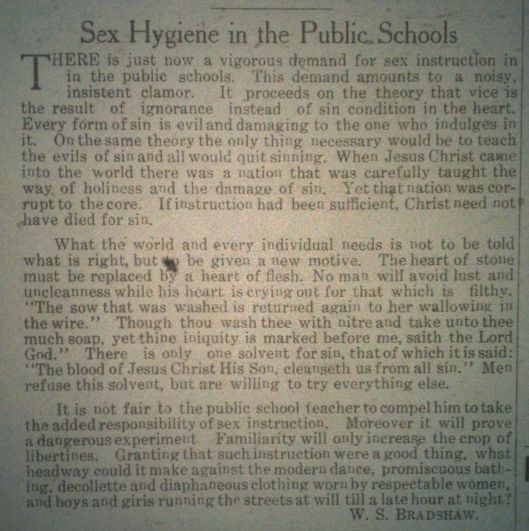
Logan (WV) Banner, 14 August 1914.
30 Saturday Jun 2018
Posted in Banco, Big Creek, Chapmanville, Gill, Huntington, Logan
Tags
A.J. Thomas, Appalachia, Banco, Big Creek, C&O Hospital, C.C. Varney, Chapmanville, Edward Ferrell, Flora Lucas, genealogy, George Chafin, Gill, history, Huntington, J.B. Lucas, J.B. Thomas, Jack Hager, Logan, Logan County, Madeline Varney, Minta Jeffrey, Myrtie Lucas, Myrtle Lucas, Nell Marie Gill, Pearl Harmon, Ted Hager, West Virginia
An unknown correspondent from Big Creek in Logan County, West Virginia, offered the following items, which the Logan Banner printed on February 7, 1928:
Mrs. Pearl Harmon has been in the C. & O. hospital at Huntington but is home again.
Little Nell Marie Gill has returned home again from a visit with her grandmother at Gill.
Mrs. Minta Jeffrey of Banco was a business caller here today.
Geo. Chafin and A.J. Thomas of Logan were Big Creek callers Thursday.
Mrs. C.C. Varney and daughter Madeline were calling on Mrs. Myrtie Lucas Thursday afternoon.
Mrs. Flora Lucas was the pleasant guest of Mrs. Myrtle Lucas one day last week.
Mr. and Mrs. Ted Hager and son Jack are visiting friends and relatives at Banco this week.
J.B. Lucas made a business trip to Chapmanville Saturday.
Edward Ferrell is store clerk in the Hunter store at present. Be careful, girls, and don’t stay too too long when shopping.
J.B. Thomas was a business caller in Logan this week.
24 Sunday Jun 2018
Posted in Big Harts Creek, Culture of Honor
Tags
Andrew Howlett, Appalachia, Augustus Fowler, Ben Bartram, Bill Driver, Boone County, C.S. Wilson, Carroll County, constable, crime, Delbarton, Floyd Allen, Frank Adams, Frank Allen, genealogy, Harts Creek, Hillsville, history, Kirk, Leonard Conley, Lew Webb, Logan, Logan Banner, Logan County, McDowell County, Mingo County, moonshining, Moundsville, Nancy E. Ayres, Shanklin Creek, Sidna Allen, T.L. Massie, Virginia, W.M. Foster, W.M. Ray, Wallace Dillon, Welch, West Virginia, West Virginia State Penitentiary, Williamson, Wythe County
In 1912, Floyd Allen and other members of his family participated in a sensational gunfight during a trial at the Carroll County Courthouse in Hillsville, Carroll County, Virginia. The incident resulted in the death of Judge T.L. Massie, Prosecutor W.M. Foster, Sheriff L.F. Webb, juror Augustus Fowler, and witness Nancy E. Ayres, while seven others were wounded. In 1927, Frank Allen–a reputed relative of Carroll County Allens–was captured on Harts Creek in Logan County, WV.
Frank Allen Caught On Murder Charge
“Bad Frank” Allen was captured on Harts Creek last night and was lodged in jail here at 6 o’clock this morning. An hour or so later he was taken to Williamson to answer to a murder charge.
State police from Williamson, accompanied by Trooper Wilson and Constable Frank Adams, made the capture. They went to a house where he was known to be and called him to the door. As he appeared in view he was “covered” by high powered rifle and was commanded to drop a pistol he held in his hand. He refused to let go but one of the officers walked up to him and took possession.
Source: Logan (WV) Banner, 11 November 1927.
“Bad” Frank Allen Moved to Welch Jail for Safe-Keeping
Charged With Murder, He Eluded Officers from October 1 Until Captured on Harts Creek Week Ago–Kinsmen of Allens of Carroll Court House Fame.
“Bad Frank” Allen, who was captured on Harts Creek a week ago last night, to answer to a murder charge in Mingo county, was subsequently moved from the Williamson jail to the Welch jail for safe-keeping. Boys with hard heads or big feet are in the habit of kicking holes in the Williamson bastile, but a ball bearing nutmeg grater will be presented to the first one who bumps his way to freedom through the thick walls of the McDowell prison.
Allen is accused of killing Wallace Dillon at a horsetrading carnival held near the Baptist Association meeting on Shanklin Creek October 1. Stories of the affray are conflicting. It is said Dillon and others had a whale of a fight, after there had been much imbibing of strong liquor. In the free-for-all Dillon was a star performer, upsetting friends and foes with little regard for consequences. Allen missed the “party,” but when he heard that Dillon had beat up the other participants in the affray, he is said to have construed it as a challenge. Saddling his horse he rode to the scene of the fight and presumably without any provocation fired at Dillon with fatal effect. He escaped after the shooting and officials of both Mingo and Logan county waged a strenuous man hunt in an effort to capture him.
The arrest was made at the home of Leonard Conley in a wild and isolated corner of Harts Creek. His captors were Deputy Sheriffs Bill Driver and Ben Bartram, of Williamson; State Police Wamsley and McClure, of Delbarton, and State Trooper C.S. Wilson, of the Logan detachment.
Conley, wanted on a liquor charge, was not at home, but the officers had a tip that “Bad Frank” was there. One yelled for him to come out and he appeared in the doorway, pistol in hand, and ready to “shoot it out,” until he saw several high-powered rifles leveled at him. Even then he ignored the command to drop his gun, but stood motionless as an officer approached him and took possession of the weapon, which proved to be of 45-calibre.
Allen told his captors that during the six weeks he was a fugitive he had slept in caves and barns and had nearly starved at times. It is thought he fared much better in the hospitable hills of Harts, altho he said that was the first night he had sought shelter in a human habitation.
Big Shoot Recalled
Allen hails from Wythe county, Virginia, and is said to be a kinsmen of the Allens who shot up the Hillsville court house on March 14, 1912. Two of the clan were executed for the crime and Sidney Allen was released from prison on a conditional pardon a year or more ago, the first fusillade in the court upon Judge T.L. Massie and Sheriff Lew F. Webb fell dead. Augustus Fowler, a juror was shot through the head and died two days later. Commonwealth’s Attorney Forst was also shot. Andrew Howlett, another juror, was shot through the _____st. Another juror and Clerk of the court Dextor Goad were wounded but recovered. Miss Elizabeth Ayres received a death wound. Sidna and Allen Floyd were wounded also.
Source: Logan (WV) Banner, 18 November 1927.
Penitentiary Awaits “Bad” Frank Allen
“Bad” Frank Allen, whose recent capture under dramatic circumstances on Harts Creek, will be recalled by Banner readers, was found guilty of voluntary manslaughter in the circuit court at Williamson this week. Sentence has not been pronounced but that offense is punishable by from one to five years in the penitentiary.
This desperado of a picturesque type killed Wallace Dillon at a horse-trading gathering near Kirk, on October 1. State’s evidence indicated he rode on the scene when the crowd was watching a fight between Dillon’s brother and another man and shot Dillon without any provocation. Allen testified he shot in self-defense, claiming there was no ill feeling between them and that they were unacquainted.
Allen is 28 and said to be related to the Allens of Hillsville court house fame.
Source: Logan (WV) Banner, 16 December 1927.
“Bad” Frank Allen Escapes from Pen
“Bad” Frank Allen, said to be one of the Hillsville Allens and known in these parts, has escaped from the penitentiary and is at large. W.M. Ray, a Boone county man serving a two-year sentence for moonshining, escaped with him. They were missed at the prison mine Monday.
The usual reward of $50 has been offered for Allen’s recapture, but those familiar with his record are likely to believe the reward is too small to be tempting.
Allen entered the pen last December 26 to serve a term for shooting and killing Wallace Dillon at a horse-trading carnival near the Baptist Association meeting on Shanklin Creek, Mingo county, October 1. After that affray he escaped but late in November was captured at the isolated home of Leonard Conley on Harts Creek. State policemen armed with rifles and pistols surrounded the house and several were pointed at the front door when Conley, .45 pistol in hand, opened the door in response to a knock. He ignored commands to drop his gun but allowed an officer to seize it.
During the six weeks preceding his capture, Allen stayed in the wilds, subsisting on nuts and fruits largely, he told his captors, though he fared better after getting into the hospitable Harts Creek country.
Source: Logan (WV) Banner, 24 April 1928.
22 Friday Jun 2018
Posted in Banco, Big Creek, Estep, Huntington, Logan
Tags
A.S. Harmon, Appalachia, Banco, Big Creek, Bruce Hunter, C.C. Varney, Chapmanville, Christmas, Clara Harmon, D.H. Harmon, E.S. Harmon, Estep, George Chafin, history, Huntington, J.B. Lucas, J.B. Toney, Logan, Logan Banner, Logan County, Nell Mobley, R.C. Vickers, R.S. Pardue, Ted Hager, Thanksgiving, W.C. Lucas, West Virginia
An unknown correspondent from Big Creek in Logan County, West Virginia, offered the following items, which the Logan Banner printed on December 6, 1927:
Everything is lively around Banco now days, with everyone looking forward to Christmas.
Mr. and Mrs. J.B. Lucas and Mr. and Mrs. R.S. Pardue were visiting homefolks at Banco Thanksgiving Day.
E.S. Harmon of Estep was a business caller here this week.
Mrs. J.B. Toney and Mrs. A.S. Harmon of Huntington were weekend visitors here.
We have a new shoe shop here. Now the boys can have their shoes mended without going far.
W.C. Lucas is on his job at the new gas station.
Bruce Hunter is going to put in a big store in the W.C. Lucas building in the east end of town.
George Chafin of Logan was here on business Tuesday.
D.H. Harmon of Banco was also a business caller here this week.
Mrs. C.C. Varney and Mrs. Ted Hager were calling on Mrs. J.B. Lucas, Wednesday.
Miss Clara Harmon of Banco was in Big Creek for a short time Sunday evening.
Mrs. Nell Mobley was calling on Mrs. R.S. Pardue one afternoon last week.
Mr. and Mrs. Ted Hager were visiting Mrs. Hager’s mother at Banco Sunday.
R.C. Vickers of Chapmanville was down to look after the Sunday School Sunday.
17 Sunday Jun 2018
Posted in Logan
Tags
Appalachia, Coal Street, grocery store, history, J.L. Buskirk, J.W. Mullins & Company, Logan, Logan County, Straton Street, West Virginia
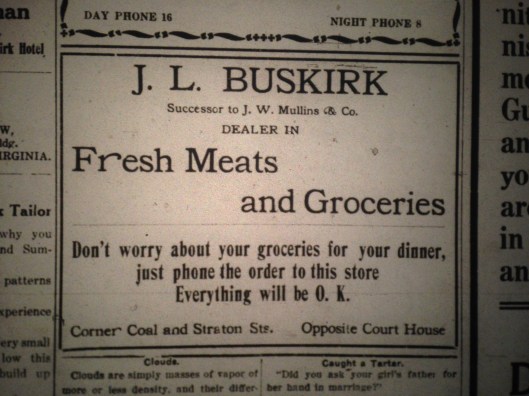
Logan (WV) Democrat, 23 January 1913.
16 Saturday Jun 2018
Posted in Big Harts Creek, Dingess, Logan, Whirlwind
Tags
Anna Mullins, Appalachia, Buck Fork, Charleston, Curtis Hamlin, Daniel McCloud, Dingess, Elias Workman, Frank McCloud, genealogy, Gertrude Clendenin, Harts, Harts Creek, history, Hoover Fork, Joe Martin, Logan, Logan County, Mingo County, Ohio, Twelve Pole Creek, West Virginia, Whirlwind, Wilburn Mullins
An unknown correspondent from Whirlwind in Logan County, West Virginia, offered the following items, which the Logan Banner printed on December 6, 1927:
Miss Gertrude Clendenin has just returned from Ohio where she has been visiting her parents.
Wilburn Mullins made a business trip to Dingess Monday.
Elias Workman made a business trip to Charleston last week.
Daniel McCloud was a business caller in Logan Monday.
Frank McCloud made a visit to Hoover one night last week.
Anna Mullins of Twelvepole was a visitor of Harts Sunday.
Curtis Hamlin is on the sick list this week.
Joe Martin and family of Buck Fork motored to Hoover Sunday.
13 Wednesday Jun 2018
Posted in Logan
Tags
Appalachia, German Restaurant, history, Logan, Logan Banner, Logan County, R. Tobin, West Virginia
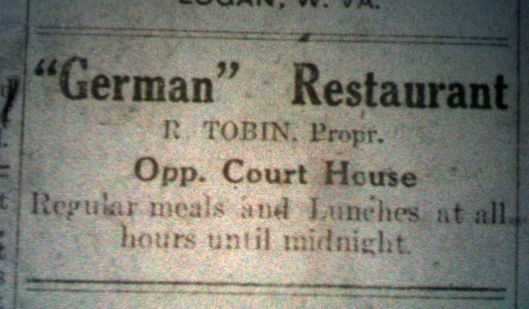
Logan (WV) Banner, 20 June 1913.
10 Sunday Jun 2018
Tags
abolitionists, Appalachia, Aracoma, Ben Bolt, Bergen County, Columbian Fountain, Daily Dispatch, Democrat, Democratic Party, history, Logan, Logan County, Lucretia Mott, New Jersey, New York, New York Daily Tribune, poet, politics, Thomas Dunn English, U.S. Congress, Virginia, West Virginia, William and Mary College, writers
From various newspapers come these items relating to Thomas Dunn English, the famous poet who once lived in Logan County, (West) Virginia:
The Columbian Fountain (Washington, DC), 19 September 1846
Thomas Dunn English is to be the Democratic candidate for Congress in the fifth district, New York.
***
New York (NY) Daily Tribune, 27 December 1850
Doctor Thomas Dunn English will lecture concerning Hungarian matters on Sunday the 22d inst. and Lucretia Mott concerning Woman’s Rights upon the 29th of December, Sabbath evening.
***
Daily Dispatch (Richmond, VA), 29 July 1853
Dr. Thomas Dunn English is engaged in making geological exploration for some New York capitalists in Western Virginia.
***
Richmond (VA) Enquirer, 6 March 1855
We have seen the proof-sheets of a selection of the poems of Thomas Dunn English, the author of “Ben Bolt.” The same author is collating and arranging materials for an illustrated history of South-western Virginia.
***
Nashville (TN) Union and American via Richmond (VA) Enquirer, 6 September 1861
THOMAS DUNN ENGLISH MOBBED.–This gentleman was mobbed in Bergen county, New Jersey, on Friday, while on his way to speak at a peace meeting. He was severely maltreated by the Abolitionists, and, though he fought his way boldly, was with difficulty saved from assassination by the sheriff of the county. Dr. English resided in Logan county, Va., for several years. He represented Logan county in the legislature several years ago, and last year he delivered the poem at the commencement of William and Mary College. He is a genial poet and eloquent speaker. Since 1855 he has resided in New Jersey.
10 Sunday Jun 2018
Tags
Appalachia, coffee, Guyandotte Club Coffee, history, Logan, Logan Banner, Logan County, West Virginia

Logan (WV) Banner, 26 August 1927.
07 Thursday Jun 2018
Posted in Logan
Tags
Appalachia, Black Bottom, fortune teller, history, Jerusalem, Logan, Logan Banner, Logan County, Madam Wonder, phrenology, seer, West Virginia

Logan (WV) Banner, 25 October 1927.
04 Monday Jun 2018
Posted in Big Harts Creek, Crawley Creek, Logan
Tags
Appalachia, Brushy Fork, county clerk, Crawley Creek, David Straton, Eliza Straton, genealogy, Harts Creek, Henry Conley, Hickman S. White, history, Hugh Bryan, John J. Besnoist, Joseph Straton, justice of the peace, Lawnsville, Logan, Logan County, Logan Court House, Mulligan Lot, Polly Straton, Rebecca A. Straton, Virginia, West Virginia, William Straton

Deed Book C, page 367, Logan County Clerk’s Office, Logan, WV. This land is located in present-day West Virginia.
31 Thursday May 2018
Posted in Logan
Tags
Appalachia, genealogy, history, Ira P. Baer, Leppart Boarding House, Logan, Logan County, Logan Democrat, W.I. Campbell, West Virginia
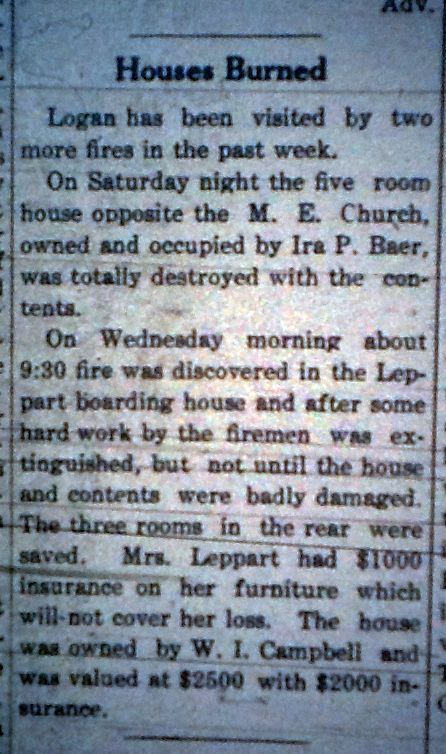
Logan (WV) Democrat, 28 November 1912.
28 Monday May 2018
Posted in Gilbert, Guyandotte River, Logan
Tags
Appalachia, Bernard Call, Boy Scouts, Gilbert, Guyandotte River, history, Logan, Logan Banner, Logan County, Mingo County, Tom Johnson, West Virginia

Logan (WV) Banner, 23 August 1927.
27 Sunday May 2018
Posted in Logan
Tags
Appalachia, Bennett Theatre, history, L. & M. Theatrical Company, Logan, Logan County, Palace Theatre, vaudeville, Virginian Hotel, Welch Theatre, West Virginia, Wilkinson Building

Logan (WV) Banner, 8 August 1913.
Writings from my travels and experiences. High and fine literature is wine, and mine is only water; but everybody likes water. Mark Twain
This site is dedicated to the collection, preservation, and promotion of history and culture in Appalachia.
Genealogy and History in North Carolina and Beyond
A site about one of the most beautiful, interesting, tallented, outrageous and colorful personalities of the 20th Century
 Brandon Ray Kirk