
• About

Brandon Ray Kirk

~ This site is dedicated to the collection, preservation, and promotion of history and culture in my section of Appalachia.

Brandon Ray Kirk

Tag Archives: Lawrence Haley

In Search of Ed Haley 48

09 Wednesday Jan 2013

Posted by Brandon Ray Kirk in Ed Haley

≈ Leave a comment

Tags

Alaska, blind, California, Cleveland, Clyde Haley, Ed Haley, genealogy, Harts Creek, Hawaii, history, Japan, John Hartford, Kentucky, Lawrence Haley, Liza Mullins, Louisiana, Milt Haley, Montana, New York, Noah Haley, Ohio, Pacific Theatre, Pike County, Scoffield Barracks, Virginia, World War II

I asked Lawrence if he’d heard from any of his brothers or sister and he said, “I’ve got one that lives in town now. He moved back from Cleveland, Ohio. He lives in town. Noah was a little bit… You might want to talk to him, I don’t know. But Noah, he went away, I guess, in 1939. He went in the service. He was at Scoffield Barracks in Hawaii when the Japanese… He was in all that Pacific Theater. I think he was wounded a couple of times. The Japanese bayoneted him one time in a bonsai attack or something. It left Noah a little bit shell-shocked or something. He gets a pension from it. He’s not together all there, I guess. You know, in a way, if you talked to him you’d never notice it. He was married to a woman of Hungarian descent and raised a family — a boy and a girl. He had a problem with the girl, too. She was having a problem with a boyfriend or something and her boyfriend was there at the house. Well, the boy had a pistol or some sort of a gun and she went and got that pistol and said, ‘If you don’t love me,’ or something and she shot herself. She committed suicide. I think it was non-intentional. It was just a bluff.”

I said to Lawrence, “Well now, aren’t your other brothers, they’re all kind of hard to get along with, aren’t they?”

“Yeah, a little bit odd,” he answered. “Clyde just moved out and took off and went his way, I guess. Followed the sun, I call it. We’d hear from him in Louisiana one year and the next year he might be in Montana or Upper State New York. He did hobo. Noah went to see him about ten years ago out in California and they started back and Noah was going to stop and get some gasoline. Clyde said, ‘No, don’t stop here and get gas. I’ll get your gasoline.’ He went over to this big church and told them he was on the road back to Ohio and didn’t have money to get there. I guess they give them a tank of gas and they come all the way back from California like that. Clyde was good at that. He did work and we’d get his W-2 forms. He never did turn in his income tax, I don’t think. He’d send his W-2 forms home. Some years he was out on an oil rig in Louisiana. Apparently during the time he was working for them they had rigs off the coast of Alaska.”

Hearing Lawrence speak of his brothers caused me to ask if maybe any of Milt Haley’s “stuff” — which I now presumed to be sort of bad — might’ve come down in their genetics.

“I don’t know, John,” he said. “I couldn’t say. They never met their granddad. I don’t think… My dad, if he’d been a sighted man, he’d probably been as gentle as a lamb. But he had frustrations in his own life.”

“Sometimes in a situation like that, sometimes a gene will come and it won’t get everybody,” I said, pressing Lawrence a little further. “Like it’ll skip your dad, and like skip you, but pick out a brother there and one over there.”

Lawrence totally disagreed.

“Well, I don’t think any of them… And I really don’t think my grandfather, from what I’ve heard of that tale… It was caused by hard times. I’m not trying to defend my grandpa because, hell, it don’t make any difference to me now.”

Milt in so many ways seemed like a critical character in the story: an ambiguous rogue — a key player in causing Ed’s blindness and inspiring his music, whose very genetic attributes or deficiencies might still live on strongly in his grandchildren.

I wondered if Lawrence knew where Milt came from before his settlement on Harts Creek.

“I think maybe over in Old Virginia or over in Pike County,” he said. “I understand there’s some Haleys in Pike County. I’d ask Aunt Liza, ‘Where’d Milt Haley come from?’ ‘Well, he come from over the mountain.’ Now, that’s as far as I could get from her.”

Lawrence thought his father had resolved his hard feelings toward the Brumfields in later years.

“Pop was supposed to have made the remark that if he’d had his eyesight he’d hunted down the people that killed his dad,” Lawrence said. “But afterwards, him and one of the Brumfield sons, they settled their trouble.”

I said, “Well obviously if your grandmother was at the Brumfields’ house the night she got shot, there was no animosity between her and the Brumfields.”

I was starting to understand how the tragedies of Ed’s early life, as well as the legacy of his father, had manifested itself into the pain, rage, and lonesomeness I’d been so drawn to in his music. I kept telling Lawrence, “We’re gonna have to go back up Harts Creek,” but it would be a year before we actually did so.

Parkersburg Landing

06 Sunday Jan 2013

Posted by Brandon Ray Kirk in Ed Haley

≈ Leave a comment

Tags

Appalachia, culture, Ed Haley, genealogy, Harts Creek, John Hartford, Lawrence Haley, life, photos, U.S. South, West Virginia

Connie Mullins and Lawrence Haley, 1991

Connie Mullins and Lawrence Haley, Harts Creek, WV, 1991

Parkersburg Landing 47

06 Sunday Jan 2013

Posted by Brandon Ray Kirk in Ed Haley

≈ Leave a comment

Tags

Blackberry Blossom, blind, culture, Ed Haley, fiddler, Half Past Four, history, John Hartford, Lawrence Haley, life, music, Steve Haley, Tennessee, U.S. South, writing

     Later that summer, I met Lawrence Haley at the home of his oldest son, Steve Haley, in Hendersonville, Tennessee. Steve was a music enthusiast and computer expert. Lawrence graciously loaned me the four Junius Martin records, which contained his father’s signature tune, “Garfield’s Blackberry Blossom”. I asked him about “Poplar Bluff,” one of the tunes on the records, and wondered if it was connected to the small Missouri town by that name. Lawrence said he didn’t know but that it sounded like Pop was mad when he was playing it on the record.

     “Well, he was either mad or they had taken some strong drink with them and Pop had got into that pretty heavy,” he said.

     I said, “What about a tune like ‘Stonewall Jackson’?”

     “No, he was playing fine music there,” he said. “I don’t think when these records was made at home he had a drop to drink. But I’ll tell you John, he done an exceptional job then because before I went into the service he would shake his left hand trying to get some of the numbness out and I guess that was from a heart problem right there. If he had any decay in his muscle reaction, it didn’t show too much. Of course, he had to go downhill at that age from what he used to be when he was a young man.”

     I played a tune for Lawrence that was unnamed on the records, then said, “This guy I know, Bruce Greene, he collected a lot of stuff, and I played it for him over the telephone and he said, ‘Oh, that’s ‘Indian Squaw’. But then it could have had another name. Like that ‘Yellow Barber’ tune that your dad plays, they call that ‘Arthur Berry’.”

     Lawrence said, “I don’t think he called that ‘Indian Squaw’. I never heard anybody request it. Pop played a piece of music called ‘Indian Nation’.”

     I’d been listening to Ed’s recordings a lot in the last few months and was focused on how he got a “real swing” in his music.

     Lawrence agreed, “That’s what I say. That’s what I was trying to tell you. When Pop was playing and enjoying it, he put a lot of drive in his music. You could see it. You could watch him and just see that he was enjoying it.”

     I asked if Ed played with his whole body and Lawrence said, “Well, yeah he’d do a little, maybe, dance on his chair.”

     Would he ever come up off his chair?

     “No, no, not like that. But you could tell that when he was playing with somebody that fit in with his style or if his accompaniment was doing their job right then he always enjoyed it.”

     Now what would his feet be doing?

     “Well, he’d just be patting his foot or his heel one or the other, most of the time. Not too loud. It was a subdued type of enjoyment, but you could see the drive that he was putting into it. I mean, he could slur a bow and pull a bow and put different pressures on the strings and you’d know that he was enjoying it, or I felt that he was.”

     I played a lot of Ed’s tunes for Lawrence, hoping to jar some of his memories. When I played “Ida Red”, he said his father used to sing, “Ida Red, Ida Red. I’m in love with Ida Red.”

     I told him I loved “Half Past Four”.

     “That’s one of my favorite tunes of all time,” I said. “I get to playing that and I can’t stop playing that tune. Now, that’s one he wrote, isn’t it?”

     Lawrence said, “Yeah, it seems to me like my mother told us that one time. That one of us, I’m not for sure which one it was, but we were delivered at about that time in the morning and Pop had been up all night, I guess. He just sat down and started playing because he was happy he had another boy, I guess. Or it might have been the girl, I don’t know.”

In Search of Ed Haley

03 Thursday Jan 2013

Posted by Brandon Ray Kirk in Ed Haley

≈ Leave a comment

Tags

Appalachia, Ashland, culture, Ed Haley, history, John Hartford, Kentucky, Lawrence Haley, Lee Trick Gore, life, music, photos, writing

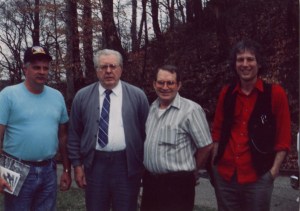
Lee "Trick" Gore (center, wearing tie) with Lawrence Haley and John Hartford (extreme right), Ashland, Kentucky, 1991.

Lee “Trick” Gore (center, wearing tie) with Lawrence Haley and John Hartford, Ashland, Kentucky, 1991.

Parkersburg Landing 45

03 Thursday Jan 2013

Posted by Brandon Ray Kirk in Ed Haley

≈ Leave a comment

Tags

Appalachia, Blackberry Blossom, civil war, Ed Haley, fiddler, history, James A Garfield, Jean Thomas, John Hartford, Junius Martin, Kentucky, Lawrence Haley, music, writing

     A few weeks after finding this article, Lawrence Haley called me with the news that he had found four more of his father’s records. These were not from the home recording sessions of the mid-forties. Instead they were from Junius Martin, a man who “ran with Pop some.” Martin had brought them to Lawrence in the late ’70s and traded them for a Parkersburg Landing album. I was extremely excited — what tunes were on these records? Were they dated? Lawrence said two of the Martin records, titled “Blackberry Blossom”/”Poplar Bluff” and “Bluegrass Meadows”/”Ox in the Mud” were dated December 1947. The other two, “Indian Eat the Woodchuck”/Unnamed and “Cabin Creek”/”Indian Eat the Woodchuck”, were undated.

     Inspired by the find, I read up on some history behind “Garfield’s Blackberry Blossom” in Jean Thomas’ Ballad Makin’ in the Mountains of Kentucky. According to Thomas, a French harpist named Christopher Columbus learned the tune from General Garfield in the Big Sandy Valley during the War Between the States. Upon returning home, he told his wife, “Americkee, I’ve learnt another tune! I ketched it from General Garfield his own self. The General whistled it a heap o’ times as he rode ahead of our troops right off yonder at the mouth of Big Sandy.”

     According to Thomas’ account, General Garfield heard Christopher Columbus play the tune on a harp one night at camp.

     “One night I was sent to his headquarters with a message and whilst I was waitin’ for orders I set down on the far end of the stoop and played a tune.  I had not played the piece oncet through till I hear-ed behind me a heavy tread and the clickin’ of sword agin’ boot top. I poked my harp in my pocket quick as I could and riz to my feet in salute. For there stood General Garfield his own self lookin’ down at me. ‘Let’s hear that tune again,’ said the General, as friendly as a private, ‘that’s my favorite tune though I can’t recall the name of it.’ With that, he [the General] let fly a stream of tobacco juice into a clump of blackerry bushes growin’ nigh the foreyard. The amber splattered all over the snow white blossoms on the bush and from then on we called the piece Blackberry Blossom.”

Parkersburg Landing

01 Tuesday Jan 2013

Posted by Brandon Ray Kirk in Ed Haley

≈ Leave a comment

Tags

Appalachia, culture, genealogy, Harts Creek, history, Jack Haley, Lawrence Haley, life, Liza Mullins, Logan County, photos, West Virginia

Jack Haley, Aunt Liza, Lawrence Haley, 1948-1953

Jack Haley, Aunt Liza, Lawrence Haley, 1948-1953

Parkersburg Landing 42

29 Saturday Dec 2012

Posted by Brandon Ray Kirk in Ed Haley

≈ Leave a comment

Tags

Doc Holbrook, Ed Haley, fiddle, history, J P Fraley, John Hartford, Kentucky, Laury Hicks, Lawrence Haley, Maysville, music, Sherman Luther Haley, Ugee Postalwait, Wilson Douglas, writing

     I met Lawrence a few weeks later at the Fraley Family Festival near Grayson, Kentucky. He gave me Ed’s newly located bridge and I showed him Ed’s fiddle — pointing out all of the things I had discovered about it. I specifically pointed out a “V-shape” pattern worn into the varnish on its back toward its bottom. At its top were what appeared to be “sweat marks” where Ed rotated the fiddle and slid his fingers up to get notes in second and third position (which contradicted what Snake Chapman had said about him rarely getting out of first position except when, every once in a while a finger would sneak and grab a note or two from the upper positions). As we talked about such things, J.P. Fraley showed up along with Nancy McClellan, a local folklorist.

     After some small talk, I played “Half Past Four” for Lawrence on his dad’s fiddle.

     “Where he got a name like that, I don’t know,” he said. “I think, though, it was possibly when my oldest brother Sherman Luther Haley was born. My mother went into labor about 4:30 in the morning. He was named after one of Mom’s brothers. It was the one that died.”

     I said, “Now, I’m not totally used to these Black Diamond strings and I’m not playing it note for note the way Ed did. I’m just scratching the surface.”

     Lawrence said, “I know. Them old records are hard to hear.”

     “There is so much on them records you wouldn’t believe what’s in there,” I said. “Just all kinds of little things. Like his notes, he gets certain long notes and they’re like words. Some of them are moans. And he uses certain little tones.”

     Lawrence said, “I notice a lot of you guys, it looks like it’s really hard work for you to do this. Pop never had a bit of trouble playing a fiddle. It wasn’t work to him. If he enjoyed the group he was with, you could absolutely hear it in his music. If he had good accompaniment, he’d stay all day.”

     “I’m also curious about that bridge because I think he might have played with a little bit lower action than what I’ve got here,” I said.

     Lawrence said, “Yeah, a little bit lower. You could look at that bridge I brought you.”

     I said, “Yeah, I’ve already had it on and looked at it. The thing that’s interesting about that is if you look at that bridge, that bridge has been handled a lot because he would feel of it and that’s why all that finger grease is on it. I can just see him. What I may do, I may try that on but what I might do is carve a duplicate of that because sometimes when they get old, they’ll crack.”

     Nancy McClellan asked Lawrence, “Were there other fiddlers in the family?” and he said, “No, I couldn’t play. I was left-handed and when I was a little tiny fella I nicked the whole end of this finger off and I didn’t have any meat on the end of it and that hindered me from picking a violin, see. I couldn’t work up a callus on it. Bone’s right underneath it.”

     You know, I’d never really thought much about that — the fact none of the Haley children played the fiddle. Ralph, of course, was a guitar player — but he wasn’t actually Ed’s son. It was only natural that the kids — no matter how intense their exposure or no matter their possible distaste — would at some point pick up a fiddle and at least try it. This had been Lawrence’s confession — and his reason for not carrying it any further.

     J.P. played a little on Ed’s fiddle and commented on the Black Diamond strings. “Have these strings been on there all that time?”

     “No,” I said.

     “Where’d you find them?”

     I said, “I’ve got a friend that used to carry them and he had a couple of sets and he gave them to me.”

     J.P. said, “I can remember when they was a quarter. Wonder what those fiddlers would have done if they’d had access to the strings and stuff that we can get now?”

     There was a little pause then J.P. said, “Remember I was telling you about a tune called ‘Maysville’? It had to do with Maysville, Kentucky. I don’t know where the people in Elliott County learned it. They was a tobacco house down there and those people had to wagon tobacco from back in Elliott County plumb to Maysville to sell it.”

     Lawrence said, “Pop played a lot of pieces named after…”

     J.P. interrupted, “Now he played ‘Maysville’.”

     Lawrence continued, “He played a piece of music that I really liked that he called ‘Catlettsburg’.”

     Lawrence said to J.P., who still held Ed’s fiddle, “That isn’t as fine a fiddle as you played that used to belong to my dad that the Holbrooks got.”

     J.P. said, “Paul’s got it. Well, what he done… That’s a good fiddle, too. He let me have it. I told him if he ever wanted it back… It was in the awfulest shape that ever was. But I had it fixed up. Not embellished now. Just restored. And suddenly Dr. Holbrook’s daughter was gonna take violin lessons. They took it. There’s something else he told me. See, I didn’t know the old Dr. Holbrook…”

     Lawrence said, “He’s the one delivered me.”

     J.P. said, “His son Paul — our doctor — told me that old man Holbrook went to fiddling, too. Well, Paul said that he supposedly took Ed and Ella to Columbus to do a record.”

     Lawrence said, “That was that ‘Over the Waves’, I think. Big aluminum record.”

     J.P. said, “It was the closest thing to a commercial record that Ed ever made.”

     Lawrence spoke some about his father’s travels.

     “Pop didn’t get all the way down into Old Virginia, I don’t think. He made it to Beckley and Bluefield and places like that. I can remember walking from Morehead to Farmers right down the railroad track. They went down there to somebody’s house to play — I was just a kid then — and seemed to me like they played all night.”

     Nancy McClellan said, “Well, that’s what Wilson Douglas said happened up there in Calhoun County, West Virginia. He said a fiddler named Laury Hicks would ask for ‘The Black-Eyed Susan’ and said Laury Hicks would sit there and cry while Ed Haley played.”

     I told about my recent visit with Laury’s daughter Ugee Postalwait and Lawrence said, “When Pop come around and they was playing, she’d get fiddle sticks and she’d just clog around Pop’s fiddle and every time he’d note it she beat the sticks on that. Dance right around him.”

Lawrence Haley and Aunt Liza

27 Thursday Dec 2012

Posted by Brandon Ray Kirk in Big Harts Creek, Ed Haley, Spottswood

≈ Leave a comment

Tags

Appalachia, culture, genealogy, Harts Creek, history, Lawrence Haley, life, Liza Mullins, Logan County, photos, U.S. South, West Virginia

Lawrence Haley with Aunt Liza, 1950-1953

Lawrence Haley with Aunt Liza on Harts Creek, 1950-1953

Parkersburg Landing 41

27 Thursday Dec 2012

Posted by Brandon Ray Kirk in Ed Haley

≈ Leave a comment

Tags

Ed Haley, fiddle, Harts Creek, history, John Hartford, John Hedgecoth, Lawrence Haley, Logan County, music, Nashville, Noah Mullins, Steve Haley, U.S. South, West Virginia, writing

     When I got back in Nashville, I ranted and raved over Haley’s fiddle before taking it downtown to John Hedgecoth, an instrument repairman. John and I went over its every detail. We fitted a bridge to it and put Black Diamond strings on it (the brand Haley supposedly used), then I brought it home and played on it for about two weeks. I focused on learning Ed’s version of a fabulous tune called “Half Past Four”.

     “It just sounds like a dream,” I said to Lawrence when I called him. “You play on it real light and it’s got that sound in it.”

     “Well, that’s great, John,” he said.

     “Now I had to put a chin rest on it and I am using a shoulder rest with it because that’s what I’m used to and I had to put tuners on it because I like to keep it in tune,” I said.

     “Okay. Well, that’s all right,” Lawrence laughed.

     I said, “I tell you what’s interesting about it. It looks like at one time the back had been taken off and re-glued.”

     Lawrence said, “Yeah, it got damp and the glue came loose on it and I guess that back warped or something. I don’t think it was completely off. Well, my son Steve had somebody down there in Nashville to repair it but that bridge — that thing looked real odd to me. I had an old bridge here. It’s in a drawer around here somewhere, I’d say, and I’ll look for it. I never really got it strung up since then. I just figured, well, there’s enough glue on that old fiddle that it ain’t gonna sound right anyway. If you use too much glue, you’re gonna lose a lot of the resonance in the wood.”

     I said, “Now, it also looks like at one time the neck was broken out of it and reglued.”

     Lawrence said, “Well now, it was not in the best of shape when Steve snuck it out of here. He took it out and had it repaired for me for a Christmas present. I just figured it’s gonna lay around here and just deteriorate again, maybe draw dampness some way or it’ll fall apart anyway. I just thought since you showed so much interest in it I’ll just let you have it.”

     I said, “Well, I sure appreciate that. One of the things… The fingerboard, when you look at it straight on, lays over to the right in a funny kind of an angle.”

     Lawrence said, “Yeah, that’s what I figured. I don’t remember it being like that. That fingerboard, it looked to me like it had some wear on it where my dad had fingered it so much. It looked like it had slight indentations from his fingers. I didn’t know whether it would fret right.”

     I said, “And also, the sound post is an inch back from where it ought to be.” I wasn’t sure if Ed had kept it there or not; I felt it likely that it had fallen over in the decades after his death and been misplaced by some half-wit repairman.

     I got Ed’s fiddle and played “Half Past Four” for Lawrence, who said, somewhat amused, “You’re trying to play one of his pieces. Sounds pretty good. Well, maybe some time down the line you’ll get that ‘Cacklin’ Hen’ down. It’s just working at it. And that fiddle does sound good from over the phone.”

     I said, “It’s got a little overtone in it that none of these other fiddles have and when I go back and listen to those tapes I hear that overtone in there.”

     Lawrence said, “Maybe you got a prize there. I don’t know. I think everybody agrees that you should have it. Steve seems to know more about you than what we do. I don’t know how he does but he’s a musician too, you know. He taught high school band for a while and he plays in a jazz band some. Plays the trumpet. His wife’s a musician. She’s a church organist — used to be. Two of the children… One of them’s in some kind of Nashville junior symphony. Plays the cello. The other plays the violin.”

     I told Lawrence I wanted to be sure and go back to Harts Creek in the fall and find out more about his dad’s early years there.

     “All right,” he said. “We’ll go back up there. I don’t think anybody up there, once they find out who you are will have any objections. One of my second cousins, Noah Mullins, he killed one of the revenuers that come up through there and that give Harts Creek a bad name, I guess. Those days are gone. I believe the second time up there everybody’d be glad to see you and talk to you like they were this last time. They won’t be any problem about that. People are a little suspicious if they don’t know who you are. But if they know you got a purpose and reason for being up there that isn’t detrimental to their causes they ain’t gonna jump you or anything or give you problems.”

Lawrence Haley and the Mullins Clan

27 Thursday Dec 2012

Posted by Brandon Ray Kirk in Ed Haley

≈ Leave a comment

Tags

Appalachia, culture, Ed Haley, Harts Creek, history, John Hartford, Lawrence Haley, life, Logan County, music, photos, Roxie Mullins, West Virginia, writing

Lawrence Haley (right) with Roxie Mullins and Family, 1991

Lawrence Haley (right) with Roxie Mullins and Family, 1991

In Search of Ed Haley 40

27 Thursday Dec 2012

Posted by Brandon Ray Kirk in Ed Haley

≈ 1 Comment

Tags

Black Sheep, David Haley, Ed Haley, fiddle, fiddling, history, John Hartford, Lawrence Haley, music, Nashville, Ohio, St. Clairsville, Steve Haley, writing

In Nashville, I spent several months working with Ed’s music and calling Lawrence Haley with questions and comments. I continued to study every intricate detail of Ed’s fiddling — supplementing it with recently learned facts about his life as well as devoting some attention to his songs. When I called Lawrence with questions about new “discoveries,” he said my visit to Ashland had inspired one of his granddaughters to take up the fiddle. I was very curious about that because of my belief in genetic memory. Who knew what secrets she had locked away inside her DNA? I told him I would bring her one of my fiddles the next time I saw him.

A few months later, I met Lawrence and his family at my show in St. Clairsville, Ohio. It was the first time Lawrence had seen me play on stage and I was ridiculously nervous. He listened intently from backstage and kept his criticisms to a minimum. He said his father played a lot faster than I did and really bragged on how Pop played the fiddle while singing, like with the tune “Black Sheep.”

In a quiet country town not very far away

There lived a rich and aging man whose hair was few and gray.

He had three sons, his only ones, Jack and Tom was sly.

Ted was honest as could be and could not tell a lie.

When we gathered on the bus, I gave Lawrence’s granddaughter one of my fiddles.

“Well I have something to give you, too,” Lawrence said before making a quick trip to his car. He returned with Ed’s fiddle, which he reached to me and said, “We brought something for you. We’re not using it and we know you would appreciate it and know its value.”

I carefully turned Ed Haley’s fiddle over in my hands.

It was a tremendously emotional experience.

“Are you sure you want to do this?” I asked.

Lawrence said he had talked about it with his sons Steve and David and every one agreed it was the right thing to do.

“I discussed it with the kids here,” he said. “David, he kind of showed a little bit of objection but I told him, ‘Well, John’s gonna bring a fiddle up here to Andrea. I just may as well turn loose of this one because it’s just gonna lay here and deteriorate. Why not let John have this one?’ He agreed to it. If anybody would’ve had any objections I think Steve would because his girls are both string instrumentalists. But they didn’t seem to mind too much so you got it and we won’t worry about it anymore.”

I immediately took Ed’s fiddle to my bedroom on the bus, put it in a case and laid it on the bed for safety.

Parkersburg Landing 39

26 Wednesday Dec 2012

Posted by Brandon Ray Kirk in Ed Haley

≈ Leave a comment

Tags

Appalachia, blind, Calhoun County, Ed Haley, Ella Haley, Harts Creek, history, John Hartford, Kentucky, Lawrence Haley, Milt Haley, music, Ugee Postalwait, West Virginia, writing

     The next thing I knew, Ugee was up at the stove cooking a big meal and singing “Maggie and Albert” — Haley’s version of “Frankie and Johnny”. When she was finished, she said, “Now that’s some old songs. Ed played them and when he played them, you’d be glad to sit and listen to them, too. And he patted his foot.”

     During dinner, Ugee told me about her own musical experience.

     “I started off on the five-string banjo then graduated myself to the guitar,” she said. “The first guitar that I ever seen, Howard Alexander brought it in the country. He’d been over to his mother-in-law’s around Rosedale and when he come back he brought a guitar. Howard didn’t play the guitar or banjo either. He come down and said, ‘Ugee, I brought you something. A guitar.’ And I said, ‘Well, I never tuned one of them things.’ I suppose I’d been playing the banjo about three or four years. Dad said, ‘Well, you tune the banjo. Go ahead and tune it up there.’ Howard said, ‘Aw, just keep it as long as you want to. I’m in no hurry fer it.’ He’d traded something for it. I forget what it was. I went to fooling with that guitar, you know, picking around with it, this that and another, running a knife down it. Well, I tuned it up like a banjo. First thing you know I found me a chord, and then Dad come in with a mandolin.”

     “We went to play music around at the schoolhouse and places like that for pie suppers and cake walks,” Ugee said of herself and her father. “My dad thought there wasn’t nobody in the world like me. Nobody could do like I could. We went to a place and played for a schoolhouse and the teacher down there… He was a Glenville graduate — you know, went to college and everything — thought he knew it all. He said, ‘Mr. Hicks, play ‘Soldiers Joy’. So Dad played it for him. Just as soon as he got done playing it, he said, ‘Mr. Hicks, play ‘Soldiers Joy’. Dad played it for him again. I think he played it about five times. By that time, Dad was getting tired of it. And he come there and said, ‘Mr. Hicks would you please play ‘Soldiers Joy’? Dad said, ‘Hell, I’ve played it for you five times and you didn’t know it when you heard it.’ Made Dad mad. Every once in a while, me and Dad’d be a sitting playing, practicing, you know, and I’d look over, I’d say, ‘Dad, would you please play ‘Soldiers Joy’?’ He said, ‘I’ll mash you in the mouth.'”

     Ugee said, “One time, a teacher taught at our school and he made me mad the way he treated me in school. He was having a doing going on at his school and Dad said, ‘I’m supposed to play at the White Oak School.’ And I went to the White Oak School. Well, me and Dad went over and I decided I wasn’t gonna play any music. When I sat down, the teacher said, ‘Oh, I’m so proud you come to play, Ugee,’ and just going on. I just reached down with my finger on that guitar and I broke that string. Dad reached down in his pocket and pulled out another one and said, ‘Now put that on and don’t you do that again, either.’ I never will forget it as long as I live. Jasper McCune was playing the five-string banjo. He was Dad’s first cousin. He said, ‘Why don’t you do that again, Ugee? Laury’ll slap your ears, too.'”

     After supper, I asked Ugee what she knew about Ed’s blindness.

     “They said Ed went blind when he was three or four years old. He had the measles. Well, he was sick and had a high fever. I don’t know whether you ever knowed it or not but the gypsies used to come around in the country and he had a high fever and they told his dad and them to take him down to the creek and throw him in the cold water and that would break the fever on him and he’d never have a fever again. And that’s what he done and it put him blind. But you know measles will put you blind because I almost went blind too when I had the measles. I was about twelve years old. And that’s what Ed said that put him blind. I asked him, I said, ‘Was you born blind?’ He wasn’t.”

     Ugee said Ed occasionally talked about his father — a growing source of interest for me — although she didn’t remember much about it.

     “I think his dad was a pretty mean man, the way he talked. And the way I understood him to say his mother got killed by some of them Hatfields and McCoys or some of them when that feud was going on. But I believe he said his dad was a pretty mean man. I don’t know what he meant by that. I never did hear what happened to his dad. I never heard him say about that. I believe he said he was raised by a aunt.”

     I told Ugee about Lawrence and I going to Harts Creek and she said, “Lawrence, he was little all the way around. He thought an awful lot of his dad and mother. Larry’s the only one that turned out real good. Noah, he gambles and I don’t know what all. And Clyde, he’s been in a little bit of everything. Mona’s been the same way. Poor old Larry, he’s looked after all of them. He don’t care whether he hears from them or not because every time he hears from them it’s money or have to help them out or get them out of something. Jack died. Jack was a nice looking man, too. He was taller than Lawrence. He was a nice boy like Larry.”

     I asked Ugee if she thought maybe some of Ed’s kids took after his father Milt, who she called “a pretty bad feller.” She said, “I have an idea they did. And I heard Ed say one time that Ella had some awful mean people on her side. He said Noah was turned just exactly like his mother’s people. They was a lot of mean people down there in Kentucky. Lot of murdering and lot of killing.”

Parkersburg Landing 34

20 Thursday Dec 2012

Posted by Brandon Ray Kirk in Ed Haley

≈ Leave a comment

Tags

Akron, Calhoun County, Ed Haley, history, John Hartford, Johnny Hager, Laury Hicks, Lawrence Haley, music, Ohio, Rector Hicks, Ugee Postalwait, West Virginia, writing

     By some accounts, Dr. Lawrence Hicks was Ed Haley’s best friend. Hicks was a well-known fiddler who practiced veterinary medicine in Calhoun County, West Virginia. Ed thought enough of Hicks to name his youngest son after him and, according to Parkersburg Landing, came to play the fiddle at his grave when he died in 1937. With Lawrence Haley’s encouragement, I telephoned Ugee Postalwait, a widow of advanced age and the only daughter of Dr. Hicks. Ugee (pronounced “you-gee”) was a resident of Akron, Ohio — one of those industrial towns flooded by job-seeking mountaineers some four decades ago.

     “I’m a friend of Lawrence Haley’s in Ashland and I’m very much interested in his father, Ed Haley,” I told her. “I was just visiting with Lawrence and he said you knew him real well. I was wondering if you would tell me about him.”

     “Well, I don’t know what you want me to tell you about,” Ugee said. “My dad and him was two of the finest fiddlers I ever heard. My dad’s name was Laury Hicks. Well, Lawrence was his name but they called him Laury. A lot of them called him Dr. L.A. He was a veterinarian, but he was a fine fiddler. Him and Ed were very close friends for years and years — ever since I was a little girl. They was both born in 1880. They loved each other. And Mom and Ella got along the same way. Mom was born in 1882. She lived to be a hundred years old. She played the organ. She was a good singer.”

     I said, “Now, there’s a story on that album where Ed went to this grave and played over it. Was that your dad?”

     “Yes,” she said. “They was talking one time, whichever one died first the other one was supposed to play the fiddle at their funeral. Dad requested that he play ‘When Our Lord Shall Come Again’ and said that he wouldn’t meet his Lord in the air until Ed played. Dad died on the 18th day of January in ’37 but Kentucky and Ashland was under water. The water was up so high in ’37 that Ed and Ella couldn’t get there until after that and they played the song that dad requested.”

     I asked Ugee where all that went down and she said, “Dad’s buried up there at the home place on Route 16 in Calhoun County between Chloe and Stinson — as you come up from Arnoldsburg. Him and Mom and my brothers.”

     Calhoun County, I discovered, is a rural spot wedged in the backcountry between the Little Kanawha and Elk rivers northeast of Charleston, the state capitol. It is some 75 miles away from Haley’s birthplace on Harts Creek, at least as the crow flies. In Ed Haley’s time, it was a real hot bed of musicians.

     I wondered if Laury Hicks made any recordings. No, Ugee said, although his fiddle was still around. She gave it to Harold Postalwait, her son in Rogersville, Alabama.

     “He just had it refinished and everything,” she said.

     Ugee’s memories were warming up: “Ed and Ella and all the family used to come stay at our home — not for days — but for maybe months. We had some beautiful music there. I tell you, they ain’t nothing that I’ve ever heard on the TV or any place else to beat Ed Haley and my dad playing the fiddle. Ed Haley was one of the best I ever heard. Well, I thought my dad was too, but Ed was smoother. I’m always glad to talk about Ed Haley. He’s the only one that I ever heard where my dad would play and he’d second on the fiddle. Like, you’re singing a song and somebody singing alto behind it.”

     I told Ugee what Lawrence said about Ed being able to play the banjo and she agreed. “Ed could play a guitar like crazy, too. There’s where Ralph learned to play a guitar — Ed learned him. And Ed could play a mandolin, too. He could play any kind of music, anything that had a string. Now Dad could thump a banjo a little but he wasn’t what you’d call a banjo player.”

     Ugee said, “I wish you coulda been around through that country back when I was a girl a growing up so you coulda heard the music that was in that country. They really had good musicians. Rector Hicks, he was a cousin of mine, born and raised right across the hill. That was Clay Hicks’ boy. He used to come over and Dad would learn him to play. He lived across the hill on White Oak and there’s where Ed and Ella went all the time to visit.”

     I wondered if Rector was still around and she said no — that he had died a few years ago in 1989. She promised to talk with his widow in Akron, who supposedly had recordings of his music. Maybe such recordings would provide clues about Ed’s fiddling.

     I asked Ugee if she ever met John Hager, the banjo-player shown with Ed in the White Sulphur Springs photograph.

     “Oh, I sure did,” she said. “Played the banjo. They stayed at our house one whole winter, Ed and John, and then the next time that Ed come back he had a fella playing the guitar with him. I can’t think of his name but I can see his face. Ed was a tall slender fella then.”

     I invited Ugee to my upcoming show in Akron but all I could get out of her was, “I’m always glad to talk about Ed Haley. And Lawrence, you can’t meet a nicer person. He was named after my dad. And his wife is an awful nice person. I hope I can get down to see them this year. Nice talking to you because nobody loves to watch you any more than I do on TV.”

Parkersburg Landing 32

17 Monday Dec 2012

Posted by Brandon Ray Kirk in Ed Haley

≈ Leave a comment

Tags

Al Brumfield, Appalachia, Charles Wolfe, Ed Haley, Green McCoy, Harts Creek, history, John Hartford, Kentucky, Lawrence Haley, Milt Haley, music, Paris Brumfield, West Virginia, writing

     I was elated the entire trip home. As soon as I got back in Nashville, I called Dr. Wolfe and said, “I don’t even know where to begin to start telling you everything. I’ve got records and I got leads on where the rest of the recordings are. They just took me in and everything and as I got ready to go they gave me one of his canes for a souvenir. I’ve held one of his fiddles in my hand and looked at it. Now the other thing that Lawrence let me bring back are his reel-to-reel dubs of everything the Library of Congress has. There’s a bunch of tunes on there we haven’t heard: ‘Sourwood Mountain’ and ‘Dora Dean’.

     “Yesterday we went up to Harts Creek in West Virginia, his birthplace. He’s a West Virginian; he’s not a Kentuckian. And in fact, Lawrence, because of the way his dad was treated when he was alive around Ashland, says he prefers to think of him as being a West Virginian. Lawrence, being the youngest of the five brothers, he’s kind of the keeper of the flame more or less. I think being around him I really get a flavor of what the old man was like. Even when we went up into Harts Creek, why the old-timers up there said he talked just like Ed.”

     Dr. Wolfe asked me what my intentions were and I said, “I think what it amounts to is doing everything we can to preserve the music and the history because the story is incredible.”

     I wasted little time in listening to all of Ed’s recordings on a reel-to-reel player borrowed from Doug Dillard. It was an incredible experience. I thought I’d died and gone to heaven. I immediately focused in on Ed’s recording of “Brownlow’s Dream”, the tune Roxie Mullins said was Milt Haley’s last tune. It was an amazing four part version of a tune I had learned from Elmer Bird called “Jimmy Johnson”. Lawrence had recalled his father singing, “Old Jimmy Johnson bring your jug around the hill. If you can’t bring your jug, bring your still if you will.” Not long after going through the reels, I took them to Bruce Nemerov at the Center for Popular Culture in Murfreesboro. I had promised Lawrence I would get him good copies.

     A few weeks later, Dr. Wolfe called me with news of an old West Virginia ballad that mentioned the name of Milt Haley. It was titled “A West-Virginia Feud Song” and published in Professor J.H. Cox’s Folk-Songs of the South (1924). T.M. Martin of Marlinton, Pocahontas County, West Virginia, informed Cox about the tune in 1916, while S.S. Workman of Seebert, West Virginia, was the source for events surrounding it.

     “The fight, out of which this song grew, occurred, as near as he could remember, in 1890, at the house of George Fries, eleven miles east of Hamlin, Lincoln County, and the trial took place at Hamlin,” Cox wrote. “The trouble between the factions was of long standing. The McCoy mentioned was a close relative of the McCoys that fought with the Hatfields. George Pack helped Mr. Workman get this song together. They never saw it in print.”

     Events chronicled in the song lyrics seemed to be about Ed’s father, who was reportedly killed with a McCoy, but the account was so confusing that I really wasn’t sure.

Come all you men and ladies, and fathers and mothers too;

I’ll relate to you the history of the Lincoln County crew;

Concerning bloody rowing, and a many a threatening deed;

Pray lend me your attention, and remember how it reads.

It was all in the month of August, all on a very fine day,

Ale Brumfield he got wounded, they say by Milt Haley;

But Brumfield he recovered; he says it was not so,

He says it was McCoy that fired that fatal shot.

Two months have come and passed, now those men have met at last,

Have met at George Fries’ house, at George Fries’ house at last;

McCoy and Milt Haley, it’s through the yard did walk,

They seemed to be uneasy, with no one wished to talk.

They went into the house, sit down by the fire,

But little did they think they had met their fatal hour.

As the mob came rushing on them, the ladies left the room;

A ball from some man’s pistol lay McCoy in his tomb.

They shot and killed Boney Lukes, a sober and innocent man,

And left his wife and children to do the best they can;

They wounded old Ran Sawyers, although his life was save[d];

He seems to shun the drugshops, since he stood so near the grave.

Tom Feril was soon arrested and confined in jail;

He was put in jail in Hamlin to bravely stand his trial;

The Butchers threatened to lynch him, and that was all his fears;

The trial day it came on, Tom Feril he came clear.

There is poor old Perries Brumfield, he died among the rest;

He got three balls shot through him, they went through his breast.

The death of poor old Parris so lately has been done,

They say it was a hired deed, it was done by his son.

So go tell the nation around you it will never, never cease;

I would give this whole world around me to reach my home in peace;

In the bottom of a whiskey glass there is a lurking devil dwells,

It burns the breath of those who drink it and sends their souls to hell.

In Search of Ed Haley 31

16 Sunday Dec 2012

Posted by Brandon Ray Kirk in Ed Haley

≈ Leave a comment

Tags

Appalachia, Arthur Smith, Ashland, Cincinnati, Clyde Haley, Ed Haley, Ella Haley, Hamilton, history, John Hartford, Kentucky, Lawrence Haley, life, love, Milt Haley, music, Ohio, Pat Haley, ragtime, Ralph Haley, Roxie Mullins, Scott Joplin, Sugar Foot Rag, writing

Back in Ashland, Lawrence and I told Pat all about our trip to Harts Creek. We had some great photographs — including the one of Ed’s mother — and all kinds of new information. One of the first things Lawrence did was joke Pat about seeing “that funny boy” who nearly scared her to death forty years ago. I told her about Milt Haley’s murder, the possibility of Milt having been a fiddler and about our interview with Roxie Mullins. Lawrence liked the story about his father breaking a fiddle over someone’s head, although it kind of bothered me to think he would do such a thing.

At some point during the evening, Pat suggested showing me Ella’s postcards, but Lawrence quickly dismissed the idea. I could tell there was something in those postcards he didn’t want me to see, which of course only peaked my curiosity. It was clear by his negative response, though, that the issue was closed so I didn’t mention it again.

Instead, I pelted him with very specific questions about his father. I wanted to know how Ed Haley felt about different types of music.

Did your dad like the Blues? I asked.

“I guess he liked, uh, Joplin,” Lawrence said. “He liked a lot of that ragtime. ‘Sugar Foot Rag’, he liked that.”

What about something like Hank Williams?

“No, I don’t think he cared too much for that.”

Otis Redding?

“Well, he might have liked some of it.”

How about Dixieland Jazz, somebody like Louis Armstrong?

“No, not too much of that.”

How about bluegrass?

“No, he didn’t like that.”

How about Arthur Smith?

“That was a fiddler, and he had nothing for him, I reckon.”

Clayton McMichen?

“Well, I never have heard him mention him.”

How about Georgia Slim Rutland?

“I really can’t remember him ever mentioning that guy, either.”

Did he ever know about Benny Thomasson or Major Franklin or any of those Texas fiddle players?

“John, I wouldn’t say one way or the other,” Lawrence finally said. “It’s just like you keep asking me, did he play this tune, did he play that tune? I guess my best answer whenever you started that shoulda been what didn’t he play in the way of this old-time music. And that’s the same way, who didn’t he know if they was into that and they was around this area he probably found out about them.”

Early the next morning, Lawrence and I went to see Ed and Ella’s graves in Ashland. Along the way, I asked him if he remembered all the places where his father had lived in town.

“Aw, we lived in half a dozen different places,” he said. “All we did was rent. We lived in a couple down on Greenup Avenue, 10th Street, 22nd Street. Then we lived in one on Halbert and about three different ones on 45th Street and one up on 37th Street. That’s about it.”

None of Ed’s former dwellings were still standing.

Lawrence told me about the time his brother Clyde almost got married: “That’s one of those deals where I told you he was afraid of women. He was courting a lady up in Detroit or somewhere and she told my sister-in-law, Patsy — Jack’s wife — said, ‘He run off and left me practically at the alter. We had made all the plans and everything.’ Next thing we knew, he was working on a platform out in the Gulf of Mexico out of Louisiana. I don’t know where he was when Mom passed away.”

After we got back to the house, Lawrence explained why he’d ruled out showing me his mother’s postcards the night before.

“Some of the old postcards that Mom used to receive kinda had a flavor of real broken love,” he said.

They also revealed that Ralph Haley actually belonged to Ella by a previous marriage.

“I don’t know what his name was, her first husband,” Lawrence said. “Apparently it was somebody that she met either in school or after she come out of school and went back to Morehead. I think Ralph was born around 1914, ’15, somewhere along in there, ’16. He was approximately ten years older than me, twelve at the most.”

For the first time, I thought, Lawrence was opening up about his mother. He said she used to type letters to her friends.

“She had a friend, I guess she must have been pretty well Irish. Her first name was Bridget. I don’t remember her last name. She never married. She went into a home and kept people up at Hamilton, Ohio. Every time we went to Cincinnati, Mom wanted to go see her.”

I listened quietly before saying, “I wonder what happened to your mom’s letters? I bet they would tell a lot of history.”

Pat said, “They probably would but it would mostly be my mother-in-law’s. You know, her life.”

I said, “But women invariably talk about their husbands a lot,” and Lawrence agreed.

“Women can pass along more information between them in five minutes than two men can all day long,” he said.

Still, he never offered to show the cards so I just kind of left it at that.

Just before I headed back to Nashville, Lawrence reached me his father’s walking stick. “Here’s something I think you’d like to have,” he said. He also loaned me the four Library of Congress reel-to-reel tapes, containing over 100 recordings.

Parkersburg Landing 30

15 Saturday Dec 2012

Posted by Brandon Ray Kirk in Ed Haley

≈ Leave a comment

Tags

Ed Haley, feud, Harts Creek, history, John Hartford, Lawrence Haley, Milt Haley, music, Peter Mullins, Ralph Haley, Roxie Mullins, Ticky George Adams, West Virginia, writing

     It was clear to Lawrence and I that Roxie really knew her stuff. Her memories went back to the Bull Moose era — some twenty years before Lawrence’s — and while they were a little hazy they were clearer than anything else we had heard up to that point. I think Lawrence was satisfied with Roxie’s stories but maybe a little intimidated because she just knew things about his father that went beyond his years. He really wanted to keep everything we heard about his dad in this certain context and someone like Roxie could really just carry it outside of his realm of knowledge.

     “John keeps asking me about my dad,” he said. “I told him I couldn’t tell him too much about my dad, because half of his life was over before I was ever born.”

     That got Roxie going again.

     “All of his fun days was all over. I know he played music right on, but I mean all of his fun — when he married, he laid down part of it.”

     Roxie caught Lawrence and I off-guard when she said Ed tried to get a local preacher to baptize him one time. “He joined the church once down on the hill with Cecil. And Uncle Charley Curry said, ‘Ed, will you lay down your music?’ and Ed said, ‘No, Uncle Charley. That’s the only way I’ve got to live is my music, but I can just play sacred songs, good songs.’ And Uncle Charley said, ‘Now listen, you’re drunk. You go off and get sober and come back to me tonight. I’ll take you in but I can’t take you in like you are.’ Sure did. Ed shook hands with him but I don’t guess he ever went back.”

     Lawrence said, “Well, that’s news to me. I’m not sure he was ever baptized. The only baptism he got was Milt Haley’s baptism, and that didn’t amount to much.”

     That got us to talking about Ed’s father again. I really wanted to know why he was killed, but Roxie had no idea.

     “I don’t know why they killed him, son. They was just all into it. Now, Aunt Liza coulda told you all about it.”

     She looked at Lawrence and said, “You’re like me. You waited too long to come to talk to any of his people to find out anything about it. All the old people’s dead, you see, and gone. My mother, she was a Hager, and her mother went to the Western States and died there and was buried on the banks of the Wabash River. Uncle John told us — he was with her. He said she just lived there six months till she died. I know who my grandmother was — she was a Baisden — but I don’t know a thing on earth about my grandmother, and I don’t know nothing about Joe — that’s my grandpa — nothing about who he was, who his brothers was. Daddy died in ’40 and my mother died in ’42. I’m the only one that’s living. I can’t go ask nobody nothing. People never ask nobody nothing when they’re young.”

     Lawrence agreed, “That’s right. That’s exactly why I didn’t find anything out. You’re just young, happy to be alive.”

     Roxie’s mind was still on her father, Ticky George Adams.

     “My dad could play the accordion,” she said. “He could play ‘The Golden Slipper’ and he could play ‘John Morgan’. He could play ‘John Henry’. He could play just anything he wanted to play and how he learned it I just don’t know. And ‘Old Joe Clark’, that’s another one he could play. ‘Nelly Gray’, that’s another one he played. He could make them ring.”

     I asked Roxie if Ticky George ever played with Ed.

     “No, he never played with Ed. He wouldn’t let Ed hear him play, I guess. He could really play and sing. He had a song he sung. ‘Nothing Between My Soul and Heaven’ is the name of the song. They was four verses to that and buddy he could sing every word of that, and how he learnt that I don’t know. He couldn’t read. He didn’t know his letters.”

     Roxie told us about her uncle Peter, saying, “Uncle Peter, you know, was a crippled man. His foot was turned backwards. When he bought him a pair of shoes, he had to cut the toe off here and sew it up, and his foot turned back in here.”

     I said to her, “And that’s the man that raised up Ed Haley?” and she said, “Yeah, he helped raise him. He stayed with Uncle Peter’s fellers and Grandma and Grandpa Jackson. See, she was married twice. When John Adams was killed, she married Andrew Jackson Mullins, and he kept Ed a long time, him and her. And he stayed with us. He just stayed with first one and then another. Wherever he wanted to go, he went. He was just his own boss.”

     Okay, so the Jackson Mullins I’d heard about from Bum was Ed’s grandfather and the John Adams involved in Weddie Mullins’ death must have been a Jr.

     I asked Roxie if she knew how old Ed was when he stayed with his grandparents and she said, “Well, when he was with Grandpa and Grandma Jackson, he was a young man. I guess he was twenty years old, maybe more. Grandpa and Grandma kept him a long time, and then he stayed with Uncle Peter and Aunt Liza. And he stayed with us some every now and then. He come and stayed with us two or three days at a time — with John and the boys. He musta left here about the age of thirty and went to Ashland, Kentucky. West Greenup, Kentucky, is where I wrote to them. I wrote to Ralph, Ralph wrote to me. Man he was smart, I’ll tell you that. Take anything you wanted to ask him about the books.”

     Roxie bragged on how smart Ella was, saying she tried to get her to move to Kentucky with the Haleys.

     “She graduated from college, she told us. She said The Pied Piper of Hamlin – they’s eight pages of it, on both sides. She’d beg me and Annie to go home with her and said she would learn us to play the piano. Man she could make that harmonica… Listen, she could put it in her mouth and she had things fastened under here. She didn’t have to have her hands on it. Man she’d just run that mouth over that the best you ever heard in your life. She played that mandolin right along with her fingers and then had that harp in her mouth.”

     Right before Lawrence and I left Roxie’s, she asked my name again and said she’d be watching for me on Hee Haw. She said Roy Clark used to come through “back when he was a chunk of a boy,” but Violet said she was confused — that it had been Roy Acuff.

     “That was back when he traveled through here some. He had some people or something that lived up on Buck Fork.”

     To say that Lawrence and I were blown away by our experience with Roxie would be a huge understatement. Lawrence had never heard anything about his grandfather being murdered. Maybe Ed had wanted to distance his kids from that part of his painful past on Harts Creek.

In Search of Ed Haley 29

14 Friday Dec 2012

Posted by Brandon Ray Kirk in Ed Haley

≈ Leave a comment

Tags

Appalachia, Brownlow's Dream, Ed Haley, feud, Harts Creek, history, John Hartford, Lawrence Haley, Logan County, Milt Haley, music, Roxie Mullins, U.S. South, West Virginia, writing

     Roxie wasn’t sure how Ed learned to play the fiddle.

     “It was just gifted to him, I guess. Lord man, he could make that fiddle talk. He had one song he sung, I’d give anything in the world to know it. If I could remember now… Man, it was really pretty. People’d ask him every now and then to play it but man listen, he got mad if you asked him to play again something when he got tired. He’d get tired. He’d say, ‘I ain’t no steam engine.’ He’d jump up man and maybe get a knife man and go to quarreling with a knife. Yes, sir. He told me, he’d say, ‘I ain’t no steam engine.’ And your mommy man she stayed with us some.”

     I asked Roxie if she remembered Haley playing at any dances on Harts Creek and she said, “Well, I don’t know. We never had many dances around here nowhere. He always played away from here. He went several places — big dances, you know — dance halls and played. We had a few little dances here, but he never was at them.”

     Roxie remembered Ed playing “Blackberry Blossom”.

     “Yeah, Lord he could play that, and he could play anything on earth you named to him. Anything. He played the ‘Brownlow’s Dream’. I could pick it on a banjo when I was young, but I ain’t picked none in a long time, honey.”

     I offered Roxie my banjo to see if she could play out any of “Brownlow’s Dream” (I’d never heard of it), but she said, “I belong to the church now and I don’t fool with no banjo or nothing like that.”

     I asked if she remembered Ed playing the banjo and she said, “I never did see Ed play no banjo. Uncle John Hager’s the one played the banjo. He run around with Ed a long time. I’ve got his picture a sitting in there. He was funnier than a monkey.”

     I asked Roxie more about Haley’s tunes.

     “Ed would play ‘Old Joe Clark’, you know, and pluck up on them strings. He had one he played he called ‘Devil in the Yearlings’. I don’t know what it was, but boy he could pluck up on them strings and Ralph would jump up. That little boy’d hop up and dance. Man he beat anything I ever seen in my life a dancing. Ralph was about eight years old or ten when they was at our house — Ed and his wife. First time we ever seen her. And they stayed two or three nights with us then they went to Uncle Peter’s and stayed all night. And that woman really had them trained. She had a whistle she could blow. Didn’t matter where they was at buddy, they’d come up in line.”

     I asked if Ed played “Ragtime Annie” and Roxie said, “‘Ragtime Annie’ — I heard Bernie Adams talk about that, but I don’t know whether Ed played that or not. Can you play ‘Red Wing’? That’s one of his tunes. ‘Blue-Dressed Girl’. He had something another about ‘Blue-Eyed Beauty’. Aw, he played all kinds of tunes. He’d tell us the names.”

     Talking about Ed’s tunes caused Roxie to say, “‘Brownlow’s Dream’ — it was the last tune his daddy ever played on the fiddle. Ed told us that. Right down there in Hugh Dingess’ house they was kept upstairs till they took him to kill him. French Bryant was the man that was in it — he’s dead. They said they was thirty of them, man, a whole mob of them that killed him. They was afraid of him, you see, because he had a pretty bad name.”

     I asked Roxie how Ed’s father was killed and she said, “Beat them to death, I reckon, ’cause they said the chickens was running through the yard and a pecking their brains laying in the yard. That’s what people told us children when we was little.”

     Listening to Roxie tell all these tales found me wondering about her life. I asked if she’d lived “here” — meaning Harts Creek — all of her life and she said, “No, Lord, no. We’ve lived different places. We lived across the creek there over yonder on that bank. George Baisden’s home, I bought there and lived there awhile. Moved out here on a point and the State came in and told me they’d have to condemn me if I didn’t sell to them and move out. Well, I just sold it to them and bought this then. When Floyd left me — he left me in 1940 — I been a widow woman since that. I’ll soon be 86. I didn’t have no divorce from him, and I got his railroad retirement. That’s all we had to live on. He’s been dead now — he died in ’86 — and his woman he left here with’s been dead fifteen year or sixteen, about eighteen. She didn’t last very long. I told them the Lord don’t let things prosper like people thinks they will. The Lord has blessed me a long time to live a man’s life and a woman’s life, too. I’ve raised three children myself and helped Violet raise her three.”

     At that point, I heard Violet singing to Lawrence off in the corner. She said it was one of Ed’s tunes, “The Drunkard’s Hell”, then sang it again for me, this time with Roxie:

     I started out one stormy night

     To see my poor neglected wife.

     I found her weeping by her bed

     Because her only babe was dead. 

     I started out one stormy night.

     I thought I saw an awful sight.

     The lightning flashed, the thunder rolled

     Upon the poor old drunkard’s soul.

     Roxie stopped and said, “We can’t remember it. You might find that in libraries in books or something another but honey we don’t know it. It’s been fifty or sixty years since he sung that to us.”

In Search of Ed Haley 28

13 Thursday Dec 2012

Posted by Brandon Ray Kirk in Ed Haley

≈ Leave a comment

Tags

Appalachia, blind, Cecil Brumfield, Chloe Mullins, Cleveland, Clyde Haley, Ed Haley, fiddler, Harts Creek, history, Jack Haley, John Hartford, Lawrence Haley, Liza Mullins, Logan County, Mona Haley, music, Noah Haley, Ohio, Peter Mullins, Ralph Haley, Roxie Mullins, Turley Adams, U.S. South, West Virginia, writing

Roxie seemed very interested in Ed Haley’s kids, saying, “I know now they was Mona and Clyde and Ralph and Jack.”

Lawrence said he was the “baby boy” and Roxie realized for the first time that he was Ed’s son…not me. She got real tickled and said, “I believe you was about four or five years old when you was at my house.”

He told her, “May have been, ’cause I came up here until I was about nine years old. Just about every summer, it seemed like, we come up here.”

Roxie wanted to know about the others.

Lawrence said, “Clyde is still living. He lives in California. When he quit running the country, he settled down in California.”

As for the other boys: “Jack worked as a millwright at a steel mill in Cleveland.  Noah’s in Cleveland, too. They both went up there after they come out of the service. Had a depressed time just after the war. Jack worked for a while here but that little factory closed up so about a year and a half later he went to Cleveland and got on at a steel mill up there as an electrician and worked his way up as a millwright. They say he went into work that day and he punched his card, then he had to walk to his workplace — which was a pretty good ways away — and he hadn’t even got out of the time-clock building, and he just fell over dead. Massive coronary or something.”

Roxie thought Ralph had hung himself, but Lawrence said, “No, he was out picnicking and was kinda grandstanding. You know he could take a run-a-go and do a flip-flop and land on his feet — that kind of stuff. Well, somebody was gonna take a picture of him, and he got up on this tree limb and hooked his toes over it and he was hanging straight down from his toes and he was gonna let go and flip over and land on his feet before he hit the ground. But he didn’t make it: he hit the back of his head and broke his neck. He thought he was still a young man, you know.”

Roxie’s memories of Ed went pretty far back into his life — even before his marriage. She tried to describe him for me.

“He dressed nice. Man, Ed was as clean as a pin — wore nice, clean clothes. To be a blind man, he kept hisself just as clean as a pin. I never did see him dirty. Kept his hair combed pretty and neat. Ed’s eyes looked awful bad — he wore glasses over them. We never did talk much with him. He was kindly strange to us. You see, us girls was kindly shy. We weren’t used to him. He always had a big bunch of men around him. We just listened. He wasn’t no crazy fellow, I wanna tell you that. He was smart in the Bible. He told us all about the wars, Armageddon and stuff, and about these bombs.”

I asked Roxie if she remembered the first time she saw Haley play the fiddle. She said, “Oh, I don’t know. I guess I was about eighteen years old when Ed and Uncle John played at our house. Then they left here and went off, you know, to stay awhile. They’d come back every now and then. Uncle John played a banjo and Ed played the fiddle. Boy, they could really play.”

I asked if Ed sang back then.

“Yeah, he sung,” she said. “Now, he asked Cecil… He said, ‘Cecil, I’d like to ask you something, but I don’t want you to get mad.’ He said, ‘I would like to know if you know the song about John Brumfield?’ And Cecil said, ‘Yes. I’d like to hear you.’ And Ed said, ‘All right.’ Ed played it for him. And Cecil’s daddy was the one they killed, but Cecil liked Ed. He knowed they’s just all drunk, you know, just like people now a getting dope and a killing each other.”

Roxie’s mind rolled back through the years, leaving Lawrence and I to just sit there listening to her stories. Each passing moment sent chills up the back of my neck. It was apparent that she’d known Ed very well.

“He stayed with us a whole lot, Ed did. Off and on, he stayed with Grandma and Uncle Peter and them. Grandma lived down there where Turley lives now. And they had a sheep in that field, you know? Ed kept going from Grandma’s house up to Uncle Peter’s and Aunt Liza’s house. They told him, they said, ‘Ed, that ram’s a going to kill you.’ He said, ‘No.’ He said, ‘I’ll take care of that ram.’ One day he started up through there and that ram went to bellering, you know, and run at him and butted him and he catched him by the head and slung him. He said, ‘If you don’t stay away from there, I’ll get my knife out and cut your head off.'”

Roxie laughed remembering the stories.

“Lord, he told all kinds of tales on hisself,” she said. “You woulda laughed till you woulda died if you’d heard him telling tales on hisself. He told about being at Uncle Peter’s and they was having a dance up at Jeff Baisden’s and he said he took a notion to go along in the night. He’d slept till about 9 or 10 o’clock in the night. Uncle Peter had a garden and a barn and had a lot of cattle laying out around that barn. And he went out there, he said, to that barn and aimed to climb up over a big high fence and jump out when he jumped out right astraddle of a steer. And said that thing jumped up and him on it backwards and took up that holler a flying, and said he hung right on to him till he got to the waterfall and said when he got to the waterfall, he fell off. Said he was drowning when he went on up there, and said they said, ‘Ed, what are you doing so wet?’ He said he said, ‘Well,’ said he’s riding and got in the water and couldn’t see it. He would’t tell them about the steer.”

Roxie implied that Ed took any mishaps or practical jokes in stride.

“Lord, he told all kind of tales on hisself, honey. They cut trees and put him in logs and would start him at the top of the hill and roll him into the bottom and bump to bump to bump to bump, you know, and man just skinned him all over. They played all kinds of tricks on him. Why, he’d just laughed till he died about it. He didn’t care.”

Parkersburg Landing 27

11 Tuesday Dec 2012

Posted by Brandon Ray Kirk in Ed Haley

≈ Leave a comment

Tags

Appalachia, crime, Ed Haley, feud, Harts Creek, history, Imogene Haley, John Hartford, Lawrence Haley, Logan County, Milt Haley, music, Roxie Mullins, West Virginia, writing

     From Enslow’s, Lawrence and I drove out of Trace Fork and up Harts Creek to find the home of Turley’s aunt, Roxie Mullins. We stopped to see Louie Mullins, a grandson to Uncle Peter, who said Roxie lived just up the creek and to the right, kinda down under the road. We thanked him for directions and drove on until we turned off onto a rough driveway with jutting rocks and an intimidating grade leading down to a small wooden dwelling with a chicken house built almost against it. We had found Roxie’s.

     At the front door, Roxie and her daughter Violet greeted us and told us to come on inside. As we made our way, Lawrence motioned toward me and told Roxie, “This man would like to talk to you for a few minutes about my dad if you can tell him anything. He wants to know from me and I tell him that I don’t know anything about Ed Haley.”

     Violet said, “Sit down over there on the couch Mommy and he can sit down with you and talk to you and that way you can hear him.”

     I planted myself beside of Roxie — a tiny wisp of a woman weighing no more than ninety-five pounds who was dressed in an old-timey brown dress with a white butterfly collar.

     I told her, “I just want to know everything I can find out about Ed Haley,” and, thinking that I was Lawrence, she began to talk to me in a high-pitched, thick mountain brogue.

     “Well honey, I don’t know too much about him. I just know he was Ed Haley. And Emmy Mullins, she was my daddy’s half-sister. And Milt Haley married Emmy Mullins and she and him was Ed’s father.”

     I asked Roxie if Emmy had any children aside from Ed and she said, “I don’t know as she had any other child. I reckon that’s the only one they had. If they ever had any more I never heard nothing about them. Milt Haley was his daddy. They was Emmy and Weddie and Peter was my daddy’s half-brothers and sisters. And Emmy was Ed’s mother.”

     Roxie told a slightly different version of the story about Haley’s blindness than what I had heard from Lawrence.

     “When he was a little boy, they said it took some kind of a fever. I don’t know whether it was the typhoid fever, brain fever or what. And said its daddy took it to the creek and busted the ice and put it under the ice and that made him go blind. That’s how come him to be blind. They wasn’t no doctors then. We never heard tell of a doctor till I was grown. And he had such a fever, he thought that’d kill his fever, you see, and it went to its head, you see, and put his eyes out.”

     Lawrence didn’t hesitate.

     “I get different flavors why Milton Haley did this to Ed,” he said. “I get the flavor that he did it because he was trying to stop a whiny kid from crying continually. You think he did it because he was trying to break his fever?”

     Violet said, “That’s what we always heard. My grandmother always told he had a fever.”

     Lawrence said, “That’s a better explanation,” seemingly preferring that version of the tale to that of his own.

     Roxie said, “There is men does their children like that. I don’t think he’d a done that. I don’t know.”

     Lawrence said to Roxie, “You know, the only thing I could get from Aunt Liza about my grandfather was that he come from across the mountain. He was a stranger here in this area until he met Emma, my grandmother. Can you tell me anything about that?”

     She said, “I don’t know a thing in the world about him.”

     I asked if he was a musician and she said, “I don’t know about that. Ed was a real musician. I don’t know whether your grandfather was but he was awful bad to drink they said and he kept a Winchester loaded and sitting right by the side of his door they said. People was trying to kill him and he was trying to kill people before they did kill him.”

     I’d never heard that Ed’s father was killed, so I asked Roxie if she knew who killed him.

     “I don’t know that,” she said quickly. “Whether the Brumfields killed him or the Conleys… I know the Conleys killed John Brumfield, Cecil’s daddy. My sister’s husband’s daddy. And then they shot Hollene Brumfield. She was on behind her husband. Shot her through the jaw, and that hole was in her jaw when she died. Some of them killed Milt then I think. Milt Haley, he was took… Now you’re getting me into it just right. Him and McCoy was captured and took in a house ’round here over on Smoke House where Sallie Dingess’ home is. They was took in there and put upstairs and kept till supper. And when they got their supper ready, they brought them down to eat their supper and Milt looked over at McCoy or McCoy looked over at Milt and said, ‘Eat a good supper, Milt.’ Said, ‘This is the last supper you’re gonna ever eat.’ They kept them there at that house and they give them their supper and they played their last tune on their fiddle, they said, and they took them to Chapmansville and killed them. And Grandma’s the one told me this.”

     I was blown away. So was it Ed’s father or this McCoy who played the fiddle before being killed?

     “Milt, I guess. I never did see him. I was born before he was killed, but I was little. And they said when they took them in the house to kill them, they told everybody to go out. And they was a little girl or a little boy one — I forget which Grandma said — hid in behind the stove and they killed them men and throwed them out in the yard and that little young’n run out right over the top of them and run and hid and got away.”

     We told Roxie what little we had heard about Emma’s murder at the mouth of Harts Creek and how we had no idea about Milt’s murder. She had never heard of Emma’s murder but seemed sure that Haley and McCoy were killed together.

     “They said Grandma went to see them put away,” she said. “They was both buried in one casket — their caskets right side by side in one grave, I mean. Grandma went and seen them bury them.”

     While trying to digest Roxie’s story about Milt Haley, I asked if she knew anything about the rest of Ed’s family — starting with his mother, Emma. Roxie said Emma died young — “she died before I’s ever born, honey,” which was 1905. She didn’t know of Ed having any brothers or sisters but said, “Now Uncle John Adams, he had a house full of children. He was Grandma’s child but he was them boys’ half-brother. My daddy knowed a whole lot about Ed. He traveled around a whole lot with Ed. And Uncle John Hager, he traveled with Ed and made music. But now Milt… You see we didn’t know nothing about him. We was all little when Milt was killed.”

In Search of Ed Haley 26

11 Tuesday Dec 2012

Posted by Brandon Ray Kirk in Big Harts Creek, Ed Haley, Music, Spottswood

≈ Leave a comment

Tags

Appalachia, Clyde Haley, Ed Haley, Ella Haley, Enslow Baisden, Harts Creek, history, John Hartford, Lawrence Haley, Logan County, music, Ralph Payne, Robert Martin, Sol Bumgarner, West Virginia

In talking with Enslow and Bum, Lawrence and I were able to piece together some of Ed’s family connections on Harts Creek. Everyone seemed to know about the Mullinses — Ed’s mother’s people — but drew a blank when it came to his father. Enslow remembered his kids well, hinting at their mischief.

“I don’t know whether you remember, them boys — I don’t know whether it was Clyde or who — put them three-inch firecrackers in Ed’s coat pockets and shot them off.”

Lawrence said, “That must’ve been Ralph. They’d do that to each other.”

“They used to come in here a whole lot and get out and get in a fight,” Bum said. “They’d fight with each other.”

I was slowly getting this picture of Ed’s children running wild on Harts Creek — or anywhere else for that matter — so long as they kept at a safe distance from their parents. If true, it may have severely crippled Ed and Ella’s ability as traveling musicians to find people willing to give them room and board. Then Enslow told a horrible story about one of the kids getting stuck in a well.

“They just had a cement tile for a well out there at Robert Martin’s and one of them kids went down in it and he couldn’t get back up out of it,” he said. “He wedged his feet and his arms going down in it. Got down there, couldn’t get out. They had to rescue him out of that well.”

I asked Bum what Ed did when his kids started fighting or getting into mischief and he said, “He’d tell them to quit. They’d pretty well quit whenever he told them to, too.”

← Older posts
Newer posts →

Feud Poll 1

If you had lived in the Harts Creek community during the 1880s, to which faction of feudists might you have given your loyalty?

Categories

  • Adkins Mill
  • African American History
  • American Revolutionary War
  • Ashland
  • Atenville
  • Banco
  • Barboursville
  • Battle of Blair Mountain
  • Beech Creek
  • Big Creek
  • Big Harts Creek
  • Big Sandy Valley
  • Big Ugly Creek
  • Boone County
  • Breeden
  • Calhoun County
  • Cemeteries
  • Chapmanville
  • Civil War
  • Clay County
  • Clothier
  • Coal
  • Cove Gap
  • Crawley Creek
  • Culture of Honor
  • Dingess
  • Dollie
  • Dunlow
  • East Lynn
  • Ed Haley
  • Eden Park
  • Enslow
  • Estep
  • Ethel
  • Ferrellsburg
  • Fourteen
  • French-Eversole Feud
  • Gilbert
  • Giles County
  • Gill
  • Green Shoal
  • Guyandotte River
  • Halcyon
  • Hamlin
  • Harts
  • Hatfield-McCoy Feud
  • Holden
  • Hungarian-American History
  • Huntington
  • Inez
  • Irish-Americans
  • Italian American History
  • Jamboree
  • Jewish History
  • John Hartford
  • Kermit
  • Kiahsville
  • Kitchen
  • Leet
  • Lincoln County Feud
  • Little Harts Creek
  • Logan
  • Man
  • Matewan
  • Meador
  • Midkiff
  • Monroe County
  • Montgomery County
  • Music
  • Native American History
  • Peach Creek
  • Pearl Adkins Diary
  • Pecks Mill
  • Peter Creek
  • Pikeville
  • Pilgrim
  • Poetry
  • Queens Ridge
  • Ranger
  • Rector
  • Roane County
  • Rowan County Feud
  • Salt Rock
  • Sand Creek
  • Shively
  • Spears
  • Sports
  • Spottswood
  • Spurlockville
  • Stiltner
  • Stone Branch
  • Tazewell County
  • Timber
  • Tom Dula
  • Toney
  • Turner-Howard Feud
  • Twelve Pole Creek
  • Uncategorized
  • Warren
  • Wayne
  • West Hamlin
  • Wewanta
  • Wharncliffe
  • Whirlwind
  • Williamson
  • Women's History
  • World War I
  • Wyoming County
  • Yantus

Feud Poll 2

Do you think Milt Haley and Green McCoy committed the ambush on Al and Hollene Brumfield in 1889?

Blogroll

  • Ancestry.com
  • Ashland (KY) Daily Independent News Article
  • Author FB page
  • Beckley (WV) Register-Herald News Article
  • Big Sandy News (KY) News Article
  • Blood in West Virginia FB
  • Blood in West Virginia order
  • Chapters TV Program
  • Facebook
  • Ghosts of Guyan
  • Herald-Dispatch News Article 1
  • Herald-Dispatch News Article 2
  • In Search of Ed Haley
  • Instagram
  • Lincoln (WV) Journal News Article
  • Lincoln (WV) Journal Thumbs Up
  • Lincoln County
  • Lincoln County Feud
  • Lincoln County Feud Lecture
  • LinkedIn
  • Logan (WV) Banner News Article
  • Lunch With Books
  • Our Overmountain Men: The Revolutionary War in Western Virginia (1775-1783)
  • Pinterest
  • Scarborough Society's Art and Lecture Series
  • Smithsonian Article
  • Spirit of Jefferson News Article
  • The Friendly Neighbor Radio Show 1
  • The Friendly Neighbor Radio Show 2
  • The Friendly Neighbor Radio Show 3
  • The Friendly Neighbor Radio Show 4
  • The New Yorker
  • The State Journal's 55 Good Things About WV
  • tumblr.
  • Twitter
  • Website
  • Weirton (WV) Daily Times Article
  • Wheeling (WV) Intelligencer News Article 1
  • Wheeling (WV) Intelligencer News Article 2
  • WOWK TV
  • Writers Can Read Open Mic Night

Feud Poll 3

Who do you think organized the ambush of Al and Hollene Brumfield in 1889?

Recent Posts

  • Logan County Jail in Logan, WV
  • Absentee Landowners of Magnolia District (1890, 1892, 1894)
  • Charles Spurlock Survey at Fourteen Mile Creek, Lincoln County, WV (1815)

Ed Haley Poll 1

What do you think caused Ed Haley to lose his sight when he was three years old?

Top Posts & Pages

  • Early Coal Mines in Logan County, WV
  • Hatfield-McCoy Feud: Tom "Guerilla" Mitchell grave at Meador, WV (2019)
  • Madam Wonder Advertisement (1927)
  • Tom Dula: Ferguson, NC (2020)
  • In Search of Ed Haley 64

Copyright

© Brandon Ray Kirk and brandonraykirk.wordpress.com, 1987-2023. Unauthorized use and/or duplication of this material without express and written permission from this blog’s author and/or owner is strictly prohibited. Excerpts and links may be used, provided that full and clear credit is given to Brandon Ray Kirk and brandonraykirk.wordpress.com with appropriate and specific direction to the original content.

Archives

  • February 2025
  • January 2025
  • October 2023
  • September 2023
  • December 2022
  • November 2022
  • May 2022
  • April 2022
  • February 2022
  • November 2021
  • October 2021
  • September 2021
  • June 2021
  • May 2021
  • April 2021
  • March 2021
  • February 2021
  • January 2021
  • December 2020
  • November 2020
  • October 2020
  • July 2020
  • June 2020
  • May 2020
  • April 2020
  • March 2020
  • February 2020
  • January 2020
  • December 2019
  • November 2019
  • October 2019
  • September 2019
  • August 2019
  • July 2019
  • June 2019
  • May 2019
  • April 2019
  • March 2019
  • February 2019
  • January 2019
  • December 2018
  • November 2018
  • October 2018
  • September 2018
  • August 2018
  • July 2018
  • June 2018
  • May 2018
  • April 2018
  • March 2018
  • February 2018
  • January 2018
  • December 2017
  • November 2017
  • October 2017
  • September 2017
  • August 2017
  • July 2017
  • June 2017
  • May 2017
  • April 2017
  • March 2017
  • February 2017
  • January 2017
  • December 2016
  • November 2016
  • October 2016
  • September 2016
  • August 2016
  • July 2016
  • June 2016
  • May 2016
  • April 2016
  • March 2016
  • February 2016
  • January 2016
  • December 2015
  • November 2015
  • October 2015
  • September 2015
  • August 2015
  • July 2015
  • June 2015
  • May 2015
  • April 2015
  • March 2015
  • February 2015
  • January 2015
  • December 2014
  • October 2014
  • September 2014
  • August 2014
  • July 2014
  • June 2014
  • May 2014
  • April 2014
  • March 2014
  • February 2014
  • January 2014
  • December 2013
  • November 2013
  • October 2013
  • September 2013
  • August 2013
  • July 2013
  • June 2013
  • May 2013
  • April 2013
  • March 2013
  • February 2013
  • January 2013
  • December 2012
  • November 2012

Enter your email address to follow this blog and receive notifications of new posts by email.

Join 2,927 other subscribers

Tags

Appalachia Ashland Big Creek Big Ugly Creek Blood in West Virginia Brandon Kirk Cabell County cemeteries Chapmanville Charleston civil war coal Confederate Army crime culture Ed Haley Ella Haley Ferrellsburg feud fiddler fiddling genealogy Green McCoy Guyandotte River Harts Harts Creek Hatfield-McCoy Feud history Huntington John Hartford Kentucky Lawrence Haley life Lincoln County Lincoln County Feud Logan Logan Banner Logan County Milt Haley Mingo County music Ohio photos timbering U.S. South Virginia Wayne County West Virginia Whirlwind writing

Blogs I Follow

  • OtterTales
  • Our Appalachia: A Blog Created by Students of Brandon Kirk
  • Piedmont Trails
  • Truman Capote
  • Appalachian Diaspora

BLOOD IN WEST VIRGINIA is now available for order at Amazon!

Blog at WordPress.com.

OtterTales

Writings from my travels and experiences. High and fine literature is wine, and mine is only water; but everybody likes water. Mark Twain

Our Appalachia: A Blog Created by Students of Brandon Kirk

This site is dedicated to the collection, preservation, and promotion of history and culture in Appalachia.

Piedmont Trails

Genealogy and History in North Carolina and Beyond

Truman Capote

A site about one of the most beautiful, interesting, tallented, outrageous and colorful personalities of the 20th Century

Appalachian Diaspora

  • Subscribe Subscribed
    • Brandon Ray Kirk
    • Join 789 other subscribers
    • Already have a WordPress.com account? Log in now.
    • Brandon Ray Kirk
    • Subscribe Subscribed
    • Sign up
    • Log in
    • Report this content
    • View site in Reader
    • Manage subscriptions
    • Collapse this bar
 

Loading Comments...