• About

Brandon Ray Kirk

~ This site is dedicated to the collection, preservation, and promotion of history and culture in my section of Appalachia.

Brandon Ray Kirk

Tag Archives: Lawrence Haley

In Search of Ed Haley 139

02 Tuesday Jul 2013

Posted by Brandon Ray Kirk in Ed Haley

≈ Leave a comment

Tags

Bill Monroe, Bobby Taylor, Bruce Nemerov, Clark Kessinger, Dunbar, fiddling, John Hartford, Lawrence Haley, Lefty Shafer, Mike Humphreys, Sam Jarvis, Steve Haley, writing

Around five o’clock that evening, Bobby Taylor drove over to Lawrence’s from Dunbar, West Virginia. Bobby was a Clark Kessinger protege and friend to Wilson Douglas. We gathered in the kitchen where Bobby got acquainted with Lawrence. He told about the first time he heard Clark Kessinger speak of Ed Haley.

“I was setting there and I was like a sixteen-year-old boy just hanging on his every word. I remember it just as well as if it was yesterday. I asked him who the best fiddler was that he ever heard in his life and he said Eck Robertson was really great on about four pieces. He said Ed Haley was the best fiddler he ever heard because Ed Haley played them all great. And Lefty Shafer’s dad, Von Shafer always thought the two fiddlers who were the best he had ever heard — and he said he wouldn’t turn his hand over for the difference — was Sam Jarvis and Ed Haley.”

Lawrence said, “Well, I’ve heard Pop talk about Jarvis.”

At that point, Bobby showed Lawrence how he thought Sam Jarvis had played — “a lot like Haley: smooth and even” — then said, “But Haley had a little bit more bow motion than Jarvis did.” He played a little bit for Lawrence, showing him what he thought were some of Ed’s “licks.” Lawrence tapped his fingers on the table a few times, then laughed and said, “John, watch him. He can teach you pretty well how my dad played.” He really liked Bobby’s fiddling, which made perfect sense. He had patterned after Kessinger, who patterned after Ed.

For the next hour or so, Bobby and I played a mess of tunes. Bobby’s favorite Haley tune was “Dunbar”, which he’d learned many years ago from the Parkersburg Landing album. For the most part, Lawrence watched us quietly, only periodically commenting on notes or bowing when something sounded or looked familiar. After I played my version of “Shortnin’ Bread”, Lawrence said it sure sounded like one of his father’s tunes. When Bobby played “Soldier’s Joy” he said, “Well, that’s about the way my dad played it. I mean, the notes.”

We seemed to be off on Ed’s bowing, because Lawrence kept reminding us, “Pop ran the bow from one end of the bow to the other.”

Bobby told him, “That’s the way I do if you catch me about two o’clock in the morning warmed up. I use the entire stroke of the bow.”

Occasionally, Bobby would mention old fiddlers around Charleston — Kessinger, Jarvis, Shafer. He seemed to be a big fan of Mike Humphreys, a Depression-era fiddler who turned down an offer by Bill Monroe to become a Bluegrass Boy in 1943 and spent the next twenty years competing in contests against Clark Kessinger. Lawrence said all he remembered about Ed’s trips to Charleston was that a fellow named Ruffner usually guided him around town and that Kessinger was always there watching, listening and trying to copy his father’s style. He must have been really good at it because Ugee Postalwait had said Kessinger “was as near like Ed as any fiddler I ever heard.”

Just before I headed back to Nashville, Lawrence agreed to let me borrow all of Ed’s home recordings and copy them using the latest technology. Considering how Lawrence guarded them through the years, I felt his loaning of them was an overwhelming expression of trust. In a few days, I excitedly took them to Bruce Nemerov at the Center for Popular Culture in Murfreesboro, Tennessee. As Bruce “did his thing,” Lawrence, Steve, and I talked about maybe having them cleaned up and released commercially. Lawrence liked the idea of giving any profits from such a project to the Kentucky School for the Blind.

In Search of Ed Haley

30 Sunday Jun 2013

Posted by Brandon Ray Kirk in Ed Haley

≈ Leave a comment

Tags

Ashland, genealogy, Kentucky, Lawrence Haley, life, photos

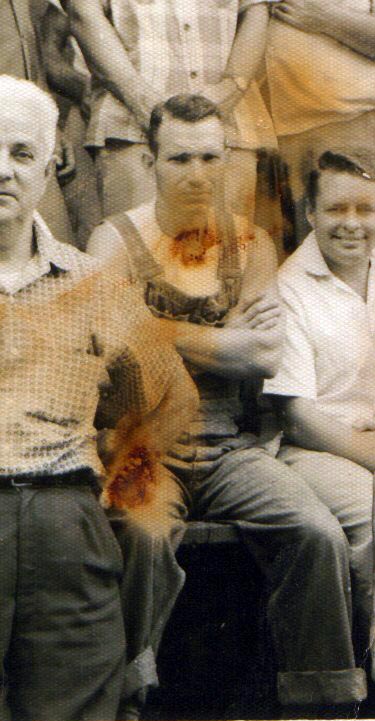
Lawrence Haley, asleep after work, 1950s

Lawrence Haley, asleep after work, 1950s

In Search of Ed Haley 138

30 Sunday Jun 2013

Posted by Brandon Ray Kirk in Ed Haley

≈ Leave a comment

Tags

Appalachia, Ashland, Bonaparte's Retreat, Ed Haley, fiddler, history, John Hartford, Kentucky, Lawrence Haley, Lost Indian, music, Napoleon Bonaparte, writing

Later that evening, back in Ashland, Lawrence and I talked about Haley’s tunes. Ed told him all about “Bonaparte’s Retreat”.

“When the French first went in, they was pushing the Russians pretty hard,” Lawrence said. “The high string going in. The Russians were retreating. When they got to a certain point, the cannons started booming and the Russians started turning the tide on them. Part of the highs, I guess, was the French Napoleon troops coming out in a hurry and the Russians right behind them and then they’d be a spell of like an old dirge or something, like they was coming out defeated. They was slacking off on ’em and letting them retreat back out of there. They knew they wasn’t gonna make it on account of the weather. Just gonna let them freeze to death. Then they’d boom the cannon and push them a little bit faster. Then the dirge come up again. That’s the way Pop kinda explained it to me. He’d say, ‘Now you listen to these cannons boom. The Russians are getting ready to turn the tide on Napoleon’s troops’.”

Lawrence had no idea where Ed heard that story.

“Same way with ‘Lost Indian’,” he said. “It seemed like, the way he explained it, this old Indian would look at something and see a far off peak that he recognized and he’d be happy and hooping and hollering and trying to get over to it and then whenever he’d get over there he would find out it wasn’t the place he thought it was. And he’d sit down and kind of reminisce, I guess, and feel bad towards his self because he wasn’t where he thought he was at so he could get home. He’d stand up and look around again and maybe see another peak or familiar point as being close to his tribe and he’d go to it with a little bit of enthusiasm and glee because he thought he’s getting home and it’d turn out the same way. He wasn’t getting no where. He was still a ‘lost Indian’.”

In Search of Ed Haley 136

28 Friday Jun 2013

Posted by Brandon Ray Kirk in Ed Haley

≈ Leave a comment

Tags

Ed Haley, fiddling, Grace Marcum, history, Josie Cline, Kermit, Lawrence Haley, Lucian Muncy, Mont Spaulding, Rush Muncy, Sammy Muncy, West Virginia, writing

The next day, Lawrence, Pat, and I drove up the Tug Fork to see 80-year-old Grace Marcum in Kermit, West Virginia. I was hoping for more information on the Muncy family, who may have been connected genealogically to Haley. It was a long drive through Wayne County up the Big Sandy Valley on Route 52. There was nothing. Then we came to Fort Gay, West Virginia, an interestingly-named town at the mouth of the Tug Fork. A little further south was some of the emptiest country I have ever seen — just the Tug and occasionally the old N&W Railroad. We finally reached the village of Crum, then crossed into Mingo County and to the old railroad town of Kermit. It was completely dead, with just a shell of a strip of old businesses. Across the river was Warfield, Kentucky.

Once we located Grace, I asked her if she had ever heard of Milt Haley.

“They called him ‘Milty,’ didn’t they?” she said. “Yeah, that’s what I heard him called.”

What about Ed Haley?

“He used to play the fiddle for us down there at the square dance,” Grace said. “Daddy built a big hotel and he’d have square dances downstairs in that big dining room. He used to play the fiddle for us down there. Him and Josie Cline and her brother Mont Spaulding was awful good friends. We’d give them twenty-five dollars a night, my daddy. They played at Warfield a lot. Across the river there. Some of her people lived there, some of Josie’s people. I don’t know who it was.”

At that point, Lawrence said, “We used to ride the N&W out of Kenova up the Tug Fork here up to Williamson and all through there. And he’d play music at some of the hotels and at the courthouse and places like that up at Williamson. Coming back, he’d usually stop here and see these Muncys and we’d stay, maybe, overnight with them.”

Grace seemed to know exactly who Lawrence was talking about.

“That was Rush and Loosh and Old Man Sammy. Yeah, I can remember. Dad sold the store out to Uncle Sammy, and he run the business there a long time. Dad got paint poison, and we liked to lost him. Rush lived in Kenova for years, but his wife died and he come up here and stayed with Loosh. Rush was the oldest one.”

Lawrence said, “Well, that’s what my dad used to do for a living was to go around and play during court days. He might stay in Williamson as long as they had a court session a going. And then come back through here and stop and see — I didn’t know that they’s his kinfolk — the Muncys was any kin to him. I’ve heard him talk about Mont Spaulding.”

So wait a minute. Ed played music with someone named Mont Spaulding and Josie Cline?

“Yeah, well, Ed come in ever once in a while, but Ed was getting pretty old,” Grace said. “And he stayed with Josie and them. Wherever they played, he went with ’em. Pretty nice old man. Well, him and Loosh Muncy and Rush Muncy was close. Now, they didn’t only play for Dad. They played for other people. Let’s see, Thursday night and Saturday night down here, and then they’d go to Borderland and play up there on Thursday and Friday nights. They made it good. Let’s see, Mont Spaulding, and a Haley and Josie Cline. Them three was the ones that… I paid them off myself. I know.”

In Search of Ed Haley 135

27 Thursday Jun 2013

Posted by Brandon Ray Kirk in Ed Haley

≈ Leave a comment

Tags

Bill Busby, Doc Holbrook, Ed Haley, feud, Greenup, Kentucky, Lawrence Haley, Morehead, Pat Haley, Paul Holbrook, Texas Anna Trumbo, William Trumbo, writing

The next morning, Lawrence and I went to see Dr. Paul Holbrook, son of Ed’s close friend, Dr. H.H. Holbrook of Greenup, Kentucky. Paul hadn’t located the silver cup Ed was supposed to have given his father for delivering Mona in 1930, but did have three very important Wilcox-Gay records his father made of Ed on a “tin machine” in Greenup. On one of the records, Ed played “Fifteen Days in Georgia” and “Wake Up Susan”. On another was Ed’s version of “Over the Waves”, with some Dinah Shore recordings on the flip side. There was also a recording of Doc playing “Ragtime Anna” on December 27, 1941 (supposedly using the fiddle Ed had given him). Paul allowed me to borrow these three records, which I found to be unbelievably scratchy.

Later that day, Lawrence told me more about his mother’s background. He said Ella came from the Trumbos, a somewhat affluent family headquartered in Morehead, Kentucky. Morehead, Lawrence reminded me, was a small college town located thirty miles west of Ashland. Ella’s father William Trumbo — who Lawrence called “Paw” — was an active participant in the early events of the famous Martin-Tolliver feud (a.k.a., the Rowan County War), while her aunt was married to one of the feud’s chief participants, John Martin.

“That’s the feud Larry always talked about until you came along,” Pat said to me. “Mom’s father and apparently her uncle was involved in that.”

Pat and Lawrence knew something about the Trumbos.

“William Trumbo was a large landowner down there on Triplett’s Creek,” Pat said. “That’s where the Trumbos are buried — on the hill behind Triplett’s Creek. We’ve been there. The graves have fallen stones for markers. It was hard for us to get down and inspect them very well to see dates and things.”

Pat told me a little something about Ella’s brother Allie, as well as Texas Anna, who Pat called “Sissy”.

“Sissy. Mom’s sister, had a son, Bill Busby,” Pat said. “I never met Bill Busby but apparently he had a speech impediment and a hearing impediment. And then she was with a man when I came over here in 1949. He was a paper hanger.”

In Search of Ed Haley 134

25 Tuesday Jun 2013

Posted by Brandon Ray Kirk in Ed Haley

≈ Leave a comment

Tags

Ashland, Ed Haley, Ella Haley, history, John Hartford, Kentucky, Lawrence Haley, life, Margaret Arms, music, Pat Haley, Ralph Haley, writing

Later that night, Lawrence, Pat and I looked through a box of family photographs. Most were “modern” pictures featuring side burns, bellbottoms, or trendy 80s sweaters, but there were a few treasures. Early in our dig, I came across an old postcard with Ed, Ella, and Ralph pictured on it. Toward the bottom of the box was a small, dark picture of Ed in between Ella and someone named Margaret Arms. Lawrence said Margaret was Ed’s cousin, originally from around Paintsville, Kentucky, “or somewhere,” who ran a barbershop on Court Street in Cincinnati. Mona later told me that Margaret used the last name of Thomas because she was married to or lived with a man by that name. Margaret used to give her jewelry.

At the bottom of the cardboard box, under the flaps, was a dark, faded picture of Ed and Ella sitting on the street with their instruments. The photo was small and blurred, but I could make out that Ed wore some kind of a billed cap and was getting ready to play a tune.

“Pop looks like he might have been getting ready to play a piece and was letting my mother know without coming right out and saying what piece of music he was gonna play,” Lawrence said of the picture. “He was maybe hitting a lick with the fiddle bow, sort of like a ‘tune-up lick’ or two.”

Lawrence pointed to his mother, who had her right arm behind the mandolin, and said, “They kept a cup on the street in front of them or some kind of place where people could put change and my mother would take that up and she would put it behind her mandolin and count the take for their piece of music. And that’s what she’s doing right there.”

In the photograph, Ed obviously had the fiddle placed against his chest, and it appeared as if he held the bow as far to the end of the frog as possible. I practiced the hold in front of the mirror in the living room, then showed it to Lawrence, who said, “That’s it. That looks right.” I could tell right away this bow hold allowed for greater leverage in playing close to the frog as well as for pulling an extremely long bow. It was very similar to a bow hold I’d learned as a boy from Gene Goforth and Benny Martin, but the emphasis was never as far back as Ed was holding it. In fact, when I first saw this picture I even thought Ed might be holding it by the “frog screw.”

In Search of Ed Haley 133

23 Sunday Jun 2013

Posted by Brandon Ray Kirk in Ed Haley

≈ 1 Comment

Tags

Ashland, Clyde Haley, Ella Haley, history, Jack Haley, Lawrence Haley, life, Mona Haley, music, Noah Haley, Pat Haley, Peter Mullins, Ralph Haley

Later in the day, Pat told me more about the Haley family when we were away from Lawrence.

“I only knew Larry three months before we were married,” she said. “I knew he had a sister that he didn’t like to talk about. He talked mainly about his brother Ralph and Jack. I had no idea that Clyde was in San Quentin. And about a week before Beverly was born, I was ironing at 1040 Greenup and his face was looking at me through the window and I screamed bloody murder. Clyde’s got a funny laugh and he laughed. He didn’t know me. Larry was gone taking a class at the time. And Clyde came in and all of his luggage had EDWARDS on it. It was stolen and he was giving things away out of it. Then Larry told me about Clyde — that he was scitzofrenic. But he was a very intelligent man. I guess he did a lot of reading. He had a brain and he could work it, too, when he wanted to. He could always find a job when nobody else could. Then Noah came home from the service that Christmas. Beverly was about three weeks, four weeks old. And Noah came in his uniform and from the very beginning him and I disliked each other. I don’t know why. I irritated him and he irritated me. And then we moved right after that to 2144 Greenup Avenue.”

Pat said Ella — who she called “Mom” — was great, that she was very emotional with her children.

“Mom always regretted leaving the kids somewhere when she and Pop were off playing music together,” she said. “Larry’s told me that Noah didn’t like it at Harts and he would go down to the mouth of the hollow a ways from where Uncle Peter and Aunt Liza lived and he would sit and cry wanting his mother to come back. Where Larry and Jack could play — and half the time I would assume Clyde was in trouble — Noah would cry for his momma. It must have been very heart-wrenching for her. And I know she hated to leave Larry because even Mona will tell you: he was her favorite. She loved her boy Ralph more than anything and Larry came next.”

What about Ed? How did he treat the children?

“I’m sure Pop had genuine feelings for his kids but he didn’t know how to express it,” Pat said. “I remember Larry telling me about Pop rocking him because he had such terrible ear-aches and Pop took him to the doctor to get ear medicine and then when he took him home he rocked him. And that’s the only memory of his dad showing him any love. And Mona doesn’t have anything like that.”

How did Ed treat you?

“Pop was always very nice to me,” Pat said. “The only problem Pop and I had was his chewing tobacco and spitting it around toilets. And he was kinda dirty. The boys would have to make him bath. But my mother-in-law, she was always sad the way Mona behaved and the sad part is she never got to see Mona settle down. And Mona regrets that now, too. But Mom had three sons that had been good to her — that was Ralph, Jack, and Lawrence. Noah was never bad to Mom — he thought the world of his Mom — but Noah was much like Pop: he didn’t know how to express his feelings.”

Pat told me a little more about Clyde’s deviancies at the end of Ed’s life.

“Mom had this radio in her bedroom and this Electrolux sweeper and Clyde came through my bedroom, got that sweeper, and took Mom’s radio and was picked up on Greenup Avenue at 3 o’clock in the morning trying to sell those things,” she said. “That must have been the week before his daddy died because he was in jail when his daddy died and we could not get him out of jail to attend his daddy’s funeral.”

Later when Ella was sick in bed Clyde stole money from beneath her pillow.

“He was in prison in Michigan when his mother died,” Pat said. “And Larry tried to get him home for that but he would’ve had to’ve paid the way for two guards to bring him home and he just couldn’t afford it. And he was in Michigan for quite some time.”

In Search of Ed Haley 132

18 Tuesday Jun 2013

Posted by Brandon Ray Kirk in Ed Haley

≈ 2 Comments

Tags

Eddy, Ella Haley, John Hartford, Laury Hicks, Lawrence Haley, life, Minnie Hicks, Montana, Pat Haley, Ralph Haley, Ralph Mullins, Shirley Hicks, writing

The next day, Steve and I told Lawrence about our visit with Wilson. He listened with great interest to every detail, ever the guardian of his father’s legacy. When I mentioned something about Ed running around with Doc White, he said he was well aware of his father carrying on some in that part of the country. He remembered  Ed goofing around with a gun one time at Laury’s and accidentally shooting himself. Luckily, it was loaded with blanks.

“That ended some of his foolishness,” he said.

Taking a little inspiration from our stories of Ed’s experience with Laury Hicks, Lawrence fetched a letter from his widow, Minnie, dated March 4, 1953. By that time, Minnie had remarried and moved to Eddy, Montana. It read:

Dear Ella and all Lawrence family and little Ralph. I arrived Home the 1 Day of Mar. at 6:30 pm. Hope you are much better. also Hope the rest are all well. Did Ralph get in? tell him I would of loved to seen him. I would of loved to seen Lawrence. he sure Has a lovely wife and children. Shirley told all of them at Home that Little Girl was the Prettiest and Smartest little Girl he ever Saw. Well Ella I so glad I found you. I do wish you were here with me. You would get Stout and you would love it so much. Well I will see you all in the future if we all live and I am going to arrange so you and I can travel Some places to visit a little. but Vanie is not well. he had the Flue. Well Ella if you get this OK I will send you Some Money in your next Letter so love to you all. I love all of you. Your old faithful pal. Minnie

In Search of Ed Haley

16 Sunday Jun 2013

Posted by Brandon Ray Kirk in Ed Haley

≈ Leave a comment

Tags

Appalachia, Ed Haley, history, Lawrence Haley, life, Minnie Hicks, photos, West Virginia

Jack Haley and Lawrence Haley at the bedside of Minnie Hicks

Lawrence Haley (right) at the bedside of Minnie Hicks, about 1980

In Search of Ed Haley 127

11 Tuesday Jun 2013

Posted by Brandon Ray Kirk in Ed Haley, Music

≈ 1 Comment

Tags

Ashland, banjo, Bernard Postalwait, Calhoun County, Clay County, Clay Court House, Doc White, Ed Haley, fiddler, fiddlers, fiddling, Ivydale, Kim Johnson, Laury Hicks, Lawrence Haley, Minnora, music, Riley Puckett, Roane County, Steve Haley, West Virginia, Wilson Douglas, writing

In mid-summer of 1994, I was back in Ashland visiting Lawrence Haley. Lawrence, I noticed right away, was indeed in poor health. His overall appearance wasn’t good; actually, he seemed convinced that he probably wouldn’t get any better. Pat was ever so cheerful, saying that he would be back to his old self soon enough. Lawrence’s son Steve had driven in from Hendersonville, Tennessee, to serve as his replacement on any “Ed Haley trips.”

Early the next morning, Steve Haley and I left Ashland to see Wilson Douglas, the old-time fiddler who remembered Ed Haley in Calhoun County, West Virginia. We drove east on I-64 past Charleston, West Virginia, where we exited off onto a winding, two-lane road leading to Clendenin, an old oil town on the Elk River. We soon turned onto a little gravel driveway and cruised up a hill to Wilson’s nice two-story home. We parked and walked up to the porch where we met Wilson and his banjo-picker, Kim Johnson. Inside, he told me more about seeing Ed at Laury Hicks’ home. He was a great storyteller, so we naturally hung onto his every word.

“Laury Hicks got in touch with Ed Haley,” he began. “So, in them days, you come to Charleston by train and from Charleston to Clay Court House by train. All right, when you got to Clay Court House, you caught the B&O train on up to Otter, which is Ivydale. Well, the word would come out and they’d be somebody there in an old car or something to pick him up and take him about fifteen, 20 miles over to Hicks’ in Calhoun County. Well, the word’d get around, you know, and my god, it was just like a carnival a coming to town. And my dad had an old ’29 model A Ford pick-up truck. Well, gas was 11 cents a gallon. So, what we’d do, we’d take our pennies or whatever we had, we’d get us that old truck up — had a big cattle rack on it — and everybody’d load in that thing. Say, ‘Well, Ed Haley’s over at Laury Hicks’. Let’s go, boys!’ Everybody would grab their loose pennies, which were very few, and we’d get over there.

“Well, it’d be probably dark, or a little before, when he would start fiddling — about maybe eight o’clock — and last until three in the morning. And he would never repeat hisself unless somebody asked him. We just sat and never opened our mouth and he’d scare [them other fiddlers]. I’d sit there till I’d get so danged sleepy, I’d think I couldn’t make it. He’d start another tune and it’d just bring me up out of there. And that Chenneth on that banjo. And then they was a fellow, he lived down the road about seven or eight miles, a fellow by the name of Bernard Postalwait. And this man was a “second Riley Puckett” on the guitar. Well, Ed’d send for him. By god, they’d never miss a note. Ed had a little old tin cup sitting there. Everybody’d put some money in it, you know. And they was some rich feller, but I can’t think of that danged guy’s name, he liked fiddle music. He’s the only man in Roane County that had any money. Well, he’d give a few one-dollar bills, you know, and he’d mention a tune. Well, if he give him a dollar, he’d play it for fifteen minutes. Well, by the time the night ended, he’d have five or six dollars, which was equivalent to fifty now. Well the next night, we’d go over — all of us’d work that day. Next night, the same thing: we’d be right back over.”

Wilson said Ed would get drunk with Bernard Postalwait and “disappear” to some rough establishments. Bernard was with Ed when he played his fiddle at Laury Hicks’ grave.

Ed also ran around with a casual fiddler named Benjamin F. “Doc” White (1885-1973) of Ivydale. Doc was a banjo-picker, veteran of the Indian Wars, schoolteacher, midwife, doctor, photographer, local judge and dentist (he even pulled his own teeth). He took Ed to “court days” and other events where he could make money.

“I was around old Doc a lot,” Wilson said. “God, he was a clown. He had kids all over West Virginia. He couldn’t fiddle much but he tried.”

Doc asked Ed one night, “Ed, how do you play them tunes without changing keys?” and Ed said, “Well Doc, I change them with my fingers!”

Wilson said Ed wasn’t being sarcastic.

It seemed like Wilson knew a lot of stories about Ed’s “running around days” with guys like Postalwait and White — which would have been great to hear to get a better understanding of him — but he refused to be very specific. He did tell one story:

They went over to a place called Minnora. That’s over where Laury Hicks lived. Doc White and Ed. Somebody else was with them, I think that Bernard Postalwait. They went down there to a Moose Lodge or something and they had a little fiddle contest or something. Well, now, Ed said, “I ain’t gonna play in this contest.” Said, “I’d ruther be a judge.” Now Old Doc White, you know, he had quite a bit of money. I don’t know, they’s four or five fiddlers that played. Old Doc played a tune, you know. They said, “What do you think, Ed?” Well, Ed said, “Boys, I hate to say it. By God, old Doc’s gotcha all mastered.” Course Ed was wanting a drink of liquor, you know. After it was over, by God, they got drunk, all of them. Doc couldn’t play much, but Ed said, “Well, that old Doc’s got you boys bested.”

In Search of Ed Haley 121

31 Friday May 2013

Posted by Brandon Ray Kirk in Ed Haley

≈ Leave a comment

Tags

Appalachia, Ed Haley, Ella Haley, fiddler, Forked Deer, guitar, history, Kentucky, Lawrence Haley, music, Pat Haley, Ralph Haley, writing

I kept in close touch with Lawrence, who Pat said always perked up at my calls.  His comments about his father’s music were very helpful. At times, I felt as if I might be talking to Ed.

“I guess Pop learned any time he was sitting around jamming. Anytime he was just sitting around making music with a bunch of friends, they was practicing and learning new pieces. How it would sound this a way and how it would sound that a way. You try different styles and things or you just try for speed. I’ve watched Bill Monroe and some of his stuff and it seems like that’s part of his aim is to see how fast he can play sometimes. Well, that might have been my dad’s. I know in that piece of music, ‘Forked Deer’, I think there’s a certain spot in it Pop changes his speed right there at the last a little bit. And I guess that’s the way most fiddlers do to see if people can keep up with them.”

I said to Lawrence, “Well, you know, a lot of that fiddling and everything, it was a competition. I bet if somebody came along that thought they could beat your dad, I bet your dad threw them a few loops to let them know who’s boss.”

Lawrence agreed.

“Yeah, I guess he did. He’d probably set and help somebody. Say, ‘Now you’d better do it this way,’ or something. If he liked who he was with, that’s the way he’d be. He’d play with them, and if the guitar player wasn’t doing it right… I’ve heard him a lot of times when Ralph — him and Mom would be a playing — he’d tell Ralph to change chord ‘so-and-so.’ And Ralph finally got to the point where he could chord it properly, but then he wanted to make those runs between chords. Pop would tell him how to get to a certain place, or what chord to be at. He’d tell him to change chords, so I guess he told everybody that if they wasn’t getting to where they should be at the right times. He’d let them know, if he wanted to teach anybody. If he played with you for a little while and saw that you weren’t going to make it, he’d probably tell you, ‘You just might as well put it up.’ That’s the way I think about my dad. I’m maybe like Clyde: I didn’t know him enough really to know what kind of a man he was. A lot of my knowledge of him is hearsay, too.”

In Search of Ed Haley 120

30 Thursday May 2013

Posted by Brandon Ray Kirk in Ed Haley

≈ Leave a comment

Tags

Ashland, Clyde Haley, Ella Haley, fiddle, fiddler, John Hartford, Lawrence Haley, music, Pat Haley, writing

As soon as I got back from California, I got on the phone with Lawrence and told him all about meeting Clyde. He took issue with some of the things his brother had told me. As for what Clyde said about him holding the fiddle down at his lap: “Well, he might have done it. I’ll tell you, if he did, he wasn’t playing the fiddle like he should. He wasn’t a fiddler then. He was just making music, probably at a square dance. They fed him too much liquor or something and he was about to pass out on them. That’s the way I’d look at that ’cause Pop had a lot of pride in his music. I don’t think he’d done that intentionally. He wasn’t no show-off with the fiddle. He might show some enthusiasm when he was playing a piece exceptionally good. He was enjoying his own talents right then.”

Lawrence got back on the subject of what Clyde had told me about Ed’s drinking and abuse.

“If he tells you that my dad made him drink or caused him to be a drunkard or an alcoholic, then Clyde was fibbing to you ’cause Clyde did that on his own. He might not have been around it as much if he hadn’t went with my dad, but he did it on his own. I don’t think Pop would have given him… Like he said, he’s sitting there at the table up on Horse Branch feeding it to him while Mom was sitting there across the table from him — I don’t think he done that. Maybe he might have been different with some of us, but he never struck me or never offered me anything to drink like that.”

I asked Lawrence how his health was holding up and he said, “Well, since I’ve talked to you, I been on the backside. My intestinal system ain’t working right and nobody seems to know anything about it. I don’t know whether I’m ever gonna get over this, John. Seems like I get to go forward for a day or two and then drop back for three or four. It wears you down after a while.”

He paused: “Other than that, I’m getting along all right.”

I told Lawrence I was planning to come see him in Ashland in the next few months — that maybe we could run around and he’d start feeling better.

“Okay,” he said, “I don’t think I’m gonna be able, John. You’re just gonna have to take Pat with you or one of the kids.” He laughed. “Take one of them along instead of me because I haven’t got the strength really. They’ve just drugged me right on down to where I can walk through the house and I’m ready to lay down. Right now, I thought, ‘Well, I’ll just be that way. I’ll just stay in a rested position as much as I can and just lay like I’m in a hospital bed and see if that don’t help me. Just pure rest.’ So, I’m gonna give that about another week, then I’m gonna find me a specialist I reckon and find out what’s the matter with me.”

In Search of Ed Haley

25 Saturday May 2013

Posted by Brandon Ray Kirk in Ed Haley

≈ Leave a comment

Tags

Appalachia, Ashland, culture, history, Kentucky, Lawrence Haley, life, photos, U.S. South

Lawrence Haley, 1949-1960

Lawrence Haley, 1949-1960

In Search of Ed Haley

14 Tuesday May 2013

Posted by Brandon Ray Kirk in Ed Haley

≈ Leave a comment

Tags

Appalachia, art, Ed Haley, fiddle, history, John Hartford, Lawrence Haley, life, music, U.S. South

John Hartford sketch of the Ed Haley fiddle, 1994-1997

John Hartford sketch of the Ed Haley fiddle, 1992-1997

In Search of Ed Haley

11 Saturday May 2013

Posted by Brandon Ray Kirk in Ed Haley

≈ Leave a comment

Tags

Appalachia, Ashland, culture, genealogy, history, Jack Haley, Kentucky, Lawrence Haley, life, photos, U.S. South

Lawrence Haley and Jack Haley, Ashland, Kentucky, 1940-1953

Lawrence Haley and Jack Haley, Ashland, Kentucky, 1940-1953

In Search of Ed Haley 108

11 Saturday May 2013

Posted by Brandon Ray Kirk in Ed Haley

≈ Leave a comment

Tags

blind, Clyde Haley, Ella Haley, fiddle, fiddler, Harts Creek, John Hartford, Kentucky School for the Blind, Lawrence Haley, Mona Haley, music, West Virginia, writing

I asked Lawrence if he knew anything about his brother Clyde supposedly trying to play the fiddle.

“Well, he never said anything about it to me and if he ever played the violin I never saw him, John,” he said. “But he did sit around and play a little on the guitar. Then he got away from home and got in some kind of industrial accident working in a woodshop or something and a band saw got his fingers. Mona, she’d take off with Pop a lot of times up into West Virginia and they’d be gone a week or two. She went with him as much as any of the rest of us did. Most of the time whenever I’d go, there’d be my mother, too.”

I told Lawrence what Wilson Douglas had said about Ed being able to get around extremely well on his own.

“I can remember, just like going up Harts Creek,” he said. “Remember where you turn off to the Trace Fork they got a big new church and stuff? They wasn’t anything in there then. They wasn’t even a road. People made their own footpaths around close to the hillside. Most of it was just pathways. And that’s how Pop could go from one house to another, I guess. He’d know when he was on that path — how many steps or something it was from his place to anybody else’s he wanted to go to. It’d be like if somebody could count the streets in succession — if they’re numbered streets… Mom could get around Ashland here anywhere she wanted to by herself, but Pop wasn’t too good at that. He couldn’t keep track of how many blocks he’d walked or where he’d started from a lot of times. He just didn’t have the training, I guess, to learn how to handle hisself as a blind man. Mom went to that Louisville School for the Blind. She was there about twelve or thirteen years, I reckon, and they taught her piano music.”

Lawrence told me more about his memories of his father’s appearance.

“He walked fairly fast and upright as a fence post with his shoulders throwed back,” he said. “He was no slouch. He set in his chair upright. A lot went through his mind, I know that. He used to tell me, ‘Son, if a man can think it up and imagine it, then it’s possible.’ In later years, he was always having some problems with his arms and hands. I remember him shaking his hand real vigorously, like he was trying to get circulation going back in it. He’d walk through the house a lot. ‘Course he’d go up and down the street some. If he felt like he wanted a beer or something, he might get out and go and play down at Russ’s Place half a day and drink what beer he wanted to and then he’d come home. I’ve seen Pop get pretty high at times.”

Lawrence said, “Well, I’ve tried to think and tell you everything I know my dad did. If I’m helping you at all, I’m tickled to death. I didn’t know him that long. He was about 44 or 45 when I was born. I went into the service when I was about eighteen and I wasn’t out of the service maybe a year and a half and he was dead.”

In Search of Ed Haley

10 Friday May 2013

Posted by Brandon Ray Kirk in Ed Haley

≈ Leave a comment

Tags

Ed Haley, fiddle, fiddler, history, Homer Dillard, inspiration, John Hartford, Lawrence Haley, music, photos, U.S. South

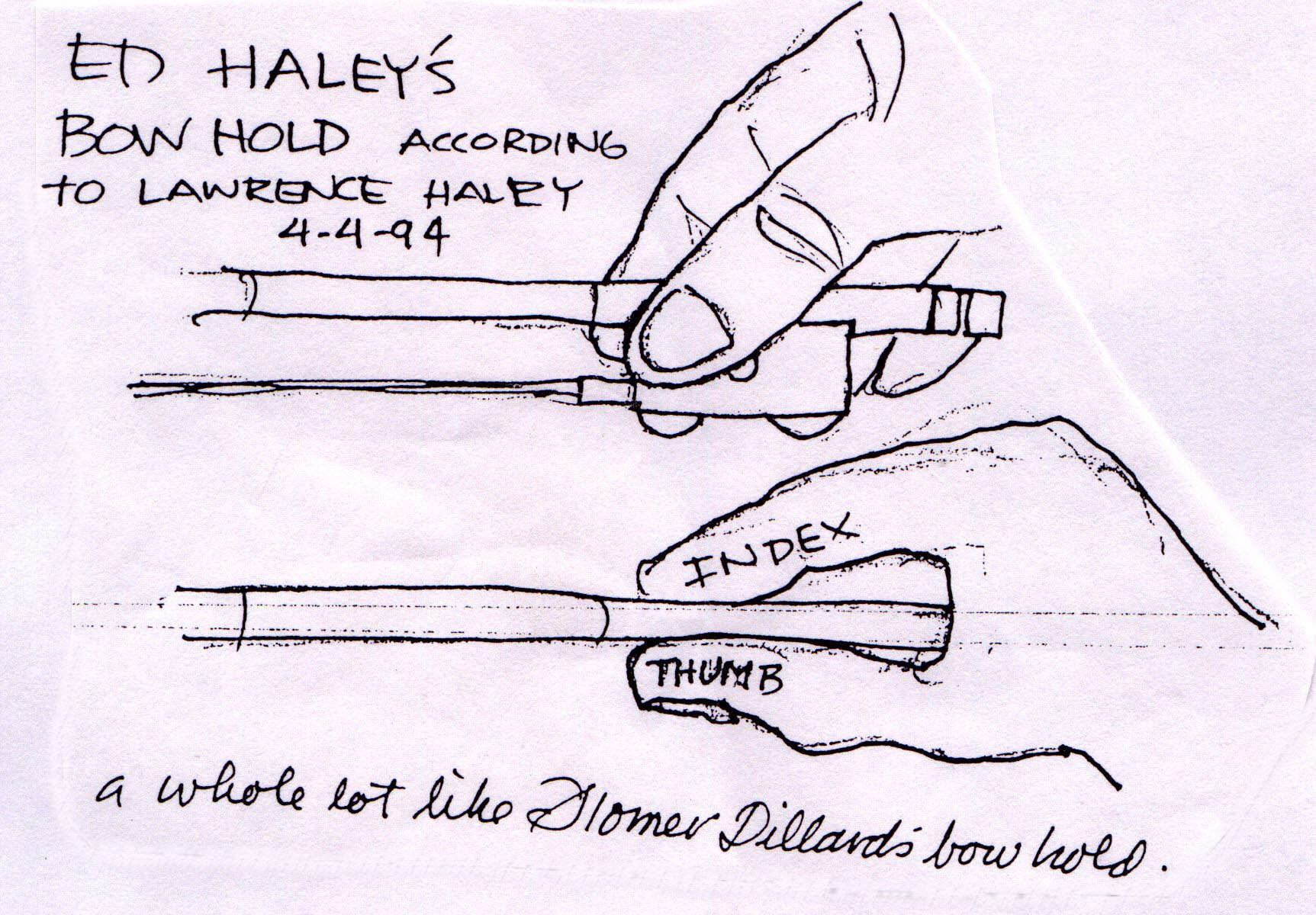
Ed Haley bow hold, according to Lawrence Haley, 1994

Ed Haley bow hold, according to Lawrence Haley, 1994

In Search of Ed Haley 107

10 Friday May 2013

Posted by Brandon Ray Kirk in Ed Haley

≈ Leave a comment

Tags

Appalachia, Cacklin Hen, Clark Kessinger, Ed Haley, Ella Haley, fiddle, fiddler, Flop-Eared Mule, history, John Hartford, Lawrence Haley, music, writing

I called Lawrence Haley a little later after working more on Ed’s music to brag on the phrasing and intonation in his father’s playing.

“Well,” Lawrence said, “that’s one thing with the bow I’d never be able to learn anyway. What pressure to put to emphasize a note or to quiet a note down. Pop did that from one end of the bow to the other. If he was holding it up and he was plumb out at the end of the bow, I know he had to put more pressure with his hand downward toward them strings to really emphasize the note. And when he got to the other end, he had to slack off a little bit I know to get the same emphasis. I guess running from one end of the bow he was all the time changing the pressure of the bow on the strings to get what he wanted. Now, that’s about all I know about bowing anyway. You gotta have room on your bow. When he knew he couldn’t make a certain note when he’s down at the short end of it, then he would reverse it but he did it in a way that you couldn’t tell which way he was going with the bow hardly. He skipped the bow on some tunes you know as he was playing it. I’ve seen him get out there, as it started down towards the handle end, he’d skip it maybe to get some notes and the way he wanted to play that piece of music. Like the ‘Cacklin’ Hen’, when he’d get down to where that hen let out that squall dropping that egg, it sounded just like an old hen just jumping right off a nest. And that ‘Flop-Eared Mule’, you can hear that mule bray if you want to listen to it.”

I told Lawrence one of the things I was trying to figure out was how Ed could hold the fiddle down from his neck and still get up into the higher positions. Lawrence remembered his father doing it.

“I’ve seen his hands run up and down the neck of the fiddle. He always did that. He’d go way down on the neck of the fiddle.”

Beyond that, Lawrence said he couldn’t get into the specifics.

“I really couldn’t say anything more about that, John. But right in there about the armpit is where he laid the fiddle. I don’t know whether he used chest muscles to kinda control it too, and shoulder and arm muscles, I really don’t know. That would take a real master to sit around and watch that and know exactly what you’re looking for. A lot of times when Pop and Mom was a playing, I’d be off somewhere else. However he mastered that fiddle, I couldn’t tell you. The guys that watched him, they mighta knowed partly what they was looking for. I guess the only one that come close to his style of playing was Clark Kessinger and he watched Pop a lot. Pop would say, ‘Yeah, I knew he was there, but he never would play for me.’ Pop was liable to criticize him or he might try to help him, but Clark wouldn’t let him. He was just there after the knowledge that he could garner from Pop’s style by watching him.”

In Search of Ed Haley 104

07 Tuesday May 2013

Posted by Brandon Ray Kirk in Ed Haley

≈ Leave a comment

Tags

Bobby Taylor, Clark Kessinger, Ed Haley, fiddle, fiddler, history, John Hartford, Lawrence Haley, music, Sam Jarvis, West Virginia, Wilson Douglas, writing

After talking with Mrs. Rutland, I called Bobby Taylor, a fiddling acquaintance and all-around nice guy in Dunbar, West Virginia. Bobby was a protégé of Clark Kessinger, the famous Charleston fiddler who regarded Haley as the best fiddler he ever heard. I told him about spending months trying to unlock the secrets behind Ed’s bowing before concluding that he played a long bow using the Scotch snap to get smoothness and note separation. Bobby agreed, telling how Clark Kessinger did the same kind of thing in “Sweet Sixteen” — “real fast and almost no bow. He would shuffle with his fingers.”

Bobby didn’t think that Ed used that one bow style for every tune, though.

“From what I could hear of Ed Haley’s fiddling, he done almost any type of style with the bow,” he said. “And I could hear his styles changing from one tune to the next and the way he would phrase. Like when I fiddle, it just depends on what mood I’m in and what style I want to play in. But Haley had to be what Kessinger would call a ‘down-bower,’ because Kessinger hated a ‘bow pusher.’ In other words, the accent’s on the up-bow. What little bit I can hear through all the scratches and everything, I hear Haley being a little more smoother, a little more fluid than Kessinger, but I still see the same bow. But Kessinger’s fast as greased lightning.”

I told Bobby how I’d really gotten into writing out Haley’s tunes note for note lately — every little slide — because I wanted to see what was going on.

“Of course, the deeper I get into it, the less I realize I know about it,” I said.

Bobby wasn’t surprised.

“Kessinger and Haley were both very complicated fiddlers, as any fiddler is,” he said. “But Kessinger was a master with the bow. I kid you not. I mean, that man could bow. Kessinger, if you listen at him fiddle, listen especially at his ‘Hell Among the Yearlings’. Man, could he fiddle that. Very few people realize how well he could fiddle it until you start really listening to what he’s doing with that bow and note correlation. It’s a masterpiece, his ‘Hell Among the Yearlings’ is. Just as Ed Haley, when I heard Ed Haley play it, I could hear where Kessinger got his idea. I could hear it all coming together. Now my style, when you get a real good guitar player that I like playing with, I have a tendency to throw Mike Humphreys into my mesh — a little bit of Kessinger — and I’ve had a lot of people tell me that I sound a great deal like Ed Haley when I do that because I play a little bigger note in a way — not quite as fast as Kessinger — and try to smooth it up a bit.”

“Lawrence has told me repeatedly about how his dad held the fiddle,” I said to Bobby, “that he didn’t stick it up under his chin but he sat it kinda there at his shoulder.”

Bobby chuckled and said, “That’s the way I hold it when I’m jamming.”

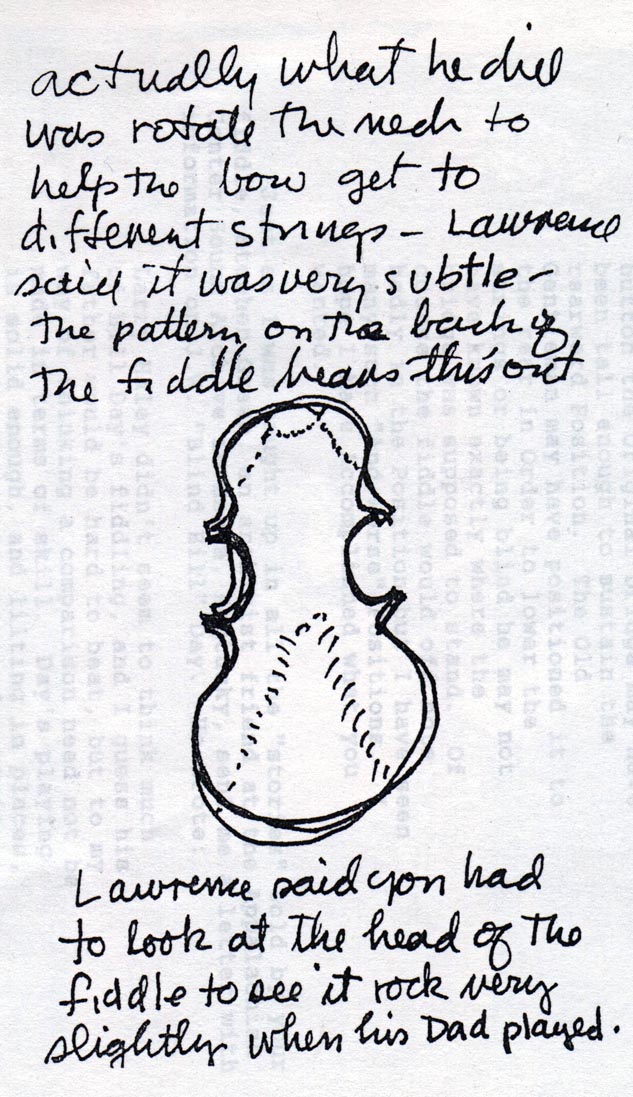
I asked Bobby if he rotated the fiddle slightly with it at that position and he said, “I don’t, but my father does. My father, I don’t think, ever met Ed Haley, but is certainly old enough to have known him. My father’s 82. But he’d always heard of him. His favorite fiddler was Sam Jarvis. He was a very prominent person — well educated. He sold insurance. He was my dad’s schoolteacher way out in a little one-room school. My father just says one word for Sam Jarvis, and he says he was ‘perfect.’ I remember when I was a small kid, my father pointed him out and talked to him for a little while and he introduced me. I’ll remember it as long as I live, he said, ‘Here is the greatest fiddler that ever lived, and someday you will learn to appreciate what I have said now.’ And to this day, if you ask me who the smoothest fiddler was I ever heard, it’s Sam Jarvis. Jarvis’ note was not of this world. He was the same age as Clark. He died in 1967.”

That was the first time I’d heard of Sam Jarvis, so — figuring that Ed likely knew him — I pressed Bobby for more information.

“Oh man, he could fiddle. Very little did he play professionally. He would just show up and terrorize the contest world occasionally. I never have heard about Sam Jarvis playing against Ed Haley, but Sam Jarvis only lost one contest in his life — and he was disqualified. You won’t catch anybody in the Charleston area that knew both the fiddlers — Kessinger and Jarvis — that will tell you Kessinger was better. The two greatest fiddlers, when you hear people talk, one’ll say Sam Jarvis and the other will say Ed Haley and most people say they wouldn’t turn their hand over for the difference.”

I asked Bobby who he thought Ed and Jarvis patterned their fiddling after and he said, “That is what is very interesting. They learned from old Edison records, somewhat. I know Jarvis did. They said that his dad wouldn’t hardly let him have a hold of the fiddle, he was so little. And he said that his feet wouldn’t even hit the floor, and he wrapped his toes around the rungs of the chair, and put the record on, and his dad said, ‘You can play the fiddle today if you’re careful with it.’ And he sat down with that record, and they said when they come home that evening, not only had he mastered the record — he had snowed the guy on the record. And he was not even six years old. So he was just automatic.”

Bobby said Wilson Douglas had been talking a lot about Ed Haley lately. Apparently, my telephone call to him had stirred some of memories.

“You will find that if you ask him off the top of his head something, he’ll say, ‘I don’t know,’ but you ask him two or three days later and he has the Brittanica version,” Bobby said.

In Search of Ed Haley 103

04 Saturday May 2013

Posted by Brandon Ray Kirk in Ed Haley

≈ Leave a comment

Tags

Appalachia, Clay County, Georgia Slim Rutland, Gilmer County, history, James Shaver, Lawrence Haley, music, Parkersburg, Russell Shaver, Ugee Postalwait, West Virginia, writing

That evening, I called Lawrence to tell him about speaking with the Holbrooks. When I mentioned them having one of Ed’s records, he reminded me about Ugee Postalwait’s half-brother Russell Shaver, who supposedly had others. Russell died several years ago, but his only grandson James Shaver lived in Parkersburg, West Virginia.

I got his number from directory assistance, then dialed him up. As soon as I mentioned Ed’s name and the records, James said, “He played the violin, right? Well, I remember hearing the record when I was a kid. I’m 41 and I was just a young kid — my grandfather raised me — and I remember listening to the record of Ed Haley playing the violin. I don’t know if it’s still around or not. I’d have to search the house and find out. Ed Haley, he was blind. I remember my grandfather talking about him. He used to come over to their house. I’m trying to think where my grandfather lived in the thirties. They lived up in Gilmer County or Clay County, the central part of West Virginia.”

James promised to try and locate the record.

The next day, I called Georgia Slim Rutland’s widow in Valdosta, Georgia to see if she knew anything about Slim staying with Ed in Ashland around 1938. Mrs. Rutland very emphatically said, “No, huh-uh, no. That’s not true, ’cause Slim was just in Ashland about a week. That’s all. He was there performing for about a week and that was it. He didn’t live there.” I told Mrs. Rutland that several people had told me he was enamored of Ed’s playing, as was Clark Kessinger, and she said, “Now, I’ve heard him speak of Clark Kessinger, yes. Lots of times. But now, I’ve never heard him mention a blind fiddle player. I’m sorry.”

← Older posts
Newer posts →

Feud Poll 1

If you had lived in the Harts Creek community during the 1880s, to which faction of feudists might you have given your loyalty?

Categories

  • Adkins Mill
  • African American History
  • American Revolutionary War
  • Ashland
  • Atenville
  • Banco
  • Barboursville
  • Battle of Blair Mountain
  • Beech Creek
  • Big Creek
  • Big Harts Creek
  • Big Sandy Valley
  • Big Ugly Creek
  • Boone County
  • Breeden
  • Calhoun County
  • Cemeteries
  • Chapmanville
  • Civil War
  • Clay County
  • Clothier
  • Coal
  • Cove Gap
  • Crawley Creek
  • Culture of Honor
  • Dingess
  • Dollie
  • Dunlow
  • East Lynn
  • Ed Haley
  • Eden Park
  • Enslow
  • Estep
  • Ethel
  • Ferrellsburg
  • Fourteen
  • French-Eversole Feud
  • Gilbert
  • Giles County
  • Gill
  • Green Shoal
  • Guyandotte River
  • Halcyon
  • Hamlin
  • Harts
  • Hatfield-McCoy Feud
  • Holden
  • Hungarian-American History
  • Huntington
  • Inez
  • Irish-Americans
  • Italian American History
  • Jamboree
  • Jewish History
  • John Hartford
  • Kermit
  • Kiahsville
  • Kitchen
  • Leet
  • Lincoln County Feud
  • Little Harts Creek
  • Logan
  • Man
  • Matewan
  • Meador
  • Midkiff
  • Monroe County
  • Montgomery County
  • Music
  • Native American History
  • Peach Creek
  • Pearl Adkins Diary
  • Pecks Mill
  • Peter Creek
  • Pikeville
  • Pilgrim
  • Poetry
  • Queens Ridge
  • Ranger
  • Rector
  • Roane County
  • Rowan County Feud
  • Salt Rock
  • Sand Creek
  • Shively
  • Spears
  • Sports
  • Spottswood
  • Spurlockville
  • Stiltner
  • Stone Branch
  • Tazewell County
  • Timber
  • Tom Dula
  • Toney
  • Turner-Howard Feud
  • Twelve Pole Creek
  • Uncategorized
  • Warren
  • Wayne
  • West Hamlin
  • Wewanta
  • Wharncliffe
  • Whirlwind
  • Williamson
  • Women's History
  • World War I
  • Wyoming County
  • Yantus

Feud Poll 2

Do you think Milt Haley and Green McCoy committed the ambush on Al and Hollene Brumfield in 1889?

Blogroll

  • Ancestry.com
  • Ashland (KY) Daily Independent News Article
  • Author FB page
  • Beckley (WV) Register-Herald News Article
  • Big Sandy News (KY) News Article
  • Blood in West Virginia FB
  • Blood in West Virginia order
  • Chapters TV Program
  • Facebook
  • Ghosts of Guyan
  • Herald-Dispatch News Article 1
  • Herald-Dispatch News Article 2
  • In Search of Ed Haley
  • Instagram
  • Lincoln (WV) Journal News Article
  • Lincoln (WV) Journal Thumbs Up
  • Lincoln County
  • Lincoln County Feud
  • Lincoln County Feud Lecture
  • LinkedIn
  • Logan (WV) Banner News Article
  • Lunch With Books
  • Our Overmountain Men: The Revolutionary War in Western Virginia (1775-1783)
  • Pinterest
  • Scarborough Society's Art and Lecture Series
  • Smithsonian Article
  • Spirit of Jefferson News Article
  • The Friendly Neighbor Radio Show 1
  • The Friendly Neighbor Radio Show 2
  • The Friendly Neighbor Radio Show 3
  • The Friendly Neighbor Radio Show 4
  • The New Yorker
  • The State Journal's 55 Good Things About WV
  • tumblr.
  • Twitter
  • Website
  • Weirton (WV) Daily Times Article
  • Wheeling (WV) Intelligencer News Article 1
  • Wheeling (WV) Intelligencer News Article 2
  • WOWK TV
  • Writers Can Read Open Mic Night

Feud Poll 3

Who do you think organized the ambush of Al and Hollene Brumfield in 1889?

Recent Posts

  • Logan County Jail in Logan, WV
  • Absentee Landowners of Magnolia District (1890, 1892, 1894)
  • Charles Spurlock Survey at Fourteen Mile Creek, Lincoln County, WV (1815)

Ed Haley Poll 1

What do you think caused Ed Haley to lose his sight when he was three years old?

Top Posts & Pages

  • History for Boone County, WV (1928)
  • Origin of Place Names in Logan County, WV (1937)
  • Big Harts Creek Post Offices
  • Early Coal Mines in Logan County, WV
  • Post Offices of Wayne County, WV

Copyright

© Brandon Ray Kirk and brandonraykirk.wordpress.com, 1987-2023. Unauthorized use and/or duplication of this material without express and written permission from this blog’s author and/or owner is strictly prohibited. Excerpts and links may be used, provided that full and clear credit is given to Brandon Ray Kirk and brandonraykirk.wordpress.com with appropriate and specific direction to the original content.

Archives

  • February 2025
  • January 2025
  • October 2023
  • September 2023
  • December 2022
  • November 2022
  • May 2022
  • April 2022
  • February 2022
  • November 2021
  • October 2021
  • September 2021
  • June 2021
  • May 2021
  • April 2021
  • March 2021
  • February 2021
  • January 2021
  • December 2020
  • November 2020
  • October 2020
  • July 2020
  • June 2020
  • May 2020
  • April 2020
  • March 2020
  • February 2020
  • January 2020
  • December 2019
  • November 2019
  • October 2019
  • September 2019
  • August 2019
  • July 2019
  • June 2019
  • May 2019
  • April 2019
  • March 2019
  • February 2019
  • January 2019
  • December 2018
  • November 2018
  • October 2018
  • September 2018
  • August 2018
  • July 2018
  • June 2018
  • May 2018
  • April 2018
  • March 2018
  • February 2018
  • January 2018
  • December 2017
  • November 2017
  • October 2017
  • September 2017
  • August 2017
  • July 2017
  • June 2017
  • May 2017
  • April 2017
  • March 2017
  • February 2017
  • January 2017
  • December 2016
  • November 2016
  • October 2016
  • September 2016
  • August 2016
  • July 2016
  • June 2016
  • May 2016
  • April 2016
  • March 2016
  • February 2016
  • January 2016
  • December 2015
  • November 2015
  • October 2015
  • September 2015
  • August 2015
  • July 2015
  • June 2015
  • May 2015
  • April 2015
  • March 2015
  • February 2015
  • January 2015
  • December 2014
  • October 2014
  • September 2014
  • August 2014
  • July 2014
  • June 2014
  • May 2014
  • April 2014
  • March 2014
  • February 2014
  • January 2014
  • December 2013
  • November 2013
  • October 2013
  • September 2013
  • August 2013
  • July 2013
  • June 2013
  • May 2013
  • April 2013
  • March 2013
  • February 2013
  • January 2013
  • December 2012
  • November 2012

Enter your email address to follow this blog and receive notifications of new posts by email.

Join 2,925 other subscribers

Tags

Appalachia Ashland Big Creek Big Ugly Creek Blood in West Virginia Brandon Kirk Cabell County cemeteries Chapmanville Charleston civil war coal Confederate Army crime culture Ed Haley Ella Haley Ferrellsburg feud fiddler fiddling genealogy Green McCoy Guyandotte River Harts Harts Creek Hatfield-McCoy Feud history Huntington John Hartford Kentucky Lawrence Haley life Lincoln County Lincoln County Feud Logan Logan Banner Logan County Milt Haley Mingo County music Ohio photos timbering U.S. South Virginia Wayne County West Virginia Whirlwind writing

Blogs I Follow

  • OtterTales
  • Our Appalachia: A Blog Created by Students of Brandon Kirk
  • Piedmont Trails
  • Truman Capote
  • Appalachian Diaspora

BLOOD IN WEST VIRGINIA is now available for order at Amazon!

Blog at WordPress.com.

OtterTales

Writings from my travels and experiences. High and fine literature is wine, and mine is only water; but everybody likes water. Mark Twain

Our Appalachia: A Blog Created by Students of Brandon Kirk

This site is dedicated to the collection, preservation, and promotion of history and culture in Appalachia.

Piedmont Trails

Genealogy and History in North Carolina and Beyond

Truman Capote

A site about one of the most beautiful, interesting, tallented, outrageous and colorful personalities of the 20th Century

Appalachian Diaspora

  • Subscribe Subscribed
    • Brandon Ray Kirk
    • Join 787 other subscribers
    • Already have a WordPress.com account? Log in now.
    • Brandon Ray Kirk
    • Subscribe Subscribed
    • Sign up
    • Log in
    • Report this content
    • View site in Reader
    • Manage subscriptions
    • Collapse this bar
 

Loading Comments...