• About

Brandon Ray Kirk

~ This site is dedicated to the collection, preservation, and promotion of history and culture in my section of Appalachia.

Brandon Ray Kirk

Tag Archives: Kentucky

In Search of Ed Haley 156

23 Friday Aug 2013

Posted by Brandon Ray Kirk in Ed Haley

≈ Leave a comment

Tags

Appalachia, blind, Ed Haley, Ella Haley, history, John Hartford, Kentucky, Lawrence Haley, life, Mona Haley, Morehead, Pat Haley, writing

I gave Pat a call to check on Lawrence, who was back at home in Ashland. Pat said Mona had been a frequent visitor since Lawrence’s heart attack and was starting to open up about her painful memories of Ed.

“Mona said her father was the cruelest, most horrible man to her,” Pat said. “Even her mother was not the mother to her that she was to Lawrence. And she said Lawrence was always the favorite. And I said to her, ‘I didn’t see any of the ugliness of your daddy or your mother,’ and Larry has never ever said anything about his father except he’ll tell you he got drunk or he’ll tell you he was mean to Mom once in a while. But he has told me he never did see his father strike his mother. Mona said she has heard them and said the things that her daddy has said to her mother were just too horrible for her to repeat. She used to put her head under the covers to keep from listening. But Larry has none of these memories. Memories he has of his dad were always good memories. But Mona will agree: there was two out of all that were the favorites: the oldest boy Ralph and Lawrence. Mona says she is very sorry that in the last years of her mother’s life she did not help me any more than she did. I was very young when his mother passed away and I had three small children.”

Pat said Lawrence was starting to act a great deal like his mother.

“There is so much that is coming back to me that was exactly like his mother,” she said. “For one thing, when I help him to the bathroom, he takes the same little steps. He goes with his eyes closed most of the time, just like he can’t see. And he’ll sit with his eyes closed. You know there is those little things, like he won’t ever eat with a fork anymore — he eats with a spoon. His mother always did. And he drinks a lot of water, just like she did. There’s just so many of his little mannerisms that remind me so much of his mother. He will call me ‘Mom’ a lot. I don’t know if I told you, but one night he was crying and I went in to him and I said, ‘Honey, what’s the matter?’ and he said, ‘Mommy, rock me. Rock me, Mommy.’ He was back in his childhood and it just breaks your heart John when that happens. He’d been talking, he wanted to go to Morehead.”

There was more bad news for Pat. Her daughter Beverly had recently been diagnosed with cancer.

In Search of Ed Haley 154

20 Tuesday Aug 2013

Posted by Brandon Ray Kirk in Ed Haley

≈ Leave a comment

Tags

Bruce Nemerov, Clyde Haley, Ed Haley, fiddling, history, Jack Haley, John Hartford, Kentucky, Lawrence Haley, Mona Haley, music, Noah Haley, writing

Not long after my call to Wilson, I received word from Bruce Nemerov that he’d finished dubbing about a third of Haley’s recordings. He sent me cassette copies, along with an audio log (which gave detailed information about the records). I listened extra close to the Nemerov copies and noticed how Ed’s playing gave the impression of being very notey, as I had originally interpreted it. This was, I determined, somewhat of an illusion.

“I don’t think your dad played as many notes as he sounds like he’s playing,” I said to Lawrence by telephone. “It sounds to me like he’s putting so much into some of those notes that they sound like they’re more than one note.”

Lawrence said, “He might be doing that, I really don’t know. The only thing I’ll go on is what it sounds to me like. I’ve seen and heard some fiddlers that it just seems like they draw a bow completely just to get one little note. Pop could get a dozen or two out of a draw of the bow. It seemed to me like that his fingers was all the time moving. He was probably touching the strings so lightly a lot of people might not have even heard some of the notes. That’s just my speculation. Pop knew how to use that bow to get force whenever he needed it and when to let up on it and to let a general sweet note come through.”

Lawrence continued, “I guess that’s what helped him in his technique that nobody else seemed to a been able to master. They might have been seeing him make the notes, but how he was pressuring the bow they might not have paid that much attention. You would have to have, I guess, a camera of some sort on it so you could go back and study what was done. You’d hear a note then you’d watch the finger and then you’d go back and hear the note and watch the bow. Maybe the little change in the muscles in his fingers or hand or wrist or something. You’d have to watch all of that and just keep going back and just keep going over it and going over it. But he got them in there, I know that. All of them wasn’t exactly crisp and clear. You could probably hear it in some of the records. I wish you’d been able to have met my dad. I think he’d a liked you and I think he’d a taught you all he could — all you was capable of or all he was capable of teaching you anyway.”

Lawrence said, “I don’t know how many fiddlers that I wouldn’t even have an idea of their names that used to come around to watch Pop play. They wasn’t there all the time, I don’t think, for the entertainment. They was there to learn some of the stuff, too. We used to go out on Route 5 about eight or ten miles. They was an old man out there that played and he said, ‘Ed, come see me whenever you can.’ He had a boy that had polio or something — had a short leg. It was a typical Kentucky hillside home. It had a big banistered front porch. And we used to go out there and maybe spend the weekend with these people. They’d just sit out there and play on the front porch. I can’t remember their name. I remember seeing the boy — he was quite a bit older than me at the time. He was almost a full-grown man. He’d walk with his hand on his knee a lot to keep that leg from giving way. That’s about all I can remember. Course I was probably eating better than I was if I had been home. People out in the country like that have usually got a cow and a good garden or good canned stuff anyway. These people were good people. They liked my dad, too.”

I asked Lawrence how things were going in his family and he seemed a little down about Mona and Noah.

“Mona passes our house just about every day — at the foot of the hill down here — and won’t even stop by,” he said. “Noah, whenever he’s in town, he’ll usually stop by. He’s back in Cleveland and got him an apartment and he likes it back up there. See, Noah gets in trouble every now and then; he has to move. I think he gets in gambling debts. He got down in Newport one year — it might have been eight or ten years after he got married — and got down there on a three or four day drinking and gambling spree and they liked to beat him to death down there, I think, ’cause he couldn’t come up with his tab on his gambling. So I think he gets in that condition every now and then and he has to take off somewhere else.”

I asked if Mona was a gambler and Lawrence said, “Now Mona, she goes over in Catlettsburg and she plays Soda Rum or something like that and gambles on that. I quit gambling of all sorts before I was married. Whenever Noah and Clyde and Jack would come around and want to play nickel-and-dime poker, I’d say, ‘Well, Pat will give you a blanket. You guys go right on outside, spread it out on the lawn, and play your nickel-and-dime poker out there.’ I wouldn’t let them play it in the house.”

A few days after speaking with Lawrence, I received word from Pat that he’d suffered a massive heart attack. It came as quite a shock, even though his health had been failing since my last trip to Ashland. Pat said the doctors didn’t give him long to live.

In Search of Ed Haley 152

17 Saturday Aug 2013

Posted by Brandon Ray Kirk in Ed Haley

≈ Leave a comment

Tags

Ashland, banjo, Brown Mule, Ed Haley, Ed Morrison, Ella Haley, fiddling, history, John Hartford, Kentucky, Lawrence Haley, music, writing

I asked Lawrence about Ed’s friends — if he remembered any of the fiddlers who came to see his father.

“I may have met a bunch of them and seen more than what you’ve got named, but as far as knowing them by name I wouldn’t know them by name,” he said. “And I probably wouldn’t recognize 90-percent of them by sight, either. Well Ed Morrison, I know Pop knew him. I didn’t know he was a fiddler, though. I just knew he was somebody that’d come around Pop every now and then. It slowed down quite a bit in my teenage years when we moved down close to town. Now, I don’t know if that was because of his heart condition or what John, I really don’t know. I think Pop had got a little bit grouchy about some things. If it was somebody he appreciated and liked he might play with them, but a lot of times, ‘I just don’t feel like it.’ If they come, they come to get him to get him to go somewhere. It might be 50 miles away or it might be two houses away. That was usually the way it was.”

I wondered if there was a big difference in Ed’s fiddling as he got older.

“Well, not really too much in his fiddling,” Lawrence said. “You know he’d just get tired. He wouldn’t play quite as much a lot of times. I know the last time we took him anywhere my brother Noah wanted him to play for one of his friend’s wedding. I think it was just get-together afterwards — sort of like a reception — only these kids just had a bunch of friends and some beer and stuff. And Pop sat there and he played and played and played and finally — they was giving him beer, I think — and it must’ve worked on him and he just fell over asleep, almost in a semi-doze. You could talk to him and he’d answer you, but he couldn’t hold a bow up any longer. He just more or less sat there in a sleepy daze. And me and my wife took him home, and that was it. He’d play some, but he wouldn’t play much for anybody after that.”

I asked Lawrence if Ed ever just sat around the house and played by himself and he said, “Well, I’ve seen him do that. He’d sit out on the front porch… There at 17th Street, we had a great wide banister and he’d sit up on that banister and play. It was pretty wide. He’d sit on that banister where he could spit out off a the porch and chew his tobacco and play for his own satisfaction. He might’ve been listening to something on the radio and come out and try it a few times and maybe play something he thought he might’ve got rusty on or some of his own music that he thought he needed to practice up on. I’ve seen him do that maybe for two or three hours at a time. The last time I reckon I seen him out like that, he was playing the banjo, though. He wasn’t playing the fiddle.”

Lawrence reminded me that his father liked to chew tobacco.

“He usually carried a can around the house like a brown coffee can as a spittoon,” he said. “He’d go out to farmers he knew and get him a few leaves of tobacco and make him a few twists, you know. It was twisted up like a double roll and he’d cut him off a piece of that and it just dry as a bone and stick that in his jaw. He always carried a little plug of Brown Mule or something like that to kinda take the dryness out of that twist or put a little sweetening in it or something. He would cut him off a little bit of sweetener and use that dry twist he’d twisted up hisself. In fact, he had a little chest he kept most of his tobacco products in. He might have 50 or 75 twists of tobacco and, you know, other products of tobacco. He smoked a pipe too, so he would have crumbled tobacco in cans and things. And he would put slices of apple — certain types of apple — in with it to kinda flavor it and things, and he kept it all in this one chest he had.”

Wow — I’d never heard or thought about Ed having a chest (or really anything else) before. I asked Lawrence if Ed had many possessions and he said, “Not a great deal, John. Just his clothes and just his violin and just his dinner table and I guess a bed to sleep in. What really would a blind man want other than that? Pop carried a good sharp knife. Did his own honing of his knife and things like that. He would whet it on a concrete banister if he couldn’t find a regular rock. He might’ve had a rock in that chest, I don’t know.”

Back to Ed’s chest — how big was it?

“Ah, it was about the size of an Army footlocker,” Lawrence said. “Just a little bit smaller than that, only it was just made out of wood. It wasn’t made out of plywood. It was made out of tongue-and-groove board. It’s long gone.”

I asked Lawrence how many fiddles his father owned in his life and he said, “I really don’t know. I imagine he had four or five dozen somebody had give him, or he’d bought or ordered. The fancy fiddles with all the inlay and all that stuff, I don’t think he’d a cared for that at all. It wouldn’t a made a bit of sense to him to have that. If he could just get the mellow sound or the sound that he liked out of it… Now, I don’t know whether it was mellow he liked or what. It was kind of a harsh music he played, I guess. I know he could get mellow music whenever he wanted it and he could make a fiddle slur or do whatever he wanted to with it.”

Lawrence paused and said, “I’m trying to tell you: a lot of stuff I don’t know about my dad. About the only thing that I really know, they was no fiddler around this area that could come any ways close to him that I ever heard. Other than that, he got out amongst his friends I guess and he came home with stories to tell and stuff, and I guess he told Mom if she wanted to hear them and if he didn’t want to tell her anything he didn’t tell her anything. Sometimes he’d come home with money, sometimes he might not come home with any money in his pockets.”

In Search of Ed Haley 151

15 Thursday Aug 2013

Posted by Brandon Ray Kirk in Ed Haley

≈ Leave a comment

Tags

blind, Bruce Nemerov, Cincinnati, Ed Haley, Ella Haley, fiddling, Jack Haley, Kentucky, Kentucky School for the Blind, Lawrence Haley, Minnie Hicks, music, Patsy Haley

A few weeks later, I gave Lawrence another call. I wanted to update him on Bruce Nemerov’s work with Ed’s records. I’d heard some of the cleaned-up tracks and noticed that Ella’s mandolin was extremely loud at times. I asked Lawrence if it was because she was seated closest to the microphone.

“I’m pretty sure my brother did it all on one microphone,” he said. “But I guess it was placement of the microphone. She was just there to keep a good solid beat going. It wasn’t anybody trying to hog the music someway.”

I really bragged on Ed’s “Fifteen Days in Georgia” and “Over the Waves” — two of the “new” tunes from the Holbrook records. I played Ed’s recording of “Over the Waves” for Lawrence; it was an incredible, up-tempo version with Ella seconding him on the mandolin.

“Well you see, the record I’ve got of that tune she was playing the piano, so they had to be in a studio somewhere for that,” he said, after the recording ended.

“It’s amazing how fast he played back then,” I said.

Lawrence agreed, “Yeah, yeah, it sure was. That was a waltz, and you’d have to waltz the hall if you waltzed that one.”

Lawrence stressed that I had “a lifetime of stuff to study in there.”

I asked him if his father ever listened to the home recordings much and he said, “No, I think Mom put them up and left them up until Pop was dead and then she started dividing them out. You know, letting the kids come in and get pieces that they enjoyed. I had 45 or 50 records that I know of. One or two of them kind of got lost. I think I know who lost them for me. That’s the way things go, I guess. You can’t hold onto every little scrap of treasure all the time. It eventually goes. My mom used to have a whole library — I mean it took up quite a bit of space — ’cause these blind books, the letters had to be big enough to finger them, and they was pretty good size books. When I went into the service, they all left, and her mandolin left, and I guess her accordion went up to Aunt Minnie’s and got burnt up, and some of Pop’s stuff left. They just got rid of it, I guess, just stuff that was in the way for my brother Jack and his wife Patsy. Things like the mandolin and his fiddle I woulda kept.”

I got the impression that Lawrence was satisfied that he had told me all he could about his father, and that his father’s music would have to speak for itself. He was more in the mood to talk about his mother.

“I’m not sure, but I think they put her in school when she’s about four,” he said of Ella. “I think she come out of school when she was nineteen or 20 years old. They must’ve kept them segregated or something. You know, she was in with mostly girls. She had quite a few friends she made while she was at school. I guess they was times when she had bad times, too. Missed her family and missed her friends back at Morehead, Kentucky. She was pretty well-educated. She would read old Chaucer’s English. She’d come out with that on us every now and then when she wanted to really stress something to us. To let us know that she didn’t approve of what we was doing. I don’t know, she was just a wonderful woman to me. She’d sit down and read. You know we’d be laying in a bed in a room pitch black and she’d be a reading that story to us. It didn’t take long to put us to sleep like that. She read the whole Robin Hood stories and Jungle Boy. Stories like that she’d read to us. That was all we had for entertainment. It was a different life for the whole Haley bunch I guess from what most people would realize.”

“I know she had a bunch of friends,” Lawrence continued. “They was one — all I knew her name was was Bridget — and she come right out of school and went to a home-type thing that they had in Mt. Healthy, Ohio. Mt. Healthy is just more or less an outlying suburb of Cincinnati. When Mom would be down in Cincinnati visiting her sister or running her newsstand or something, she’d always go to Mt. Healthy to see Bridget. I think we’d ride a trolley bus or something out there. We’d spend the day out there with Bridget. It was a nice home — great big mansion-type home — plenty of grounds and things. And I’d get out in the grounds the biggest part of the time. I’d be out checking things out on the grounds — fishes in the ponds — and I’d check on Mom every now and then and find out when she wanted to leave or something. But we’d spend that day up there just about every time she went up there till I guess Bridget died.”

In Search of Ed Haley 147

09 Friday Aug 2013

Posted by Brandon Ray Kirk in Ed Haley

≈ Leave a comment

Tags

Appalachia, Blue Goose, Brandon Kirk, Ed Haley, Harts Creek, history, Imogene Haley, Joe Mullins, Kentucky, Lawrence Haley, Noah Haley, Wrigley, writing

Throughout the summer of 1994, Lawrence Haley and I spoke frequently on the telephone. I was excited about some of the information I’d been getting in the mail from Brandon Kirk, the Harts genealogist. Lawrence seemed curious about it too, since Ed’s family background was something he’d never known a lot about.

“I don’t know that much about it, because you know how ignorant I was about the whole affair when I first went up there with you,” he said. “I didn’t know a heck of a lot about my dad’s people or anything. I seen their faces and heard them talked about, but I wouldn’t know them if I’d walk nose to nose with some of them. We never probably asked a lot of the questions we should have asked of Mom and Pop while they were still alive. I know my mother would have told me a heck of a lot more. They wasn’t no reason why I shouldn’t have asked her questions. It was just one of those things you accept, I guess, and don’t question.”

Lawrence paused, then said, “So we didn’t find out a lot about the history of our families. I really didn’t know that much about my mother’s people, either. I know she had some people out in Wrigley, Kentucky. We used to go up there every now and then. Go to a little self-contained train — back in them days, it was just a one-car thing; they called it the ‘Blue Goose’ — and it run on a little ol’ track up into Elliott County, and up through there. And that’s about all I knew. That’s the place where I found the ‘milk well.’ I thought this gal was bringing that milk right up out of the milk well in the yard. And I told Mom about it and she said, ‘Well, that’s the way they keep the milk cool. They stick it in a bucket or something — a lard bucket — and put the lid on it, stick it down in the well, and let it cool like that.’ Anyway, that’s the reason that I guess we just accepted things as children mostly, because they weren’t like that. We accepted it as, ‘That’s life.'”

Lawrence and I got on the subject of Ed’s mother, which led us into a whole variety of topics. I asked if he knew what year she was supposed to’ve been killed and he said, “I really couldn’t tell you that, John. If it happened that way, I imagine they’d been something in The Logan Banner or The Huntington Herald-Dispatch.”

Lawrence said he wasn’t even sure where he got the story of her death.

“No, I never heard Pop talk about it,” he said. “I don’t know where it came from. I don’t know who told who and how it got started. Between me and Mona and Jack and Patsy and Noah, I guess. Noah didn’t seem like he showed as much interest in things like that as… I know whenever he’d go up there he’d get homesick. He didn’t like it up there too much. I remember there used to be a paw paw patch we’d all go down to where Trace and Harts join there. We’d go down there and cut slips of that paw paw — eat the paw paws when they’s in season — and make whistles out of them, you know. They had a slick bark. You could skin off a chunk of bark at the right time of the year and then you’d take and plug each end of that bark and make you a nice little whistle out of it. Then take the bark and plaid it into whips and things. Just something to occupy a kid’s time that didn’t have a heck of a lot to do. We invented a lot of things like that. I guess Joe showed us a lot of that stuff.”

In Search of Ed Haley 143

16 Tuesday Jul 2013

Posted by Brandon Ray Kirk in Ed Haley

≈ 2 Comments

Tags

Ashland, Bake Lee, blind, Ed Haley, Ella Haley, fiddling, history, John Hartford, Kentucky, Lawrence Haley, Lula Lee, music, writing

After talking with Ugee, I called Lawrence Haley, who’d been “laid up” since my trip to Ashland. He and I talked more about finding the photograph of Ed and Ella getting ready to play music on the street. In no time at all, he was revealing new details about his father’s “street life,” first telling how he’d get a crowd together.

“He might just bow the fiddle a little bit and get a few sweet notes out of it. Stop. And if it looked too dead to him, he’d just get up and leave. ‘There’s no use of staying here.’ Pop wouldn’t play if it wasn’t something that he knew he could make money at. He wouldn’t get out and work for nickel and dime stuff all day long. Maybe ten, twelve cents an hour, just sitting there playing music, and taking requests or something and sitting on the street. But my mother did. She’d get out… I’ve seen her go in times so cold she’d cut the fingers out of gloves so she could play the mandolin, and have a harp and I know that thing’d almost freeze to her lips in weather like that. But Pop, he wouldn’t do that. Of course, I don’t guess a violin player could do too well outside. His fingers’d get stiff as they could be.”

When Ed wasn’t playing on the street in the winter, he would go inside public buildings.

“Well, I’ve seen them inside the courthouse main lobby some,” Lawrence said of his parents. “They played in theaters. Concourses of train stations, and places like that. Anywhere where they’s a lobby big enough to they didn’t interfere… You know, they could get over out of the way of main traffic flow, of pedestrian traffic. Sometimes they’d let them play and sometimes they wouldn’t. He was pretty well known in some places, and they tolerated him — if they didn’t outright appreciate it. They tolerated it anyway, because they knew that that’s how they had to make their living.”

Lawrence gave me more information on Bake and Lula Lee, the “other” blind husband-wife team working on the streets of Ashland.

“Lula Lee was blind and Bake Lee was blind,” he said. “They lived in Catlettsburg, Lula and Bake did, as long as I can remember. They raised two or three kids. Bake Lee was the flower huckster that Pop got accused of being when he died. ‘The Flower Huckster of Winchester Avenue.’ Lula Lee went to school with my mother at the School for the Blind. She played the mandolin and the harp. She had a harmonica rack. My mother played one like that, too. She did a lot of street work like that on her own, too. Pop might be in Logan, she might be in Gallipolis, Ohio, or Ironton or Portsmouth. And Pop might be off somewhere with a bunch of his cronies learning new music up in West Virginia or Kentucky. If the need for money come up, somebody had to bring it in. We didn’t eat quite as good for a day or two or something, but none of us would ever starve.”

In Search of Ed Haley 141

08 Monday Jul 2013

Posted by Brandon Ray Kirk in Ed Haley

≈ Leave a comment

Tags

Allie Trumbo, Ella Haley, genealogy, Kentucky, Kentucky School for the Blind, Laura Belle Whitt, Luther Trumbo, Morehead, Texas Anna Trumbo, Thomas Trumbo, Vansant-Kitchen Company, William Trumbo, writing

Ella Trumbo — Ed Haley’s future wife — was born in February of 1888, roughly a year after the feud’s conclusion. She was born with “runny eyes” but went blind after a doctor prescribed “bad medicine.” When the drops were put into Ella’s eyes, the family ignored her crying because they thought she was acting out with what Pat Haley called “the Trumbo temper.” Thereafter, she fell on two separate occasions, losing an eye each time. Mona said her eyes actually “burst one at a time,” leaving her face with empty sockets. Ella told Mona that all she remembered seeing was “the light of day.” Supposedly, Jesse James once stopped at her father’s vegetable stand in Morehead and gave her money because she was a little blind girl.

Some time between 1893 and 1899, Laura Belle Trumbo died, leaving a great void in Ella’s life. The situation was complicated when her father remarried to a woman named Nannie around 1899. Nannie, or Nan, as she was called, was born in April of 1878 — making her barely older than William’s oldest child, Zora. Ella did not like her stepmother, Pat said, because she was really close to her father. She found comfort among her friends at the Kentucky School for the Blind, which she attended from the age of about four years until she was nineteen or twenty years old.

In 1900, the Trumbos were listed as renters in the 1900 Rowan County Census (Morehead Precinct): William was a thirty-eight-year-old farmer, Nannie was twenty-two, Zora was twenty-one, Texas Anna was fifteen, Ella was twelve, Allie was nine and Luther was several months old. Zora worked as a day laborer, while Texas Anna and Ella attended school. All could read and write except the youngest two children.

Thomas Trumbo — Ella’s grandfather — died in October of 1909 and was buried on Triplett Creek.

“Thomas Trumbo was buried on a point overlooking his property, a place he had chosen because it was where the morning light first struck,” according to one local history.

A year later, in 1910, William Trumbo was listed in the Rowan County census (Morehead Precinct #1). William was a fifty-eight-year-old farmer, Nannie was thirty-two years old, Ella was a twenty-one-year-old blind music teacher, Allie W. was an 18-year-old working at odd jobs, and Luther was sixteen years old. William’s mother, Celia, was listed in the home as seventy-two years old, with five of her seven children alive. Willie A. Campbell, a forty-six year old widow, was listed in the home as a ward. All could read and write. Celia died four years later on January 13 or 14, 1914 and was buried beside of her husband on Triplett Creek.

By 1920, William had left Morehead and settled at Clyffeside Park in Ashland, where he was listed in a city directory as an employee of the Vansant-Kitchen Company. “In the timber-boom era of the 1880s to the early 1900s, Ashland and the immediate vicinity had several saw mills, among them the famous Vansant-Kitchen Mill,” wrote one early history. “Located at Keyes Creek, this mill depended principally on the river for bringing the timber from the forests to Ashland. It made use in the early days also of the splash-dam system of floating logs down Keyes Creek, but as the timber in that area became harder to reach, the system no longer worked well and a narrow-gauge railway was built up the creek to haul the timber from the jobs far up the hollows.”

Following William’s death, Nan remarried to a Brewer.

In Search of Ed Haley 140

06 Saturday Jul 2013

Posted by Brandon Ray Kirk in Ed Haley

≈ 7 Comments

Tags

Days of Darkness, Ella Haley, genealogy, history, Jean Thomas, John Martin, Kentucky, Laura Belle Whitt, Lincoln County Crew, Martin-Tolliver Feud, Morehead, William Trumbo, writing

William M. Trumbo — Ella Haley’s father — was born in October of 1861 to Thomas Isaac and Celia Ann (Oxley) Trumbo of Morehead, Kentucky. Thomas Isaac was a son of John L. and Sarah (Manley) Trumbo of Bath or Fleming County, Kentucky, while Celia Ann was the daughter of Prior and Isabel (Neal) Oxley. She was born in Kentucky or Ohio or Indiana (it varies in each census record). Thomas and Celia lived in Morehead across Triplett Creek from Dr. Raine’s Cottage Hotel. In 1870, Thomas was listed in the Rowan County Census as the county jailor. There were six children living in his home, aged newborn to 13 years, including son, William, who was 11. Daughter Lucy was living at Pine Grove with her new husband, John Martin — later a key participant in the Martin-Tolliver feud. The Thomas Trumbo home survived until at least 1984, according to one local history. (“The Thomas Isaac Trumbo House stands across Triplett Creek from the Raine Hotel. Dr. Raine’s Cottage Hotel was the site of many feud incidents.”)

William Trumbo married Laura Belle Whitt around 1878. They were the parents of five children: Zora Trumbo, born March 1879; Texas Anna Trumbo, born January 1885; Martha Ella, born February 1888; Allie W. Trumbo, born May 1891; and Luther Trumbo, born March 1893.

The Trumbos made their home in Morehead, where William was listed in the 1880 census as twenty-one years old. In 1884, Laura Belle Trumbo — William’s wife (who became pregnant in the spring of that year) — inadvertently played a key role in initiating the Martin-Tolliver Feud while at a pre-election dance in Morehead.

“During the evening Mrs. William Trumbo got tired, excused herself, and went upstairs to what she thought was her room,” writes John Edd Pearce in Days of Darkness: The Feuds of Eastern Kentucky (1994). “It was not. By mistake she got into the room of H.G. Price, a wealthy timber dealer and owner of the steamboat Gerty. When Price returned to his room, he was pleased to find on his bed what seemed to be a bonus, and he attempted to make the most of the situation. Mrs. Trumbo screamed, fled, and told her husband of her horrible experience.”

Unfortunately for Price, Mrs. Trumbo was related by marriage to the Logan and Martin families, both of whom made dangerous enemies.

“On election day Trumbo sought out Price and demanded that he apologize publicly to his wife,” writes Pearce. “Price replied — not dishonestly — that he had done nothing wrong, had found Mrs. Trumbo on his bed, and had done what any man would have done under the circumstances. A fight broke out. Friends of the men joined in, to the cheers of drunken onlookers.”

John Martin, a brother-in-law to Mrs. Trumbo, jumped in on the Trumbo side and soon got into a shooting scrape with Floyd Tolliver — which effectively ended the brawl. But tensions remained throughout the fall.

“It was a bleak day in December, 1884, following the August election in Rowan County when John Martin and his wife Lucy Trumbo and two of their small children climbed into their jolt wagon out on Christy Creek and rode into town,” writes Jean Thomas in Blue Ridge Country (1942). In no time at all, Martin bumped into Tolliver, who he shot dead before turning himself in to authorities. Not long thereafter, a mob of men shot Martin to death on a train at Farmers, a settlement about five miles from Morehead.

“When the train bearing John Martin’s bullet-torn body reached Morehead, he was carried, still breathing, into the old Central Hotel where he died that night,” writes Thomas. “In the meantime his distracted wife had sent for their children and her mother who was staying with the family on the farm on Christy Creek. An old darky who had long lived at the county seat mounted his half-blind mule and rode out along the lonely creek that cold winter night to carry the sad tidings to the Martin household. He also rode ahead of them on the journey back with the corpse of John Martin later that same night.”

Along the way, Granny Trumbo — Ella’s grandmother — warned the children gathered in the back of the wagon, “Hush! No telling who’s hid in the brush to kill us.” Years later, the children remembered how she sat “bravely erect on the board seat of the wagon beside her widowed daughter, gripped the reins and urged the weary team onward along the frozen road, keeping close behind the silent horseman ahead.”

It was the first violent acts in a three-year row that would claim twenty lives, almost destroy a town and inspire the song, “The Rowan County Crew”, supposedly written by Blind Bill Day. Ironically, this tune had the same melody and lyrical rhythms as “The Lincoln County Crew”, a song partly composed about the murder of Ed Haley’s father.

In Search of Ed Haley

30 Sunday Jun 2013

Posted by Brandon Ray Kirk in Ed Haley

≈ Leave a comment

Tags

Ashland, genealogy, Kentucky, Lawrence Haley, life, photos

Lawrence Haley, asleep after work, 1950s

Lawrence Haley, asleep after work, 1950s

In Search of Ed Haley 138

30 Sunday Jun 2013

Posted by Brandon Ray Kirk in Ed Haley

≈ Leave a comment

Tags

Appalachia, Ashland, Bonaparte's Retreat, Ed Haley, fiddler, history, John Hartford, Kentucky, Lawrence Haley, Lost Indian, music, Napoleon Bonaparte, writing

Later that evening, back in Ashland, Lawrence and I talked about Haley’s tunes. Ed told him all about “Bonaparte’s Retreat”.

“When the French first went in, they was pushing the Russians pretty hard,” Lawrence said. “The high string going in. The Russians were retreating. When they got to a certain point, the cannons started booming and the Russians started turning the tide on them. Part of the highs, I guess, was the French Napoleon troops coming out in a hurry and the Russians right behind them and then they’d be a spell of like an old dirge or something, like they was coming out defeated. They was slacking off on ’em and letting them retreat back out of there. They knew they wasn’t gonna make it on account of the weather. Just gonna let them freeze to death. Then they’d boom the cannon and push them a little bit faster. Then the dirge come up again. That’s the way Pop kinda explained it to me. He’d say, ‘Now you listen to these cannons boom. The Russians are getting ready to turn the tide on Napoleon’s troops’.”

Lawrence had no idea where Ed heard that story.

“Same way with ‘Lost Indian’,” he said. “It seemed like, the way he explained it, this old Indian would look at something and see a far off peak that he recognized and he’d be happy and hooping and hollering and trying to get over to it and then whenever he’d get over there he would find out it wasn’t the place he thought it was. And he’d sit down and kind of reminisce, I guess, and feel bad towards his self because he wasn’t where he thought he was at so he could get home. He’d stand up and look around again and maybe see another peak or familiar point as being close to his tribe and he’d go to it with a little bit of enthusiasm and glee because he thought he’s getting home and it’d turn out the same way. He wasn’t getting no where. He was still a ‘lost Indian’.”

In Search of Ed Haley 135

27 Thursday Jun 2013

Posted by Brandon Ray Kirk in Ed Haley

≈ Leave a comment

Tags

Bill Busby, Doc Holbrook, Ed Haley, feud, Greenup, Kentucky, Lawrence Haley, Morehead, Pat Haley, Paul Holbrook, Texas Anna Trumbo, William Trumbo, writing

The next morning, Lawrence and I went to see Dr. Paul Holbrook, son of Ed’s close friend, Dr. H.H. Holbrook of Greenup, Kentucky. Paul hadn’t located the silver cup Ed was supposed to have given his father for delivering Mona in 1930, but did have three very important Wilcox-Gay records his father made of Ed on a “tin machine” in Greenup. On one of the records, Ed played “Fifteen Days in Georgia” and “Wake Up Susan”. On another was Ed’s version of “Over the Waves”, with some Dinah Shore recordings on the flip side. There was also a recording of Doc playing “Ragtime Anna” on December 27, 1941 (supposedly using the fiddle Ed had given him). Paul allowed me to borrow these three records, which I found to be unbelievably scratchy.

Later that day, Lawrence told me more about his mother’s background. He said Ella came from the Trumbos, a somewhat affluent family headquartered in Morehead, Kentucky. Morehead, Lawrence reminded me, was a small college town located thirty miles west of Ashland. Ella’s father William Trumbo — who Lawrence called “Paw” — was an active participant in the early events of the famous Martin-Tolliver feud (a.k.a., the Rowan County War), while her aunt was married to one of the feud’s chief participants, John Martin.

“That’s the feud Larry always talked about until you came along,” Pat said to me. “Mom’s father and apparently her uncle was involved in that.”

Pat and Lawrence knew something about the Trumbos.

“William Trumbo was a large landowner down there on Triplett’s Creek,” Pat said. “That’s where the Trumbos are buried — on the hill behind Triplett’s Creek. We’ve been there. The graves have fallen stones for markers. It was hard for us to get down and inspect them very well to see dates and things.”

Pat told me a little something about Ella’s brother Allie, as well as Texas Anna, who Pat called “Sissy”.

“Sissy. Mom’s sister, had a son, Bill Busby,” Pat said. “I never met Bill Busby but apparently he had a speech impediment and a hearing impediment. And then she was with a man when I came over here in 1949. He was a paper hanger.”

In Search of Ed Haley

25 Tuesday Jun 2013

Posted by Brandon Ray Kirk in Ed Haley

≈ Leave a comment

Tags

Appalachia, art, Ed Haley, fiddler, fiddling, history, Kentucky, music

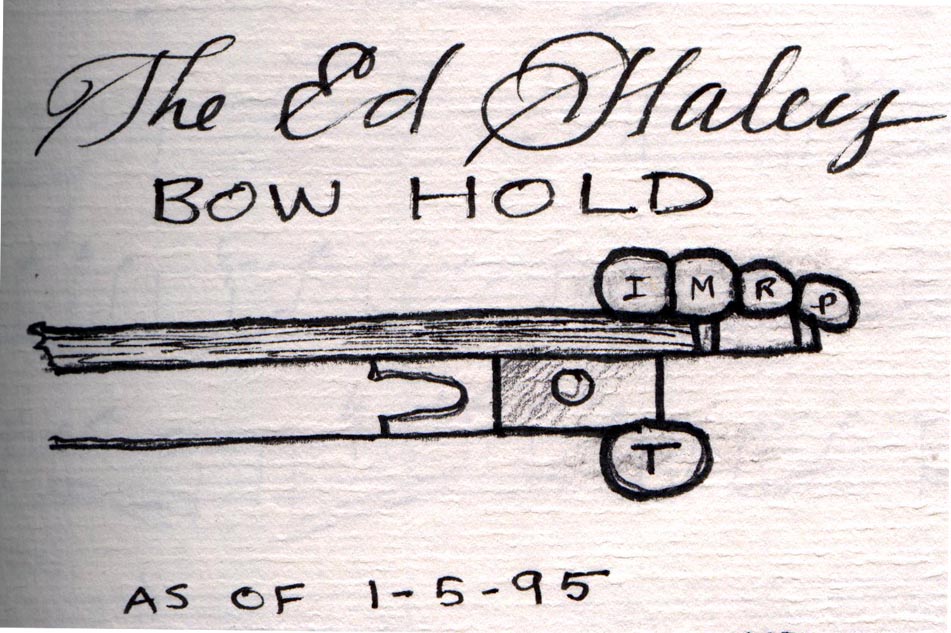
Ed Haley bow hold, 1995

Ed Haley bow hold, 1995

In Search of Ed Haley 134

25 Tuesday Jun 2013

Posted by Brandon Ray Kirk in Ed Haley

≈ Leave a comment

Tags

Ashland, Ed Haley, Ella Haley, history, John Hartford, Kentucky, Lawrence Haley, life, Margaret Arms, music, Pat Haley, Ralph Haley, writing

Later that night, Lawrence, Pat and I looked through a box of family photographs. Most were “modern” pictures featuring side burns, bellbottoms, or trendy 80s sweaters, but there were a few treasures. Early in our dig, I came across an old postcard with Ed, Ella, and Ralph pictured on it. Toward the bottom of the box was a small, dark picture of Ed in between Ella and someone named Margaret Arms. Lawrence said Margaret was Ed’s cousin, originally from around Paintsville, Kentucky, “or somewhere,” who ran a barbershop on Court Street in Cincinnati. Mona later told me that Margaret used the last name of Thomas because she was married to or lived with a man by that name. Margaret used to give her jewelry.

At the bottom of the cardboard box, under the flaps, was a dark, faded picture of Ed and Ella sitting on the street with their instruments. The photo was small and blurred, but I could make out that Ed wore some kind of a billed cap and was getting ready to play a tune.

“Pop looks like he might have been getting ready to play a piece and was letting my mother know without coming right out and saying what piece of music he was gonna play,” Lawrence said of the picture. “He was maybe hitting a lick with the fiddle bow, sort of like a ‘tune-up lick’ or two.”

Lawrence pointed to his mother, who had her right arm behind the mandolin, and said, “They kept a cup on the street in front of them or some kind of place where people could put change and my mother would take that up and she would put it behind her mandolin and count the take for their piece of music. And that’s what she’s doing right there.”

In the photograph, Ed obviously had the fiddle placed against his chest, and it appeared as if he held the bow as far to the end of the frog as possible. I practiced the hold in front of the mirror in the living room, then showed it to Lawrence, who said, “That’s it. That looks right.” I could tell right away this bow hold allowed for greater leverage in playing close to the frog as well as for pulling an extremely long bow. It was very similar to a bow hold I’d learned as a boy from Gene Goforth and Benny Martin, but the emphasis was never as far back as Ed was holding it. In fact, when I first saw this picture I even thought Ed might be holding it by the “frog screw.”

In Search of Ed Haley 125

09 Sunday Jun 2013

Posted by Brandon Ray Kirk in Ed Haley

≈ Leave a comment

Tags

Ashland, Clifford Brickey, Columbus, Ed Haley, Emily Dickerson, Emory Brickey, fiddling, history, Kentucky, Lake Brickey, music, Ohio, Preston Brickey

Around the time of my call to Wilson Douglas, Lawrence Haley reminded me that his brother Clyde had sold his share of Ed’s records to Emory Brickey, a storekeeper in Ashland. I made an effort to track the records down, even though Lawrence didn’t think I had any chance of success. I couldn’t locate any of Emory’s immediate family but I did get in touch with a distant relative, Clifford Brickey. Clifford said he thought Emory had been a fiddler, then referred me to a relative, Emily Dickerson, who also happened to be an old-time fiddler-turned-guitarist. I called her up, told her who I was and what I was doing and asked if she’d ever met Ed.

“Never did meet him, but I’ve heard a lot of talk about him,” she said. “He was quite older than I… I’ve heard of him since I was a young kid, you know. But my uncle, Preston Brickey — he was a banjo-picker — he knew him. Well, of course, he’s deceased now, but now he had a son, Lake, lives in Columbus, Ohio, and he is a fine fiddler and he knew him personally. See, he lived in Portsmouth, Lake did, then moved to Columbus. Lake is in his late sixties, I’d say. He would’ve been a young boy when Haley was in his prime.”

I got Lake Brickey’s telephone number and called him up in Columbus, Ohio. It seemed like he would be able to open all kinds of new doors but as it turned out his memories of Ed were vague.

“I don’t know any history on him or anything, but when I was learning to play fiddle myself — when I was a kid — Dad took me up there — I think it was Labor Day or 4th of July or something like that — and he, as well as other musicians used to set around the courthouse and play. And I listened to him play two or three tunes and talked with him a little bit and he wanted to hear me play a tune. And I played that and that’s about all I can tell you. I started fiddling pretty young and the first thing you know I was fiddling every Friday and Saturday for square dances and I kept so busy I never got to hear that many other fiddlers.”

H.M. Stafford

31 Friday May 2013

Posted by Brandon Ray Kirk in Big Sandy Valley

≈ Leave a comment

Tags

Appalachia, Big Sandy River, H.M. Stafford, history, Johnson County, Kentucky, photos, pushboat, steamboats

HM Stafford and pushboat Johnson County 1904

H.M. Stafford and pushboat, Johnson County, Kentucky, 1904

In Search of Ed Haley 121

31 Friday May 2013

Posted by Brandon Ray Kirk in Ed Haley

≈ Leave a comment

Tags

Appalachia, Ed Haley, Ella Haley, fiddler, Forked Deer, guitar, history, Kentucky, Lawrence Haley, music, Pat Haley, Ralph Haley, writing

I kept in close touch with Lawrence, who Pat said always perked up at my calls.  His comments about his father’s music were very helpful. At times, I felt as if I might be talking to Ed.

“I guess Pop learned any time he was sitting around jamming. Anytime he was just sitting around making music with a bunch of friends, they was practicing and learning new pieces. How it would sound this a way and how it would sound that a way. You try different styles and things or you just try for speed. I’ve watched Bill Monroe and some of his stuff and it seems like that’s part of his aim is to see how fast he can play sometimes. Well, that might have been my dad’s. I know in that piece of music, ‘Forked Deer’, I think there’s a certain spot in it Pop changes his speed right there at the last a little bit. And I guess that’s the way most fiddlers do to see if people can keep up with them.”

I said to Lawrence, “Well, you know, a lot of that fiddling and everything, it was a competition. I bet if somebody came along that thought they could beat your dad, I bet your dad threw them a few loops to let them know who’s boss.”

Lawrence agreed.

“Yeah, I guess he did. He’d probably set and help somebody. Say, ‘Now you’d better do it this way,’ or something. If he liked who he was with, that’s the way he’d be. He’d play with them, and if the guitar player wasn’t doing it right… I’ve heard him a lot of times when Ralph — him and Mom would be a playing — he’d tell Ralph to change chord ‘so-and-so.’ And Ralph finally got to the point where he could chord it properly, but then he wanted to make those runs between chords. Pop would tell him how to get to a certain place, or what chord to be at. He’d tell him to change chords, so I guess he told everybody that if they wasn’t getting to where they should be at the right times. He’d let them know, if he wanted to teach anybody. If he played with you for a little while and saw that you weren’t going to make it, he’d probably tell you, ‘You just might as well put it up.’ That’s the way I think about my dad. I’m maybe like Clyde: I didn’t know him enough really to know what kind of a man he was. A lot of my knowledge of him is hearsay, too.”

Rafting Scene

26 Sunday May 2013

Posted by Brandon Ray Kirk in Big Sandy Valley, Timber

≈ Leave a comment

Tags

Appalachia, Catlettsburg, culture, history, Kentucky, life, logging, photos, steamboats, timbering, U.S. South

Six steamboats with log rafts, Catlettsburg, Kentucky, 1901

Six steamboats with log rafts, Catlettsburg, Kentucky, 1901

In Search of Ed Haley

25 Saturday May 2013

Posted by Brandon Ray Kirk in Ed Haley

≈ Leave a comment

Tags

Appalachia, Ashland, culture, history, Kentucky, Lawrence Haley, life, photos, U.S. South

Lawrence Haley, 1949-1960

Lawrence Haley, 1949-1960

In Search of Ed Haley

24 Friday May 2013

Posted by Brandon Ray Kirk in Ed Haley

≈ Leave a comment

Tags

Appalachia, culture, history, Jenkins, Kentucky, life, photos, Pike County, U.S. South

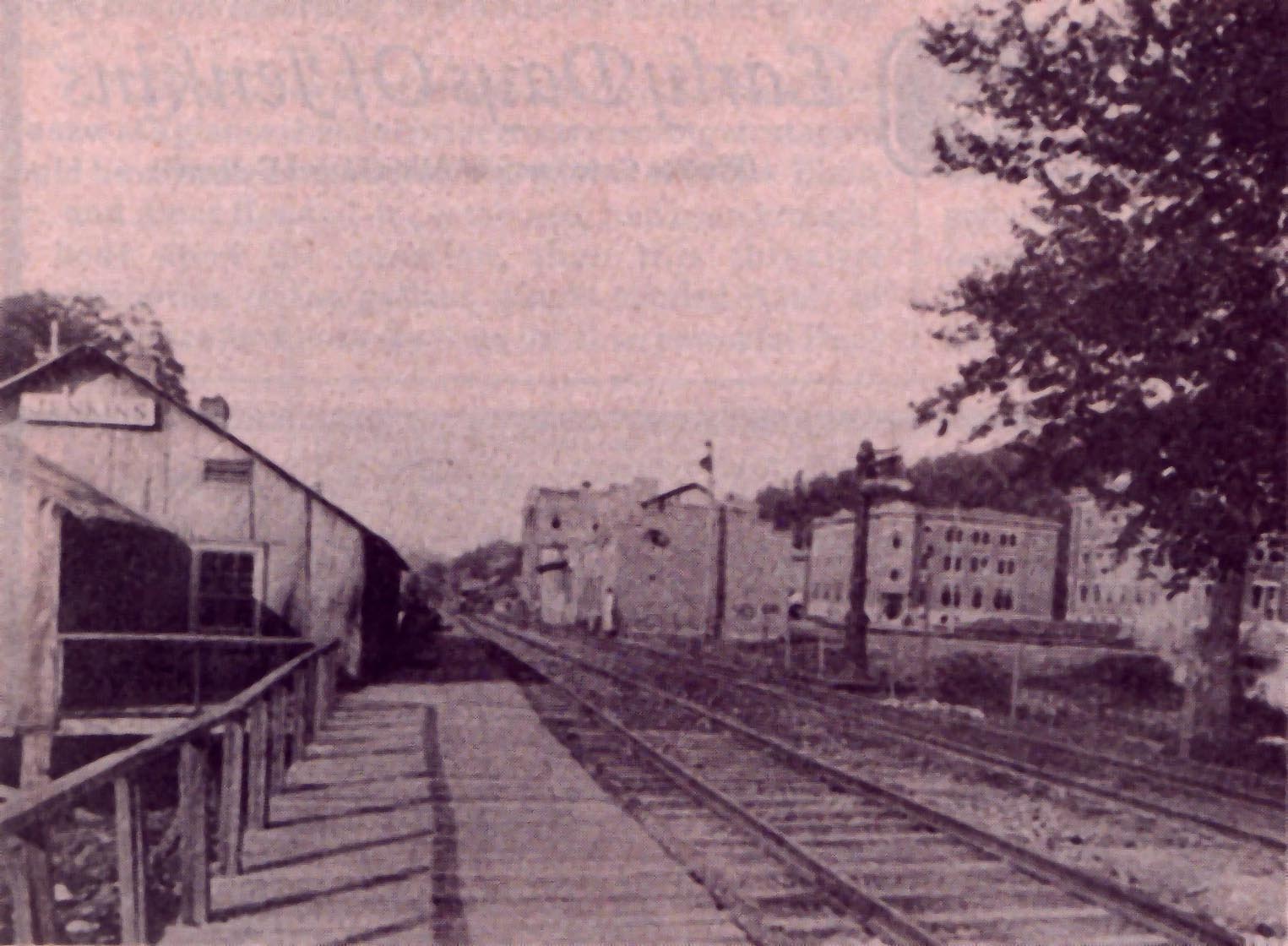
Jenkins, Kentucky

Jenkins, Kentucky

In Search of Ed Haley 115

23 Thursday May 2013

Posted by Brandon Ray Kirk in Big Harts Creek, Ed Haley, Spottswood, Warren, Whirlwind

≈ Leave a comment

Tags

Andrew Jackson, Ben Adams, Bill Abbott, Bob Mullins Cemetery, Buck Fork, Chloe Mullins, civil war, Confederate Army, Dicy Adams, Ed Haley, Elizabeth Mullins, Enoch Baker, genealogy, Harts Creek, Henderson Dingess, history, Hollene Brumfield, Imogene Haley, Imogene Mullins, Jackson Mullins, Jane Mullins, Jeremiah Lambert, John Frock Adams, John Gore, John Q. Adams, Joseph Adams, Kentucky, Logan County, Margaret Gore, Mathias Elkins, Peter Mullins, Riland Baisden, Spencer A. Mullins, Tennessee, Ticky George Adams, timbering, Trace Fork, Turley Adams, Van Buren Mullins, Weddie Mullins, Weddington Mullins, West Virginia, writing

Ed Haley’s grandfather, Andrew Jackson Mullins, was born about 1843 to Peter and Jane (Mullins) Mullins. Jackson, as he was called, was named in honor of President Andrew Jackson, that early American icon. Like many folks in those days, Peter and Jane Mullins appear to have been caught up in the Jackson mystique. They even named one son Van Buren, after his vice president. Jackson Mullins was the first child born to Peter following the family exodus from Kentucky or Tennessee to Logan County, (West) Virginia. The 1850 Logan County Census listed him as seven years old. In 1860, he was eighteen. During the Civil War, Jackson served in the Confederate army. Brothers Weddington and Van Buren served as Confederates. In the late 1860s, Jackson married the slightly older Chloe Ann (Gore) Adams, a widow. Chloe had been born around 1840 to John and Margaret (Dingess) Gore, pioneer residents of Harts Creek. She had first married John Quincy “Bad John” Adams, a first cousin to Jackson, with whom she had four children: Dicy (born 1857), Joseph (born May 1858), John C. “Frock” (born c. 1861) and George Washington “Ticky George” (born 15 Jul 1864). She and Jackson had three children: Imogene Mullins (born c.1868), Peter Mullins (born May 1870), and Weddington Mullins (born April 10, 1872). Jackson and Chloe are thought to have lived on Trace Fork, perhaps at the present-day site of the Turley Adams home where they certainly lived in later years.

What little is known of Jackson Mullins — the man who partially raised Ed Haley — comes through deed records and census records. On February 13, 1869, his uncle Spencer A. Mullins wrote him a note that read: “Mr. A.J. Mullins and wife: you will pleas Come down and git your Deed for the Buck fork Land. I will not pay the taxes any longer.” In 1869 he purchased 200 acres of land on the creek from Riland Baisden. The next year he was listed in the 1870 census as 27 years old with 700 dollars worth of real estate and 200 dollars worth of personal property. His daughter — Ed Haley’s mother — first appeared in that record as “Em. Jane Mullins,” age two.  An April 1871, Justice Jeremiah Lambert provided a receipt to him for $2.80 “in the cost of the peace warrant in favor [of] him against Benjamin Adams.” An 1871 Logan County tax receipt listed A.J. Mullins as a resident of “Hearts Creek.” On February 28, 1877, the Logan County Court appointed him as “Surveyor of Roads in Precinct No. 76 in place of Weddington Mullins for the time of two years commencing April 1, 1877.” On December 17, 1877, the Logan County Clerk provided a receipt to him for recording a deed from Henderson Dingess and wife (parents to Hollene Brumfield). An 1878 tax receipt shows him in charge of six tracts totaling 244 acres under the ownership of “John Adams Heirs.”

The 1880 Logan County Census listed Jackson as 37 years old, while his wife was 40. Children in the household were John C. Adams (aged eighteen), George Adams (aged 15), “Emagane Mullins” (aged 12), Peter Mullins (aged 9), and Weddington Mullins (aged 6). That same year, Jackson sold five tracts of land totaling over 200 acres to brother-in-law Mathias Elkins for 3,000 dollars. He also sold 50 or so acres on Buck Fork to his father Peter and stepmother Elizabeth for 600 dollars. In February 1881, the Logan County Court reappointed him to relieve his brother Weddington as Surveyor of Public Roads for Precinct No. 76 “commencing April 1st, 1881.” That same year, he secured land from the John Q. Adams estate and bought 100 acres on Trace Fork from A.A. Low, attorney. On August 7, 1883, Enoch Baker, a timber boss on Harts Creek,  provided a receipt to him for fifteen dollars “in payment for a Stove.” In 1886, Jackson deeded 37 tracts on Trace Fork to stepsons Joseph and John Adams. On April 2, 1888, he signed a promissory note agreeing to pay William Abbott $41.75 plus interest within a year. Because he was illiterate, he signed the note with an “X.”

In March 1891, Jackson and Chloe Mullins deeded their property on Trace Fork to their three children: Imogene Haley, Peter Mullins, and Weddie Mullins.

In the 1900 Logan County Census, Jackson gave his birth date as March of 1845, while Chloe gave hers as July 1834. Ed Haley first appears in the 1900 Logan County Census as “James E. Haley, born August 1885,” and living in their home. His birth date of 1885 was two years later than what was given by the Haley family records. By 1910, Jackson lived with son Peter Mullins, while Chloe was in the home of Weddie Mullins’ widow, Mag. Ed was absent from the census entirely, indicating that he was gone from Harts by that time. A few years later, in 1915, Jackson Mullins died and was buried in an unmarked grave at the Bob Mullins Cemetery on main Harts Creek. His widow died in 1919.

← Older posts
Newer posts →

Feud Poll 1

If you had lived in the Harts Creek community during the 1880s, to which faction of feudists might you have given your loyalty?

Categories

  • Adkins Mill
  • African American History
  • American Revolutionary War
  • Ashland
  • Atenville
  • Banco
  • Barboursville
  • Battle of Blair Mountain
  • Beech Creek
  • Big Creek
  • Big Harts Creek
  • Big Sandy Valley
  • Big Ugly Creek
  • Boone County
  • Breeden
  • Calhoun County
  • Cemeteries
  • Chapmanville
  • Civil War
  • Clay County
  • Clothier
  • Coal
  • Cove Gap
  • Crawley Creek
  • Culture of Honor
  • Dingess
  • Dollie
  • Dunlow
  • East Lynn
  • Ed Haley
  • Eden Park
  • Enslow
  • Estep
  • Ethel
  • Ferrellsburg
  • Fourteen
  • French-Eversole Feud
  • Gilbert
  • Giles County
  • Gill
  • Green Shoal
  • Guyandotte River
  • Halcyon
  • Hamlin
  • Harts
  • Hatfield-McCoy Feud
  • Holden
  • Hungarian-American History
  • Huntington
  • Inez
  • Irish-Americans
  • Italian American History
  • Jamboree
  • Jewish History
  • John Hartford
  • Kermit
  • Kiahsville
  • Kitchen
  • Leet
  • Lincoln County Feud
  • Little Harts Creek
  • Logan
  • Man
  • Matewan
  • Meador
  • Midkiff
  • Monroe County
  • Montgomery County
  • Music
  • Native American History
  • Peach Creek
  • Pearl Adkins Diary
  • Pecks Mill
  • Peter Creek
  • Pikeville
  • Pilgrim
  • Poetry
  • Queens Ridge
  • Ranger
  • Rector
  • Roane County
  • Rowan County Feud
  • Salt Rock
  • Sand Creek
  • Shively
  • Spears
  • Sports
  • Spottswood
  • Spurlockville
  • Stiltner
  • Stone Branch
  • Tazewell County
  • Timber
  • Tom Dula
  • Toney
  • Turner-Howard Feud
  • Twelve Pole Creek
  • Uncategorized
  • Warren
  • Wayne
  • West Hamlin
  • Wewanta
  • Wharncliffe
  • Whirlwind
  • Williamson
  • Women's History
  • World War I
  • Wyoming County
  • Yantus

Feud Poll 2

Do you think Milt Haley and Green McCoy committed the ambush on Al and Hollene Brumfield in 1889?

Blogroll

  • Ancestry.com
  • Ashland (KY) Daily Independent News Article
  • Author FB page
  • Beckley (WV) Register-Herald News Article
  • Big Sandy News (KY) News Article
  • Blood in West Virginia FB
  • Blood in West Virginia order
  • Chapters TV Program
  • Facebook
  • Ghosts of Guyan
  • Herald-Dispatch News Article 1
  • Herald-Dispatch News Article 2
  • In Search of Ed Haley
  • Instagram
  • Lincoln (WV) Journal News Article
  • Lincoln (WV) Journal Thumbs Up
  • Lincoln County
  • Lincoln County Feud
  • Lincoln County Feud Lecture
  • LinkedIn
  • Logan (WV) Banner News Article
  • Lunch With Books
  • Our Overmountain Men: The Revolutionary War in Western Virginia (1775-1783)
  • Pinterest
  • Scarborough Society's Art and Lecture Series
  • Smithsonian Article
  • Spirit of Jefferson News Article
  • The Friendly Neighbor Radio Show 1
  • The Friendly Neighbor Radio Show 2
  • The Friendly Neighbor Radio Show 3
  • The Friendly Neighbor Radio Show 4
  • The New Yorker
  • The State Journal's 55 Good Things About WV
  • tumblr.
  • Twitter
  • Website
  • Weirton (WV) Daily Times Article
  • Wheeling (WV) Intelligencer News Article 1
  • Wheeling (WV) Intelligencer News Article 2
  • WOWK TV
  • Writers Can Read Open Mic Night

Feud Poll 3

Who do you think organized the ambush of Al and Hollene Brumfield in 1889?

Recent Posts

  • Logan County Jail in Logan, WV
  • Absentee Landowners of Magnolia District (1890, 1892, 1894)
  • Charles Spurlock Survey at Fourteen Mile Creek, Lincoln County, WV (1815)

Ed Haley Poll 1

What do you think caused Ed Haley to lose his sight when he was three years old?

Top Posts & Pages

  • Halcyon 4.10.1919
  • Civil War Gold Coins Hidden Near Chapmanville, WV
  • Halcyon-Yantus 12.08.1911
  • Ran'l McCoy's Final Months (1914)
  • Blood in West Virginia: Brumfield v. McCoy (2014)

Copyright

© Brandon Ray Kirk and brandonraykirk.wordpress.com, 1987-2023. Unauthorized use and/or duplication of this material without express and written permission from this blog’s author and/or owner is strictly prohibited. Excerpts and links may be used, provided that full and clear credit is given to Brandon Ray Kirk and brandonraykirk.wordpress.com with appropriate and specific direction to the original content.

Archives

  • February 2025
  • January 2025
  • October 2023
  • September 2023
  • December 2022
  • November 2022
  • May 2022
  • April 2022
  • February 2022
  • November 2021
  • October 2021
  • September 2021
  • June 2021
  • May 2021
  • April 2021
  • March 2021
  • February 2021
  • January 2021
  • December 2020
  • November 2020
  • October 2020
  • July 2020
  • June 2020
  • May 2020
  • April 2020
  • March 2020
  • February 2020
  • January 2020
  • December 2019
  • November 2019
  • October 2019
  • September 2019
  • August 2019
  • July 2019
  • June 2019
  • May 2019
  • April 2019
  • March 2019
  • February 2019
  • January 2019
  • December 2018
  • November 2018
  • October 2018
  • September 2018
  • August 2018
  • July 2018
  • June 2018
  • May 2018
  • April 2018
  • March 2018
  • February 2018
  • January 2018
  • December 2017
  • November 2017
  • October 2017
  • September 2017
  • August 2017
  • July 2017
  • June 2017
  • May 2017
  • April 2017
  • March 2017
  • February 2017
  • January 2017
  • December 2016
  • November 2016
  • October 2016
  • September 2016
  • August 2016
  • July 2016
  • June 2016
  • May 2016
  • April 2016
  • March 2016
  • February 2016
  • January 2016
  • December 2015
  • November 2015
  • October 2015
  • September 2015
  • August 2015
  • July 2015
  • June 2015
  • May 2015
  • April 2015
  • March 2015
  • February 2015
  • January 2015
  • December 2014
  • October 2014
  • September 2014
  • August 2014
  • July 2014
  • June 2014
  • May 2014
  • April 2014
  • March 2014
  • February 2014
  • January 2014
  • December 2013
  • November 2013
  • October 2013
  • September 2013
  • August 2013
  • July 2013
  • June 2013
  • May 2013
  • April 2013
  • March 2013
  • February 2013
  • January 2013
  • December 2012
  • November 2012

Enter your email address to follow this blog and receive notifications of new posts by email.

Join 2,927 other subscribers

Tags

Appalachia Ashland Big Creek Big Ugly Creek Blood in West Virginia Brandon Kirk Cabell County cemeteries Chapmanville Charleston civil war coal Confederate Army crime culture Ed Haley Ella Haley Ferrellsburg feud fiddler fiddling genealogy Green McCoy Guyandotte River Harts Harts Creek Hatfield-McCoy Feud history Huntington John Hartford Kentucky Lawrence Haley life Lincoln County Lincoln County Feud Logan Logan Banner Logan County Milt Haley Mingo County music Ohio photos timbering U.S. South Virginia Wayne County West Virginia Whirlwind writing

Blogs I Follow

  • OtterTales
  • Our Appalachia: A Blog Created by Students of Brandon Kirk
  • Piedmont Trails
  • Truman Capote
  • Appalachian Diaspora

BLOOD IN WEST VIRGINIA is now available for order at Amazon!

Blog at WordPress.com.

OtterTales

Writings from my travels and experiences. High and fine literature is wine, and mine is only water; but everybody likes water. Mark Twain

Our Appalachia: A Blog Created by Students of Brandon Kirk

This site is dedicated to the collection, preservation, and promotion of history and culture in Appalachia.

Piedmont Trails

Genealogy and History in North Carolina and Beyond

Truman Capote

A site about one of the most beautiful, interesting, tallented, outrageous and colorful personalities of the 20th Century

Appalachian Diaspora

  • Subscribe Subscribed
    • Brandon Ray Kirk
    • Join 789 other subscribers
    • Already have a WordPress.com account? Log in now.
    • Brandon Ray Kirk
    • Subscribe Subscribed
    • Sign up
    • Log in
    • Report this content
    • View site in Reader
    • Manage subscriptions
    • Collapse this bar
 

Loading Comments...