• About

Brandon Ray Kirk

~ This site is dedicated to the collection, preservation, and promotion of history and culture in my section of Appalachia.

Brandon Ray Kirk

Tag Archives: John Martin

World War I Statue in Logan, WV (1928)

26 Monday Aug 2019

Posted by Brandon Ray Kirk in Huntington, Italian American History, Logan, World War I

≈ 1 Comment

Tags

A.D. Collins, A.F. Benjamin, American Legion, Bee Stewart, Betty Davin, Boy Scouts, C.L. Wright, Clarence Bartram, David Hensley, Doris Bradley, Edward Gunther, Favaro, Floyd W. Clay, Gunther-McNeely-Nowlan Post, Hatfield Island, history, Huntington, Italy, James Greever, James L. Robinson, John B. McNeely, John Martin, Keefer Jennings Whitman, Logan, Logan Banner, Logan County, Lorena greever, M.B. Kendall, M.D. Tony Kendall, Madge Adkins, Margaret McNemar, Marshall College, Marshall University, Midelburg Island, Mike Tarka, Morris P. Shawkey, Newton Cook, Oscar Dial, Pete Minotti, Peter White, Robert F. Caverlee, Roy Lowe, Roy Simms, Scotty McDonald, Tony Curia, Ulysses B. Vance, W.C. Turley, West Virginia, Willard Ball, William F. Munsey, Willie F. Smith, World War I

From the Logan Banner of Logan, WV, comes this bit of history about the World War I statue now located at Hatfield/Midelburg Island:

IMG_7592

Soldier Monument Dedication Nov. 11

Granite Figure of Doughboy Will Be Set Up This Week, Minotti Says

The $6,000 granite doughboy memorial to World War veterans, the erection of which is being sponsored by Pete Minotti of this city, will be placed on the base near the west Court House entrance sometime during the next three days.

Word was received here by Mr. Minotti that the monument had been shipped from Chicago Monday and that it would arrive in Logan sometime tomorrow. Mr. Minotti said that the figure would be placed on the base and all the work completed this week.

Dedication will be held Sunday afternoon, November 11, at 2 o’clock. The American Legion of this city will have charge of the ceremonies to which the public is invited.

Boy scouts of the community are busy selling tags to help defray expenses of purchasing and erecting the monument. The doughboy figure is larger than life size, being seven feet tall. The figure depicts an American soldier carrying a rifle in one hand and throwing a bomb with the other hand. He is pictured as in the midst of a barb wire entanglement.

Logan (WV) Banner, 30 October 1928

***

8 Tons of Granite In New Monument to Logan Soldiery

Seventeen thousand pounds of Vermont granite will surmount the concrete base of the monument now being erected in the Court House yard. Atop the granite blocks will be placed a seven-foot statue representing an American doughboy carrying a rifle and bomb poised for throwing.

The monument will be 19 feet high, says Pete Minotti, local contractor, who is backing and taking the leading part in providing a suitable memorial for Logan county’s heroic dead. The base will be hidden by an earthen mound or terrace on all four sides.

Dedication of this memorial will be the feature of this year’s celebration of the signing of the Armistice on November 11.

Logan (WV) Banner, 2 November 1928

***

Arrange Plans for Unveiling of Statue

Plans for the dedication of the new monument to the memory of World War participants, living and dead, will be completed at a special meeting of the local post, American Legion, at the Court House Dugout Thursday night at 7:30.

The unveiling and dedicatory services are set for 2 o’clock Sunday afternoon, Armistice day. Pete Minotti, originator of the plan and the donor of the monument, will make the presentation. Formal acceptance will be by M.D. (Tony) Kendall, a leading legionnaire of the city. There will be other addresses and vocal numbers by Mrs. Madge Adkins, popular and talented singer.

Boy Scouts will aid the Legion men in carrying out an appropriate program of exercises.

Logan (WV) Banner, 6 November 1928

***

Monument to Soldiers Ready For Unveiling

Exercises to be Held at Court House at 2:00 O’clock Sunday Afternoon

Minotti is Moving Spirit

Huntington Educator Will Deliver Address–Flag-Raising Comes First

On the tenth anniversary of the signing of the Armistice, Logan county soldiers who paid the supreme price will be honored by their kinsfolk and the citizens of the county when the Pete Minotti memorial is unveiled Sunday afternoon at two o’clock.

The memorial, a fine bronze reproduction of a doughboy mounted on a suitable granite base, was erected near the western entrance to the Court House during the first part of this week and by tomorrow evening everything will be in complete readiness for the dedication exercise.

The American Legion will have charge of the services with the Boy Scouts and several others assisting. The Boy Scouts will conduct a flag-raising just before the unveiling exercises.

The dedicatory address will be delivered by C.L. Wright, superintendent of Huntington schools and a brilliant orator. These exercises will be opened with prayer by Rev. Robert F. Caverlee. Pete Minotti, whose generosity and whose love for his–adopted–country have made this memorial possible, will make the presentation speech. Thereupon the unveiling will take place, with Misses Scotty McDonald, Margaret McNemar, Lorena Greever, Doris Bradley and Betty Davin and James Greever participating. Formal acceptance will be made by M.B. Kendall, commander of Fifth district, department of West Virginia, American Legion. Salute and taps will be followed by benediction by Rev. A.F. Benjamin.

This monument, costing $6,000, is 19 feet high.

A bronze name plate at the statue’s base has inscribed across the top the dates, “1917-1918,” and underneath are the names of the 39 Logan County World War veterans killed, mortally wounded or fatally afflicted by disease while in service. At the bottom is the name, “Pete Minotti Memorial,” and the date, “1928.” The American Legion crest is also on the plate.

Logan (WV) Banner, 13 November 1928

***

Big Concourse At Dedication of Monument

Dr. M.P. Shawkey Delivers Eloquent, Patriotic Address At Sunday’s Exercises

P. Minotti the Generous

Presents Memorial to Legion Post as Custodian–Flag-Raising Ceremony

Logan county paid tribute Sunday to a long list of its heroic dead sleeping in foreign and native soil when hundreds of people witnessed the dedication of the monument to the memory of the warriors who fell in the World War.

The Pete C. Minnotti memorial depicting a khaki-clad doughboy hurling a grenade amid barb wire entanglements was dedicated with fitting ceremonies on the eleventh Armistice Day. Dr. M.P. Shawkey, president of Marshall College, delivered the address. C.L. Wright, superintendent of the Huntington schools, who was unable to be present because of illness, was scheduled to deliver the address and Dr. Shawkey filled his place.

In his presentation speech Mr. Minotti reminded the people that the memorial was erected so that people passing by hurriedly in the pursuit of riches might glance up at the soldier figure and remember the boys who fell fighting for freedom and democracy. Mr. Minotti said that he convicted the idea of erecting some memorial to the dead soldiers last summer as he journeyed through his native land, Italy, and in every city and hamlet, no matter how small, the people had erected some kind of a memorial to their dead heroes.

Generous and Patriotic

“Adjoining counties had honored their soldiers and it was time that Logan county honor their dead with a fitting memorial,” said Mr. Minotti.

During the last two months Mr. Minotti, through the cooperation of the American Legion, has been busy planning for and erecting the monument that now graces the Court House lawn near the western entrances. This generous donor, an Italian by birth and an American by choice, was born at Favaro, Italy, October 22, 1885. He came to Logan county 22 years ago and since that time Logan has been his home.

The monument was accepted by A.D. Collins, commander of Gunther-McNeely-Nowlan post, in behalf of the Legion.

Dr. Shawkey spoke of the prosperity which this country enjoys and the lofty position which the nation commands. Yet he urged that the goal which the people should strive for should be a happy and contented country is preference to wealth and a dominating position.

In the unveiling ceremony Misses Scotty McDonald, Margaret McNemar, Lorena Greever, Doris Bradley, Betty Davin and James Greever participated. Previous to the unveiling the Logan county scouts had charge of the flag raising ceremony. W.C. Turley was chairman of the dedication. Following the ceremony a rifle squad fired three volleys of shots over the monument as a salute to the dead.

C. & O. Band Made Special Music

It is also said that the light in the right hand of the doughboy which represents a grenade is the only one of its kind in the state and it was Mr. Minotti’s original idea.

On the bronze tablet on the base of the monument are inscribed the names of 39 men who died in action of wounds and of disease in Europe.

Roll of Honor

The men killed in action are:

Willard Ball, Clarence Bartram, Floyd W. Clay, Newton Cook, Tony Curia, Oscar Dial, Edward Gunther, David Hensley, Roy Lowe, John B. McNeely, John Martin, William F. Munsey, James L. Robinson, Roy Simms, Willie F. Smith, Bee Stewart, Mike Tarka, Ulysses B. Vance, Peter White, Keefer Jennings Whitman.

Those dying of wounds are: John L. Blankenship, Elmer Cook, Homer Hobbs, Noble J. Lax, Lawrence Marcuzzi, Denver Mullins, William R. Nowland, Haskell Phillips, Henry H. Runyon, Harold Thompson. Those dying of disease in Europe: Allen Bryant, Thomas J. Cox, Fred E. Hahne, Joe Hardy, Clyde Jeffrey, Johnnie Johnson, Allen Tabor, Homer Vance, and Levi J. Vance.

Those who died of disease in the United States but whose names do not appear on the tablet are William O. Bailey, Elbert Billups, James L. Brown, Elbert Carter, Sam Dillard, George D. Fletcher, Bert W. Green, Calvin Hughes, Wilbert S. Jeffreys, Sam Johnson, Claude B. Justice, Druie Mounts, Moss F. Stone, James Weaver, and Roy White.

The soldiers from Logan county who were wounded in action but whose names do not appear on the tablet were Albert Adams, Zatto Adkins, William W. Adkins, Lovell  H. Aldridge, Willie Allen, Frank Ball, Elisha Ball, Frank J. Bell, Walter S. Blake, Evert Blankenship, Tom Boring, George F. Breeden, H. Brewster, Charles Brewster, H.C. Brown, Floyd Chambers, James Chapin, Greenway Christian, Gay T. Gonley, George E. Covey, Ella Craddock, Dan Craft, Jim F. Crawford, John H. Crittenden, James Cyrus, Thomas Y. Davis, Bird Dingess, Rector H. Elkins, James M. Ellis, Carl Ellis, Frank Ferrell, Sidney Ferrell, Robert L. Gore, Burton W. Gore, Ben H. Gosney, Meddie Craley, Orvil Grubb, Earl Hager, William E. Hanshaw, John H. Harris, William Harris, Stonewall Hensley, James Jackson, Albert Jeffrey, Henon Jerrell, Ned Johnson, Floyd Johnson, Thomas P. Justice, Luther Lacy, Tony Ladas, Charles Burton Litten, George Luty, Herbert L. McKinney, Nick Mallozzo, Clifton Manns, Bill Manville, Ben Maynard, William D. Maynard, George Meadows, Shellie Moxley, Charlie M. Munsey, Spencer Mullins, Thomas R. Newmann, Clarence W. Parkins, James D. Peters, Arlie J. Price, Alfred Prichard, Finnie Walter Pugh, Bert Rayborn, Frank C. Reynolds, John Roberts, Dennie Robertson, Jennings Robinson, Otto Sanders, Burnie Sanson, Lee Shelton, John A. Shepherd, Clarence Smith, John Smith, Mack Smith, Patsy Vance, Frank Ward, John L. Ward, Charlie Warcovies, Thomas Weir, Joseph White, John B. Wilkinson, Jr., Frank C. Willcoven, Tom Williams, Will Wilson, Jasper Wooten, and Wilson Workman.

Sunday’s exercises were witnessed by a crowd comparable in size to that which greeted Colonel Roosevelt here during the campaign. While the Roosevelt crowd was considerably larger, Sunday’s crowd occupied most of the space fronting the monument and the main entrance to the Court House, and those on the outer edges heard but snatches of the speeches. And of course there were present scores of kinsmen of those whose names appear in rustless bronze on this granite shaft. As they gathered close to scan these names and to note the expression on the face of the doughboy representation, tears poured down the cheeks of Gold Star mothers as if to climax the hallowing of this spot–this heart center of the city and county–this monument to the ashes, this temple to the fame of those who laid their lives on their country’s altar in the greatest crisis in human history.

Much of the time since the dedication, at least during daylight hours, this new monument has been the cynosure of groups of varying size.

Logan (WV) Banner, 13 November 1928

Rowan County Feud in Morehead, KY (2019)

29 Wednesday May 2019

Posted by Brandon Ray Kirk in Cemeteries, Rowan County Feud

≈ Leave a comment

Tags

Appalachia, Craig Tolliver, D.B. Logan, Daniel Boone Tolliver, feuds, Floyd Tolliver, Hiram Pigman, John Martin, Kentucky, Lee Cemetery, Martin-Tolliver Feud, Morehead, Rowan County, Rowan County Feud, Tolliver-Martin Feud

IMG_5907

Historical marker providing some details of the Rowan County Feud, Morehead, KY. 24 June 2017. For a little more history about the feud, go here: https://brandonraykirk.com/2013/07/06/in-search-of-ed-haley-140/

IMG_7830.JPG

Historical marker providing some details of the Rowan County Feud, Morehead, KY. 20 May 2019

IMG_7187

Memorial to the casualties of the Rowan County Feud, Morehead, KY. 20 May 2019

IMG_7177

Lee Cemetery, Morehead, KY. Feudists are buried here! 20 May 2019

IMG_7176.JPG

Daniel Boone Tolliver was father to Craig Tolliver. Lee Cemetery, Pikeville, KY. 20 May 2019

World War I Casualties for Logan County, WV (1927)

25 Wednesday Apr 2018

Posted by Brandon Ray Kirk in African American History, Cemeteries, Logan, World War I

≈ Leave a comment

Tags

16th Infantry, 4th Infantry, African-Americans, Albert Adams, Albert Jeffrey, Alfred Prichard, Allen Bryant, Allen Tabor, American Legion, Appalachia, Argonne Woods, Arle J. Price, Armistice Day, Bee Stewart, Ben H. Gosney, Ben Maynard, Bert Rayborn, Bill Manville, Bird Dingess, Burnie G. Sanson, Burton W. Gore, Calvin Coolidge, Carl Ellis, Charles Brewster, Charles Burton Litten, Charlie M. Munsey, Charlie Warcovies, Clarence Bartram, Clarence Smith, Clarence W. Parkins, Clifton Manns, Clyde Jeffrey, Coal Branch, Crooked Creek Cemetery, Dan Craft, David Hensley, Dennie Robertson, Denver Mullins, Doc Workman, Earl Hager, East End, Edward Gunther, Elbert Billups, Elbert Carter, Elisha Ball, Ella Craddock, Elmer Cook, Everett Blankenship, Finne Walter Pugh, Floyd Chambers, Floyd Johnson, Floyd W. Clay, France, Frank Bell, Frank C. Reynolds, Frank C. Wilcoxen, Frank Ferrell, Frank J. Bell, Frank Ward, Fred E. Hahne, genealogy, George E. Covey, George F. Breeden, George Luty, George Meadows, Greenway Christian, Guy T. Conley, Harold Thompson, Haskell Phillips, Henan Jarrell, Henry H. Runyon, Herbert L. McKinney, Hill Brewster, Hirse C. Brown, history, Hoboken, Homer Hobbs, Homer Vance, James Chapin, James E. Peters, James G. Cyrus, James Jackson, James L. Robinson, James Linford Brown, James M. Ellis, Jasper Wooten, Jennings Robinson, Jim F. Crawford, Joe Hardy, John A. Shepherd, John B. McNeely, John B. Wilkinson, John H. Crittenden, John H. Harris, John L. Blankenship, John L. Ward, John Martin, John Roberts, John Smith, Johnie Johnson, Joseph White, Keefer Jennings Whitman, Lawrence Marcuzzi, Lee Cox, Lee Shelton, Levi J. Vance, Logan, Logan Banner, Logan County, Lovel H. Aldredge, Luther Lacy, Mack Smith, Meddie Graley, Mike Tarka, Ned Johnson, Newton Cook, Nick Malozzo, Noble J. Lax, Orvil Grubb, Oscar Dial, Otto Sanders, Patsy Vance, Peter White, Rector H. Elkins, Robert L. Gore, Roy Lowe, Roy Simms, Sam McNeely, Shellie Moxley, Sidney Ferrell, Spencer Mullins, Stonewall Hensley, Thomas J. Cox, Thomas P. Justice, Thomas R. Newman, Thomas Weir, Thomas Y. Davis, Tom Boring, Tom Williams, Tony Curia, Tony Ladas, Ulysses B. Vance, Walter S. Blake, West Virginia, Will Wilson, Willard Ball, William D. Maynard, William E. Hanshaw, William F. Munsey, William H. Adkins, William Harris, William O. Bailey, William R. Nowlan, Willie Allen, Willie F. Smith, World War I, Zatto Adkins

From the Logan Banner of Logan, WV, comes this story titled “Logan County Boys Killed or Wounded,” dated November 8, 1927:

Logan County Boys Killed or Wounded

Prayers in behalf of peace are suggested for Armistice Day by President Coolidge. It will likewise be proper to recall the names of those who sacrificed most in the cause of peace, who died or were wounded in the dreary days before the signing of the Armistice ended the most colossal conflict of all history. Twenty young men from Logan county were killed in action. Half that number died of wounds. Their names and the names of others who died in the service of their country a decade ago are reproduced from the official records:

Killed in Action

Willard Ball

Clarence Bartram

Floyd W. Clay

Newton Cook

Tony Curia

Oscar Dial

Edward Gunther

David Hensley

Roy Lowe

John B. McNeely

John Martin

William F. Munsey

James L. Robinson

Roy Simms

Willie F. Smith

Bee Stewart

Mike Tarka

Ulysses B. Vance

Peter White

Keefer Jennings Whitman

Died of Wounds

John L. Blankenship

Elmer Cook

Homer Hobbs

Noble J. Lax

Lawrence Marcuzzi

Denver Mullins

William R. Nowlan

Haskell Phillips

Henry H. Runyan

Harold Thompson

Died of Disease (A.E.F.)

Thomas J. Cox

Fred E. Hahne

Joe Hardy (colored)

Clyde Jeffrey

Johnie Johnson (colored)

Allen Tabor

Homer Vance

Levi J. Vance

Died of Disease in U.S.

William O. Bailey

Elbert Billups

James Linford Brown

Elbert Carter

Wounded in Action

Albert Adams

Zatto Adkins

William H. Adkins

Lovel H. Aldredge

Willie Allen

Frank Bell

Elisha Ball

Frank J. Bell

Walter S. Blake

Everett Blankenship

Tom Boring

George F.  Breeden

Hill Brewster

Charles Brewster

Hirse C. Brown

Allen Bryant

Floyd Chambers

James Chapin

Greenway Christian

Guy T. Conley

George E. Covey

Ella Craddock

Dan Craft (colored)

Jim F. Crawford

John H. Crittenden

James G. Cyrus

Thomas Y. Davis

Bird Dingess

Rector H. Elkins

James M. Ellis

Carl Ellis

Frank Ferrell

Sidney Ferrell

Robert L. Gore

Burton W. Gore

Ben H. Gosney

Meddie Graley

Orvil Grubb

Earl Hager

William E. Hanshaw

John H. Harris

William Harris (colored)

Stonewall Hensley

James Jackson (colored)

Albert Jeffrey

Henan Jarrell

Ned Johnson

Floyd Johnson

Thomas P. Justice

Luther Lacy

Tony Ladas

Charles Burton Litten

George Luty

Herbert L. McKinney

Nick Malozzo

Clifton Manns

Bill Manville

Ben Maynard

William D. Maynard

George Meadows

Shellie Moxley

Charlie M. Munsey

Spencer Mullins

Thomas R. Newman

Clarence W. Parkins

James E. Peters

Arle J. Price

Alfred Prichard

Finne Walter Pugh

Bert Rayborn

Frank C. Reynolds

John Roberts

Dennie Robertson

Jennings Robinson

Otto Sanders

Burnie G. Sanson

Lee Shelton

John A. Shepherd

Clarence Smith

John Smith (colored)

Mack Smith

Patsy Vance

Frank Ward (colored)

John L. Ward

Charlie Warcovies

Thomas Weir

Joseph White

John B. Wilkinson

Frank C. Wilcoxen

Tom Williams

Will Wilson (colored)

Jasper Wooten

Wilson Workman

It seems likely there are errors of spelling in the foregoing list, and perhaps some names have been omitted from the roster from which this list was copied. Desiring a complete and perfect list The Banner will appreciate having its attention called to any omissions or misspellings.

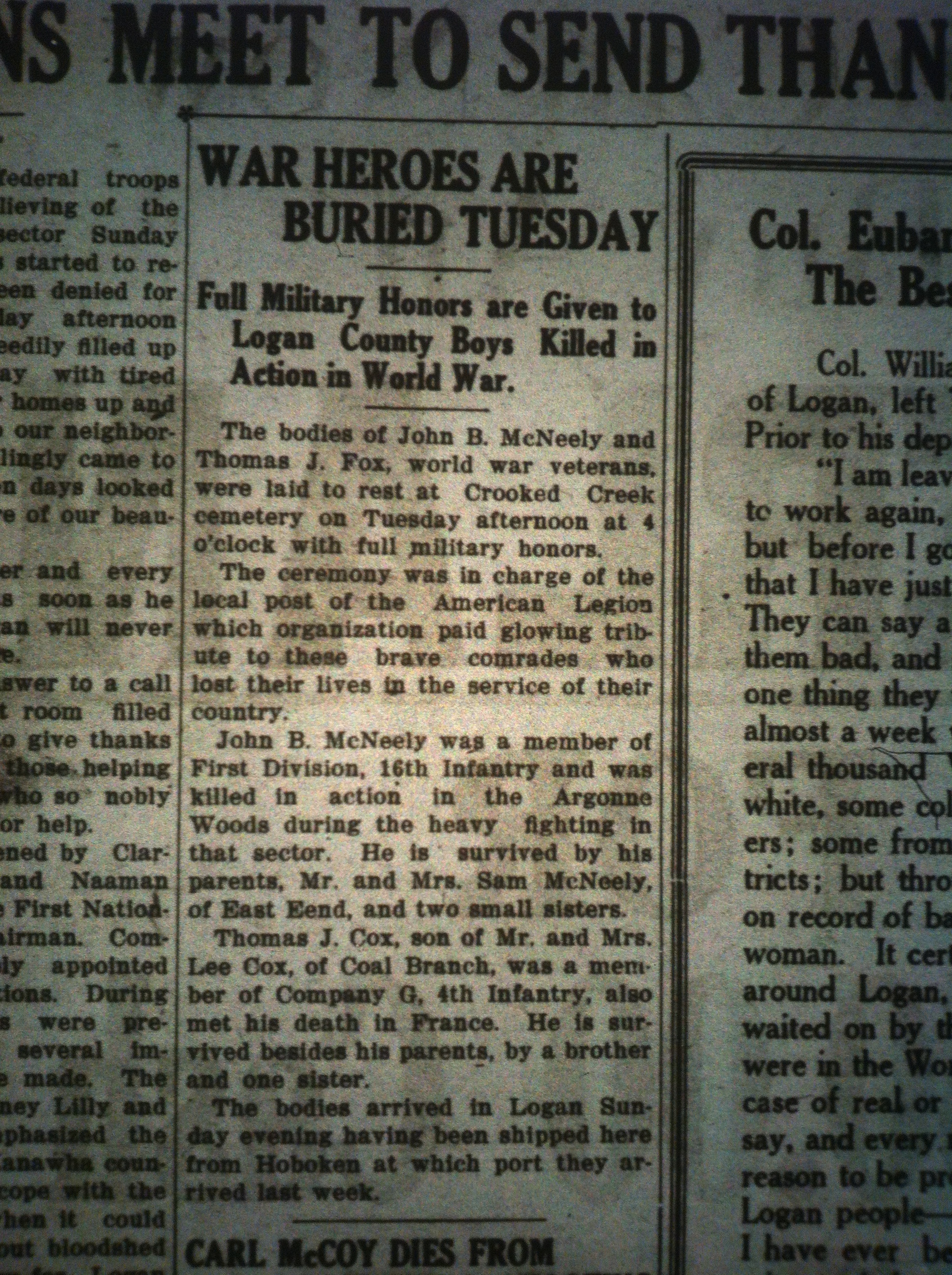
War Heroes are Buried LB 09.09.1921.JPG

Logan (WV) Banner, 9 September 1921.

Rowan County Feud Letter (1887)

08 Monday Jan 2018

Posted by Brandon Ray Kirk in Culture of Honor, Rowan County Feud

≈ 1 Comment

Tags

Appalachia, Cabell County, Cook Humphrey, Craig Tolliver, Democratic Party, history, Huntington, Huntington Advertiser, John Martin, Kentucky, Morehead, politics, Republican Party, Rowan County, Rowan County Feud, sheriff, Solomon Bradley, West Virginia

From the Huntington Advertiser of Huntington, WV, dated July 2, 1887 comes this letter about the Rowan County Feud:

The Rowan County War.

Editor Advertiser:

The writer is not surprised that your paper of last week fell into the current of popular opinion and denounced the Toliver gang, of Morehead, Kentucky, as the guilty ones in the celebrated feud which has caused the killing of about thirteen persons. Later advices appear at least to throw doubt on the subject of who is really to blame. Let us see. Here is the Cincinnati Enquirer’s account of the origin of the trouble, taken from that journal of the 23d inst.:

“The beginning of the trouble dates from the August election of 1884, when Cook Humphrey, a Republican, was elected sheriff by a trifling majority. He was a young, spare-built man, fresh from the country, and unsophisticated in appearance and manner. Craig Toliver, at the head of a party of friends, declared that Humphrey should not serve as sheriff. On the evening of the election a row occurred. Pistols were drawn and used, and Solomon Bradley (Democrat), a friend of Toliver’s, was shot and killed. The killing was charged against John Martin, and Toliver swore to be avenged. Subsequently Floyd Toliver and Martin got into a fight and the former (Toliver, Democrat) was killed on the street. From this time it may be said that the Martin (Republican) and Toliver (Democrat) factions were organized in deadly array, both sides determined never to yield, one to the other.”

The analysis of the above is, that the Republicans, having carried the election, became more or less insolent towards the opposition, who were correspondingly depressed and sore over their defeat, and gave utterance to their disappointment, and Craig Toliver used a very foolish expression to the effect that the Republican sheriff elect should not be installed. It is probable that this was accompanied by charges of fraudulent voting on the part of the Republicans–at any rate it was not such an offense as to justify Martin, Republican, in shooting Sol. Bradley, a partisan of Toliver’s. Subsequently Floyd Toliver denounced Martin for having killed Bradley without sufficient provocation and in an unmanly way, and was himself shot by Martin on the instant. So that a war of extermination seems to have been inaugurated by the Martins and their Republican following, against the Bradleys and Tolivers and their Democratic following, and signalized by the cold blooded murder of two of the latter. If this is true, and the record seems to bear it out as true, then the Tolivers were simply defending themselves and their households and party friends against the tumultuous murder of the Martins and their Republican following.

The subsequent getting possession of the person of John Martin (already a double murderer) and his killing at the hands of the Tolivers, whose brother and friend he had slain, was in the nature of retribution, and justified by the circumstances. Later, killings on both sides followed from the hot blooded feud which these had aroused, and while some of them appear to have been barbarous in the extreme, yet they legitimately came of a war of extermination such as had been initiated by the Martins and responded to, and not by the Tolivers and their friends.

A prominent citizen of Cabell Co., now sojourning near the scene of the disorder, in Rowan County, says:

“I suppose the dispatches have told you the war news; how 300 Republicans succeeded in killing four Democrats; but the war has only begun. I hear, to-day, that the Democrats are organizing a company near —— to put down the mob at Morehead who did the killing. He is more than sanguine who thinks the trouble ended.”

Our fellow-citizen, on the ground in Kentucky, evidently thinks the late killing of the three Tolivers unjustified by the facts as they are known to him. Let us wait for the facts.

BEN.


In Search of Ed Haley 188

30 Wednesday Oct 2013

Posted by Brandon Ray Kirk in Ed Haley

≈ Leave a comment

Tags

Ben Adams, Charlie Curry, Ed Haley, feud, French Bryant, history, Hollene Brumfield, John Martin, Mae Brumfield, Robert Martin, Tom Brumfield, Wesley Ferguson, writing

Brandon asked Mae what else she’d heard from the family about Al’s trouble with Milt and Green.

“All I’ve ever heard them talk about is going and getting them fellers that shot him and her, over in Kentucky,” she said. “They was just a posse went — I don’t know who they were — they rode horses and went to Kentucky and hunted these men. They caught them and they brought them back I guess and put them on their horses. I think that’s the way Granny told it to me. The river was up, and they tied them to horses and had somebody on the other side to catch them when they come across. Run them horses across that river with them to the other side. That’s how they got them and brought them up here to Fry.”

Now how did they get possession of them?

“Wasn’t some of the law men with them?” Mae asked. “I think now they was some law had them, and they claimed they took them away from the law. They never did discuss it too much to me. I’ve just heard outsiders talk about it.”

Mae said the Brumfields and Dingesses made life hard on Ben Adams after hearing that he’d been the one who hired Haley and McCoy. One night, they set his house on fire and tried to flush him out into the yard so they could shoot him. His wife, hoping they wouldn’t hurt her, ran outside repeatedly and extinguished the blaze. She begged the Brumfields and Dingesses to leave them alone for her sake and that of her children, and promised to take the family away the next morning if they were spared. The attackers were apparently satisfied because they left Ben Adams alone afterwards.

I asked Mae if she knew French Bryant and she said, “Yeah, I knew French Bryant. He was one of the gang, they said, I don’t know. I wasn’t acquainted with him — seen him pass here.”

Brandon asked Mae what it was like at Hollena’s house in her time there.

“Well, the family just practically came in and out all the time,” she said. “Tom’s mother lived here in a little old three-room house, and she stayed down there. Ward was a manager — that was her husband — Tom’s daddy. He managed her till he got killed. They all just practically lived at home. Hendricks lived up in the bottom over in Harts. At daylight, him and his family come down here — every day, they never missed a day. The family helped cook. Just always a big crowd there.”

Brandon asked if Hollena ever did any cooking.

“Oh, no,” Mae said. “She couldn’t work. She was crippled up too bad. She hired people to stay with her, and then Tom’s mother stayed there and done the work a lot. I never seen her cook none but one Sunday. Everyone had gone somewhere and me and Tom had come over there. And me and her and Wesley — her husband — and Tom was the only ones there. And she said, ‘Me and Mae’s gonna cook dinner. Tom go out there and kill me one of them big fat hens. Gonna make me some homemade dumplings.’ I’d never made no dumplings. That’s just right after we’d got married. I said, ‘Granny, I don’t know how to make dumplings.’ ‘I’ll teach you. I know how.’ Buddy, she did. She made the finest pot of dumplings you ever ate. She’d tell you how to cook. She knew all about it.”

I wondered if Hollena liked to have music in her home.

“I never did see no music,” Mae said. “I don’t know whether she liked it or not. She didn’t even have records probably. Had an old organ. I guess some of her girls mighta played it, you know. They was married and gone when I come into the family.”

Two local fiddlers, Bob and John Martin, sometimes came around and played for Hollena’s boarders. At these gatherings, there was moonshine for everyone (including Hollena, who liked to nip).

Mae heard that Milt Haley’s son — a blind fiddler — once had dinner there.

“His son, Ed Haley, come down there at Granny’s,” she said, catching me totally by surprise. “He played music, and he’d been around here playing music. He was down there around the mouth of the creek somewhere around her home, and she made them bring him in and feed him dinner. She didn’t hold no grudge. I’ve heard them tell it. I think maybe he stayed around in the community here. They used to have — I’ve heard them talk about it — them old dances around on Saturday nights. See all I know I’m telling you is just hearsay, something that somebody told me.”

Brandon asked Mae about Hollena Brumfield’s death. Mae wasn’t sure exactly what killed her.

“Supposed to been old age,” she said. “I don’t know whether she had any other problems or not. She was sick. Not long — one or two weeks.”

Brandon asked, “Did Hollena make any confessions or give any advice on her deathbed?”

Mae said, “I wasn’t a Christian at that time and I never asked her no questions like that. I don’t know whether she ever belonged to any church or not.”

Brandon said, “Somebody told me that right before she died she wanted a preacher named Charlie Curry to see her.”

“Probably did,” Mae said. “I don’t know. She may have.”

Charlie Curry, I remembered, was the preacher who once refused to baptize Ed Haley because he was drunk and wouldn’t give up playing the fiddle.

In Search of Ed Haley 140

06 Saturday Jul 2013

Posted by Brandon Ray Kirk in Ed Haley

≈ 7 Comments

Tags

Days of Darkness, Ella Haley, genealogy, history, Jean Thomas, John Martin, Kentucky, Laura Belle Whitt, Lincoln County Crew, Martin-Tolliver Feud, Morehead, William Trumbo, writing

William M. Trumbo — Ella Haley’s father — was born in October of 1861 to Thomas Isaac and Celia Ann (Oxley) Trumbo of Morehead, Kentucky. Thomas Isaac was a son of John L. and Sarah (Manley) Trumbo of Bath or Fleming County, Kentucky, while Celia Ann was the daughter of Prior and Isabel (Neal) Oxley. She was born in Kentucky or Ohio or Indiana (it varies in each census record). Thomas and Celia lived in Morehead across Triplett Creek from Dr. Raine’s Cottage Hotel. In 1870, Thomas was listed in the Rowan County Census as the county jailor. There were six children living in his home, aged newborn to 13 years, including son, William, who was 11. Daughter Lucy was living at Pine Grove with her new husband, John Martin — later a key participant in the Martin-Tolliver feud. The Thomas Trumbo home survived until at least 1984, according to one local history. (“The Thomas Isaac Trumbo House stands across Triplett Creek from the Raine Hotel. Dr. Raine’s Cottage Hotel was the site of many feud incidents.”)

William Trumbo married Laura Belle Whitt around 1878. They were the parents of five children: Zora Trumbo, born March 1879; Texas Anna Trumbo, born January 1885; Martha Ella, born February 1888; Allie W. Trumbo, born May 1891; and Luther Trumbo, born March 1893.

The Trumbos made their home in Morehead, where William was listed in the 1880 census as twenty-one years old. In 1884, Laura Belle Trumbo — William’s wife (who became pregnant in the spring of that year) — inadvertently played a key role in initiating the Martin-Tolliver Feud while at a pre-election dance in Morehead.

“During the evening Mrs. William Trumbo got tired, excused herself, and went upstairs to what she thought was her room,” writes John Edd Pearce in Days of Darkness: The Feuds of Eastern Kentucky (1994). “It was not. By mistake she got into the room of H.G. Price, a wealthy timber dealer and owner of the steamboat Gerty. When Price returned to his room, he was pleased to find on his bed what seemed to be a bonus, and he attempted to make the most of the situation. Mrs. Trumbo screamed, fled, and told her husband of her horrible experience.”

Unfortunately for Price, Mrs. Trumbo was related by marriage to the Logan and Martin families, both of whom made dangerous enemies.

“On election day Trumbo sought out Price and demanded that he apologize publicly to his wife,” writes Pearce. “Price replied — not dishonestly — that he had done nothing wrong, had found Mrs. Trumbo on his bed, and had done what any man would have done under the circumstances. A fight broke out. Friends of the men joined in, to the cheers of drunken onlookers.”

John Martin, a brother-in-law to Mrs. Trumbo, jumped in on the Trumbo side and soon got into a shooting scrape with Floyd Tolliver — which effectively ended the brawl. But tensions remained throughout the fall.

“It was a bleak day in December, 1884, following the August election in Rowan County when John Martin and his wife Lucy Trumbo and two of their small children climbed into their jolt wagon out on Christy Creek and rode into town,” writes Jean Thomas in Blue Ridge Country (1942). In no time at all, Martin bumped into Tolliver, who he shot dead before turning himself in to authorities. Not long thereafter, a mob of men shot Martin to death on a train at Farmers, a settlement about five miles from Morehead.

“When the train bearing John Martin’s bullet-torn body reached Morehead, he was carried, still breathing, into the old Central Hotel where he died that night,” writes Thomas. “In the meantime his distracted wife had sent for their children and her mother who was staying with the family on the farm on Christy Creek. An old darky who had long lived at the county seat mounted his half-blind mule and rode out along the lonely creek that cold winter night to carry the sad tidings to the Martin household. He also rode ahead of them on the journey back with the corpse of John Martin later that same night.”

Along the way, Granny Trumbo — Ella’s grandmother — warned the children gathered in the back of the wagon, “Hush! No telling who’s hid in the brush to kill us.” Years later, the children remembered how she sat “bravely erect on the board seat of the wagon beside her widowed daughter, gripped the reins and urged the weary team onward along the frozen road, keeping close behind the silent horseman ahead.”

It was the first violent acts in a three-year row that would claim twenty lives, almost destroy a town and inspire the song, “The Rowan County Crew”, supposedly written by Blind Bill Day. Ironically, this tune had the same melody and lyrical rhythms as “The Lincoln County Crew”, a song partly composed about the murder of Ed Haley’s father.

In Search of Ed Haley 25

10 Monday Dec 2012

Posted by Brandon Ray Kirk in Big Harts Creek, Ed Haley, Music, Spottswood

≈ Leave a comment

Tags

Appalachia, Ashland, blind, Cleveland, Ed Haley, Ella Haley, Enslow Baisden, fiddler, fiddlers, fiddling, Harts Creek, Hell Up Coal Hollow, history, Huntington, Jack Haley, Jeff Baisden, John Hartford, John Martin, Kentucky, Las Vegas, Lawrence Haley, Liza Mullins, Logan County, Milt Haley, music, Nevada, Noah Mullins, Ohio, Oklahoma, Peter Mullins, Robert Martin, Sherman Baisden, Sol Bumgarner, Trace Fork, Turley Adams, U.S. South, West Virginia, writing

After visiting with Turley and Joe’s girls, Bum guided Lawrence and I up a nearby hollow to see his uncle Enslow Baisden. Enslow lived in a newly built single story log cabin. He said he’d gone blind recently due to sugar and cataracts. At Enslow’s, we met “Shermie”, who Lawrence indicated was the “funny boy” that chased the Haley women off of Aunt Liza’s porch in 1951.

“A lot of times I wouldn’t have no company if it wasn’t for him,” Enslow said of Shermie, who was epileptic. Shermie wasted little time in pulling out a few cards from the pocket of his overalls and sputtering toward me, even reaching for my fiddle case. I knew right then I was surrounded by “good people”: they had kept Shermie under their care all of these years as a valued member of the family in lieu of institutionalization.

When I mentioned Ed Haley’s name, Enslow said, “I was young but I can remember him all the time a coming. They was some Martins lived on top of a mountain out here — Robert Martin and John — and they fiddled all the time, and he’d go out there and fiddle with them. I don’t know how he walked from up this creek and out on that mountain and him blind, for I can’t find my way through the house.”

Enslow said he didn’t know much about Ed because he left Harts during the early years of the Depression.

“See, I lost all time, about everything nearly. I left here in ’35 and went up to the northern part of the state here and then went out in Las Vegas, Nevada, a while. Then, when I come out, I went in the Army in April of ’41. I stayed in there four and a half years and got married out in Oklahoma and we never did come back but just on visits. And Ed, he died in ’51.”

Enslow’s recounting of his travels was sort of an interesting revelation since it reminded me that these folks on Harts Creek — like many mountain people — were not as isolated as some may think. Ed Haley himself left the creek and traveled widely with his music just after the turn of the century, while Lawrence and his siblings had lived in Ashland and Cleveland and served overseas in the armed forces. Several of the people I had met on Harts Creek had been to faraway places and lived in big cities but chose at some point to return to the grounds of their ancestors.

I asked Enslow how old he was the first time he saw Haley and he said, “Oh man I was about nine or ten years old. He all the time played that fiddle. He used to come down here to old man Peter Mullins’ and Liza Mullins’. I guess they was real close kin to him. And Ed’s daddy’s name was Milt Haley. I don’t know whether Lawrence knowed that or not.”

Lawrence said, “Yeah, I knew that. But I understood from the way Aunt Liza told me, he came from over the mountain and I think that she was talking about from up around Williamson or over in that area. My dad, he was born right down here below Uncle Peter’s, where Turley’s at now, in the old house.”

Lawrence’s mentioning of “the old house” really got Enslow going. He remembered it well.

“There used to be an old log house there he was born in and they had a chimney outside on that old house down there — just an old rock chimney. Dad all the time talked about it. He said Ed got him one of them little old homemade sleds, you know, and he got him a ladder and put it on top of that house. And he got right up by that chimney and then when he come off’n there on that sled he knocked the rocks off with him.”

What? Why would he have done such a thing?

“I’ve always heard my dad tell it,” Enslow said. “Said that rock just barely did miss him.”

I wasn’t sure what to make of such a story but before I could really ask anything about it Enslow was off on another tale.

“Dad said one time they sent Ed down there to get some milk or butter or something. When Ed got out there on his way back he got in a briar patch. Dad took a notion to have some fun out of Ed. They had an old horse they called Fred. Dad got to stomping and snickering like that old horse and Ed said, ‘Old Fred, don’t you come here, now. Don’t you come here, Fred.’ Dad said he kept stomping and Ed throwed that stuff at him and tore hisself all to pieces in them briars.”

I asked Enslow to describe Haley and he said, “Well, he just always dressed pretty nice. He was a big man, too. They used to buy him these plugs of tobacco and these guys would get this beech bark and whittle it out about the size of a plug of tobacco and let Ed have that bark and they’d take his tobacco. If he ever got a hold of you, though, he’d eat you up, see. They said you couldn’t get loose from him.”

Apparently, Ed and his wife were so self-sufficient that locals sometimes forgot they were blind. Enslow told a great story about Ella and Aunt Liza, who were sitting by a lamp together one night. “Well, Mrs. Haley, I’m going to bed,” Liza said. “Well, just blow out the light,” Ella answered. “I’m going to read a while.” Liza said, “How’re you going to read in the dark?” Ella said, “Well, I can’t see no way.”

Enslow’s mentioning of Aunt Liza conjured up a great memory from Lawrence.

“Uncle Peter liked to wore me to death one time. Me and my brother Jack went with him up there behind his house and he had a old team of oxen we was snaking logs out of a hollow with. These oxen got hot. One of them got in the creek trying to cool off. Well, Uncle Peter couldn’t get him to move, so he went over underneath a tree and sat down. Well, me and my brother Jack was a cutting up, you know. He was teasing me. I was younger than he was. And I picked up a big rock and throwed it at him and hit Uncle Peter right where it hurts. And he got up. I knowed I could outrun him. My brother — I looked at him — he took off. And I was afraid to move. Uncle Peter come up there. I thought, ‘Well, I’m dead meat.’ It looked like he pulled down a half a tree and got a hold of me and he didn’t let go until he wore that limb out.”

I asked Enslow about Ed Haley’s music.

“I used to hear him play all them old tunes,” he said. “He’d sit and play for hours and hours at a time, him and her.”

Enslow motioned toward Lawrence, saying, “His mother played a mandolin and had a thing on that sat on her shoulders there and had a harp and played them both at the same time.”

He leaned back a little, reflecting, “Yeah, he played all the old music. He’d make up songs. Be sitting around and just directly he’d write a song. Like ‘Hell Up Coal Hollow’ and two or three more he made up that way. You’d come up and say, ‘What was that Ed?’ He’d just tell them what it was.”

Enslow and Bum said Haley made “Hell Up Coal Holler” and named it for Cole Branch, a tributary of Harts Creek. I didn’t know if Ed was the source of that story but I later learned that “Hell Up Coal Hollow” (at least the title) actually predated Haley’s lifetime. As I was gradually learning, Ed wasn’t preoccupied with historical accuracy and was good at creating temporary titles and weaving stories based on coincidence.

Enslow said, “Ed had some kind of saying he always said when he played on the radio down there about ‘carbide acid and acifidity gum’ or something.”

Lawrence said he’d never heard anything about his father playing on the radio but Enslow seemed sure of it.

“He played on the radio down there at Ashland or Huntington or somewheres way back there. I’m pretty sure they said he did.”

I wondered what acifidity gum was and no one knew, although Lawrence had heard Ed talk about it. (We later learned it was an old folk remedy for treating asthma.) Enslow said Uncle Peter asked Ed about it one time and he said, “Well, you have to get a little comedy with the music.”

Wow — so Ed told jokes?

Enslow said, “I guess to draw their attention or something.”

I asked Enslow if he’d ever heard Ed play for a dance and he said, “Well, I used to go to lots of things he played for, but I can’t remember now. They’d go out there on that mountain and play all night at Robert and John Martin’s. They’d be maybe two hundred people out there. Robert Martin all the time played the fiddle and I don’t know whether John played or not.”

Enslow thought Ed and Robert played their fiddles “together,” but Bum added, “Bob played a little different than Ed did. He played newer stuff.”

Enslow thought for a moment, then said, “Yeah, my dad, he used to play the banjo all the time, him and his nephew. They used to play for dances way back years ago.”

What was his name?

“Jeff Baisden.”

Bum said, “I was telling him about Grandpaw taking them two little sticks and beating on the fiddle for Ed.”

Someone said, “He’s the one had the big old feet and he’d get up and dance and play the banjo.”

Enslow said, “They called him ‘Jig-Toe’ Baisden. He wore a twelve or thirteen shoe and he’d get up on his toes and dance. And Noah Mullins, Uncle Peter’s son, he could flat dance. He’d get on his heels and dance all over. He called their square dance about all the time.”

Feud Poll 1

If you had lived in the Harts Creek community during the 1880s, to which faction of feudists might you have given your loyalty?

Categories

  • Adkins Mill
  • African American History
  • American Revolutionary War
  • Ashland
  • Atenville
  • Banco
  • Barboursville
  • Battle of Blair Mountain
  • Beech Creek
  • Big Creek
  • Big Harts Creek
  • Big Sandy Valley
  • Big Ugly Creek
  • Boone County
  • Breeden
  • Calhoun County
  • Cemeteries
  • Chapmanville
  • Civil War
  • Clay County
  • Clothier
  • Coal
  • Cove Gap
  • Crawley Creek
  • Culture of Honor
  • Dingess
  • Dollie
  • Dunlow
  • East Lynn
  • Ed Haley
  • Eden Park
  • Enslow
  • Estep
  • Ethel
  • Ferrellsburg
  • Fourteen
  • French-Eversole Feud
  • Gilbert
  • Giles County
  • Gill
  • Green Shoal
  • Guyandotte River
  • Halcyon
  • Hamlin
  • Harts
  • Hatfield-McCoy Feud
  • Holden
  • Hungarian-American History
  • Huntington
  • Inez
  • Irish-Americans
  • Italian American History
  • Jamboree
  • Jewish History
  • John Hartford
  • Kermit
  • Kiahsville
  • Kitchen
  • Leet
  • Lincoln County Feud
  • Little Harts Creek
  • Logan
  • Man
  • Matewan
  • Meador
  • Midkiff
  • Monroe County
  • Montgomery County
  • Music
  • Native American History
  • Peach Creek
  • Pearl Adkins Diary
  • Pecks Mill
  • Peter Creek
  • Pikeville
  • Pilgrim
  • Poetry
  • Queens Ridge
  • Ranger
  • Rector
  • Roane County
  • Rowan County Feud
  • Salt Rock
  • Sand Creek
  • Shively
  • Spears
  • Sports
  • Spottswood
  • Spurlockville
  • Stiltner
  • Stone Branch
  • Tazewell County
  • Timber
  • Tom Dula
  • Toney
  • Turner-Howard Feud
  • Twelve Pole Creek
  • Uncategorized
  • Warren
  • Wayne
  • West Hamlin
  • Wewanta
  • Wharncliffe
  • Whirlwind
  • Williamson
  • Women's History
  • World War I
  • Wyoming County
  • Yantus

Feud Poll 2

Do you think Milt Haley and Green McCoy committed the ambush on Al and Hollene Brumfield in 1889?

Blogroll

  • Ancestry.com
  • Ashland (KY) Daily Independent News Article
  • Author FB page
  • Beckley (WV) Register-Herald News Article
  • Big Sandy News (KY) News Article
  • Blood in West Virginia FB
  • Blood in West Virginia order
  • Chapters TV Program
  • Facebook
  • Ghosts of Guyan
  • Herald-Dispatch News Article 1
  • Herald-Dispatch News Article 2
  • In Search of Ed Haley
  • Instagram
  • Lincoln (WV) Journal News Article
  • Lincoln (WV) Journal Thumbs Up
  • Lincoln County
  • Lincoln County Feud
  • Lincoln County Feud Lecture
  • LinkedIn
  • Logan (WV) Banner News Article
  • Lunch With Books
  • Our Overmountain Men: The Revolutionary War in Western Virginia (1775-1783)
  • Pinterest
  • Scarborough Society's Art and Lecture Series
  • Smithsonian Article
  • Spirit of Jefferson News Article
  • The Friendly Neighbor Radio Show 1
  • The Friendly Neighbor Radio Show 2
  • The Friendly Neighbor Radio Show 3
  • The Friendly Neighbor Radio Show 4
  • The New Yorker
  • The State Journal's 55 Good Things About WV
  • tumblr.
  • Twitter
  • Website
  • Weirton (WV) Daily Times Article
  • Wheeling (WV) Intelligencer News Article 1
  • Wheeling (WV) Intelligencer News Article 2
  • WOWK TV
  • Writers Can Read Open Mic Night

Feud Poll 3

Who do you think organized the ambush of Al and Hollene Brumfield in 1889?

Recent Posts

  • Logan County Jail in Logan, WV
  • Absentee Landowners of Magnolia District (1890, 1892, 1894)
  • Charles Spurlock Survey at Fourteen Mile Creek, Lincoln County, WV (1815)

Ed Haley Poll 1

What do you think caused Ed Haley to lose his sight when he was three years old?

Top Posts & Pages

  • About
  • Perry A. Cline Deed to Anderson Hatfield (1877)
  • Civil War Hanging in Logan County, WV (1937)
  • Ran'l McCoy's Final Months (1914)
  • Hatfield-McCoy Feud Prisoners (1889-1890)

Copyright

© Brandon Ray Kirk and brandonraykirk.wordpress.com, 1987-2023. Unauthorized use and/or duplication of this material without express and written permission from this blog’s author and/or owner is strictly prohibited. Excerpts and links may be used, provided that full and clear credit is given to Brandon Ray Kirk and brandonraykirk.wordpress.com with appropriate and specific direction to the original content.

Archives

  • February 2025
  • January 2025
  • October 2023
  • September 2023
  • December 2022
  • November 2022
  • May 2022
  • April 2022
  • February 2022
  • November 2021
  • October 2021
  • September 2021
  • June 2021
  • May 2021
  • April 2021
  • March 2021
  • February 2021
  • January 2021
  • December 2020
  • November 2020
  • October 2020
  • July 2020
  • June 2020
  • May 2020
  • April 2020
  • March 2020
  • February 2020
  • January 2020
  • December 2019
  • November 2019
  • October 2019
  • September 2019
  • August 2019
  • July 2019
  • June 2019
  • May 2019
  • April 2019
  • March 2019
  • February 2019
  • January 2019
  • December 2018
  • November 2018
  • October 2018
  • September 2018
  • August 2018
  • July 2018
  • June 2018
  • May 2018
  • April 2018
  • March 2018
  • February 2018
  • January 2018
  • December 2017
  • November 2017
  • October 2017
  • September 2017
  • August 2017
  • July 2017
  • June 2017
  • May 2017
  • April 2017
  • March 2017
  • February 2017
  • January 2017
  • December 2016
  • November 2016
  • October 2016
  • September 2016
  • August 2016
  • July 2016
  • June 2016
  • May 2016
  • April 2016
  • March 2016
  • February 2016
  • January 2016
  • December 2015
  • November 2015
  • October 2015
  • September 2015
  • August 2015
  • July 2015
  • June 2015
  • May 2015
  • April 2015
  • March 2015
  • February 2015
  • January 2015
  • December 2014
  • October 2014
  • September 2014
  • August 2014
  • July 2014
  • June 2014
  • May 2014
  • April 2014
  • March 2014
  • February 2014
  • January 2014
  • December 2013
  • November 2013
  • October 2013
  • September 2013
  • August 2013
  • July 2013
  • June 2013
  • May 2013
  • April 2013
  • March 2013
  • February 2013
  • January 2013
  • December 2012
  • November 2012

Enter your email address to follow this blog and receive notifications of new posts by email.

Join 2,925 other subscribers

Tags

Appalachia Ashland Big Creek Big Ugly Creek Blood in West Virginia Brandon Kirk Cabell County cemeteries Chapmanville Charleston civil war coal Confederate Army crime culture Ed Haley Ella Haley Ferrellsburg feud fiddler fiddling genealogy Green McCoy Guyandotte River Harts Harts Creek Hatfield-McCoy Feud history Huntington John Hartford Kentucky Lawrence Haley life Lincoln County Lincoln County Feud Logan Logan Banner Logan County Milt Haley Mingo County music Ohio photos timbering U.S. South Virginia Wayne County West Virginia Whirlwind writing

Blogs I Follow

  • OtterTales
  • Our Appalachia: A Blog Created by Students of Brandon Kirk
  • Piedmont Trails
  • Truman Capote
  • Appalachian Diaspora

BLOOD IN WEST VIRGINIA is now available for order at Amazon!

Blog at WordPress.com.

OtterTales

Writings from my travels and experiences. High and fine literature is wine, and mine is only water; but everybody likes water. Mark Twain

Our Appalachia: A Blog Created by Students of Brandon Kirk

This site is dedicated to the collection, preservation, and promotion of history and culture in Appalachia.

Piedmont Trails

Genealogy and History in North Carolina and Beyond

Truman Capote

A site about one of the most beautiful, interesting, tallented, outrageous and colorful personalities of the 20th Century

Appalachian Diaspora

  • Subscribe Subscribed
    • Brandon Ray Kirk
    • Join 787 other subscribers
    • Already have a WordPress.com account? Log in now.
    • Brandon Ray Kirk
    • Subscribe Subscribed
    • Sign up
    • Log in
    • Report this content
    • View site in Reader
    • Manage subscriptions
    • Collapse this bar
 

Loading Comments...