• About

Brandon Ray Kirk

~ This site is dedicated to the collection, preservation, and promotion of history and culture in my section of Appalachia.

Brandon Ray Kirk

Tag Archives: John Hartford

In Search of Ed Haley 64

12 Tuesday Feb 2013

Posted by Brandon Ray Kirk in Ashland, Big Sandy Valley, Ed Haley, Music

≈ 1 Comment

Tags

Ashland, Big Sandy River, Blackberry Blossom, Blaze Starr, Bluegrass Meadows, Boyd County, Clark Kessinger, Dave Peyton, Delbarton, Duke Williamson, Ed Haley, fiddle, fiddler, fiddlers, fiddling, Georgia Slim Rutland, Grand Ole Opry, Hank Williams, Herald-Dispatch, history, Huntington, Jennies Creek, John Fleming, John Hartford, Kentucky, Lawrence Haley, Lynn Davis, McVeigh, Mingo County, Minnie Pearl, Molly O Day, Molly O'Day, music, Parkersburg Landing, Pike County, Pond Creek, Short Tail Fork, Shove That Hog's Foot, Skeets Williamson, Snake Chapman, Texas, West Virginia, Williamson

Early that summer, I was back at Lawrence Haley’s in Ashland with plans to visit Lynn Davis in Huntington, West Virginia. Lynn had been mentioned in the Parkersburg Landing liner notes as a source for Haley’s biographical sketch and was the widower of Molly O’Day, the famous country singer. Snake Chapman had told me that Molly and her family were close friends to Haley, who visited their home regularly in Pike County, Kentucky. I was sure Lynn would have a lot of great stories to tell about Ed. At our arrival, he was incredibly friendly — almost overwhelming us with the “welcome mat.” All we had to do was mention Ed’s name and he started telling us how he and Molly used to pick him up in Ashland and drive him up the Big Sandy Valley to see Molly’s father in southeastern Kentucky.

“That was back in the early forties,” he said. “We’d come to Ashland and get him at his home up on Winchester about 37th Street. They was a market there or something you turned up by and we’d go there and pick him up and take him up to Molly’s dad and mother up in Pond Creek, Kentucky — above Williamson. There’s an old log house up there — it’s been boarded up and sort of a thing built around it so people couldn’t get in and tear it up or something — but it’s falling down. He’d stay up there with Molly’s dad and mother for several days. They’d take him to Delbarton, a coal town over there from Williamson, and they’d just drive him around, buddy. Now Molly’s brother, he really loved Ed’s fiddling.”

Lynn was referencing Skeets Williamson, Molly’s older brother and a good fiddler by all accounts. Lynn showed me an album titled Fiddlin’ Skeets Williamson (c.1977), which referenced him as “one of country music’s more skilled fiddlers during the 1940’s — one of the best in his day.”

Skeets was born in 1920 at McVeigh, Kentucky, meaning he was approximately 35 years younger than Haley. As a child, he played music with Molly and his older brother Duke Williamson, as well as Snake Chapman. “During these years, the famous fiddler of Eastern Kentucky, Blind Ed Haley, became a tremendous influence on him,” the album liner notes proclaimed. “Skeets (along with Clark Kessinger) still contend that Haley was the greatest fiddler who ever played.” During a brief stint on Texas radio, Skeets met Georgia Slim Rutland, the famous radio fiddler who spent a year listening to Haley in Ashland.

I asked Lynn more about his trips to Haley’s home on 37th Street.

“We used to go down to his house and Molly’d say, ‘Uncle Ed, I’d just love to hear you play me a tune.’ Well he’d be sitting on the couch and he’d just reach over behind the couch — that’s where he kept his fiddle. He always had it in hand reach. So he would get it out of there, man, and fiddle.”

Sometimes Lynn and Molly would join in, but they mostly just sat back in awe.

“You’ve seen people get under the anointing of the Holy Ghost, John,” Lynn said. “Well now, that’s the way he played. I mean, I’ve seen him be playing a tune and man just shake, you know. It was hitting him. I mean, it was vibrating right in his very spirit. Molly always said, ‘I believe that fiddlers get anointed to the fiddle just like a preacher gets anointed to preach.’ They feel it. Man, he’d rock that fiddle. He’d get with rocking it what a lot of people get with bowing. It was something else. But he got into it man. He moved all over.”

Lynn said Ed was a “great artist” but had no specific memories of his technique. He didn’t comment on Ed’s bowing, fingering or even his fiddle positioning but did say that he mostly played in standard tuning. Only occasionally did Ed “play some weird stuff” in other tunings.

Lynn’s memories of Haley’s tunes seemed limited.

“Well, he played one called ‘Bluegrass Meadows’,” he said. “He had some great names for them. Of course one of his specials was ‘Blackberry Blossoms’. He liked that real good, and he’d tell real stories. He would be a sawing his fiddle a little while he was telling the story, and everybody naturally was just quiet as a mouse. You know, they didn’t want to miss nothing.”

What kind of stories?

“Well, I know about the hog’s foot thing. He said they went someplace to play and they didn’t have anything to eat and those boys went out and stole a hog and said they brought it in and butchered it and heard somebody coming. It was the law. They run in and put that hog in the bed and covered it up like it was somebody sleeping. And Ed was sitting there fiddling and somebody whispered to him, said, ‘Ed, that hog’s foot’s stickin’ out from under the cover there.’ So he started fiddling and singing, ‘Shove that hog’s foot further under the cover…’ He made it up as he went.”

The next thing I knew, Lynn was telling me about his musical career. He’d been acquainted with everybody from country great Hank Williams to Opry star Minnie Pearl. We knew a lot of the same people — a source of “bonding” — and it wasn’t long until he started handing me tapes and records of Molly O’Day and Georgia Slim Rutland. He said he had a wire recording of Ed and Ella somewhere, but couldn’t find it. He promised me though, “When I find this wire — and I will find it — it’s yours.”

Sometime later, he called Dave Peyton, a reporter-friend from the Huntington Herald-Dispatch, to come over for an interview. With Peyton’s arrival, Lynn (ever the showman) spun some big tales.

“Now, Molly’s grandfather on her mother’s side was the king of the moonshiners in West Virginia and he was known as ‘Twelve-Toed John Fleming’,” Lynn said. “He had six toes on each foot. Man, he was a rounder. Little short fella, little handlebar mustache — barefooted. He was from the Short Tail Fork of Jenny’s Creek. And the reason they called it that, those boys didn’t have any britches and they wore those big long night shirts till they was twelve or fourteen years old.”

Lynn was on a roll.

“I preached Molly’s uncle’s funeral. Her uncle is the father of Blaze Starr — the stripper. That’s Molly’s first cousin. In her book, she said she would walk seven miles through the woods to somebody that had a radio so she could hear her pretty cousin Molly sing. She was here in town about three or four months ago. We had breakfast a couple times together. She’s not stripping anymore. She makes jewelry and sells it. She’s about 60 right now.”

In Search of Ed Haley 63

11 Monday Feb 2013

Posted by Brandon Ray Kirk in Ed Haley

≈ Leave a comment

Tags

Bonaparte's Retreat, Brooks Hardway, Clark Kessinger, Dusty Miller, Ed Haley, Emery Bailey, fiddler, fiddling, French Carpenter, Gerry Milnes, history, Jimmy Johnson Bring Your Jug Around the Hill, John Cottrell, John Hartford, Laury Hicks, Lost Indian, Mississippi Sawyer, music, Old Sledge, Sally Ann Johnson, Sally Goodin, Sol Carpenter, Spencer, Stackolee, Ward Jarvis, West Virginia, writing

After listening to Gerry’s tape, I gave Brooks a call. His voice was extremely weak compared to the 1988 interview, indicating that his health had taken a turn for the worse. As I introduced myself and tried to explain the reason for my call he told me to speak up because his hearing wasn’t very good. Just when I figured he hadn’t heard a word I said, he remarked, “I’ve got a lot of tapes of you, John. I’ve been listening to you for twenty years.” He also had Ed’s record, which he said was a good representation of his fiddling.

“It had his zip on the bow,” Brooks said. “The record that I’ve got was made off of some old discs that his wife had saved. They was a record man visited him and talked with him and wanted him to make records but at that time they just paid you for it and that was it. And Ed said, ‘I won’t make a record unless you give me royalty on it. You’ll have to give me a percentage of what you make on it.’ So he never made no records.”

I wanted to know more about the “zip” in Ed’s bowing, but Brooks didn’t remember any specifics.

“No, at the time I met Ed Haley I was just a big young boy entering into manhood,” he said. “But I’ll never forget Ed Haley and his fiddle as long as I live. My my, he fiddled fast. He had the smoothest bow hand I ever heard. Soft as silk — soft as a woman’s voice. And he had fingers like a baby. You see, he never did work any. I think he went blind at about nine years old.”

I asked where Ed positioned the fiddle when playing and he said, “He held the fiddle high on his shoulder. Not on his arm nor not up under his chin.”

As for Ed’s tunes, Brooks said, “He played these old Clay County-Braxton-Calhoun-Gilmer tunes. These old John Cottrell tunes — ‘Mississippi Sawyer’. The old-time ‘Sally Goodin’ — mercy mercy he could play ‘Sally Goodin’. And ‘Sally Ann Johnson’.”

I asked Brooks where he used to see Ed and he basically repeated what he had told Gerry Milnes about him playing at the courthouse in Spencer, West Virginia. I wondered if there was a crowd around him.

“You betcha there was a crowd,” Brook said. “Generally, they was ten or fifteen men standing around up as close to old Ed as they could get. He was sitting on a chair and had that tin cup on the arm of that chair. Them nickels and dimes was just cracking in that tin cup. I even put a quarter in his tin cup. Course he’d empty it every little bit. That was back in the late 20s, early 30s. You take a tin cup half full of nickels and dimes and you could buy a pretty good sack of groceries with it. It wasn’t like it is today.”

In spite of Ed’s popularity, no one in the crowd danced.

“Them old farmers wouldn’t hit a lick with their feet,” Brooks said.

Brooks said he never heard Ed play the banjo but got really excited when I asked him about his singing.

“Oh, I’m glad you mentioned it,” he said. “The first time I heard ‘Stackolee’, Ed Haley played it and sung it sitting in the courthouse yard at Spencer. Now I’m telling you, he could make you hump up when he’d sing that song. And he knew it the old original way. That’s the first time I ever heard a man sing with a fiddle. Back in that day, it was seldom you heard a man do that. French Carpenter, he was a good singer with the fiddle. He was a good old-time fiddler. His daddy was named Solly Carpenter. Old Sol Carpenter’s favorite was Emery Bailey. He was fifty years ahead of his time.”

I asked if Emery Bailey was as good as Ed Haley and Brooks said, “He wasn’t as good as Ed Haley by no means. Ed Haley was far ahead of everybody at that day and time. But Emery Bailey was one among the best of the fiddlers in Calhoun-Braxton-Clay-Gilmer Counties. Now, there’s a contemporary of Ed Haley — have you heard of Clark Kessinger? He could fiddle just about… Well, not as good — there was nobody could fiddle as good as Ed Haley could, but I’ll tell you, Clark Kessinger could come close to him.”

Brooks pointed out that being a fiddler in those days wasn’t necessarily a good thing.

“No, at that time the fiddle was looked down upon. People wouldn’t fool with a fiddler,” he said. “The fiddle seemed to be a disgrace. You take a man going along the road with a fiddle and he was looked down upon and talked about.”

Things got kind of quiet, then I asked him if Ed played a tune called “Jimmy Johnson Bring Your Jug Around the Hill”.

“Oh, you betcha,” Brooks said. “Ward Jarvis learned to play that just about as good as Ed played it, too. Ward Jarvis was among the best fiddlers in the country.”

Brooks said Ed also played “Dusty Miller” and “Lost Indian”. He played everything in the standard key.

“Now you take a lot of tunes that some of our country fiddlers — Laury Hicks and Ward Jarvis and others… French Carpenter. They would tune their fiddle and put it up in A — they called it the high key. Ed never changed his fiddle that I seen.”

Brooks didn’t remember Ed playing some of his most famous cross-key pieces, like “Old Sledge” or “Bonaparte’s Retreat”.

“Now them’s Sol Carpenter tunes that you’re talking about,” he said. “That’s back a generation behind Ed Haley.”

In Search of Ed Haley 60

30 Wednesday Jan 2013

Posted by Brandon Ray Kirk in Big Sandy Valley, Ed Haley, Huntington, Music, Pikeville, Williamson

≈ 2 Comments

Tags

Appalachia, Beaver Creek, Big Sandy River, Bill Necessary, Carter Caves State Park, Curly Wellman, Ed Haley, Ella Haley, fiddler, fiddling, Floyd County, Fraley Family Festival, Grayson, history, Huntington, J P Fraley, John Hartford, Kentucky, Lawrence Haley, Levisa Fork, Lynn Davis, Mingo County, Molly O Day, Molly O'Day, Mona Hager, music, Nashville, Paintsville, Prestonsburg, Snake Chapman, Tug Fork, U.S. South, Ugee Postalwait, West Virginia, Williamson, writers, writing

A few months later, I met Lawrence Haley at the Fraley Family Festival at Carter Caves State Park near Grayson, Kentucky. Lawrence and I spoke with Bill Necessary, a musician who saw Ed and Ella all over the Big Sandy Valley when he was about twenty years old. He said they rode a train up Levisa Fork to Paintsville, the seat of government for Johnson County, where they spent the day playing music at the courthouse. From there, they continued by train to Prestonsburg, county seat of Floyd County. At times, they went into the nearby coal camps of Beaver Creek and played at theatres. From Prestonsburg, they took the train to Pikeville, the county seat of Pike County, and then continued over to the Tug River around Williamson, county seat of Mingo County, West Virginia.

“Aw, they took in the whole dern country up through there,” Bill said. “By the time they made that circuit, why it’d be time for them to come again. I guess they’d tour a couple of weeks. By God, I just followed them around, son.”

Lawrence didn’t remember going to all of those places with Ed but did remember staying with Molly O’Day’s family around Williamson. Bill said Molly’s widow Lynn Davis was still living around Huntington, West Virginia.

Bill said Ed always wore a long overcoat — “rain or shine” — and even played in it. He never sang or entered contests.

“He was pretty up to date on music at that time,” Bill said. “His notes were real clear, boy.”

Back in Nashville, I worked really hard trying to figure out Ed’s bowing. There was a lot of contradictory information to consider. Snake Chapman said he bowed short strokes, indicating a lot of sawstrokes and pronounced note separation. J.P. Fraley, Slim Clere, Lawrence and Mona said that he favored the long bow approach and only used short strokes when necessary, like for hoedowns. Preacher Gore, Ugee Postalwait and Curly Wellman spoke about how smooth his fiddling was, which kind of hinted at him being a long bow fiddler. All were probably accurate in some respect. It seemed plain to me that one reason why there were so many contrasting and sometimes completely opposite accounts of how or even what Ed played was that everyone I’d talked to witnessed him playing at different times and places during his musical evolution. All along the way, he was experimenting, looking for that “right combination” or playing the style needed to create the sounds popular in a certain area. Even what I could actually hear on his home recordings was really just a glimpse into the world of his fiddling as it existed at that moment toward the end of his lifetime.

In Search of Ed Haley 59

28 Monday Jan 2013

Posted by Brandon Ray Kirk in Ed Haley, Music

≈ Leave a comment

Tags

Abe Glenn, Abe Keibler, Asa Neal, Berea College, Bob Glenn, Buddy Thomas, Clark Kessinger, Ed Haley, fiddlers, Gus Meade, history, John Harrod, John Hartford, John Keibler, John Lozier, Kentucky, Lewis County, music, Ohio, Portsmouth, Roger Cooper, South Shore, writing

A few days later, I called Roger Cooper, a fiddler in Lewis County, Kentucky. Roger was a protégé of Buddy Thomas, the eastern Kentucky fiddler who captured the interest and won the hearts of folklorists in the 1970s. Roger was more than happy to talk with me but said, “Really, I don’t know very much about Ed Haley. Course, I’m just like 43 years old myself so I never did see him or nothing, but a lot of guys around here knew him and would see him and stuff. I’ve heard quite a bit of talk about him. He’d come down to the Portsmouth area and play sometimes. And the Portsmouth area had lots of fiddlers around during the 20s and 30s and on up into about the 50s before they started dying off. There was stories going around about how he played.”

I asked Roger if he knew anything about Asa Neal, the famous Portsmouth fiddler.

“Asa Neal, from what they say about him, he was from down here in this county starting out and lived on a shanty boat and I guess he went on up towards Portsmouth,” Roger said. “He even made some records, I think.”

I told Roger that I figured Asa and Clark Kessinger were Ed’s two chief competitors and he said, “Well, Clark Kessinger, he gave Ed Haley a lot of credit as to learning some stuff from him himself.”

Roger felt there were a lot of other good fiddlers in the area aside from Asa Neal and Clark Kessinger.

“There was six fiddlers in South Shore — that’s just across the river from Portsmouth — all brothers — Keiblers — and there was six of them played the fiddle and they was supposed to been the best around here,” Roger said. “They was a German people. Uncle John Keibler was supposed to have been the best. The old guys around here, they say they learned from the Glenn Brothers out of West Virginia. Their names were Bob and Abe Glenn. Those Glenns would come down through here and sometimes they’d stay maybe a year with those Keiblers and they learned a lot of tunes off them Glenns. They all say that Bob Glenn was a great fiddler. I’ll tell you a little story. John Keibler was over there and Ed Haley was playing in Portsmouth, you know, like for nickels and dimes, so he went over to see him and asked Ed if he could play him a tune. And Ed let him have the fiddle and after he played the tune he thought he was Glenn playing. He went over and started feeling of him. He said, ‘Are you Glenn? You sound just like him.’ That’s what Morris Allen told me. He was a nephew to the Keiblers.”

“I wish I could tell you more about Ed Haley myself,” Roger said. “An old man and some boys named Mershon, they was awful good fiddlers. The old man Mershon, he musta been something great. One of his boys came home and said, ‘Dad, I found a fiddle player that can beat you.’ He said, ‘Well, I’ll just have to go hear him.’ He said, ‘Well, come tomorrow and go with me and you can hear him.’ He took him into Portsmouth and there was Ed Haley playing for nickels and dimes and that old man watched him play for a while and said, ‘Boy, he is a great fiddler but he don’t play like I do.’ That’s all he had to say about it. Evidently, Ed really showed him some stuff. All I can hear from any of these guys around here, they just talk like there was hardly any way of describing how Ed Haley could play. They all just seem to think he was the greatest that ever was. And them old German fiddlers, it’d take something to win them over.”

Roger recommended that I contact Abraham Keibler — a nephew to “those good fiddlers” — who took up the fiddle himself when he was around 50 years old. He also suggested John Lozier, an 82-year-old harmonica player who used to watch Ed play in Portsmouth.

“He said Ed Haley was the smoothest fiddler he’d heard in his life,” Roger said of Lozier.

We talked a lot about the old tunes played in eastern Kentucky.

“A lot of those kinds of tunes I just didn’t get to get on tape or nothing and I wasn’t far enough along and my memory’s not that good, but I can tell you somebody that you really should talk to is John Harrod down there. John Harrod, he plays an awful lot of tunes and he’s researched them for years. He don’t try to be no star fiddler or nothing but he’s got a real good bow lick. He’s got bow licks down like a lot of the fiddlers in this area — the old ones. And he’s a real fine fella along with it. He researched all the old fiddlers, him and Gus Meade. I think he’s some kind of a schoolteacher. Also, he has a lot to do with Berea College.”

Roger gave me John’s telephone number just before we hung up. I put it away for later reference, trying to keep my focus on Ed Haley and not getting lost researching the fiddle music of eastern Kentucky in general.

Lawrence Haley (1991)

27 Sunday Jan 2013

Posted by Brandon Ray Kirk in Ed Haley, John Hartford, Music

≈ Leave a comment

Tags

Appalachia, Ashland, Boyd County, culture, Ed Haley, fiddle, history, John Hartford, Kentucky, Lawrence Haley, photos

Lawrence Haley with Ed Haley Fiddle

Lawrence Haley with his father’s fiddle, Ashland, KY, 1991. Photo by John Hartford.

In Search of Ed Haley 58: Slim Clere Recollects Ed Haley

27 Sunday Jan 2013

Posted by Brandon Ray Kirk in Ashland, Ed Haley, Music

≈ Leave a comment

Tags

Appalachia, Ashland, blind, Clark Kessinger, Doc Holbrook, Ed Haley, Ella Haley, fiddle, fiddler, fiddlers, fiddling, Georgia Slim Rutland, history, John Hartford, Kentucky, mandolin, music, Slim Clere

The cassette player was giving Slim fits. I used the opportunity to ask him more about Ed. His answers came swift and sure, leaving little room for doubt.

Me: What kind of strings did Ed Haley use?

Slim: Believe it or not — gut. He used an aluminum-wound A, an aluminum-wound gut D and a silver-wound G. Professional stuff.

Me: Did Ed use a flat bridge or a round bridge?

Slim: I would say a round bridge.

Me: Did he ever talk about who he learned from or any of that?

Slim: No, but I think Clark Kessinger stole some of his stuff.

Me: When Ed played, was it loud?

Slim: He played very soft. He wasn’t rough.

I could hear Slim’s wife talking — she was helping him with the cassette player. Slim told her I was on the other end of the line and she got on the telephone and said, “Are you the one that does the riverboat things? I have seen you on Ralph Emery’s show. I have enjoyed you tremendously because you’re different.” That flattered me, of course, but I had more questions for Slim, who was still battling the tape player.

Me: Did you ever hear Ed sing?

Slim: No, but I’ve heard people say that he could play a guitar well.

Me: Was he easy to get to know?

Slim: He was a very congenial guy. You’d go around where he was playing, he’d hand you his fiddle. “Here,” he’d say. In other words, he was a very cordial guy.

Me: Did you ever see him play away from his wife?

Slim: He always had that woman with him. And when she played with him it seemed like she was straining to keep her eyes closed. She did not have a happy look on her, I remember that. But she played a Taterbug mandolin; they had a good tone.

I asked Slim where he first met Ed and he said, “I knew him a long, long time – maybe 25 years. Down in Ashland, Kentucky. Well, I know exactly where he used to live down there. He lived in a little old four-room house that had a bunch of steps going up on the porch there. And he used to sit out there on the porch and rock and fiddle. I think it was a kind of open rocker. I don’t think the chair had those high handrails on them. It didn’t matter to him. He relaxed that way, see.”

I asked Slim to describe how Ed looked.

“His hair was a kind of a dark brown, I believe,” he said. “He was fair complected and his hands were as soft as a rag. He had a little hand — and his fingers were pointed. It seems to me like his eyes were pretty well blanked out. He didn’t wear glasses, like most blind men do. And his wife didn’t either. He didn’t have too much action. Being blind, he didn’t have any personality or anything like that. You almost had to close your eyes to appreciate the guy. He always had that woman with him. She kept good time. Of course, she didn’t make any runs or nothing. And he had a son that was a good guitar player but he was ashamed to play with Ed and his mother because they were blind.”

Slim remembered Doc Holbrook, although he didn’t necessarily equate him as Ed’s good friend.

“Doc Holbrook is the one that loaned Clark Kessinger a fiddle to play on. See, there was years and years that Clark never did own a fiddle. And when Doc Holbrook wanted his fiddle back, Clark got mad at him for taking his fiddle away from him. Doc said, ‘You’ve had it all this time. Had a chance to buy it and never would.'” I wondered if this was the same fiddle that Ed had given Doc but Slim didn’t know about any of that.

Slim confirmed that Ed was acquainted with Georgia Slim Rutland, the popular radio fiddler. “Yeah, I bumped into Georgia Slim in Macon, Georgia in a contest in 1937 and I was telling him what a great country this was up here and when I came back up here, here he was.” I had heard that Georgia Slim moved to Ashland just to hear Ed Haley and Slim sort of agreed. “Well, he was down there a while. I remember I told him about Ed Haley myself.”

Parkersburg Landing 57

26 Saturday Jan 2013

Posted by Brandon Ray Kirk in Ed Haley

≈ Leave a comment

Tags

Appalachia, Ashland, blind, Clayton McMichen, Ed Haley, fiddler, history, John Hartford, Kentucky, life, music, Riley Puckett, Slim Clere, U.S. South, writing

     Curly Wellman had also recommended that I talk with Slim Clere, an Ashland-born fiddler whose telephone number I secured from a friend, Curly Fox. As I told him about my interest in Ed Haley, he was very rigid and formal; he kept referring to me as “sir.” Things loosened up once I mentioned the name Curly Wellman and asked if he had learned anything from watching Ed play.

     “Well, I would say yes that I did,” he said. “He had a style of his own. Now I picked up my backward bowing from him. What he would do, he noted out a lot of stuff. Like he was playing ‘Devil’s Dream’, he bowed it out with a straight slur all the way down. And you didn’t hear him return his bow from one end to the other. Ed was the smoothest violin player. Mostly always long bow, but you never would know it. He never made a bobble and he wasn’t a double-noter. Now, he was not a waltz man. He could play a waltz, though.”

     Slim said Ed had a unique bow hold.

     “What he did when he bowed his violin… You know when you put your finger under the frog on the stick? He gripped the whole thing with his thumb under the whole frog, like you’d do a butcher knife.” As for Ed’s fiddle placement: “He played it right on top of his collar bone there. He let it sit on his wrist.”

     “He was hot stuff,” Slim said. “He didn’t know what a different position was — he just reached up and got it — but he knew where it was. His favorite tune was ‘Blackberry Blossom’ and ‘Cacklin’ Hen’. And there was nobody in the world that could beat him playing ‘Dill Pickle Rag’.”

     Slim remembered playing against Ed in a contest one time at the Paramount Theatre in Ashland during the Depression.

     “Every contest Ed ever got into, he won. They had a contest down there at the Paramount Theatre at Ashland one time — that’s our home. He and I was both born in the same place. There was four or five fiddle players in the contest and they drew numbers: 1, 2, 3, 4, 5… They didn’t allow anybody else to play the same tune the guy played before and his heart was set on playing ‘Cacklin’ Hen’. A guy got up and he said, ‘I’m gonna play ‘Cacklin’ Hen’.’ Ed smiled. I told the guy that was playing with me, I said, ‘He’s got a trick up his sleeve.’ He said, ‘Why?’ and I said, ‘This guy played his tune. When he looks like that, you know that he’s thinking and he’s gonna win.’ And they came around to Ed and said, ‘What’re you gonna play Mr. Haley?’ and he said, ‘I’m gonna play ‘The Speckled Pullet’ and she cackles, too.’ And he played ‘Cacklin’ Hen’ and cackled himself into first place. I thought that was the cutest thing I ever heard in my life.”

     Slim’s memories of Ed were broken up with stories about his own musical career. We knew a lot of the same people. I asked him again about Ed playing in contests — something no one seemed to remember in great detail.

     “Oh yea, he played in contests all the time,” Slim said. “He liked the money. They had them a bunch of theatres in Ashland. They had the Paramount and the Grand and the Capital and they would have contests in county fairs. Then he used to do a lot of barnstorming on courthouse steps. See, by being blind he didn’t have to get permits or anything like that.”

     Slim said he bumped into Ed all over West Virginia.

     “I’ve seen him in Logan, I’ve seen him in Williamson, in Grantsville, seen him in Spencer, in Charleston, Huntington. And he could always smell me when I was around him. He’d say, ‘I smell Slim Clere.’ Everybody had a smell to him and all you had to do was say, ‘How’re you doing, Ed?’ and he knew you by name just right now, see. He was an old trooper. He knew what it was all about. He wasn’t a dummy. He used to come down there to Central Park and I’d go down there and sometimes I’d play his fiddle. He liked to hear other people play because he got his ideas that way.”

     Slim said he wanted to play me some music by Ernie Hodges, an old fiddling teacher who he felt was as good as Ed. I could hear him over the telephone trying to get a tape working in the cassette player — buttons popping, an occasional “dad-burn-it,” etc. As he struggled with the tape, he talked more about some of the people he’d worked with back in his radio days. “Curly Fox, he was with the old school that I was with. McMichen and John Carson and Gid Tanner — all of them. I worked with them down in Georgia. I worked with Bert Layne and Riley Puckett in Gary, Indiana, till they sent for me to come to Atlanta. Ed reminded me so much of Riley.”

In Search of Ed Haley 56

25 Friday Jan 2013

Posted by Brandon Ray Kirk in Ed Haley, Huntington, Music

≈ 1 Comment

Tags

Ashland, Boyd County, Curly Wellman, Dixie Lee, Ed Haley, history, Huntington, Hymns from the Hills, John Hartford, Kentucky, Laverne Williamson, Lawrence Haley, Lynn Davis, McVeigh, Molly O Day, Molly O'Day, Mountain Fern, Mountaineer Jamboree, music, Nashville, Snake Chapman, U.S. South, WEMM-FM, West Virginia, writers, writing

Back in Nashville, I followed up on some leads from Curly Wellman. I focused in on Molly O’Day, the famous singer who grew up hearing Ed’s music at her parents’ home in McVeigh, Kentucky. Snake Chapman and Lawrence Haley had both implied a strong connection between she and Ed. Named Laverne Williamson at birth, she initially used the stage names Dixie Lee and Mountain Fern. In 1941, she married Lynn Davis; the following year, she changed her name to Molly O’Day. During the 1940s, she was one of the leading female vocalists in country music.

“Uncomfortable with fame, Lynn and Molly found consolation in religion and evangelism from 1950,” according to Mountaineer Jamboree. “More often than not Huntington or its suburbs has been their home and since 1974 they have had a program called ‘Hymns from the Hills’ on WEMM-FM radio which features country gospel records and inspirational talk. Molly O’Day continued as a familiar voice on WEMM-FM radio in Huntington until she was diagnosed with cancer. She ‘went home to be with the Lord’ on December 4, 1987, and Lynn Davis has continued their radio ministry alone.”

I definitely wanted to look up Molly’s widower the next time I was in Ashland.

Hartford Christmas Party

22 Tuesday Jan 2013

Posted by Brandon Ray Kirk in Ed Haley

≈ Leave a comment

Tags

Christmas, history, John Hartford, Lawrence Haley, life, music, Nashville, Pat Haley, photos, Steve Haley, Tennessee, U.S. South

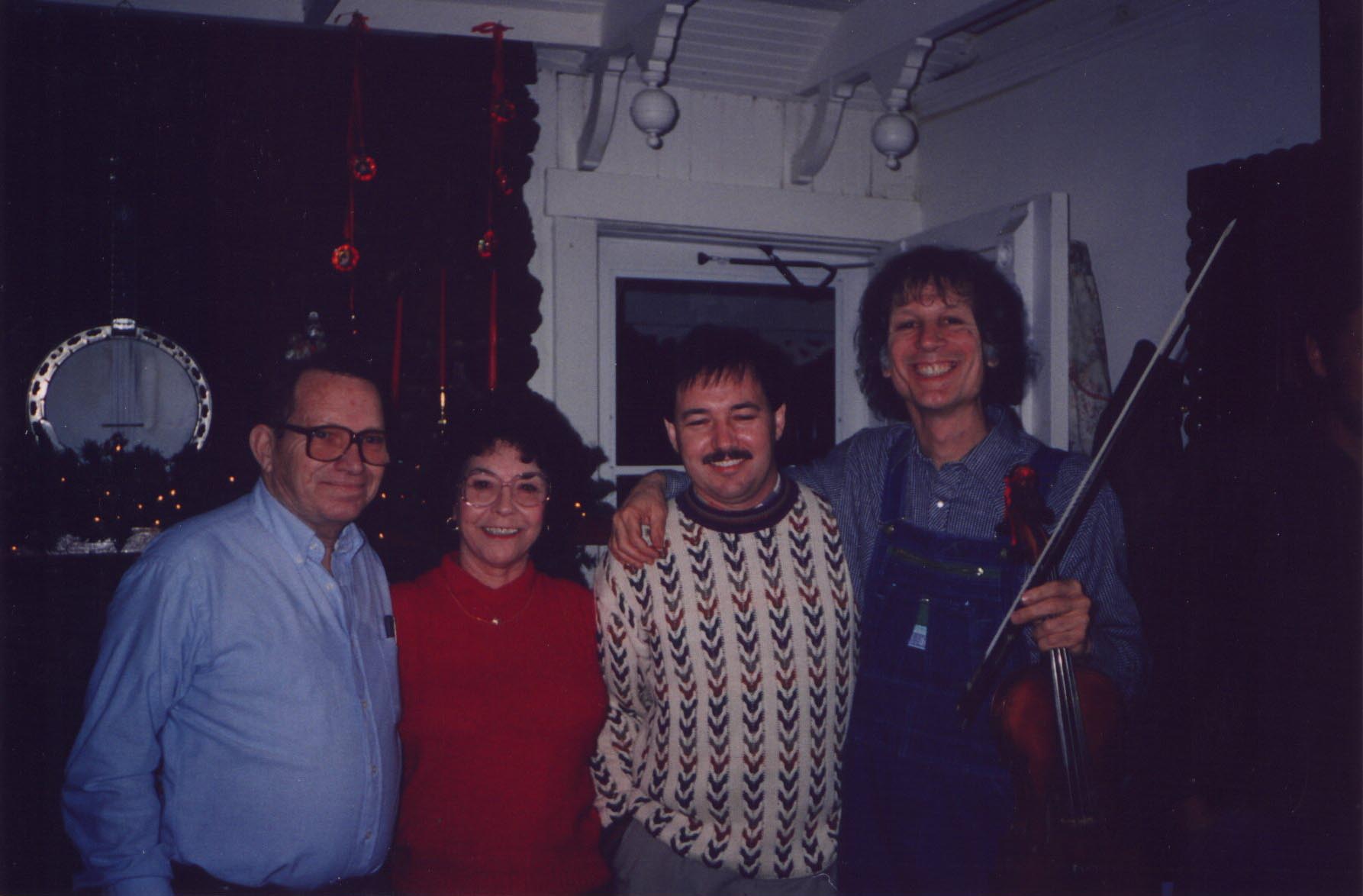
Lawrence Haley, Pat Haley, Steve Haley, and John Hartford at a Christmas Party, Nashville, TN, 1991-1994

Lawrence Haley, Pat Haley, Steve Haley, and John Hartford at a Hartford Christmas Party, Madison, TN, 1991-1994

Parkersburg Landing 56

22 Tuesday Jan 2013

Posted by Brandon Ray Kirk in Ed Haley

≈ Leave a comment

Tags

Ashland, culture, Ed Haley, history, Ironton, John Hartford, Kentucky, life, Mona Haley, music, Ohio, Ralph Haley, U.S. South, writing

     Mona was about fourteen years old when Ed made the dining room recordings at 17th Street. I had some detailed questions for her, since — unlike Lawrence, who was away in the service — she had first-hand memories of the whole experience.

Mona: My brother played a guitar…

Me: And you played the mandolin on some of them?

Mona: I don’t remember which one. I don’t remember but you can hear it in the background.

Me: What kind of room were those records made in?

Mona: Dining room.

Me: How big a room was it?

Lawrence: Not very big. Twelve feet by twelve feet, I guess.

Me: You put the recorder on the table and he’d sit up next to the table and play?

Mona: Yeah, it was on the table. It was an old one where they had to brush the curls off the record. He wasn’t holding the fiddle over the table.

Me: What time of the day were they made in?

Mona: Different times. He didn’t make them all in one day.

Lawrence: It mostly depended on when Ralph had the time, I guess.

Mona: Yeah and — again — it depended on whether Pop felt like it.

Me: Was he drinking during any of those records?

Mona: No.

Me: Do you think those records were a pretty good representation of how he played or do you think he played a lot better than what’s on those records?

Mona: He played a lot better than what was on the records because some of them was a little too fast. You know, the speed on them. When he was in a good mood you could just hear the happiness in it.

Me: So a lot of that’s not on the records?

Mona: No, a lot of it’s lost forever.

     In the car on the way home, Lawrence told me more about why he thought Ed never recorded commercially. “He was a kind of a proud man. But I’m like Curly Wellman: if he’d been alive back when these people first started coming to me back thirty years ago he could’ve made a bundle of money if he’d a wanted to. If he hadn’t been afraid of being taken by recording companies and things.”

     As we made our way through town, Lawrence pointed out a spot on Greenup Avenue where Pop used to play: “Right here on this empty corner there used to be a two or three story building. It was a big restaurant called Russ’ place. Pop used to play on the sidewalk out here on his own when he felt like it, if the weather was good. He’d go in there and stay all day and play a while and drink a while and talk a while and go back and play a while.”

In Search of Ed Haley 55

21 Monday Jan 2013

Posted by Brandon Ray Kirk in Ed Haley

≈ 2 Comments

Tags

culture, Doc Holbrook, Ed Haley, fiddler, history, Ironton, John Hartford, Lawrence Haley, life, Mona Haley, music, Ohio, U.S. South, writing

     I asked Mona and Lawrence how they passed the day when they were young and traveling with Ed.

     “Oh, I’d probably go to a movie,” Mona said. “Mom would give me money and send me to a walk-in movie. Just go get something to eat. Or sit around and watch them. All the people was standing around and most of them was dancing.”

     She and Lawrence said Ella kept a cup attached to the head of her mandolin to catch the money; Pop only put a hat out when playing by himself. He was very serious about his work, Mona said.

     “Most of the time he worked hard,” she said. “When he was working he wouldn’t drink.”

     Lawrence agreed, “He didn’t get much to drink, you know, when he was sitting out on the courthouse square — they wouldn’t have stood for that, for one thing. Maybe at a fair or something he might take a drink or two. Or out on the streets.”

     “Or unless he was at a square dance and somebody would bring him a beer and that’d get him started,” Mona added.

     Mona remembered Pop getting in “a lot” of fiddlers’ contests but didn’t recall any specifically. She said he paid Doc Holbrook for her delivery with 25 dollars and a silver cup he’d won in a contest.

     “We never could get that silver cup back,” she said.

     Lawrence figured Doc’s son had the cup.

     “He’s got a fiddle of Pop’s, too,” he said. “He’s right in Ashland.”

     I wanted to know more about Ed being in contests but everyone kind of drew a blank about it. Mona joked with Lawrence about a time they were in a contest as children.

     “Mom made up a song for me,” she said. “Had me a dress made.”

     I got her to sing it for me.

See my pretty ruffled dress.

See my pretty pocket.

See my pretty handkerchief.

See my pretty locket.

     Lawrence said Mona won first prize in the contest and I was very quick to tell her that to be Ed’s daughter she probably had a lot of musical talent. She wasn’t willing to admit that but said, “I think I got more than any of the boys had.”

     I asked if she ever tried playing the fiddle and she said, “Yeah, I could play ‘Over the Waves’ on a fiddle and that’s it.”

     Okay — I was very curious.

     I asked if she could show me how Ed held the bow and she said sure — that he held it like she holds a pool stick, “real loose with straight fingers.”

     I reached my fiddle and bow to her and she showed me how Pop held the bow (little finger on top of the stick), then started playing “Over the Waves”. Her hands had an incredible economy of motion — almost as if they were “miniaturizing” the music. In watching her, I got a real feel for Ed’s technique and it was hard not to imagine Ed playing in a way similar to Vassar Clements. Mona clapped when I played for her but said I only played “a little bit” like Pop.

In Search of Ed Haley 54

20 Sunday Jan 2013

Posted by Brandon Ray Kirk in Ed Haley

≈ Leave a comment

Tags

Appalachia, Ashland, Big Sandy River, Bill Bowler, blind, Cabell County, Ed Haley, Ella Haley, Field Furniture Store, Gibson's Furniture Store, Green McCoy, guitar, Harts Creek, history, Ironton, John Hartford, Kentucky, Lawrence County, Lawrence Haley, life, Logan, Milt Haley, Mona Haley, music, Noah Haley, Ohio, Paintsville, Peter Mullins, Portsmouth, Ralph Haley, Route 23, Route 60, Russell, South Point, West Virginia, writing

Lawrence said we could go see Mona if Noah would show us the way. Apparently, Lawrence didn’t know where his own sister lived. Noah agreed to guide us there, but drove a separate car so he could leave right away. He and Mona weren’t getting along. On the way, I said to Lawrence, “Now this sister is the youngest one?” and he said, “Yeah, she’s the baby.” I said, “She’s the only sister you have, and her name is?” “Mona,” he finished. “M-O-N-A. That wasn’t what she was intended to be named. Mother intended her to be named after old Doc Holbrook’s wife — her name was Monnie.”

Mona was staying with her daughter in nearby Ironton, Ohio. At the door, before Lawrence could tell her who I was or the reason for our visit, she looked right at me and said, “Well I know you. I’ve seen you on television.” It was an instant connection. I noticed that she had a high forehead just like her father.

We went on out in the yard where she showed a little surprise that Noah had led us to her house.

“He’s mad at me,” she said before sighing, “I feel sorry for poor old Noah. So lonely. Has to buy his friendship.” Right away, she dispelled our hopes that she had any of Ed’s records.

“No, I don’t have any,” she said. “I let my part of the records get away from me. I lost mine in my travels. I left them somewhere and never did get them back. It was around ’56. I went back to get them and the lady — Dorothy Bates — had moved. And I think she’s dead. I was living here in Ironton.”

Mona seemed a little emotionless — her voice was hollow, distant, as if her mind was a million miles away. She didn’t seem to show much remorse about losing her father’s records — “I’m sorry that I did, but you know hindsight’s 20/20.”

I asked her if Ed ever talked about his father or mother and she said, “He talked about his dad getting killed. He said that he was in the Hatfield-McCoy feud and he got killed with Green McCoy. He was a friend to the McCoys, I guess. And that’s all I can tell you about that. And he never talked about his mother at all.” Mona had no idea who Ed’s mother was and knew nothing about her connection with Uncle Peter Mullins on Harts Creek. She didn’t even remember what year her father died, saying, “My memory is failing me. I was married and living at South Point.”

I noticed again how much Mona looked like her dad.

I asked her if she ever had any long talks with him and she said, “My mother and I were very close but we didn’t talk much about my dad. I’ll tell you, I loved my dad but I didn’t like him very much because he was mean.”

She laughed and said to Lawrence, “Wasn’t he?”

“Yeah, if you struck him the wrong way,” Lawrence admitted. “He never was mean to me. I can’t even remember Pop whipping me.”

Mona insisted, “He wasn’t ever mean to me either but he was mean to Mom.”

I asked her what Ed did to her mother and Lawrence said (somewhat agitated), “He was a little bit mean to Mom. He’d fight with her sometimes and we’d have to stop things like that.”

It got a little quiet — a whole new facet of Ed’s life had just opened up to me.

“Maybe I shouldn’t have said that,” Mona said, “but that’s how I feel. I sympathize with him now but he was a mean man.”

Lawrence tried to smooth it over by saying, “I put that down, part of it, to frustration with his condition. Really, I do.”

Sensing Lawrence’s dislike of the topic, I got the conversation directed back toward Ed’s music. He and Mona remembered Pop playing frequently on the streets of Ashland at Gibson’s Furniture Store, Field Furniture Store (later Sears) on 17th and Winchester and at the Ashland (later Second) National Bank on 16th and Winchester. It made sense that Ed often played on Winchester Avenue, the main east-west thoroughfare through town, currently merged with Route 60 and Route 23. I asked if Ralph ever played with Ed and Ella on the street and Mona said no — that he only played with them at home. Bill Bowler, a blind guitarist, was the person she remembered playing with her father on the street.

“He wasn’t very good,” Mona said. “When they’d get ready to set down and make music Pop would have to tune up his guitar for him.”

Ed hung around Ashland through the winter, Lawrence said, then took off around February. There was not a particular place he went first; it just depended on his mood. Mona said he was in Greenup County, Kentucky, often.

“He played in front of the courthouse there,” she said. “I’ve seen them have that whole front of the courthouse with people standing around dancing.”

She and Lawrence also remembered Pop playing in Portsmouth, Ohio; Cabell County, West Virginia; Logan, West Virginia; Lawrence County, Kentucky; Paintsville, Kentucky; and “all up and down the Big Sandy River.”

“They’d play around railroad YMCAs, too,” Lawrence said. “They had one in Ashland, one in Russell. And down on the N&W they had a big railroad YMCA in Portsmouth — New Boston, I guess. And there was a big steel mill at New Boston. Mom used to play there more than Pop, I guess. Mom used to play at the main gate.”

Mona and Lawrence gave me a great idea of how Ed dressed when on the road. She said he wore “moleskin pants and a long-sleeve shirt — sometimes a top coat when it was cold.” Lawrence said his dad always buttoned his shirt “all the way to the top button” but never wore a tie and mostly wore blue pants. For shoes, he preferred some type of slipper, although he sometimes wore “high top patent leather shoes” — what I call “old man comfort shoes.” Mona said he always donned a hat, whether it was a Panama hat, straw hat or felt hat. He also packed his fiddle in a “black, leather-covered case” — never in a paper sack as Lawrence remembered. “No,” she stressed, seeming amused at the idea of Ed having anything other than a case. Lawrence disagreed, clearly recalling to the contrary — “Buddy, I have.” He said Ed seldom had his fiddle in a case when he went through the country, usually just tucking it under his arm. “Same way with Mom. She didn’t have a case for her mandolin a lot of times. I guess that’s the reason he wore out so many, reckon?”

Parkersburg Landing

18 Friday Jan 2013

Posted by Brandon Ray Kirk in Ed Haley

≈ 3 Comments

Tags

Appalachia, culture, Ed Haley, genealogy, Harts Creek, history, John Hartford, life, Logan County, photos, Roxie Mullins, West Virginia

Roxie Mullins, 1991

Roxie Mullins, 1991

Parkersburg Landing 53

18 Friday Jan 2013

Posted by Brandon Ray Kirk in Ed Haley

≈ 2 Comments

Tags

Appalachia, Ashland, Ed Haley, Ella Haley, history, John Hartford, Kentucky, Lawrence Haley, life, Mona Haley, music, Noah Haley, West Virginia, World War II, writing

     We drove over to Noah’s rented apartment and parked near a Chrysler with “NOAH HALEY” emblazoned on its bumper in big stick-on letters. At the door, Lawrence told Noah, “I got a fella here that wants to talk to you.” Noah was surprised but seemed happy to see Lawrence. “Come on in,” he said. “I’ll just straighten up in here a little bit, but come on in.” He led us into a living room where the TV was blaring. It was a real bachelor pad. We all sat down and Lawrence introduced me. It was the first time I had met any of Ed’s children other than Lawrence and I was very curious to watch Noah for clues about his father and to shore up his memories of his dad with what Lawrence had told me.

     “I’ll tell you anything I can,” Noah said. “It’s been so long ago, I’ve just about forgot everything.”

     “I told him you probably couldn’t tell him much because you went into the service in 1939,” Lawrence said.

     Noah said, “Right. I stayed in the service nine and a half years — from 1940 until 1949. And then in ’51 I went to work on the railroad in Cleveland and I worked there until I retired. The only thing I know is they made their living by playing music on the streets and at fairs and churches and everywhere else. We’d go with them — one of us kids — to lead them around. And they would go to Logan, West Virginia. They used to set out on the street and play music at the courthouse, and we’d just wait till they got done. They would play sometimes all day long on Saturdays in the courtyard. People’d come along and give them money. That’s about all I can remember about them.”

     I asked if Ed ever talked about any older fiddlers he learned from and Noah said, “The only thing I ever heard him say was he taught himself. He couldn’t read music or nothing but my mother could read music by Braille. She was pretty well-educated. Pop played by ear.”

     The room got a little quiet for a few seconds — we were waiting on Noah to tell us something (anything) about Ed. Instead, he kind of laughed and said, “I’m not gonna be much help to you on this.” Lawrence asked Noah if Pop ever talked about his parents and Noah said, “The way I understood it, this guy shot his mother and… I don’t remember now how it went. Whether his dad got a gun and killed him or how.”

     Basically, Noah was saying just enough to confirm that he’d “been there,” but his memories were so vague that I wasn’t getting any great insight out of them. I wasn’t ready to give up though, next asking him about his share of Ed’s records. He assured us that he didn’t have any, which caused Lawrence to say, “You know, when Mom divided those records out, she gave you so many, she gave Mona so many, she gave Jack so many, and she gave me so many of them. And the only ones that was left, Jack had eight or nine left, I think.”

     “I don’t have a one of them,” Noah said. “The only ones I had I give them to Pat. She made tapes of them.”

     Pat, Lawrence explained, was Patsy Haley — his sister-in-law.

     “My sister, she could tell you more than I could,” Noah said to me. “Mona knows all them things. And she’s even got records of Mom and Pop’s music.” He looked at Lawrence and said, “I think she’s got some like you have — round and aluminum.”

     That was all I needed to hear.

     Looking back, I realize I lost almost all interest in talking with Noah — sacrificing his memories — at the prospect of getting to hear more of Ed’s records. That’s a strange thing to consider from a biographical standpoint but I was just so into Ed’s music.

In Search of Ed Haley 52

18 Friday Jan 2013

Posted by Brandon Ray Kirk in Ed Haley

≈ Leave a comment

Tags

Appalachia, Ashland, Ed Haley, Ella Haley, genealogy, history, John Hartford, Kentucky, Lawrence Haley, life, Milt Haley, Noah Haley, U.S. South, writing

     Lawrence Haley and I spent an hour or so driving around Ashland looking at many of the sites where Ed had lived in town. Not one single residence was still standing. As we visited each site, I noticed that the Haley residences seemed to have been in poor areas of town…although I didn’t suggest this to Lawrence.

     “They never did own a home,” Lawrence said of his parents. “They always rented. About eight different places in Ashland and one in Catlettsburg that I can remember.”

     In 1933, according to city directories, Ed and Ella lived at 805 45th Street. The next year, Ella received a postcard at 1030 45t Street. The 45th Street area of Ashland — renamed Blackburn Avenue in recent years — was a long street situated to the back of town, with schools and churches intermixed occasionally with small residences. It was the longest street in town.

     Lawrence guided me to 37th Street, also known as Ward Hollow, where the Haleys settled around 1937-38. Ward Hollow, I discovered, was recently cleared entirely of homes and filled with dirt as part of some planned business development. It was nothing like Lawrence or Curly Wellman remembered it.

     “This was a two-lane road at that time,” Lawrence said, looking up the hollow where he once lived. “And they was a bunch of houses sat up on the bank. There wasn’t too many trees up through there. About twelve to fifteen houses — small homes, twenty-five or thirty foot long. We lived in a three-bedroom house. I was just a kid then.”

     In 1944, the Haleys moved downtown to 105 17th Street, the spot where Haley made his home recordings. From this location, presently occupied by a dull gas building and a partially empty lot near the floodwall, Haley could easily walk up 17th Street past City Hall to the post office or Central Park.

     In 1947, the Haleys were briefly at 5210 45th Street, before settling at 1040 Greenup Avenue. Two years later, Ella was listed in city directories at 932 45th Street. Today, this spot is almost wiped out, although a Little Caesar’s pizza is on the corner of a modern building at 933 45th Street.

     Around 1950, the Haleys lived at 2144 Greenup Avenue. This spot, where Ed Haley died in 1951, is the current site of a Boyd County Ford parking lot and Pathways, Inc. “They’ve got a mental health center there where Pop died,” Lawrence said.

     In 1952, Ella lived at 932 45th Street.

     As Lawrence and I made our way around town, I suggested going to see his older brother Noah who had recently moved back to town.

     “Well that’ll be fine John, but if he’s playing cards I ain’t even gonna go around him because that’s one of his vices,” he said. “He used to go down there to Covington, Kentucky, some and lose his shirt. Two or three shady people have been after him to collect his debts.”

     It seemed as if each of the Haley children had some kind of a major hang-up, which kept me thinking about Milt Haley’s genetics — as well as Ed’s. I asked Lawrence if Noah was a drinker and he said, “He doesn’t drink any more. I think he’s got to the point where drinking aggravates his system too much.” There was also the restlessness. Milt Haley came to Harts Creek from “over the mountain” — probably the Tug Valley — and married a local girl. After the trouble with Al Brumfield, he hid out in Kentucky. Ed Haley, perhaps taking a genetic cue from his father, left Harts Creek at a young age and roamed throughout West Virginia and eastern Kentucky. Even after marrying and settling down in Ashland, it was a Haley ritual to always be on the go — moving through town or taking off on a season-long jaunt. Lawrence Haley did not seem to “inherit” that desire, preferring to live the quiet life of a laborer and postman in Ashland. But his half-brother Ralph had went overseas during World War II and then on to live in Cincinnati. His brother Clyde had been all over the United States — everywhere from Alaska to New Orleans. Likewise, Jack had moved away to Cleveland and Mona had been in different cities in Ohio.

     Noah, a veteran of the Pacific Theater and longtime resident of Cleveland, was apparently a roamer, too. “He moves around,” Lawrence said. “The last place he lived was up on Winchester Avenue in an apartment out over a garage. He’s getting ready to go out to California, I guess. He’s about 71.”

Henry “Curly” Wellman

13 Sunday Jan 2013

Posted by Brandon Ray Kirk in Ed Haley

≈ Leave a comment

Tags

Appalachia, Ashland, culture, Curly Wellman, Ed Haley, guitar, history, John Hartford, Kentucky, life, music, photos

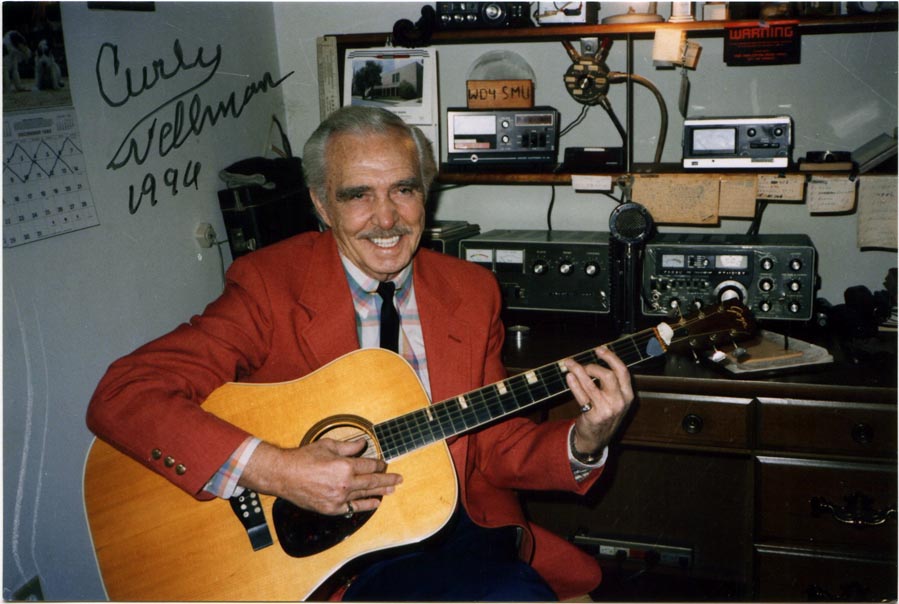
Curly Wellman, Kentucky Musician

Curly Wellman, Kentucky Musician

In Search of Ed Haley 50

13 Sunday Jan 2013

Posted by Brandon Ray Kirk in Ed Haley

≈ Leave a comment

Tags

Appalachia, Ashland, banjo, Billy in the Lowground, Blackberry Blossom, blind, Cacklin Hen, Catlettsburg, Clark Kessinger, Clayton McMichen, culture, Curly Wellman, Curt Polton, Ed Haley, Elvis Presley, fiddler, Floyd Collins, Forked Deer, Grand Ole Opry, guitar, Hatfield-McCoy Feud, history, Horse Branch, Huntington, Ivan Tribe, John Hartford, Kentucky, Lawrence Haley, Logan County, Mid-Day Merry-Go-Round, Morehead, Mountain Melody Boys, Mountaineer Jamboree, music, National Fiddling Association, Old Sledge, Poplar Bluff, Rowan County Crew, Ugee Postalwait, Ward Hollow, WCHS, WCMT, Westphalia Waltz, writing, WSAZ

I asked Curly if he remembered any of Ed’s tunes and he said, “Ah, I remember ‘Forked Deer’ and I remember ‘Billy in the Lowground’ and I remember the ‘Old Sledge’ and I remember ‘Poplar Bluff.’ ‘Blackberry Blossom.’ The longer he played a tune, the meaner he got on it. If he got the feel, it hit him. And the more he played the better he got and the more tunes come to him. He played one waltz — ‘Westphalia Waltz’ — and that’s really the only waltz that I can recall that he played. And it was all double stop fiddle.”

Curly never heard Ed sing a note — a very surprising recollection considering the way that Ugee Postalwait had hyped Haley’s singing abilities.

“I got a copy of a song from him,” Curly said. “He had somebody to write it down. Because at this time, out at Morehead, Kentucky, they had a feud out there. And they had a shoot-out there on the steps and then somebody wrote this song called ‘Rowan County Crew.’ And Ed, they tell me, would sing that at different places throughout Kentucky. At that time, it was like Floyd Collins that was in the cave and like the Hatfields and the McCoys — only this was called the ‘Rowan County Crew.’ Well, at that time it was hot as a pistol through the state. Now evidently he sang that song, but he never sang it for me.”

Curly said, “Ed could have been as great as the Blue Yodeler or any of those people. He could have been right on those records with them but under no reason did he want to record commercially. Had he been living today and with the equipment they’ve got today, he would’ve been in more demand than Elvis Presley ever was. Nobody played ‘Cacklin’ Hen’ like him. And a very humble man. I never heard Ed down anybody else, I never heard him put anybody below him and I never had him to tell me how good he was. In fact, I wonder sometimes if he knew how good he was. But I knew it. He was a brilliant man. He’d just about keep a check up on everything during his lifetime. He knew the news, he knew the political field, he knew what was going on in the state.”

I asked Curly about the first time he ever saw Haley play.

“I played with Ed when I was a kid — twelve, thirteen years old — and we lived at a place called Horse Branch. That’s as you enter Catlettsburg, Kentucky. And I was a kid carrying an old flat-top guitar — no case — trying to learn how to play. In the evening, he’d come out on the front porch after dinner and Ralph would get the guitar and the mother would get the mandolin and the neighborhood would gather because at that time radio was just coming into being. And I’d go down there and sit and bang while they were playing. And that’s where I first heard Ed Haley.”

Curly lost track of Ed when he started playing music out on his own at the age of fifteen. Throughout the mid-thirties, he played over the radio on Huntington’s WSAZ and Ashland’s WCMT with the “Mountain Melody Boys,” then made several appearances on the Grand Ole Opry and Knoxville’s Mid-Day Merry-Go-Round with Curt Polton’s band. It was during that time, he said, around 1936, that Ed got into a contest with Clark Kessinger and Clayton McMichen at the WCHS radio station in Charleston. Clayton was the National Fiddling Champion, while Clark was the National Fiddling Association’s champion of the East. The whole thing was “built up for months — it was a showdown.” In the contest, each fiddler got to play two tunes and someone named Banjo Murphy seconded every one using a three-finger picking style on a four-string banjo. First prize was a “live baby” (a little pig) and the winner was determined by a clapping meter. Curly wasn’t sure what tunes Ed played (probably “Cacklin’ Hen,” his contest specialty) but remembered the results clearly.

“Ed Haley beat the two men on stage,” he said. “McMichen was out of it in a little bit but it took several rounds to eliminate Clark Kessinger.”

Curly returned to Ashland in the early forties and found Ed living in the bottom of a weather-boarded, two-story apartment building on 37th Street (Ward Hollow). He started visiting Haley again, usually on cold days when he knew that he’d be close to home. He’d put his D-18 flat-top Martin guitar in the trunk of his car and “go pick up a pint or a half a pint of moonshine,” then head on over to Ed’s house.

I’d go in. I wouldn’t take the guitar in at all. I’d just knock on the door and go in and I’d say, “Hi, Uncle Ed.” “Hi, Curly.” He knew me by my voice. And I’d go in and sit down, you know, and say, “How’s the weather?” and “How’s things?” and “How’s the family?” and so forth and so on. We’d sit around there and talk a little bit. I’d say, “Ed, been playing any lately?” “No, I haven’t felt like it. I just haven’t felt like it.” I’d say, “Well, how about a little nip? You think that would help?” “Well now you know you might have something there.” So I’d go on to the car and I’d get the bottle and come in and we’d sit back down and I’d pass it to him. He’d hit it. He’d sit right there a little bit you know and I’d say, “Take another little nip, Ed.” “Well, I believe I will,” he’d say. “It’s too wet to plow.” And he’d sit there and he’d rock a little bit in that chair and… Being blind, he talked a little loud. “Hey, did I ever play that ‘Old Sledge’ for you?” I’d say, “Well, I can’t remember Ed. Just can’t remember.” Well, he’d get up and he’d go over and he’d lay his hand right on that fiddle laying on the mantle of the fireplace. By that time I’d be out the door and getting the Martin. I’d come back in and he’d tune ‘er up there and feel her across you know and touch her a little bit here and there. He’d take off on it.

Curly and I got our instruments out and played a few of Haley’s tunes. He showed me the type of runs he used to play behind Ed and gave me a few more tips about his fiddling. He said Ed was “all fingers…so smooth” and could play all over the fingerboard — even in second and third positions. He “put a lot of his upper body into the fiddling” and patted one foot to keep time. If he fiddled for a long time, he put a handkerchief under his chin for comfort (never a chinrest) and dropped the fiddle down to his arm and played with a collapsed wrist.

Just before Lawrence and I left, Curly said, “I’ll tell you somebody that’s still living in Charleston and he’s a hell of a fiddle player — or was. They called him Slim Clere. He’s about 82. He knew Ed. In fact, he was the man that Clere looked up to as he was learning. And he could probably give you more information than I could because he’s followed the fiddle all of his life.”

Curly also recommended Mountaineer Jamboree (1984), a book written by Ivan Tribe that attemped to detail West Virginia’s contributions to country music. It briefly mentioned Ed: “Blind Ed Haley (1883-1954), a legendary Logan County fiddler who eventually settled in Ashland, Kentucky, repeatedly refused to record, but did belatedly cut some home discs for his children in 1946.”

Parkersburg Landing 49

11 Friday Jan 2013

Posted by Brandon Ray Kirk in Ed Haley

≈ Leave a comment

Tags

Appalachia, Ashland, Clark Kessinger, culture, Curly Wellman, Ed Haley, fiddler, history, John Hartford, Kentucky, Lawrence Haley, life, music, U.S. South, writing

     Not long after meeting with Lawrence Haley in Tennessee, I found myself heading toward his home in Ashland. As soon as I arrived in town, he suggested that we speak with Curly Wellman, a local musician who had often visited his parents’ home during the Depression. Lawrence had no memories of Curly’s visits but listened as he told all about them at a recent chance-type meeting at a local grocery store. “I was too young to remember him coming,” Lawrence said to me. Curly had told Lawrence to be sure and visit anytime, so we made a quick call to make sure it was okay for us to drop in, then headed out the door.

     “I used to see him on the Ralph Shannon Show years ago,” Lawrence said, as we piled into the car. Curly was still quite the entertainer. We found him more than ready for us — wearing a big grin and dressed in a fruity-striped button-up shirt with a large medallion around his neck. There was no real need for questions or prompting on our part. His memory was very clear.

     “I don’t think there was anybody that ever drawed a bow that played country like he did,” Curly said of Ed. “The biggest finger on his hand wasn’t as big as my little one. Smallest hands you ever looked at in your life. Just a natural touch. I mean everything — tone, ear, perfect pitch… The whole thing. I would carry my flat top and I’d go up to Uncle Ed’s and go in and he’d grab the fiddle. Well, all he would do was throw the fiddle under his neck and run his fingers across the strings — before he ever heard my guitar — then all I had to do was rake across it and we were together. That was Ed Haley. I’ve followed him since I was about twelve or thirteen and I’m 74 now and I’ve worked with a lot of them and, well, I think he was the greatest.”

     Curly didn’t even catch his breath in bragging on Ed.

     “The bow work is the secret to Ed Haley’s music,” he said. “All of the bow work was strictly in the wrist. More like watching an artist that plays classical stuff — the bow arm. He could get more notes out of the length of the bow than any other man I ever watched or heard in my life. It was all fingers. Just so easy. And double stops were nothing for him. I’ve heard him catch three notes on a fiddle. Terrific! Terrific! I started playing when I was about fourteen and I played for him just for pleasure and lived close to the family and knew them all personally — marvelous people. He had a boy that played the guitar pretty fair. Now there was one other fiddle player in this country that thought he was that good, but he wasn’t. His name was Clark Kessinger. Now Clark played a lot of fiddle. I have to give him credit for what he did play. But I don’t believe he could tune Ed’s fiddle. Clark’s a good imitation of Ed.”

     Curly said he’d give anything to hear Ed’s music again.

     Just then, Lawrence, who’d been sitting quiet as a mouse, pulled out some of his father’s tapes and said warmly, “Hey, put these on.”

     Curly got everything set up and stood mesmerized listening to Ed’s music. He kept saying things like, “Listen how true his notes are. The tone quality. And when this was taped, they didn’t have this stuff to work with that they’ve got today. They make you sound like what they want you to sound like. Ah, he was a fine man. Is that his wife playing the mandolin? She could do it. I used to watch that poor old soul down here in town and she’d bring one of the little girls with her to take her to and from places. She’d sit down there on a little folding stool with her mandolin and play for change and this and that. They were hard-working people.”

     Ed’s music gave Curly’s memories a boost.

     “At the time that I knew him, I was a kid. The thing between me and Ed was just love for one another, I suppose, and love for music. And he loved a guitar that could back him up. And he didn’t want no sixth-string chord — you better not strike one in his presence because he’d tell you to crawl back down on the neck. He said if he wanted a snare drum, he’d get one. He was the type of guy that said what he thought. That was his nature. And if you didn’t like it, you’d just well to get up and go out. He was a man that had the flattest delivery with speech when he said something to you. I mean it was just flat out straight. It didn’t make any difference to him.”

     Ed hated to be pitied or touched and liked to get around by himself. Because Curly had seen his “vicious temper,” he never asked him about his background.

     “I was a kid and as blunt as he was there was a lot of things I would like to’ve known that I wouldn’t even ask,” he said. “In other words, I might just say something that he would completely turn me off, me being that young. But, well, he had a big heart.”

In Search of Ed Haley 48

09 Wednesday Jan 2013

Posted by Brandon Ray Kirk in Ed Haley

≈ Leave a comment

Tags

Alaska, blind, California, Cleveland, Clyde Haley, Ed Haley, genealogy, Harts Creek, Hawaii, history, Japan, John Hartford, Kentucky, Lawrence Haley, Liza Mullins, Louisiana, Milt Haley, Montana, New York, Noah Haley, Ohio, Pacific Theatre, Pike County, Scoffield Barracks, Virginia, World War II

I asked Lawrence if he’d heard from any of his brothers or sister and he said, “I’ve got one that lives in town now. He moved back from Cleveland, Ohio. He lives in town. Noah was a little bit… You might want to talk to him, I don’t know. But Noah, he went away, I guess, in 1939. He went in the service. He was at Scoffield Barracks in Hawaii when the Japanese… He was in all that Pacific Theater. I think he was wounded a couple of times. The Japanese bayoneted him one time in a bonsai attack or something. It left Noah a little bit shell-shocked or something. He gets a pension from it. He’s not together all there, I guess. You know, in a way, if you talked to him you’d never notice it. He was married to a woman of Hungarian descent and raised a family — a boy and a girl. He had a problem with the girl, too. She was having a problem with a boyfriend or something and her boyfriend was there at the house. Well, the boy had a pistol or some sort of a gun and she went and got that pistol and said, ‘If you don’t love me,’ or something and she shot herself. She committed suicide. I think it was non-intentional. It was just a bluff.”

I said to Lawrence, “Well now, aren’t your other brothers, they’re all kind of hard to get along with, aren’t they?”

“Yeah, a little bit odd,” he answered. “Clyde just moved out and took off and went his way, I guess. Followed the sun, I call it. We’d hear from him in Louisiana one year and the next year he might be in Montana or Upper State New York. He did hobo. Noah went to see him about ten years ago out in California and they started back and Noah was going to stop and get some gasoline. Clyde said, ‘No, don’t stop here and get gas. I’ll get your gasoline.’ He went over to this big church and told them he was on the road back to Ohio and didn’t have money to get there. I guess they give them a tank of gas and they come all the way back from California like that. Clyde was good at that. He did work and we’d get his W-2 forms. He never did turn in his income tax, I don’t think. He’d send his W-2 forms home. Some years he was out on an oil rig in Louisiana. Apparently during the time he was working for them they had rigs off the coast of Alaska.”

Hearing Lawrence speak of his brothers caused me to ask if maybe any of Milt Haley’s “stuff” — which I now presumed to be sort of bad — might’ve come down in their genetics.

“I don’t know, John,” he said. “I couldn’t say. They never met their granddad. I don’t think… My dad, if he’d been a sighted man, he’d probably been as gentle as a lamb. But he had frustrations in his own life.”

“Sometimes in a situation like that, sometimes a gene will come and it won’t get everybody,” I said, pressing Lawrence a little further. “Like it’ll skip your dad, and like skip you, but pick out a brother there and one over there.”

Lawrence totally disagreed.

“Well, I don’t think any of them… And I really don’t think my grandfather, from what I’ve heard of that tale… It was caused by hard times. I’m not trying to defend my grandpa because, hell, it don’t make any difference to me now.”

Milt in so many ways seemed like a critical character in the story: an ambiguous rogue — a key player in causing Ed’s blindness and inspiring his music, whose very genetic attributes or deficiencies might still live on strongly in his grandchildren.

I wondered if Lawrence knew where Milt came from before his settlement on Harts Creek.

“I think maybe over in Old Virginia or over in Pike County,” he said. “I understand there’s some Haleys in Pike County. I’d ask Aunt Liza, ‘Where’d Milt Haley come from?’ ‘Well, he come from over the mountain.’ Now, that’s as far as I could get from her.”

Lawrence thought his father had resolved his hard feelings toward the Brumfields in later years.

“Pop was supposed to have made the remark that if he’d had his eyesight he’d hunted down the people that killed his dad,” Lawrence said. “But afterwards, him and one of the Brumfield sons, they settled their trouble.”

I said, “Well obviously if your grandmother was at the Brumfields’ house the night she got shot, there was no animosity between her and the Brumfields.”

I was starting to understand how the tragedies of Ed’s early life, as well as the legacy of his father, had manifested itself into the pain, rage, and lonesomeness I’d been so drawn to in his music. I kept telling Lawrence, “We’re gonna have to go back up Harts Creek,” but it would be a year before we actually did so.

Parkersburg Landing

06 Sunday Jan 2013

Posted by Brandon Ray Kirk in Ed Haley

≈ Leave a comment

Tags

Appalachia, culture, Ed Haley, genealogy, Harts Creek, John Hartford, Lawrence Haley, life, photos, U.S. South, West Virginia

Connie Mullins and Lawrence Haley, 1991

Connie Mullins and Lawrence Haley, Harts Creek, WV, 1991

← Older posts
Newer posts →

Feud Poll 1

If you had lived in the Harts Creek community during the 1880s, to which faction of feudists might you have given your loyalty?

Categories

  • Adkins Mill
  • African American History
  • American Revolutionary War
  • Ashland
  • Atenville
  • Banco
  • Barboursville
  • Battle of Blair Mountain
  • Beech Creek
  • Big Creek
  • Big Harts Creek
  • Big Sandy Valley
  • Big Ugly Creek
  • Boone County
  • Breeden
  • Calhoun County
  • Cemeteries
  • Chapmanville
  • Civil War
  • Clay County
  • Clothier
  • Coal
  • Cove Gap
  • Crawley Creek
  • Culture of Honor
  • Dingess
  • Dollie
  • Dunlow
  • East Lynn
  • Ed Haley
  • Eden Park
  • Enslow
  • Estep
  • Ethel
  • Ferrellsburg
  • Fourteen
  • French-Eversole Feud
  • Gilbert
  • Giles County
  • Gill
  • Green Shoal
  • Guyandotte River
  • Halcyon
  • Hamlin
  • Harts
  • Hatfield-McCoy Feud
  • Holden
  • Hungarian-American History
  • Huntington
  • Inez
  • Irish-Americans
  • Italian American History
  • Jamboree
  • Jewish History
  • John Hartford
  • Kermit
  • Kiahsville
  • Kitchen
  • Leet
  • Lincoln County Feud
  • Little Harts Creek
  • Logan
  • Man
  • Matewan
  • Meador
  • Midkiff
  • Monroe County
  • Montgomery County
  • Music
  • Native American History
  • Peach Creek
  • Pearl Adkins Diary
  • Pecks Mill
  • Peter Creek
  • Pikeville
  • Pilgrim
  • Poetry
  • Queens Ridge
  • Ranger
  • Rector
  • Roane County
  • Rowan County Feud
  • Salt Rock
  • Sand Creek
  • Shively
  • Spears
  • Sports
  • Spottswood
  • Spurlockville
  • Stiltner
  • Stone Branch
  • Tazewell County
  • Timber
  • Tom Dula
  • Toney
  • Turner-Howard Feud
  • Twelve Pole Creek
  • Uncategorized
  • Warren
  • Wayne
  • West Hamlin
  • Wewanta
  • Wharncliffe
  • Whirlwind
  • Williamson
  • Women's History
  • World War I
  • Wyoming County
  • Yantus

Feud Poll 2

Do you think Milt Haley and Green McCoy committed the ambush on Al and Hollene Brumfield in 1889?

Blogroll

  • Ancestry.com
  • Ashland (KY) Daily Independent News Article
  • Author FB page
  • Beckley (WV) Register-Herald News Article
  • Big Sandy News (KY) News Article
  • Blood in West Virginia FB
  • Blood in West Virginia order
  • Chapters TV Program
  • Facebook
  • Ghosts of Guyan
  • Herald-Dispatch News Article 1
  • Herald-Dispatch News Article 2
  • In Search of Ed Haley
  • Instagram
  • Lincoln (WV) Journal News Article
  • Lincoln (WV) Journal Thumbs Up
  • Lincoln County
  • Lincoln County Feud
  • Lincoln County Feud Lecture
  • LinkedIn
  • Logan (WV) Banner News Article
  • Lunch With Books
  • Our Overmountain Men: The Revolutionary War in Western Virginia (1775-1783)
  • Pinterest
  • Scarborough Society's Art and Lecture Series
  • Smithsonian Article
  • Spirit of Jefferson News Article
  • The Friendly Neighbor Radio Show 1
  • The Friendly Neighbor Radio Show 2
  • The Friendly Neighbor Radio Show 3
  • The Friendly Neighbor Radio Show 4
  • The New Yorker
  • The State Journal's 55 Good Things About WV
  • tumblr.
  • Twitter
  • Website
  • Weirton (WV) Daily Times Article
  • Wheeling (WV) Intelligencer News Article 1
  • Wheeling (WV) Intelligencer News Article 2
  • WOWK TV
  • Writers Can Read Open Mic Night

Feud Poll 3

Who do you think organized the ambush of Al and Hollene Brumfield in 1889?

Recent Posts

  • Logan County Jail in Logan, WV
  • Absentee Landowners of Magnolia District (1890, 1892, 1894)
  • Charles Spurlock Survey at Fourteen Mile Creek, Lincoln County, WV (1815)

Ed Haley Poll 1

What do you think caused Ed Haley to lose his sight when he was three years old?

Top Posts & Pages

  • Civil War Gold Coins Hidden Near Chapmanville, WV
  • West Virginia Banjo Player 5
  • Chapmanville News 06.29.1926
  • "Holly Creek" John Mullins Grave in Clintwood, VA (2018)
  • Baisden Family Troubles

Copyright

© Brandon Ray Kirk and brandonraykirk.wordpress.com, 1987-2023. Unauthorized use and/or duplication of this material without express and written permission from this blog’s author and/or owner is strictly prohibited. Excerpts and links may be used, provided that full and clear credit is given to Brandon Ray Kirk and brandonraykirk.wordpress.com with appropriate and specific direction to the original content.

Archives

  • February 2025
  • January 2025
  • October 2023
  • September 2023
  • December 2022
  • November 2022
  • May 2022
  • April 2022
  • February 2022
  • November 2021
  • October 2021
  • September 2021
  • June 2021
  • May 2021
  • April 2021
  • March 2021
  • February 2021
  • January 2021
  • December 2020
  • November 2020
  • October 2020
  • July 2020
  • June 2020
  • May 2020
  • April 2020
  • March 2020
  • February 2020
  • January 2020
  • December 2019
  • November 2019
  • October 2019
  • September 2019
  • August 2019
  • July 2019
  • June 2019
  • May 2019
  • April 2019
  • March 2019
  • February 2019
  • January 2019
  • December 2018
  • November 2018
  • October 2018
  • September 2018
  • August 2018
  • July 2018
  • June 2018
  • May 2018
  • April 2018
  • March 2018
  • February 2018
  • January 2018
  • December 2017
  • November 2017
  • October 2017
  • September 2017
  • August 2017
  • July 2017
  • June 2017
  • May 2017
  • April 2017
  • March 2017
  • February 2017
  • January 2017
  • December 2016
  • November 2016
  • October 2016
  • September 2016
  • August 2016
  • July 2016
  • June 2016
  • May 2016
  • April 2016
  • March 2016
  • February 2016
  • January 2016
  • December 2015
  • November 2015
  • October 2015
  • September 2015
  • August 2015
  • July 2015
  • June 2015
  • May 2015
  • April 2015
  • March 2015
  • February 2015
  • January 2015
  • December 2014
  • October 2014
  • September 2014
  • August 2014
  • July 2014
  • June 2014
  • May 2014
  • April 2014
  • March 2014
  • February 2014
  • January 2014
  • December 2013
  • November 2013
  • October 2013
  • September 2013
  • August 2013
  • July 2013
  • June 2013
  • May 2013
  • April 2013
  • March 2013
  • February 2013
  • January 2013
  • December 2012
  • November 2012

Enter your email address to follow this blog and receive notifications of new posts by email.

Join 2,927 other subscribers

Tags

Appalachia Ashland Big Creek Big Ugly Creek Blood in West Virginia Brandon Kirk Cabell County cemeteries Chapmanville Charleston civil war coal Confederate Army crime culture Ed Haley Ella Haley Ferrellsburg feud fiddler fiddling genealogy Green McCoy Guyandotte River Harts Harts Creek Hatfield-McCoy Feud history Huntington John Hartford Kentucky Lawrence Haley life Lincoln County Lincoln County Feud Logan Logan Banner Logan County Milt Haley Mingo County music Ohio photos timbering U.S. South Virginia Wayne County West Virginia Whirlwind writing

Blogs I Follow

  • OtterTales
  • Our Appalachia: A Blog Created by Students of Brandon Kirk
  • Piedmont Trails
  • Truman Capote
  • Appalachian Diaspora

BLOOD IN WEST VIRGINIA is now available for order at Amazon!

Blog at WordPress.com.

OtterTales

Writings from my travels and experiences. High and fine literature is wine, and mine is only water; but everybody likes water. Mark Twain

Our Appalachia: A Blog Created by Students of Brandon Kirk

This site is dedicated to the collection, preservation, and promotion of history and culture in Appalachia.

Piedmont Trails

Genealogy and History in North Carolina and Beyond

Truman Capote

A site about one of the most beautiful, interesting, tallented, outrageous and colorful personalities of the 20th Century

Appalachian Diaspora

  • Subscribe Subscribed
    • Brandon Ray Kirk
    • Join 789 other subscribers
    • Already have a WordPress.com account? Log in now.
    • Brandon Ray Kirk
    • Subscribe Subscribed
    • Sign up
    • Log in
    • Report this content
    • View site in Reader
    • Manage subscriptions
    • Collapse this bar
 

Loading Comments...