Tags
Appalachia, crime, culture, Harts Creek, history, life, Logan County, Noah Mullins, photos, U.S. South, West Virginia, writing

Noah Mullins, 1927-1940

14 Friday Dec 2012
Posted in Culture of Honor
Tags
Appalachia, crime, culture, Harts Creek, history, life, Logan County, Noah Mullins, photos, U.S. South, West Virginia, writing
Noah Mullins, 1927-1940
14 Friday Dec 2012
Posted in Pearl Adkins Diary
Tags
Appalachia, Harts Creek, history, inspiration, life, Lincoln County, love, Pearl Adkins, thoughts, U.S. South, West Virginia, writers, writing
“Alone in my cuddy with no one near me I and my thoughts are struggling with each other,” Pearl wrote in late fall or early winter. “My thoughts have drifted off in a dream world. They have got the better of me. They keep drifting to that Nobody. In twilight hours my thoughts form swiftly of one fancy and then the other of him. They have woven a strong cord around my heart which seems never to be broken. I keep thinking of him and can’t help it. Aw shucks, he is in mind morning, noon and night. What makes me keep picturing him in my mind — his look, his ways, his talk and every thing about him — and what it all means, I can’t tell. I never thought of any one else as I do him. I can’t account for the uneasy feeling around my heart unless it is, I love him. Oh God, can it be I love him? Lord this has slipped upon me unexpected. Oh what sorrow it brought. It would have been a blessing to any one else, but to me it will eat my heart away. I guess I have loved him from urchin days but never realized it till just now. No hopes what ever of winning his love. God, what I have to suffer and why it is I can’t tell. I haven’t done any thing to any one that I would be chasened for, but God’s will be done. It’s a higher power above that controls our nature. We love whether it’s our wishes our not. I know it isn’t my will to love the one I do. It came with such a shock as if from the streaks of lightning. It shot through my weak body and unnerved me so I haven’t hardly recovered from the shock yet for it was all so strange and new and I’m not quite used to it yet.”
“Winter passed on with her sleet and snow,” Pearl continued, perhaps in the spring. “I care but a little for the wind’s loud roar for I’m near the old fire place. I sit there sadly dreaming of my one love here no more. Aw, I dream of a bright future of happy moments I may spend with him when he returns home. My, the winter is gone before I hardly knew it for I heard every few days some thing of my Ideal man but I didn’t know he was till long after he had gone. As you know from girlhood days, I have had my Ideal for he is the one boy for me by and by. I have pictured my sweet many times — his height, his eyes, his weight, and last of all the color of his hair, but never dreamed of him being in miles of here, but when I did awaken I awoke with a shock to think I had known him a many a long day and had learned to love him very dearly before I knew it.”
“Well, spring is here,” Pearl next wrote. “I have changed places but he is in my mind all the long spring days but I love him better each day and each day that passes I think I can’t love him any better but the dawning day brings on a stronger love than the preceding day. I guess there’s no limit to this love of mine.”
“Spring days are slipping by as if on wings,” Pearl wrote, a little later. “The fleeter they are, the closer the summer draws nearer, the quicker I will get to see my honey for I have heard he will be here about the 26th of July.”
14 Friday Dec 2012
Posted in Timber
Tags
Appalachia, culture, history, life, photos, timbering, U.S. South

Appalachian Mill-Dam, 1890-1915
13 Thursday Dec 2012
Posted in Music
Tags
Appalachia, banjo, culture, Harts Creek, history, life, Lincoln County, music, photos, U.S. South, West Virginia, writing
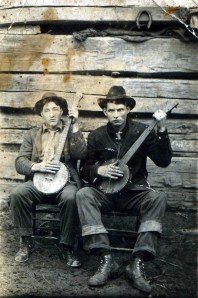
Dockie Vance and John A. Farley, 1910-1920
13 Thursday Dec 2012
Posted in Ed Haley
Tags
Appalachia, blind, Cecil Brumfield, Chloe Mullins, Cleveland, Clyde Haley, Ed Haley, fiddler, Harts Creek, history, Jack Haley, John Hartford, Lawrence Haley, Liza Mullins, Logan County, Mona Haley, music, Noah Haley, Ohio, Peter Mullins, Ralph Haley, Roxie Mullins, Turley Adams, U.S. South, West Virginia, writing
Roxie seemed very interested in Ed Haley’s kids, saying, “I know now they was Mona and Clyde and Ralph and Jack.”
Lawrence said he was the “baby boy” and Roxie realized for the first time that he was Ed’s son…not me. She got real tickled and said, “I believe you was about four or five years old when you was at my house.”
He told her, “May have been, ’cause I came up here until I was about nine years old. Just about every summer, it seemed like, we come up here.”
Roxie wanted to know about the others.
Lawrence said, “Clyde is still living. He lives in California. When he quit running the country, he settled down in California.”
As for the other boys: “Jack worked as a millwright at a steel mill in Cleveland. Noah’s in Cleveland, too. They both went up there after they come out of the service. Had a depressed time just after the war. Jack worked for a while here but that little factory closed up so about a year and a half later he went to Cleveland and got on at a steel mill up there as an electrician and worked his way up as a millwright. They say he went into work that day and he punched his card, then he had to walk to his workplace — which was a pretty good ways away — and he hadn’t even got out of the time-clock building, and he just fell over dead. Massive coronary or something.”
Roxie thought Ralph had hung himself, but Lawrence said, “No, he was out picnicking and was kinda grandstanding. You know he could take a run-a-go and do a flip-flop and land on his feet — that kind of stuff. Well, somebody was gonna take a picture of him, and he got up on this tree limb and hooked his toes over it and he was hanging straight down from his toes and he was gonna let go and flip over and land on his feet before he hit the ground. But he didn’t make it: he hit the back of his head and broke his neck. He thought he was still a young man, you know.”
Roxie’s memories of Ed went pretty far back into his life — even before his marriage. She tried to describe him for me.
“He dressed nice. Man, Ed was as clean as a pin — wore nice, clean clothes. To be a blind man, he kept hisself just as clean as a pin. I never did see him dirty. Kept his hair combed pretty and neat. Ed’s eyes looked awful bad — he wore glasses over them. We never did talk much with him. He was kindly strange to us. You see, us girls was kindly shy. We weren’t used to him. He always had a big bunch of men around him. We just listened. He wasn’t no crazy fellow, I wanna tell you that. He was smart in the Bible. He told us all about the wars, Armageddon and stuff, and about these bombs.”
I asked Roxie if she remembered the first time she saw Haley play the fiddle. She said, “Oh, I don’t know. I guess I was about eighteen years old when Ed and Uncle John played at our house. Then they left here and went off, you know, to stay awhile. They’d come back every now and then. Uncle John played a banjo and Ed played the fiddle. Boy, they could really play.”
I asked if Ed sang back then.
“Yeah, he sung,” she said. “Now, he asked Cecil… He said, ‘Cecil, I’d like to ask you something, but I don’t want you to get mad.’ He said, ‘I would like to know if you know the song about John Brumfield?’ And Cecil said, ‘Yes. I’d like to hear you.’ And Ed said, ‘All right.’ Ed played it for him. And Cecil’s daddy was the one they killed, but Cecil liked Ed. He knowed they’s just all drunk, you know, just like people now a getting dope and a killing each other.”
Roxie’s mind rolled back through the years, leaving Lawrence and I to just sit there listening to her stories. Each passing moment sent chills up the back of my neck. It was apparent that she’d known Ed very well.
“He stayed with us a whole lot, Ed did. Off and on, he stayed with Grandma and Uncle Peter and them. Grandma lived down there where Turley lives now. And they had a sheep in that field, you know? Ed kept going from Grandma’s house up to Uncle Peter’s and Aunt Liza’s house. They told him, they said, ‘Ed, that ram’s a going to kill you.’ He said, ‘No.’ He said, ‘I’ll take care of that ram.’ One day he started up through there and that ram went to bellering, you know, and run at him and butted him and he catched him by the head and slung him. He said, ‘If you don’t stay away from there, I’ll get my knife out and cut your head off.'”
Roxie laughed remembering the stories.
“Lord, he told all kinds of tales on hisself,” she said. “You woulda laughed till you woulda died if you’d heard him telling tales on hisself. He told about being at Uncle Peter’s and they was having a dance up at Jeff Baisden’s and he said he took a notion to go along in the night. He’d slept till about 9 or 10 o’clock in the night. Uncle Peter had a garden and a barn and had a lot of cattle laying out around that barn. And he went out there, he said, to that barn and aimed to climb up over a big high fence and jump out when he jumped out right astraddle of a steer. And said that thing jumped up and him on it backwards and took up that holler a flying, and said he hung right on to him till he got to the waterfall and said when he got to the waterfall, he fell off. Said he was drowning when he went on up there, and said they said, ‘Ed, what are you doing so wet?’ He said he said, ‘Well,’ said he’s riding and got in the water and couldn’t see it. He would’t tell them about the steer.”
Roxie implied that Ed took any mishaps or practical jokes in stride.
“Lord, he told all kind of tales on hisself, honey. They cut trees and put him in logs and would start him at the top of the hill and roll him into the bottom and bump to bump to bump to bump, you know, and man just skinned him all over. They played all kinds of tricks on him. Why, he’d just laughed till he died about it. He didn’t care.”
12 Wednesday Dec 2012
Posted in Pearl Adkins Diary
Tags
Appalachia, Harts Creek, history, inspiration, life, Lincoln County, love, Pearl Adkins, thoughts, U.S. South, West Virginia, writers, writing
The third volume of Pearl’s diary is almost entirely void of dates, although it does appear to reflect chronological writing.
“This is Spring,” Pearl began. “This is a beautiful place with its birds and flowers. It would be an Ideal home if it wasn’t such an out away place. I like the inhabitants but don’t like the location of the site with all of its beauty. I don’t want to make my home here forever. Every one wants to be so good to us but for all their kindness I don’t like here by no means. I have a few friends but a very few they are. I have one that’s every thing to me. His name, that will never do to tell. Well, his name will be Mr. Nobody here.”
About that time, Mr. Nobody became ill.
“Spring yet. Mr. Nobody is quite sick,” she wrote. “I have prayed that he might get well.”
“We have had company all day and have had a nice time in the afternoon,” Pearl wrote one Sunday. “Mr. Nobody came and he was so weak he could hardly walk.”
“He is a lot better now,” Pearl wrote in an undated entry. “My, his loss of weight, parched lips and all symptoms of a sick person made a scarecrow of him. He has gone. Wished he had stayed longer. This is the first place he’s gone since he got better. The kid has left and gone some where or other.”
Whatever illness it was that plagued Pearl’s “crush” proved to be of a lingering nature.
“He is sick again,” she worredly wrote. “The Lord knows whether he will have strength to get over this.”
“He’s worse,” she wrote, yet still. “Oh Lord, can’t he never get well? Oh, he is bad — worse, he’s just as bad as can be to live. In fact, there seems to be no better in this life for him.”
And then, to Pearl’s relief, Mr. Nobody’s condition improved.
“He is better after all. If he did narrowly escape the clutches of death, he is well and strong again. I’m so thankful that my prayer has been answered.”
Not long thereafter, Mr. Nobody took off on a road trip, giving Pearl nothing much to write about until his return to Harts.
“Nobody has come back,” she wrote. “My, oh, he looks like I don’t know what with his hair growed out in his temples. He had some pictures made while some where and brought them and showed them to me. They were the ugliest things I ever seen but I told him they were real nice looking and that they looked just like him and that he couldn’t have had one more like him than those were. Ha.”
“Well, he is now back for a long stay,” Pearl again wrote at a later date. “I guess this old place won’t be quite so desolate now. Just to get a glimpse of him makes the long summer days seems shorter.”
11 Tuesday Dec 2012
Posted in Ed Haley
Tags
Appalachia, crime, Ed Haley, feud, Harts Creek, history, Imogene Haley, John Hartford, Lawrence Haley, Logan County, Milt Haley, music, Roxie Mullins, West Virginia, writing
From Enslow’s, Lawrence and I drove out of Trace Fork and up Harts Creek to find the home of Turley’s aunt, Roxie Mullins. We stopped to see Louie Mullins, a grandson to Uncle Peter, who said Roxie lived just up the creek and to the right, kinda down under the road. We thanked him for directions and drove on until we turned off onto a rough driveway with jutting rocks and an intimidating grade leading down to a small wooden dwelling with a chicken house built almost against it. We had found Roxie’s.
At the front door, Roxie and her daughter Violet greeted us and told us to come on inside. As we made our way, Lawrence motioned toward me and told Roxie, “This man would like to talk to you for a few minutes about my dad if you can tell him anything. He wants to know from me and I tell him that I don’t know anything about Ed Haley.”
Violet said, “Sit down over there on the couch Mommy and he can sit down with you and talk to you and that way you can hear him.”
I planted myself beside of Roxie — a tiny wisp of a woman weighing no more than ninety-five pounds who was dressed in an old-timey brown dress with a white butterfly collar.
I told her, “I just want to know everything I can find out about Ed Haley,” and, thinking that I was Lawrence, she began to talk to me in a high-pitched, thick mountain brogue.
“Well honey, I don’t know too much about him. I just know he was Ed Haley. And Emmy Mullins, she was my daddy’s half-sister. And Milt Haley married Emmy Mullins and she and him was Ed’s father.”
I asked Roxie if Emmy had any children aside from Ed and she said, “I don’t know as she had any other child. I reckon that’s the only one they had. If they ever had any more I never heard nothing about them. Milt Haley was his daddy. They was Emmy and Weddie and Peter was my daddy’s half-brothers and sisters. And Emmy was Ed’s mother.”
Roxie told a slightly different version of the story about Haley’s blindness than what I had heard from Lawrence.
“When he was a little boy, they said it took some kind of a fever. I don’t know whether it was the typhoid fever, brain fever or what. And said its daddy took it to the creek and busted the ice and put it under the ice and that made him go blind. That’s how come him to be blind. They wasn’t no doctors then. We never heard tell of a doctor till I was grown. And he had such a fever, he thought that’d kill his fever, you see, and it went to its head, you see, and put his eyes out.”
Lawrence didn’t hesitate.
“I get different flavors why Milton Haley did this to Ed,” he said. “I get the flavor that he did it because he was trying to stop a whiny kid from crying continually. You think he did it because he was trying to break his fever?”
Violet said, “That’s what we always heard. My grandmother always told he had a fever.”
Lawrence said, “That’s a better explanation,” seemingly preferring that version of the tale to that of his own.
Roxie said, “There is men does their children like that. I don’t think he’d a done that. I don’t know.”
Lawrence said to Roxie, “You know, the only thing I could get from Aunt Liza about my grandfather was that he come from across the mountain. He was a stranger here in this area until he met Emma, my grandmother. Can you tell me anything about that?”
She said, “I don’t know a thing in the world about him.”
I asked if he was a musician and she said, “I don’t know about that. Ed was a real musician. I don’t know whether your grandfather was but he was awful bad to drink they said and he kept a Winchester loaded and sitting right by the side of his door they said. People was trying to kill him and he was trying to kill people before they did kill him.”
I’d never heard that Ed’s father was killed, so I asked Roxie if she knew who killed him.
“I don’t know that,” she said quickly. “Whether the Brumfields killed him or the Conleys… I know the Conleys killed John Brumfield, Cecil’s daddy. My sister’s husband’s daddy. And then they shot Hollene Brumfield. She was on behind her husband. Shot her through the jaw, and that hole was in her jaw when she died. Some of them killed Milt then I think. Milt Haley, he was took… Now you’re getting me into it just right. Him and McCoy was captured and took in a house ’round here over on Smoke House where Sallie Dingess’ home is. They was took in there and put upstairs and kept till supper. And when they got their supper ready, they brought them down to eat their supper and Milt looked over at McCoy or McCoy looked over at Milt and said, ‘Eat a good supper, Milt.’ Said, ‘This is the last supper you’re gonna ever eat.’ They kept them there at that house and they give them their supper and they played their last tune on their fiddle, they said, and they took them to Chapmansville and killed them. And Grandma’s the one told me this.”
I was blown away. So was it Ed’s father or this McCoy who played the fiddle before being killed?
“Milt, I guess. I never did see him. I was born before he was killed, but I was little. And they said when they took them in the house to kill them, they told everybody to go out. And they was a little girl or a little boy one — I forget which Grandma said — hid in behind the stove and they killed them men and throwed them out in the yard and that little young’n run out right over the top of them and run and hid and got away.”
We told Roxie what little we had heard about Emma’s murder at the mouth of Harts Creek and how we had no idea about Milt’s murder. She had never heard of Emma’s murder but seemed sure that Haley and McCoy were killed together.
“They said Grandma went to see them put away,” she said. “They was both buried in one casket — their caskets right side by side in one grave, I mean. Grandma went and seen them bury them.”
While trying to digest Roxie’s story about Milt Haley, I asked if she knew anything about the rest of Ed’s family — starting with his mother, Emma. Roxie said Emma died young — “she died before I’s ever born, honey,” which was 1905. She didn’t know of Ed having any brothers or sisters but said, “Now Uncle John Adams, he had a house full of children. He was Grandma’s child but he was them boys’ half-brother. My daddy knowed a whole lot about Ed. He traveled around a whole lot with Ed. And Uncle John Hager, he traveled with Ed and made music. But now Milt… You see we didn’t know nothing about him. We was all little when Milt was killed.”
11 Tuesday Dec 2012
Posted in Culture of Honor
Tags
Appalachia, Bob Dingess, crime, culture, genealogy, Harts Creek, history, life, Logan County, photos, U.S. South, West Virginia, writing

Bob Dingess, 1908-1914
11 Tuesday Dec 2012
Posted in Big Harts Creek, Ed Haley, Music, Spottswood
Tags
Appalachia, Clyde Haley, Ed Haley, Ella Haley, Enslow Baisden, Harts Creek, history, John Hartford, Lawrence Haley, Logan County, music, Ralph Payne, Robert Martin, Sol Bumgarner, West Virginia
In talking with Enslow and Bum, Lawrence and I were able to piece together some of Ed’s family connections on Harts Creek. Everyone seemed to know about the Mullinses — Ed’s mother’s people — but drew a blank when it came to his father. Enslow remembered his kids well, hinting at their mischief.
“I don’t know whether you remember, them boys — I don’t know whether it was Clyde or who — put them three-inch firecrackers in Ed’s coat pockets and shot them off.”
Lawrence said, “That must’ve been Ralph. They’d do that to each other.”
“They used to come in here a whole lot and get out and get in a fight,” Bum said. “They’d fight with each other.”
I was slowly getting this picture of Ed’s children running wild on Harts Creek — or anywhere else for that matter — so long as they kept at a safe distance from their parents. If true, it may have severely crippled Ed and Ella’s ability as traveling musicians to find people willing to give them room and board. Then Enslow told a horrible story about one of the kids getting stuck in a well.
“They just had a cement tile for a well out there at Robert Martin’s and one of them kids went down in it and he couldn’t get back up out of it,” he said. “He wedged his feet and his arms going down in it. Got down there, couldn’t get out. They had to rescue him out of that well.”
I asked Bum what Ed did when his kids started fighting or getting into mischief and he said, “He’d tell them to quit. They’d pretty well quit whenever he told them to, too.”
11 Tuesday Dec 2012
Posted in Pearl Adkins Diary
Tags
Appalachia, Harts Creek, history, inspiration, life, love, Pearl Adkins, thoughts, West Virginia, writers, writing
“Inez has seen him and has been telling me about him, his sweet talk about a certain girl,” Pearl wrote on Monday. “I couldn’t talk about it to her. I feared she would catch on to my hurt feelings so she rambled right on in her talk but not one word he ever said of me. But Gee, how it does hurt my old heart to know I won’t ever be any thing to any boy unless he should pity me. I guess I’m like a cursed log arousing nothing but pity in the heart of any one — not even the one I love.”
“Sunday morning church service folks have gathered from all around,” Pearl concluded in an undated entry. “How my heart did yearn for him to come but it seems that he was no where around. But my heart told me he was coming. As always, mother had a good dinner. Just about time dinner was ready… Well, I remember I was sitting near the door when footsteps sounded on the walk. I knew his walk before I seen him. He came in and sat down and talked friendly to every one but me. He asked where Cora was. You don’t know what it is to love some body and you never get a word from them. Well, he didn’t stay.”
10 Monday Dec 2012
Posted in Big Harts Creek, Ed Haley, Music, Spottswood
Tags
Appalachia, Ashland, blind, Cleveland, Ed Haley, Ella Haley, Enslow Baisden, fiddler, fiddlers, fiddling, Harts Creek, Hell Up Coal Hollow, history, Huntington, Jack Haley, Jeff Baisden, John Hartford, John Martin, Kentucky, Las Vegas, Lawrence Haley, Liza Mullins, Logan County, Milt Haley, music, Nevada, Noah Mullins, Ohio, Oklahoma, Peter Mullins, Robert Martin, Sherman Baisden, Sol Bumgarner, Trace Fork, Turley Adams, U.S. South, West Virginia, writing
After visiting with Turley and Joe’s girls, Bum guided Lawrence and I up a nearby hollow to see his uncle Enslow Baisden. Enslow lived in a newly built single story log cabin. He said he’d gone blind recently due to sugar and cataracts. At Enslow’s, we met “Shermie”, who Lawrence indicated was the “funny boy” that chased the Haley women off of Aunt Liza’s porch in 1951.
“A lot of times I wouldn’t have no company if it wasn’t for him,” Enslow said of Shermie, who was epileptic. Shermie wasted little time in pulling out a few cards from the pocket of his overalls and sputtering toward me, even reaching for my fiddle case. I knew right then I was surrounded by “good people”: they had kept Shermie under their care all of these years as a valued member of the family in lieu of institutionalization.
When I mentioned Ed Haley’s name, Enslow said, “I was young but I can remember him all the time a coming. They was some Martins lived on top of a mountain out here — Robert Martin and John — and they fiddled all the time, and he’d go out there and fiddle with them. I don’t know how he walked from up this creek and out on that mountain and him blind, for I can’t find my way through the house.”
Enslow said he didn’t know much about Ed because he left Harts during the early years of the Depression.
“See, I lost all time, about everything nearly. I left here in ’35 and went up to the northern part of the state here and then went out in Las Vegas, Nevada, a while. Then, when I come out, I went in the Army in April of ’41. I stayed in there four and a half years and got married out in Oklahoma and we never did come back but just on visits. And Ed, he died in ’51.”
Enslow’s recounting of his travels was sort of an interesting revelation since it reminded me that these folks on Harts Creek — like many mountain people — were not as isolated as some may think. Ed Haley himself left the creek and traveled widely with his music just after the turn of the century, while Lawrence and his siblings had lived in Ashland and Cleveland and served overseas in the armed forces. Several of the people I had met on Harts Creek had been to faraway places and lived in big cities but chose at some point to return to the grounds of their ancestors.
I asked Enslow how old he was the first time he saw Haley and he said, “Oh man I was about nine or ten years old. He all the time played that fiddle. He used to come down here to old man Peter Mullins’ and Liza Mullins’. I guess they was real close kin to him. And Ed’s daddy’s name was Milt Haley. I don’t know whether Lawrence knowed that or not.”
Lawrence said, “Yeah, I knew that. But I understood from the way Aunt Liza told me, he came from over the mountain and I think that she was talking about from up around Williamson or over in that area. My dad, he was born right down here below Uncle Peter’s, where Turley’s at now, in the old house.”
Lawrence’s mentioning of “the old house” really got Enslow going. He remembered it well.
“There used to be an old log house there he was born in and they had a chimney outside on that old house down there — just an old rock chimney. Dad all the time talked about it. He said Ed got him one of them little old homemade sleds, you know, and he got him a ladder and put it on top of that house. And he got right up by that chimney and then when he come off’n there on that sled he knocked the rocks off with him.”
What? Why would he have done such a thing?
“I’ve always heard my dad tell it,” Enslow said. “Said that rock just barely did miss him.”
I wasn’t sure what to make of such a story but before I could really ask anything about it Enslow was off on another tale.
“Dad said one time they sent Ed down there to get some milk or butter or something. When Ed got out there on his way back he got in a briar patch. Dad took a notion to have some fun out of Ed. They had an old horse they called Fred. Dad got to stomping and snickering like that old horse and Ed said, ‘Old Fred, don’t you come here, now. Don’t you come here, Fred.’ Dad said he kept stomping and Ed throwed that stuff at him and tore hisself all to pieces in them briars.”
I asked Enslow to describe Haley and he said, “Well, he just always dressed pretty nice. He was a big man, too. They used to buy him these plugs of tobacco and these guys would get this beech bark and whittle it out about the size of a plug of tobacco and let Ed have that bark and they’d take his tobacco. If he ever got a hold of you, though, he’d eat you up, see. They said you couldn’t get loose from him.”
Apparently, Ed and his wife were so self-sufficient that locals sometimes forgot they were blind. Enslow told a great story about Ella and Aunt Liza, who were sitting by a lamp together one night. “Well, Mrs. Haley, I’m going to bed,” Liza said. “Well, just blow out the light,” Ella answered. “I’m going to read a while.” Liza said, “How’re you going to read in the dark?” Ella said, “Well, I can’t see no way.”
Enslow’s mentioning of Aunt Liza conjured up a great memory from Lawrence.
“Uncle Peter liked to wore me to death one time. Me and my brother Jack went with him up there behind his house and he had a old team of oxen we was snaking logs out of a hollow with. These oxen got hot. One of them got in the creek trying to cool off. Well, Uncle Peter couldn’t get him to move, so he went over underneath a tree and sat down. Well, me and my brother Jack was a cutting up, you know. He was teasing me. I was younger than he was. And I picked up a big rock and throwed it at him and hit Uncle Peter right where it hurts. And he got up. I knowed I could outrun him. My brother — I looked at him — he took off. And I was afraid to move. Uncle Peter come up there. I thought, ‘Well, I’m dead meat.’ It looked like he pulled down a half a tree and got a hold of me and he didn’t let go until he wore that limb out.”
I asked Enslow about Ed Haley’s music.
“I used to hear him play all them old tunes,” he said. “He’d sit and play for hours and hours at a time, him and her.”
Enslow motioned toward Lawrence, saying, “His mother played a mandolin and had a thing on that sat on her shoulders there and had a harp and played them both at the same time.”
He leaned back a little, reflecting, “Yeah, he played all the old music. He’d make up songs. Be sitting around and just directly he’d write a song. Like ‘Hell Up Coal Hollow’ and two or three more he made up that way. You’d come up and say, ‘What was that Ed?’ He’d just tell them what it was.”
Enslow and Bum said Haley made “Hell Up Coal Holler” and named it for Cole Branch, a tributary of Harts Creek. I didn’t know if Ed was the source of that story but I later learned that “Hell Up Coal Hollow” (at least the title) actually predated Haley’s lifetime. As I was gradually learning, Ed wasn’t preoccupied with historical accuracy and was good at creating temporary titles and weaving stories based on coincidence.
Enslow said, “Ed had some kind of saying he always said when he played on the radio down there about ‘carbide acid and acifidity gum’ or something.”
Lawrence said he’d never heard anything about his father playing on the radio but Enslow seemed sure of it.
“He played on the radio down there at Ashland or Huntington or somewheres way back there. I’m pretty sure they said he did.”
I wondered what acifidity gum was and no one knew, although Lawrence had heard Ed talk about it. (We later learned it was an old folk remedy for treating asthma.) Enslow said Uncle Peter asked Ed about it one time and he said, “Well, you have to get a little comedy with the music.”
Wow — so Ed told jokes?
Enslow said, “I guess to draw their attention or something.”
I asked Enslow if he’d ever heard Ed play for a dance and he said, “Well, I used to go to lots of things he played for, but I can’t remember now. They’d go out there on that mountain and play all night at Robert and John Martin’s. They’d be maybe two hundred people out there. Robert Martin all the time played the fiddle and I don’t know whether John played or not.”
Enslow thought Ed and Robert played their fiddles “together,” but Bum added, “Bob played a little different than Ed did. He played newer stuff.”
Enslow thought for a moment, then said, “Yeah, my dad, he used to play the banjo all the time, him and his nephew. They used to play for dances way back years ago.”
What was his name?
“Jeff Baisden.”
Bum said, “I was telling him about Grandpaw taking them two little sticks and beating on the fiddle for Ed.”
Someone said, “He’s the one had the big old feet and he’d get up and dance and play the banjo.”
Enslow said, “They called him ‘Jig-Toe’ Baisden. He wore a twelve or thirteen shoe and he’d get up on his toes and dance. And Noah Mullins, Uncle Peter’s son, he could flat dance. He’d get on his heels and dance all over. He called their square dance about all the time.”
09 Sunday Dec 2012
Posted in Ferrellsburg
Tags
Appalachia, culture, education, history, life, Lincoln County, Low Gap School, photos, U.S. South, West Virginia
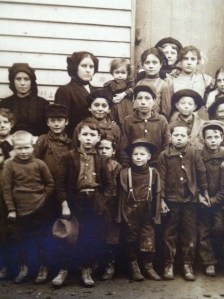
Harts Creek School Children, 1895-1915
09 Sunday Dec 2012
Posted in Pearl Adkins Diary
Tags
Appalachia, culture, Harts Creek, history, inspiration, life, love, Pearl Adkins, thoughts, U.S. South, West Virginia, writers, writing
Pearl’s second diary concludes with entries from 1928.
“I got up this morning with a calm spirit,” Pearl wrote on April 30. “I knew he was coming. He has been gone so long.”
“My heart. Jesus blessed Jesus, let me get till I can walk for I love and it’s a shame to love and you a cripple,” she next wrote in an undated entry. “It’s dark. I have dreamed of his coming so often I know he will be here soon for I never dream of him till a while before he comes.”
“Diary dear. It has been some time since I have conveyed you a little secret,” Pearl wrote on Sunday, May 6. “You are my constant and steadfast friend. I think it’s so strange the turns life will take. I have long admired a cute little boy but dared not to speak of it to anyone. He’s so young and funny. I can’t keep from hardly falling in love with him. I have teased Inez and told her how much I cared for him, but she took it all as a joke. I just let her think it a joke but I never meant any thing more in my life than that. Inez was telling me about his girls, when I told her to hush. It made me mad to hear of his love making to other girls but she took that as a huge joke. But it really hurt to hear of those other girls being where I wanted to be. But that can never be. He is lots younger than I to start with, but circumstances is another obstacle. Gee, but he is just the kind of a boy I could love for life if I just had that chance. I wonder if he can feel my presence tonight. Oh Lord, how lonely I am tonight. If he were here I would be satisfied for the time being just to be with him. Gee, wish I knew if he ever thinks of me. I would give most any thing to know if he just gave me one little thought to night.”
09 Sunday Dec 2012
Posted in Culture of Honor
Tags
Appalachia, crime, culture, Harts Creek, history, Lewis Farley, life, Logan County, photos, U.S. South, West Virginia, writing

Three Harts Creek Men, circa 1920
09 Sunday Dec 2012
Posted in Big Harts Creek, Ed Haley, Spottswood
Tags
Appalachia, Ashland, Ashland Cemetery, Buck Fork, Clifford Belcher, Connie Woods, Dingess, Ed Belcher, Ed Haley, Ella Haley, fiddle, fiddler, fiddling, genealogy, George Greasy Adams, guitar, Harts Creek, history, Hoover Fork, Jackson Mullins, Jeff Baisden, John Frock Adams, John Hartford, Johnny Hager, Kentucky, Lawrence Haley, Liza Mullins, Logan, Logan County, Maynard's Store, music, Nashville, Peach Creek, Peter Mullins, Ralph Haley, Sol Bumgarner, square dances, Trace Fork, Turley Adams, Violet Mullins, Weddie Mullins, West Virginia
At some point, Connie showed up with a small entourage of women toting some of Joe Mullins’ old pictures. My eyes immediately went to a large, framed photograph of two serious mustachioed men. Turley said one was Weddie Mullins — his grandfather on “both sides” of the family tree — while the other was Ed Haley’s Uncle Peter Mullins. Both men were brothers. Turley said his grandfather Weddie — Ed’s uncle — was murdered at the little town of Dingess just after the turn of the century.
Lawrence said, “Mom and Pop used to play at Dingess — just a little community over in MingoCounty.”
That got us back on the subject of Ed, although most of the commentary was choppy and mixed between looking at photographs. One of the girls said, “We’ve heard talk of Ed all our lives.” Another made the unusual remark, “He could see lightning. Some way he could feel it or something and tell it was hitting.” Someone said Ella could tell the difference between the Haley children by their smell.
Turley, who had been fairly quiet throughout our visit, said to Lawrence, “Bernie Adams used to play a lot of music with your dad.”
Violet said, “Bernie’s the one took him in the chicken house for the toilet. They stayed all night up at our house. Robert Martin and Bernie and Ed and them played music all night. I can remember it. I was just a little girl. Mother said Ed played many a time where she was raised up over in the head of Francis Creek.”
Lawrence said, “You know, these different places like Hoover and places like that don’t ring a bell to me. I can remember going down here to the end of Trace, and maybe down to Smoke House, and up to George Adams’ who lived on up this way, and up to that store — Maynard’s Store — and buying candy, but that’s about the limit of my travel, except coming up from the mouth of Harts.”
Basically, the next half-hour or so was a giant “get to know everybody session” — mostly between Lawrence and the locals. I sort of hung back a little, taking it all in, while Lawrence spoke of and listened to stories about his father. There was a glow about his face that had been absent in Ashland.
At one juncture, he told Connie how her grandparents, Peter and Liza Mullins, raised his father.
“Oh, really?” she said. “I didn’t know that. Now I remember Granny. They wanted me to stay all night with her and I was always afraid she’d die in her sleep or something. That’s terrible.”
She asked Lawrence if he remembered Uncle Jeff — “he was Granny’s brother and he was kinda slow.”
Violet said, “He liked to go to all these dinner meetings they’d have out in the country. He’d walk for miles and miles.”
Connie asked Lawrence if Ed ever played at Logan — the seat of government for Logan County — and he said, “Yeah, he used to play around Logan quite a bit and Peach Creek. He’d play up there during court days especially. Back in them days, the town would load up. I’ve been there with him during those times. The old courthouse, I think it faced toward the river. One side of it was on Stratton Street.”
Connie asked where Ed was buried and Lawrence said, “He’s buried in the Ashland Cemetery in Ashland. Mom’s buried in the same cemetery but not with him. By the time my mother died — she died three years after Pop — they’d filled that section up.”
I’d never really thought about that. Ed and his wife were not buried together, the kind of seemingly minor detail tossed out randomly that took on somewhat of a greater meaning at a later date. I made a note to myself right then that I would visit Ed’s grave in Ashland before heading back to Nashville.
Violet wondered about Lawrence’s older brother, Clyde.
“Clyde’s out in Stockton, California,” he said. “He’s what I call the black sheep of the family. Never married. He just followed the sun for work. When it was summertime, he’d go north; when it was wintertime, he’d go south.”
Just then, an old man called Bum showed up at Turley’s. Bum remembered Ed and his family well. He asked Lawrence about the Haleys. It was hard to focus on their conversation — everyone in the room seemed to be talking at once — but I heard Bum mention something about how Lawrence’s brother Ralph used to hang from tree limbs by his “sticky toes” and would “do anything.”
“That’s exactly how he got killed,” Lawrence said. “He was hanging by his toes and he was gonna let go with his toes and flip over and land on his feet but he didn’t make it. He was just active like that. See, Ralph danced around these carnivals and fairs and places.”
A few minutes later, things quieted down a little. I moved over near Bum to ask him about Haley. His answers seemed to come through his nose more than his mouth and were usually followed by a little chuckle. He was great. Bum said he was 67 years old and first saw “Uncle Ed” in the thirties.
“He lived down in Ashland and he’d come up pretty often,” Bum said. “People come from everywhere to listen at him play whenever they’d have them big dances and stuff. He’d play half the night. Yeah, I’ve been right there.”
I asked Bum about Ed’s tunes and he said, “Ah, he played so many… There was one religious tune he’d put the bow under the fiddle, and the hair, he’d turn it right over and slip his fiddle between it, and play that. I forgot what it was.”
Bum told me all about the old dances.
“They used to have a big working,” he said. “About every family on this creek and Harts Creek down here, they’d all gather up and hoe one man’s field out and then move to the next one. And they’d all go to each other’s farms that way and help each other, and when they got done one man would have a big dance. They’d have a dance on Saturday night. They’d have them at just about every home, mostly at Uncle Peter’s up here, in the house. Like one room in there, they’d gather everything up and take it outside and they’d have a dance in there, and when they got through they’d put the furniture all back in. Anybody that wanted to come was invited. They’d have food right in the house. There were usually three or four around to call the reel: ‘Dosy doe and here she comes and there she goes.'”
“It’d just be Uncle Ed and John Hager playing?” I asked.
“Well, Ed mostly,” Bum said. “Uncle Johnny, he played some with him. Uncle Ed, he played by himself most all of these dances. Mrs. Haley played with him a lot. She played the mandolin, guitar or accordion.”
“Did Johnny Hager play the banjo about like Grandpa Jones?” Turley asked Bum.
“Yeah, over-handed they call it,” Bum said. “Molly O’Day, she played that way. My grandpaw would whittle out two little sticks and he’d sit and beat on them strings and Ed a playing the fiddle.”
“Ed played with Ed Belcher,” Turley said.
“Yeah, I’ve heard Pop talk about Ed Belcher,” Lawrence said.
Now who was Ed Belcher?
“He played the guitar,” Bum said. “He could play the piano, too. They’d get together at times and play together. They’d go up Buck Fork.”
Bum said he last saw Ed Haley “over here on that mountain yonder” at Clifford Belcher’s beer joint.
“He’d go down there and play and people’d give him beer and stuff. That’s about all he wanted. I run into him over there one night. I said, ‘Uncle Ed, where you been?’ He said, ‘I ain’t been no where but right here. I come up here to sit around and play music a while.’ I bought him a beer and he sat there and played music. Well, a Conley boy run in and went to playing and thought he was better than Ed and everything. Ed finally told that boy, said, ‘Why don’t you quit playing that music? You can’t play. You’re cutting my music up too much.’ That boy come back at him, you know, and aimed to fight him. He said, ‘Shut up, old man. You don’t know what you’re a talking about.’ I was standing there and I told him, I said, ‘Now listen. If you jump on that man, you’ll have me to fight and him both.’ And Ed took his fiddle and hit that feller right down over the head with it and busted that fiddle all to pieces.”
Lawrence laughed.
Turley said Ed Haley was high-tempered, as well as strong, and hinted at his mean streak.
“Dad said Peter had a dog that Ed couldn’t get along with at all. Ed told Uncle Johnny, ‘You get me close to him and I’ll hit him in the mouth. I’ll knock him out.’ And he said Ed hit that dog and killed him with his fist. Hit him in the ear and killed him. That’s what my daddy told.”
Bum was very familiar with Ed Haley’s family on Trace. He said Uncle Peter Mullins was “pretty bad to get out and get drunk and get into it with people.” He knew all about Ed’s uncle Weddie Mullins’ murder at an election in Dingess. “There used to be a train come in there and they’d bring flour and stuff over there and people’d go over there to Dingess and get it,” he said. “They’d take wagons and go through these hills, like up Henderson and all them places and they got into it over there.” Bum wasn’t sure who shot Weddie but knew that his killer survived the fracas. Once the news reached Harts Creek, John Adams got a pistol from Jackson Mullins and rode to Dingess where he found Weddie’s killer laid up in a bed clinging to life. Someone told him the guy probably wouldn’t make it so (like something out of a Hollywood Western) he pulled out a .38 pistol and said, “I know he won’t,” and shot him in cold blood.
I wasn’t exactly sure who any of these people were — Jackson Mullins, John Adams — but I had the impression that they were some relation to Ed Haley. At that juncture, I just let the tape recorder roll and tried to take notes and absorb everything, figuring that what seemed like unimportant details would perhaps later develop into major items of interest.
09 Sunday Dec 2012
Posted in Culture of Honor
Tags
Appalachia, crime, culture, Harts Creek, history, life, Lincoln County, photos, U.S. South, West Virginia, writing
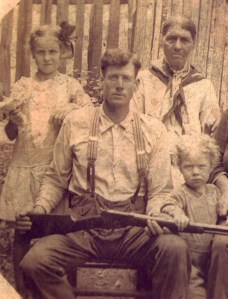
Ed Dalton, about 1915
09 Sunday Dec 2012
Posted in Ed Haley, Spottswood
Tags
Adeline Adkins, Appalachia, blind, Buck Fork, Connie Woods, Ed Haley, George W. Adams, Harts Creek, history, Jack Mullins, Joe Mullins, John Hartford, Johnny Hager, Lawrence Haley, life, Logan County, Louie Mullins, Milt Haley, music, Peter Mullins, Roxie Mullins, Trace Fork, Turley Adams, U.S. South, Victoria Adams, Violet Adams, West Virginia, Yellow Leg Spaulding
Connie suggested we go see her neighbor Turley Adams, who lived just down the creek near the mouth of a branch. She pointed toward a man working in his yard a few hundred yards away at his one-story white home. That’s Turley? We took off right away. As we approached the place, Lawrence mentioned that Turley lived at the same approximate location of Milt Haley’s old cabin. While the cabin was long gone, I noticed the front yard still had the same beautiful roll to it I had seen in an old picture at Lawrence’s house. I tried to imagine how the cabin would have looked in Ed Haley’s day.
Turley met us near the porch, where Lawrence introduced us and told our reason for visiting him. Turley was immediately friendly and, in his gruff voice, invited us inside. At first, our conversation went pretty slow. Then Lawrence said, “I never did get much about my granddad, Milton Haley. Joe said he’s buried down here somewhere in a graveyard and I thought maybe he was talking about down at the mouth of Trace somewhere.”
Turley’s wife Violet said there was an old cemetery just back of their house, although it had been in terrible condition for many years.
“Well now, they was some graves out there. Turley’s mom told me that some of them were Mullinses and some of them were Haleys. They was some babies and then they was some older people. All unmarked. They was sort of in a row and they was rocks up to them but by the time I married Turley they’d rolled down the hill so you couldn’t tell where the graves really were.”
Oh god. I could just imagine someone finding a Milt Haley tombstone (probably no more than a rock with “MH” carved on it) lying at the foot of the hill and just tossing it in the creek.
“Well one grave we could tell pretty well where it was at, the others we couldn’t,” Violet said. “It had all growed up so we started cutting the bushes and keeping it mowed and cleaned up but we still don’t know where the graves are.”
We walked outside briefly to survey the site.
“They’s eleven graves,” Turley said. “I used to help Uncle Jack Mullins keep them cleaned up a little bit.”
Was this little embankment with a sunken spot the final resting place of Ed Haley’s parents?
Back inside, Turley said he remembered Ed, which seemed to please Lawrence somewhat. He told this story about a local girl who danced to Ed’s music.
“When I was in high school, Ed was around my house and he said, ‘I’d like to fiddle for somebody to dance.’ And I asked this girl, Adeline Adkins from around here on Buck Fork, if she could dance and she said, ‘I can dance to anything.’ She danced three or four tunes and my dad come in. Ed said, ‘By god, John, she’s just like Yellow Leg Spaulding. She can hit ever thing I do on this fiddle. And Dad said that they was a guy that used to go with them and dance that he called Yellow Leg Spaulding.”
“Well I didn’t know whether we’d even find anybody up here now, except Joe,” Lawrence said. “I thought I’d come up and see if I could find him, maybe introduce John to somebody that could give us some information on my dad. I know they couldn’t be very many people old enough to probably appreciate his music.”
“He come to my mom and dad’s house one time and played music all night,” Violet said. “Robert Martin was with him. I guess they’d been drinking or whatever because they was gonna take him out to the toilet and instead of taking him to the toilet they took him into the chicken house. They didn’t pay no attention to what they was doing. But they played all night. I never will forget.”
I had never really considered the possibility that Ed’s cousins and neighbors played jokes on him. I saw him as this great musician — an elevated status that may not have been shared by many of his contemporaries. All of a sudden, I was flooded with images of this little blind orphan — alone in the world — victimized mercilessly throughout his childhood. How did he take it? And how would Lawrence react to hearing these kind of stories? In quick time, I had this latter question answered. Lawrence immediately countered Violet’s story about the outhouse with a tale that cast his father in a more triumphant light.
“Joe said when Pop was just a little kid he got to the point to where he could travel from this house over to Uncle Peter’s,” Lawrence said. “Uncle Peter kept cattle in the field out here or something — a bull or two. Well, the boys teased him. You know, he’d get about half way across that field and then they’d go to snorting like a bull — scare him — and then stand way back and laugh at him. Pop took that for a while and finally found a pistol over here at the old house and he went across the field and they started doing that to him. Well, he just pulled that pistol and, where that sound was coming from, he started shooting that pistol. I guess that broke that little game up.”
Lawrence was obviously determined to guard his father’s legacy, which was a perfectly legitimate thing to do.
Violet got out a few albums filled with old photographs of Ed’s kinfolk from up and down the creek, which stirred Lawrence’s memories.
“Seemed to me like we walked down here to Trace to go up the hill there and there was a store down there,” he said.
Violet said, “Turley’s dad run a store around on Hart at one time and Ewell Mullins had a store up here.”
Lawrence remembered Ewell’s store. “Yeah, he had a store up here, I know that. And then they was one on up and over the hill there where you could go and buy a nickel’s worth of brown sugar. We’d get one of them little penny-paper pokes full of brown sugar and we thought we was having a big time.”
Lawrence’s mind was starting to click in high gear. “I heard Pop talk about how he’d ride a horse up the hollow going up through there,” he said.
Lawrence asked Turley if he knew anything about a George Adams. Turley said his grandfather was named George Washington Adams but he went by the nickname of “Ticky George” to distinguish him from a cousin, “Greasy George.” Ticky George spent most of his life in the woods hunting for ginseng where he apparently acquired a great number of ticks.
“He didn’t have good mind,” Violet said later. “He just knowed enough to get by.”
Turley said his grandmother Adams was a sister to Ed’s friend, Johnny Hager.
“Well, there’s how Johnny Hager came into this,” Lawrence said.
Turley didn’t know much about his genealogy but said his aunt Roxie Mullins could tell us the “whole history” of the Hagers.
“She lives around there above Louie on Harts Creek there,” he said.
Louie Mullins was a grandson to Uncle Peter, making him a third cousin to Lawrence (at least by our count).
This was sort of a confusing moment. Names of people I’d never heard of were popping into the conversation and converging upon one another in seemingly irrelevant connections.
It was great.
There was an unmatchable poetry in it: Turley, Yellow Leg Spaulding, Ticky George… I mean nobody could make this kind of stuff up.
08 Saturday Dec 2012
Posted in Culture of Honor
Tags
Appalachia, crime, culture, Floyd Farley, Harts Creek, history, life, Logan County, photos, U.S. South, West Virginia, writing

Floyd Farley, West Virginia deputy sheriff
08 Saturday Dec 2012
Posted in Culture of Honor
Tags
Appalachia, crime, culture, history, life, Logan County, photos, U.S. South, West Virginia, writers, writing
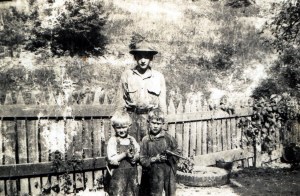
Harts Creek Children, circa 1938
08 Saturday Dec 2012
Posted in Ed Haley
Tags
Appalachia, Big Sandy River, Ceredo, Clifton Mullins, Connie Mullins, culture, Ed Haley, fiddler, genealogy, Guyandotte River, Harts, Harts Creek, Hatfield-McCoy Feud, history, Huntington, Imogene Haley, John Hartford, Johnny Hager, Kenova, Lawrence Haley, Logan County, Loretta Mullins, music, Pat Haley, Peter Mullins, Trace Fork, U.S. South, West Virginia, writing
Early the next morning, Lawrence and I boarded my Cadillac and drove out of Ashland across the Big Sandy River into West Virginia. We drove past little towns named Kenova and Ceredo on I-64 then turned off onto Route 10 just south of Huntington. For the next hour, we weaved our way on this curvy, two-lane road toward Harts, cruising past small settlements named Salt Rock, West Hamlin, Pleasant View, Branchland, Midkiff and Ranger — all situated on the Guyandotte River. Finally, after what seemed like an eternity, we saw a tiny green and white sign planted to the right of the road reading “Harts, Unincorporated.” Just past it was a beautiful two-story white home, which Lawrence quickly pointed out as the place where Ed’s mother was murdered in the Hatfield-McCoy Feud. Excited, I quickly pulled over and took a picture, then took off in a cloud of gravel and dust.
Lawrence and I turned right onto a narrow paved road and snaked our way up Harts Creek, bypassing a high school, trailers, Depression-era framed houses and newer brick homes. It was beautiful country. Cold weather was barely gone and the hillsides were a faint blush of green buds. Lawrence motioned toward the creek — which was up somewhat due to spring rains — and told again how difficult it was to get up Harts Creek in his younger days.
“Biggest part of the time, you was down in the creek bed there, if the weather was right. If it was times like this you had to take to the hillside but the road usually followed the creek bed. It seemed like it took us all day walking up here, but they didn’t have the roadway up on the side of the hill like this.”
After a ride of some fifteen minutes, we reached Trace Fork, the place where Ed Haley was born over one hundred years ago. We drove a short distance up the branch to the site of Peter Mullins’ cabin, which had burned or been torn down about fifteen years earlier. Lawrence pointed out the only remaining relics from the original farm: a lonely tree and an old smokehouse.
After taking in the sights and smells, we went to see Joe Mullins, who lived in a small white house just down the bottom. We first met Joe’s daughters, Connie and Loretta, who said Joe had gone to Chapmanville and would probably be out for most of the day. Lawrence introduced himself as “Ed Haley’s son,” which caused Connie to giggle and say, “Oh, yeah. Don’t we have a picture of him?”
Loretta said, “We got a lot of pictures.”
“The old fiddle,” Connie said. “Remember the old fiddle that used to be up there in that old house?”
What old house?
“That old smokehouse up there at the old house,” Connie said. “There was an old fiddle up in the top of it.”
There was more giggling, as if the two had just shared a secret joke.
I said to Connie, “You don’t think you could find that do you, just to see it?”
She said, “No, I doubt it.”
Loretta said, “We could probably find the picture.”
Boy that would be great.
“I don’t know about right this minute. How long are you gonna be around?”
“Long enough for you to find that picture,” I said.
The next thing I knew, Connie walked us to Uncle Peter Mullins’ old smokehouse and flung open a door. I took a few steps inside — past old furniture and piles of God-knows-what — and quickly spotted a decorative metal lid with Ed and Johnny Hager’s picture on it. In the picture, a copy of which I had first seen at Lawrence’s, Haley was slim and decked out in a suit with a derby and dark glasses. Hager stood beside him with a banjo. Lawrence said it was taken at White Sulphur Springs in eastern West Virginia.
At some point, Connie showed us a large, framed portrait of a woman she identified as Ed’s mother, Emma Jean Haley — the same picture Pat Haley had seen on her visit to Harts Creek several years ago. Connie said Lawrence could have both pictures.
Writings from my travels and experiences. High and fine literature is wine, and mine is only water; but everybody likes water. Mark Twain
This site is dedicated to the collection, preservation, and promotion of history and culture in Appalachia.
Genealogy and History in North Carolina and Beyond
A site about one of the most beautiful, interesting, tallented, outrageous and colorful personalities of the 20th Century

