Tags
Appalachia, Cora Adkins, culture, Harts, Harts Creek, history, life, Lincoln County, photos, U.S. South, West Virginia
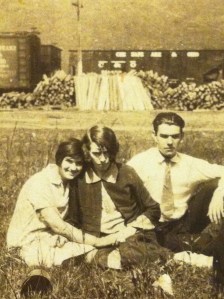
Cora Adkins (center), 1920-1925
18 Tuesday Dec 2012
Posted in Harts, Pearl Adkins Diary, Women's History
Tags
Appalachia, Cora Adkins, culture, Harts, Harts Creek, history, life, Lincoln County, photos, U.S. South, West Virginia
Cora Adkins (center), 1920-1925
18 Tuesday Dec 2012
Posted in Pearl Adkins Diary
Tags
Appalachia, Cora Adkins, Harts, history, life, Lincoln County, love, Pearl Adkins, thoughts, U.S. South, West Virginia, writers, writing
“This has been a very nice day,” Pearl wrote on Saturday in the spring or summer. “I have been at home all day by my self. They all have been gone for the longest time. I guess I would have had to stayed the whole time by my self if it hadn’t been for a girl friend who dropped in for a few minutes chat. She has gone and I have been dreaming of my love and his sweet looks when another face broke in on my meditation and said, ‘I see [name omitted] is back again.’ I asked, ‘Where is he at?’ She said, ‘I seen him out at the store. He’s a lot better looking than he used to be.’ But I never got a glimpse of him at all.”
“Our company began to come in,” Pearl wrote the following day, a Sunday. “Cora was primping up to go out with some of them. I was laying on the bed lost in deep thoughts of my afflictions. That caused me to be so sorrowful and sad, for I couldn’t go with them. I was nursing my misery to its fullest heights when some one came in the next room. All at once a calmness came over me. I was thinking of my sweet lipped honey and wishing he was here. But I felt his presence before he entered the room. I was so astonished and dumbfounded that I couldn’t speak for several seconds when he smiled one of his smiles and said, ‘Why hello, Pearl. How are you?’ I hardly remember what I said for I was still under the shock of it all, for this was the first time I had seen him since I discovered I loved him so dearly. I know I blushed from my neck to the roots of my hair. I was so overjoyed and thankful for his return that I hardly knew what to do. Aw shucks, what could I do? I couldn’t do any thing — only lay there and smile too myself. They all left out and he stayed on. But he didn’t stay in there for long where I was, but sit in the next room nursing his misery too, I guess. But I’m not telling what it was and he wouldn’t eat no dinner and stayed till late in the evening and then was gone and left me to suffer it out by my self. No one ever guessed that I too suffered like others do. I don’t guess he ever dreamed I could love him but I do just the same and I mean that he shall know by and by.”
08 Saturday Dec 2012
Posted in Ed Haley
Tags
Appalachia, Big Sandy River, Ceredo, Clifton Mullins, Connie Mullins, culture, Ed Haley, fiddler, genealogy, Guyandotte River, Harts, Harts Creek, Hatfield-McCoy Feud, history, Huntington, Imogene Haley, John Hartford, Johnny Hager, Kenova, Lawrence Haley, Logan County, Loretta Mullins, music, Pat Haley, Peter Mullins, Trace Fork, U.S. South, West Virginia, writing
Early the next morning, Lawrence and I boarded my Cadillac and drove out of Ashland across the Big Sandy River into West Virginia. We drove past little towns named Kenova and Ceredo on I-64 then turned off onto Route 10 just south of Huntington. For the next hour, we weaved our way on this curvy, two-lane road toward Harts, cruising past small settlements named Salt Rock, West Hamlin, Pleasant View, Branchland, Midkiff and Ranger — all situated on the Guyandotte River. Finally, after what seemed like an eternity, we saw a tiny green and white sign planted to the right of the road reading “Harts, Unincorporated.” Just past it was a beautiful two-story white home, which Lawrence quickly pointed out as the place where Ed’s mother was murdered in the Hatfield-McCoy Feud. Excited, I quickly pulled over and took a picture, then took off in a cloud of gravel and dust.
Lawrence and I turned right onto a narrow paved road and snaked our way up Harts Creek, bypassing a high school, trailers, Depression-era framed houses and newer brick homes. It was beautiful country. Cold weather was barely gone and the hillsides were a faint blush of green buds. Lawrence motioned toward the creek — which was up somewhat due to spring rains — and told again how difficult it was to get up Harts Creek in his younger days.
“Biggest part of the time, you was down in the creek bed there, if the weather was right. If it was times like this you had to take to the hillside but the road usually followed the creek bed. It seemed like it took us all day walking up here, but they didn’t have the roadway up on the side of the hill like this.”
After a ride of some fifteen minutes, we reached Trace Fork, the place where Ed Haley was born over one hundred years ago. We drove a short distance up the branch to the site of Peter Mullins’ cabin, which had burned or been torn down about fifteen years earlier. Lawrence pointed out the only remaining relics from the original farm: a lonely tree and an old smokehouse.
After taking in the sights and smells, we went to see Joe Mullins, who lived in a small white house just down the bottom. We first met Joe’s daughters, Connie and Loretta, who said Joe had gone to Chapmanville and would probably be out for most of the day. Lawrence introduced himself as “Ed Haley’s son,” which caused Connie to giggle and say, “Oh, yeah. Don’t we have a picture of him?”
Loretta said, “We got a lot of pictures.”
“The old fiddle,” Connie said. “Remember the old fiddle that used to be up there in that old house?”
What old house?
“That old smokehouse up there at the old house,” Connie said. “There was an old fiddle up in the top of it.”
There was more giggling, as if the two had just shared a secret joke.
I said to Connie, “You don’t think you could find that do you, just to see it?”
She said, “No, I doubt it.”
Loretta said, “We could probably find the picture.”
Boy that would be great.
“I don’t know about right this minute. How long are you gonna be around?”
“Long enough for you to find that picture,” I said.
The next thing I knew, Connie walked us to Uncle Peter Mullins’ old smokehouse and flung open a door. I took a few steps inside — past old furniture and piles of God-knows-what — and quickly spotted a decorative metal lid with Ed and Johnny Hager’s picture on it. In the picture, a copy of which I had first seen at Lawrence’s, Haley was slim and decked out in a suit with a derby and dark glasses. Hager stood beside him with a banjo. Lawrence said it was taken at White Sulphur Springs in eastern West Virginia.
At some point, Connie showed us a large, framed portrait of a woman she identified as Ed’s mother, Emma Jean Haley — the same picture Pat Haley had seen on her visit to Harts Creek several years ago. Connie said Lawrence could have both pictures.
04 Tuesday Dec 2012
Posted in Ed Haley
Tags
Appalachia, Ashland, banjo, Chapmanville, Charley Gore, East Tennessee Blues, Ed Haley, Ethel, fiddle, fiddler, fiddling, Fire on the Mountain, Great Depression, Harts, Harts Creek, Hell Among the Yearlings, history, Ira Gore, John Hartford, Johnny Hager, Kentucky, Lawrence Haley, Lee Trick Gore, Liza Mullins, Logan County, Mag Gore, Mona Haley, music, Ode Curry, Peter Mullins, Stoney Ferrell, The Dying Californian, U.S. South, West Fork, West Virginia, Wild Horse
Later in the evening, Pat put me in touch with Lee “Trick” Gore, an Ashland preacher and musician who remembered Ed Haley from his childhood days on Harts Creek. We met Gore the following day at his home in what was my first meeting with someone from Ed’s birthplace. He was a polite man with a loud clear voice, somewhat thick in stature and decked out in a tie and button-up sweater.
“I understand what you’re trying to do,” Gore said right away.
It wasn’t long until he and Lawrence were in a deep discussion about the people and places in and around Harts.
“We used to spend a week or two with Aunt Liza or Uncle Peter,” Lawrence said, prompting Gore. “Most of the time we’d ride the train up there and get off at Harts. They run passenger trains up into coalfields then. We’d get off there at the mouth of Hart and walk up and it was nothing but creek. You’d ford that creek a dozen times trying to stay close to the road and the road was in the creek half the time. You had to wade the creek half the way up through there. It’d take us half the day it seemed like.”
Lawrence said his father spent some time in Chapmanville, a town upriver from Harts about nine miles.
“I remember staying in Chapmanville, too. There was a beer joint or something that Pop wanted to stop at. They was some guy in there got to down-mouthing Pop. Stoney Ferrell, that’s exactly who it was. This guy kept aggravating him and Pop just edged toward his voice, you know. Instead of carrying a blind man’s cane, Pop carried a big heavy cattle cane. He got pretty close to him and he reached out and grabbed him around the neck with that cane.”
Gore said Ed used to come see his uncle Charley Gore at Ferrellsburg, a settlement about two miles upriver from Harts.
“Uncle Charley was a fiddler,” he said. “Charley was the principal of the school and Ed stayed with him. Well, once a year he’d happen by. That was right on the heels of the Depression. I was twelve. I was just learning to play the guitar then.”
Gore looked at Lawrence and said, “Either you or Mona was leading him.”
I asked Gore what Ed looked like at that time and he said, “He just dressed ordinary. He never dressed up, but he wasn’t dirty looking or nothing like that — just old-fashioned.”
He stopped for a moment, lost in thought, then said, “He was just something else. He was far ahead of a lot of fiddlers, buddy. There wasn’t none of this grinding on that violin. When he played it, it was just as smooth in that bow hand. I know he played ‘Hell Among the Yearlings’, ‘Fire on the Mountain’ and ‘The Wild Horse’. Uncle Charley played those tunes, too. I guess he learned them from Ed Haley.”
“I wish my daddy was alive,” Gore said. “Boy, he could tell you about Ed Haley because he loved him. Uncle Charley loved him dearly. And Ed knew that he was welcome at our house and that’s where he hung his hat buddy — where he was welcome. Do you know how I think of him? I think of him as kind of a mountain poet. He sung religious songs and them old mournful mountain tunes. It seems to me like he sung a song called ‘The Dying Californian’. I can’t remember the poetry to it, but it was a mile long.”
Ed sang while fiddling it.
Gore said Ed sometimes traveled with “Little Johnny” Hager, a banjo player who used to stay weeks at a time with his family when he was a boy. Lawrence Haley had shown me a picture earlier of Ed with Johnny Hager in Webster Springs in 1914.
I asked Gore if he knew that Ed could play the banjo and he said, “Seems like I heard him play it when him and Johnny was together. No doubt he could play it.”
Gore asked Lawrence if he remembered a man his father used to play with named Ode Curry (he didn’t), then said, “Ode Curry was just a fella that played the banjo and sang and he had a big nose, as well as I remember, and it’d vibrate when he’d sing because he sung through his nose. But let me tell you something: they would give him all he could drink to play and Ode knew some of the lonesomest, heart-breaking songs you ever listened to.”
Gore got his guitar and sang several songs for me, then whistled the melody for “East Tennessee Blues” and named it as one of Haley’s tunes. He said, “That’s funny how things come back to you when you sit down and get to talking about it, and reminiscing.”
I encouraged him to “play another tune and see what it stirs up,” so he strummed and whistled out a few more melodies.
At some point, Gore’s wife said she remembered seeing Haley play at Logan Court House and in a nearby coal town named Ethel.
Just before Lawrence and I left, Gore called his 85-year-old aunt, Mag Gore, about Haley. “Mag was a singer,” he said. “She married Ira Gore, her third cousin. She couldn’t get out of the Gore family.” He spoke with her briefly on the phone, then told us: “The only thing she remembers was that her husband Ira went to town one day and Ed Haley come home with him because Ira had a little bit of that good ol’ ‘moon’ they make over on the West Fork. They was a sipping that a little bit.”
West Fork, Gore said, was a tributary of Harts Creek with its headwaters in Logan County.
01 Saturday Dec 2012
Posted in Harts, Pearl Adkins Diary, Women's History
Tags
Adkins Conspiracy Case, Appalachia, Beecher Avenue, Billy Adkins, Custer McCann, Fed Adkins, Ferrellsburg, Guyandotte River, Harts, history, Isaac Adkins Branch, Lincoln County, Pearl Adkins, polio, Rinda Adkins, Sand Creek, U.S. South, Watson Adkins, West Virginia, writers, writing
Some years ago, I located a diary kept by Pearl Adkins, a physically handicapped and romantically frustrated intellect. A life-long resident of Harts, West Virginia, Pearl was born on August 1, 1904 to Fed and Rinda (Davis) Adkins. At the time of her birth, her parents resided in a two-story plank house situated at the mouth of Isaac Adkins Branch on Guyandotte River. Her father’s involvement in the famous Adkins conspiracy case of 1907 and subsequent incarceration in the West Virginia state penitentiary and loss of property disrupted her childhood and prompted a move. In 1908, the family relocated to a rental dwelling situated above the Adkins store, just back of the original homeplace. Between 1914 and 1916, Pearl and her family lived elsewhere in Hart Bottom. Thereafter, they resided at Sand Creek (1916-1921), then Ferrellsburg — a community above Hart. At this latter location, the Adkins clan briefly operated a store.
“I knew Pearl real well,” said Custer McCann, an 83-year-old retired schoolteacher and Harts resident in June 2002. “I worked for her brother Watson Adkins and stayed around there a lot. She was Watson’s half-sister. She was highly intelligent and she read widely. I’d say she was self-educated. She was a very kind-hearted person. I never did hear her say a bad word about any one.”
Polio crippled Pearl at a young age.
“I’ve always heard my sister Inez [Pearl’s friend and sister-in-law] say that Pearl walked until she was twelve years old,” said McCann. “She had a sick spell and never got over that. But her mother did a real job taking care of her. When she got out of bed, they’d put her in a wheelchair. She had no control with her legs at all.”
According to the genealogy notebooks of nephew Billy Adkins of Harts, “Pearl was five feet, one inch tall and had brown hair and blue eyes. She was a very intelligent woman. She read a lot. She was a very wise woman and counseled people. She was a good listener.”
Pearl’s three volume diary appears to chronicle thoughts and events from January 30, 1922 until May 6, 1928, although it is full of undated or vaguely dated entries. At the time of her writing, Pearl was a young woman approximately eighteen to twenty-four years old still living at home with her parents. The family resided on Beecher Avenue in a small single-story house situated on property owned by Watson Adkins.
Writings from my travels and experiences. High and fine literature is wine, and mine is only water; but everybody likes water. Mark Twain
This site is dedicated to the collection, preservation, and promotion of history and culture in Appalachia.
Genealogy and History in North Carolina and Beyond
A site about one of the most beautiful, interesting, tallented, outrageous and colorful personalities of the 20th Century
 Brandon Ray Kirk