Clifford Dalton, James Browning, and Jake Dalton
18 Saturday May 2013
Posted in Big Harts Creek, Music
18 Saturday May 2013
Posted in Big Harts Creek, Music
11 Saturday May 2013
Posted in Ed Haley
Tags
blind, Clyde Haley, Ella Haley, fiddle, fiddler, Harts Creek, John Hartford, Kentucky School for the Blind, Lawrence Haley, Mona Haley, music, West Virginia, writing
I asked Lawrence if he knew anything about his brother Clyde supposedly trying to play the fiddle.
“Well, he never said anything about it to me and if he ever played the violin I never saw him, John,” he said. “But he did sit around and play a little on the guitar. Then he got away from home and got in some kind of industrial accident working in a woodshop or something and a band saw got his fingers. Mona, she’d take off with Pop a lot of times up into West Virginia and they’d be gone a week or two. She went with him as much as any of the rest of us did. Most of the time whenever I’d go, there’d be my mother, too.”
I told Lawrence what Wilson Douglas had said about Ed being able to get around extremely well on his own.
“I can remember, just like going up Harts Creek,” he said. “Remember where you turn off to the Trace Fork they got a big new church and stuff? They wasn’t anything in there then. They wasn’t even a road. People made their own footpaths around close to the hillside. Most of it was just pathways. And that’s how Pop could go from one house to another, I guess. He’d know when he was on that path — how many steps or something it was from his place to anybody else’s he wanted to go to. It’d be like if somebody could count the streets in succession — if they’re numbered streets… Mom could get around Ashland here anywhere she wanted to by herself, but Pop wasn’t too good at that. He couldn’t keep track of how many blocks he’d walked or where he’d started from a lot of times. He just didn’t have the training, I guess, to learn how to handle hisself as a blind man. Mom went to that Louisville School for the Blind. She was there about twelve or thirteen years, I reckon, and they taught her piano music.”
Lawrence told me more about his memories of his father’s appearance.
“He walked fairly fast and upright as a fence post with his shoulders throwed back,” he said. “He was no slouch. He set in his chair upright. A lot went through his mind, I know that. He used to tell me, ‘Son, if a man can think it up and imagine it, then it’s possible.’ In later years, he was always having some problems with his arms and hands. I remember him shaking his hand real vigorously, like he was trying to get circulation going back in it. He’d walk through the house a lot. ‘Course he’d go up and down the street some. If he felt like he wanted a beer or something, he might get out and go and play down at Russ’s Place half a day and drink what beer he wanted to and then he’d come home. I’ve seen Pop get pretty high at times.”
Lawrence said, “Well, I’ve tried to think and tell you everything I know my dad did. If I’m helping you at all, I’m tickled to death. I didn’t know him that long. He was about 44 or 45 when I was born. I went into the service when I was about eighteen and I wasn’t out of the service maybe a year and a half and he was dead.”
02 Thursday May 2013
Posted in Ed Haley
28 Sunday Apr 2013
Posted in Ed Haley
27 Saturday Apr 2013
Posted in Ed Haley, John Hartford, Music
Tags
Appalachia, Catlettsburg, Clyde Haley, Ed Haley, Ella Haley, fiddle, fiddlers, fiddling, Harts Creek, history, Irish lilt, Kenova, Kermit, Kevin Burke, Lawrence Haley, music, Nashville, Noah Mullins, Norfolk and Western Railroad, Patsy Haley, snap bowing, West Virginia, Williamson, writing
Nestled in Nashville, I worked obsessively on Ed Haley’s music. First, I made a real effort to transcribe it note for note and break it down “under the microscope.” Initially, I had tried to play it generally the way he did while keeping its spirit — with my own twists, of course, which is nearly impossible not to do. This time, though, I wanted to study it as you might a fabulous book — break it down, look at it mechanically… I made a huge discovery regarding Ed’s bowing during that time. With Lawrence’s help via telephone conversations, I deduced that Ed used what Scotch fiddlers call “snap bowing,” which is when you separate notes by applying pressure (“little stops”) with the bow — not by changing its direction. Of course, Ed didn’t use those patterns exclusively and mixed them with more conventional strokes.
I also spent a lot of time listening to Ed’s recordings and playing my versions of his songs into a tape recorder. One of the first things I figured out was that he used what fiddler Kevin Burke calls the “Irish lilt” to give his music a “dotted note feel.” It would be like playing a tune in triplets with the middle note taken out.
I also discovered that Lawrence was right about Ed not playing so many notes; instead, he created the illusion of doing so by phrasing his tunes in a way that gave them a nice “crooked” flavor.
Throughout these discoveries, Lawrence continued his role as my brutally honest fiddle teacher. His comments were surprisingly musical for someone who kept reminding me that he didn’t even play anything. When I played “Yellow Barber” for him over the telephone, he said, “That sounded right except when you get down to that low end, you’re doing a little skipping in there and it seemed to me like Pop played that a little bit smoother. Like he had a roll to his… And I noticed you had a few jumping notes in there that really I don’t remember hearing. Maybe you can hear them. Other than that, it sounded great to me.”
Lawrence seemed pleased with my playing of Ed’s “Catlettsburg”.
“That was good, John,” he said. “That was really good.”
I told him I didn’t know how Ed was able to get up into second position on that tune with the fiddle sitting at his shoulder.
“I always thought that he kinda controlled the violin with his thumb and the meaty part of his hand between his finger and thumb,” Lawrence said. “He could relax that up and down the neck of the violin or he could tighten that and he could still have the flexibility of his fingers, plus that give him the ability to rock that violin body underneath the bow, too.”
I was trying that and eventually got to where I could will my fingers into third position still holding the fiddle at my shoulder, which if you have to play for a long time is sure easier on the neck of the player.
I told Lawrence about talking with Clyde, especially about his memories of Ed mistreating him as a child.
“I don’t know, maybe my dad was mean to him when he was a young’n,” Lawrence said. “But I can’t remember my dad ever laying a hand on me to hurt me. I musta been a rowdy little kid ’cause it seemed like whenever Pop’d pick me up he’d call me ‘muddy duck’ because I was always dirty, I reckon, whenever he’d get a hold of me. He’d just rub my head or something like that and call me his ‘muddy duck.’ I don’t know where Clyde got his story from.”
Lawrence agreed that his dad sometimes abused his mother, although he placed a lot of blame for their marital problems on her.
“Well, he could be temperamental with my mother at times, but I think she was temperamental, too. I think my mother’s people had higher tempers than Dad’s people did. They seemed to be kinda quiet people. Noah Mullins was supposed to killed a revenuer up there at Harts. They waylaid a revenuer and they laid it on Noah, but Noah Mullins always seemed to me like just as quiet and as calm a fella as could be. But I had some of my uncles on my mother’s side, they were a little bit of a temperamental type of people. So I’d put some of the blame on my mother for her treatment of my dad. You know, a woman can upset a man and whip him quicker with words than he can whip her with his fists.”
I totally agreed, then asked Lawrence if he knew anything about the Muncys from Patsy’s genealogy.
“We’d ride the Norfork and Western train up from Kenova and stop at Kermit and stay there with Muncy people,” he said. “They lived in an apartment up over their store and filling station-type thing and they had one of them small monkeys. I went up there one day and got right at the top of the steps and was playing with that monkey and I musta made it mad and it made a rush at me and I musta jumped back and I went to the bottom of them steps. That made me remember it more than anything else. I can’t even remember that Pop played music while he was there for them. They mighta just talked. We used to stop there maybe and stay all night and Pop and Mom and me would go on to Williamson and they’d play at courthouse days or something there. Pop musta had people up in there, but he never said anything to me about it.”
22 Monday Apr 2013
Posted in Music
18 Thursday Apr 2013
Posted in Ed Haley
Tags
Clyde Haley, Ella Haley, Frank Creech, Harts Creek, Kentucky, music, Noah Mullins, Patsy Haley, Peter Mullins, Ralph Haley, Sherman Luther Haley, writing
Clyde said, “My brother Ralph, he was my dad’s favorite because Ralph was smarter than I was. He wouldn’t ever beat up on Ralph. Well, Ralph was bigger than he was. Did you ever know a guy from this part of the area named Frank Creech? Well, he was one of the bad boys around my area when I was growing up. And he come and borrowed Ralph’s guitar from my dad. Ralph had a great big Martin guitar. He’d bought it from one of those Ruffner boys, I think. He worked. But this guy Frank Creech borrowed Ralph’s guitar and took it somewhere and had a truck run over it — smashed it up. So Frank Creech come to the house and told my dad about it and my dad wasn’t saying a word about it. I was there in the house when this happened. And my mother didn’t like to hear anybody cuss. She was a Puritan about things like that. She didn’t allow any of that in her house.”
Clyde’s memories trailed off at that point, but I knew he was telling more about Ed’s attack on Frank Creech, an event which I’d first heard about while watching a Christmas video at Lawrence’s house.
Clyde said Ed and Ella argued sometimes about music.
“He’d want to play it one way and she’d want to play it the other,” he said. “But a mandolin and a fiddle are tuned up the same way — got the same pitch on the strings — but it’s a different kind of music.”
I asked him who usually won the arguments and he said, “Well she did because he’d give up on her.”
Clyde laughed, “He was mean. If he didn’t win with his talking, he’d do it with his fists to my mother.”
So Ed beat on his wife? I knew that was something Lawrence would have never told.
“He was a mean devil,” Clyde continued. “The worst I ever done him in my life, we was up on Harts Creek at Uncle Peter’s house. And he wanted to go somewhere and she didn’t want to go at that particular minute [and he started hitting her with his fists, so I got a hold of a plowpoint] and hit him in the head with it. Knocked a pretty good-sized hole in the head. Noah Mullins and the other Mullins boy Tennis chased me all over that mountain with a great big piece of a hoe-club. He never did catch me because I was pretty fast on my feet, too, running through those mountains and I could really get over the land. I was a boy then — a minor, you know — and they took us all down to Catlettsburg to the city jail and they threatened him with putting him in the penitentiary for beating on my mother that way and after that he never did beat her up too much.”
I asked Clyde if Ed did a lot of jail time and he said, “Just for minutes, like to hold him over for a few hours. Let him get sobered up a little bit. They weren’t mean to him, but they were mean to us boys, the police were. We deserved it.”
When I mentioned Ed’s oldest son, the boy who had died young, Clyde said, “He was born before I was. His name was Sherman Luther. Sherman was between me and Ralph.”
I said, “Now Ralph was your mother’s boy by somebody else.”
“Well, I didn’t know that,” Clyde said, kind of rattled. “See, you’re telling me things I don’t know and that kinda shakes me around a little bit and I don’t know what to say.”
I tried to smooth things up by saying, “Well I heard that but I wasn’t sure.”
Clyde said, “Well it seems to me like it could be, because my mother was a woman just like all the rest of the women. She had her good points about her. She was a Christian. I think that in my heart. But my dad wasn’t. He was just an ornery, old mean man. I hate to keep saying that about him because I… I hated him for a long time for the way he treated my mother and I finally got out of that hate and I got so I could talk about it to people who had business a knowing about it. I’m telling you things that I wouldn’t say to anybody else because I believe in you and I believe you’re being honest about what you’re doing. I wish it could be known widely about what he did for a living.”
Clyde promised if I’d come and see him, he’d tell me a lot more about Ed that he didn’t “dare mention over the telephone.” He said, “You know, I had a skull fracture here about a year ago and I can’t think real properly like I could if I set down. I’ve had my head broke, my brains knocked out a couple of times, and that affected me, too. If I saw you… Maybe if I could be prodded a little bit, I might could recall some things that might go good in a book.”
In the meantime, he said I should contact his sister-in-law, Patsy (Cox) Haley, who’d done some research on Ed’s family years ago.
“That was Jack’s wife,” Clyde said. “Her husband Jack, he blew up with a heart attack. You ought to get in touch with her. She can tell you more about that than any of us boys could ’cause she was a genealogist. She took that up as a hobby and she got into it and she couldn’t get out of it.”
16 Tuesday Apr 2013
Posted in Big Harts Creek, Ed Haley, Lincoln County Feud, Music
Tags
Appalachia, Clyde Haley, Ewell Mullins, fiddler, Harts Creek, Harts Mountain, history, Hollene Brumfield, John Hartford, Liza Mullins, Logan County, Milt Haley, music, Peter Mullins, West Virginia, Zack Williams
I asked Clyde if Ed ever talked about his early life on Harts Creek and he said, “He didn’t talk to us kids too much. My dad’s folks were from all around Logan County, West Virginia. I didn’t know who they were. I remember his Aunt Liza and Uncle Peter Mullins. ‘Club-Footed Peter’ Mullins, they called him, and ‘Reel-Footed Peter’ Mullins. That was his uncle. I remember them because I was the one that went with him when he went up that way. As a matter of fact, I went up there one time and stayed just for a whole year.”
I said, “Your grandfather Milt Haley was involved in an attempted murder…” before being cut off. “Yeah, Hollene Brumfield. I know about that. I know things about it, because I’ve been up there. He killed this guy and in the process of trying to kill this guy, he shot Hollene Brumfield in the face and mutilated her pretty bad. It was a accident. Hollene was riding behind her husband on a horse down Harts Creek. He missed him and shot Hollene — killed her. That’s the way I always got the story from my dad.”
Clyde seemed to have Milt’s story down better than any of Ed’s other kids, so I pressed him for more details about Harts Creek. I asked him about the musicians in that vicinity and he said, “They didn’t play the kind of music my dad played. There was one old fiddler up there, lived up in the head of Harts Creek. Not off on one of the branches — right straight up Harts Creek past Ewell Mullins’ store. This guy’s name was Zack Williams. Him and my dad used to fiddle together. Never went out on big sprees or anything like that, but he’d go up to Zack Williams’ house up on the top of the mountain — head of Harts Mountain — and they’d make music up there. Zack was a pretty good fiddle player.”
11 Thursday Apr 2013
Posted in Ed Haley
Tags
California, Clyde Haley, Dingess, Ed Haley, Ella Haley, fiddler, Harts Creek, John Hartford, Lawrence Haley, Logan County, Mona Haley, music, Nashville, Ralph Haley, Stockton, Wayne County, West Virginia, writing
In January of 1994, Lawrence put me in touch with his brother Clyde Haley, an old bachelor who had spent most of his life roaming the country, working here and there and always managing to get into some kind of trouble. Lawrence called Clyde “the black sheep of the family,” while Mona laughingly dubbed him as a “rogue.” He was Ed Haley’s oldest son and some seven years older than Lawrence. Each time I went to Harts Creek, people had asked about Clyde. Apparently, he made quite an impression.
When I first called Clyde, he lived in a minimum-security nursing home in Stockton, California. Our conversation started like this:
“Hello, John!”
Hey, Clyde. How’re you doing?
“Well, I’m still in the hospital.”
Well, all right. I been wanting to talk to you for two years now.
“Who is this?”
This is John Hartford in Nashville.
“Well, I don’t know whether I know you personally, do I?”
Well, you may not. I’m a real good friend of Lawrence and Pat’s. And I play the fiddle myself and I’m on television. I wear a little derby hat and I dance while I play the fiddle.
Clyde laughed.
But the reason I want to talk to you is I think your father was the greatest old-time fiddler that ever lived.
“I do, too,” he said.
Apparently, Clyde spent a lot of time bragging on Ed’s music at the nursing home. I told him I would send him copies of his father’s music and he got really excited.
“Okay,” he said. “We do a lot of little dancing here in our recreation periods. I think I’ll be outta here in March. It’s not a jail or anything — it’s a hospital.”
I told him I would be touring California in June and he said, “Well, you’ve got my address. Drop by and see me. I’m in Stockton.”
In the meantime, there were a lot of things we could talk about over the telephone. I could tell early in our conversation that Clyde was sometimes right on with his stories, while at other times he was completely out to lunch. His memories were sporadic — in no particular order — like bits of broken glass in a huge pile of garbage that you have to sort through and put back together.
I knew Clyde was Lawrence’s oldest living brother, but wasn’t exactly sure of his age.
“I was born in 1921,” he said. “That’d make me about 73.”
Clyde said he went with his father on trips more than any of the other Haley children.
“When my dad wanted to leave Mom and get away from her for a change, he’d always take me as his crutch,” he said. “I was his favorite son outside of Ralph. He called me ‘Reecko’. That was his nickname for me. I used to carry the fiddle case for him. And I went with him when he’d go to Logan County and go up on Harts Creek and up in Dingess and up that way. And he’d go over around Wayne County. He knew people up there.”
I asked Clyde to describe his father and he said, “My dad, he was about 6’2″ and he had real small feet. He had feet like a dancer would have and he wore a size six shoe. I remember that because I used to wear his shoes. I never saw him with a suit on in my life.”
07 Sunday Apr 2013
Posted in Ed Haley
Tags
Brandon Kirk, Charles Wolfe, Green McCoy, Harts Creek, history, Huntington, John Hartford, Lawrence Haley, Marshall University, Milt Haley, timbering, West Virginia, writing
Around that same time, I called Brandon Kirk, a great-nephew to Lawrence Kirk. Brandon was into genealogy and local history; for the past several years, he had been heavily researching the Brumfields. A college student and library assistant at Marshall University in Huntington, West Virginia, he spent his weekends at Harts interviewing neighbors, gathering up old photographs and documenting cemeteries. He said his family had told him about my recent trip to Harts; he was eager to make contact and compare notes on the story of Al Brumfield’s trouble with Milt Haley, especially since I represented a “non-Brumfield, non-Harts Creek” perspective.
After my initial call, Brandon sent me detailed letters in giant manila envelopes full of information about the Brumfields, the death of Milt Haley and the Adams and Mullins families on Harts Creek. It went a long way in explaining who some of the people were in the stories Lawrence and I had been hearing. It was clear that Brandon had a lot of information to offer. He knew all the genealogies, geography, and chronology that we’d been lacking to completely understand the story of Milt Haley and Ed’s connection to Harts Creek.
At the time of the Haley-McCoy murders, according to Brandon, Harts was in the midst of a timber boom. It was a tumultuous time: a whole new economic system had descended on locals who’d previously been primarily small farmers. Competition and the desire to accumulate wealth and status had created a lot of jealousy among and within local families. This new way of life was made worse by the arrival of “new faces” in town, many of whom were transients from Kentucky looking for work. Brandon figured that Milt Haley and Green McCoy were among these immigrants, as their family names were absent from the old records around Harts Creek. In his estimation, Milt and Green may have been like so many of the new arrivals: outlaws trying to escape a seedy past in a somewhat isolated but moderately booming town. He cited at least one such example in his own family tree.
As for the Haley-McCoy murders, Brandon and I seemed to have traced down roughly the same versions of the story. He said it was just one of many murder stories in Harts’ past that had caught his interest — and only one of several involving his ancestors. As a result, he had neglected to hunt down many possible leads regarding it. It was one of probably a hundred incredible stories pertaining to Harts.
I told Brandon about my recent trip, how I had gone to Milt and Green’s grave with Lawrence Kirk. He said he had never been to the grave but had heard that Milt and Green were buried together in a single hole. I wondered why they were buried together and he suggested that if they were handcuffed together at the time of the murders maybe it was a practical decision; or maybe their mutilated bodies warranted a “rushed job.” There may have also been a customary aspect to the burial: in 1882, during the Hatfield-McCoy feud, three of Randolph McCoy’s sons were buried together after their single-night execution.
Around that time, I compiled Xerox versions of my notes on Ed’s life and sent it to Lawrence Haley and Dr. Wolfe. Dr. Wolfe showed his copy to Judy McCollough of the University of Illinois Press who immediately called and told me that I had a book in the works and that she wanted to print it. It was the first time I had really thought about my research regarding Ed Haley as anything more than an obsession to totally immerse myself in his life. I told her that it wasn’t a book yet, but if it was gonna be there was a tremendous amount of work that needed to be done.
04 Thursday Apr 2013
Posted in Big Harts Creek, Ed Haley, John Hartford, Spottswood
Tags
Appalachia, art, genealogy, Harts Creek, history, Jackson Mullins, John Hartford, Logan County, Milt Haley, Turley Adams, West Virginia

Jackson Mullins Home, Sketch by John Hartford, 1993
01 Monday Apr 2013
Posted in Big Harts Creek, Ed Haley, Spottswood
Tags
Appalachia, Bill Mullins, Harts Creek, history, Logan County, Peter Mullins, photos, West Virginia

Bill Mullins and Peter Mullins, 1900-1910. Courtesy of Joe Mullins.
01 Monday Apr 2013
Posted in Ed Haley
Tags
Clifton Mullins, Harts Creek, Jackson Mullins, John Hartford, Lawrence Haley, Liza Mullins, Logan County, Milt Haley, Peter Mullins, Turley Adams, Weddie Mullins, West Virginia, writing
Lawrence, Clifton, and I headed back down to Joe’s in order to see more of his pictures. We first looked in a smokehouse near Joe’s trailer. As Clifton took hold of the door, he proudly mentioned that it had come from Uncle Peter’s old log home. Almost as soon as I stepped inside, just back of an ancient spinning wheel, piles of rotting furniture and bags of god-knows-what, I spotted the large framed photograph of Bill and Peter Mullins — two very serious young men with thick mustaches. Thinking that the picture showed Peter and his brother Weddie, Clifton began to tell of Weddie’s death.
“They went over to Dingess and they got into a fight about an election or something and one of them got shot over there and they brought him back across the mountain, you know, on the horses. Weddie, he got killed.”
Nearby this picture was a faded one of equal size featuring what appeared to be a whole family of people. My first inclination was to assume it was the Jackson Mullins family, maybe even showing Milt Haley and Ed somewhere in the shadows.
Clifton said we were welcome to borrow the two large pictures. He then fetched a box from which we borrowed 22 small photographs. Satisfied, we headed down to Turley’s for his input on their identification.
Turley was very interested in the large photo of what we thought was Weddie and Peter Mullins, since Weddie was his grandfather.
“They shot and wounded a constable or sheriff or something another over at Dingess,” he said. “John Dillon was the sheriff over there, or deputy-sheriff. He killed Weddie, and Peter, he got away. Peter come home and Uncle John went back over there and Peter went with him but he didn’t go in, I don’t think. He went in, said this guy was laying there dying, said he asked him how he was. They said, ‘Well, seems to me like he’s a dying.’ Said he just pulled a gun there and shot him and said, ‘He’s dead now.'”
I was most interested in the large faded photo of what I presumed to be the Jackson Mullins family. The picture showed a very old couple, who I figured to be Jackson and Chloe, Ed’s grandparents. There was another smaller picture of the couple, which we had borrowed from Joe’s box. Turley, though, didn’t think it was Jackson and Chloe Mullins.
“I can tell you who I think that is,” he said. “Lude and Van Mullins.”
Van Mullins, he said, was a brother to Peter’s wife Liza.
“So Aunt Liza was a Mullins before she married Peter Mullins?” I asked.
“Yeah, I guess so,” Turley said, as if he’d never thought of it before.
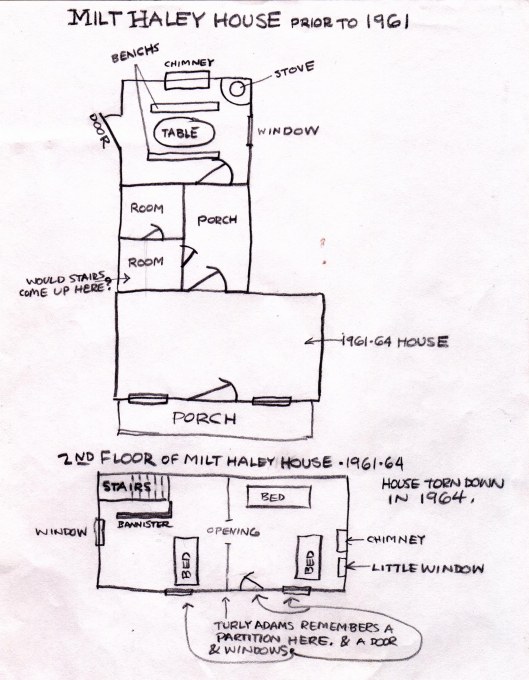
After looking at more of Joe’s pictures, I asked Turley about the location of the old Milt Haley house. He said it used to sit at the site of his present-day home.
“When I was a little boy I could remember it,” he said. “They was a big old log house front and they was a big long porch. And they had guest rooms. And then the kitchen was back there. Had a big chimney in it. And then they had that porch and everything back through there. Had that big kitchen in it and big fireplace. They could just put a big kettle in there and make a whole big kettle of stuff.”
It resembled the old Stonewall Workman home, Turley said, although I had no idea what that meant.
“The year I was six years old is when they remodeled that house — seven,” he said. “I remember after they took a part of it off the top, made it a story and a half.”
I drew out a floor plan of “The Milt Haley House” based on Turley’s memories.
28 Thursday Mar 2013
Posted in Big Harts Creek, Ed Haley, Green Shoal, Lincoln County Feud, Spottswood
Tags
Alice Baisden, Appalachia, blind, Cas Baisden, Clifton Mullins, Clyde Haley, Dicy Baisden, Ed Haley, Ella Haley, Green Shoal, Harts Creek, Hazard, history, Imogene Haley, John Hartford, John Henry, Kentucky, Lawrence Haley, Lincoln County Feud, Liza McKenzie, Liza Mullins, Loretta Mullins, Mag Farley, Milt Haley, Perry County, Peter Mullins, Sol Bumgarner, Trace Fork, West Virginia
We found Bum on our way up the hollow and went to sit on his porch with his aunt, Liza McKenzie, two of his sisters, Alice and Dicy — and of course Shermie. As soon as Liza figured out who we were she looked at Lawrence and said he was just a small boy the last time she’d seen him.
“Yeah, I guess around 1940 or ’41 was the last time I come to this area,” Lawrence said.
Liza said, “Well, I lived in Kentucky about sixty years. Perry County, up in Hazard.”
I said to her, “Is that where Milt Haley was from?” and she said, “I don’t know but now Ed Haley was borned and raised right around here. When he was a boy, he got up on top of that house down there where Aunt Mag used to live — in that old two-story house — and rolled off in a box. Mother said, ‘Lord, Ed, are you hurt?’ He said, ‘No, God no. It’s give me eyesight.’ He said he jarred his eyesight back.”
I liked Liza right away.
I asked her if she had any pictures and she said, “Loretta’s mother had all the pictures of Ed Haley I ever did know. They used to have a picture down there at Loretta’s of Ed’s mother. She was a pretty woman.”
She looked at Clifton and said, “Clif, I believe your mother had a picture of Ed Haley that was made down there at the old home where he was born and raised. Down there where Aunt Mag used to live. I know they had them.”
Clifton remembered it.
“Yeah, they was sitting out in the yard,” he said. “They was together. She was in the chair and he was standing. He didn’t have no pants on.”
Clifton said, “Yeah, you’re right. They was a picture down there. But I looked; they was so many pictures in that box.”
Box of pictures? I thought.
Before I could ask about them, Clifton said, “There’s one down there faded out. It’s in a big frame. I got it in another building.”
He told me, “I can show them to ya.”
About that time, Cas Baisden came up to the porch. Bum said he was Liza’s 83-year-old twin brother. I asked Cas if he remembered Ed and he said, “I knowed him, yeah. He was raised up here. Old man Peter lived down at the mouth of the holler and his boy lived up the road here and old man Ed’d go up there and he’d come down that road a running and jumping just like he could see and cut the awfulest shine that ever was.”
Lawrence joked, “That’s probably how Clyde got to be the way he was.”
Cas said, “Yeah, I guess Clyde took after him. Clyde went out here and got down in a well once and they had the awfulest time that ever was getting him out. Way back in top of a mountain.”
I asked Cas about the first time he ever saw Ed and he said, “It’s been many a year ago. He stayed down here, him and his wife and them. They’d play music and drink and fight and scratch with one another and them boys was so mean… He’d get so drunk he couldn’t walk.”
Bum knew that Ed was real “easy to get mad about music,” but said he could get him to play nearly anything he wanted because Ed liked him. He’d ask Ed to play something like “John Henry” and he’d say, “Are you sure that’s what you want me to play? You know, I was just thinking about playing that.” If Ed didn’t like someone Bum said he’d “goof around” and not play for them.
Things kinda tapered off after that. Nobody knew anything about Ed having any brothers. Cas had heard about Ed’s father, who he thought was named Green.
“You know, he got killed when I was a little fella, I guess,” Cas said. “His name was Green. They took him over yonder on Green Shoal, they said, and killed him. Walked him down here and up Smoke House and over and down Piney and across the river.”
I asked if Lawrence looked like Ed and Liza said, “Yes, he does. Ed was a bigger man than he is. Ed was a big man.”
But Lawrence looks like Ed in the face?
“Yeah, he looks like him all over.”
Cas said, “Ed was a taller man. I guess he takes after his mother. She’s a little short woman.”
Lawrence agreed: “Yeah, she was about five feet tall — not much bigger than Aunt Liza.”

26 Tuesday Mar 2013
Posted in Big Harts Creek, Ed Haley, John Hartford, Lincoln County Feud, Spottswood
26 Tuesday Mar 2013
Posted in Big Harts Creek, Ed Haley, John Hartford, Music, Spottswood
Tags
Appalachia, Clifton Mullins, Connie Mullins, Crawley Mountain, Ed Haley, Enslow Baisden, fiddle, Harts Creek, history, Joe Mullins, John Hartford, Lawrence Haley, Logan County, Loretta Mullins, Peter Mullins, Sol Bumgarner, Trace Fork, Turley Adams, West Virginia
I told Turley that Lawrence and I needed to visit Joe Mullins, who had been gone during our last trip to Harts Creek. Turley completely deflated us: Joe, he said, had recently suffered a stroke. He now lived with his daughter Connie Mullins in a trailer just up the creek. Turley pointed the way. Driving a short distance, Lawrence and I parked our car by the creek and walked over a little narrow bridge where an army of barking dogs greeted us. At the porch, Connie introduced us to her brother, Clifton. We stepped on inside and found Joe seated in a wheelchair, surrounded by more dogs. His mind — or at least his ability to communicate a great deal — was all but gone due to the lingering effects of his stroke. Lawrence sat next to him with his hand on his arm. Almost in tears over Joe’s condition, he tried to rekindle Joe’s memories by saying, “I’m Ed Haley’s boy.”
I hung out with Joe’s kids — Connie, Clifton and Loretta. While all were reasonably young, Clifton and Connie had Parkinson’s Disease.
“They’s four of us got it,” Clifton said. “They said it runs through the family some way another. Musta come down the tree somewhere.”
I asked him how old he was.
“38,” he said.
Clifton had just moved back to Harts.
“I got hurt in Michigan and Daddy was sick so I said, ‘Well, it’s a good chance for me to go help my daddy and my sisters.'”
Clifton’s sisters said he was the one who found Ed’s smashed fiddle years ago in the rafters of Uncle Peter’s old smokehouse.
“I was up in there — we was playing around one day — and it fell out on me,” he said. “And I just looked at it and I said, ‘Well, I’ll try to glue it together.’ I started gluing it and it wouldn’t glue so I dumped it into the creek. I didn’t know whose it was. I was about eight but all the pieces wasn’t there to it. When it hit that guy it just splintered everywhere.”
Clifton suggested that we visit Bum and his family just up the hollow. Two years earlier, Bum had told originally Lawrence and I how he had witnessed Ed smash the fiddle over a man’s head while at a tavern on Crawley Mountain. Bum lived only a short distance from Joe’s trailer, up the hollow past Uncle Peter’s old homeplace, in a house situated near Enslow Baisden’s log cabin.
15 Friday Mar 2013
Tags
Al Brumfield, Appalachia, feud, Harts Creek, Hollene Brumfield, John Hartford, Lawrence Haley, Lawrence Kirk, Peter Mullins, timbering, West Virginia, writers, writing
Mr. Kirk hopped in the car with Lawrence Haley and I and guided us to “Presto’s garden,” a small corn patch located just off of the hill from the Haley-McCoy grave. It was late afternoon: the air was clear and the remains of the sun slanted through the trees on the hillside. Lawrence Haley chose to stay at the garden due to his heart condition, but I made the steep climb toward the grave with Mr. Kirk just behind me. A few minutes later, we stopped at an indentation — a round shallow crater about seven feet in diameter. It had a little pile of stones on each end and was just as Bob Adkins had said it would be. We walked back and forth studying the “bowl” and the markers and I took some pictures.
At the bottom of the hill, we got back in the car and rode up Low Gap Road to the site of Milt Haley’s murder. On the way, I told Mr. Kirk what we’d heard about Ed’s mother Emma Jean Mullins being shot in the face.
“See, I hadn’t heard that part of it,” he said. “Well now, you know them Adamses and Mullinses up there on Hart married back and forth for generations. That’s quite possible. Of course, them Brumfields and them Adamses had trouble over that log boom they had had there at the mouth of Hart. It’d catch water and hold it back like a dam. They’d float them logs all out of Harts Creek back in yonder, then when the backwater come up in the spring of the year they’d make them into a raft and float them out of here and take them to the town of Guyandotte. That’s the market. They claimed the Brumfields got to sawing the ends of them logs off and re-branding them. I don’t know what the extent of their trouble was but they had some misunderstanding over that lumber and then Runyon and whiskey got involved in it down on that houseboat where they’s selling whiskey. All of them drinking, you know. They’d all go down there and get drunk and talk this shit up, you know, and get it started, get it going, down there where the booze was. Things were getting out of hand. Whiskey’s destroyed an awful lot of people in this country. A lot of my relatives.”
Mr. Kirk said, “They’s supposed to killed them at daylight or immediately after daylight. The story that I’ve heard on it has been that they were both knocked in the head with the flat side of a double-bit axe. Killed them separately. Hit them right in the top of the head there. And I’ve heard people say they was shot up you know, and some said they were chopped up with an axe. But my grandmother, she was awful critical of the Brumfields and their conduct. She was an Adkins — part Dingess. Bill Brumfield’s widow. By her being pretty critical of them, I feel like she handed me what she had as being true. But now they was organized into kind of a posse. She said they called theirselves ‘The Night Riders.’ Vigilante group. Operated all the time at night. They were pretty sneaking in what they did.”
They must’ve had some serious shortcomings, because Mr. Kirk said they “tried to organize themselves into the Klan, but the Klan wouldn’t have them.”
After surveying the site of Milt’s murder, we drove down to the mouth of Harts Creek where Mr. Kirk pointed out the site of the recently burned Al Brumfield house.
“Except being a landmark, it wasn’t worth much,” he said. “They used to have a meal-house out there to ground meal for people. Had a store in here. That’s Al Brumfield and Aunt Hollene. He was in his fifties when he died of typhoid fever. Watson Adkins later bought his house and lived there. Had a store over here for years. Now, Runyon had a boat down yonder — great big boat — barge built in there and had a store in it. He run poker games. Selling whiskey. Had a few groceries in there. Al and his bunch trying to do the same thing over here.”
All during our ride with Mr. Kirk, he kept pointing out spots where murders had taken place. As we made our way back up West Fork, I asked him why there’d been so many killings around Harts Creek. He didn’t hesitate in saying, “Whiskey. Whiskey’s caused it. This section of country up through here — this West Fork section — has had a few killings. It wasn’t as bad as back yonder. Whiskey involved in every bit of that.”
Lawrence Haley agreed that whiskey was the primary cause of trouble in the old days, even mentioning how one of Uncle Peter Mullins’ boys once killed a “revenue man” around Trace Fork. He said it “it took just about everything Uncle Peter had to keep him out of jail.”
Mr. Kirk said, “Is that the one they called ‘Reel-Footed’ Peter? Ewell’s daddy?”
Lawrence confirmed that it was — and that it was his great-uncle — and Mr. Kirk said, “I can remember old man Peter. I believe it was his right foot that was curled in. Man, he’d work in the woods, draw a team…”
10 Sunday Mar 2013
Posted in Culture of Honor, Whirlwind
07 Thursday Mar 2013
Posted in Ed Haley
Tags
Bernie Adams, blind, Ed Belcher, Harts Creek, history, Iris Williams, John Hartford, Lawrence Haley, Lawrence Kirk, Lincoln County, Logan, Milt Haley, music, West Virginia, writing
The next day, Lawrence and I went to find Milt Haley’s grave on the West Fork of Harts Creek. It had been two years since our initial trip up the Guyandotte Valley and I was excited to once again plant my feet on the grounds of Ed Haley’s childhood. We followed Bob Adkins’ directions to the West Fork of Harts Creek, where we found a confusing sign labeled “East Fork Road” pointing us across a stone bridge and past a somewhat large red brick church. Lower West Fork was very much different from my memories of main Harts Creek — more sparsely settled. It was surprisingly beautiful farm country with a view of an almost-forgotten agrarian way of life. There were old barns, cattle and tiny farms all along the nice little road.
Not surprisingly, Lawrence and I were unable to find the Milt Haley grave, which we figured was located in a thicket on top of one of the surrounding mountains. Hoping for the best, we decided to ask for directions at a nice-looking house. We chose a neat little white home, where an older lady came out and showed almost complete confusion as we asked about Ed Haley, Milt Haley and a grave. Once she figured out what we were talking about, though, she introduced herself as Iris Williams, said she was part-Brumfield and pointed toward the grave just down the road and to the right on a hill. She said her older brother Lawrence Kirk would know all about it. She went back inside and called Lawrence, who said he’d come right over and tell us what he knew about Ed Haley and the Haley-McCoy murders.
It wasn’t long until Lawrence Kirk pulled into the driveway and popped out of his car. He was a short stocky 70-something-year-old fellow with thinning hair and glasses. He made his way toward the porch, grinning and waving a newspaper. He said he had seen me on TV and unraveled the paper, which featured a front-page story about our recent visit to see Lynn Davis in Huntington.
In one of those “strange contact moments,” I introduced him to Lawrence Haley. It was a first-ever meeting of men whose ancestors had shot it out along Harts Creek over one hundred years earlier. They seemed to like each other right away and made it clear they held no grudges over their ancestors’ troubles. This was great news — no barriers to information flow. However, I have to admit, I got a little adrenaline rush in thinking that Lawrence and I were now in “enemy territory.” In my mind, the 1889 feud was still smoldering in the hearts and minds of at least a few people.
Instead, we all sat on Mrs. Williams’ front porch with Mr. Kirk, who remembered Ed well.
“I’ve heard Ed Haley play up there at the courthouse square many of a time in Logan with Ed Belcher,” he said. “They’d get together up there sometimes and play all day. I’d be with my dad up there when I was a youngster. I kinda got acquainted with the old man, enough to speak to him. He’d always ask you who it is. ‘Yeah, I know some Kirks,’ he’d say.”
Mr. Kirk said he used to see Ed and his wife on the Logan-Williamson bus that ran between the coalfields and Huntington.
“I felt sympathetic towards them,” he said. “They were blind — handicapped — and I’d notice them. I can’t remember that well about him. I can’t remember too much how he was dressed. It bears on my mind about ever time I ever saw him he was bald-headed. I’m not sure…but he played that fiddle.”
Mr. Kirk last saw Ed play music on a Sunday just before the election of 1948 or ’50 at the Harts Tavern. His uncle Taylor Brumfield was the owner of the tavern. Ed was there with Bernie Adams, who Mr. Kirk called “a pretty good guitar player.”
“Bernie was bad to drink,” he said. “He just drunk liquor until it finally killed him, I reckon.”
Ed was “being pretty sassy” at the tavern.
“They wasn’t giving him enough money to please him, you know,” Mr. Kirk said. “They was buying him a few drinks but he felt like fellows ought to throw him in a few dollars of money along. But that bunch there, they had to have their quarters to buy some beer with.”
Ed told Bernie, “Well hell, let’s go. This tight bunch here won’t buy a man no beer. Can’t get a crowd together no how.”
Bernie said, “Now, Ed. Don’t get to talking too rough about these fellows around Harts. Some of your folks didn’t have too good a relation with these Brumfields around here.”
“Aw, to hell with these damn Brumfields,” Ed said. “There’s nobody afraid of these Brumfields.”
I almost fell off the porch laughing.
05 Tuesday Mar 2013
Posted in Ed Haley, John Hartford, Music
Tags
Ashland, blind, Charles Dickens, Cleveland, Ed Haley, Ella Haley, England, Freddie Smith, Great Expectations, Harts Creek, history, Jack Haley, James Hager, John Hartford, Kenny Smith, Kenny Smith Jr., Kentucky, Kentucky School for the Blind, Lawrence Haley, Michigan, Mona Haley, Mona Lisa Hager, Morehead Normal School, Morehead University, music, Noble Boatsman, Ohio, Pat Haley, Patsy Haley, Ralph Haley, Ralph Mullins, Raymond Willis, Robin Hood, Scott Haley, Washington DC, Wilson Mullins, writing
That evening, back at Lawrence’s, I was full of questions about Mona. She had made a real impression. As I spoke about her, I could sense a little hostility from Pat, as if there were years of family trouble between them, barely hidden away.
“Mona was married to Wilson Mullins,” Pat said. “He was from Harts. Mona was fourteen, I guess, when she married and he was 23 years older than her. She had one boy by Wilson Mullins — Ralph Andrew, who was named after Ralph Andrew Haley. When I came over here in 1949, Mona was divorced from Wilson and she was married to a Kenny Smith. She had two boys by Kenny Smith. Freddie lives in Michigan and Kenny Jr. lives in Ohio. Kenny Sr. is dead. Had a heart attack in Cleveland.”
After a brief marriage to Raymond Willis, a railroad engineer in Ashland, Mona married James Hager.
Pat said, “We met him once. I think they lived in Ohio.”
Mona had a daughter by Mr. Hager named Mona Lisa.
Pat seemed to think the most of Lawrence’s brother, Jack.
“Jack was a very devoted husband and father and had a beautiful home,” she said. “He worked very hard. Larry and Jack were very, very close. Jack was five years older than Lawrence.”
Jack’s wife Patsy had done a lot of family research “but found nothing beyond Uncle Peter and Aunt Liza.”
I asked if Patsy had any pictures of Ed and Pat said, “No more than what we have, because when Rounder Records came to Larry and we was getting pictures for them we went up to Pat’s and Larry got records from them. Jack had four or five records left and their son Scott brought those to Washington and whatever pictures they had.”
Pat promised to ask Patsy if she had anything.
Later that night, Lawrence told me more about his mother. He said Ella was a very small person, only about five feet tall. As a young woman, she attended the Kentucky School for the Blind at Louisville and earned a piano teaching certificate at the Morehead Normal School (now Morehead University).
“Mom was very refined,” Pat said. “No matter where she went, you could always tell she was an educated lady. Mom had very good manners. She was very good at speaking. And when you saw her and Pop together, and listening to both of them, you could tell there was a vast difference in the way they were raised.”
“Mom would read Dickens to us,” Lawrence said. “Robin Hood, Great Expectations — all them classical stories that came out of England and places at that time.”
When young, Ella was proficient at playing the piano and organ. After marrying Ed, she learned to play the mandolin and banjo-mandolin so that she could play “his type of music.”
“She used to sing more of the old English-type music,” Lawrence said. “Little nonsense stuff. We’d ask for it a lot of times ’cause we didn’t have anything else but the radio. I remember her singing one that had to do with a sea captain and it went something like this:
There was a noble boatsman.
Noble he did well.
He had a lovin’ wife
But she loved the tailor well.
And then it went on to state that the sea captain had to take his boat and go on a trip and he left his house and kissed his wife and started out. And the local tailor came in. And it just so happened the captain had forgot his sea chest so he came back and when he knocked on the door the wife was trying to find a place for him to hide. Guess where he hid? In the sea chest. And what happened to the tailor, he got chucked into the sea sometime or another on that cruise.”
Writings from my travels and experiences. High and fine literature is wine, and mine is only water; but everybody likes water. Mark Twain
This site is dedicated to the collection, preservation, and promotion of history and culture in Appalachia.
Genealogy and History in North Carolina and Beyond
A site about one of the most beautiful, interesting, tallented, outrageous and colorful personalities of the 20th Century