• About

Brandon Ray Kirk

~ This site is dedicated to the collection, preservation, and promotion of history and culture in my section of Appalachia.

Brandon Ray Kirk

Tag Archives: Gallipolis

Civil War in the Kanawha Valley: Littlepage Mansion (2019)

20 Monday Jan 2020

Posted by Brandon Ray Kirk in Civil War, Women's History

≈ Leave a comment

Tags

Adam Littlepage, Appalachia, architecture, Camp Two Mile, Charleston, civil war, Confederate Army, Gallipolis, George B. McClellan, Henry Wise, history, Kanawha County, Kanawha Valley, Littlepage Mansion, National Register of Historic Places, Ohio, Rebecca Littlepage, Ripley, Terry Lowry, The Battle of Charleston, Two Mile Creek, Union Army, West Virginia

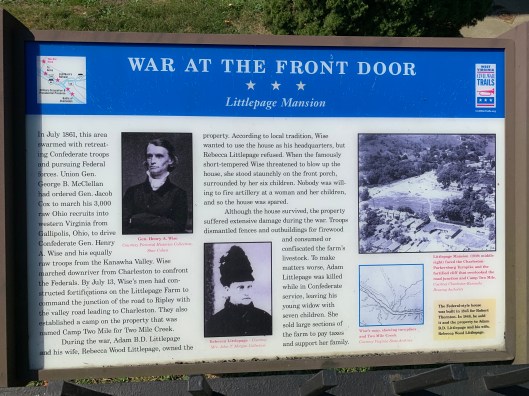
IMG_0669

Terry Lowry is THE authority on the Civil War in the Kanawha Valley. Stop 7 on his tour: Littlepage Mansion in Charleston, WV. 29 September 2019. Here is a link to Terry’s latest book, The Battle of Charleston (2016): https://wvcivilwar.com/now-available-the-battle-of-charleston/

IMG_0670

Built in 1845, the Littlepage mansion is one of only six antebellum houses remaining in Charleston, WV. It is listed on the National Register of Historic Places. 29 September 2019

IMG_0667

Rebecca Littlepage reportedly refused to allow Confederate General Henry A. Wise to occupy her home as a headquarters. According to the historical marker: “When the famously short-tempered Wise threatened to blow up the house, she stood staunchly on the front porch, surrounded by her six children. Nobody was willing to fire artillery at a woman and her children, and the house was spared.” For more history about the Littlepage mansion, go here: https://www.wvencyclopedia.org/exhibits/23?section=7

One-Armed Indian Doctor Visits Huntington, WV (1886)

08 Friday Dec 2017

Posted by Brandon Ray Kirk in Huntington, Native American History

≈ Leave a comment

Tags

Appalachia, Cabell County, Gallipolis, history, Huntington, Huntington Advertiser, Indian, King of Pain, medicine, medicine man, Native American History, Native Americans, Ohio, Queen of the Valley, Utawaun, West Virginia

From the Huntington Advertiser of Huntington, WV, come these interesting historical items about a Native American visitor to town in 1886:

The one-armed Indian doctor, who pulls teeth for the love of his species and sells compounds known as the “King of Pain” and the “Queen of the Valley” for a livelihood, is in the town. The crowds that nightly surround his wagon demonstrate that the American people have queer ideas of entertainment. Many people take advantage of the aborigine’s gratuitous services, and as he tosses in the air black and crumbling snags and molars with hideous roots, the crowd manifests its pleasure by generous applause. The doctor will remain as long as the harvest of snags holds out, the crowd remains appreciative, and last but not least, as long as the sale of the “King” and “Queen” does not lag.

Source: Huntington (WV) Advertiser, 15 May 1886.

***

U-ta-wa-un, the Indian medicine man and lightning tooth-puller, visited this city this week and pulled an astonishing number of decayed teeth, lectured on temperance and dispensed the King of Pain and the Queen of the Valley to the eager populace. On Thursday the aborigine departed for Gallipolis.

Source: Huntington (WV) Advertiser, 3 July 1886.

Civil War Dispatches From Wayne County, WV (1865-1866)

07 Thursday Sep 2017

Posted by Brandon Ray Kirk in Big Sandy Valley, Civil War, Timber

≈ Leave a comment

Tags

Abel Segur, Abraham Lincoln, Appalachia, Arthur I. Boreman, Bill Smith, Burlington, Cabell County, Cassville, Catlettsburg, Ceredo, Charleston, civil war, Confederate Army, crime, David Bartram, David Frasher, Department of West Virginia, deputy sheriff, G.W. Brown, Gallipolis, Gallipolis Journal, George Crook, Greenbrier County, Guyandotte, history, Ironton Register, Isaac Bloss, J.W. Merricks, Jack Meadows, Jefferson Davis, Jim Turner, John B. Bowen, John W. Holt, Kentucky, Logan County, Monroe County, Ohio, Ohio River, Pete Jeffers, Pike County, Pocahontas County, Point Pleasant, Raleigh County, sheriff, The Weekly Register, Tug Fork, Union Army, Wayne County, Webster County, West Virginia, Wheeling Intelligencer, William Wirt Brumfield

Below are several dispatches relating to the Civil War and immediate post-war era in Wayne County, West Virginia. These dispatches appeared in pro-Union newspapers.

Wheeling Intelligencer, 21 January 1865

WEST VIRGINIA AS A PLACE TO LIVE. I could not conscientiously recommend any one to come here now to live, although investment in farms will surely be profitable. The trouble now, chiefly, is that the guerrillas have broken up their organization, if they ever had any, and scattered into small squads to rob and steal. A schoolmistress, passing along a lonely road not far from Ceredo, was robbed of all her money, the amount she had just received for three months’ teaching, by three ruffians. A few nights ago men went to the house of a quiet farmer, one mile from Ceredo, and robbed him of a few dollars, all he had, and boots and some clothing. Some of the citizens keep arms in their houses, and intend to use them if visited in that way. One of these shot one of a gang of six one night not long ago, but became frightened himself, and ran off, giving the robbers a chance to take their wounded companion away. He has not been troubled since. Geo. Crook, commanding the Department of West Virginia, has issued a circular notifying the people that they must organize for their own protection, and recommends them to hunt the bushwhackers and kill them. Governor Boreman offers to furnish arms and ammunition. It will be done, and the guerrillas will decrease every week, I hope.

The Weekly Register (Point Pleasant, WV), 26 January 1865

GIVING THEMSELVES UP. — We learn that Lieut. Samuels, brother of Judge Samuels, formerly Adjutant General of this State, recently came into Wayne county, accompanied by a dozen or fifteen other rebel soldiers, all of whom took the amnesty oath. They say they are tired of fighting for nothing and freezing to death.

Wheeling Intelligencer, 21 February 1865

A GUERRILLA MURDER. We learn from citizens of Wayne county, who arrived yesterday, that a few days ago a guerrilla murder was committed at Ceredo, on the Ohio river in that county. It appears that a gang of men, under command of the notorious Bill Smith, came down to Ceredo and entered the house of Jack Meadows, a citizen, shot him through the heart, drove his wife and children out of doors, and set fire to the premises. Mrs. Meadows who fortunately armed with a revolver, shot one of the guerrillas dead and seriously wounded another, but not until one of her legs had been broken by a blow with a gun in the hands of one of the rebels. The rebels having completely destroyed the house of Mr. Meadows, and with all its contents, fled to their hiding places, leaving their dead companion unburied. Mrs. Meadows and her children were taken to Catlettsburg, Ky., where she still remains.

Wheeling Intelligencer, 23 February 1865

GUERRILLAS. — During the debate yesterday in the House of Delegates, upon the bill to provide for the better organization of the State Guards, some horrible pictures were presented of the condition of the loyal people of the border counties. Mr. Ferguson said that every part of the county of Wayne on the Ohio river, was held by guerrillas. In the county of Cabell only one two, Guyandotte, was held by the Federal troops. The rebels have their headquarters up in Logan county, and they make forays down toward the Ohio river, stealing, murdering and devastating the country. They enter the houses of loyal people and steal household furniture and bed clothing, and frequently strip women and children of wearing apparel and leave them in an actual state of nudity. Mr. Wells, of Raleigh, and Mr. Gregory, who represents Webster and Pocahontas, gave similar accounts of the condition of things in their respective localities.

Gallipolis Journal, 2 March 1865

CEREDO, WEST VIRGINIA. — Since the breaking out of the rebellion, “I give bread” town has been subjected to many vicissitudes. Its prospects when projected, in 1854, and later, was that of a great manufacturing city. Early in 1862, many of the Yankee citizens anticipated the coming storm, and either disposed of their property or left it to the despoiler. At one time it had a regiment quartered in its midst, but of late no troops have been nearer than Guyandotte. Disloyalty has cropped out under drunkenness and personal hate, until one’s life is endangered at any moment. Guerrillas and rebel sympathizers occupy the principal houses vacated by the owners. Not a public building stands untouched. The window and door frames, flooring and every sleeper of the hotel have been torn out and burned up. The dismantling of the steam saw mill and Glass Factory have long since been accomplished. Night is made hideous by the continued debaucheries of certain desperate characters, such as Jack Meddows and Pete Jeffers. There is not a loyal family left in Ceredo.

The Weekly Register (Point Pleasant, WV), 9 March 1865

A correspondent of the Ironton Register, writing from Burlington, O., says: The murder of Jack Middaughs, at Ceredo, on the 13th inst., was attended with some circumstances that deserve mention. The guerrillas surrounded his house before he knew of their presence. Then with a single revolver he drove them a little, wounding two of them. His wife then seized the revolver and threatened them, while Jack made his motions for escape. It was then that the rebs pressed forward to get up the stairs, Mrs. Middaugh standing at the head. Jim Turner was in advance, and finding Mrs. Middaugh in his way, swung his gun and with a blow smashed her foot. She then shot him through the breast, and he fell. At this moment Jack sprang down the stairs knocking down all in his path. He got out and nearly reached the woods, when he was met by three or four mounted men, who surrounded and killed him. — There were thirty-five men in the gang, with Smith, and it would be safe to say that twenty of them were at the house. Through this crowd Jack heroically fought his way and would have escaped but for the guards near the woods. The treatment of Mrs. Middaugh was barbarous in the extreme. It has been equaled only by the cruelties practiced by the Indians in the early times in this country. After she was disabled they took her and her children out, and made her lie down upon the ground, half dressed, refusing to permit her to get a single article from the house, while they were setting fire to it. On that bitter cold night of the 13th of February, in her condition, she was compelled to remain until the savages left. The conduct of this heroic woman is duly appreciated by the citizens of Catlettsburg and they have generously provided for her and her little ones.

Wheeling Register, 6 June 1865

The following resolutions were passed at a meeting of the citizens of Wayne county, West Virginia, held at the Court House on the 18th ult.:

WHEREAS, Our country is just emerging from civil war, which has laid waste our fields and drenched the land in fraternal blood; and

WHEREAS, It is to the interest of all to restore permanent peace and harmonize the elements necessary to a well regulated society; therefore, we, the people of Wayne county, in Mass Meeting assembled, do Resolve:

1st. That in the preservation and perpetuity of the principles set forth in the Constitution and Government of our fathers, we most sincerely and devoutly acknowledge an all wise Providence, who is the Giver of every good and perfect gift, and the common Father of us all; and we will, in time to come, rely implicitly upon Him for His protection and guidance.

2d. That it is the duty of every individual to lend his active aid and energy to the establishment of civil law, both State and National, and to its enforcement for the protection of life, liberty and property.

3d. That we justify and approve the Amnesty of President Lincoln. Its results have been beneficial, and the croakers and fault finders of the policy are morally arrayed against the Government and its best interest, and are not found among those who have fought its battles and borne it through the ordeal of war with success.

4th. That we concur in the convention called by the citizens of Greenbrier and Monroe, to meet at Charleston on the third day of June next, for the purpose of suppressing the lawless persons, and the restoration of order throughout the State, and do appoint and constitute Messrs. Abel Segur, John B. Bowen, R. Banton, and Isaac Bloss as delegates to represent Wayne county in said convention.

W.W. Brumfield, President

J.W. Merricks, Secretary

Wheeling Intelligencer, 25 April 1866

AFFAIRS IN WAYNE COUNTY. Cassville, Wayne Co., W.Va., March 23d, 1866. To the Governor of the State of West Virginia: Dear Sir: — After respects, I wish to call your immediate attention to some facts, as follows: Sometime last Spring you commissioned me as a notary public, and I was sworn and gave bond as the law directs. I am also assessor of the 2d district of Wayne county. I live and keep my office in Cassville; and it is with extreme difficulty and under great danger and hard threats that I am getting along. My entire neighborhood is rebel with the exception of old Squire Bartram and his boys, one of whom is our high Sheriff and another Capt. David Bartram our deputy Sheriff. I have forborne for a long time calling for men and arms, thinking the rebels would quiet down; but sir, we cannot execute the civil law unless something is done. We have been beaten by mobs and shot at on the streets and dared to help ourselves. They say they can’t have power, and we shan’t have it. Now, Governor, I suggest and absolutely insist that a company of one hundred volunteer militia be raised for our protection. The rebels say if you call out the militia, they will be in the majority but we do not want more than one hundred men. Our county is mostly quiet except around Cassville. A commander and company is not necessary for the enforcement of civil law in the lower end of the county. If in your judgment you see fit to commission and arm men, I would suggest that William Shannon be commissioned Captain. He is an honorable and upright man and knows something of both civil and military matters. Further, that David Frasher be commissioned as Lieutenant, to be stationed at Cassville. We must have from 25 to 50 men here in Cassville, or else we must get out of here. This is the landing place for all lumber that comes down Tug river. Those big buck rebels come down in time of high water sometimes by dozens from Logan county and from Pike county, Ky., with their navies [revolvers] buckled around them, hurrahing “for Jeff Davis,” cursing the Government, cursing Union men, and then we have to get out. Sir, I frequently see men come in here who are indicted for murder in Kentucky, defying everybody. Not more than eight miles from here, as some of the Home Guards were on their way home from being paid off a company of rebels fell on them and beat and abused them severely, calling the party “damned abolitionists,” and swore they would not submit to our laws. A few days ago they gathered in here and raised a riot with our Sheriff, and fell on him with clubs and weights and tried to kill him and his brother. His brother ran into my house for protection. They stoned my window out, knocked two panels out of my door and nearly killed my little child. If you see fit to protect us send the commissions immediately. The men can be raised in a few days. Send full instructions and special orders. You may send arms if you think proper, for there will be no doubt about recruiting the men immediately. We have plenty of guns here which belong to the State that can be gathered up. This company should be armed with revolvers instead of guns. I refer you to Major Brown [Col. G.W. Brown, Q.M. General], the man who came here and paid the home guards. He formed some acquaintance with me when he was here, also with Shannon and Lieut. Frasher. Yours, with respect, John W. Holt.

 

In Search of Ed Haley 13

01 Saturday Dec 2012

Posted by Brandon Ray Kirk in Ed Haley

≈ Leave a comment

Tags

Appalachia, Ashland, Beckley, Bluefield, Chillicothe, Ed Haley, Ella Haley, Farmers, fiddler, fiddlers, fiddling, Gallipolis, Gene Goforth, Hazard, history, Jenkins, Jess Adams, John Hartford, Kentucky, Lawrence Haley, Lexington, Missouri, Morehead, music, Nila Adams, Ohio, Pat Haley, Pikeville, Portsmouth, Pound, Princeton, Shannon County, U.S. South, Virginia, West Virginia, Winchester, writers, writing

Ed Haley spent his young bachelor days just “running around all over,” Lawrence said. He didn’t know any specifics about that time in his life but I could fill in the blanks based on memories of myself at that age. When I was growing up in Missouri, Gene Goforth, the great Shannon County fiddler took me into some of the darkest dives I could ever imagine — real “skull orchards.” Those places were filled with hot-tempered, burly men who were mean enough to fight or kill anyone. Even though Gene and I felt safe around them because we played their type of music, there was always an unpredictable danger in the air. I bet Ed’s music at that time in his life was as exciting as anything I would’ve ever wanted to hear, but to stay in some of those old taverns to hear it would’ve been like being in a cave full of rattlesnakes.

I asked Lawrence if he had any idea about how far Ed traveled with his music and he said, “I don’t know where he went when he was single, running the country. The way people talked, he started out about the time he married my mother. Hell, he was going twenty years before that. When he married my mother was more or less his settling down time. Well, I know he’s been all the way south through Beckley and Princeton and Bluefield, West Virginia and all the way down into Pikeville, Kentucky and over into Pound, Virginia. I guess he’s been as far as Hazard and Jenkins, Kentucky and all those little towns. County seats mostly is where he played.”

Lawrence didn’t think Ed made it as far west as Lexington, Kentucky. “They say that he never was down through the Bluegrass, but I’m pretty sure he’s been as far west into Kentucky as Winchester,” he said. “And I know he’s been to Morehead and Farmers; that’s a little town just outside of Morehead, Kentucky. He’s been to Chillicothe and Portsmouth, Gallipolis — up in Ohio that a way. Now, I don’t think he ever made it into the Carolinas or Johnson City, Tennessee but if he did it was before my time.”

Lawrence said his parents supported the family by playing music on the streets, but would play just about anywhere money could be made. “Pop used to go down to Portsmouth to a steel mill. It’s closed down now. It was a pretty good sized mill. They made everything from steel plate down to wire nails and fencing and everything else in there. It was Detroit Steel or one of those. He used to go down there, and he’d go to the railroad YMCA, too, because there was all the time train men coming and going on the N&W train line. A lot of train crews’d come in there and stay all night and Pop and Mom used to go in there and play right in the YMCA building. They used to do it down here at the Russell Y.”

Lawrence told me more about seeing Ed and Ella play for dances. “I’ve walked Mom and Pop to Morehead down the C&O Railroad tracks to Farmers — that’s six or seven miles — to play at a home. They’d take any rugs and furniture out of a room and pack them in another room and then dance. It might have been seven to nine o’clock sets, but it seemed to me like they lasted all night. I’ve seen Pop sit one set right after another without really stopping. When he’d play a piece of music, he’d play it as long as the caller wanted to call. Pop’d play ten minutes on a piece of music if that’s what was requested. Them was awful long sets. I’d get up and we’d start home at daybreak.”

I asked how Ed was paid for a dance and he said, “It would be more or less passing the hat or somebody coming up and wanting a certain piece of music played in a set or something. I don’t think they ever contracted a certain monetary fee for anything. They just took it as it came.”

Lawrence obviously preferred to think of Ed and Ella playing at dances instead of on the sidewalks, probably because street musicians are often regarded as being little more than talented bums. It was surely more romantic to think of them at county fairs, courthouses or little country houses. No doubt, he thought his father was above the street scene and likely had strong memories of long hot or cold days spent on sidewalks with passersby throwing out nickels and occasional slurs.

Pat gave me a little insight into that facet of Ed’s life story when she asked Lawrence if he’d told me about his “winter coat.” Lawrence said no because I wanted to know about Pop — not him — but she said, “Oh, I thought that was cute. He was a little boy and he was with his mama and they were in Cincinnati. It was very, very cold and he didn’t have a coat. And they were standing — you know his mama was playing — and his mother had told him he would get his winter coat for Christmas and he said, ‘Santa Claus better hurry up, Mama, ’cause I won’t be here.’ His mother went that very day and bought him that winter coat so he got his coat from Santa Claus a little bit early.”

Those were clearly memories that Lawrence didn’t care to re-hash.

“Sometimes it was good, sometimes it was lean,” he said. “Apparently, Mom and Pop was making enough. They always kept some kind of roof over our heads. We didn’t have anything fancy. Mom swept her own floors a lot of times, and she swept barefooted, and that’s the way she knew her floor was clean. She felt with her toes and her feet.”

Pat said, “My mother-in-law was very, very particular. She couldn’t stand to feel the least little thing on her — it bothered her. And if she sat down at your table — even though somebody would say, ‘These are very clean people’ — she would put her hand in the cup or the glass and run her hands over the plate. And I’ve heard people tell that they had the cleanest clothes in the area because she scrubbed them on a board and she would scrub twice as hard and twice as long to be sure those clothes were clean.”

On occasion, according to Pat, Ella even hired out neighbors to work for her. “Aunt Nila Adams worked some for your Mom,” she said to Lawrence. “She did a lot of the big cleaning.” She looked at me, “And his mother paid them well,” seemingly in an effort to compensate for the “winter coat” story. “She paid better than the average.”

Lawrence said, “Well, people like Nila Adams and Jess Adams — he was a hard-working man. He just was uneducated and that’s all he ever knew was hard work. And a lot of times that ditch-digging and hard work wasn’t around, so I guess Mom helped Nila Adams. When she’d come clean house for Mom she was helping Nila Adams keep her household together, too, in a way.”

One thing was to be understood: Ed Haley and his wife were not bums on the street begging for money. They were professional musicians who earned a decent living and who raised their children as well as any one else in the neighborhood.

Feud Poll 1

If you had lived in the Harts Creek community during the 1880s, to which faction of feudists might you have given your loyalty?

Categories

  • Adkins Mill
  • African American History
  • American Revolutionary War
  • Ashland
  • Atenville
  • Banco
  • Barboursville
  • Battle of Blair Mountain
  • Beech Creek
  • Big Creek
  • Big Harts Creek
  • Big Sandy Valley
  • Big Ugly Creek
  • Boone County
  • Breeden
  • Calhoun County
  • Cemeteries
  • Chapmanville
  • Civil War
  • Clay County
  • Clothier
  • Coal
  • Cove Gap
  • Crawley Creek
  • Culture of Honor
  • Dingess
  • Dollie
  • Dunlow
  • East Lynn
  • Ed Haley
  • Eden Park
  • Enslow
  • Estep
  • Ethel
  • Ferrellsburg
  • Fourteen
  • French-Eversole Feud
  • Gilbert
  • Giles County
  • Gill
  • Green Shoal
  • Guyandotte River
  • Halcyon
  • Hamlin
  • Harts
  • Hatfield-McCoy Feud
  • Holden
  • Hungarian-American History
  • Huntington
  • Inez
  • Irish-Americans
  • Italian American History
  • Jamboree
  • Jewish History
  • John Hartford
  • Kermit
  • Kiahsville
  • Kitchen
  • Leet
  • Lincoln County Feud
  • Little Harts Creek
  • Logan
  • Man
  • Matewan
  • Meador
  • Midkiff
  • Monroe County
  • Montgomery County
  • Music
  • Native American History
  • Peach Creek
  • Pearl Adkins Diary
  • Pecks Mill
  • Peter Creek
  • Pikeville
  • Pilgrim
  • Poetry
  • Queens Ridge
  • Ranger
  • Rector
  • Roane County
  • Rowan County Feud
  • Salt Rock
  • Sand Creek
  • Shively
  • Spears
  • Sports
  • Spottswood
  • Spurlockville
  • Stiltner
  • Stone Branch
  • Tazewell County
  • Timber
  • Tom Dula
  • Toney
  • Turner-Howard Feud
  • Twelve Pole Creek
  • Uncategorized
  • Warren
  • Wayne
  • West Hamlin
  • Wewanta
  • Wharncliffe
  • Whirlwind
  • Williamson
  • Women's History
  • World War I
  • Wyoming County
  • Yantus

Feud Poll 2

Do you think Milt Haley and Green McCoy committed the ambush on Al and Hollene Brumfield in 1889?

Blogroll

  • Ancestry.com
  • Ashland (KY) Daily Independent News Article
  • Author FB page
  • Beckley (WV) Register-Herald News Article
  • Big Sandy News (KY) News Article
  • Blood in West Virginia FB
  • Blood in West Virginia order
  • Chapters TV Program
  • Facebook
  • Ghosts of Guyan
  • Herald-Dispatch News Article 1
  • Herald-Dispatch News Article 2
  • In Search of Ed Haley
  • Instagram
  • Lincoln (WV) Journal News Article
  • Lincoln (WV) Journal Thumbs Up
  • Lincoln County
  • Lincoln County Feud
  • Lincoln County Feud Lecture
  • LinkedIn
  • Logan (WV) Banner News Article
  • Lunch With Books
  • Our Overmountain Men: The Revolutionary War in Western Virginia (1775-1783)
  • Pinterest
  • Scarborough Society's Art and Lecture Series
  • Smithsonian Article
  • Spirit of Jefferson News Article
  • The Friendly Neighbor Radio Show 1
  • The Friendly Neighbor Radio Show 2
  • The Friendly Neighbor Radio Show 3
  • The Friendly Neighbor Radio Show 4
  • The New Yorker
  • The State Journal's 55 Good Things About WV
  • tumblr.
  • Twitter
  • Website
  • Weirton (WV) Daily Times Article
  • Wheeling (WV) Intelligencer News Article 1
  • Wheeling (WV) Intelligencer News Article 2
  • WOWK TV
  • Writers Can Read Open Mic Night

Feud Poll 3

Who do you think organized the ambush of Al and Hollene Brumfield in 1889?

Recent Posts

  • Logan County Jail in Logan, WV
  • Absentee Landowners of Magnolia District (1890, 1892, 1894)
  • Charles Spurlock Survey at Fourteen Mile Creek, Lincoln County, WV (1815)

Ed Haley Poll 1

What do you think caused Ed Haley to lose his sight when he was three years old?

Top Posts & Pages

  • Baisden Family Troubles
  • About
  • Jeff Baisden
  • Man High School Girls' Basketball Team (1928)
  • Jeff and Harriet Baisden

Copyright

© Brandon Ray Kirk and brandonraykirk.wordpress.com, 1987-2023. Unauthorized use and/or duplication of this material without express and written permission from this blog’s author and/or owner is strictly prohibited. Excerpts and links may be used, provided that full and clear credit is given to Brandon Ray Kirk and brandonraykirk.wordpress.com with appropriate and specific direction to the original content.

Archives

  • February 2025
  • January 2025
  • October 2023
  • September 2023
  • December 2022
  • November 2022
  • May 2022
  • April 2022
  • February 2022
  • November 2021
  • October 2021
  • September 2021
  • June 2021
  • May 2021
  • April 2021
  • March 2021
  • February 2021
  • January 2021
  • December 2020
  • November 2020
  • October 2020
  • July 2020
  • June 2020
  • May 2020
  • April 2020
  • March 2020
  • February 2020
  • January 2020
  • December 2019
  • November 2019
  • October 2019
  • September 2019
  • August 2019
  • July 2019
  • June 2019
  • May 2019
  • April 2019
  • March 2019
  • February 2019
  • January 2019
  • December 2018
  • November 2018
  • October 2018
  • September 2018
  • August 2018
  • July 2018
  • June 2018
  • May 2018
  • April 2018
  • March 2018
  • February 2018
  • January 2018
  • December 2017
  • November 2017
  • October 2017
  • September 2017
  • August 2017
  • July 2017
  • June 2017
  • May 2017
  • April 2017
  • March 2017
  • February 2017
  • January 2017
  • December 2016
  • November 2016
  • October 2016
  • September 2016
  • August 2016
  • July 2016
  • June 2016
  • May 2016
  • April 2016
  • March 2016
  • February 2016
  • January 2016
  • December 2015
  • November 2015
  • October 2015
  • September 2015
  • August 2015
  • July 2015
  • June 2015
  • May 2015
  • April 2015
  • March 2015
  • February 2015
  • January 2015
  • December 2014
  • October 2014
  • September 2014
  • August 2014
  • July 2014
  • June 2014
  • May 2014
  • April 2014
  • March 2014
  • February 2014
  • January 2014
  • December 2013
  • November 2013
  • October 2013
  • September 2013
  • August 2013
  • July 2013
  • June 2013
  • May 2013
  • April 2013
  • March 2013
  • February 2013
  • January 2013
  • December 2012
  • November 2012

Enter your email address to follow this blog and receive notifications of new posts by email.

Join 2,925 other subscribers

Tags

Appalachia Ashland Big Creek Big Ugly Creek Blood in West Virginia Brandon Kirk Cabell County cemeteries Chapmanville Charleston civil war coal Confederate Army crime culture Ed Haley Ella Haley Ferrellsburg feud fiddler fiddling genealogy Green McCoy Guyandotte River Harts Harts Creek Hatfield-McCoy Feud history Huntington John Hartford Kentucky Lawrence Haley life Lincoln County Lincoln County Feud Logan Logan Banner Logan County Milt Haley Mingo County music Ohio photos timbering U.S. South Virginia Wayne County West Virginia Whirlwind writing

Blogs I Follow

  • OtterTales
  • Our Appalachia: A Blog Created by Students of Brandon Kirk
  • Piedmont Trails
  • Truman Capote
  • Appalachian Diaspora

BLOOD IN WEST VIRGINIA is now available for order at Amazon!

Blog at WordPress.com.

OtterTales

Writings from my travels and experiences. High and fine literature is wine, and mine is only water; but everybody likes water. Mark Twain

Our Appalachia: A Blog Created by Students of Brandon Kirk

This site is dedicated to the collection, preservation, and promotion of history and culture in Appalachia.

Piedmont Trails

Genealogy and History in North Carolina and Beyond

Truman Capote

A site about one of the most beautiful, interesting, tallented, outrageous and colorful personalities of the 20th Century

Appalachian Diaspora

  • Subscribe Subscribed
    • Brandon Ray Kirk
    • Join 787 other subscribers
    • Already have a WordPress.com account? Log in now.
    • Brandon Ray Kirk
    • Subscribe Subscribed
    • Sign up
    • Log in
    • Report this content
    • View site in Reader
    • Manage subscriptions
    • Collapse this bar
 

Loading Comments...