Tags
Ed Haley, fiddle, fiddler, history, Homer Dillard, inspiration, John Hartford, Lawrence Haley, music, photos, U.S. South
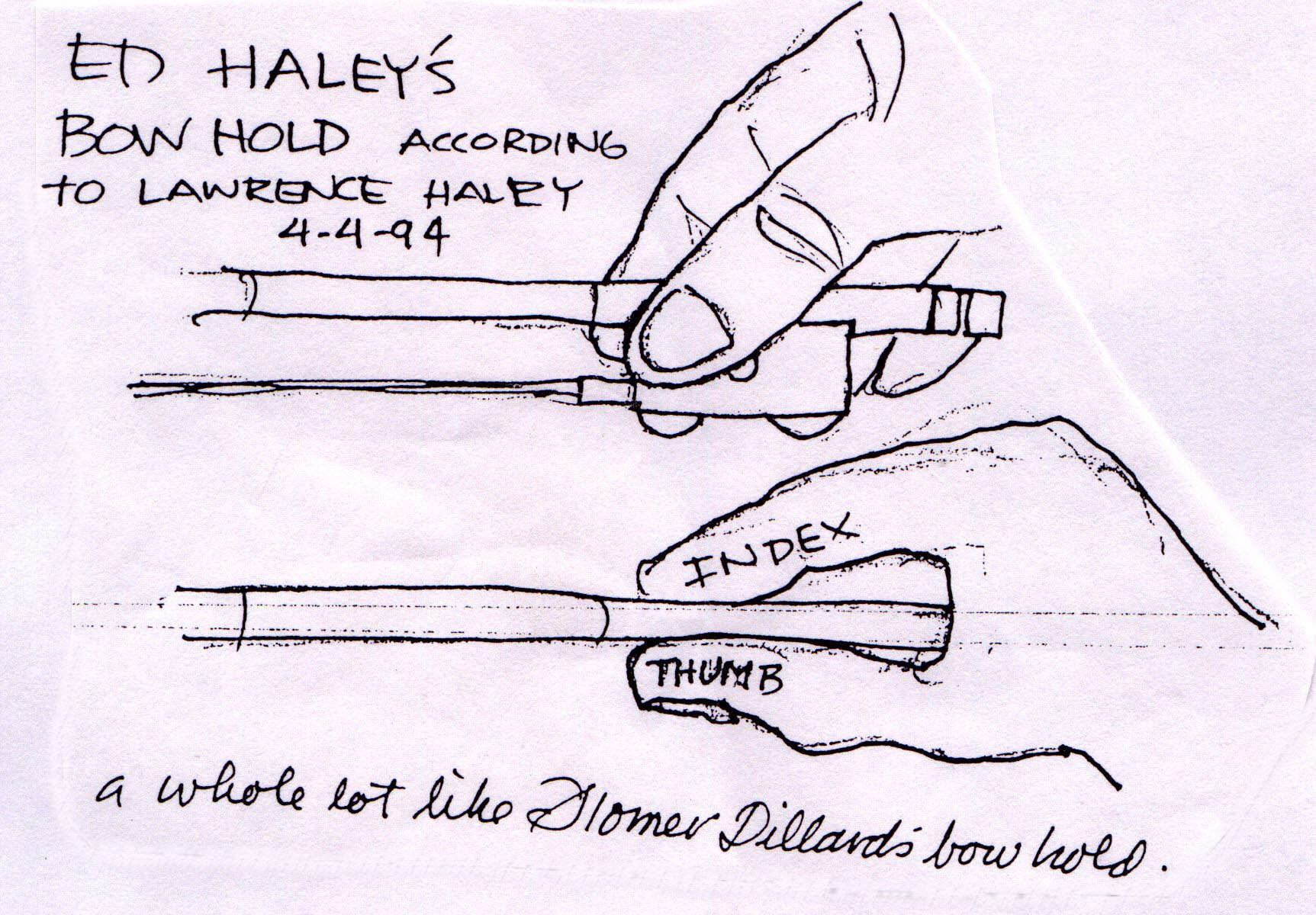
Ed Haley bow hold, according to Lawrence Haley, 1994
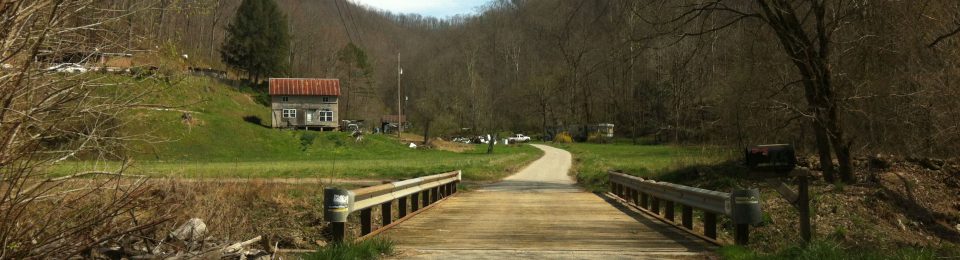
10 Friday May 2013
Posted in Ed Haley
Tags
Ed Haley, fiddle, fiddler, history, Homer Dillard, inspiration, John Hartford, Lawrence Haley, music, photos, U.S. South
Ed Haley bow hold, according to Lawrence Haley, 1994
10 Friday May 2013
Posted in Ed Haley
Tags
Appalachia, Cacklin Hen, Clark Kessinger, Ed Haley, Ella Haley, fiddle, fiddler, Flop-Eared Mule, history, John Hartford, Lawrence Haley, music, writing
I called Lawrence Haley a little later after working more on Ed’s music to brag on the phrasing and intonation in his father’s playing.
“Well,” Lawrence said, “that’s one thing with the bow I’d never be able to learn anyway. What pressure to put to emphasize a note or to quiet a note down. Pop did that from one end of the bow to the other. If he was holding it up and he was plumb out at the end of the bow, I know he had to put more pressure with his hand downward toward them strings to really emphasize the note. And when he got to the other end, he had to slack off a little bit I know to get the same emphasis. I guess running from one end of the bow he was all the time changing the pressure of the bow on the strings to get what he wanted. Now, that’s about all I know about bowing anyway. You gotta have room on your bow. When he knew he couldn’t make a certain note when he’s down at the short end of it, then he would reverse it but he did it in a way that you couldn’t tell which way he was going with the bow hardly. He skipped the bow on some tunes you know as he was playing it. I’ve seen him get out there, as it started down towards the handle end, he’d skip it maybe to get some notes and the way he wanted to play that piece of music. Like the ‘Cacklin’ Hen’, when he’d get down to where that hen let out that squall dropping that egg, it sounded just like an old hen just jumping right off a nest. And that ‘Flop-Eared Mule’, you can hear that mule bray if you want to listen to it.”
I told Lawrence one of the things I was trying to figure out was how Ed could hold the fiddle down from his neck and still get up into the higher positions. Lawrence remembered his father doing it.
“I’ve seen his hands run up and down the neck of the fiddle. He always did that. He’d go way down on the neck of the fiddle.”
Beyond that, Lawrence said he couldn’t get into the specifics.
“I really couldn’t say anything more about that, John. But right in there about the armpit is where he laid the fiddle. I don’t know whether he used chest muscles to kinda control it too, and shoulder and arm muscles, I really don’t know. That would take a real master to sit around and watch that and know exactly what you’re looking for. A lot of times when Pop and Mom was a playing, I’d be off somewhere else. However he mastered that fiddle, I couldn’t tell you. The guys that watched him, they mighta knowed partly what they was looking for. I guess the only one that come close to his style of playing was Clark Kessinger and he watched Pop a lot. Pop would say, ‘Yeah, I knew he was there, but he never would play for me.’ Pop was liable to criticize him or he might try to help him, but Clark wouldn’t let him. He was just there after the knowledge that he could garner from Pop’s style by watching him.”
09 Thursday May 2013
Posted in Ed Haley
Tags
Appalachia, Clay County, culture, fiddler, French Carpenter, history, life, music, photos, U.S. South, West Virginia, writing
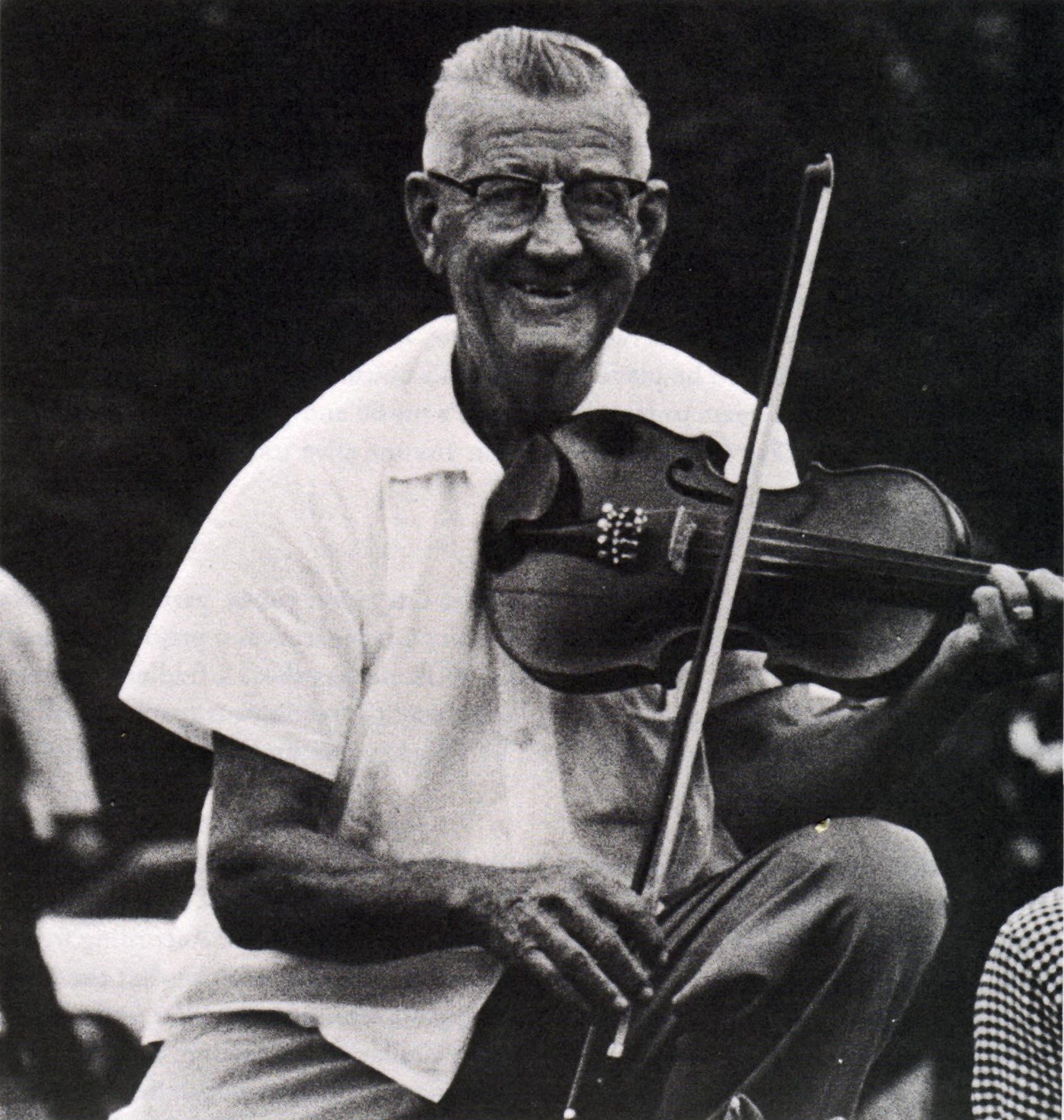
French Carpenter, fiddler from Clay County, West Virginia, 1955-1965
09 Thursday May 2013
Posted in Ed Haley
Tags
Appalachia, Arthur Smith, Clark Kessinger, Ed Haley, fiddler, French Carpenter, history, John Hartford, music, Ugee Postalwait, West Virginia, Wilson Douglas, writing
Wilson well remembered Ed “rocking” the fiddle as he played.
“His violin rocked continuously on his chest,” he said. “I mean it rocked like a rocking chair. That’s the only fiddler I ever seen do that. He told me one time, he said, ‘Wilson, I don’t play the ‘Mockingbird’. It’s a hard matter to play the ‘Mockingbird’ unless the violin is placed under your chin.’ He really commended Arthur Smith on the ‘Mockingbird’ and Clark Kessinger, but he didn’t play the ‘Mockingbird’ at all. I’m sure he could’ve. He could play anything. I’ll put it this way, sir. I know a lot of great fiddle players. Well, I’ve seen French Carpenter — he was good — and Clark Kessinger was good but I think Haley was one of the greatest as far as I’m concerned. He was a legend in this country and in any country that knew about him.”
I asked Wilson about Ed’s fingers, like whether they came up off the fingerboard very high when he was fiddling.
“John, I’m gonna tell you like it is,” he said. “You could hardly tell the man was changing notes. His fingers practically stayed on the fingerboard and they moved like worms. Now that’s it in a nutshell. And his fingers was about as big around as a writing pencil. He had fingers more like some lady typist, you know what I mean. But I could understand: he never did any work to build his hands up other than play that fiddle. And he told me once — somebody had made the remark about not being able to note with your little finger, you know — Ed said, ‘Well, I’ll tell you what you gotta do to play the fiddle. You got to use all four of them and use your thumb, too, if you can.’ He had a sense of humor in a way, you know. And he said, ‘Son, get some soul out of your fiddle. Don’t play it to just hear the wind blow.'”
I asked Wilson if he remembered the names of Ed’s tunes.
“He played a tune he called ‘Harry in the Wildwood’,” he said. “Carpenter played it and I used to play it, but danged if I ain’t forgot it. It was a good tune. And then he played a tune he called the ‘Silver Lake’. It was on the bass. It was a four-string tune. God, he pulled a note on that bass that was out of this world. The more bass, the better he liked it.”
Wilson didn’t remember Ed singing much.
The only song he sung was “Frankie and Johnny”, which I had heard from Ugee Postalwait some time earlier. “Oh yeah,” Wilson added. “He called it ‘Old Billy Lyons’.” Unlike Ugee, who stressed Ed’s singing, Wilson emphasized Ed’s fiddling. “He had a beautiful voice,” Wilson said, “but he liked to concentrate on them hoedowns. He and Clark Kessinger would play that ‘Dunbar’ and he said, ‘Now, I’ll tell you Wilson. Clark plays that well, but they’s a little bit of bow work in there that he never did get, but I never would mention it to him.’ But he commended Clark constantly. I heard him say several times, ‘They’s very few men, maybe three out of a hundred, can play that fast and get clear notes.’ He liked Clark. He also liked Arthur Smith — some of Arthur’s tunes.”
I told Wilson that Haley supposedly hated Arthur Smith and he said, “Well, he said he didn’t know all that many tunes, but what he knew he was real unique at it, you know.”
I tried to jar more of Wilson’s memories of Ed’s repertoire by naming off some of the titles from Haley’s home recordings. He had some great comments.
“Oh God, that ‘Bonaparte’s Retreat’, he was good on that. But now that ‘Three Forks of Sandy’, they’s another tune related to that. I used to play it a little bit. He called it the ‘Three Forks of Reedy’. That’s a creek over here in Calhoun County. It empties into the Little Kanawha River. That tune is as old as the hills.”
When I mentioned “Hell Among the Yearlings”, Wilson said, “Oh God, he had the world beat on that.”
As for “Blackberry Blossom”:
“Well, he was awful good on the ‘Blackberry’. Well, to tell you the truth, they wasn’t nothing he was bad on. That’s the whole bottom line. Everything he played was good.”
I asked Wilson if he remembered what key Ed played a lot of his tunes in and he said, “Well, he played a lot of tunes in the key of C, like ‘West Virginia Birdie’ and the ‘Billy in the Lowground’ and ‘Callahan’. And he didn’t play much in the key of E. Very little in the key of E. Ed’s main key was G, C and D and A. However he could play in E-minor or he could play in A-sharp, or any of the sharps that he wanted to, but he stuck pretty close to the regular standard mountain music key.”
How about B-flat?
“Oh god, yeah. Like ‘Hey Old Man’ and the ‘Lost Indian’. Stuff like that. Oh yeah, he played a tune in B-flat, he called it ‘Boot Hill’. And he said the tune came from out West back in the old days. Somewhere back in the 18 and 80s.”
Wilson said he couldn’t play those tunes anymore.
“It’s been so long. I can remember a few tunes, but yet I can’t get them together anymore. I quit for about seventeen years.”
08 Wednesday May 2013
Posted in Ed Haley
Tags
Appalachia, blind, Calhoun County, Ed Haley, fiddle, fiddler, history, Laury Hicks, music, U.S. South, West Virginia, Wilson Douglas, writing
Taking Bobby Taylor’s advice, I decided to call Wilson Douglas and ask him more about Ed Haley.
“You know, he’d come to Calhoun County, West Virginia, which borders Clay County,” Wilson said. “And there was an old gentleman over there by the name of Laury Hicks. He played the banjo for him a lot and also the fiddle. Now, he was a hell of a fiddler. Ed said the first time he went over there, Hicks was setting on the porch playing the ‘Arkansas Traveler’ — him and Cheneth on the banjo. And he said, ‘Wilson, I thought I was up against it right there. That old Hicks was a powerful hoedown fiddler.’ I knew it when I was a boy.”
I asked Wilson how Ed looked back in those early days, hoping to glean more personal and less-musical memories this time around.
“He would weigh about 185 pounds and he had a large-like stomach on him and he had little tiny feet,” he said. “When he went to a strange place, he would have me to lead him one time to the kitchen, one time to the living room, one time to the outhouse and that was all after that. He didn’t ask you to go no place with him and he walked like a cat, you know — very quick, very active man. He moved like a mountain lion. I’d say, ‘Now slow down a little bit Ed, and I’ll let you get the feel.’ But he picked his feet up fast, you know what I mean? And he could tell if you was a tidy housekeeper or a messy housekeeper. When he wasn’t playing the fiddle, he was continually moving his fingers — just like he did it so much that he did it unconsciously. He was an oddball. He didn’t fool with very many people — very withdrawn. Now when he got with a gang of mountain people playing music, he was very talkative then.”
Wilson said, “I was sixteen or seventeen years old and he saw I was interested in the fiddle and he sorta took a liking to me and he talked to me quite a bit. He treated me nice but he was a very obnoxious, sarcastic man if he didn’t like you. If he liked you, fine, and if he didn’t, he’d do his thing and that was it. And I’m gonna tell you something about Ed Haley. In as much as he was blind, especially if he’d had a drink or two, he was a dangerous man. He was a mean man. But he had an awful sense of feel. He had this sense of knowing when anything was close. He knew when he wasn’t in danger. He said, ‘Wilson, I went to a place one time,’ and he said, ‘it was rough, the people was rough.’ And said, ‘This man took me to the outhouse. I come back and I thought I could go myself.’ And said, ‘I must’ve got a little bit out of the path. I was fixing to make a step and something told me not to do it and I pulled back.’ And said, ‘I turned around and went back,’ and said, ‘I just liked one step of falling in that big, dug well.’ Now, that was the kind of good sense of feeling he had, you see?”
08 Wednesday May 2013
Posted in Ed Haley
Tags
Appalachia, Ashland, Bill Day, culture, fiddle, fiddler, history, Jean Thomas, Kentucky, life, music, photos, U.S. South

J.W. “Bill” Day, Eastern Kentucky fiddler, 1925-1940
07 Tuesday May 2013
Posted in Music
Tags
Appalachia, Boyd County, Ed Morrison, fiddle, fiddler, genealogy, history, Kentucky, life, music, photos, U.S. South
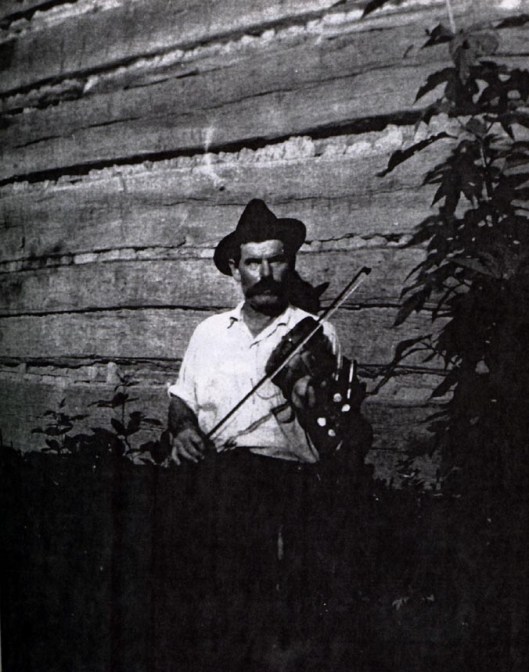
Ed Morrison, a Boyd County, Kentucky, fiddler, c.1925. Another photo of Mr. Morrison can be found here: http://digital.library.louisville.edu/cdm/ref/collection/jthom/id/1102
07 Tuesday May 2013
Posted in Ed Haley
Tags
Bobby Taylor, Clark Kessinger, Ed Haley, fiddle, fiddler, history, John Hartford, Lawrence Haley, music, Sam Jarvis, West Virginia, Wilson Douglas, writing
After talking with Mrs. Rutland, I called Bobby Taylor, a fiddling acquaintance and all-around nice guy in Dunbar, West Virginia. Bobby was a protégé of Clark Kessinger, the famous Charleston fiddler who regarded Haley as the best fiddler he ever heard. I told him about spending months trying to unlock the secrets behind Ed’s bowing before concluding that he played a long bow using the Scotch snap to get smoothness and note separation. Bobby agreed, telling how Clark Kessinger did the same kind of thing in “Sweet Sixteen” — “real fast and almost no bow. He would shuffle with his fingers.”
Bobby didn’t think that Ed used that one bow style for every tune, though.
“From what I could hear of Ed Haley’s fiddling, he done almost any type of style with the bow,” he said. “And I could hear his styles changing from one tune to the next and the way he would phrase. Like when I fiddle, it just depends on what mood I’m in and what style I want to play in. But Haley had to be what Kessinger would call a ‘down-bower,’ because Kessinger hated a ‘bow pusher.’ In other words, the accent’s on the up-bow. What little bit I can hear through all the scratches and everything, I hear Haley being a little more smoother, a little more fluid than Kessinger, but I still see the same bow. But Kessinger’s fast as greased lightning.”
I told Bobby how I’d really gotten into writing out Haley’s tunes note for note lately — every little slide — because I wanted to see what was going on.
“Of course, the deeper I get into it, the less I realize I know about it,” I said.
Bobby wasn’t surprised.
“Kessinger and Haley were both very complicated fiddlers, as any fiddler is,” he said. “But Kessinger was a master with the bow. I kid you not. I mean, that man could bow. Kessinger, if you listen at him fiddle, listen especially at his ‘Hell Among the Yearlings’. Man, could he fiddle that. Very few people realize how well he could fiddle it until you start really listening to what he’s doing with that bow and note correlation. It’s a masterpiece, his ‘Hell Among the Yearlings’ is. Just as Ed Haley, when I heard Ed Haley play it, I could hear where Kessinger got his idea. I could hear it all coming together. Now my style, when you get a real good guitar player that I like playing with, I have a tendency to throw Mike Humphreys into my mesh — a little bit of Kessinger — and I’ve had a lot of people tell me that I sound a great deal like Ed Haley when I do that because I play a little bigger note in a way — not quite as fast as Kessinger — and try to smooth it up a bit.”
“Lawrence has told me repeatedly about how his dad held the fiddle,” I said to Bobby, “that he didn’t stick it up under his chin but he sat it kinda there at his shoulder.”
Bobby chuckled and said, “That’s the way I hold it when I’m jamming.”
I asked Bobby if he rotated the fiddle slightly with it at that position and he said, “I don’t, but my father does. My father, I don’t think, ever met Ed Haley, but is certainly old enough to have known him. My father’s 82. But he’d always heard of him. His favorite fiddler was Sam Jarvis. He was a very prominent person — well educated. He sold insurance. He was my dad’s schoolteacher way out in a little one-room school. My father just says one word for Sam Jarvis, and he says he was ‘perfect.’ I remember when I was a small kid, my father pointed him out and talked to him for a little while and he introduced me. I’ll remember it as long as I live, he said, ‘Here is the greatest fiddler that ever lived, and someday you will learn to appreciate what I have said now.’ And to this day, if you ask me who the smoothest fiddler was I ever heard, it’s Sam Jarvis. Jarvis’ note was not of this world. He was the same age as Clark. He died in 1967.”
That was the first time I’d heard of Sam Jarvis, so — figuring that Ed likely knew him — I pressed Bobby for more information.
“Oh man, he could fiddle. Very little did he play professionally. He would just show up and terrorize the contest world occasionally. I never have heard about Sam Jarvis playing against Ed Haley, but Sam Jarvis only lost one contest in his life — and he was disqualified. You won’t catch anybody in the Charleston area that knew both the fiddlers — Kessinger and Jarvis — that will tell you Kessinger was better. The two greatest fiddlers, when you hear people talk, one’ll say Sam Jarvis and the other will say Ed Haley and most people say they wouldn’t turn their hand over for the difference.”
I asked Bobby who he thought Ed and Jarvis patterned their fiddling after and he said, “That is what is very interesting. They learned from old Edison records, somewhat. I know Jarvis did. They said that his dad wouldn’t hardly let him have a hold of the fiddle, he was so little. And he said that his feet wouldn’t even hit the floor, and he wrapped his toes around the rungs of the chair, and put the record on, and his dad said, ‘You can play the fiddle today if you’re careful with it.’ And he sat down with that record, and they said when they come home that evening, not only had he mastered the record — he had snowed the guy on the record. And he was not even six years old. So he was just automatic.”
Bobby said Wilson Douglas had been talking a lot about Ed Haley lately. Apparently, my telephone call to him had stirred some of memories.
“You will find that if you ask him off the top of his head something, he’ll say, ‘I don’t know,’ but you ask him two or three days later and he has the Brittanica version,” Bobby said.
04 Saturday May 2013
Posted in Ed Haley
Tags
Appalachia, culture, Doc Holbrook, fiddler, Jenkins, Kentucky, life, medicine, music, photos, Pike County, U.S. South
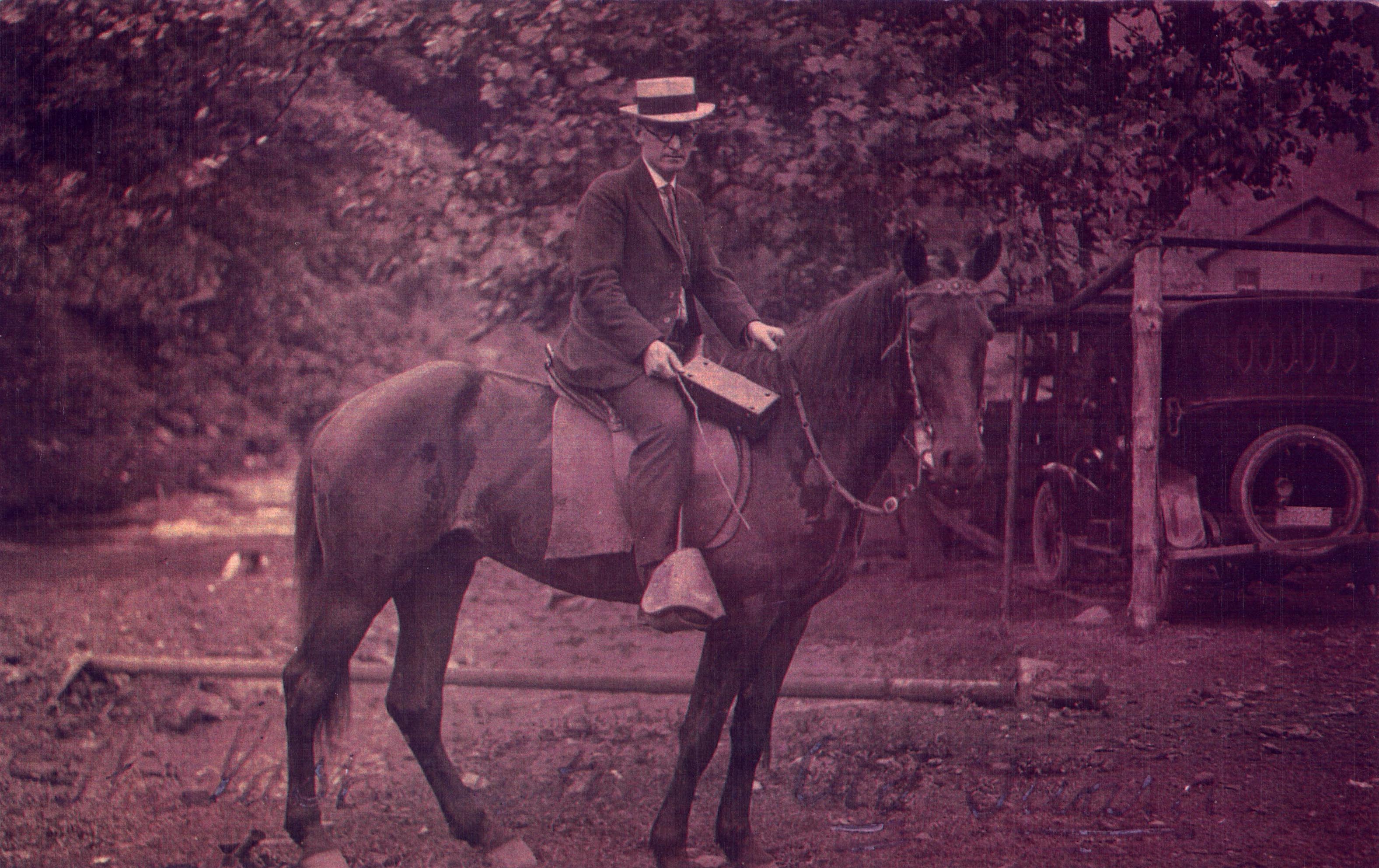
Dr. H.H. Holbrook, Jenkins, Kentucky, circa 1916
03 Friday May 2013
Posted in Ed Haley
Tags
Doc Holbrook, Ed Haley, fiddle, fiddler, history, J P Fraley, John Hartford, Kentucky, Lawrence Haley, Lexington, music, Paul Holbrook, writing
Back in Nashville, with Lawrence’s encouragement, I made contact by telephone with Paul Holbrook, a retired general practitioner living in Ashland. Paul’s father, Dr. H.H. Holbrook, had been a good friend to Ed, who once gave him a fiddle and a silver trophy cup for delivering Mona. In talking with Paul, I could tell right away that he was well-educated. He also seemed to be advanced in years; his memory was a little foggy.
“Well, I think Dad was a friend of his,” he said. “I think he delivered maybe one of his children. Dad fiddled a little bit and he always was interested in hearing Ed play. The fact Dad liked to fiddle and learned to when he was a young boy was the attraction. Other than that, I really can’t tell you a whole lot.”
I asked Paul if he remembered the names of any of Doc’s tunes and he said, “No, not really. If I heard them I would, but I was never interested much in it.”
Paul told me as much as he could remember about his father’s fiddling.
“Dad just played some for his own amusement,” he said. “He must have done most of his playing when he was a young boy or young man maybe playing at some of the country dances. He was from Lawrence County. My grandfather’s farm was between Blaine and Martha.”
Paul said his father moved a lot after becoming a doctor.
“Well, he was at Burdine, Kentucky, and Jenkins, Kentucky, many years ago and as far as I know that’s where he first saw Ed Haley. That was up in the coalfields of southeastern Kentucky. And he was in Louisa for a couple of years. And then we moved to Ashland here back in 1922. As far as I know, Ed was down here at that time. I remember seeing him when he and his wife used to play on the street corners back in the twenties. Dad was here for ten years and then moved to Greenup. I believe Ed was down in Greenup once and played some for Dad at home. Now, Dad had made a little recording of Ed in Greenup, Kentucky playing the fiddle on a little old machine and I think I still have the record around someplace. I don’t know what kind of shape it’s in and I’m not even sure I can find it. I can try to find it if you might be interested in it.”
Lord have mercy.
What about him giving your dad a silver cup or trophy?
“I don’t ever remember seeing a cup and I don’t remember ever hearing of it,” Holbrook said.
What about him giving your dad a fiddle?
“Yes, Dad had one of his fiddles and my son now has it,” he said. “J.P. Fraley borrowed the old fiddle and I think he used it to make some recordings for the National Archives or someplace in Washington. He had it for a while and brought it back and my son had a friend who had a child who was taking fiddle lessons and he used it some. But I don’t really know what shape it’s in, but the last time I heard my son say anything about it he said it needed some repair.”
Just before hanging up, Paul gave me his son’s telephone number in Lexington, Kentucky.
“He teaches some in Lexington at the university and also at Midway College and he comes home up here about every two or three weeks,” he said.
I asked if he was a doctor, too, and Paul said, “He’s a Ph.D. doctor. He’s not an MD.”
This was too much: new recordings, one of Ed’s fiddles…
I called up Paul, Jr. to ask about the fiddle. His speech reminded me a lot of his father, although his mind was quicker, not having been clouded with age. When I mentioned the fiddle, he said, “J.P. Fraley had used it for a while and gotten some blue ribbons with it, but it is in Lexington with me at the moment. It has a very low bridge — a fiddle player’s bridge. I don’t know if it came from Ed Haley in this particular case or not. It is in the case that Grandfather kept it in. It’s difficult for us to say what Grandfather might have done to it. Since Grandfather’s death, nothing has ever changed about it. Grandfather died in 1961. His fiddle playing, I would describe as casual. I don’t think Grandfather was a terribly good fiddler, but he liked to play around.”
30 Tuesday Apr 2013
Posted in Ed Haley
Tags
Bernard Postalwait, Edden Hammons, fiddler, French Carpenter, history, Jack McElwain, music, Osner Cheneson, Ward Jarvis, West Virginia, Wilson Douglas, writing
Wilson tried to give me an idea of what kind of tunes Ed played — or rather didn’t play.
“He wasn’t a hornpipe fiddler,” he said. “He might’ve been, but if he was he never did play them around me. And if you mentioned tunes like ‘Orange Blossom Special’ and the ‘Fire on the Mountain’ and ‘Boil the Cabbage Down’, why he just might give you a cussing. No, he didn’t like a tune like the ‘Fire on the Mountain’. I think he hated it because Natchee the Indian played it all the time. And if you asked him to play the ‘Sourwood Mountain’ or something like that, you got in trouble. He would smart you off. And if you asked him to play some of what he called ‘two string tunes’ if he wasn’t a feeling good why he’d just cuss you out. But if he felt good, he’d just laugh and say, ‘Well, I’ll play the damn thing. There’s not much to it, but I’ll do it.’ But, however, if somebody throwed a quarter in the cup, you know, by god he’d play that tune. You could figure on him playing it a good seven minutes anyway.”
Wilson said Ed seldom re-tuned his fiddle for cross-key tunes.
“In a tune in cross-key, all he did was change his notes,” he said. “He used to tell me, he said, ‘Wilson, I change my fingers instead of my notes.’ Now, I do a little bit of that, but I think them cross-key tunes — really I wouldn’t have never told him that — but I don’t think they sound right unless they’re tuned in the proper tuning. But he would get French Carpenter to play the cross-key tunes for him. I can remember that, you know. And Carpenter would say, ‘Well now Ed, you play them.’ Well Ed would say, ‘I can’t. I just don’t have the bow to play a lot of them cross-key tunes.’ So he’d set and listen to French Carpenter. However, French wasn’t in no class with him, but what French did, he was good, you know.”
I said, “So, he learned a lot of tunes from French Carpenter?” and Wilson said, “Oh, yeah. Well, I was with French Carpenter for a long time.”
I asked Wilson if he remembered any other people around Calhoun County who played with Ed.
“Most of the time, it was just him and his wife,” he said. “She was a mandolin player. But then he had a fella over here in Calhoun County, a fellow by the name of Bernard Postalwait. He was one of the best guitar players, I guess, that ever was, but he was very withdrawn. He was really a ‘second Riley Puckett,’ and Ed wouldn’t have anybody else. Ed’d get him to follow his hoedowns you know, and then occasionally they would both find too much to drink somewhere and they’d wind up someplace else.”
How about banjo players?
“Oh yeah. An old guy by the name of Osner Cheneson, he’d play a lot with Ed. He was a claw-hammer banjo player from Calhoun County.”
Wilson knew about other old fiddlers from other parts of West Virginia. When I mentioned the name Jack McElwain, he said, “Oh god, yeah. Now, he was right up there next to Ed Haley. Some of them Hammonses in Pocahontas County, now they knew of Ed and they liked Ed’s fiddling. Old Edden Hammons, he was a top fiddler in Pocahontas County. It was older stuff, but now the man could fiddle.”
How about Senate Cottrell?
“Yeah, well, he wasn’t that good, I never thought. But now there was another fiddler over there in Roane County, Ward Jarvis. He was good, too. Ed Haley liked his fiddling. He wasn’t as good as Ed, but he played a good fiddle.”
29 Monday Apr 2013
Posted in Ed Haley
Tags
Appalachia, Calhoun County, fiddler, history, music, U.S. South, West Virginia, Wilson Douglas, World War II, writing
I played a little for Wilson over the telephone to see what he thought of my bow stroke and he said, “You’ve got a lot of nice bow technique there. Now, that’s very close to Haley. Now, he plays a longer bow, but now you’re right on it as well as I remember. That’s the first time I’ve been reminded of him since ’55. You know, he died in ’55.” Hearing that made me feel good about my Scotch snap theory regarding Ed’s bowing, which I had been wearing out at home, although I noted that Wilson was off four years on Ed’s death date.
Wilson said Ed played for dances all over Calhoun County.
“Now when he got in a square dance where they was wound up, he played ‘Pigeon on the Gate’. That was a odd fiddle tune. He said it came out of Missouri somewhere. He’d play all night, you know. I believe he had more endurance at a dance than I used to have when I was younger. I’ve been around him when he would play for hours and never play the same tune twice, unless it was requested by somebody. But now what amazed me, he would play all night and maybe not play the same tune twice. And he told me, he said, ‘I know over a thousand fiddle tunes’.”
I wondered if Ed drank at those dances, as Mona had said he was wont to do.
“Now, if anybody had any alcoholic beverages around them places, they always kept that hid until after the fiddling session was over,” Wilson said. “If Haley took one drink of liquor, he could not play a bit. He would sort of get a chip on his shoulder and then he’d become violent, too. However, I could understand that. The man was blind and maybe he would go through a depressing stage.”
Ed was deeply depressed during World War II, Wilson said, because his sons were away in the fighting.
“We would go over to this place to hear him fiddle and he would not play one bit till I informed him what all Hitler was a doing, what the U.S. was doing, where all they were invading.”
Wilson’s memories of Ed’s family were limited.
“I saw one of his boys one time and I didn’t talk to him too much. He didn’t seem interested in music.”
I asked Wilson if Ed ever told any stories and he said, “Na, he wouldn’t tell you nothing or he wouldn’t show ya nothing. He was real touchy, you know. You had to be careful not to punch the wrong buttons. He did not have the patience to show you anything on the violin. He wouldn’t show you where to slow up and show you no notes. He just wanted you to listen and think about it. He said a man ought to comprehend a tune and if he heard it a few times he ought to start at the outer edge of it and then finally it will dawn on you what to do. He said, ‘If you’re determined enough, you’ll finally get it.’ And in them days, you know, there was no tape recorders, so you just had to hear it over and over and do the best you could. I kind of believe his theory: I think fiddle playing is a gift and if you ain’t got a little of the gift, I don’t think you’ll get it.”
28 Sunday Apr 2013
Posted in Ed Haley
Tags
Appalachia, Calhoun County, Doc White, fiddler, French Carpenter, history, Ivydale, Laury Hicks, music, West Virginia, Wilson Douglas, writing
After some thought, I called Wilson Douglas, whose voice sounded “robotic,” like someone singing through an electric shaver. He said he had to talk through one of those little buzz boxes because he had lost his vocal chords to throat cancer several years ago. I asked him what he remembered about Ed coming to Laury Hicks’ house and he repeated a lot of what I had already read.
“Well now that’s a pretty long story,” Wilson began. “I knew him way back in ’38, ’39. As you know, he was a resident of Ashland, Kentucky, and he was born in Logan County, West Virginia. Well, he would come up to Ivydale, West Virginia, by train and then he would ride over on up into Calhoun County with the mail carrier. And he would get a ride with somebody over to Laury Hicks’, like with an old gentleman who used to be a country doctor, Dr. White. And while he was up in Calhoun County and Clay County, we’d go ever night — if we could get there anyway — and he’d play that fiddle about four or five hours at a time. Well, he’d go back to Ashland and stay a couple of months. I guess he was playing somewhere around in Kentucky. And then along in the fall he’d come back and maybe stay a month and then he’d catch the train to Logan County.”
I asked Wilson if he played a lot with Ed and he said, “Oh, well. No, I didn’t play a lot with him. I was just beginning to fiddle, you know, and he was my idol of a fiddler player. He mostly inspired me to fiddle, him and David French Carpenter of Clay County, West Virginia. I’m going to tell you, that there album [Parkersburg Landing] don’t give him credit.”
I asked Wilson if he remembered any of Ed’s tunes and he said, “Oh god, he played all the old tunes. Well, as you know, they all played the ‘Billy in the Lowground’, the ‘Tennessee Wagner’. I play one of Haley’s tunes: he called it the ‘Morning Flower’. Played in the key of A. I’ll have to think. Well, as you know, he called the ‘Stony Point’, the ‘Gilroy’. I learned that off of him. You know, all these tunes has got four or five different titles. And I played a little bit of his ‘Devil’s Dream’. He would play that to get warmed up.”
Did you ever hear him play “Blackberry Blossom”? I asked.
“Oh, by god yeah,” he said. “I remember him playing that. You know, Ed Haley told me he could hear a tune twice and play it, and I believe it.”
I said to Wilson, “Now, Ed Haley improvised a lot, didn’t he? Like take a tune and play it different kinda ways.”
“Well, he could play it about any way,” he said. “I’ll tell you what. He’d do a lot of that to show his skill, I think, but when you settled him down he didn’t vary the bow from one time to another. Now where they’s a gang of fiddlers around, you know, a little distant to him, trading tunes and messing around, he would show them up. I don’t think he did it just to be smart: he did it to show them that he could do it, you know. And what I liked about him: if he heard somebody play a tune, they’d say, ‘Well now Ed, am I getting it?’ And he’d say, ‘No, you’re not getting it.’ And if you were to get it, he’d say, ‘Yeah, that’s good enough. Drop it. Don’t try to do it no better than that.’ I liked that. He went straight to the point, and he told it like it was. If a fiddler got to fiddling too fast, he’d say, ‘Well, you’re losing the soul.’ Oh, he’d just cuss. Only tune to my knowledge that he really played fast was ‘Forked Deer’.”
I asked Wilson what he remembered about Ed’s bowing and he said, “Now, he played a long straight bow, but he put in the bow whatever the tune required. Every tune requires a different bow technique, as you know. Oh God, he played a long shuffle bow. I always thought he had the longest fiddle bow I’d ever seen. You know, he could tell if a fiddler was playing the short bow. He’d say, ‘Well son, don’t hold your bow up in the middle. Catch back on the frog of the bow. By god, you need to have bow if you’re gonna play that kind of music.'”
I asked Wilson if he thought Vassar Clements’ bowing was anything like Ed’s and he said, “No, no. By god, no. No, not in my book. Now, you know everybody’s entitled to his own opinion.”
Did Ed play with a tight or loose bow?
“He played a half-tight bow. He didn’t want any bouncing or want any wobbling.”
27 Saturday Apr 2013
Posted in Clay County, Ed Haley, Music
Tags
Appalachia, Clay County, culture, fiddle, fiddler, history, life, music, photos, U.S. South, West Virginia, Wilson Douglas
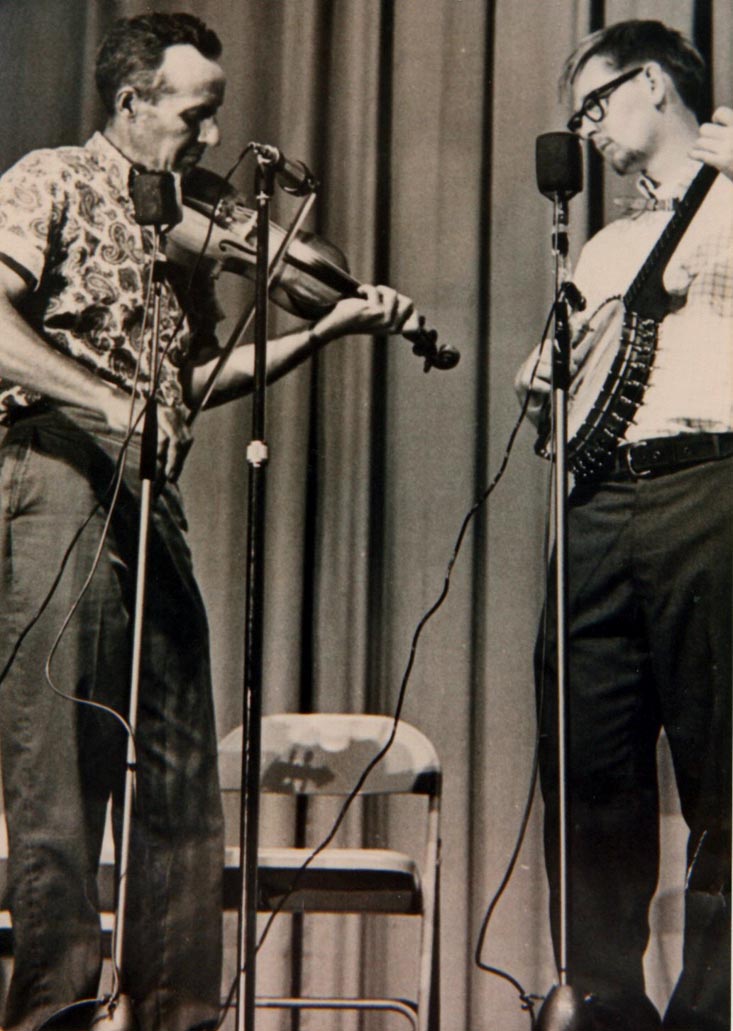
Wilson Douglas, West Virginia fiddler
27 Saturday Apr 2013
Posted in Ed Haley
Tags
Calhoun County, Clay County, Doc White, fiddler, guitar, history, Laury Hicks, music, West Virginia, Wilson Douglas, writing
Around that time, I read up on Wilson Douglas, an old-time fiddler who remembered Ed Haley visiting Laury Hicks during the Depression. I had first heard of him several months earlier from J.P. Fraley’s circle of friends. Wilson came from a family of musicians in the Elk River Valley north of Charleston, West Virginia.
“I was born October 22, 1922 in Clay County,” Wilson said in one published interview. “My grandfather, Martin Stephenson Van Buren Douglas was one of the greatest ballad singers of all times. My dad was Shirley Andrew Douglas and he was a beautiful banjoist! And my Grandmother Morris was an old-time square dance fiddler and all her brothers were top fiddlers on my mother’s side, the Morris side.”
Wilson started playing music at a young age, first the guitar, then the fiddle.
“I started on the guitar when I was nine years old and I played the guitar Carter-fashion,” he said. “And 1935-36 was a severe cold winter. I was 13 years old. I had played the guitar up until that time for various fiddlers. During that winter I lived about a mile from my grandmother’s. At that time she had the only old fiddle in the country to my knowledge. The old instrument was patched with solder, carpet tacks, and various other things. Every night I would take my guitar over there and play. She would play hoedown fiddle tunes half the night. She played mostly dance tunes on two or three strings. She seldom played the bass. The following winter her health failed and she began to lose interest in the violin. However, that fiddle began to sound good to me. Then I suddenly decided that I would quit playing the guitar and try to make some kind of fiddler out of myself. So I started saving my money to buy me a fiddle.”
In a short time, Wilson found himself visiting at the home of Laury Hicks, where he first saw Haley.
“There was an old gentleman that lived in Calhoun County joining Clay County by the name of Laury Hicks,” Wilson said. “He was a good old-time rough fiddler. I would ride a bicycle over to his home to hear him play the fiddle. Then somehow Laury Hicks contacted Ed Haley in Ashland, Kentucky. In about a month Haley came to Calhoun County. So the news got around through the country that Ed Haley was at Laury Hicks’. Everybody around went to hear him play. It was 12 miles from where I was raised over to Laury Hicks’ where Ed Haley’d come to. And if a gang didn’t gather up to go in an old ’29 Model-A Ford truck, we’d start walking. Maybe somebody’d come along in an old car and pick us up. And it was just like a dang carnival, you know. We just sat and never opened our mouth and he’d scare them fellers. Them fellers never tried to play. I was just dazed with that fiddle. He’d play until about 12 o’clock at night, and when he got tired, he’d quit. I was really not conscious of coming back home.””
According to Wilson, the locals tried to keep Haley in that part of the country as long as possible.
“Well, when he’d take a notion to go back to Kentucky, we’d all beg him to stay another week,” he said. “Doc White would say, ‘Ed, now listen. They’s a gang of people coming from Roane County, you can make some money. Now, you stay another week.’ Ed was bad to swear. Well, they’d talk him into it. Maybe some of these old farmers would come along. They’d had a tune and maybe their father played or some of their ancestors and they’d heard it. They’d say, ‘Well, Ed, play me this tune,’ and they’d hand him a dollar. Well, he’d play it for 15 minutes! They’d sit there with big tears. Well, he’d play till the money ran out and he’d quit!”
Wilson told about the last time he saw Haley play at the Hicks home.
“The last night, the last time I seen him, I was a big boy and I’d got over there,” he said. “I was sitting in this old split-bottom chair. Sleepy, you know. But every time he’d play a tune, I’d survive. And he said, ‘Son, what’s your name?’ I didn’t know that he knew that I’d been sitting in front of him. I told him. He said, ‘You’ve been over here every night, haven’t you?’ I said, ‘Yeah,’ and I said, ‘Mr. Haley, you’ve played tunes for everybody and I don’t have no money. I’m saving up to buy me a fiddle.’ He laughed! I said, ‘How about you playing me a tune?’ ‘All right. What is it?’ I said, ‘Play the ‘Black-Eyed Susie’.’ ‘Well, that’s really no tune. It’s just a little old thing.’ ‘Well,’ he said, ‘Damn it, I’ll play it. I don’t like to play it. Them’s single-line tunes, but I’ll play it for you.’ And he did, because I was interested, you see?”
27 Saturday Apr 2013
Posted in John Hartford
Tags
banjo, bluegrass, culture, fiddler, John Hartford, music, Nashville, photos, Tennessee, U.S. South

1 9 9 5
24 Wednesday Apr 2013
17 Wednesday Apr 2013
Posted in Ed Haley
Tags
Asa Neal, Bill Day, blind, Bus Johnson, Calhoun County, Camp Crowder, Cincinnati, Clyde Haley, Doc Holbrook, fiddle, fiddler, history, Laury Hicks, Lawrence Haley, Minnie Hicks, Missouri, Mona Holbrook, music, Ohio, Ralph Haley, Ralph Payne, Rosie Day, Sam Vie, Signal Corps, West Virginia, WLW, writing
Clyde said Ed never said “too much” about where he learned to play the fiddle.
“Well, he was blind all his life, since he was a small boy, and he started with a cornstalk.”
Ed did talk about other fiddlers, though.
“Oh, yes,” Clyde said. “He knew Sam Vie and Asa Neal, and all those old-timers. Did you know Bill Day? Well, my dad used to play with him a lot. But Bill Day couldn’t play the fiddle as far as I’m concerned.”
Bill Day’s wife Rosie was a sister to Laury Hicks, Haley’s veterinarian friend in Calhoun County, West Virginia.
“Well, Rosie was Laury’s sister, as I remember,” Clyde said. “Rosie stayed with my mother and helped take care of Mom because my Mom didn’t like to cook in the summertime because of the flies. I got in trouble one time and I had to go stay with Laury and Aunt Minnie. And I stayed with them in my growing up years. Laury was a doctor, you know, and so was Minnie. She’d just go on a horse, travel miles and miles and miles on a horse, to go deliver a baby or something like that.”
Clyde also remembered Doc Holbrook, Ed’s friend in Greenup, Kentucky.
“Yeah, yeah,” he said. “Monnie, my sister, was named after Dr. Holbrook’s wife: M-O-N-N-I-E.”
Clyde was well aware of Ed’s suspicions toward the commercial music industry.
“My dad didn’t ever want his music recorded and it was difficult to get him to get in a position where he would let anybody record his music,” he said. “There was a guy named Bus Johnson in Cincinnati that wanted my dad — I remember — he wanted my dad to come down there to Cincinnati to WLW and get some music recorded for him but he wanted to commercialize it, you know, which I wish he had’ve now. My dad and mother would’ve had a lot better life with the money they could’ve made off the music. I always did tell my dad, ‘Pop, you ought to get those things recorded because you got money laying around in the fiddle case.'”
Talking about Ed’s refusal to make commercial records caused me to ask about his home recordings.
“Him and my mother had over six hundred records,” Clyde said. “Them old records that Ralph sent home out of the Army. He was in the Signal Corps at Camp Crowder, Missouri, and he took a lot of the equipment home — borrowed it from the Army — and my dad and my mother was in on some of the records, too, you know. And Lawrence has got all that kind of information; more than I would have because I’ve been gone from home. I’ve been a roamer, you know. And I used to drink a lot. I don’t think I’ll ever take another drink, but that’s neither here nor there. I’m in this hospital and it’s what it’s for. I had strokes. It’s not a nut-house hospital or anything. It takes care of people like me. I used to drink quite a bit myself, but I’ve made up my mind since I had the strokes that I’ll let that stuff alone when I get out of this place. I talk like it’s a jailhouse, but it’s not. It’s full of women.”
16 Tuesday Apr 2013
Posted in Big Harts Creek, Ed Haley, Lincoln County Feud, Music
Tags
Appalachia, Clyde Haley, Ewell Mullins, fiddler, Harts Creek, Harts Mountain, history, Hollene Brumfield, John Hartford, Liza Mullins, Logan County, Milt Haley, music, Peter Mullins, West Virginia, Zack Williams
I asked Clyde if Ed ever talked about his early life on Harts Creek and he said, “He didn’t talk to us kids too much. My dad’s folks were from all around Logan County, West Virginia. I didn’t know who they were. I remember his Aunt Liza and Uncle Peter Mullins. ‘Club-Footed Peter’ Mullins, they called him, and ‘Reel-Footed Peter’ Mullins. That was his uncle. I remember them because I was the one that went with him when he went up that way. As a matter of fact, I went up there one time and stayed just for a whole year.”
I said, “Your grandfather Milt Haley was involved in an attempted murder…” before being cut off. “Yeah, Hollene Brumfield. I know about that. I know things about it, because I’ve been up there. He killed this guy and in the process of trying to kill this guy, he shot Hollene Brumfield in the face and mutilated her pretty bad. It was a accident. Hollene was riding behind her husband on a horse down Harts Creek. He missed him and shot Hollene — killed her. That’s the way I always got the story from my dad.”
Clyde seemed to have Milt’s story down better than any of Ed’s other kids, so I pressed him for more details about Harts Creek. I asked him about the musicians in that vicinity and he said, “They didn’t play the kind of music my dad played. There was one old fiddler up there, lived up in the head of Harts Creek. Not off on one of the branches — right straight up Harts Creek past Ewell Mullins’ store. This guy’s name was Zack Williams. Him and my dad used to fiddle together. Never went out on big sprees or anything like that, but he’d go up to Zack Williams’ house up on the top of the mountain — head of Harts Mountain — and they’d make music up there. Zack was a pretty good fiddle player.”
14 Sunday Apr 2013
Tags
Appalachia, Armco, Ashland, banjo, Billy in the Lowground, Blackberry Blossom, Brownlow's Dream, Cacklin Hen, Clyde Haley, Dill Pickle Rag, Ella Haley, fiddle, fiddler, fiddling, Flop-Eared Mule, history, John Hartford, Kentucky, music, Roy Clark
Clyde’s memories of Ed playing in contests were much more detailed than anything I had heard from the other kids.
“I’ve seen him go to contests and look like a farmer and he won every one he ever got into,” he said. “He’d go down to the Armco there in Ashland — they’d put up a bandstand up there — and when they’d have contests they had these eight or ten fiddlers up on the stage and he’d be up in all that mess. He fiddled with some of the best that there was in that country in that particular part of the time. I know he had a lot of people used to come to the house and play music with him.”
I asked Clyde what tunes Ed won contests with and he said, “Well, ‘Cacklin’ Hen’, ‘Billy in the Lowground’ and tunes like that. Not any particular ones. He could play any kind of music if he knew it. If he knew the words, he could make music like nobody you ever heard in your life. He had one tune called the ‘Flop-Eared Mule’. I remember ‘Brownlow’s Dream’, ‘Blackberry Blossom’ and ‘Dill Pickle Rag’.”
Gradually easing into specifics, I wondered if Ed held the bow in the middle or out on the end.
“It would depend on what kind of music he was playing,” Clyde said matter-of-factly. “I’ve seen him hold a fiddle bow down at the end, where the hair hooks up. Depending on the tune, the fastness of the tune, he could hold a bow anywhere he wanted to.”
Did he bow with short strokes or long strokes?
“Well, it would depend on which way he was sitting,” Clyde said. “If he was sitting on a chair with his right leg put out far… He never held the fiddle like anybody else I ever saw. He held it way low on his chest, almost down to his belt-line. My dad had long arms, you know. He was a long, thin man. We have a tendency to want to exaggerate a little bit and say he was bigger than he was, but I knew him pretty well. His hands were real thin — looked like a piano player. He could finger that fiddle like nobody you ever heard or saw.”
I asked if Ed picked the banjo and Clyde said, “Oh, yes. He was better with a banjo than he was with his fiddle. It didn’t have a thumb-string on it. I tried to learn how to play the banjo, too, but I never could do any good at it. Well, my mother bought me a fiddle in the store somewhere and she tried to get me to learn how to play the fiddle because she knew she was gonna be dead one of these days and him too and she wanted to have all that music made for posterity. My mom didn’t want me to do it, but my dad wanted me to. He called me his favorite son and said he wanted me to carry on his tradition. I tried, but I got my fingers cut off when I was a lot younger — two-thirds of my first and second fingers on my left hand — and that messed me up from noting. Ralph was the one that played with my dad a lot. He played the guitar like Roy Clark played. He had a big Martin guitar that was a double-header and he could play on both necks of it at the same time. Ralph was a good musician. He died in 1945.”
Clyde talked a lot about Ed being a drinker, which was something Lawrence kind of kept “under wraps”.
“He was a rip-snorter, don’t think he wasn’t,” he said. “You know, he could be pretty boisterous when he wanted to be. Ed Haley was a mean person — believe me he was. I loved him… He used to take me because he knew I liked to go with him. He would give me a drink every once in a while. He knew I got to liking that and he’d take me with him just about everywhere he went. I think he was the one who got me to drinking too when I was a kid and it’s the worst thing I could’ve done. Course I had no control over it then.”
I asked Clyde what Ed’s drink of choice was and he said, “Whiskey. He wasn’t a beer drinker much, or wine. He didn’t go much for that kind of stuff. He drank moonshine when he could get it, and he generally got it.”
Clyde had seen Ed drunk but said it didn’t hurt his fiddle playing.
“I think if anything, it made it better.”
Writings from my travels and experiences. High and fine literature is wine, and mine is only water; but everybody likes water. Mark Twain
This site is dedicated to the collection, preservation, and promotion of history and culture in Appalachia.
Genealogy and History in North Carolina and Beyond
A site about one of the most beautiful, interesting, tallented, outrageous and colorful personalities of the 20th Century

 Brandon Ray Kirk