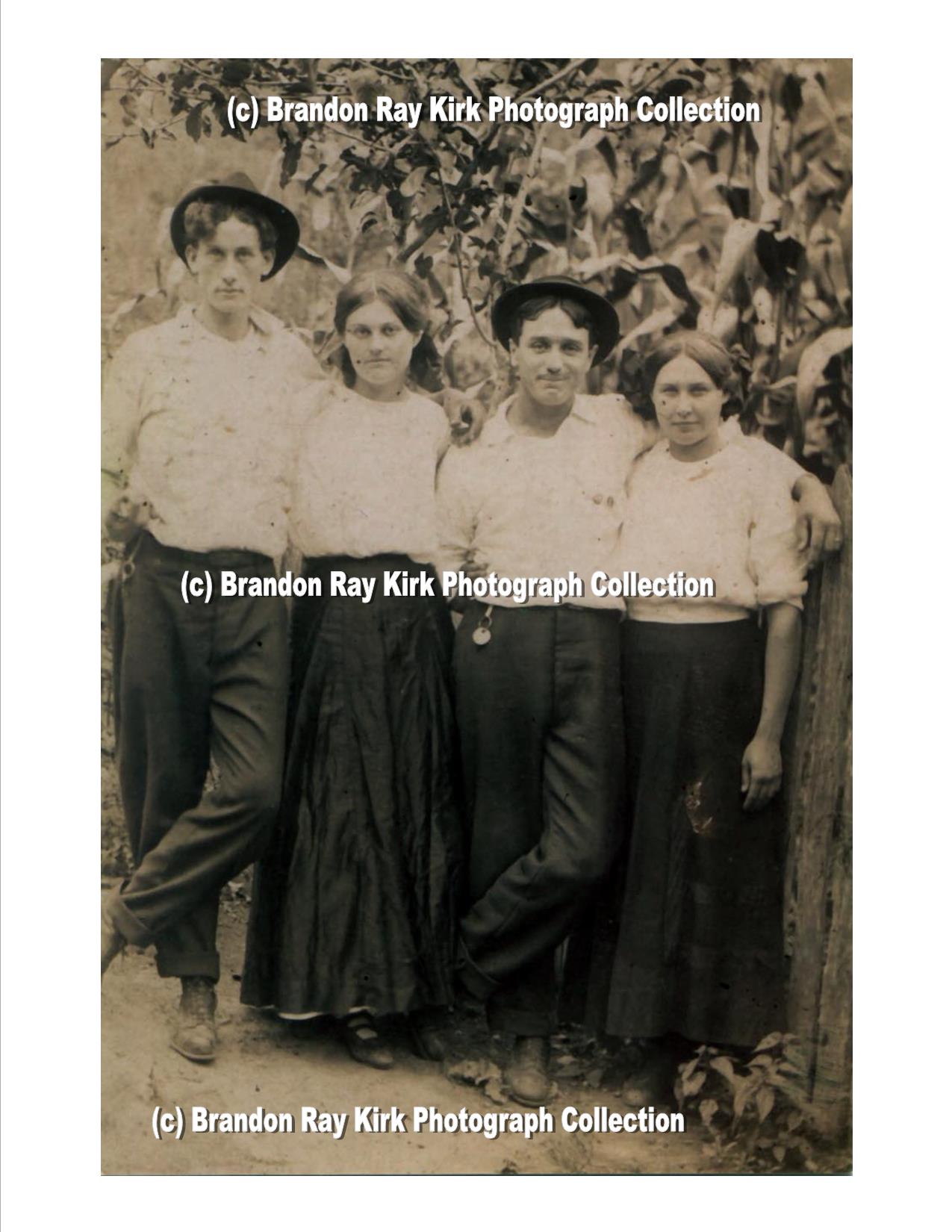
Bernie Adams and Ed Haley
13 Tuesday May 2014
Posted in Big Harts Creek, Ed Haley, Music, Whirlwind
13 Tuesday May 2014
Posted in Big Harts Creek, Ed Haley, Music, Whirlwind
26 Saturday Apr 2014
13 Sunday Apr 2014
Posted in Culture of Honor, Harts, Little Harts Creek
08 Tuesday Apr 2014
Posted in Ed Haley, Lincoln County Feud
Tags
Angeline Lucas, banjo, Boney Lucas, Brandon Kirk, Cain Adkins, Daisy Ross, Eustace Gibson, Faye Smith, fiddler, Green McCoy, guitar, Harts, Harts Creek, history, Huntington Advertiser, John McCoy, Kenova, Lincoln County, Milt Haley, Oscar Osborne, Paris Brumfield, Sherman Boyd, Sherman McCoy, Spicie McCoy, Tug Valley, West Fork, West Virginia, Winchester Adkins, writing
Meanwhile, as I churned up new details about Ed Haley, Brandon was busy chasing down leads on the Milt Haley story in West Virginia. One crisp December day he visited Daisy Ross, the aged daughter of Spicy McCoy, who lived in a nice two-story house at Kenova, a pretty little town just west of Huntington. It was Brandon’s first face-to-face contact with Green McCoy’s descendants and he was anxious to hear more about their side of the tale. Daisy was white-headed and a little hard-of-hearing — but full of information about Green’s family. Her daughter Faye played hostess during Brandon’s visit.
Daisy said Green McCoy was originally from the Tug Fork area. He came to Harts playing music with his brother, John McCoy. He always kept his hair combed and wore a neatly trimmed mustache. Spicy used to have a tintype picture of him with Milt Haley. He and Milt met each other in the Tug Valley.
Daisy said her grandfather Cain Adkins was a country doctor. He was gone frequently doctoring and was usually paid with dried apples or chickens. He feuded a lot with the Brumfields, who killed his son-in-law, Boney Lucas. Boney’s widow Angeline was pretty wild: she had two illegitimate children after Boney’s death. One child belonged to a man named Sherman Boyd and the other belonged to John McCoy — Green’s brother.
When Green McCoy came to Harts, Cain discouraged Spicy from marrying him because he was divorced from a woman living in Kentucky. Spicy didn’t believe the family talk of “another woman” and married him anyway. She and Green rented one of the little houses on Cain’s farm. Green made his living playing music and he was often gone for several days at a time. When he came home, Spicy, ever the faithful wife, ran out of the house to hug him and he would playfully run around the yard for a while before letting her “catch” him. Daisy had no idea where Green went on his trips because he never told her mother. Spicy didn’t really care: she always said she would “swim the briny ocean for him.”
Brandon showed Daisy an 1888 newspaper article he had recently found, documenting Cain’s trouble with Paris Brumfield.
“Paris Brumfield was indicted for felony in five different cases by the grand jury of Lincoln county at its last term,” according to the Huntington Advertiser on June 23, 1888. “He fled the county, not being able to give bail, which was fixed by the Court at $5,000. Brumfield’s latest act of violence was his murderous assault upon Cain Adkins, a staunch Democrat, one of THE ADVERTISER’S most esteemed subscribers. The last act was the straw that broke the camel’s back, and the county became too hot for Paris. Gibson & Michi have been retained by Brumfield’s friends to defend him when brought to trial.”
Daisy blamed Green’s murder on the Brumfields. She said Green once got into a fight with Paris Brumfield and “pulled his eyeballs out and let them pop back like rubber bands.” Brumfield had to wear a blindfold for a while afterward.
After Green’s death, Cain Adkins and his son Winchester fled Harts, probably on horses. Winchester was one of the best local fiddlers in his day. He mostly played with his nephew Sherman McCoy (banjo) and Oscar Osborne (guitar).
28 Friday Mar 2014
25 Tuesday Mar 2014
Posted in Big Harts Creek, Ed Haley, Music
Tags
banjo, Bernie Adams, Bernie Hager, Billy Adkins, Boone County, Brandon Kirk, Ed Haley, fiddle, fiddler, Harts Creek, history, Hubert Baisden, Ike Hager, Irene Hager, John Hartford, Johnny Hager, Low Gap, music, Robert Adams, Roy Dempsey, West Virginia, writing
The next day, I followed a tip from Billy and Brandon and made the short drive to see Irene Hager and her son Ike at Low Gap in Boone County, West Virginia. Irene was the daughter of Hubert Baisden, a close friend to Johnny Hager, and was the widow of Bernie Hager, Johnny’s nephew. Irene said Johnny used to visit her father at nearby Big Branch when she was a girl. Johnny played the fiddle and banjo and talked frequently about his travels with Ed back in the ’20s and ’30s.
“Ed Haley was an ever day word with Johnny,” Ike said.
Ike said Johnny Hager was most known as a fiddler, not a banjo-picker. He said he “cradled” the fiddle in his arms, never put it under his chin and bowed a lot of long strokes. He was primarily a claw-hammer banjoist but “did have a finger style.” Irene said his favorite song was “Joshua’s Prayer”, while Ike remembered him loving “Will There Be Any Stars in My Crown”. He also played “Rosewood Casket”, “Nelly Gray”, “Ballad of Old Number Nine”, “John Hardy”, “In the Pines”, “Cripple Creek”, “Wreck of ’97”, “Mockingbird on the Hill”, and “Little Log Cabin”.
Ike said Johnny taught his father how to play the banjo.
“He wanted a banjo player in the family to play around the houses and the homes with him,” Ike said. “My dad was musically inclined — he could chord a guitar and follow him along on the fiddle and banjo — so he talked Dad into getting a banjo. Dad traded six or seven hens and walked several mile with them hens upside down for this old banjo and Johnny taught him how to play. He picked up on playing pretty fast. I know they used to go over on Big Ugly and play in a school somewhere. Now they was some more boys that played with them. They was Wilcoxes, down on Mud River.”
That evening, I met up with Brandon at Billy Adkins’ house in Harts. Billy said a local man named Roy Dempsey told him earlier that day about having a genuine Ed Haley fiddle. I didn’t have too much time — I was leaving for Nashville later that night — but I wanted to see Roy. Brandon and I drove a little ways up Harts Creek to the Dempsey place, situated on a hill near the mouth of Big Branch. Roy showed us the fiddle, which he said Ed had given to Bernie Adams. Bernie later gave it to Roy’s father-in-law, Robert Adams. It was the first “Ed Haley fiddle” I’d seen on Harts Creek.
24 Monday Mar 2014
Posted in Big Harts Creek, Culture of Honor, Ed Haley, Lincoln County Feud
Tags
Al Brumfield, Albert Dingess, Ben Adams, Brandon Kirk, Charlie Dingess, crime, Dave "Dealer Dave" Dingess, Dave Dingess, feud, fiddler, fiddling, French Bryant, Green McCoy, Harts Creek, Harve Dingess, Harvey "Long Harve" Dingess, Henderson Dingess, history, Hollene Brumfield, Hugh Dingess, Maude Dingess, Millard Dingess, Milt Haley, Thompson Branch, writing
Either way, Milt Haley and Green McCoy were paid a side of bacon and some money to eliminate Al Brumfield. Maude Dingess said Milt and Green ambushed Al and Hollena Brumfield as they rode down Harts Creek on a single horse. Hollena’s brothers, Harvey and Dave, followed behind them on separate horses.
“I guess they thought he was gonna have trouble or they wouldn’t a been doing that,” Maude said, somewhat logically.
As they made their way past Thompson Branch, Brumfield spotted two men hiding in the weeds. He ducked somehow to avoid harm, but Hollena was shot from the horse.
“Al just went on,” Maude said, while Dave and Harve “ran back up here to their mother and daddy’s house to get somebody to go down there with them.”
They later returned with a sled and hauled Hollena’s bloody body back to Smoke House.
In a short time, Milt and Green were rounded up and taken to Hugh Dingess’ home at the mouth of Bill’s Branch.
“I’d say old man Hugh got them kids and took them maybe to some of their relatives’ houses or somewhere else,” Harve Dingess said. “Maybe up to old Albert Dingess’ or somewhere like that. See, old Albert just lived on up the road a mile, mile and a half.”
Harve continued, “They said they all had a big feast there and I guess they had a lot of the corn whiskey there and all of them drinking and playing music. And they said they made the old man Haley — he was a fiddle player — they said they made him play that fiddle all night and all of them drunk a dancing. They said that they just kept telling him to keep that fiddle a going.”
I wondered where Milt got the fiddle at Hugh’s and Maude said, “They sent somebody to somebody’s house that had a fiddle I bet and brought it back. Back in them days you know a lot of households had them old instruments in them.”
I asked if Milt was considered a good fiddler and Harve said, “At that time, I think they said he was. Supposed to’ve been very good.”
Harve had never heard much talk about Green McCoy but stressed: “I know I did hear them talk about them making the old man play the fiddle all night and all of them a dancing and cooking and having a big feast there and drinking their moonshine.”
I said, “Most people that are gonna kill somebody, they don’t want to get to know them. If you have an execution, the executioner don’t want to get to know the prisoner because the more he gets to know that prisoner the harder it is for him to conduct the execution. To have two guys to play music for you before you’re fixing to kill them — that’s a good way to get to know them real quick. Boy, I don’t see how they did that.”
“I guess that’s the reason they kept old French Bryant,” Harve said. “They said he didn’t care for nothing. They said he was one of the leaders. He was a hollering, ‘Let’s go! Let’s do it!’ Pushing the thing, from what I could understand. He was a hollering, ‘Let’s kill the sons of bitches!’ That’s what I heard over the years. I even heard Millard say that one time. French was the one wanting to hang them up to the walnut tree and I think they finally decided against that.”
Brandon wondered who else was in the gang and Maude said, “Hugh and Charlie Dingess was into that. They was Grandpap’s boys — the older boys. Hugh was rough and over-bearing. Harve’s grandfather, ‘Short Harve,’ was into that. Burl Farley was into it, too.”
Maude doubted that Henderson Dingess was involved due to his advanced age (approximately 58 years), but we felt it was entirely possible since (1) men his age and older participated in the Hatfield-McCoy feud and (2) these guys had reportedly shot his daughter. Harve said he figured that his great-grandfather Albert Dingess was in on it because “he was just that kind of guy.”
“Dealer Dave” Dingess was probably involved, too, Harve said, because “them Dingesses all hung together. They was just a band of outlaws, as we would call it, that day and time.”
Harve and Maude hadn’t heard much about the story beyond that, although they knew that Milt and Green were taken away from Hugh’s when the Brumfields learned that another mob was forming to rescue them. They never confessed to committing the ambush on Al and Hollena Brumfield but everyone figured that Ben Adams was behind the trouble. As a result, Maude said the Brumfields and Dingesses were “against” Ben in following years. At one point, they tried to burn his home. Maude’s father was one of the few Dingesses who never held a grudge. He often referred to him as “poor old Uncle Ben.”
14 Friday Mar 2014
Posted in Big Harts Creek, Ed Haley, Music
Tags
Billy Adkins, Brandon Kirk, Carolyn Johnnie Farley, Ed Belcher, Ed Haley, fiddler, fiddling, George Mullins, guitar, Harts Creek, Hattie Farley, history, Hollene Brumfield, Lewis Farley, Logan County, Mary Ann Farley, Mason Conley, music, Rosa Mullins, West Virginia, writing
The next day — the 106th anniversary of Milt Haley’s death – Billy Adkins suggested that we go see Carolyn “Johnnie” Farley on Brown’s Run of Smoke House Fork. She was a granddaughter to Burl Farley, one of the ringleaders of the Brumfield mob. There were other interesting connections: her grandmother was Hollena Brumfield’s sister and her mother was Ben Adams’ niece. Her ancestors, then, represented both sides of the trouble, helping to make her a great source on the 1889 feud. Billy said she was old enough to remember Ed, too. His notes showed her as being born in 1924.
Without really hesitating, we went outside through a small rain shower and boarded the car and took off up the creek. We were oblivious to the poor weather and kept pointing to spots that were probably only significant to us.
“Now that was part of the old Al Brumfield farm.”
“There’s where the old boom was.”
“Here’s where the ambush took place.”
Our fascination with all the sites continued after we turned up the Smoke House Fork.
“There’s the Hugh Dingess Elementary School.”
“There’s the old Henderson Dingess place.”
“There’s where the old Dingesses are buried.”
“There’s Cecil Brumfield’s place. Ed used to visit there.”
We finally reached Browns Run. Johnnie Farley’s white house was just up the branch on the left, accessed by a muddy driveway filled with ruts and sharp jutting rocks. We parked behind the house, where several wooly dogs and a flock of tiny chickens surrounded us — three strangers ankle-deep in mud holes.
Almost immediately, Johnnie came out the back door and spotted Billy — one of the most recognized and popular guys in Harts — and told us to come on inside. She led us through the kitchen and a hallway, past a giant photograph of her grandmother, Mary Ann Farley (Hollena’s sister), and into a very dim living room. We all sat down on furniture that was literally surrounded by papers, books and pictures. Johnnie was obviously a packrat — a woman after my own heart.
Billy began introducing Brandon and I, but Johnnie stopped him short and looked at me with her ice blue eyes and said, “Oh I know who you are. I’ve got some of your records.” Her spirit and energy were immediately apparent — she spoke as if we were old friends. Her husband sat quietly nearby in a comfortable chair. He was in poor health.
I asked Johnnie if she remembered Ed and she said, “Yes, I knowed Ed Haley. He used to come through this country and pick and play the fiddle. I knowed Uncle Ed good. That old man could stop at any man’s house and they’d take him in and keep him all night and feed him. And he’d come through and stop you know and Mom and the girls would have a meal on the table. They’d just say, ‘Uncle Ed, come on.’ And they’d help him, show him the wash-pan and stuff, let him wash his hands, and he’d just go sit right down and eat with us. Whenever he’d come through out of the Chapmanville area he’d stay with one of my uncles and aunts that lived across the hill. That was George and Rosa Mullins. He’d go across the mountain ’cause he liked drinking and they had it over there — moonshine. And he stayed there week in and week out. People was good to him. He wasn’t mistreated.”
I asked Johnnie how old she was when Ed used to come around and she said, “I was about 10, maybe 12.”
She tried to describe him.
“Well, Ed was a little bit maybe heavier than you are, ’bout as tall. I know he kinda had a great, big belly on him. He was a great big fat man. I’d say Ed weighed around 170 pound. To my recollection, Ed had slim hands and slim fingers. He wore shaded glasses and he wore an overcoat — a brown one — and he had an old brown hat. I believe he smoked a pipe. He wore real old-fashioned shoes and old yarn socks. Uncle Ed drunk a lot. He was a good person. He was humble. He didn’t bother nobody. The only harm you could say he done was to hisself and that was drinking. He was around a lot of people, but Uncle Ed didn’t talk too much. He wouldn’t confront his own feelings. He wouldn’t open up fully to nobody.”
I asked Johnnie if she ever saw Ed drunk and she said, “I never did see him drunk — really drunk, no. I’ve seen him drink but not drunk.”
What about singing?
“No. I heard him fiddle but never sing. He played old tunes. ‘Turkey in the Straw’ and just quite a lot of the old-fashioned first fiddle player’s tunes. Uncle Ed was a good fiddler. He could make a fiddle talk. Mason Conley played the guitar and he’d get with him and play. And they was an old man traveled a lot with him named Ed Belcher. They had an old tune they played called ‘Sally Goodin’.”
Now, what happened to Ed Haley?
“I believe Ed died up around Ed Belcher and them. He drinked himself to death.”
13 Thursday Mar 2014
Posted in Big Harts Creek, Ed Haley, Music
07 Friday Mar 2014
06 Thursday Mar 2014
Posted in Big Harts Creek, Music
Tags
Appalachia, culture, Dood Dalton, fiddler, fiddling, genealogy, Harts Creek, history, life, Lincoln County, music, photos, West Virginia, writing
04 Tuesday Mar 2014
Posted in Big Ugly Creek, Ed Haley, Music
Tags
Big Ugly Creek, Bill Monroe, Boney Lucas, Carl Toney, charlie paris, Clarence Lambert, Durg Fry, fiddler, fiddlers, fiddling, Frank Fry, Grand Ole Opry, Green Shoal, Guyandotte River, history, Irvin Lucas, Jack Lucas, Jim Lucas, Jupiter Fry, Leander Fry, music, Paris Brumfield, Sam Lambert, writing
At the turn of the century, Jim Lucas was the best fiddler on Big Ugly Creek — that peculiarly named creek located a few miles downriver from Harts Creek. Jim was born in 1881 to Irvin Lucas (a fiddler), and was a nephew to Boney Lucas and Paris Brumfield. Based on interviews with Jim’s family, Jim always went clean-shaven and wore an overcoat year round because “whatever’d keep the cold out would keep the heat out.” He was also an avid hunter and cowboy — he could supposedly command cattle from across the Guyan River. As for his fiddling, Jim either cradled the fiddle on the inside of his shoulder or held it under his chin. He gripped the bow with two or three fingers right on its very end, used a lot of bow, and patted one of his feet when playing. He sometimes sang, typically played alone, and devoted a great deal of his time fiddling for children. Every Saturday, he’d get with Clarence Lambert at his home on the Rockhouse Fork of Big Ugly or at Sam Lambert’s porch on Green Shoal. Some of Sam’s daughters sang and played the guitar. Jim’s grandson Jack Lucas said they played a lot of gospel and bluegrass music but could only remember one tune Jim played: “Ticklish Reuben.” Jim had to give up the fiddle when he got old but always put an almost deaf ear up against the radio and listened to Bill Monroe on the Grand Ole Opry. He died in 1956.
Charlie Paris, a long-time resident of the Laurel Fork of Big Ugly Creek, remembered Jim Lucas coming to visit his grandfather Durg Fry in the thirties. He said his grandpa Durg lived on Laurel Fork in a home with cracks between the logs so large that “you could throw a dog through” them. He was a fiddler himself, as were his brothers Leander and Jupiter and his nephew Frank Fry. Charlie said Durg played with the fiddle under his chin and never sang or played gospel or bluegrass. He patted his feet when playing and, in his old age, would hold himself up by a chair and dance to music. One time, when he and Jim were hanging out on Laurel Fork, Jim reached his fiddle to a younger fella named Carl Toney and said, “Your turn.” Carl was a very animated fiddler and when he took off playing “Orange Blossom Special” Jim just shook his head and said, “I’ve quit.”
03 Monday Mar 2014
Tags
Appalachia, Bill Adkins, culture, fiddler, Harts, history, life, Lincoln County, photos, timbering, West Virginia
02 Sunday Mar 2014
Posted in Big Sandy Valley, Ed Haley, Music, Women's History
Tags
Appalachia, culture, fiddle, fiddler, history, Josie Cline, Kentucky, Kermit, life, music, photos, Tug River, Warfield, West Virginia
14 Friday Feb 2014
Tags
167th Virginia Militia, 5th West Virginia Infantry, Ben Haley, Camp Parole, Camp Pierpont, Ceredo, City Point, civil war, Cynthia Haley, Doris Miller Papers, fiddler, history, James Baisden, James Haley, James Short, Joseph M. Kirk, Luray, Marshall University, Maryland, Nellie Muncy, New Creek, Parkersburg, Richmond, Russell County, Sperryville, Twelve Pole Creek, Vincent A. Witcher, Virginia, Wayne County, William T. Caldwell, Woodsville, writing
Benjamin R. Haley — Milt Haley’s father — was one of the most ardent Unionists in Wayne County (West) Virginia during the Civil War. He served in at least two companies of infantry (one in West Virginia and one in Kentucky), one company of militia, and two companies of Home Guards. He first enlisted in April of 1861 and remained on muster rolls as late as May 1865. He was twice captured and almost court martialed. He was also, based on his military records, a drinker and a fiddler.
Ben Haley was born around 1820 in Virginia. According to census records, he married Cynthia Dyer around 1843. They were the parents of the following children: Hannah Jane Haley, born about 1844; William A. Haley, born about 1846; John B. Haley; James Haley; Helen M. Haley, born about 1850; Charles Haley, born about 1852; and Margaret Haley, born about 1856. In 1850, the Haleys lived in Russell County, Virginia (as did, incidentally, Bill Duty and the Ferrells). Toward the latter years of the decade, Ben moved to Wayne County in the Big Sandy Valley, where he fathered Milt Haley by Nellie Muncy. What contact he had with Milt is unknown. In 1860, according to census records, Ben and his family lived with James Short in Wayne County, (West) Virginia. Haley had $300 worth of real estate and $250 worth of personal property. At some point, according to the Doris Miller Papers at Marshall University, he lived on the Sweetwater Branch of the East Fork of Twelve Pole Creek.
On April 2, 1861, 40-year-old Haley enlisted as a corporal in Captain Joseph M. Kirk’s Company of the 5th Virginia Foot Volunteers at Ceredo, (West) Virginia, for a period of three years. Ceredo was an abolitionist town established in 1857. On September 2, the 5th was reorganized as the 5th West Virginia Infantry at Camp Pierpont in Ceredo. It was mustered into U.S. service on October 18. On November 1, Haley was appointed 1st lieutenant of Company F (following the death of former lieutenant James Baisden). In December, the 5th was ordered to Parkersburg, while a principal part of the regiment was sent to New Creek, Virginia. Haley was apparently with the Parkersburg group as he left there for home in March of 1862 without permission and was listed in records as “Absent, sick at Ceredo.” He was still AWOL in April.
By late spring, Haley was back with the 5th where he soon found trouble with the U.S. Army. According to papers filed by the army, he was charged with “Conduct unbecoming an Officer and a gentleman; Conduct subversive of discipline; and Violating 77th Article of War.” More specifically, “on the 20th day of June, 1862, at New Creek, Va., the said Lieut. Benj. R. Haley, did drink at a saloon, with a number of enlisted men, of his own and other companies, and was then and there drunk and disorderly, being subversive of good order and discipline at said Post.” Furthermore, “Lieut. Benj. R. Haley, did, when put under arrest, allow a detachment of his company, to resist the demand for his sword, and thereby inciting mutiny. That, at the same time and place, when asked for his name and regiment, he told the Post Adjutant to find out as best he could.” More importantly, “the said Lieut. Benj. R. Haley, after having been placed in arrest and ordered to his quarters, did leave the same without permission and was afterward found in a Beer Saloon, playing the violin for some teamsters and enlisted men to dance.”
On July 16, 1862, Haley wrote a letter of resignation as second lieutenant while camped near Woodsville, Virginia. The 5th had recently been engaged at Luray, Virginia, from July 5-11 and at Sperryville, Virginia, on July 11. “I have the honor to tender my resignation as Second Lieut. Fifth Regt. Va. Inf. for the following reasons. Charges are herewith enclosed prepared by Major Burtnett agst myself, parts of which are true and I prefer that my resignation should be accepted than be tried by Court Martial. In the second place I feel my incompetency to discharge the duties of the Office which I hold.” Haley’s resignation was approved and finalized on July 30, 1862.
On August 7, 1862, Ben Haley and his son James enrolled as privates in William T. Caldwell’s Company of the 167th Virginia Militia in Wayne County. On November 29, Haley was captured in Wayne County and confined at Richmond on April 1, 1863. He was paroled on April 3 at City Point, Virginia, and reported to Camp Parole, Maryland, on April 6. He and his son James were back on muster rolls for the 167th on May 7. Captain Caldwell referenced Haley in a letter dated May 17 (“Your favor of the 14th inst has just been handed me by Mr. B.R. Haley…”) Ben’s son James was wounded later that fall, probably in an October 20 skirmish near the Logan-Wayne County line with Vincent “Clawhammer” Witchers’ troops.
13 Thursday Feb 2014
Posted in Big Sandy Valley, Ed Haley, Music
Tags
Billy Adkins, Cain Adkins, fiddle, fiddler, Grand Ole Opry, Harts Creek, Lincoln County, Mingo Ramblers, Norfolk and Western, Stiltner, Tom Atkins, Wayne County, West Virginia, Williamson, Winchester Adkins, writing
A week later, I followed up on a lead from Billy Adkins and called Tom Atkins. Tom was a great-grandson of Cain Adkins and a genealogist in Williamson, West Virginia. It was a chance lead: Billy had called him to ask about Ed Haley’s genealogical connections in the Tug Valley only to discover that Tom’s grandfather was Winchester Adkins — a son to Cain.
When I called Tom, he said he knew almost nothing about Cain and only a little about his grandfather, Winchester Adkins. He said Winchester left the West Fork of Harts Creek at a young age and settled at Stiltner in Wayne County. He eventually moved to Williamson and worked as an engineer on the N&W Railroad. At that location, after a repeated “mix-up over his checks” he changed the spelling of his surname from “Adkins” to “Atkins.” He was also a well-known fiddler who tried his hand at professional music.
“I heard my mother tell someone here while back how many tunes my grandfather played,” Tom said. “It was a hundred and some. See, he just knew them by ear. And I believe that at one time he had a fiddle that was made by Cain — his father — and I don’t know who has that or whether it’s even in existence now ’cause we’ve had floods here. And I do know at one time he was a member of a group in Mingo County called the ‘Mingo Ramblers’ and they were on the Grand Ole Opry way back in the early days.”
Tom said that was all he knew because his grandfather died when he was four years old.
10 Monday Feb 2014
10 Monday Feb 2014
Tags
Appalachia, Billy Adkins, Boone County, Brandon Kirk, Chapmanville, Ed Haley, fiddler, Guyandotte Voice, history, John Hartford, Johnny Hager, Louise Johnson, music, Simeon Bias, West Virginia, writing
As Brandon and Billy dug up more information in West Virginia, I received a letter in the mail from Louise (Adkins) Johnson of Powderly, Texas. She’d read an article about my Ed Haley search in a now-defunct Chapmanville newspaper called The Guyandotte Voice.
“I was so pleased to hear some one mention Blind Ed & his wife,” Johnson wrote. “I’m 72 yrs. old, was born and raised, in Boone Co. just over the hill from Chapmanville, W.V. My Uncle Simeon Bias & his wife Bertha (Baisden) & my family were (I guess you could say backwood singers & musicians) but Ed & his wife came to my Uncle Sim’s often & everyone played. I remember my brother was 3 1/2 or 4 (he’s 65 now) had the most beautiful blonde curls, & Ed would feel his head and say how pretty he was. They would stay a couple of wks. at a time. If you would contact the older people of Bias Branch in Boone Co. you may be able to find out more about them.”
“Now Johnny Hager lived with my mother & Daddy my sister, my Brother & me all our growing up yrs. @ home,” Louise continued. “He was a handy man, & a fiddle player. I also have his picture. He had no family as my Parents knew of, & he stayed more with us, some time’s a neighbor would need him to come live with them, to build them an out house for them. He was noted for the best out houses, he earned his keep by living with & helping others. A very neat man.”
09 Sunday Feb 2014
Posted in Civil War, Logan, Music, Women's History
27 Monday Jan 2014
Posted in Big Ugly Creek, Civil War, Timber
Tags
Archibald Harrison, Big Ugly Creek, Daniel Fry, fiddler, Francis Brumfield, genealogy, George Marshall Fry, Harold R. Smith, Henry H. Hardesty, John H Fry, Jupiter Fry, Levi Rakes, Martha E. Harrison, Nine Mile Creek, Phernatt's Creek, Sampson Brumfield, timbering, William A. Fry, writing
In 1865, Harrison married Martha E. Fry, the 21-year-old divorced wife of Lewis “Jupiter” Fry, a Confederate veteran and well-known fiddler in the Big Ugly Creek area of what was then Cabell County. Martha had been born on September 8, 1844 in Logan County. She was the daughter of Daniel H. and Nancy P. (Bailey) Fry, who lived at Big Creek in Logan County and later at the mouth of Big Ugly. One of her brothers, William A. Fry, died as a POW in a Delaware prison camp during the Civil War.
Archibald and Martha had seven children: William T., born April 18, 1867 in Kentucky; Daniel H., born September 29, 1869 in Kentucky; John M., born October 18, 1871; Mary L., born February 19, 1875, died August 7, 1875; George W., born October 10, 1874; Guy French, born June 18, 1876 in Virginia; and Louisa J., born February 1, 1879.
The first 23 years of Harrison’s second marriage are somewhat of a mystery. During the late 1860s, based on the birthplace of his two oldest children, he and his wife lived somewhere in Kentucky and, based on the birthplace of another child, they were in Virginia in the mid-1870s.
In 1878 Harrison settled near the Bend of the River or the mouth of Big Ugly Creek in the Harts Creek District of Lincoln County. His neighbors, based on the 1880 census, were Levi Rakes and Francis Brumfield, as well as brothers-in-law John H. Fry and Sampson S. Brumfield. Samp was a timber boss with a log boom at the mouth of the creek. George Marshall Fry, another brother-in-law, lived up Big Ugly where he worked as a farmer, timberman, and general store clerk.
On July 1, 1882, Harrison bought 360 acres of land on the west side of the Guyandotte River (near the Bend) in the Harts District from James I. Kuhn, a land agent for Abiel A. Low and William H. Aspinwall. It was worth $1.50 per acre and contained a $50 building, presumably a house or business.
“All that certain piece and parcel of land containing 260 acres more or less, granted by the commonwealth of Virginia to Wm. C. Miller & John H. Brumfield, assignees of Richard Elkins and Richard Elkins, May 1, 1850, lying on the Guyandotte above the mouth of Buck Lick branch,” the deed began. “Also all that part of a survey of 700 acres made for John H. Brumfield, Sept. 11th, 1854, on the east fork of Fourteen Mile Creek. The above described tract 100 acres of land is not to conflict with the lands conveyed to James Marcum.”
(The Kuhn deeds are interesting. In most cases, Kuhn, the grantor, was merely “selling” the surface rights to property already owned by the grantee. Kuhn’s employers claimed the mineral rights.)
In 1883, Harrison bought a 120-acre tract of land worth $2.50 per acre at Nine Mile Creek and a 230-acre tract of land worth $1.50 per acre on Phernatt’s Creek (at what would later be known as Brady) from W.T. Thompson. Harrison and his family soon settled on this latter property.
“Archibald B. Harrison is extensively engaged in farming, in Laurel Hill district, owning 380 acres of land on Guyan river, at the mouth of Phernats Creek,” Henry H. Hardesty chronicled in his history of Lincoln County, with “good improvements upon the farm, large orchard, heavily timbered, coal and iron ore in abundance.”
While Harrison referred to himself as a farmer in Hardesty’s history, there is also some indication that he was a timberman.
“The fact Archibald Harrison owned so much land at the mouth of Phernatt’s Creek is a clue that he was in the timber business,” said Harold R. Smith, Lincoln County genealogist and historian, in a c.2003 interview. “That was during the timber boom and land at the mouth of these creeks was heavily sought by people in that line of work. You could build a boom there and charge people a fee to get their logs out of the creek.”
At the time Harrison was profiled in Hardesty’s history, he and his wife were members of the Christian Church and received their mail at Hamlin.
“I don’t think he stayed at Phernatt’s Creek too long,” said Smith. “I think I read or heard somewhere that he moved to Big Ugly or Green Shoal and did a lot of timbering.”

Writings from my travels and experiences. High and fine literature is wine, and mine is only water; but everybody likes water. Mark Twain
This site is dedicated to the collection, preservation, and promotion of history and culture in Appalachia.
Genealogy and History in North Carolina and Beyond
A site about one of the most beautiful, interesting, tallented, outrageous and colorful personalities of the 20th Century