Tags
Bernie Adams, Ed Haley, fiddle, Harts Creek, history, Lincoln County, music, photos, Robert Adams, Roy Dempsey, West Virginia

Ed Haley fiddle, Roy Dempsey house, Harts, Lincoln County, WV, October 1995

25 Tuesday Mar 2014
Posted in Big Harts Creek, Ed Haley, Music
Tags
Bernie Adams, Ed Haley, fiddle, Harts Creek, history, Lincoln County, music, photos, Robert Adams, Roy Dempsey, West Virginia
Ed Haley fiddle, Roy Dempsey house, Harts, Lincoln County, WV, October 1995
25 Tuesday Mar 2014
Posted in Big Harts Creek, Ed Haley, Music
Tags
banjo, Bernie Adams, Bernie Hager, Billy Adkins, Boone County, Brandon Kirk, Ed Haley, fiddle, fiddler, Harts Creek, history, Hubert Baisden, Ike Hager, Irene Hager, John Hartford, Johnny Hager, Low Gap, music, Robert Adams, Roy Dempsey, West Virginia, writing
The next day, I followed a tip from Billy and Brandon and made the short drive to see Irene Hager and her son Ike at Low Gap in Boone County, West Virginia. Irene was the daughter of Hubert Baisden, a close friend to Johnny Hager, and was the widow of Bernie Hager, Johnny’s nephew. Irene said Johnny used to visit her father at nearby Big Branch when she was a girl. Johnny played the fiddle and banjo and talked frequently about his travels with Ed back in the ’20s and ’30s.
“Ed Haley was an ever day word with Johnny,” Ike said.
Ike said Johnny Hager was most known as a fiddler, not a banjo-picker. He said he “cradled” the fiddle in his arms, never put it under his chin and bowed a lot of long strokes. He was primarily a claw-hammer banjoist but “did have a finger style.” Irene said his favorite song was “Joshua’s Prayer”, while Ike remembered him loving “Will There Be Any Stars in My Crown”. He also played “Rosewood Casket”, “Nelly Gray”, “Ballad of Old Number Nine”, “John Hardy”, “In the Pines”, “Cripple Creek”, “Wreck of ’97”, “Mockingbird on the Hill”, and “Little Log Cabin”.
Ike said Johnny taught his father how to play the banjo.
“He wanted a banjo player in the family to play around the houses and the homes with him,” Ike said. “My dad was musically inclined — he could chord a guitar and follow him along on the fiddle and banjo — so he talked Dad into getting a banjo. Dad traded six or seven hens and walked several mile with them hens upside down for this old banjo and Johnny taught him how to play. He picked up on playing pretty fast. I know they used to go over on Big Ugly and play in a school somewhere. Now they was some more boys that played with them. They was Wilcoxes, down on Mud River.”
That evening, I met up with Brandon at Billy Adkins’ house in Harts. Billy said a local man named Roy Dempsey told him earlier that day about having a genuine Ed Haley fiddle. I didn’t have too much time — I was leaving for Nashville later that night — but I wanted to see Roy. Brandon and I drove a little ways up Harts Creek to the Dempsey place, situated on a hill near the mouth of Big Branch. Roy showed us the fiddle, which he said Ed had given to Bernie Adams. Bernie later gave it to Roy’s father-in-law, Robert Adams. It was the first “Ed Haley fiddle” I’d seen on Harts Creek.
09 Sunday Mar 2014
Tags
Appalachia, blind, Crawley Creek, Ed Haley, fiddle, Green McCoy, Green Shoal, Harts Creek, history, Jacob Stainer, John Hartford, Milt Haley, music, Stump Dalton, Ward Kinser, West Virginia, writing
Stump said Ed would sometimes talk to him and his brothers.
“Well, his fiddle playing of course was the number one thing he talked about but also his rendezvous, like playing on street corners and beer gardens, and the people he associated with playing music. That’s the type of conversations he would have. He’d tell about some fiddle player maybe dying or something happening to them, and he knew them all over the country. Now he’d been around, old Ed had, buddy. Ed stayed on the road practically.”
What about his children?
“I think he had two or three,” Stump said. “He had one boy come to our house one time and stayed three days with him. That’s the only one of his kids I ever seen. I forget his name. He was older than me. He was turned just like his daddy. You’d never know that the boy’d get into anything but I think he drank some.”
What about Ed’s father? Did he ever talk about his father?
“Yeah, he’s talked about his dad, but I don’t remember the things he said about him. Never heard him mention his mother.”
We tried to prod Stump’s memory by mentioning that Milt was killed at the mouth of Green Shoal.
“Yeah, Milt Haley. My dad knowed all about it. They got chopped up with an axe. Do you know that big two-story house? That’s where it’s supposed to’ve happened at — right along in there somewhere. They was him and one other guy killed — McCoy.”
So what do you know about Ed’s blindness?
“He told me he was blind from the time he was three years old,” Stump said. “His eyes wasn’t like our eyes. His eyeballs — instead of the pupils and stuff — was white. Just very faint, you could see the pupils.”
Ed was very good at compensating for his blindness and was able to use his fingers to identify certain types of fiddles.
“Dad bought me a little Jacob Stainer fiddle one time off of a man by the name of Ward Kinser,” Stump said, elaborating. “Ward was a distant relation of ours, lived up above Logan. He come riding a horse up through there with that fiddle and Dad bought that off of him for five dollars and give it to me. Ed come just not long after we’d bought that fiddle. When Dad went out to the road and got him, he said, ‘Come on Ed, I got a fiddle down here I want you to look at.’ And him blinder than a bat. We went down there and Ed took that fiddle and set it right on his belly and he started at the neck up here, just feeling around it at the keys. He felt all around that fiddle then he turned around to my dad and said, ‘My, my, Dood. That’s the first Jacob Stainer I’ve had in my hand in I don’t know how many years.'”
Stump laughed, “I never will forget that.”
We asked Stump about Ed playing at the old post office/store in Harts.
“Yeah, he played down there,” he confirmed. “He played for money down there. He put out a little old can, I believe it was. He used to play a lot up there at Logan at the courthouse. Now, he had more friends around here, like up on Crawley and up on Big Hart, than just our family. He may stay a month with us and stay sober but then he’d get with a bunch up on Crawley and up in the head of the creek here and you wouldn’t see him for a while. He’d stay up in there drinking. He got killed about half way up Crawley.”
What?
“Now, it was after I come out of the army, I know,” Stump said. “The first part of ’53. They was a beer garden up there, like a two story building — seemed to me like a bunch of Butchers owned that, I’m not sure — and they found him dead at that building up there. Somebody beat him to death. I’ve heard somebody robbed him. They was supposed to been three people done it, but it never did come out. I never heard no names.”
I had to stop Stump and say, “Wait a minute. Are you saying that Ed Haley was murdered on Harts Creek?”
“Yeah,” he said assuredly. “We knew where he was at. He’d been at our house. That’s where he said he was going. Well, he’d been gone awhile, ’cause he’d go up Big Hart, maybe, it might take him maybe a month to get on Crawley up there. They took Ed Haley, buddy, and shipped his body back out of here. He never come back to our house after that.”
Wow…
04 Tuesday Mar 2014
Posted in Big Ugly Creek, Ed Haley, Green Shoal, Music
Tags
Appalachia, Big Ugly Creek, culture, fiddle, Green Shoal, history, Jim Lucas, life, Lincoln County, music, photos, West Virginia

Jim Lucas fiddle, Green Shoal, Lincoln County, WV. Photo taken in the 1990s.
02 Sunday Mar 2014
Posted in Big Sandy Valley, Ed Haley, Music, Women's History
Tags
Appalachia, culture, fiddle, fiddler, history, Josie Cline, Kentucky, Kermit, life, music, photos, Tug River, Warfield, West Virginia

The fiddle of Josie (Spaulding) Cline, “Lady Champion Fiddler of Kentucky, Virginia, Ohio & West Virginia”
13 Thursday Feb 2014
Posted in Big Sandy Valley, Ed Haley, Music
Tags
Billy Adkins, Cain Adkins, fiddle, fiddler, Grand Ole Opry, Harts Creek, Lincoln County, Mingo Ramblers, Norfolk and Western, Stiltner, Tom Atkins, Wayne County, West Virginia, Williamson, Winchester Adkins, writing
A week later, I followed up on a lead from Billy Adkins and called Tom Atkins. Tom was a great-grandson of Cain Adkins and a genealogist in Williamson, West Virginia. It was a chance lead: Billy had called him to ask about Ed Haley’s genealogical connections in the Tug Valley only to discover that Tom’s grandfather was Winchester Adkins — a son to Cain.
When I called Tom, he said he knew almost nothing about Cain and only a little about his grandfather, Winchester Adkins. He said Winchester left the West Fork of Harts Creek at a young age and settled at Stiltner in Wayne County. He eventually moved to Williamson and worked as an engineer on the N&W Railroad. At that location, after a repeated “mix-up over his checks” he changed the spelling of his surname from “Adkins” to “Atkins.” He was also a well-known fiddler who tried his hand at professional music.
“I heard my mother tell someone here while back how many tunes my grandfather played,” Tom said. “It was a hundred and some. See, he just knew them by ear. And I believe that at one time he had a fiddle that was made by Cain — his father — and I don’t know who has that or whether it’s even in existence now ’cause we’ve had floods here. And I do know at one time he was a member of a group in Mingo County called the ‘Mingo Ramblers’ and they were on the Grand Ole Opry way back in the early days.”
Tom said that was all he knew because his grandfather died when he was four years old.
11 Saturday Jan 2014
Posted in Ed Haley
Tags
Cary Mullins, Ed Belcher, Ed Haley, fiddle, fiddling, Harts Creek, history, Joe Adams, Logan County, music, Noah Mullins, West Virginia, writing
When I pressed Joe for specific details about Ed’s technique he said, “He’d play up on the bow about four or five inches, but he played the full stroke with the bow all the time. He didn’t jiggle it.”
I asked if he always sat down when he played and Joe said, “I’ve seen him sitting down and standing up both. They said he danced, but I never did see him dance none. He pat his foot when he played. You’d never hardly know he was patting it. He just patted one foot. He had that chin rest…”
“So Ed put the fiddle up under his chin?” I interrupted.
“He put it up under his chin and played,” Joe confirmed. “Ed Belcher, he played with it under his chin, too. Now Robert Martin, sometimes he’d have it under his chin, sometimes he’d have it down here on his chest.”
Brandon asked if Ed packed his fiddle in a case and Joe said, “Yeah, he had a case. If it was raining or something, I’ve seen him with it under his coat. He had two or three bows. I’ve seen him take the bow loose… He took the end of it loose and put it under the string and played some kind of a tune. They was just one tune he played like that. I believe it was some kind of a religious song. I don’t know how he done it.”
I asked Joe if Ed sang any and he said, “I heard him sing a little bit one or two times on one or two tunes. He’d play a verse and then he’d sing a little bit but not much. Seems to me like that his wife sung a little bit with him on some of them but they didn’t do too much singing. He’d play a little bit, then sing a little bit. They was just a few tunes that he done like that. He didn’t play none of this modern music or nothing like that. He played old-time tunes, like ‘The Arkansas Traveler’. He’d play that and some of them boys’d be sitting off someplace and talking about the big rock in the field and all about the feller digging the taters out and that old sow rooting them out. Ed would play the music and they’d put that in. They’re all dead now, them boys that used to do that. Noah Mullins and my brother Howard and Burl Mullins and Cary and them.”
Joe’s memories seemed to stretch back fondly to that time.
“Yeah, it was all right,” he said. “Every time I played with him he played ‘Lady of the Lake’. Real old tunes.”
Joe said Ed played “Love Somebody”, “Birdie”, “Brownlow’s Dream”, “Hell Up Coal Hollow”, “Hell Among the Yearlings”, “Wild Hog in the Red Brush”, and “Jenny’s Creek”. He also played “Mockingbird” with “everything in it.”
“He’d make the bird holler and everything else,” Joe said.
I asked Joe if Ed played a tune for a long time and he said, “Well, some of his tunes he played a long time and some of them were just short and sweet. He put a lot extra in them sometimes. It went along with it but if you didn’t know him pretty well and watch what you was doing you’d get off. It just come natural for me to follow him because he played good time.”
10 Friday Jan 2014
Posted in Ed Haley
Tags
Appalachia, banjo, Boone County, culture, fiddle, fiddler, fiddling, history, Johnny Hager, life, music, photos, U.S. South, West Virginia
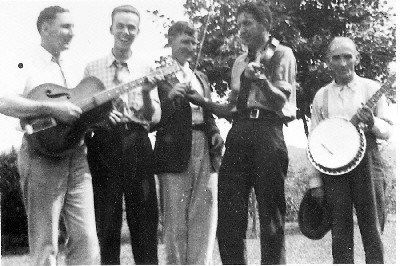
Johnny Hager on extreme right holding a banjo, Boone County, WV, 1950s.
14 Saturday Dec 2013
Posted in Ed Haley
Tags
Appalachia, Ed Haley, fiddle, fiddling, history, John Hartford, Laury Hicks, Lawrence Haley, music, Ugee Postalwait, West Virginia, writing
After pouring over all of this new information, I called Ugee Postalwait and asked if she could sing me any more of Ed’s songs. I hadn’t been thinking much about Laury Hicks lately and it seemed like a good time to just “check in” on that facet of Ed’s story. It wasn’t long until she was spinning this story that gave me insight into Ed’s ability to take a little melody and make it into a tune.
“One time when I was a little girl, somebody went up or down the road at night a singing, ‘Blue-eyed rabbit went away, the blue-eyed rabbit went to stay. Doodledy-do, doodledy do, doodledy do do doodledy do’,” Ugee said. “So I got up and that’s all I was singing all day long. Ed said, ‘What are you trying to sing?’ I said, ‘I’m a singing ‘Doodledy Doo’.’ Dad and him said, ‘Well it’s got a name. What is it?’ I said, ‘I don’t know.’ Said, ‘Where’d you hear it?’ I said, ‘I heard it in the night.’ Said, ‘Did you dream it?’ I said, ‘No, I didn’t dream it.’ They fooled around with that piece there for weeks trying to play it. When Ed Haley and Dad got done playing that, they had all kinds of runs in that there piece. One’d be a playing it and then the other’n, then they’d bring the different runs in on that song. Someone liked it real well when Ed was a playing it and wanted to know what the name of it was. He said, ‘Well, the one that give me the name of it said it was ‘Doodledy Doo’.’ Ed just laughed and would tell Aunt Rosie about him a playing that piece.”
This story was very interesting since I was starting to formulate this improvable theory that Ed first learned to play fiddle tunes by listening to his mother whistle or hum them. As a young widow who had lost her husband in tragic circumstances, she may well have been determined to pass along some of her beloved’s music to little Ed as best as she could. Of course, he may well have begun playing before Milt’s death, even “sneaking” and playing on his fiddle when his father was out working timber. (I’d had a similar experience with an old fiddle in my grandfather’s closet as a boy.)
I asked Ugee if Ed ever talked about where he learned to play and she said, “He told me about somebody leaving an old fiddle laying around when he was a boy. I don’t remember who the man was.” I told her his father had been a fiddler and asked if maybe he’d meant “my old man left an old fiddle laying around” and she said, “Some old man left an old fiddle laying around and I just wonder if it was his dad. And he picked that up and went to see-sawing on it and he said he found out he could play the fiddle. He said that was all he was good for: to play the fiddle. That’s all he studied. I asked him if he went to school to learn to play the fiddle. He said no.”
I just couldn’t shake the image of Ed playing on Milt’s fiddle. If he hadn’t fooled with it before Milt’s death, maybe he picked it up afterwards (“it was just laying around”) and learned to play with his mother’s help. I had these images of Emma whistling or singing Milt’s tunes to him and saying, “Yeah, do that.” “Don’t do that.” I got chills thinking about the way Ed may have began learning tunes and the way I used to ask Lawrence, “Did he do this?” “Did he play this?” Or the way he would say to me, “Pop didn’t do it like that.”
31 Thursday Oct 2013
Posted in Ed Haley
Tags
Al Brumfield, Bill Adkins, Billy Adkins, Cain Adkins, fiddle, Green McCoy, Harts, history, Hollene Brumfield, Jackson Mullins, Lola McCann, Milt Haley, writing
That night, Brandon suggested visiting Lola McCann, a local widow of advanced age. Lola, born on the West Fork of Harts Creek in 1909, lived in Harts proper, just back of an old hardware store, a video store, and the post office. She spent a lot of time with her daughter Cheryl Bryant, who lived across the street with her family. We found Lola at her daughter’s home almost buried in the cushions of a plush couch. As everyone made introductions, I headed over and sat down beside of her.
When Brandon asked Lola about the old Al Brumfield house, she said it was haunted, that Hollena Brumfield had kept the clothes of deceased relatives in an upstairs closet (top-story front downriver side). She never would spend the night there. She said the staircase was stained with blood and five or six bodies lay down in the old well. This all sounded like folk tales, the type of stories to tell in an old cabin around the fireplace…but who knows?
As things kinda moved along with Lola, Brandon mentioned that we should be sure and visit Billy Adkins, a neighbor and expert on local history and genealogy. Lola’s daughter immediately called him and invited him over. The next thing I knew a little stocky guy with a shaggy beard arrived at the door. It was Billy, of course, holding a fiddle, which he said belonged to his father Bill Sr., an old fiddler in Harts.
I told Billy that his father just had to know Ed Haley but he said, “I asked him and his mind’s gone. He can’t remember. He’s got Alzheimer’s. His mind just comes and goes.”
Bill, Sr. had given up the fiddle in recent years, but Lola’s daughter had a short home video of him playing “Bully of the Town”, “Way Out Yonder”, and “Sally Goodin” in 1985. Bill’s style was completely different from what I pictured as Ed’s — he held the bow toward the middle and played roughly with a lot of double-stops — but I was still anxious to talk to him. Billy said we could see him the following day as he was already in bed asleep.
When we mentioned our interest in the 1889 troubles, Billy said, “Green McCoy married Cain Adkins’ daughter. Cain and Mariah. Mariah was a Vance, I think. And they lived where Irv Workman’s house is now.”
Brandon asked, “Which is near where they’re buried, right?” and Billy said, “Yeah, right across the road from it. And Milt Haley married Jackson Mullins’ daughter. Jackson and Chloe Mullins, from up on Trace. She married again.”
What? Ed’s mother remarried after Milt’s murder?
“I believe it was another Mullins,” Billy said, “but I’d have to look it up. Milt’s name was Thomas, you see.”
It was all in his notebooks at home, he said, although he warned us: “See, I didn’t document any of this stuff. I didn’t put my sources down and when I’d run across it I’d just write it down. Now, I don’t know how I found it out.”
03 Tuesday Sep 2013
Posted in Ed Haley
Tags
Appalachia, Ashland, Cincinnati, Ed Haley, fiddle, history, John Hartford, Lawrence Haley, life, music, Nashville, Portsmouth, U.S. South
Once I returned to Nashville, I called Lawrence Haley, who was in the mood to reminisce.
“Me and Pop hitch-hiked to Cincinnati out of Portsmouth a time or two,” he said. “We took old 52. And we’d had about three rides to get there.”
I asked him if Ed took his fiddle on those trips and he said, “Yeah, if he thought he was gonna be in a little bit other than country settings, he would put it in the case. But most of the time, he’d just carry it in his hand, tucked under his arm, maybe, with the bow in his hand.”
I wondered if Ed packed any extra bags on the road and Lawrence said, “Mostly just the clothes on his back, unless he was going on an extended trip — then he’d pack him a suitcase. He’d, of course, fill it up about a third with his homemade tobacco. His own cure — apple or peach or something. He’d take him some of that with him and off he’d go.”
Lawrence Haley passed away on February 3, 1995, the 44th anniversary of his father’s death.
27 Thursday Jun 2013
Posted in Ed Haley
Tags
culture, Doc Holbrook, Ed Haley, fiddle, history, John Hartford, life, music, Paul Holbrook

Ed Haley fiddle, given to Doc Holbrook many years ago
13 Thursday Jun 2013
Posted in Ed Haley
05 Wednesday Jun 2013
Posted in Ed Haley
Tags
Appalachia, culture, fiddle, fiddler, history, life, music, photos, U.S. South, West Virginia, Wilson Douglas

Wilson Douglas, West Virginia fiddler
05 Wednesday Jun 2013
Posted in Ed Haley
Tags
Appalachia, Bobby Taylor, Ed Haley, fiddle, fiddler, Forked Deer, history, John Hartford, music, Webster County, West Virginia, Wilson Douglas, writing
I told Wilson about working on Ed’s long bow and the Scotch snap — about the little stops between notes — and he said, “Right, right. That’s hesitation in the notes. That is correct. He talked about ‘chopped notes.’ That’s a quick note. But you know, what I liked about Haley, whenever he would settle down and fiddle… I like to hear a fiddle drive a straight, hard, flat note. A clear note. This skipping over the notes, I don’t go for that. And Haley didn’t do that. Every note he got was clear, or he would make a ‘chopped note,’ he called it, and the hesitation was with the — well the hand was quicker’n the eye. He could make a quick hesitation with the bow.”
I was very impressed with Wilson’s memory of such details, which improved with each passing minute. Apparently, Bobby Taylor was right: after he thought about something for a while his memories became sharp as a knife.
Wilson said, “But now I didn’t tell you about the kind of strings he played, did I? He played the old Blue Bird. They quit making them back in ’42 or ’43. They was a steel string, something like a Black Diamond. I believe they’s a little better toned. They wasn’t so sharp. And they cost one quarter in them days, for I bought one as a kid. Now that was the string that Ed Haley played. He liked these solid bone keys in his fiddle, white bone keys. And I always thought about where he got that dang fiddle bow, but it must’ve been four-and-a-half foot long. I never will forget it: that’s the longest fiddle bow I ever saw. I’ve thought about that many a times. It looked to me like it was six inches longer than any other kind of bow, and he played it from one end to the other.”
I said, “You don’t reckon it was just the way he was pulling it that made it look long, do you?”
“No, it was long,” Wilson answered. “You know, a boy sixteen years old don’t miss nothing for he’s eager to learn, you see? I know a fiddler over here in Webster County, and he’s good, too. He’s a top fiddler. And me and him talked about that, and he said, ‘Ed Haley pulled the longest fiddle bow I ever saw.’ And he said his notes was plain. I said, ‘Absolutely.’ Now the frog on that bow was some kind of a bone, if that means anything. White bone.”
Wilson really bragged on Ed’s repertoire.
“Now the man, John, what amazed me, he would play all night and maybe not play the same tune twice,” he said. “And he told me, said, ‘I know over a thousand fiddle tunes.’ Old Ed played ‘Callahan’ out of this world. I can’t remember the key. I wasn’t far enough along. But now, Ed sometimes would put that B-flat in the ‘Forked Deer’ and sometimes he wouldn’t. He would run that B-flat in there if he was showing off, you know. He played the ‘Paddy on the Pike’ in standard tuning. ‘Paddy on the Handcar’, Ed played that cross-key. Two different tunes. And he played ‘Poplar Bluff’ and the ‘Hole in the Poplar’ and all that kind of stuff.”
02 Sunday Jun 2013
Posted in Ed Haley
Tags
Appalachia, culture, fiddle, fiddler, history, Jack McElwain, life, music, photos, U.S. South, Webster County, West Virginia
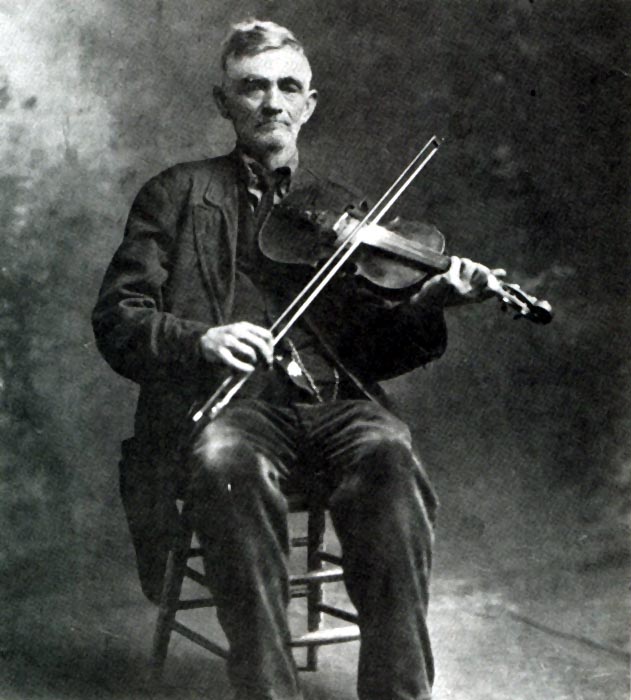
Lewis Johnson “Uncle Jack” McElwain (1856-1938), fiddler from Webster County, West Virginia
02 Sunday Jun 2013
Posted in John Hartford, Music
Tags
Appalachia, banjo, bluegrass, culture, fiddle, fiddler, history, John Hartford, Museum of Appalachia, music, Norris, photos, Tennessee
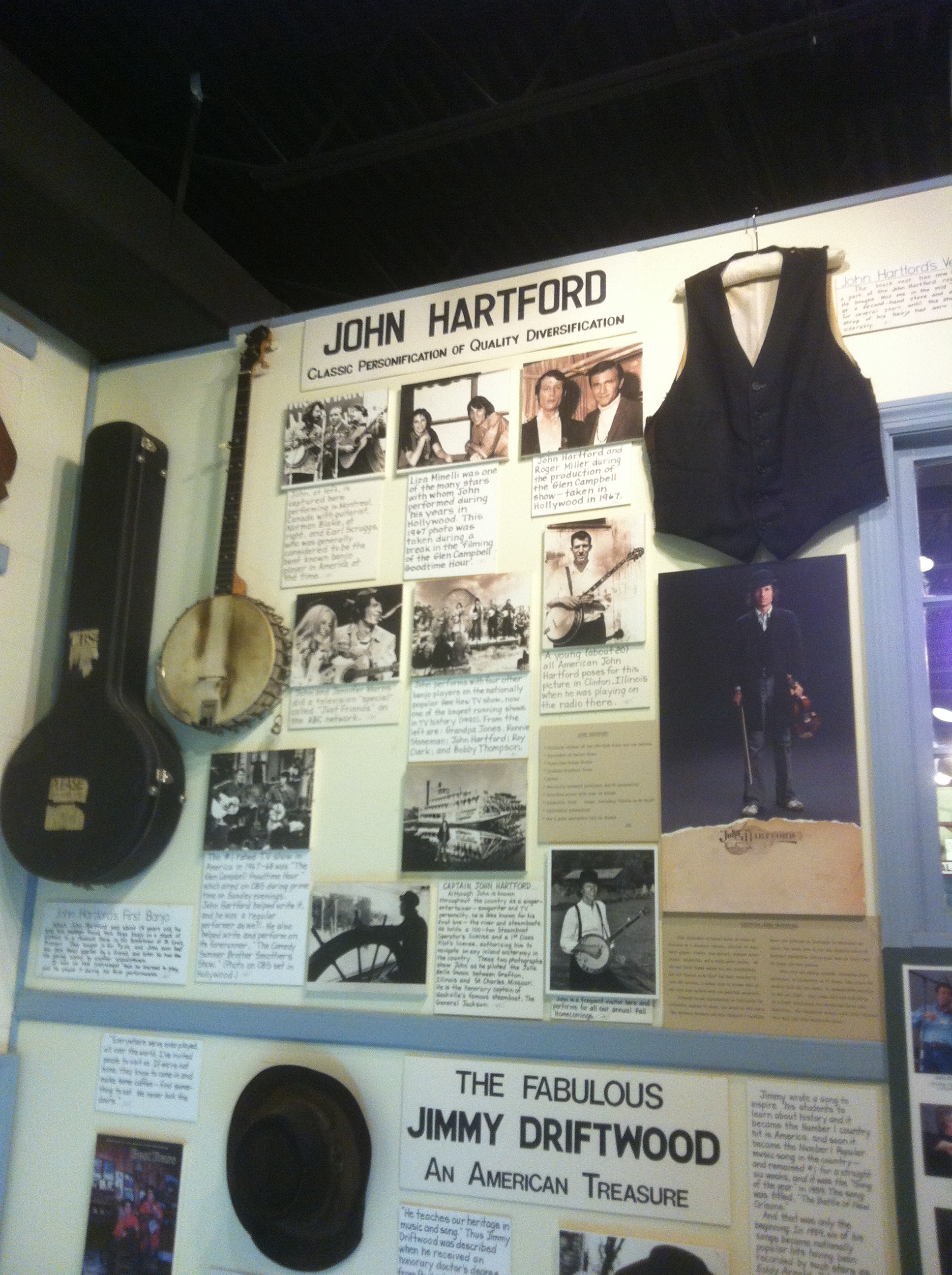
John Hartford display, Museum of Appalachia, Norris, Tennessee, 2011-2012
30 Thursday May 2013
Posted in Ed Haley
Tags
Ashland, Clyde Haley, Ella Haley, fiddle, fiddler, John Hartford, Lawrence Haley, music, Pat Haley, writing
As soon as I got back from California, I got on the phone with Lawrence and told him all about meeting Clyde. He took issue with some of the things his brother had told me. As for what Clyde said about him holding the fiddle down at his lap: “Well, he might have done it. I’ll tell you, if he did, he wasn’t playing the fiddle like he should. He wasn’t a fiddler then. He was just making music, probably at a square dance. They fed him too much liquor or something and he was about to pass out on them. That’s the way I’d look at that ’cause Pop had a lot of pride in his music. I don’t think he’d done that intentionally. He wasn’t no show-off with the fiddle. He might show some enthusiasm when he was playing a piece exceptionally good. He was enjoying his own talents right then.”
Lawrence got back on the subject of what Clyde had told me about Ed’s drinking and abuse.
“If he tells you that my dad made him drink or caused him to be a drunkard or an alcoholic, then Clyde was fibbing to you ’cause Clyde did that on his own. He might not have been around it as much if he hadn’t went with my dad, but he did it on his own. I don’t think Pop would have given him… Like he said, he’s sitting there at the table up on Horse Branch feeding it to him while Mom was sitting there across the table from him — I don’t think he done that. Maybe he might have been different with some of us, but he never struck me or never offered me anything to drink like that.”
I asked Lawrence how his health was holding up and he said, “Well, since I’ve talked to you, I been on the backside. My intestinal system ain’t working right and nobody seems to know anything about it. I don’t know whether I’m ever gonna get over this, John. Seems like I get to go forward for a day or two and then drop back for three or four. It wears you down after a while.”
He paused: “Other than that, I’m getting along all right.”
I told Lawrence I was planning to come see him in Ashland in the next few months — that maybe we could run around and he’d start feeling better.
“Okay,” he said, “I don’t think I’m gonna be able, John. You’re just gonna have to take Pat with you or one of the kids.” He laughed. “Take one of them along instead of me because I haven’t got the strength really. They’ve just drugged me right on down to where I can walk through the house and I’m ready to lay down. Right now, I thought, ‘Well, I’ll just be that way. I’ll just stay in a rested position as much as I can and just lay like I’m in a hospital bed and see if that don’t help me. Just pure rest.’ So, I’m gonna give that about another week, then I’m gonna find me a specialist I reckon and find out what’s the matter with me.”
21 Tuesday May 2013
Posted in Ed Haley
Tags
Clayton McMichen, culture, fiddle, fiddler, Georgia, Georgia Wildcats, history, life, music, photos, Skillet Lickers
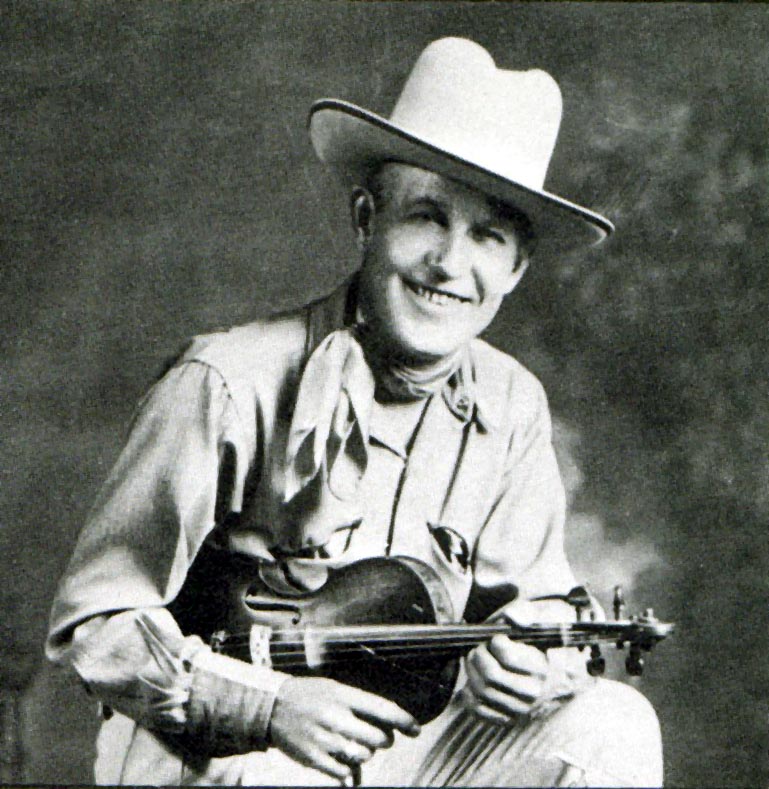
Clayton McMichen of Georgia
17 Friday May 2013
Posted in Ed Haley
Writings from my travels and experiences. High and fine literature is wine, and mine is only water; but everybody likes water. Mark Twain
This site is dedicated to the collection, preservation, and promotion of history and culture in Appalachia.
Genealogy and History in North Carolina and Beyond
A site about one of the most beautiful, interesting, tallented, outrageous and colorful personalities of the 20th Century


 Brandon Ray Kirk