Tags
Appalachia, culture, Ed Haley, genealogy, Harts Creek, history, John Hartford, life, Logan County, photos, Roxie Mullins, West Virginia

Roxie Mullins, 1991

18 Friday Jan 2013
Posted in Ed Haley
Tags
Appalachia, culture, Ed Haley, genealogy, Harts Creek, history, John Hartford, life, Logan County, photos, Roxie Mullins, West Virginia
Roxie Mullins, 1991
18 Friday Jan 2013
Posted in Ed Haley
Tags
Appalachia, Ashland, Ed Haley, Ella Haley, history, John Hartford, Kentucky, Lawrence Haley, life, Mona Haley, music, Noah Haley, West Virginia, World War II, writing
We drove over to Noah’s rented apartment and parked near a Chrysler with “NOAH HALEY” emblazoned on its bumper in big stick-on letters. At the door, Lawrence told Noah, “I got a fella here that wants to talk to you.” Noah was surprised but seemed happy to see Lawrence. “Come on in,” he said. “I’ll just straighten up in here a little bit, but come on in.” He led us into a living room where the TV was blaring. It was a real bachelor pad. We all sat down and Lawrence introduced me. It was the first time I had met any of Ed’s children other than Lawrence and I was very curious to watch Noah for clues about his father and to shore up his memories of his dad with what Lawrence had told me.
“I’ll tell you anything I can,” Noah said. “It’s been so long ago, I’ve just about forgot everything.”
“I told him you probably couldn’t tell him much because you went into the service in 1939,” Lawrence said.
Noah said, “Right. I stayed in the service nine and a half years — from 1940 until 1949. And then in ’51 I went to work on the railroad in Cleveland and I worked there until I retired. The only thing I know is they made their living by playing music on the streets and at fairs and churches and everywhere else. We’d go with them — one of us kids — to lead them around. And they would go to Logan, West Virginia. They used to set out on the street and play music at the courthouse, and we’d just wait till they got done. They would play sometimes all day long on Saturdays in the courtyard. People’d come along and give them money. That’s about all I can remember about them.”
I asked if Ed ever talked about any older fiddlers he learned from and Noah said, “The only thing I ever heard him say was he taught himself. He couldn’t read music or nothing but my mother could read music by Braille. She was pretty well-educated. Pop played by ear.”
The room got a little quiet for a few seconds — we were waiting on Noah to tell us something (anything) about Ed. Instead, he kind of laughed and said, “I’m not gonna be much help to you on this.” Lawrence asked Noah if Pop ever talked about his parents and Noah said, “The way I understood it, this guy shot his mother and… I don’t remember now how it went. Whether his dad got a gun and killed him or how.”
Basically, Noah was saying just enough to confirm that he’d “been there,” but his memories were so vague that I wasn’t getting any great insight out of them. I wasn’t ready to give up though, next asking him about his share of Ed’s records. He assured us that he didn’t have any, which caused Lawrence to say, “You know, when Mom divided those records out, she gave you so many, she gave Mona so many, she gave Jack so many, and she gave me so many of them. And the only ones that was left, Jack had eight or nine left, I think.”
“I don’t have a one of them,” Noah said. “The only ones I had I give them to Pat. She made tapes of them.”
Pat, Lawrence explained, was Patsy Haley — his sister-in-law.
“My sister, she could tell you more than I could,” Noah said to me. “Mona knows all them things. And she’s even got records of Mom and Pop’s music.” He looked at Lawrence and said, “I think she’s got some like you have — round and aluminum.”
That was all I needed to hear.
Looking back, I realize I lost almost all interest in talking with Noah — sacrificing his memories — at the prospect of getting to hear more of Ed’s records. That’s a strange thing to consider from a biographical standpoint but I was just so into Ed’s music.
18 Friday Jan 2013
Posted in Ed Haley
Tags
Appalachia, Ashland, Ed Haley, Ella Haley, genealogy, history, John Hartford, Kentucky, Lawrence Haley, life, Milt Haley, Noah Haley, U.S. South, writing
Lawrence Haley and I spent an hour or so driving around Ashland looking at many of the sites where Ed had lived in town. Not one single residence was still standing. As we visited each site, I noticed that the Haley residences seemed to have been in poor areas of town…although I didn’t suggest this to Lawrence.
“They never did own a home,” Lawrence said of his parents. “They always rented. About eight different places in Ashland and one in Catlettsburg that I can remember.”
In 1933, according to city directories, Ed and Ella lived at 805 45th Street. The next year, Ella received a postcard at 1030 45t Street. The 45th Street area of Ashland — renamed Blackburn Avenue in recent years — was a long street situated to the back of town, with schools and churches intermixed occasionally with small residences. It was the longest street in town.
Lawrence guided me to 37th Street, also known as Ward Hollow, where the Haleys settled around 1937-38. Ward Hollow, I discovered, was recently cleared entirely of homes and filled with dirt as part of some planned business development. It was nothing like Lawrence or Curly Wellman remembered it.
“This was a two-lane road at that time,” Lawrence said, looking up the hollow where he once lived. “And they was a bunch of houses sat up on the bank. There wasn’t too many trees up through there. About twelve to fifteen houses — small homes, twenty-five or thirty foot long. We lived in a three-bedroom house. I was just a kid then.”
In 1944, the Haleys moved downtown to 105 17th Street, the spot where Haley made his home recordings. From this location, presently occupied by a dull gas building and a partially empty lot near the floodwall, Haley could easily walk up 17th Street past City Hall to the post office or Central Park.
In 1947, the Haleys were briefly at 5210 45th Street, before settling at 1040 Greenup Avenue. Two years later, Ella was listed in city directories at 932 45th Street. Today, this spot is almost wiped out, although a Little Caesar’s pizza is on the corner of a modern building at 933 45th Street.
Around 1950, the Haleys lived at 2144 Greenup Avenue. This spot, where Ed Haley died in 1951, is the current site of a Boyd County Ford parking lot and Pathways, Inc. “They’ve got a mental health center there where Pop died,” Lawrence said.
In 1952, Ella lived at 932 45th Street.
As Lawrence and I made our way around town, I suggested going to see his older brother Noah who had recently moved back to town.
“Well that’ll be fine John, but if he’s playing cards I ain’t even gonna go around him because that’s one of his vices,” he said. “He used to go down there to Covington, Kentucky, some and lose his shirt. Two or three shady people have been after him to collect his debts.”
It seemed as if each of the Haley children had some kind of a major hang-up, which kept me thinking about Milt Haley’s genetics — as well as Ed’s. I asked Lawrence if Noah was a drinker and he said, “He doesn’t drink any more. I think he’s got to the point where drinking aggravates his system too much.” There was also the restlessness. Milt Haley came to Harts Creek from “over the mountain” — probably the Tug Valley — and married a local girl. After the trouble with Al Brumfield, he hid out in Kentucky. Ed Haley, perhaps taking a genetic cue from his father, left Harts Creek at a young age and roamed throughout West Virginia and eastern Kentucky. Even after marrying and settling down in Ashland, it was a Haley ritual to always be on the go — moving through town or taking off on a season-long jaunt. Lawrence Haley did not seem to “inherit” that desire, preferring to live the quiet life of a laborer and postman in Ashland. But his half-brother Ralph had went overseas during World War II and then on to live in Cincinnati. His brother Clyde had been all over the United States — everywhere from Alaska to New Orleans. Likewise, Jack had moved away to Cleveland and Mona had been in different cities in Ohio.
Noah, a veteran of the Pacific Theater and longtime resident of Cleveland, was apparently a roamer, too. “He moves around,” Lawrence said. “The last place he lived was up on Winchester Avenue in an apartment out over a garage. He’s getting ready to go out to California, I guess. He’s about 71.”
16 Wednesday Jan 2013
Posted in Ed Haley
Tags
Appalachia, Big Sandy River, blind, Catlettsburg, Center Street, Ed Haley, Elks Building, Gunnel Block, history, Horse Branch, Kenova, Kentucky, Lawrence Haley, life, Louisa Street, Ohio River, Pat Haley, U.S. South, West Virginia, writing, Yates Building
Catlettsburg, Kentucky — the place where Ed Haley lived from the mid-twenties until the early thirties — was a booming timber town in its hey-day. Located at the mouth of the Big Sandy River and across the Ohio River from Kenova, West Virginia, it was laid out in 1849 and incorporated in 1858.
Catlettsburg is a blue-collar town. As of 1990, its population was 2231 with 98% registering as white. Downtown Catlettsburg extends from the courthouse area on Louisa Street between 30th and 28th streets to the vicinity of the Elks Building on 26th street, with evidence of old structures just beyond. The courthouse, which was erected in 1930, is neat and surrounded by a spacious yard. It is flanked by annexes, a few small new buildings, and an old red brick two-story building on 28th that offers apartments to the public. On a moist day, the smell of wet garbage or a strong musty odor pervades the central part of town. Down Louisa Street from the courthouse exist a few churches and a couple of old buildings now occupied by an antique store and pizzeria. Across the street, toward the river, sits a string of more old buildings, but mostly newer stuff. Continuing toward the Elks Building is Center Street. The floodwall — a hideous but necessary structure — is positioned to the right, with a few old storefronts and a bingo place where Pat Haley runs a kitchen business. On its Center Street side, the Elks Building has a carving that reads: “Gunnel Block 1906.” Toward its back is a tall slender addition called “The Yates Building 1911.” Across Center Street, evidence of a business district extends one more block to 25th Street. The town continues on but the old downtown seems to end there. Near the floodwall, just back of the old district are the backs of little houses and a few narrow two-story frame houses facing the river — or wall. On 26th Street up past the Elks Building is City Hall and a beautiful little church. The street ends at four sets of railroad tracks. Turning left onto Chestnut Street, which runs east to the back of the courthouse are nice two-story white or red brick residences with a funeral home and law office. Across the tracks, which are elevated slightly above the old part of town, is Route 23 and beyond are larger homes on the hill.
While Ed Haley spent countless days walking on most of these streets, especially in the vicinity of the courthouse, he actually lived at the western edge of town on Horse Branch. Today, Horse Branch offers a flood-prone playground, a Freewill Baptist church and old single story frame shacks crowded together against a narrow paved road. The only thing new on the creek seems to be trailers. Lawrence Haley said the old family home there was long-gone.
13 Sunday Jan 2013
Posted in Ed Haley
Tags
Appalachia, Ashland, culture, Curly Wellman, Ed Haley, guitar, history, John Hartford, Kentucky, life, music, photos
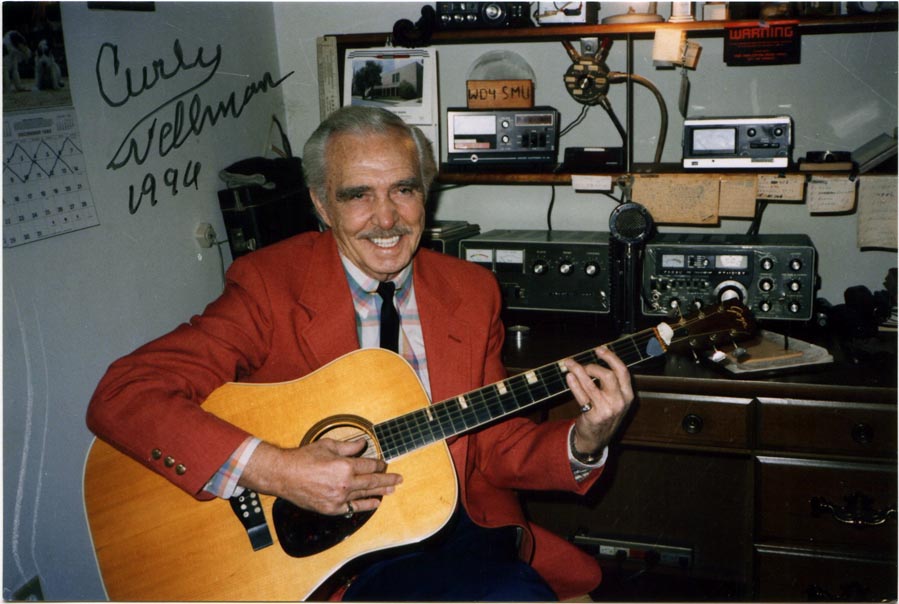
Curly Wellman, Kentucky Musician
13 Sunday Jan 2013
Posted in Ed Haley
Tags
Appalachia, Ashland, banjo, Billy in the Lowground, Blackberry Blossom, blind, Cacklin Hen, Catlettsburg, Clark Kessinger, Clayton McMichen, culture, Curly Wellman, Curt Polton, Ed Haley, Elvis Presley, fiddler, Floyd Collins, Forked Deer, Grand Ole Opry, guitar, Hatfield-McCoy Feud, history, Horse Branch, Huntington, Ivan Tribe, John Hartford, Kentucky, Lawrence Haley, Logan County, Mid-Day Merry-Go-Round, Morehead, Mountain Melody Boys, Mountaineer Jamboree, music, National Fiddling Association, Old Sledge, Poplar Bluff, Rowan County Crew, Ugee Postalwait, Ward Hollow, WCHS, WCMT, Westphalia Waltz, writing, WSAZ
I asked Curly if he remembered any of Ed’s tunes and he said, “Ah, I remember ‘Forked Deer’ and I remember ‘Billy in the Lowground’ and I remember the ‘Old Sledge’ and I remember ‘Poplar Bluff.’ ‘Blackberry Blossom.’ The longer he played a tune, the meaner he got on it. If he got the feel, it hit him. And the more he played the better he got and the more tunes come to him. He played one waltz — ‘Westphalia Waltz’ — and that’s really the only waltz that I can recall that he played. And it was all double stop fiddle.”
Curly never heard Ed sing a note — a very surprising recollection considering the way that Ugee Postalwait had hyped Haley’s singing abilities.
“I got a copy of a song from him,” Curly said. “He had somebody to write it down. Because at this time, out at Morehead, Kentucky, they had a feud out there. And they had a shoot-out there on the steps and then somebody wrote this song called ‘Rowan County Crew.’ And Ed, they tell me, would sing that at different places throughout Kentucky. At that time, it was like Floyd Collins that was in the cave and like the Hatfields and the McCoys — only this was called the ‘Rowan County Crew.’ Well, at that time it was hot as a pistol through the state. Now evidently he sang that song, but he never sang it for me.”
Curly said, “Ed could have been as great as the Blue Yodeler or any of those people. He could have been right on those records with them but under no reason did he want to record commercially. Had he been living today and with the equipment they’ve got today, he would’ve been in more demand than Elvis Presley ever was. Nobody played ‘Cacklin’ Hen’ like him. And a very humble man. I never heard Ed down anybody else, I never heard him put anybody below him and I never had him to tell me how good he was. In fact, I wonder sometimes if he knew how good he was. But I knew it. He was a brilliant man. He’d just about keep a check up on everything during his lifetime. He knew the news, he knew the political field, he knew what was going on in the state.”
I asked Curly about the first time he ever saw Haley play.
“I played with Ed when I was a kid — twelve, thirteen years old — and we lived at a place called Horse Branch. That’s as you enter Catlettsburg, Kentucky. And I was a kid carrying an old flat-top guitar — no case — trying to learn how to play. In the evening, he’d come out on the front porch after dinner and Ralph would get the guitar and the mother would get the mandolin and the neighborhood would gather because at that time radio was just coming into being. And I’d go down there and sit and bang while they were playing. And that’s where I first heard Ed Haley.”
Curly lost track of Ed when he started playing music out on his own at the age of fifteen. Throughout the mid-thirties, he played over the radio on Huntington’s WSAZ and Ashland’s WCMT with the “Mountain Melody Boys,” then made several appearances on the Grand Ole Opry and Knoxville’s Mid-Day Merry-Go-Round with Curt Polton’s band. It was during that time, he said, around 1936, that Ed got into a contest with Clark Kessinger and Clayton McMichen at the WCHS radio station in Charleston. Clayton was the National Fiddling Champion, while Clark was the National Fiddling Association’s champion of the East. The whole thing was “built up for months — it was a showdown.” In the contest, each fiddler got to play two tunes and someone named Banjo Murphy seconded every one using a three-finger picking style on a four-string banjo. First prize was a “live baby” (a little pig) and the winner was determined by a clapping meter. Curly wasn’t sure what tunes Ed played (probably “Cacklin’ Hen,” his contest specialty) but remembered the results clearly.
“Ed Haley beat the two men on stage,” he said. “McMichen was out of it in a little bit but it took several rounds to eliminate Clark Kessinger.”
Curly returned to Ashland in the early forties and found Ed living in the bottom of a weather-boarded, two-story apartment building on 37th Street (Ward Hollow). He started visiting Haley again, usually on cold days when he knew that he’d be close to home. He’d put his D-18 flat-top Martin guitar in the trunk of his car and “go pick up a pint or a half a pint of moonshine,” then head on over to Ed’s house.
I’d go in. I wouldn’t take the guitar in at all. I’d just knock on the door and go in and I’d say, “Hi, Uncle Ed.” “Hi, Curly.” He knew me by my voice. And I’d go in and sit down, you know, and say, “How’s the weather?” and “How’s things?” and “How’s the family?” and so forth and so on. We’d sit around there and talk a little bit. I’d say, “Ed, been playing any lately?” “No, I haven’t felt like it. I just haven’t felt like it.” I’d say, “Well, how about a little nip? You think that would help?” “Well now you know you might have something there.” So I’d go on to the car and I’d get the bottle and come in and we’d sit back down and I’d pass it to him. He’d hit it. He’d sit right there a little bit you know and I’d say, “Take another little nip, Ed.” “Well, I believe I will,” he’d say. “It’s too wet to plow.” And he’d sit there and he’d rock a little bit in that chair and… Being blind, he talked a little loud. “Hey, did I ever play that ‘Old Sledge’ for you?” I’d say, “Well, I can’t remember Ed. Just can’t remember.” Well, he’d get up and he’d go over and he’d lay his hand right on that fiddle laying on the mantle of the fireplace. By that time I’d be out the door and getting the Martin. I’d come back in and he’d tune ‘er up there and feel her across you know and touch her a little bit here and there. He’d take off on it.
Curly and I got our instruments out and played a few of Haley’s tunes. He showed me the type of runs he used to play behind Ed and gave me a few more tips about his fiddling. He said Ed was “all fingers…so smooth” and could play all over the fingerboard — even in second and third positions. He “put a lot of his upper body into the fiddling” and patted one foot to keep time. If he fiddled for a long time, he put a handkerchief under his chin for comfort (never a chinrest) and dropped the fiddle down to his arm and played with a collapsed wrist.
Just before Lawrence and I left, Curly said, “I’ll tell you somebody that’s still living in Charleston and he’s a hell of a fiddle player — or was. They called him Slim Clere. He’s about 82. He knew Ed. In fact, he was the man that Clere looked up to as he was learning. And he could probably give you more information than I could because he’s followed the fiddle all of his life.”
Curly also recommended Mountaineer Jamboree (1984), a book written by Ivan Tribe that attemped to detail West Virginia’s contributions to country music. It briefly mentioned Ed: “Blind Ed Haley (1883-1954), a legendary Logan County fiddler who eventually settled in Ashland, Kentucky, repeatedly refused to record, but did belatedly cut some home discs for his children in 1946.”
11 Friday Jan 2013
Posted in Ed Haley
Tags
Appalachia, Ashland, Clark Kessinger, culture, Curly Wellman, Ed Haley, fiddler, history, John Hartford, Kentucky, Lawrence Haley, life, music, U.S. South, writing
Not long after meeting with Lawrence Haley in Tennessee, I found myself heading toward his home in Ashland. As soon as I arrived in town, he suggested that we speak with Curly Wellman, a local musician who had often visited his parents’ home during the Depression. Lawrence had no memories of Curly’s visits but listened as he told all about them at a recent chance-type meeting at a local grocery store. “I was too young to remember him coming,” Lawrence said to me. Curly had told Lawrence to be sure and visit anytime, so we made a quick call to make sure it was okay for us to drop in, then headed out the door.
“I used to see him on the Ralph Shannon Show years ago,” Lawrence said, as we piled into the car. Curly was still quite the entertainer. We found him more than ready for us — wearing a big grin and dressed in a fruity-striped button-up shirt with a large medallion around his neck. There was no real need for questions or prompting on our part. His memory was very clear.
“I don’t think there was anybody that ever drawed a bow that played country like he did,” Curly said of Ed. “The biggest finger on his hand wasn’t as big as my little one. Smallest hands you ever looked at in your life. Just a natural touch. I mean everything — tone, ear, perfect pitch… The whole thing. I would carry my flat top and I’d go up to Uncle Ed’s and go in and he’d grab the fiddle. Well, all he would do was throw the fiddle under his neck and run his fingers across the strings — before he ever heard my guitar — then all I had to do was rake across it and we were together. That was Ed Haley. I’ve followed him since I was about twelve or thirteen and I’m 74 now and I’ve worked with a lot of them and, well, I think he was the greatest.”
Curly didn’t even catch his breath in bragging on Ed.
“The bow work is the secret to Ed Haley’s music,” he said. “All of the bow work was strictly in the wrist. More like watching an artist that plays classical stuff — the bow arm. He could get more notes out of the length of the bow than any other man I ever watched or heard in my life. It was all fingers. Just so easy. And double stops were nothing for him. I’ve heard him catch three notes on a fiddle. Terrific! Terrific! I started playing when I was about fourteen and I played for him just for pleasure and lived close to the family and knew them all personally — marvelous people. He had a boy that played the guitar pretty fair. Now there was one other fiddle player in this country that thought he was that good, but he wasn’t. His name was Clark Kessinger. Now Clark played a lot of fiddle. I have to give him credit for what he did play. But I don’t believe he could tune Ed’s fiddle. Clark’s a good imitation of Ed.”
Curly said he’d give anything to hear Ed’s music again.
Just then, Lawrence, who’d been sitting quiet as a mouse, pulled out some of his father’s tapes and said warmly, “Hey, put these on.”
Curly got everything set up and stood mesmerized listening to Ed’s music. He kept saying things like, “Listen how true his notes are. The tone quality. And when this was taped, they didn’t have this stuff to work with that they’ve got today. They make you sound like what they want you to sound like. Ah, he was a fine man. Is that his wife playing the mandolin? She could do it. I used to watch that poor old soul down here in town and she’d bring one of the little girls with her to take her to and from places. She’d sit down there on a little folding stool with her mandolin and play for change and this and that. They were hard-working people.”
Ed’s music gave Curly’s memories a boost.
“At the time that I knew him, I was a kid. The thing between me and Ed was just love for one another, I suppose, and love for music. And he loved a guitar that could back him up. And he didn’t want no sixth-string chord — you better not strike one in his presence because he’d tell you to crawl back down on the neck. He said if he wanted a snare drum, he’d get one. He was the type of guy that said what he thought. That was his nature. And if you didn’t like it, you’d just well to get up and go out. He was a man that had the flattest delivery with speech when he said something to you. I mean it was just flat out straight. It didn’t make any difference to him.”
Ed hated to be pitied or touched and liked to get around by himself. Because Curly had seen his “vicious temper,” he never asked him about his background.
“I was a kid and as blunt as he was there was a lot of things I would like to’ve known that I wouldn’t even ask,” he said. “In other words, I might just say something that he would completely turn me off, me being that young. But, well, he had a big heart.”
09 Wednesday Jan 2013
Posted in Ed Haley
Tags
Alaska, blind, California, Cleveland, Clyde Haley, Ed Haley, genealogy, Harts Creek, Hawaii, history, Japan, John Hartford, Kentucky, Lawrence Haley, Liza Mullins, Louisiana, Milt Haley, Montana, New York, Noah Haley, Ohio, Pacific Theatre, Pike County, Scoffield Barracks, Virginia, World War II
I asked Lawrence if he’d heard from any of his brothers or sister and he said, “I’ve got one that lives in town now. He moved back from Cleveland, Ohio. He lives in town. Noah was a little bit… You might want to talk to him, I don’t know. But Noah, he went away, I guess, in 1939. He went in the service. He was at Scoffield Barracks in Hawaii when the Japanese… He was in all that Pacific Theater. I think he was wounded a couple of times. The Japanese bayoneted him one time in a bonsai attack or something. It left Noah a little bit shell-shocked or something. He gets a pension from it. He’s not together all there, I guess. You know, in a way, if you talked to him you’d never notice it. He was married to a woman of Hungarian descent and raised a family — a boy and a girl. He had a problem with the girl, too. She was having a problem with a boyfriend or something and her boyfriend was there at the house. Well, the boy had a pistol or some sort of a gun and she went and got that pistol and said, ‘If you don’t love me,’ or something and she shot herself. She committed suicide. I think it was non-intentional. It was just a bluff.”
I said to Lawrence, “Well now, aren’t your other brothers, they’re all kind of hard to get along with, aren’t they?”
“Yeah, a little bit odd,” he answered. “Clyde just moved out and took off and went his way, I guess. Followed the sun, I call it. We’d hear from him in Louisiana one year and the next year he might be in Montana or Upper State New York. He did hobo. Noah went to see him about ten years ago out in California and they started back and Noah was going to stop and get some gasoline. Clyde said, ‘No, don’t stop here and get gas. I’ll get your gasoline.’ He went over to this big church and told them he was on the road back to Ohio and didn’t have money to get there. I guess they give them a tank of gas and they come all the way back from California like that. Clyde was good at that. He did work and we’d get his W-2 forms. He never did turn in his income tax, I don’t think. He’d send his W-2 forms home. Some years he was out on an oil rig in Louisiana. Apparently during the time he was working for them they had rigs off the coast of Alaska.”
Hearing Lawrence speak of his brothers caused me to ask if maybe any of Milt Haley’s “stuff” — which I now presumed to be sort of bad — might’ve come down in their genetics.
“I don’t know, John,” he said. “I couldn’t say. They never met their granddad. I don’t think… My dad, if he’d been a sighted man, he’d probably been as gentle as a lamb. But he had frustrations in his own life.”
“Sometimes in a situation like that, sometimes a gene will come and it won’t get everybody,” I said, pressing Lawrence a little further. “Like it’ll skip your dad, and like skip you, but pick out a brother there and one over there.”
Lawrence totally disagreed.
“Well, I don’t think any of them… And I really don’t think my grandfather, from what I’ve heard of that tale… It was caused by hard times. I’m not trying to defend my grandpa because, hell, it don’t make any difference to me now.”
Milt in so many ways seemed like a critical character in the story: an ambiguous rogue — a key player in causing Ed’s blindness and inspiring his music, whose very genetic attributes or deficiencies might still live on strongly in his grandchildren.
I wondered if Lawrence knew where Milt came from before his settlement on Harts Creek.
“I think maybe over in Old Virginia or over in Pike County,” he said. “I understand there’s some Haleys in Pike County. I’d ask Aunt Liza, ‘Where’d Milt Haley come from?’ ‘Well, he come from over the mountain.’ Now, that’s as far as I could get from her.”
Lawrence thought his father had resolved his hard feelings toward the Brumfields in later years.
“Pop was supposed to have made the remark that if he’d had his eyesight he’d hunted down the people that killed his dad,” Lawrence said. “But afterwards, him and one of the Brumfield sons, they settled their trouble.”
I said, “Well obviously if your grandmother was at the Brumfields’ house the night she got shot, there was no animosity between her and the Brumfields.”
I was starting to understand how the tragedies of Ed’s early life, as well as the legacy of his father, had manifested itself into the pain, rage, and lonesomeness I’d been so drawn to in his music. I kept telling Lawrence, “We’re gonna have to go back up Harts Creek,” but it would be a year before we actually did so.
06 Sunday Jan 2013
Posted in Ed Haley
Tags
Appalachia, culture, Ed Haley, genealogy, Harts Creek, John Hartford, Lawrence Haley, life, photos, U.S. South, West Virginia

Connie Mullins and Lawrence Haley, Harts Creek, WV, 1991
06 Sunday Jan 2013
Posted in Ed Haley
Tags
Blackberry Blossom, blind, culture, Ed Haley, fiddler, Half Past Four, history, John Hartford, Lawrence Haley, life, music, Steve Haley, Tennessee, U.S. South, writing
Later that summer, I met Lawrence Haley at the home of his oldest son, Steve Haley, in Hendersonville, Tennessee. Steve was a music enthusiast and computer expert. Lawrence graciously loaned me the four Junius Martin records, which contained his father’s signature tune, “Garfield’s Blackberry Blossom”. I asked him about “Poplar Bluff,” one of the tunes on the records, and wondered if it was connected to the small Missouri town by that name. Lawrence said he didn’t know but that it sounded like Pop was mad when he was playing it on the record.
“Well, he was either mad or they had taken some strong drink with them and Pop had got into that pretty heavy,” he said.
I said, “What about a tune like ‘Stonewall Jackson’?”
“No, he was playing fine music there,” he said. “I don’t think when these records was made at home he had a drop to drink. But I’ll tell you John, he done an exceptional job then because before I went into the service he would shake his left hand trying to get some of the numbness out and I guess that was from a heart problem right there. If he had any decay in his muscle reaction, it didn’t show too much. Of course, he had to go downhill at that age from what he used to be when he was a young man.”
I played a tune for Lawrence that was unnamed on the records, then said, “This guy I know, Bruce Greene, he collected a lot of stuff, and I played it for him over the telephone and he said, ‘Oh, that’s ‘Indian Squaw’. But then it could have had another name. Like that ‘Yellow Barber’ tune that your dad plays, they call that ‘Arthur Berry’.”
Lawrence said, “I don’t think he called that ‘Indian Squaw’. I never heard anybody request it. Pop played a piece of music called ‘Indian Nation’.”
I’d been listening to Ed’s recordings a lot in the last few months and was focused on how he got a “real swing” in his music.
Lawrence agreed, “That’s what I say. That’s what I was trying to tell you. When Pop was playing and enjoying it, he put a lot of drive in his music. You could see it. You could watch him and just see that he was enjoying it.”
I asked if Ed played with his whole body and Lawrence said, “Well, yeah he’d do a little, maybe, dance on his chair.”
Would he ever come up off his chair?
“No, no, not like that. But you could tell that when he was playing with somebody that fit in with his style or if his accompaniment was doing their job right then he always enjoyed it.”
Now what would his feet be doing?
“Well, he’d just be patting his foot or his heel one or the other, most of the time. Not too loud. It was a subdued type of enjoyment, but you could see the drive that he was putting into it. I mean, he could slur a bow and pull a bow and put different pressures on the strings and you’d know that he was enjoying it, or I felt that he was.”
I played a lot of Ed’s tunes for Lawrence, hoping to jar some of his memories. When I played “Ida Red”, he said his father used to sing, “Ida Red, Ida Red. I’m in love with Ida Red.”
I told him I loved “Half Past Four”.
“That’s one of my favorite tunes of all time,” I said. “I get to playing that and I can’t stop playing that tune. Now, that’s one he wrote, isn’t it?”
Lawrence said, “Yeah, it seems to me like my mother told us that one time. That one of us, I’m not for sure which one it was, but we were delivered at about that time in the morning and Pop had been up all night, I guess. He just sat down and started playing because he was happy he had another boy, I guess. Or it might have been the girl, I don’t know.”
03 Thursday Jan 2013
Posted in Ed Haley
Tags
Appalachia, Ashland, culture, Ed Haley, history, John Hartford, Kentucky, Lawrence Haley, Lee Trick Gore, life, music, photos, writing
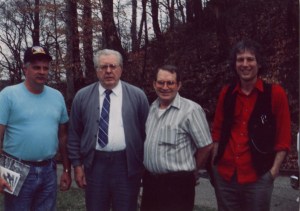
Lee “Trick” Gore (center, wearing tie) with Lawrence Haley and John Hartford, Ashland, Kentucky, 1991.
03 Thursday Jan 2013
Posted in Ed Haley
Tags
Appalachia, Blackberry Blossom, civil war, Ed Haley, fiddler, history, James A Garfield, Jean Thomas, John Hartford, Junius Martin, Kentucky, Lawrence Haley, music, writing
A few weeks after finding this article, Lawrence Haley called me with the news that he had found four more of his father’s records. These were not from the home recording sessions of the mid-forties. Instead they were from Junius Martin, a man who “ran with Pop some.” Martin had brought them to Lawrence in the late ’70s and traded them for a Parkersburg Landing album. I was extremely excited — what tunes were on these records? Were they dated? Lawrence said two of the Martin records, titled “Blackberry Blossom”/”Poplar Bluff” and “Bluegrass Meadows”/”Ox in the Mud” were dated December 1947. The other two, “Indian Eat the Woodchuck”/Unnamed and “Cabin Creek”/”Indian Eat the Woodchuck”, were undated.
Inspired by the find, I read up on some history behind “Garfield’s Blackberry Blossom” in Jean Thomas’ Ballad Makin’ in the Mountains of Kentucky. According to Thomas, a French harpist named Christopher Columbus learned the tune from General Garfield in the Big Sandy Valley during the War Between the States. Upon returning home, he told his wife, “Americkee, I’ve learnt another tune! I ketched it from General Garfield his own self. The General whistled it a heap o’ times as he rode ahead of our troops right off yonder at the mouth of Big Sandy.”
According to Thomas’ account, General Garfield heard Christopher Columbus play the tune on a harp one night at camp.
“One night I was sent to his headquarters with a message and whilst I was waitin’ for orders I set down on the far end of the stoop and played a tune. I had not played the piece oncet through till I hear-ed behind me a heavy tread and the clickin’ of sword agin’ boot top. I poked my harp in my pocket quick as I could and riz to my feet in salute. For there stood General Garfield his own self lookin’ down at me. ‘Let’s hear that tune again,’ said the General, as friendly as a private, ‘that’s my favorite tune though I can’t recall the name of it.’ With that, he [the General] let fly a stream of tobacco juice into a clump of blackerry bushes growin’ nigh the foreyard. The amber splattered all over the snow white blossoms on the bush and from then on we called the piece Blackberry Blossom.”
31 Monday Dec 2012
Posted in Ed Haley
Tags
Al Brumfield, Ed Haley, feud, fiddle, George Fry, Green McCoy, history, John Hartford, Kennie Lamb, Lincoln County Crew, Milt Haley, music, Paris Brumfield, Stephen Green, writing
When I arrived back in Nashville, I set about lining up Ed’s fiddle as close as I could to how he would have wanted it. I had John Hedgcoth make a duplicate bridge, then strung it all up so that if he were to walk in the room it would suit him. After about a week, though, the neck started pulling up. I loosened the strings and called Kennie Lamb, a violin expert and craftsman in Baton Rouge, Louisiana. Kennie picked the fiddle up in Nashville and hand-carried it back to Louisiana for minimal restoration.
A few weeks later, I received a letter from him:
John,
The Markings in Red Corrspond to the Haley Bridge. The only exception being that the D string on the Original Bridge has two notches very close together. I have Marked a D notch in Red but the unmarked D notch will line up with one of the Original notches so you can take your choice on where you believe Mr. Haley Kept the D String.
I have noticed one other interesting thing: Mr. Haley “or Some one” has played this fiddle with the bridge set Almost 1/2 inch to the rear of where it should be set. NOTe: the Markin[g]s where the feet of the bridge once stood. The bridge was in this position for Many a year: Before the neck was out of Alignment and probably before the damage and subsequent repair to the back button the Original bridge may have been tall enough to sustain the rearward Position. The Old Gentleman may have positioned it to the rear in Order to lower the strings or being blind he may not have known exactly where the bridge was supposed to stand. Of course the fiddle would off note badly in the Position but I have seen many such “And Worse” Positions. I hope I have Accomplished what you wanted.
Around the time Kennie’s letter arrived in the mail, Stephen Green, an archivist at the Appalachian Center Sound Archive in Berea, Kentucky, sent me a Summer 1986 article from a West Virginia magazine called Goldenseal. It told all about Milt Haley’s murder and was based on a song called “The Lincoln County Crew”, as sung by Irma Butcher of Bear Creek in northwestern Lincoln County. The song was very similar to Cox’s “A West Virginia Feud-Song”.
Butcher first heard her version around 1910 from fiddler Keenan Hunter, a friend to her banjo-picking father, Press Blankenship. In 1978, she played it for Michael M. Meador at the Vandalia Gathering, West Virginia’s annual statewide folk festival in Charleston.
Come all dear friends and people, come fathers, mothers too;
I’ll relate to you the story of the Lincoln County Crew;
Concerning bloody rowing and many a thieving deed;
Come friends and lend attention, remember how it reads.
‘Twas in the month of August, all on a very fine day,
Al Brumfield he was wounded, they say by Milt Haley;
The people did not believe it, nor hardly think it so,
They say it was McCoy that struck the fatal blow.
They shot and killed Boney Lucas, a sober and innocent man,
Who leaves a wife and children to do the best they can;
They wounded poor Oak Stowers, although his life was saved,
He meant to shun the drug shop, that stood so near his grave.
Allen Brumfield he recovered, in some months to come to pass,
And at the house of George Frye, those men they met at last;
Green McCoy and Milt Haley about the yard did walk,
They seemed to be uneasy and no one wished to talk.
They went into the house and sat down by the fire,
But little did they think, dear friends, they’d met their final hour;
The sting of death was near them when a mob rushed in at the door,
And a few words passed between them concerning the row before.
The people all got frightened and rushed clear out of the room,
When a ball from some man’s pistol lay the prisoners in their tomb;
Their friends had gathered ’round them, their wives did weep and wail,
Tom Ferrell was arrested and soon confined in jail.
Confined in jail at Hamlin to stay there for awhile,
In the hands of Andrew Chapman to bravely stand his trial;
But many talked of lynching him, but that was just a fear,
For when the trial day came on, Tom Ferrell, he came out clear.
I suppose this is a warning, a warning to all men;
Your pistols will cause trouble, on this you can depend;
In the bottom of a whiskey glass, a lurking devil dwells;
And burns the breast of those who drink, and sends their souls to hell.
29 Saturday Dec 2012
Posted in Ed Haley
Tags
Appalachia, blind, culture, Ed Haley, Ella Haley, fiddler, fiddling, history, life, music, photos, U.S. South

Ella and Ed Haley, 1925-1945
29 Saturday Dec 2012
Posted in Ed Haley
Tags
Doc Holbrook, Ed Haley, fiddle, history, J P Fraley, John Hartford, Kentucky, Laury Hicks, Lawrence Haley, Maysville, music, Sherman Luther Haley, Ugee Postalwait, Wilson Douglas, writing
I met Lawrence a few weeks later at the Fraley Family Festival near Grayson, Kentucky. He gave me Ed’s newly located bridge and I showed him Ed’s fiddle — pointing out all of the things I had discovered about it. I specifically pointed out a “V-shape” pattern worn into the varnish on its back toward its bottom. At its top were what appeared to be “sweat marks” where Ed rotated the fiddle and slid his fingers up to get notes in second and third position (which contradicted what Snake Chapman had said about him rarely getting out of first position except when, every once in a while a finger would sneak and grab a note or two from the upper positions). As we talked about such things, J.P. Fraley showed up along with Nancy McClellan, a local folklorist.
After some small talk, I played “Half Past Four” for Lawrence on his dad’s fiddle.
“Where he got a name like that, I don’t know,” he said. “I think, though, it was possibly when my oldest brother Sherman Luther Haley was born. My mother went into labor about 4:30 in the morning. He was named after one of Mom’s brothers. It was the one that died.”
I said, “Now, I’m not totally used to these Black Diamond strings and I’m not playing it note for note the way Ed did. I’m just scratching the surface.”
Lawrence said, “I know. Them old records are hard to hear.”
“There is so much on them records you wouldn’t believe what’s in there,” I said. “Just all kinds of little things. Like his notes, he gets certain long notes and they’re like words. Some of them are moans. And he uses certain little tones.”
Lawrence said, “I notice a lot of you guys, it looks like it’s really hard work for you to do this. Pop never had a bit of trouble playing a fiddle. It wasn’t work to him. If he enjoyed the group he was with, you could absolutely hear it in his music. If he had good accompaniment, he’d stay all day.”
“I’m also curious about that bridge because I think he might have played with a little bit lower action than what I’ve got here,” I said.
Lawrence said, “Yeah, a little bit lower. You could look at that bridge I brought you.”
I said, “Yeah, I’ve already had it on and looked at it. The thing that’s interesting about that is if you look at that bridge, that bridge has been handled a lot because he would feel of it and that’s why all that finger grease is on it. I can just see him. What I may do, I may try that on but what I might do is carve a duplicate of that because sometimes when they get old, they’ll crack.”
Nancy McClellan asked Lawrence, “Were there other fiddlers in the family?” and he said, “No, I couldn’t play. I was left-handed and when I was a little tiny fella I nicked the whole end of this finger off and I didn’t have any meat on the end of it and that hindered me from picking a violin, see. I couldn’t work up a callus on it. Bone’s right underneath it.”
You know, I’d never really thought much about that — the fact none of the Haley children played the fiddle. Ralph, of course, was a guitar player — but he wasn’t actually Ed’s son. It was only natural that the kids — no matter how intense their exposure or no matter their possible distaste — would at some point pick up a fiddle and at least try it. This had been Lawrence’s confession — and his reason for not carrying it any further.
J.P. played a little on Ed’s fiddle and commented on the Black Diamond strings. “Have these strings been on there all that time?”
“No,” I said.
“Where’d you find them?”
I said, “I’ve got a friend that used to carry them and he had a couple of sets and he gave them to me.”
J.P. said, “I can remember when they was a quarter. Wonder what those fiddlers would have done if they’d had access to the strings and stuff that we can get now?”
There was a little pause then J.P. said, “Remember I was telling you about a tune called ‘Maysville’? It had to do with Maysville, Kentucky. I don’t know where the people in Elliott County learned it. They was a tobacco house down there and those people had to wagon tobacco from back in Elliott County plumb to Maysville to sell it.”
Lawrence said, “Pop played a lot of pieces named after…”
J.P. interrupted, “Now he played ‘Maysville’.”
Lawrence continued, “He played a piece of music that I really liked that he called ‘Catlettsburg’.”
Lawrence said to J.P., who still held Ed’s fiddle, “That isn’t as fine a fiddle as you played that used to belong to my dad that the Holbrooks got.”
J.P. said, “Paul’s got it. Well, what he done… That’s a good fiddle, too. He let me have it. I told him if he ever wanted it back… It was in the awfulest shape that ever was. But I had it fixed up. Not embellished now. Just restored. And suddenly Dr. Holbrook’s daughter was gonna take violin lessons. They took it. There’s something else he told me. See, I didn’t know the old Dr. Holbrook…”
Lawrence said, “He’s the one delivered me.”
J.P. said, “His son Paul — our doctor — told me that old man Holbrook went to fiddling, too. Well, Paul said that he supposedly took Ed and Ella to Columbus to do a record.”
Lawrence said, “That was that ‘Over the Waves’, I think. Big aluminum record.”
J.P. said, “It was the closest thing to a commercial record that Ed ever made.”
Lawrence spoke some about his father’s travels.
“Pop didn’t get all the way down into Old Virginia, I don’t think. He made it to Beckley and Bluefield and places like that. I can remember walking from Morehead to Farmers right down the railroad track. They went down there to somebody’s house to play — I was just a kid then — and seemed to me like they played all night.”
Nancy McClellan said, “Well, that’s what Wilson Douglas said happened up there in Calhoun County, West Virginia. He said a fiddler named Laury Hicks would ask for ‘The Black-Eyed Susan’ and said Laury Hicks would sit there and cry while Ed Haley played.”
I told about my recent visit with Laury’s daughter Ugee Postalwait and Lawrence said, “When Pop come around and they was playing, she’d get fiddle sticks and she’d just clog around Pop’s fiddle and every time he’d note it she beat the sticks on that. Dance right around him.”
27 Thursday Dec 2012
Posted in Ed Haley
Tags
Ed Haley, fiddle, Harts Creek, history, John Hartford, John Hedgecoth, Lawrence Haley, Logan County, music, Nashville, Noah Mullins, Steve Haley, U.S. South, West Virginia, writing
When I got back in Nashville, I ranted and raved over Haley’s fiddle before taking it downtown to John Hedgecoth, an instrument repairman. John and I went over its every detail. We fitted a bridge to it and put Black Diamond strings on it (the brand Haley supposedly used), then I brought it home and played on it for about two weeks. I focused on learning Ed’s version of a fabulous tune called “Half Past Four”.
“It just sounds like a dream,” I said to Lawrence when I called him. “You play on it real light and it’s got that sound in it.”
“Well, that’s great, John,” he said.
“Now I had to put a chin rest on it and I am using a shoulder rest with it because that’s what I’m used to and I had to put tuners on it because I like to keep it in tune,” I said.
“Okay. Well, that’s all right,” Lawrence laughed.
I said, “I tell you what’s interesting about it. It looks like at one time the back had been taken off and re-glued.”
Lawrence said, “Yeah, it got damp and the glue came loose on it and I guess that back warped or something. I don’t think it was completely off. Well, my son Steve had somebody down there in Nashville to repair it but that bridge — that thing looked real odd to me. I had an old bridge here. It’s in a drawer around here somewhere, I’d say, and I’ll look for it. I never really got it strung up since then. I just figured, well, there’s enough glue on that old fiddle that it ain’t gonna sound right anyway. If you use too much glue, you’re gonna lose a lot of the resonance in the wood.”
I said, “Now, it also looks like at one time the neck was broken out of it and reglued.”
Lawrence said, “Well now, it was not in the best of shape when Steve snuck it out of here. He took it out and had it repaired for me for a Christmas present. I just figured it’s gonna lay around here and just deteriorate again, maybe draw dampness some way or it’ll fall apart anyway. I just thought since you showed so much interest in it I’ll just let you have it.”
I said, “Well, I sure appreciate that. One of the things… The fingerboard, when you look at it straight on, lays over to the right in a funny kind of an angle.”
Lawrence said, “Yeah, that’s what I figured. I don’t remember it being like that. That fingerboard, it looked to me like it had some wear on it where my dad had fingered it so much. It looked like it had slight indentations from his fingers. I didn’t know whether it would fret right.”
I said, “And also, the sound post is an inch back from where it ought to be.” I wasn’t sure if Ed had kept it there or not; I felt it likely that it had fallen over in the decades after his death and been misplaced by some half-wit repairman.
I got Ed’s fiddle and played “Half Past Four” for Lawrence, who said, somewhat amused, “You’re trying to play one of his pieces. Sounds pretty good. Well, maybe some time down the line you’ll get that ‘Cacklin’ Hen’ down. It’s just working at it. And that fiddle does sound good from over the phone.”
I said, “It’s got a little overtone in it that none of these other fiddles have and when I go back and listen to those tapes I hear that overtone in there.”
Lawrence said, “Maybe you got a prize there. I don’t know. I think everybody agrees that you should have it. Steve seems to know more about you than what we do. I don’t know how he does but he’s a musician too, you know. He taught high school band for a while and he plays in a jazz band some. Plays the trumpet. His wife’s a musician. She’s a church organist — used to be. Two of the children… One of them’s in some kind of Nashville junior symphony. Plays the cello. The other plays the violin.”
I told Lawrence I wanted to be sure and go back to Harts Creek in the fall and find out more about his dad’s early years there.
“All right,” he said. “We’ll go back up there. I don’t think anybody up there, once they find out who you are will have any objections. One of my second cousins, Noah Mullins, he killed one of the revenuers that come up through there and that give Harts Creek a bad name, I guess. Those days are gone. I believe the second time up there everybody’d be glad to see you and talk to you like they were this last time. They won’t be any problem about that. People are a little suspicious if they don’t know who you are. But if they know you got a purpose and reason for being up there that isn’t detrimental to their causes they ain’t gonna jump you or anything or give you problems.”
27 Thursday Dec 2012
Posted in Ed Haley
Tags
Appalachia, culture, Ed Haley, Harts Creek, history, John Hartford, Lawrence Haley, life, Logan County, music, photos, Roxie Mullins, West Virginia, writing

Lawrence Haley (right) with Roxie Mullins and Family, 1991
27 Thursday Dec 2012
Tags
Black Sheep, David Haley, Ed Haley, fiddle, fiddling, history, John Hartford, Lawrence Haley, music, Nashville, Ohio, St. Clairsville, Steve Haley, writing
In Nashville, I spent several months working with Ed’s music and calling Lawrence Haley with questions and comments. I continued to study every intricate detail of Ed’s fiddling — supplementing it with recently learned facts about his life as well as devoting some attention to his songs. When I called Lawrence with questions about new “discoveries,” he said my visit to Ashland had inspired one of his granddaughters to take up the fiddle. I was very curious about that because of my belief in genetic memory. Who knew what secrets she had locked away inside her DNA? I told him I would bring her one of my fiddles the next time I saw him.
A few months later, I met Lawrence and his family at my show in St. Clairsville, Ohio. It was the first time Lawrence had seen me play on stage and I was ridiculously nervous. He listened intently from backstage and kept his criticisms to a minimum. He said his father played a lot faster than I did and really bragged on how Pop played the fiddle while singing, like with the tune “Black Sheep.”
In a quiet country town not very far away
There lived a rich and aging man whose hair was few and gray.
He had three sons, his only ones, Jack and Tom was sly.
Ted was honest as could be and could not tell a lie.
When we gathered on the bus, I gave Lawrence’s granddaughter one of my fiddles.
“Well I have something to give you, too,” Lawrence said before making a quick trip to his car. He returned with Ed’s fiddle, which he reached to me and said, “We brought something for you. We’re not using it and we know you would appreciate it and know its value.”
I carefully turned Ed Haley’s fiddle over in my hands.
It was a tremendously emotional experience.
“Are you sure you want to do this?” I asked.
Lawrence said he had talked about it with his sons Steve and David and every one agreed it was the right thing to do.
“I discussed it with the kids here,” he said. “David, he kind of showed a little bit of objection but I told him, ‘Well, John’s gonna bring a fiddle up here to Andrea. I just may as well turn loose of this one because it’s just gonna lay here and deteriorate. Why not let John have this one?’ He agreed to it. If anybody would’ve had any objections I think Steve would because his girls are both string instrumentalists. But they didn’t seem to mind too much so you got it and we won’t worry about it anymore.”
I immediately took Ed’s fiddle to my bedroom on the bus, put it in a case and laid it on the bed for safety.
26 Wednesday Dec 2012
Posted in Ed Haley
26 Wednesday Dec 2012
Posted in Ed Haley
Tags
Appalachia, blind, Calhoun County, Ed Haley, Ella Haley, Harts Creek, history, John Hartford, Kentucky, Lawrence Haley, Milt Haley, music, Ugee Postalwait, West Virginia, writing
The next thing I knew, Ugee was up at the stove cooking a big meal and singing “Maggie and Albert” — Haley’s version of “Frankie and Johnny”. When she was finished, she said, “Now that’s some old songs. Ed played them and when he played them, you’d be glad to sit and listen to them, too. And he patted his foot.”
During dinner, Ugee told me about her own musical experience.
“I started off on the five-string banjo then graduated myself to the guitar,” she said. “The first guitar that I ever seen, Howard Alexander brought it in the country. He’d been over to his mother-in-law’s around Rosedale and when he come back he brought a guitar. Howard didn’t play the guitar or banjo either. He come down and said, ‘Ugee, I brought you something. A guitar.’ And I said, ‘Well, I never tuned one of them things.’ I suppose I’d been playing the banjo about three or four years. Dad said, ‘Well, you tune the banjo. Go ahead and tune it up there.’ Howard said, ‘Aw, just keep it as long as you want to. I’m in no hurry fer it.’ He’d traded something for it. I forget what it was. I went to fooling with that guitar, you know, picking around with it, this that and another, running a knife down it. Well, I tuned it up like a banjo. First thing you know I found me a chord, and then Dad come in with a mandolin.”
“We went to play music around at the schoolhouse and places like that for pie suppers and cake walks,” Ugee said of herself and her father. “My dad thought there wasn’t nobody in the world like me. Nobody could do like I could. We went to a place and played for a schoolhouse and the teacher down there… He was a Glenville graduate — you know, went to college and everything — thought he knew it all. He said, ‘Mr. Hicks, play ‘Soldiers Joy’. So Dad played it for him. Just as soon as he got done playing it, he said, ‘Mr. Hicks, play ‘Soldiers Joy’. Dad played it for him again. I think he played it about five times. By that time, Dad was getting tired of it. And he come there and said, ‘Mr. Hicks would you please play ‘Soldiers Joy’? Dad said, ‘Hell, I’ve played it for you five times and you didn’t know it when you heard it.’ Made Dad mad. Every once in a while, me and Dad’d be a sitting playing, practicing, you know, and I’d look over, I’d say, ‘Dad, would you please play ‘Soldiers Joy’?’ He said, ‘I’ll mash you in the mouth.'”
Ugee said, “One time, a teacher taught at our school and he made me mad the way he treated me in school. He was having a doing going on at his school and Dad said, ‘I’m supposed to play at the White Oak School.’ And I went to the White Oak School. Well, me and Dad went over and I decided I wasn’t gonna play any music. When I sat down, the teacher said, ‘Oh, I’m so proud you come to play, Ugee,’ and just going on. I just reached down with my finger on that guitar and I broke that string. Dad reached down in his pocket and pulled out another one and said, ‘Now put that on and don’t you do that again, either.’ I never will forget it as long as I live. Jasper McCune was playing the five-string banjo. He was Dad’s first cousin. He said, ‘Why don’t you do that again, Ugee? Laury’ll slap your ears, too.'”
After supper, I asked Ugee what she knew about Ed’s blindness.
“They said Ed went blind when he was three or four years old. He had the measles. Well, he was sick and had a high fever. I don’t know whether you ever knowed it or not but the gypsies used to come around in the country and he had a high fever and they told his dad and them to take him down to the creek and throw him in the cold water and that would break the fever on him and he’d never have a fever again. And that’s what he done and it put him blind. But you know measles will put you blind because I almost went blind too when I had the measles. I was about twelve years old. And that’s what Ed said that put him blind. I asked him, I said, ‘Was you born blind?’ He wasn’t.”
Ugee said Ed occasionally talked about his father — a growing source of interest for me — although she didn’t remember much about it.
“I think his dad was a pretty mean man, the way he talked. And the way I understood him to say his mother got killed by some of them Hatfields and McCoys or some of them when that feud was going on. But I believe he said his dad was a pretty mean man. I don’t know what he meant by that. I never did hear what happened to his dad. I never heard him say about that. I believe he said he was raised by a aunt.”
I told Ugee about Lawrence and I going to Harts Creek and she said, “Lawrence, he was little all the way around. He thought an awful lot of his dad and mother. Larry’s the only one that turned out real good. Noah, he gambles and I don’t know what all. And Clyde, he’s been in a little bit of everything. Mona’s been the same way. Poor old Larry, he’s looked after all of them. He don’t care whether he hears from them or not because every time he hears from them it’s money or have to help them out or get them out of something. Jack died. Jack was a nice looking man, too. He was taller than Lawrence. He was a nice boy like Larry.”
I asked Ugee if she thought maybe some of Ed’s kids took after his father Milt, who she called “a pretty bad feller.” She said, “I have an idea they did. And I heard Ed say one time that Ella had some awful mean people on her side. He said Noah was turned just exactly like his mother’s people. They was a lot of mean people down there in Kentucky. Lot of murdering and lot of killing.”
Writings from my travels and experiences. High and fine literature is wine, and mine is only water; but everybody likes water. Mark Twain
This site is dedicated to the collection, preservation, and promotion of history and culture in Appalachia.
Genealogy and History in North Carolina and Beyond
A site about one of the most beautiful, interesting, tallented, outrageous and colorful personalities of the 20th Century
 Brandon Ray Kirk