
Ed’s double windup

17 Monday Jun 2013
Posted in Ed Haley
Ed’s double windup
17 Monday Jun 2013
Posted in Ed Haley
Tags
Appalachia, culture, Ed Haley, fiddler, French Carpenter, history, John Hartford, Kim Johnson, music, Steve Haley, West Virginia, Wilson Douglas, writing
That evening, we all gathered in Wilson’s kitchen and played music. It was clear in watching Wilson play that his style was different from Ed’s, but he knew all kinds of great tunes: “Abe’s Retreat”, “Coo Coo’s Nest”, “Fourteen Days in Georgia”, “Walkin’ in the Parlor”, “Boatin’ Up Sandy”, and “Brushy Run”. He had a real sense of humor. When I played “Stony Point”, he just kinda looked at me laughing, then said, “John, that ain’t ‘Stony Point’. Can I kid you a little? Now, Ed Haley wouldn’t like that.”
Every now and then, between tunes, Wilson told me more little things about Ed. He said Ed wouldn’t change his style for anyone and hated when someone asked him to play fast. He said Ed used to tell him to sometimes play it “lazy” and slow a piece down for different effects, such as at the end of “Birdie”. Wilson remembered that he played “Billy in the Lowground” with a double wind-up.
Wilson really bragged on Ed’s version of “Forked Deer”.
“Anybody that tried to play ‘Forked Deer’ with Ed Haley had to be crazy,” he said. “Oh god, he’d put that B-flat in there and he’d have a little grin on his face. He didn’t laugh very much. I’d watch that fiddle like a hawk. I’d watch them notes but god they were fast. And he;d play that ‘Sweet Sixteen’…”
Now, what was “Sweet Sixteen”?
“Well now, that’s got three titles,” Wilson said. “‘Too Young to Marry’, ‘Chinky Pin’, and all that. Ed said most people just smothered it to death on the bass, but he didn’t. Him and Clark Kessinger both played it about the same. Now John, he just used two notes on that bass.”
Wilson said Ed played “Callahan” in the key of A, then said, “And he played ‘Charleston Number One’ but he called it ‘Goin’ to Charleston’. I tell you where he got it from. He borrowed it from them old Possum Hunters in Nashville way back in ’37 and ’38.”
Wilson said Ed also got a lot of tunes from French Carpenter, the last of the old-time Carpenter fiddlers (and Wilson’s distant cousin) in central West Virginia. Ed used to spend a week or two at a time with French listening to him play cross-key tunes, like “Camp Chase”.
“There was one thing about Carpenter,” Wilson said. “Now Ed Haley was a better fiddler all around, but what Carpenter played he was good. He didn’t have no inferiority complex. He done a good job playing in front of Ed Haley. He’d say, ‘Well, now Ed, if you want to hear me, fine. I’ll give you what I’ve got.'”
I asked Wilson if Ed played “Shelvin’ Rock” and he said, “He liked it, but he never did play it. He liked to get French to play it. He’d sit, you know, and grin. He’d say, ‘By god, you got the bow, Carpenter, to play that tune.'”
Ed and French played “Devil in Georgia”, although Haley called it “Deer Walk”.
Over the next few hours, Wilson played me a lot of tunes, many of which he’d heard Ed play. The tunes had strange names, some familiar but most not: “Elzic’s Farewell”, “Little Rose”, “Mouth of Old Stinson”, “Old Aunt Jenny With Her Nightcap On”, “Run Here Granny”, and “What Are We Gonna Do With the Baby-O” (in the key of E).
There were other tunes that he only remembered Ed playing, like “Bostony”, “Brickyard Joe”, “Dusty Miller”, “Jimmy in the Swamp”, “Katy Hill”, “Lost Indian”, “Old Joe”, “Pumpkin Ridge”, “Snowbird on the Ashbank”, “Sweet Georgia Brown”, “Twinkle Twinkle Little Star”, and “Waynesboro Reel”.
Wilson thought Ed fiddled “Red-Haired Boy” in the key of A, “Mississippi Sawyer” in G, and “Coo Coo’s Nest” in A or G, and said he played “Running Up the Stairs” so well “it’d make a person cry.”
Wilson remembered that Ed had some strange titles for his tunes. He said he used to call some tune with a common name “Dance Around Molly”, then added, “And he played another tune, I never could get it in my mind. Ed called it ‘Raccoon in a Pine Top’. I’ll be danged if he wouldn’t break that bass out — it’d sound like ‘Over the Waves’ or something.”
Wilson said, “You know, John, if I had a lot of time, like a week, I could tell you a lot of things about Ed Haley. When you get old, all that stuff comes to you, then you forget it.”
Hoping to pull something from his memory, I played tunes I knew from long ago and asked, “Did Ed play anything like this?”
He came up with something almost every time.
Ed also played “Fine Times at Our House” but called it “George Booker”, which is interesting in that the old-time Texas fiddlers also call it that.
I told Wilson what Lawrence Haley had said about Ed loving Scott Joplin and ragtime. He thought for a moment, then said, “Well, he may’ve done it, but now, he stayed with hoedowns all the time I heard him. Course he’s afraid to play anything else: them old people didn’t know what that kind of music was.”
In other words, he played what they wanted to hear.
“Absolutely. And he made money by it. And he played straight. He didn’t fancy it up no way. He didn’t want you to change a tune one note. He wanted it like it was. He said, ‘Cut it off at the stump like it is.'”
I said, “He didn’t take tunes and add stuff to it?” and Wilson said, “If he thought it was appropriate he would. The man had enough skill, he could play anything he wanted to.”
Steve and I hung around with Wilson until late that night, talking more about Ed’s music and playing tunes. We eventually pried ourselves away and headed back to Lawrence’s in Ashland.
16 Sunday Jun 2013
Posted in Ed Haley

Lawrence Haley (right) at the bedside of Minnie Hicks, about 1980
15 Saturday Jun 2013
Posted in Ed Haley
Tags
A.P. Carter, Appalachia, Arthur Smith, Chubby Wise, Earl Scruggs, Ed Haley, fiddler, Georgia Slim Rutland, history, John Hartford, music, Wilson Douglas, writing
Wilson’s memories seemed to be flowing, so I tried not to interrupt him with questions.
“You know, Ed would talk to me after he figured out I was gonna try to play the fiddle,” he said. “He’d say, ‘Now, play your fiddle with some soul about it. Don’t start these trembling notes. That’s for some violinist in Germany.’ And another thing he would do, you can’t fiddle with the other man’s tricks. There’d be some little old chicken fiddlers around and come over and play about like I do. They’d rear back. Ed would listen at it and never criticize them and then when he started to play he would drop them to the floor. The man would come down on the fingerboard, playing half way down on that neck. It was so clear I couldn’t get over it. But the bow was as smooth. It must have been an imported bow. That danged bow was six inches longer than any bow I ever saw. But I didn’t want to ask him about it. You couldn’t interrogate him no way. And don’t ask him to show you how to play a tune. He didn’t show nobody nothing.”
I asked Wilson if Ed ever heard Bill Monroe and he said, “He talked about all them guys. Now John don’t get me wrong. He said Monroe was a pretty good singer. He said pretty good. Well I’d say Monroe was a A-1 singer, but I wasn’t gonna disagree with Ed. He liked the Carter family. And he said, ‘That old A.P. Carter and Mother Maybelle and them they got the soul about it.’ And he said, ‘Wilson, you know I don’t trust none of them Nashville people. I don’t wanna get involved with them.’ He said, ‘They’ll knife you. They’ll play your tunes, then walk somewhere and make a lot of money out of it.'”
What about banjo-pickers, like Earl Scruggs?
“Oh, no. By god, you’d push the wrong button. He didn’t like Scruggs. No, he liked the clawhammer banjo. He said they could get in and they could get out where it belongs. But I didn’t say nothing. I claimed the Fifth Amendment. I liked both of them, but I wasn’t gonna tell him nothing. I learned Ed Haley. I knowed when to talk and when not to talk. Now he’d cuss you out, don’t you think he wouldn’t.”
Wilson said he only heard Ed compliment a few Nashville musicians over the years. He said Georgia Slim Rutland, who stayed a lot with him in Ashland during the winter of 1937-38, was great on “Southern tunes” and couldn’t be beaten on “Billy in the Lowground”. He felt that Arthur Smith was “hell on them Blues,” complemented his versions of “Bonaparte’s Retreat” and “Katy Hill”, and even played his “Blackberry Blossom”.
“And now he did say a little something about Chubby Wise,” Wilson said. “He liked a few of Wise’s tunes, but he didn’t go in excess about it. But now that was it. Them Possum Hunters and them Fruit Jar Drinkers, he couldn’t stand them.”
13 Thursday Jun 2013
Posted in Ed Haley
13 Thursday Jun 2013
Posted in Ed Haley
Tags
Bernard Postalwait, Calhoun County, Ed Haley, fiddler, history, Laury Hicks, Logan, music, Natchee the Indian, Roane County, West Virginia, Wilson Douglas, writing
Wilson said Ed hung out with his buddies for a month or so, then made plans to head back down to Ashland or to Logan County.
“About a week before he’d get ready to go to Logan, we’d say, ‘Now Ed, stay another week. They is some big farmers coming out of Roane County, and you can make a little money there’,” Wilson said. “And that Postalwait, a week or two before he knew about when Ed was gonna leave, he’d [give Ed] some homebrew — and ah God it’d knock your hat off. Bernard would say, ‘Now Ed, hang on a few days, now. We’ll help you get some more money.’ Aw, he’d cuss around, ‘Well, I’ll stay another week, and that’s it.’ When that homebrew’d work off, Postalwait would bring him just a little bit about noon that day before the session. By God, he’d just lick his lips, you know, and he’d say, ‘That’s fine,’ but he’d never let him get none before the session. Well he’d stay that week and we’d tell all the aristocrats that had money. Some of them old retired ladies, they liked to hear him and they would bring a little money.”
“Well, he’d leave over there maybe with sixty or seventy dollars,” Wilson said. “Then he’d head for Logan and the coalfields, and they would begin to make money, stay up there two or three weeks. Back to Ashland, and then in the fall, he’d come back to Calhoun County. Let everybody build up a little, you know? And if they was nobody down there to meet him, he’d catch that what we call the ‘mail hack’ — a man that carried the mail with a little buggy and a team of horses. Everybody hollered, ‘Well where’re you gonna be?’ ‘I’m over at Hicks’, boys!’ That danged house was full. The yard was full. Minnie Hicks’d have a big pot of beans and three gallon of coffee. And it was just about every night.”
Wilson had really specific memories of Ed playing at Laury Hicks’ house.
“He’d sit there in an old split-backed chair, by god, and never miss a note,” he said. “And his endurance never slowed up. He patted his feet a little bit, but not in excess. Any time Haley was just sitting around, his fingers constantly moved all the time just like he was playing the fiddle. And there was no fine tuners. The man didn’t have a chin rest — he didn’t have no use for a chin rest.”
What kind of strings did he use?
“John, in them days, there were no super sensitive strings,” Wilson said. “It was the old Bird, and the old Gibson, and them Black Diamonds. They cost twenty-five cents. And he played them strings and them white bone keys and that old fiddle. And I tried to remember what kind of fiddle he had but it didn’t matter much whether it was any good or not. He could make it play. Now John, another thing I want to mention to ya. Now, Ed Haley’s bridge was almost flat. He didn’t have much roll in his bridge.”
Wilson said Ed didn’t have a lot of rosin on his fiddle because he didn’t use much on his bow.
What was he like?
“You couldn’t punch the wrong button,” Wilson said. “He didn’t want you to ask him about any ‘Orange Blossom Special’ or ‘Boil the Cabbage Down’. You had to be real careful. We didn’t talk a lot, but he took a liking to me. I picked up enough nerve to ask him why he didn’t go onto WSM way back there in ’37 and ’38. ‘Well,’ he said,’‘I don’t like them people. I don’t trust them. And another thing, they’ve got no soul about their music.’ And if you mentioned Natchee the Indian, you punched the wrong button. Ah, there’s so much stuff about him — I don’t want to leave nothing out. I remember this one night in particular it was about 3:30 in the morning. Some lady come in there. She was about half-stooped on that homebrew. Said, ‘Ed, I wanna hear the ‘Old Spinning Wheel in the Parlor’.” He said, ‘Damn the ‘Old Spinning Wheel in the Parlor’. I’m tired. I’m quitting.’ That’s the way he was.”
11 Tuesday Jun 2013
Tags
Ashland, banjo, Bernard Postalwait, Calhoun County, Clay County, Clay Court House, Doc White, Ed Haley, fiddler, fiddlers, fiddling, Ivydale, Kim Johnson, Laury Hicks, Lawrence Haley, Minnora, music, Riley Puckett, Roane County, Steve Haley, West Virginia, Wilson Douglas, writing
In mid-summer of 1994, I was back in Ashland visiting Lawrence Haley. Lawrence, I noticed right away, was indeed in poor health. His overall appearance wasn’t good; actually, he seemed convinced that he probably wouldn’t get any better. Pat was ever so cheerful, saying that he would be back to his old self soon enough. Lawrence’s son Steve had driven in from Hendersonville, Tennessee, to serve as his replacement on any “Ed Haley trips.”
Early the next morning, Steve Haley and I left Ashland to see Wilson Douglas, the old-time fiddler who remembered Ed Haley in Calhoun County, West Virginia. We drove east on I-64 past Charleston, West Virginia, where we exited off onto a winding, two-lane road leading to Clendenin, an old oil town on the Elk River. We soon turned onto a little gravel driveway and cruised up a hill to Wilson’s nice two-story home. We parked and walked up to the porch where we met Wilson and his banjo-picker, Kim Johnson. Inside, he told me more about seeing Ed at Laury Hicks’ home. He was a great storyteller, so we naturally hung onto his every word.
“Laury Hicks got in touch with Ed Haley,” he began. “So, in them days, you come to Charleston by train and from Charleston to Clay Court House by train. All right, when you got to Clay Court House, you caught the B&O train on up to Otter, which is Ivydale. Well, the word would come out and they’d be somebody there in an old car or something to pick him up and take him about fifteen, 20 miles over to Hicks’ in Calhoun County. Well, the word’d get around, you know, and my god, it was just like a carnival a coming to town. And my dad had an old ’29 model A Ford pick-up truck. Well, gas was 11 cents a gallon. So, what we’d do, we’d take our pennies or whatever we had, we’d get us that old truck up — had a big cattle rack on it — and everybody’d load in that thing. Say, ‘Well, Ed Haley’s over at Laury Hicks’. Let’s go, boys!’ Everybody would grab their loose pennies, which were very few, and we’d get over there.
“Well, it’d be probably dark, or a little before, when he would start fiddling — about maybe eight o’clock — and last until three in the morning. And he would never repeat hisself unless somebody asked him. We just sat and never opened our mouth and he’d scare [them other fiddlers]. I’d sit there till I’d get so danged sleepy, I’d think I couldn’t make it. He’d start another tune and it’d just bring me up out of there. And that Chenneth on that banjo. And then they was a fellow, he lived down the road about seven or eight miles, a fellow by the name of Bernard Postalwait. And this man was a “second Riley Puckett” on the guitar. Well, Ed’d send for him. By god, they’d never miss a note. Ed had a little old tin cup sitting there. Everybody’d put some money in it, you know. And they was some rich feller, but I can’t think of that danged guy’s name, he liked fiddle music. He’s the only man in Roane County that had any money. Well, he’d give a few one-dollar bills, you know, and he’d mention a tune. Well, if he give him a dollar, he’d play it for fifteen minutes. Well, by the time the night ended, he’d have five or six dollars, which was equivalent to fifty now. Well the next night, we’d go over — all of us’d work that day. Next night, the same thing: we’d be right back over.”
Wilson said Ed would get drunk with Bernard Postalwait and “disappear” to some rough establishments. Bernard was with Ed when he played his fiddle at Laury Hicks’ grave.
Ed also ran around with a casual fiddler named Benjamin F. “Doc” White (1885-1973) of Ivydale. Doc was a banjo-picker, veteran of the Indian Wars, schoolteacher, midwife, doctor, photographer, local judge and dentist (he even pulled his own teeth). He took Ed to “court days” and other events where he could make money.
“I was around old Doc a lot,” Wilson said. “God, he was a clown. He had kids all over West Virginia. He couldn’t fiddle much but he tried.”
Doc asked Ed one night, “Ed, how do you play them tunes without changing keys?” and Ed said, “Well Doc, I change them with my fingers!”
Wilson said Ed wasn’t being sarcastic.
It seemed like Wilson knew a lot of stories about Ed’s “running around days” with guys like Postalwait and White — which would have been great to hear to get a better understanding of him — but he refused to be very specific. He did tell one story:
They went over to a place called Minnora. That’s over where Laury Hicks lived. Doc White and Ed. Somebody else was with them, I think that Bernard Postalwait. They went down there to a Moose Lodge or something and they had a little fiddle contest or something. Well, now, Ed said, “I ain’t gonna play in this contest.” Said, “I’d ruther be a judge.” Now Old Doc White, you know, he had quite a bit of money. I don’t know, they’s four or five fiddlers that played. Old Doc played a tune, you know. They said, “What do you think, Ed?” Well, Ed said, “Boys, I hate to say it. By God, old Doc’s gotcha all mastered.” Course Ed was wanting a drink of liquor, you know. After it was over, by God, they got drunk, all of them. Doc couldn’t play much, but Ed said, “Well, that old Doc’s got you boys bested.”
10 Monday Jun 2013
Posted in Ed Haley
Tags
Abe Glenn, Bob Glenn, Bob Kessinger, Clark Kessinger, Ed Haley, fiddler, Georgia Slim Rutland, history, Logan County, music, Sam Virus, West Virginia, writing
At some point, no doubt at a festival, I bumped into Bob Kessinger, a mandolin-playing nephew of Clark Kessinger and a Church of Christ preacher. Bob looked a great deal like Clark and was a very jovial guy, eager to plug the family musicians. I told him about my interest in Ed Haley and he said he first heard of him about 1944 from Smokey Harless, a smooth fiddler out of Boone County, West Virginia.
“When I was about seventeen or eighteen, I was at his house one time and he asked me if I ever heard Ed Haley play,” Bob said. “I said, ‘No,’ and he said, ‘Well, your uncle says he’s the best he ever heard.’ And I went home and the first thing I asked, I said, ‘Dad, can Ed Haley play a fiddle?’ He just stopped everything and he said, ‘Can he play a fiddle? Your uncle Clark says he’s the best he’s ever heard.’ And he told me about it and then after that I never heard Clark sit down to play if he played very long that he didn’t mention Ed Haley. Well, I’ve heard Clark say, ‘I betcha Ed Haley knew more tunes than anybody I ever heard in my life.”
Bob said Clark first heard Haley play in Logan County in the 1930s.
“Did you ever hear of Abe and Bob Glenn?” he asked.
I mistakenly said no, forgetting what I had heard from Roger Cooper and others.
“They were two brothers and they were from Kentucky,” he said. “Clark was influenced a whole lot by them. They musta been good, too. And then there was a Sam Virus, a blind man that used to play in Charleston down on the levee. It was a whole lot like Ed Haley’s case: his wife played with him. Now, Clark said he was in the class of Ed Haley. Said he didn’t know as many tunes. But he musta been good because I heard Clark mention him several times.”
I told Bob I had read that Georgia Slim Rutland knew Haley.
“I first met him when I was living in Kentucky in ’63, ’64,” Bob said of Rutland, catching me a little by surprise. “I found out he’d moved back to Valdosta and I was staying with this Richard Black — he lives in Valdosta — and I asked if he knew him and he said yes. I said, ‘Well, would you introduce me to him?’ He took me over. He had two or three taxis and he started with just a little hole in the wall music store. And Richard introduced us. He said, ‘Robert, I want you to meet Robert Kessinger.’ He said, ‘Kessinger, Kessinger. Are you from West Virginia?’ I said, ‘Well, originally. I’m a nephew to Clark.’ He turned around to Richard Black and he said, ‘One of the greatest old-time fiddlers I ever heard in my life.’ But every time I’d go in that section, he’d go to church with me. The last time I was there, I was in a meeting at Jasper, Florida, and I stopped on the way down there and we played together for about an hour. He died unexpectedly. He just had a massive heart attack and he’d been dead about six months before I knew it and his wife apologized. She said she didn’t know how to get in touch with me.”
I told Bob how Mrs. Rutland had recently told me that Slim had never known Haley, which he discounted.
“Yeah, he stayed at Ed Haley’s house for a while,” Bob said. “He did. In fact, I was talking to him one day about good fiddlers that Clark didn’t like and I mentioned Ed Haley. He said, ‘He didn’t tell you that Ed Haley couldn’t play, did he?’ I said, ‘No, he thought he was the best.’ He didn’t tell me that he was there, but I’ve got it from someone. See Ed lived in Logan County, West Virginia, part of the time. That’s where Clark heard him. I think that’s where Slim spent time with him ’cause he spent some time in West Virginia back in the early thirties.”
09 Sunday Jun 2013
Posted in Ed Haley
Tags
Ashland, Clifford Brickey, Columbus, Ed Haley, Emily Dickerson, Emory Brickey, fiddling, history, Kentucky, Lake Brickey, music, Ohio, Preston Brickey
Around the time of my call to Wilson Douglas, Lawrence Haley reminded me that his brother Clyde had sold his share of Ed’s records to Emory Brickey, a storekeeper in Ashland. I made an effort to track the records down, even though Lawrence didn’t think I had any chance of success. I couldn’t locate any of Emory’s immediate family but I did get in touch with a distant relative, Clifford Brickey. Clifford said he thought Emory had been a fiddler, then referred me to a relative, Emily Dickerson, who also happened to be an old-time fiddler-turned-guitarist. I called her up, told her who I was and what I was doing and asked if she’d ever met Ed.
“Never did meet him, but I’ve heard a lot of talk about him,” she said. “He was quite older than I… I’ve heard of him since I was a young kid, you know. But my uncle, Preston Brickey — he was a banjo-picker — he knew him. Well, of course, he’s deceased now, but now he had a son, Lake, lives in Columbus, Ohio, and he is a fine fiddler and he knew him personally. See, he lived in Portsmouth, Lake did, then moved to Columbus. Lake is in his late sixties, I’d say. He would’ve been a young boy when Haley was in his prime.”
I got Lake Brickey’s telephone number and called him up in Columbus, Ohio. It seemed like he would be able to open all kinds of new doors but as it turned out his memories of Ed were vague.
“I don’t know any history on him or anything, but when I was learning to play fiddle myself — when I was a kid — Dad took me up there — I think it was Labor Day or 4th of July or something like that — and he, as well as other musicians used to set around the courthouse and play. And I listened to him play two or three tunes and talked with him a little bit and he wanted to hear me play a tune. And I played that and that’s about all I can tell you. I started fiddling pretty young and the first thing you know I was fiddling every Friday and Saturday for square dances and I kept so busy I never got to hear that many other fiddlers.”
05 Wednesday Jun 2013
Posted in Ed Haley
Tags
Appalachia, Bobby Taylor, Ed Haley, fiddle, fiddler, Forked Deer, history, John Hartford, music, Webster County, West Virginia, Wilson Douglas, writing
I told Wilson about working on Ed’s long bow and the Scotch snap — about the little stops between notes — and he said, “Right, right. That’s hesitation in the notes. That is correct. He talked about ‘chopped notes.’ That’s a quick note. But you know, what I liked about Haley, whenever he would settle down and fiddle… I like to hear a fiddle drive a straight, hard, flat note. A clear note. This skipping over the notes, I don’t go for that. And Haley didn’t do that. Every note he got was clear, or he would make a ‘chopped note,’ he called it, and the hesitation was with the — well the hand was quicker’n the eye. He could make a quick hesitation with the bow.”
I was very impressed with Wilson’s memory of such details, which improved with each passing minute. Apparently, Bobby Taylor was right: after he thought about something for a while his memories became sharp as a knife.
Wilson said, “But now I didn’t tell you about the kind of strings he played, did I? He played the old Blue Bird. They quit making them back in ’42 or ’43. They was a steel string, something like a Black Diamond. I believe they’s a little better toned. They wasn’t so sharp. And they cost one quarter in them days, for I bought one as a kid. Now that was the string that Ed Haley played. He liked these solid bone keys in his fiddle, white bone keys. And I always thought about where he got that dang fiddle bow, but it must’ve been four-and-a-half foot long. I never will forget it: that’s the longest fiddle bow I ever saw. I’ve thought about that many a times. It looked to me like it was six inches longer than any other kind of bow, and he played it from one end to the other.”
I said, “You don’t reckon it was just the way he was pulling it that made it look long, do you?”
“No, it was long,” Wilson answered. “You know, a boy sixteen years old don’t miss nothing for he’s eager to learn, you see? I know a fiddler over here in Webster County, and he’s good, too. He’s a top fiddler. And me and him talked about that, and he said, ‘Ed Haley pulled the longest fiddle bow I ever saw.’ And he said his notes was plain. I said, ‘Absolutely.’ Now the frog on that bow was some kind of a bone, if that means anything. White bone.”
Wilson really bragged on Ed’s repertoire.
“Now the man, John, what amazed me, he would play all night and maybe not play the same tune twice,” he said. “And he told me, said, ‘I know over a thousand fiddle tunes.’ Old Ed played ‘Callahan’ out of this world. I can’t remember the key. I wasn’t far enough along. But now, Ed sometimes would put that B-flat in the ‘Forked Deer’ and sometimes he wouldn’t. He would run that B-flat in there if he was showing off, you know. He played the ‘Paddy on the Pike’ in standard tuning. ‘Paddy on the Handcar’, Ed played that cross-key. Two different tunes. And he played ‘Poplar Bluff’ and the ‘Hole in the Poplar’ and all that kind of stuff.”
03 Monday Jun 2013
Posted in Ed Haley
Tags
Appalachia, Calhoun County, Ed Haley, Harts Creek, history, John Hartford, Josie Cline, Laury Hicks, Logan County, music, West Virginia, Wilson Douglas, writing
I spent the spring of 1994 triangulating the many different versions I had heard of Ed Haley’s life and trying to make some sense of the direction of my research. There were so many avenues to explore: Ed’s background and the story of his father’s death on Harts Creek; Ed’s family and professional life in Ashland; Ed’s experience in places like Portsmouth or Calhoun County… Really, I seemed to only be scraping the tip of the iceberg — and it appeared to be a large one at that. It was amazing to consider how much I might learn about someone who I had first read about as being “a misty legend.” Almost daily, some little scrap of information came in.
I called Wilson Douglas several times with very specific questions in mind. I asked him if Ed played a lot in the second and third position and he said, “Oh, yeah, he did a lot of that. Well, you know it’s like this, John. When he wanted to show off he would play in the standard position then he would let loose and get down the violin neck — way down — and play down there a while. He’d do a lot of that where he had competition, you know, and more or less to show off. That is, if somebody provoked him that’s the way he would do. I don’t know how he did it, but you wouldn’t detect any change, any hesitation, any loss of time, or nothing like that. But the man was a genius, they’s no question about it. He played the fiddle so many different ways, you had to listen close to tell what he was a doing.”
I asked Wilson if he knew anything about Ed’s personal history.
“No, not too much,” he said. “You know, he had the measles when he was two or three years old and that put him blind. He told me, ‘Wilson, where I was born and raised there on Harts Creek in Logan County, we almost starved to death.’ Said, ‘All we had was greens and green onions to eat of a summer and practically nothing of a winter.’ He said, ‘Now you know what the Depression is.’ I said, ‘Yeah.’ He said, ‘Well that was a picnic to what I was raised on .'”
I said to Wilson, “Well, let me tell you a little bit about Ed’s background and see if that rings any bells. His daddy was lynched.”
“Right,” he interrupted. “They was mean people. They were mean, violent people.”
I asked if Ed ever talked about his father.
“Not too much,” he said. “He didn’t want you to ask him too many questions about a thing like that, you know? He did mention one thing to me one time — said something about his dad, but he didn’t comment much, you know. Not enough to make any sense of it. Ed Haley wouldn’t tell you too much. You had to be in his confidence strongly before he’d tell you much of anything.”
When I mentioned my theory about Josie Cline being Ed’s half-sister, Wilson said, “Well, I heard him telling Laury Hicks that he had a sister, but he didn’t say his ‘half.’ He said his sister.”
31 Friday May 2013
Posted in Ed Haley
Tags
Appalachia, Ed Haley, Ella Haley, fiddler, Forked Deer, guitar, history, Kentucky, Lawrence Haley, music, Pat Haley, Ralph Haley, writing
I kept in close touch with Lawrence, who Pat said always perked up at my calls. His comments about his father’s music were very helpful. At times, I felt as if I might be talking to Ed.
“I guess Pop learned any time he was sitting around jamming. Anytime he was just sitting around making music with a bunch of friends, they was practicing and learning new pieces. How it would sound this a way and how it would sound that a way. You try different styles and things or you just try for speed. I’ve watched Bill Monroe and some of his stuff and it seems like that’s part of his aim is to see how fast he can play sometimes. Well, that might have been my dad’s. I know in that piece of music, ‘Forked Deer’, I think there’s a certain spot in it Pop changes his speed right there at the last a little bit. And I guess that’s the way most fiddlers do to see if people can keep up with them.”
I said to Lawrence, “Well, you know, a lot of that fiddling and everything, it was a competition. I bet if somebody came along that thought they could beat your dad, I bet your dad threw them a few loops to let them know who’s boss.”
Lawrence agreed.
“Yeah, I guess he did. He’d probably set and help somebody. Say, ‘Now you’d better do it this way,’ or something. If he liked who he was with, that’s the way he’d be. He’d play with them, and if the guitar player wasn’t doing it right… I’ve heard him a lot of times when Ralph — him and Mom would be a playing — he’d tell Ralph to change chord ‘so-and-so.’ And Ralph finally got to the point where he could chord it properly, but then he wanted to make those runs between chords. Pop would tell him how to get to a certain place, or what chord to be at. He’d tell him to change chords, so I guess he told everybody that if they wasn’t getting to where they should be at the right times. He’d let them know, if he wanted to teach anybody. If he played with you for a little while and saw that you weren’t going to make it, he’d probably tell you, ‘You just might as well put it up.’ That’s the way I think about my dad. I’m maybe like Clyde: I didn’t know him enough really to know what kind of a man he was. A lot of my knowledge of him is hearsay, too.”
28 Tuesday May 2013
Posted in Ed Haley
Tags
California, Clyde Haley, Ed Haley, Ella Haley, fiddler, history, John Hartford, life, music, writing
While on tour in California, I visited Clyde Haley at what he kept reminding me was his “hospital.” Clyde, I noticed, had his mother’s nose and those piercing blue eyes that Pat Haley told me about. We were allowed some privacy in a sun-drenched courtyard, where he encouraged me to “ask away” about his father. At first, his memories were fuzzy, but when I played the fiddle for him, he got very excited — “You’re playing my dad’s tunes!” — and started calling out the names of songs, places, and people. He told me quite a bit about Ed, although the historical accuracy of our conversation deteriorated fairly quickly. Clyde said his father played with the fiddle positioned at his groin — a remarkably different location than anywhere I’d seen before. He also said that when Ed played for a long time at dances, he straightened his right leg and rested his left forearm and the fiddle on his left leg, which he propped up on a chair. He held my fiddle to better show me what he meant, but it looked so bizarre that I just wasn’t sure about it.
Talking with Clyde was great in that he offered a completely different slant on Ed’s character and personality than what Lawrence gave me. He was very adamant about Ed being an angry, abusive drunk, and even went so far as to blame his failures in life on him. He said the first time he ever tasted moonshine, Ed slipped it to him at the dinner table and he got so drunk that he fell off of his stool. Ella bent over to help him up and smelled alcohol on his breath. “Moonshine whiskey,” she said to Ed. “What are you trying to do, kill him?”
26 Sunday May 2013
Posted in Ed Haley
Tags
Appalachia, blind, Ed Haley, fiddler, genealogy, history, Josie Cline, Kermit, Mont Spaulding, music, U.S. South, West Virginia, writing
Later that night, I got back on the phone with Grace Marcum. I just had to know more about Josie Cline.
“She was a little round-faced woman…a little short, chubby woman,” Grace said. “And she wore her hair twisted up on top of her head, a little roll, you know, in a pin. Seem to me like she was blue-eyed, as good as I can remember. Josie Cline’s been dead for years. She collected bridge toll on this here… Well, it’s a free bridge now. They freed it, but when it was first built, they let Josie collect the toll. And she lived there in that little house, her and her husband. Her husband was a paralyzed man, and he couldn’t talk. I don’t know what happened to him.”
I asked Grace if Josie was supposed to be Ed’s older or younger sister and she said, “I guess she was an older sister. She was a funny old woman. She could make anybody laugh. Fine person.”
I asked her again about Josie being a fiddler and she said, “Oh yeah, her and Mont both.”
Who?
“Her and her brother Mont.”
So she had another brother?
“Oh yeah. Seemed to me like — Mont Spaulding. He wore colored glasses. He wasn’t very tall.”
How could Josie be a sister to Ed and Mont Spaulding when everyone all had different last names? Was she a half-sister?
“Well, she could’ve been, yeah,” Grace said. “But I know they was awful close. Yeah, they had a time. Mont was a pretty good fiddler, and Josie was, too. I couldn’t say which one was the best, but now they played at square dances and everything. Yeah, my dad hired them to play a many a Saturday night down there at the hotel.”
I asked Grace how often Ed came through the area and she said, “Oh, I don’t know. You know, I was just a small girl, and I couldn’t tell you nothing like that ‘cause my father had a grocery store on this side of the railroad — between the railroad and the county road — and I worked there with Dad. He put us all to work. Raised a big family of us, so we all worked, you know, we all helped out.”
After hanging up with Grace, I formulated a theory that maybe Milt Haley had Josie Cline by another woman before coming to Harts and marrying Ed’s mother. It was just a hunch, like the “Emma Jane Hager-Emma Jean Haley” thing. I also wondered if Grace hadn’t partially confused Ed with Mont Spaulding or if Ed was in fact a boyfriend to the widowed Josie.
24 Friday May 2013
Posted in Ed Haley
Tags
Ed Haley, fiddler, Grace Marcum, history, John Hartford, Josie Cline, Lucian Muncy, Milt Haley, Pat Haley, Rush Muncy, Sammy Muncy, Tug River, writing
For reasons I can’t quite explain, although perhaps related to my belief in genetic memory, Ed Haley’s genealogy remained a real source of interest to me. I knew virtually nothing about his father’s background, although I had a strong suspicion that Milt Haley’s roots were somewhere along the Tug Fork at the West Virginia-Kentucky border — that same section of country made famous by the Hatfield-McCoy feud. Taking a tip from Pat Haley, I called Grace Marcum, a woman of advanced age who was somewhat of an authority on the old families in her section of the Tug Valley. I first asked Grace if she remembered a fiddler named Ed Haley.
“Oh, I did know Ed Haley years ago when I was a girl,” she said. “He played a fiddle and he was blind. He had a sister named Josie and she married a Cline and he stayed with her.”
What?
“Oh, Lord,” Grace laughed. “I was just a young girl. I’m 80 years old now.”
I said to Grace, “Now, we’d understood that the Muncys were related to the Haleys,” and she said, “They was. Ed visited Loosh and his wife pretty often. He stayed with Loosh a while and then he stayed with Rush a while. They was old Uncle Sammy Muncy’s boys. They used to live here. My daddy sold him the store. He bought our grocery store out, Loosh did. Yeah, they always kept a grocery store a going, both of them did.”
23 Thursday May 2013
Posted in Big Harts Creek, Ed Haley, Spottswood, Warren, Whirlwind
Tags
Andrew Jackson, Ben Adams, Bill Abbott, Bob Mullins Cemetery, Buck Fork, Chloe Mullins, civil war, Confederate Army, Dicy Adams, Ed Haley, Elizabeth Mullins, Enoch Baker, genealogy, Harts Creek, Henderson Dingess, history, Hollene Brumfield, Imogene Haley, Imogene Mullins, Jackson Mullins, Jane Mullins, Jeremiah Lambert, John Frock Adams, John Gore, John Q. Adams, Joseph Adams, Kentucky, Logan County, Margaret Gore, Mathias Elkins, Peter Mullins, Riland Baisden, Spencer A. Mullins, Tennessee, Ticky George Adams, timbering, Trace Fork, Turley Adams, Van Buren Mullins, Weddie Mullins, Weddington Mullins, West Virginia, writing
Ed Haley’s grandfather, Andrew Jackson Mullins, was born about 1843 to Peter and Jane (Mullins) Mullins. Jackson, as he was called, was named in honor of President Andrew Jackson, that early American icon. Like many folks in those days, Peter and Jane Mullins appear to have been caught up in the Jackson mystique. They even named one son Van Buren, after his vice president. Jackson Mullins was the first child born to Peter following the family exodus from Kentucky or Tennessee to Logan County, (West) Virginia. The 1850 Logan County Census listed him as seven years old. In 1860, he was eighteen. During the Civil War, Jackson served in the Confederate army. Brothers Weddington and Van Buren served as Confederates. In the late 1860s, Jackson married the slightly older Chloe Ann (Gore) Adams, a widow. Chloe had been born around 1840 to John and Margaret (Dingess) Gore, pioneer residents of Harts Creek. She had first married John Quincy “Bad John” Adams, a first cousin to Jackson, with whom she had four children: Dicy (born 1857), Joseph (born May 1858), John C. “Frock” (born c. 1861) and George Washington “Ticky George” (born 15 Jul 1864). She and Jackson had three children: Imogene Mullins (born c.1868), Peter Mullins (born May 1870), and Weddington Mullins (born April 10, 1872). Jackson and Chloe are thought to have lived on Trace Fork, perhaps at the present-day site of the Turley Adams home where they certainly lived in later years.
What little is known of Jackson Mullins — the man who partially raised Ed Haley — comes through deed records and census records. On February 13, 1869, his uncle Spencer A. Mullins wrote him a note that read: “Mr. A.J. Mullins and wife: you will pleas Come down and git your Deed for the Buck fork Land. I will not pay the taxes any longer.” In 1869 he purchased 200 acres of land on the creek from Riland Baisden. The next year he was listed in the 1870 census as 27 years old with 700 dollars worth of real estate and 200 dollars worth of personal property. His daughter — Ed Haley’s mother — first appeared in that record as “Em. Jane Mullins,” age two. An April 1871, Justice Jeremiah Lambert provided a receipt to him for $2.80 “in the cost of the peace warrant in favor [of] him against Benjamin Adams.” An 1871 Logan County tax receipt listed A.J. Mullins as a resident of “Hearts Creek.” On February 28, 1877, the Logan County Court appointed him as “Surveyor of Roads in Precinct No. 76 in place of Weddington Mullins for the time of two years commencing April 1, 1877.” On December 17, 1877, the Logan County Clerk provided a receipt to him for recording a deed from Henderson Dingess and wife (parents to Hollene Brumfield). An 1878 tax receipt shows him in charge of six tracts totaling 244 acres under the ownership of “John Adams Heirs.”
The 1880 Logan County Census listed Jackson as 37 years old, while his wife was 40. Children in the household were John C. Adams (aged eighteen), George Adams (aged 15), “Emagane Mullins” (aged 12), Peter Mullins (aged 9), and Weddington Mullins (aged 6). That same year, Jackson sold five tracts of land totaling over 200 acres to brother-in-law Mathias Elkins for 3,000 dollars. He also sold 50 or so acres on Buck Fork to his father Peter and stepmother Elizabeth for 600 dollars. In February 1881, the Logan County Court reappointed him to relieve his brother Weddington as Surveyor of Public Roads for Precinct No. 76 “commencing April 1st, 1881.” That same year, he secured land from the John Q. Adams estate and bought 100 acres on Trace Fork from A.A. Low, attorney. On August 7, 1883, Enoch Baker, a timber boss on Harts Creek, provided a receipt to him for fifteen dollars “in payment for a Stove.” In 1886, Jackson deeded 37 tracts on Trace Fork to stepsons Joseph and John Adams. On April 2, 1888, he signed a promissory note agreeing to pay William Abbott $41.75 plus interest within a year. Because he was illiterate, he signed the note with an “X.”
In March 1891, Jackson and Chloe Mullins deeded their property on Trace Fork to their three children: Imogene Haley, Peter Mullins, and Weddie Mullins.
In the 1900 Logan County Census, Jackson gave his birth date as March of 1845, while Chloe gave hers as July 1834. Ed Haley first appears in the 1900 Logan County Census as “James E. Haley, born August 1885,” and living in their home. His birth date of 1885 was two years later than what was given by the Haley family records. By 1910, Jackson lived with son Peter Mullins, while Chloe was in the home of Weddie Mullins’ widow, Mag. Ed was absent from the census entirely, indicating that he was gone from Harts by that time. A few years later, in 1915, Jackson Mullins died and was buried in an unmarked grave at the Bob Mullins Cemetery on main Harts Creek. His widow died in 1919.
21 Tuesday May 2013
Posted in Ed Haley
Tags
Barney Carter, Ed Haley, genealogy, Harts Creek, history, Jackson Mullins, Jane Mullins, Kentucky, Mathias Elkins, Peter Mullins, Pike County, Solomon Mullins, West Virginia
Ed Haley’s roots, at least on his mother’s side, originated in the high mountains of Appalachia somewhere in that wild section of country situated along the Virginia-Kentucky state line. Peter Mullins, Haley’s great-grandfather, was born around 1804 in Kentucky or, according to one source, in North Carolina. The son of a notorious counterfeiter, “Money Makin’ Sol” Mullins, and reported descendant of those mysterious people the Melungions, Peter chose for his wife Jane Mullins, a first cousin. Between 1830 and 1858, he and his wife had at least eleven children. The sixth child, Andrew Jackson Mullins, was Ed Haley’s grandfather. Peter and his wife initially lived in Pike County, Kentucky, near Clintwood, Virginia. Based on census records, the family remained in Kentucky throughout the 1830s. Family tradition, however, states that Peter relocated to Marion County, Tennessee, due to his involvement in a counterfeiting operation. Around 1841-42, he traveled north to Upper Hart in what was then Logan County, Virginia, and settled near a sister, Dicy Adams. In 1842, he bought 25 acres of land from Abijah Workman and Mekin Vance on Hoover Fork. Deed records indicate that he operated a mill on Hoover. Two years later, he acquired 50 acres on the “first lower branch” of Trace Fork.
There are no stories chronicling Peter’s life on Harts Creek, nor any photographs to reveal anything about his physical features. All we have are census records and deed records — somewhat dry but noteworthy. In the 1850 Logan County Census, he was 46 years old and had 200 dollars worth of real estate. Three years later, in 1853, he bought 40 acres of land on Hoover from John and Sarah Workman and 37 additional acres on Trace. That same year, he sold a 35-acre tract (that included a “mill built by Mullins”) and a 25-acre tract on Hoover to son-in-law Barney Carter for 400 dollars. In 1854 he bought 30 acres on the Gunnel Branch of Trace Fork and another 1/4 acre on Hoover from Carter. On this latter property, he acquired a mill and dam, referenced in the deed. Three years later, he purchased three tracts of land totaling 97 acres on Trace. In 1858 he sold land on Hoover to son-in-law Mathias Elkins for 400 dollars. The next year, he sold a small acreage on Hoover to Carter for 100 dollars. In 1860, Peter appeared in Logan County Census records as 54 years old with 1,500 dollars worth of real estate and 2,000 dollars worth of personal property. In 1869, he bought 29 acres from Elkins for 100 dollars located “10 poles above the Alfred Tombline House” on Harts Creek.
In 1870, 63-year-old Peter Mullins appeared in the Logan County Census with his wife Jane and four of their children. Within in the next few years, Jane Mullins died. In 1874, Peter remarried to the much-younger Elizabeth (Johnson) Bryant and settled on Buck Fork. That same year, he sold a tract on the Bills Branch of Trace to son-in-law William Jonas, then bought 50 acres of land on Harts Creek above Lick Branch from Carter the following year. The 1880 Logan County Census listed him as a 68-year-old farmer; his wife Elizabeth was aged 40. That same year, he sold 80 acres on Trace to son Jackson Mullins — Ed Haley’s grandfather — who simultaneously sold him 50 acres of land on Buck Fork for 600 dollars. In 1882, he bought surface rights to a 100-acre tract and a 30-acre tract on Buck Fork and a 25-acre tract on Trace. Thereafter, in 1883, he sold 35 acres to son Solomon Mullins on Buck Fork for 250 dollars and 20 acres to Mary D. Mullins on Trace Fork for 100 dollars. In 1886, he sold 30 acres to Dicy Blair on Buck Fork.
Peter died around 1888 and was buried on Buck Fork under a large stone slab. In March of 1889, just a few months before the outbreak of the Haley-McCoy trouble, his heirs sold 20 more acres of his property on Buck Fork to Dicy Blair.
19 Sunday May 2013
Posted in Ed Haley
Tags
Abe Keibler, blind, Catlettsburg, Ed Haley, fiddler, Greenup, history, Kentucky, music, New Boston, Ohio, Portsmouth, writing
A few days later, I called Abe Keibler, “last of the old Keibler fiddlers” in the Portsmouth area. The Keiblers had been top fiddlers in that part of the country according to Roger Cooper.
“I didn’t play with him, but I heard him play all the time,” Abe said of Ed. “That was back in the twenties when I was a hearing him. I’m 86. I was about eighteen or nineteen year old the first time I heard him. I saw him at Greenup, the county seat of Greenup County, on Labor Days and Fourth of July. He was on the courthouse ground playing around there. I remember one time he was playing on one side of the courthouse and they was a church group started up right behind him and he just stopped right then. He said, ‘I ain’t got nothing again’ the church, but this fiddling don’t go with church.’ And he went around on the other side away from them, you know. He was a nice old fella.”
I asked Abe to describe Ed and he said, “He dressed comely like. He had to wear a suit of clothes. He wore a hat. He was blind, I guess, about all his life. He knowed your voice if he’d ever talked to you. I remember one time a doctor up there came around and asked Ed to play ‘Turkey in the Straw’ and he said, ‘Hello, Doc! I ain’t seen you in a long time.’ Yeah, he was a good old man. He had the fiddle under his chin and held the bow back down there on the end. He was all over that neck a playing. And if you asked him to play a tune – I don’t care, maybe half a dozen – he’d play what you asked for. His wife played the mandolin and sung with him. They sung a lot of them old tunes back there. ‘Big Rock Candy Mountain’ was his main tune – he sung and played it on the fiddle. He played them old-time fiddle tunes. He mostly played down in the standard and in the ‘C’. He played ‘Sally Goodin’ and all them old tunes back there. ‘Turkey in the Straw’. He played some hornpipes, like ‘Big Indian Hornpipe’ and ‘Grey Eagle’.”
I had a lot of detailed questions for Abe about things Ed might have said when he was playing on the street, but he said Ed never got time to talk much.
“When I was around him, they was a crowd there and they kept him busy,” he said. “Quick as he could play one, somebody else had one in. They just kept him a playing all the time. He’d have a big crowd around him. Over there at New Boston, he had big crowds over there. He lived in Catlettsburg but he come down to New Boston when the mill was a running full and played there on them waiting stations and a lot of them mill-men come out there and they give him lots of money. He always had a cup on the neck of his fiddle and they dropped dollars. Back there then, why, they’d just throw their money in to him – five dollars, tens, and everything – and they was big money there then. He made a lot of money back in them days.”
17 Friday May 2013
Posted in Ed Haley
14 Tuesday May 2013
Posted in Ed Haley
Tags
Appalachia, art, Ed Haley, fiddle, history, John Hartford, Lawrence Haley, life, music, U.S. South
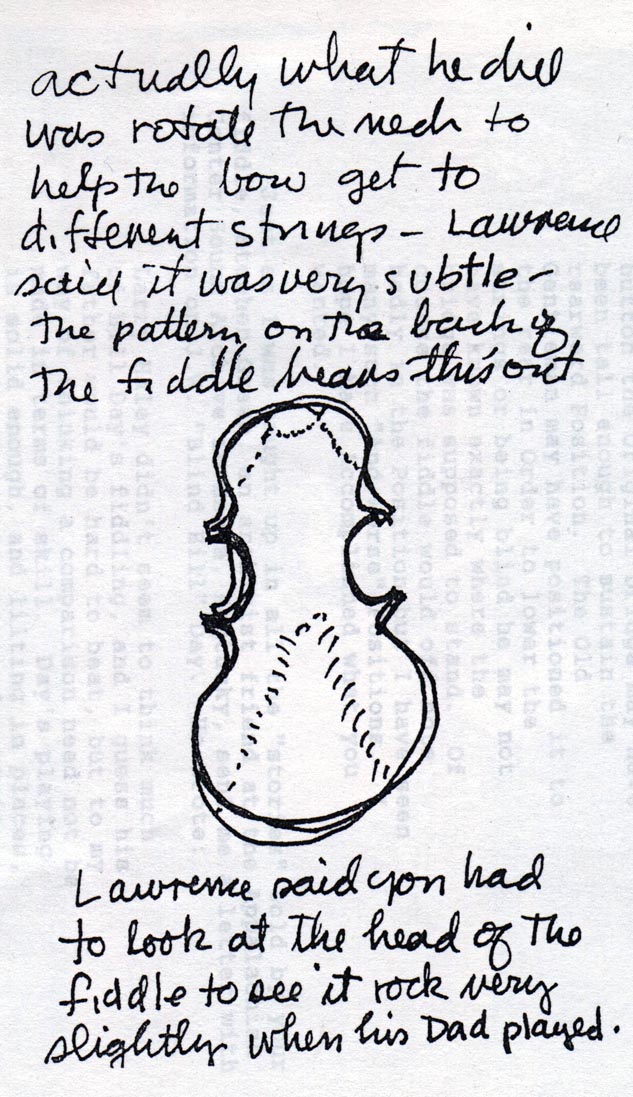
John Hartford sketch of the Ed Haley fiddle, 1992-1997
Writings from my travels and experiences. High and fine literature is wine, and mine is only water; but everybody likes water. Mark Twain
This site is dedicated to the collection, preservation, and promotion of history and culture in Appalachia.
Genealogy and History in North Carolina and Beyond
A site about one of the most beautiful, interesting, tallented, outrageous and colorful personalities of the 20th Century


 Brandon Ray Kirk