• About

Brandon Ray Kirk

~ This site is dedicated to the collection, preservation, and promotion of history and culture in my section of Appalachia.

Brandon Ray Kirk

Tag Archives: Doc Holbrook

In Search of Ed Haley 294

22 Tuesday Apr 2014

Posted by Brandon Ray Kirk in Ed Haley

≈ Leave a comment

Tags

Ashland, Catlettsburg, Catlettsburg Stock Yard, Doc Holbrook, Ed Haley, Ella Haley, Great Depression, history, John Hartford, Kentucky, Lawrence Haley, life, Mona Haley, Ohio, Pat Haley, Ralph Mullins, South Point, Ward Hollow, writing

Pat, slowly becoming the interviewer, asked Mona how far back she could remember and she said, “As far back as I can remember was Halbert Street. I can remember going out in the rain and standing out in the rain while Mom and Pop was fighting or Pop was fighting Mom — which that was probably the way it was. But it takes two to make a fight or an argument. I don’t remember whatever started it. I just remember Pop being mean to Mom, and that was on 45th Street. And the next memory I have is at Ward Hollow. 337 37th Street, that was Ward Hollow. And the next one was at 17th Street. And the next one was back up on 45th Street.”

Pat said, “When they lived on 45th Street that time had to be about ’48, ’49.”

Mona agreed: “It was, because Ralph was a baby. My Ralph.”

Pat said, “Good or bad memories are you talking about?”

Mona kind of laughed and said, “They’re all bad but there had to been some good ones.”

I said, “Bad stuff is easiest to remember. Most history and everything is told in terms of bad things instead of good things. Usually, if you go along a highway, most highway markers that you see commemorate battles and tragedies.”

Mona said, “I remember some good times with Mom. I remember seeing a lot of movies.”

Pat said, “That’s what Larry said. Said you’d see movies while they played.”

Mona said, “Yeah. I can imagine how Mom worried, too. I couldn’t sit there with her. They didn’t let us go too far away.”

Mona said she mostly traveled with Ella as a girl but remembered going with Ed to Doc Holbrook’s office where she watched him reach into her father’s mouth with something that looked like a giant spoon and take out his tonsils. Ed said, “How long do I have to do this?” and Doc answered, “It’s over…” and then they started playing music.

I said, “Did your mom and dad usually play around a movie theatre?” and Mona said, “Seems to me like it might have been a block or two away from the movies but that wasn’t very far.”

I asked what kind of places Ed usually looked for when he first came into a town and she said, “Pop always looked for a courthouse square or a YMCA — something where they’d be a lot of people around. He played at the Catlettsburg Stock Yard a lot, him and Mom.”

We made small talk for a few minutes — the kind that often signals the end of a conversation — when Pat said to Mona, “What do you remember about your childhood other than those bad memories?”

“I remember Mom playing with me and me getting a wash pan and washing her face and her hands and her arms,” Mona said. “Just with Mom, you know. Lawrence and I would take turns doing dishes and cooking for Mom and Pop. I remember playing cowboys and Indians with the boys and they didn’t like me playing with them.”

Mona was apparently quite the tomboy when she was a young girl.

Pat said, “I told John about how harsh they were with you about keeping your dress down and sitting property.”

Mona said, “Yeah, they were. They was rough on me. There wasn’t any ‘Come here, let me have you,’ or no love. Always ‘You do this’ or ‘You do that.'”

Pat said she figured Lawrence had been right in on all that and Mona said, “Why, I’d a whipped Lawrence. You remember Mom sent Lawrence to get me one time — I don’t know where I was – and he said, ‘I can’t.’ She said, ‘Why?’ He said, ‘She can whip me.'”

Pat said, “I’ve heard Mom tell that story. And he used to tattle on you.”

Mona said, “Yeah, he did. But I don’t know if I tattled on him or not. I don’t remember.”

A little later, when they were teenagers, Lawrence was so overprotective of Mona that he cut one of her boyfriends with a knife trying to run him away from the house. Ed was also hard on her boyfriends; he called one of them a “raggedy-ass-son-of-a-bitch.”

Mona told me about her memories of Ed in his later years.

“He retired from playing…period. I remember one time on 45th Street. I came over from South Point, where I lived, and I tried to get Pop to play some for me and Mom said, ‘He’ll never play no more. He’s quit.’ It was a long time after the divorce.”

I asked her if Ed had his beard at that time and she said, “Yes. I used to shave him with a straight razor under his beard. Trim it. He shaved hisself most of the time, but once in a while I’d shave him.”

She said Pop seldom took baths.

“He said it was a waste of water. He was like that guy that said too much bathing will weaken you.”

In Search of Ed Haley 153

19 Monday Aug 2013

Posted by Brandon Ray Kirk in Ed Haley

≈ 1 Comment

Tags

Appalachia, Doc Holbrook, Ed Haley, fiddler, fiddling, history, John Hartford, Laury Hicks, music, West Virginia, Wilson Douglas, writing

I called Wilson Douglas a few weeks later, still blown away by Ed’s incredibly fast fiddling on the Holbrook recordings. I raved about it to Wilson — how it was like a “rush of music” — who showed no surprise that he fiddled with so much of what he called “drive.”

“Now, they’s another tune I thought about that Haley played, he called it ‘Dance Around Molly’,” he said. “My god, Haley could play that. It’s a real good tune. Got a lot of drive about it. ‘They’s so many tunes,’ Ed said, ‘a man can’t learn them all, but I guess he can keep trying.'”

I played Ed’s recording of “Fifteen Days in Georgia” for Wilson and asked him if he played that fast at Laury Hicks’ house.

“About the same, John,” he said. “He was a great hand to play a tune in whatever time it was pitched in. He didn’t overplay his notes. And he played the solid driving note. He didn’t skip over it like skipping over with a motor boat.”

Wilson said one of the tunes that Ed played at Laury Hicks’ grave was “Arkansas Traveler”.

In Search of Ed Haley

27 Thursday Jun 2013

Posted by Brandon Ray Kirk in Ed Haley

≈ Leave a comment

Tags

culture, Doc Holbrook, Ed Haley, fiddle, history, John Hartford, life, music, Paul Holbrook

Ed Haley fiddle, given to Doc Holbrook many years ago

Ed Haley fiddle, given to Doc Holbrook many years ago

In Search of Ed Haley 135

27 Thursday Jun 2013

Posted by Brandon Ray Kirk in Ed Haley

≈ Leave a comment

Tags

Bill Busby, Doc Holbrook, Ed Haley, feud, Greenup, Kentucky, Lawrence Haley, Morehead, Pat Haley, Paul Holbrook, Texas Anna Trumbo, William Trumbo, writing

The next morning, Lawrence and I went to see Dr. Paul Holbrook, son of Ed’s close friend, Dr. H.H. Holbrook of Greenup, Kentucky. Paul hadn’t located the silver cup Ed was supposed to have given his father for delivering Mona in 1930, but did have three very important Wilcox-Gay records his father made of Ed on a “tin machine” in Greenup. On one of the records, Ed played “Fifteen Days in Georgia” and “Wake Up Susan”. On another was Ed’s version of “Over the Waves”, with some Dinah Shore recordings on the flip side. There was also a recording of Doc playing “Ragtime Anna” on December 27, 1941 (supposedly using the fiddle Ed had given him). Paul allowed me to borrow these three records, which I found to be unbelievably scratchy.

Later that day, Lawrence told me more about his mother’s background. He said Ella came from the Trumbos, a somewhat affluent family headquartered in Morehead, Kentucky. Morehead, Lawrence reminded me, was a small college town located thirty miles west of Ashland. Ella’s father William Trumbo — who Lawrence called “Paw” — was an active participant in the early events of the famous Martin-Tolliver feud (a.k.a., the Rowan County War), while her aunt was married to one of the feud’s chief participants, John Martin.

“That’s the feud Larry always talked about until you came along,” Pat said to me. “Mom’s father and apparently her uncle was involved in that.”

Pat and Lawrence knew something about the Trumbos.

“William Trumbo was a large landowner down there on Triplett’s Creek,” Pat said. “That’s where the Trumbos are buried — on the hill behind Triplett’s Creek. We’ve been there. The graves have fallen stones for markers. It was hard for us to get down and inspect them very well to see dates and things.”

Pat told me a little something about Ella’s brother Allie, as well as Texas Anna, who Pat called “Sissy”.

“Sissy. Mom’s sister, had a son, Bill Busby,” Pat said. “I never met Bill Busby but apparently he had a speech impediment and a hearing impediment. And then she was with a man when I came over here in 1949. He was a paper hanger.”

In Search of Ed Haley

04 Saturday May 2013

Posted by Brandon Ray Kirk in Ed Haley

≈ Leave a comment

Tags

Appalachia, culture, Doc Holbrook, fiddler, Jenkins, Kentucky, life, medicine, music, photos, Pike County, U.S. South

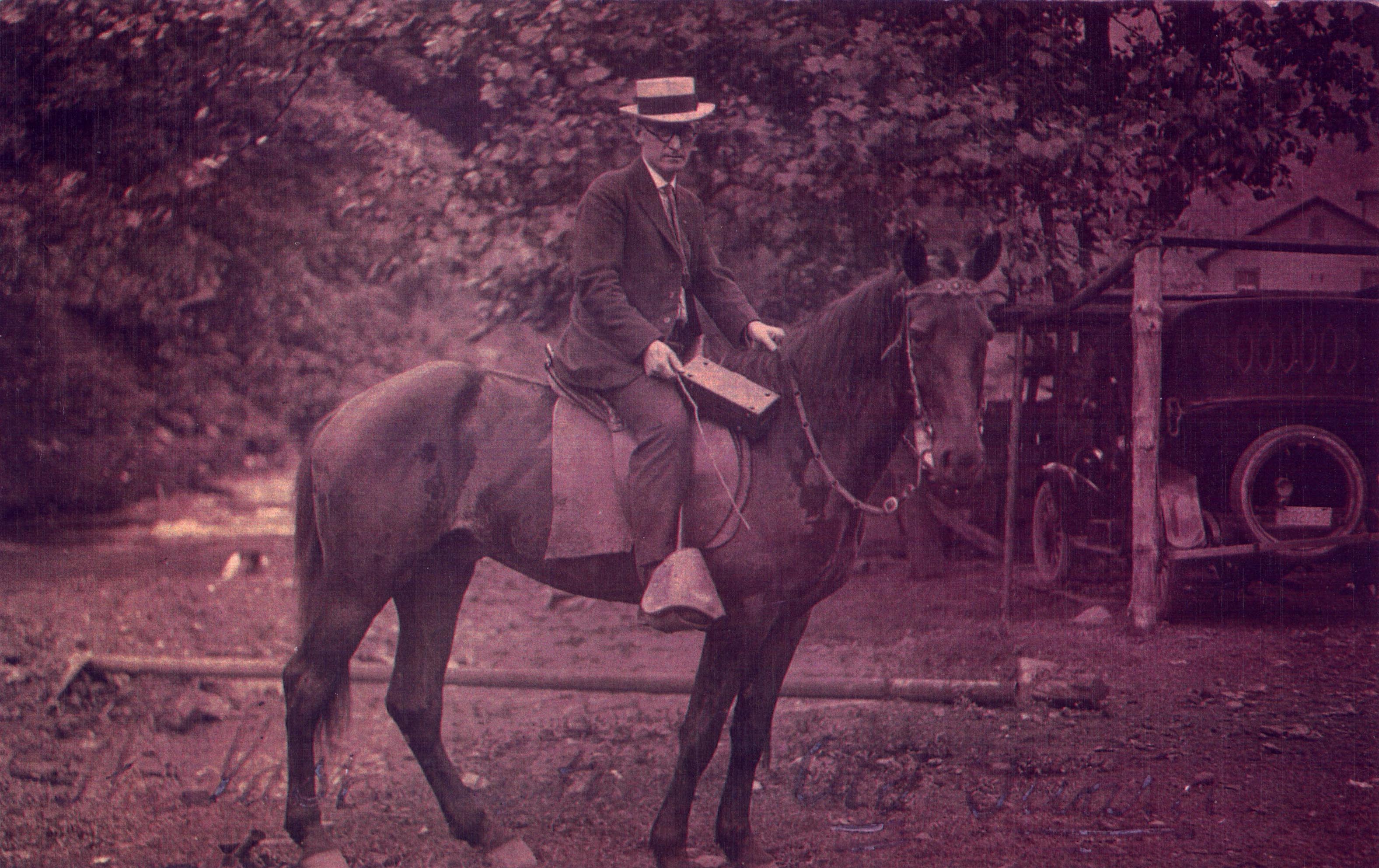
Dr. H.H. Holbrook, Jenkins, Kentucky, circa 1916

Dr. H.H. Holbrook, Jenkins, Kentucky, circa 1916

In Search of Ed Haley 102

03 Friday May 2013

Posted by Brandon Ray Kirk in Ed Haley

≈ Leave a comment

Tags

Doc Holbrook, Ed Haley, fiddle, fiddler, history, J P Fraley, John Hartford, Kentucky, Lawrence Haley, Lexington, music, Paul Holbrook, writing

     Back in Nashville, with Lawrence’s encouragement, I made contact by telephone with Paul Holbrook, a retired general practitioner living in Ashland. Paul’s father, Dr. H.H. Holbrook, had been a good friend to Ed, who once gave him a fiddle and a silver trophy cup for delivering Mona. In talking with Paul, I could tell right away that he was well-educated. He also seemed to be advanced in years; his memory was a little foggy.

     “Well, I think Dad was a friend of his,” he said. “I think he delivered maybe one of his children. Dad fiddled a little bit and he always was interested in hearing Ed play. The fact Dad liked to fiddle and learned to when he was a young boy was the attraction. Other than that, I really can’t tell you a whole lot.”

     I asked Paul if he remembered the names of any of Doc’s tunes and he said, “No, not really. If I heard them I would, but I was never interested much in it.”

     Paul told me as much as he could remember about his father’s fiddling.

     “Dad just played some for his own amusement,” he said. “He must have done most of his playing when he was a young boy or young man maybe playing at some of the country dances. He was from Lawrence County. My grandfather’s farm was between Blaine and Martha.”

     Paul said his father moved a lot after becoming a doctor.

     “Well, he was at Burdine, Kentucky, and Jenkins, Kentucky, many years ago and as far as I know that’s where he first saw Ed Haley. That was up in the coalfields of southeastern Kentucky. And he was in Louisa for a couple of years. And then we moved to Ashland here back in 1922. As far as I know, Ed was down here at that time. I remember seeing him when he and his wife used to play on the street corners back in the twenties. Dad was here for ten years and then moved to Greenup. I believe Ed was down in Greenup once and played some for Dad at home. Now, Dad had made a little recording of Ed in Greenup, Kentucky playing the fiddle on a little old machine and I think I still have the record around someplace. I don’t know what kind of shape it’s in and I’m not even sure I can find it. I can try to find it if you might be interested in it.”

     Lord have mercy.

     What about him giving your dad a silver cup or trophy?

     “I don’t ever remember seeing a cup and I don’t remember ever hearing of it,” Holbrook said.

     What about him giving your dad a fiddle?

     “Yes, Dad had one of his fiddles and my son now has it,” he said. “J.P. Fraley borrowed the old fiddle and I think he used it to make some recordings for the National Archives or someplace in Washington. He had it for a while and brought it back and my son had a friend who had a child who was taking fiddle lessons and he used it some. But I don’t really know what shape it’s in, but the last time I heard my son say anything about it he said it needed some repair.”

     Just before hanging up, Paul gave me his son’s telephone number in Lexington, Kentucky.

     “He teaches some in Lexington at the university and also at Midway College and he comes home up here about every two or three weeks,” he said.

     I asked if he was a doctor, too, and Paul said, “He’s a Ph.D. doctor. He’s not an MD.”

     This was too much: new recordings, one of Ed’s fiddles…

     I called up Paul, Jr. to ask about the fiddle. His speech reminded me a lot of his father, although his mind was quicker, not having been clouded with age. When I mentioned the fiddle, he said, “J.P. Fraley had used it for a while and gotten some blue ribbons with it, but it is in Lexington with me at the moment. It has a very low bridge — a fiddle player’s bridge. I don’t know if it came from Ed Haley in this particular case or not. It is in the case that Grandfather kept it in. It’s difficult for us to say what Grandfather might have done to it. Since Grandfather’s death, nothing has ever changed about it. Grandfather died in 1961. His fiddle playing, I would describe as casual. I don’t think Grandfather was a terribly good fiddler, but he liked to play around.”

In Search of Ed Haley 91

17 Wednesday Apr 2013

Posted by Brandon Ray Kirk in Ed Haley

≈ Leave a comment

Tags

Asa Neal, Bill Day, blind, Bus Johnson, Calhoun County, Camp Crowder, Cincinnati, Clyde Haley, Doc Holbrook, fiddle, fiddler, history, Laury Hicks, Lawrence Haley, Minnie Hicks, Missouri, Mona Holbrook, music, Ohio, Ralph Haley, Ralph Payne, Rosie Day, Sam Vie, Signal Corps, West Virginia, WLW, writing

Clyde said Ed never said “too much” about where he learned to play the fiddle.

“Well, he was blind all his life, since he was a small boy, and he started with a cornstalk.”

Ed did talk about other fiddlers, though.

“Oh, yes,” Clyde said. “He knew Sam Vie and Asa Neal, and all those old-timers. Did you know Bill Day? Well, my dad used to play with him a lot. But Bill Day couldn’t play the fiddle as far as I’m concerned.”

Bill Day’s wife Rosie was a sister to Laury Hicks, Haley’s veterinarian friend in Calhoun County, West Virginia.

“Well, Rosie was Laury’s sister, as I remember,” Clyde said. “Rosie stayed with my mother and helped take care of Mom because my Mom didn’t like to cook in the summertime because of the flies. I got in trouble one time and I had to go stay with Laury and Aunt Minnie. And I stayed with them in my growing up years. Laury was a doctor, you know, and so was Minnie. She’d just go on a horse, travel miles and miles and miles on a horse, to go deliver a baby or something like that.”

Clyde also remembered Doc Holbrook, Ed’s friend in Greenup, Kentucky.

“Yeah, yeah,” he said. “Monnie, my sister, was named after Dr. Holbrook’s wife: M-O-N-N-I-E.”

Clyde was well aware of Ed’s suspicions toward the commercial music industry.

“My dad didn’t ever want his music recorded and it was difficult to get him to get in a position where he would let anybody record his music,” he said. “There was a guy named Bus Johnson in Cincinnati that wanted my dad — I remember — he wanted my dad to come down there to Cincinnati to WLW and get some music recorded for him but he wanted to commercialize it, you know, which I wish he had’ve now. My dad and mother would’ve had a lot better life with the money they could’ve made off the music. I always did tell my dad, ‘Pop, you ought to get those things recorded because you got money laying around in the fiddle case.'”

Talking about Ed’s refusal to make commercial records caused me to ask about his home recordings.

“Him and my mother had over six hundred records,” Clyde said. “Them old records that Ralph sent home out of the Army. He was in the Signal Corps at Camp Crowder, Missouri, and he took a lot of the equipment home — borrowed it from the Army — and my dad and my mother was in on some of the records, too, you know. And Lawrence has got all that kind of information; more than I would have because I’ve been gone from home. I’ve been a roamer, you know. And I used to drink a lot. I don’t think I’ll ever take another drink, but that’s neither here nor there. I’m in this hospital and it’s what it’s for. I had strokes. It’s not a nut-house hospital or anything. It takes care of people like me. I used to drink quite a bit myself, but I’ve made up my mind since I had the strokes that I’ll let that stuff alone when I get out of this place. I talk like it’s a jailhouse, but it’s not. It’s full of women.”

In Search of Ed Haley 58: Slim Clere Recollects Ed Haley

27 Sunday Jan 2013

Posted by Brandon Ray Kirk in Ashland, Ed Haley, Music

≈ Leave a comment

Tags

Appalachia, Ashland, blind, Clark Kessinger, Doc Holbrook, Ed Haley, Ella Haley, fiddle, fiddler, fiddlers, fiddling, Georgia Slim Rutland, history, John Hartford, Kentucky, mandolin, music, Slim Clere

The cassette player was giving Slim fits. I used the opportunity to ask him more about Ed. His answers came swift and sure, leaving little room for doubt.

Me: What kind of strings did Ed Haley use?

Slim: Believe it or not — gut. He used an aluminum-wound A, an aluminum-wound gut D and a silver-wound G. Professional stuff.

Me: Did Ed use a flat bridge or a round bridge?

Slim: I would say a round bridge.

Me: Did he ever talk about who he learned from or any of that?

Slim: No, but I think Clark Kessinger stole some of his stuff.

Me: When Ed played, was it loud?

Slim: He played very soft. He wasn’t rough.

I could hear Slim’s wife talking — she was helping him with the cassette player. Slim told her I was on the other end of the line and she got on the telephone and said, “Are you the one that does the riverboat things? I have seen you on Ralph Emery’s show. I have enjoyed you tremendously because you’re different.” That flattered me, of course, but I had more questions for Slim, who was still battling the tape player.

Me: Did you ever hear Ed sing?

Slim: No, but I’ve heard people say that he could play a guitar well.

Me: Was he easy to get to know?

Slim: He was a very congenial guy. You’d go around where he was playing, he’d hand you his fiddle. “Here,” he’d say. In other words, he was a very cordial guy.

Me: Did you ever see him play away from his wife?

Slim: He always had that woman with him. And when she played with him it seemed like she was straining to keep her eyes closed. She did not have a happy look on her, I remember that. But she played a Taterbug mandolin; they had a good tone.

I asked Slim where he first met Ed and he said, “I knew him a long, long time – maybe 25 years. Down in Ashland, Kentucky. Well, I know exactly where he used to live down there. He lived in a little old four-room house that had a bunch of steps going up on the porch there. And he used to sit out there on the porch and rock and fiddle. I think it was a kind of open rocker. I don’t think the chair had those high handrails on them. It didn’t matter to him. He relaxed that way, see.”

I asked Slim to describe how Ed looked.

“His hair was a kind of a dark brown, I believe,” he said. “He was fair complected and his hands were as soft as a rag. He had a little hand — and his fingers were pointed. It seems to me like his eyes were pretty well blanked out. He didn’t wear glasses, like most blind men do. And his wife didn’t either. He didn’t have too much action. Being blind, he didn’t have any personality or anything like that. You almost had to close your eyes to appreciate the guy. He always had that woman with him. She kept good time. Of course, she didn’t make any runs or nothing. And he had a son that was a good guitar player but he was ashamed to play with Ed and his mother because they were blind.”

Slim remembered Doc Holbrook, although he didn’t necessarily equate him as Ed’s good friend.

“Doc Holbrook is the one that loaned Clark Kessinger a fiddle to play on. See, there was years and years that Clark never did own a fiddle. And when Doc Holbrook wanted his fiddle back, Clark got mad at him for taking his fiddle away from him. Doc said, ‘You’ve had it all this time. Had a chance to buy it and never would.'” I wondered if this was the same fiddle that Ed had given Doc but Slim didn’t know about any of that.

Slim confirmed that Ed was acquainted with Georgia Slim Rutland, the popular radio fiddler. “Yeah, I bumped into Georgia Slim in Macon, Georgia in a contest in 1937 and I was telling him what a great country this was up here and when I came back up here, here he was.” I had heard that Georgia Slim moved to Ashland just to hear Ed Haley and Slim sort of agreed. “Well, he was down there a while. I remember I told him about Ed Haley myself.”

In Search of Ed Haley 55

21 Monday Jan 2013

Posted by Brandon Ray Kirk in Ed Haley

≈ 2 Comments

Tags

culture, Doc Holbrook, Ed Haley, fiddler, history, Ironton, John Hartford, Lawrence Haley, life, Mona Haley, music, Ohio, U.S. South, writing

     I asked Mona and Lawrence how they passed the day when they were young and traveling with Ed.

     “Oh, I’d probably go to a movie,” Mona said. “Mom would give me money and send me to a walk-in movie. Just go get something to eat. Or sit around and watch them. All the people was standing around and most of them was dancing.”

     She and Lawrence said Ella kept a cup attached to the head of her mandolin to catch the money; Pop only put a hat out when playing by himself. He was very serious about his work, Mona said.

     “Most of the time he worked hard,” she said. “When he was working he wouldn’t drink.”

     Lawrence agreed, “He didn’t get much to drink, you know, when he was sitting out on the courthouse square — they wouldn’t have stood for that, for one thing. Maybe at a fair or something he might take a drink or two. Or out on the streets.”

     “Or unless he was at a square dance and somebody would bring him a beer and that’d get him started,” Mona added.

     Mona remembered Pop getting in “a lot” of fiddlers’ contests but didn’t recall any specifically. She said he paid Doc Holbrook for her delivery with 25 dollars and a silver cup he’d won in a contest.

     “We never could get that silver cup back,” she said.

     Lawrence figured Doc’s son had the cup.

     “He’s got a fiddle of Pop’s, too,” he said. “He’s right in Ashland.”

     I wanted to know more about Ed being in contests but everyone kind of drew a blank about it. Mona joked with Lawrence about a time they were in a contest as children.

     “Mom made up a song for me,” she said. “Had me a dress made.”

     I got her to sing it for me.

See my pretty ruffled dress.

See my pretty pocket.

See my pretty handkerchief.

See my pretty locket.

     Lawrence said Mona won first prize in the contest and I was very quick to tell her that to be Ed’s daughter she probably had a lot of musical talent. She wasn’t willing to admit that but said, “I think I got more than any of the boys had.”

     I asked if she ever tried playing the fiddle and she said, “Yeah, I could play ‘Over the Waves’ on a fiddle and that’s it.”

     Okay — I was very curious.

     I asked if she could show me how Ed held the bow and she said sure — that he held it like she holds a pool stick, “real loose with straight fingers.”

     I reached my fiddle and bow to her and she showed me how Pop held the bow (little finger on top of the stick), then started playing “Over the Waves”. Her hands had an incredible economy of motion — almost as if they were “miniaturizing” the music. In watching her, I got a real feel for Ed’s technique and it was hard not to imagine Ed playing in a way similar to Vassar Clements. Mona clapped when I played for her but said I only played “a little bit” like Pop.

Parkersburg Landing 42

29 Saturday Dec 2012

Posted by Brandon Ray Kirk in Ed Haley

≈ Leave a comment

Tags

Doc Holbrook, Ed Haley, fiddle, history, J P Fraley, John Hartford, Kentucky, Laury Hicks, Lawrence Haley, Maysville, music, Sherman Luther Haley, Ugee Postalwait, Wilson Douglas, writing

     I met Lawrence a few weeks later at the Fraley Family Festival near Grayson, Kentucky. He gave me Ed’s newly located bridge and I showed him Ed’s fiddle — pointing out all of the things I had discovered about it. I specifically pointed out a “V-shape” pattern worn into the varnish on its back toward its bottom. At its top were what appeared to be “sweat marks” where Ed rotated the fiddle and slid his fingers up to get notes in second and third position (which contradicted what Snake Chapman had said about him rarely getting out of first position except when, every once in a while a finger would sneak and grab a note or two from the upper positions). As we talked about such things, J.P. Fraley showed up along with Nancy McClellan, a local folklorist.

     After some small talk, I played “Half Past Four” for Lawrence on his dad’s fiddle.

     “Where he got a name like that, I don’t know,” he said. “I think, though, it was possibly when my oldest brother Sherman Luther Haley was born. My mother went into labor about 4:30 in the morning. He was named after one of Mom’s brothers. It was the one that died.”

     I said, “Now, I’m not totally used to these Black Diamond strings and I’m not playing it note for note the way Ed did. I’m just scratching the surface.”

     Lawrence said, “I know. Them old records are hard to hear.”

     “There is so much on them records you wouldn’t believe what’s in there,” I said. “Just all kinds of little things. Like his notes, he gets certain long notes and they’re like words. Some of them are moans. And he uses certain little tones.”

     Lawrence said, “I notice a lot of you guys, it looks like it’s really hard work for you to do this. Pop never had a bit of trouble playing a fiddle. It wasn’t work to him. If he enjoyed the group he was with, you could absolutely hear it in his music. If he had good accompaniment, he’d stay all day.”

     “I’m also curious about that bridge because I think he might have played with a little bit lower action than what I’ve got here,” I said.

     Lawrence said, “Yeah, a little bit lower. You could look at that bridge I brought you.”

     I said, “Yeah, I’ve already had it on and looked at it. The thing that’s interesting about that is if you look at that bridge, that bridge has been handled a lot because he would feel of it and that’s why all that finger grease is on it. I can just see him. What I may do, I may try that on but what I might do is carve a duplicate of that because sometimes when they get old, they’ll crack.”

     Nancy McClellan asked Lawrence, “Were there other fiddlers in the family?” and he said, “No, I couldn’t play. I was left-handed and when I was a little tiny fella I nicked the whole end of this finger off and I didn’t have any meat on the end of it and that hindered me from picking a violin, see. I couldn’t work up a callus on it. Bone’s right underneath it.”

     You know, I’d never really thought much about that — the fact none of the Haley children played the fiddle. Ralph, of course, was a guitar player — but he wasn’t actually Ed’s son. It was only natural that the kids — no matter how intense their exposure or no matter their possible distaste — would at some point pick up a fiddle and at least try it. This had been Lawrence’s confession — and his reason for not carrying it any further.

     J.P. played a little on Ed’s fiddle and commented on the Black Diamond strings. “Have these strings been on there all that time?”

     “No,” I said.

     “Where’d you find them?”

     I said, “I’ve got a friend that used to carry them and he had a couple of sets and he gave them to me.”

     J.P. said, “I can remember when they was a quarter. Wonder what those fiddlers would have done if they’d had access to the strings and stuff that we can get now?”

     There was a little pause then J.P. said, “Remember I was telling you about a tune called ‘Maysville’? It had to do with Maysville, Kentucky. I don’t know where the people in Elliott County learned it. They was a tobacco house down there and those people had to wagon tobacco from back in Elliott County plumb to Maysville to sell it.”

     Lawrence said, “Pop played a lot of pieces named after…”

     J.P. interrupted, “Now he played ‘Maysville’.”

     Lawrence continued, “He played a piece of music that I really liked that he called ‘Catlettsburg’.”

     Lawrence said to J.P., who still held Ed’s fiddle, “That isn’t as fine a fiddle as you played that used to belong to my dad that the Holbrooks got.”

     J.P. said, “Paul’s got it. Well, what he done… That’s a good fiddle, too. He let me have it. I told him if he ever wanted it back… It was in the awfulest shape that ever was. But I had it fixed up. Not embellished now. Just restored. And suddenly Dr. Holbrook’s daughter was gonna take violin lessons. They took it. There’s something else he told me. See, I didn’t know the old Dr. Holbrook…”

     Lawrence said, “He’s the one delivered me.”

     J.P. said, “His son Paul — our doctor — told me that old man Holbrook went to fiddling, too. Well, Paul said that he supposedly took Ed and Ella to Columbus to do a record.”

     Lawrence said, “That was that ‘Over the Waves’, I think. Big aluminum record.”

     J.P. said, “It was the closest thing to a commercial record that Ed ever made.”

     Lawrence spoke some about his father’s travels.

     “Pop didn’t get all the way down into Old Virginia, I don’t think. He made it to Beckley and Bluefield and places like that. I can remember walking from Morehead to Farmers right down the railroad track. They went down there to somebody’s house to play — I was just a kid then — and seemed to me like they played all night.”

     Nancy McClellan said, “Well, that’s what Wilson Douglas said happened up there in Calhoun County, West Virginia. He said a fiddler named Laury Hicks would ask for ‘The Black-Eyed Susan’ and said Laury Hicks would sit there and cry while Ed Haley played.”

     I told about my recent visit with Laury’s daughter Ugee Postalwait and Lawrence said, “When Pop come around and they was playing, she’d get fiddle sticks and she’d just clog around Pop’s fiddle and every time he’d note it she beat the sticks on that. Dance right around him.”

In Search of Ed Haley 11

29 Thursday Nov 2012

Posted by Brandon Ray Kirk in Ed Haley

≈ Leave a comment

Tags

Akron, Appalachia, Asa Neal, Ashland, books, Calhoun County, Catlettsburg, Clay County, Clyde Haley, Columbus, Doc Holbrook, Doc White, Ed Haley, Ella Haley, feud, fiddle, fiddler, fiddlers, fiddling, Greasy George Adams, Greenup, Greenup County, Harts Creek, Ivydale, J P Fraley, Jack Haley, John Hartford, Kentucky, Laury Hicks, Lawrence Haley, Minnie Hicks, music, Noah Haley, Ohio, Over the Waves, Parkersburg Landing, Pat Haley, Ralph Haley, Sanitary Dairy, Ugee Postalwait, West Virginia, writing

Eight days later, I was with Lawrence Haley in Ashland looking at Ed Haley’s fiddle and holding old family photographs while he talked as if he’d just seen his father the day before. Pat was gone for the day, so it was just Lawrence and I, talking carefully in the kitchen with funeral home silence in the background. Lawrence — or Larry, as his wife called him — was a short, stocky man with thinning hair and a very straightforward manner. I could tell that he was a no-nonsense kind of guy and that it would serve me best to walk on pins and needles for a while. I also had the impression that in talking with me he hoped to correct some of the errors in the Parkersburg Landing liner notes. He was very careful with his words. Occasionally one of the Haley grandchildren would come in and sit nearby as quiet as a mouse before leaving to play in the yard.

In the initial small talk, I looked over Ed Haley’s fiddle, which appeared to be of an inexpensive Czech variety. It was stained brown and was without strings and a bridge. According to Lawrence, his father acquired it during the early 1940s. He confirmed that it was the one used to make the home recordings featured on Parkersburg Landing but was not the one pictured on Parkersburg Landing. He said Ed used “regular old steel strings — no cat-gut at all” and remembered that he always kept his fiddle on an old “pump-type” organ at home. He had the bridge somewhere around the house in a drawer, which he promised to find.

“If you ever find that bridge, we ought to rig that thing up and put some strings on it,” I said.

Lawrence reached me Ed’s bow, which he said was the same one he used the last ten years of his life. “He just used the same bow,” he said. “Whenever he got another fiddle, he’d change the bow.” I looked it over and noticed that it was as heavy as a log.

I started questioning Lawrence slowly with important but seemingly mundane questions about Ed’s music. I wondered if Ed knew what key he was playing in and Lawrence said, “Sure. Well, when my brother Ralph first started playing, Pop’d tell him which key to change to in a piece of music. He’d just lean over to Ralph and tell him.”

I asked Lawrence if he remembered the names of Ed’s favorite fiddle players and he said, “I couldn’t tell you, John. He’s mentioned a few fiddle players but I couldn’t tell you their name now.” Lawrence said he didn’t even remember many of Ed’s local fiddling buddies because he was a kid “wanting to get out and do something else.”

“I don’t even remember Doc White as far as that goes,” he said. “But I remember Laury Hicks up in Calhoun County, which is the next county right against Clay County there.”

I had read about Haley’s friendship with fiddler Laury Hicks on Parkersburg Landing. Hicks was a veterinarian in Calhoun County, West Virginia.

“One of Ed’s lifelong friends was an Ivydale physician named Laury Hicks,” it read. “Shortly before he died, Hicks requested that he be able to hear Ed Haley one more time. Ed arrived too late and it is said that he played over Laury’s grave for hours into the night.”

I asked about Asa Neal, the great Portsmouth fiddler. “Yeah, Asa Neal,” Lawrence said. “I’ve heard my dad talk about him. But I never seen the guy to my knowledge.”

He seemed to know the most about a local physician and casual fiddler named Doc Holbrook, whose name J.P. Fraley had mentioned to me. “They was long-time friends,” Lawrence said. “Doc Holbrook was a physician that practiced medicine in the county seat of Greenup County, which is also named Greenup. He was a fiddle buff and apparently a pretty good one because my dad wouldn’t a fooled with him if he hadn’t showed a lot of promise in playing the violin.”

This was a little confusing. Ed apparently had several doctor friends: Doctor Laury Hicks, Doc White and Doc Holbrook.

“They tell a tale about how Pop would come down to Greenup County and he’d go to where Doctor Holbrook had his practice. He had it in part of his home — had a riverfront home there. When Dad would go over to visit Doctor Holbrook, regardless of how many patients Doctor Holbrook had in his office, he’d shut his office up — he might have a half a dozen patients sitting out there — and him and Pop’d go in and play the fiddle half the day. That’s hear-say, but that’s what they tell me.”

I really liked that image.

Lawrence said his father made a recording for Doc one time, which he assumed was in the hands of Holbrook family descendants.

“Doctor Holbrook wanted this particular piece of music called ‘Over the Waves’ and he bundled my dad and mother up one day and, since there was no recording studios around this area, he took them to Columbus, Ohio where they had a good soundproof recording studio and had them make this piece of music. Now, whether they was other pieces of music made at the same time, I really don’t know. There probably was.”

In addition to giving Doc records, Ed also gave him a fiddle. “Pop had a real good copy of a Stradivarius, and it had a real good mellow tone and a real good solid deep resonance to it,” Lawrence said. “I think it was the one that he give to Doc Holbrook.” Lawrence said it was also still in the Holbrook family. “Doc had a son who had an office down at the Second National Bank Building and he inherited that fiddle,” he said. “J.P. Fraley was supposed to’ve taken that fiddle to the Smithsonian or at some kind of a centennial or something. But that was Pop’s fiddle.”

I asked Lawrence if his father had perfect pitch.

“Yes,” he said. “He never used a pitch pipe or anything. He tuned the fiddle by ear. One of his fiddles, I think had that little tuner on that high key. I never seen one on every string, though. It took him maybe four or five thumps on his strings to get them in tune. You know, them keys would get awful dry and squeaky in their pegs — in their holes — and they’d strip a lot of times and if it was a real dry season or something and it wasn’t holding in tune, he’d blow moist breath on them pegs to get them to hold in place.”

Lawrence had no idea where Ed got any of his tunes, except for one song.

“My dad and mother used to say they played a certain piece of music they heard from this old fella by the name of Greasy George. I won’t say his last name. Greasy George had apparently stolen a pig from somebody and had put it in a small pen close to the house. And two or three days later, he was sitting on the porch playing the fiddle and he saw the sheriff coming up the drive and he began to play a piece of music my dad plays. I don’t know the name of it, except that it went something like this: ‘Shove that hog’s foot further in the bed, further in the bed, further in the bed. Shove that hog’s foot further in the bed. Katy, can’t you understand me now?’ And his purpose in singing those words was trying to get his wife to hide that pig under a blanket, I think. Or that’s what my dad and mother inferred to me — that he wanted his wife to hide that pig somewhere. Mom was telling me about it.”

I asked Lawrence how Ed met his mother.

“I really don’t know,” he said. “Pop was either in Catlettsburg or somewhere around here close. My grandfather on my mother’s side, he moved from Morehead up here to Ashland. People followed work wherever they could get it. My granddad was an old timber man, I guess. They mighta been some work around here for him. In fact, I’m pretty sure at the time my dad met my mother, my grandfather was working at an old stave mill over here — where they make barrel staves. I guess Pop was playing and somebody heard him and told my mother that she ought to come hear him play. Somebody thought that my mother — which was supposed to be a trained musician — they wanted her to hear this old fiddle player. And they got them together that-a-way, I guess. Just a chance-type meeting. They got together and raised a family.”

Lawrence tried to describe the extent of Pop’s travels, a crucial detail in ascertaining the extent of his influence as he was primarily a non-recording, non-radio fiddler. “His travels, as far as being too enormously wide, was restricted to about a three state area, I guess. But apparently his influence got around eventually. Like you say, he might be the granddaddy of Texas style contest music. Far be it from me to dispute it. I really think if he’d been around during the sixties when old-time fiddling was coming back and everybody was wanting to hear this fiddle music, I think he could’ve been worth something. I think he could’ve made a little bit of money at that time. And he might not’ve wanted to do that, see. He didn’t want to do it back in the twenties when they was making recordings around.”

I said, “Well, he’d been on the street. He knew what was going on out there. That’s where life is lived.”

Lawrence said, “Well, that’s why he always steered away from these commercial record companies. The way I feel about my dad, if somebody wants to learn about his music or play it, maybe it might not be completely forgotten. I don’t want to make a dime out of it. If there’s any money anywhere to be made out of it that might come to Pop, turn it over to the Foundation for the Blind. I don’t want to make anything off of my dad. He brought me into this world and raised me up and I’ve had a pretty good life.”

I asked Lawrence what Ed did when he was sitting around home and he said, “He liked to chew tobacco. He’d take this old twist — Stader’s twist, they called it — and he’d take his pocketknife and cut that up and put it down in his pocket. It was picked right off a farm. In fact, that picture of him on the front of that album, I think he had a chew of tobacco in his mouth then. He always carried a vegetable can with him to spit in. Mom never did like it but it was just almost a part of him when he was around the house, except when he’d get out on the porch — then he’d spit out in the yard.”

Lawrence said his dad liked to play music on the porch.

“We lived down on 17th Street and he’d get out on the front porch with that banjo or fiddle and he’d sit on the front porch and play. He’d cross his legs and sit up on the banister where he could spit easy or he’d just sit down with a banjo and play it.”

Lawrence had no clue what happened to Ed’s banjo. “It was one of those things that left when I was in the service, I guess. And Mom’s mandolin disappeared. The accordion my mother had, she let Aunt Minnie have it because Aunt Minnie played the organ some and she wanted to try that accordion. They took it up there and she left it up there for Aunt Minnie and then the house burnt down. It was not a very expensive accordion.”

Aunt Minnie, Lawrence said, was Laury Hicks’ widow in Calhoun County, West Virginia. Lawrence mentioned that I should get in touch with their daughter, Ugee (Hicks) Postalwait, in Akron, Ohio. “I guess she must be close to 81 or 82,” he said. “She was a young woman when I was just a kid. She would dance around Pop when he played and while he was noting the fiddle she’d be up there hitting them strings that he was noting. It had a real nice little ring to it. She heard him like these people hear you right now. She heard him live, danced around it and played on it and everything else. She said all that scratch on the records didn’t sound like Ed Haley. It’s not the same.” I said I would call Ugee when I got back to Nashville.

Lawrence told me a little about his childhood trips to Harts Creek — the place of Ed’s birth. “Most of the time we’d ride the train up there and get off at Harts and then maybe walk and it seemed to me like it took us half the day to get up Harts Creek. You’d ford that creek half a dozen times and the road was in the creek half time time.”

I asked him if Ed carried his fiddle all the way up there and he said, “Most of the time he carried the fiddle. I’ve seen him carry nothing but a fiddle — not even a case a lot of times. He’d carry it out in the open.” He said Ed never played it or thumped on it while walking — “he’d tuck it under his arm and go.” What if it rained? “That’s another thing,” he said. “I can’t remember any instance like that, but I imagine he’s had instances like that. But I know he has went around with a fiddle with no case — just a fiddle and a bow. Same way with Mom. She didn’t have a case for her mandolin.”

At that point, Lawrence showed me several family photographs, including a wonderful picture of his family just before his birth in 1928.

“I was born just a year before the Depression hit,” he said. “They was two of us just babies when the Depression started. Ralph, Clyde, Noah and Jack were stepped from five to fifteen. A lot of times it was skimpy eating and at other times it was pretty good. We never starved or anything. We’d go down to an old dairy just below us called Sanitary Dairy and get a big lard bucket full of buttermilk for a dime, and I could take a piece of cornbread and a glass of buttermilk and make a meal out of it. I’ve done that a lot. I’ve taken ten cents when Mom could scrape up a dime and us kids would all walk downtown to one of them ten-cent movies and stay all day and be starving to death when we came home and there wouldn’t be nothing but cold cornbread and pinto beans or something like that. That’s the way our life went, during the Depression anyway.”

There was another remarkable photo of Ed and his family just after the Depression started. “Everybody can tell you about hard times in the Depression,” Lawrence said. “I know in my second summer Mom said she fed me fresh corn and I took the trots and liked to wasted away from diarrhea. That was about 1930. We made it anyway.”

As Lawrence showed me a few family pictures, his wife Pat showed up with a few of her “bingo buddies.” Pat was a very polite English lady with dark hair and a small frame who wore large glasses. We said our “hellos” and I played a few tunes.

Once the guests left, I spoke more about Ed Haley with Pat and Lawrence in the kitchen. With Pat’s presence, Lawrence’s demeanor was a little different. I could tell that he wanted to present his dad to me in just such a way and he almost openly resented any input from Pat. There was a slight tension in the air. At one point, Lawrence said to Pat, “Go ahead Pat. You tell it. You know more about it than I do.” Pat took it all in stride. She just wanted to be helpful. In any case, Lawrence gave me the impression — and this was very important — that if I did or said anything to his disfavor I would be more than welcome to hit the road. Ironically, and contrary to what I had heard, he seemed more over-protective of his father’s story than his music. Needless to say, it took me a while to get up enough nerve to pull out my tape recorder and record his memories.

In Search of Ed Haley 7

26 Monday Nov 2012

Posted by Brandon Ray Kirk in Ed Haley

≈ Leave a comment

Tags

Appalachia, Ashland, Billy in the Lowground, Birdie, Blackberry Blossom, blind, books, Catlettsburg, Charleston, Clovis Hurt, Columbus, Doc Holbrook, Ed Haley, fiddle, fiddler, Flannery's Dream, Forked Deer, Grayson, Greenup, history, J P Fraley, James A Garfield, John Hartford, Kentucky, Lawrence Haley, logging, Morehead, music, Ohio, Old Sledge, Parkersburg Landing, Portsmouth, Ralph Haley, Rounder Records, Route 60, Snake Chapman, Soldiers Joy, Tennessee Wagner, The Wild Rose of the Mountain, West Virginia, Wild Wagner, writing

A few days later, while re-reading the liner notes for Parkersburg Landing, I focused in on the name of J.P. Fraley as one of the informants for Ed’s biographical information. Encouraged by my success in contacting Snake, I got J.P.’s telephone number from a mutual friend and just called him up. He lived near Grayson, Kentucky, a small town southwest of Ashland and roughly mid-way between Ashland and Morehead on Route 60. I could tell right away that Ed Haley was one of his favorite subjects.

As soon as I mentioned Haley’s album, J.P. just took off. “You know, he never did make a commercial record. Those little old things, they had a cardboard center. They was home recordings. At the time, Rounder was a making the record that I did, The Wild Rose of the Mountain, and I told them about Ed Haley. And we was lucky with Lawrence, one of his boys…”

J.P. stopped.

“John, I’ll tell you quickly the story of it. Lawrence was really proud of his daddy, but people around Ashland would say, ‘Aw, he was just a bum.’ Well, he wasn’t a bum. Anyway, I got a hold of Lawrence and he was dubious about even letting us make an album of the records. He was pretty well put out because his daddy never did get recognition, but I told him Rounder was legitimate. He said, ‘I’ll go with you and take them records.’ He insisted on it. He was on the verge of being a retired postman. So he went to the Smithsonian and finally come out with the album. It tickled me to death that they did it.”

J.P. paused and then said, “Well, so much for that. I’m on your nickel,” – as if what he’d just told me was something I didn’t really care to hear.

I asked him to tell me more, specifically about his memories of seeing Haley on the street. He said, “You know, he fascinated me. When I was just a kid learning to fiddle, my daddy was a merchant. He’d take me into Ashland and stand me on the street just to listen to this blind fiddler and his boy play. I was about twelve or fourteen. Well, even earlier than that I was listening to him on the street – watching him – and I swear to god, his fingers, when he played the fiddle just looked like they was dancing. It was out of this world. Now, I don’t know which world’s fair it was, but they picked him up – I think it was Mr. Holbrook, the doctor – and took him to the world’s fair and the critics in New York – might have been ’35 or somewhere in there – wrote about him. Said he was a ‘fiddling genius.’ Just what I already knew, and I was just a kid.”

In the 1940s, one of J.P.’s friends, Clovis Hurt, had a run-in with Haley at Murphy’s Ten Cent Store in Ashland. “Clovis Hurt played fiddle in a band. He discovered Ed playing on the street and it just had him washed away. So Clovis told Ed that he was a fiddler. Ed said, ‘Have you got a fiddle?’ He said, ‘Yeah.’ Ed said, ‘Where’s it at?’ He said, ‘It’s in the car.’ Ed said, ‘Get it and play me a tune.'” J.P. chuckled. “Now, this happened. They was several of us around there when this took place. Clovis never did like Ed after what happened. He got his fiddle out and he played a tune called ‘Grandmaw’s Chickens’. It sounded like a whole flock of them – scared chickens. Ed said, ‘Listen, I wanna tell you something. Don’t you play the fiddle in public anymore. You’re just a learning it a little bit.’ Clovis hated him. Well, I mean he didn’t hate him, but he said he didn’t like him. Said he didn’t have any personality. I said, ‘Well, Clovis, he didn’t have to have. He made it with the fiddle.’ But he was nice enough.”

So Ed wasn’t afraid to speak his mind, even though he was blind?

“Oh, no,” J.P. said. “I’ve heard him get loud. He would actually try to fight if somebody bothered him. He’d tell them, ‘Come around here.'”

Haley apparently had a cranky side: according to Parkersburg Landing, he “was known for his irascible moods and anyone who did not properly appreciate music was liable to his scorn.

I asked J.P. about Haley’s fiddle and he said, “Well, Ed wouldn’t fool with a cheap instrument. Over the years, he had several fiddles. This doctor I told you about – Doc Holbrook – he had one of Ed’s fiddles and I got to keep it for two or three years.”

As for Haley’s technique, J.P. said he “leaned” the fiddle against his chest when playing and held the bow at its end. I wondered if he played long or short bow strokes. “He done it both. I know when he played for his own benefit he used more bow. But he played a lot for dances and as they used to say they had to play ‘quick and devilish.'”

Did he play in cross-key?

“Oh Lord, yeah.”

What about bluegrass music? Did he like it?

“I honestly don’t think Ed woulda fooled with it. He didn’t do a whole lot of double-stopping or too many minors and stuff.”

Being an avid collector of fiddle tunes, I was very curious about Haley’s repertoire. J.P. said, “Oh, Lord. I play some of his tunes: ‘Birdie’ and ‘Billy in the Lowground’. And he played tunes like ‘Old Sledge’. He played all the standards like ‘Soldiers Joy’ and ‘Forked Deer’ and all of that. ‘Wagner’. He didn’t call it ‘Tennessee Wagner’, but he called it ‘Wild Wagner’. He played a tune that I woulda loved to learned – one called ‘Flannery’s Dream’. He was limited but now he would play hymns, too – especially on the street, on account of this is the whole Bible Belt. He played some waltzes. They were crudely pretty. I don’t remember him a singing at all, but now I have heard his wife sing and him backing her on the fiddle.”

I asked J.P. if he remembered Haley playing the eastern Kentucky version of “Blackberry Blossom” and he said yes – that he played it, too. He knew a little bit about the tune’s history: “Well, General Garfield was a fiddler. A lot of people didn’t know it. I guess it had to be in the Civil War. The ‘Blackberry Blossom’ – the old one – was General Garfield’s favorite tune. Ed – I never will forget it – he told me that that was General Garfield’s ‘Blackberry Blossom’.” This “Garfield’s Blackberry Blossom”, J.P. said, was a different tune entirely than the one made famous by Arthur Smith. J.P. said local fiddler Asa Neal also played the tune. “He was from around the Portsmouth area. He’s dead, and he was quite a fiddler. Now, he knew Ed. Fact of the matter, he learned a lot from Ed, but he was about Ed’s age.”

J.P. said Haley never talked about where he learned to play. “I have an idea that it was probably a lot like I learned. See Catlettsburg was a jumping off place, I call it, for loggers and coal miners and rousters and so forth, and they was always some musicians in them. And Ed had this ability – he couldn’t read – but he had an ear like nobody’s business. If he heard a tune and liked it, he’d play it and he’d just figure out his own way to do it.”

J.P. was on a roll: “See, Ed has become more or less of a legend now…and rightfully so. His range was from, say, Portsmouth, Ohio to Ashland, Catlettsburg, and up to Charleston, West Virginia. I think he was at Columbus, Ohio, and then he went to the world’s fair. He played consistently up and down the river. He made good money on the boats.”

I asked J.P. how Haley got around to all of those places and he said, “What he would do, especially when that boy was living… He drank all the time and it was easy for him with his cronies. Somebody would move him here or yonder in a car. But now, like if he was a going to Portsmouth or someplace, usually Mr. Holbrook – he lived down at Greenup – he’d take him anywhere he wanted him to. And doctored him. I mean, if he got sick or anything, he took care of him.”

Doc Holbrook “was a pretty famous doctor in the area. He was known pretty well for a pneumonia doctor, which was hard to find then.”

J.P. kept mentioning “that boy” – meaning one of Haley’s sons – so I asked him about Haley’s family, particularly Lawrence. He said, “Fact of the matter, I didn’t know Lawrence at all. I had done something. I don’t know what it was. I think I’d played at the Smithsonian and had given Ed credit for some of the tunes and Lawrence read about it. And he called me and he almost cried thanking me for recognizing his daddy for what he could do. You see, when it comes to his daddy, he’s got up like a shield. He’ll say, ‘You can come this far, but you ain’t gonna go no farther.’ But once you know him, well, he became a good friend of mine. Now Annadeene, my wife, she worked with his wife a little while at a sewing factory and she broke a lot of ice, too. They’re on good terms with us.”

I told J.P. how much I’d like to meet Lawrence and his family sometime and he said, “Well, I’ll tell you, John. You’re welcome to yell at us anytime you want to and we’ll get you in contact with them.”

Feud Poll 1

If you had lived in the Harts Creek community during the 1880s, to which faction of feudists might you have given your loyalty?

Categories

  • Adkins Mill
  • African American History
  • American Revolutionary War
  • Ashland
  • Atenville
  • Banco
  • Barboursville
  • Battle of Blair Mountain
  • Beech Creek
  • Big Creek
  • Big Harts Creek
  • Big Sandy Valley
  • Big Ugly Creek
  • Boone County
  • Breeden
  • Calhoun County
  • Cemeteries
  • Chapmanville
  • Civil War
  • Clay County
  • Clothier
  • Coal
  • Cove Gap
  • Crawley Creek
  • Culture of Honor
  • Dingess
  • Dollie
  • Dunlow
  • East Lynn
  • Ed Haley
  • Eden Park
  • Enslow
  • Estep
  • Ethel
  • Ferrellsburg
  • Fourteen
  • French-Eversole Feud
  • Gilbert
  • Giles County
  • Gill
  • Green Shoal
  • Guyandotte River
  • Halcyon
  • Hamlin
  • Harts
  • Hatfield-McCoy Feud
  • Holden
  • Hungarian-American History
  • Huntington
  • Inez
  • Irish-Americans
  • Italian American History
  • Jamboree
  • Jewish History
  • John Hartford
  • Kermit
  • Kiahsville
  • Kitchen
  • Leet
  • Lincoln County Feud
  • Little Harts Creek
  • Logan
  • Man
  • Matewan
  • Meador
  • Midkiff
  • Monroe County
  • Montgomery County
  • Music
  • Native American History
  • Peach Creek
  • Pearl Adkins Diary
  • Pecks Mill
  • Peter Creek
  • Pikeville
  • Pilgrim
  • Poetry
  • Queens Ridge
  • Ranger
  • Rector
  • Roane County
  • Rowan County Feud
  • Salt Rock
  • Sand Creek
  • Shively
  • Spears
  • Sports
  • Spottswood
  • Spurlockville
  • Stiltner
  • Stone Branch
  • Tazewell County
  • Timber
  • Tom Dula
  • Toney
  • Turner-Howard Feud
  • Twelve Pole Creek
  • Uncategorized
  • Warren
  • Wayne
  • West Hamlin
  • Wewanta
  • Wharncliffe
  • Whirlwind
  • Williamson
  • Women's History
  • World War I
  • Wyoming County
  • Yantus

Feud Poll 2

Do you think Milt Haley and Green McCoy committed the ambush on Al and Hollene Brumfield in 1889?

Blogroll

  • Ancestry.com
  • Ashland (KY) Daily Independent News Article
  • Author FB page
  • Beckley (WV) Register-Herald News Article
  • Big Sandy News (KY) News Article
  • Blood in West Virginia FB
  • Blood in West Virginia order
  • Chapters TV Program
  • Facebook
  • Ghosts of Guyan
  • Herald-Dispatch News Article 1
  • Herald-Dispatch News Article 2
  • In Search of Ed Haley
  • Instagram
  • Lincoln (WV) Journal News Article
  • Lincoln (WV) Journal Thumbs Up
  • Lincoln County
  • Lincoln County Feud
  • Lincoln County Feud Lecture
  • LinkedIn
  • Logan (WV) Banner News Article
  • Lunch With Books
  • Our Overmountain Men: The Revolutionary War in Western Virginia (1775-1783)
  • Pinterest
  • Scarborough Society's Art and Lecture Series
  • Smithsonian Article
  • Spirit of Jefferson News Article
  • The Friendly Neighbor Radio Show 1
  • The Friendly Neighbor Radio Show 2
  • The Friendly Neighbor Radio Show 3
  • The Friendly Neighbor Radio Show 4
  • The New Yorker
  • The State Journal's 55 Good Things About WV
  • tumblr.
  • Twitter
  • Website
  • Weirton (WV) Daily Times Article
  • Wheeling (WV) Intelligencer News Article 1
  • Wheeling (WV) Intelligencer News Article 2
  • WOWK TV
  • Writers Can Read Open Mic Night

Feud Poll 3

Who do you think organized the ambush of Al and Hollene Brumfield in 1889?

Recent Posts

  • Logan County Jail in Logan, WV
  • Absentee Landowners of Magnolia District (1890, 1892, 1894)
  • Charles Spurlock Survey at Fourteen Mile Creek, Lincoln County, WV (1815)

Ed Haley Poll 1

What do you think caused Ed Haley to lose his sight when he was three years old?

Top Posts & Pages

  • U.B. Buskirk of Logan, WV (1893-1894)
  • Vance Homeplace and Cemetery on West Fork (2017)
  • Tice Elkins in Ferrellsburg, WV
  • Red Rock Cola in Logan, WV (1939)
  • Tom Chafin Recalls Story of Ellison Hatfield's Killing (1989)

Copyright

© Brandon Ray Kirk and brandonraykirk.wordpress.com, 1987-2023. Unauthorized use and/or duplication of this material without express and written permission from this blog’s author and/or owner is strictly prohibited. Excerpts and links may be used, provided that full and clear credit is given to Brandon Ray Kirk and brandonraykirk.wordpress.com with appropriate and specific direction to the original content.

Archives

  • February 2025
  • January 2025
  • October 2023
  • September 2023
  • December 2022
  • November 2022
  • May 2022
  • April 2022
  • February 2022
  • November 2021
  • October 2021
  • September 2021
  • June 2021
  • May 2021
  • April 2021
  • March 2021
  • February 2021
  • January 2021
  • December 2020
  • November 2020
  • October 2020
  • July 2020
  • June 2020
  • May 2020
  • April 2020
  • March 2020
  • February 2020
  • January 2020
  • December 2019
  • November 2019
  • October 2019
  • September 2019
  • August 2019
  • July 2019
  • June 2019
  • May 2019
  • April 2019
  • March 2019
  • February 2019
  • January 2019
  • December 2018
  • November 2018
  • October 2018
  • September 2018
  • August 2018
  • July 2018
  • June 2018
  • May 2018
  • April 2018
  • March 2018
  • February 2018
  • January 2018
  • December 2017
  • November 2017
  • October 2017
  • September 2017
  • August 2017
  • July 2017
  • June 2017
  • May 2017
  • April 2017
  • March 2017
  • February 2017
  • January 2017
  • December 2016
  • November 2016
  • October 2016
  • September 2016
  • August 2016
  • July 2016
  • June 2016
  • May 2016
  • April 2016
  • March 2016
  • February 2016
  • January 2016
  • December 2015
  • November 2015
  • October 2015
  • September 2015
  • August 2015
  • July 2015
  • June 2015
  • May 2015
  • April 2015
  • March 2015
  • February 2015
  • January 2015
  • December 2014
  • October 2014
  • September 2014
  • August 2014
  • July 2014
  • June 2014
  • May 2014
  • April 2014
  • March 2014
  • February 2014
  • January 2014
  • December 2013
  • November 2013
  • October 2013
  • September 2013
  • August 2013
  • July 2013
  • June 2013
  • May 2013
  • April 2013
  • March 2013
  • February 2013
  • January 2013
  • December 2012
  • November 2012

Enter your email address to follow this blog and receive notifications of new posts by email.

Join 2,925 other subscribers

Tags

Appalachia Ashland Big Creek Big Ugly Creek Blood in West Virginia Brandon Kirk Cabell County cemeteries Chapmanville Charleston civil war coal Confederate Army crime culture Ed Haley Ella Haley Ferrellsburg feud fiddler fiddling genealogy Green McCoy Guyandotte River Harts Harts Creek Hatfield-McCoy Feud history Huntington John Hartford Kentucky Lawrence Haley life Lincoln County Lincoln County Feud Logan Logan Banner Logan County Milt Haley Mingo County music Ohio photos timbering U.S. South Virginia Wayne County West Virginia Whirlwind writing

Blogs I Follow

  • OtterTales
  • Our Appalachia: A Blog Created by Students of Brandon Kirk
  • Piedmont Trails
  • Truman Capote
  • Appalachian Diaspora

BLOOD IN WEST VIRGINIA is now available for order at Amazon!

Blog at WordPress.com.

OtterTales

Writings from my travels and experiences. High and fine literature is wine, and mine is only water; but everybody likes water. Mark Twain

Our Appalachia: A Blog Created by Students of Brandon Kirk

This site is dedicated to the collection, preservation, and promotion of history and culture in Appalachia.

Piedmont Trails

Genealogy and History in North Carolina and Beyond

Truman Capote

A site about one of the most beautiful, interesting, tallented, outrageous and colorful personalities of the 20th Century

Appalachian Diaspora

  • Subscribe Subscribed
    • Brandon Ray Kirk
    • Join 787 other subscribers
    • Already have a WordPress.com account? Log in now.
    • Brandon Ray Kirk
    • Subscribe Subscribed
    • Sign up
    • Log in
    • Report this content
    • View site in Reader
    • Manage subscriptions
    • Collapse this bar
 

Loading Comments...