• About

Brandon Ray Kirk

~ This site is dedicated to the collection, preservation, and promotion of history and culture in my section of Appalachia.

Brandon Ray Kirk

Tag Archives: crime

In Search of Ed Haley 219

07 Tuesday Jan 2014

Posted by Brandon Ray Kirk in Ed Haley, Green Shoal, Harts, Lincoln County Feud, Music, Toney

≈ Leave a comment

Tags

Appalachia, banjo, Bell Morris, Billy Adkins, Brandon Kirk, Bud Workman, Bumble Bee, Charley Davis, crime, Dave Dick, Don Morris, Ed Haley, Greasy George Adams, Green McCoy, Green Shoal, Harts, history, Hollena Brumfield, Hollene Brumfield, Hugh Dingess, Irvin Workman, Milt Haley, Peter Mullins, Ranger, Route 10, Toney, writing

Back at Billy’s, the subject of the “murder table” came up again. Supposedly, the table upon which Milt and Green had eaten their last meal somehow eventually ended up in the possession of Billy’s family. He suggested visiting his aunt Don Morris, who as a child had eaten from the table many times. Taking the cue, we loaded in the car and drove up Route 10 to Don’s house. Don lived at Toney, a small residential settlement just upriver from Green Shoal.

Don was a pleasant lady — very eager to help — and was aged probably in her seventies. After all the introductions, I asked her about the table. She said her grandfather Irvin Workman must have gotten it soon after the 1889 troubles. “He had it way back when he was raising his family,” Don said. “Then my dad, Bud Workman, when he moved out with my mother, they took the table with them.”

I asked, “Who told you that table was the Haley-McCoy table?” and she said, “My dad. It was in his father’s house before it was in his.”

“And you said that people would come by to see it?” I asked. “Who would come to see it?”

Don said, “I imagine it was relatives of the people that was involved in it.”

Don seemed to remember the table well, so I asked her for some paper so I could try to sketch it based on her memories. I started out asking about the length of the table, the style of its legs, and so forth…estimating everything by comparing it to Don’s current table. It was like doing a police sketch. After I had a rough drawing of the table, I asked her about the size and angle of the bullet holes.

Satisfied, I asked Don if she’d heard anything about Milt and Green’s death.

“It was pretty complicated,” she said. “Well, they got those men in and fed them. They knew they was gonna kill them all the time and they let them eat first. I can’t remember too much about the actual thing, because they didn’t talk too much about it in the family. Grandpa did sometimes. Well, I understood they shot them around the table after they ate. But it was execution style. Now, I couldn’t swear to it.”

Don figured the only light in the room was a kerosene lamp in the middle of the table. There was a story, Brandon said, that Hugh Dingess “shot out the lights” just before the murders — which presumably meant this lamp. While this may have occurred (perhaps so no one could witness the subsequent murders and thus testify in a future trial), it seemed unlikely. I mean, the room was probably really crowded if only half the people supposedly there were actually there and shooting in the room would have seemed dangerous. Of course, shooting a kerosene lamp could have set the whole house on fire.

“Well, I have heard they did, and I’ve heard they didn’t, so I couldn’t say which is true,” Don said of the lights. “I don’t think they could have without burning down the table.”

Brandon asked, “Was one of the men supposed to have played music before they killed him?” and she said, “He sang, didn’t he? It seems to me he played the banjo and sang a song. I guess they thought since they was going out anyway they might as well go out in style.”

I said, “Now, I heard that the wives went down there to try to plead for their lives and they turned them away. Have you ever heard that?”

Don answered, “Yes, I’ve heard that, but whether or not it’s true I’m not sure. My husband’s mother Bell Morris was related to the McCoys.”

I said, “Just for the record, what happened to that old house?” and she said, “I bet it burned.”

Don wondered why I was so interested in Milt Haley and I explained that I was researching the story of his son, Ed Haley, of which he was a very important part. I asked if she ever heard Ed play and she said, “I’m not sure, seems that maybe I did a long time ago. I think Haley played with Dave Dick. Dave played banjo. He was blind.” Brandon said Charley Davis had described Dick as a “pretty good” banjo-picker who mostly played “little ditties” like “Bumble Bee”. He lived downriver around Ranger but stayed in Harts for a week or so at a time with different families, sometimes playing for dances. Kids used to imitate him by bumping into things.

After mentioning Ed’s name to Don our conversation dwindled off to me asking if she knew people like Peter Mullins, Greasy George, or Hollena Brumfield. She gave answers like, “Well, I used to know a Peter Mullins. His foot was turned back. I remember watching him go up the hill there at the house.” As for Hollena Brumfield: “I knew one down here at this big old house at Hart. They put in a restaurant and you know it didn’t do too well. She said, ‘We got hotdogs on ice.’ Yeah, I knew those people.”
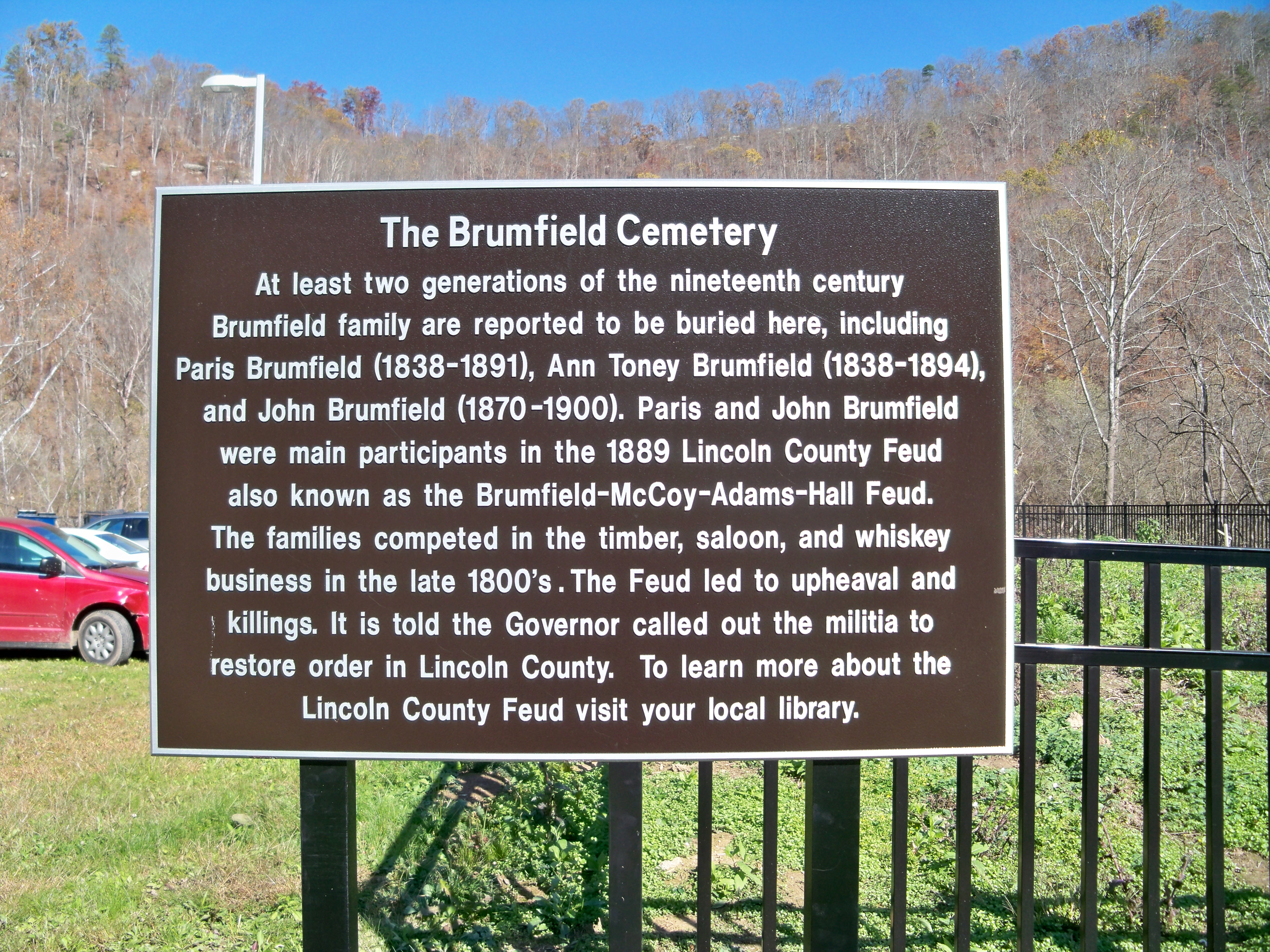
Paris Brumfield Family Cemetery

07 Tuesday Jan 2014

Posted by Brandon Ray Kirk in Cemeteries, Culture of Honor, Harts, Lincoln County Feud

≈ Leave a comment

Tags

Al Brumfield, Ann Brumfield, cemeteries, crime, feud, genealogy, history, John Brumfield, Lettie Brown, Moses Brown, Paris Brumfield, Paris Brumfield Family Cemetery, tourism, West Virginia

Harts, Lincoln County, WV, c.2012.

Harts, Lincoln County, WV, c.2012.

In Search of Ed Haley 208

07 Saturday Dec 2013

Posted by Brandon Ray Kirk in Ed Haley, Hatfield-McCoy Feud, Lincoln County Feud

≈ Leave a comment

Tags

Al Brumfield, crime, Enoch Baker, George Fry, Green McCoy, Green Shoal, Harts Creek, Hatfield-McCoy Feud, history, Hollene Brumfield, Logan County Banner, Milt Haley, writing

On November 7, 1889, The Banner printed a Huntington story titled “Two More Victims To the Endless Hatfield-McCoy Feud/Prisoners Belonging to the Latter Faction Lynched.” This article was extremely difficult to read — some of its words were completely gone, which probably didn’t really matter since it was so error-ridden.

HUNTINGTON, W.VA., October 25 — Information was brought [here from] Hamlin, Lincoln County, that about midnight Friday, a mob surrounded the Lincoln County jail, took two of the prisoners, Green McCoy and Milton Haley, and hung them to a tree a short distance from the [jail]. Haley and McCoy are natives of Kentucky and are allied to the McCoy faction of outlaws [feuding] with the Hatfields generally familiar by the public. McCoy was engaged in a shooting scrape with Paris Brumfield about a year ago and about a month ago he, in company with Haley, ambushed and attempted to murder Brumfield and his wife. The shooting occurred on a Sunday and both victims [were] badly wounded, Mrs. Brumfield being shot in the breast and her husband in the leg. For a time it was thought the woman would die but she recovered. McCoy and Haley escaped to Hunto, Kentucky, [but] not before they made two more attempts at assassination in the county, in ____ of _____ man named Adkins was wounded. The would be murderers were arrested at Ben Postoffice, Martin county, Kentucky, and were confined in jail there. Friday they were locked up in Lincoln county (W.Va.) Jail, and in the absence of definite information it is supposed they were lynched by some of the Hatfield sympathizers.

It wasn’t clear if the Adkins who supposedly wounded in the above account was closely related to Cain Adkins or Fed Adkins. The place names given were also questionable, since Brandon couldn’t locate Hunto or Ben Post Office in any Kentucky map books.

The Huntington story apparently had little credibility since The Banner followed it with corrections:

The above is copied from the Enquirer, and is about as reliable as you find most reports about the Hatfield-McCoy feud.  In the first place, the prisoners Haley and McCoy were not in jail.

Secondly. — No mob ever surrounded the jail, they went into Geo. Fry’s house and took them out without any resistance from the guards.

Thirdly. — They were not hung to a tree a short distance from the jail building, but were shot at Green Shoals some 25 miles from the C.H.

Fourthly. — Haley has no connection whatsoever with the McCoys of Kentucky.

Fifthly. — Mrs. Brumfield was not shot in the breast but in the face, and her husband was not shot in the leg but in one arm.

Sixthly. — McCoy and Haley never wounded Adkins, or even shot at him.

Seventhly. — Neither the Hatfields nor the Hatfield sympathizers had anything to do with the _____ing of McCoy and Haley.

It was done by the citizens of Lincoln who sympathized with the Brumfields and Dingess and by men who do not believe in the assassination of women by way laying and shooting them as they peacefully ride along the bank.

The Hatfield-McCoy feud had nothing whatever to do with the trouble, and from present appearances it is about over. Reports that some forty men _____ are armed and preparing for battle is without foundation.

For the next month, The Banner was silent about the Haley-McCoy trouble. Then, on December 12th, it gave this brief update: “Enoch Baker, of Harts Creek, was in town Monday, and reports every thing quiet, but thinks the Brumfield-McCoy feud is liable at any time to break out afresh.”

In Search of Ed Haley 206

29 Friday Nov 2013

Posted by Brandon Ray Kirk in Big Harts Creek, Ed Haley, Lincoln County Feud, Timber

≈ Leave a comment

Tags

Al Brumfield, Allen Martin, Andrew D. Robinson, Andrew Robinson, Anthony Adams, Appalachia, Ben Adams, Ben Robinson, Boardtree Branch, Chloe Gore, Chloe Mullins, crime, David Robinson, Dicy Adams, Elizabeth Abbott, genealogy, general store, Greasy George Adams, Green McCoy, Harts Creek, Harvey Adams, Henderson Dingess, history, Hollena Brumfield, Hugh Dingess, Jackson Mullins, John Frock Adams, John M. Adams, John Robinson, Joseph Adams, Joseph Robinson, Lincoln County Feud, Logan County, Logan County Banner, Lucinda Brumfield, May Adams, Meekin Branch, Milt Haley, Peter Carter, Rhoda Robinson, Sallie Dingess, Solomon Adams, Spicie McCoy, Susan Abbott, Ticky George Adams, timber, Trace Fork, Victoria Dingess, Viola Dingess, West Virginia, Wilson Abbott

Ben Adams — the man who supposedly hired Milt Haley and Green McCoy to assassinate Al Brumfield — was born in 1855 to Joseph and Dicy (Mullins) Adams on Big Harts Creek in Logan County, (West) Virginia. His older sister Sarah married Henderson Dingess and was the mother of Hollena Brumfield, Hugh Dingess and several others. He was a first cousin to Jackson Mullins, Milt Haley’s father-in-law, and a brother-in-law to Chloe Mullins, Milt’s mother-in-law, by her first marriage to John Adams.

In 1870, 17-year-old Ben lived at home with his mother, where he worked as a farmer. He was illiterate, according to census records. His neighbors were Andrew Robinson and Henderson Dingess, both of whom had married his sisters (Rhoda J. and Sally). In the next year, according to tradition, he fathered an illegitimate child, William Adams, who was born to Lucinda Brumfield (niece of Paris).

In 1873, Ben married Victoria Dingess. Victoria was born in 1856 and was a first cousin to Hollena Brumfield and Hugh Dingess. The marriage made for an interesting genealogical connection: Ben was already Hugh’s uncle; now he was also his brother-in-law, as Hugh was married to Victoria’s sister, Viola (his first cousin). Ben’s daughter Sally, who was named after Hollena’s mother, later married a cousin of Spicie McCoy, Green’s wife. For all practical purposes then, Ben Adams was genealogically connected to all sides of the feud — making it a true intra-family feud from his perspective.

For the first decade or so of his marriage, Ben lived with his mother on family property, although he did acquire land and open a general store business. In 1880, he was listed in the Lincoln County Census with his mother Dicy, aged 63, and family. He was 26 years old, Victory was 23, Sally was six, son Charlie was four, daughter Patsy A. was two, and son Anthony was a few months old. George Greaar, age 20, was a boarder. In 1881, he purchased 25 acres on the Meekin Branch of Trace Fork. Three years later, he was listed in a business directory as the proprietor of a general store. At that same time, his brother-in-law and neighbor Henderson Dingess was a distiller.

Later in the decade, Ben fathered three more children: George “Greasy” (1885), Harvey (1886), and May (1889). In 1889, the time of Milt Haley’s ambush of Al Brumfield, Adams owned 260 acres on the Boardtree Branch of Trace Fork valued at $1.00 per acre in Logan County.

Anthony Adams — Ben’s brother and ally in the 1889 troubles — was a prominent timberman on Harts Creek. Anthony had been born in 1849 and was the husband of Pricie Alifair Chapman, Burl Farley’s half-sister. In 1884, Adams was listed in a business directory as a blacksmith. In 1889, he owned two 50-acre tracts of land, one valued at $3.50 per acre with a $30 building on it, the other valued at $2.00 per acre. By that time, he had three sons of fighting age who may have participated in the feud: Solomon Adams (born 1869), Horatio “Rush” Adams (born 1871), and Wayne Adams (born 1874), as well as a son-in-law, Harrrison Blair (born c.1867).

A quick examination of the Adams genealogy gives a clue as to Ben’s other 1889 allies. First there was brother “Bad John” Adams. Adams was deceased at the time of the Haley-McCoy incident, but he had been married to Chloe Gore — mother of Emma Jean (Mullins) Haley. He had three sons of fighting age in 1889: Joseph Adams (born 1859), John Frock Adams (born 1861), and Ticky George Adams (born 1865)…as well as son-in-law Sampson Thomas.

Rhoda J. Robinson was a sister to the three Adams brothers. She had several children who may have allied with Ben: David Robinson (born 1860), Ben Robinson (born 1866), John R. Robinson (born 1868), and Joseph Robinson (born 1870). There was also brother Solomon Adams, who may have offered his loyalty to Ben, along with sons John M. Adams (born 1869) and Benjamin Adams (born 1867), and sons-in-law David Robinson and Peter Carter (c.1873).

As for Ben himself, he stayed busy with timber after the feud. According to an 1896 article from the Logan County Banner: “Benj. Adams, of Hart, is hauling some fine poplar from trace fork.” In 1901, he married Venila Susan Abbott, a daughter of Wilson and Elizabeth (Workman) Abbott, and had at least eight more children (born between 1901 and 1921). Not long after his remarriage, he was accused of murdering a local postman named Jim Allen Martin — and nearly went bankrupt paying for his legal defense. He died in 1910 and was buried on the hill near the mouth of Trace Fork.

Lincoln County Feud

13 Wednesday Nov 2013

Posted by Brandon Ray Kirk in Lincoln County Feud

≈ Leave a comment

Tags

Appalachia, Charley Brumfield, crime, culture, feud, Harts, history, life, Lincoln County, photos, West Virginia

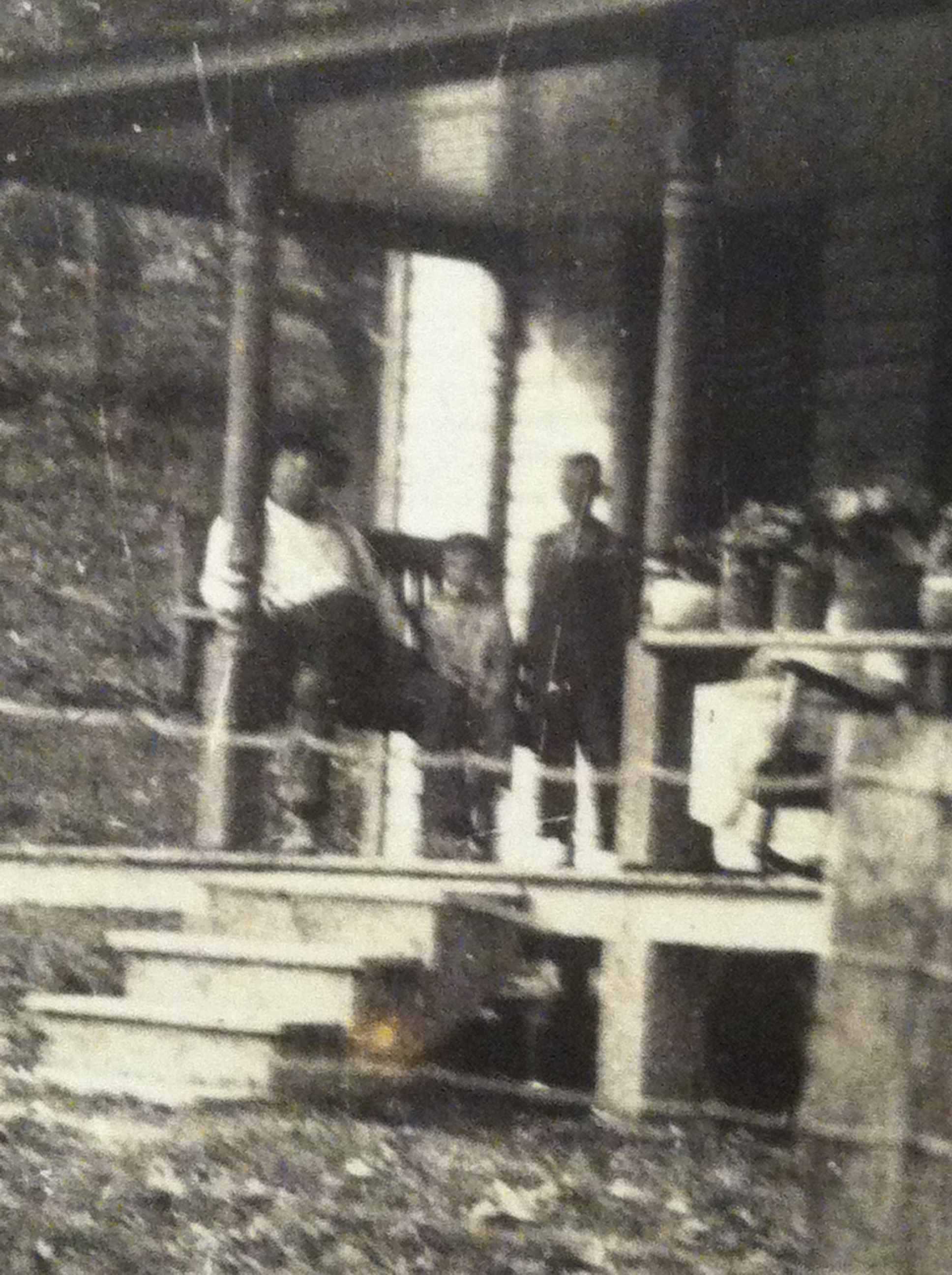
Charley Brumfield on his porch with children, Harts, Lincoln County, WV, 1915-1926

Charley Brumfield on his porch with children, Harts, Lincoln County, WV, 1915-1926

Lincoln County Feud

12 Tuesday Nov 2013

Posted by Brandon Ray Kirk in Lincoln County Feud

≈ Leave a comment

Tags

Appalachia, crime, feud, George Fry, Green McCoy, Green Shoal, history, Milt Haley, photos, West Virginia

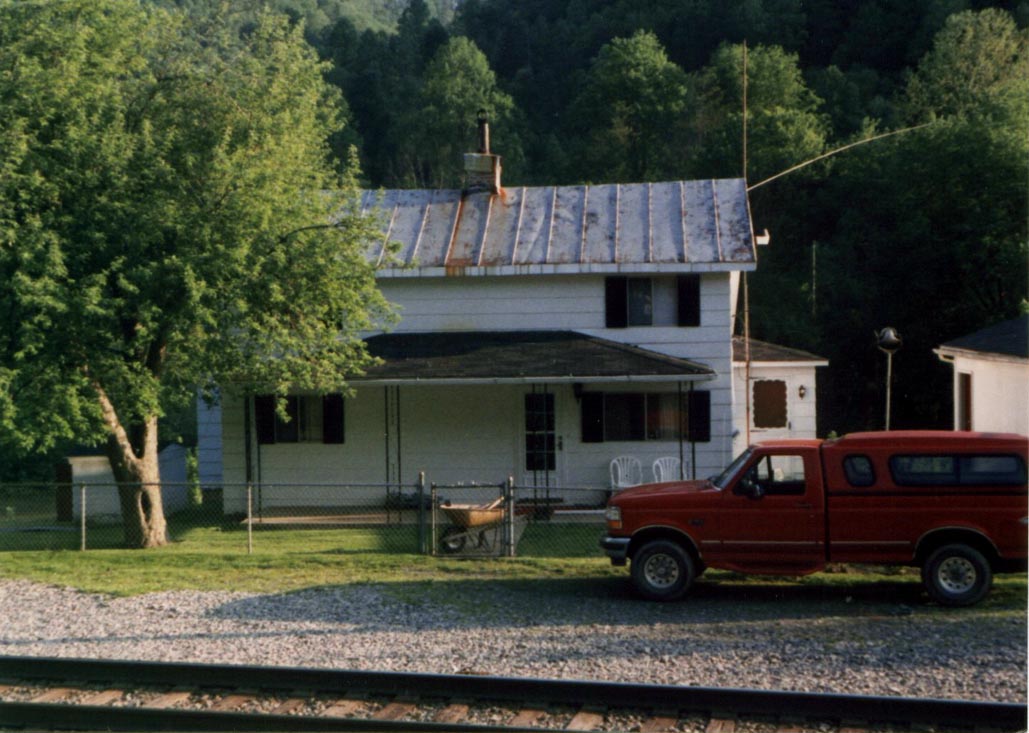
The Murder House? #Appalachia #feud #history

The Murder House? Green Shoal, Lincoln County, WV, 1995

In Search of Ed Haley 196

12 Tuesday Nov 2013

Posted by Brandon Ray Kirk in Ed Haley

≈ Leave a comment

Tags

Boney Lucas, Cat Fry, Charley Brumfield, crime, genealogy, history, Hollena Brumfield, Ida Taylor, Jim Brumfield, Letilla Dial, Paris Brumfield, Sarah Lucas, writing

To get to Ida’s house, we drove a short distance up Green Shoal Road, a somewhat narrow strip of pavement that snaked its way alongside the creek. We were welcomed inside by some of her family, who knew Billy and Brandon. Just inside the door, I spotted Ida sitting in a chair near a bed and a fireplace. In the initial small talk, we learned that Ida was born on Green Shoal in 1914 and had lived there all of her life. Brandon began by showing her a picture of her grandfather, Paris Brumfield. She said her father Jim Brumfield (1880-1965) had spoken of him.

“Dad said he kindly mistreated their mother,” she said. “He drinked an awful lot. The children were afraid of him. Now, I can remember Dad talking about seeing him get killed. Uncle Charley was the one killed him, his own son. I think Dad said he was about 16 years old — maybe older. Dad said he was hid up on the hill behind a foddershock when Uncle Charley shot him. Said he was laying down the drawbars and said Charley told him not to come any farther and he just kept going and he shot him in the back. He said he saw the dust jump out of his jacket. He’s told us kids that lots of times.”

Jim was practically raised by his brother Al in Harts because his mother died not too long after his father’s murder. In 1900, he was with his brother John at Chapmanville when they were attacked by the Conleys. He was stabbed and carried a piece of the knife blade in his body for the rest of his life. A little later, he fell out with his older siblings (Al, Rachel, and Charley), who he felt had “swindled” him out of some of the family property.

Brandon asked Ida if she remembered going to visit Hollena Brumfield and she said, “I never was there. Dad didn’t think much of her as a sister-in-law.”

Ida said she’d kinda been raised away from all the Brumfields around Harts.

“They used to come here, but we never was down in there too much,” she said. “The first time I was ever in Uncle Charley’s house is when I attended his funeral. And Uncle Bill’s house, I never was there at all. But I always liked him. He was here quite a bit, Uncle Bill was, you know. Spent a little time in jail for killing a man. I was afraid of him, though. He was a little guy and wore a little sandy mustache. He dodged around up in here after they found this man dead. He’d been dead quite a while and he’s supposed to got beat up at Uncle Bill’s house. I think he beat him up with an axe handle as well as I remember. They carried him back in there someplace. That’s what we were told. Billie killed Uncle Bill. Said he was drinking whiskey out of a half a gallon jar and Billie slipped around the house and shot him. They thought that was over his mother, too. They was really rough down in there.”

Ida said she heard about the Haley-McCoy killings from her mother Letilla Dial and grandmother Cat Fry (the infamous “Aunt Cat”). Ida’s mother Til was raised by Sarah Lucas, who married a Brumfield and then later a Workman. Hearing the name Lucas caused me to ask Ida if she knew anything about Boney Lucas.

“Oh, yeah,” she said. “They was raised up on the creek here. Boney Lucas — I’m not sure but I believe that was Aunt Sarah Workman’s brother. I can remember hearing her talk about Boney Lucas. Now, they were raised down here someplace in a log house.”

Mouth of Green Shoal Creek

11 Monday Nov 2013

Posted by Brandon Ray Kirk in Green Shoal, Lincoln County Feud

≈ Leave a comment

Tags

Appalachia, crime, feud, George Fry, Green McCoy, Green Shoal, history, Lincoln County, Lincoln County Feud, Milt Haley, murder, photos, West Virginia

Site of the Haley-McCoy murders, Green Shoal, Lincoln County, WV.

Site of the Haley-McCoy murders, Green Shoal, Lincoln County, WV.

Lincoln County Feud

02 Saturday Nov 2013

Posted by Brandon Ray Kirk in Lincoln County Feud

≈ Leave a comment

Tags

Appalachia, crime, culture, feud, genealogy, Harts, history, life, Lincoln County, photos, West Virginia, Will Adkins

G.W. "Will" Adkins, member of the 1889 mob

G.W. “Will” Adkins, member of the 1889 mob

In Search of Ed Haley 191

02 Saturday Nov 2013

Posted by Brandon Ray Kirk in Ed Haley

≈ Leave a comment

Tags

Appalachia, Billy Adkins, Boone County, Chloe Mullins, Clintwood, crime, Ed Haley, history, Hollene Brumfield, Imogene Haley, slavery, Solomon Mullins, writing

After talking with Lola, we walked down the street with Billy Adkins and spent a few hours filtering through genealogy books at his kitchen table. Billy, I discovered, had two large bookcases filled with categorized three-ring binders dedicated to Harts families. One of the first things we dug out were notes pertaining to Ed’s mother, Emma Jean Haley. Years earlier, Lawrence Haley had told me that someone shot her in the doorway of what I later learned to be Al Brumfield’s house. In his notes, Billy recorded her as re-marrying James Benton Mullins, a son of Peter and Jane Mullins, which we ruled out immediately: James B. was her uncle. The Emma who had actually had married this fellow was born in 1876 (about eight years after Emma Haley) and was listed in other sources with the maiden name of Johnson.

“I don’t know where I found that out but somebody told me that that woman right there was Milt Haley’s widow,” Billy said. “But that date’s totally wrong, see.”

Whether or not Ed’s mother had ever remarried anyone, based on census information, Brandon was convinced that she had died in the 1890s. In the 1900 Logan County Census, her mother Chloe Mullins listed seven of her nine children as being alive. The seven accounted for were Joseph Adams, John Adams, Ticky George Adams, Peter Mullins, and Weddie Mullins. The two who were not listed in the 1900 census were Dicy (Adams) Thomas, whose husband was listed as a widower in the census, and Ed’s mother.

We found out from Billy’s notes that Emma Haley descended from a notorious counterfeiter named Solomon Mullins.

“Money Makin’ Sol,” as he was called, was born to John and Jane Mullins on the Broad River in North Carolina in 1782. Around 1806, he married Sarah Cathey; he settled in Kentucky by 1810.

“Solomon was always ready for action,” according to photocopied papers at Billy’s house. “He served in the War of 1812 in Cpt. David Gooding’s Company of Kentucky Volunteer Militia. After the war, Solomon, evidently ready for more action, began counterfeiting coins. Family tradition has it that Solomon found one of John Swift’s ‘Lost Silver Mines’ in the hills of eastern Kentucky and ‘South of the Mountain’ in Southwestern Virginia. Thus he became known as ‘Money Making Sol’, and I might add always the ‘genius’, stayed one step ahead of his trouble. In 1837 Solomon decided to join his father and his two brothers in Russell County. He bought a farm and built a shop just a little ways from his house where he began making money again. He melted the silver down and didn’t seem to care who saw him.”

“I was born August 29, 1840, at my father’s home below Clintwood,” according to a 1926 interview with one Nancy Mullins. “The Mullins mixed with the Indians. I have heard it said that Grandpa John Mullins was about one-fourth Indian. Grandpa John had at least two brothers. One was named Sol and he owned a lot of slaves. He was a moneymaking man. He lived on the other side of the branch in a bottom near my father’s home. He had a crowd of slave wenches. He made money on Holly Creek back of Press Harris’ home. He had his work place under a cliff. Pa and Uncle John used to help him work at this business. They would ‘strike’ for Sol. While they lived there, his slave women would take guns and go hunting. They would kill deer and pack them in on their backs. The government got after Sol and he went to West Virginia where he died.”

“Solomon Mullins moved to the waters of Holly Creek, about two miles northeast of Clintwood, [Virginia,] where he lived for several years,” according to Sutherland’s The Mullins Family in Dickenson County (1967). “He owned several slaves, mostly women, who worked in the fields and hunted in the woods. He made counterfeit money for several years under a cliff near Holly Creek. The cliff is still pointed out by neighbors as ‘Sol’s Cliff.’ He was caught at work once by a detective and when he saw he was caught, he ordered the detective to help him work, saying: ‘Grab that hammer and strike this.’ He hoped this would make the detective afraid to tell on him, but it didn’t do any good. He managed to get pure silver and mixed other metal with it to make the counterfeit money. He would pay $2 of his counterfeit money for $1 of the government money. At last, he took a scare and left this country.”

In 1837, Sol and his son Peter were involved in making counterfeit coins in Russell County, Virginia. As a result, according to Boone County, West Virginia, History (1990), they moved to Marion County, Tennessee, where they renewed their counterfeiting activity. In the winter of 1841-42, after pressure from government authorities in Tennessee, Sol and Peter moved with their families and slaves to the North Fork of Big Creek in Logan (now Boone) County, (West) Virginia.

“They rode mules and walked all the way,” according to Boone County. “He died in 1858 and Sarah died about 1872.”

As Brandon flipped through the Sol Mullins notes, I could see his brain working, making connections. Suddenly, he said, “Sol was a great-grandfather to both Emma Haley and Hollena Brumfield…making them third cousins.”

Oh my.

In Search of Ed Haley 190

01 Friday Nov 2013

Posted by Brandon Ray Kirk in Ed Haley

≈ Leave a comment

Tags

Appalachia, Billy Adkins, Cain Adkins, Cat Fry, crime, feud, George Fry, Green McCoy, history, Lola McCann, Milt Haley, Vinnie Workman, writing

Before heading to Billy’s, we became knee-deep in conversation about Milt Haley’s death. Billy told us about the Brumfields retrieving Milt and Green in Kentucky.

“Now, I don’t know where they come from over there,” he said. “I know they had a bogus warrant, the people that went to get them. They made up a fake warrant and got them. Then when they started back down through here, they was a big bunch of people was waiting to attack them. That was Cain Adkins and them and his family. They was fields full of them up on Big Branch. And somebody tipped them off, and so they went up what’s called Bill’s Branch. And so they took up Bill’s Branch and down Piney and then over to Frank Fleming holler.”

From Frank Fleming hollow, the Brumfield gang went over a mountain and crossed the river to a Fry house near the mouth of Green Shoal. At some point, according to Lola, a group of men came in and shot out the lights. Cat Fry crawled under a bed while either Milt or Green shouted to the other, “Stand up and die like a man!” Lola heard that one of the men “died a praying and the other died a cussing.”

I asked Billy if he’d heard how Milt and Green were killed.

“I’ve heard so many stories, I don’t know,” he said. “I just heard they was shot. I heard they was tied up to a tree. Tied to a chair back to back in the kitchen.”

Lola said she heard that Milt and Green were shot and hung.

“The table Milt and Green had their last meal on ended up with my grandmother, Vinnie Thompson Workman,” Billy said. “And there was bullet holes in the table.”

I asked Billy if he had any pictures of the “murder house” and he said, “No, I don’t know of anybody would. It’s where Doran’s house is. It was over there against the hill — an old log house. Of course, the railroad and stuff wasn’t there, you see. That was the old John and Catherine Fry house to start with. And then John’s son Baptist, he lived there next. That was my grandmaw’s grandpaw. And after he died, I guess this George Fry lived there. Charley Fry and George Fry both lived there and I don’t remember which one lived there when they killed them there.”

At that point, Lola completely changed the direction of the conversation when she said, “Billy, Cain Adkins was kin to us.” She’d never met Cain and had no clue what happened to him but knew that he once owned most of the lower end of West Fork at one time. All the old-timers referred to him as “Uncle Cain” because he’d been a well-respected person in the community.

Lola said George Thomas (one of Ed’s cousins, we later learned) owned the Cain Adkins farm in the years prior to her birth. Her father bought the place from him around 1905. At that time, the only remnant of Cain’s life there was his apple orchard by the creek. The Haley-McCoy grave was on the family lands.

“You go up almost to the top where it gets real flat,” Lola said. “They’s a path used to be up there. It’s up pretty much on the hill. It ain’t way up there, I’d say the first flat.”

Brandon asked her, “Now, did you tell me that some old woman used to come up there and decorate that grave?”

“They always came as long as they lived, I guess, and decorated the grave,” Lola said. “That was their wives. I was only four or five years old, but I can remember seeing them. One of them was tall and slim. But they stopped at our house every time they come.”

In Search of Ed Haley 185

21 Monday Oct 2013

Posted by Brandon Ray Kirk in Culture of Honor, Ed Haley

≈ Leave a comment

Tags

Bill Brumfield, Bob Adkins, Brandon Kirk, Charley Brumfield, crime, Eustace Ferguson, Harts, history, Hollene Brumfield, John Hartford, Lincoln County, Paris Brumfield, Wesley Ferguson, West Virginia, writing

In thinking about the old Brumfields, Bob mentioned the name of Paris Brumfield, the patriarch of the clan. Brandon quickly pulled out Paris’ picture and reached it to Bob saying, “He was my great-great-great-grandfather.” Paris, we knew, was murdered by his son Charley in 1891.

“Son, he was a mean old man, I’ll tell you that,” Bob said, turning the picture upside down in his hands and slowly studying it under a magnifying glass. “He’d kill anybody. He beat up on Charley’s mother and she went down to Charley’s for protection. He went down to get his wife. He got up to the top of that fence and Charles told him, ‘You beat up on Mother the last time. You’re not coming in here.’ Paris said, ‘Ah, you wouldn’t shoot your own father.’ Drunk, you know. And Charley said, ‘You step your foot over that fence, I will.’ Directly he started in and that there ended it, son. Charley killed him right there.”

I said, “Now there was another Brumfield father-son murder later on. Who was that?”

“Ah, that was Charley’s brother,” Bob said. “Bill Brumfield, up on Big Hart. He’s a mean old devil. He ought to been killed. He had a way… He never shot anybody. He’d beat them to death with a club. He’d hold a gun on them and make them walk up to him and then take a club and beat their brains out. He come down there to Hart to get drunk once in a while and he’d run everything away from there. And Hollene set on that front porch of that little old store she had out there with that pistol in her apron and she cussed him. He knew she had that gun — he wouldn’t open his mouth to her. It was his sister-in-law, you know. He just set there and chewed his tobacco and spit out in the street. She’d tell him how mean he was, you know. But his own son killed him. He was beating up on his mother and you can’t do that if you got a son around somewhere. I don’t give a damn who you are, they’re gonna kill ya. He didn’t miss a thing there, that boy didn’t. I don’t think they did anything with him about it.”

This Bill Brumfield, I remembered, was Brandon’s great-great grandfather. As Bob spoke of his departed ancestor, I noticed how Brandon just sat there without taking any offense, as some might want to do. Gathering the information seemed more important than family pride — at least for the moment. Brandon asked Bob if he remembered anything about Charley and Ward Brumfield’s murder in 1926.

“What they got into was very foolish,” Bob said. “Charley would come up there — and Ward was his nephew — and they’d ride up into the head of Harts Creek and get them some whisky and they’d drink. They went up around them Adamses — they was kin to the Dingesses and Brumfields — and bought them a bottle of whisky from this guy and they got his wife to cook them a chicken dinner. She cooked them up a nice chicken dinner and, of course, they drank that liquor and was pretty dern high, I expect. They was sitting there eating and they was a damn fella… Who was that killed them? They’s so dern many of them a shooting and a banging around among each other that I couldn’t keep track of them. He was just kind of a straggler.”

Bob thought for a moment then said, “Eustace Ferguson. Now, Eustace Ferguson was a brother to Hollene’s second husband, Wesley. They had asked him to go with them and he caught an old mule or something and followed them. He was mad at them ’cause he didn’t like the Dingesses and Brumfields anyway. He followed them up there and they was eating dinner. He come in there and told them if they had anything to say they better say it ’cause he was gonna kill them. And Charley raised out of there and he said, ‘Well, by god, I’d just as soon die here as anywhere,’ and he started shooting and they just shot the devil out of each other. And he killed Charley and Ward and Charley shot him but he got somebody to get him to the doctor before the Brumfields got up there ’cause he knew them Brumfields would kill him if they got up there in time. He begged them not to report it till he had time to get to Chapmanville to get into the hand of the law. And those people wasn’t too friendly to the Brumfields and they kept it hid for about an hour or two before they reported that.”

I asked Bob if there were any dances around Harts in his younger days and he said, “Not in my time. They had a few dances ’round here and yonder but I was too young to go.”

Were there any dances at Al and Hollena Brumfield’s store?

“I don’t think so. They wasn’t the dancing type. I never was around her too much. Sometimes I’d be there and play with her grandchildren, Tom and Ed Brumfield. They were about my age.”

In Search of Ed Haley 184

19 Saturday Oct 2013

Posted by Brandon Ray Kirk in Ed Haley

≈ Leave a comment

Tags

Al Brumfield, Bob Adkins, Charlie Conley, crime, Green McCoy, Henderson Dingess, history, Hollene Brumfield, Hugh Dingess, John Brumfield, Lincoln County, Milt Haley, writing

A few days later, I picked Brandon up at his apartment in Huntington and we drove to see Bob Adkins in Hamlin. We parked on the street in front of Bob’s house (just past the red light) and walked up onto the front porch where his wife, Rena, a very friendly and cordial lady, met us at the door. She welcomed us inside to the living room. We listened to Bob speak of Milt Haley’s death. It was clear that his memory had faded somewhat since my last trip to see him in 1993.

“Well, what the trouble was there, that fella Runyon, he had a saloon and a little old grab-a-nickel store right across the creek there at the mouth of Harts,” Bob said. “And Aunt Hollene and Al Brumfield, they had a big store over there on the lower side of the creek. They was competitors in a way, you know. And that fella Runyon, he wanted to get rid of them, see. He hired these two thugs to kill them. These fellas Milt Haley and Green McCoy were two characters. And a fella by the name of Runyon gave them a side of bacon and a can of lard to kill them…each.”

Bob laughed, fully aware of how it would all turn out and seemingly amused.

“They got in a big sinkhole up above the road with a high-powered gun — a .30.30 Winchester.”

According to Bob, Haley and McCoy waited in that sinkhole for Al and Hollena Brumfield to pass by.

“Ever Sunday, Aunt Hollene — she was my mother’s aunt — she’d go up to the forks of Big Hart about ten miles up there to visit her father, old Henderson Dingess. Al had a fine riding horse and he’d get on the horse and she’d ride behind him. They’d go up there on a Sunday and have dinner with her father. And they’d been up there — it was a pretty summer day — and they came along about three or four o’clock in the evening. They shot at Al’s head and that high-spirited horse jumped and that bullet missed his head and hit Hollene in the side of the jaw — knocked her teeth out. That knocked her off’n the horse. Of course, that horse sprang and run. But they had come down off’n the hill and they aimed to shoot Aunt Hollene again. And she a laying there in the road — her eyes full of blood. She couldn’t see hardly who it was. She begged them not to shoot her anymore — she told them she was dying anyway.”

So where was Al Brumfield at that time?

“Al got offa the horse down below there and come back under the creek bank and got to shooting at them see and they took off,” Bob said. “Hollene got over that. She was my mother’s aunt. I was around her home a lot. She lived in that big white house in Hart. Burned down now.”

How did they figure out who ambushed the Brumfields?

“Well, they didn’t know who it was,” Bob said. “But they noticed they weren’t around home, the Brumfields and Dingesses did. They was watching all around to see who it was. And these two guys just left their families and went into Kentucky. Just deserted their families. Then they knew who it was. After they got a hold of them, the Dingesses and the Brumfields, they told them the whole story. That was at my grandfather’s home. They took one guy out there in the yard and gagged him so he couldn’t make a noise and stuck a gun in his back and told him if he made any noise they’d shoot him. So he listened to that other fella inside the house. That other fella broke down and cried and he told them the truth about it. And they killed both of them over at Green Shoal. Took them out in the yard and shot them all to pieces. Walked off and left them. I was born and raised about three quarters of a mile below there.”

I asked Bob why the Brumfields did not avenge John Brumfield’s murder with the same ferocity. John, I knew from Brandon, was killed by Charlie Conley at a Chapmanville Fourth of July celebration in 1900.

“I don’t know,” he said. “But I’ll tell you, John Brumfield, he was mean as a snake anyway. He treated them fellers pretty rough. And they killed him up there in the head of Hart in an association ground. They just walked up to him in that association ground — a whole bunch of people there — and shot his brains out.”

An association ground?

“They had them once a year near an old schoolhouse,” Bob said. “People’d all gather in and they had a place where they traded horses. Half a mile away, an old country preacher would preach to them. It was kind of a rough place up in there at that time.”

Caleb Headley 4

15 Tuesday Oct 2013

Posted by Brandon Ray Kirk in Fourteen

≈ Leave a comment

Tags

Appalachia, Ballard Headley, crime, Dave Headley, Dave Merrill, Fourteen Mile Creek, genealogy, Harry Tracy, history, Sarah Headley, Will Headley, writing, Zachary Neace

During the 1890s, Sarah Headley remained on Sulphur Spring Fork, although tax records and oral tradition do not indicate the exact location of her dwelling house. In that span of time, according to tax records, her property valuations increased significantly. In 1891, a 50-acre tract climbed from $100 to $125, a 45-acre tract went from $69 to $90 and a 26-acre tract jumped from $39 to $156.

In 1892, Margaret Headley, Sarah’s youngest daughter, married Zachary T. Neace, a well-to-do timberman on the creek. In subsequent years, they lived in Virginia, the place of Neace’s origin, or on Fourteen Mile Creek.

In 1893, Sarah Headley — perhaps taking advantage of a rising evaluation on her property — sold a 45-acre tract of land worth $90 to an unknown party, leaving her with only 76 acres of the 455 acres she had owned just after her husband’s death in 1882.

A few years later, Dave Headley, Sarah’s 23-year-old son, was accidentally shot and killed.

“Dave was aiming to sell this guy a gun and this guy was looking at it and it went off and shot Dave in the head,” said Ward Adkins, a step-great-grandson to Sarah Headley, in a 2003 interview. “When Will and Uncle Johnny first heard about it they aimed to kill that guy, then they found out it was an accident.”

In the late 1890s, Will Headley, who had left Sulphur around the time of the disastrous house fire and spent time with his uncle Burl Farley on Harts Creek, moved back to Fourteen after marrying Caroline Lucas, a daughter of William R. and Emily (Fry) Lucas. He and his wife settled near the mouth of Sulphur where he continued to assist his mother and family.

During that time, Sarah Headley was still somewhere on Sulphur. In 1897, she sold 42 acres — including 16 acres of the old homeplace — to Sarah A. (Nelson) Sias, whose husband Billy had bought 174 acres from Headley in 1884. Three years later, she was listed there in the Lincoln County Census as “Sarah A. Hedley,” age 51, with sons Ballard, age 20, and Moses, age 15.

Just after the turn of the century, Ballard Headley joined the army and left Sulphur Spring for a few years.

“Uncle Bal joined the army and they sent him West,” said Adkins. “I think he was in one or two Indian skirmishes and he deserted and joined a gang with Harry Tracy and Dave Merrill, two famous outlaws. I was reading a book about Harry Tracy. I asked him, ‘Did you ever hear of Harry Tracy when you was out West?’ He said, ‘Son, I rode with him.’ He said, ‘We was horse thieves. We’d steal horses from one state and take them into another state and sell them and then steal some there and take them somewhere else and sell them.’ He wasn’t afraid of nothing. He told me himself he held up a passenger train one time, too.”

Harry Tracy, the outlaw supposedly befriended by Headley, was born in Wisconsin in 1874. At a young age, he drifted west to Wyoming where he hooked up with a gang of cattle rustlers who worked with Butch Cassidy and the Sundance Kid. In 1897 he was arrested in Salt Lake City but escaped and went to Colorado where he joined the Hole-In-The-Wall gang. He was arrested there and sent to jail in Aspen, Colorado, but escaped a short time later after nearly killing a guard with a lead pipe. He next went to Oregon, where he met gambler Dave Merrill in a saloon. The pair committed their first crime together in January of 1899. They were soon arrested and Tracy and sent to Oregon State Penitentiary. In December of 1899, he and Merrill were transported to Olympia, Washington to face charges, where they again escaped. They were both free for New Year’s in 1900, but were captured again in Portland a short time later. On the morning of June 9, 1902, Tracy and Merrill broke out of prison, leaving behind dead and wounded guards. On June 28, Tracy killed Merrill in a duel near Napavine, Washington. Thereafter, he hijacked a boat, which dropped him off near Seattle. He slipped through the city and crossed the Snoqualmie Pass, before he killed himself after a shoot out with a small posse in Creston, Washington.

“Uncle Bal was mean,” Adkins said. “He wasn’t out West long but when he came back here he told my grandpa Neace, who ran the post office, ‘If any mail comes here for George Golden, it will be for me. You hold it for me.’ Sure enough, there was. And by the time the government tracked him down for desertion he was blind as a bat. Some people said he put his eyes out to keep from going back in the army but he didn’t. He said he’d caught this disease and it got in his eyebrows and he put red persipity in there to kill it and got out and got to working and went to sweating and it got in his eyes and put his eyes out.”

“Now Bal was awful intelligent,” Adkins continued. “He’d come up and he’d have me to read the Bible to him. He belonged to the church. And he knew the Bible all ready, I don’t know why he’d want me to read it. But I’d try to skip on him. Maybe I’d just down here eight or ten verses. He’d say, ‘Hold on, back up there.’ Then he’d start quoting it off to me.”

Lincoln County Feud

08 Tuesday Oct 2013

Posted by Brandon Ray Kirk in Ed Haley, Harts, Lincoln County Feud

≈ Leave a comment

Tags

Appalachia, crime, culture, feud, genealogy, Harts, history, life, Lincoln County, Paris Brumfield, photos, West Virginia

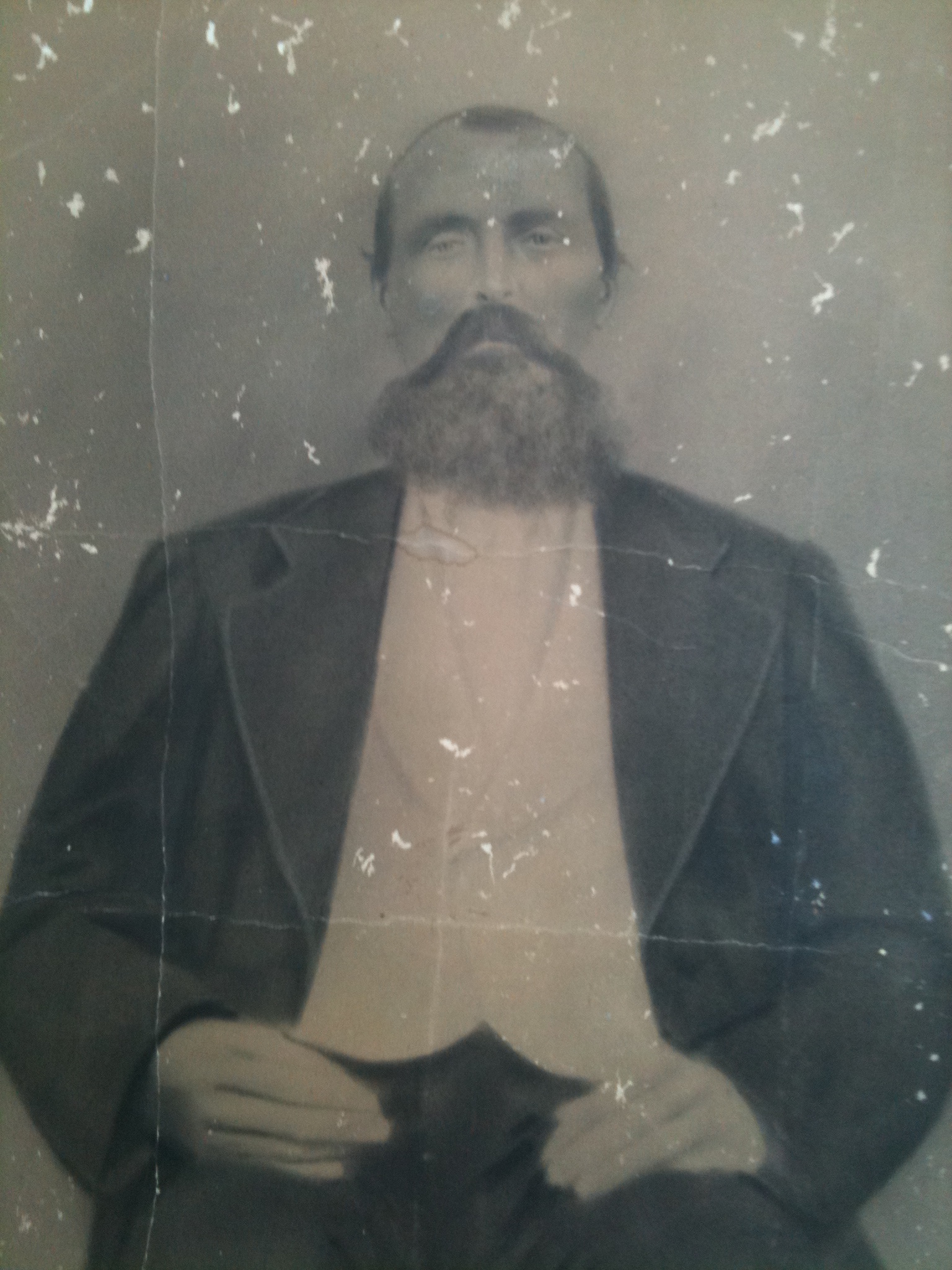
Paris Brumfield (1838-1891), Lincoln County feudist.

Paris Brumfield, Lincoln County feudist, 1880-1891.

In Search of Ed Haley 179

08 Tuesday Oct 2013

Posted by Brandon Ray Kirk in Ed Haley

≈ 2 Comments

Tags

Bob Adkins, Boney Lucas, Brandon Kirk, Charley Brumfield, crime, feud, genealogy, history, Lawrence Kirk, Paris Brumfield, Ray Kirk, West Virginia, writing

After about thirty minutes of talking with Brandon, I was convinced that he loved the families of Harts and was wrapped up in its history. He was not only serious business but he really — I mean really — knew his stuff.

Brandon flipped a few pages in his photo album, then pointed to a picture of a black-bearded, broad-shouldered giant of a man and said, “That’s Paris Brumfield.” I’d heard a lot about him from Bob Adkins and Lawrence Kirk — and never forgot what they said about him being killed by his own son. He was Brandon’s great-great-great-grandfather.

According to the Lambert Collection, Paris Brumfield was one of the most feared loggers in the Guyandotte Valley – a man who “gloried in shooting people.” He frequently stirred up trouble in the town of Guyandotte with his friends, Jerome Shelton of West Hamlin and Pete Dingess of Harts Creek. Shelton often got drunk and wandered through the streets of Guyandotte screaming “I am God!” and other obscenities. He climbed on ladders and pretended to make speeches to taunt officers and citizens. Wild cheering from loggers always followed his cry of “Millions bow down to me!” Wilburn Bias was the only marshal in Guyandotte who Paris and his gang feared, although others like a Mr. Fuller sometimes tried to arrest him. One marshal, J. “Doc” Suiter, once came to Brumfield’s hotel room to make an arrest, but a brawl ensued in which both men crashed through a window. At some point, while rafting on the Guyan River, Paris slammed his raft into Doc’s after seeing that it was fouled on some shoals.

Brumfield was a real rabble-rouser. Not only did he drink heavily and abuse his wife: in the late 1870s he took a mistress for himself. This woman, one Keziah Ramey, originally from the Kiah’s Creek area of Wayne County, moved near Paris at Harts and quickly produced him four children. Paris was a reported murderer as well, according to local history. There are rumors about him killing pack-peddlers and someone named Charlie Hibbits (whose body was put on the “Ha’nt Rock”). Reportedly, he also murdered a man who disturbed a fiddler playing his favorite song, “Golden Slippers”. These stories are likely untrue, as the only murder positively linked to him was his shooting of a local man named Boney Lucas.

Bob Adkins had told me about it. “They had a fight right there at the mouth of West Fork and Boney got loose and he run through the creek there,” Bob had said a few years earlier. “And Paris’ daughter Rat, she run and got the gun and brought it to Paris and, by george, he shot Lucas with a Winchester right across the creek. Lucas tried to get away.” Brandon’s grandfather Ray Kirk said the trouble was “over logs,” while Lawrence Kirk said it was brought on by arguments between their children at school. Either way, their fatal confrontation occurred at the Narrows of Harts Creek, where Al Brumfield later built his infamous log boom. Paris had gone to a store on the creek with his daughter when he noticed Lucas working there in a timber crew. He and Lucas “had words,” then Lucas attacked him, initially with the butt-end of his axe. In no time, one of Brumfield’s arms was almost completely severed from his shoulder — courtesy of Lucas’ axe. Paris hollered for his daughter to give him a pistol that he’d tucked into a grocery bag, then used it to shoot Boney in self-defense.

Life in the Brumfield home was difficult. At one point, during the fall of 1891, Ann Brumfield fled to her son Charley’s home for protection. I knew from Bob Adkins what had happened next.

On November 11, 1891, the Ceredo Advance reported: “The noted desperado of Lincoln county — Paris Brumfield — was shot five times by his son Charles, on Tuesday of last week [Nov. 3]. Paris was drinking and attempted to take the life of his wife, when the son interfered with the above result. The wounded man lived only a few hours after having been shot. Paris killed several men during his life and it is said that no man could get the drop on him, but finally one of his own flesh and blood ended his career. The son has not been arrested, and probably will not be.”

In 1892, The Logan County Banner reported: “We think the papers in the State have been a little harsh with Paris Brumfield. From what we have learned we do not blame his son for killing him in the defense of his mother, and we deeply sympathize with the young man in having to imbue his hands in the blood of his father. Paris Brumfield was an overbearing man and dangerous when in whisky, yet he was surrounded by a people not noted for angelic sweetness of temper, and he was driven to many an act of which he was ashamed. There was, however, a good side to the man. He was generous and brave, and no one was ever turned [away in] hunger from his door; and, remembering his kindness to the poor, we are willing to draw the curtain over his many grievous faults.”

Brandon said many old-timers around Harts heard that Paris’ ghost would jump up behind Charley every time he got on a horse to go anywhere.

U.B. Buskirk: West Virginia Timber Boss 1

29 Sunday Sep 2013

Posted by Brandon Ray Kirk in Logan, Timber

≈ 8 Comments

Tags

36th Virginia Volunteer Infantry Regiment, C.R. Williams, civil war, crime, Frank Buskirk, Fred B. Lambert, genealogy, Guy Lawson, history, Holland, Logan, Logan Wildcats, Peter Morgan, Thomas Buchanan, Thomas Buskirk, Urias Buskirk, Urias Guy Buskirk, West Virginia, writing

In the early decades of the twentieth century, Fred B. Lambert, local historian and educator, interviewed Urias Beckley Buskirk, a former resident of Logan, West Virginia, who had amassed a great deal of wealth in coal and timber. Buskirk spoke primarily of his family history and the timber industry as it existed around the turn of the century.

“I was born November 22, 1862 in the City of Logan,” Buskirk began. “My father was Urias Buskirk, a Pennsylvania Dutchman of Erie Co., Pa. My grandfather was Joseph Van Buskirk who lived in Erie Co., Pa., with one or two older children. My mother was Louisa Goings, of Lawrence Co., Kentucky, a daughter of William Goings.”

In early Logan County records, Urias “Guy” Buskirk, father to U.B., was listed as a shoemaker (1856), bootmaker (1859), and merchant (1860).

“We are a family of shoemakers,” the younger Buskirk told Lambert. “My father’s grandfather and all of his boys were shoemakers, even in Holland. All had a big demand. My father did that here — probably made 10 cents an hour clear.”

Urias Buskirk married Louisa (Goings) West on October 6, 1856 in Logan County. Louisa was a daughter of Alex and Mary (Skidmore) Goings. She was first married to James West. The Buskirks had six children: James Bilton, born about 1853, Ann Brooke, born about 1857, John L., born about 1859, Urias Beckley (the subject of this sketch), George, born about 1866, and Robert W. “Bob”, born about 1869.

“I am a brother of James Bilton Buskirk, a hotel man of Logan, postmaster and storekeeper,” Buskirk told Lambert. “My sister was Ann Buskirk who married James A. Sidebottom of Boone County. One of my brothers was John Buskirk who, at the time of his death, lived at Apple Grove in Mason County but was buried at Logan.”

Buskirk gave more detailed genealogy for his younger brothers, George and Bob.

“My brother George married Mollie Henderson, a daughter of the late James R. Henderson of Montgomery Co., Va., a sheriff,” he said. “Their daughter Mattie died single while Tina married John Maynard and had two children. My brother Bob married Moldah Hamilton. They had no children. Then he married a widow with two children from Arkansas. They had one son, Robert, Jr., who was born the day after his father’s death.

In recounting events of his early life to Lambert, Buskirk could have drawn on the two sensational events of his childhood: the Civil War, which ended in 1865, and his father’s murder of Peter Morgan in 1870. More than likely, he was too young to have had any personal memories of the war, but his father, a private in Company E of the 45th Battalion Virginia Infantry, surely told him stories, as did his relatives Thomas V., a private in Company G of the 16th Virginia Cavalry, and Francis S., a private in Company D of the 36th Virginia Infantry (Logan Wildcats).

Or maybe not.

For whatever reason, Buskirk limited his childhood memories to a single but interesting line: “When I was a small boy, a bear was chased through the streets of Logan.”

In the spring of 1870, Urias Buskirk, the father of U.B. and a merchant in Logan, shot and killed Peter D. Morgan, a former Logan County constable and sergeant in the Logan Wildcats. Morgan was reportedly engaged in an affair with Buskirk’s wife and had threatened to kill him. In an 1874 trial, Buskirk pled self-defense for the murder in front of a hung jury at Wayne. A Cabell County jury finally acquitted him of the crime in 1879.

A newspaper story from the period offers some insight into the murder.

“In May, 1870, the community here was startled by the intelligence that a murder had been committed — a cold-blooded, deliberate murder,” the Democratic Banner of Guyandotte, West Virginia, reported on Thursday, August 27, 1874. “The murdered man was Peter D. Morgan; the murderer supposed to be Urias Buskirk. Buskirk had a bad reputation, and on account of his troubles had been compelled to leave; he had a pretty little wife, and Morgan had been in a liaison with her during his absence as well as after his return. Buskirk had threatened to kill Morgan, and on the evening he was killed said that he should not be surprised at any time to hear of Morgan’s brains being blow out. One night Buskirk was at Morgan’s store with a rifle, Morgan was at the counter waiting on some customers, and while standing there some one standing outside the window, with deadly aim, sent a bullet crashing through his brain. The blood gushed over the lady’s face he was waiting on and over the goods, and he fell to the floor a corpse. Buskirk, a few minutes afterward, went to a doctor who lived near and told him ‘he heard a gun go off, and should not wonder if some one was killed.’ He was arrested on suspicion, but escaped from jail and remained for two years returning in 1872. He was then re-arrested, and had a trial but the jury disagreed.”

“His counsel moved for a change of venue and his trial moved to Wayne Court-house, where it took place, after several postponements, last March, and resulted in another disagreement,” the story continued. “He is now out on bail, Morgan, who was killed left a very pretty widow, and since his death she has been living a rather fast life, having had an amour with one C.R. Williams, prosecuting attorney of the county, who was also one of the principal witnesses against Buskirk. On Tuesday morning, Guy Lawson, brother of Mrs. Morgan, met Williams and accused him of debauching his sisters; from words they rapidly came to blows; then pistols were drawn, and an indiscriminate firing begun. The friends of the parties rush in; C.R. Williams shot Lawson, and Frank Buskirk, brother of the one who is accused of murder, took up for him, and shot both of the Williamses. It was at first reported that C.R. Williams and Lawson were both killed, but that was a mistake.”

“Lawson was shot in the left breast near the heart, and is not likely to recover; C.R. Williams was shot under the left eye, the ball passing down into his mouth, knocking out several of his teeth; R.B. Williams shot in the left leg, and a man named Dingess behind the left ear, but the ball did not enter the skull,” the story concluded. “The doctors think all will recover except Lawson. In the height of the affray Thomas Buskirk appeared on the ground with his wife, and stopped the fight by jumping right in between  the combatants and swearing he would kill the next man who fired a shot. He was greatly commended for his action, as the combatants had friends who had rushed to the scene — many of them armed — and it seemed likely there would be a bloody affray. Several parties have been arrested. Most of the original combatants were under the influence of whisky. It is a mixed up affair, and we should not be surprised to hear of a renewal of the combat.”

In Search of Ed Haley 81

18 Monday Mar 2013

Posted by Brandon Ray Kirk in Ed Haley

≈ Leave a comment

Tags

Belle Fowler, creative nonfiction, crime, feud, history, Iris Williams, John Fowler, John Hartford, Lawrence Haley, Lincoln County, Milt Haley, Shelby Kirk, writing

Back at Iris Williams’, we met another of her brothers, Shelby Kirk. We told Shelby a little of what we’d heard about Milt’s death from Roxie Mullins, who he said had recently died, then listened to his version of the trouble.

“They brought them in there sometime that night and they said they was killed at the edge of daylight,” he said. “There was a boy John Fowler told me once, he said, ‘I’ve heard my aunt Belle Fowler tell about that.’ Said she was there, a little girl. Said in one of them rooms they had apples picked off of a tree and had them stored, poured out you know, up there in a room. And said she got in that pile of apples and covered her head up with them apples to keep from hearing that when they was getting ready to kill them. They said they was a crying and a begging, wanting not to be killed away from their families and their children but they went right on and did it anyhow. They said they led them out the back door one at a time and as they come out that back door they was a fellow hit them with a double-headed axe — sideways, top of the head.”

I asked Shelby where the killing took place and he said it occurred on the Green Shoal side of the river, opposite where Mr. Kirk had showed us.

“The old house is still standing right there,” he said. “It’s just got some weather-boarding on it. An old log house.”

Shelby tried to describe the way law and order worked around Harts in Milt Haley’s day.

“Boy, they used to have mobs,” he said. “Used to have an outfit called the Night Riders down in here. If they got it in for me or you one — if we’d done something, you know — why, they’d pull straws to see who was gonna do the killing.”

What Happened to John Fleming?

18 Monday Feb 2013

Posted by Brandon Ray Kirk in Big Harts Creek, Culture of Honor

≈ 2 Comments

Tags

Appalachia, Charlie McCoy, crime, Frank Fleming, genealogy, Harts Creek, history, John Fleming, John Henan Fry, life, Lincoln County, U.S. South, West Virginia, writing

Newspaper article, 1908

Newspaper article, 1909

Bob Adkins Interview, Part 2 (1993)

18 Monday Feb 2013

Posted by Brandon Ray Kirk in Breeden, Ed Haley, Guyandotte River, Hamlin, Harts, John Hartford, Lincoln County Feud

≈ Leave a comment

Tags

Al Brumfield, Appalachia, Bob Adkins, Breeden, Cincinnati, crime, feud, feuds, Green McCoy, Guyandotte River, Harts Creek, Henderson Dingess, history, Hollene Brumfield, John Dingess, John Hartford, John W Runyon, Kentucky, Lincoln County Feud, Milt Haley, Norfolk and Western Railroad, Thompson Branch, Tug River, Twelve Pole Creek, West Virginia

Wow. So what about Al Brumfield, the guy who got into the feud with Milt?

“Well, he was a little more tamer fellow than old Paris but he was kind of a rough character — mean as a snake,” Bob said. “All those Brumfields were, you know. They was a tough outfit, all of them was.”

Al and his wife Hollena lived in a large white house at the mouth of Harts Creek, which Bob said had recently burned. They had a store and log boom nearby and kept a boat tied up at the riverbank for easy access across the Guyandotte. Things were going great for them until John Runyon (who Bob called “the root of all evil”) moved in from Kentucky.

“That fellow Runyon, he had a saloon and a store right across the creek there at the mouth of Harts, you know — a shebang,” Bob said. “And Aunt Hollene and Al Brumfield, they had a big store over there on the other side of the creek, over on the lower side of the creek. They was competitors in a way, you know. This fellow Runyon hired these two thugs to kill them, so as to get rid of their competition. And he hired Milt Haley and Green McCoy to kill them. They got a side of bacon and a can of lard and five dollars to do that…each. And these fellows, Milt Haley and Green McCoy, were two characters. I don’t know why they ever took a chance on that. Them boys got into that before they knew what they was into. Them Brumfields was mean as the devil up there.”

Bob spun out the details of Milt and Green’s ambush of Al Brumfield.

“Every Sunday, Al and Hollene would get on their horse and they’d ride up to the Forks of Big Hart about ten miles to visit her father. He was old Henderson Dingess, my great-grandfather. Al had a fine riding horse and he’d get on the horse and she’d ride behind him, see? And they’d been up there on a pretty summer day, and they’d done had dinner with her father.”

Haley and McCoy, meanwhile, laid in wait for them in a sinkhole at Thompson Branch with a .30/.30 Winchester.

“And Al and Hollene came along about three or four o’clock in the evening and those thugs laywaid them on the side of the hill up there as they came back down Harts Creek. They shot at Al’s head. That horse jumped and that bullet missed his head and hit Hollene right in the face right there and the bullet knocked her teeth out and came out this side here. It knocked her off of the horse.”

Al was carried on down the creek by his horse, which “sprang and run” so Milt and Green came off the hill toward his wife.

“They aimed to shoot Aunt Hollene again — and she a laying there in the road, her eyes full of blood. She couldn’t see hardly who it was. But she begged them not to shoot her anymore, because she figured they’d already killed her. She told them she was dying and begged them out of it.”

At that point, Al came back up along the creek bed shooting toward them “and they got scared and they run.”

Bob said, “Well, the Brumfields didn’t know who it was so they watched all around to see who it was. They watched Runyon like a hawk but he changed his name and walked right off. He left his store, his saloon and his family and went back to Kentucky. They hunted for years for him but they never did find him. He never poked his head around there anymore, not even to contact his family.”

Milt and Green also disappeared from the neighborhood — which caused locals to assume that they were guilty of some role in the trouble.

“And these two guys just left their family and went into Kentucky and just deserted their families,” Bob said. “Then they knew who it was. And they started looking for them.”

Al Brumfield put out a $3,000 reward for their capture. Detectives were told to search in river towns, as both men had run rafts out of the Guyan River.

A detective caught Green McCoy first in a Cincinnati restaurant. He identified him by noticing a nick in one of his ears. Just before apprehending him, the detective walked up and said, “I think you’re the man I’m looking for.” Once caught, Green gave the whereabouts of Milt, who was found working a butter churn on a steamboat at the river. Both men were jailed. Al Brumfield was informed of their capture by letter.

Brumfield organized two of his brothers-in-law and perhaps one of his brothers into a posse and rode to the rendezvous point (presumably in the vicinity of Cincinnati). He posed as a sheriff, paid the reward, took possession of the two men, then headed across eastern Kentucky and up the Tug River to Williamson. He and his gang rode a train on the N&W across Twelve Pole to Breeden, where they crossed the mountain and spent a night at the home of John Dingess, Hollena’s brother. Dingess ran a large country store and saloon, Bob said, but “nothing exciting happened around there.”

← Older posts
Newer posts →

Feud Poll 1

If you had lived in the Harts Creek community during the 1880s, to which faction of feudists might you have given your loyalty?

Categories

  • Adkins Mill
  • African American History
  • American Revolutionary War
  • Ashland
  • Atenville
  • Banco
  • Barboursville
  • Battle of Blair Mountain
  • Beech Creek
  • Big Creek
  • Big Harts Creek
  • Big Sandy Valley
  • Big Ugly Creek
  • Boone County
  • Breeden
  • Calhoun County
  • Cemeteries
  • Chapmanville
  • Civil War
  • Clay County
  • Clothier
  • Coal
  • Cove Gap
  • Crawley Creek
  • Culture of Honor
  • Dingess
  • Dollie
  • Dunlow
  • East Lynn
  • Ed Haley
  • Eden Park
  • Enslow
  • Estep
  • Ethel
  • Ferrellsburg
  • Fourteen
  • French-Eversole Feud
  • Gilbert
  • Giles County
  • Gill
  • Green Shoal
  • Guyandotte River
  • Halcyon
  • Hamlin
  • Harts
  • Hatfield-McCoy Feud
  • Holden
  • Hungarian-American History
  • Huntington
  • Inez
  • Irish-Americans
  • Italian American History
  • Jamboree
  • Jewish History
  • John Hartford
  • Kermit
  • Kiahsville
  • Kitchen
  • Leet
  • Lincoln County Feud
  • Little Harts Creek
  • Logan
  • Man
  • Matewan
  • Meador
  • Midkiff
  • Monroe County
  • Montgomery County
  • Music
  • Native American History
  • Peach Creek
  • Pearl Adkins Diary
  • Pecks Mill
  • Peter Creek
  • Pikeville
  • Pilgrim
  • Poetry
  • Queens Ridge
  • Ranger
  • Rector
  • Roane County
  • Rowan County Feud
  • Salt Rock
  • Sand Creek
  • Shively
  • Spears
  • Sports
  • Spottswood
  • Spurlockville
  • Stiltner
  • Stone Branch
  • Tazewell County
  • Timber
  • Tom Dula
  • Toney
  • Turner-Howard Feud
  • Twelve Pole Creek
  • Uncategorized
  • Warren
  • Wayne
  • West Hamlin
  • Wewanta
  • Wharncliffe
  • Whirlwind
  • Williamson
  • Women's History
  • World War I
  • Wyoming County
  • Yantus

Feud Poll 2

Do you think Milt Haley and Green McCoy committed the ambush on Al and Hollene Brumfield in 1889?

Blogroll

  • Ancestry.com
  • Ashland (KY) Daily Independent News Article
  • Author FB page
  • Beckley (WV) Register-Herald News Article
  • Big Sandy News (KY) News Article
  • Blood in West Virginia FB
  • Blood in West Virginia order
  • Chapters TV Program
  • Facebook
  • Ghosts of Guyan
  • Herald-Dispatch News Article 1
  • Herald-Dispatch News Article 2
  • In Search of Ed Haley
  • Instagram
  • Lincoln (WV) Journal News Article
  • Lincoln (WV) Journal Thumbs Up
  • Lincoln County
  • Lincoln County Feud
  • Lincoln County Feud Lecture
  • LinkedIn
  • Logan (WV) Banner News Article
  • Lunch With Books
  • Our Overmountain Men: The Revolutionary War in Western Virginia (1775-1783)
  • Pinterest
  • Scarborough Society's Art and Lecture Series
  • Smithsonian Article
  • Spirit of Jefferson News Article
  • The Friendly Neighbor Radio Show 1
  • The Friendly Neighbor Radio Show 2
  • The Friendly Neighbor Radio Show 3
  • The Friendly Neighbor Radio Show 4
  • The New Yorker
  • The State Journal's 55 Good Things About WV
  • tumblr.
  • Twitter
  • Website
  • Weirton (WV) Daily Times Article
  • Wheeling (WV) Intelligencer News Article 1
  • Wheeling (WV) Intelligencer News Article 2
  • WOWK TV
  • Writers Can Read Open Mic Night

Feud Poll 3

Who do you think organized the ambush of Al and Hollene Brumfield in 1889?

Recent Posts

  • Logan County Jail in Logan, WV
  • Absentee Landowners of Magnolia District (1890, 1892, 1894)
  • Charles Spurlock Survey at Fourteen Mile Creek, Lincoln County, WV (1815)

Ed Haley Poll 1

What do you think caused Ed Haley to lose his sight when he was three years old?

Top Posts & Pages

  • Halcyon 4.10.1919
  • Civil War Gold Coins Hidden Near Chapmanville, WV
  • Halcyon-Yantus 12.08.1911
  • Ran'l McCoy's Final Months (1914)
  • Blood in West Virginia: Brumfield v. McCoy (2014)

Copyright

© Brandon Ray Kirk and brandonraykirk.wordpress.com, 1987-2023. Unauthorized use and/or duplication of this material without express and written permission from this blog’s author and/or owner is strictly prohibited. Excerpts and links may be used, provided that full and clear credit is given to Brandon Ray Kirk and brandonraykirk.wordpress.com with appropriate and specific direction to the original content.

Archives

  • February 2025
  • January 2025
  • October 2023
  • September 2023
  • December 2022
  • November 2022
  • May 2022
  • April 2022
  • February 2022
  • November 2021
  • October 2021
  • September 2021
  • June 2021
  • May 2021
  • April 2021
  • March 2021
  • February 2021
  • January 2021
  • December 2020
  • November 2020
  • October 2020
  • July 2020
  • June 2020
  • May 2020
  • April 2020
  • March 2020
  • February 2020
  • January 2020
  • December 2019
  • November 2019
  • October 2019
  • September 2019
  • August 2019
  • July 2019
  • June 2019
  • May 2019
  • April 2019
  • March 2019
  • February 2019
  • January 2019
  • December 2018
  • November 2018
  • October 2018
  • September 2018
  • August 2018
  • July 2018
  • June 2018
  • May 2018
  • April 2018
  • March 2018
  • February 2018
  • January 2018
  • December 2017
  • November 2017
  • October 2017
  • September 2017
  • August 2017
  • July 2017
  • June 2017
  • May 2017
  • April 2017
  • March 2017
  • February 2017
  • January 2017
  • December 2016
  • November 2016
  • October 2016
  • September 2016
  • August 2016
  • July 2016
  • June 2016
  • May 2016
  • April 2016
  • March 2016
  • February 2016
  • January 2016
  • December 2015
  • November 2015
  • October 2015
  • September 2015
  • August 2015
  • July 2015
  • June 2015
  • May 2015
  • April 2015
  • March 2015
  • February 2015
  • January 2015
  • December 2014
  • October 2014
  • September 2014
  • August 2014
  • July 2014
  • June 2014
  • May 2014
  • April 2014
  • March 2014
  • February 2014
  • January 2014
  • December 2013
  • November 2013
  • October 2013
  • September 2013
  • August 2013
  • July 2013
  • June 2013
  • May 2013
  • April 2013
  • March 2013
  • February 2013
  • January 2013
  • December 2012
  • November 2012

Enter your email address to follow this blog and receive notifications of new posts by email.

Join 2,927 other subscribers

Tags

Appalachia Ashland Big Creek Big Ugly Creek Blood in West Virginia Brandon Kirk Cabell County cemeteries Chapmanville Charleston civil war coal Confederate Army crime culture Ed Haley Ella Haley Ferrellsburg feud fiddler fiddling genealogy Green McCoy Guyandotte River Harts Harts Creek Hatfield-McCoy Feud history Huntington John Hartford Kentucky Lawrence Haley life Lincoln County Lincoln County Feud Logan Logan Banner Logan County Milt Haley Mingo County music Ohio photos timbering U.S. South Virginia Wayne County West Virginia Whirlwind writing

Blogs I Follow

  • OtterTales
  • Our Appalachia: A Blog Created by Students of Brandon Kirk
  • Piedmont Trails
  • Truman Capote
  • Appalachian Diaspora

BLOOD IN WEST VIRGINIA is now available for order at Amazon!

Blog at WordPress.com.

OtterTales

Writings from my travels and experiences. High and fine literature is wine, and mine is only water; but everybody likes water. Mark Twain

Our Appalachia: A Blog Created by Students of Brandon Kirk

This site is dedicated to the collection, preservation, and promotion of history and culture in Appalachia.

Piedmont Trails

Genealogy and History in North Carolina and Beyond

Truman Capote

A site about one of the most beautiful, interesting, tallented, outrageous and colorful personalities of the 20th Century

Appalachian Diaspora

  • Subscribe Subscribed
    • Brandon Ray Kirk
    • Join 789 other subscribers
    • Already have a WordPress.com account? Log in now.
    • Brandon Ray Kirk
    • Subscribe Subscribed
    • Sign up
    • Log in
    • Report this content
    • View site in Reader
    • Manage subscriptions
    • Collapse this bar
 

Loading Comments...