Clay, West Virginia (2015)
30 Sunday Aug 2015
Posted in Lincoln County Feud
30 Sunday Aug 2015
Posted in Lincoln County Feud
14 Wednesday May 2014
Posted in Calhoun County, Clay County, Ed Haley, Music
Tags
Appalachia, Arnoldsburg, Ashland, banjo, Ben Friend, Bernard Postalwait, Bill Stutler, Bob Carr, Brandon Kirk, Calhoun County, Camp Chase, Charleston, civil war, Clay, Clay County, Clendenin, Ed Haley, Ed Williams, Edden Hammons, fiddlers, fiddling, history, Hog Run Hollow, Jack McElwain, John Hartford, Kentucky, Kim Johnson, Laury Hicks, Lawrence Haley, Lincoln Republican, Luther Carder, music, Pat Haley, Pisgah Bridge, Richwood, Sol Carpenter, St. Albans, Ugee Postalwait, West Virginia, William E. Chilton, Williams River, Wilson Douglas, writing
Brandon and I got a good night’s sleep at Pat Haley’s home in Ashland, then took off the next morning to see Wilson Douglas in Clendenin, West Virginia. I wanted to hear more about his memories of Ed, play some music, and go see the old Laury Hicks homeplace. Wilson met us on his porch with Kim Johnson, a banjo player. We all went inside and got settled, where Kim mentioned that Laury first invited Ed to his house after meeting him in St. Albans, near Charleston. Wilson was quick to offer new details about Ed — of a more seedy variety. He said Ed “ran around” a lot with Bernard Postalwait when he was in the area. They usually got drunk and went “women crazy” and stayed gone all night. Hicks apparently had a “wild side,” too. Wilson hinted that he was a moonshiner who sometimes left home on timber jobs…and never showed up.
We wasted little time in taking off to see some of Ed’s old stomping grounds in Clay and Calhoun Counties. There was a slight drizzle, just enough to wet everything.
Our first stop was the Hicks homeplace, which had been overtaken by weeds on my previous visit in 1994. The weeds were gone this time, so we got out of the car and maneuvered through the rotting remains of an outhouse, chicken coop, cellar base, parts of an old fence, and scattered boards — all damp and colored dark brown due to the light rain dropping down around us.
It was a far cry from the “old days” when (according to Ugee Postalwait) the family had farmed corn, wheat and cane all the way back up the mountain to the head of Hog Run Hollow. Gone were the apple and peach orchards. Gone were the gardens down by the creek (now taken in by the paved road). And, most obviously, gone was the old Hicks home, the last of four houses built on the site (the final one having been constructed in 1936).
We soon made our way up the hill to the cemetery, where Brandon took pictures. I just kind of stared at Laury’s grave — picturing Ed playing there after Laury’s death in 1937.
As we came off the hill, Wilson said Hicks was rumored to have died from “some bad cases of VD.”
Later that day, Wilson showed us Clay, the seat of government for Clay County. This was the place where Ed Haley arrived by train from Charleston enroute to the home of Laury Hicks. Lawrence Haley once told me about his father walking from Clay to Arnoldsburg, a town some thirty miles away. Brandon had found this great article titled “Old-Time Fiddlers Will Gather At Clay Saturday” from a 1921 edition of the Lincoln Republican.
Clay, W.Va., Jan. 10 — Elaborate preparations are being made in the little city of Clay for the old-time fiddlers’ contest which will be held on Saturday night, January 22. An attendance surpassing anything ever held in Clay is expected, and the hospitable citizens of this town have appointed a committee to look after the welfare of its guests. Similar contests have been held in various other sections of West Virginia this winter, but they cannot even compare to the one which will be held in Clay, it is predicted. Old-time fiddlers from far and near are coming to compete, and, if possible, carry off the honors of the evening.
Among some of the celebrated old-time fiddlers who will be here is “Jack” McElwaine of Erbacon, in Webster county. “Jack” has played the fiddle for more than fifty years, and between times has been justice of the peace, preached the gospel and practiced law. He learned to play under Saul Carpenter, the most famous old-time fiddler of them all, and who played himself out of Camp Chase during the Civil war. Another fiddler equally famous is “Edin” Hammons, who hails from the head of Wiliams river, and whose sole occupation all through life has been hunt, trap and play the fiddle. “Edin” has killed more bears, deer and played the fiddle more than any other man on Williams River.
It is said that Senator William E. Chilton and Colonel Bob Carr of Charleston have been given invitations to attend the contest and compete with these old-time fiddlers.
Several local celebrities are expected to enter the contest, and the old mountaineer fiddlers are looking forward to this part of the contest with great pleasure and saying “the city fellers will have to fiddle some to beat them.” No complete list of the fiddlers who enter the contest has been made public, but some fifteen or twenty are expected. Ben Friend, Ed Williams, Luther Carder and “Bill” Stutler, men who have been winning prizes in other contests, will be there.
People of Clay and surrounding country are looking forward to this event with great anticipation and pleasure. The last contest of the kind was held at Richwood, Thursday night of last week, and fully 200 persons were unable to get into the theater where it was held.
There are very few of the real old time fiddlers who play the old mountain tunes living today, and within a very short time there will be none left and no one to take their place. The younger generation has neither talent nor desire for this kind of music. At any rate, one can not find a young man of today who can play the fiddle in the “good old-fashioned way.”
Clay, I found, was a small shell of a town with a nice old courthouse sitting high on the hill. There was the typical arrangement of buildings: sagging old businesses hinting at lost prosperity, a small bank, dollar stores, a car dealership, a post office, and a Gino’s restaurant. No red lights and basically one two-lane thoroughfare through town. There was a hotel with the weekly newspaper office headquartered beneath where, I was told, you could go in late and help yourself to a key and then pay for your room the next morning on your way out. After passing through town and crossing the Pisgah Bridge, we spotted an old section of residences and a community church. The track bed was still visible but the railroad was long gone.
13 Tuesday May 2014
Posted in Big Creek, Big Harts Creek, Big Ugly Creek, Calhoun County, Music
Tags
Akron, Arthur Smith, banjo, Bertha Bias, Big Creek, blind, Boone County, Boone County Genealogical Society, Broad Branch, Calhoun County, Chapmanville, Clay County, Dave Brumfield, Dicy Thomas, Dolly Bell, Ed Belcher, Ed Haley, Ella Haley, fiddle, fiddler, Garretts Fork, genealogy, Greenview, Harts Creek, Harvey Hicks, Hewetts Creek, history, Hubert Baisden, Irene Hager, Jeff Baisden, Jeff Duty, Jess Chambers, Johnny Hager, Kanawha County, Kansas, Kentucky, Kith and Kin, Laury Hicks, life, Little Coal River, Logan County, Lydia Johnson, Madison, Mary Baisden, Morehead, music, North Fork, Ohio, Powderly, Riland Bias, Robert Martin, Rowan County, Sampson Thomas, Simon Bias, Spruce Fork, Texas, Trace Fork, Turley Adams, Ugee Postalwait, Victoria Adams, West Virginia, Wilson Craddock, writing
After his return to West Virginia, Johnny Hager took immediate notice of the large number of musicians who lived in the head of Big Harts Creek. His first cousin, Jefferson “Jig-Toe” Baisden (1879-1970), was a dancer and banjo-picker. J. E. “Ed” Belcher (1889-1970), who played several instruments, and Robert Martin, an Arthur Smith-style fiddler, were other significant musicians in the area. Ed Haley (1885-1951), a blind fiddler from Trace Fork, particularly caught Hager’s attention. Johnny’s desire to absorb Haley’s music was understandable because, as Jess Chambers stated, “It was a badge of honor to have played with Ed Haley.” Jeff Baisden, a cousin to both men, may have introduced the pair.
Johnny could supposedly play any instrument and his trip out to Kansas allowed him to soak up a variety of western tunes and playing styles which were completely new to folks in Logan County. Both of these qualities, his diverse musical capabilities and his unique musical background, ensured that he an Ed Haley had many intense music sessions. According to Turley Adams, Johnny’s great-nephew, Hager encouraged Ed to take his show on the road and volunteered to serve as Haley’s “eyes” on such trips. This willingness to travel, coupled with his apparent competence as a musician, made Johnny a perfect sidekick to Ed. Haley and Hager were both unmarried, a convenience which allowed them to roam the country with few cares or responsibilities.
Johnny and Ed traveled to various places in West Virginia but are particularly remembered up around the Calhoun-Clay County area north of Kanawha County. Aside from being populated with rural folks similar to Hager’s neighbors in Logan and Boone Counties, the area was also endowed with a host of great musicians. Haley and Hager wintered there as young men with a fiddler named Lawrence “Laury” Hicks (1880-1937). Ugee (Hicks) Postalwait of Akron, Ohio, a daughter of Laury Hicks, said that Ed and Johnny first came and visited her father in the early 1910s. Hager was a tall, slim banjo-picker. When Ed and Johnny left Laury’s home in the spring, with Johnny leading the way, Ugee and her brother stood on the bank by the house and “hollered and cried after them.”
Most agree that Johnny’s travels with Ed Haley ended around 1914 when Haley married Ella Trumbo, a blind music instructor from Morehead in Rowan County, Kentucky. Haley’s habit of cursing and drinking also helped end the partnership. Hager did not care for it.
For the most part, Johnny spent the remainder of his life playing music while boarding with his Baisden kinfolk on the North Fork of Big Creek. Irene Hager, a daughter of Hubert E. and Mary (Pauley) Baisden, remembered Johnny playing music on her father’s front porch in the late 1920s. Her father, a banjo-picker, lived at Greenview and the Big Branch of Spruce Fork of Little Coal River in Boone County. Hubert Baisden was Johnny’s first cousin. Hager boarded with him for several weeks at a time. One of Hager’s chores at the Baisden home was to keep wood in the stove. Irene said that Johnny often talked about his early travels with Ed Haley.
Johnny Hager was a man with little roots and family, a fellow who never had a real home. Many from Harts Creek remember that Hager was simply from the “the North Fork of Big Creek.” Dave Brumfield, a great-nephew, said that Hager stayed in that vicinity with a Thomas family. No doubt, this Thomas family was headed by Sampson Thomas who married Dicy Adams, a sister-in-law to Johnny’s sister Victoria Adams. Incidentally, just over the mountain from North Fork was the Broad Branch of Big Ugly Creek where lived a fiddler named Jefferson “Jeff” Duty (born about 1877). During Hager’s stay on the North Fork, he probably visited this musician (and any others in this locality) to learn a few new licks.
Hager also stayed with Simon and Bertha (Baisden) Bias on Bias Branch in Boone County. Mrs. Bias’ grandfather, Riland Baisden, was a brother to Johnny Hager’s mother. He spent a lot of time on the Garretts Fork of Big Creek with the Barkers before leaving them to stay with Wilson Craddock’s family on Hewitts Creek in Boone County. Mr. Craddock’s widow has a necklace which Johnny gave her during his time there. Lydia (Adkins) Johnson of Powderly, Texas, recalled that Hager lived with her mother and father during her “growing up years at home” in the late 1920s and 1930s. Johnson “was born (around 1923) and raised in Boone Co. just over the hill from Chapmanville.” Hager was a hard worker and was very efficient at “old-time” carpentry jobs and such tasks as digging wells. According to Johnson: “[Johnny] was a handy man, & a fiddle player. (Sometimes) a neighbor would need him to come live with them, to build them an out house for them. He was noted for the best out houses, he earned his keep by living with & helping others.”
Lydia Johson described Johnny as “a very neat man” and Dolly Bell agreed, stating that he always kept his hair cut and his face shaved. He never wore suits and never dated women so far as any of his family knew. In Irene Hager’s words, he “was a pretty straight fellow” and Dave Brumfield said he never drank when visiting his father’s home on Harts Creek.
NOTE: Originally published in “Kith and Kin of Boone County, West Virginia” Volume XXII
Published by Boone County Genealogical Society
Madison, West Virginia, 1997
Dedicated to the late Dolly (Hager) Bell
19 Saturday Oct 2013
Posted in Ed Haley, Music, Women's History
12 Monday Aug 2013
Posted in Ed Haley
Tags
Appalachia, Clay County, Ed Haley, fiddling, history, life, Lindsay Morris, Maxine McClain, music, Ralph Haley, Roane County, West Virginia, writing
During the time I was in touch with Lawrence Haley, I received a letter in the mail from Maxine McClain of Newton, West Virginia.
“When I was 12 yrs. old there was a blind Ed Haley and blind wife Ella, would travel from Ashland, Ky. to our region in Roane Co. and spend a lot of time with my family,” she wrote. “They were wonderful people and we loved them dearly. They had a son Ralph who traveled with them. I am 76 years old now so that has been a long time ago but I remember them very well.”
I gave Maxine a call and she said, “I always loved music and I do still. My daddy, Lindsay Morris, was a musician and he used to travel in Clay County and he fiddled at what they called fiddlers’ contest.”
I asked her if Ed ever played with her father and she said, “Yes, he would play with him there at home. Ed would have me to sit down by him and he’d want to feel my fingers and he always told me I had fiddling fingers, but I don’t believe I did for I never could fiddle very much. They’d stay for days you know and my dad and mom would take them around. Back then, people would gather at the old country store at a place called Elana. People would come for miles to hear them because it was just sort of unusual to have someone that way in the neighborhood. They wasn’t room in the store to dance. I remember Ella singing ‘Are You From Dixie’? We was kinda raised up with music.”
11 Sunday Aug 2013
Posted in Ed Haley
Tags
Clay County, Ed Haley, Ella Haley, fiddling, Harts Creek, history, Kentucky School for the Blind, Lawrence Haley, Liza Mullins, Minnie Hicks, music, West Virginia, writing
Ella provided most of the family entertainment.
“Pop never tried to sing any songs to us,” Lawrence said. “Mom sang songs. She had one she called ‘The Coo Coo’s Nest’. A lot of religious songs, little nonsense songs and rhymes, like ‘The Watermelon’. She had a principal, I guess, or the headmaster of the school — Dr. Huntington, or something like that — he’d come into the class and he’d have a reading session with them. Read them a story and he would read all the parts in different voices. And my Mom kinda got to using inflections a lot more than any of us would. Like, she used to read us Robin Hood from her Braille magazine.”
I wondered if Ed ever entertained the kids with stories.
“Ah, maybe a ghost story or two,” Lawrence said. “He’s telling one time about somebody a riding a… I guess it was a story he heard when he was a kid, too. Somebody was coming down Trace Fork from somewhere riding a horse way up above where Aunt Liza and them lived. Said they began to hear this rattling kind of sound, this guy did. And they said he began to speed up his horse a little bit, and this rattling kept getting louder and louder and he’s a going faster and faster. Said all at once this thing jumped right up on the horse behind him and locked its arms up around him and just stayed with him forever it seemed like. And just all at once got off. Pop could tell stories like that, now. Those stories kinda filled our lonely days, too. That was the thing that they did back in them days, I guess, was tell stories, but Aunt Liza never told any stories like that, or Uncle Peter didn’t.”
I asked Lawrence if Ed “worked on” tunes at home and he said, “Well, yeah, he’d kinda play the general outline and then maybe start working on some of the real, I guess, it would be the depth of a piece of music that he wanted to put in there. Depth or body to it. He’d add to it. But mostly he might just hear a piece of music and maybe just hit every fifth or sixth note or something just to get an outline of how he wanted to play it.”
I don’t think Lawrence realized what an important and sophisticated piece of musical insight that was. What he meant by saying that Ed hit “every fifth or six note” was that he was coming down on the big accent notes that made up the “spine” of the tune. I later wondered if Lawrence’s statement was based on observations or genetic memory or both.
I asked him about Ed playing for dances, but he said those memories had left his mind years ago.
“I was walking from Clay over to Clay Junction there that one night and there was nothing but the moon — it was a full moon — but it was a hazy… It had a big ring around the moon. It was the first time I ever noticed that. Now I can’t remember where we came from, but I know that they had their instruments with them. I guess we’s a gonna go back up on Stinson up there to Aunt Minnie’s. I think this was after the time of Laury’s death, so I guess we’s heading back that way. And if we could get to Clay Junction there, we’s supposed to get a ride or something, I think. Like I say, I can’t remember what kind of function we’d come from, and what we did after that. My recollection of that was walking down this highway — a dark night, except for a hazy, ringed moon. Now that hazy ringed moon kept that in my mind all these years. The rest of it I don’t know. So there’s a lot of stuff that you forget and you never remember.”
11 Tuesday Jun 2013
Tags
Ashland, banjo, Bernard Postalwait, Calhoun County, Clay County, Clay Court House, Doc White, Ed Haley, fiddler, fiddlers, fiddling, Ivydale, Kim Johnson, Laury Hicks, Lawrence Haley, Minnora, music, Riley Puckett, Roane County, Steve Haley, West Virginia, Wilson Douglas, writing
In mid-summer of 1994, I was back in Ashland visiting Lawrence Haley. Lawrence, I noticed right away, was indeed in poor health. His overall appearance wasn’t good; actually, he seemed convinced that he probably wouldn’t get any better. Pat was ever so cheerful, saying that he would be back to his old self soon enough. Lawrence’s son Steve had driven in from Hendersonville, Tennessee, to serve as his replacement on any “Ed Haley trips.”
Early the next morning, Steve Haley and I left Ashland to see Wilson Douglas, the old-time fiddler who remembered Ed Haley in Calhoun County, West Virginia. We drove east on I-64 past Charleston, West Virginia, where we exited off onto a winding, two-lane road leading to Clendenin, an old oil town on the Elk River. We soon turned onto a little gravel driveway and cruised up a hill to Wilson’s nice two-story home. We parked and walked up to the porch where we met Wilson and his banjo-picker, Kim Johnson. Inside, he told me more about seeing Ed at Laury Hicks’ home. He was a great storyteller, so we naturally hung onto his every word.
“Laury Hicks got in touch with Ed Haley,” he began. “So, in them days, you come to Charleston by train and from Charleston to Clay Court House by train. All right, when you got to Clay Court House, you caught the B&O train on up to Otter, which is Ivydale. Well, the word would come out and they’d be somebody there in an old car or something to pick him up and take him about fifteen, 20 miles over to Hicks’ in Calhoun County. Well, the word’d get around, you know, and my god, it was just like a carnival a coming to town. And my dad had an old ’29 model A Ford pick-up truck. Well, gas was 11 cents a gallon. So, what we’d do, we’d take our pennies or whatever we had, we’d get us that old truck up — had a big cattle rack on it — and everybody’d load in that thing. Say, ‘Well, Ed Haley’s over at Laury Hicks’. Let’s go, boys!’ Everybody would grab their loose pennies, which were very few, and we’d get over there.
“Well, it’d be probably dark, or a little before, when he would start fiddling — about maybe eight o’clock — and last until three in the morning. And he would never repeat hisself unless somebody asked him. We just sat and never opened our mouth and he’d scare [them other fiddlers]. I’d sit there till I’d get so danged sleepy, I’d think I couldn’t make it. He’d start another tune and it’d just bring me up out of there. And that Chenneth on that banjo. And then they was a fellow, he lived down the road about seven or eight miles, a fellow by the name of Bernard Postalwait. And this man was a “second Riley Puckett” on the guitar. Well, Ed’d send for him. By god, they’d never miss a note. Ed had a little old tin cup sitting there. Everybody’d put some money in it, you know. And they was some rich feller, but I can’t think of that danged guy’s name, he liked fiddle music. He’s the only man in Roane County that had any money. Well, he’d give a few one-dollar bills, you know, and he’d mention a tune. Well, if he give him a dollar, he’d play it for fifteen minutes. Well, by the time the night ended, he’d have five or six dollars, which was equivalent to fifty now. Well the next night, we’d go over — all of us’d work that day. Next night, the same thing: we’d be right back over.”
Wilson said Ed would get drunk with Bernard Postalwait and “disappear” to some rough establishments. Bernard was with Ed when he played his fiddle at Laury Hicks’ grave.
Ed also ran around with a casual fiddler named Benjamin F. “Doc” White (1885-1973) of Ivydale. Doc was a banjo-picker, veteran of the Indian Wars, schoolteacher, midwife, doctor, photographer, local judge and dentist (he even pulled his own teeth). He took Ed to “court days” and other events where he could make money.
“I was around old Doc a lot,” Wilson said. “God, he was a clown. He had kids all over West Virginia. He couldn’t fiddle much but he tried.”
Doc asked Ed one night, “Ed, how do you play them tunes without changing keys?” and Ed said, “Well Doc, I change them with my fingers!”
Wilson said Ed wasn’t being sarcastic.
It seemed like Wilson knew a lot of stories about Ed’s “running around days” with guys like Postalwait and White — which would have been great to hear to get a better understanding of him — but he refused to be very specific. He did tell one story:
They went over to a place called Minnora. That’s over where Laury Hicks lived. Doc White and Ed. Somebody else was with them, I think that Bernard Postalwait. They went down there to a Moose Lodge or something and they had a little fiddle contest or something. Well, now, Ed said, “I ain’t gonna play in this contest.” Said, “I’d ruther be a judge.” Now Old Doc White, you know, he had quite a bit of money. I don’t know, they’s four or five fiddlers that played. Old Doc played a tune, you know. They said, “What do you think, Ed?” Well, Ed said, “Boys, I hate to say it. By God, old Doc’s gotcha all mastered.” Course Ed was wanting a drink of liquor, you know. After it was over, by God, they got drunk, all of them. Doc couldn’t play much, but Ed said, “Well, that old Doc’s got you boys bested.”
09 Thursday May 2013
Posted in Ed Haley
Tags
Appalachia, Clay County, culture, fiddler, French Carpenter, history, life, music, photos, U.S. South, West Virginia, writing
04 Saturday May 2013
Posted in Ed Haley
Tags
Appalachia, Clay County, Georgia Slim Rutland, Gilmer County, history, James Shaver, Lawrence Haley, music, Parkersburg, Russell Shaver, Ugee Postalwait, West Virginia, writing
That evening, I called Lawrence to tell him about speaking with the Holbrooks. When I mentioned them having one of Ed’s records, he reminded me about Ugee Postalwait’s half-brother Russell Shaver, who supposedly had others. Russell died several years ago, but his only grandson James Shaver lived in Parkersburg, West Virginia.
I got his number from directory assistance, then dialed him up. As soon as I mentioned Ed’s name and the records, James said, “He played the violin, right? Well, I remember hearing the record when I was a kid. I’m 41 and I was just a young kid — my grandfather raised me — and I remember listening to the record of Ed Haley playing the violin. I don’t know if it’s still around or not. I’d have to search the house and find out. Ed Haley, he was blind. I remember my grandfather talking about him. He used to come over to their house. I’m trying to think where my grandfather lived in the thirties. They lived up in Gilmer County or Clay County, the central part of West Virginia.”
James promised to try and locate the record.
The next day, I called Georgia Slim Rutland’s widow in Valdosta, Georgia to see if she knew anything about Slim staying with Ed in Ashland around 1938. Mrs. Rutland very emphatically said, “No, huh-uh, no. That’s not true, ’cause Slim was just in Ashland about a week. That’s all. He was there performing for about a week and that was it. He didn’t live there.” I told Mrs. Rutland that several people had told me he was enamored of Ed’s playing, as was Clark Kessinger, and she said, “Now, I’ve heard him speak of Clark Kessinger, yes. Lots of times. But now, I’ve never heard him mention a blind fiddle player. I’m sorry.”
27 Saturday Apr 2013
Posted in Clay County, Ed Haley, Music
Tags
Appalachia, Clay County, culture, fiddle, fiddler, history, life, music, photos, U.S. South, West Virginia, Wilson Douglas
27 Saturday Apr 2013
Posted in Ed Haley
Tags
Calhoun County, Clay County, Doc White, fiddler, guitar, history, Laury Hicks, music, West Virginia, Wilson Douglas, writing
Around that time, I read up on Wilson Douglas, an old-time fiddler who remembered Ed Haley visiting Laury Hicks during the Depression. I had first heard of him several months earlier from J.P. Fraley’s circle of friends. Wilson came from a family of musicians in the Elk River Valley north of Charleston, West Virginia.
“I was born October 22, 1922 in Clay County,” Wilson said in one published interview. “My grandfather, Martin Stephenson Van Buren Douglas was one of the greatest ballad singers of all times. My dad was Shirley Andrew Douglas and he was a beautiful banjoist! And my Grandmother Morris was an old-time square dance fiddler and all her brothers were top fiddlers on my mother’s side, the Morris side.”
Wilson started playing music at a young age, first the guitar, then the fiddle.
“I started on the guitar when I was nine years old and I played the guitar Carter-fashion,” he said. “And 1935-36 was a severe cold winter. I was 13 years old. I had played the guitar up until that time for various fiddlers. During that winter I lived about a mile from my grandmother’s. At that time she had the only old fiddle in the country to my knowledge. The old instrument was patched with solder, carpet tacks, and various other things. Every night I would take my guitar over there and play. She would play hoedown fiddle tunes half the night. She played mostly dance tunes on two or three strings. She seldom played the bass. The following winter her health failed and she began to lose interest in the violin. However, that fiddle began to sound good to me. Then I suddenly decided that I would quit playing the guitar and try to make some kind of fiddler out of myself. So I started saving my money to buy me a fiddle.”
In a short time, Wilson found himself visiting at the home of Laury Hicks, where he first saw Haley.
“There was an old gentleman that lived in Calhoun County joining Clay County by the name of Laury Hicks,” Wilson said. “He was a good old-time rough fiddler. I would ride a bicycle over to his home to hear him play the fiddle. Then somehow Laury Hicks contacted Ed Haley in Ashland, Kentucky. In about a month Haley came to Calhoun County. So the news got around through the country that Ed Haley was at Laury Hicks’. Everybody around went to hear him play. It was 12 miles from where I was raised over to Laury Hicks’ where Ed Haley’d come to. And if a gang didn’t gather up to go in an old ’29 Model-A Ford truck, we’d start walking. Maybe somebody’d come along in an old car and pick us up. And it was just like a dang carnival, you know. We just sat and never opened our mouth and he’d scare them fellers. Them fellers never tried to play. I was just dazed with that fiddle. He’d play until about 12 o’clock at night, and when he got tired, he’d quit. I was really not conscious of coming back home.””
According to Wilson, the locals tried to keep Haley in that part of the country as long as possible.
“Well, when he’d take a notion to go back to Kentucky, we’d all beg him to stay another week,” he said. “Doc White would say, ‘Ed, now listen. They’s a gang of people coming from Roane County, you can make some money. Now, you stay another week.’ Ed was bad to swear. Well, they’d talk him into it. Maybe some of these old farmers would come along. They’d had a tune and maybe their father played or some of their ancestors and they’d heard it. They’d say, ‘Well, Ed, play me this tune,’ and they’d hand him a dollar. Well, he’d play it for 15 minutes! They’d sit there with big tears. Well, he’d play till the money ran out and he’d quit!”
Wilson told about the last time he saw Haley play at the Hicks home.
“The last night, the last time I seen him, I was a big boy and I’d got over there,” he said. “I was sitting in this old split-bottom chair. Sleepy, you know. But every time he’d play a tune, I’d survive. And he said, ‘Son, what’s your name?’ I didn’t know that he knew that I’d been sitting in front of him. I told him. He said, ‘You’ve been over here every night, haven’t you?’ I said, ‘Yeah,’ and I said, ‘Mr. Haley, you’ve played tunes for everybody and I don’t have no money. I’m saving up to buy me a fiddle.’ He laughed! I said, ‘How about you playing me a tune?’ ‘All right. What is it?’ I said, ‘Play the ‘Black-Eyed Susie’.’ ‘Well, that’s really no tune. It’s just a little old thing.’ ‘Well,’ he said, ‘Damn it, I’ll play it. I don’t like to play it. Them’s single-line tunes, but I’ll play it for you.’ And he did, because I was interested, you see?”
12 Friday Apr 2013
Posted in Clay County, Music
Tags
Appalachia, Clay County, fiddle, fiddler, fiddling, history, Kim Johnson, music, photos, West Virginia, Wilson Douglas

Wilson Douglas, fiddler, Clay County, WV, 1930s. Courtesy of Kim Johnson.
18 Monday Mar 2013
Posted in Clay County, Ed Haley, Music
Tags
Appalachia, Clay County, culture, fiddler, French Carpenter, history, music, photos, West Virginia

French Carpenter, fiddler in Clay County, WV.
19 Tuesday Feb 2013
Posted in Civil War, Clay County, Music
Tags
Appalachia, civil war, Clay County, fiddle, fiddler, fiddling, genealogy, history, Kim Johnson, Marshall Cottrell, music, photos, West Virginia

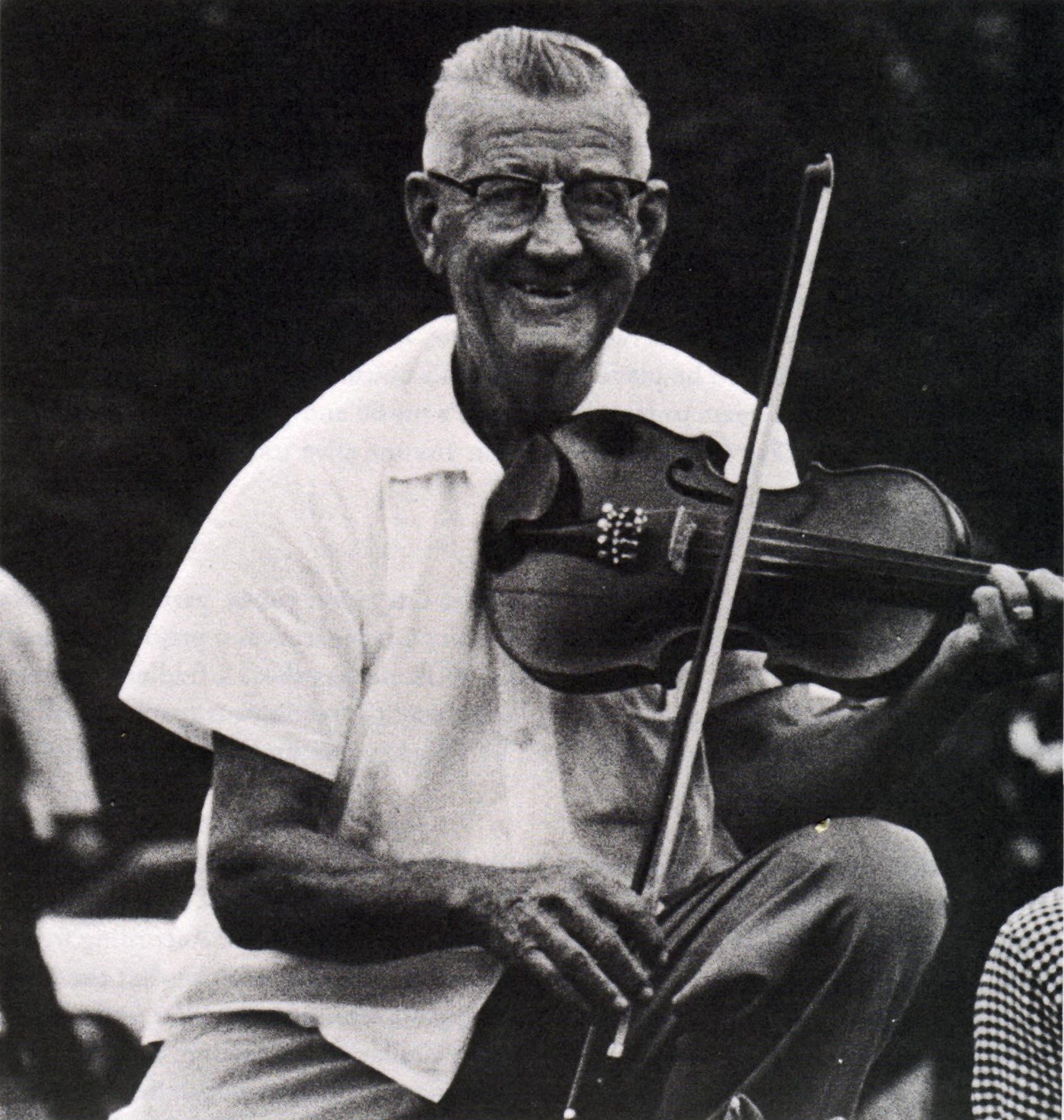
Marshall Cottrell, Fiddle Player and Confederate Veteran from Clay County, WV. Photo courtesy of Kim Johnson.
29 Thursday Nov 2012
Posted in Ed Haley
Tags
Akron, Appalachia, Asa Neal, Ashland, books, Calhoun County, Catlettsburg, Clay County, Clyde Haley, Columbus, Doc Holbrook, Doc White, Ed Haley, Ella Haley, feud, fiddle, fiddler, fiddlers, fiddling, Greasy George Adams, Greenup, Greenup County, Harts Creek, Ivydale, J P Fraley, Jack Haley, John Hartford, Kentucky, Laury Hicks, Lawrence Haley, Minnie Hicks, music, Noah Haley, Ohio, Over the Waves, Parkersburg Landing, Pat Haley, Ralph Haley, Sanitary Dairy, Ugee Postalwait, West Virginia, writing
Eight days later, I was with Lawrence Haley in Ashland looking at Ed Haley’s fiddle and holding old family photographs while he talked as if he’d just seen his father the day before. Pat was gone for the day, so it was just Lawrence and I, talking carefully in the kitchen with funeral home silence in the background. Lawrence — or Larry, as his wife called him — was a short, stocky man with thinning hair and a very straightforward manner. I could tell that he was a no-nonsense kind of guy and that it would serve me best to walk on pins and needles for a while. I also had the impression that in talking with me he hoped to correct some of the errors in the Parkersburg Landing liner notes. He was very careful with his words. Occasionally one of the Haley grandchildren would come in and sit nearby as quiet as a mouse before leaving to play in the yard.
In the initial small talk, I looked over Ed Haley’s fiddle, which appeared to be of an inexpensive Czech variety. It was stained brown and was without strings and a bridge. According to Lawrence, his father acquired it during the early 1940s. He confirmed that it was the one used to make the home recordings featured on Parkersburg Landing but was not the one pictured on Parkersburg Landing. He said Ed used “regular old steel strings — no cat-gut at all” and remembered that he always kept his fiddle on an old “pump-type” organ at home. He had the bridge somewhere around the house in a drawer, which he promised to find.
“If you ever find that bridge, we ought to rig that thing up and put some strings on it,” I said.
Lawrence reached me Ed’s bow, which he said was the same one he used the last ten years of his life. “He just used the same bow,” he said. “Whenever he got another fiddle, he’d change the bow.” I looked it over and noticed that it was as heavy as a log.
I started questioning Lawrence slowly with important but seemingly mundane questions about Ed’s music. I wondered if Ed knew what key he was playing in and Lawrence said, “Sure. Well, when my brother Ralph first started playing, Pop’d tell him which key to change to in a piece of music. He’d just lean over to Ralph and tell him.”
I asked Lawrence if he remembered the names of Ed’s favorite fiddle players and he said, “I couldn’t tell you, John. He’s mentioned a few fiddle players but I couldn’t tell you their name now.” Lawrence said he didn’t even remember many of Ed’s local fiddling buddies because he was a kid “wanting to get out and do something else.”
“I don’t even remember Doc White as far as that goes,” he said. “But I remember Laury Hicks up in Calhoun County, which is the next county right against Clay County there.”
I had read about Haley’s friendship with fiddler Laury Hicks on Parkersburg Landing. Hicks was a veterinarian in Calhoun County, West Virginia.
“One of Ed’s lifelong friends was an Ivydale physician named Laury Hicks,” it read. “Shortly before he died, Hicks requested that he be able to hear Ed Haley one more time. Ed arrived too late and it is said that he played over Laury’s grave for hours into the night.”
I asked about Asa Neal, the great Portsmouth fiddler. “Yeah, Asa Neal,” Lawrence said. “I’ve heard my dad talk about him. But I never seen the guy to my knowledge.”
He seemed to know the most about a local physician and casual fiddler named Doc Holbrook, whose name J.P. Fraley had mentioned to me. “They was long-time friends,” Lawrence said. “Doc Holbrook was a physician that practiced medicine in the county seat of Greenup County, which is also named Greenup. He was a fiddle buff and apparently a pretty good one because my dad wouldn’t a fooled with him if he hadn’t showed a lot of promise in playing the violin.”
This was a little confusing. Ed apparently had several doctor friends: Doctor Laury Hicks, Doc White and Doc Holbrook.
“They tell a tale about how Pop would come down to Greenup County and he’d go to where Doctor Holbrook had his practice. He had it in part of his home — had a riverfront home there. When Dad would go over to visit Doctor Holbrook, regardless of how many patients Doctor Holbrook had in his office, he’d shut his office up — he might have a half a dozen patients sitting out there — and him and Pop’d go in and play the fiddle half the day. That’s hear-say, but that’s what they tell me.”
I really liked that image.
Lawrence said his father made a recording for Doc one time, which he assumed was in the hands of Holbrook family descendants.
“Doctor Holbrook wanted this particular piece of music called ‘Over the Waves’ and he bundled my dad and mother up one day and, since there was no recording studios around this area, he took them to Columbus, Ohio where they had a good soundproof recording studio and had them make this piece of music. Now, whether they was other pieces of music made at the same time, I really don’t know. There probably was.”
In addition to giving Doc records, Ed also gave him a fiddle. “Pop had a real good copy of a Stradivarius, and it had a real good mellow tone and a real good solid deep resonance to it,” Lawrence said. “I think it was the one that he give to Doc Holbrook.” Lawrence said it was also still in the Holbrook family. “Doc had a son who had an office down at the Second National Bank Building and he inherited that fiddle,” he said. “J.P. Fraley was supposed to’ve taken that fiddle to the Smithsonian or at some kind of a centennial or something. But that was Pop’s fiddle.”
I asked Lawrence if his father had perfect pitch.
“Yes,” he said. “He never used a pitch pipe or anything. He tuned the fiddle by ear. One of his fiddles, I think had that little tuner on that high key. I never seen one on every string, though. It took him maybe four or five thumps on his strings to get them in tune. You know, them keys would get awful dry and squeaky in their pegs — in their holes — and they’d strip a lot of times and if it was a real dry season or something and it wasn’t holding in tune, he’d blow moist breath on them pegs to get them to hold in place.”
Lawrence had no idea where Ed got any of his tunes, except for one song.
“My dad and mother used to say they played a certain piece of music they heard from this old fella by the name of Greasy George. I won’t say his last name. Greasy George had apparently stolen a pig from somebody and had put it in a small pen close to the house. And two or three days later, he was sitting on the porch playing the fiddle and he saw the sheriff coming up the drive and he began to play a piece of music my dad plays. I don’t know the name of it, except that it went something like this: ‘Shove that hog’s foot further in the bed, further in the bed, further in the bed. Shove that hog’s foot further in the bed. Katy, can’t you understand me now?’ And his purpose in singing those words was trying to get his wife to hide that pig under a blanket, I think. Or that’s what my dad and mother inferred to me — that he wanted his wife to hide that pig somewhere. Mom was telling me about it.”
I asked Lawrence how Ed met his mother.
“I really don’t know,” he said. “Pop was either in Catlettsburg or somewhere around here close. My grandfather on my mother’s side, he moved from Morehead up here to Ashland. People followed work wherever they could get it. My granddad was an old timber man, I guess. They mighta been some work around here for him. In fact, I’m pretty sure at the time my dad met my mother, my grandfather was working at an old stave mill over here — where they make barrel staves. I guess Pop was playing and somebody heard him and told my mother that she ought to come hear him play. Somebody thought that my mother — which was supposed to be a trained musician — they wanted her to hear this old fiddle player. And they got them together that-a-way, I guess. Just a chance-type meeting. They got together and raised a family.”
Lawrence tried to describe the extent of Pop’s travels, a crucial detail in ascertaining the extent of his influence as he was primarily a non-recording, non-radio fiddler. “His travels, as far as being too enormously wide, was restricted to about a three state area, I guess. But apparently his influence got around eventually. Like you say, he might be the granddaddy of Texas style contest music. Far be it from me to dispute it. I really think if he’d been around during the sixties when old-time fiddling was coming back and everybody was wanting to hear this fiddle music, I think he could’ve been worth something. I think he could’ve made a little bit of money at that time. And he might not’ve wanted to do that, see. He didn’t want to do it back in the twenties when they was making recordings around.”
I said, “Well, he’d been on the street. He knew what was going on out there. That’s where life is lived.”
Lawrence said, “Well, that’s why he always steered away from these commercial record companies. The way I feel about my dad, if somebody wants to learn about his music or play it, maybe it might not be completely forgotten. I don’t want to make a dime out of it. If there’s any money anywhere to be made out of it that might come to Pop, turn it over to the Foundation for the Blind. I don’t want to make anything off of my dad. He brought me into this world and raised me up and I’ve had a pretty good life.”
I asked Lawrence what Ed did when he was sitting around home and he said, “He liked to chew tobacco. He’d take this old twist — Stader’s twist, they called it — and he’d take his pocketknife and cut that up and put it down in his pocket. It was picked right off a farm. In fact, that picture of him on the front of that album, I think he had a chew of tobacco in his mouth then. He always carried a vegetable can with him to spit in. Mom never did like it but it was just almost a part of him when he was around the house, except when he’d get out on the porch — then he’d spit out in the yard.”
Lawrence said his dad liked to play music on the porch.
“We lived down on 17th Street and he’d get out on the front porch with that banjo or fiddle and he’d sit on the front porch and play. He’d cross his legs and sit up on the banister where he could spit easy or he’d just sit down with a banjo and play it.”
Lawrence had no clue what happened to Ed’s banjo. “It was one of those things that left when I was in the service, I guess. And Mom’s mandolin disappeared. The accordion my mother had, she let Aunt Minnie have it because Aunt Minnie played the organ some and she wanted to try that accordion. They took it up there and she left it up there for Aunt Minnie and then the house burnt down. It was not a very expensive accordion.”
Aunt Minnie, Lawrence said, was Laury Hicks’ widow in Calhoun County, West Virginia. Lawrence mentioned that I should get in touch with their daughter, Ugee (Hicks) Postalwait, in Akron, Ohio. “I guess she must be close to 81 or 82,” he said. “She was a young woman when I was just a kid. She would dance around Pop when he played and while he was noting the fiddle she’d be up there hitting them strings that he was noting. It had a real nice little ring to it. She heard him like these people hear you right now. She heard him live, danced around it and played on it and everything else. She said all that scratch on the records didn’t sound like Ed Haley. It’s not the same.” I said I would call Ugee when I got back to Nashville.
Lawrence told me a little about his childhood trips to Harts Creek — the place of Ed’s birth. “Most of the time we’d ride the train up there and get off at Harts and then maybe walk and it seemed to me like it took us half the day to get up Harts Creek. You’d ford that creek half a dozen times and the road was in the creek half time time.”
I asked him if Ed carried his fiddle all the way up there and he said, “Most of the time he carried the fiddle. I’ve seen him carry nothing but a fiddle — not even a case a lot of times. He’d carry it out in the open.” He said Ed never played it or thumped on it while walking — “he’d tuck it under his arm and go.” What if it rained? “That’s another thing,” he said. “I can’t remember any instance like that, but I imagine he’s had instances like that. But I know he has went around with a fiddle with no case — just a fiddle and a bow. Same way with Mom. She didn’t have a case for her mandolin.”
At that point, Lawrence showed me several family photographs, including a wonderful picture of his family just before his birth in 1928.
“I was born just a year before the Depression hit,” he said. “They was two of us just babies when the Depression started. Ralph, Clyde, Noah and Jack were stepped from five to fifteen. A lot of times it was skimpy eating and at other times it was pretty good. We never starved or anything. We’d go down to an old dairy just below us called Sanitary Dairy and get a big lard bucket full of buttermilk for a dime, and I could take a piece of cornbread and a glass of buttermilk and make a meal out of it. I’ve done that a lot. I’ve taken ten cents when Mom could scrape up a dime and us kids would all walk downtown to one of them ten-cent movies and stay all day and be starving to death when we came home and there wouldn’t be nothing but cold cornbread and pinto beans or something like that. That’s the way our life went, during the Depression anyway.”
There was another remarkable photo of Ed and his family just after the Depression started. “Everybody can tell you about hard times in the Depression,” Lawrence said. “I know in my second summer Mom said she fed me fresh corn and I took the trots and liked to wasted away from diarrhea. That was about 1930. We made it anyway.”
As Lawrence showed me a few family pictures, his wife Pat showed up with a few of her “bingo buddies.” Pat was a very polite English lady with dark hair and a small frame who wore large glasses. We said our “hellos” and I played a few tunes.
Once the guests left, I spoke more about Ed Haley with Pat and Lawrence in the kitchen. With Pat’s presence, Lawrence’s demeanor was a little different. I could tell that he wanted to present his dad to me in just such a way and he almost openly resented any input from Pat. There was a slight tension in the air. At one point, Lawrence said to Pat, “Go ahead Pat. You tell it. You know more about it than I do.” Pat took it all in stride. She just wanted to be helpful. In any case, Lawrence gave me the impression — and this was very important — that if I did or said anything to his disfavor I would be more than welcome to hit the road. Ironically, and contrary to what I had heard, he seemed more over-protective of his father’s story than his music. Needless to say, it took me a while to get up enough nerve to pull out my tape recorder and record his memories.

Writings from my travels and experiences. High and fine literature is wine, and mine is only water; but everybody likes water. Mark Twain
This site is dedicated to the collection, preservation, and promotion of history and culture in Appalachia.
Genealogy and History in North Carolina and Beyond
A site about one of the most beautiful, interesting, tallented, outrageous and colorful personalities of the 20th Century