
• About

Brandon Ray Kirk

~ This site is dedicated to the collection, preservation, and promotion of history and culture in my section of Appalachia.

Brandon Ray Kirk

Tag Archives: Calhoun County

In Search of Ed Haley 97

27 Saturday Apr 2013

Posted by Brandon Ray Kirk in Ed Haley

≈ Leave a comment

Tags

Calhoun County, Clay County, Doc White, fiddler, guitar, history, Laury Hicks, music, West Virginia, Wilson Douglas, writing

     Around that time, I read up on Wilson Douglas, an old-time fiddler who remembered Ed Haley visiting Laury Hicks during the Depression. I had first heard of him several months earlier from J.P. Fraley’s circle of friends. Wilson came from a family of musicians in the Elk River Valley north of Charleston, West Virginia.

     “I was born October 22, 1922 in Clay County,” Wilson said in one published interview. “My grandfather, Martin Stephenson Van Buren Douglas was one of the greatest ballad singers of all times. My dad was Shirley Andrew Douglas and he was a beautiful banjoist! And my Grandmother Morris was an old-time square dance fiddler and all her brothers were top fiddlers on my mother’s side, the Morris side.”

     Wilson started playing music at a young age, first the guitar, then the fiddle.

     “I started on the guitar when I was nine years old and I played the guitar Carter-fashion,” he said. “And 1935-36 was a severe cold winter. I was 13 years old. I had played the guitar up until that time for various fiddlers. During that winter I lived about a mile from my grandmother’s. At that time she had the only old fiddle in the country to my knowledge. The old instrument was patched with solder, carpet tacks, and various other things. Every night I would take my guitar over there and play. She would play hoedown fiddle tunes half the night. She played mostly dance tunes on two or three strings. She seldom played the bass. The following winter her health failed and she began to lose interest in the violin. However, that fiddle began to sound good to me. Then I suddenly decided that I would quit playing the guitar and try to make some kind of fiddler out of myself. So I started saving my money to buy me a fiddle.”

     In a short time, Wilson found himself visiting at the home of Laury Hicks, where he first saw Haley.

     “There was an old gentleman that lived in Calhoun County joining Clay County by the name of Laury Hicks,” Wilson said. “He was a good old-time rough fiddler. I would ride a bicycle over to his home to hear him play the fiddle. Then somehow Laury Hicks contacted Ed Haley in Ashland, Kentucky. In about a month Haley came to Calhoun County. So the news got around through the country that Ed Haley was at Laury Hicks’. Everybody around went to hear him play. It was 12 miles from where I was raised over to Laury Hicks’ where Ed Haley’d come to. And if a gang didn’t gather up to go in an old ’29 Model-A Ford truck, we’d start walking. Maybe somebody’d come along in an old car and pick us up. And it was just like a dang carnival, you know. We just sat and never opened our mouth and he’d scare them fellers. Them fellers never tried to play. I was just dazed with that fiddle. He’d play until about 12 o’clock at night, and when he got tired, he’d quit. I was really not conscious of coming back home.””

     According to Wilson, the locals tried to keep Haley in that part of the country as long as possible.

     “Well, when he’d take a notion to go back to Kentucky, we’d all beg him to stay another week,” he said. “Doc White would say, ‘Ed, now listen. They’s a gang of people coming from Roane County, you can make some money. Now, you stay another week.’ Ed was bad to swear. Well, they’d talk him into it. Maybe some of these old farmers would come along. They’d had a tune and maybe their father played or some of their ancestors and they’d heard it. They’d say, ‘Well, Ed, play me this tune,’ and they’d hand him a dollar. Well, he’d play it for 15 minutes! They’d sit there with big tears. Well, he’d play till the money ran out and he’d quit!”

     Wilson told about the last time he saw Haley play at the Hicks home.

     “The last night, the last time I seen him, I was a big boy and I’d got over there,” he said. “I was sitting in this old split-bottom chair. Sleepy, you know. But every time he’d play a tune, I’d survive. And he said, ‘Son, what’s your name?’ I didn’t know that he knew that I’d been sitting in front of him. I told him. He said, ‘You’ve been over here every night, haven’t you?’ I said, ‘Yeah,’ and I said, ‘Mr. Haley, you’ve played tunes for everybody and I don’t have no money. I’m saving up to buy me a fiddle.’ He laughed! I said, ‘How about you playing me a tune?’ ‘All right. What is it?’ I said, ‘Play the ‘Black-Eyed Susie’.’ ‘Well, that’s really no tune. It’s just a little old thing.’ ‘Well,’ he said, ‘Damn it, I’ll play it. I don’t like to play it. Them’s single-line tunes, but I’ll play it for you.’ And he did, because I was interested, you see?”
In Search of Ed Haley 91

17 Wednesday Apr 2013

Posted by Brandon Ray Kirk in Ed Haley

≈ Leave a comment

Tags

Asa Neal, Bill Day, blind, Bus Johnson, Calhoun County, Camp Crowder, Cincinnati, Clyde Haley, Doc Holbrook, fiddle, fiddler, history, Laury Hicks, Lawrence Haley, Minnie Hicks, Missouri, Mona Holbrook, music, Ohio, Ralph Haley, Ralph Payne, Rosie Day, Sam Vie, Signal Corps, West Virginia, WLW, writing

Clyde said Ed never said “too much” about where he learned to play the fiddle.

“Well, he was blind all his life, since he was a small boy, and he started with a cornstalk.”

Ed did talk about other fiddlers, though.

“Oh, yes,” Clyde said. “He knew Sam Vie and Asa Neal, and all those old-timers. Did you know Bill Day? Well, my dad used to play with him a lot. But Bill Day couldn’t play the fiddle as far as I’m concerned.”

Bill Day’s wife Rosie was a sister to Laury Hicks, Haley’s veterinarian friend in Calhoun County, West Virginia.

“Well, Rosie was Laury’s sister, as I remember,” Clyde said. “Rosie stayed with my mother and helped take care of Mom because my Mom didn’t like to cook in the summertime because of the flies. I got in trouble one time and I had to go stay with Laury and Aunt Minnie. And I stayed with them in my growing up years. Laury was a doctor, you know, and so was Minnie. She’d just go on a horse, travel miles and miles and miles on a horse, to go deliver a baby or something like that.”

Clyde also remembered Doc Holbrook, Ed’s friend in Greenup, Kentucky.

“Yeah, yeah,” he said. “Monnie, my sister, was named after Dr. Holbrook’s wife: M-O-N-N-I-E.”

Clyde was well aware of Ed’s suspicions toward the commercial music industry.

“My dad didn’t ever want his music recorded and it was difficult to get him to get in a position where he would let anybody record his music,” he said. “There was a guy named Bus Johnson in Cincinnati that wanted my dad — I remember — he wanted my dad to come down there to Cincinnati to WLW and get some music recorded for him but he wanted to commercialize it, you know, which I wish he had’ve now. My dad and mother would’ve had a lot better life with the money they could’ve made off the music. I always did tell my dad, ‘Pop, you ought to get those things recorded because you got money laying around in the fiddle case.'”

Talking about Ed’s refusal to make commercial records caused me to ask about his home recordings.

“Him and my mother had over six hundred records,” Clyde said. “Them old records that Ralph sent home out of the Army. He was in the Signal Corps at Camp Crowder, Missouri, and he took a lot of the equipment home — borrowed it from the Army — and my dad and my mother was in on some of the records, too, you know. And Lawrence has got all that kind of information; more than I would have because I’ve been gone from home. I’ve been a roamer, you know. And I used to drink a lot. I don’t think I’ll ever take another drink, but that’s neither here nor there. I’m in this hospital and it’s what it’s for. I had strokes. It’s not a nut-house hospital or anything. It takes care of people like me. I used to drink quite a bit myself, but I’ve made up my mind since I had the strokes that I’ll let that stuff alone when I get out of this place. I talk like it’s a jailhouse, but it’s not. It’s full of women.”

In Search of Ed Haley 62

06 Wednesday Feb 2013

Posted by Brandon Ray Kirk in Ed Haley, Music

≈ 2 Comments

Tags

Brooks Hardway, Calhoun County, Chicken Reel, Clark Kessinger, Ed Haley, Emery Bailey, fiddler, fiddling, Frank Santy, Gerry Milnes, history, Homer Bailey, John McCune, Laury Hicks, music, Parkersburg Landing, Roane County, Senate Cottrell, Spencer, Stinson, Ward Jarvis, West Virginia, writing

At that point, Gerry asked Brooks about Ed Haley, and it was clear from his remarks that he thought he was an incredible fiddler.

“I’ve saw Ed Haley and stood and listened to him and sat in houses and listened to Ed Haley play,” he said. “Ed Haley is the best fiddler I ever listened to and I’ve heard a lot of them. And I’m a pretty good judge of what good fiddling is. And Ed Haley was the slickest, hottest… He bluegrassed it — he’s another fellow that was 50 years ahead of his time, like I mentioned about Emery Bailey. Ed Haley could lay the leather on that fiddle bow and so smooth it was out of this world.”

Brooks told Gerry about seeing Ed at the Roane County Courthouse in West Virginia before the Depression.

     I walked up in the courthouse at Spencer one time back in the 20s and there was a crowd in the courthouse yard and there sat Ed Haley fiddling. He had a tin cup sitting there on a little stand. Ed Haley wouldn’t play unless that tin cup kept rattling with nickels and dimes. A dollar bill was out of this world in them days. I listened to Ed Haley play and Homer Bailey, Emery’s brother, was at the stock pen. The stock pen was just across the stream from the courthouse and I hurried to tell Homer. I wanted Homer to hear Ed Haley. I said, “Homer, Ed Haley’s over here at the courthouse yard playing the fiddle. Let’s go over and hear him play a tune or two.” And as we was crossing the bridge going back over the courthouse Homer said, “Plum honor, Brook. I wonder if he can fiddle ‘Chicken Reel’ as good as Emery can?” I said, “I don’t know but we’ll find out pretty soon now and you be the judge.”

     And we walked up close to Ed. Ed wasn’t playing — there wasn’t no nickels going in the cup. I put a big Bull Moose nickel in the cup and rattled it and I said, “Ed, I’d like to hear you play ‘Chicken Reel’.” And he reared back and leveled off on that fiddle and you never heard such a ‘Chicken Reel’ in all my life. Homer turned sideways and bent over and held his head right forward towards Ed Haley and took that tune in. Shortly, when Ed quit playing, Homer looked at me with a big gold-toothed smile and said, “Plum honor, Emery can’t play it can he, Brook?” So he really took a spell over Ed Haley. But Emery was good on it but that was what Ed Haley would do for a fiddler. When you heard Ed play, that was it.

Brooks said to Gerry, “Now Emery Bailey never did see Ed Haley but Clark Kessinger copied Ed Haley fiddling. Ed Haley made a statement before he died. He said he hoped that his type of fiddling had rubbed off on somebody that could carry the thing along and keep it going. Well now, Clark Kessinger was the man. He could imitate Ed Haley’s stroke. But I had the privilege of seeing and hearing Ed Haley play. Nobody could fiddle as good as Ed Haley could, but Clark Kessinger could come close to him.”

Gerry asked Brooks what brought Ed into the Calhoun County area of West Virginia.

“I would say it was Laury Hicks,” Brooks said. “Laury Hicks was another fiddler. Laury Hicks had his own stroke. He never copied nobody. Laury Hicks was rough as a cob but my my he could put stuff on a fiddle that was out of this world. They lived on Stinson, over in that Nebo country. And he would go down to Charleston and bring Ed Haley up and keep him a week — maybe two. Ed enjoyed that. That was free board for Ed, you see. That day and time, it was nippity tuck to make a living if a man didn’t live on a patch of land somewhere. And Laury picked up a lot of his stuff, too.”

Brooks told about a time when Ed was staying with Hicks and visited John McCune, an old fiddler who lived “in that Nebo country” a half-mile below Hicks.

   Now, Frank Santy told me this and Ward Jarvis and Senate Cottrell. They fiddled till midnight and Laury thought of old John McCune. He couldn’t play much but he had one tune that they said he was out of this world on. Laury thought of that and he said, “Ed, if you ain’t too tired I’d like to go down to John McCune’s and have him fiddle a tune for you.” Ed was going home the next morning and he said, “We may not have time to do that tomorrow.” And they went down to old John McCune’s John got out of the bed and fiddled that tune. And Ed Haley sat there and listened to it. When John got through, Ed Haley said, “Mr. McCune, you never need to hesitate to play that tune for anybody. There’s nobody living that can beat you playing that tune.” So that was an honor to John McCune on his number.

Brooks knew a little about Ed playing over Laury’s grave, which I had first read about on the Parkersburg Landing liner notes.

“When Laury Hicks was on his dying bed, he said, ‘I would like to have Ed Haley play a few tunes over my grave when I’m dead and gone.’ And Ed Haley made a special trip up to Stinson and fiddled over Laury Hicks’ grave. They said he played some of the sweetest tunes they ever listened to. He took a little group with him and he played the fiddle over Laury’s grave. That’s a true story.”

In Search of Ed Haley 61

02 Saturday Feb 2013

Posted by Brandon Ray Kirk in Ed Haley

≈ 1 Comment

Tags

Braxton County, Brooks Hardway, Calhoun County, Emery Bailey, Frank Santy, French Carpenter, Gerry Milnes, history, music, Sol Carpenter, Ward Jarvis, West Virginia, Willie Santy, writing, Yew Piney Mountain

Later that fall, I met Gerry Milnes, an old-time West Virginia fiddler and banjo-picker, at the Tennessee Banjo Institute in Cedar of Lebanon State Park near Nashville. Gerry said he’d heard a lot about Ed Haley through his interviews of older musicians in central West Virginia. It was obvious that he was some type of folklorist but I didn’t realize to what degree until a few months later when I received a letter in the mail declaring him to be the coordinator of the Augusta Heritage Center in Elkins, West Virginia. In his letter, he wrote about his suspicion of Ed learning tunes from Jack McElwain (1856-1938), who he called “the premier fiddler in the state of West Virginia around the turn of the century.” He felt there were clues in Haley’s repertoire: his “Old Sledge” was a McElwain specialty and his “Garfield’s Blackberry Blossom” was very much like McElwain’s “Yew Piney Mountain”.

A few months later, Gerry sent me a cassette tape of a 1988 interview with Brooks Hardway. Brooks was an old-time banjo player who knew first hand about all of the old musicians in north-central West Virginia — “Laury Hicks country.” He also knew about Ed Haley. On the tape, he gave a little bit of information about his own life, important to note in order to keep his stories in context.

“I’m 81 today,” Brooks said. “I was born at Walnut, West Virginia. Walnut is in Calhoun County. I was seven years old when we moved over to the Left Hand Fork of West Fork. My daddy bought a store at Gip. So there’s where I grew up from seven until I got married at the age of 32. Grandpa Santy moved from Walnut to Gip when we did and he lived in a little country Jenny Lynd house where we did. And he had a boy named Willie Santy. He was a clawhammer banjo-picker. I would give the world if I could do it like he did. But he had a hook with his thumb that I never could learn. That is, to get down and hit that second string and walk it back up with his thumb. My goodness, he could put the double shuffle on them tunes.”

Brooks’ maternal family, the Santys, was a key player in the musical history of Calhoun County. Aside from his uncle Willie Santy, who was apparently an accomplished banjo player, his great-uncle Frank Santy was a popular left-handed fiddler.

“When I was a boy — ten, twelve, fourteen — he played for dances on the West Fork,” Brooks said. “He’d fiddle all night and they’d charge fifteen cents a set and he’d have the next morning five or six dollars. Frank Santy could fiddle ‘Piney Mountain’ so good it’d bring chills of hilarity throughout your body. It’s an old Clay County number. I think he learned it from old Sol Carpenter — one of the original old-time fiddlers. Old Senate Cottrell, that was his favorite tune.”

Ward Jarvis, a son of Jim Jarvis who lived in the head of Walnut in Braxton County, was a good banjo picker and fiddler.

“I practically stayed at Jim Jarvis’ and played with Ward,” Brooks said. “Will played a banjo and I played a banjo and guitar. We’d cut wood of a daytime and burn it up of a night a playing the fiddle, banjo and guitar. Ward Jarvis is the origin of my clawhammering the banjo. Ward Jarvis was one of the best. He played the banjo for a while while he was a young man. And Ward Jarvis played the banjo with Frank Santy and then he got to picking Frank’s fiddle up and he learned to play that fiddle and he got better than Frank was. Frank got jealous of him and dropped him.”

Emery Bailey was a top fiddler in Calhoun County, according to Brooks.

“Emery Bailey was the top of the tops at that day and time,” he said. “Emery Bailey fiddled 50 years ahead of his time. Emery lived just below where we did and he had a brother named Homer. Now they was at the top of the list in their day in fiddling and banjo-picking. They had a contest at Sutton one time — old time fiddlers’ contest — and Emery went. That woulda been back in the late 20s or early 30s. When Emery come back I asked him what he did. ‘Plum honor Brooks, they didn’t let me play. They wouldn’t let me enter the contest.’ I said, ‘Did you play a tune or two for them, Emery?’ Emery said, ‘Plum honor I fiddled ‘Sally Goodin’, Brooks. They said I didn’t fit in an old-time fiddlers’ contest.’ I said, ‘What was wrong?’ Emery said, ‘I think I put too much diddle on the bow.’ Now Emery’d been laying the leather to ‘Sally Goodin’.”

How did Emery Bailey compare to Ward Jarvis?

“Now Ward Jarvis always was more of an old-time, old-fashioned fiddler,” Brooks said. “He had a different lick to what Emery had. Wherever Ward played in a contest in that day and time he took first place. He had the best shuffle I believe I ever heard.”

Brooks was also familiar with French Carpenter, one of the most well-known fiddlers from Clay County.

     I never heard Solly Carpenter play but I’ve heard his son French Carpenter play. I was at my grandpa’s house… I was ten or eleven, twelve years old and looked down the road and seen a man coming up the road with a flour poke in his hand and we watched him till he got up in front of Grandpa’s house and it was French Carpenter with the fiddle in a flour poke and about four inches of the neck of it sticking out the top of that poke and he had his hand around that fiddle neck. Well, Grandpa never let a man with a fiddle or a banjo pass the house without stopping him and bringing him in so he halted French Carpenter and French Carpenter stayed all night with Grandpa Santy and they had music and the house was full of people that night. First time I’d ever seen French Carpenter and he was the first man that we in that part of the country ever heard sing with the fiddle. And he played some of the sweetest tunes that I ever listened to and sung them and fiddled till twelve or one o’clock in the night and held the attention of them people. You could have heard a pin drop a listening to French Carpenter sing them pretty songs.

Parkersburg Landing 39

26 Wednesday Dec 2012

Posted by Brandon Ray Kirk in Ed Haley

≈ Leave a comment

Tags

Appalachia, blind, Calhoun County, Ed Haley, Ella Haley, Harts Creek, history, John Hartford, Kentucky, Lawrence Haley, Milt Haley, music, Ugee Postalwait, West Virginia, writing

     The next thing I knew, Ugee was up at the stove cooking a big meal and singing “Maggie and Albert” — Haley’s version of “Frankie and Johnny”. When she was finished, she said, “Now that’s some old songs. Ed played them and when he played them, you’d be glad to sit and listen to them, too. And he patted his foot.”

     During dinner, Ugee told me about her own musical experience.

     “I started off on the five-string banjo then graduated myself to the guitar,” she said. “The first guitar that I ever seen, Howard Alexander brought it in the country. He’d been over to his mother-in-law’s around Rosedale and when he come back he brought a guitar. Howard didn’t play the guitar or banjo either. He come down and said, ‘Ugee, I brought you something. A guitar.’ And I said, ‘Well, I never tuned one of them things.’ I suppose I’d been playing the banjo about three or four years. Dad said, ‘Well, you tune the banjo. Go ahead and tune it up there.’ Howard said, ‘Aw, just keep it as long as you want to. I’m in no hurry fer it.’ He’d traded something for it. I forget what it was. I went to fooling with that guitar, you know, picking around with it, this that and another, running a knife down it. Well, I tuned it up like a banjo. First thing you know I found me a chord, and then Dad come in with a mandolin.”

     “We went to play music around at the schoolhouse and places like that for pie suppers and cake walks,” Ugee said of herself and her father. “My dad thought there wasn’t nobody in the world like me. Nobody could do like I could. We went to a place and played for a schoolhouse and the teacher down there… He was a Glenville graduate — you know, went to college and everything — thought he knew it all. He said, ‘Mr. Hicks, play ‘Soldiers Joy’. So Dad played it for him. Just as soon as he got done playing it, he said, ‘Mr. Hicks, play ‘Soldiers Joy’. Dad played it for him again. I think he played it about five times. By that time, Dad was getting tired of it. And he come there and said, ‘Mr. Hicks would you please play ‘Soldiers Joy’? Dad said, ‘Hell, I’ve played it for you five times and you didn’t know it when you heard it.’ Made Dad mad. Every once in a while, me and Dad’d be a sitting playing, practicing, you know, and I’d look over, I’d say, ‘Dad, would you please play ‘Soldiers Joy’?’ He said, ‘I’ll mash you in the mouth.'”

     Ugee said, “One time, a teacher taught at our school and he made me mad the way he treated me in school. He was having a doing going on at his school and Dad said, ‘I’m supposed to play at the White Oak School.’ And I went to the White Oak School. Well, me and Dad went over and I decided I wasn’t gonna play any music. When I sat down, the teacher said, ‘Oh, I’m so proud you come to play, Ugee,’ and just going on. I just reached down with my finger on that guitar and I broke that string. Dad reached down in his pocket and pulled out another one and said, ‘Now put that on and don’t you do that again, either.’ I never will forget it as long as I live. Jasper McCune was playing the five-string banjo. He was Dad’s first cousin. He said, ‘Why don’t you do that again, Ugee? Laury’ll slap your ears, too.'”

     After supper, I asked Ugee what she knew about Ed’s blindness.

     “They said Ed went blind when he was three or four years old. He had the measles. Well, he was sick and had a high fever. I don’t know whether you ever knowed it or not but the gypsies used to come around in the country and he had a high fever and they told his dad and them to take him down to the creek and throw him in the cold water and that would break the fever on him and he’d never have a fever again. And that’s what he done and it put him blind. But you know measles will put you blind because I almost went blind too when I had the measles. I was about twelve years old. And that’s what Ed said that put him blind. I asked him, I said, ‘Was you born blind?’ He wasn’t.”

     Ugee said Ed occasionally talked about his father — a growing source of interest for me — although she didn’t remember much about it.

     “I think his dad was a pretty mean man, the way he talked. And the way I understood him to say his mother got killed by some of them Hatfields and McCoys or some of them when that feud was going on. But I believe he said his dad was a pretty mean man. I don’t know what he meant by that. I never did hear what happened to his dad. I never heard him say about that. I believe he said he was raised by a aunt.”

     I told Ugee about Lawrence and I going to Harts Creek and she said, “Lawrence, he was little all the way around. He thought an awful lot of his dad and mother. Larry’s the only one that turned out real good. Noah, he gambles and I don’t know what all. And Clyde, he’s been in a little bit of everything. Mona’s been the same way. Poor old Larry, he’s looked after all of them. He don’t care whether he hears from them or not because every time he hears from them it’s money or have to help them out or get them out of something. Jack died. Jack was a nice looking man, too. He was taller than Lawrence. He was a nice boy like Larry.”

     I asked Ugee if she thought maybe some of Ed’s kids took after his father Milt, who she called “a pretty bad feller.” She said, “I have an idea they did. And I heard Ed say one time that Ella had some awful mean people on her side. He said Noah was turned just exactly like his mother’s people. They was a lot of mean people down there in Kentucky. Lot of murdering and lot of killing.”

In Search of Ed Haley 38

25 Tuesday Dec 2012

Posted by Brandon Ray Kirk in Ed Haley

≈ Leave a comment

Tags

Black Sheep, Blackberry Blossom, Buttermilk Mountain, Calhoun County, Ed Haley, Ella Haley, fiddling, Fire on the Mountain, Florene, Harvey Hicks, history, John Hartford, Laury Hicks, McKinley, music, Old Zed Tanner, Parkersburg Landing, Pat Malone, Stacker Lee, Sweet Florena, Ugee Postalwait, West Virginia, writing

I reached Ugee my Parkersburg Landing album, hoping it might rekindle the names of more Haley tunes.

“Ed had a habit of changing the name if he was in a different town,” she said. “Now just like this ‘Parkersburg Landing’, that’s another song that he always played.”

Ugee remembered Haley’s singing ability more than his fiddling.

“He had a beautiful voice,” she said. “It’d bring tears to anybody’s eyes. He could sing low, he could sing high. He sang ‘Stacker Lee’ and he didn’t lay his fiddle down when he sung. He played his own music and sang at the same time. I never heard nothing like him and I’ve heard a lot of them, Mr. Hartford, because they used to come to my dad’s house. Anybody come in anyplace close, they’d come to our place. They didn’t stay all night — they stayed a week or month. Banjos, guitars, whoever played music come to my dad’s. They wasn’t nobody in the world loved it any better than he did.”

Ugee went through some other tunes — like “McKinley” and “Old Zed Tanner” — but only remembered pieces of them. There was also “Fire on the Mountain” and “Buttermilk Mountain”.

Going on Buttermilk Mountain to see my old girlfriend again.

When I come out, there’ll be no Buttermilk girlfriend to meet me again.

When I come back, I’ll bring my girl from old Buttermilk Mountain.

I’m a goin’ away, I’m a goin’ to stay, I’m a goin’ to Buttermilk Mountain.

“Ella didn’t like that song,” Ugee said. “She’d say, ‘I hate that song. I don’t want to hear that old thing.’ She thought it was some girl Ed used to go with that he was talking about. Harvey my brother would get around and have Ed to sing it.”

Ugee said Harvey would come around with whisky and get Ed to play what he wanted, usually songs that made Ella jealous, like “Florene”.

I’m leavin’ you sweet Florena.

I’m leavin’ you sweet Florene.

I’m goin’ away, I’m goin’ to stay.

I’m a leavin’ you sweet Florene.

Oncest I bought your clothes sweet Florena.

Oncest I bought your clothes sweet Florene.

Oncest I bought your clothes

But now I ain’t got no dough

Now I have to travel on, sweet Florene.

Down in the pen sweet Florena.

I’m down in the pen sweet Florene.

I’m down in the pen, but for you I’d go again

I’m a leavin’ you sweet Florene.

“Harvey was a good man but he’d slip Ed a little shot of whiskey,” Ugee said. “He’d say, ‘Ed, it’s about time for you to have a little drink of water, ain’t it?’ Oh, it wouldn’t be but about a few minutes till old Ed was playing like crazy. You give him a shot and boy you oughta heard him. Then he’d say, ‘Ed, I’d like to hear that old Florene song.’ Ella would shake her head — ‘I don’t like that song. That’s about some of his old women that he used to run around with probably.’ And that’s all she’d say about it, but she’d shut her eyes tight and shake her head.”

She remembered Ed playing ‘Blackberry Blossom’ but couldn’t quite remember the story behind it.

“And then there was a song called ‘Pat Malone’,” she said. “Did you ever hear that song?”

Before I could answer, she started singing:

Times are hard in an Irish town. Everything was a going down

And Pat Malone was short for any cash.

He for life insurance spent all his money to a cent

And the most of his affairs had gone to smash.

Pat’s wife spoke up and said, “Oh dear Pat, if you were dead

There’s twenty thousand dollars we could get.”

So old Pat laid down and tried to make out that he had died

Until he smelt the whiskey at the wake.

Then Pat Malone forgot that he was dead.

Oh, he raised right up and shouted from his bed.

“If the wake goes on a minute, the corpse’ll sure be in it.

You gotta get me drunk to keep me dead.”

So they gave the corpse a sup.

After they had filled him up

And they laid him back upon his bunk again.

Then before the break of day everybody felt so gay

That they all forgot that he was dead.

So they took him from his bunk, still alive but he’s awful drunk.

And they laid him in his coffin with a prayer.

Then the driver swore by dad that he’d never start ahead

Until he seen that someone paid the fare.

And Pat Malone forgot that he was dead.

He raised right up in the coffin and he said,

“If you dare to doubt my credit, you’ll be sorry that you said it.

Drive on or this corpse will smash your head.”

So the driver started out on the cemetery route

And the people tried that widow to console.

Then near the churchyard lot, Pat Malone’s last resting spot,

They begin to lower the dummy in the hole.

When the clods begin to drop, Pat burst off the coffin top

And quickly to the earth he did ascend.

Then Pat Malone forgot that he was dead.

He quickly from that cemetery fled.

Pat come near a goin’ under, what a lucky thing by thunder,

Old Pat Malone forgot that he was dead.

I was blown away. I said to Ugee, “That’s great! Where in the world did that come from?”

“Oh,” she said, “that was from back in the hills there. That’s an old song. Just like that ‘Black Sheep’ song. You ought to have heard Ed play that.”

In a quiet country town not so very far away

Lived a rich and aging man whose hair was silvery gray.

He had three sons, his only ones, Jack and Tom were sly.

Ted was as honest as he could be and he would not tell a lie.

They both began to ruin him within the old man’s eyes.

Then the poison began its work and Ted was most despised.

One day the father said to him, “Be gone ye to the poor,”

And these words the Black Sheep said while standing in the door:

“Don’t be angry with me Dad. Don’t turn me from your door.

I know that I’ve been a worry, but I’ll worry you no more.”

Give to me one other chance and put to me the test

And you’ll find the Black Sheep loves you Dad far better than the rest.”

Year by year passed by and the father he grew old.

He called in both Jack and Tom and he gave to them his gold.

“All I want is a little room, just a place by your fireside.”

Jack returning home one night and he brought with him a bride.

The bride begin to hate the father more and more each day

Until one night she declared, “That old fool is in our way.”

They decided to send him to the poor house which was near.

And like a flash that Black Sheep’s words went ringing in his ear:

“Don’t be angry with me Dad. Don’t turn me from your door.

You know that I’ve been a worry worry, but I’ll worry you no more.

Give to me one other chance and put to me the test

And you’ll find the Black Sheep loves you Dad far better than the rest.”

Well a wagon drove up to the door, it was the poor house van.

The boys laughed and pointed to their dad and they says, “There is your man.”

Just then a rich and a manly form came pressing through the crowd.

“Stop you brutes,” the stranger said, “This will not be allowed.

You’ve taken the old man’s property and all that he could save.

You’ve even sold that little lot containing his wife’s grave.

I am his son but I’m not your kin from now till Judgement Day.”

The old man clasped the Black Sheep’s hand and the crowd all heard him say:

“Don’t be angry with me lad. Don’t turn me from your door.

I know that I was foolish, but I’ve repented o’er and o’er.

I should have gave to you my gold ’cause you have stood the test.

Now I find the Black Sheep far better than all the rest.”

Ugee apologized for her voice, saying, “Now, that’s not sung right. You oughta heard Ed Haley sing that to you. The first time I ever sung that, I sung a little bit of it to Ed, and when he come back again he was playing and singing that. It’d raise the hair on your head.”

I wondered if Laury was a singer and she said, “My dad couldn’t carry a tune but he could play that fiddle. My dad could whistle.”

Parkersburg Landing 37

24 Monday Dec 2012

Posted by Brandon Ray Kirk in Ed Haley

≈ Leave a comment

Tags

Akron, Calhoun County, Ed Haley, Ella Haley, history, John Hartford, Laury Hicks, music, Ohio, Ralph Haley, Spencer, Ugee Postalwait, West Virginia, writing

     A little later, Ugee saw Ed and Ella at Spencer, the county seat of Roane County.

     “I lived three miles below Spencer one year and come up to town to get some groceries or something and Ed and Ella was there at the courthouse playing music. Well I went over to talk to Ed and Ella. Nothing else would do but for us to go down to eat at the hotel. Well, there was just a whole bunch of big shots over for that stock sale and Roane County was a Republican county. And they put us up to eat. That’s when they had that WPA and were giving out rations, like meat. My son Harold was up at the end of the table and they said, ‘Well, what do you want?’ He said, ‘I think I’ll have some of that Roosevelt dog meat.’ Aw, you ought to heard them good ole Republicans get up and just clap their hands. ‘Oh, that’s the smartest little boy I ever seen,’ he said and throwed him a dollar. Ed just throwed back his head. I can see him now – ‘Ha! Ha! Ha! That wasn’t a Republican said that, though.’ Me and Ella laughed about that.”

     In later years, Ugee’s brother Harvey took Ed and Ella to Akron, Ohio where he worked at the B.F. Goodrich factory. Ugee said, “Ed drawed such a big crowd at the B.F. Goodrich they passed a law that people had to keep moving on the streets. Harvey got so mad. At Goodyear, it was the same way. People couldn’t get by. Traffic was that bad.”

     I tried to explain to Ugee what I had learned about Haley’s fiddling and she said, “He was one of the smoothest fiddlers I ever heard. He’d put his fiddle right along here — he didn’t put it under his chin — and if somebody’d make him mad when they’d ask him to play something he’d almost make that fiddle insult that person. I don’t know how he’d do it, but I’ll tell you what: he could almost insult you with it. He’d make it squawl at them and squeal at them. Just like that ‘Wild Hogs in the Red Brush’ — the way he’d hit that fiddle somehow or other it’d sound just like hogs squealing.”

     I played some of Ed’s recordings for Ugee, who quickly pointed out that they didn’t compare to hearing him in person.

     “I’d give anything in the world if they could get some of Ed’s music out,” she said. “Now I had a nephew that went down to Kentucky after World War II and got two or three records of Ed’s. He give them five dollars. I tried to buy one off of him and he said, ‘I wouldn’t take a million dollars for them.’ That’s just how much we thought of Ed and Ella and them.”

     More Ed Haley records?

     “My nephew’s dead but his son is living in Parkersburg and I don’t know whether he’s throwed them away or what he’s done with them,” Ugee said. “They shouldn’t be scratched up. They took care of them.”

     Ugee said her nephew was James Russell Shaver, who lived just off of 7th Avenue.

     Turning my thoughts to music, I got my fiddle out to probe Ugee’s mind about Ed’s technique. She said, “Him and Dad both — that wrist done the work for them.”

     Did he always sit down when he played?

     “Most of the time. He could stand up and play but he didn’t like to.”

     Did he pat his foot pretty hard when he played?

     “Patted this one,” Ugee said. “The other one came down like you’re dancing. Whenever he began to pat that foot you could say he was bringing out some good music somewhere.”

     I asked if fiddlers ever questioned Ed about how to play and she said, “Well he wouldn’t a showed one how to play. He learned it like I did — the hard way — just fooling with the fiddle.”

     I told Ugee, “Now Lawrence said Ed played the banjo,” and she said, “Ed could play a guitar like crazy, too. He could play any kind of string music. Now Dad could thump a banjo a little but he wasn’t what you call a banjo player. Ed could play a mandolin, too. He could play a guitar, too. There’s where Ralph learned to play a guitar — Ed learned him.”

     I told her about working on Ed’s music with Lawrence and about my theory regarding genetic memory and she said, “I don’t think I ever seen Lawrence even pick up a music box and try to play anything,” kind of dismissing the entire notion. She didn’t know much about Ralph’s musical ability. “I never was around him too much — just there at home,” she said. “He played with his pick or fingers either one.”

     She was aware that Ella had Ralph before she married Ed.

     “I forget how old he was when Ed and Ella got married but he’s just a half-brother to them.”

     I asked Ugee if Ella ever talked about her first husband and she said, “No. They always made out like Ralph was Ed’s boy. Ed just called him his boy.”

     I was very curious to see what Haley tunes Ugee might remember.

     “I can remember a lot of his tunes,” she said, “but I can’t sing them any more: ‘Sourwood Mountain’, ‘Cripple Creek’ and ‘Wild Hogs in the Red Brush’. He played one — ‘The blue-eyed rabbit’s gone away. The blue-eyed rabbit’s gone to stay.’ Probably old fiddle tunes, all of them. You couldn’t mention one of them he couldn’t play. ‘Marching Through Georgia’, ‘Red Wing’. ‘Old Jimmy Johnson’ — you’ve heard that. ‘Old Jimmy Johnson, bring your jug around the hill. If you don’t have a jug, bring a ten dollar bill.'”

     I asked if her father and Ed played most of the same tunes and she said, “Oh, yeah. Dad knowed some that Ed didn’t but Ed would learn them when he’d get in there, and if Ed knowed some, why Dad’d learn them, too.”

When Our Lord Shall Come Again

22 Saturday Dec 2012

Posted by Brandon Ray Kirk in Ed Haley

≈ Leave a comment

Tags

Appalachia, Calhoun County, Ed Haley, fiddler, genealogy, history, John Hartford, Laury Hicks, music, photos, U.S. South, West Virginia

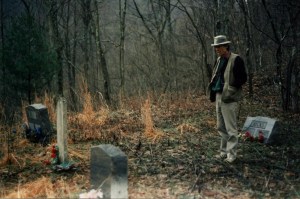
John Hartford at the Laury Hicks Grave, 1996

John Hartford at the Laury Hicks Grave, 1996

Parkersburg Landing 36

22 Saturday Dec 2012

Posted by Brandon Ray Kirk in Ed Haley

≈ Leave a comment

Tags

Appalachia, Arnoldsburg, Calhoun County, Ed Haley, Ella Haley, Harvey Hicks, history, John Hartford, Laury Hicks, music, Natchee the Indian, Spencer, Ugee Postalwait, West Virginia, writing

     Ugee said Ed seldom had a fiddle case with him when he traveled into Calhoun County, West Virginia.

     “Most of the time Ed had his fiddle in a twenty-four pound flour poke,” she said. “Sometimes he’d put it under his coat and sometimes up under his arm — just whichever way he felt best about it. He was very careful with it under there. Dad told him one time, ‘Why don’t you get a case so you can carry that bow without tearing it up all the time?’ Ed said he didn’t want to bother with carrying that case in his hand. Some times he might take a notion to stop and play some music somewhere on the road.”

     At that instant, I had this image of Ed being so attached to his fiddle, with such an addiction, that the two were virtually inseparable. To not even want to put it away in a case made me think he always had it in his hands, feeling it, tinkering with it, trying new ways to make it work — all the time. You know, a person can get really attached to feeling an object — a ball or a pen — to where it doesn’t seem comfortable to not have it in hand. I imagine for a blind person this feeling is most intense. There’s a real comfort level to consider. This fiddle would’ve been his entire life — his passion, his breadbasket, his ticket to daily comforts and a better life in general. Then, I also pictured horrible images of him stumbling or even falling with it in his hands or tucked under his coat as he scooted along bumpy country roads.

     Ugee said Ed ordered his strings from “Sears & Roebuck and places like that. You could buy strings out in them country stores. Used to be you could buy them all in a drug store.”

     How did he get his bows haired?

     “Horse’s tail. Dad haired it for him.”

     Ugee said Ed and Laury played music at little towns called Rosedale, Grantsville and Webster Springs. I asked if Ed put a box or cup out to catch money and she said, “Oh, no. Maybe Dad would put a cigar box down. When Ed was some place and Dad was around, he’d just step up after they’d get to playing and Dad’d say, ‘If you fellers like that how about putting some money in this cigar box? This man’s got six kids. Don’t make him play for nothing’.”

     Ugee had faint memories of Ed fiddling in contests with her father. One time, she said, he lost a contest in Charleston to an Indian — no doubt Natchez the Indian, the famous show fiddler. “Ed got so mad at hisself,” Ugee said, “he just about blowed up over it because he knowed the feller couldn’t play but they give it to him. He was the world champion fiddler but he couldn’t play. Ed said, ‘It’s already cut and dried.’ Ed cut a shine and said that his music wasn’t worth a damn. You never heard such cussing.”

     The first time Ugee saw Ella, she was pregnant with Lawrence (circa 1927). At that time, Ella did not play the mandolin — an important thing to note considering how it was so prominently featured on the home recordings of the mid-40s.

     “Now Ella, when she first come in there, she played the accordion. Dad told Ed, he said, ‘I don’t like the accordion. It drowns out your music. I’d ruther hear the fiddle.’ He said, ‘Why don’t you teach her to play the guitar or the mandolin?’ Ed laughed. He said, ‘Hell, you can’t teach her nothing.’ Ella — I can see her shut her eyes yet — said, ‘Laury, don’t you like the accordion?’ He said, ‘Oh, I like it. Ella, you’re the best in the world, but I like string music.’ Next time she come back, she was playing mandolin. Ed learned her how to second and buddy she could keep time with it, too. Dad said, ‘I like that a whole lot better, just hearing that time.'”

     Ugee said, “Well, they had Lawrence and they named him after Dad. Then when they come back they had a little girl and they named her Monnie after my mother, Minnie. Ella wrote and told Mom, ‘Well, I had my baby and it’s a girl. Instead of calling her Minnie, I’m calling her Monnie, but it’s still your namesake.”

     I wondered if Ed and Ella played at courthouses in that part of West Virginia and Ugee said, “Yes, yes. They played at every courthouse there was in West Virginia down there: Grantsville, Clay County, Glenville and back through that way. Gassaway, West Virginia. Sutton, West Virginia. Just any place around — all the churches and all the schoolhouses. The old Roane County Courthouse in Spencer, it used to have great big shade trees. Then they had the stock market up on the Spencer Hill back towards Arnoldsburg and Ed and them’d go over there. And they had a boarding house just before you crossed the bridge — state hospital’s across over there — and then there’s the big Miller Hotel and everybody went in there to eat. And they’d be over there playing music and people would take Ed and Ella down there to eat.”

     Ugee said Ed and Ella were regulars at Arnoldsburg, a little town north of the Hicks home on Route 33 in Calhoun County. It was the first of many stories where she became the hero of her own narrative.

     “My brother, Harvey, he took me down to Arnoldsburg and Ed and Ella was playing music. They had a platform to dance on and Dad was down there. Harvey said, ‘Well, let’s sit back over here and listen to them a while.’ There was some girls trying to dance. They wasn’t keeping time. You could tell right then that Ed didn’t like the noise they were making. They was some way about twisting his shoulders that he didn’t like something that was going on. I looked at Harold and said, ‘He’s gonna quit playing in a little bit.’ Me and him sat over there in the car and was laughing about it. And Ed and them wasn’t making very much money there at the time.

     “So Dad happened to see us over there. He come over and said, ‘Won’t you go over and dance some?’ I said, ‘I don’t want to go over and dance.’ He went back and he told Uncle Jerry — that was Aunt Susan’s man — he said, ‘I’ll give you ten dollars if you’ll say something like, I’ll give ten dollars to see Ugee Hicks dance.’ Jerry said, ‘You give me ten dollars and I’ll put it in the box.’ Uncle Jerry said, ‘I’ll give ten dollars to see Ugee Hicks dance.’ Ed perked up like that — he’d give ten dollars too almost to hear me dance. And old Carey Smith, I never will forget it. Carey and old John both was there and they had money. ‘Well,’ Carey said, ‘I’d give a twenty-dollar bill to see Ugee Hicks come in there on that board and show them girls a few things.’ I just walked over to Uncle Jerry and I said, ‘Uncle Jerry, just put your ten where your mouth is.’ And I looked down at Carey Smith and I said, ‘Carey, you put your twenty where your mouth is. Throw it in that cigar box.’

     “Well, Ed went to playing ‘Carroll County Blues’. I had a pair of shoes on that had like a wooden heel on them. I hit that floor and I wanna tell you right now, you oughta heard Ed play. He just brightened up so. I don’t think I ever heard him play it better in my life. And Uncle Jerry turned around to old John, he said, ‘Well, you better put your twenty in here.’ Well, Ed made fifty dollars. Old Ed and Ella, you know they had a family. I was a pretty good dancer then. Them two girls quit. One girl stepped back and said, ‘Well, she can’t do the Charleston.'”

     Ugee told me more about the pact made between her father and Ed in the early thirties.

     “Now they made that pact a long time ago and they renewed it when Ed was back again. Dad told him he wanted him to play ‘When Our Lord Shall Come Again’ and he said, ‘I don’t care what you play before, fiddling pieces or anything, but when you play ‘When Our Lord Shall Come Again’, that’s when I’ll meet my Lord.’ And he said, ‘I’ll be a laying there in that grave until you sing that.'”

     Ed asked Laury to play “What A Friend We Have in Jesus” and a few fiddle tunes at his funeral.

     “I’ll lay there in that grave and won’t hear nothing,” Laury joked.

     Ed was “kindly acting a fool” about it too and told him to let Ugee sing since he was such a horrible singer.

     “Laury, we’re getting a little serious with this stuff,” Ed finally said. “I don’t know whether I can play anything or not.”

     “I know,” Laury said. “I don’t know whether I can sing over you, either.”

     Ugee said her father died of leukemia and stomach cancer in January of 1937 at the age of 56 years. About a month later, Ed made it to Calhoun County and played “When Our Lord Shall Come Again” at his grave. The famous Ohio River flood of ’37 delayed his trip. According to one publication, the flood crested in Ashland at 74.3 feet — nearly 20 feet above flood stage. It took one month and a half to play out, leaving residents with a large cleanup effort that lasted for six months.

     “Ed went up to the grave — it’s right up on the hill from the house — and he stayed and played music all day,” Ugee said. “He played fast fiddle tunes and he played slow ones and then he’d sing. That evening, back at the house, nobody said a thing. You coulda dropped a pin in our house. Ed just come down on the fiddle and went to playing that ‘Carroll County Blues’ and I just jumped up in the floor and went to dancing. I said, ‘Well, if my dad was a living, that’s what he’d wanted me to do because I can’t hold my feet.’ Ed told me the next day, ‘If you hadn’t done that I’d a choked to death right there.’ Ella said, ‘When you hit that floor I knowed you was gonna be all right.'”

Laury Hicks and Minnie Hicks

21 Friday Dec 2012

Posted by Brandon Ray Kirk in Ed Haley, Music

≈ Leave a comment

Tags

Appalachia, Calhoun County, fiddler, genealogy, history, Laury Hicks, Minnie Hicks, music, photos, U.S. South, West Virginia, writing

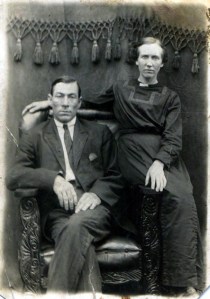
Laury and Minnie Hicks, 1930s

Laury and Minnie Hicks of Calhoun County, WV, 1920s

In Search of Ed Haley 35

21 Friday Dec 2012

Posted by Brandon Ray Kirk in Ed Haley

≈ Leave a comment

Tags

Appalachia, Calhoun County, Ed Haley, fiddler, history, John Hartford, Johnny Hager, Laury Hicks, Logan County, music, U.S. South, Ugee Postalwait, West Virginia, writing

     A few weeks later, I met Ugee Postalwait at her home in Akron, Ohio. An energetic, feisty woman with a band-aid on her nose, she didn’t look nearly as old as she said she was (eighty-something). She was very anxious to talk about Ed Haley and her memories seemed sharper than when I’d first called her. She bragged about him right away.

     “He had the brain of music,” she said. “He’s one of the best I ever heard. You could name a tune and if he didn’t know it and you sang it to him one time he knowed it then, and when you heard it the next time he’d blow your stack.”

     “Now they is some people’ll tell you my dad was better — Laury Hicks,” she continued, wasting no time in bragging on her father. “He and Ed was about the same age. Both born in about 1880.”

     I asked Ugee to recall her childhood, when she first saw Ed Haley.

     “The first time I ever seen Ed Haley, I was about five years old,” she said. “Dick Joblin told him that he wanted him to hear a boy that he knowed played music and he brought him there to Dad. Ed was about — oh, he must’ve been around twenty maybe, something like that. He was a young man. Dick had my dad to play the fiddle and he played three pieces: ‘Arkansas Traveler’ and another’n I can’t remember right now and ‘Sally Goodin’. Ed said, ‘If that next’n had come up as strong as the first few I heard, I’d never pulled my bow across that fiddle as long as I lived.’ And Dad at the time had his first fiddle. My dad made his first fiddle out of a cigar box and that’s what he learned on and he had that up till I was about ten or twelve years old.”

     Ugee said, “Then the next time I seen Ed, he come there with John Hager.”

     I asked her how Ed looked and she said he had on a suit and plug hat and had his fiddle in a flour sack.

     “They stayed all winter, and they left on the first day of spring,” she said. “I’ll never forget that. There was a little narrow country road and as long as I live I’ll always see Ed, and Johnny leading him around a mud hole. We went out on the bank and watched them as they left and I stood there and cried after him and just cut a shine. Well, Ed then sent back a card — I think I still got it. ‘I love your wife, but oh your kids’ — from White Sulphur Springs.”

     I asked Ugee if she had seen the picture of Ed and Johnny at White Sulphur Springs.

     “Oh, yeah, I got that someplace in a box with a bunch of my pictures,” she said, before correcting herself. “Well, I think I give Larry all the pictures I had of Ed and Ella.”

     When I pulled out the one of Ed and Johnny, she said, “Yeah, that’s John Hager. He was a little fella. That banjo had the longest neck I ever seen.”

    She then pointed to Ed and said, “That looks just exactly like him. He wore dark glasses then. After he got married he stopped wearing dark glasses. Ed was six foot or something like that. Well Dad was a real little skinny guy like Ed Haley when he was young. He weighed about 144 pounds and then he had pneumonia fever and come near to dying. When he got over that, he gained weight. Went up to 175 pounds. But he weighed about 200 pounds. Dad was tall.”

     Ugee said Ed stopped wearing his derby and gained a little weight after marrying Ella. I was surprised to hear her describe him as a “little skinny guy” but she insisted, “Yeah, looked like you put a pair of britches up on a fence rail. Ed said to me one day, ‘Ugee, can you make a shirt?’ I said, ‘Well sure I can make a shirt.’ Well, he come back from the store with material and I made him three shirts. He laughed about it. He said, ‘I want long tails. They won’t slip out of my pants.'”

     Ugee said, “Yeah, I’ve seen these pictures.”

     “This one,” she said, pointing to the picture of Ed used on the cover of Parkersburg Landing, “I don’t remember ever seeing that one of Ed. He looks to me like he’s been on a drunk.”

     Ugee tried to describe the way things were when she was a girl in Calhoun County.

     “When I was growing up and in the cornfield hoeing corn, you could hear singing on the mountains,” she said. “There was music in that country and very few people didn’t play some kind of music. My brother Russell played the banjo. My brother Shirley played the guitar and would’ve made a good fiddle player if he’d went ahead at it. I used to pick up the fiddle and see-saw a little bit. I can’t any more. We had a string band at our house, you might say. Mom played the organ and I went to playing the guitar. Anyway, they was nobody that come in that country that played the fiddle within thirty, forty or fifty miles away that wouldn’t come to our place and play music.”

     The Hicks home took on a party atmosphere when Haley arrived.

     “When Ed Haley was in the country, they come from miles around to our house,” Ugee said. “Dad would get out and tell everybody that Ed was there or Ed was gonna be there a certain day. They’d come through the day. Everybody did. Dad and them would play music all day — half a night.”

     Ugee said she used to get up around two o’clock in the morning to see who’d be eating breakfast in a few hours.

     Some of her happiest memories were of Haley’s visits to her father’s home.

     “Dad’d go out there on the porch and if Ed was a playing music and if I was in the kitchen a cooking he’d go out and tell Ed to play ‘Carroll County Blues’,” she said. “Oh, I’d come out of that kitchen just a hitting that floor and a dancing all the way out there on the porch. I’d say, ‘Ed, don’t do that. You’ll not get no dinner ’cause I can’t hold my feet when you play that.’ Every time he played that, I’d dance. And Dad, when he played ‘Sally Goodin’, that’s when I’d dance for him. Mom didn’t want me to dance. She tried to keep me from it but I’d go out under them old oak trees out there on them old flat rocks and just dance, you know.”

     I asked how far the Hicks home was from Harts Creek and Ugee said, “I would say that’s pretty close to a hundred mile. I never was in around Logan. I always wanted to go because Nora and Aunt Rosie lived up there. Dad and the boys, they used to go see them.” Aunt Rosie, she said, was Bill Day’s wife, while Nora was her daughter. I never knew the Days lived around Logan, West Virginia.

Parkersburg Landing 34

20 Thursday Dec 2012

Posted by Brandon Ray Kirk in Ed Haley

≈ Leave a comment

Tags

Akron, Calhoun County, Ed Haley, history, John Hartford, Johnny Hager, Laury Hicks, Lawrence Haley, music, Ohio, Rector Hicks, Ugee Postalwait, West Virginia, writing

     By some accounts, Dr. Lawrence Hicks was Ed Haley’s best friend. Hicks was a well-known fiddler who practiced veterinary medicine in Calhoun County, West Virginia. Ed thought enough of Hicks to name his youngest son after him and, according to Parkersburg Landing, came to play the fiddle at his grave when he died in 1937. With Lawrence Haley’s encouragement, I telephoned Ugee Postalwait, a widow of advanced age and the only daughter of Dr. Hicks. Ugee (pronounced “you-gee”) was a resident of Akron, Ohio — one of those industrial towns flooded by job-seeking mountaineers some four decades ago.

     “I’m a friend of Lawrence Haley’s in Ashland and I’m very much interested in his father, Ed Haley,” I told her. “I was just visiting with Lawrence and he said you knew him real well. I was wondering if you would tell me about him.”

     “Well, I don’t know what you want me to tell you about,” Ugee said. “My dad and him was two of the finest fiddlers I ever heard. My dad’s name was Laury Hicks. Well, Lawrence was his name but they called him Laury. A lot of them called him Dr. L.A. He was a veterinarian, but he was a fine fiddler. Him and Ed were very close friends for years and years — ever since I was a little girl. They was both born in 1880. They loved each other. And Mom and Ella got along the same way. Mom was born in 1882. She lived to be a hundred years old. She played the organ. She was a good singer.”

     I said, “Now, there’s a story on that album where Ed went to this grave and played over it. Was that your dad?”

     “Yes,” she said. “They was talking one time, whichever one died first the other one was supposed to play the fiddle at their funeral. Dad requested that he play ‘When Our Lord Shall Come Again’ and said that he wouldn’t meet his Lord in the air until Ed played. Dad died on the 18th day of January in ’37 but Kentucky and Ashland was under water. The water was up so high in ’37 that Ed and Ella couldn’t get there until after that and they played the song that dad requested.”

     I asked Ugee where all that went down and she said, “Dad’s buried up there at the home place on Route 16 in Calhoun County between Chloe and Stinson — as you come up from Arnoldsburg. Him and Mom and my brothers.”

     Calhoun County, I discovered, is a rural spot wedged in the backcountry between the Little Kanawha and Elk rivers northeast of Charleston, the state capitol. It is some 75 miles away from Haley’s birthplace on Harts Creek, at least as the crow flies. In Ed Haley’s time, it was a real hot bed of musicians.

     I wondered if Laury Hicks made any recordings. No, Ugee said, although his fiddle was still around. She gave it to Harold Postalwait, her son in Rogersville, Alabama.

     “He just had it refinished and everything,” she said.

     Ugee’s memories were warming up: “Ed and Ella and all the family used to come stay at our home — not for days — but for maybe months. We had some beautiful music there. I tell you, they ain’t nothing that I’ve ever heard on the TV or any place else to beat Ed Haley and my dad playing the fiddle. Ed Haley was one of the best I ever heard. Well, I thought my dad was too, but Ed was smoother. I’m always glad to talk about Ed Haley. He’s the only one that I ever heard where my dad would play and he’d second on the fiddle. Like, you’re singing a song and somebody singing alto behind it.”

     I told Ugee what Lawrence said about Ed being able to play the banjo and she agreed. “Ed could play a guitar like crazy, too. There’s where Ralph learned to play a guitar — Ed learned him. And Ed could play a mandolin, too. He could play any kind of music, anything that had a string. Now Dad could thump a banjo a little but he wasn’t what you’d call a banjo player.”

     Ugee said, “I wish you coulda been around through that country back when I was a girl a growing up so you coulda heard the music that was in that country. They really had good musicians. Rector Hicks, he was a cousin of mine, born and raised right across the hill. That was Clay Hicks’ boy. He used to come over and Dad would learn him to play. He lived across the hill on White Oak and there’s where Ed and Ella went all the time to visit.”

     I wondered if Rector was still around and she said no — that he had died a few years ago in 1989. She promised to talk with his widow in Akron, who supposedly had recordings of his music. Maybe such recordings would provide clues about Ed’s fiddling.

     I asked Ugee if she ever met John Hager, the banjo-player shown with Ed in the White Sulphur Springs photograph.

     “Oh, I sure did,” she said. “Played the banjo. They stayed at our house one whole winter, Ed and John, and then the next time that Ed come back he had a fella playing the guitar with him. I can’t think of his name but I can see his face. Ed was a tall slender fella then.”

     I invited Ugee to my upcoming show in Akron but all I could get out of her was, “I’m always glad to talk about Ed Haley. And Lawrence, you can’t meet a nicer person. He was named after my dad. And his wife is an awful nice person. I hope I can get down to see them this year. Nice talking to you because nobody loves to watch you any more than I do on TV.”

In Search of Ed Haley 11

29 Thursday Nov 2012

Posted by Brandon Ray Kirk in Ed Haley

≈ Leave a comment

Tags

Akron, Appalachia, Asa Neal, Ashland, books, Calhoun County, Catlettsburg, Clay County, Clyde Haley, Columbus, Doc Holbrook, Doc White, Ed Haley, Ella Haley, feud, fiddle, fiddler, fiddlers, fiddling, Greasy George Adams, Greenup, Greenup County, Harts Creek, Ivydale, J P Fraley, Jack Haley, John Hartford, Kentucky, Laury Hicks, Lawrence Haley, Minnie Hicks, music, Noah Haley, Ohio, Over the Waves, Parkersburg Landing, Pat Haley, Ralph Haley, Sanitary Dairy, Ugee Postalwait, West Virginia, writing

Eight days later, I was with Lawrence Haley in Ashland looking at Ed Haley’s fiddle and holding old family photographs while he talked as if he’d just seen his father the day before. Pat was gone for the day, so it was just Lawrence and I, talking carefully in the kitchen with funeral home silence in the background. Lawrence — or Larry, as his wife called him — was a short, stocky man with thinning hair and a very straightforward manner. I could tell that he was a no-nonsense kind of guy and that it would serve me best to walk on pins and needles for a while. I also had the impression that in talking with me he hoped to correct some of the errors in the Parkersburg Landing liner notes. He was very careful with his words. Occasionally one of the Haley grandchildren would come in and sit nearby as quiet as a mouse before leaving to play in the yard.

In the initial small talk, I looked over Ed Haley’s fiddle, which appeared to be of an inexpensive Czech variety. It was stained brown and was without strings and a bridge. According to Lawrence, his father acquired it during the early 1940s. He confirmed that it was the one used to make the home recordings featured on Parkersburg Landing but was not the one pictured on Parkersburg Landing. He said Ed used “regular old steel strings — no cat-gut at all” and remembered that he always kept his fiddle on an old “pump-type” organ at home. He had the bridge somewhere around the house in a drawer, which he promised to find.

“If you ever find that bridge, we ought to rig that thing up and put some strings on it,” I said.

Lawrence reached me Ed’s bow, which he said was the same one he used the last ten years of his life. “He just used the same bow,” he said. “Whenever he got another fiddle, he’d change the bow.” I looked it over and noticed that it was as heavy as a log.

I started questioning Lawrence slowly with important but seemingly mundane questions about Ed’s music. I wondered if Ed knew what key he was playing in and Lawrence said, “Sure. Well, when my brother Ralph first started playing, Pop’d tell him which key to change to in a piece of music. He’d just lean over to Ralph and tell him.”

I asked Lawrence if he remembered the names of Ed’s favorite fiddle players and he said, “I couldn’t tell you, John. He’s mentioned a few fiddle players but I couldn’t tell you their name now.” Lawrence said he didn’t even remember many of Ed’s local fiddling buddies because he was a kid “wanting to get out and do something else.”

“I don’t even remember Doc White as far as that goes,” he said. “But I remember Laury Hicks up in Calhoun County, which is the next county right against Clay County there.”

I had read about Haley’s friendship with fiddler Laury Hicks on Parkersburg Landing. Hicks was a veterinarian in Calhoun County, West Virginia.

“One of Ed’s lifelong friends was an Ivydale physician named Laury Hicks,” it read. “Shortly before he died, Hicks requested that he be able to hear Ed Haley one more time. Ed arrived too late and it is said that he played over Laury’s grave for hours into the night.”

I asked about Asa Neal, the great Portsmouth fiddler. “Yeah, Asa Neal,” Lawrence said. “I’ve heard my dad talk about him. But I never seen the guy to my knowledge.”

He seemed to know the most about a local physician and casual fiddler named Doc Holbrook, whose name J.P. Fraley had mentioned to me. “They was long-time friends,” Lawrence said. “Doc Holbrook was a physician that practiced medicine in the county seat of Greenup County, which is also named Greenup. He was a fiddle buff and apparently a pretty good one because my dad wouldn’t a fooled with him if he hadn’t showed a lot of promise in playing the violin.”

This was a little confusing. Ed apparently had several doctor friends: Doctor Laury Hicks, Doc White and Doc Holbrook.

“They tell a tale about how Pop would come down to Greenup County and he’d go to where Doctor Holbrook had his practice. He had it in part of his home — had a riverfront home there. When Dad would go over to visit Doctor Holbrook, regardless of how many patients Doctor Holbrook had in his office, he’d shut his office up — he might have a half a dozen patients sitting out there — and him and Pop’d go in and play the fiddle half the day. That’s hear-say, but that’s what they tell me.”

I really liked that image.

Lawrence said his father made a recording for Doc one time, which he assumed was in the hands of Holbrook family descendants.

“Doctor Holbrook wanted this particular piece of music called ‘Over the Waves’ and he bundled my dad and mother up one day and, since there was no recording studios around this area, he took them to Columbus, Ohio where they had a good soundproof recording studio and had them make this piece of music. Now, whether they was other pieces of music made at the same time, I really don’t know. There probably was.”

In addition to giving Doc records, Ed also gave him a fiddle. “Pop had a real good copy of a Stradivarius, and it had a real good mellow tone and a real good solid deep resonance to it,” Lawrence said. “I think it was the one that he give to Doc Holbrook.” Lawrence said it was also still in the Holbrook family. “Doc had a son who had an office down at the Second National Bank Building and he inherited that fiddle,” he said. “J.P. Fraley was supposed to’ve taken that fiddle to the Smithsonian or at some kind of a centennial or something. But that was Pop’s fiddle.”

I asked Lawrence if his father had perfect pitch.

“Yes,” he said. “He never used a pitch pipe or anything. He tuned the fiddle by ear. One of his fiddles, I think had that little tuner on that high key. I never seen one on every string, though. It took him maybe four or five thumps on his strings to get them in tune. You know, them keys would get awful dry and squeaky in their pegs — in their holes — and they’d strip a lot of times and if it was a real dry season or something and it wasn’t holding in tune, he’d blow moist breath on them pegs to get them to hold in place.”

Lawrence had no idea where Ed got any of his tunes, except for one song.

“My dad and mother used to say they played a certain piece of music they heard from this old fella by the name of Greasy George. I won’t say his last name. Greasy George had apparently stolen a pig from somebody and had put it in a small pen close to the house. And two or three days later, he was sitting on the porch playing the fiddle and he saw the sheriff coming up the drive and he began to play a piece of music my dad plays. I don’t know the name of it, except that it went something like this: ‘Shove that hog’s foot further in the bed, further in the bed, further in the bed. Shove that hog’s foot further in the bed. Katy, can’t you understand me now?’ And his purpose in singing those words was trying to get his wife to hide that pig under a blanket, I think. Or that’s what my dad and mother inferred to me — that he wanted his wife to hide that pig somewhere. Mom was telling me about it.”

I asked Lawrence how Ed met his mother.

“I really don’t know,” he said. “Pop was either in Catlettsburg or somewhere around here close. My grandfather on my mother’s side, he moved from Morehead up here to Ashland. People followed work wherever they could get it. My granddad was an old timber man, I guess. They mighta been some work around here for him. In fact, I’m pretty sure at the time my dad met my mother, my grandfather was working at an old stave mill over here — where they make barrel staves. I guess Pop was playing and somebody heard him and told my mother that she ought to come hear him play. Somebody thought that my mother — which was supposed to be a trained musician — they wanted her to hear this old fiddle player. And they got them together that-a-way, I guess. Just a chance-type meeting. They got together and raised a family.”

Lawrence tried to describe the extent of Pop’s travels, a crucial detail in ascertaining the extent of his influence as he was primarily a non-recording, non-radio fiddler. “His travels, as far as being too enormously wide, was restricted to about a three state area, I guess. But apparently his influence got around eventually. Like you say, he might be the granddaddy of Texas style contest music. Far be it from me to dispute it. I really think if he’d been around during the sixties when old-time fiddling was coming back and everybody was wanting to hear this fiddle music, I think he could’ve been worth something. I think he could’ve made a little bit of money at that time. And he might not’ve wanted to do that, see. He didn’t want to do it back in the twenties when they was making recordings around.”

I said, “Well, he’d been on the street. He knew what was going on out there. That’s where life is lived.”

Lawrence said, “Well, that’s why he always steered away from these commercial record companies. The way I feel about my dad, if somebody wants to learn about his music or play it, maybe it might not be completely forgotten. I don’t want to make a dime out of it. If there’s any money anywhere to be made out of it that might come to Pop, turn it over to the Foundation for the Blind. I don’t want to make anything off of my dad. He brought me into this world and raised me up and I’ve had a pretty good life.”

I asked Lawrence what Ed did when he was sitting around home and he said, “He liked to chew tobacco. He’d take this old twist — Stader’s twist, they called it — and he’d take his pocketknife and cut that up and put it down in his pocket. It was picked right off a farm. In fact, that picture of him on the front of that album, I think he had a chew of tobacco in his mouth then. He always carried a vegetable can with him to spit in. Mom never did like it but it was just almost a part of him when he was around the house, except when he’d get out on the porch — then he’d spit out in the yard.”

Lawrence said his dad liked to play music on the porch.

“We lived down on 17th Street and he’d get out on the front porch with that banjo or fiddle and he’d sit on the front porch and play. He’d cross his legs and sit up on the banister where he could spit easy or he’d just sit down with a banjo and play it.”

Lawrence had no clue what happened to Ed’s banjo. “It was one of those things that left when I was in the service, I guess. And Mom’s mandolin disappeared. The accordion my mother had, she let Aunt Minnie have it because Aunt Minnie played the organ some and she wanted to try that accordion. They took it up there and she left it up there for Aunt Minnie and then the house burnt down. It was not a very expensive accordion.”

Aunt Minnie, Lawrence said, was Laury Hicks’ widow in Calhoun County, West Virginia. Lawrence mentioned that I should get in touch with their daughter, Ugee (Hicks) Postalwait, in Akron, Ohio. “I guess she must be close to 81 or 82,” he said. “She was a young woman when I was just a kid. She would dance around Pop when he played and while he was noting the fiddle she’d be up there hitting them strings that he was noting. It had a real nice little ring to it. She heard him like these people hear you right now. She heard him live, danced around it and played on it and everything else. She said all that scratch on the records didn’t sound like Ed Haley. It’s not the same.” I said I would call Ugee when I got back to Nashville.

Lawrence told me a little about his childhood trips to Harts Creek — the place of Ed’s birth. “Most of the time we’d ride the train up there and get off at Harts and then maybe walk and it seemed to me like it took us half the day to get up Harts Creek. You’d ford that creek half a dozen times and the road was in the creek half time time.”

I asked him if Ed carried his fiddle all the way up there and he said, “Most of the time he carried the fiddle. I’ve seen him carry nothing but a fiddle — not even a case a lot of times. He’d carry it out in the open.” He said Ed never played it or thumped on it while walking — “he’d tuck it under his arm and go.” What if it rained? “That’s another thing,” he said. “I can’t remember any instance like that, but I imagine he’s had instances like that. But I know he has went around with a fiddle with no case — just a fiddle and a bow. Same way with Mom. She didn’t have a case for her mandolin.”

At that point, Lawrence showed me several family photographs, including a wonderful picture of his family just before his birth in 1928.

“I was born just a year before the Depression hit,” he said. “They was two of us just babies when the Depression started. Ralph, Clyde, Noah and Jack were stepped from five to fifteen. A lot of times it was skimpy eating and at other times it was pretty good. We never starved or anything. We’d go down to an old dairy just below us called Sanitary Dairy and get a big lard bucket full of buttermilk for a dime, and I could take a piece of cornbread and a glass of buttermilk and make a meal out of it. I’ve done that a lot. I’ve taken ten cents when Mom could scrape up a dime and us kids would all walk downtown to one of them ten-cent movies and stay all day and be starving to death when we came home and there wouldn’t be nothing but cold cornbread and pinto beans or something like that. That’s the way our life went, during the Depression anyway.”

There was another remarkable photo of Ed and his family just after the Depression started. “Everybody can tell you about hard times in the Depression,” Lawrence said. “I know in my second summer Mom said she fed me fresh corn and I took the trots and liked to wasted away from diarrhea. That was about 1930. We made it anyway.”

As Lawrence showed me a few family pictures, his wife Pat showed up with a few of her “bingo buddies.” Pat was a very polite English lady with dark hair and a small frame who wore large glasses. We said our “hellos” and I played a few tunes.

Once the guests left, I spoke more about Ed Haley with Pat and Lawrence in the kitchen. With Pat’s presence, Lawrence’s demeanor was a little different. I could tell that he wanted to present his dad to me in just such a way and he almost openly resented any input from Pat. There was a slight tension in the air. At one point, Lawrence said to Pat, “Go ahead Pat. You tell it. You know more about it than I do.” Pat took it all in stride. She just wanted to be helpful. In any case, Lawrence gave me the impression — and this was very important — that if I did or said anything to his disfavor I would be more than welcome to hit the road. Ironically, and contrary to what I had heard, he seemed more over-protective of his father’s story than his music. Needless to say, it took me a while to get up enough nerve to pull out my tape recorder and record his memories.

Newer posts →

Feud Poll 1

If you had lived in the Harts Creek community during the 1880s, to which faction of feudists might you have given your loyalty?

Categories

  • Adkins Mill
  • African American History
  • American Revolutionary War
  • Ashland
  • Atenville
  • Banco
  • Barboursville
  • Battle of Blair Mountain
  • Beech Creek
  • Big Creek
  • Big Harts Creek
  • Big Sandy Valley
  • Big Ugly Creek
  • Boone County
  • Breeden
  • Calhoun County
  • Cemeteries
  • Chapmanville
  • Civil War
  • Clay County
  • Clothier
  • Coal
  • Cove Gap
  • Crawley Creek
  • Culture of Honor
  • Dingess
  • Dollie
  • Dunlow
  • East Lynn
  • Ed Haley
  • Eden Park
  • Enslow
  • Estep
  • Ethel
  • Ferrellsburg
  • Fourteen
  • French-Eversole Feud
  • Gilbert
  • Giles County
  • Gill
  • Green Shoal
  • Guyandotte River
  • Halcyon
  • Hamlin
  • Harts
  • Hatfield-McCoy Feud
  • Holden
  • Hungarian-American History
  • Huntington
  • Inez
  • Irish-Americans
  • Italian American History
  • Jamboree
  • Jewish History
  • John Hartford
  • Kermit
  • Kiahsville
  • Kitchen
  • Leet
  • Lincoln County Feud
  • Little Harts Creek
  • Logan
  • Man
  • Matewan
  • Meador
  • Midkiff
  • Monroe County
  • Montgomery County
  • Music
  • Native American History
  • Peach Creek
  • Pearl Adkins Diary
  • Pecks Mill
  • Peter Creek
  • Pikeville
  • Pilgrim
  • Poetry
  • Queens Ridge
  • Ranger
  • Rector
  • Roane County
  • Rowan County Feud
  • Salt Rock
  • Sand Creek
  • Shively
  • Spears
  • Sports
  • Spottswood
  • Spurlockville
  • Stiltner
  • Stone Branch
  • Tazewell County
  • Timber
  • Tom Dula
  • Toney
  • Turner-Howard Feud
  • Twelve Pole Creek
  • Uncategorized
  • Warren
  • Wayne
  • West Hamlin
  • Wewanta
  • Wharncliffe
  • Whirlwind
  • Williamson
  • Women's History
  • World War I
  • Wyoming County
  • Yantus

Feud Poll 2

Do you think Milt Haley and Green McCoy committed the ambush on Al and Hollene Brumfield in 1889?

Blogroll

  • Ancestry.com
  • Ashland (KY) Daily Independent News Article
  • Author FB page
  • Beckley (WV) Register-Herald News Article
  • Big Sandy News (KY) News Article
  • Blood in West Virginia FB
  • Blood in West Virginia order
  • Chapters TV Program
  • Facebook
  • Ghosts of Guyan
  • Herald-Dispatch News Article 1
  • Herald-Dispatch News Article 2
  • In Search of Ed Haley
  • Instagram
  • Lincoln (WV) Journal News Article
  • Lincoln (WV) Journal Thumbs Up
  • Lincoln County
  • Lincoln County Feud
  • Lincoln County Feud Lecture
  • LinkedIn
  • Logan (WV) Banner News Article
  • Lunch With Books
  • Our Overmountain Men: The Revolutionary War in Western Virginia (1775-1783)
  • Pinterest
  • Scarborough Society's Art and Lecture Series
  • Smithsonian Article
  • Spirit of Jefferson News Article
  • The Friendly Neighbor Radio Show 1
  • The Friendly Neighbor Radio Show 2
  • The Friendly Neighbor Radio Show 3
  • The Friendly Neighbor Radio Show 4
  • The New Yorker
  • The State Journal's 55 Good Things About WV
  • tumblr.
  • Twitter
  • Website
  • Weirton (WV) Daily Times Article
  • Wheeling (WV) Intelligencer News Article 1
  • Wheeling (WV) Intelligencer News Article 2
  • WOWK TV
  • Writers Can Read Open Mic Night

Feud Poll 3

Who do you think organized the ambush of Al and Hollene Brumfield in 1889?

Recent Posts

  • Logan County Jail in Logan, WV
  • Absentee Landowners of Magnolia District (1890, 1892, 1894)
  • Charles Spurlock Survey at Fourteen Mile Creek, Lincoln County, WV (1815)

Ed Haley Poll 1

What do you think caused Ed Haley to lose his sight when he was three years old?

Top Posts & Pages

  • About
  • Perry A. Cline Deed to Anderson Hatfield (1877)
  • U.B. Buskirk of Logan, WV (1893-1894)
  • Hugh Dingess Family Cemetery (2014)
  • Anderson Blair Account with William A. Dempsey (1854-1855)

Copyright

© Brandon Ray Kirk and brandonraykirk.wordpress.com, 1987-2023. Unauthorized use and/or duplication of this material without express and written permission from this blog’s author and/or owner is strictly prohibited. Excerpts and links may be used, provided that full and clear credit is given to Brandon Ray Kirk and brandonraykirk.wordpress.com with appropriate and specific direction to the original content.

Archives

  • February 2025
  • January 2025
  • October 2023
  • September 2023
  • December 2022
  • November 2022
  • May 2022
  • April 2022
  • February 2022
  • November 2021
  • October 2021
  • September 2021
  • June 2021
  • May 2021
  • April 2021
  • March 2021
  • February 2021
  • January 2021
  • December 2020
  • November 2020
  • October 2020
  • July 2020
  • June 2020
  • May 2020
  • April 2020
  • March 2020
  • February 2020
  • January 2020
  • December 2019
  • November 2019
  • October 2019
  • September 2019
  • August 2019
  • July 2019
  • June 2019
  • May 2019
  • April 2019
  • March 2019
  • February 2019
  • January 2019
  • December 2018
  • November 2018
  • October 2018
  • September 2018
  • August 2018
  • July 2018
  • June 2018
  • May 2018
  • April 2018
  • March 2018
  • February 2018
  • January 2018
  • December 2017
  • November 2017
  • October 2017
  • September 2017
  • August 2017
  • July 2017
  • June 2017
  • May 2017
  • April 2017
  • March 2017
  • February 2017
  • January 2017
  • December 2016
  • November 2016
  • October 2016
  • September 2016
  • August 2016
  • July 2016
  • June 2016
  • May 2016
  • April 2016
  • March 2016
  • February 2016
  • January 2016
  • December 2015
  • November 2015
  • October 2015
  • September 2015
  • August 2015
  • July 2015
  • June 2015
  • May 2015
  • April 2015
  • March 2015
  • February 2015
  • January 2015
  • December 2014
  • October 2014
  • September 2014
  • August 2014
  • July 2014
  • June 2014
  • May 2014
  • April 2014
  • March 2014
  • February 2014
  • January 2014
  • December 2013
  • November 2013
  • October 2013
  • September 2013
  • August 2013
  • July 2013
  • June 2013
  • May 2013
  • April 2013
  • March 2013
  • February 2013
  • January 2013
  • December 2012
  • November 2012

Enter your email address to follow this blog and receive notifications of new posts by email.

Join 2,925 other subscribers

Tags

Appalachia Ashland Big Creek Big Ugly Creek Blood in West Virginia Brandon Kirk Cabell County cemeteries Chapmanville Charleston civil war coal Confederate Army crime culture Ed Haley Ella Haley Ferrellsburg feud fiddler fiddling genealogy Green McCoy Guyandotte River Harts Harts Creek Hatfield-McCoy Feud history Huntington John Hartford Kentucky Lawrence Haley life Lincoln County Lincoln County Feud Logan Logan Banner Logan County Milt Haley Mingo County music Ohio photos timbering U.S. South Virginia Wayne County West Virginia Whirlwind writing

Blogs I Follow

  • OtterTales
  • Our Appalachia: A Blog Created by Students of Brandon Kirk
  • Piedmont Trails
  • Truman Capote
  • Appalachian Diaspora

BLOOD IN WEST VIRGINIA is now available for order at Amazon!

Blog at WordPress.com.

OtterTales

Writings from my travels and experiences. High and fine literature is wine, and mine is only water; but everybody likes water. Mark Twain

Our Appalachia: A Blog Created by Students of Brandon Kirk

This site is dedicated to the collection, preservation, and promotion of history and culture in Appalachia.

Piedmont Trails

Genealogy and History in North Carolina and Beyond

Truman Capote

A site about one of the most beautiful, interesting, tallented, outrageous and colorful personalities of the 20th Century

Appalachian Diaspora

  • Subscribe Subscribed
    • Brandon Ray Kirk
    • Join 787 other subscribers
    • Already have a WordPress.com account? Log in now.
    • Brandon Ray Kirk
    • Subscribe Subscribed
    • Sign up
    • Log in
    • Report this content
    • View site in Reader
    • Manage subscriptions
    • Collapse this bar
 

Loading Comments...