• About

Brandon Ray Kirk

~ This site is dedicated to the collection, preservation, and promotion of history and culture in my section of Appalachia.

Brandon Ray Kirk

Tag Archives: Boney Lucas

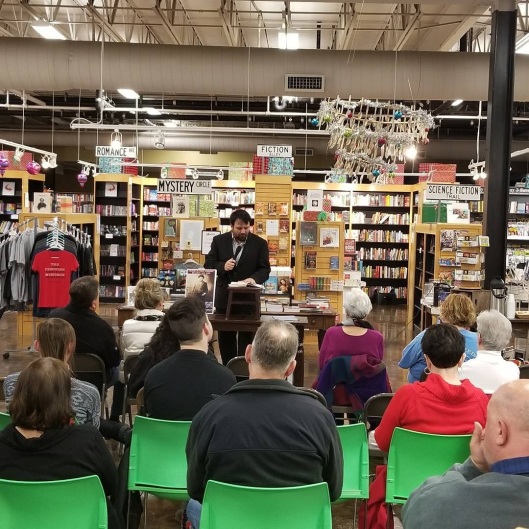
Writers Can Read Open Mic Night at Empire Books in Huntington, WV (2017)

22 Friday Dec 2017

Posted by Brandon Ray Kirk in Huntington, Lincoln County Feud

≈ Leave a comment

Tags

Appalachia, author, authors, Blood in West Virginia, Boney Lucas, book, books, Brandon Kirk, Dave Lavender, Diana Pishner Walker, Eliot Parker, Empire Books, Herald-Dispatch, history, Hollywood Book Festival Honorable Mention, Huntington, Lincoln County, Lincoln County Feud, Marshall University, Paris Brumfield, Pelican Publishing Company, Readers' Favorite International Book Award, Silver Mom's Choice Award, Southern California Book Festival, West Virginia, Writers Can Read Open Mic NIght

IMG_1238

Many thanks to Eliot Parker for inviting me to appear as a featured author and read from Blood in West Virginia: Brumfield v. McCoy at the Writers Can Read Open Mic Night at Empire Books in Huntington, WV. I dedicated my reading to the feudists and their descendants. Paris Brumfield and Boney Lucas descendants were among the listeners–thrilling! I met some really great folks and enjoyed the event. 18 December 2017.

IMG_1230

As always, thanks to Dave Lavender for promoting the event in the Herald-Dispatch. http://www.herald-dispatch.com/features_entertainment/empire-books-hosting-writers-can-read/article_02abde5d-bb75-55bb-8a0d-d9451c00b8e2.html

Julia Lucas Newman and Family (c.1905)

21 Monday Aug 2017

Posted by Brandon Ray Kirk in Big Harts Creek, Lincoln County Feud, Women's History

≈ Leave a comment

Tags

Ada Virginia Newman, Angeline Lucas, Appalachia, Boney Lucas, genealogy, George Ora Newman, Harts Creek, history, Julia Newman, Lincoln County, Millard Lucas, Ohio, Ross County, West Fork, West Virginia

Julia Lucas Newman.jpg

Julia Newman with her husband George Ora “Shug” Newman (1879-1952) and daughter Ada Virginia Newman (b. 1899). Julia, born in 1879 in the Harts Creek area of Lincoln County, WV, was the daughter of Mont “Boney” and Angeline (Adkins) Lucas. She moved to Ross County, OH, where she died in 1970. Photo courtesy of Millard Lucas family.

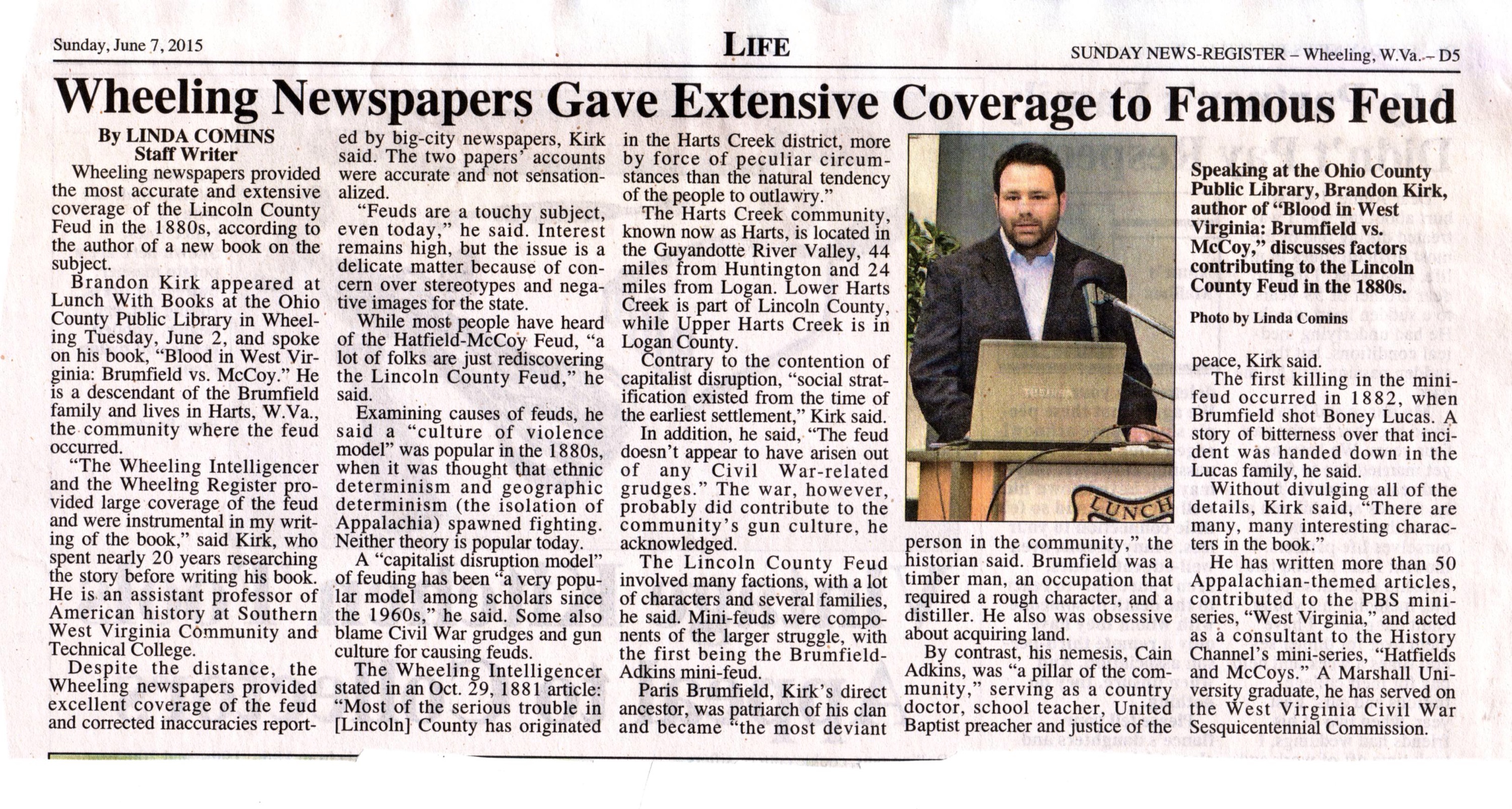
Wheeling, West Virginia (2015)

24 Wednesday Jun 2015

Posted by Brandon Ray Kirk in Lincoln County Feud

≈ Leave a comment

Tags

Appalachia, Blood in West Vorginia, Boney Lucas, books, Brandon Ray Kirk, Cain Adkins, feuds, Guyandotte River, Harts, Harts Creek, Hatfield-McCoy Feud, history, Huntington, Lincoln County, Lincoln County Feud, Linda Comins, Logan, Logan County, Paris Brumfield, photos, Southern West Virginia Community and Technical College, West Virginia, Wheeling, Wheeling Intelligencer, Wheeling Register

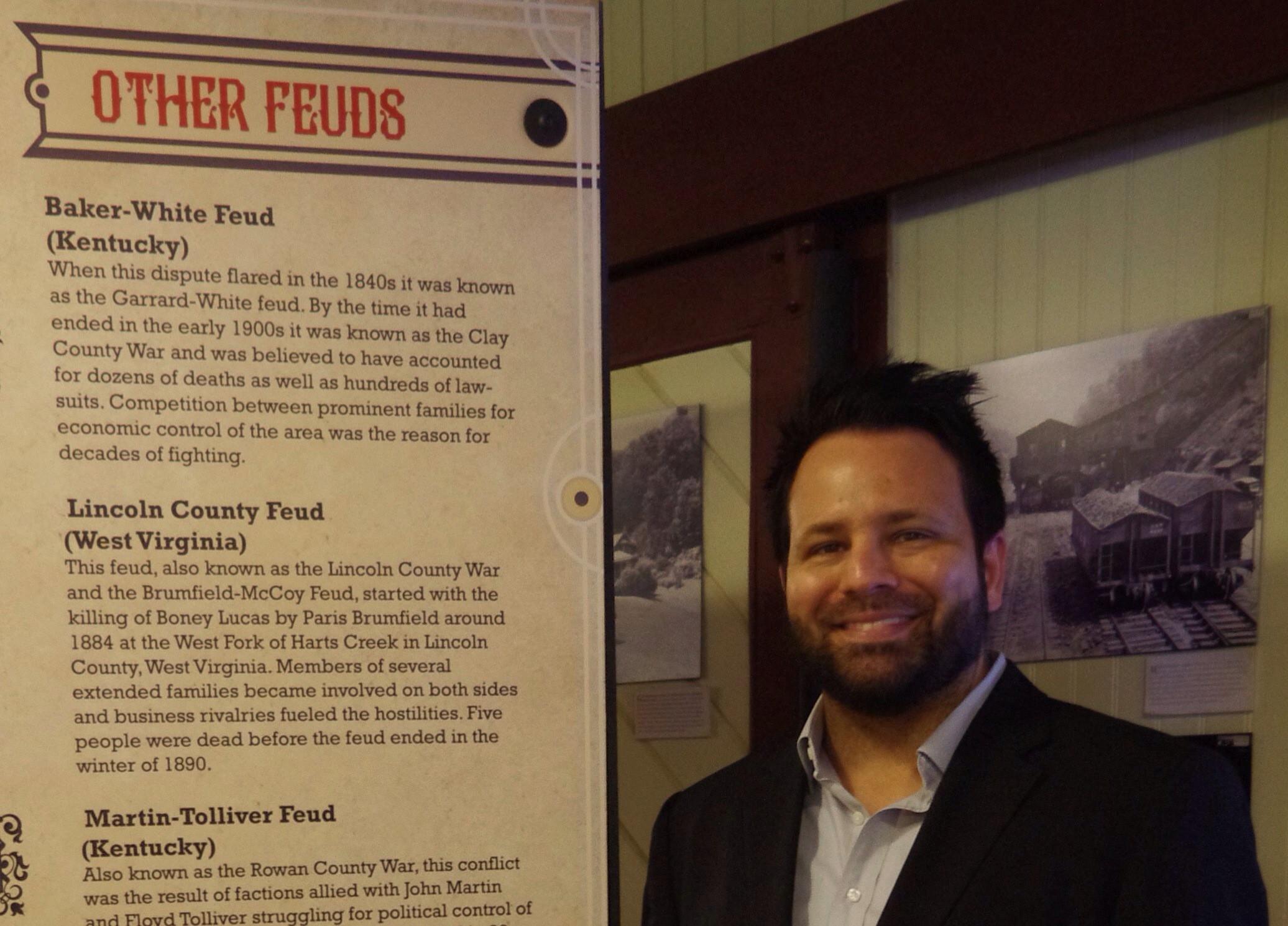
Lincoln County Feud (2015)

22 Monday Jun 2015

Posted by Brandon Ray Kirk in Lincoln County Feud

≈ 1 Comment

Tags

Appalachia, Baker-White Feud, Blood in West Virginia, Boney Lucas, books, Brandon Kirk, feud, Harts Creek, Hatfield-McCoy Feud, history, Lincoln County, Lincoln County Feud, Martin-Tolliver Feud, Matewan Depot, Paris Brumfield, photos, U.S. South, West Fork, West Virginia, writers

Our feud…we have arrived! 20 June 2015

Glenna Epling recalls Boney Lucas

31 Saturday May 2014

Posted by Brandon Ray Kirk in Lincoln County Feud

≈ 6 Comments

Tags

Angeline Lucas, Boney Lucas, Cain Adkins, Catlettsburg, feud, Glenna Epling, Green Shoal, history, Kentucky, Lincoln County, Millard Lucas, Paris Brumfield, Wayne, West Virginia, writing

One of the more interesting sources on the Cain Adkins family was Glenna Epling, a schoolteacher in Wayne, West Virginia. Glenna, the great-granddaughter of Boney Lucas, told Brandon that Paris Brumfield accused Lucas of “messing with” a fifteen-year-old Brumfield girl. Lucas, who was innocent of the charge, was killed by Brumfield after he had said something “out of the way” to the young girl. At some point thereafter, Boney’s widow Angeline, armed with a gun, laid in wait for Brumfield at a rock. Millard Lucas (Glenna’s grandfather), who was supposedly nine years old, asked her why she was going to kill “Uncle Paris.” She put the gun down and said, “I almost made a mistake like the Brumfields made.” (This event would have occurred circa 1889, as Millard was born in 1880.)

Millard told Glenna that Angeline — his own mother — was a “bad woman.” After Boney’s death, she moved to Catlettsburg, Kentucky, and to Wayne County. At some point, she joined a traveling show as a dancer and left her children home alone with food and instructions not to go to Grandpa Cain’s house. Later, she married an Adams. Perhaps for obvious reasons, Glenna said the Lucases on Green Shoal in Lincoln County never wanted anything to do with Boney’s family.

Blackburn Lucas

06 Tuesday May 2014

Posted by Brandon Ray Kirk in Big Harts Creek, Lincoln County Feud, Stiltner

≈ Leave a comment

Tags

Angeline Lucas, Blackburn Lucas, Boney Lucas, genealogy, Harts Creek, history, Lincoln County, photos, Wayne County, West Fork, West Virginia

Blackburn Lucas, son of Mont "Boney" and Angeline (Adkins) Lucas, resident of Wayne County, WV

Blackburn Lucas, son of Mont “Boney” and Angeline (Adkins) Lucas, resident of Wayne County, WV

In Search of Ed Haley 301

02 Friday May 2014

Posted by Brandon Ray Kirk in Lincoln County Feud

≈ Leave a comment

Tags

Boney Lucas, Brandon Kirk, Cain Adkins, crime, Daisy Ross, Eden, Eliza Fry, Faye Smith, feud, Green McCoy, history, Imogene Haley, Kentucky, Logan County, Milt Haley, Paris Brumfield, Randolph McCoy, Sherman McCoy, Spicie McCoy, West Virginia, writing

Brandon asked Daisy about Paris Brumfield.

“Well, he had a band of people. They went around and killed a lot of people, they said. They called them a mob. Mommy said they had a mob and if they didn’t like somebody they’d kill them. The Brumfields was rough. The Brumfields first killed Grandpa’s son-in-law, Boney Lucas, and when Mom married Green McCoy they said they had another one they was gonna kill.”

Daisy told us an incredible story about Green whipping Paris in a fight.

“All I know, they was into a racket beforehand and Green McCoy got him down and pulled his eyes all out and said, ‘Go back.’ He said they was just like rubber — he’d pull his eyeballs out and they’d go back. Said you couldn’t pull them all the way out. He did finally get his sight back. Had to wear a blindfold for two or three weeks or a month. Laid around for a while.”

Faye said, “Mom said Grandma was laughing — she kinda thought it was funny to tell about him pulling that eyeball out and it popping back like a rubber band.”

We could just picture the fight, based on what we’d read in the Lambert Collection.

“Fist fights between neighborhood bullies, or to settle old scores” were a part of local culture in those times. “It was not uncommon for contestants to engage in ‘gouging,’ as a natural sequence of a fist fight. Weapons were banned, but many a man lost an eye, by having it gouged out.”

It probably wasn’t too long after Green’s fight with Paris that he and Milt were murdered. Daisy knew they were killed in October (just after Spicie’s twenty-third birthday) after being captured in Eden, Kentucky, where Green’s first family lived. She said a Brumfield mob easily took possession of them there because “the law was afraid of them.”

“Paris Brumfield was one of the ringleaders,” she said. “They brought them back from Kentucky up to Fry and killed them there. They made Green McCoy play the fiddle and he didn’t want to. They was a gonna kill him, they said. Mrs. Fry — that lived in that house — she crawled under the bed, she said. She was afraid they was gonna kill her.”

Mrs. Fry was a sister to Boney Lucas.

Daisy said some of the younger Brumfields protested Milt’s and Green’s murder.

“They are good Brumfields,” she said. “Like other people, they’re mean people in every generation. Some of the Brumfields was real good people.”

Daisy said Spicie didn’t go with Milt’s wife to beg for Milt’s and Green’s life, as we’d heard from Billy Adkins. Actually, Daisy didn’t think her mother had known Emma Haley but Brandon wondered about that since one of Emma’s uncles had married an aunt to Spicie McCoy years before. (Another confusing, but seemingly relevant, genealogical connection.)

“Then after they shot them and killed them,” Daisy said, “they took a pole axe and beat his brains in and his brains went up on the door, Mom said. Oh, that liked to killed Mom.”

After the murders, the Brumfields warned people not to touch Milt’s and Green’s bodies.

“The Hatfields up there was a friend to Green McCoy ’cause when they murdered them they wasn’t gonna let them be buried, they said, and the Hatfields from Logan County come down there with their rifles to see if Grandpaw had let them bury them on his farm,” Daisy said.

That seemed unlikely to us, considering how the Hatfields were busy feuding with Randolph McCoy’s clan, however, Devil Anse Hatfield’s mother was a first cousin to Spicie McCoy’s grandfather.

In any case, Daisy said there was no Hatfield-Brumfield trouble because Milt and Green were buried on Cain’s farm before the Hatfields arrived in Harts.

In later years, Spicie made several trips to the gravesite with her son, Sherman McCoy — sometimes on paw paw runs. Faye took Daisy and Spicie on a final trip in August of 1953. The graves were in bad shape.

“It looked like it had been neglected,” Daisy said. “They just had little rocks for their tombstone. I couldn’t go up there now — I’m ninety-one years old — but I went there several years ago with my mother.”

In Search of Ed Haley 299

29 Tuesday Apr 2014

Posted by Brandon Ray Kirk in Ed Haley, Lincoln County Feud

≈ Leave a comment

Tags

Ben Walker, Boney Lucas, Brandon Kirk, Cain Adkins, Daisy Ross, diphtheria, education, Faye Smith, feud, Flora Adkins, genealogy, Green McCoy, history, Huntington, Kenova, Low Gap United Baptist Church, Mariah Adkins, medicine, Melvin Kirk, murder, Nancy Adkins, Paris Brumfield, Spicie McCoy, Wayne County, West Virginia, writing

The day after visiting Abe Keibler, I met Brandon Kirk in Huntington, West Virginia. We made the short drive into Wayne County where we located the home of Daisy Ross in Kenova. Her daughter, Faye Smith, met us at the door and told us to come in — her mother was waiting on us. She led us through a TV room and into the dining room where we found Daisy seated comfortably in a plush chair. She was hard of hearing, so Faye had to repeat many of our questions to her.

We first asked Daisy about Cain Adkins. Daisy said he was a United Baptist preacher, schoolteacher, and “had several different political offices.” He was also a “medical doctor” and was frequently absent from home on business.

“I would imagine Grandpaw Cain — I’m not bragging – was pretty well off at that time compared to other people,” Faye said.

Daisy didn’t think Cain was educated — he “just had the brains. Mom said he could be writing something and talk to you all the time.” He was also charitable.

“Lots of times when he doctored, they didn’t have no money,” Daisy said. “They’d give him meat or something off of the farm,” things like dried apples and chickens. “He had little shacks built and would bring in poor people that didn’t have no homes and Grandpaw would keep them and Grandmaw would have to furnish them with food. Kept them from starving to death.”

Cain seemed like a great guy.

Why would the Brumfields have any trouble with him?

Daisy had no idea.

We had a few theories, though, based on Cain’s various occupations. First, as a schoolteacher in the lower section of Harts Creek, he may have provoked Brumfield’s wrath as a possible teacher of his children. As a justice of the peace, he was surely at odds with Paris Brumfield, who we assume (based on numerous accounts) was often in Dutch with the law. As a preacher, Cain may have lectured citizens against living the “wild life” or condemning those locals already engaged in it, which would’ve also made him an “opposing force” to Brumfield.

There is some reason to believe that Cain was a potent religious force in the community during the feud era. Unfortunately, the earliest church record we could locate was for the Low Gap United Baptist Church, organized by Ben Walker and a handful of others in 1898. Melvin Kirk was an early member. More than likely, Cain was an inspiration to Walker, who was ordained a preacher in 1890.

Brandon asked Daisy what she knew about Boney Lucas’ murder.

“They killed him before they killed Green McCoy,” she said.

But why?

“I don’t know,” she said. “They mighta had trouble, too.”

Then came an incredible story, indicating that Boney Lucas was no saint, either.

“He lived about a week after he was hurt,” she said. “He wanted to be baptized and the preachers around there wouldn’t baptize him because he didn’t belong to the church. Grandpaw said, ‘I’ll baptize him.’ Grandpaw was a good preacher. He said, ‘I’ll baptize you, Boney.’ So they made a scaffold and they took him out there and somebody helped him and they baptized him before he died.”

Brandon said, “So Boney was kind of a rough character,” and Faye said, “See, he was connected with Grandpaw’s family and they didn’t tell things. If some of the family was mean, they didn’t get out and tell things.”

Cain had more bad luck when two of his daughters, Nancy and Flora, died of diphtheria.

“They buried them little girls out from the house somewhere up on the hill,” Daisy said. “I don’t know where they were buried. Mom never showed me. I guess they just had rocks for tombstones, you know.”

Daisy Ross Interview in Kenova, WV

08 Tuesday Apr 2014

Posted by Brandon Ray Kirk in Ed Haley, Lincoln County Feud

≈ Leave a comment

Tags

Angeline Lucas, banjo, Boney Lucas, Brandon Kirk, Cain Adkins, Daisy Ross, Eustace Gibson, Faye Smith, fiddler, Green McCoy, guitar, Harts, Harts Creek, history, Huntington Advertiser, John McCoy, Kenova, Lincoln County, Milt Haley, Oscar Osborne, Paris Brumfield, Sherman Boyd, Sherman McCoy, Spicie McCoy, Tug Valley, West Fork, West Virginia, Winchester Adkins, writing

Meanwhile, as I churned up new details about Ed Haley, Brandon was busy chasing down leads on the Milt Haley story in West Virginia. One crisp December day he visited Daisy Ross, the aged daughter of Spicy McCoy, who lived in a nice two-story house at Kenova, a pretty little town just west of Huntington. It was Brandon’s first face-to-face contact with Green McCoy’s descendants and he was anxious to hear more about their side of the tale. Daisy was white-headed and a little hard-of-hearing — but full of information about Green’s family. Her daughter Faye played hostess during Brandon’s visit.

Daisy said Green McCoy was originally from the Tug Fork area. He came to Harts playing music with his brother, John McCoy. He always kept his hair combed and wore a neatly trimmed mustache. Spicy used to have a tintype picture of him with Milt Haley. He and Milt met each other in the Tug Valley.

Daisy said her grandfather Cain Adkins was a country doctor. He was gone frequently doctoring and was usually paid with dried apples or chickens. He feuded a lot with the Brumfields, who killed his son-in-law, Boney Lucas. Boney’s widow Angeline was pretty wild: she had two illegitimate children after Boney’s death. One child belonged to a man named Sherman Boyd and the other belonged to John McCoy — Green’s brother.

When Green McCoy came to Harts, Cain discouraged Spicy from marrying him because he was divorced from a woman living in Kentucky. Spicy didn’t believe the family talk of “another woman” and married him anyway. She and Green rented one of the little houses on Cain’s farm. Green made his living playing music and he was often gone for several days at a time. When he came home, Spicy, ever the faithful wife, ran out of the house to hug him and he would playfully run around the yard for a while before letting her “catch” him. Daisy had no idea where Green went on his trips because he never told her mother. Spicy didn’t really care: she always said she would “swim the briny ocean for him.”

Brandon showed Daisy an 1888 newspaper article he had recently found, documenting Cain’s trouble with Paris Brumfield.

“Paris Brumfield was indicted for felony in five different cases by the grand jury of Lincoln county at its last term,” according to the Huntington Advertiser on June 23, 1888. “He fled the county, not being able to give bail, which was fixed by the Court at $5,000. Brumfield’s latest act of violence was his murderous assault upon Cain Adkins, a staunch Democrat, one of THE ADVERTISER’S most esteemed subscribers. The last act was the straw that broke the camel’s back, and the county became too hot for Paris. Gibson & Michi have been retained by Brumfield’s friends to defend him when brought to trial.”

Daisy blamed Green’s murder on the Brumfields. She said Green once got into a fight with Paris Brumfield and “pulled his eyeballs out and let them pop back like rubber bands.” Brumfield had to wear a blindfold for a while afterward.

After Green’s death, Cain Adkins and his son Winchester fled Harts, probably on horses. Winchester was one of the best local fiddlers in his day. He mostly played with his nephew Sherman McCoy (banjo) and Oscar Osborne (guitar).

In Search of Ed Haley 274

27 Thursday Mar 2014

Posted by Brandon Ray Kirk in Culture of Honor, Ed Haley, Lincoln County Feud

≈ Leave a comment

Tags

Ashland, Boney Lucas, Cain Adkins, Catlettsburg, crime, Daisy Ross, Ed Haley, Eden, Fry, Goble Fry, Harts Creek, history, John Hartford, Kenova, Kentucky, Laurel Creek, Mariah Adkins, Milt Haley, murder, music, Sherman McCoy, Spicie McCoy, Wayne County, West Virginia, Winchester Adkins, writing

Excitedly, I next called Spicie McCoy’s daughter Daisy Ross who lived in Kenova, a small city near Huntington, West Virginia. Daisy’s voice was weak — she said she’d been down sick with a cold for the past week. I told her that we were trying to find out about Green McCoy’s death and she said, “My mother married Green McCoy and he was murdered. She married Goble Fry after he died. My mother was Spicie. She talked about Milt Haley. She just said they played music together, him and Green McCoy. They were good friends. I don’t know whether he was rough or not. I never heard Mom say nothing against Milt Haley.”

To our surprise, Daisy had no idea why Milt and Green were killed by the Brumfields.

“The Brumfields was rough: they had a mob,” she said. “The Brumfields first killed Grandpa’s son-in-law Boney Lucas, and when Mom married Green McCoy they said they had another’n they was gonna kill. Said they were gonna kill everything from the housecat up. They was just kindly mean people, I reckon.”

Daisy said Milt and Green tried to hide out from the Brumfields somewhere in Eden, Kentucky. She wasn’t sure where that was, but knew why they went there.

“Green McCoy had been married and had his wife and two children down there,” she said. “Yeah, Mommy didn’t know that, you see. Just before she got married, she got news that he had a wife and two children down there. He had told her that he had divorced her and Grandma said that hurt her awful bad and she couldn’t make Mommy understand it. Said Mom loved him so good she went ahead and married him anyhow.”

It didn’t take long for the Brumfields to locate Milt and Green.

“They went down and got them,” Daisy said. “The law was afraid of them, you know. They killed them there at Fry. And when the Brumfields killed them, they wasn’t satisfied with that. They took a pole-axe and beat their brains out and their brains splattered up on the door, Mom said. That hurt Mom so bad.”

I was chilled to the bone.

After Milt’s and Green’s murder, Daisy’s mother and family fled Harts Creek.

“The murder was in October and Grandpa and Uncle Winchester, his son, had to get out to Wayne County because they said they was gonna kill everything from the housecat up, the Brumfields did,” she said. “Grandma and Mom and the girls rented a boat and put all their household stuff and barrels of meat and come down on the river in January to Laurel Creek here in Wayne County. It was in January, but the peach trees was in full bloom, Mom said. Come a little warm spell and they all budded out in bloom. They didn’t have no menfolks to row the boat; the women had to do it. Mom said they was looking every minute to be drowned ’cause they was all kinds of stuff on the river. It was up from bank to bank.”

I asked Daisy if she knew Ed Haley and she said, “Yeah that’s the one played music with my brother, Sherman McCoy. My brother, he played the banjo. That was Green McCoy’s son you know and that was my half-brother. Ed Haley and Sherman McCoy — they was good friends. They got together and played music together down in Kentucky somewhere. I guess maybe in Catlettsburg or maybe in Ashland. He was Milt Haley’s son. And they said their fathers was killed together.”

Angeline Adkins Lucas Family

26 Wednesday Mar 2014

Posted by Brandon Ray Kirk in Ed Haley, Lincoln County Feud, Women's History

≈ Leave a comment

Tags

Angeline Lucas, Appalachia, Boney Lucas, feud, history, Stiltner, U.S. South, Wayne County, West Virginia

Angeline (Adkins) Lucas, shown at center, with two of her daughters, Wayne County, WV

Angeline (Adkins) Lucas, shown at center, with two of her daughters, Wayne County, WV

In Search of Ed Haley 256

04 Tuesday Mar 2014

Posted by Brandon Ray Kirk in Big Ugly Creek, Ed Haley, Music

≈ Leave a comment

Tags

Big Ugly Creek, Bill Monroe, Boney Lucas, Carl Toney, charlie paris, Clarence Lambert, Durg Fry, fiddler, fiddlers, fiddling, Frank Fry, Grand Ole Opry, Green Shoal, Guyandotte River, history, Irvin Lucas, Jack Lucas, Jim Lucas, Jupiter Fry, Leander Fry, music, Paris Brumfield, Sam Lambert, writing

At the turn of the century, Jim Lucas was the best fiddler on Big Ugly Creek — that peculiarly named creek located a few miles downriver from Harts Creek. Jim was born in 1881 to Irvin Lucas (a fiddler), and was a nephew to Boney Lucas and Paris Brumfield. Based on interviews with Jim’s family, Jim always went clean-shaven and wore an overcoat year round because “whatever’d keep the cold out would keep the heat out.” He was also an avid hunter and cowboy — he could supposedly command cattle from across the Guyan River. As for his fiddling, Jim either cradled the fiddle on the inside of his shoulder or held it under his chin. He gripped the bow with two or three fingers right on its very end, used a lot of bow, and patted one of his feet when playing. He sometimes sang, typically played alone, and devoted a great deal of his time fiddling for children. Every Saturday, he’d get with Clarence Lambert at his home on the Rockhouse Fork of Big Ugly or at Sam Lambert’s porch on Green Shoal. Some of Sam’s daughters sang and played the guitar. Jim’s grandson Jack Lucas said they played a lot of gospel and bluegrass music but could only remember one tune Jim played: “Ticklish Reuben.” Jim had to give up the fiddle when he got old but always put an almost deaf ear up against the radio and listened to Bill Monroe on the Grand Ole Opry. He died in 1956.

Charlie Paris, a long-time resident of the Laurel Fork of Big Ugly Creek, remembered Jim Lucas coming to visit his grandfather Durg Fry in the thirties. He said his grandpa Durg lived on Laurel Fork in a home with cracks between the logs so large that “you could throw a dog through” them. He was a fiddler himself, as were his brothers Leander and Jupiter and his nephew Frank Fry. Charlie said Durg played with the fiddle under his chin and never sang or played gospel or bluegrass. He patted his feet when playing and, in his old age, would hold himself up by a chair and dance to music. One time, when he and Jim were hanging out on Laurel Fork, Jim reached his fiddle to a younger fella named Carl Toney and said, “Your turn.” Carl was a very animated fiddler and when he took off playing “Orange Blossom Special” Jim just shook his head and said, “I’ve quit.”

In Search of Ed Haley 251

26 Wednesday Feb 2014

Posted by Brandon Ray Kirk in Ed Haley, Lincoln County Feud, Music

≈ Leave a comment

Tags

Admiral S. Fry, Al Brumfield, Arena Ferrell, Boney Lucas, Burbus Toney, Cat Fry, Charles Lucas, Christian Fry, crime, Eliza Fry, Evermont Ward Fry, genealogy, George Fry, George McComas, George W. Ferrell, Green Shoal, Guyandotte, history, James L. Caldwell, Jesse James, John Brumfield, Milt Haley, Paris Brumfield, The Lincoln County Crew, Watson Lucas, West Virginia, writing

According to the Fry history, A.S. Fry eventually moved to Guyandotte, a river town in Cabell County, “where he built and owned a hotel. The Jesse James gang, who robbed a Huntington bank, stayed in his hotel for several nights.” His son George, meanwhile, took control of the family interests at Green Shoal. He presumably lived in the family homestead, where he was located at the time of Milt and Green’s murder in 1889. Deed records refer to it “as the old A.S. Fry homestead above the mouth of Green Shoals” and describe it as follows:

BEGINNING at the mouth of Green Shoals Creek, thence up with the meanderings of said creek to a survey made by C.T. fry, thence with the line of same to a white oak corner on a point, thence up the said point with the line of Chas. Lucas to the top of the mountain, thence running with the ridge to the head of a little ravine to a dog-wood corner made by C.T. Fry, thence down the hollow with C.T. Fry’s and B.C. Toney’s lands to a walnut corner made by said C.T. Fry, thence down the hill with John Fry’s and B.C. Toney’s line to the river, thence down with meanderings of the river to the place of beginning, containing seventy-five acres, more or less.

Although the deed was vague in giving its coordinates, it clearly proved that the “A.S. Fry homestead” — and thus the site of Milt and Green’s murder — was on the same side of the river as the railroad tracks.

By 1889, when the Brumfield gang took over the Fry house, George and his wife Eliza had a six-year-old daughter and a one-year-old son. Cat Fry, a niece, also lived in the home. The family was connected to various participants in the 1889 troubles. Eliza’s older brother was married to Paris Brumfield’s sister, while two of her sisters were married to Brumfield’s nephews. These marriages were perhaps complicated when Paris murdered Mrs. Fry’s brother, Boney Lucas.

Following the Haley-McCoy murders, George Fry suffered some bad luck. In 1892, his wife reportedly had an illegitimate child by John Brumfield (Al’s younger brother). Four years later, his father sold the family homestead on Green Shoal to Arena Ferrell, a local storekeeper. George’s wife died around 1902 “when her children were young” (according to one source) and was buried in the old Fry Cemetery at Green Shoal. A.S. Fry himself was murdered at his hotel in 1904. George afterwards moved to Guyandotte where he died on May 19, 1905. Control of family businesses thereafter went to his brother Evermont Ward Fry, who was still alive as late as October 1939.

As for the “murder house” itself, Arena Ferrell deeded it to her adopted son George W. Ferrell, who is credited with writing “The Lincoln County Crew” — the song about Milt’s death. In 1899, he sold it to George R. McComas, who in turn sold it to J.L. Caldwell three years later. (This was probably the same J.L. Caldwell referred to in George Fry’s 1880 letter.) It was around that time (1902-04) when the railroad came through the Guyan Valley, which apparently had a direct effect on the “murder house.”

“The railroad now runs through one side of the house as well as that of the school building,” Ward told Fred Lambert. “This school was about one fourth mile above our residence.”

In 1915, Caldwell sold the property back to Arena Ferrell. Then, in 1919, it was transferred to Watson Lucas, whose heirs sold it to the current owners, the Lamberts, in the 1960s.

In Search of Ed Haley 231

24 Friday Jan 2014

Posted by Brandon Ray Kirk in Ed Haley

≈ Leave a comment

Tags

Andrew D. Robinson, Ben Adams, Boney Lucas, Chloe Mullins, Ed Haley, Harts Creek, Henderson Dingess, history, Imogene Haley, Jackson Mullins, Logan County Banner, logging, McCloud & Company, Paris Brumfield, Peter Mullins, timbering, Turley Adams, Van Prince, Warren, Weddie Mullins, West Virginia, writing

Ed Haley was born in 1885 at Warren, a small post office established the previous year five miles up Harts Creek just below the mouth of Smoke House Fork. It was a place of 300 to 500 people chiefly led in its daily affairs by Henderson Dingess, Andrew Robinson, Anthony Adams, Ben Adams, and Burl Farley — all connected genealogically through the Adams family. At Warren, in 1884, the primary business was a general store called McCloud & Company. Henderson Dingess, father to Hollena and the patriarch of the clan, was a distiller and storekeeper. Ben Adams, a brother-in-law to Dingess, was a general store operator. Andrew Robinson was the local postmaster. Van Prince was a physician, perhaps assisting in Ed Haley’s birth or in the treatment of his measles.

Henderson Dingess, a prominent personality from that era, was the son of pioneer parents, born in 1829 to John and Chloe (Farley) Dingess. His wife, Sarah Adams (1833-1920), was a daughter of Joseph and Dicie (Mullins) Adams, who settled on Harts Creek from Floyd County, Kentucky, in the late 1830s. Henderson and Sarah lived in a two-story log house on land partly granted to him by the Commonwealth of Virginia in 1856. There, at the mouth of Hog Pen Branch, they raised eleven children, many of whom were active in the 1889 troubles. In the late 1880s, roughly the time of Milt Haley’s murder, Henderson and Sarah owned a 93-acre tract of land on Smoke House with a building valued at $100. They also owned an additional 350 acres on main Harts Creek and a 44-acre tract on nearby Crawley Creek worth $6.00 per acre with a $20 building on it.

At that time, Harts was caught up in the regional timber boom. According to The Logan County Banner, an estimated one million dollars worth of timber went out of the area in 1889. Perhaps prompted by this capitalistic invasion of the local economy, violence became the norm in Harts. Beginning with Paris Brumfield’s murder of Boney Lucas “over logs” in the early 1880s, there were at least six area killings before the turn of the century. (The Brumfields were involved in four of them and the Dingesses in three.) It was an era when Harts lost its innocence and began to earn the rough reputation it still carries today.

More than likely, following the horrific events of 1889, little Ed Haley and his mother lived for a brief time with Jackson and Chloe Mullins on Trace Fork. This changed a little later when, in 1891, Jackson and Chloe began to deed property to their three children. On March 18, they deeded their homestead to son Peter for 25 dollars. Deed records specify the property as a 20-acre tract of land, which began somewhere around the mouth of Trace and continued up to the Jackson Mullins Branch (basically the present-day Turley Adams property). The following day, Jackson and Chloe deeded another 20-acre tract to son Weddie Mullins for 25 dollars. This tract basically included everything from Jackson Mullins Branch to Jonas Branch.

On March 19, 1891, Jackson and Chloe deeded Imogene Haley 20 acres of land on Trace Fork for 25 dollars. In the property index, Imogene’s surname was spelled as “Hauley”, while the deed referred to her as “Immagin A. Haley.” Her land began at Jonas Branch and continued on up the creek. In the original deed, it was described as follows:

Beginning at the mouth of William Jonas branch thence up the Branch with the center of the branch to a _______ tree on the right hand side of the Branch as you go up the branch near a Chestnut that ________ on the left side of said branch thence acrosf the fields to some willow bushes at the front of the hill thence up the point with the center of the point to the brow of the Mountain thence with the brow of the Mountain to Mary Mullins line thence down the mountain to a bush thence a strate line crosfing the creek to a ash thence up the hill to the back line of the parties of the first part thence down the creek with the line of the said opposite the mouth of William Jonas branch thence down the hill a strate line to the Beginning supposed to contain 20 acres more or less.

An 1891 tax book listed “Emigene Hawley’s” property as being worth $2.00 per acre and having a total worth of $40. Records do not indicate if there was a house or building located on the property. In any case, Emma died soon after: an 1892 tax book lists her property under the name of “Immogen Hailey heirs”, which would have been Ed Haley. More than likely, seven-year-old Ed remained living in the home of his grandparents, Jackson and Chloe, for several more years.

At that time, Logan County was in the middle of a timber boom, which gave employment to Ed’s family on Trace Fork. “Some of the finest timber in the State is found in Logan county,” writes The Mountain State: A Description of the Natural Resources of West Virginia (1893). “Magnificent forests of oak, poplar, ash, lynn, maples, beech, birch, pines, hickory and other varieties still cover the greater part of the county in their primitive state. For thirty years timber men have been at work, destroying the forests and still in all this time not over a fourth of the timber has been removed. As an estimate of the value of the timber still standing in Logan county, three million dollars will not be far amise.”

In Search of Ed Haley 217

31 Tuesday Dec 2013

Posted by Brandon Ray Kirk in Ed Haley

≈ 2 Comments

Tags

Big Ugly Creek, Billy Adkins, Boney Lucas, Doska Adkins, Durg Fry, Ed Haley, Eunice Ferrell, Fred B. Lambert, George Fry, history, Jupiter Fry, Leander Fry, Solomon Mullins, writing

As we headed out of Big Ugly, we dropped Eunice and Doska off at their homes and said our “thank yous” and “goodbyes.” Billy suggested leaving the creek by a different route than Green Shoal, so we could see the grave of Ed’s great-great-grandfather, Money Makin’ Sol Mullins. That sounded good to me, I said. Plus, it was such a beautiful day; the extra drive with our windows down would be a nice way to take in all the fresh air and scenery.

We drove out of Big Ugly on a paved road and then over a mountain that dumped us at a gravel road on the Ellis Fork of the North Fork of Big Creek in Boone County. Sol’s grave was a few feet from the road in a weed patch. His headstone read, “SOLOMON MULLINS, FEB 23, 1782  NC – AUG 28, 1858, A GENIUS IN HIS OWN TIME.” Quite an epitaph for a counterfeiter. On the back of the headstone were the names of his sons: Peter (Ed’s ancestor) of Harts Creek, Alexander of Kentucky, Eli of Kentucky and Spencer of Harts. The footstone mentioned his military service and provided conflicting dates from what was given on his headstone: “SOLOMON MULLINS, 16 KY MILITIA, WAR OF 1812, FEB 20, 1782 – AUG 25, 1858.”

His wife’s headstone listed the names of their daughters: Matilda, Jenny, Margaret, and Dicie (Hollena Brumfield’s grandmother).

Back at Billy’s, we pulled out the Fry family history and looked up information on Lewis “Jupiter” Fry (1843-1924), the fiddler Mayme referenced as her father’s favorite.

“Known as Jupiter because he was interested in astronomy, he owned a telescope and predicted the weather to his family and associates,” the history read. “He also owned a typewriter and typed his own contracts. He never hired a lawyer when he was hauled into court, but represented himself and pleaded his own case. Once when he was involved in a feud over his land, he shot a man. The victim survived and Jupiter was not sentenced. He was a tall, thin man who was well-known for his fiery temper. Lewis owned and operated a grocery store at Gill of Lincoln County for many years. He also operated a push boat, running it from Gill to Guyandotte to buy groceries.”

Jupiter’s younger brother Anderson “Durg” Fry (1849-c.1938) was also a fiddler. He married a first cousin, Drusilla Lucas, and lived at Durg Frye Hollow on the Laurel Fork of Big Ugly. Drusilla was a sister to Boney Lucas and a first cousin to George Fry.

“Durg, of average height, was truly a mountaineer, a great hunter who practically stayed in the woods: coon hunting, trapping, hunting ginseng and catching ground hogs,” according to the Fry history. “He sold lots of animal furs, butchered cattle and hogs for others, and also made molasses. He smoked a pipe and chewed tobacco. He had a dog he called ‘Rat,’ and told others that when he died he hoped the Lord gave him back Rat and 1,000 acres for hunting ground. Durg loved to tell stories and relate stories of the past.”

Mayme Ferrell had told us nothing about Leander Fry (1856-c.1896), who seems to have been the best of the family fiddlers. The Fry history simply said that he “could play the violin well,” while the Lambert Collection had mentioned him as “a great fiddler” who “used to come down [the Guyan River to Guyandotte] from Lincoln on timber to play the fiddle.” Billy said his father used to play a tune called “The Ballad of Lee Fry”. Leander’s biography was vague: so far as we could tell, he never married nor had any children.

In Search of Ed Haley 196

12 Tuesday Nov 2013

Posted by Brandon Ray Kirk in Ed Haley

≈ Leave a comment

Tags

Boney Lucas, Cat Fry, Charley Brumfield, crime, genealogy, history, Hollena Brumfield, Ida Taylor, Jim Brumfield, Letilla Dial, Paris Brumfield, Sarah Lucas, writing

To get to Ida’s house, we drove a short distance up Green Shoal Road, a somewhat narrow strip of pavement that snaked its way alongside the creek. We were welcomed inside by some of her family, who knew Billy and Brandon. Just inside the door, I spotted Ida sitting in a chair near a bed and a fireplace. In the initial small talk, we learned that Ida was born on Green Shoal in 1914 and had lived there all of her life. Brandon began by showing her a picture of her grandfather, Paris Brumfield. She said her father Jim Brumfield (1880-1965) had spoken of him.

“Dad said he kindly mistreated their mother,” she said. “He drinked an awful lot. The children were afraid of him. Now, I can remember Dad talking about seeing him get killed. Uncle Charley was the one killed him, his own son. I think Dad said he was about 16 years old — maybe older. Dad said he was hid up on the hill behind a foddershock when Uncle Charley shot him. Said he was laying down the drawbars and said Charley told him not to come any farther and he just kept going and he shot him in the back. He said he saw the dust jump out of his jacket. He’s told us kids that lots of times.”

Jim was practically raised by his brother Al in Harts because his mother died not too long after his father’s murder. In 1900, he was with his brother John at Chapmanville when they were attacked by the Conleys. He was stabbed and carried a piece of the knife blade in his body for the rest of his life. A little later, he fell out with his older siblings (Al, Rachel, and Charley), who he felt had “swindled” him out of some of the family property.

Brandon asked Ida if she remembered going to visit Hollena Brumfield and she said, “I never was there. Dad didn’t think much of her as a sister-in-law.”

Ida said she’d kinda been raised away from all the Brumfields around Harts.

“They used to come here, but we never was down in there too much,” she said. “The first time I was ever in Uncle Charley’s house is when I attended his funeral. And Uncle Bill’s house, I never was there at all. But I always liked him. He was here quite a bit, Uncle Bill was, you know. Spent a little time in jail for killing a man. I was afraid of him, though. He was a little guy and wore a little sandy mustache. He dodged around up in here after they found this man dead. He’d been dead quite a while and he’s supposed to got beat up at Uncle Bill’s house. I think he beat him up with an axe handle as well as I remember. They carried him back in there someplace. That’s what we were told. Billie killed Uncle Bill. Said he was drinking whiskey out of a half a gallon jar and Billie slipped around the house and shot him. They thought that was over his mother, too. They was really rough down in there.”

Ida said she heard about the Haley-McCoy killings from her mother Letilla Dial and grandmother Cat Fry (the infamous “Aunt Cat”). Ida’s mother Til was raised by Sarah Lucas, who married a Brumfield and then later a Workman. Hearing the name Lucas caused me to ask Ida if she knew anything about Boney Lucas.

“Oh, yeah,” she said. “They was raised up on the creek here. Boney Lucas — I’m not sure but I believe that was Aunt Sarah Workman’s brother. I can remember hearing her talk about Boney Lucas. Now, they were raised down here someplace in a log house.”

In Search of Ed Haley 193

06 Wednesday Nov 2013

Posted by Brandon Ray Kirk in Ed Haley

≈ Leave a comment

Tags

Angeline Lucas, Billy Adkins, Boney Lucas, Don Morris, feud, Green McCoy, Harkins Fry, history, Imogene Haley, Milt Haley, music, Paris Brumfield, Sherman McCoy, Spicie McCoy, Tucker Fry, Vinnie Workman, writing

I said, “That’s the very same story that Ed Haley’s people told. They would have just as much shame about the incident as Ed Haley’s folks. I wonder if Spicie and Emma got together and got their stories straight before they went their separate ways? I wonder if Spicie knew Emma Jean?”

Billy said, “Grandmaw I believe said them women come over that night and begged for them men — for them not to kill them. She said her mother was telling her about it. Her mother was the Fry where they lived at there. They wouldn’t listen to them. Now I don’t know if that’s true or not. That’s just what was passed down to her. Now I’ll tell you, that table had bullet holes in it.”

Oh, yeah…the table where Milt and Green ate their final meal. Brandon asked Billy who had it last and he said, “My grandmother, Vinnie Workman. I don’t know whether I can remember it or if I was just told about it.”

I told Billy that it sure would be nice to find that table, so he called up his Aunt Don Morris, who had eaten many meals on it as a child. When he got off the telephone, he confirmed, “The table they had their last meal in ended up with my Grandmother Vinnie (Thompson) Workman. And there were bullet holes in the table. Of course my aunt wasn’t there, but she said she can verify there was bullet holes in the table under the bottom of it — not on the top of it. You know, how side pieces are on a table. But when they’d be under the table as kids playing under the table, they’d see the bullet holes. She doesn’t know where the table is.”

And why did Vinnie end up with the table?

“I don’t know,” Billy said. “Uncle Tucker Fry, the one that owned the house where they was killed at, was my grandmother’s uncle. He may have just give the table to her. They was just probably getting rid of it and she took it.”

After thinking about it for a while, Billy said the table might be stored in his parents’ abandoned house next door. We walked over to the dark house and searched in vain.

Back at Billy’s, we returned to the family histories. I noticed there seemed to be a great deal of musical talent in Green and Spicie McCoy’s family. The Fry history referred to Spicie as a “well-known quartet singer” and featured a photograph of her in a quartet with her son, guitarist Sherman McCoy, and her grandsons, Charles and Raymond McCoy. Whether their talent came from Spicie or Green (or both) I didn’t know, but I took note of the fact that some of the children by Spicie’s second husband were also musical. According to Adkins, Harkins Fry of Huntington was a “song writer and publisher, and music teacher.”

My head was filled with images of Milt, Green and Spicie playing dances around Harts.

There was another surprise: according to the Adkins book, Spicie’s sister Angeline married Monteville “Mounty P.” Lucas (a brother to Mrs. George Fry) – a.k.a. “Boney Lucas.” Boney, then, was a brother-in-law to Green McCoy — making his death closely connected to the troubles of 1889. He and Angeline had several children: Eliza Lucas (1877), Julie A. Lucas (1879), Millard Fillmore Lucas (1880-1971), Blackburn Lucas (1882-1946), Ruth “Spicey Jane” Lucas (1883-1971), Taylor Lucas (1889-1966) and Wilda Lucas, born in 1891. Boney died around 1891, according to the Adkins history, when the “Brumfield brothers killed him by cutting his throat while Angeline watched.” According to Billy’s notes, Boney was “killed by Paris Brumfield while he was running from Paris.”

In Search of Ed Haley 179

08 Tuesday Oct 2013

Posted by Brandon Ray Kirk in Ed Haley

≈ 2 Comments

Tags

Bob Adkins, Boney Lucas, Brandon Kirk, Charley Brumfield, crime, feud, genealogy, history, Lawrence Kirk, Paris Brumfield, Ray Kirk, West Virginia, writing

After about thirty minutes of talking with Brandon, I was convinced that he loved the families of Harts and was wrapped up in its history. He was not only serious business but he really — I mean really — knew his stuff.

Brandon flipped a few pages in his photo album, then pointed to a picture of a black-bearded, broad-shouldered giant of a man and said, “That’s Paris Brumfield.” I’d heard a lot about him from Bob Adkins and Lawrence Kirk — and never forgot what they said about him being killed by his own son. He was Brandon’s great-great-great-grandfather.

According to the Lambert Collection, Paris Brumfield was one of the most feared loggers in the Guyandotte Valley – a man who “gloried in shooting people.” He frequently stirred up trouble in the town of Guyandotte with his friends, Jerome Shelton of West Hamlin and Pete Dingess of Harts Creek. Shelton often got drunk and wandered through the streets of Guyandotte screaming “I am God!” and other obscenities. He climbed on ladders and pretended to make speeches to taunt officers and citizens. Wild cheering from loggers always followed his cry of “Millions bow down to me!” Wilburn Bias was the only marshal in Guyandotte who Paris and his gang feared, although others like a Mr. Fuller sometimes tried to arrest him. One marshal, J. “Doc” Suiter, once came to Brumfield’s hotel room to make an arrest, but a brawl ensued in which both men crashed through a window. At some point, while rafting on the Guyan River, Paris slammed his raft into Doc’s after seeing that it was fouled on some shoals.

Brumfield was a real rabble-rouser. Not only did he drink heavily and abuse his wife: in the late 1870s he took a mistress for himself. This woman, one Keziah Ramey, originally from the Kiah’s Creek area of Wayne County, moved near Paris at Harts and quickly produced him four children. Paris was a reported murderer as well, according to local history. There are rumors about him killing pack-peddlers and someone named Charlie Hibbits (whose body was put on the “Ha’nt Rock”). Reportedly, he also murdered a man who disturbed a fiddler playing his favorite song, “Golden Slippers”. These stories are likely untrue, as the only murder positively linked to him was his shooting of a local man named Boney Lucas.

Bob Adkins had told me about it. “They had a fight right there at the mouth of West Fork and Boney got loose and he run through the creek there,” Bob had said a few years earlier. “And Paris’ daughter Rat, she run and got the gun and brought it to Paris and, by george, he shot Lucas with a Winchester right across the creek. Lucas tried to get away.” Brandon’s grandfather Ray Kirk said the trouble was “over logs,” while Lawrence Kirk said it was brought on by arguments between their children at school. Either way, their fatal confrontation occurred at the Narrows of Harts Creek, where Al Brumfield later built his infamous log boom. Paris had gone to a store on the creek with his daughter when he noticed Lucas working there in a timber crew. He and Lucas “had words,” then Lucas attacked him, initially with the butt-end of his axe. In no time, one of Brumfield’s arms was almost completely severed from his shoulder — courtesy of Lucas’ axe. Paris hollered for his daughter to give him a pistol that he’d tucked into a grocery bag, then used it to shoot Boney in self-defense.

Life in the Brumfield home was difficult. At one point, during the fall of 1891, Ann Brumfield fled to her son Charley’s home for protection. I knew from Bob Adkins what had happened next.

On November 11, 1891, the Ceredo Advance reported: “The noted desperado of Lincoln county — Paris Brumfield — was shot five times by his son Charles, on Tuesday of last week [Nov. 3]. Paris was drinking and attempted to take the life of his wife, when the son interfered with the above result. The wounded man lived only a few hours after having been shot. Paris killed several men during his life and it is said that no man could get the drop on him, but finally one of his own flesh and blood ended his career. The son has not been arrested, and probably will not be.”

In 1892, The Logan County Banner reported: “We think the papers in the State have been a little harsh with Paris Brumfield. From what we have learned we do not blame his son for killing him in the defense of his mother, and we deeply sympathize with the young man in having to imbue his hands in the blood of his father. Paris Brumfield was an overbearing man and dangerous when in whisky, yet he was surrounded by a people not noted for angelic sweetness of temper, and he was driven to many an act of which he was ashamed. There was, however, a good side to the man. He was generous and brave, and no one was ever turned [away in] hunger from his door; and, remembering his kindness to the poor, we are willing to draw the curtain over his many grievous faults.”

Brandon said many old-timers around Harts heard that Paris’ ghost would jump up behind Charley every time he got on a horse to go anywhere.

In Search of Ed Haley 178

29 Sunday Sep 2013

Posted by Brandon Ray Kirk in Ed Haley

≈ Leave a comment

Tags

Al Brumfield, Boney Lucas, Brandon Kirk, George Fry, George W. Ferrell, Green McCoy, Henderson Dingess, history, Hollene Brumfield, John Hartford, John W Runyon, Milt Haley, Paris Brumfield, The Lincoln County Crew, writing

After a few hours of digesting this material, I met Brandon Kirk in the hall near the copier. Brandon, a neatly groomed young man wearing a tie, was freighted down with satchels. We introduced ourselves and were soon in the study room where Brandon started fishing through his bags and pulling out letters, notebooks, folders and photo albums. Within a few minutes, the table was covered. It was as if someone had walked up with a giant garbage bag full of papers and dumped it all out in front of me.

One of the first things Brandon showed me was a small account of Milt Haley’s murder titled “The Brumfield-McCoy Feud”, which was originally published in a 1926 edition of Lambert’s Llorrac.

The Brumfield-McCoy Feud took place in the month of September, about 1888, some three miles up Hart’s Creek. Hollena Brumfield and her husband, Allen Brumfield, had been visiting Henderson Dingess, father of Mrs. Brumfield, one Sunday and were about two miles below Mr. Dingess’ on their way home. Green McCoy and Milt Haley laid in wait for them. Mr. and Mrs. Brumfield were riding down the creek, Mrs. Brumfield being on the same horse behind her husband. McCoy and Haley began shooting at them, one bullet striking Mr. Brumfield in the arm, and the other tearing away a portion of Mrs. Brumfield’s face, disfiguring her for life. Mr. Brumfield jumped from his horse and ran, and in that way escaped further injury. McCoy afterwards told that they were bribed by John Runyons with a barrel of flour and a side of bacon to McCoy, and twenty-five dollars in money to [Haley]. The murderers escaped into Kentucky but were captured a little later and brought back. Allen Brumfield supplemented the reward offered by the state with one of his own.

It seems the cause of the trouble was bad feeling between John Runyons and Al Brumfield. Runyons had a store and saloon at the mouth of Hart’s Creek. Brumfield had a store on Guyan River about a fourth of a mile below Hart, on the south side of the Guyan and sold whiskey on a houseboat. John Dingess [Mrs. Brumfield’s brother] was a bartender.

McCoy and Haley were brought back and kept over night at the house of George Fry. The next morning a number of men, presumably Brumfield’s friends came in, and the two prisoners were shot and killed.

Along with the above article was another version of “The Lincoln County Crew”, which gave George (and not Tom) Ferrell as the author.

Come all young men and ladies, come fathers, mothers, too;

I’ll relate to you the history of the Lincoln County crew.

Concerning bloody rows, and many a thieving deed,

Dear friend, pray lend attention to these few lines I say.

It was in the month of August all on a very fine day;

Allen Brumfield he got wounded they say by Milt Haley.

But Brumfield couldn’t believe it, nor hardly thought it so;

He said it was McCoy who shot that fatal blow.

They shot and killed Boney Lucas, a sober and innocent man,

And left his wife and children, to do the best they can.

They wounded Rufus Stowers, although his life was saved;

And he seemed to shun the grog shop, since he stood so near his grave.

Allen Brumfield he recovered, some weeks and months had past;

It was at the house of George Fry, these men they met at last.

Green McCoy and Milt Haley, about the yard did walk;

They seemed to be uneasy and no one wished to talk.

And then they went into the house, and sat down by the fire,

And little did they think, dear friends, they had met their final hour.

The sting of death was near them, _________________________

A few words passed between them concerning a row before.

The people some got frightened, began to rush out of the room;

When a ball from some one’s pistol laid the prisoners in the tomb.

Their friends then gathered ’round them, their wives to weep and wail;

Tom Ferrell was arrested, and soon confined to jail.

The butchers talked of lynching him, but that was all the fear;

And when the day of trial came, Tom Ferrell he came clear.

And then poor Paris Brumfield, relation to the rest,

He got three balls shot through him, they went straight through his breast.

The death of these few men have caused great trouble in our land;

Men to leave their wives and children to do the best they can.

Lincoln County’s still at war, they never, never cease;

Oh, could I only, only see my land once more in peace.

I composed this as a warning, a warning to all men;

Your pistols will cause trouble, on that you may depend.

In the bottom of the whiskey glass, the lurking devil dwells;

It burns the hearts of those who drink, and sends their soul to hell.

Feud Poll 1

If you had lived in the Harts Creek community during the 1880s, to which faction of feudists might you have given your loyalty?

Categories

  • Adkins Mill
  • African American History
  • American Revolutionary War
  • Ashland
  • Atenville
  • Banco
  • Barboursville
  • Battle of Blair Mountain
  • Beech Creek
  • Big Creek
  • Big Harts Creek
  • Big Sandy Valley
  • Big Ugly Creek
  • Boone County
  • Breeden
  • Calhoun County
  • Cemeteries
  • Chapmanville
  • Civil War
  • Clay County
  • Clothier
  • Coal
  • Cove Gap
  • Crawley Creek
  • Culture of Honor
  • Dingess
  • Dollie
  • Dunlow
  • East Lynn
  • Ed Haley
  • Eden Park
  • Enslow
  • Estep
  • Ethel
  • Ferrellsburg
  • Fourteen
  • French-Eversole Feud
  • Gilbert
  • Giles County
  • Gill
  • Green Shoal
  • Guyandotte River
  • Halcyon
  • Hamlin
  • Harts
  • Hatfield-McCoy Feud
  • Holden
  • Hungarian-American History
  • Huntington
  • Inez
  • Irish-Americans
  • Italian American History
  • Jamboree
  • Jewish History
  • John Hartford
  • Kermit
  • Kiahsville
  • Kitchen
  • Leet
  • Lincoln County Feud
  • Little Harts Creek
  • Logan
  • Man
  • Matewan
  • Meador
  • Midkiff
  • Monroe County
  • Montgomery County
  • Music
  • Native American History
  • Peach Creek
  • Pearl Adkins Diary
  • Pecks Mill
  • Peter Creek
  • Pikeville
  • Pilgrim
  • Poetry
  • Queens Ridge
  • Ranger
  • Rector
  • Roane County
  • Rowan County Feud
  • Salt Rock
  • Sand Creek
  • Shively
  • Spears
  • Sports
  • Spottswood
  • Spurlockville
  • Stiltner
  • Stone Branch
  • Tazewell County
  • Timber
  • Tom Dula
  • Toney
  • Turner-Howard Feud
  • Twelve Pole Creek
  • Uncategorized
  • Warren
  • Wayne
  • West Hamlin
  • Wewanta
  • Wharncliffe
  • Whirlwind
  • Williamson
  • Women's History
  • World War I
  • Wyoming County
  • Yantus

Feud Poll 2

Do you think Milt Haley and Green McCoy committed the ambush on Al and Hollene Brumfield in 1889?

Blogroll

  • Ancestry.com
  • Ashland (KY) Daily Independent News Article
  • Author FB page
  • Beckley (WV) Register-Herald News Article
  • Big Sandy News (KY) News Article
  • Blood in West Virginia FB
  • Blood in West Virginia order
  • Chapters TV Program
  • Facebook
  • Ghosts of Guyan
  • Herald-Dispatch News Article 1
  • Herald-Dispatch News Article 2
  • In Search of Ed Haley
  • Instagram
  • Lincoln (WV) Journal News Article
  • Lincoln (WV) Journal Thumbs Up
  • Lincoln County
  • Lincoln County Feud
  • Lincoln County Feud Lecture
  • LinkedIn
  • Logan (WV) Banner News Article
  • Lunch With Books
  • Our Overmountain Men: The Revolutionary War in Western Virginia (1775-1783)
  • Pinterest
  • Scarborough Society's Art and Lecture Series
  • Smithsonian Article
  • Spirit of Jefferson News Article
  • The Friendly Neighbor Radio Show 1
  • The Friendly Neighbor Radio Show 2
  • The Friendly Neighbor Radio Show 3
  • The Friendly Neighbor Radio Show 4
  • The New Yorker
  • The State Journal's 55 Good Things About WV
  • tumblr.
  • Twitter
  • Website
  • Weirton (WV) Daily Times Article
  • Wheeling (WV) Intelligencer News Article 1
  • Wheeling (WV) Intelligencer News Article 2
  • WOWK TV
  • Writers Can Read Open Mic Night

Feud Poll 3

Who do you think organized the ambush of Al and Hollene Brumfield in 1889?

Recent Posts

  • Logan County Jail in Logan, WV
  • Absentee Landowners of Magnolia District (1890, 1892, 1894)
  • Charles Spurlock Survey at Fourteen Mile Creek, Lincoln County, WV (1815)

Ed Haley Poll 1

What do you think caused Ed Haley to lose his sight when he was three years old?

Top Posts & Pages

  • Baisden Family Troubles
  • History for Boone County, WV (1928)
  • Armed March Trial (1923): Convicted Man Flees to Mexico
  • Civil War Gold Coins Hidden Near Chapmanville, WV
  • Crotch Grabs

Copyright

© Brandon Ray Kirk and brandonraykirk.wordpress.com, 1987-2023. Unauthorized use and/or duplication of this material without express and written permission from this blog’s author and/or owner is strictly prohibited. Excerpts and links may be used, provided that full and clear credit is given to Brandon Ray Kirk and brandonraykirk.wordpress.com with appropriate and specific direction to the original content.

Archives

  • February 2025
  • January 2025
  • October 2023
  • September 2023
  • December 2022
  • November 2022
  • May 2022
  • April 2022
  • February 2022
  • November 2021
  • October 2021
  • September 2021
  • June 2021
  • May 2021
  • April 2021
  • March 2021
  • February 2021
  • January 2021
  • December 2020
  • November 2020
  • October 2020
  • July 2020
  • June 2020
  • May 2020
  • April 2020
  • March 2020
  • February 2020
  • January 2020
  • December 2019
  • November 2019
  • October 2019
  • September 2019
  • August 2019
  • July 2019
  • June 2019
  • May 2019
  • April 2019
  • March 2019
  • February 2019
  • January 2019
  • December 2018
  • November 2018
  • October 2018
  • September 2018
  • August 2018
  • July 2018
  • June 2018
  • May 2018
  • April 2018
  • March 2018
  • February 2018
  • January 2018
  • December 2017
  • November 2017
  • October 2017
  • September 2017
  • August 2017
  • July 2017
  • June 2017
  • May 2017
  • April 2017
  • March 2017
  • February 2017
  • January 2017
  • December 2016
  • November 2016
  • October 2016
  • September 2016
  • August 2016
  • July 2016
  • June 2016
  • May 2016
  • April 2016
  • March 2016
  • February 2016
  • January 2016
  • December 2015
  • November 2015
  • October 2015
  • September 2015
  • August 2015
  • July 2015
  • June 2015
  • May 2015
  • April 2015
  • March 2015
  • February 2015
  • January 2015
  • December 2014
  • October 2014
  • September 2014
  • August 2014
  • July 2014
  • June 2014
  • May 2014
  • April 2014
  • March 2014
  • February 2014
  • January 2014
  • December 2013
  • November 2013
  • October 2013
  • September 2013
  • August 2013
  • July 2013
  • June 2013
  • May 2013
  • April 2013
  • March 2013
  • February 2013
  • January 2013
  • December 2012
  • November 2012

Enter your email address to follow this blog and receive notifications of new posts by email.

Join 2,925 other subscribers

Tags

Appalachia Ashland Big Creek Big Ugly Creek Blood in West Virginia Brandon Kirk Cabell County cemeteries Chapmanville Charleston civil war coal Confederate Army crime culture Ed Haley Ella Haley Ferrellsburg feud fiddler fiddling genealogy Green McCoy Guyandotte River Harts Harts Creek Hatfield-McCoy Feud history Huntington John Hartford Kentucky Lawrence Haley life Lincoln County Lincoln County Feud Logan Logan Banner Logan County Milt Haley Mingo County music Ohio photos timbering U.S. South Virginia Wayne County West Virginia Whirlwind writing

Blogs I Follow

  • OtterTales
  • Our Appalachia: A Blog Created by Students of Brandon Kirk
  • Piedmont Trails
  • Truman Capote
  • Appalachian Diaspora

BLOOD IN WEST VIRGINIA is now available for order at Amazon!

Blog at WordPress.com.

OtterTales

Writings from my travels and experiences. High and fine literature is wine, and mine is only water; but everybody likes water. Mark Twain

Our Appalachia: A Blog Created by Students of Brandon Kirk

This site is dedicated to the collection, preservation, and promotion of history and culture in Appalachia.

Piedmont Trails

Genealogy and History in North Carolina and Beyond

Truman Capote

A site about one of the most beautiful, interesting, tallented, outrageous and colorful personalities of the 20th Century

Appalachian Diaspora

  • Subscribe Subscribed
    • Brandon Ray Kirk
    • Join 787 other subscribers
    • Already have a WordPress.com account? Log in now.
    • Brandon Ray Kirk
    • Subscribe Subscribed
    • Sign up
    • Log in
    • Report this content
    • View site in Reader
    • Manage subscriptions
    • Collapse this bar
 

Loading Comments...