• About

Brandon Ray Kirk

~ This site is dedicated to the collection, preservation, and promotion of history and culture in my section of Appalachia.

Brandon Ray Kirk

Tag Archives: Bonaparte’s Retreat

John Hartford

02 Tuesday Apr 2019

Posted by Brandon Ray Kirk in John Hartford, Lincoln County Feud, Music

≈ 2 Comments

Tags

art, Bonaparte's Retreat, Brandon Kirk, Brownlow's Dream, Dixie, fiddling, history, John Hartford, Museum of Appalachia, music, The Lincoln County Crew

IMG_9535

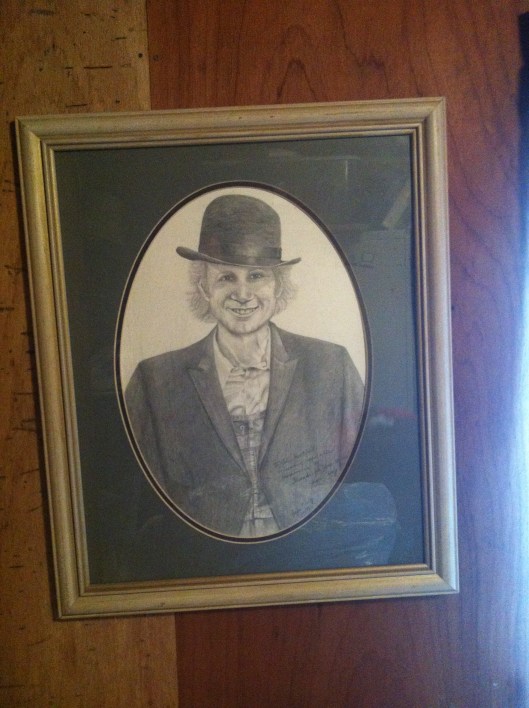
An artist presented this framed drawing to John at the Museum of Appalachia in the late 1990s…and he gave it to me.

IMG_9534

I asked John to make a tape of these tunes for me, and he did.

In Search of Ed Haley 308

21 Wednesday May 2014

Posted by Brandon Ray Kirk in Ed Haley

≈ Leave a comment

Tags

Ashland, Billy in the Lowground, Bonaparte's Retreat, Charles Gardner, Charleston, Dallas, Done Gone, fiddling, Flatfoot Nash, French Carpenter, Georgia Slim Rutland, Gunboats Through Georgia, history, John Hartford, Kentucky, music, West Virginia, Wilson Douglas, writing

Back in Nashville, I called Wilson Douglas to thank him for being such a good host on my recent trip to West Virginia. I also had a few questions, starting with whether or not Ed played a tune called “Gunboats Through Georgia”.

“Oh, yeah,” Wilson said. “Well, they wasn’t very many, John, that he didn’t play. And he played a danged tune, him and French Carpenter, called the ‘Flatfoot Nash’.”

Wilson paused, then said, “I told you about Ed Haley commending Georgia Slim, didn’t I? He said he believed that Georgia Slim was the best fiddler on some of them there Southern tunes he ever heard. He said nobody could touch him on the ‘Billy in the Lowground’. Now, Georgia Slim — way back there in ’37, ’38 — he went and stayed with Ed Haley a lot in the wintertime.”

Wilson’s memories of Georgia Slim caused me to recall my theory that Ed was a grandfather of the Texas contest fiddling style. I hadn’t thought much about that lately so I called up Charles Gardner, an authority on Texas fiddling. Charles said Georgia Slim had influenced a lot of Texas fiddlers when he played over Dallas radio in the early 1940s. At that time, he was fresh from the Ashland-Charleston area, his playing no doubt filled with Haley and Kessinger licks. It seemed very possible to me that the unfamiliar parts he played on tunes like “Done Gone” and “Bonaparte’s Retreat” were learned from Ed or at least based on his approach.

In Search of Ed Haley 138

30 Sunday Jun 2013

Posted by Brandon Ray Kirk in Ed Haley

≈ Leave a comment

Tags

Appalachia, Ashland, Bonaparte's Retreat, Ed Haley, fiddler, history, John Hartford, Kentucky, Lawrence Haley, Lost Indian, music, Napoleon Bonaparte, writing

Later that evening, back in Ashland, Lawrence and I talked about Haley’s tunes. Ed told him all about “Bonaparte’s Retreat”.

“When the French first went in, they was pushing the Russians pretty hard,” Lawrence said. “The high string going in. The Russians were retreating. When they got to a certain point, the cannons started booming and the Russians started turning the tide on them. Part of the highs, I guess, was the French Napoleon troops coming out in a hurry and the Russians right behind them and then they’d be a spell of like an old dirge or something, like they was coming out defeated. They was slacking off on ’em and letting them retreat back out of there. They knew they wasn’t gonna make it on account of the weather. Just gonna let them freeze to death. Then they’d boom the cannon and push them a little bit faster. Then the dirge come up again. That’s the way Pop kinda explained it to me. He’d say, ‘Now you listen to these cannons boom. The Russians are getting ready to turn the tide on Napoleon’s troops’.”

Lawrence had no idea where Ed heard that story.

“Same way with ‘Lost Indian’,” he said. “It seemed like, the way he explained it, this old Indian would look at something and see a far off peak that he recognized and he’d be happy and hooping and hollering and trying to get over to it and then whenever he’d get over there he would find out it wasn’t the place he thought it was. And he’d sit down and kind of reminisce, I guess, and feel bad towards his self because he wasn’t where he thought he was at so he could get home. He’d stand up and look around again and maybe see another peak or familiar point as being close to his tribe and he’d go to it with a little bit of enthusiasm and glee because he thought he’s getting home and it’d turn out the same way. He wasn’t getting no where. He was still a ‘lost Indian’.”

Parkersburg Landing 69

21 Thursday Feb 2013

Posted by Brandon Ray Kirk in Ed Haley

≈ Leave a comment

Tags

Appalachia, Ashland, banjo, Bonaparte's Retreat, Ed Haley, fiddler, history, John Hartford, Kentucky, Lawrence Haley, music, Pat Haley, Red Apple Rag, U.S. South, writing

     That night, I played some of Ed’s tunes for Lawrence in his kitchen. In spite of the great story opening up about Milt Haley, I didn’t lose sight of the music and my quest to understand it. As I played, Lawrence was brutally honest.

     “Notice how you’re using a fourth of the bow?” he said. “Pop played all over it.”

     “Did you hear a few real strong driving notes in that and then some really weak ones that didn’t hardly get out?” he asked.

     “Pretty good — but never just like my dad,” he stated flatly.

     The closest I came to gaining his approval was when I played “Bonaparte’s Retreat”.

     “You got a pretty good version of that,” he said. “Nothing too wrong with that.”

     “Your cannons sounded very good,” Pat added politely.

     When I played Ed’s “Red Apple Rag”, Lawrence said there was one part — what I call the “House of David Blues” part — that didn’t belong in the song, even though I knew Ed had played it there in the home recordings. He remembered his father playing “House of David Blues” as a separate tune and singing:

Bring it on down to my house honey,
Ain’t nobody home but me.
Bring it on down to my house honey,
I need the company.

Now a nickel is a nickel
And a dime’s a dime.
You show me yours and I’ll show you mine.
Bring it on down to my house honey,
Ain’t nobody home but me.

     I asked again about Haley’s banjo and Pat said she remembered that it was still around when she first came to Ashland in the late 1940s. She thought it belonged to Ella, but Lawrence said, “No, Mom played what they call a banjo-mandolin. It wasn’t too many years that I remember her playing one. Pop probably had a banjo. He’d just as soon sit down and play the banjo a lot of times. Or he’d play the guitar a lot. He played it like he did the fiddle. He’d make runs and everything else. He could sit down and play a organ or piano if he wanted to. I’ve seen him sit down on that old pump organ we had and he’d start pumping and he’d just play it for a while.”

     I wondered if Ed’s talent as, or even fondness for, being a multi-instrumentalist had been somewhat overstated. It seemed a little odd that, among the hundreds of home recordings, there was not one single sample of him playing anything but the fiddle. Of course, I didn’t bring this up to Lawrence because I totally believed him. Besides, he seemed a little cranky.

     Pat said she remembered Ed playing something about “going down the Mississippi” and Lawrence said it was the “Battle of New Orleans”.

     “Pop used to play that a long time ago,” he said. “That and ‘Soldier’s Joy’ and all those old pieces like that. ‘Arkansas Traveler’ and ‘Mississippi Sawyer’.”

In Search of Ed Haley 63

11 Monday Feb 2013

Posted by Brandon Ray Kirk in Ed Haley

≈ Leave a comment

Tags

Bonaparte's Retreat, Brooks Hardway, Clark Kessinger, Dusty Miller, Ed Haley, Emery Bailey, fiddler, fiddling, French Carpenter, Gerry Milnes, history, Jimmy Johnson Bring Your Jug Around the Hill, John Cottrell, John Hartford, Laury Hicks, Lost Indian, Mississippi Sawyer, music, Old Sledge, Sally Ann Johnson, Sally Goodin, Sol Carpenter, Spencer, Stackolee, Ward Jarvis, West Virginia, writing

After listening to Gerry’s tape, I gave Brooks a call. His voice was extremely weak compared to the 1988 interview, indicating that his health had taken a turn for the worse. As I introduced myself and tried to explain the reason for my call he told me to speak up because his hearing wasn’t very good. Just when I figured he hadn’t heard a word I said, he remarked, “I’ve got a lot of tapes of you, John. I’ve been listening to you for twenty years.” He also had Ed’s record, which he said was a good representation of his fiddling.

“It had his zip on the bow,” Brooks said. “The record that I’ve got was made off of some old discs that his wife had saved. They was a record man visited him and talked with him and wanted him to make records but at that time they just paid you for it and that was it. And Ed said, ‘I won’t make a record unless you give me royalty on it. You’ll have to give me a percentage of what you make on it.’ So he never made no records.”

I wanted to know more about the “zip” in Ed’s bowing, but Brooks didn’t remember any specifics.

“No, at the time I met Ed Haley I was just a big young boy entering into manhood,” he said. “But I’ll never forget Ed Haley and his fiddle as long as I live. My my, he fiddled fast. He had the smoothest bow hand I ever heard. Soft as silk — soft as a woman’s voice. And he had fingers like a baby. You see, he never did work any. I think he went blind at about nine years old.”

I asked where Ed positioned the fiddle when playing and he said, “He held the fiddle high on his shoulder. Not on his arm nor not up under his chin.”

As for Ed’s tunes, Brooks said, “He played these old Clay County-Braxton-Calhoun-Gilmer tunes. These old John Cottrell tunes — ‘Mississippi Sawyer’. The old-time ‘Sally Goodin’ — mercy mercy he could play ‘Sally Goodin’. And ‘Sally Ann Johnson’.”

I asked Brooks where he used to see Ed and he basically repeated what he had told Gerry Milnes about him playing at the courthouse in Spencer, West Virginia. I wondered if there was a crowd around him.

“You betcha there was a crowd,” Brook said. “Generally, they was ten or fifteen men standing around up as close to old Ed as they could get. He was sitting on a chair and had that tin cup on the arm of that chair. Them nickels and dimes was just cracking in that tin cup. I even put a quarter in his tin cup. Course he’d empty it every little bit. That was back in the late 20s, early 30s. You take a tin cup half full of nickels and dimes and you could buy a pretty good sack of groceries with it. It wasn’t like it is today.”

In spite of Ed’s popularity, no one in the crowd danced.

“Them old farmers wouldn’t hit a lick with their feet,” Brooks said.

Brooks said he never heard Ed play the banjo but got really excited when I asked him about his singing.

“Oh, I’m glad you mentioned it,” he said. “The first time I heard ‘Stackolee’, Ed Haley played it and sung it sitting in the courthouse yard at Spencer. Now I’m telling you, he could make you hump up when he’d sing that song. And he knew it the old original way. That’s the first time I ever heard a man sing with a fiddle. Back in that day, it was seldom you heard a man do that. French Carpenter, he was a good singer with the fiddle. He was a good old-time fiddler. His daddy was named Solly Carpenter. Old Sol Carpenter’s favorite was Emery Bailey. He was fifty years ahead of his time.”

I asked if Emery Bailey was as good as Ed Haley and Brooks said, “He wasn’t as good as Ed Haley by no means. Ed Haley was far ahead of everybody at that day and time. But Emery Bailey was one among the best of the fiddlers in Calhoun-Braxton-Clay-Gilmer Counties. Now, there’s a contemporary of Ed Haley — have you heard of Clark Kessinger? He could fiddle just about… Well, not as good — there was nobody could fiddle as good as Ed Haley could, but I’ll tell you, Clark Kessinger could come close to him.”

Brooks pointed out that being a fiddler in those days wasn’t necessarily a good thing.

“No, at that time the fiddle was looked down upon. People wouldn’t fool with a fiddler,” he said. “The fiddle seemed to be a disgrace. You take a man going along the road with a fiddle and he was looked down upon and talked about.”

Things got kind of quiet, then I asked him if Ed played a tune called “Jimmy Johnson Bring Your Jug Around the Hill”.

“Oh, you betcha,” Brooks said. “Ward Jarvis learned to play that just about as good as Ed played it, too. Ward Jarvis was among the best fiddlers in the country.”

Brooks said Ed also played “Dusty Miller” and “Lost Indian”. He played everything in the standard key.

“Now you take a lot of tunes that some of our country fiddlers — Laury Hicks and Ward Jarvis and others… French Carpenter. They would tune their fiddle and put it up in A — they called it the high key. Ed never changed his fiddle that I seen.”

Brooks didn’t remember Ed playing some of his most famous cross-key pieces, like “Old Sledge” or “Bonaparte’s Retreat”.

“Now them’s Sol Carpenter tunes that you’re talking about,” he said. “That’s back a generation behind Ed Haley.”

In Search of Ed Haley 15

03 Monday Dec 2012

Posted by Brandon Ray Kirk in Ed Haley

≈ 1 Comment

Tags

Appalachia, Ashland, Bill Day, Blind Frailey, Bonaparte's Retreat, Clyde Haley, Ed Haley, Ella Haley, fiddler, fiddling, history, Ironton, Jack Haley, Jesse Stuart, John Hartford, Kentucky, Lawrence Haley, Library of Congress, life, Mona Haley, music, Noah Haley, Ohio, Pat Haley, U.S. South, Washington's March

Pat said, “My mother-in-law used to worry about Pop — whether Pop would go to heaven, because Pop would curse and I guess Pop was a rough man when he was growing up.” Lawrence added, “A drinker and a swarper, I guess.” Pat went on: “My father-in-law used to wear these big Yank work clothes — the dark green and navy blue, he liked those — and I would tell him, ‘Pop, time to change your clothes.’ Pop had been dead, I guess, about two years and one night I had a dream. And I saw my father-in-law on this cloud and he had an almost brand new set of big Yank work clothes on. He was chewing his tobacco and he had his pipe, and he said, ‘Patricia, I don’t have to worry about it anymore. I can chew my tobacco all I want and spit anywhere I want.’ I got up and my mother-in-law got up and I said, ‘Mom, you don’t have to worry about Pop anymore. I had a dream about him.'”

Hearing this caused me to think about how Jesse Stuart, the famous Kentucky writer, wrote about Haley — who he called “Blind Frailey” — playing in Heaven.

This is a fiddler when he gets to Heaven

As people say “Blind” Frailey’s sure to do —

He’d go up to the golden gates of Heaven,

“Blind” Frailey would, and fiddle his way right thru.

He’d fiddle all round God’s children with harps,

“Blind” Frailey doesn’t know the flats and sharps,

But all God’s children will throw down their harps

And listen to a blind man fiddling thru.

“Blind” Frailey will fiddle on the golden street

Till dancers will forget they are in Heaven,

And they’ll be swept away on dancing feet

And dance all over golden streets of Heaven.

“Blind” Frailey will fiddle for the dancers there

Up where the Lord sits in his golden chair,

He will sit down to jolly fiddling there.

 And if one Plum Grove man has gone to Heaven

And if he hears this fiddle by a chance,

He will call out the angels here in Heaven;

The sweet fair maids here all white-robed in Heaven,

And they’ll renew again the old square dance —

The old Kentucky mountain “Waltz the Hall” — 

The most Kentuckian of all dance calls —

The Lord will sit in his high golden chair

And watch “Blind” Frailey from Kentucky there,

The Lord will sit wistfully a-looking on

But the Lord will never say a word at all,

Not when he sees his angels “Waltz the Hall — “

And when he hears Frailey from Kentucky there

He will sit back and laugh from his golden chair.

And if “Blind” Frailey finds rest in Heaven

And if the Plum Grove folks knew it back here,

I’m sure these folks would try harder for Heaven

To follow the “Blind” Frailey fiddler there —

They love to dance to his magic fiddle —

They could dance all the night and all the day —

And if they would become light spirits in Heaven

And get all the thirst and hunger away

Their light spirits then could dance till Doomsday —

There’s danger that they would forget to pray —

But when “Blind” Frailey starts sawing his fiddle

Only he stops long enough to resin his bow —

When he does this, spry dancers will jig a little —

Jig on till Frailey says: “Boys, let ‘er go!”

I wondered if Ed was a religious man.

“A lot of preachers, he was with them like he was the record companies,” Lawrence said. “He took about half of what they said as truth. But he believed in a heaven and hell, I’m pretty sure, because his hell was if he had to play music with people like Bill Day or some other half-assed musician. And that would be his hell, and that’s the way he felt about it.”

Not long after Ed’s death, Ella divided their home recordings among the kids.  Lawrence showed me his share — some were aluminum-based, while others were paper-based. Most had been scratched. Others were warped or had the disc holes entirely off center. But in spite of their poor condition, I could tell that Lawrence had faithfully guarded them with a passion and a stubborn resolve that his dad’s music would survive. (Back in the fifties or sixties, he’d refused a $5,000 offer for them by a Gospel singer from Nashville.) His dedication seemed to stem from a deep love for Ed and Ella, as well as an unyielding pride in their music. When I told him that Ed was a musical genius, he wasn’t surprised or flattered — it was something he already knew. He took it all in stride. If I started bragging on Ed too much, he joked about how I never did see his “mean side.”

Lawrence didn’t know much about the circumstances surrounding Ed’s records, because they were made during his years in the Air Force.

“I was in the service, and they give me what they thought I’d like. They mighta duplicated some of the same records they gave me and gave them to some of the other children. Like ‘Old Sledge’, maybe one of my other brothers or somebody liked that piece of music, so they’d make one for me and one for them. Maybe a fifth of those were duplicated.”

Most of the records featured Ella on the accordion or singing.

“Mom would sing things like ‘Me and my wife and an old yellow dog, we crossed the creek on an old hollow log.’ She would come up with that mostly. Maybe one little thing like that through the whole tune.”

In addition to Haley’s home recordings, Lawrence showed me the four reel-to-reel tapes of his dad’s music, which the Library of Congress had made for him in the early 1970s.

I asked him about the other kids’ records and he said, for starters, his brother Clyde sold his to “a guy by the name of Brickey that run a store down on 12th Street and Winchester. Pop used to go around and play with Brickey — sit around the store with him and play music. I think this guy was from out in Carter County originally. But Clyde sold him all of his records, just for enough money for him to take off on one of his wild jaunts. He’d start out and take off and be gone two or three years at a time.”

Lawrence didn’t think any of the Brickeys were still around Ashland.

“I think this old gentleman died. I got some of the records back from him, but I know he didn’t turn loose of all of them.”

Lawrence’s sister Mona lost her records when she got behind on her rent.

“I know my sister, she lived over in Ironton, and she got in back on her rent some way and moved out. She took one of them ‘midnight flights’ you know, and didn’t take this trunk — she had a big trunk — and all those records was in that and where they went to from there nobody knows.” Pat said, “She never could get the trunk. The woman later told her that she discarded it. We also know for a fact that my sister-in-law trashed a bunch of the records because she was angry at her husband and threw them at him.”

Oh Lord.

Lawrence’s brother Jack apparently lost most of his records, too.

“Jack and his family, they probably just wore a lot of theirs out and discarded them,” Lawrence said. “They didn’t take care of them right. They just played them to death, I guess.” Pat agreed, “Jack said they didn’t take care of them. They let the kids play with them.”

Noah, Lawrence’s older brother, lost his records when his ex-wife threw them at him in various arguments.

Lawrence sorta dismissed their destruction.

“They went. We all had our share of them — just one of the gifts that Mom and Pop gave us.”

As our conversation turned away from Ed’s life and toward his music, Lawrence almost immediately mentioned his father’s version of “Bonaparte’s Retreat”.

“Well, they call the first part of it ‘Washington’s March’,” he said. “My dad would tune the low string way down and you could hear the real fast march, like the men marching at a pretty good pace, and all at once he’d lift that bow up and hit that low string and it’d sound like a cannon booming. And he’d go into this real fast finger-work that had to do with the troops moving out of Russia as fast as they could and then there’d be a small section that was slow, like it was a sad, sad situation for these French soldiers coming back out of Russia. You can picture it, I guess. A bunch of soldiers coming out with their shoulders stooped and rags around their feet and just barely able to move. Pop would play part of that real slow like a funeral dirge and then he’d go back to the fast march with the cannons booming.”

In Search of Ed Haley 8

27 Tuesday Nov 2012

Posted by Brandon Ray Kirk in Ed Haley

≈ Leave a comment

Tags

Annadeene Fraley, Appalachia, Ashland, Ballad Makin' in the Mountains of Kentucky, Bert Hatfield, Bill Day, Birdie, Black Mountain Rag, Bloody Ground, Bonaparte's Retreat, books, Canada, Catlettsburg, David Haley, Dick Fraley, Doc Chapman, Dry and Dusty, Ed Haley, fiddler, fiddlers, fiddling, Gallagher's Drug Store, Grey Eagle, history, Horse Branch, J P Fraley, Jean Thomas, Jilson Setters, John F. Day, John Hartford, Kentucky, Lawrence Haley, Maysville, music, New Money, Paul David Smith, Pikeville, Snake Chapman, The Singin' Fiddler of Lost Hope Hollow, The Wheel, Wee House in the Wood, White Rose Waltz, writers, writing

As soon as my schedule cleared, I loaded my car and traveled north on I-65 out of Nashville toward the home of J.P. and Annadeene Fraley in Carter County, Kentucky. I took the Bluegrass Parkway northeast to Lexington, where I boarded I-64 and drove eastward past Winchester, Mt. Sterling and Owingsville. In a short time, I was in “Ed Haley country,” passing by Morehead — birthplace of Mrs. Ed Haley — and through the northern end of the Daniel Boone National Forest. A little later, I took the Grayson exit, where I found J.P. and Annadeene at their beautiful log home in a small settlement called Denton.

In the initial small talk, J.P. told about seeing Ed Haley play on the streets of Ashland. He specifically remembered him playing at Gallagher’s Drug Store where he sat cross-legged “like an Indian” with his back against the wall “right by the doors where you go in.” Ed kept a hat out for money and knew people by the sound of their voices. In the cold months, he played inside for square dances, Kiwanis Club events, and at local beer joints like “The Wheel.” J.P. said, “Now business people treated him good but the general public, they didn’t know what they was doing.”

At that point, we got our instruments out and squared up to play some tunes. As J.P. worked through his repertoire — “Birdie” (Haley’s version), “New Money”, “White Rose Waltz” — he sang little ditties and gave some of the history behind his tunes. He played a great tune called “Maysville” and said, “Daddy played it. What it was, they wasn’t no tobacco warehouses in Morehead or Flemingsburg so they had to haul their tobacco plumb into Maysville to sell it. When they was going there, they played the tune fast because they was happy. They were going to get that tobacco check, see? On the way back, they was playing it slow because they were drunk. They all had hangovers.”

J.P. also played “Grey Eagle”, “Black Mountain Blues” and “Bonaparte’s Retreat”. His treatment of this latter piece was somewhat unique — he began it with “Dry and Dusty” (“Daddy’s introduction”) — although he really bragged on Haley’s version. “If you listen to that record you got, you can hear… It’s just like cannons going off. I mean he was doing it on the fiddle. Man he had the best version of that. Ed Haley was colorful with his fiddle tunes.”

In between all of the fiddling and reminiscing, little comments spilled out about Haley. Things like, “His fingers was like a girls.” Then more fiddling.

Some time later, J.P. and I put our instruments away and sat down to dinner. Between bites, I asked him where he remembered Haley playing in Ashland.

“His range was right along 15th – 16th Street on Winchester Avenue. When you went down between Winchester and Greenup, there was shoe shops and a saloon or two and a poolroom where mostly a congregation of men were. Then over on Greenup the women’d be shopping. Sometimes he played on Front Street, but that was a wild part of town. I don’t ever remember his wife being over in there but I seen him there when the boy was picking with him. Down by the railroad over on Front Street, there used to be stores over there — and on Greenup. I mean, grocery stores, family stores. I can remember seeing him play in front of one — had to be down there. I guess around 14th Street on Greenup. I guess hunting season was going on because wild rabbits was hung up out there for sale…with the fur still on them. And stocks of bananas. Slabs of bacon, hams. I mean they wasn’t bound up to keep the flies off of them.”

After dinner, I played some of Haley’s music on cassette tapes for J.P. He casually told how people sometimes griped about Ella’s accompaniment being too loud. He also brought up how people occasionally complained when Haley played inside Ashland businesses. J.P.’s father once confronted a store owner who had asked Ed to leave his store. “Daddy told me he’d went in that hardware store, you know, to take up for Ed,” J.P. said. “The storeowner knowed Dad. He said, ‘Now Dick, you forget about it ’cause I’d ruther for him to be out there a fiddling as all them people to come in here that’s been a complaining about him.’ It wasn’t really a problem.” I said, “So he fiddled outside the hardware store all the time?” and J.P. said, “Right in that vicinity. If it was rainy or a real hot sun, you’d find him along there playing.”

Annadeene and I made plans to visit Ed’s son, Lawrence Haley, in Ashland the following day. J.P. showed me to a guest bedroom, presumably to turn in for the night, but we were soon playing music again. He cranked out “Goin’ Back to Kentucky”, then said, “I bet you money Ed Haley played that because Asa Neal did.”

The next morning, Annadeene and I hopped onto US Route 60 and made the thirty-minute drive into Ashland, the place where Ed Haley lived the last thirty years of his life. In those days, Ashland was a somewhat affluent industrial town on the Ohio River. Today, its population has dwindled to around 20,000 and its once prominent river culture seems long gone. It is best known as the hometown of country music stars, Naomi and Wynonna Judd, as well as movie actress Ashley Judd. It was clear that the place seemed to be somewhat depressed in the way most river towns are in this section of the Ohio River, outside of a budding shopping center to the northeast.

Annadeene and I drove around town for about an hour. She pointed out all the places she remembered Ed playing and told me all about his relationship with Jean Thomas, the late Ashland folklorist. I had heard of Jean Thomas and was roughly aware of the arguments for and against her work in Ashland to preserve and perpetuate mountain culture. She was the creator of the American Folksong Festival, an annual production held at the “Wee House in the Wood.” The central character in Thomas’ festival was Jilson Setters, a blind fiddler character “from Lost Hope Hollow” who Annadeene said had been inspired by Haley. She was sure of this, having served as Thomas’ personal secretary years ago.

In The Singin’ Fiddler of Lost Hope Hollow (1938), Thomas gave an account of her first encounter with ‘Jilson’ at a local courthouse: “There under the great leafy oak in the court house yard, the sun gleaming on its wet leaves, stood an old man, tall, gaunt, with a hickory basket on his arm, a long oil cloth poke clutched in his hand. It was the poke that caught my eye. Already a crowd was gathering about him. He put down the basket, then took off his dilapidated wide-brimmed felt and placed it, upturned, on the wet grass at his feet. Carefully he untied the string on the oilcloth poke and – to my surprise – took out a fiddle! In another moment, fiddle to chin, his sightless eyes raised to heaven, he swept the bow across the strings with masterly ease…and sang in a strong, a vibrant voice for one so old. While he fiddled a measure, before starting the next stanza, I fairly flew across the road. I wanted to be close at the old minstrel’s side, lest I lose a word that fell from his lips. When the song was ended I clapped loud and long, like the rest, and like them, too, tossed a coin into the old fellow’s hat.”

Annadeene said Thomas first offered Haley the opportunity to role-play Jilson Setters but he refused. He likely agreed with writer John F. Day, who offered a scathing criticism of Thomas in Bloody Ground (1941). “The trouble with most ballad-pushers, as well as of the other ‘native culturists,’ is that they’re seeking their own exultation under a guise of working for the benefit of the mountain people,” Day wrote. “One wonders as he watches the American Folksong Festival whether it’s all for the glory of God, art, and mountain balladry, or Jean Thomas, Jean Thomas and Jean Thomas. After reading one of Jean Thomas’ books I feel ill. Everything is so lovely and quaint; so damnably, sickeningly quaint. Writers like Jean Thomas would have one believe that every-other mountaineer goes around singing quaint, beautiful sixteenth-century ballads as he plunks on a dulcimer. The people of Kentucky laugh at Miss Thomas’ stuff, but the people outside the state are willing to lap it up. Now in the first place thousands of hill dwellers know no old ballads and other thousands know the old ones but prefer the newer ones. In the second place 90 per cent of the ballads and 90 per cent of the ballad singers stink. Further, the only dulcimers left in the hills are gathering dust on the walls of the settlement schools. The mountain people found out long ago there wasn’t any music in the damned things, and so they discarded them for fiddles, banjos, and guitars.”

After Haley refused to play the part of Jilson Setters, Thomas chose Blind Bill Day, a left-handed fiddler and migrant to Ashland. At some point, she took him to play his fiddle for the Queen of England. Based on Thomas’ book, Ballad Makin’ In The Mountains of Kentucky (1939), Day met his future wife “Rhuhamie” (actually named Rosie) on Horse Branch in Catlettsburg, Kentucky.

I went to Ed Haley’s the day it was bright

I met with a woman I loved at first sight.

I asked her some questions about her past life.

She told me she was single – but had been a wife.

 In deep conversation I studied her mind,

She had come down to Brushy to wait on the blind;

The labor was hard and the wages was small,

I soon saw that she did not like Horse Branch at all.

Needless to say, the entire concept of Jilson Setters went a long way in destroying Thomas’ credibility as an authentic folklorist. John F. Day wrote: “The mountaineers had to be quaint. Such determination led to hoaxes like the one Jean Thomas perpetrated with ‘Jilson Setters, the Singing Fiddler of Lost Hope Hollow.’ She took this ‘typical representative of the quaint mountain folk of Kentucky’ to New York and to London and made quite a name for herself and him. But though he might have been Jilson Setters to the New Yorkers and the English he was James William Day (nicknamed ‘Blind Bill’ Day) to the people of Kentucky who knew him. There may be a ‘Lost Hope Hollow’ – they name them everything – but nobody in the Kentucky mountains ever heard of it. There was no particular harm of course in changing Bill Day’s name to Jilson Setters if the latter sounded more poetic – or something. Names are changed every day in Hollywood. The harm came in pawning off Bill, well-coached in quaintness, as a representative of the Kentucky mountain people. But the most laughable part of the whole affair was that Bill Day had lived for years in Ashland and Catlettsburg, and of all the sections of the Kentucky mountains, that in which the two cities lie is the most modern. Ashland is an industrial city of more than 30,000 population, and Catlettsburg is almost a suburb. The Big Sandy Valley was opened up years before southeastern Kentucky, and thus if one is to find any ‘quaintness’ at all he must get out of the Big Sandy country.”

Annadeene and I drove around Ashland for about an hour discussing such things before heading to nearby Catlettsburg, Kentucky on US Route 23. According to J.P. Fraley, Catlettsburg — a former boomtown for loggers who rafted timber out of the Big Sandy River at the turn of the century — served as Ed Haley’s place of residence during the twenties and early thirties. Today, its historic and interesting downtown area — featuring the Boyd County Courthouse and other buildings that attest to its short prosperous history — is almost hidden from view due to a railroad to the south and a large floodwall to the north. Its most visible section is a modern strip along US Route 23, consisting of a slow-moving four-lane road dotted with gas stations, old dwelling houses and fast-food restaurants. A sign proclaims Catlettsburg as a town of 6000 residents and maps show it situated across the Big Sandy River from the town of Kenova, West Virginia and across the Ohio River from South Point, Ohio.

After looking over the place, Annadeene and I drove back to Ashland on Winchester Avenue and turned onto 45th Street at a large, brick Presbyterian church. We drove up a narrow and curvy street until it crested at Gartrell Street, where Annadeene pointed out the home of Lawrence Haley, an unpretentious white one-and-a-half-story residence. We parked on the street and eased out of the car toward the Haley porch. As I stood there preparing to ring the doorbell, I noticed the original picture of Ed Haley featured on Parkersburg Landing hanging just inside a window on the living room wall. I had goose bumps in realizing how much this experience meant to me. After a few rings of the bell, it was clear that no one was home.

Just as we were ready to step off of the porch, a young girl with a wonderful smile came up from next door and said that her grandparents had gone over into Ohio. I realized just then that she was Ed’s great-granddaughter and was instantly as impressed as if I’d just met the daughter of the President of the United States. A stocky man with a dark mustache followed her over and introduced himself as her father, David Haley. Annadeene and I talked with him briefly, then said we’d come back some time when his parents were home. I walked out of the Haley yard wondering if the girl or her father had inherited any of Ed’s musical talent.

Later in the day, after parting ways with the Fraleys, I drove south through the Big Sandy Valley on US Route 23 to see Snake Chapman, the fiddler who remembered seeing Ed Haley so often during his youth in Pike County, Kentucky. At Pikeville, I took US Route 119 to Snake’s mountain home up Chapman Hollow near a settlement called Canada. Snake was a retired coalminer who spent most of his time caring for his sick wife. He was very mild-spoken — almost meek — and had what seemed like hundreds of cats all over his yard (even on the roof of his house). Once we began playing music, it was clear that he was a great old-time fiddler. I had a blast with his buddies, Bert Hatfield (a relative of the feuding Hatfields) and Paul David Smith.

Snake told me a little about his father, Doc Chapman. “He was an herb doctor, Dad was. Everybody knowed him by Doc Chapman. He knowed every herb that growed here in the mountains and what they was for and doctored people all around.” Doc was also a fiddler.

Snake took up his fiddle and played several more tunes, including Haley’s version of “Birdie”. Snake was a man of few words, so most of my visit consisted of playing old-time tunes. I spent the night at Bert Hatfield’s, then left eastern Kentucky on US 119 and US 25E via the Cumberland Gap.

Feud Poll 1

If you had lived in the Harts Creek community during the 1880s, to which faction of feudists might you have given your loyalty?

Categories

  • Adkins Mill
  • African American History
  • American Revolutionary War
  • Ashland
  • Atenville
  • Banco
  • Barboursville
  • Battle of Blair Mountain
  • Beech Creek
  • Big Creek
  • Big Harts Creek
  • Big Sandy Valley
  • Big Ugly Creek
  • Boone County
  • Breeden
  • Calhoun County
  • Cemeteries
  • Chapmanville
  • Civil War
  • Clay County
  • Clothier
  • Coal
  • Cove Gap
  • Crawley Creek
  • Culture of Honor
  • Dingess
  • Dollie
  • Dunlow
  • East Lynn
  • Ed Haley
  • Eden Park
  • Enslow
  • Estep
  • Ethel
  • Ferrellsburg
  • Fourteen
  • French-Eversole Feud
  • Gilbert
  • Giles County
  • Gill
  • Green Shoal
  • Guyandotte River
  • Halcyon
  • Hamlin
  • Harts
  • Hatfield-McCoy Feud
  • Holden
  • Hungarian-American History
  • Huntington
  • Inez
  • Irish-Americans
  • Italian American History
  • Jamboree
  • Jewish History
  • John Hartford
  • Kermit
  • Kiahsville
  • Kitchen
  • Leet
  • Lincoln County Feud
  • Little Harts Creek
  • Logan
  • Man
  • Matewan
  • Meador
  • Midkiff
  • Monroe County
  • Montgomery County
  • Music
  • Native American History
  • Peach Creek
  • Pearl Adkins Diary
  • Pecks Mill
  • Peter Creek
  • Pikeville
  • Pilgrim
  • Poetry
  • Queens Ridge
  • Ranger
  • Rector
  • Roane County
  • Rowan County Feud
  • Salt Rock
  • Sand Creek
  • Shively
  • Spears
  • Sports
  • Spottswood
  • Spurlockville
  • Stiltner
  • Stone Branch
  • Tazewell County
  • Timber
  • Tom Dula
  • Toney
  • Turner-Howard Feud
  • Twelve Pole Creek
  • Uncategorized
  • Warren
  • Wayne
  • West Hamlin
  • Wewanta
  • Wharncliffe
  • Whirlwind
  • Williamson
  • Women's History
  • World War I
  • Wyoming County
  • Yantus

Feud Poll 2

Do you think Milt Haley and Green McCoy committed the ambush on Al and Hollene Brumfield in 1889?

Blogroll

  • Ancestry.com
  • Ashland (KY) Daily Independent News Article
  • Author FB page
  • Beckley (WV) Register-Herald News Article
  • Big Sandy News (KY) News Article
  • Blood in West Virginia FB
  • Blood in West Virginia order
  • Chapters TV Program
  • Facebook
  • Ghosts of Guyan
  • Herald-Dispatch News Article 1
  • Herald-Dispatch News Article 2
  • In Search of Ed Haley
  • Instagram
  • Lincoln (WV) Journal News Article
  • Lincoln (WV) Journal Thumbs Up
  • Lincoln County
  • Lincoln County Feud
  • Lincoln County Feud Lecture
  • LinkedIn
  • Logan (WV) Banner News Article
  • Lunch With Books
  • Our Overmountain Men: The Revolutionary War in Western Virginia (1775-1783)
  • Pinterest
  • Scarborough Society's Art and Lecture Series
  • Smithsonian Article
  • Spirit of Jefferson News Article
  • The Friendly Neighbor Radio Show 1
  • The Friendly Neighbor Radio Show 2
  • The Friendly Neighbor Radio Show 3
  • The Friendly Neighbor Radio Show 4
  • The New Yorker
  • The State Journal's 55 Good Things About WV
  • tumblr.
  • Twitter
  • Website
  • Weirton (WV) Daily Times Article
  • Wheeling (WV) Intelligencer News Article 1
  • Wheeling (WV) Intelligencer News Article 2
  • WOWK TV
  • Writers Can Read Open Mic Night

Feud Poll 3

Who do you think organized the ambush of Al and Hollene Brumfield in 1889?

Recent Posts

  • Logan County Jail in Logan, WV
  • Absentee Landowners of Magnolia District (1890, 1892, 1894)
  • Charles Spurlock Survey at Fourteen Mile Creek, Lincoln County, WV (1815)

Ed Haley Poll 1

What do you think caused Ed Haley to lose his sight when he was three years old?

Top Posts & Pages

  • Baisden Family Troubles
  • About
  • Stephen Hart: Origins of Harts Creek (1896/1937)
  • Ran'l McCoy's Final Months (1914)
  • Perry A. Cline Deed to Anderson Hatfield (1877)

Copyright

© Brandon Ray Kirk and brandonraykirk.wordpress.com, 1987-2023. Unauthorized use and/or duplication of this material without express and written permission from this blog’s author and/or owner is strictly prohibited. Excerpts and links may be used, provided that full and clear credit is given to Brandon Ray Kirk and brandonraykirk.wordpress.com with appropriate and specific direction to the original content.

Archives

  • February 2025
  • January 2025
  • October 2023
  • September 2023
  • December 2022
  • November 2022
  • May 2022
  • April 2022
  • February 2022
  • November 2021
  • October 2021
  • September 2021
  • June 2021
  • May 2021
  • April 2021
  • March 2021
  • February 2021
  • January 2021
  • December 2020
  • November 2020
  • October 2020
  • July 2020
  • June 2020
  • May 2020
  • April 2020
  • March 2020
  • February 2020
  • January 2020
  • December 2019
  • November 2019
  • October 2019
  • September 2019
  • August 2019
  • July 2019
  • June 2019
  • May 2019
  • April 2019
  • March 2019
  • February 2019
  • January 2019
  • December 2018
  • November 2018
  • October 2018
  • September 2018
  • August 2018
  • July 2018
  • June 2018
  • May 2018
  • April 2018
  • March 2018
  • February 2018
  • January 2018
  • December 2017
  • November 2017
  • October 2017
  • September 2017
  • August 2017
  • July 2017
  • June 2017
  • May 2017
  • April 2017
  • March 2017
  • February 2017
  • January 2017
  • December 2016
  • November 2016
  • October 2016
  • September 2016
  • August 2016
  • July 2016
  • June 2016
  • May 2016
  • April 2016
  • March 2016
  • February 2016
  • January 2016
  • December 2015
  • November 2015
  • October 2015
  • September 2015
  • August 2015
  • July 2015
  • June 2015
  • May 2015
  • April 2015
  • March 2015
  • February 2015
  • January 2015
  • December 2014
  • October 2014
  • September 2014
  • August 2014
  • July 2014
  • June 2014
  • May 2014
  • April 2014
  • March 2014
  • February 2014
  • January 2014
  • December 2013
  • November 2013
  • October 2013
  • September 2013
  • August 2013
  • July 2013
  • June 2013
  • May 2013
  • April 2013
  • March 2013
  • February 2013
  • January 2013
  • December 2012
  • November 2012

Enter your email address to follow this blog and receive notifications of new posts by email.

Join 2,925 other subscribers

Tags

Appalachia Ashland Big Creek Big Ugly Creek Blood in West Virginia Brandon Kirk Cabell County cemeteries Chapmanville Charleston civil war coal Confederate Army crime culture Ed Haley Ella Haley Ferrellsburg feud fiddler fiddling genealogy Green McCoy Guyandotte River Harts Harts Creek Hatfield-McCoy Feud history Huntington John Hartford Kentucky Lawrence Haley life Lincoln County Lincoln County Feud Logan Logan Banner Logan County Milt Haley Mingo County music Ohio photos timbering U.S. South Virginia Wayne County West Virginia Whirlwind writing

Blogs I Follow

  • OtterTales
  • Our Appalachia: A Blog Created by Students of Brandon Kirk
  • Piedmont Trails
  • Truman Capote
  • Appalachian Diaspora

BLOOD IN WEST VIRGINIA is now available for order at Amazon!

Blog at WordPress.com.

OtterTales

Writings from my travels and experiences. High and fine literature is wine, and mine is only water; but everybody likes water. Mark Twain

Our Appalachia: A Blog Created by Students of Brandon Kirk

This site is dedicated to the collection, preservation, and promotion of history and culture in Appalachia.

Piedmont Trails

Genealogy and History in North Carolina and Beyond

Truman Capote

A site about one of the most beautiful, interesting, tallented, outrageous and colorful personalities of the 20th Century

Appalachian Diaspora

  • Subscribe Subscribed
    • Brandon Ray Kirk
    • Join 787 other subscribers
    • Already have a WordPress.com account? Log in now.
    • Brandon Ray Kirk
    • Subscribe Subscribed
    • Sign up
    • Log in
    • Report this content
    • View site in Reader
    • Manage subscriptions
    • Collapse this bar
 

Loading Comments...