Tags
Ashland, Big Foot Keaton, Blackberry Blossom, blind, Cartersville, Catlettsburg, Clayton McMichen, Curly Wellman, Ed Haley, fiddle, fiddling, Georgia, Georgia Wildcats, Great Depression, guitar, history, John Hartford, Kentucky, Maude Johnson, moonshine, music, Sweet Georgia Brown, Ward Hollow, WCMI, Winchester Avenue, writing
Curly said he lost contact with Ed Haley in the mid-thirties (other than seeing him on a street corner or at court days).
“When I got about fourteen, fifteen years old, I went to playing around with younger musicians and I left Catlettsburg and I come down to Ashland,” he said. “I started playing bars at fifteen.”
Curly told me all about how he “rediscovered” Ed toward the end of the decade.
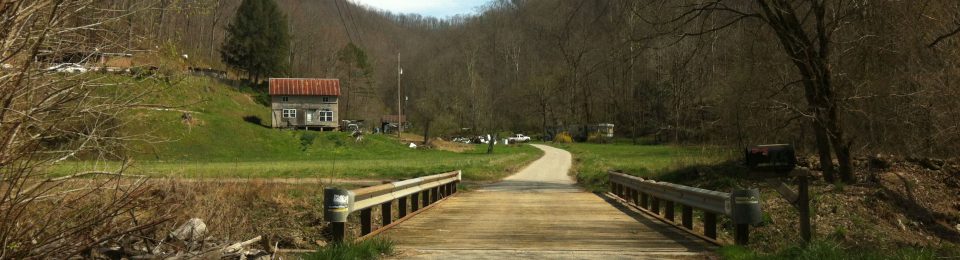
Along about 1937, we were working WCMI and Mother and I was talking one day and I asked her, I said, “Well Mother, do you know anything about Ed Haley or the Haley family or where they’re at? I haven’t heard from them in years.” And my mother told me, said, “Why, they live right up there at Ward Hollow.” I said, “Well, I didn’t know that.” See, what I used to do, I’d get lonesome to hear him. And I knew him and he knew my voice and he knew my mother and my father and all my brothers and sisters and I’d get lonesome to play with him. And I’d get a pint of “moon” — bought it from old Maude Johnson down there at 29th Street — and walk all the way to Ward Hollow. The front door was never locked. And when I’d open the door — I’d know where he was gonna be, in that rocking chair — I’d say, “Uncle Ed?” “Well Curly, come in.” And I’d go in — wouldn’t even carry a guitar or nothing — and I’d go in and I’d sit down. He’d go get the straight chair when he played, but he would be sitting in there. A little old fireplace. I’d say, “How are you, Uncle Ed?” “Well, I don’t feel so good today. I’m not as pure as I should be.” And I’d say, “Well, do you think maybe a little hooter…?” And he’d say, “Well, uh, yes.” Talked loud then. I’d say, “Well, I brought one along.” Moonshine. I’d go out and get it and come in and give it to him and he’d hit it.
We’d sit there and talk a little more — about this and that and the weather and so forth and so on — and I’d say, “You better getcha another little drink there, Ed. Maybe if you got a cold it’ll help you.” He’d hit it again and he’d sit there and all at once he’d say, “Say, did I ever play ‘Blackberry Blossom’ for ya?” And while he was saying this, he was getting up… He knew exactly where his fiddle was on the mantle, he knowed where the bow was on the mantle, and he never touched a thing that was on that mantle — just them two things. I never saw him finger for the fiddle: he always picked it up by the neck and got the bow with his right hand. And then he’d throw that fiddle under there — the chin was holding it — and he never even had a chin-rest — then he’d sit down and he’d say, “Well, you brought your old box along, didn’t ya?” I’d say, “Yeah, it’s out there in the car.” I think it was a D-18 Martin. Sixty-five bucks. Go get the guitar, come in, sit down, tune up with him. And that’s another thing about that man. I often wondered how he kept the fiddle at 440 tuning. I know he didn’t use a pitch pipe.
Curly said it was during that time that Ed met Bernice “Sweet Georgia” Brown, who he called “Brownie.” He elaborated: “Brownie’s father owned a business here, which was in the making of tombstones, right down on Winchester Avenue, and his mother was from Cartersville, Georgia. And he was a tremendous old-time… The old English fiddle tunes and a lot of that stuff — the hornpipes. He was just marvelous on them. He would’ve loved to have played jazz fiddle, but he didn’t have it. Because he was from Georgia, Big Foot said, ‘I’ll teach you how to play ‘Sweet Georgia Brown’, so from then on that was his name. We had him and Big Foot playing twin fiddles. During the time that he was here, I wanted him to hear Ed Haley. Neither one of us had a car at that time, but we were in walking distance of Ward Hollow, which was just up the road from me about eight, nine blocks. We’d walk up there and take a little hooter along and finally get him started. Well, Georgia wouldn’t pull a bow in front of Ed Haley, but he would watch him awful close. Every move — even the way he tuned the fiddle with his chin and his knee mostly. He was an amazing man.”
I asked Curly if Ed played “Sweet Georgia Brown” and he said, “Never. I don’t think he woulda even rosined his bow to play a thing like that.”
Thinking back about that time in his life caused Curly to talk about his personal memories of Ed.
“I had a lot of experiences with that old man. I loved the old man. Really loved him. He was a swell old man. He was a dear friend. So timid. He was easy to be around and knew a joke as quick as he heard it. He wasn’t boastful or pushy — just a very little timid man that would sit in the corner for hours. He let everything out with the fiddle. He turned everything loose that was inside and he done it with the instrument. I think his first love really was his music.”
I asked Curly if Ed got along with other fiddlers like Clayton McMichen and he said, “I don’t think he woulda even talked to him. When Clayton mouthed off like he did — and was all mouth — I just think Ed would have set back and not taken any part in anything. Brassy and forward — Clayton was awful bad for that. I didn’t care for Clayton McMichen myself other than I appreciated the group he had together, The Georgia Wildcats.”
 Brandon Ray Kirk