Tags
Ben France, Cabell County, civil war, Confederate Army, fiddler, fiddling, history, Long Branch, music, photos, West Virginia
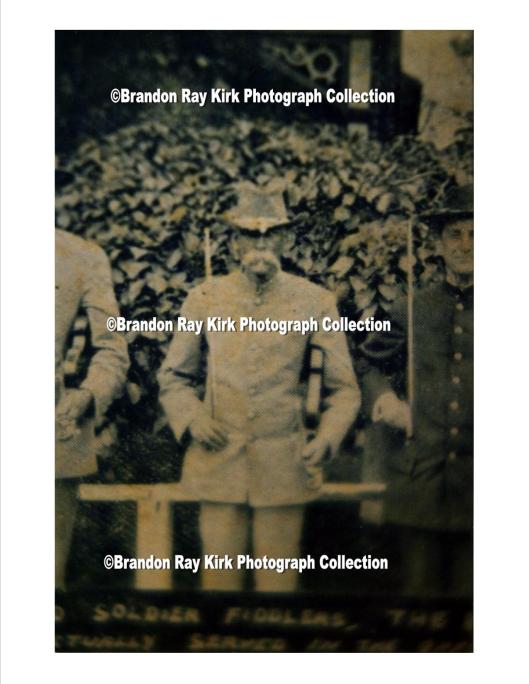
Ben France, a Confederate veteran and fiddler from Long Branch area of Cabell County, WV

11 Wednesday Jun 2014
Tags
Ben France, Cabell County, civil war, Confederate Army, fiddler, fiddling, history, Long Branch, music, photos, West Virginia
Ben France, a Confederate veteran and fiddler from Long Branch area of Cabell County, WV
11 Wednesday Jun 2014
Tags
Appalachia, Army of Tennessee, Battle of Gettysburg, Ben France, Ben Haley, Brandon Kirk, Cabell County, civil war, Confederate Army, Dave Bing, Ed Haley, fiddler, genealogy, Guyandotte Valley, Henry France Cemetery, history, John D. Rockefeller, John Hartford, Long Branch, Milt Haley, music, Old Soldier Fiddlers, Shenandoah Valley, Stonewall Jackson, Wayne County, West Virginia, writing
Around that same time, Brandon located a picture of Ben France in a newsletter called High Notes: Mountain Music from West Virginia (1996). France was the most famous fiddler in the Guyandotte Valley during the 1850s. He may have been acquainted with Ed’s grandfather, Ben Haley, or even influenced Milt or Ed.
“These are the ‘Old Soldier Fiddlers’ — two Union, two Confederate — who toured the country after the Civil War,” the caption read. “The second fiddler from the left is Ben France of Wayne County, a Confederate courier who was second on the scene after Stonewall Jackson was fatally wounded. France was the great-great-great-great-great-uncle of our own Bing Brothers. Thanks to Dave Bing for the use of the photograph.”
A little later, I called Dave Bing, a West Virginia fiddler pretty well known among the traditional festival circuit, to ask him about the picture.
“Uncle Ben was born in what is now Wayne County, West Virginia, in the 1840s,” he said. “He joined the Confederate Army at the age of seventeen and served as a carrier in the Shenandoah Valley campaign. He was in the area on a mission the night Stonewall Jackson was shot and was said to be the second man to come to his aid. During the Battle of Gettysburg, he was wounded and transferred to the Army of Tennessee where he served until the end of the war. Uncle Ben was known as a fine horseman.”
France became somewhat of a professional musician after the war.
“After the war, Uncle Ben and three other war veterans (all fiddlers) toured the country playing resorts and fine hotels,” Bing said. “The group was known as the ‘Blue and the Gray.’ Uncle Ben once played by invitation for John D. Rockefeller, Sr. at his hotel. He was an outstanding banjo player but was more famous for his fiddling. He was well-dressed and always had his fiddle — which he called ‘Sally.’ He never married but was the father of a daughter. He died in 1917. He was buried in Henry France Cemetery located off of Long Branch in Cabell County.”
07 Friday Mar 2014
Tags
Appalachia, Ben France, Cabell County, civil war, Confederate Army, fiddler, fiddling, Fred B. Lambert, genealogy, history, music, photos, West Virginia

Ben France, fiddler and Confederate veteran, Cabell County, West Virginia. From the Fred B. Lambert Papers at Special Collections Department, Morrow Library, Marshall University, Huntington, WV.
27 Friday Sep 2013
Posted in African American History, Ed Haley, Music
Tags
Annie Adkins, Anse Blake, Appalachia, Ben France, Bob Claypool, Bob Glenn, Burgess Stewart, Cain Adkins, Champ Adkins, Charley Robinson, Dave Glenn, Ed Haley, fiddling, Frank Jefferson, Fred B. Lambert, George Stephens, Gilbert Smith, Harkins Fry, Hezekiah Adkins, history, Isom Johnson, Jimmie Rodgers, Kish Adkins George Crockett, Leander Fry, Lish Adkins, Lucian W. Osbourne, music, Percival Drown, Spicie McCoy, Staunton Ross
In a separate interview, one Mr. Miller told Fred B. Lambert, “Leander Fry used to come down from Lincoln on timber to play the fiddle. He was a great fiddler. Jack McComas was an old fiddler, as was also his brother. Mose Thornburg said that a man who wouldn’t fight to the music made by the musicians of the musters had no fight in him. Wm. Collins was a fifer. John Reece was a tenor drummer, Clarke Thurston a base drummer. On muster days, whiskey, ginger ales, cider, &c were plentiful. Hogs were fattened on the way East. That wore the valley out. Dishes were plain. Cups instead of glass. They were cheaper. No washboards. Lye soap. Used a board to beat clothes with. Later, washboards were made of soft wood and sold for 5 cents each. Old fiddlers: George Stephens and Wiley, — Joplin, Guyandotte (?). In later days Morris Wentz and Ben France.”
Amaziah Ross told Lambert about some of the other fiddlers.
“Old Charley Robison came from Alabama. Brought ‘Birdie.’ He was a colored man and a good fiddler. Bob Glenn lived up Ohio River about Mason Co., played at Guyandotte when I was a boy. A first class fiddler. His bro. Dave Glenn also was a good one. Jimmie Rodgers lived at Guyandotte. He was a bro. to Bascom Rogers who kept saloon at Guyandotte — The Logan Saloon when I was a boy.”
Ross gave Lambert the names of many old fiddle tunes, which I of course noted being an avid fan and collector of such things:
Shelvin’ Rock played by Ben France
Natchez Under the Hill
Seven Mile Winder
Money Muss
Devil’s Dream
Mississippi Sawyer
Sixteen Days in Georgia
Little Sallie Waters
Marching Through Georgia
Whitefield, Georgia
Annie Adkins — By herself a fiddler when my father was a boy.
Ocean Wave
Over the Way
Grasshopper
Cabin Creek
Fisher’s Hornpipe
Sailor’s Hornpipe
Ladies’ Hornpipe
Gerang Hornpipe
Forked Deer
Third Day of July
Butterfly
Birdie
Lop Eared Mule
Billy in the Lowground
Wild Horse
Old Bill Keenan
Round Town Girls
SourwoodMountain
Old Joe Clark
Greasy String
Cross Keys
Bet My Money on Bobtail Horse
Blue Ridge Mountain Home
Someone told Lambert about the dances held after corn-shuckings.
“After a few weeks, it was ready to shuck. It was an opportunity for young and old to gather and spend a day at work in the name of play. Of course, the women and girls prepared the noon meal and sometimes even the supper. When night came on, the labors of the day were followed by a dance, which of all pioneer amusements was king. Shooting matches with rifles, wrestling matches, foot races, fist fights between neighborhood bullies, or to settle old scores. It was not uncommon for contestants to engage in ‘gouging’, as a natural sequence of a first fight. Weapons were banned, but many a man lost an eye by having it gouged out.”
Another person said, “Dances were very common at weddings, and on many other occasions.” Some of the tunes played were:
The Devil’s Dream
Old Zip Cook
Billie in the Low Ground
Virginia Reel
“I had a Dog And His Name was Rover,
When he Had Fleas, He had ‘Em All Over”
Irish Washerwoman
Mississippi Sawyer
Myron Drumond gave these tunes to Lambert: “Sugar in the Gourd”, “Chicken Reel”, “Fisher’s Hornpipe”, “Cincinnati Hornpipe” (the latter two tunes for “Jig dancing”) and “Irish Washerwoman”.
These tunes and fiddlers came from “a Barboursville man:”
Tunes
Turkey In the Straw
Sourwood Mountain
“Hage ’em Along.”
The Lost Indian
Pharoah’s Dream
Hell up the Coal Hollow
The Devil’s Dream
Shady Grove
Arkansas Traveler
Little Bunch o’ Blues
New River Train
I Love Some Body
Hard Up
Fiddlers
Morris Wentz
Ben France
Percival Drown
Bob Claypool—Lincoln Co.
Staunton Ross—near Salt Rock
Burgess (“Coon”) Stewart — Lincoln Co. Buffalo Cr. Extra Good
Frank Jefferson — Nine Mile
Anse Blake — Nine Mile
A lot of Lambert’s research, particularly in regard to old-time music trailed off around the time of the War Between the States. He only mentioned Ed Haley twice — once in relation to Milt Haley and once in a list with Ben France, Blind Lish Adkins, Hezekiah Adkins of Wayne County, “Fiddler Cain” Adkins (a son of Jake Adkins), Gilbert Smith and Isom Johnson. His last letter on fiddling was from an uninterested Lucian W. Osbourne of East Lynn, Wayne County, who wrote in March of 1951: “Complying with your request, I send the names of a few old fiddlers, as follows: Champ Adkins, Kish Adkins, Ben Frances, George Crockett. All dead. For information about others write Mrs. Spicy Fry, Stiltner, and Harkins Fry, Kenova. Here are some of the old tunes: ‘Sourwood Mountain,’ ‘The Lone Prairie,’ ‘Little Old Log Cabin in the Lane,’ ‘Nelly Gray,’ &c. I know but little about the fiddling, as I am a Sunday School man, and interested in better things. I think it is better to say after one when he is dead that he is a Christian than to say he was a fiddler or baseball fan.”
23 Monday Sep 2013
Posted in African American History, Civil War, Ed Haley, Music
Tags
Babe McCallister, banjo, Ben France, Billy Walker, Charley Dodd, civil war, fiddling, Henry France, Henry Peyton, history, J.T. "Pomp" Wentz, Jack McComas, Lincoln County, Morris Wentz, West Virginia, William S. Rogers
By the time of the Civil War, Benjamin France of Cabell County was the chief fiddler in the lower Guyandotte Valley. One person interviewed by Fred B. Lambert referred to him as “the best of all” in a list of fiddlers that included even Ed Haley. Of course, I was immediately interested in him.
According to Lambert’s notes, France was born in 1844. He “learned on a gourd fiddle, and was able to play when he entered the army. He served as a Rebel soldier, throughout the Civil War, entering the army, at the age of 17 years. He was noted as one of the best fiddlers of his time. He won two or three times, in contests, but his medals do not show when, nor whether they were first rank. Henry France, his nephew, says he could play all the old fiddle tunes, and could play all night without repeating the same tunes even once.”
France was a resident of Long Branch, near the Lincoln County line and died in 1918.
“From Cabell County, the principal fiddlers were Morris Wentz, Ben France, William S. Rogers and Charley Dodd,” according to J.T. “Pomp” Wentz, a riverboat captain who spoke with Lambert. “Banjoes were not used so much, in those days, but later Rev. Billy Walker and others used to play them very well. As a fiddler, Ben France played with the most ease of any man I ever saw. Morris Wentz played with some difficulty compared with Mr. France, but he could play almost anything. Morris Wentz used to play: ‘The Cold Frosty Morning’, ‘Going Back to Dixie’, ‘The Arkansas Traveler’, ‘Bonaparte’s Retreat’ (this pleased Billy Bramblett, the Frenchman), ‘Ducks in the Pond’, ‘The Puncheon Floor’, ‘Hop Light Ladies’, ‘The Boatsman’, ‘The Cackling Hen’, ‘Sourwood Mountain’, ‘Soldiers Joy’, ‘Little Birdie’, ‘Old Dan Tucker’, ‘Granny Will Your Dog Bite?’, ‘Liza Jane’, ‘The Shelvin’ Rock’, ‘Knock Kneed Nannie’, ‘Chippy, Get Your Hair Cut’, ‘The Rebel Raid’, ‘Turkey in the Straw’, ‘Sugar In the Gourd’, ‘Ginny, the Gal With the Blue Dress On’, ‘Old Joe Clark’, ‘Birdie’, ‘Old Napper’, ‘The Forked Duck’. After dancing the ‘set’ down, they would close with the ‘winder’.”
Apparently, the popular tunes of the day were “Forked Deer” and “The Peach Tree”.
“Babe McCallister, ‘a darkey’ owned by a farmer named McCallister from upper Mud River, was a master of ‘Forked Deer’,” one fiddler raved. “He ‘played the fiddle with the ‘free arm movement,’ the wrist joint only working, the elbow joint still, while the wrist joint was in active movement. To hear the coon on ‘Forked Deer’, his favorite tune, and call the cotillion figure was a great treat. Could I have inherited such talent with my fondness of and for the violin, it would have been dead easy that I should tour the universe and earn a million playing only ‘Forked Deer’ and ‘Peach Tree’.”
Further up the Guyandotte River from the Cabell County towns, in present-day Lincoln County, were fiddlers of lesser note.
“Some of the best fiddlers I ever knew in Lincoln County, were Henry Peyton, father of ‘Blind’ Bill Peyton, and Jack McComas, both of whom played before the Civil War,” said Pomp Wentz.
Writings from my travels and experiences. High and fine literature is wine, and mine is only water; but everybody likes water. Mark Twain
This site is dedicated to the collection, preservation, and promotion of history and culture in Appalachia.
Genealogy and History in North Carolina and Beyond
A site about one of the most beautiful, interesting, tallented, outrageous and colorful personalities of the 20th Century
 Brandon Ray Kirk