• About

Brandon Ray Kirk

~ This site is dedicated to the collection, preservation, and promotion of history and culture in my section of Appalachia.

Brandon Ray Kirk

Tag Archives: African-Americans

African-American Schools in Logan County, WV (1927)

21 Tuesday Aug 2018

Posted by Brandon Ray Kirk in African American History, Huntington

≈ Leave a comment

Tags

A.A. Wright, A.D. Robinson, A.V. McRae, African-Americans, Albert Meade, Anna B. Harris, Anna C. Hunter, Anna Spencer, Appalachia, Aracoma, Ardrossan, Audra Wilson, B.H. Hall, board of education, Bruce Hull, Clara Lee Johnson, Clara Richardson, Clothier, Coal River, Copperas, Cora, Crystal Block, D.E. Hopkins, Daisy Sheffery, Daniel H. Wood, Dehue, Doratha Withers, education, Elaine Ferguson, Elizabeth Creasy, Elizabeth Notter, Elma Phipps, Esta Shriver, Ethel, Ethel M. Page, F.O. Woerner, Flossie Hatfield, Flossie M. Jones, Garlands Fork, Georgia L. Miller, Gertrude Huntsman, Grace V. Reynolds, Harold Starcher, Hatfield, Helen E. Jones, history, Holden, Huntington, I.G. Hollandsworth, Imogene Baker, Ione Hall Cook, Island Creek, J.C. Evans, Jane Walker, John Pelter, Joseph D. Cary, Josephine Vaughan, Laura Griere, Laura J. Bayes, Laurel Hill, Lillian Samors, Logan County, Logan District, Logan High School, Logan Junior High School, Louis Simmons, M. Amelia Brooks, Macbeth, Mary Smith, Matilda Wade, Micco, Omar, Page Hamilton, Peach Creek, Preston A. Cave, Rossmore, Sharples, Slagle, Stirratt, teacher, Theodora Bradford, Thomas Jordan, Virginia Spratt, W.H. Houston, W.H. Huston, West Virginia, Yolyn

New Colored School at Crystal Block LB 08.12.1927 1

Logan (WV) Banner, 12 August 1927.

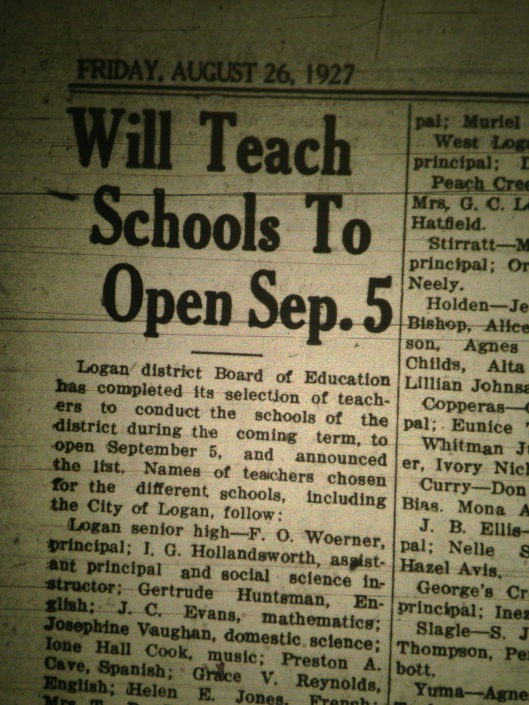
Logan District Colored Schools LB 08.26.1927 1

Logan (WV) Banner, 26 August 1927. This photo is meant to show the headline of the story; teachers named here are “white.”

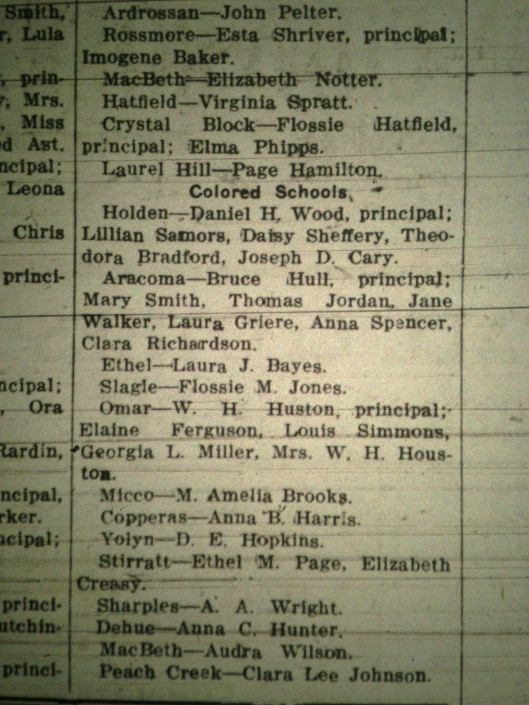
Logan District Colored Schools LB 08.26.1927 2

Logan (WV) Banner, 26 August 1927. The list of “colored” teachers begin here and continue in the photos below.

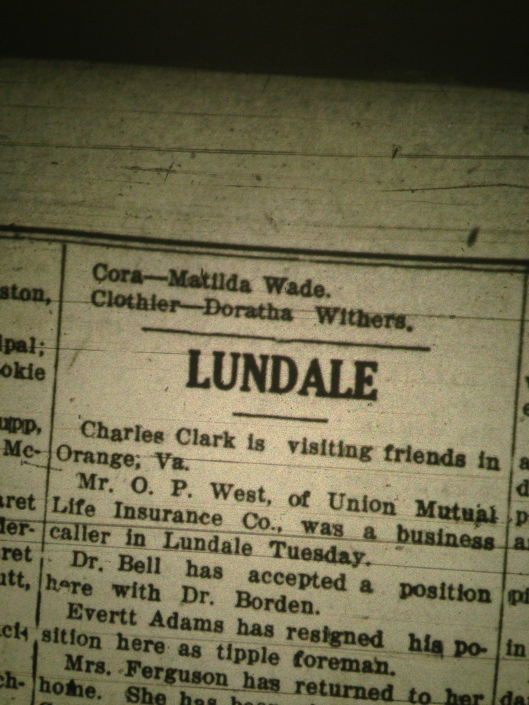
Logan District Colored Schools LB 08.26.1927 3

Logan (WV) Banner, 26 August 1927.

History of the West Virginia Penitentiary (1901), Part 1

31 Tuesday Jul 2018

Posted by Brandon Ray Kirk in African American History, Civil War, Culture of Honor, Timber

≈ Leave a comment

Tags

African-Americans, Alabama, Appalachia, Arthur I. Boreman, civil war, history, J.W. McWhorter, Moundsville, North Carolina, Ohio River, Potomac River, South Carolina, Virginia, West Virginia, West Virginia State Penitentiary

HISTORY OF THE WEST VIRGINIA PENITENTIARY.

WRITTEN BY A PRISONER.

In 1863 the state was admitted as one of the constellation of states of the union. Virginia had seceded from the union by a majority vote. The strong and indomitable minority citizens of the Old Dominion residing in the western part of it, many of whom were Scotch and Irish descendants and natives of the adjoining states, who had taken up their homes in the valleys and on the hillsides, were loyal to the Union, loved well the flag, and reverenced with an undying affection the builders of the union of states for the greater blessing of the people, and stood firm and unyielding for an indivisible united country. By their hands and brave hearts they built a state stretching from the Potomac to the Ohio river, carved out of the Old Dominion. The war-born daughter of the historical commonwealth proved, in subsequent years, to be rich in the production of materials in active demand in the marts of commerce, and she now outstrips her mother state in the race for greatness, prosperity, and happiness.

Many regions of the state are mountainous, and the principal industries are lumbering, mining, and oil production. Many of the white people are typical mountaineers and somewhat rough and uncouth in manner, while the negroes, many of them, have drifted from North and South Carolina, Alabama, and other southern states to be employed in the development of these industries.

There are very many respectable farmers, professional and business men, and cultured ladies residing in these almost inaccessible parts; but the rough element in many places predominates, and the order of the day and night is drinking and brawling, ending as a rule in desperate encounters and murder. Most of the white and black inmates of the penitentiary have been and are now composed of the lawless men from these regions, from the time it was only a stockade of ten acres in 1866, when Hon. J.W. McWhorter of the Tenth Judicial District was appointed warden by Governor Boreman. He resigned this position after viewing it. In a letter to Warden Hawk he states it was for the reason that there was not so much as a building erected for the shelter of the inmates, and he thought he could not work the convicts to advantage under the circumstances. The penitentiary has been improved from time to time to the present, by additions, until it is a massive structure of stone and iron, with a high stone surrounding wall. It has 695 inmates at the present writing.

The center, or main building, is built after the old baronial castellated style of architecture, and with its several stories height, it makes an imposing appearance. It is flanked on the north and south by the stone and strongly-barred buildings, wherein the old and first built stone cells and the modern steel ones–900 in all–are placed. Entrance is to be had into the prison proper by means of a round turning iron-barred cage in the main hallway of the central building.

Source: E.E. Byrum, Behind the Prison Bars: A Reminder of Our Duties Toward Those Who Have Been So Unfortunate as to Be Cast Into Prison (Moundsville, WV: Gospel Trumpet Publishing Co., 1901), pp. 73-75.

John R. Browning Debt to James A. Nighbert (1860)

07 Thursday Jun 2018

Posted by Brandon Ray Kirk in African American History, Logan

≈ Leave a comment

Tags

African-Americans, Appalachia, genealogy, history, James A. Nighbert, John R. Browning, Logan County, slavery, Virginia, West Virginia

IMG_1355

John R. Browning Check to James A. Nighbert, Logan County, (W)VA, 1860.

IMG_1356.JPG

John R. Browning Promissory Note to James A. Nighbert, Logan County, (W)VA, 1860-1861. Note reference to “Negro boy” named Simon.

For more information about John R. Browning, follow this link: https://www.familysearch.org/ark:/61903/3:1:33S7-9BSZ-9N3H?i=46&cc=1473181

Dils Cemetery in Pikeville, KY (2018)

29 Sunday Apr 2018

Posted by Brandon Ray Kirk in African American History, Cemeteries, Civil War, Hatfield-McCoy Feud, Pikeville

≈ Leave a comment

Tags

39th Kentucky Infantry, African-Americans, Ann Dils, Appalachia, Basil Hatfield, cemeteries, civil war, Dils Cemetery, genealogy, Hatfield-McCoy Feud, history, John Dils Jr., Kentucky, Martha Hatfield, Martha McCoy, National Register off Historic Places, photos, Pike County, Pikeville, Randolph McCoy, Roseanna McCoy, Sam McCoy, Sarah McCoy, slavery, Union Army

IMG_9093

The Dils Cemetery Sign, Pikeville, KY. 27 April 2018.

IMG_9170

McCoy Family wreath, Dils Cemetery, Pikeville, KY. 27 April 2018.

IMG_9095

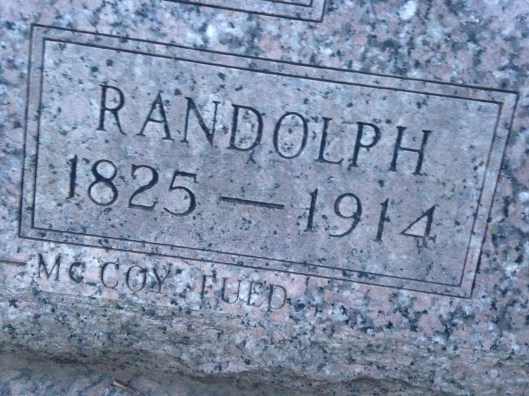
Randolph and Sarah McCoy graves, Dils Cemetery, Pikeville, KY. 27 April 2018.

IMG_9096

Randolph McCoy grave, Dils Cemetery, Pikeville, KY. 27 April 2018.

IMG_9171

Roseanna McCoy grave, Dils Cemetery, Pikeville, KY. 27 April 2018.

IMG_9172

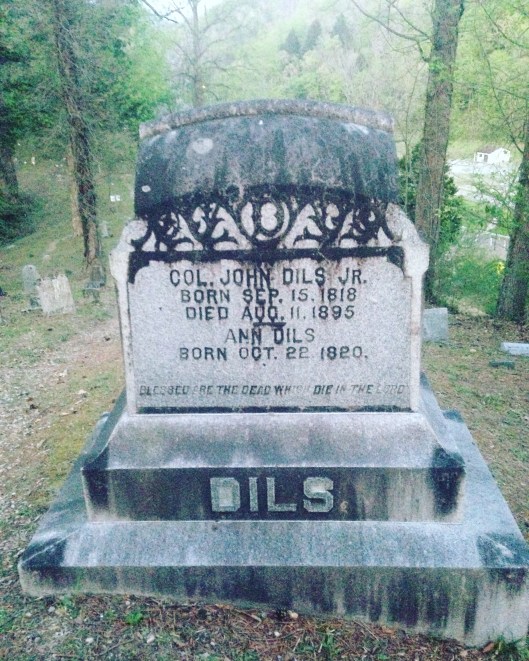
Col. John Dils grave, Dils Cemetery, Pikeville, KY. 27 April 2018.

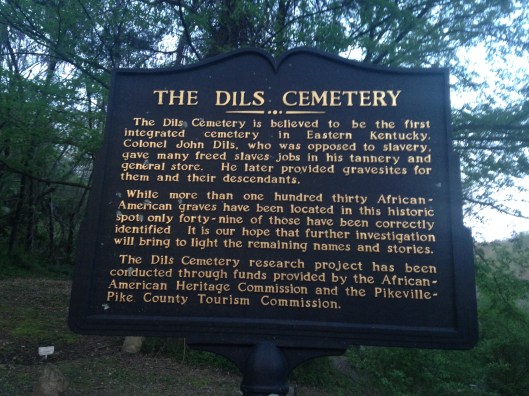
IMG_9110

History Marker, Dils Cemetery, Pikeville, KY. 27 April 2018.

IMG_9174

Dils Cemetery, Pikeville, KY. 27 April 2018.

IMG_9101

Basil Hatfield grave sign, Dils Cemetery, Pikeville, KY. 27 April 2018.

IMG_9100

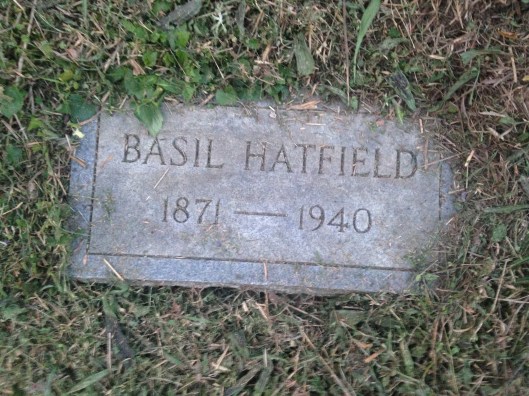
Basil Hatfield grave, Dils Cemetery, Pikeville, KY. 27 April 2018.

IMG_9113

Sam and Martha McCoy grave, Dils Cemetery, Pikeville, KY. 27 April 2018.

World War I Casualties for Logan County, WV (1927)

25 Wednesday Apr 2018

Posted by Brandon Ray Kirk in African American History, Cemeteries, Logan, World War I

≈ Leave a comment

Tags

16th Infantry, 4th Infantry, African-Americans, Albert Adams, Albert Jeffrey, Alfred Prichard, Allen Bryant, Allen Tabor, American Legion, Appalachia, Argonne Woods, Arle J. Price, Armistice Day, Bee Stewart, Ben H. Gosney, Ben Maynard, Bert Rayborn, Bill Manville, Bird Dingess, Burnie G. Sanson, Burton W. Gore, Calvin Coolidge, Carl Ellis, Charles Brewster, Charles Burton Litten, Charlie M. Munsey, Charlie Warcovies, Clarence Bartram, Clarence Smith, Clarence W. Parkins, Clifton Manns, Clyde Jeffrey, Coal Branch, Crooked Creek Cemetery, Dan Craft, David Hensley, Dennie Robertson, Denver Mullins, Doc Workman, Earl Hager, East End, Edward Gunther, Elbert Billups, Elbert Carter, Elisha Ball, Ella Craddock, Elmer Cook, Everett Blankenship, Finne Walter Pugh, Floyd Chambers, Floyd Johnson, Floyd W. Clay, France, Frank Bell, Frank C. Reynolds, Frank C. Wilcoxen, Frank Ferrell, Frank J. Bell, Frank Ward, Fred E. Hahne, genealogy, George E. Covey, George F. Breeden, George Luty, George Meadows, Greenway Christian, Guy T. Conley, Harold Thompson, Haskell Phillips, Henan Jarrell, Henry H. Runyon, Herbert L. McKinney, Hill Brewster, Hirse C. Brown, history, Hoboken, Homer Hobbs, Homer Vance, James Chapin, James E. Peters, James G. Cyrus, James Jackson, James L. Robinson, James Linford Brown, James M. Ellis, Jasper Wooten, Jennings Robinson, Jim F. Crawford, Joe Hardy, John A. Shepherd, John B. McNeely, John B. Wilkinson, John H. Crittenden, John H. Harris, John L. Blankenship, John L. Ward, John Martin, John Roberts, John Smith, Johnie Johnson, Joseph White, Keefer Jennings Whitman, Lawrence Marcuzzi, Lee Cox, Lee Shelton, Levi J. Vance, Logan, Logan Banner, Logan County, Lovel H. Aldredge, Luther Lacy, Mack Smith, Meddie Graley, Mike Tarka, Ned Johnson, Newton Cook, Nick Malozzo, Noble J. Lax, Orvil Grubb, Oscar Dial, Otto Sanders, Patsy Vance, Peter White, Rector H. Elkins, Robert L. Gore, Roy Lowe, Roy Simms, Sam McNeely, Shellie Moxley, Sidney Ferrell, Spencer Mullins, Stonewall Hensley, Thomas J. Cox, Thomas P. Justice, Thomas R. Newman, Thomas Weir, Thomas Y. Davis, Tom Boring, Tom Williams, Tony Curia, Tony Ladas, Ulysses B. Vance, Walter S. Blake, West Virginia, Will Wilson, Willard Ball, William D. Maynard, William E. Hanshaw, William F. Munsey, William H. Adkins, William Harris, William O. Bailey, William R. Nowlan, Willie Allen, Willie F. Smith, World War I, Zatto Adkins

From the Logan Banner of Logan, WV, comes this story titled “Logan County Boys Killed or Wounded,” dated November 8, 1927:

Logan County Boys Killed or Wounded

Prayers in behalf of peace are suggested for Armistice Day by President Coolidge. It will likewise be proper to recall the names of those who sacrificed most in the cause of peace, who died or were wounded in the dreary days before the signing of the Armistice ended the most colossal conflict of all history. Twenty young men from Logan county were killed in action. Half that number died of wounds. Their names and the names of others who died in the service of their country a decade ago are reproduced from the official records:

Killed in Action

Willard Ball

Clarence Bartram

Floyd W. Clay

Newton Cook

Tony Curia

Oscar Dial

Edward Gunther

David Hensley

Roy Lowe

John B. McNeely

John Martin

William F. Munsey

James L. Robinson

Roy Simms

Willie F. Smith

Bee Stewart

Mike Tarka

Ulysses B. Vance

Peter White

Keefer Jennings Whitman

Died of Wounds

John L. Blankenship

Elmer Cook

Homer Hobbs

Noble J. Lax

Lawrence Marcuzzi

Denver Mullins

William R. Nowlan

Haskell Phillips

Henry H. Runyan

Harold Thompson

Died of Disease (A.E.F.)

Thomas J. Cox

Fred E. Hahne

Joe Hardy (colored)

Clyde Jeffrey

Johnie Johnson (colored)

Allen Tabor

Homer Vance

Levi J. Vance

Died of Disease in U.S.

William O. Bailey

Elbert Billups

James Linford Brown

Elbert Carter

Wounded in Action

Albert Adams

Zatto Adkins

William H. Adkins

Lovel H. Aldredge

Willie Allen

Frank Bell

Elisha Ball

Frank J. Bell

Walter S. Blake

Everett Blankenship

Tom Boring

George F.  Breeden

Hill Brewster

Charles Brewster

Hirse C. Brown

Allen Bryant

Floyd Chambers

James Chapin

Greenway Christian

Guy T. Conley

George E. Covey

Ella Craddock

Dan Craft (colored)

Jim F. Crawford

John H. Crittenden

James G. Cyrus

Thomas Y. Davis

Bird Dingess

Rector H. Elkins

James M. Ellis

Carl Ellis

Frank Ferrell

Sidney Ferrell

Robert L. Gore

Burton W. Gore

Ben H. Gosney

Meddie Graley

Orvil Grubb

Earl Hager

William E. Hanshaw

John H. Harris

William Harris (colored)

Stonewall Hensley

James Jackson (colored)

Albert Jeffrey

Henan Jarrell

Ned Johnson

Floyd Johnson

Thomas P. Justice

Luther Lacy

Tony Ladas

Charles Burton Litten

George Luty

Herbert L. McKinney

Nick Malozzo

Clifton Manns

Bill Manville

Ben Maynard

William D. Maynard

George Meadows

Shellie Moxley

Charlie M. Munsey

Spencer Mullins

Thomas R. Newman

Clarence W. Parkins

James E. Peters

Arle J. Price

Alfred Prichard

Finne Walter Pugh

Bert Rayborn

Frank C. Reynolds

John Roberts

Dennie Robertson

Jennings Robinson

Otto Sanders

Burnie G. Sanson

Lee Shelton

John A. Shepherd

Clarence Smith

John Smith (colored)

Mack Smith

Patsy Vance

Frank Ward (colored)

John L. Ward

Charlie Warcovies

Thomas Weir

Joseph White

John B. Wilkinson

Frank C. Wilcoxen

Tom Williams

Will Wilson (colored)

Jasper Wooten

Wilson Workman

It seems likely there are errors of spelling in the foregoing list, and perhaps some names have been omitted from the roster from which this list was copied. Desiring a complete and perfect list The Banner will appreciate having its attention called to any omissions or misspellings.

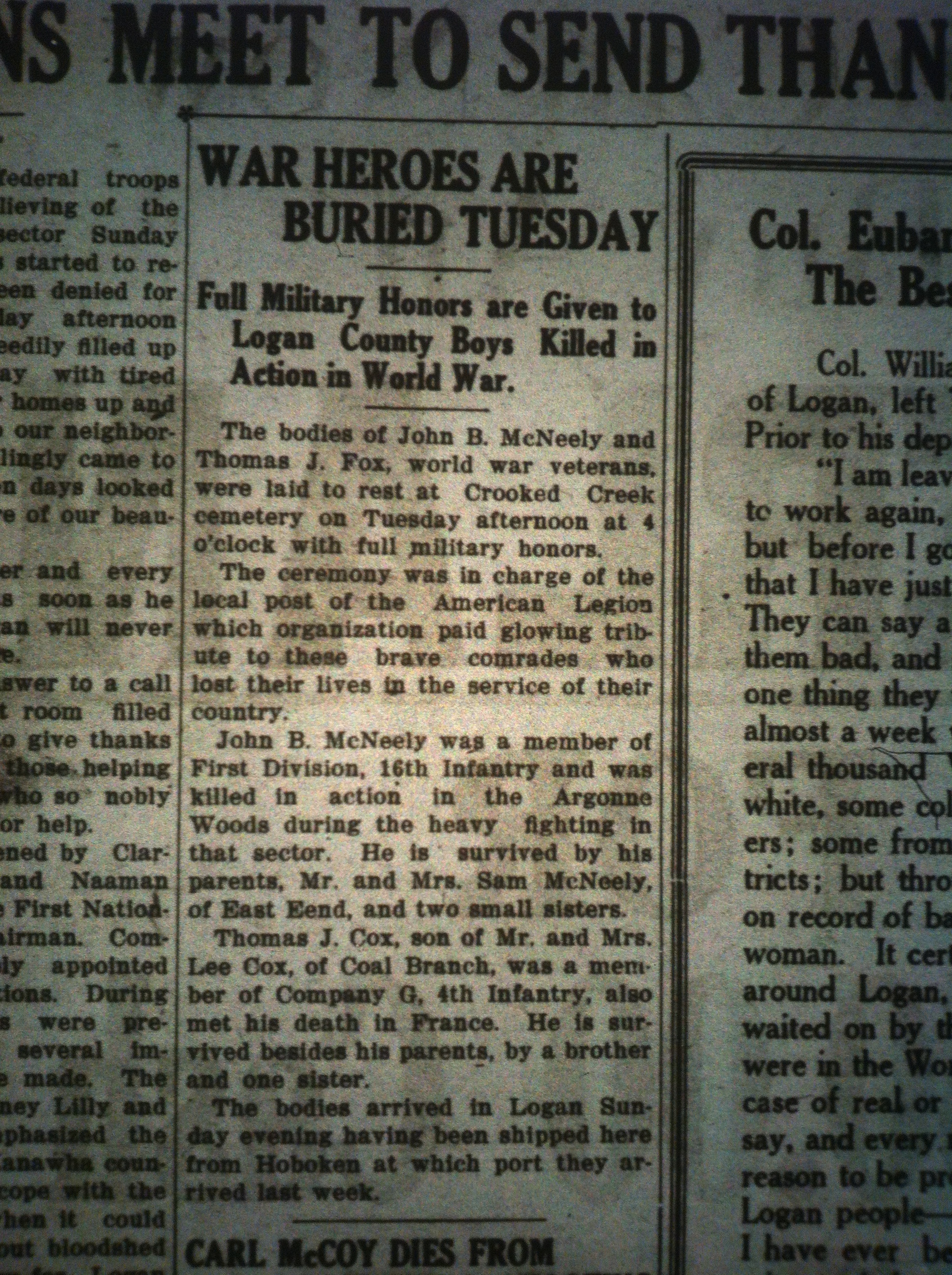
War Heroes are Buried LB 09.09.1921.JPG

Logan (WV) Banner, 9 September 1921.

Aracoma High School in Logan, WV (1927)

11 Sunday Mar 2018

Posted by Brandon Ray Kirk in African American History, Logan

≈ Leave a comment

Tags

African-Americans, Appalachia, Aracoma High School, Bruce H. Hull, education, history, Logan, Logan Banner, Logan County, Logan High School, North Central Association of Secondary Schools, teachers, West Virginia

From the Logan Banner of Logan, WV, comes this interesting item about Aracoma High School dated September 2, 1927:

ARACOMA HIGH OPENS SEPT. 5th

Principal Hull Announces Some New Features Since Last Term, Adding To the Facilities

Plans are about completed for the opening of the Aracoma high school for the coming year. The principal, Mr. Bruce H. Hull, states that an annex will be fitted up for use this year giving an additional room for high school purposes. This annex will be equipped as a science laboratory. Equipment, including special furniture, has already been ordered for this department and is expected to be in place for the beginning of the year. The additional room and added facilities thus provided should enable the high school to be classified as second class.

Mr. Hull further stated that the board of education will furnish transportation to all students living in the district who wish to attend the high school up to and including the eleventh grade. Parents are urged by him to have their boys and girls enter school on the first day for purpose of classification.

The faculty for the school will be composed of five members holding baccalaureate degrees from standard and approved colleges and two members who are graduates of the standard normal course. It will be recalled that when Mr. Hull came to Logan two years ago there was no accredited senior high school for Negroes, but now plans have been completed for a new building which the board expects to complete before the end of the present term. The completion of this unit in the system of education together with the entrance of the Logan high school into the North Central Association of Secondary Schools will be tangible evidence of the progress of Logan county in the field of education.

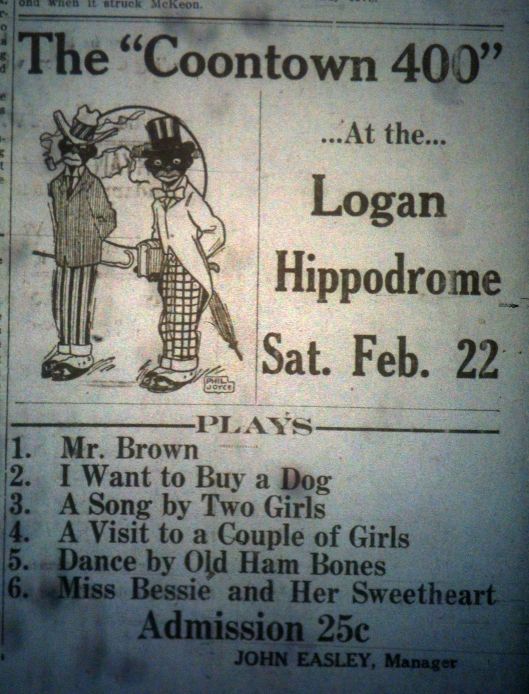
Coontown 400 Advertisements (1913)

06 Tuesday Feb 2018

Posted by Brandon Ray Kirk in African American History, Logan

≈ Leave a comment

Tags

A Song by Two Girls, A Visit to a Couple of Girls, African-Americans, Appalachia, Coontown 400, Dance by Old Ham Bones, history, Holden, Holden Opera House, I Want to Buy a Dog, John Easley, Logan County, Logan Hippodrome, Miss Bessie and Her Sweetheart, Mr. Brown, West Virginia

Coontown 400 Advertisement LB 01.31.1913

Logan (WV) Banner, 31 January 1913.

Coontown 400 LB 02.21.1913

Logan (WV) Banner, 21 February 1913.

Aracoma High School in Logan, WV (1927)

14 Sunday Jan 2018

Posted by Brandon Ray Kirk in African American History, Battle of Blair Mountain, Logan

≈ Leave a comment

Tags

African-Americans, Appalachia, Appalachian Power Company, Aracoma High School, Battle of Blair Mountain, board of education, Buskirk & Kayser, Coal Branch, Coal River, E.F. Scaggs, education, Elaine Ferguson, Georgia Miller, history, Island Creek Bridge, J.F. May, J.W. Beckett, K.F. Deskins, L.E. Farnsworth, Logan, Logan Banner, Logan County, Logan High School, Lois Simmons, Omar Colored School, Opperman, R.H. May, W.H. Houston, West Virginia, White & Browning Building

In 1927, the Logan County Board of Education discussed construction of a new high school building for the county’s black pupils. At this time, Republicans held many county offices by narrow majorities.

aracoma high school

Board of Education Favorable to Providing New Building for Colored Pupils.

NEEDS OF BLAIR POINTED OUT

Colored Teachers Hired For Omar

–Board Meets Again Friday–

Other Matters.

That negotiations for the purchase of a site for a centralized colored high school for Logan district have been under way was disclosed at the regular monthly meeting of the Logan district board of education last Saturday. At an adjourned meeting to be held Friday of this week a further step toward this end may be taken.

The site under consideration is a two-acre tract fronting on the north shore of Island creek in Coal Branch. It lies between Coal Branch (stream) and the Island Creek bridge and roadway, and to which the only access at this time is through the alley along side and back of Buskirk & Kayser’s store. The upper half of it is now a weed patch; the other half is under cultivation.

This tract belongs to K.F. Deskins and has been priced to the board at $21,000. The ground is low and often overflows, but the board has been advised that the Appalachian Power Company will fill it with its own refuse up to the level of the road at no cost to the purchaser. Thus it would be made virtually flood proof.

Saturday’s meeting was attended by all three members, President J.F. May, Dr. L.E. Farnsworth and J.W. Beckett. Though convinced the price is high, Dr. May and Dr. Farnsworth said, everything considered, they believed the tract to be the most suitable for the purpose that could be found; and they further made it clear that in their opinion a new high school for the colored pupils is imperative and should be made available just as soon as possible. While admitting there are many things that should and must be done, they doubt whether any other contemplated improvement is more urgent than this.

The Aracoma high school building, a rickety, wholly unsuitable two-story frame, is characterized as a fire-box that must be abandoned. This property would be sold, if the other is bought, it is said, but the proceeds of the sale would doubtless be negligible compared to the price of the Dingess tract.

Central Location

The Dingess tract is believed to be ideally located with reference to the colored population of the district. Besides, it is easily accessible from various directions and is ample in dimensions; and if necessary, one or more lots could be sold, though nothing of that sort is now contemplated.

Just how this proposed purchase and the proposed new wing for the Logan high school are to be financed was not explained at Saturday’s meeting. But there were many other matters demanding attention.

Conditions of school buildings and equipment at Blair and other Coal River points were discussed at length and definite action will be taken soon, it was promised. The two Richardson brothers, coal operators at Opperman, took a hand in these discussions and urged a program of improvements. Blasting done by road contractors nearly wrecked the Blair school building a good while ago.

The following teachers were hired for the Omar colored school: W.H. Houston, principal; Mrs. Georgia Miller,  Mrs. Lois Simmons, Mrs. Elaine Ferguson, Mrs. W.H. Houston. The last three are new ones.

Prof. Houston was given a contract to paint some parts of the building for 10 cents a yard, the board to furnish the paint. He was told he could not make wages at that price but said he did not care about that, adding that he wanted the work done and would do it right or would not expect to receive even the low contract price for his work.

Many bills, many of them small and incurred by the old regime, were ordered paid. Among these was one for $40 for two months rent for an office in the White & Browning building for E.F. Scaggs. That contract was declared canceled.

R.H. May was appointed janitor of the Logan high school building, effective August 1.

Source: Logan (WV) Banner, 26 July 1927.

Republicans Driven from Logan County by Gunmen (1914)

01 Friday Dec 2017

Posted by Brandon Ray Kirk in African American History, Logan

≈ Leave a comment

Tags

African-Americans, Appalachia, coal, Con Chafin, crime, Democratic Party, deputy sheriff, Don Chafin, E.T. England, guitar, Guyandotte River, Herald-Dispatch, history, Huntington, Ira P. Hager, John B. Wilkinson, Ku Klux Klan, lawyers, Logan, Logan Banner, Logan County, mine guards, O.J. Deegan, politics, prosecuting attorney, Republican Party, sheriff, timbering, W.C. Lawrence Jr., West Virginia

From the Herald-Dispatch of Huntington, WV, comes this story printed by the Logan Banner of Logan, WV, dated October 30, 1914:

Republican Voters Driven from Co. by Gunmen

Deputy Sheriffs, Acting as Mine Guards, Are the Law and Enforcement Thereof.

Many Believe Martial Law Will be Sequel to Rule of Thugs.

Democratic schemes for the intimidation of Republican voters, for the prevention of a Republican victory in the state next Tuesday, whether by fair means or foul, have reached their climax in Logan county. If there is a place in West Virginia where lawlessness has succeeded law and order, where the persons chosen to enforce the law have initiated a system of rule by force and intimidation, a rule by force of clubs and pistols, a rule by thugs and gunmen, that place is Logan county.

A thorough investigation of conditions in Logan county today proves that the Ku Klux Klan in the south were mere pikers. There are men in Logan county who could beat them blindfolded.

The man, woman or child who would enjoy life–aye, who are willing to accept life or pass through Logan county, must be careful not to cross the paths of Sheriff Don Chafin and his force of about two hundred armed deputies.

And it can be truthfully said that the paths of these men extend to every nook and corner of the county. And several newly-made graves along the banks of the Guyandotte river and its tributaries shows who is the law and the enforcement thereof.

Several men have been shot, two negroes fatally, others have been clubbed and driven out of the county, women and children have been forced to flee clad only in their night-clothes, upon order of the Chafin deputies.

And all this because some Republicans desired to be registered in order that they might cast their votes for the Republican candidates next Tuesday.

Logan county is about to throw off the yoke of Democracy. The coal and lumber industries are rapidly being developed, and, as is always the case in progressive communities, the Republicans are making large gains.

If the voters of Logan county are allowed to cast their ballots as they desire, and those ballots are counted as cast, the Republican candidates will be elected.

If the conspiracy which has been formed by and in the interest of the Democrats is allowed to be carried out, the Democrats will continue in control of the county, the enforcement of law will be a mere joke and there will be probably a score added to the newly made graves along Old Guyan after next Tuesday.

Opinions vary as to what the outcome will be. Some believe that only martial law will prove a solution. Others are of the opinion that conditions will grow gradually worse and that the enforcement of law and order in Logan county will be a subject for investigation by the next legislature which convenes in January. Most certainly, if the threats of the Democrats are carried out, the Republicans are driven from the polls next Tuesday, the legislature will be asked to make a sweeping investigation and their findings will reveal conditions incredible in a civilized state.

Don Chafin is high sheriff of Logan county. His cousin, Con Chafin is prosecuting attorney. All the county officials are Democrats. Circuit Judge Wilkinson is a Democrat, though a man who wants the law enforced.

Sheriff Chafin, it is estimated, has about two hundred deputies. When he was elected, a part of his platform was that he would drive out the Baldwin mine guards from Logan county. No Baldwin men are known to be in this county now but these deputy sheriffs are known as mine guards. All of them are supposed to be armed with pistols, black-jacks and the usual weapons of gunmen. But few of them are licensed to carry such weapons and there is no trouble to find evidence that they have these weapons in violation of the law. Some of them are known to be ex-convicts and as such would not be licensed to carry revolvers, etc.

They shoot, club, slug and thug at will. But they are not arrested and imprisoned. For they are the law and the enforcement thereof.

Events of the past few weeks show the effectiveness of this organization of deputies and the way in which they operate. When the registrars were on their rounds registering the voters some of the deputies were on hand and even the Democratic registrars were afraid not to obey their orders. To go back further, they were on hand at the Democratic primaries and the Democratic nominees were the men of their choice and of that of their chief.

The Democratic registrars refused to register many Republicans, especially among the colored voters. When the county commissioners met to canvass the registration, four Republican lawyers State Senator E.T. England, Ira P. Hager, W.C. Lawrence, Jr., and O.J. Deegan, the latter being Republican county chairman, took the lead to see that Republicans entitled to vote were registered. One hundred colored voters were brought into Logan for examination and registration.

Threats have been made by deputies against the journeying of negroes to the court house, there to demand their rights, and the republican leaders realized there was danger.

The work before the county court was slow, as the democratic leaders challenged every step of the republicans. But eleven men were passed upon the first day, five of whom were registered, six turned down. That night the apparent cause for delay came. A colored family lived at Monitor, a mile from the court house. It was supposed that some of the negroes awaiting registration were there. This gave the conspirators a chance and the gunmen got busy.

Soon after dark a band of armed men raided the house, shot out the windows, fired bullets into bodies of two colored men, beat up others and drove a woman and child into the hills without giving them time to dress. The raiders said they were looking for “strange niggers.” As the result of that raid one colored man lies in an unmarked grave on the hillside and another is likely to join him soon. No “strange niggers” were in that house.

A colored man owned a cleaning and pressing establishment within a couple of squares of the court house. His windows were demolished and his place of business next morning looked as though a German siege gun had been turned on it.

A score of colored men awaiting registration were quartered for the night in the office of Senator England, and adjoining offices. About 11:30 o’clock at night some of the negroes were awakened by noises in the hallways and a sensation of not being able to breathe. They rushed to the windows and threw them open, but met with a shower of stones from the outside.

Piled on Senator England’s desk can be seen the stones hurled with force as is shown by the scars on the walls. Some of the stones were thrown from the court house steps.

No arrests were made. A grand jury was in session and Judge Wilkinson instructed the jurors to ferret out the dastardly assault and bring the miscreants to justice. But not an indictment resulted. It is no mystery in Logan as to who committed the deed. Any citizen not afraid to talk, and they are few, will name half a dozen deputy sheriffs as being in the party.

A telephone exchange girl next door to where some of the negroes were attacked made an outcry and was told that she would not be hurt if she kept still. She knows who told her to keep quiet, but would hardly give his name, probably not if she faced a jail sentence for contempt of court. It is not safe to talk in Logan county. “Don’t mention my name,” is what they all say when discussing the outrages.

A short distance from Logan is a construction camp. A large crowd of deputies raided the camp. One negro was playing the guitar and singing. No “strange niggers” were found there, but the one negro sang his last song. He, too, lies in an unmarked grave along the banks of Old Guyan. “Resisting arrest” was the excuse given.

Such depredations naturally drove many colored voters away and they will not vote.

Though threats have been made against the life of Senator England and his followers, they are putting up a game fight. By agreement the county court was to hold a night session to get through with the registration. England was later notified that nothing further would be done that night but the work would be taken up the next day he was amazed to find the court was no longer sitting. He went before Judge Wilkinson, mandamused the county court to sit again, and got ninety-eight colored voters registered.

The democrats were beaten in that game. “What’s the difference,” said a deputy when the court reconvened. “We will get them election day.” It has been openly boasted by the democrats that in many precincts the republicans, especially the colored voters, will not be allowed at the polls next Tuesday.

The sheriff and his deputies form an organization with unlimited power. Every little town or village, every public works, has the deputies. By intimidation and force in most instances and by favors in others, these deputies can run things to suit themselves. Infractions of the law by supporters of the organization can easily be overlooked, while on the other hand, the slightest technical violation can be punished to the full extent of the law.

The high-handed way in which the Democratic county organization is running things has caused a ruction in the Democratic ranks and many of them will quietly vote the Republican ticket. Many members of the old-time militant Democracy, some of them ex-Confederate soldiers, have assured the Republican leaders that they can no longer approve the Democratic methods employed in Logan County and will record their votes against it.
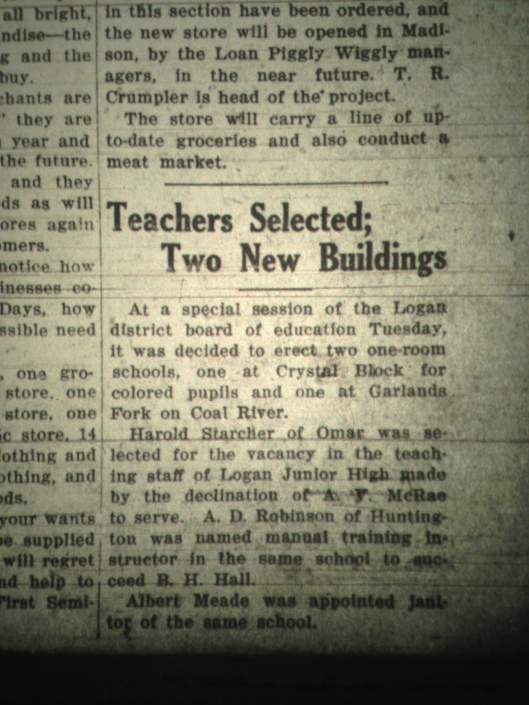
Chapmanville District Schools (1927) 1

14 Wednesday Jun 2017

Posted by Brandon Ray Kirk in African American History, Banco, Big Creek, Big Harts Creek, Chapmanville, Civil War, Guyandotte River, Holden, Native American History, Stone Branch, Timber

≈ Leave a comment

Tags

36th Virginia Volunteer Infantry Regiment, African-Americans, Appalachia, Battle of Kanawha Gap, Big Creek, Big Creek School, Burley Stollings, Buzzard Hill, Chapmanville District, Chapmanville School, Charles I. Stone, civil war, Confederate Army, Crispin Stone, Daisy Pettit, Daisy School, Dare Devils, Ed Stone School, Edith Richardson, education, Fort Sumter, French Dingess, Garrett Fork, genealogy, George Hill, Godby Branch, Guyandotte River, history, Holden, Hugh Thompson School, Hugh Toney, J.A. Vickers, J.G. Beymer, John Conley, John Garrett, John Godby, John stone, Kitchen School, Lane School, Local History and Topography of Logan County, Logan County, Lot W. Adams, Mabel Lowe, Native American History, Native Americans, Pigeon Mountain, Poplar Camp Creek, Prudential Coal Mine, Rosa Barker, Sid Ferrell, Simon Girty, Spanish-American War, Stone Branch, Stone Branch School, Thomas Huff, Thomas School, Union Army, Vette, Violet H. Agee, West Virginia, World War I

Teachers identified the following schools in Chapmanville District of Logan County, WV, and offered a bit of local history in 1927:

Big Creek School, est. 1852

Edith Richardson, teacher

Big Creek School was built of logs in 1870. Crispin S. Stone taught the first free school in his kitchen in 1870. A log building was erected the next year by the people. A Baptist Church exists here as of 1906. Many soldiers of the Civil War served from here. Two are still living. George Hill of Holden served in the Spanish-American War. Sid Ferrell of Big Creek was wounded in World War I when he left the trenches ahead of his command. The first merchant started here in 1904. Prudential was the first coal mine, just below here, in 1905. The first gas well was drilled here in 1909. Big Creek was formerly named “vette.” On the left of Big Creek (stream) looking downstream is Buzzard Hill and on the right is Pigeon Mountain. Pigeon Hill was named due to the great number of pigeons resting there. Big Creek was formerly called Poplar Camp Creek from a surveyor’s camp made of logs. The town was pretty well built up since 1902.

Lane School, est. 1887

Mable Lowe, teacher

Two room frame building

Four Confederate soldiers and one Union soldier lived here during the war. Garrett Fork was named for John Garrett, an old soldier.

Under the entry for Godby Branch: Godby Branch was named for John Godby. Old settlers claim that Simon Girty who married an Indian squaw lived on Godby Branch for several years. He cut his name on a large beech tree that fell in 1890. John Godby told the story.

Chapmanville School, est. 1892

Lot W. Adams, teacher

Four rooms and two outside rooms

There is a large Indian mound in Chapmanville. French Dingess reportedly fired the first gun at Fort Sumter. The Guyandotte River was reportedly named from the Indian word meaning “narrow bottoms.” Company D, 36th Virginia Infantry, known as the Dare Devils, organized here in May 1861 with Charles I. Stone as captain. Later it combined with Co. C, 36th Virginia Volunteer Infantry and was known as the Logan Wildcats with Hugh Toney as captain. The Battle of Chapmanville Mountain was fought in the fall of 1861 here. Major Davis was wounded and captured and his original is still kept by his relatives. He charged fifty cents a month per pupil and the textbooks were free. A large beech and a large white oak plainly marked a corner trees on the Thomas Huff 850-acre survey made on June 3, 1784.

Stone Branch School (colored), est. 1902

Violet H. Agee, teacher

Kitchen School, est. 1905

Uses three one-room buildings

John Stone said there were a few straggling bands of Indians here when he came to Stone Branch in 1807 but committed no depredations after he settled. John Stone taught the first school in this district and maybe in the county at Stone Branch in 1812. The textbooks were made by him with goose quill pens.

Hugh Thompson School, est. 1916

J.G. Beymer, teacher

One room frame building

A school house erected in 1916 was blown down in a heavy storm, killing John Conley, an old citizen who had taken shelter under the floor. The house was not used for school this year but was rebuilt the following year.

Ed Stone School, est. 1919

Rosa Barker, teacher

One room frame building

One Confederate soldier lived here during the war.

Thomas School, est. 1919

Burley Stollings, teacher

One room frame building

Two Confederate soldiers lived here during the war.

Daisy School, est. 1920

Daisy Pettit, teacher

One room frame house

Source: Local History and Topography of Logan County by J.A. Vickers (Charleston, WV: George M. Ford, State Superintendent, 1927).

Ripperville Restaurant for Colored Folks in Logan, WV (1921)

09 Friday Jun 2017

Posted by Brandon Ray Kirk in African American History, Logan

≈ Leave a comment

Tags

African-Americans, Appalachia, Elias Tripplett, history, Logan, Logan Banner, Logan County, Ripperville Restaurant, West Virginia

Ripperville Restaurant for Colored Folks in Logan LB 02.04.1921

Logan (WV) Banner, 4 February 1921.

Newer posts →

Feud Poll 1

If you had lived in the Harts Creek community during the 1880s, to which faction of feudists might you have given your loyalty?

Categories

  • Adkins Mill
  • African American History
  • American Revolutionary War
  • Ashland
  • Atenville
  • Banco
  • Barboursville
  • Battle of Blair Mountain
  • Beech Creek
  • Big Creek
  • Big Harts Creek
  • Big Sandy Valley
  • Big Ugly Creek
  • Boone County
  • Breeden
  • Calhoun County
  • Cemeteries
  • Chapmanville
  • Civil War
  • Clay County
  • Clothier
  • Coal
  • Cove Gap
  • Crawley Creek
  • Culture of Honor
  • Dingess
  • Dollie
  • Dunlow
  • East Lynn
  • Ed Haley
  • Eden Park
  • Enslow
  • Estep
  • Ethel
  • Ferrellsburg
  • Fourteen
  • French-Eversole Feud
  • Gilbert
  • Giles County
  • Gill
  • Green Shoal
  • Guyandotte River
  • Halcyon
  • Hamlin
  • Harts
  • Hatfield-McCoy Feud
  • Holden
  • Hungarian-American History
  • Huntington
  • Inez
  • Irish-Americans
  • Italian American History
  • Jamboree
  • Jewish History
  • John Hartford
  • Kermit
  • Kiahsville
  • Kitchen
  • Leet
  • Lincoln County Feud
  • Little Harts Creek
  • Logan
  • Man
  • Matewan
  • Meador
  • Midkiff
  • Monroe County
  • Montgomery County
  • Music
  • Native American History
  • Peach Creek
  • Pearl Adkins Diary
  • Pecks Mill
  • Peter Creek
  • Pikeville
  • Pilgrim
  • Poetry
  • Queens Ridge
  • Ranger
  • Rector
  • Roane County
  • Rowan County Feud
  • Salt Rock
  • Sand Creek
  • Shively
  • Spears
  • Sports
  • Spottswood
  • Spurlockville
  • Stiltner
  • Stone Branch
  • Tazewell County
  • Timber
  • Tom Dula
  • Toney
  • Turner-Howard Feud
  • Twelve Pole Creek
  • Uncategorized
  • Warren
  • Wayne
  • West Hamlin
  • Wewanta
  • Wharncliffe
  • Whirlwind
  • Williamson
  • Women's History
  • World War I
  • Wyoming County
  • Yantus

Feud Poll 2

Do you think Milt Haley and Green McCoy committed the ambush on Al and Hollene Brumfield in 1889?

Blogroll

  • Ancestry.com
  • Ashland (KY) Daily Independent News Article
  • Author FB page
  • Beckley (WV) Register-Herald News Article
  • Big Sandy News (KY) News Article
  • Blood in West Virginia FB
  • Blood in West Virginia order
  • Chapters TV Program
  • Facebook
  • Ghosts of Guyan
  • Herald-Dispatch News Article 1
  • Herald-Dispatch News Article 2
  • In Search of Ed Haley
  • Instagram
  • Lincoln (WV) Journal News Article
  • Lincoln (WV) Journal Thumbs Up
  • Lincoln County
  • Lincoln County Feud
  • Lincoln County Feud Lecture
  • LinkedIn
  • Logan (WV) Banner News Article
  • Lunch With Books
  • Our Overmountain Men: The Revolutionary War in Western Virginia (1775-1783)
  • Pinterest
  • Scarborough Society's Art and Lecture Series
  • Smithsonian Article
  • Spirit of Jefferson News Article
  • The Friendly Neighbor Radio Show 1
  • The Friendly Neighbor Radio Show 2
  • The Friendly Neighbor Radio Show 3
  • The Friendly Neighbor Radio Show 4
  • The New Yorker
  • The State Journal's 55 Good Things About WV
  • tumblr.
  • Twitter
  • Website
  • Weirton (WV) Daily Times Article
  • Wheeling (WV) Intelligencer News Article 1
  • Wheeling (WV) Intelligencer News Article 2
  • WOWK TV
  • Writers Can Read Open Mic Night

Feud Poll 3

Who do you think organized the ambush of Al and Hollene Brumfield in 1889?

Recent Posts

  • Logan County Jail in Logan, WV
  • Absentee Landowners of Magnolia District (1890, 1892, 1894)
  • Charles Spurlock Survey at Fourteen Mile Creek, Lincoln County, WV (1815)

Ed Haley Poll 1

What do you think caused Ed Haley to lose his sight when he was three years old?

Top Posts & Pages

  • Early Anglo Settlers of Logan, WV (1937)
  • Alice Dingess piano
  • History for Boone County, WV (1928)
  • Battle of Curry Farm (1864)
  • Thomas C. Whited

Copyright

© Brandon Ray Kirk and brandonraykirk.wordpress.com, 1987-2023. Unauthorized use and/or duplication of this material without express and written permission from this blog’s author and/or owner is strictly prohibited. Excerpts and links may be used, provided that full and clear credit is given to Brandon Ray Kirk and brandonraykirk.wordpress.com with appropriate and specific direction to the original content.

Archives

  • February 2025
  • January 2025
  • October 2023
  • September 2023
  • December 2022
  • November 2022
  • May 2022
  • April 2022
  • February 2022
  • November 2021
  • October 2021
  • September 2021
  • June 2021
  • May 2021
  • April 2021
  • March 2021
  • February 2021
  • January 2021
  • December 2020
  • November 2020
  • October 2020
  • July 2020
  • June 2020
  • May 2020
  • April 2020
  • March 2020
  • February 2020
  • January 2020
  • December 2019
  • November 2019
  • October 2019
  • September 2019
  • August 2019
  • July 2019
  • June 2019
  • May 2019
  • April 2019
  • March 2019
  • February 2019
  • January 2019
  • December 2018
  • November 2018
  • October 2018
  • September 2018
  • August 2018
  • July 2018
  • June 2018
  • May 2018
  • April 2018
  • March 2018
  • February 2018
  • January 2018
  • December 2017
  • November 2017
  • October 2017
  • September 2017
  • August 2017
  • July 2017
  • June 2017
  • May 2017
  • April 2017
  • March 2017
  • February 2017
  • January 2017
  • December 2016
  • November 2016
  • October 2016
  • September 2016
  • August 2016
  • July 2016
  • June 2016
  • May 2016
  • April 2016
  • March 2016
  • February 2016
  • January 2016
  • December 2015
  • November 2015
  • October 2015
  • September 2015
  • August 2015
  • July 2015
  • June 2015
  • May 2015
  • April 2015
  • March 2015
  • February 2015
  • January 2015
  • December 2014
  • October 2014
  • September 2014
  • August 2014
  • July 2014
  • June 2014
  • May 2014
  • April 2014
  • March 2014
  • February 2014
  • January 2014
  • December 2013
  • November 2013
  • October 2013
  • September 2013
  • August 2013
  • July 2013
  • June 2013
  • May 2013
  • April 2013
  • March 2013
  • February 2013
  • January 2013
  • December 2012
  • November 2012

Enter your email address to follow this blog and receive notifications of new posts by email.

Join 2,925 other subscribers

Tags

Appalachia Ashland Big Creek Big Ugly Creek Blood in West Virginia Brandon Kirk Cabell County cemeteries Chapmanville Charleston civil war coal Confederate Army crime culture Ed Haley Ella Haley Ferrellsburg feud fiddler fiddling genealogy Green McCoy Guyandotte River Harts Harts Creek Hatfield-McCoy Feud history Huntington John Hartford Kentucky Lawrence Haley life Lincoln County Lincoln County Feud Logan Logan Banner Logan County Milt Haley Mingo County music Ohio photos timbering U.S. South Virginia Wayne County West Virginia Whirlwind writing

Blogs I Follow

  • OtterTales
  • Our Appalachia: A Blog Created by Students of Brandon Kirk
  • Piedmont Trails
  • Truman Capote
  • Appalachian Diaspora

BLOOD IN WEST VIRGINIA is now available for order at Amazon!

Blog at WordPress.com.

OtterTales

Writings from my travels and experiences. High and fine literature is wine, and mine is only water; but everybody likes water. Mark Twain

Our Appalachia: A Blog Created by Students of Brandon Kirk

This site is dedicated to the collection, preservation, and promotion of history and culture in Appalachia.

Piedmont Trails

Genealogy and History in North Carolina and Beyond

Truman Capote

A site about one of the most beautiful, interesting, tallented, outrageous and colorful personalities of the 20th Century

Appalachian Diaspora

  • Subscribe Subscribed
    • Brandon Ray Kirk
    • Join 787 other subscribers
    • Already have a WordPress.com account? Log in now.
    • Brandon Ray Kirk
    • Subscribe Subscribed
    • Sign up
    • Log in
    • Report this content
    • View site in Reader
    • Manage subscriptions
    • Collapse this bar
 

Loading Comments...