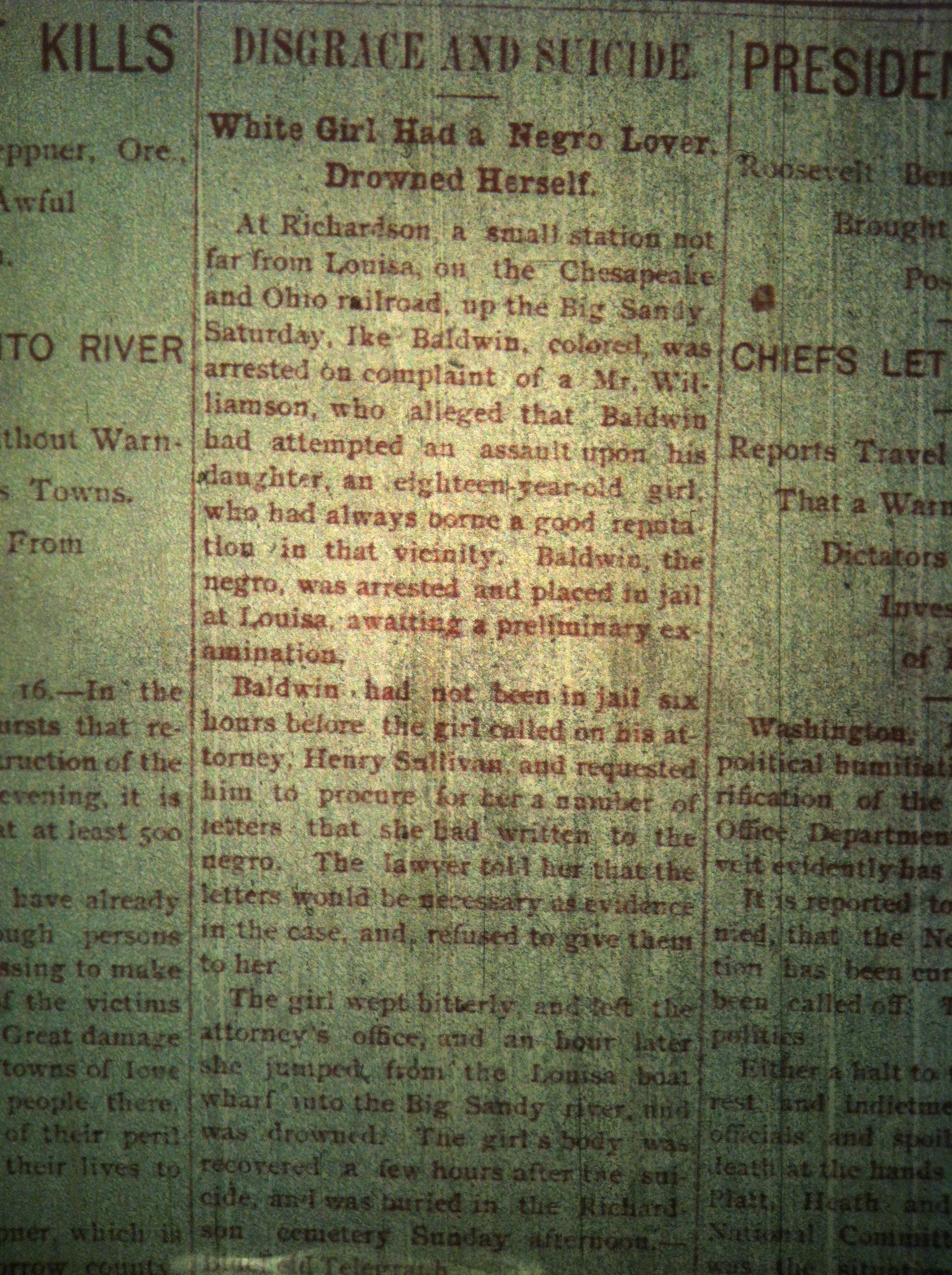
White Girl Had Negro Lover (1903)
12 Monday Jan 2015
12 Monday Jan 2015
20 Sunday Jul 2014
Posted in African American History, Fourteen, Gill, Ranger, Wewanta
Tags
Arthur Napier, Boyd Wiley, Dr. Crockett, East Fork, Elias Williamson, Fourteen Mile Creek, Garrett Webb, genealogy, Gill, Guyandotte River, history, Huntington, Jackson Mullins, John Smith, Lincoln County, Lincoln Republican, Maynard, Milton Nelson, P.J. Williamson, Rachel Adkins, Ranger, Sherman Nelson, Shirley Hankles, West Virginia, Wewanta, William Adkins, William Webb
An unnamed local correspondent from Wewanta in Lincoln County, West Virginia, offered the following items, which the Lincoln Republican printed on Thursday, June 22, 1922:
Mr. and Mrs. P.J. Williamson entertained a number of friends Sunday, among whom were: Mrs. Rachel Adkins, Mrs. Shirlie Hankles, Mrs. Elias Williamson, Jackson Mullins, of Maynard, and Mr. Elias Williamson.
Arthur Napier and Boyd Wiley, of this place, attended singing at East Fork of Fourteen, Saturday.
Milton Nelson, of Gill, tells of finding a dead man in the Guyan river near Gill. Inquest was held by Wm. Adkins at Ranger. Dr. Crockett was called and after examination, stated that he had been dead about three months. He had very costly cuff links, and a fine bill-book. He also had insurance papers on which his name and address, John Smith, of Huntington, W.Va., appeared. His bill-book contained $2. His body was in such a bad state that not much could be told of his features, but it is believed that he was a colored man. The body was found by Sherman Nelson and his son, Milton, while out fishing.
Garrett Webb was a visitor at Wm. Webb’s Sunday.
13 Sunday Jul 2014
Posted in African American History, Ed Haley, Music
Tags
accordion, Aracoma, Ashland, Bill Bowler, Clayton White, Ed Haley, Ella Haley, history, Kentucky, Kiss Me Quick, Lawrence Haley, Logan, Lula Lee, Man of Constant Sorrow, Manuel Martin, Mona Haley, music, Nora Martin, Old Man Duff, Pat Haley, Soutwood Mountain, West Virginia, writing
Meanwhile, as Brandon flushed out more information about the 1889 feud, I was on the phone with Ed’s daughter, Mona Hager. In no time, she was singing “Old Man Duff”, one of Ed’s songs:
Old Man Duff was so doggone tough
That they called him dynamite.
On a mattress filled with broken glass
He rested well each night.
He combed his hair with a garden rake
And he ate his vittles raw.
He picked his teeth with a horseshoe nail
And he shaved his beard with a saw.
Old Man Duff was mighty tough
And rough as a man could be.
He had hair on his chest
And he wore no vest a
And he looked like a chimpanzee.
Old Man Duff had a daughter fair
But she died a poor old maid.
Lots of men woulda courted her
But they were all afraid.
Once old Duff seen a fella with her.
You could hear him rave and shout:
He’d put his hand down the poor man’s throat
And he’d turn him inside out.
Old Man Duff was mighty rough
And tough as a man could be.
He ate iron nails and the bones of whales
And he drank gasoline for tea.
Old Man Duff lived a thousand years
And he died and went below.
And when old Satan looked at him
He smiled and said, “Hello.”
Now the fire was mighty hot
When they put old Duff in there,
But he layed right down and he went to sleep
And it never singed a hair.
Old Man Duff was mighty rough
And tough as a man could be.
He had hair on his chest
And he wore no vest
And he looked like a chimpanzee.
Mona also remembered Ed singing “Man of Constant Sorrow”. She said Ed sometimes sang “little ditties” like with “Sourwood Mountain”. Ella did the same thing to “Kiss Me Quick”.
Kiss me quick, kiss me runnin’.
Kiss me quick ’cause my daddy’s comin’.
Love my wife, love my baby.
Love my biscuits sopped in gravy.
Ed never called square dances but would “blurt out some of the square dance reel” while fiddling.
I told Mona that I was still very interested in the source of Ed’s music.
“Pop was around a lot of blacks, you know, up in the coalfields up in West Virginia,” she said. “I even had a black nanny up there. She babysat me sometimes for Mom and Pop. Now that was at Manuel and Nora Martin’s house on the hill there at Aracoma [near Logan]. And Pop took me up to an old color lady’s bootleg joint one time somewhere up in West Virginia. And I know he was around a lot of blacks and I know that he learned some of the black’s music. They had a lot of blind friends that made music on the street, too, and one of them was Clayton White. He played an accordion. He walked up from 15th to 16th and back, you know.”
I asked Mona how many musicians were playing on the streets of Ashland in Ed’s time and she said, “Well, there was Pop and Mom, and there was Bill Bowler, and then there was a lady named Lula Lee. Now she was an illiterate woman and a lot of people got my mom and her mixed up. Mom was a cultured lady.”
I asked Mona if she thought her mother’s education rubbed off on Ed over the years and she said, “Oh, yeah. He only got uncultured when he was drinking. He talked well educated but of course he wasn’t. He was a very intelligent man.”
Mona seemed surprised when I told her that Ed could supposedly quote the Bible.
I asked her more about Ed’s and Ella’s relationship in later years and she said, “You know about me bringing him back from Logan back to Mom after they were divorced? Well, I was up there and I persuaded Pop to come home with me and I brought Pop home and he had one of those long change purses that snapped together and he had that in his pocket. And when we got home, he sit down and he was talking to Mom and he said, ‘Ella, I’ve got this plumb full of half-dollars and if you’ll let me sit by your fire this winter, I’ll give them all to you.’ I’m glad I took him home. That was when we lived on Greenup. He stayed with her until he died. Eventually Mom stayed with Lawrence and Patricia. She didn’t do any good after Pop died. She lost her friends. She didn’t have anybody to talk to.”
So after their divorce, they had a good relationship?
“They had a better relationship than they did before the divorce,” Mona said.

02 Monday Jun 2014
Posted in African American History, Ferrellsburg, Harts
26 Monday May 2014
Posted in African American History, Logan
Tags
Appalachia, Charles Dingess, Fannie Dingess, history, Logan County, Logan County Banner, slavery, U.S. South, West Virginia

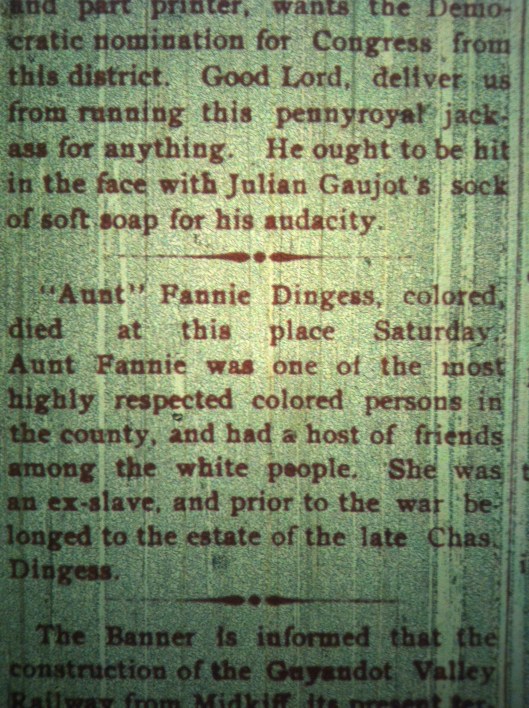
Fannie Dingess obituary, Logan County Banner, May 15, 1902
11 Sunday May 2014
Posted in African American History, Logan, Women's History
Tags
Charles Dingess, culture, Fannie Dingess, history, life, Logan, Logan County, slavery, West Virginia

Fannie Dingess obituary, Logan County Banner, Thursday, May 15, 1902
31 Monday Mar 2014
Posted in African American History, Ed Haley, Music
Tags
Appalachia, Big Bear Fork, Black Bill, Bone Ratliff, Brown Hicks, Calhoun County, genealogy, Glenville, Harold Postalwait, Harvey Hicks, history, Jake Catlip, John Hartford, Laury Hicks, Little Bear Fork, Minnie Hicks, music, Sadie Hicks, Shock, Stumptown, Ugee Postalwait, West Virginia, writing
I asked Ugee if there were any black musicians in Calhoun County and she said she remembered some living around Big Bear Fork and Little Bear Fork.
“That’s in between Stumptown and Shock. They was two families lived out there: Jake Catlip and Bone Ratliff. They were black people. Lived out there in the country. First ones I ever seen. They called and wanted Dad to come to Bear Fork. Well, this boy had a guitar there. Maybe he was eight years old. They called him ‘Black Bill’ later. Dad said, ‘I can’t play it but I’ll show you something.’ Dad tuned it up and showed him three chords. Said, ‘Now learn that and come up and we’ll play music some day.'”
Ugee said she met Black Bill a little later.
“Well, when I was carrying Harold before Harold was born, I walked up the road and was going up to Dad’s and Mom’s and down there at what they call Hog Run there was a pile of rock there by the side the road and a paw paw tree,” she said. “And up jumped that black boy with a guitar on his back — liked to scared me to death. He said, ‘Lady, could you tell me where Dr. L.A. Hicks lives?’ I just pointed up to the house and said, ‘That house right there.’ I couldn’t speak I got scared so bad. Well, he just started out running. I was so weak I had to sit down. Got up there and here was that boy that Dad had showed how to chord. Now, you ought to heard him play. They kept him around there for a month. Well, the boys liked to hear him play the guitar. That’s where I got that ‘Down the road, down the road. Everybody going off down the road. Down the road, far as I can see. All the pretty girls look alike to me.’ Dad said to him, ‘Bill, you made a good guitar player but you can’t play with a fiddle. Now, let my daughter show you how to play the guitar with a fiddle.'”
Ugee’s meeting with Black Bill made a real impression on her.
“I’m not the type to get scared bad but that scared me: just come around a corner and there sat a black man — jump right out like that,” she said. “Now, I was only seven months along with Harold and when he was born he was so blue I thought I had ‘marked’ him with Black Bill. You know, you hear people ‘marking’ their kids? I raised up and they had him up to show me and I said, ‘Oh my god, I marked him to Black Bill.’ Mom said, ‘He’s not marked. He’s just blue.’ Me and Black Bill had many a laugh over it.”
I asked Ugee what happened to Black Bill and she said, “Brown Hicks was down sick and he went there and helped them out and everything. He stayed there one whole winter with them. Someone told me that he took up with Brown Hicks’ wife, Sadie. They lived together, I guess, over there toward Glenville and she had one kid by him. My brother Harvey seen the kid. Harvey said Sadie’s boy was ‘just a Black Bill made over.’ I don’t know what ever become of him after that. I never heard no more about him.”
27 Friday Sep 2013
Posted in African American History, Ed Haley, Music
Tags
Annie Adkins, Anse Blake, Appalachia, Ben France, Bob Claypool, Bob Glenn, Burgess Stewart, Cain Adkins, Champ Adkins, Charley Robinson, Dave Glenn, Ed Haley, fiddling, Frank Jefferson, Fred B. Lambert, George Stephens, Gilbert Smith, Harkins Fry, Hezekiah Adkins, history, Isom Johnson, Jimmie Rodgers, Kish Adkins George Crockett, Leander Fry, Lish Adkins, Lucian W. Osbourne, music, Percival Drown, Spicie McCoy, Staunton Ross
In a separate interview, one Mr. Miller told Fred B. Lambert, “Leander Fry used to come down from Lincoln on timber to play the fiddle. He was a great fiddler. Jack McComas was an old fiddler, as was also his brother. Mose Thornburg said that a man who wouldn’t fight to the music made by the musicians of the musters had no fight in him. Wm. Collins was a fifer. John Reece was a tenor drummer, Clarke Thurston a base drummer. On muster days, whiskey, ginger ales, cider, &c were plentiful. Hogs were fattened on the way East. That wore the valley out. Dishes were plain. Cups instead of glass. They were cheaper. No washboards. Lye soap. Used a board to beat clothes with. Later, washboards were made of soft wood and sold for 5 cents each. Old fiddlers: George Stephens and Wiley, — Joplin, Guyandotte (?). In later days Morris Wentz and Ben France.”
Amaziah Ross told Lambert about some of the other fiddlers.
“Old Charley Robison came from Alabama. Brought ‘Birdie.’ He was a colored man and a good fiddler. Bob Glenn lived up Ohio River about Mason Co., played at Guyandotte when I was a boy. A first class fiddler. His bro. Dave Glenn also was a good one. Jimmie Rodgers lived at Guyandotte. He was a bro. to Bascom Rogers who kept saloon at Guyandotte — The Logan Saloon when I was a boy.”
Ross gave Lambert the names of many old fiddle tunes, which I of course noted being an avid fan and collector of such things:
Shelvin’ Rock played by Ben France
Natchez Under the Hill
Seven Mile Winder
Money Muss
Devil’s Dream
Mississippi Sawyer
Sixteen Days in Georgia
Little Sallie Waters
Marching Through Georgia
Whitefield, Georgia
Annie Adkins — By herself a fiddler when my father was a boy.
Ocean Wave
Over the Way
Grasshopper
Cabin Creek
Fisher’s Hornpipe
Sailor’s Hornpipe
Ladies’ Hornpipe
Gerang Hornpipe
Forked Deer
Third Day of July
Butterfly
Birdie
Lop Eared Mule
Billy in the Lowground
Wild Horse
Old Bill Keenan
Round Town Girls
SourwoodMountain
Old Joe Clark
Greasy String
Cross Keys
Bet My Money on Bobtail Horse
Blue Ridge Mountain Home
Someone told Lambert about the dances held after corn-shuckings.
“After a few weeks, it was ready to shuck. It was an opportunity for young and old to gather and spend a day at work in the name of play. Of course, the women and girls prepared the noon meal and sometimes even the supper. When night came on, the labors of the day were followed by a dance, which of all pioneer amusements was king. Shooting matches with rifles, wrestling matches, foot races, fist fights between neighborhood bullies, or to settle old scores. It was not uncommon for contestants to engage in ‘gouging’, as a natural sequence of a first fight. Weapons were banned, but many a man lost an eye by having it gouged out.”
Another person said, “Dances were very common at weddings, and on many other occasions.” Some of the tunes played were:
The Devil’s Dream
Old Zip Cook
Billie in the Low Ground
Virginia Reel
“I had a Dog And His Name was Rover,
When he Had Fleas, He had ‘Em All Over”
Irish Washerwoman
Mississippi Sawyer
Myron Drumond gave these tunes to Lambert: “Sugar in the Gourd”, “Chicken Reel”, “Fisher’s Hornpipe”, “Cincinnati Hornpipe” (the latter two tunes for “Jig dancing”) and “Irish Washerwoman”.
These tunes and fiddlers came from “a Barboursville man:”
Tunes
Turkey In the Straw
Sourwood Mountain
“Hage ’em Along.”
The Lost Indian
Pharoah’s Dream
Hell up the Coal Hollow
The Devil’s Dream
Shady Grove
Arkansas Traveler
Little Bunch o’ Blues
New River Train
I Love Some Body
Hard Up
Fiddlers
Morris Wentz
Ben France
Percival Drown
Bob Claypool—Lincoln Co.
Staunton Ross—near Salt Rock
Burgess (“Coon”) Stewart — Lincoln Co. Buffalo Cr. Extra Good
Frank Jefferson — Nine Mile
Anse Blake — Nine Mile
A lot of Lambert’s research, particularly in regard to old-time music trailed off around the time of the War Between the States. He only mentioned Ed Haley twice — once in relation to Milt Haley and once in a list with Ben France, Blind Lish Adkins, Hezekiah Adkins of Wayne County, “Fiddler Cain” Adkins (a son of Jake Adkins), Gilbert Smith and Isom Johnson. His last letter on fiddling was from an uninterested Lucian W. Osbourne of East Lynn, Wayne County, who wrote in March of 1951: “Complying with your request, I send the names of a few old fiddlers, as follows: Champ Adkins, Kish Adkins, Ben Frances, George Crockett. All dead. For information about others write Mrs. Spicy Fry, Stiltner, and Harkins Fry, Kenova. Here are some of the old tunes: ‘Sourwood Mountain,’ ‘The Lone Prairie,’ ‘Little Old Log Cabin in the Lane,’ ‘Nelly Gray,’ &c. I know but little about the fiddling, as I am a Sunday School man, and interested in better things. I think it is better to say after one when he is dead that he is a Christian than to say he was a fiddler or baseball fan.”
23 Monday Sep 2013
Posted in African American History, Civil War, Ed Haley, Music
Tags
Babe McCallister, banjo, Ben France, Billy Walker, Charley Dodd, civil war, fiddling, Henry France, Henry Peyton, history, J.T. "Pomp" Wentz, Jack McComas, Lincoln County, Morris Wentz, West Virginia, William S. Rogers
By the time of the Civil War, Benjamin France of Cabell County was the chief fiddler in the lower Guyandotte Valley. One person interviewed by Fred B. Lambert referred to him as “the best of all” in a list of fiddlers that included even Ed Haley. Of course, I was immediately interested in him.
According to Lambert’s notes, France was born in 1844. He “learned on a gourd fiddle, and was able to play when he entered the army. He served as a Rebel soldier, throughout the Civil War, entering the army, at the age of 17 years. He was noted as one of the best fiddlers of his time. He won two or three times, in contests, but his medals do not show when, nor whether they were first rank. Henry France, his nephew, says he could play all the old fiddle tunes, and could play all night without repeating the same tunes even once.”
France was a resident of Long Branch, near the Lincoln County line and died in 1918.
“From Cabell County, the principal fiddlers were Morris Wentz, Ben France, William S. Rogers and Charley Dodd,” according to J.T. “Pomp” Wentz, a riverboat captain who spoke with Lambert. “Banjoes were not used so much, in those days, but later Rev. Billy Walker and others used to play them very well. As a fiddler, Ben France played with the most ease of any man I ever saw. Morris Wentz played with some difficulty compared with Mr. France, but he could play almost anything. Morris Wentz used to play: ‘The Cold Frosty Morning’, ‘Going Back to Dixie’, ‘The Arkansas Traveler’, ‘Bonaparte’s Retreat’ (this pleased Billy Bramblett, the Frenchman), ‘Ducks in the Pond’, ‘The Puncheon Floor’, ‘Hop Light Ladies’, ‘The Boatsman’, ‘The Cackling Hen’, ‘Sourwood Mountain’, ‘Soldiers Joy’, ‘Little Birdie’, ‘Old Dan Tucker’, ‘Granny Will Your Dog Bite?’, ‘Liza Jane’, ‘The Shelvin’ Rock’, ‘Knock Kneed Nannie’, ‘Chippy, Get Your Hair Cut’, ‘The Rebel Raid’, ‘Turkey in the Straw’, ‘Sugar In the Gourd’, ‘Ginny, the Gal With the Blue Dress On’, ‘Old Joe Clark’, ‘Birdie’, ‘Old Napper’, ‘The Forked Duck’. After dancing the ‘set’ down, they would close with the ‘winder’.”
Apparently, the popular tunes of the day were “Forked Deer” and “The Peach Tree”.
“Babe McCallister, ‘a darkey’ owned by a farmer named McCallister from upper Mud River, was a master of ‘Forked Deer’,” one fiddler raved. “He ‘played the fiddle with the ‘free arm movement,’ the wrist joint only working, the elbow joint still, while the wrist joint was in active movement. To hear the coon on ‘Forked Deer’, his favorite tune, and call the cotillion figure was a great treat. Could I have inherited such talent with my fondness of and for the violin, it would have been dead easy that I should tour the universe and earn a million playing only ‘Forked Deer’ and ‘Peach Tree’.”
Further up the Guyandotte River from the Cabell County towns, in present-day Lincoln County, were fiddlers of lesser note.
“Some of the best fiddlers I ever knew in Lincoln County, were Henry Peyton, father of ‘Blind’ Bill Peyton, and Jack McComas, both of whom played before the Civil War,” said Pomp Wentz.
23 Monday Sep 2013
Posted in African American History, Logan
Tags
Andrew Bierne, Ann Lawson, Anthony Lawson, Appalachia, England, history, Logan, Logan County, Oceana, slavery, U.S. South, West Virginia, writing
Almost two hundred years ago, an Englishman made his way into the Guyandotte Valley and soon found himself fully engaged in the fur trading business and the creation of a new county.
Anthony Lawson was born on October 31, 1785 in Stanton, Northumberland, England. He was the son of Anthony and Margaret (Carse) Lawson. On May 26, 1806, Lawson married Ann Bilton, a daughter of Lewis and Jane Bilton, at Saint Helens Church in Longhorsley Parish, Northumberland. Ann was born on March 17, 1783 in Fieldhead, England.
In the early summer of 1817, Anthony and his family left England for America aboard the ship Active. “They left England on account of religious persecution,” according to the late Dr. Sidney B. Lawson, who spoke some years ago with historian Fred B. Lambert. Accompanying Lawson were his wife and four children: John Lawson, born in 1807 in Woodcraft, Northumberland; Lewis Bilton Lawson, born in 1808 in Stanhope, Northumberland; James B. Lawson, born in 1808 in Northumberland; and Anthony Lawson II, born in 1813.
On July 12, 1817, the Lawson family arrived at Philadelphia. They settled in Alexandria, Virginia, where Anthony’s uncle, John Lawson, operated a store on Cameron Street. While there, Ann gave birth to a fifth child named George Wilborn Lawson in 1818.
At that time, according to Ragland’s History of Logan County (1896), Lawson was persuaded to move to the Guyandotte Valley. “Col. Andrew Bierne, of Lewisburg, soon made his acquaintance, and induced him to come to the wilds of Guyandotte River and engage in the fur and ginseng trade,” Ragland wrote. “Mr. Lawson first settled near the present site of Oceana, where he remained about four years and then moved to the present site of Logan C.H.”
At Logan, which was then called the “Islands of Guyandot” and situated in Cabell County, Lawson ran a mercantile store. “Anthony had many buying and selling trips to Philadelphia,” writes James Avis of Albuquerque, New Mexico. “He would travel by horseback to the town of Guyandotte and from there by boat to Philadelphia. It is believed that he would visit with relatives living in Philadelphia.”
In 1824, when Logan County was formed from Cabell, Lawson served on the first County Court. His store was chosen as the seat of government for the new county. He also donated land for the construction of a courthouse. Reportedly, Logan was originally named Lawsonville but later had its name shortened to Lawnsville. Later still, it became Aracoma, then Logan Court House.
In 1830, Lawson was listed in the Logan County Census with his wife and four children, as well as two slaves (one female aged 10-24 and one male aged 0-10). His oldest son, John, was enumerator of the county census.
In 1840, Lawson was listed in the Logan County Census with his wife, son Anthony II, and three slaves. In that same year, sons John and James were also living in the county, with no slaves.
In 1847, Lawson became ill while on a return trip from Philadelphia. He was taken from a boat at Guyandotte, now Huntington’s east end, where he died of cholera on May 20. He was buried in the city cemetery. “Col. Anthony Lawson Sr. — Logan County — died at Guyandot aged upwards of 60 on his way home from Philadelphia,” the Richmond Whig wrote on June 17, 1847. “He often spoke of his birthplace as the vicinity of Alnwick Castle, the seat of the Percies in Yorkshire, England. He accumulated a large fortune which he left his children.”
On December 27, 1847, Ann Lawson was murdered by two of her slaves in Logan County. “Ann was mending a shirt for one of the slaves so that he and another slave could go to town for supplies,” Avis writes. “Thinking that they could be free after Anthony’s death, the negro she was mending the shirt for struck her on the head with an iron poker and she died.” After the murder, the slaves robbed Lawson. “The slave knew that money was kept in one of the drawers in the bureau,” according to Avis. “The poker was again used to pry open the drawer and take the money.” Two slaves named Bill and Hardin were accused of the murder. “The one that killed her was hanged, probably on the courthouse lawn,” Avis writes. “The other slave was severely punished.”
21 Saturday Sep 2013
Posted in African American History, Ed Haley, Music
Tags
fiddling, Fred B. Lambert, George Stephens, Gus Wolcott, history, Ike Handley, Jim Peatt, Jim Wilcot, Morton Milstead, music, Percival S. Drown, Sam Peatt, slavery
“There were other fiddlers of less note than those I have named,” Percival Drown continued. “Jim Peatt was a fiddler of fair attainments only as to the number of tunes. I only remember that he played ‘Pigeon on the Gate’, ‘Indian Eat the Woodcock’ (with words), and ‘Old Dan Tucker’ with words and chorous… Ike Handley and Jim Wilcot, who lived below Guyan seven or eight miles, were of the class with Jim Peatt, as I now regard them and recall their fiddling.”
Around 1846, a “dark-skinned” fiddler named Joplin with a “French-Italian look about him” appeared briefly in Cabell County. He was “an educated fiddler and dancing master.”
“It was charming to me, at least, to listen to Joplin’s refined music and I scarcely let the opportunity pass and not hear him,” Drown wrote.
While a master of the violin in the classical sense, Joplin didn’t impress many locals.
“The average native of Cabell County at the period of which I am writing,” one citizen said, “would be far more entertained listening to George Stephen’s ‘Possum Creek’ or ‘Soap Suds over the Fence’, or ‘Peach Tree’ as he played it by ear, than Joplin’s classics rendered from book Clythe Masters.”
These fiddlers made a great impression on young Percival Drown, who took up the fiddle himself as a teenager.
“As brief as I can make it, I will give an account of my own career as a fiddler, which is of little merit, yet would appear to be in order to detail here with other reminiscent memories,” he wrote.
Early in the 40s my father said to me: “Perl would you like to learn to play the fiddle?” I was in my thirteenth year, I think. “Yes sir, I certainly would,” was about my reply — I think my exact words. He went on at some length in extolling the virtues of the violin — how a fiddler could elevate himself socially, and even become a great and popular personage. I have no idea he had ever listened to Joplin or Turner at that time, and certainly not an Ole Bull, or other high class performers. “Bonaparte’s Retreat” and “Money Musk”, also the “Irish Washerwoman,” were his special tunes to listen to. He then said: “Take this $3.00 and get Vere or Gus Wolcott (who kept the wharfboat at Logan) to send to Cincinnati and get the best instrument the $3.00 will buy, and you can begin and try and learn”. I took the money. Wolcott sent and got the instrument, and I was not long “to try and learn to play on it.” The employment of a teacher was out of the question — not to be thought of. We lived far in the back country, too far from where an instructor of the violin ever came. I could never have paid the tuition of an instructor could one have been engaged, but the husband of a negro woman and two children my father had bought at a public sale of the property of Joe Gardner, dec’d at Guyan, was a fiddler. My father hired the husband [named Sam] every winter to work on the farm. Sam became my teacher. I watched his fingers as he played “Old Grimes”, and by timing the fingers and getting the tune effectively fixed in my mind, it was not long until I could actually play “Old Grimes” myself, by which time I could also “tune up” the instrument. The worst was over.
[I learned] by listening to Geo. Stephens, and every other fiddler that came along the road, closely watching Sam’s fingers and hearing him play every rainy day that we wouldn’t work on the farm (and every night, rain or dry). In four to six months I could play any slow tune and the “Peach Tree” for a dance. For a cotillion I could play one tune, “Rose in the Mountain”. On an occasion, I think it was near 1846, a popular blacksmith and farmer named Stonebreaker who lived out on Beech Fork wanted to give the young people a party. So, he gathered his corn crop, hauled it into the barn, and appointed a day for the husking. “Corn shucking” it was called. The day for the corn shucking was Saturday. George Stephens was sought for, but was away and could not be got in time. Walcott lived twenty miles away, and was not known much anyway. Milstead lived in Ohio, fifteen miles or more. Joplin lived in Gallipolis, thirty miles up the Ohio, too. Hence, he was not available. I had no reputation as a fiddler, and Sam could not leave home — his wife was expecting to be sick of another kid — when it seemed that no fiddler of any known qualification could be engaged. A messenger was sent for me to ascertain if I would come, the time being short. I readily assented. Nothing said about the fiddler’s fee for the service. On the day set I done up the fiddle in my overcoat, and strapping it behind my saddle, mounted “Dave” a very comely animal and away to Stonebreaker’s. Afternoon I went nine or ten miles. Made the trip in good shape, arriving as big as life, fiddle and all. The husking of the corn concluded, the next order of business was to dance. The figures chiefly danced were “Virginia Reel”, “French Four”, and “Dan Tucker”. I could only play the “Peach Tree” in fairly good shape for dancing; and the “Peach Tree” it was for all night, except for supper. We adjourned for about an hour. Then on with the dance for the balance of the night. For this service I received all that was collected, 75 cents, fifteen times five cents in 5 cent pieces… but like George Stephens I felt that I, too, was a lilter. That was my very first playing for the dance. That was fully 68 years ago.
In 1854 I obtained another and superior instrument that, figuring some time ago how many miles I had carried that violin, it amounted to some 38,000 miles.
26 Tuesday Feb 2013
Posted in African American History, Big Harts Creek, Ed Haley, Hatfield-McCoy Feud, Logan, Music, Sports
Tags
Appalachia, Aracoma, Big Foot, blind, Blues, Clyde Haley, Come Take A Trip in My Airship, Coney Island, Devil Anse Hatfield, Done Got the 'Chines in My Mind, Ed Haley, Ella Haley, fiddler, Fox Cod Knob, Franklin Roosevelt, Harts Creek, Hester Mullins, Hiram Dempsey, history, Island Queen, Jack Dempsey, John Hartford, Lawrence Haley, Logan, Logan County, Mona Haley, music, mystery, Noah Haley, Nora Martin, Pink Mullins, steamboats, Trace Fork, Turkey in the Straw, West Virginia
Mona’s memories were really pouring out, about a variety of things. I asked her what Ed was like and she said, “Noah is a lot like Pop in a way. He always liked the outdoors, Pop did. He’d get out and sleep on the porch at night. He could peel an apple without breaking the skin. There was an old man up on Harts Creek and I’m almost sure that his name was Devil Anse Hatfield and Pop trimmed his fingernails out on his porch with his pocketknife. Aw, he could trim my nails or yours or anybody’s.”
Ed was good at predicting the future.
“Pop said machines was gonna take over man’s work and we was gonna go to the moon one day,” Mona said. She figured he wrote the song “Come Take A Trip in My Airship” because it sounded like his kind of foresight.
Mona said she remembered some of Ed’s stories but warned me that I wouldn’t want to hear them.
Of course, I did.
I asked her if they were off-color and she said, “Well, not really, but he was kind of an off-color guy. I can’t really remember any of the tales about him. What was that one about him dreaming he was on Fox Cod Knob and dragging a big log chain and he fell over a big cliff and when he come to hisself he was standing on his head on a chicken coop with his legs locked around a clothes line?”
What?
“He told some weird stories sometimes — ghost stories and things that I can’t remember,” she continued. “He told that story about Big Foot up in the hills of Harts Creek. A wild banshee. Pop talked about it. Clyde said he saw a Big Foot.”
Lawrence said, “It was up in the head of the Trace Fork of Harts Creek somewhere. Pop was on the back of this horse behind somebody. They was coming down through there and all at once something jumped up on back of the horse behind him and it was just rattling chains all the way down through there and the more that chain rattled the faster that horse would go. They absolutely run that horse almost to death getting away from it.”
I asked about Ed’s travels. Mona said her parents walked and hitchhiked a lot. Along the way, Ella sang to occupy the kids. Lawrence remembered buses and trains, where Ed sometimes played the fiddle for a little extra money from passengers. I asked if he ever talked about playing on any boats and Mona said, “No, but I know they did because I was with them on the ISLAND QUEEN that was going back and forth to Coney Island. Up by the calliope on the top deck.”
Mona said Ed always set up in towns near a movie theatre so the kids could watch movies.
“Every time he played he drawed a crowd,” she said. “He was loud and he was good. I never seen him play any that he didn’t have a crowd around him — anywhere.”
Ed was “all business” but would talk to people if they came up to him.
“One time we went in a beer joint up in Logan, West Virginia, that sat by the railroad tracks,” she said. “They played over at the courthouse and we walked over there. Pop wanted to get a beer while I ate supper. It was back when Roosevelt was president I reckon and he got in an argument with some guy about President Roosevelt. That was his favorite fella, you know. This guy started a fight with him and he backed off and walked away. Pop just let the man walk the length of his cane, hooked it around his neck, brought him back and beat him nearly to death. He was strong. He was dangerous if he ever got a hold of you, if he was mad at you. He always carried a pocketknife and it was sharp as a razor. He whittled on that knife — I mean, sharpened it every day.”
“Everybody liked Pop — everybody that I ever knew,” Mona said. “He had some pretty high people as friends.”
In Logan County, Ed visited Pink and Hester Mullins on Mud Fork and Rosie Day’s daughter Nora Martin in Aracoma. Mona said Ed was also friends with a famous boxer in town whose father played the fiddle, but she couldn’t remember his name. I later learned from Lawrence that it was Jack Dempsey, the heavyweight champion of the world from 1919-1926. Dempsey wrote in his biography that his father had fiddled “Turkey in the Straw” so much that all the children thought it was the National Anthem.
Ed mixed freely with some of the colored folks in Logan, and sometimes even left Mona at a “bootleg joint” operated by a black lady named Tootsie. She and Lawrence both felt Ed absorbed a lot of the Blues from the blacks in the coalfields. Mona sang one of her father’s songs — which I had never heard — to make the point:
Done got the [ma]chines in my mind, Lord, Lord.
Done got the ‘chines in my mind.
‘Chines in my mind and I can’t make a dime.
Done got the ‘chines in my mind.
My old gal got mad at me.
I never did her any harm.
‘Chines in my mind and I can’t make a dime.
Done got the ‘chines in my mind.
05 Wednesday Dec 2012
Posted in African American History, Ferrellsburg
Writings from my travels and experiences. High and fine literature is wine, and mine is only water; but everybody likes water. Mark Twain
This site is dedicated to the collection, preservation, and promotion of history and culture in Appalachia.
Genealogy and History in North Carolina and Beyond
A site about one of the most beautiful, interesting, tallented, outrageous and colorful personalities of the 20th Century