
• About

Brandon Ray Kirk

~ This site is dedicated to the collection, preservation, and promotion of history and culture in my section of Appalachia.

Brandon Ray Kirk

Monthly Archives: September 2013

In Search of Ed Haley 172

20 Friday Sep 2013

Posted by Brandon Ray Kirk in Ed Haley, Music

≈ Leave a comment

Tags

Anthony Riggs, Barboursville, fiddler, fiddling, Fred B. Lambert, George Stephens, Guyandotte River, history, Morton Milstead, music, Percival S. Drown, Samp Johnson, writing

The next morning, I went to see the Lambert Collection at the Morrow Library in Huntington, West Virginia. According to information at the library, the late Fred B. Lambert (1873-1967), a schoolteacher and administrator, had spent “at least sixty years of his life collecting information about West Virginia history” into a 500-notebook collection, mostly focusing on Cabell, Lincoln, Wayne, and Logan Counties. His notes on fiddling and old-time music were incredibly detailed. In some cases, he documented the first time a tune arrived in the Guyandotte Valley. Incredibly, none of his work was published outside of The Llorrac, an old high school yearbook from the 1920s.

As I flipped through his notebooks, it was difficult to keep my focus — there were stories about murders, genealogy, and life on the river. I took great interest in the stories about early fiddlers in the Guyan Valley. It helped put Ed — at least his early years — into a sort of regional context, the culmination of years of musical evolution. Any one of the mid-nineteenth century Guyan fiddlers may have actually known Ed Haley or, more likely, his father Milt.

In the 1830s and 1840s, according to Lambert’s research, George Stephens was a dominant fiddler in the Cabell County towns situated at or near the mouth of the Guyandotte River.

“George Stephens was a fiddler of wider reputation than most of those old time artists of the ‘fiddle and the bow,'” wrote one Percival S. Drown in a 1914 letter. “In his repertoire was ‘Bonaparte’s Retreat from Moscow,’ ‘Bonaparte Crossing the Rhine,’ ‘Cold, Frosty Morning,’ ‘Puncheon Floor,’ ‘Possum Creek,’ ‘Pop Goes the Weasel,’ ‘Pretty Betty Martin,’ ‘Carry Me Back to Old Virginia,’ ‘Hail Columbia,’ and ‘Star Spangled Banner.’ He had another tune and words ‘Big John, Little John, Big John Bailey.’ The tune Stephens seemed to throw himself away most on was the ‘Peach Tree.’ The meter and time governing this tune permitted its use and adaptation for dance music, and applying a long drawn bow with correct harmony and concord of sound, he carried the listener away in dreamy thought and recollection.

“When about midnight after the day of the ‘quilting,’ ‘Corn Husking,’ and ‘Log Rolling,’ when the ‘dance was on,’ Stephens, well-liquored up on Dexter Rectified, would have his face turned over his right shoulder apparently as much asleep as awake, but never missing a note of the ‘Peach Tree’, while the dancers would be ‘hoeing down’ for dear life. All at once he would order ‘Promenade to Seats’, cease playing, adjust himself in his seat and exclaim with energy ‘if I aint a lilter damme.’ Seemingly he was suddenly inspired with an exalter opinion of his greatness as a fiddler. As much as to say at the same time ‘and don’t you forget it.’ Then he might resen his bow and break out with a few stanzas of ‘Puncheon Floor’ or a tune he called ‘Soap Suds Over the Fence,’ to be followed by a slow tune so everyone could march to the supper table in the kitchen, across the yard (It was a common thing in those dear old times, for the kitchen to be detached from the ‘big house’).”

Samp Johnson was another top local fiddler, according to Percival Drown.

“‘Samp’ Johnson was the first fiddler I heard play ‘Arkansas Traveler’. One of his favorite places to play was at McKendree’s Tavern in Barboursville [on Main Street]. His favorite for playing was during Court days, when fiddler’s drinks were full and plentiful. The sun [was] full at 2 o’clock that day. Court day. The Town was full of visitors, chiefly ‘hayseed’, most of whom were fully equipped for home when they could tear themselves away from ‘Samp’ Johnson’s music. I well remember the day. McKendree’s second story porch was crowded with the audience. Roll Bias, who was a character in his day, lived far up Guyan River. He usually had business ‘at Court’. He was prosperous, in a way. I think he paid for all the drinks flowing from the attraction furnished by Johnson’s music in the street. While endowed with good common sense he could neither write his own or any other name. Poor ‘Samp’ Johnson came to his death at the Falls of Guyan when driving logs at high tide of the river, date not far from the time (1852) of my leaving the State.”

Another great fiddler in that era was Anthony Riggs.

“Anthony Riggs’ favorite tune that I more distinctly remember than others he played was called ‘Annie Hays,'” Drown wrote. “It was that fiddler’s favorite tune and one to suit the step and time for reels, and other ‘figures’ so called. Like all fiddlers of his class, he played ‘Nachez Under the Hill’, now known as ‘Turkey in the Straw.'”

Morton Milstead of Ohio “would come over to Cabell, stay around a few days, in the early 30s, I heard it said, and played the fiddle for drinks, mostly,” Drown wrote. “Milstead was rated as a high-class musician, as I recollect the talk of him. Never heard Milstead play but once, and I well remember now after a lapse of 65 or 70 years that his performance was much below that of George Stephens, Anthony Riggs, or ‘Samp’ Johnson, from my viewpoint at least.”
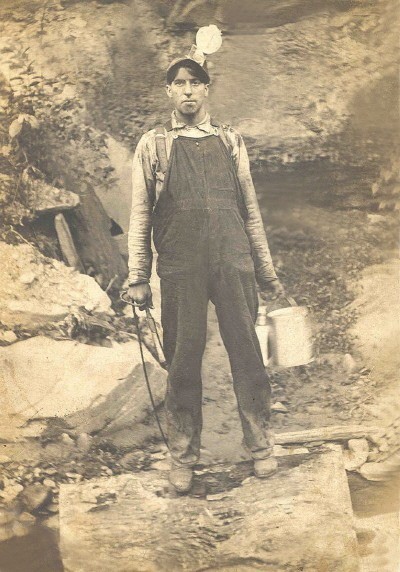
West Virginia Coal Miner 1

18 Wednesday Sep 2013

Posted by Brandon Ray Kirk in Coal

≈ Leave a comment

Tags

Appalachia, coal, culture, history, labor, life, photos, U.S. South, West Virginia

Harrison Smith

Harrison Smith

In Search of Ed Haley 171

18 Wednesday Sep 2013

Posted by Brandon Ray Kirk in Ed Haley

≈ Leave a comment

Tags

Appalachia, Ashland, blind, Ed Haley, Ella Haley, genealogy, history, Kentucky, Lawrence Haley, life, Mona Haley, Pat Haley, writing

“So when Larry and I got there, my mother-in-law, she was the one opened the door. I fell in love with her right away. And I didn’t see Ed until the next day. He was in bed and he was also hard-of-hearing and he didn’t hear us come in. Mom led us inside and, of course, Jack’s wife Patsy had the house very clean.”

One of the first things they did after arriving was eat a meal.

“Mom asked Lawrence, she said, ‘’awrencey boy, are you hungry?’ He said, ‘We’re starving, Mom.’ Well, Mom called upstairs and told Pat and Jack that we was here and they came down and Mom told Patsy we were hungry and Pat said, ‘Well, we don’t have much ready to eat. Would you like sausage and eggs?’ Well, I thought that was fine. But when these little patties came up… There was an oilcloth on the table — everything was clean and nice but the silverware was in a Mason jar in the middle of the table. I was just amazed that nobody set the table like I had been used to. I’d never seen sausage fried black. After dinner, they told us they had the bedroom upstairs fixed up for us. My mother-in-law had bought a new bedspread and new doilies for the dresser and Patsy had bought a lamp and some doilies and a picture for the wall. She’d really tried to fix up the room and make it nice for us. Mom had bought a very nice wardrobe and a dresser. The bed was Mom’s. The other furniture had belonged to Patsy and Jack.”

The next morning, Pat first met Ed.

“He came into the dining room and I was in the dining room, me and Larry. Larry just said, ‘Pop, this is Patricia.’ He just, you know, said, ‘Howdy do.’ And I went up to him to shake his hand. Larry had told me that I would have to go to him. If you looked at Ed Haley, it looked as though he was looking right at you. When I got up to him, Larry put his hand on my head and told him I was as short as Mom. Larry had told me that Pop would put his hands on me and check my head and face and my arms to see what kind of woman I was. He took his fingers — that’s the way he checked your features. And he could tell how you was built. Then he patted me on the shoulder to see what sort of made woman I was. But he had the smoothest hands. They were not a bit rough. Larry took Pop’s hand and put it on my belly and said, ‘See here, Pop.'”

Pat said she met Mona later that day.

“Mona came over the next day after I got here — her and her husband and her mother-in-law and her sister-in-law. Sometime after that, Mona came over and was playing a mandolin and her and Mom was playing. Mom played me some English tunes. And I don’t know how come they played but they got Pop to play a tune or two and he wouldn’t play much because he had whittled on his fingers and made them raw. He always loved my salmon. Course he called them salmon cakes. I call them croquettes.”

Leet, West Virginia

18 Wednesday Sep 2013

Posted by Brandon Ray Kirk in Big Ugly Creek, Timber

≈ Leave a comment

Tags

Appalachia, Big Ugly Creek, culture, genealogy, history, Leet, life, Lincoln County, photos, timbering, West Virginia

Leet, West Virginia, 1905-1920

Leet, West Virginia, 1905-1920

B. Johnson & Son

17 Tuesday Sep 2013

Posted by Brandon Ray Kirk in Big Ugly Creek, Timber

≈ Leave a comment

Tags

B Johnson & Son, Big Ugly Creek, D P Crockett, Henderson Davis, history, Jesse Hobbs, Joe Dodson, Lester Defibaugh, Sam Peyton, Stewart May, T J Bolin, timbering, West Virginia

One hundred years ago, one of the largest tie and timber firms in the nation came to Big Ugly Creek and changed it forever.

Around 1907, B. Johnson & Son of Richmond, Ind. bought several tracts of land on Big Ugly and soon established an extensive tie and lumber business.

B. Johnson & Son was headquartered at Leet, a lumber center at the mouth of Laurel Fork. It built a huge saw mill on large rocks. Nearby was a pond where logs were cleaned before sawing. There was also a row of houses called Stringtown.

T.J. Bolin of Huntington was superintendent of 250 men who worked at the mill. D.P. Crockett was the company doctor, while Jesse Hobbs was the saw filer.

Within a few years, B. Johnson & Son constructed a narrow gauge of railroad called the Guyan, Big Ugly & Coal River Railway (GBU & CRR), which extended ten miles from Gill, at the mouth of Big Ugly, to the head of Laurel Fork.

“There was a small train that used to run up and down this creek,” said the late Adam Adkins of Leet. “My wife’s father used to run it.”

B. Johnson & Son was big news in its hey-day. The county newspaper reported its weekly doings. noting especially when workers were hurt or killed.

“Joe Dodson, 25 years of age, and unmarried who was employed at the logging camp of Stewart May at the B. Johnson and Son’s works on Big Ugly Creek, was so terribly injured Saturday evening that he died the following morning,” according to the Lincoln Republican on November 3, 1910. “Dodson had a team of cattle pulling a heavy log and the latter in some way slipped in the snow that had just fallen and caught Dodson, knocking him down. The log was dragged over his left side and leg, mutilating the flesh of the member in a horrible manner and producing the fatal internal injuries.”

In the summer of 1911, B. Johnson & Son was occupied with extending the GBU & CRR into the head of Big Ugly. B. Spears was in charge of the project.

“The G.B.U. & C.R.R. is completed to Rector Postoffice,” the Republican reported on October 12, 1911.

Meanwhile, the mill experienced periodic setbacks.

“The big saw mill of the Johnson Tie Co. has shut down for a few days, the drive belt having given away,” the Republican noted in a less dramatic story on October 12.

That winter, work slowed down on the railroad, as it only extended one mile beyond Rector by December.

At that time, there was a change in the accounting staff at B. Johnson & Son.

“Lester Defibaugh, who has been the efficient bookkeeper at the B. Johnson & Son’s plant here for over a year has tendered his resignation to accept a place in a business house at Lynn, Indiana,” the Republican reported on December 21. “Henderson Davis, who has been keeping books on Upton, is here to take Defibaugh’s place.”

During the Christmas season of 1911, according to newspaper reports, B. Johnson & Son gave its employees a four-day holiday to spend time with family.

Work on the railroad continued at a snail’s pace.

“The new branch of the Guyan, Big Ugly and Coal River Railway has reached a point near the Big Sulphur Spring up Big Ugly,” according to the Republican. “The work is progressing very slowly now.”

By the following summer, things were in full swing at B. Johnson & Son.

“There are now ten logging jobs at the B. Johnson & Son timber shop above here but they have not yet succeeded in keeping the mill at Leet running every day,” the Republican reported on July 25. “Quite a force of men are in these camps.”

The railroad extension was nearing completion.

“The Big Ugly railroad has been extended three miles above this place and work is progressing nicely. The road will be built one mile further.”

Then, early one August morning, just as things were really chugging along, a terrible fire destroyed the mill at B. Johnson & Son.

“A very disastrous fire broke out about 6 o’clock Saturday morning at the big saw mill of B. Johnson and Son,” the Republican reported on Thursday, August 22. “Sam Peyton, the night watchman, was getting ready to go off duty when he noticed a tiny blaze shooting up from a point midway in the mill. He ran tot he place and prepared to get the fire apparatus about the plant in working order but the fire spread so rapidly over the inflammable stuff about the establishment that Peyton pulled the alarm whistle and then fled from the approaching blaze.”

Thereafter, Superintendent Bolin organized 100 men — the “Bucket Brigade” — to fight the fire using water from the nearby creek.

“Superintendent Bolin got a force of a hundred men to save the valuable lumber on the yard adjacent to the mill and covering some acres. The several ‘Dinky engines’ threw water on the blaze and this with a bucket brigade of scores of men worked for two hours and were finally successful in getting the conflagration under control.”

According to the Republican, Superintendent Bolin had no idea of the loss but speculated that it was near $20,000.

“The mill, one of the largest in this section, is a total loss. $2,000 worth of saws were virtually destroyed and nothing about the mill was saved.”

Fortunately, B. Johnson & Son carried insurance on the property. The company hired Bill Bench of Huntington to rebuild the mill.

In subsequent months, there were minor setbacks for B. Johnson & Son, such as the New Year’s Day train wreck.

“On New Year day the dinky engine, No. 618, on Big Ugly wrecked and had to have engine No. 944 to pull her back on the track,” the Republican reported. “No damage was done.”

By January of 1913, work was completed on the new sawmill, prompting the Republican to happily write, “The big band mill belonging to B. Johnson & Son has gone sawing. The new machinery works fine. The log train will get down to business in a short time as the new mill will whittle lots of logs.”

In that same month, Dr. Skelton replaced Dr. Crockett as the company doctor.

Around 1917, B. Johnson & Son left Big Ugly.

“I was still a little girl when the mill pulled out,” said the late Lula Adkins of Leet. “They tore down the houses at Stringtown and just left here.”

In Search of Ed Haley 170

16 Monday Sep 2013

Posted by Brandon Ray Kirk in Ed Haley

≈ Leave a comment

Tags

Ashland, blind, Ed Haley, Ella Haley, Farmers, immigration, Jim Brown, John Hartford, Kentucky, Lawrence Haley, Morehead, Pat Haley, writing

Early in March 1995, I fired up the Cadillac and drove the familiar road toward Ashland, Kentucky. After several hours of travel, I entered Rowan County — the place of Ella’s birth — and took the Farmers exit off of I-64. I wanted to get a closer look at Farmers, it being a place where Ella had lived, where Ralph was supposedly conceived, and where Lawrence remembered Ed playing for a dance. At one time, Farmers was the county’s largest town with 1,000 people. At the time of my visit, it was a small settlement, easily eclipsed by nearby Morehead.

A little later, I made my way into Morehead, a small college town with a curvy downtown business district and with most of its historical buildings torn down. It was somewhat disappointing. Triplett Creek, the Trumbo section of town, was dull and uninspiring. Small modern apartments replaced Ella’s old home place. Scenes of the Martin-Tolliver feud were long gone, removed to make way for a new road. At the college library, I found some interesting local history but nothing really pertaining to Ed and Ella’s story.

That evening, I arrived at Pat Haley’s home in Ashland. Pat was really down about Lawrence’s death and the progression of her daughter’s cancer. It was sad to be there – especially in the kitchen where Lawrence and I had spent so much time hashing out Ed’s music. Pat’s grandchildren were around frequently – especially David’s three daughters – but there was a great void in the house. I imagine it was a hundred-fold for Pat.

“We met August 14th, 1948, and he came back to America on November 5th,” she said of Lawrence. “We wrote to each other and I never saw him again until he came back to England and we met on Valentine’s Day, 1949. We married ten days later. I was almost eighteen. He was 21. I was staying with my sister in Hertfordshire, which is just on the outskirts of London. Larry came back to America in May, when he got out of the service. That’s when he told his mother he was married. Although she was writing to me, she didn’t know we were married. And she told him, ‘I suppose there’s a baby on the way.’ And he told her yes.

“I left England September 28th, 1949 on a Danish ship with a Polish crew. I was seven and a half months pregnant. It was a terrible experience. I went into false labor on the way over. The doctor was Polish and I never did understand a word the man said except ‘Haley.’ Had Beverly been born on that ship she could have claimed nationality to any country because we were in international waters. I got in this country on October 6th after eight days of choppy water. Larry met me in New York. We come past Staten Island and Ellis Island. I couldn’t see Larry on the dock but bless his heart he didn’t know he had to get a docking pass. He was stuck up at the barrier and here were all these people getting off the ship. And there was Larry in civilian clothes. It was the first time I’d seen Larry in civilian clothes. And one of the immigration officers said, ‘Why, he’s just a little boy.’

“We spent ten days in New York. Part of my luggage was lost and we were having some problem with some papers Larry should have gotten done. I didn’t know his parents were blind until we were in New York. I asked Larry what his mother thought of the pictures that he had given her of him and I, and he said, ‘She hasn’t seen them.’ And I said, ‘Why not?’ and he said, ‘She can’t see them. She’s blind.’ And I said, ‘Well, what did your dad think of them?’ And he said, ‘He’s blind, too.’

“We stayed in New York till October 16th. Just before we left, we had enough to buy a Spam sandwich and two apples in the bus station. He gave me the sandwich. It took us 24 hours to get from New York to Ashland. I got deathly sick on that bus ride. It was twist and turn over those mountains. It was about midnight when we got into Ashland and we had three cents in our pocket. Jack thought we would be there in the afternoon so he and Jim Brown had gone to the bus station and looked for us. They were drinking. Well, when we didn’t show up — I think it was between six and eight o’clock — they went back to the house. The bus station was located at 13th Street between Winchester and Carter Avenue. His parents lived at 1040 Greenup Avenue. So we walked and carried our suitcases and I had high heels on. We walked about six blocks — three down and three across.”

In Search of Ed Haley 169

10 Tuesday Sep 2013

Posted by Brandon Ray Kirk in Ed Haley

≈ 3 Comments

Tags

Alva Greene, Brandon Kirk, Ed Haley, fiddling, Fred B. Lambert, Huntington, J P Fraley, John Hartford, Kentucky, Lawrence Kirk, music, Pat Haley, writing

Not long after talking with Patsy, while on a trip through Kentucky, I visited J.P. Fraley. I had Ed’s fiddle with me, which excited J.P. greatly. He fiddled Haley’s version of “Granny Will Your Dog Bite?” as best as he could remember it and said Ed used to sing:

Granny, will your dog bite, dog bite, dog bite?

Granny will your dog bite?  “No, child, no.”

Granny will your dog bite, dog bite, dog bite?

“Johnny cut his biter off a long time ago.”

He said Ed also used to play “Hunky Dory”.

Between tunes, J.P. talked about how Haley was the top fiddler in his section of Kentucky. “Daddy and Alva Greene and Doctor Sparks and Frank Clay, Drew Crockett — reputable fiddlers, I called them — ever chance they got, they’d go listen to Ed Haley. He was the yardstick of the fiddlers in this whole area.”

J.P. said, “I’ve kept something for years, buddy. I’ve got a fiddle bridge of Ed Haley’s. I don’t know what it’s made out of.”

Apparently, when he borrowed the Haley fiddle from the Holbrooks years ago, he had kept a little memento before returning it.

In the next couple of weeks, I finalized plans for another “Ed Haley trip.” Pat Haley said I could stay at her place in Ashland, while Lawrence Kirk said I was welcome to stay with him in West Virginia. I called Brandon Kirk, the Harts genealogist, and arranged to meet him at the Morrow Library in Huntington. There he said we would have a lot of genealogical material at our fingertips, as well as all the room we needed to sort through our books and old photographs. I was very interested in the Lambert Collection, which he said was full of local historical information.

In Search of Ed Haley 168

08 Sunday Sep 2013

Posted by Brandon Ray Kirk in Ed Haley

≈ Leave a comment

Tags

Allie Trumbo, Cincinnati, Ed Haley, Ella Haley, Harts Creek, history, Imogene Haley, Liza Mullins, Mona Haley, Patsy Haley, Ralph Haley, West Virginia, writing

After getting familiar with the postcards, I called Patsy Haley to see if she could tell me any more about Ella’s young life with Ralph.

“Ralph was about five years old when Mom married Ed Haley,” Patsy said. “Ralph is not by Ed Haley. I figure that Mom and Pop must’ve got married about the end of the teens.”

I asked Patsy if Ed was very close to Allie Trumbo, who often wrote to Ella in her younger days.

“They weren’t really close or anything like that,” she said. “My husband and I moved to Cincinnati and that’s when I got acquainted with Allie and his wife. In fact, we lived right across the street from them. They really didn’t talk too much. Allie used to tell me about their father Mr. Trumbo auctioning off land and selling it for a dollar ’cause he owned quite a bit of land by that college. I think Mom had a falling out with him. Mom used to go and stay with them, like on weekends, when she’d go to Cincinnati to work. Allie had called her ‘Penny Ella’ ’cause when she paid them for staying with them she always paid them with change ’cause that’s what Mom got from selling her newspapers.”

Was Allie a musician?

“No, not that I know of,” Patsy said. “He was a fine pool player.”

Patsy didn’t remember Ralph making the records.

“No, that was just before I come in the family,” she said. “I don’t think he did any more recordings after I came into the family. You know, Mom had divorced when I come in the family and they never got remarried. But he lived in the house because the kids wanted him there. Now I can remember when I first came in the family and Mona and I talked, she was quite afraid of her father when she was a little girl because I guess he must’ve been mean. And he musta been abusive and mean to Mom or she wouldn’t a divorced him. But he was a sweet old guy when I knew him. I never ever saw Pop drunk or drinking. But I do remember one time — it was at the holidays — and Noah took his father and went up to Ferguson’s I believe for Pop to play music for them. Well, he kept them out all night ’cause I guess he got pretty loaded. But I never ever saw Pop drink. Now Pat said she had, but I never had.”

I updated Patsy on some of the things I’d found out about Ed’s past on Harts Creek and asked if she knew anything about his mother.

“He really didn’t talk about her too much,” she said. “Only thing that I understood — and he didn’t tell me this — Mom told me — that she was killed when the father was killed. There was never no bad feelings about his parents, either one.”

Patsy said she learned more about Ed’s parents on a trip to Harts in 1947.

“We went up to Harts Creek because Pop had gone up there and we went to get him back,” she said. “That was the first time I met Aunt Liza.”

Aunt Liza said Milt came from “the other side of the mountain,” and that he and his wife were buried up behind their old log cabin on Trace Fork.

“I can remember Aunt Liza pointing to where they were buried,” she said. “When she pointed up, she pointed over towards where the log cabin was.”

In Search of Ed Haley 167

07 Saturday Sep 2013

Posted by Brandon Ray Kirk in Ed Haley

≈ Leave a comment

Tags

Allie Trumbo, Ashland, Cincinnati, Clyde Haley, Ed Haley, Ella Haley, Jack Haley, James Brown, Kentucky, Margaret Arms, Ohio, Ralph Haley, Texas Anna Trumbo

On April 10, 1916, a postcard referenced Ralph for the first time. “Florence,” of Portsmouth, wrote to Ella, who had settled at 630 Curtis Avenue in Middletown, Ohio.

“Dear Friend,” she wrote. “I got your card. Was glad to hear from you. Kiss Ralph a dozen kisses for me. Ruth gave me Ralph’s picture and is awful sweet. Tell Mrs. Trumbo I said Hello. How do you like Middletown? Let me know how you and Ralph are.”

Ella was still in Middletown in December of 1916.

By November of 1917, Ella had settled at 913 10th Street in Portsmouth, Ohio. Today, this address (just around the corner from her former Portsmouth location) is an empty lot situated in a bad section of town. Ella’s brother Luther lived nearby on Gay Street, while brother Allie was away in the Army.

“Hello Sister,” Allie wrote. “I am now on my way to the training camp. Will arrive there Some time tomorrow. It is at San Antonio Texas Camp Travis.”

On January 10, 1918, “Miss Ella Trumbo” was living in Ashland, Kentucky. She remained unmarried, based on the usage of her maiden name in the postcard.

The next postcard is dated in the early 1930s. By this time, she had married Ed Haley.

On April 17, 1934, Ralph sent Ella a postcard from Fort Knox, Kentucky. It was addressed to “Mrs. J.E. Haley” at 1030 45th Street in Ashland.

“Having a fine time, leaving for Cal. Thursday,” Ralph wrote. “Wish you could go. Tell Allie, Jane, and the children hello.”

In another card from Ralph and postmarked from Fort Knox (April 19, 1934), he wrote: “Dear Mother. Rec. your letter yesterday. Glad to hear from U. I am leaving today for San Diego Cal. down on the mexican border. Am saving stamped envelope to write to U while on the train. do not try to answer till I send address. Your affecionate Son, Ralph.”

In May of 1934, there was a card from a sister in Cincinnati, Ohio (probably Sissy), which read, “Will be at your house a Bout noon Saturday. Will stay all night at Margaret’s. we will Leve circa in the morning.”

In April 1941, Clyde sent several postcards to the family at 337 37th Street from Washington, D.C. His message for “Monnie & Lawrence Haley” was: “Hello Kids! How is school now-a-days? Fine, I hope. Wish I could see you. I’ll be seeing you. Write soon.” To Jack: “How are you? Fine, I hope. I know I am. Wish you were here. It’s a great place.” To “Mrs. J.E. Haley”: “Am getting along Fine. Hope you’re O.K. Am Sight seeing in the mountains along Skyline Drive. Your affectionate Son.”

In May, Jack received this odd note from Louisville, Kentucky: “I thought may be I would write you a few lines to let you know I got in Louisville okay. Well Jack how are you getting along. Fine I hope. Jack how is the girls out in South Ashland getting along? Well you be a good boy honey and daddy will bring you a candy sucker. Well Jack I will have to close for now. It’s getting late. Jack it is Tuesday night. I am in Bed writing this card. Love James Brown.”

Clyde sent another card home from Cincinnati, Ohio, postmarked February 16, 1943: “Dear Mom: We are all well and hope you are the same. As soon as you send me my Birth Certificate I go to work. Get it tomorrow and send it. SALARY $33.50 a week. Go down town and get it and send it soon as possible.”

There was one final card dated April of 1943 from “Pvt. Ralph A. Payne” at Camp Crowder, Missouri. The Haley family was still at 337 37th Street.

In Search of Ed Haley 166

06 Friday Sep 2013

Posted by Brandon Ray Kirk in Ed Haley

≈ Leave a comment

Tags

Allie Trumbo, Ella Haley, Florida, history, Kentucky, life, Luther Trumbo, Mont Spaulding, Morehead, Ohio, Plant City, Portsmouth, writing

Ella was in Morehead as late as June 1911, where she received a card from “C.E.G.” reading, “I am living high. I go riding every day with my friend, Mrs. Mell Washington.”

Later in the fall of 1911, Ella was once again at 115 Woodland Avenue in Lexington, Kentucky. While there, one card was sent to her reading, “Well Ella, I got your card. Was glad to hear you Was all Well. Luther is Still here. Will Stay till you come home.”

Ella was back in Morehead by July 1912, where she received a card from Mont and Jim Spaulding postmarked in Richmond, Virginia. I wondered, was this the Mont Spaulding who was blind and played the fiddle around Kermit, West Virginia? In September, Mont and Dora Spaulding wrote her from Charleston, West Virginia:  “hello Ella. Did you get the card I send you from Va?”

“M. Spaulding” wrote to her again in November (although in a totally different handwriting), this time from Norton, Virginia. “It might be possible that my Daughter and I will see you about the last of this month.” The Spauldings apparently made the trip because Dora wrote Ella early in December, again from Charleston: “certainly did enjoy my short stay in your town.”

Ella’s postcards for the first part of 1913 were primarily from her brother Luther and were postmarked from Asheville, Knoxville, and Indianapolis.

In May, some friends sent her a postcard that read: “We would like very much for you to come up Sat. night and play for us. Come to stay all night if you can. Let us know if you will come.” At that time, Ella’s address was Clearfield, Kentucky, but she was in Morehead briefly the next month.

In September, she was in Farmers, Kentucky — her location when she became pregnant with Ralph. While in Farmers, she received a card from “Sissie” postmarked in Hitchins, Kentucky, reading “I am so Lonesome.”

In May of 1914, Allie and Texana wrote her in care of C.D. Davis.

“We are keeping house here in West Morehead and want you to come up and See us at once So Bring your Harp and harp rack with you So we can have some music So let us know When you are coming and we will meet you.”

In August 1914 Allie wrote to her in care of R.A. Thomas from Loveland, Kentucky.

“Well, Ella, I am thinking about getting married Sometime. I think I will and then I change my mind.”

In the next several months, Ella moved from Farmers to 1124 Gay Street in Portsmouth, Ohio. At that location, which is now a DMV parking lot, she received frequent postcards from a mysterious “R.B.” in Plant City, Florida. Only two of the cards were postmarked. In June of 1915, R.B. wrote: “Well, the Sun is Getting hot as H. Down hear.” In August: “I am at Cincinnati to Night But Don’t know whear I will Be to morrow.”

None of the remaining cards from R.B. are postmarked, making it impossible to arrange them chronologically. Here are some of the more interesting ones:

“My Dear friend. You Do Eny Thing with The money you want to. I will Try and Send you Some more wedensday if nothing happens. Don’t forget your Florida friend.”

“This is Tuesday Eve, and no Letter yet. Don’t no what to think if you are mad Rite and tell me what you got mad about. I am going to Kentucky next week.”

“Dear friend, I am Disipointed this Evening By Not getting a Letter. Hoping you haven’t Forgotten me.”

“I will Rite you a few Lines as I promest you. I guess you wish I wood quit Riting So much. Yes, Ella I wood Bee more Then Pleased to get That Picture we was talking about. I am Sorrow you are not well. Say Ella if you can Rite to me three times a week as I am So Lonesom hear. you have no Idea what I have to put up with.”

“I am going to do the Best I can till I can get away But what Ever you Do Don’t change Bording houses. Now you may think I am crazy But I no what I am talking about. I will Rite a Point Letter the first chance I have hoping to hear from you again Soon.”

“Yes Ella I guess you are tard of hearing that word Some Day But Don’t get worried I am going to Do the Best I can.”

“I am so Proud you think of me as often as you Do for I am so Lonesom hear.”

“I think you ort to Rite oftener Then you Do. Please tell me why you Don’t. I am worrying my Life away Faster Then Eny one on Earth. So Rite and cheer me up all you can.”

“This Leaves me feeling Bad This Evening. I was Expectin a Letter But got Disipointed. I will Start you That money Saturday if Nothing happens.”

“Why Don’t you Rite oftener. this is Tuesday Evening and I haven’t had a Letter since Saturday. I guess you are about to Forget me.”

“Some one Swears Thay are going Back to Ky. and I wood Be glad to get Rid of Them So keep quite.”

“Yes, Ella I am going to come Back Soon. I want to get a way From hear By the 20th of July if I can. Ella I can’t tell you wheather or not Maudie and Vada Noes eny thing about what. Guess at the Rest.”

“Say Ella the theater is Right By the Post office hear and the Piano is Playing Silver threads among the Gold. you can guess how I feal. I get so nervous Some times I can’t hardly Liv.”

In Search of Ed Haley 165

05 Thursday Sep 2013

Posted by Brandon Ray Kirk in Ed Haley

≈ Leave a comment

Tags

Allie Trumbo, Ella Haley, genealogy, history, Kentucky, Kentucky School for the Blind, life, Lula Lee, Luther Trumbo, Morehead, S.H. Childers, U.S. South, writing

When I got back in Nashville, I arranged all of Ella’s postcards into chronological order in the hopes of discovering some new revelation. Most of the cards were dated between 1908-1918, the years immediately prior to her marriage to Ed. Individually they carried only short messages from family and friends, but together they formed an interesting story line detailing events from Ella’s “single years.”

Ella was at the Kentucky School for the Blind in Louisville throughout the first part of 1908. She returned home to Morehead during her summer break, where friends wrote her fondly from Louisville, Nashville, Richmond, and Paducah. There was one card from “Bridget” – probably the same one that Lawrence remembered his mother visiting in Mt. Healthy, Ohio.

“Suppose you think I have forgotten you but think of you every day,” the card read. “Company season has started in and we are having plenty of visitors. Wish you were one. Your cousin Lula is expecting to go West for her health. She was much grieved to hear of the death of Aunt Henrette. Answer soon with love.”

In June of 1909, Ella received a card from “Loula Lee” in Denison, Texas. This was no doubt the same Lula Lee who Lawrence Haley had remembered playing music on the streets of Ashland at the same time as his parents, likely the same person as “cousin Lula” referenced in other cards.

“Hello Ella how are you,” Loula wrote. “all wright I hope. Got out here all right and I like Very Well. It is hot as Summer out here.”

There was also a card from Nellie Motts in South Portsmouth, Ohio.

“I rec’d your card a few days ago and was very glad to hear from you. I am having a delightful vacation. How did you enjoy the Fourth?”

Then this from “Mabel” in Mississippi: “I am away down in the Sunny South. Awful warm weather. I will be glad to get back to Kentucky.”

Ella was back in Louisville that fall where her brother Allie Trumbo sent several cards to her.

“Luther is at home now,” one read. “Please write within 23 hours this time.”

Luther was Ella’s other brother and a future soldier in World War I.

“Hello Allie,” she responded. “It seems as though you keep the road hot sending cards. Now I have written within 23 hours. What more do you bid me to do? The girls are waiting on you.”

Allie wrote back: “how is everything. We had a little rain last week. Please write within 22 hrs. I just got your letter out of the office and will write to you soon.”

“Thank you for the pretty card,” someone wrote from Providence, Rhode Island. “Am glad you are having a pleasant year. Be sure and do good work.”

More from Allie: “I couldn’t make out all of your card but I enjoy it very much. I will send you some cards of our town which will show the bridge and george’s house and part of grandmaw’s.”

“how are you?” one from someone named Cora in Morehead read. “We have biscuits this morning for breakfast and I am going to have fried potatoes for dinner and when I got your card last night we had beef steak.”

“You have been sending me the ugliest cards you can find,” Allie writes. “Try and do better. The creek was Higher than it ever was before Tuesday night.”

In November 1909, there was a “Forget-Me-Not” card from S.H. Childers postmarked in Hellier, Kentucky.

“I do insist on you sending me one of those pictures,” Childers wrote. “Never mind what it looks like.”

There were more from Childers, often signed, “Your lonely friend,” with passages reading, “I am not quite well now. Haven’t don any thing for two weeks. They tell me I am love sick but I don’t think that’s it.”

Bridget sent a Christmas card, signing her last name as Welsh, while another friend, “Flossie,” wrote a few months later.

“You may think I have forgotten you but indeed I have not,” she wrote. “Hope you are having a good time playing in the snow.”

In May 1910, Allie wrote from Portsmouth, Ohio.

“I came from Ashland on this Boat. We got here all O.K. and have got a job. Go to work Tuesday. I like to stay here.”

For the next several weeks, Ella received mail at 115 Woodland Avenue in Lexington, Kentucky. By June of 1910, she was back in Morehead. A card was sent there to “Miss Bridget Welsh & Miss Ella Trumbo” from Miss Henderson in Little Rock, Arkansas.

In July, there was another card reading, “Know you and Bridget are enjoying each others company.”

Late in August 1910 there was a card from “Aunt Anna” to Ella and Bridget: “arrived here all right. Am well and having a fine time. hope you are both enjoying good health.”

On September 7, “Oma” wrote: “Received your pretty card. I guess you will sure hate to see Bridget leave.”

Later in September was a card sent “With Fond Love” and stamped with a fanciful signature from S.H. Childress at the Sunset Ranch in Rhine, Washington.

“I have at last made up my mind to vacate Ky. and have done so. Will write you all a bout my future home when I get my slate.”

It seemed clear that this “S.H. Childress” was the same “S.H. Childers” who’d written Ella the previous fall. He wrote again in December.

“I believe is your first Xmas at home and I trust it will be the happiest you have ever spent.”

In Search of Ed Haley 164

04 Wednesday Sep 2013

Posted by Brandon Ray Kirk in Ed Haley

≈ 1 Comment

Tags

Ashland, fiddling, genealogy, Jack Haley, John Hartford, Kentucky, Lawrence Haley, Morehead, music, Pat Haley, Patsy Haley, Ralph Haley, Scott Haley

A few days later, I was in Ashland at Pat Haley’s house, where the Haley clan had gathered in for Lawrence’s funeral. All of Lawrence’s kids were there, of course (Beverly, Steve and David), as was Clyde and Mona. I also spotted Noah, who introduced me to his son, James Edward Haley (Ed’s namesake). Pat made a point to introduce me to Patsy Haley and her son Scott, who were in from Cleveland. A little later, I played Ed’s fiddle for Lawrence’s service and it sounded so good that I seriously considered making it my main fiddle on stage. I quickly slipped into “the zone” and it was the first time I seemed to experience (as crazy as it may seem) the sensation of Ed and Lawrence both whispering in my ear, guiding me along, looking over my shoulder, and saying things like, “Easy now, don’t play so many notes.” “Yeah, try that and see if it works.” “You’re getting too far away from the melody.”

After the funeral, I returned to Pat’s and played for the family in the kitchen. I wasn’t really sure what to expect. I mean, with Lawrence gone it would have been really easy for the Haleys to say, “Thanks for showing an interest in Pop, now see ya later,” but instead they took me into their fold — with Pat leading the way.

There were a few new stories. For instance, Patsy’s son Scott Haley told me about “catching” his father Jack in private moments playing a fiddle right along with Ed’s records. I was excited to hear that and could easily imagine that Jack was the child who had inherited Ed’s talent for the fiddle. But when I asked Pat and Steve about it they gave Scott’s claim little credence. They said Jack might have tried to play with the records but he couldn’t really play anything. They fancied Scott’s memory to be a lot like the one they had of Lawrence, who occasionally strung up Ed’s fiddle (backwards because he was left-handed) and attempted to play along with the records. I never forgot the possibility, though, that Jack Haley could play the fiddle, which seemed to irritate Pat.

Before I left Ashland, Pat gave me Ed’s records. She said she wanted me to keep them because I would “know what to do with them.”

“I have a real love-hate relationship with those records,” Steve said jokingly. “When we were kids we had to tip-toe through the house to keep from scratching them.”

Pat also loaned me Ella’s postcards and explained why Lawrence hadn’t wanted me to see them on my first visit roughly four years earlier. Apparently, they alluded to the fact that Ella had conceived Ralph not by a previous marriage — but out of wedlock. Pat said Ella was boarding with a Mr. Payne and giving piano lessons to his five-year-old daughter in Farmers, Kentucky, when she became pregnant. Mr. Payne promptly returned her to her family in nearby Morehead.

In Search of Ed Haley 163

03 Tuesday Sep 2013

Posted by Brandon Ray Kirk in Ed Haley

≈ Leave a comment

Tags

Appalachia, Ashland, Cincinnati, Ed Haley, fiddle, history, John Hartford, Lawrence Haley, life, music, Nashville, Portsmouth, U.S. South

Once I returned to Nashville, I called Lawrence Haley, who was in the mood to reminisce.

“Me and Pop hitch-hiked to Cincinnati out of Portsmouth a time or two,” he said. “We took old 52. And we’d had about three rides to get there.”

I asked him if Ed took his fiddle on those trips and he said, “Yeah, if he thought he was gonna be in a little bit other than country settings, he would put it in the case. But most of the time, he’d just carry it in his hand, tucked under his arm, maybe, with the bow in his hand.”

I wondered if Ed packed any extra bags on the road and Lawrence said, “Mostly just the clothes on his back, unless he was going on an extended trip — then he’d pack him a suitcase. He’d, of course, fill it up about a third with his homemade tobacco. His own cure — apple or peach or something. He’d take him some of that with him and off he’d go.”

Lawrence Haley passed away on February 3, 1995, the 44th anniversary of his father’s death.

Newer posts →

Feud Poll 1

If you had lived in the Harts Creek community during the 1880s, to which faction of feudists might you have given your loyalty?

Categories

  • Adkins Mill
  • African American History
  • American Revolutionary War
  • Ashland
  • Atenville
  • Banco
  • Barboursville
  • Battle of Blair Mountain
  • Beech Creek
  • Big Creek
  • Big Harts Creek
  • Big Sandy Valley
  • Big Ugly Creek
  • Boone County
  • Breeden
  • Calhoun County
  • Cemeteries
  • Chapmanville
  • Civil War
  • Clay County
  • Clothier
  • Coal
  • Cove Gap
  • Crawley Creek
  • Culture of Honor
  • Dingess
  • Dollie
  • Dunlow
  • East Lynn
  • Ed Haley
  • Eden Park
  • Enslow
  • Estep
  • Ethel
  • Ferrellsburg
  • Fourteen
  • French-Eversole Feud
  • Gilbert
  • Giles County
  • Gill
  • Green Shoal
  • Guyandotte River
  • Halcyon
  • Hamlin
  • Harts
  • Hatfield-McCoy Feud
  • Holden
  • Hungarian-American History
  • Huntington
  • Inez
  • Irish-Americans
  • Italian American History
  • Jamboree
  • Jewish History
  • John Hartford
  • Kermit
  • Kiahsville
  • Kitchen
  • Leet
  • Lincoln County Feud
  • Little Harts Creek
  • Logan
  • Man
  • Matewan
  • Meador
  • Midkiff
  • Monroe County
  • Montgomery County
  • Music
  • Native American History
  • Peach Creek
  • Pearl Adkins Diary
  • Pecks Mill
  • Peter Creek
  • Pikeville
  • Pilgrim
  • Poetry
  • Queens Ridge
  • Ranger
  • Rector
  • Roane County
  • Rowan County Feud
  • Salt Rock
  • Sand Creek
  • Shively
  • Spears
  • Sports
  • Spottswood
  • Spurlockville
  • Stiltner
  • Stone Branch
  • Tazewell County
  • Timber
  • Tom Dula
  • Toney
  • Turner-Howard Feud
  • Twelve Pole Creek
  • Uncategorized
  • Warren
  • Wayne
  • West Hamlin
  • Wewanta
  • Wharncliffe
  • Whirlwind
  • Williamson
  • Women's History
  • World War I
  • Wyoming County
  • Yantus

Feud Poll 2

Do you think Milt Haley and Green McCoy committed the ambush on Al and Hollene Brumfield in 1889?

Blogroll

  • Ancestry.com
  • Ashland (KY) Daily Independent News Article
  • Author FB page
  • Beckley (WV) Register-Herald News Article
  • Big Sandy News (KY) News Article
  • Blood in West Virginia FB
  • Blood in West Virginia order
  • Chapters TV Program
  • Facebook
  • Ghosts of Guyan
  • Herald-Dispatch News Article 1
  • Herald-Dispatch News Article 2
  • In Search of Ed Haley
  • Instagram
  • Lincoln (WV) Journal News Article
  • Lincoln (WV) Journal Thumbs Up
  • Lincoln County
  • Lincoln County Feud
  • Lincoln County Feud Lecture
  • LinkedIn
  • Logan (WV) Banner News Article
  • Lunch With Books
  • Our Overmountain Men: The Revolutionary War in Western Virginia (1775-1783)
  • Pinterest
  • Scarborough Society's Art and Lecture Series
  • Smithsonian Article
  • Spirit of Jefferson News Article
  • The Friendly Neighbor Radio Show 1
  • The Friendly Neighbor Radio Show 2
  • The Friendly Neighbor Radio Show 3
  • The Friendly Neighbor Radio Show 4
  • The New Yorker
  • The State Journal's 55 Good Things About WV
  • tumblr.
  • Twitter
  • Website
  • Weirton (WV) Daily Times Article
  • Wheeling (WV) Intelligencer News Article 1
  • Wheeling (WV) Intelligencer News Article 2
  • WOWK TV
  • Writers Can Read Open Mic Night

Feud Poll 3

Who do you think organized the ambush of Al and Hollene Brumfield in 1889?

Recent Posts

  • Logan County Jail in Logan, WV
  • Absentee Landowners of Magnolia District (1890, 1892, 1894)
  • Charles Spurlock Survey at Fourteen Mile Creek, Lincoln County, WV (1815)

Ed Haley Poll 1

What do you think caused Ed Haley to lose his sight when he was three years old?

Top Posts & Pages

  • History for Boone County, WV (1928)
  • Origin of Place Names in Logan County, WV (1937)
  • Early Anglo Settlers of Logan, WV (1937)
  • Early Coal Mines in Logan County, WV
  • White Family History at Pecks Mill, WV (1937)

Copyright

© Brandon Ray Kirk and brandonraykirk.wordpress.com, 1987-2023. Unauthorized use and/or duplication of this material without express and written permission from this blog’s author and/or owner is strictly prohibited. Excerpts and links may be used, provided that full and clear credit is given to Brandon Ray Kirk and brandonraykirk.wordpress.com with appropriate and specific direction to the original content.

Archives

  • February 2025
  • January 2025
  • October 2023
  • September 2023
  • December 2022
  • November 2022
  • May 2022
  • April 2022
  • February 2022
  • November 2021
  • October 2021
  • September 2021
  • June 2021
  • May 2021
  • April 2021
  • March 2021
  • February 2021
  • January 2021
  • December 2020
  • November 2020
  • October 2020
  • July 2020
  • June 2020
  • May 2020
  • April 2020
  • March 2020
  • February 2020
  • January 2020
  • December 2019
  • November 2019
  • October 2019
  • September 2019
  • August 2019
  • July 2019
  • June 2019
  • May 2019
  • April 2019
  • March 2019
  • February 2019
  • January 2019
  • December 2018
  • November 2018
  • October 2018
  • September 2018
  • August 2018
  • July 2018
  • June 2018
  • May 2018
  • April 2018
  • March 2018
  • February 2018
  • January 2018
  • December 2017
  • November 2017
  • October 2017
  • September 2017
  • August 2017
  • July 2017
  • June 2017
  • May 2017
  • April 2017
  • March 2017
  • February 2017
  • January 2017
  • December 2016
  • November 2016
  • October 2016
  • September 2016
  • August 2016
  • July 2016
  • June 2016
  • May 2016
  • April 2016
  • March 2016
  • February 2016
  • January 2016
  • December 2015
  • November 2015
  • October 2015
  • September 2015
  • August 2015
  • July 2015
  • June 2015
  • May 2015
  • April 2015
  • March 2015
  • February 2015
  • January 2015
  • December 2014
  • October 2014
  • September 2014
  • August 2014
  • July 2014
  • June 2014
  • May 2014
  • April 2014
  • March 2014
  • February 2014
  • January 2014
  • December 2013
  • November 2013
  • October 2013
  • September 2013
  • August 2013
  • July 2013
  • June 2013
  • May 2013
  • April 2013
  • March 2013
  • February 2013
  • January 2013
  • December 2012
  • November 2012

Enter your email address to follow this blog and receive notifications of new posts by email.

Join 2,925 other subscribers

Tags

Appalachia Ashland Big Creek Big Ugly Creek Blood in West Virginia Brandon Kirk Cabell County cemeteries Chapmanville Charleston civil war coal Confederate Army crime culture Ed Haley Ella Haley Ferrellsburg feud fiddler fiddling genealogy Green McCoy Guyandotte River Harts Harts Creek Hatfield-McCoy Feud history Huntington John Hartford Kentucky Lawrence Haley life Lincoln County Lincoln County Feud Logan Logan Banner Logan County Milt Haley Mingo County music Ohio photos timbering U.S. South Virginia Wayne County West Virginia Whirlwind writing

Blogs I Follow

  • OtterTales
  • Our Appalachia: A Blog Created by Students of Brandon Kirk
  • Piedmont Trails
  • Truman Capote
  • Appalachian Diaspora

BLOOD IN WEST VIRGINIA is now available for order at Amazon!

Blog at WordPress.com.

OtterTales

Writings from my travels and experiences. High and fine literature is wine, and mine is only water; but everybody likes water. Mark Twain

Our Appalachia: A Blog Created by Students of Brandon Kirk

This site is dedicated to the collection, preservation, and promotion of history and culture in Appalachia.

Piedmont Trails

Genealogy and History in North Carolina and Beyond

Truman Capote

A site about one of the most beautiful, interesting, tallented, outrageous and colorful personalities of the 20th Century

Appalachian Diaspora

  • Subscribe Subscribed
    • Brandon Ray Kirk
    • Join 787 other subscribers
    • Already have a WordPress.com account? Log in now.
    • Brandon Ray Kirk
    • Subscribe Subscribed
    • Sign up
    • Log in
    • Report this content
    • View site in Reader
    • Manage subscriptions
    • Collapse this bar
 

Loading Comments...