Tags
Appalachia, culture, Ferrellsburg, genealogy, life, Lincoln County, logging, Low Gap, Pat Kirk, photos, timbering, U.S. South, West Virginia

Pat Kirk hauling timber, Low Gap (near Ferrellsburg), Lincoln County, West Virginia, 1908-1920

19 Sunday May 2013
Posted in Timber
Tags
Appalachia, culture, Ferrellsburg, genealogy, life, Lincoln County, logging, Low Gap, Pat Kirk, photos, timbering, U.S. South, West Virginia
Pat Kirk hauling timber, Low Gap (near Ferrellsburg), Lincoln County, West Virginia, 1908-1920
19 Sunday May 2013
Posted in Ed Haley
Tags
Abe Keibler, blind, Catlettsburg, Ed Haley, fiddler, Greenup, history, Kentucky, music, New Boston, Ohio, Portsmouth, writing
A few days later, I called Abe Keibler, “last of the old Keibler fiddlers” in the Portsmouth area. The Keiblers had been top fiddlers in that part of the country according to Roger Cooper.
“I didn’t play with him, but I heard him play all the time,” Abe said of Ed. “That was back in the twenties when I was a hearing him. I’m 86. I was about eighteen or nineteen year old the first time I heard him. I saw him at Greenup, the county seat of Greenup County, on Labor Days and Fourth of July. He was on the courthouse ground playing around there. I remember one time he was playing on one side of the courthouse and they was a church group started up right behind him and he just stopped right then. He said, ‘I ain’t got nothing again’ the church, but this fiddling don’t go with church.’ And he went around on the other side away from them, you know. He was a nice old fella.”
I asked Abe to describe Ed and he said, “He dressed comely like. He had to wear a suit of clothes. He wore a hat. He was blind, I guess, about all his life. He knowed your voice if he’d ever talked to you. I remember one time a doctor up there came around and asked Ed to play ‘Turkey in the Straw’ and he said, ‘Hello, Doc! I ain’t seen you in a long time.’ Yeah, he was a good old man. He had the fiddle under his chin and held the bow back down there on the end. He was all over that neck a playing. And if you asked him to play a tune – I don’t care, maybe half a dozen – he’d play what you asked for. His wife played the mandolin and sung with him. They sung a lot of them old tunes back there. ‘Big Rock Candy Mountain’ was his main tune – he sung and played it on the fiddle. He played them old-time fiddle tunes. He mostly played down in the standard and in the ‘C’. He played ‘Sally Goodin’ and all them old tunes back there. ‘Turkey in the Straw’. He played some hornpipes, like ‘Big Indian Hornpipe’ and ‘Grey Eagle’.”
I had a lot of detailed questions for Abe about things Ed might have said when he was playing on the street, but he said Ed never got time to talk much.
“When I was around him, they was a crowd there and they kept him busy,” he said. “Quick as he could play one, somebody else had one in. They just kept him a playing all the time. He’d have a big crowd around him. Over there at New Boston, he had big crowds over there. He lived in Catlettsburg but he come down to New Boston when the mill was a running full and played there on them waiting stations and a lot of them mill-men come out there and they give him lots of money. He always had a cup on the neck of his fiddle and they dropped dollars. Back there then, why, they’d just throw their money in to him – five dollars, tens, and everything – and they was big money there then. He made a lot of money back in them days.”
18 Saturday May 2013
Tags
Alex Burton, Bill Farley, Catlettsburg, Crawley Creek, culture, history, Kentucky, Logan County, logging, Samuel S. Vinson, timbering, Vinson Goble and Prichard, West Virginia

Bill Farley timber contract (page 1 of 3), 1882
18 Saturday May 2013
Posted in Big Harts Creek, Music
Tags
banjo, Clifford Dalton, culture, Ezra Jake Dalton, fiddler, Harts Creek, history, James Browning, life, Lincoln County, music, photos, West Virginia

Clifford Dalton, James Browning, and Ezra “Jake” Dalton of Harts Creek, Lincoln County, West Virginia, 1935-1950
18 Saturday May 2013
Posted in Ed Haley
Tags
fiddler, harmonica, history, John Harrod, John Hartford, John Lozier, Kentucky, music, Ohio, Portsmouth, South Portsmouth, U.S. South, writing
A few days later, I called John Lozier, a harpist in South Portsmouth, Kentucky. I could tell right away that he was feisty. When I mentioned Ed’s name, he said, “Ed Haley played so soft and so smooth you had to listen when he played. Well, that’s about all I can tell you ol’ buddy.”
Of course, I wanted more.
I pressed John by asking where he first saw Haley.
“Sitting on Market Street over here in Portsmouth, Ohio, playing for nickels and dimes back in the twenties or early thirties,” he said. “That’s the way he made a living. Raised five children. Then after that him and his wife separated. Now, can you imagine that?”
John seemed so sure of his memories that I asked him about Ed’s repertoire.
“John Harrod always had me to play one tune — nobody else played it,” he said. “My grandfather knew it, called ‘Portsmouth Airs’. I play all the fiddle tunes on a harp. My grandfather made fiddles and played fiddles but he never would allow me to pick it up. He’s afraid I’d drop and break the neck out of it. So when I was three years old I started playing fiddle tunes — so they tell me. I’m 85…or will be.”
I wondered what the secret was to getting that old and being as healthy as he sounded to be and he said, “Ah, boy. I work every day at something. I got a garden here. I’ve got out a hundred pounds of taters and I planted some beans and my cabbage is out and I move around a little bit every day.”
I had more questions.
Did Ed play a lot of waltzes?
“He could play anything,” John answered immediately.
Did you ever hear him sing?
“If he ever sung a song, I never knew it.”
How did he hold his fiddle?
“Very loosely,” John said, confirming Mona’s memory.
John asked me if I ever got up to his part of the country, then said, “Well, old buddy, I’m fixing to go to church and it’s good talking to ya. I live at South Portsmouth. If you’re ever up in here come around and let’s take a look at one another.”
17 Friday May 2013
Posted in Ed Haley
17 Friday May 2013
Posted in Ed Haley
Tags
Abe Keibler, Asa Neal, Charley Keibler, fiddle, fiddler, Germany, Henry Keibler, history, John Keibler, Kentucky, music, Portsmouth, writing
After listening to the Lozier tape, I played a 1992 interview/jam session with Abe Keibler, last of the old fiddling Keiblers in South Shore, Kentucky.
“The first Keibler to come into this area was my grandfather, Henry C. Keibler,” Abe said. “He come here when he was 21 years old from Germany. I don’t know whether he played any music or not but they was some good ones in the uncles that raised me. The fiddlers was John and Sam and Henry and Charley but Uncle John Keibler, he was the best fiddler in the whole bunch. He won contest after contest. [When he was young and learning to play a fiddle,] his dad wouldn’t let him bring it into the house. My aunt told me he didn’t want to hear him screeking around on it, you know, so he took it out in the cornfield. My grandpap said, ‘Well, them boys is into something. I’m gonna slip out there to see what they’re into.’ And he sneaked out there and the old son was a picking the banjo, and him the fiddle and some a dancing. Then he said to him, ‘Well John, you can bring your fiddle in home now.’ Then he brought it in and it didn’t bother him no more. He was playing then good.”
Abe said, “Then I had an uncle, Charley ‘Shorty’ Keibler — they said he was an awful good left-handed fiddler, but I never heard him, see. Uncle Charley died young. He’s the one bought that old fiddle that I was raised with. Uncle Charley lived over in Portsmouth. Back then, they had old saloons and my other uncle John he tried to buy [this fiddle from a man there]. But [this man, he wouldn’t sell it to John. He] told Uncle Charley, he said, ‘Now, Charley, if you want that fiddle I’ll sell it to you for ten dollars.’ Well, he bought it [from the man] and Uncle John give him the money and he kept it over the years. He wouldn’t let me touch that fiddle though ’til I was sixteen years old. He didn’t want to hear me jigging around on it. He thought you ought to already know how to play, I guess. [Uncle John], he had a stroke and he tried to tune it up one day and he couldn’t tune it. And he told his nephew, said, ‘Take that fiddle and give it to Henry.’ Uncle John died on September 6, 1932. Then in ’55, I think it was, Uncle Henry said to his sister, ‘I’m gonna give old Abraham this fiddle. Next time he comes down I’ll give it to him.’ I went down and he said, ‘There’s the fiddle. She’s yours. Now, do whatever you want with it.’ He couldn’t play much then. He was sick. Henry died in 1959.”
On the tape, someone asked Abe about the Glenn Brothers, who I had heard about in connection with Clark Kessinger.
“Abe Glenn, I was named after him,” he said. “Bob Glenn, they said he was a real fiddler. I never heard either one — that was before my time. They said he was really about as good as you could find.”
Abe also remembered Asa Neal.
“When he first come here to play, he couldn’t play a hornpipe nor nothing — just them old blues. When I was about sixteen year old, he come there to my uncle’s and he learnt to play all of these old tunes. He used a lot of slip notes but he could get them in there, boy. He learnt to be a good fiddler, ol’ Asa.”
On the tape, Abe mostly played old standards — “Sally Goodin”, “Turkey in the Straw”, “Liza Jane” — but every now and then he came out with some obscure tunes, like “Portsmouth Airs”, “Headwaters of Tygart” and “Old Coon Dog”.
14 Tuesday May 2013
Posted in Ed Haley
Tags
Appalachia, art, Ed Haley, fiddle, history, John Hartford, Lawrence Haley, life, music, U.S. South
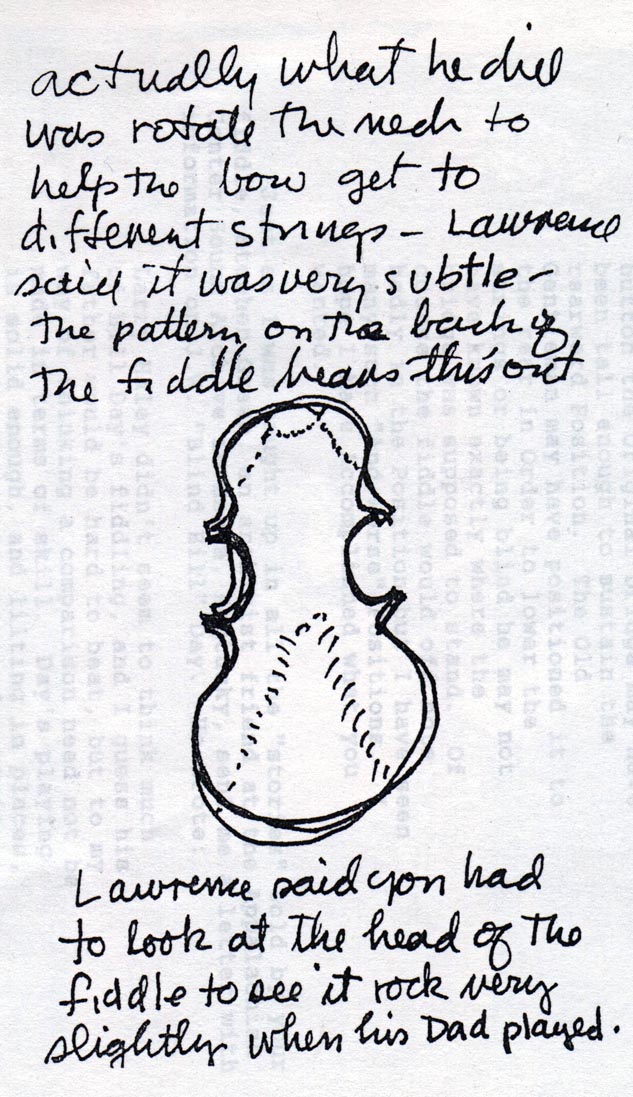
John Hartford sketch of the Ed Haley fiddle, 1992-1997
14 Tuesday May 2013
Posted in Ed Haley
Tags
Clark Kessinger, Dinky Coffman, Ed Haley, Ella Haley, fiddler, history, John Harrod, John Lozier, music, Ohio, Portsmouth, Portsmouth Airs, writing
One morning, in one of those unexpected surprise moments, I received in the mail from John Harrod, the Kentucky folklorist and musician, two cassette interviews regarding Ed Haley. One tape featured John Lozier, the harmonica master from South Portsmouth, speaking at a 1992 workshop in Berea, Kentucky. His memories were much more detailed on the tape than when I’d talked with him a few months ago and went a long way in helping me to understand more about Ed Haley’s Portsmouth experience.
“I started playing when I was three and a half, or so they tell me,” he said. “Well I had an uncle Walter Lozier that played a little harp. We lived in an old log house in Lewis County and he and I was sitting in this old door facing the railroad and he was playing and he handed me the harp and, so they tell me, I played ‘Red Wing’. I learned to play fiddle tunes on a harmonica from my granddad.”
John told about some of the better musicians around Portsmouth during the Depression era.
“At one time in Portsmouth, Ohio, during the thirties, there was no work,” he said. “You couldn’t get a job. And at that time, there was more good musicians in Portsmouth. They just sat around and drank a little moonshine and got good, but nobody ever made anything out of it. We had a group of fiddlers up home by the name of Keibler. They came from Germany. The old father brought the old Stradivarius fiddle and they have still got that in the family. They used to play one they called ‘Headwaters of Tygart’ and then they played one they called ‘Windin’ Down the Sheets’, then they played one they called ‘Nigger Hill’, played one they called ‘Rye Straw’, ‘Gettin’ Upstairs’, ‘Old Coon Dog’. And I learned to play fiddle tunes from the Kieblers, Ed Haley, Clark Kessinger, Harry Fry, the Mershons…”
John told about his experience with Ed.
“I met Ed Haley about 1929 or ’30,” he said. “He was a little old winked up fella with a little ol’ plug hat on. His wife sitting over here. Both blind. She played a banjo-mandolin. And he was sitting on Market Street in the lower end of Portsmouth, Ohio, playing for nickels and dimes in a hat box or whatever he had thrown down there. He had one of the boys with him. He was a fella that had little slim fingers like a woman and he played real soft and low. He wasn’t a loud fiddler. But he played so smooth and so soft you had to listen when he played. In other words, if he didn’t kindle your fire your wood was wet. I played several concerts with him and his wife. We had a fella by the name of Dinky Coffman that was on the entertaining committee at the Portsmouth N&W YMCA where people come in off the trains and slept and bought their meals. You could buy a meal for fifty cents, you could stay all night for fifty cents, and then they’d go back to Columbus or either to Williamson, West Virginia — and I’d worked there with him. I’d worked at Russell yards, one of the biggest railroad yards in the world.”
One of the tunes John said he’d learned from Ed was ‘Garfield’s Blackberry Blossom’, which he played almost note for note on the tape (minus the little ornaments and some of the “deeper” stuff that would be hard to get on a harp). He also played “Portsmouth Airs”, which he said was a Haley tune.
At that point in the tape, someone asked John about putting a lot of notes in a tune.
“Clark Kessinger could put more notes in a fiddle tune than any man I ever heard in my life and he played fast,” he said. “He was a big, tall, slim, skinny fella. Lived in Three Maples, West Virginia — right this side of Charleston, just off of I-64. I met him one time at a fiddlers’ contest back in the thirties at Portsmouth, Ohio.”
12 Sunday May 2013
Posted in Ed Haley
Tags
Appalachia, culture, fiddler, history, life, Morris Allen, music, Ohio, photos, Portsmouth

Morris Allen, Portsmouth-area fiddler
12 Sunday May 2013
Posted in Ed Haley
Tags
Asa Neal, Boneyfiddle District, Covington, Ed Haley, Ella Haley, fiddler, Greenup, Kentucky, Maysville, Ohio, Portsmouth, South Portsmouth, writing
Portsmouth, Ohio — the fiddler-rich city where Ed Haley frequently played during the Depression — is now a fiddlers’ graveyard. Historically, it was settled some two hundred years ago and has been the seat of government for Scioto County since 1808. For most of its existence, Portsmouth has been an industrial town comparable to Huntington or Ashland in that section of Ohio River country, although in recent years it has focused on tourism. It is accessed by Route 52 in Ohio or, more commonly, by Route 23 from Ashland. This latter route, also known as Country Music Highway (a real “speed trap”), runs northwest across the Boyd County line past the Flatwoods exit (hometown of Billy Ray Cyrus) and to Greenup, home of the late Jesse Stuart, Eastern Kentucky’s most famous writer. At Greenup’s 124 Front Street, the former home of Doc Holbrook still stands facing the mighty Ohio River. Beyond there, for a short distance, exists a stretch of rolling hills with the mighty Ohio flowing just out of view and almost no economic development in sight. Eventually, if traveling west on Route 23, South Portsmouth presents itself. South Portsmouth is connected to its mother city of Portsmouth by a bridge over the Ohio. Portsmouth is a beautiful river town. Its Boneyfiddle district, which basically includes Front and Second Streets between Market Street and the campus of Shawnee State University, showcases Victorian era buildings with a few antique stores and cafes and a series of well-painted city historical murals on a nearby floodwall. It is depressed economically but has a strong river heritage, which seems to be nearly forgotten in Ashland and Huntington.
Traditionally, Portsmouth has been a major stopping point for folks traveling in the Ohio Valley west to Cincinnati — whether it was loggers in Milt Haley’s day or musicians in Ed Haley’s day. Portsmouth was home to Asa Neal, a fiddler I ranked as second only to Ed Haley. Ed was very familiar with Portsmouth, as well as the nearby town of New Boston, where he played on sidewalks and in contests. Portsmouth had also been important in the life of his wife Ella, who had lived there at least twice before her marriage: at 913 10th Street and later at 1124 Gay Street (each address being in close proximity of each other).
Traveling west from Portsmouth, after a considerable distance through the northeastern Kentucky countryside, is Maysville, a former tobacco center and home of the late Rosemary Clooney, famous actress and singer. Beyond there is Augusta, the hometown of actor George Clooney, and beyond there still is the well-known metro area of Cincinnati, including Covington.
11 Saturday May 2013
Posted in Culture of Honor
Tags
Appalachia, culture, history, Kentucky, life, photos, U.S. South

Unidentified man with guns and dog
11 Saturday May 2013
Posted in Ed Haley
Tags
Appalachia, Ashland, culture, genealogy, history, Jack Haley, Kentucky, Lawrence Haley, life, photos, U.S. South

Lawrence Haley and Jack Haley, Ashland, Kentucky, 1940-1953
11 Saturday May 2013
Posted in Ed Haley
Tags
blind, Clyde Haley, Ella Haley, fiddle, fiddler, Harts Creek, John Hartford, Kentucky School for the Blind, Lawrence Haley, Mona Haley, music, West Virginia, writing
I asked Lawrence if he knew anything about his brother Clyde supposedly trying to play the fiddle.
“Well, he never said anything about it to me and if he ever played the violin I never saw him, John,” he said. “But he did sit around and play a little on the guitar. Then he got away from home and got in some kind of industrial accident working in a woodshop or something and a band saw got his fingers. Mona, she’d take off with Pop a lot of times up into West Virginia and they’d be gone a week or two. She went with him as much as any of the rest of us did. Most of the time whenever I’d go, there’d be my mother, too.”
I told Lawrence what Wilson Douglas had said about Ed being able to get around extremely well on his own.
“I can remember, just like going up Harts Creek,” he said. “Remember where you turn off to the Trace Fork they got a big new church and stuff? They wasn’t anything in there then. They wasn’t even a road. People made their own footpaths around close to the hillside. Most of it was just pathways. And that’s how Pop could go from one house to another, I guess. He’d know when he was on that path — how many steps or something it was from his place to anybody else’s he wanted to go to. It’d be like if somebody could count the streets in succession — if they’re numbered streets… Mom could get around Ashland here anywhere she wanted to by herself, but Pop wasn’t too good at that. He couldn’t keep track of how many blocks he’d walked or where he’d started from a lot of times. He just didn’t have the training, I guess, to learn how to handle hisself as a blind man. Mom went to that Louisville School for the Blind. She was there about twelve or thirteen years, I reckon, and they taught her piano music.”
Lawrence told me more about his memories of his father’s appearance.
“He walked fairly fast and upright as a fence post with his shoulders throwed back,” he said. “He was no slouch. He set in his chair upright. A lot went through his mind, I know that. He used to tell me, ‘Son, if a man can think it up and imagine it, then it’s possible.’ In later years, he was always having some problems with his arms and hands. I remember him shaking his hand real vigorously, like he was trying to get circulation going back in it. He’d walk through the house a lot. ‘Course he’d go up and down the street some. If he felt like he wanted a beer or something, he might get out and go and play down at Russ’s Place half a day and drink what beer he wanted to and then he’d come home. I’ve seen Pop get pretty high at times.”
Lawrence said, “Well, I’ve tried to think and tell you everything I know my dad did. If I’m helping you at all, I’m tickled to death. I didn’t know him that long. He was about 44 or 45 when I was born. I went into the service when I was about eighteen and I wasn’t out of the service maybe a year and a half and he was dead.”
10 Friday May 2013
Posted in Ed Haley
Tags
Ed Haley, fiddle, fiddler, history, Homer Dillard, inspiration, John Hartford, Lawrence Haley, music, photos, U.S. South
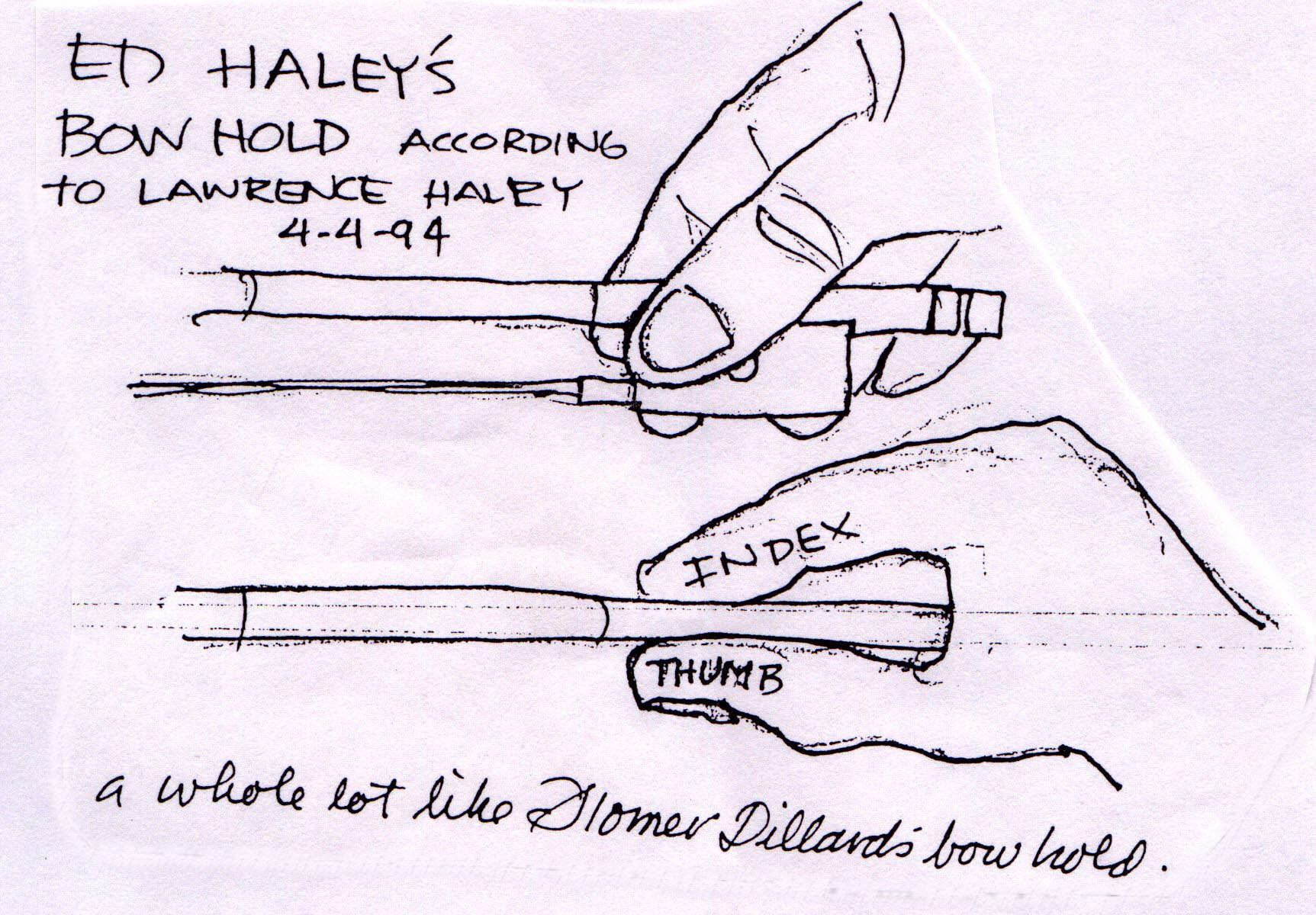
Ed Haley bow hold, according to Lawrence Haley, 1994
10 Friday May 2013
Posted in Ed Haley
Tags
Appalachia, Cacklin Hen, Clark Kessinger, Ed Haley, Ella Haley, fiddle, fiddler, Flop-Eared Mule, history, John Hartford, Lawrence Haley, music, writing
I called Lawrence Haley a little later after working more on Ed’s music to brag on the phrasing and intonation in his father’s playing.
“Well,” Lawrence said, “that’s one thing with the bow I’d never be able to learn anyway. What pressure to put to emphasize a note or to quiet a note down. Pop did that from one end of the bow to the other. If he was holding it up and he was plumb out at the end of the bow, I know he had to put more pressure with his hand downward toward them strings to really emphasize the note. And when he got to the other end, he had to slack off a little bit I know to get the same emphasis. I guess running from one end of the bow he was all the time changing the pressure of the bow on the strings to get what he wanted. Now, that’s about all I know about bowing anyway. You gotta have room on your bow. When he knew he couldn’t make a certain note when he’s down at the short end of it, then he would reverse it but he did it in a way that you couldn’t tell which way he was going with the bow hardly. He skipped the bow on some tunes you know as he was playing it. I’ve seen him get out there, as it started down towards the handle end, he’d skip it maybe to get some notes and the way he wanted to play that piece of music. Like the ‘Cacklin’ Hen’, when he’d get down to where that hen let out that squall dropping that egg, it sounded just like an old hen just jumping right off a nest. And that ‘Flop-Eared Mule’, you can hear that mule bray if you want to listen to it.”
I told Lawrence one of the things I was trying to figure out was how Ed could hold the fiddle down from his neck and still get up into the higher positions. Lawrence remembered his father doing it.
“I’ve seen his hands run up and down the neck of the fiddle. He always did that. He’d go way down on the neck of the fiddle.”
Beyond that, Lawrence said he couldn’t get into the specifics.
“I really couldn’t say anything more about that, John. But right in there about the armpit is where he laid the fiddle. I don’t know whether he used chest muscles to kinda control it too, and shoulder and arm muscles, I really don’t know. That would take a real master to sit around and watch that and know exactly what you’re looking for. A lot of times when Pop and Mom was a playing, I’d be off somewhere else. However he mastered that fiddle, I couldn’t tell you. The guys that watched him, they mighta knowed partly what they was looking for. I guess the only one that come close to his style of playing was Clark Kessinger and he watched Pop a lot. Pop would say, ‘Yeah, I knew he was there, but he never would play for me.’ Pop was liable to criticize him or he might try to help him, but Clark wouldn’t let him. He was just there after the knowledge that he could garner from Pop’s style by watching him.”
09 Thursday May 2013
Posted in Ed Haley
Tags
Appalachia, Clay County, culture, fiddler, French Carpenter, history, life, music, photos, U.S. South, West Virginia, writing
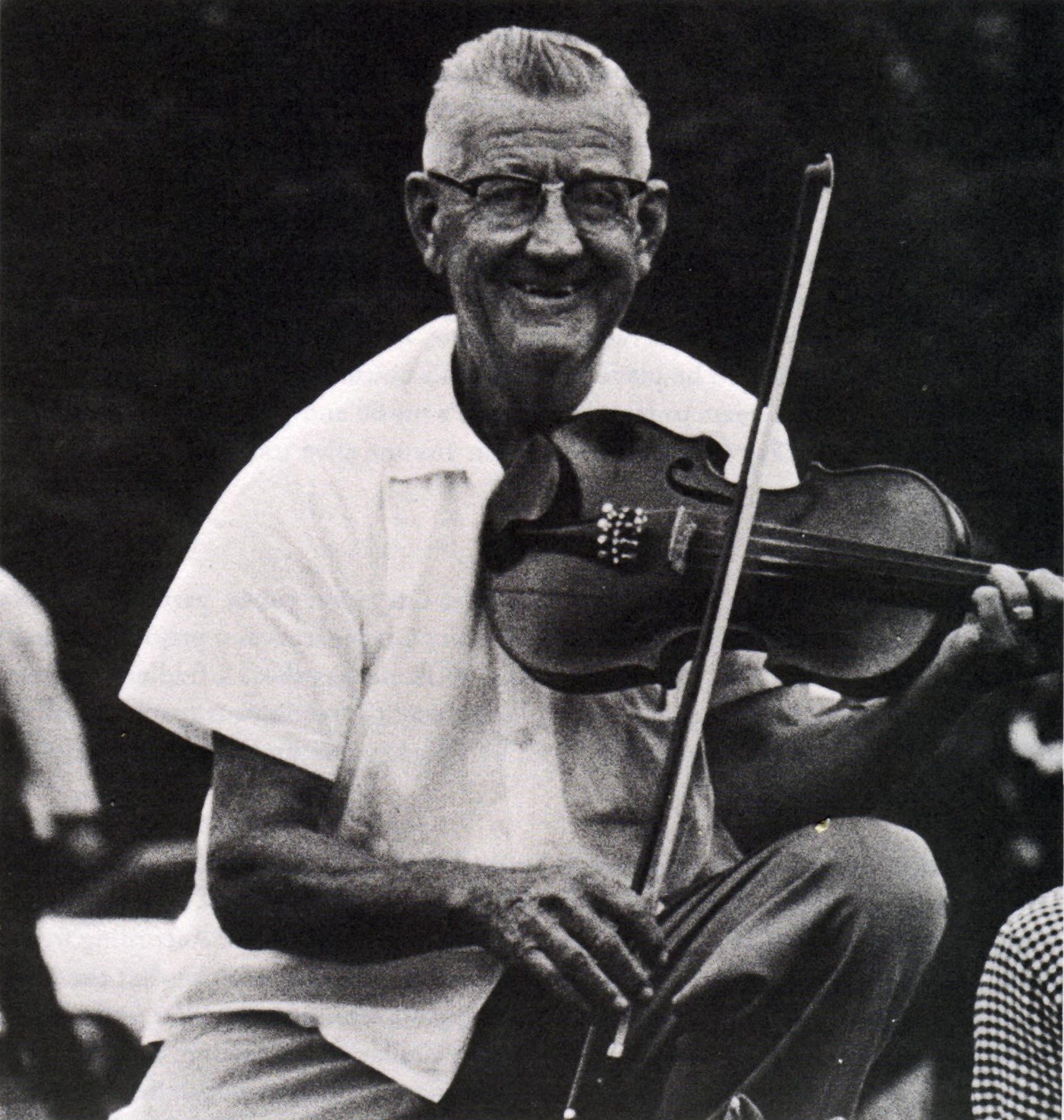
French Carpenter, fiddler from Clay County, West Virginia, 1955-1965
09 Thursday May 2013
Posted in Ed Haley
Tags
Appalachia, Arthur Smith, Clark Kessinger, Ed Haley, fiddler, French Carpenter, history, John Hartford, music, Ugee Postalwait, West Virginia, Wilson Douglas, writing
Wilson well remembered Ed “rocking” the fiddle as he played.
“His violin rocked continuously on his chest,” he said. “I mean it rocked like a rocking chair. That’s the only fiddler I ever seen do that. He told me one time, he said, ‘Wilson, I don’t play the ‘Mockingbird’. It’s a hard matter to play the ‘Mockingbird’ unless the violin is placed under your chin.’ He really commended Arthur Smith on the ‘Mockingbird’ and Clark Kessinger, but he didn’t play the ‘Mockingbird’ at all. I’m sure he could’ve. He could play anything. I’ll put it this way, sir. I know a lot of great fiddle players. Well, I’ve seen French Carpenter — he was good — and Clark Kessinger was good but I think Haley was one of the greatest as far as I’m concerned. He was a legend in this country and in any country that knew about him.”
I asked Wilson about Ed’s fingers, like whether they came up off the fingerboard very high when he was fiddling.
“John, I’m gonna tell you like it is,” he said. “You could hardly tell the man was changing notes. His fingers practically stayed on the fingerboard and they moved like worms. Now that’s it in a nutshell. And his fingers was about as big around as a writing pencil. He had fingers more like some lady typist, you know what I mean. But I could understand: he never did any work to build his hands up other than play that fiddle. And he told me once — somebody had made the remark about not being able to note with your little finger, you know — Ed said, ‘Well, I’ll tell you what you gotta do to play the fiddle. You got to use all four of them and use your thumb, too, if you can.’ He had a sense of humor in a way, you know. And he said, ‘Son, get some soul out of your fiddle. Don’t play it to just hear the wind blow.'”
I asked Wilson if he remembered the names of Ed’s tunes.
“He played a tune he called ‘Harry in the Wildwood’,” he said. “Carpenter played it and I used to play it, but danged if I ain’t forgot it. It was a good tune. And then he played a tune he called the ‘Silver Lake’. It was on the bass. It was a four-string tune. God, he pulled a note on that bass that was out of this world. The more bass, the better he liked it.”
Wilson didn’t remember Ed singing much.
The only song he sung was “Frankie and Johnny”, which I had heard from Ugee Postalwait some time earlier. “Oh yeah,” Wilson added. “He called it ‘Old Billy Lyons’.” Unlike Ugee, who stressed Ed’s singing, Wilson emphasized Ed’s fiddling. “He had a beautiful voice,” Wilson said, “but he liked to concentrate on them hoedowns. He and Clark Kessinger would play that ‘Dunbar’ and he said, ‘Now, I’ll tell you Wilson. Clark plays that well, but they’s a little bit of bow work in there that he never did get, but I never would mention it to him.’ But he commended Clark constantly. I heard him say several times, ‘They’s very few men, maybe three out of a hundred, can play that fast and get clear notes.’ He liked Clark. He also liked Arthur Smith — some of Arthur’s tunes.”
I told Wilson that Haley supposedly hated Arthur Smith and he said, “Well, he said he didn’t know all that many tunes, but what he knew he was real unique at it, you know.”
I tried to jar more of Wilson’s memories of Ed’s repertoire by naming off some of the titles from Haley’s home recordings. He had some great comments.
“Oh God, that ‘Bonaparte’s Retreat’, he was good on that. But now that ‘Three Forks of Sandy’, they’s another tune related to that. I used to play it a little bit. He called it the ‘Three Forks of Reedy’. That’s a creek over here in Calhoun County. It empties into the Little Kanawha River. That tune is as old as the hills.”
When I mentioned “Hell Among the Yearlings”, Wilson said, “Oh God, he had the world beat on that.”
As for “Blackberry Blossom”:
“Well, he was awful good on the ‘Blackberry’. Well, to tell you the truth, they wasn’t nothing he was bad on. That’s the whole bottom line. Everything he played was good.”
I asked Wilson if he remembered what key Ed played a lot of his tunes in and he said, “Well, he played a lot of tunes in the key of C, like ‘West Virginia Birdie’ and the ‘Billy in the Lowground’ and ‘Callahan’. And he didn’t play much in the key of E. Very little in the key of E. Ed’s main key was G, C and D and A. However he could play in E-minor or he could play in A-sharp, or any of the sharps that he wanted to, but he stuck pretty close to the regular standard mountain music key.”
How about B-flat?
“Oh god, yeah. Like ‘Hey Old Man’ and the ‘Lost Indian’. Stuff like that. Oh yeah, he played a tune in B-flat, he called it ‘Boot Hill’. And he said the tune came from out West back in the old days. Somewhere back in the 18 and 80s.”
Wilson said he couldn’t play those tunes anymore.
“It’s been so long. I can remember a few tunes, but yet I can’t get them together anymore. I quit for about seventeen years.”
08 Wednesday May 2013
Posted in Ed Haley
Tags
Appalachia, Calhoun County, culture, genealogy, history, life, Minnie Hicks, photos, Russell Shaver, U.S. South, West Virginia

Minnie Hicks (right) with son, Russell Shaver, and unknown woman, Calhoun County, West Virginia, 1905-1915
08 Wednesday May 2013
Posted in Ed Haley
Tags
Appalachia, blind, Calhoun County, Ed Haley, fiddle, fiddler, history, Laury Hicks, music, U.S. South, West Virginia, Wilson Douglas, writing
Taking Bobby Taylor’s advice, I decided to call Wilson Douglas and ask him more about Ed Haley.
“You know, he’d come to Calhoun County, West Virginia, which borders Clay County,” Wilson said. “And there was an old gentleman over there by the name of Laury Hicks. He played the banjo for him a lot and also the fiddle. Now, he was a hell of a fiddler. Ed said the first time he went over there, Hicks was setting on the porch playing the ‘Arkansas Traveler’ — him and Cheneth on the banjo. And he said, ‘Wilson, I thought I was up against it right there. That old Hicks was a powerful hoedown fiddler.’ I knew it when I was a boy.”
I asked Wilson how Ed looked back in those early days, hoping to glean more personal and less-musical memories this time around.
“He would weigh about 185 pounds and he had a large-like stomach on him and he had little tiny feet,” he said. “When he went to a strange place, he would have me to lead him one time to the kitchen, one time to the living room, one time to the outhouse and that was all after that. He didn’t ask you to go no place with him and he walked like a cat, you know — very quick, very active man. He moved like a mountain lion. I’d say, ‘Now slow down a little bit Ed, and I’ll let you get the feel.’ But he picked his feet up fast, you know what I mean? And he could tell if you was a tidy housekeeper or a messy housekeeper. When he wasn’t playing the fiddle, he was continually moving his fingers — just like he did it so much that he did it unconsciously. He was an oddball. He didn’t fool with very many people — very withdrawn. Now when he got with a gang of mountain people playing music, he was very talkative then.”
Wilson said, “I was sixteen or seventeen years old and he saw I was interested in the fiddle and he sorta took a liking to me and he talked to me quite a bit. He treated me nice but he was a very obnoxious, sarcastic man if he didn’t like you. If he liked you, fine, and if he didn’t, he’d do his thing and that was it. And I’m gonna tell you something about Ed Haley. In as much as he was blind, especially if he’d had a drink or two, he was a dangerous man. He was a mean man. But he had an awful sense of feel. He had this sense of knowing when anything was close. He knew when he wasn’t in danger. He said, ‘Wilson, I went to a place one time,’ and he said, ‘it was rough, the people was rough.’ And said, ‘This man took me to the outhouse. I come back and I thought I could go myself.’ And said, ‘I must’ve got a little bit out of the path. I was fixing to make a step and something told me not to do it and I pulled back.’ And said, ‘I turned around and went back,’ and said, ‘I just liked one step of falling in that big, dug well.’ Now, that was the kind of good sense of feeling he had, you see?”
Writings from my travels and experiences. High and fine literature is wine, and mine is only water; but everybody likes water. Mark Twain
This site is dedicated to the collection, preservation, and promotion of history and culture in Appalachia.
Genealogy and History in North Carolina and Beyond
A site about one of the most beautiful, interesting, tallented, outrageous and colorful personalities of the 20th Century

 Brandon Ray Kirk