Tags
Appalachia, culture, Dood Dalton, fiddler, Harts Creek, history, Laura Adkins, life, Lincoln County, love, Nary Dalton, photos, West Virginia
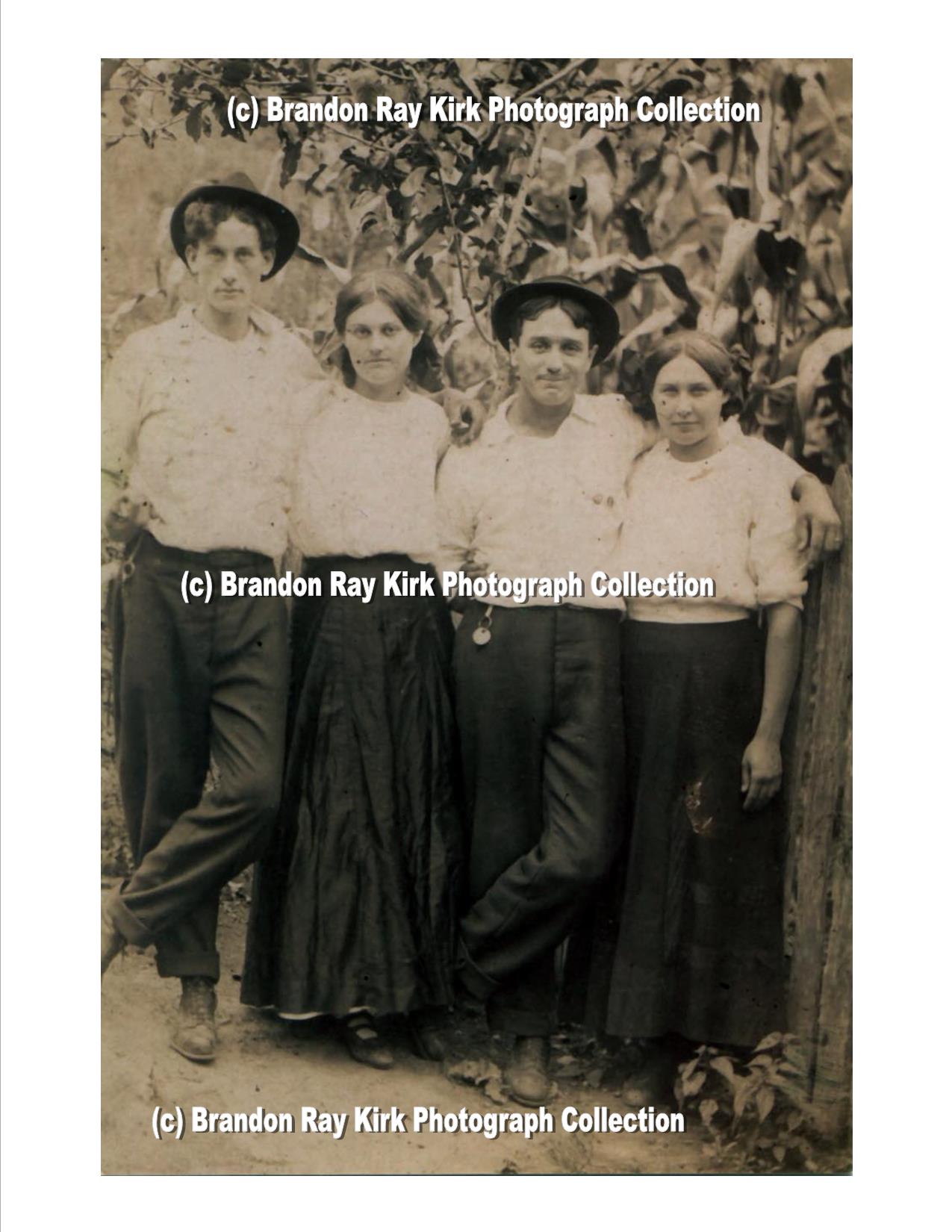
Dood Dalton, Nary (Adkins) Dalton, unknown man, Laura Tomblin

13 Thursday Mar 2014
Posted in Big Harts Creek, Ed Haley, Music
Tags
Appalachia, culture, Dood Dalton, fiddler, Harts Creek, history, Laura Adkins, life, Lincoln County, love, Nary Dalton, photos, West Virginia
Dood Dalton, Nary (Adkins) Dalton, unknown man, Laura Tomblin
13 Thursday Mar 2014
Posted in Big Harts Creek, Ed Haley, Music
Tags
Clabe Tomblin, Dood Dalton, Ed Haley, Ella Haley, Ezra Jake Dalton, Harts Creek, history, Jeff Mullins, Lincoln County, Liza Mullins, Logan, music, Nary Dalton, Tootsie Tomblin, West Virginia, writing
We later drove to see Tootsie Tomblin, a younger sister to Jake and a neighbor on Big Branch. Tootsie greeted us at the door, flanked by her tall husband Clabe, and a small nut-cracking housedog that barked at our every movement — even after we’d sat down at a large eating table in the dining room.
Tootsie referred to Ed Haley as “Uncle Ed” and said her whole family loved him. She said he was “a great person…so understanding.” Ed was particularly close to her mother, Nary Dalton.
“Ed thought the world of my mother. He thought my mother was the finest woman he had ever laid his eyes on. And he’d tell her, he’d say, ‘Come over here Nary and set down beside me. I want to talk to you a little bit.’ And he’d tell her everything about hisself, and about his wife, his children and everything. He loved her cooking.”
Tootsie laughed.
“Daddy had a whole litter of kids and we all had nicknames but Mommy insisted on calling us by our real names. And Ed, being blind, couldn’t figure out why there were so many kids in the home. He called for Mom. ‘Hey Nary, come in here and set down beside of me.’ Mom went to him and said, ‘What are you a wanting, Ed?’ He said, ‘I’ve listened for three or four days and I’m kind of buffaloed.’ She said, ‘What are you buffaloed on?’ Ed said, ‘You got too many kids. All of these names don’t add up. What are we a doing with all these names?’ Mom laughed and then explained it to him.”
Before we could ask Tootsie any more questions, she showed us several small boxes of old family photographs while feeding us donuts, pie and milk. I asked her if she remembered much about Ed coming to her father’s house.
“They was a funny family of people,” she said. “I mean, they had peculiar ways. They was different. Them people went clean as pins. You never seen them dirty. Ed could take care of them good as I could mine and me with eyes. When Ed spoke, he spoke with authority. They knew he meant what he was saying. He’d say, ‘Now, that’s enough,’ and that was it. He never had to whip his kids.”
Tootsie said Ed mostly visited Dood at his first home (“Jake’s place”) and never brought his wife with him. Later, after her father built his new house in 1951 (her current home), Ed only came a time or two. On his last trip, he had a Jacob Stainer or a Stradivarius violin with him.
“He was here in the fall and died the next summer or maybe that winter,” she said. “One of his boys brought him here.”
When Ed was in Harts, he traveled a lot with Jeff Mullins, a simple-minded man and brother to Aunt Liza who stayed with the Adams family. In Logan, he played with his wife or a colored man.
I asked Tootsie if she remembered a lot about how her father played the fiddle. She said she was sure that he played with the fiddle under his chin. Some of his tunes were “Cacklin’ Hen”, “Wednesday Night Waltz”, and “Bear Dog” — basically what Ed played. He could also play a little on the guitar and sing. Tootsie really bragged on Ed’s singing — like his “Coming Around the Mountain” — and kind of caught us off guard when she said, “Buddy, Ed Haley could dance. He was a chubby fellow but he could move. That old man could move.”
11 Tuesday Mar 2014
Posted in Big Harts Creek, Ed Haley, Music
Tags
Bernie Adams, Billy Adkins, Dood Dalton, Ed Haley, Ella Haley, Ezra Jake Dalton, fiddlers, fiddling, Harts Creek, history, Lincoln County, Logan, Mona Haley, moonshine, Nary Dalton, West Virginia, World War II, writing
Along the way, we stopped and picked up Billy Adkins, who guided us to Jake’s home on Big Branch. Jake, we found, was a little skinny fellow, somewhat quiet, and — I was told — a decorated World War II veteran.
I asked Jake if he remembered the first time he ever saw Ed.
“I don’t remember that,” he said right away. “I was born in 1916 but I didn’t stay at home like the rest of my family. I’d slip off from home here when I was a little bitty fella and maybe stay a week or two before I come back or they’d come get me or something another. Then after I got up in years, I joined the Army and I stayed over four years in the Army. I was in there nineteen months before they bombed Pearl Harbor. So I didn’t stay home like the rest of the kids.”
A little later in the conversation, Jake made it clear that he remembered more about Ed and his family than he realized.
“He stayed with Mother and Dad a lot, Ed did, and them young’ns,” he said. “She was a music teacher, the old woman was. She was from out of Kentucky and he was off’n Harts Creek. They had about five, six children.”
I asked Jake how long Ed usually stayed with his father and he said, “Aw, he might stay a week. They’d go up there at the courthouse at Logan and play music, him and her, and she had this little boy tied to the rope so she could draw him in you know out on the sidewalk. And somebody give him some pennies and he had them pennies you know and he dropped them and she started drawing them in. He ripped out a big oath, ‘Wait till I get my money!’ You know, they couldn’t see what they done or nothing.”
Sometimes, Ed left his kids with Dood when he was playing in Logan.
“Now them kids, they was pretty mean, but people most of the time helped him correct them,” Jake said. “They raised one girl, Mona. That girl, she was a bad one. She’d run up and down the road with them boys if Dad didn’t get after her. She was just a young gal, you know. Ed, he didn’t care if you corrected them kids. If you busted the hide on one that was all right.”
Jake didn’t remember much about Ed’s appearance other than that his eyes were “milky-looking.”
When Brandon asked him what it was like to hang around with Ed, Jake said, “He talked to Dad a whole lot. He said to my dad one time, ‘Dood, where do you think hell’s gonna be at?’ Dad said, ‘I never thought about where it’s gonna be, Ed.’ He said, ‘I have an idea where it’s gonna be. I believe it’ll be on the outside of this world.’ He was a good ole man in a way, but he was bad to drink in a way.”
Oh…so Jake remembered Ed drinking.
I asked him if Ed drank a lot and he said, “No, I never did see him come to Dad’s drunk. Dad didn’t allow no bad stuff around his house, even when he wasn’t a Christian.”
Jake thought for a second, then said, “Ed was a healthy eater. He’d come in there — get up for breakfast — he’d say to my mother, ‘Nary, have you got ary onion?’ And she’d get him an onion. He’d eat an onion head for breakfast. My mother was a person that would feed anybody that came along. It didn’t make no difference whether he was a drunk, a hobo, or what he mighta been, Mom would feed him. We had a big long table with a bench on one side and about ten people to eat off of it besides who come in. We kept Bernie Adams half the time. He was the puniest feller that ever you saw — a plumb weakling he was — and he’d stay with Dad for maybe two or three weeks.”
Jake tried to describe his memories of Ed and Dood playing around the house.
“We just had an old log house,” he said. “A door over there and one here and one room and Dad had a lot of trees around here. They’d sit out there in the yard. They’d start in on Saturday evening and they’d be a sitting right there when Monday morning come with a half a gallon of moonshine playing music. They’d fiddle that long.”
07 Friday Mar 2014
Posted in Culture of Honor, Ed Haley, Music
Tags
Bill Adkins, Brandon Kirk, culture, Devil Anse Hatfield, Dingess, Dood Dalton, Ed Haley, fiddlers, fiddling, history, John Hartford, life, music, Nary Dalton, Stump Dalton, Wog Dalton, writing
I got my fiddle out and played for Stump, hoping to generate some detailed memories of what he’d seen Ed and his father do. He watched me play for a while, then said, “You play exactly like the old-time fiddlers played, and I’m gonna tell you why. You’ve got the smoothest bow of anybody I’ve heard in a long time. Now that’s what they strived for, Ed Haley and Dad — them old-time fiddle players. This herky-jerky stuff, they didn’t go for that.”
Brandon asked, “What about Bill Adkins down at Harts? Did he play that style, too?”
Stump said, “He was pretty good. Bill had a little jerk to his. Bill had what I call a stiff wrist. All these players taught themselves. Dad, all of them.”
Dood Dalton, Stump said, started playing the fiddle when he was about six years old. A little later, he played for dances in the town of Dingess and on Mud Fork near Logan.
Brandon asked Stump if he knew the names of any more old fiddlers around Harts.
“My grandpaw, Wog Dalton, he was a fiddle player. One of the best, they said.”
Did Ed Haley know him?
“Ed said there wasn’t a fiddle player in this country could play with Wog Dalton,” Stump said. “Now, I barely can remember him. He was the spitting image of Devil Anse Hatfield.”
Wog was apparently a pretty rough character, too.
“My granddad was playing for a square dance and he and this guy had been into it,” Stump said. “Somebody came in there and told old man Wog, said, ‘Whatcha call it’s out there and he’s gonna cut you with a knife.’ He just kept playing that fiddle and here come this guy through there. He grabbed Granddad Wog and Granddad Wog just pulled his knife out and they just took each other by the hand, son, and started cutting each other.”
Stump laughed and said, “I think Granddad Wog was laid up about two months over that.”
I wanted to know more about Stump’s memories of Ed’s technique and repertoire, so I asked him the same kind of questions I’d asked Lawrence Haley in previous years.
Did Ed hold the fiddle up under his chin or down on his chest?
“He laid his chin right on it, like he was listening to it,” Stump said.
Did you ever see him play standing up, like at a contest?
“No. Now, old man Ed did play in fiddle contests. I know of two. One of them was in Ohio, ’cause he come in our house right after he done it.”
I wondered if Ed sang much.
“I never heard him sing a song in my life. Maybe a verse — just stop along there and sing a verse. Now, him and Dad both would do that. But to put the poetry to it, I never heard him really do that.”
Did he pat his foot a lot when he played?
“He patted both feet,” Stump said. “He’d switch off, and sometimes he’d pat both of them together. He just got himself into it.”
Did Ed ever play tunes in cross key?
“Now that there one I give you, ‘The Lost Indian’, was a cross key,” Stump said. “I remember that real well. That was one of the prettiest fiddle tunes. I asked Dad, ‘How are you tuning that fiddle?’ and he was tuning it in a banjo tuning.”
I asked if Ed traded fiddles much and Stump said, “No, he didn’t do much trading, I don’t think. And a lot of times he’d come without a fiddle. He knowed Dad had fiddles.”
I wondered if Ed brought a different fiddle every time he came to Dood’s and Stump said, “No, he had one fiddle he’d really like. But now, he’d bring an extra one once in a while.”
Stump thought for a second then said, “Now Ed would bring all his bows to Dad, after he’d broke up the hairs in them. Dad had horses, you know, and Dad would re-string that bow.”
How many bows did Ed carry around?
“Well, he’d just have maybe two in his case.”
Did he always have a case?
“No, a lot of times he’d just have a bare fiddle.”
Did you ever see him play anything besides the fiddle?
“I never seen him pick up anything besides a fiddle.”
Brandon asked Stump if he remembered the first time Ed came to see his father.
“I was born in 1929 but he was coming there, I know, in the thirties,” he said.
There were big musical gatherings at the Dalton home in those days.
“I’ve seen people all over the place,” Stump said. “My mother, she had a long table and she would have any kind of meat on that table you wanted to eat, any kind of bread on that table you wanted to eat. We raised all this stuff now. And sometimes you’d feed two tables full of people just through the week. Instead of cooking one pot of beans, she’d cook two. And we raised our own meat. We’d have sheep meat — what they call mutton — and pork and beef. We ground our own meal. The only thing we went to the store for was sugar, salt, and things like that. And I’ve seen people there lined up to eat — just country people gathering to enjoy themselves and that was it.”
Was there any drinking going on?
“Had one incident: this guy, he thought he was mean. My dad had my sister in his lap and we had music a going. This guy shot down in the floor there near my sister. He didn’t last long. Just somebody a drinking.”
Writings from my travels and experiences. High and fine literature is wine, and mine is only water; but everybody likes water. Mark Twain
This site is dedicated to the collection, preservation, and promotion of history and culture in Appalachia.
Genealogy and History in North Carolina and Beyond
A site about one of the most beautiful, interesting, tallented, outrageous and colorful personalities of the 20th Century
 Brandon Ray Kirk