Tags
Appalachia, Ben Adams, Blood in West Virginia, genealogy, Harts Creek, history, life, Lincoln County Crew, Logan County, miller, millstone, photos, West Virginia
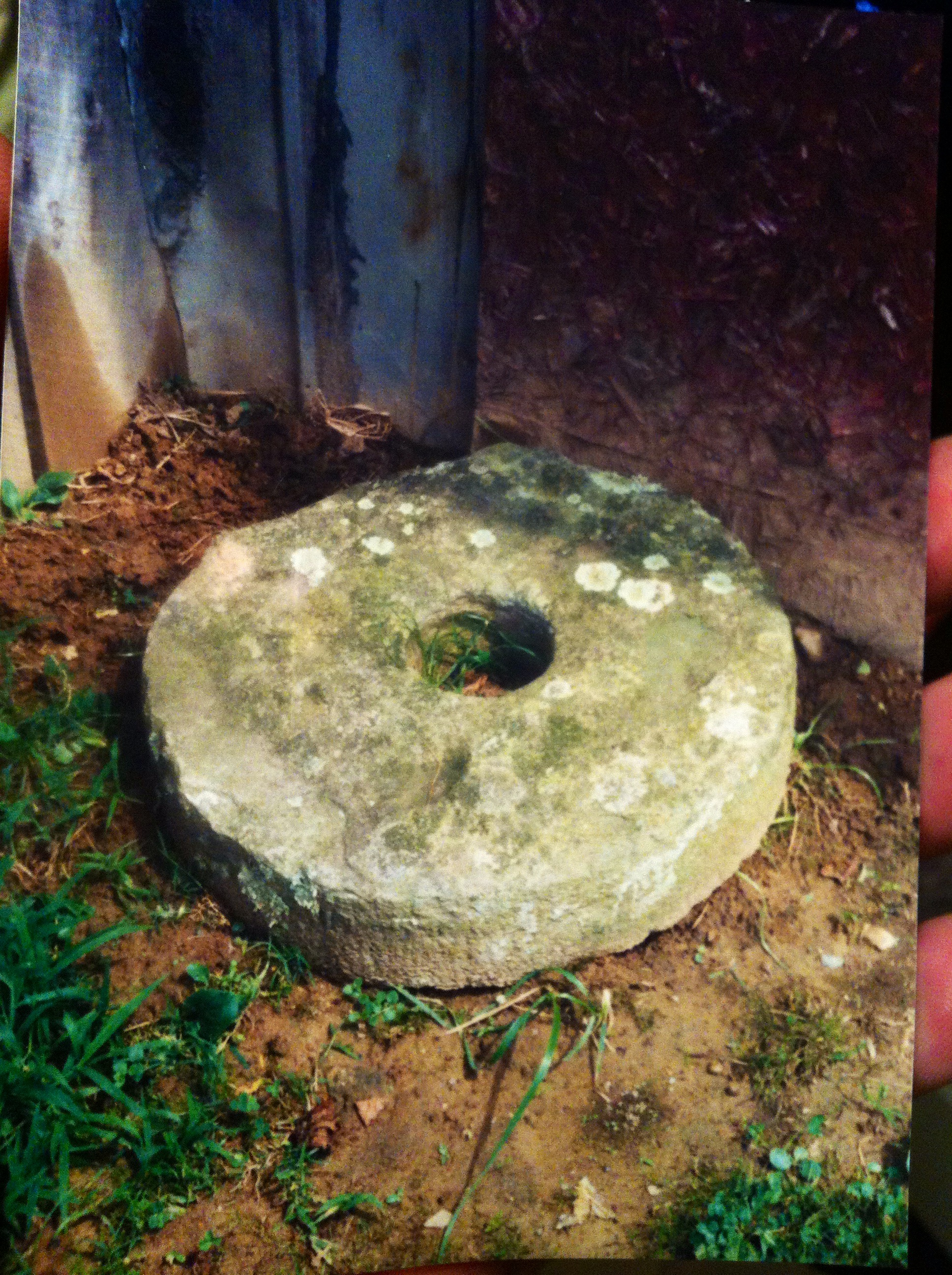
I took this photograph in August 1996 on Trace Fork of Harts Creek.

01 Sunday Mar 2015
Posted in Big Harts Creek, Lincoln County Feud, Warren
Tags
Appalachia, Ben Adams, Blood in West Virginia, genealogy, Harts Creek, history, life, Lincoln County Crew, Logan County, miller, millstone, photos, West Virginia
I took this photograph in August 1996 on Trace Fork of Harts Creek.
24 Saturday Aug 2013
Posted in Ed Haley
Tags
Appalachia, Ashland, Brandon Kirk, Ed Haley, Fred B. Lambert, Green Shoal, history, Lincoln County Crew, Marshall University, Milt Haley, Sam Vinson Harold, Tom Ferrell, writing
Around that time, I received a very important letter in the mail from Brandon Kirk, the Harts genealogist. “Here are some documents pertaining to your research which I found in the F.B. Lambert Collection here at Marshall University,” he wrote. “There is a good chance that there may be more references in the collection regarding old time fiddlers.” Along with Brandon’s note was a single photocopied page of an interview with someone named Sam Vinson Harold on February 22, 1951. “Ed Haley was originally from Kentucky, about Ashland,” Lambert wrote. “I think he is living yet. Milt Haley, Blind Ed’s father, was a great fiddler. Some one shot him, on his porch, at mo. of Green Shoals.” Harold claimed to have penned the tune about Milt Haley’s death, “The Lincoln County Crew”, with someone named Tom Ferrell. This interview — while small in content — was a great find because it was the first solid reference that Milt was a fiddler, which meant Ed would’ve had music around in his childhood and could’ve possibly even begun learning to play by watching him.
06 Saturday Jul 2013
Posted in Ed Haley
Tags
Days of Darkness, Ella Haley, genealogy, history, Jean Thomas, John Martin, Kentucky, Laura Belle Whitt, Lincoln County Crew, Martin-Tolliver Feud, Morehead, William Trumbo, writing
William M. Trumbo — Ella Haley’s father — was born in October of 1861 to Thomas Isaac and Celia Ann (Oxley) Trumbo of Morehead, Kentucky. Thomas Isaac was a son of John L. and Sarah (Manley) Trumbo of Bath or Fleming County, Kentucky, while Celia Ann was the daughter of Prior and Isabel (Neal) Oxley. She was born in Kentucky or Ohio or Indiana (it varies in each census record). Thomas and Celia lived in Morehead across Triplett Creek from Dr. Raine’s Cottage Hotel. In 1870, Thomas was listed in the Rowan County Census as the county jailor. There were six children living in his home, aged newborn to 13 years, including son, William, who was 11. Daughter Lucy was living at Pine Grove with her new husband, John Martin — later a key participant in the Martin-Tolliver feud. The Thomas Trumbo home survived until at least 1984, according to one local history. (“The Thomas Isaac Trumbo House stands across Triplett Creek from the Raine Hotel. Dr. Raine’s Cottage Hotel was the site of many feud incidents.”)
William Trumbo married Laura Belle Whitt around 1878. They were the parents of five children: Zora Trumbo, born March 1879; Texas Anna Trumbo, born January 1885; Martha Ella, born February 1888; Allie W. Trumbo, born May 1891; and Luther Trumbo, born March 1893.
The Trumbos made their home in Morehead, where William was listed in the 1880 census as twenty-one years old. In 1884, Laura Belle Trumbo — William’s wife (who became pregnant in the spring of that year) — inadvertently played a key role in initiating the Martin-Tolliver Feud while at a pre-election dance in Morehead.
“During the evening Mrs. William Trumbo got tired, excused herself, and went upstairs to what she thought was her room,” writes John Edd Pearce in Days of Darkness: The Feuds of Eastern Kentucky (1994). “It was not. By mistake she got into the room of H.G. Price, a wealthy timber dealer and owner of the steamboat Gerty. When Price returned to his room, he was pleased to find on his bed what seemed to be a bonus, and he attempted to make the most of the situation. Mrs. Trumbo screamed, fled, and told her husband of her horrible experience.”
Unfortunately for Price, Mrs. Trumbo was related by marriage to the Logan and Martin families, both of whom made dangerous enemies.
“On election day Trumbo sought out Price and demanded that he apologize publicly to his wife,” writes Pearce. “Price replied — not dishonestly — that he had done nothing wrong, had found Mrs. Trumbo on his bed, and had done what any man would have done under the circumstances. A fight broke out. Friends of the men joined in, to the cheers of drunken onlookers.”
John Martin, a brother-in-law to Mrs. Trumbo, jumped in on the Trumbo side and soon got into a shooting scrape with Floyd Tolliver — which effectively ended the brawl. But tensions remained throughout the fall.
“It was a bleak day in December, 1884, following the August election in Rowan County when John Martin and his wife Lucy Trumbo and two of their small children climbed into their jolt wagon out on Christy Creek and rode into town,” writes Jean Thomas in Blue Ridge Country (1942). In no time at all, Martin bumped into Tolliver, who he shot dead before turning himself in to authorities. Not long thereafter, a mob of men shot Martin to death on a train at Farmers, a settlement about five miles from Morehead.
“When the train bearing John Martin’s bullet-torn body reached Morehead, he was carried, still breathing, into the old Central Hotel where he died that night,” writes Thomas. “In the meantime his distracted wife had sent for their children and her mother who was staying with the family on the farm on Christy Creek. An old darky who had long lived at the county seat mounted his half-blind mule and rode out along the lonely creek that cold winter night to carry the sad tidings to the Martin household. He also rode ahead of them on the journey back with the corpse of John Martin later that same night.”
Along the way, Granny Trumbo — Ella’s grandmother — warned the children gathered in the back of the wagon, “Hush! No telling who’s hid in the brush to kill us.” Years later, the children remembered how she sat “bravely erect on the board seat of the wagon beside her widowed daughter, gripped the reins and urged the weary team onward along the frozen road, keeping close behind the silent horseman ahead.”
It was the first violent acts in a three-year row that would claim twenty lives, almost destroy a town and inspire the song, “The Rowan County Crew”, supposedly written by Blind Bill Day. Ironically, this tune had the same melody and lyrical rhythms as “The Lincoln County Crew”, a song partly composed about the murder of Ed Haley’s father.
01 Tuesday Jan 2013
Posted in Ed Haley
Tags
Al Brumfield, crime, George Fry, Green McCoy, Harts Creek, history, Hollene Brumfield, John W Runyon, Kentucky, Lincoln County, Lincoln County Crew, Milt Haley, Paris Brumfield, West Virginia, writing
Meador’s article was my first real glimpse into the story of Milt Haley’s death since talking with Roxie Mullins. I read it carefully and often.
“In 1889, around the time the Hatfields and McCoys were killing each other along the Tug River, another less known family war was occurring, not too far away, in Lincoln County. The details of the feud are sketchy today, and would be all but forgotten had its events not been recorded in a ballad known as ‘The Lincoln County Crew.’ In 1923, the text of the ballad, attributed to George Ferrell, and a brief explanation were published in The Llorrac, a Lincoln County historical journal published by the students and faculty at Carroll High School in Hamlin.”
Meador began with a somewhat interesting description of Harts at the time of Milt’s death.
“The community of Harts, isolated in southern Lincoln County near the Logan County line, was one of the places where citizens occasionally had to take the law into their own hands. Harts, on the Guyandotte River about midway between Huntington and Logan, was a convenient stopping place for travelers journeying between the two towns. Also it played host to the teams of rough-and-tumble men who rafted logs down the river to ports on the Ohio. Because of its location and because whiskey was sold there, Harts attracted more than its share of troublemakers. Differences were often settled with a gun, and killings sometimes avenged by the family of the murdered person.”
The impetus for the feud that claimed Milt’s life, according to Meador, was trouble between Allen Brumfield and John Runyon, two merchants at the mouth of Harts Creek.
“In Harts, in the latter decades of the 19th Century, lived a man by the name of Allen Brumfield. According to Irma Butcher, Brumfield lived in a large white house near the Guyandotte River bridge. The Llorrac relates that Brumfield operated a store near Harts and sold whiskey from a houseboat in the river. Allen Brumfield, according to The Llorrac, was not the only whiskey merchant in Harts. At the mouth of Harts Creek, a man by the name of John Runyons operated a store and saloon. For some reason there were hard feelings between Runyons and Brumfield, and Runyons is reported to have hired Milt Haley and Green McCoy to kill Brumfield. Payment for the two men is supposed to have been a barrel of flour, a side of bacon and $25.”
Now that was a real interesting twist to the story — no mention of Milt’s wife getting shot at the Brumfield place. Milt was apparently a hired gunman. In a way, I wasn’t surprised. From the very beginning, I had the impression that Milt was a bad character. Roxie Mullins had said he was “awful bad to drink and kept a Winchester loaded and sitting right by the side of his door. A whole mob killed him. They was afraid of him because he had a pretty bad name.” Lawrence had said, “When my dad was very young he didn’t like the whiny way my dad was acting so to make him more of a man he took him out and dropped him in a rain barrel through the ice.” And then there was the poverty aspect: I mean, to kill someone for a barrel of flour, a side of bacon and twenty-five dollars?
According to Meador’s article, Milt and Green supposedly ambushed Brumfield, a very common thing to do in those days.
“The day chosen by McCoy and Haley for their grim deed was a Sunday afternoon in mid-August of 1889. Allen Brumfield and his wife, Hollena, were returning on horseback from a visit to Mrs. Brumfield’s father, Henderson Dingess, who lived on Harts Creek. Mrs. Brumfield was on the same horse, behind her husband. From ambush and without warning, McCoy and Haley fired at the couple as they rode down the river. Their aim was good but not fatal. Allen Brumfield received a bullet in his arm and his wife was shot in the face. Brumfield jumped from his horse and by running was able to make his escape. Mrs. Brumfield also survived but was disfigured for life. Irma Butcher, who knows little about the history behind the ballad, remembers as a young girl visiting in the home of Allen Brumfield’s widow, Hollena, at Harts. Mrs. Butcher relates that widow Brumfield had a hole ‘the size of a quarter’ in her nose, where she had been shot during the feud.”
After the shooting, Milt and Green fled across the Kentucky state line to escape from the law.
“Haley and McCoy fled to Martin County, Kentucky, but in mid-October of that same year were captured and lodged in the Martin County jail. Their captors were no doubt attracted by the reward offered by the state of West Virginia and supplemented by Allen Brumfield.”
A posse fetched Milt and Green and brought them to Lincoln County.
“The accused gunmen were returned to West Virginia by way of Logan County, which was then a border county including what is now Mingo County. There they were turned over to a party of Lincoln County men headed by the aggrieved Brumfield himself. The group journeyed as far as Chapmanville by mid-afteroon and tried to find lodging for the night among the families there. No one would take them in, evidently because of a fear of mob violence. Still looking for overnight shelter, the party continued down the Guyandotte River. For some reason, the guard split so that a portion crossed to the other side, leaving but an officer and three men in charge of the prisoners. A few miles below Chapmanville this small company entered into Lincoln County, soon finding lodging at the house of George Frye. The Frye house was located near the mouth of Green Shoals at Ferrellsburg.”
At Green Shoal, Milt and Green were brutally murdered by a mob.
“About eight o’clock that evening, according to the Logan County Banner of October 31, 1889, an armed mob estimated at 20 or more men surrounded Frye’s house and demanded that the prisoners be turned over to them. Frye and his family were ordered into the kitchen and the guards were allowed to leave the house. The mob then rushed in, firing their guns. McCoy and Haley were dragged out into the front yard and shot several times. The angry crowd then took rocks and smashed in the skulls of the two men. Their bloody work accomplished, the mob disappeared into the darkness, leaving the neighbors to take care of the bodies.”
No one was brought to justice for the killings.
“The Logan County Banner, in relating the story of the murders of Haley and McCoy, said that there had been no arrests in connection with the killings even though it was generally well known in the area who had been involved. The paper also gave the impression that most local people were in agreement in condoning the action of the lynch mob. The paper itself seemed to justify the unlawful treatment of Haley and McCoy on the grounds that they had shot an innocent woman.”
At the end of Meador’s article was an interesting note about Paris Brumfield, father to Al, hinting at past trouble between the Brumfields and McCoy.
“Another mystery concerns a man by the name of Paris Brumfield, who is mentioned in Professor Cox’s version [of the song] as being murdered by his own son. A story quoted in the November 7, 1889, edition of the Logan County Banner, says that Paris Brumfield was engaged in a shooting scrape with Green McCoy about a year before the attack on Allen Brumfield.”
31 Monday Dec 2012
Posted in Ed Haley
Tags
Al Brumfield, Ed Haley, feud, fiddle, George Fry, Green McCoy, history, John Hartford, Kennie Lamb, Lincoln County Crew, Milt Haley, music, Paris Brumfield, Stephen Green, writing
When I arrived back in Nashville, I set about lining up Ed’s fiddle as close as I could to how he would have wanted it. I had John Hedgcoth make a duplicate bridge, then strung it all up so that if he were to walk in the room it would suit him. After about a week, though, the neck started pulling up. I loosened the strings and called Kennie Lamb, a violin expert and craftsman in Baton Rouge, Louisiana. Kennie picked the fiddle up in Nashville and hand-carried it back to Louisiana for minimal restoration.
A few weeks later, I received a letter from him:
John,
The Markings in Red Corrspond to the Haley Bridge. The only exception being that the D string on the Original Bridge has two notches very close together. I have Marked a D notch in Red but the unmarked D notch will line up with one of the Original notches so you can take your choice on where you believe Mr. Haley Kept the D String.
I have noticed one other interesting thing: Mr. Haley “or Some one” has played this fiddle with the bridge set Almost 1/2 inch to the rear of where it should be set. NOTe: the Markin[g]s where the feet of the bridge once stood. The bridge was in this position for Many a year: Before the neck was out of Alignment and probably before the damage and subsequent repair to the back button the Original bridge may have been tall enough to sustain the rearward Position. The Old Gentleman may have positioned it to the rear in Order to lower the strings or being blind he may not have known exactly where the bridge was supposed to stand. Of course the fiddle would off note badly in the Position but I have seen many such “And Worse” Positions. I hope I have Accomplished what you wanted.
Around the time Kennie’s letter arrived in the mail, Stephen Green, an archivist at the Appalachian Center Sound Archive in Berea, Kentucky, sent me a Summer 1986 article from a West Virginia magazine called Goldenseal. It told all about Milt Haley’s murder and was based on a song called “The Lincoln County Crew”, as sung by Irma Butcher of Bear Creek in northwestern Lincoln County. The song was very similar to Cox’s “A West Virginia Feud-Song”.
Butcher first heard her version around 1910 from fiddler Keenan Hunter, a friend to her banjo-picking father, Press Blankenship. In 1978, she played it for Michael M. Meador at the Vandalia Gathering, West Virginia’s annual statewide folk festival in Charleston.
Come all dear friends and people, come fathers, mothers too;
I’ll relate to you the story of the Lincoln County Crew;
Concerning bloody rowing and many a thieving deed;
Come friends and lend attention, remember how it reads.
‘Twas in the month of August, all on a very fine day,
Al Brumfield he was wounded, they say by Milt Haley;
The people did not believe it, nor hardly think it so,
They say it was McCoy that struck the fatal blow.
They shot and killed Boney Lucas, a sober and innocent man,
Who leaves a wife and children to do the best they can;
They wounded poor Oak Stowers, although his life was saved,
He meant to shun the drug shop, that stood so near his grave.
Allen Brumfield he recovered, in some months to come to pass,
And at the house of George Frye, those men they met at last;
Green McCoy and Milt Haley about the yard did walk,
They seemed to be uneasy and no one wished to talk.
They went into the house and sat down by the fire,
But little did they think, dear friends, they’d met their final hour;
The sting of death was near them when a mob rushed in at the door,
And a few words passed between them concerning the row before.
The people all got frightened and rushed clear out of the room,
When a ball from some man’s pistol lay the prisoners in their tomb;
Their friends had gathered ’round them, their wives did weep and wail,
Tom Ferrell was arrested and soon confined in jail.
Confined in jail at Hamlin to stay there for awhile,
In the hands of Andrew Chapman to bravely stand his trial;
But many talked of lynching him, but that was just a fear,
For when the trial day came on, Tom Ferrell, he came out clear.
I suppose this is a warning, a warning to all men;
Your pistols will cause trouble, on this you can depend;
In the bottom of a whiskey glass, a lurking devil dwells;
And burns the breast of those who drink, and sends their souls to hell.
Writings from my travels and experiences. High and fine literature is wine, and mine is only water; but everybody likes water. Mark Twain
This site is dedicated to the collection, preservation, and promotion of history and culture in Appalachia.
Genealogy and History in North Carolina and Beyond
A site about one of the most beautiful, interesting, tallented, outrageous and colorful personalities of the 20th Century
 Brandon Ray Kirk