After talking with Lola, we walked down the street with Billy Adkins and spent a few hours filtering through genealogy books at his kitchen table. Billy, I discovered, had two large bookcases filled with categorized three-ring binders dedicated to Harts families. One of the first things we dug out were notes pertaining to Ed’s mother, Emma Jean Haley. Years earlier, Lawrence Haley had told me that someone shot her in the doorway of what I later learned to be Al Brumfield’s house. In his notes, Billy recorded her as re-marrying James Benton Mullins, a son of Peter and Jane Mullins, which we ruled out immediately: James B. was her uncle. The Emma who had actually had married this fellow was born in 1876 (about eight years after Emma Haley) and was listed in other sources with the maiden name of Johnson.
“I don’t know where I found that out but somebody told me that that woman right there was Milt Haley’s widow,” Billy said. “But that date’s totally wrong, see.”
Whether or not Ed’s mother had ever remarried anyone, based on census information, Brandon was convinced that she had died in the 1890s. In the 1900 Logan County Census, her mother Chloe Mullins listed seven of her nine children as being alive. The seven accounted for were Joseph Adams, John Adams, Ticky George Adams, Peter Mullins, and Weddie Mullins. The two who were not listed in the 1900 census were Dicy (Adams) Thomas, whose husband was listed as a widower in the census, and Ed’s mother.
We found out from Billy’s notes that Emma Haley descended from a notorious counterfeiter named Solomon Mullins.
“Money Makin’ Sol,” as he was called, was born to John and Jane Mullins on the Broad River in North Carolina in 1782. Around 1806, he married Sarah Cathey; he settled in Kentucky by 1810.
“Solomon was always ready for action,” according to photocopied papers at Billy’s house. “He served in the War of 1812 in Cpt. David Gooding’s Company of Kentucky Volunteer Militia. After the war, Solomon, evidently ready for more action, began counterfeiting coins. Family tradition has it that Solomon found one of John Swift’s ‘Lost Silver Mines’ in the hills of eastern Kentucky and ‘South of the Mountain’ in Southwestern Virginia. Thus he became known as ‘Money Making Sol’, and I might add always the ‘genius’, stayed one step ahead of his trouble. In 1837 Solomon decided to join his father and his two brothers in Russell County. He bought a farm and built a shop just a little ways from his house where he began making money again. He melted the silver down and didn’t seem to care who saw him.”
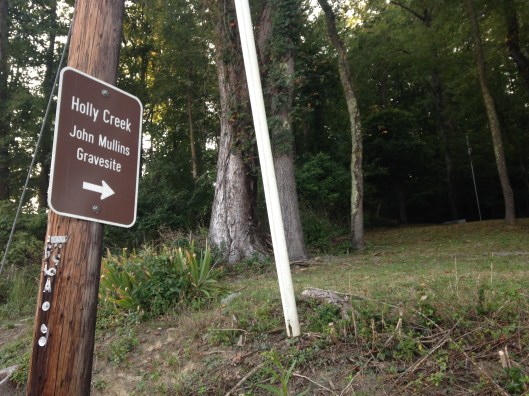
“I was born August 29, 1840, at my father’s home below Clintwood,” according to a 1926 interview with one Nancy Mullins. “The Mullins mixed with the Indians. I have heard it said that Grandpa John Mullins was about one-fourth Indian. Grandpa John had at least two brothers. One was named Sol and he owned a lot of slaves. He was a moneymaking man. He lived on the other side of the branch in a bottom near my father’s home. He had a crowd of slave wenches. He made money on Holly Creek back of Press Harris’ home. He had his work place under a cliff. Pa and Uncle John used to help him work at this business. They would ‘strike’ for Sol. While they lived there, his slave women would take guns and go hunting. They would kill deer and pack them in on their backs. The government got after Sol and he went to West Virginia where he died.”
“Solomon Mullins moved to the waters of Holly Creek, about two miles northeast of Clintwood, [Virginia,] where he lived for several years,” according to Sutherland’s The Mullins Family in Dickenson County (1967). “He owned several slaves, mostly women, who worked in the fields and hunted in the woods. He made counterfeit money for several years under a cliff near Holly Creek. The cliff is still pointed out by neighbors as ‘Sol’s Cliff.’ He was caught at work once by a detective and when he saw he was caught, he ordered the detective to help him work, saying: ‘Grab that hammer and strike this.’ He hoped this would make the detective afraid to tell on him, but it didn’t do any good. He managed to get pure silver and mixed other metal with it to make the counterfeit money. He would pay $2 of his counterfeit money for $1 of the government money. At last, he took a scare and left this country.”
In 1837, Sol and his son Peter were involved in making counterfeit coins in Russell County, Virginia. As a result, according to Boone County, West Virginia, History (1990), they moved to Marion County, Tennessee, where they renewed their counterfeiting activity. In the winter of 1841-42, after pressure from government authorities in Tennessee, Sol and Peter moved with their families and slaves to the North Fork of Big Creek in Logan (now Boone) County, (West) Virginia.
“They rode mules and walked all the way,” according to Boone County. “He died in 1858 and Sarah died about 1872.”
As Brandon flipped through the Sol Mullins notes, I could see his brain working, making connections. Suddenly, he said, “Sol was a great-grandfather to both Emma Haley and Hollena Brumfield…making them third cousins.”
Oh my.






 Brandon Ray Kirk