
• About

Brandon Ray Kirk

~ This site is dedicated to the collection, preservation, and promotion of history and culture in my section of Appalachia.

Brandon Ray Kirk

Tag Archives: Ceredo

Battle of Kanawha Gap (1861)

10 Sunday Jun 2018

Posted by Brandon Ray Kirk in Barboursville, Big Creek, Boone County, Chapmanville, Civil War, Guyandotte River, Tazewell County

≈ 5 Comments

Tags

129th Regiment Virginia Militia, 1st Kentucky Infantry, 34th Ohio Volunteer Infantry Regiment, 5th Virginia Regiment, Abram S. Piatt, Appalachia, Baltimore & Ohio Railroad, Barboursville, Battle of Kanawha Gap, Big Creek, Big Sandy River, Boone County, Burlington Weekly Hawk-Eye, Camp Enyart, Ceredo, Chapmanville, Charleston, Chicago Daily Tribune, Cincinnati Daily Press, Cincinnati Gazette, civil war, Cleveland Morning Leader, Coal River, Confederate Army, Daily Green Mountain Freeman, David S. Enyart, Eli Thayer, Evening Star, George McClellan, Greenbrier County, Guyandotte River, H.C. Evans, Harpers Ferry, Herman Evans, history, J.V. Guthrie, J.W. Davis, Jacob D. Cox, John Dejernatt, Kanawha River, Kanawha Valley, Logan County, Logan Court House, M.H. Wood, National Republican, O.P. Evans, Ohio, Ohio River, Parkersburg, Pomeroy Weekly Telegraph, Portsmouth, Richmond Whig, Robert E. Lee, Samuel Smoot, Sewell Mountain, Southwestern Times, Staunton Spectator, T.W. Rathbone, Tazewell County, Tug Fork, Union Army, Virginia, West Virginia, West Virginia Division of Culture and History, Wheeling, William Baisden, William Rosecrans, William S. Rosecrans, Zouaves

The following newspaper accounts describe the Battle of Kanawha Gap near present-day Chapmanville, Logan County, WV, which occurred on September 25, 1861:

Cleveland (OH) Morning Leader, 3 October 1861

GALLIPOLIS, Oct. 2.

The expedition planned by Col. J.V. Guthrie of the First Kentucky Regiment, and sent out under Lieut. Col. Enyart and Col. Piatt, has returned. They encountered the enemy at Chapmansville under Col. J. Lucien Davis, of Greenbrier, and utterly routed them. The enemy lost between fifty and sixty killed. Our loss was four killed. The expedition returned to Charleston on the 30th ult.

david s. enyart photo

Col. David S. Enyart, 1st Kentucky Infantry (Union).

Evening Star (Washington, DC), 4 October 1861

A Confederate Camp in Western Virginia Broken Up and Routed

CINCINNATI, Oct. 3 — A body of Federal troops, under Lieut. Col. Enyart, attacked a camp of rebels at Chapmansville, in Logan county, Va., near the Kentucky line, routing them, killing sixty and taking seventy prisoners. The same body of rebels were afterward intercepted in their retreat by Col. Piatt, who killed forty and made a large number prisoners.
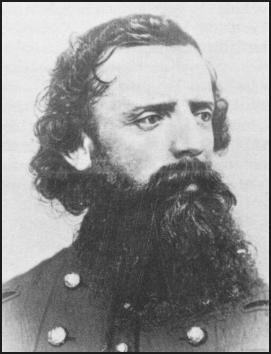
abram s. piatt photo

Col. Abram S. Piatt (1821-1908), 34th Ohio Infantry Regiment.

New York (NY) Herald, 4 October 1861

FIGHT WITH THE REBELS AT CHAPMANSVILLE

Cincinnati, Oct. 3, 1861.

The Kanawha correspondent of the Commercial of this city says that five companies of the First Kentucky regiment, four companies of the Thirty-fourth Ohio regiment and one company of the Fifty Virginia regiment, under Lieutenant Colonel Enyart, surrounded and attacked the rebels at Chapmansville, and after a short engagement completely routed them, killing sixty and taking seventy prisoners. The rebels in escaping were intercepted by Colonial Piatt, who killed forty and took a large number of prisoners. The country between Charleston and Wyandot river is now freed from secession power. This is the most effective blow given the rebels in this part of the valley.

IMG_2256.JPG

One section of the Kanawha Gap Battle Site, Chapmanville, Logan County, WV, 9 June 2018.

Daily Green Mountain Freeman (Montpelier, VT), 7 October 1861

Chapmansville, Va., the scene of the most recent engagement, is a small post village in Logan county, Va. Logan county is in the extreme Western portion of Virginia, the Tug Fork of the Big Sandy being the boundary line between it and the State of Kentucky. It is one of the largest, wildest and most sparsely inhabited counties in the State.

IMG_2238.JPG

Part of the Kanawha Gap Battle Site, Chapmanville, Logan County, WV, 9 June 2018.

National Republican (Washington, DC), 7 October 1861

THE SITUATION.

The two affairs at Chapmansville, reported three or four days since, in which the enemy lost one hundred killed and a proportionate number of wounded, will, it is supposed, restore permanent peace to the Virginia counties western of the Kanawha. Chapmansville is on the turnpike from Charleston to Logan county Court-house, and is about twenty-five miles to the south of Barboursville, the shire town of Cabell county. The secessionists in that part of Western Virginia have been numerous and pertinacious. They have once had possession of Guyandotte on the Ohio river and for a long time they threatened Ceredo (Mr. Thayer’s colony,) which lies on the river between Guyandotte and the Kentucky line. There have been two engagements with them in the rear of Ceredo, one at Barboursville, one at Logan county Court-house, one at Boone county Court-house (which town was burnt by the national troops,) and finally two at Chapmansville. The truth is, that in large portions of numerous, and, but for the early occupation of that region by the National troops, would have controlled it, not because they were the majority, but because one secessionist is, everywhere, a match for three Union men.

The secessionists are reckless, violent, and desperate, while their opponents, if not timid are at any rate remarkably pacific. We doubt, indeed, from all the information we can get, whether throwing out of the account Wheeling and Parkersburg, the terminal on the Ohio river of the Baltimore and Ohio railroad, Western Virginia had more elements of Union strength than the Valley of Virginia. From Harper’s Ferry south for fifty miles, the Union men have been numerous from the first, and it is a matter of deep regret that it did not consist with the plans of military strategy adopted at the headquarters of the army here, to occupy (at least) the northern part of the Valley of Virginia. It is consoling, that a different policy was adopted in retrospect to Western Virginia. That region was promptly taken possession of, cleared of the rebel armies by Gen. McClellan, and has since been victoriously held by Gen. Rosecrans. All attempts of the enemy to affect a re-entrance into Western Virginia are promptly repulsed.

34th Ohio Volunteer Infantry Regiment, Piatt's Zouaves Flag Photo.jpg

Staunton (VA) Spectator, 8 October 1861

Status at Sewell’s Mountain.

The enemy, under Gen. Rozencrantz, and our forces under Gen. Lee, are both upon Sewell Mountain very near each other. A fight has been daily expected there for some time, but the enemy have been fortifying ever since they have been there, and there will not be a fight unless we attack them in their entrenchments. They are afraid to attack us, and it is probable that our force is too weak to risk an attack on them within their fortification. It may, therefore, be some time before an engagement will take place. We understand that we had sent a force of four regiments to their rear for the purpose of cutting off their supplies—that we succeeded in getting around them, but were compelled to return because we did not have sufficient supplies ourselves. We also learn that Col. Jas. W. Davis of Greenbrier, whilst commanding a force of militia in Logan county, attacked a part of the enemy, and was shot down at the first fire. The militia, after several rounds caught the Yankee fever which made their cowardly legs run off with their brave hearts, and they left their commander in the hands of the enemy, who, we fear, has died from his wound.

IMG_2923

New historical sign placed by the WV Division of Culture and History located at the 119 ramp in Chapmanville, WV. 26 April 2017.

Chicago (IL) Daily Tribune, 9 October 1861

A Splendid Achievement of the Ohio Zouaves–“Wood Up” the Battle Cry.

[The following letter is exclusively devoted to the fight which the Piatt Zouaves had with the rebels near Chapmansville, Va. It is distinct from the victorious fight which the command of Lieut. Col. Enyart had with another body of rebels, in the same vicinity. EDS. CINCINNATI COM]

CAMP ENYART, KANAWHA, Oct. 2, 1861. EDS. COM.: The Zouave Thirty-fourth Regimens, Ohio, have had a chance to show their metal. This was on Wednesday, on Kanawha Gap, near Chapmansville, Va. After marching 42 miles, they came upon the enemy, who were behind breastworks, but could not stand our boys’ steady fire, for they retreated in utter consternation, their Col. J.W. Davis, of Greenbrier, Va, (but the traitor is a native of Portsmouth, Ohio,) being mortally wounded. We killed 20, took 3 prisoners, a secesh flag, 20 feet long with FIFTEEN STARS, 4 horses, 1 wagon, 10 rifles (one of which I claim), 12 muskets, and commissary stores (very low.) We lost 3 killed, 9 wounded, one since died. The route of the enemy was complete, although they had a brave, skillful commander, and strong position, with two days’ information of our intentions. They fled the moment their commander fell. The fight lasted about 10 minutes opposite the breastworks, but a running fire was kept up previous to that, by the Bushwhackers and rebel cavalry for two hours. At every turn of the road over the mountains, they would fire upon our advance men, wheel round, and gallop away. This kind of fight was kept up till we came suddenly upon their breastworks, immediately in line of our entire column. It was made on the side of a knoll, between two mountain sides, the road running between the mountain on our left. The wily rebel commander had adroitly cut down the brush on the right, placing a force of 100 men on the mountain top on our right, who raked our column from the front to the center. This was to draw our attention from their breastworks. Our men naturally fired upon the rebels on their right, steadily advancing up the road, until within 20 feet of the enemy’s works, when the rebels suddenly opened fire, from their right, left and center. The order from Col. Piatt and Lieut. Col. Toland, to flank right and left was immediately responded to by the Zouaves with a hurrah, a Zouave yell, and a cry of “wood up” from Little Red; a dash by our boys upon the enemy’s breastworks, above which about 300 rebel heads suddenly appeared, unknown by our men till that moment. They sent a perfect storm of bullets around, over, under, and into our men. A few minutes more and our boys were inside the breastworks, chasing them over the mountains, the enemy running away like cowards as they proved to be. They left 29 dead behind. Their force was 450 infantry and 50 cavalry. Our force was 560.

We buried our three brave dead comrades that night, carried our wounded to the house wherein the rebel Colonel lay, mortally wounded, deserted by all his men but one. Our whole column finally marched into the little town of Chapmansville, formerly headquarters of the enemy, and camped for the night.

34th Ohio Volunteer Infantry Regiment, Piatt's Zouaves Captain Photo.jpg

34th Ohio Volunteer Infantry Regiment, Piatt’s Zouaves, Captain Photo.

Pomeroy (OH) Weekly Telegraph, 11 October 1861

Brilliant Action in the Kanawha Valley.

CHARLESTON, Va., Sept. 30, ’61. Eds. Cin. Com.–Information having been brought to Col. J.V. Guthrie, commanding this post, that a large force of Rebels were gathered at Logan Co., Lt. Col. Enyart, of the 1st Kentucky, was at once sent to engage them. His force was composed of five companies of the 1st Kentucky, four companies of the 34th Ohio–German Regiment–under command of Col. A.S. Piatt, and one company of the 5th Virginia Regiment, under command of Maj. M.H. Wood.

Col. Enyart, with the Kentucky force, surrounded and attacked the Rebels at Chapmanville, and after a short but decisive engagement, completely routed them, killing 60 and taking 70 prisoners. The Rebels, in escaping, were intercepted by Col. Piatt, who surprised them and killed 40 men, and took a large number of prisoners.

The force of the Rebels is now completely broken up, and the country between this point and Guyandotte River is now freed from Secession power. This is the most effective blow given the Rebels in this part of the Valley.

In great haste. Further particulars by next boat.

Very respectfully,

M. CLEMENS,

Lieut. Col. 5th Va. Reg’t.

34th Ohio Volunteer Infantry Regiment, Piatt's Zouaves Soldier Photo

34th Ohio Volunteer Infantry Regiment, Piatt’s Zouaves, Soldier.

Evening Star (Washington, DC), 11 October 1861

THE BATTLE OF KANAWHA GAP.

The Western Virginia correspondent of the Cincinnati Gazette gives the following account of the late engagement at Kanawha Gap:

There were about 1,050 troops under the command of Colonels Enyart and Piatt, who left their camp Monday morning, 30th ulto., and took up their line of march for the enemy.

The forces moved together until they reached Peytona, on Cole river, where they separated; Col. Enyart going up Cole river. Col. Enyart did not meet the enemy in force at any place but his men did meet and ford swollen rivers, and marched on short rations, and were anxious to meet with the running enemy of Old Virginia. Col. Enyart did not meet Col. Piatt until they met on the Kanawha, on their return.

Col. Piatt’s command immediately proceeded thence to Boone Court House, and camped that night one mile beyond. The next day, after proceeding some sixteen miles,t hey came up with the advance guard of the enemy, consisting of cavalry, when a brisk fire was exchanged, the cavalry retreating. After the retreat of cavalry the battalion was immediately put in order of battle. The advance guard of fifteen men was led forward by Adj’t Clarke, proceeding along the road. Scouts were sent out on either side of the road to meet and repulse the sharp-shooters of the enemy.

The force proceeded in this order for about two miles, meeting the pickets of the enemy, exchanging shots with them incessantly, and driving them back with increased confusion at each charge.

Being unable to ascertain the position of the rebels, the entire force halted for a few moments, and Col. Piatt rode in advance and took observations with his glass, but could not ascertain their force and position, as it was covered with a thick growth of underbrush. After these observations a command was issued to forward the column. The scouts moved on the rapidity and enthusiasm, the main body moving up the narrow road cautiously and firmly. The fire continued to increase, and shots were rapidly exchanged from the right and left with the enemy, until our advanced guard reached within sixty yards of their main force. The column was some eighty yards from the enemy when they received a perfect volley of fire upon their right, indicating that the rebels were in force in that direction. Company “A,” commanded by Capt. Rathbone, was ordered to deploy as skirmishers to the right, up the side of the mountain, and if possible to flank the enemy on the left. Company “C,” commanded by Capt. Miller, was ordered to the right, up a similar mountain, to flank the enemy on their left. Company “I,” commanded by Capt. Anderson, was ordered directly up the ravine, on the left. In this position he drew the concentrated fire of the rebels upon his company, who made use of the knowledge thus obtained by rapidly charging upon and destroying the enemy’s breastworks. The center moved directly up the road. With this disposition of the forces, Col. Piatt routed them from their confusion. Capt. Anderson was the first to mount their breastworks, his men following him in the face of a terrible fire without flinching or confusion.

As Capt. Anderson sealed the breastwork, Capt. Miller closed upon the left and Capt. Rathbone came in upon the right, his men crying “Zouave!” The main column moving up the road in double quick–until they were brought to a temporary halt by obstructions placed in the road by the enemy.

The rebels, terrified by the strange bravery and almost wild enthusiasm that was exhibited by each advancing column, ran in confusion, leaving their dead, wounded, clothing, guns, horses, &c., making their escape by Capt. Rathbone’s right; his company being too far up the mountain to cut off their retreat. Capt. West, commanding company F, was detailed to scour the mountain on the west, on the left of the road. Capt. O.P. Evans on the west side of the mountain, on the right side of the road. Capt. Herman Evans, commanding Company H, on the east side of the mountain, on the left of the road.

Each of these companies moved with dispatch, yet such was the knowledge of the rebels of teh by-paths in the mountains, and belonging to the “F.F.V.’s,” and having been drilled at running all summer, that but two were captured.

Among interesting objects captured was a genuine secession flag, captured by Lieut. Brown.

The enemy’s loss was thirty killed and fifty wounded.

We regret to know that four of our men were killed and eight wounded.

34th Ohio Volunteer Infantry Regiment, Piatt's Zouaves Soldiers Photo 2.jpg

34th Ohio Volunteer Infantry Regiment, Piatt’s Zouaves, Soldiers. Here’s a link to Captain T.W. Rathbone’s Civil War diary: http://resources.ohiohistory.org/ohj/browse/displaypages.php?display[]=0071&display[]=33&display[]=56

Burlington (IA) Weekly Hawk-Eye, 12 October 1861

The fight at Chapmansville was a sharp and bloody affair. Five of Piatt’s Zouaves were killed. The rebels lost thirty-five killed.
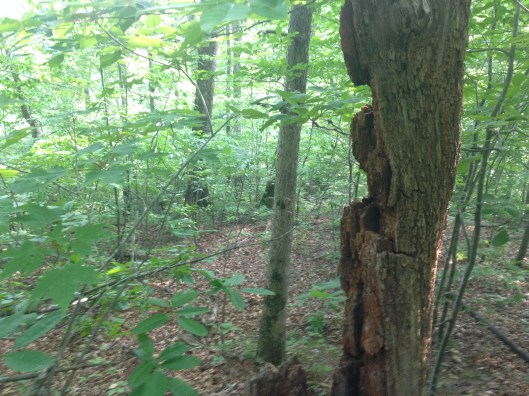
IMG_2235.JPG

Part of the Kanawha Gap Battle Site, Chapmanville, Logan County, WV, 9 June 2018.

National Republican (Washington, DC), 17 October 1861

The thirty-fourth regiment (first Zouaves) have been actively engaged since they came to the Kanawha Valley. Since the glorious victory they won near Chapmansville where the rebel commander, Colonel Davis, was mortally wounded, the Union sentiment has advanced on the Cole River. Two companies have been organized, and are ready to go to work to defend their own homes and give the organized regiments an opportunity to advance into the heart of the enemy’s country.

IMG_2254.JPG

Part of the Kanawha Gap Battle Site, Chapmanville, Logan County, WV, 9 June 2018.

Cincinnati (OH) Daily Press, 22 October 1861

Captain H.C. Evans, of Piatt’s Zouave Regiment, yesterday called in our office and exhibited a Secesh flag, captured at the Chapmansville fight, on the 24th ult.
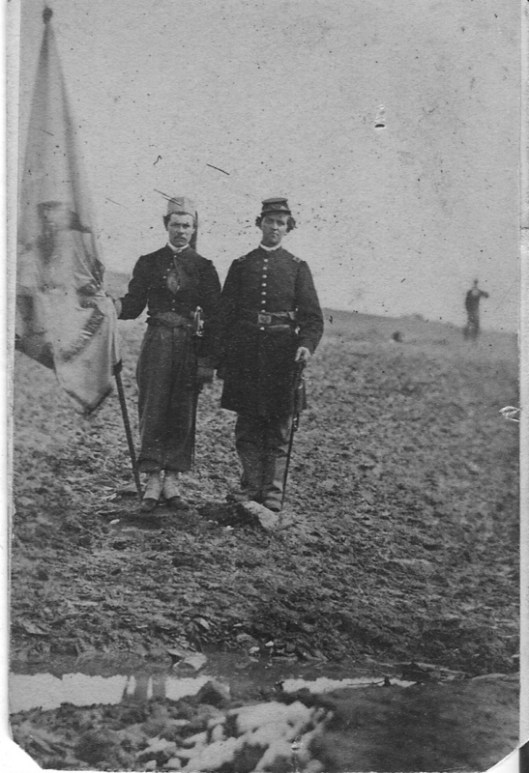
34th Ohio Volunteer Infantry Regiment, Piatt's Zouaves Soldiers Photo

34th Ohio Volunteer Infantry Regiment, Piatt’s Zouaves, Soldiers.

Clarksville (TN) Chronicle, 25 October 1861

The Fight in Logan County, Va.

[From the Richmond Whig of the 15th.]

We yesterday published the Yankee account of a battle in Logan county, which as usual, was manufactured out of whole cloth. The following are the facts as given by the South-western Times, (Tazewell county) of the 10th inst.:

From Samuel Smoot, Esq., of Boone county, who was in the fight, we learn the following particulars of the battle near Chapmanville, Logan county, on the 25th ult: The Yankees numbered 700, and commenced the attack upon our troops–the Logan militia–in a low gap between Guyandotte river and Big Creek, where they were engaged in raising a temporary breastwork. Our troops numbered 220, but there were only about 80 of them engaged in the fight. They were commanded by Col. J.W. Davis, of Greenbrier, a brave and gallant officer, who was severely, but not dangerously wounded, in the arm and breast. As soon as it became known that Col. Davis was wounded, the militia commenced a retreat. The commanding officer of the Lincoln troops afterwards confessed to Col. Davis, who was taken prisoner, that at the same moment a portion of the Yankees were running, and that one more round would have completely dispersed them.

The loss of the Yankees, by their own confession to Col. Davis, was 40 killed and a number wounded; among the former were four Union men, all of whom are represented by the Yankees to be most arrant thieves and cowards. Our loss was two killed and three or four wounded, besides Col. Davis, whose valuable services are at present lost to the Confederacy, being paroled by the enemy.

On the following day our scouts killed one of their pickets, and wounded another, at a point about half way between Logan Court House and Chapmanville, promising to give them particular thunder before daylight next morning. This with some news from a lady on the road, and some account of the militia of the surrounding counties, found on the person of Col. Davis, caused a hasty stampede for their headquarters, in the valley of the Kanawha. It seems that high water, bad roads, nor anything else could impede their rapid flight. They tore down a meeting house in Boone county to make rafts whereon to cross the river. They drowned two of their wounded, lost a wagon containing their entire stock of ammunition, and were fully persuaded that they were followed by two thousand cavalry, of which the Yankees in the West are about as fearful as their Eastern brothers are of masked batteries.

Upon the whole, we are much gratified at the result of this fight. It has, for the present, driven the cowardly thieves from the country, given renewed energy to the true patriots of Logan and the adjoining counties, fully convincing them that with the assistance of two or three hundred of their gallant friends in Tazewell county, they will be fully able to thrash any number that Gen. Cox or his friends shall dare to send against them.”

Note: An almost identical version of this story appeared in the Staunton (VA) Spectator on 22 October 1861.
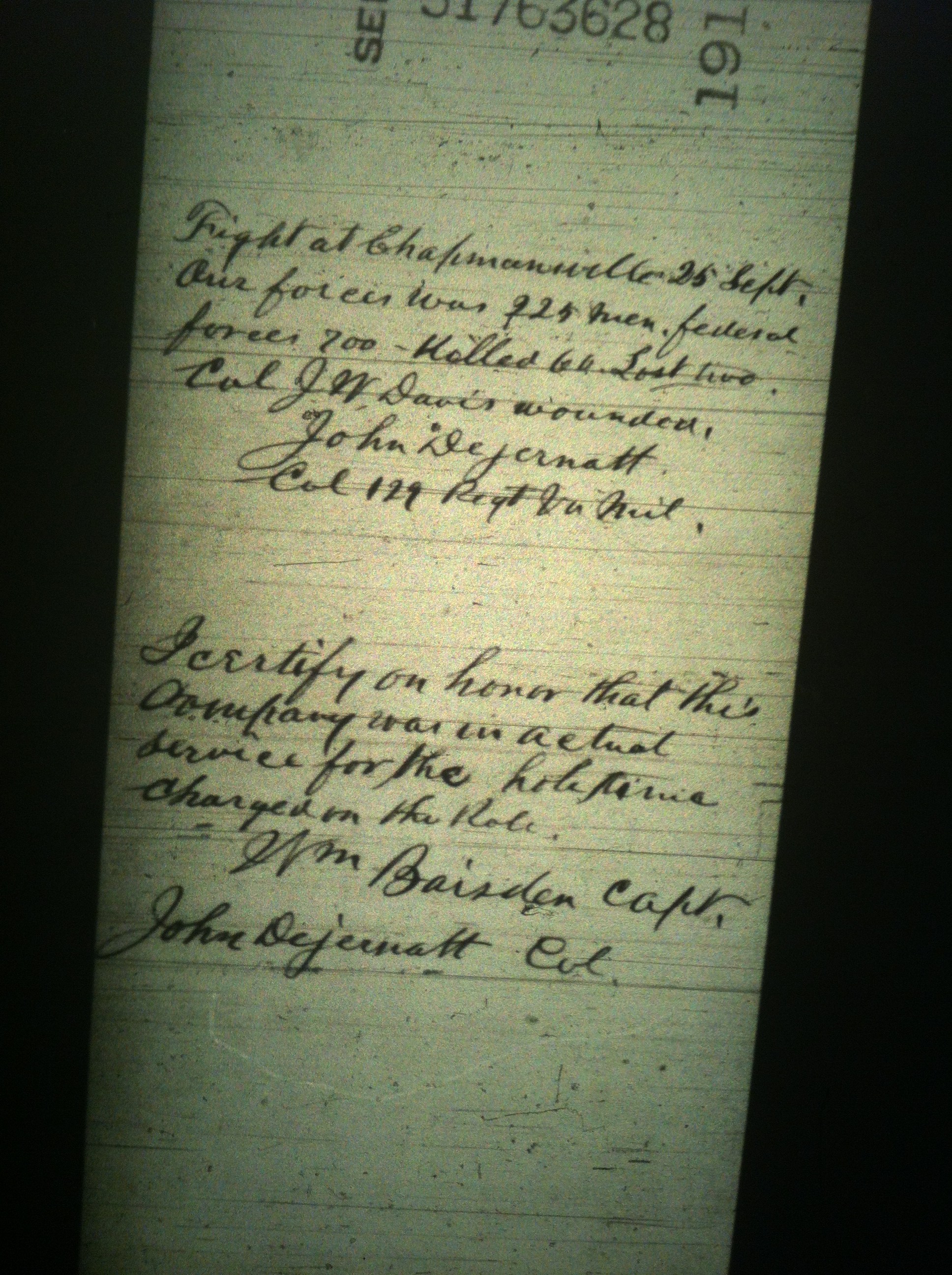
IMG_7149.JPG

Record relating to the 129th Virginia Militia (Confederate), which was present at the Battle of Kanawha Gap.

Mollie Drake: “The Florence Nightingale of Blair Mountain” (1921)

20 Friday Oct 2017

Posted by Brandon Ray Kirk in Battle of Blair Mountain, Coal, Huntington, Logan, Women's History

≈ Leave a comment

Tags

Allen B. Dingess, Alleyne Dye, Appalachia, Ashland, Battle of Blair Mountain, Cabell County, Caroline Dingess, Cattaraugus County, Ceredo, coal, Democratic Party, genealogy, Hannah Mitchell, Henry Street Settlement, history, Huntington, Illinois, Kentucky, Leo Frank Drake, Logan, Logan Banner, Logan County, Mollie Drake, New York, Republican Party, Springfield, Wayne County, West Virginia

Mollie (Dingess) Drake, daughter of Allen B. Dingess and Caroline (Jackson) Dingess, was born on June 30, 1881 in Logan County, WV. She was the wife of Leo Frank Drake, a salesman. She appears in the 1910 Wayne County Census (Ceredo District). Hannah Mitchell profiled her life in the Logan Banner of Logan, WV, on December 30, 1921. Her husband died in 1925. In 1930, Mollie lived at Springfield, IL. In 1940, she made her home in Cattaraugus County, NY. Mrs. Drake died on July 7, 1958 at a nursing home in Huntington, WV.

Mollie Dingess Drake Photo.jpg

It would be easy enough to make a melodramatic start and give her some such extravagant title as “The Angel of the Hills” or “The Mother of the Mines” or “The Florence Nightingale of Blair Mountain.” But if you did and Molly Dingess Drake found it out she might laugh and she might make some sharp remark, but most certainly she would not be pleased.

How she escaped the “war correspondents” who were rushed to the front to cover West Virginia’s recent mine war is more than I can say, for the story is still told of how Molly, like “Sheridan twenty miles away,” when the armed miners were marching on Logan, made all haste not toward safety, as she might very wisely have done, but back to where the bullets were flying.

Her narrowest escape from the feature pages of newspapers was several years ago–two, in fact–when, a woman of some two score years, she was graduated from high school with her sixteen-year-old daughter. That graduation and the attendant high school diploma were in no sense honorary affairs given out of respect for Molly Dingess Drake. They had been earned by this very determined, ambitious woman of the hills after four years of high school work, in which she had enrolled along with her daughter and for which she had attended classes faithfully and with classmates half her age.

On pay day Mrs. Drake is a welfare worker for one of the coal companies operating in the Logan field. Having finished her high school course, she did not go on to college with her daughter. And, as she puts it, one of the coal producers “knew she wouldn’t sit at home and knit and crochet.” So he offered her the job of visiting nurses among the employees of his company. In this job Mollie mothers a large family. It is composed of men and women much older than she and of the children of these older children. True to the mother-type anywhere, she makes their individual troubles, their health, their happiness, a very personal matter.

There was the young Spaniard who lay in the hospital after a severe accident. No friends or relatives rallied to his bedside, and the doctors and nurses could not understand him when he moaned out a word or two in his native tongue. Mollie Drake scoured the hills for an interpreter and found one. She also dug up a cousin of the unfortunate boy. Moreover she made the lives of nurses and doctors miserable until the lad was out of danger, sometimes calling at the hospital late at night to see how the boy was getting on. Was not this foreign born lad one of her children?

It was not the Mollie Dingess Drake, ready to face danger along with other brave women of Logan county when armed miners were marching upon their homes, that interested me most, as you may have guessed already. The World War is too recent proof that American women are not afraid to risk their lives for a cause. It is Mollie Drake and the work of her hands when peace broods over her native hills that make her a woman among women.

Mrs. Drake is a mountain woman herself. She knows the desires, the needs and the hopes of the women and children who live in her hills; in a double sense she is working among her own people.

No serious-minded killjoy is Mrs. Drake, but a large motherly woman with a great capacity for fun and for seeing the human side of things.

It is a common statement among traveling salesmen that they live in a Pullman; Mollie Drake might say she lives in a day coach. Her headquarters are in Logan, and much of her time is spent in riding to and from the little mining towns along the branch lines out of Logan.

Her trips are taken to visit the homes of miners, and no place is too remote for her to visit. Her energy in tramping about and the speed with which she walks over the hills is enough to make a younger woman gasp for breath and all but beg for quarter. That from one who knows.

We started out of Logan one morning on the 10 o’clock train.

Before the train started we were part of the social gathering which greets the all-too-few passenger trains that come into Logan. Mollie Dingess knew everybody.

Arrived at the mining center, our first visit was to the schoolhouse, a substantial two-story building, in front of which were all the latest playground devices for amusing the modern child. The teachers were young and efficient in their schoolroom manners. In Logan county the schools have the advantage of extra good teachers because after the school board has voted what it can afford for salaries the coal companies make up the deficit needed to attract the best.

It was then I learned of Mrs. Drake’s unusual high school career.

“You know I have a high school education,” she remarked as we left the school and strode (at least Mrs. Drake strode) along the dirt road.

“As a girl I went to school till I was thirteen. In the teens I took up nursing and later was married. But I always wanted more education. Sometimes it is the persons who are denied education appreciate it most. Well, when my daughter was ready for high school I decided that I would get my high school education too–not by following her studies at home (I knew that wouldn’t do), but by enrolling in high school with her.

“Some of my friends thought it was an absurd idea. They said I could enroll in college for special courses or take correspondence courses. But the idea of my going to school right along with my daughter and the other young people seemed queer to them. I suppose it was unusual. But what I wanted was a regular education. So I enrolled and went through the four years of high school and was graduated in the same class with my daughter.”

“And how did your daughter feel about it?”

“Oh, she had her young friends and took part in school activities just the same.” Again the twinkle behind the glasses. “It may be that she studied harder than she would have.” I had no doubt of that.

“She is in college now,” continued Mrs. Drake. “When her grades aren’t has high as I think they ought to be she sends them to her father, but a man can’t keep such things secret, and I always find out. She knows I haven’t much patience with students who don’t keep up their grades.

“My daughter is going to be a physician. She didn’t make up her mind until after she entered college. I was rather anxious to know what she would choose. After she started studying biology she was so interested that she decided to go on and study medicine.”

It occurred to me that Mollie Drake was a feminist. I wondered if she had ever been a suffrage worker.

“No,” she answered. “I’ve always been a Democrat, though. My husband says I am what is called ‘a mean Democrat.'”

She paused and then laughed. “I made one rule when I was married. You see, Mr. Drake is a Republican. Well, I told him that if I married him he must keep just one rule. I knew our marriage would be a success if he did. And of course I promised to keep it too. The rule was that we should never talk politics. We never have and we’ve been very happy.

“Of course I voted at the last election, and much good it did so far as the Presidency was concerned. But someway I didn’t care so much for the voting. I’m old-fashioned in many ways. I was brought up in a strict way and I don’t like to hear about folks playing cards on Sunday. I suppose it isn’t wicked, but I can’t get over my bringing-up. And I never take a needle in my hand on a Sunday, only when I just have to mend something, that I don’t feel kind of guilty.”

Our conversation had been interspersed with visits to various miners’ homes, mostly where there were babies. Mrs. Drake’s philosophy had been punctuated by advice on babies and friendly comment upon the little interests of the women we visited. If we weren’t inspecting a baby we were talking with some elderly woman over a fence about her latest “misery.”

As we climbed the trails I was tired, but Mrs. Drake seemed as energetic as when the day began.

“I like the work,” she said, “but I want to study more. Last summer I took a course in New York, and I’d like to go back there for a second at the Henry Street Settlement. I want to study languages, too. There are so many things I want to do.”

Some day I have not a doubt she will do these things she wants to do. In the meantime I think of her in connection with the verse: “Whatsoever thy hand findeth to do.”

Source: “The Florence Nightingale of Blair Mountain,” Logan (WV) Banner, 30 December 1921.

Notes:

To see Mrs. Drake’s photo and entry at Find-A-Grave, follow this link: https://www.findagrave.com/cgi-bin/fg.cgi?page=gr&GRid=20145994

Mrs. Drake’s daughter, Alleyne Howell Dye, died of suicide in Ashland, KY, in 1944. For her death record, follow this link: https://www.familysearch.org/ark:/61903/3:1:3Q9M-C9YV-H7M5-H

To see Mrs. Dye’s photo and entry at Find-A-Grave, follow this link: https://www.findagrave.com/cgi-bin/fg.cgi?page=gr&GRid=20146072


Civil War Dispatches From Wayne County, WV (1865-1866)

07 Thursday Sep 2017

Posted by Brandon Ray Kirk in Big Sandy Valley, Civil War, Timber

≈ Leave a comment

Tags

Abel Segur, Abraham Lincoln, Appalachia, Arthur I. Boreman, Bill Smith, Burlington, Cabell County, Cassville, Catlettsburg, Ceredo, Charleston, civil war, Confederate Army, crime, David Bartram, David Frasher, Department of West Virginia, deputy sheriff, G.W. Brown, Gallipolis, Gallipolis Journal, George Crook, Greenbrier County, Guyandotte, history, Ironton Register, Isaac Bloss, J.W. Merricks, Jack Meadows, Jefferson Davis, Jim Turner, John B. Bowen, John W. Holt, Kentucky, Logan County, Monroe County, Ohio, Ohio River, Pete Jeffers, Pike County, Pocahontas County, Point Pleasant, Raleigh County, sheriff, The Weekly Register, Tug Fork, Union Army, Wayne County, Webster County, West Virginia, Wheeling Intelligencer, William Wirt Brumfield

Below are several dispatches relating to the Civil War and immediate post-war era in Wayne County, West Virginia. These dispatches appeared in pro-Union newspapers.

Wheeling Intelligencer, 21 January 1865

WEST VIRGINIA AS A PLACE TO LIVE. I could not conscientiously recommend any one to come here now to live, although investment in farms will surely be profitable. The trouble now, chiefly, is that the guerrillas have broken up their organization, if they ever had any, and scattered into small squads to rob and steal. A schoolmistress, passing along a lonely road not far from Ceredo, was robbed of all her money, the amount she had just received for three months’ teaching, by three ruffians. A few nights ago men went to the house of a quiet farmer, one mile from Ceredo, and robbed him of a few dollars, all he had, and boots and some clothing. Some of the citizens keep arms in their houses, and intend to use them if visited in that way. One of these shot one of a gang of six one night not long ago, but became frightened himself, and ran off, giving the robbers a chance to take their wounded companion away. He has not been troubled since. Geo. Crook, commanding the Department of West Virginia, has issued a circular notifying the people that they must organize for their own protection, and recommends them to hunt the bushwhackers and kill them. Governor Boreman offers to furnish arms and ammunition. It will be done, and the guerrillas will decrease every week, I hope.

The Weekly Register (Point Pleasant, WV), 26 January 1865

GIVING THEMSELVES UP. — We learn that Lieut. Samuels, brother of Judge Samuels, formerly Adjutant General of this State, recently came into Wayne county, accompanied by a dozen or fifteen other rebel soldiers, all of whom took the amnesty oath. They say they are tired of fighting for nothing and freezing to death.

Wheeling Intelligencer, 21 February 1865

A GUERRILLA MURDER. We learn from citizens of Wayne county, who arrived yesterday, that a few days ago a guerrilla murder was committed at Ceredo, on the Ohio river in that county. It appears that a gang of men, under command of the notorious Bill Smith, came down to Ceredo and entered the house of Jack Meadows, a citizen, shot him through the heart, drove his wife and children out of doors, and set fire to the premises. Mrs. Meadows who fortunately armed with a revolver, shot one of the guerrillas dead and seriously wounded another, but not until one of her legs had been broken by a blow with a gun in the hands of one of the rebels. The rebels having completely destroyed the house of Mr. Meadows, and with all its contents, fled to their hiding places, leaving their dead companion unburied. Mrs. Meadows and her children were taken to Catlettsburg, Ky., where she still remains.

Wheeling Intelligencer, 23 February 1865

GUERRILLAS. — During the debate yesterday in the House of Delegates, upon the bill to provide for the better organization of the State Guards, some horrible pictures were presented of the condition of the loyal people of the border counties. Mr. Ferguson said that every part of the county of Wayne on the Ohio river, was held by guerrillas. In the county of Cabell only one two, Guyandotte, was held by the Federal troops. The rebels have their headquarters up in Logan county, and they make forays down toward the Ohio river, stealing, murdering and devastating the country. They enter the houses of loyal people and steal household furniture and bed clothing, and frequently strip women and children of wearing apparel and leave them in an actual state of nudity. Mr. Wells, of Raleigh, and Mr. Gregory, who represents Webster and Pocahontas, gave similar accounts of the condition of things in their respective localities.

Gallipolis Journal, 2 March 1865

CEREDO, WEST VIRGINIA. — Since the breaking out of the rebellion, “I give bread” town has been subjected to many vicissitudes. Its prospects when projected, in 1854, and later, was that of a great manufacturing city. Early in 1862, many of the Yankee citizens anticipated the coming storm, and either disposed of their property or left it to the despoiler. At one time it had a regiment quartered in its midst, but of late no troops have been nearer than Guyandotte. Disloyalty has cropped out under drunkenness and personal hate, until one’s life is endangered at any moment. Guerrillas and rebel sympathizers occupy the principal houses vacated by the owners. Not a public building stands untouched. The window and door frames, flooring and every sleeper of the hotel have been torn out and burned up. The dismantling of the steam saw mill and Glass Factory have long since been accomplished. Night is made hideous by the continued debaucheries of certain desperate characters, such as Jack Meddows and Pete Jeffers. There is not a loyal family left in Ceredo.

The Weekly Register (Point Pleasant, WV), 9 March 1865

A correspondent of the Ironton Register, writing from Burlington, O., says: The murder of Jack Middaughs, at Ceredo, on the 13th inst., was attended with some circumstances that deserve mention. The guerrillas surrounded his house before he knew of their presence. Then with a single revolver he drove them a little, wounding two of them. His wife then seized the revolver and threatened them, while Jack made his motions for escape. It was then that the rebs pressed forward to get up the stairs, Mrs. Middaugh standing at the head. Jim Turner was in advance, and finding Mrs. Middaugh in his way, swung his gun and with a blow smashed her foot. She then shot him through the breast, and he fell. At this moment Jack sprang down the stairs knocking down all in his path. He got out and nearly reached the woods, when he was met by three or four mounted men, who surrounded and killed him. — There were thirty-five men in the gang, with Smith, and it would be safe to say that twenty of them were at the house. Through this crowd Jack heroically fought his way and would have escaped but for the guards near the woods. The treatment of Mrs. Middaugh was barbarous in the extreme. It has been equaled only by the cruelties practiced by the Indians in the early times in this country. After she was disabled they took her and her children out, and made her lie down upon the ground, half dressed, refusing to permit her to get a single article from the house, while they were setting fire to it. On that bitter cold night of the 13th of February, in her condition, she was compelled to remain until the savages left. The conduct of this heroic woman is duly appreciated by the citizens of Catlettsburg and they have generously provided for her and her little ones.

Wheeling Register, 6 June 1865

The following resolutions were passed at a meeting of the citizens of Wayne county, West Virginia, held at the Court House on the 18th ult.:

WHEREAS, Our country is just emerging from civil war, which has laid waste our fields and drenched the land in fraternal blood; and

WHEREAS, It is to the interest of all to restore permanent peace and harmonize the elements necessary to a well regulated society; therefore, we, the people of Wayne county, in Mass Meeting assembled, do Resolve:

1st. That in the preservation and perpetuity of the principles set forth in the Constitution and Government of our fathers, we most sincerely and devoutly acknowledge an all wise Providence, who is the Giver of every good and perfect gift, and the common Father of us all; and we will, in time to come, rely implicitly upon Him for His protection and guidance.

2d. That it is the duty of every individual to lend his active aid and energy to the establishment of civil law, both State and National, and to its enforcement for the protection of life, liberty and property.

3d. That we justify and approve the Amnesty of President Lincoln. Its results have been beneficial, and the croakers and fault finders of the policy are morally arrayed against the Government and its best interest, and are not found among those who have fought its battles and borne it through the ordeal of war with success.

4th. That we concur in the convention called by the citizens of Greenbrier and Monroe, to meet at Charleston on the third day of June next, for the purpose of suppressing the lawless persons, and the restoration of order throughout the State, and do appoint and constitute Messrs. Abel Segur, John B. Bowen, R. Banton, and Isaac Bloss as delegates to represent Wayne county in said convention.

W.W. Brumfield, President

J.W. Merricks, Secretary

Wheeling Intelligencer, 25 April 1866

AFFAIRS IN WAYNE COUNTY. Cassville, Wayne Co., W.Va., March 23d, 1866. To the Governor of the State of West Virginia: Dear Sir: — After respects, I wish to call your immediate attention to some facts, as follows: Sometime last Spring you commissioned me as a notary public, and I was sworn and gave bond as the law directs. I am also assessor of the 2d district of Wayne county. I live and keep my office in Cassville; and it is with extreme difficulty and under great danger and hard threats that I am getting along. My entire neighborhood is rebel with the exception of old Squire Bartram and his boys, one of whom is our high Sheriff and another Capt. David Bartram our deputy Sheriff. I have forborne for a long time calling for men and arms, thinking the rebels would quiet down; but sir, we cannot execute the civil law unless something is done. We have been beaten by mobs and shot at on the streets and dared to help ourselves. They say they can’t have power, and we shan’t have it. Now, Governor, I suggest and absolutely insist that a company of one hundred volunteer militia be raised for our protection. The rebels say if you call out the militia, they will be in the majority but we do not want more than one hundred men. Our county is mostly quiet except around Cassville. A commander and company is not necessary for the enforcement of civil law in the lower end of the county. If in your judgment you see fit to commission and arm men, I would suggest that William Shannon be commissioned Captain. He is an honorable and upright man and knows something of both civil and military matters. Further, that David Frasher be commissioned as Lieutenant, to be stationed at Cassville. We must have from 25 to 50 men here in Cassville, or else we must get out of here. This is the landing place for all lumber that comes down Tug river. Those big buck rebels come down in time of high water sometimes by dozens from Logan county and from Pike county, Ky., with their navies [revolvers] buckled around them, hurrahing “for Jeff Davis,” cursing the Government, cursing Union men, and then we have to get out. Sir, I frequently see men come in here who are indicted for murder in Kentucky, defying everybody. Not more than eight miles from here, as some of the Home Guards were on their way home from being paid off a company of rebels fell on them and beat and abused them severely, calling the party “damned abolitionists,” and swore they would not submit to our laws. A few days ago they gathered in here and raised a riot with our Sheriff, and fell on him with clubs and weights and tried to kill him and his brother. His brother ran into my house for protection. They stoned my window out, knocked two panels out of my door and nearly killed my little child. If you see fit to protect us send the commissions immediately. The men can be raised in a few days. Send full instructions and special orders. You may send arms if you think proper, for there will be no doubt about recruiting the men immediately. We have plenty of guns here which belong to the State that can be gathered up. This company should be armed with revolvers instead of guns. I refer you to Major Brown [Col. G.W. Brown, Q.M. General], the man who came here and paid the home guards. He formed some acquaintance with me when he was here, also with Shannon and Lieut. Frasher. Yours, with respect, John W. Holt.


Chapmanville News 06.25.1926

04 Sunday Jun 2017

Posted by Brandon Ray Kirk in Big Creek, Chapmanville

≈ Leave a comment

Tags

Appalachia, Big Creek, Ceredo, Chapmanville, Democratic Party, French Barker, genealogy, history, J.W. Barker, Logan Banner, Logan County, May Newman, Nettie Ballard, Phico, Republican Party, Sunday School, West Virginia, Wilkinson

An unknown local correspondent from Chapmanville in Logan County, West Virginia, offered the following items, which the Logan Banner printed on June 25, 1926:

Master French Barker of Wilkinson is visiting his uncle, J.W. Barker, here this week.

Mrs. May Newman of Ceredo is visiting her sister, Mrs. Nettie Ballard, here this week.

The contest among the girls and boys at Sunday School here is getting very interesting.

Some of our citizens say they are looking for the King Bee most any day now.

Quite a lot of men of mystery were in town last week.

The Banner correspondent at Phico was in town Tuesday.

Mr. Smith, the county road man, was looking over some of our roads this week.

A number of people at Big Creek were discussing politics the other day and one lady of about 65 years with her arm in a sling said she didn’t know which party was the best for the country. Said she never was harmed by a Republican, but a Democrat broke her arm. Someone else remarked that the Democrats were in the habit of breaking everything they had anything to do with.

John Adams Letter (1863)

17 Saturday Sep 2016

Posted by Brandon Ray Kirk in Civil War

≈ 1 Comment

Tags

Appalachia, Bill Smith, Ceredo, Confederate Army, history, John Adams, Ohio River, Union Army, Wayne County, West Virginia, West Virginia Adjutant Generals Papers

The following letter from John Adams dated October 5, 1863 at Ceredo, WV to Governor Arthur I. Boreman offers insight into war conditions in Wayne County, WV.

Ceredo, W.Va.

Oct. 5, 1863

Rebel Capt. Bill Smith with about 175 men made a raid into Wayne Co. this last summer with the avowed purpose of pressing horses. He passed thro our Co. one way & returned another, coming entirely to the Ohio River. He took all the horses he could from the Union men, even those that were very old & poor. But at the premises of Secessionists, he posted guards. The facts now are the Secessionists ride about the county on their good horses & the Union people walk! They deride our new State & Government, never vote, but secretly assist all rebel raids. They can stay & live at home securely while our Union people hide about where they can. As the case is now in our Co. the Secessionists are secure on their farms, secure their crops, ride good horses, make money & in fact appear to be Lords of this Country. How long do you think the Union men here will endure this state of affairs? They are beginning to think that the Rebels ought to have different rights to what they now enjoy in the Co. We want all Rebels & their assistants hung or Sent out of our Co. never to return. Please write to us. I remain yours.

Source: West Virginia Adjutant Generals’ Papers, Union Militia 1861-1865, Ar 373, Box 28, Wayne County, Folder 2. Located at WV State Archives, The Culture Center, Charleston, WV.

Dingess Doings 09.03.1891

31 Tuesday Mar 2015

Posted by Brandon Ray Kirk in Dingess, Timber

≈ Leave a comment

Tags

A.S. Wellman, Appalachia, Brit Wellman, Ceredo, Dingess, Elisha Wellman, genealogy, history, John Workman, Logan County Banner, logging, Mingo County, Pittsburg, preachers, saw mill, sawyer, Tillie McCloud, timbering, U.S. South, Vane Dingess, W.R. Ellis, Wayne County, Wellman mill, West Virginia, William Mullins

“Quongo Tandem,” a local correspondent at Dingess in present-day Mingo County, West Virginia, offered the following items, written on August 26, 1891, which the Logan County Banner printed on September 3, 1891:

Wm. Mullins is able to walk about with the aid of crutches.

John Workman, sawyer at Wellman mill, has returned after a brief visit in Wayne county.

Vane Dingess, our wide-awake merchant, has enclosed the lot adjoining his new store with a neat board fence.

Contractor Tresher has returned from Pittsburg with his family and is domiciled in one of the “camp cottages.” His present contract demands his presence at this point.

On Tuesday last Brit Wellman, proprietor of the saw-mill at this place, procured a warrant and searched the premises of W.R. Ellis in request of chains, a yoke, a pair of lines, etc., said to have been stolen by the latter. Part of the property was recovered and the end is not yet.

Monday evening two of our “callud breddun,” preachers of the word, held forth at Camp Locker to a large congregation. As our native Hottentots are much given to “shooting craps” “chuck-a-luck” and similar delectable games, this will doubtless prove a good field for mission work.

On Monday, the 17th inst., at the residence of A.S. Wellman, Mr. Elisha Wellman and Miss Tillie McCloud were united in the bonds of wedlock. Elder Dingess, in his usual impressive manner, spoke the words that made them one. Mr. Wellman is one of Dingess’ best known young men with a host of friends, and his bride, a beautiful young lady from Twelve Pole, no less noted for her many endearing qualities than for her many graces of person. Mr. Wellman is to be congratulated upon his fortunate conquest, and if well wishes count for anything, the happy couple’s future will be one continued summer day. They will reside at Ceredo.

In Search of Ed Haley 243

16 Sunday Feb 2014

Posted by Brandon Ray Kirk in Big Sandy Valley, Civil War, Ed Haley

≈ Leave a comment

Tags

45th Kentucky Volunteer Mounted Infantry, Albert Gallatin Jenkins, Arthur I. Boreman, Ashland, Ben Haley, Buffalo Shoals, Catlettsburg, Ceredo, Cumberland Gap, Flemingsburg, Independent Company of Scouts, James Haley, John Bowen, Kentucky, Louisa, Morgan Garrett, Mount Sterling, Prestonsburg, Saltville, Vincent A. Witcher, Virginia, Wayne County, West Virginia, William A. Haley

On June 8, 1863, Benjamin R. Haley and his son James enlisted for one year of service in the 45th Kentucky Volunteer Mounted Infantry. The 45th was organized in the summer of 1863 as a battalion (four companies) whose purpose it was the protect the Virginia front and the counties of eastern Kentucky. On October 10, the 45th was upgraded to a regiment in Ashland. At that time, Haley was made captain of Company B, while son William A. Haley was made second lieutenant.

“During the early part of 1864 the regimental headquarters were at Mt. Sterling, Ky., from which point the 45th was continually employed in constant and arduous duty, covering the entire Virginia front from Cumberland Gap to Louisa, and keeping in check, by ceaseless activity, the rebel cavalry command concentrated in and about Abingdon, Va.,” according to Union Regiments of Kentucky.

In March of ’64, the 45th moved its headquarters further north to Flemingsburg, Kentucky. Haley, perhaps wishing to remain closer to his home in Wayne County, resigned on March 17, 1864. William absented himself from command at Prestonsburg, Kentucky, on April 24, 1864 while on the march to Saltville, Virginia. James A. was mustered out on December 24, 1864 at Catlettsburg.

On April 8, 1864, John Bowen, a resident of Buffalo Shoals, wrote West Virginia governor Arthur I. Boreman to request that Ben Haley be permitted to organize a company and provide more Union protection in Wayne County.

Dear Sir I wish to inform you that Mr. Morgan Garret has declined to raise a Scouting Company for this part of our county and has gone to Kentucky. Horse Stealing is Still going on here. We need a company for this part of the county very much. They have three companeys upon Sandy and I understand they are trying to get another one. I think if their are to be another company for this county it ought to be for this part of the county. I would recommend either Benjamin Haley or William Nixson for capt. of a company and I request that one of them be commisioned to raise a company as soon as possible as we need protection badly.

Governor Boreman heeded Bowman’s request. On April 28, 1864, 46-year-old Ben Haley organized an Independent Company of Scouts for Wayne County. Some 25 men enlisted at Ceredo to serve in Captain Ben Haley’s Company for twelve months. “The members of my com were organized and Sworn in to the Servis by Abel Segar Esq the only Justice of the Peace that is in the County that will attempt to Edecute his office,” Haley wrote to the governor. On May 7, he requested 25 hats, 25 pairs of boots, 25 woolen blankets, 25 rubber blankets, 25 haversacks, 50 flannel shirts, fifty pairs of drawers and fifty pairs of stockings. He also requested 25 Colt rifles, 4000 bullet cartridges, 25 bayonet scabbards, 25 waist belts, 12 screw drivers and two ball screws, among other items. On May 10, Haley took his oath of office and then signed an oath of allegiance to the United States of America on the following day.

On June 6, Haley wrote Governor Boreman:

Sir I have the Honor of reporting the condition of my co of Independent Scouts for Wayne Co West Va. We are in Camp at present in Ceredo. The men in good condition except 3 cases of sickness disserrtions non captured two rebels prisoners one of Rebel Witcher command & the other of Jenkins turned over to the post at Catllesburg Ky please instruction what to be don with Sick also what is to be don with capturd property horses guns in consequence of the U.S. Troops being Sent to the front we are very much trobled with Strong bands of gurillas which prevents our Scouting very far in the county notwithstanding we have Scouted considerable & have lost no man I think in my next months report I shall be able to give a good account of the Service of my men as they are brace & hardy. Men all Suplied with arms in good condition.

In Search of Ed Haley 242

14 Friday Feb 2014

Posted by Brandon Ray Kirk in Civil War, Ed Haley

≈ Leave a comment

Tags

167th Virginia Militia, 5th West Virginia Infantry, Ben Haley, Camp Parole, Camp Pierpont, Ceredo, City Point, civil war, Cynthia Haley, Doris Miller Papers, fiddler, history, James Baisden, James Haley, James Short, Joseph M. Kirk, Luray, Marshall University, Maryland, Nellie Muncy, New Creek, Parkersburg, Richmond, Russell County, Sperryville, Twelve Pole Creek, Vincent A. Witcher, Virginia, Wayne County, William T. Caldwell, Woodsville, writing

Benjamin R. Haley — Milt Haley’s father — was one of the most ardent Unionists in Wayne County (West) Virginia during the Civil War. He served in at least two companies of infantry (one in West Virginia and one in Kentucky), one company of militia, and two companies of Home Guards. He first enlisted in April of 1861 and remained on muster rolls as late as May 1865. He was twice captured and almost court martialed. He was also, based on his military records, a drinker and a fiddler.

Ben Haley was born around 1820 in Virginia. According to census records, he married Cynthia Dyer around 1843. They were the parents of the following children: Hannah Jane Haley, born about 1844; William A. Haley, born about 1846; John B. Haley; James Haley; Helen M. Haley, born about 1850; Charles Haley, born about 1852; and Margaret Haley, born about 1856. In 1850, the Haleys lived in Russell County, Virginia (as did, incidentally, Bill Duty and the Ferrells). Toward the latter years of the decade, Ben moved to Wayne County in the Big Sandy Valley, where he fathered Milt Haley by Nellie Muncy. What contact he had with Milt is unknown. In 1860, according to census records, Ben and his family lived with James Short in Wayne County, (West) Virginia. Haley had $300 worth of real estate and $250 worth of personal property. At some point, according to the Doris Miller Papers at Marshall University, he lived on the Sweetwater Branch of the East Fork of Twelve Pole Creek.

On April 2, 1861, 40-year-old Haley enlisted as a corporal in Captain Joseph M. Kirk’s Company of the 5th Virginia Foot Volunteers at Ceredo, (West) Virginia, for a period of three years. Ceredo was an abolitionist town established in 1857. On September 2, the 5th was reorganized as the 5th West Virginia Infantry at Camp Pierpont in Ceredo. It was mustered into U.S. service on October 18. On November 1, Haley was appointed 1st lieutenant of Company F (following the death of former lieutenant James Baisden). In December, the 5th was ordered to Parkersburg, while a principal part of the regiment was sent to New Creek, Virginia. Haley was apparently with the Parkersburg group as he left there for home in March of 1862 without permission and was listed in records as “Absent, sick at Ceredo.” He was still AWOL in April.

By late spring, Haley was back with the 5th where he soon found trouble with the U.S. Army. According to papers filed by the army, he was charged with “Conduct unbecoming an Officer and a gentleman; Conduct subversive of discipline; and Violating 77th Article of War.” More specifically, “on the 20th day of June, 1862, at New Creek, Va., the said Lieut. Benj. R. Haley, did drink at a saloon, with a number of enlisted men, of his own and other companies, and was then and there drunk and disorderly, being subversive of good order and discipline at said Post.” Furthermore, “Lieut. Benj. R. Haley, did, when put under arrest, allow a detachment of his company, to resist the demand for his sword, and thereby inciting mutiny. That, at the same time and place, when asked for his name and regiment, he told the Post Adjutant to find out as best he could.” More importantly, “the said Lieut. Benj. R. Haley, after having been placed in arrest and ordered to his quarters, did leave the same without permission and was afterward found in a Beer Saloon, playing the violin for some teamsters and enlisted men to dance.”

On July 16, 1862, Haley wrote a letter of resignation as second lieutenant while camped near Woodsville, Virginia. The 5th had recently been engaged at Luray, Virginia, from July 5-11 and at Sperryville, Virginia, on July 11. “I have the honor to tender my resignation as Second Lieut. Fifth Regt. Va. Inf. for the following reasons. Charges are herewith enclosed prepared by Major Burtnett agst myself, parts of which are true and I prefer that my resignation should be accepted than be tried by Court Martial. In the second place I feel my incompetency to discharge the duties of the Office which I hold.” Haley’s resignation was approved and finalized on July 30, 1862.

On August 7, 1862, Ben Haley and his son James enrolled as privates in William T. Caldwell’s Company of the 167th Virginia Militia in Wayne County. On November 29, Haley was captured in Wayne County and confined at Richmond on April 1, 1863. He was paroled on April 3 at City Point, Virginia, and reported to Camp Parole, Maryland, on April 6. He and his son James were back on muster rolls for the 167th on May 7. Captain Caldwell referenced Haley in a letter dated May 17 (“Your favor of the 14th inst has just been handed me by Mr. B.R. Haley…”) Ben’s son James was wounded later that fall, probably in an October 20 skirmish near the Logan-Wayne County line with Vincent “Clawhammer” Witchers’ troops.

In Search of Ed Haley 22

08 Saturday Dec 2012

Posted by Brandon Ray Kirk in Ed Haley

≈ Leave a comment

Tags

Appalachia, Big Sandy River, Ceredo, Clifton Mullins, Connie Mullins, culture, Ed Haley, fiddler, genealogy, Guyandotte River, Harts, Harts Creek, Hatfield-McCoy Feud, history, Huntington, Imogene Haley, John Hartford, Johnny Hager, Kenova, Lawrence Haley, Logan County, Loretta Mullins, music, Pat Haley, Peter Mullins, Trace Fork, U.S. South, West Virginia, writing

Early the next morning, Lawrence and I boarded my Cadillac and drove out of Ashland across the Big Sandy River into West Virginia. We drove past little towns named Kenova and Ceredo on I-64 then turned off onto Route 10 just south of Huntington. For the next hour, we weaved our way on this curvy, two-lane road toward Harts, cruising past small settlements named Salt Rock, West Hamlin, Pleasant View, Branchland, Midkiff and Ranger — all situated on the Guyandotte River. Finally, after what seemed like an eternity, we saw a tiny green and white sign planted to the right of the road reading “Harts, Unincorporated.” Just past it was a beautiful two-story white home, which Lawrence quickly pointed out as the place where Ed’s mother was murdered in the Hatfield-McCoy Feud. Excited, I quickly pulled over and took a picture, then took off in a cloud of gravel and dust.

Lawrence and I turned right onto a narrow paved road and snaked our way up Harts Creek, bypassing a high school, trailers, Depression-era framed houses and newer brick homes. It was beautiful country. Cold weather was barely gone and the hillsides were a faint blush of green buds. Lawrence motioned toward the creek — which was up somewhat due to spring rains — and told again how difficult it was to get up Harts Creek in his younger days.

“Biggest part of the time, you was down in the creek bed there, if the weather was right. If it was times like this you had to take to the hillside but the road usually followed the creek bed. It seemed like it took us all day walking up here, but they didn’t have the roadway up on the side of the hill like this.”

After a ride of some fifteen minutes, we reached Trace Fork, the place where Ed Haley was born over one hundred years ago. We drove a short distance up the branch to the site of Peter Mullins’ cabin, which had burned or been torn down about fifteen years earlier. Lawrence pointed out the only remaining relics from the original farm: a lonely tree and an old smokehouse.

After taking in the sights and smells, we went to see Joe Mullins, who lived in a small white house just down the bottom. We first met Joe’s daughters, Connie and Loretta, who said Joe had gone to Chapmanville and would probably be out for most of the day. Lawrence introduced himself as “Ed Haley’s son,” which caused Connie to giggle and say, “Oh, yeah. Don’t we have a picture of him?”

Loretta said, “We got a lot of pictures.”

“The old fiddle,” Connie said. “Remember the old fiddle that used to be up there in that old house?”

What old house?

“That old smokehouse up there at the old house,” Connie said. “There was an old fiddle up in the top of it.”

There was more giggling, as if the two had just shared a secret joke.

I said to Connie, “You don’t think you could find that do you, just to see it?”

She said, “No, I doubt it.”

Loretta said, “We could probably find the picture.”

Boy that would be great.

“I don’t know about right this minute. How long are you gonna be around?”

“Long enough for you to find that picture,” I said.

The next thing I knew, Connie walked us to Uncle Peter Mullins’ old smokehouse and flung open a door. I took a few steps inside — past old furniture and piles of God-knows-what — and quickly spotted a decorative metal lid with Ed and Johnny Hager’s picture on it. In the picture, a copy of which I had first seen at Lawrence’s, Haley was slim and decked out in a suit with a derby and dark glasses. Hager stood beside him with a banjo. Lawrence said it was taken at White Sulphur Springs in eastern West Virginia.

At some point, Connie showed us a large, framed portrait of a woman she identified as Ed’s mother, Emma Jean Haley — the same picture Pat Haley had seen on her visit to Harts Creek several years ago. Connie said Lawrence could have both pictures.

Feud Poll 1

If you had lived in the Harts Creek community during the 1880s, to which faction of feudists might you have given your loyalty?

Categories

  • Adkins Mill
  • African American History
  • American Revolutionary War
  • Ashland
  • Atenville
  • Banco
  • Barboursville
  • Battle of Blair Mountain
  • Beech Creek
  • Big Creek
  • Big Harts Creek
  • Big Sandy Valley
  • Big Ugly Creek
  • Boone County
  • Breeden
  • Calhoun County
  • Cemeteries
  • Chapmanville
  • Civil War
  • Clay County
  • Clothier
  • Coal
  • Cove Gap
  • Crawley Creek
  • Culture of Honor
  • Dingess
  • Dollie
  • Dunlow
  • East Lynn
  • Ed Haley
  • Eden Park
  • Enslow
  • Estep
  • Ethel
  • Ferrellsburg
  • Fourteen
  • French-Eversole Feud
  • Gilbert
  • Giles County
  • Gill
  • Green Shoal
  • Guyandotte River
  • Halcyon
  • Hamlin
  • Harts
  • Hatfield-McCoy Feud
  • Holden
  • Hungarian-American History
  • Huntington
  • Inez
  • Irish-Americans
  • Italian American History
  • Jamboree
  • Jewish History
  • John Hartford
  • Kermit
  • Kiahsville
  • Kitchen
  • Leet
  • Lincoln County Feud
  • Little Harts Creek
  • Logan
  • Man
  • Matewan
  • Meador
  • Midkiff
  • Monroe County
  • Montgomery County
  • Music
  • Native American History
  • Peach Creek
  • Pearl Adkins Diary
  • Pecks Mill
  • Peter Creek
  • Pikeville
  • Pilgrim
  • Poetry
  • Queens Ridge
  • Ranger
  • Rector
  • Roane County
  • Rowan County Feud
  • Salt Rock
  • Sand Creek
  • Shively
  • Spears
  • Sports
  • Spottswood
  • Spurlockville
  • Stiltner
  • Stone Branch
  • Tazewell County
  • Timber
  • Tom Dula
  • Toney
  • Turner-Howard Feud
  • Twelve Pole Creek
  • Uncategorized
  • Warren
  • Wayne
  • West Hamlin
  • Wewanta
  • Wharncliffe
  • Whirlwind
  • Williamson
  • Women's History
  • World War I
  • Wyoming County
  • Yantus

Feud Poll 2

Do you think Milt Haley and Green McCoy committed the ambush on Al and Hollene Brumfield in 1889?

Blogroll

  • Ancestry.com
  • Ashland (KY) Daily Independent News Article
  • Author FB page
  • Beckley (WV) Register-Herald News Article
  • Big Sandy News (KY) News Article
  • Blood in West Virginia FB
  • Blood in West Virginia order
  • Chapters TV Program
  • Facebook
  • Ghosts of Guyan
  • Herald-Dispatch News Article 1
  • Herald-Dispatch News Article 2
  • In Search of Ed Haley
  • Instagram
  • Lincoln (WV) Journal News Article
  • Lincoln (WV) Journal Thumbs Up
  • Lincoln County
  • Lincoln County Feud
  • Lincoln County Feud Lecture
  • LinkedIn
  • Logan (WV) Banner News Article
  • Lunch With Books
  • Our Overmountain Men: The Revolutionary War in Western Virginia (1775-1783)
  • Pinterest
  • Scarborough Society's Art and Lecture Series
  • Smithsonian Article
  • Spirit of Jefferson News Article
  • The Friendly Neighbor Radio Show 1
  • The Friendly Neighbor Radio Show 2
  • The Friendly Neighbor Radio Show 3
  • The Friendly Neighbor Radio Show 4
  • The New Yorker
  • The State Journal's 55 Good Things About WV
  • tumblr.
  • Twitter
  • Website
  • Weirton (WV) Daily Times Article
  • Wheeling (WV) Intelligencer News Article 1
  • Wheeling (WV) Intelligencer News Article 2
  • WOWK TV
  • Writers Can Read Open Mic Night

Feud Poll 3

Who do you think organized the ambush of Al and Hollene Brumfield in 1889?

Recent Posts

  • Logan County Jail in Logan, WV
  • Absentee Landowners of Magnolia District (1890, 1892, 1894)
  • Charles Spurlock Survey at Fourteen Mile Creek, Lincoln County, WV (1815)

Ed Haley Poll 1

What do you think caused Ed Haley to lose his sight when he was three years old?

Top Posts & Pages

  • U.B. Buskirk of Logan, WV (1893-1894)
  • Vance Homeplace and Cemetery on West Fork (2017)
  • Alice Dingess piano
  • Tice Elkins in Ferrellsburg, WV
  • Civil War Gold Coins Hidden Near Chapmanville, WV

Copyright

© Brandon Ray Kirk and brandonraykirk.wordpress.com, 1987-2023. Unauthorized use and/or duplication of this material without express and written permission from this blog’s author and/or owner is strictly prohibited. Excerpts and links may be used, provided that full and clear credit is given to Brandon Ray Kirk and brandonraykirk.wordpress.com with appropriate and specific direction to the original content.

Archives

  • February 2025
  • January 2025
  • October 2023
  • September 2023
  • December 2022
  • November 2022
  • May 2022
  • April 2022
  • February 2022
  • November 2021
  • October 2021
  • September 2021
  • June 2021
  • May 2021
  • April 2021
  • March 2021
  • February 2021
  • January 2021
  • December 2020
  • November 2020
  • October 2020
  • July 2020
  • June 2020
  • May 2020
  • April 2020
  • March 2020
  • February 2020
  • January 2020
  • December 2019
  • November 2019
  • October 2019
  • September 2019
  • August 2019
  • July 2019
  • June 2019
  • May 2019
  • April 2019
  • March 2019
  • February 2019
  • January 2019
  • December 2018
  • November 2018
  • October 2018
  • September 2018
  • August 2018
  • July 2018
  • June 2018
  • May 2018
  • April 2018
  • March 2018
  • February 2018
  • January 2018
  • December 2017
  • November 2017
  • October 2017
  • September 2017
  • August 2017
  • July 2017
  • June 2017
  • May 2017
  • April 2017
  • March 2017
  • February 2017
  • January 2017
  • December 2016
  • November 2016
  • October 2016
  • September 2016
  • August 2016
  • July 2016
  • June 2016
  • May 2016
  • April 2016
  • March 2016
  • February 2016
  • January 2016
  • December 2015
  • November 2015
  • October 2015
  • September 2015
  • August 2015
  • July 2015
  • June 2015
  • May 2015
  • April 2015
  • March 2015
  • February 2015
  • January 2015
  • December 2014
  • October 2014
  • September 2014
  • August 2014
  • July 2014
  • June 2014
  • May 2014
  • April 2014
  • March 2014
  • February 2014
  • January 2014
  • December 2013
  • November 2013
  • October 2013
  • September 2013
  • August 2013
  • July 2013
  • June 2013
  • May 2013
  • April 2013
  • March 2013
  • February 2013
  • January 2013
  • December 2012
  • November 2012

Enter your email address to follow this blog and receive notifications of new posts by email.

Join 2,925 other subscribers

Tags

Appalachia Ashland Big Creek Big Ugly Creek Blood in West Virginia Brandon Kirk Cabell County cemeteries Chapmanville Charleston civil war coal Confederate Army crime culture Ed Haley Ella Haley Ferrellsburg feud fiddler fiddling genealogy Green McCoy Guyandotte River Harts Harts Creek Hatfield-McCoy Feud history Huntington John Hartford Kentucky Lawrence Haley life Lincoln County Lincoln County Feud Logan Logan Banner Logan County Milt Haley Mingo County music Ohio photos timbering U.S. South Virginia Wayne County West Virginia Whirlwind writing

Blogs I Follow

  • OtterTales
  • Our Appalachia: A Blog Created by Students of Brandon Kirk
  • Piedmont Trails
  • Truman Capote
  • Appalachian Diaspora

BLOOD IN WEST VIRGINIA is now available for order at Amazon!

Blog at WordPress.com.

OtterTales

Writings from my travels and experiences. High and fine literature is wine, and mine is only water; but everybody likes water. Mark Twain

Our Appalachia: A Blog Created by Students of Brandon Kirk

This site is dedicated to the collection, preservation, and promotion of history and culture in Appalachia.

Piedmont Trails

Genealogy and History in North Carolina and Beyond

Truman Capote

A site about one of the most beautiful, interesting, tallented, outrageous and colorful personalities of the 20th Century

Appalachian Diaspora

  • Subscribe Subscribed
    • Brandon Ray Kirk
    • Join 787 other subscribers
    • Already have a WordPress.com account? Log in now.
    • Brandon Ray Kirk
    • Subscribe Subscribed
    • Sign up
    • Log in
    • Report this content
    • View site in Reader
    • Manage subscriptions
    • Collapse this bar
 

Loading Comments...