Tags
Appalachia, Ashland, Bill Day, culture, fiddle, fiddler, history, Jean Thomas, Kentucky, life, music, photos, U.S. South

J.W. “Bill” Day, Eastern Kentucky fiddler, 1925-1940

08 Wednesday May 2013
Posted in Ed Haley
Tags
Appalachia, Ashland, Bill Day, culture, fiddle, fiddler, history, Jean Thomas, Kentucky, life, music, photos, U.S. South
J.W. “Bill” Day, Eastern Kentucky fiddler, 1925-1940
07 Tuesday May 2013
Posted in Music
Tags
Appalachia, Boyd County, Ed Morrison, fiddle, fiddler, genealogy, history, Kentucky, life, music, photos, U.S. South
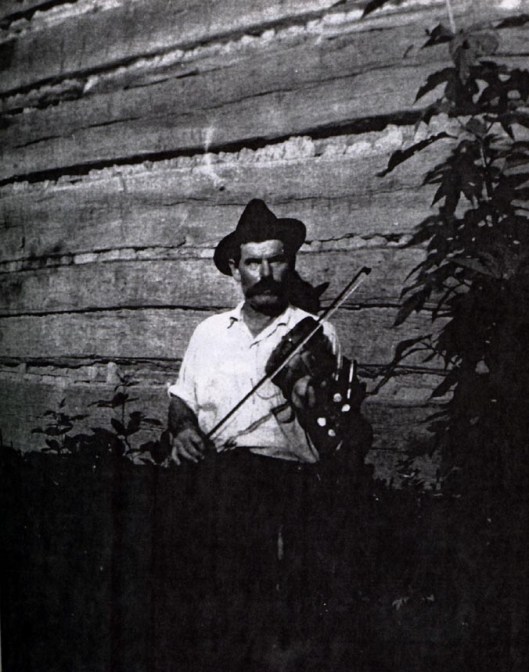
Ed Morrison, a Boyd County, Kentucky, fiddler, c.1925. Another photo of Mr. Morrison can be found here: http://digital.library.louisville.edu/cdm/ref/collection/jthom/id/1102
07 Tuesday May 2013
Posted in Ed Haley
Tags
Bobby Taylor, Clark Kessinger, Ed Haley, fiddle, fiddler, history, John Hartford, Lawrence Haley, music, Sam Jarvis, West Virginia, Wilson Douglas, writing
After talking with Mrs. Rutland, I called Bobby Taylor, a fiddling acquaintance and all-around nice guy in Dunbar, West Virginia. Bobby was a protégé of Clark Kessinger, the famous Charleston fiddler who regarded Haley as the best fiddler he ever heard. I told him about spending months trying to unlock the secrets behind Ed’s bowing before concluding that he played a long bow using the Scotch snap to get smoothness and note separation. Bobby agreed, telling how Clark Kessinger did the same kind of thing in “Sweet Sixteen” — “real fast and almost no bow. He would shuffle with his fingers.”
Bobby didn’t think that Ed used that one bow style for every tune, though.
“From what I could hear of Ed Haley’s fiddling, he done almost any type of style with the bow,” he said. “And I could hear his styles changing from one tune to the next and the way he would phrase. Like when I fiddle, it just depends on what mood I’m in and what style I want to play in. But Haley had to be what Kessinger would call a ‘down-bower,’ because Kessinger hated a ‘bow pusher.’ In other words, the accent’s on the up-bow. What little bit I can hear through all the scratches and everything, I hear Haley being a little more smoother, a little more fluid than Kessinger, but I still see the same bow. But Kessinger’s fast as greased lightning.”
I told Bobby how I’d really gotten into writing out Haley’s tunes note for note lately — every little slide — because I wanted to see what was going on.
“Of course, the deeper I get into it, the less I realize I know about it,” I said.
Bobby wasn’t surprised.
“Kessinger and Haley were both very complicated fiddlers, as any fiddler is,” he said. “But Kessinger was a master with the bow. I kid you not. I mean, that man could bow. Kessinger, if you listen at him fiddle, listen especially at his ‘Hell Among the Yearlings’. Man, could he fiddle that. Very few people realize how well he could fiddle it until you start really listening to what he’s doing with that bow and note correlation. It’s a masterpiece, his ‘Hell Among the Yearlings’ is. Just as Ed Haley, when I heard Ed Haley play it, I could hear where Kessinger got his idea. I could hear it all coming together. Now my style, when you get a real good guitar player that I like playing with, I have a tendency to throw Mike Humphreys into my mesh — a little bit of Kessinger — and I’ve had a lot of people tell me that I sound a great deal like Ed Haley when I do that because I play a little bigger note in a way — not quite as fast as Kessinger — and try to smooth it up a bit.”
“Lawrence has told me repeatedly about how his dad held the fiddle,” I said to Bobby, “that he didn’t stick it up under his chin but he sat it kinda there at his shoulder.”
Bobby chuckled and said, “That’s the way I hold it when I’m jamming.”
I asked Bobby if he rotated the fiddle slightly with it at that position and he said, “I don’t, but my father does. My father, I don’t think, ever met Ed Haley, but is certainly old enough to have known him. My father’s 82. But he’d always heard of him. His favorite fiddler was Sam Jarvis. He was a very prominent person — well educated. He sold insurance. He was my dad’s schoolteacher way out in a little one-room school. My father just says one word for Sam Jarvis, and he says he was ‘perfect.’ I remember when I was a small kid, my father pointed him out and talked to him for a little while and he introduced me. I’ll remember it as long as I live, he said, ‘Here is the greatest fiddler that ever lived, and someday you will learn to appreciate what I have said now.’ And to this day, if you ask me who the smoothest fiddler was I ever heard, it’s Sam Jarvis. Jarvis’ note was not of this world. He was the same age as Clark. He died in 1967.”
That was the first time I’d heard of Sam Jarvis, so — figuring that Ed likely knew him — I pressed Bobby for more information.
“Oh man, he could fiddle. Very little did he play professionally. He would just show up and terrorize the contest world occasionally. I never have heard about Sam Jarvis playing against Ed Haley, but Sam Jarvis only lost one contest in his life — and he was disqualified. You won’t catch anybody in the Charleston area that knew both the fiddlers — Kessinger and Jarvis — that will tell you Kessinger was better. The two greatest fiddlers, when you hear people talk, one’ll say Sam Jarvis and the other will say Ed Haley and most people say they wouldn’t turn their hand over for the difference.”
I asked Bobby who he thought Ed and Jarvis patterned their fiddling after and he said, “That is what is very interesting. They learned from old Edison records, somewhat. I know Jarvis did. They said that his dad wouldn’t hardly let him have a hold of the fiddle, he was so little. And he said that his feet wouldn’t even hit the floor, and he wrapped his toes around the rungs of the chair, and put the record on, and his dad said, ‘You can play the fiddle today if you’re careful with it.’ And he sat down with that record, and they said when they come home that evening, not only had he mastered the record — he had snowed the guy on the record. And he was not even six years old. So he was just automatic.”
Bobby said Wilson Douglas had been talking a lot about Ed Haley lately. Apparently, my telephone call to him had stirred some of memories.
“You will find that if you ask him off the top of his head something, he’ll say, ‘I don’t know,’ but you ask him two or three days later and he has the Brittanica version,” Bobby said.
04 Saturday May 2013
Posted in Ed Haley
Tags
Appalachia, culture, genealogy, history, life, photos, Russell Shaver, U.S. South, West Virginia

Russell Shaver, 1925-1940
04 Saturday May 2013
Posted in Ed Haley
Tags
Appalachia, Clay County, Georgia Slim Rutland, Gilmer County, history, James Shaver, Lawrence Haley, music, Parkersburg, Russell Shaver, Ugee Postalwait, West Virginia, writing
That evening, I called Lawrence to tell him about speaking with the Holbrooks. When I mentioned them having one of Ed’s records, he reminded me about Ugee Postalwait’s half-brother Russell Shaver, who supposedly had others. Russell died several years ago, but his only grandson James Shaver lived in Parkersburg, West Virginia.
I got his number from directory assistance, then dialed him up. As soon as I mentioned Ed’s name and the records, James said, “He played the violin, right? Well, I remember hearing the record when I was a kid. I’m 41 and I was just a young kid — my grandfather raised me — and I remember listening to the record of Ed Haley playing the violin. I don’t know if it’s still around or not. I’d have to search the house and find out. Ed Haley, he was blind. I remember my grandfather talking about him. He used to come over to their house. I’m trying to think where my grandfather lived in the thirties. They lived up in Gilmer County or Clay County, the central part of West Virginia.”
James promised to try and locate the record.
The next day, I called Georgia Slim Rutland’s widow in Valdosta, Georgia to see if she knew anything about Slim staying with Ed in Ashland around 1938. Mrs. Rutland very emphatically said, “No, huh-uh, no. That’s not true, ’cause Slim was just in Ashland about a week. That’s all. He was there performing for about a week and that was it. He didn’t live there.” I told Mrs. Rutland that several people had told me he was enamored of Ed’s playing, as was Clark Kessinger, and she said, “Now, I’ve heard him speak of Clark Kessinger, yes. Lots of times. But now, I’ve never heard him mention a blind fiddle player. I’m sorry.”
04 Saturday May 2013
Posted in Ed Haley
Tags
Appalachia, culture, Doc Holbrook, fiddler, Jenkins, Kentucky, life, medicine, music, photos, Pike County, U.S. South
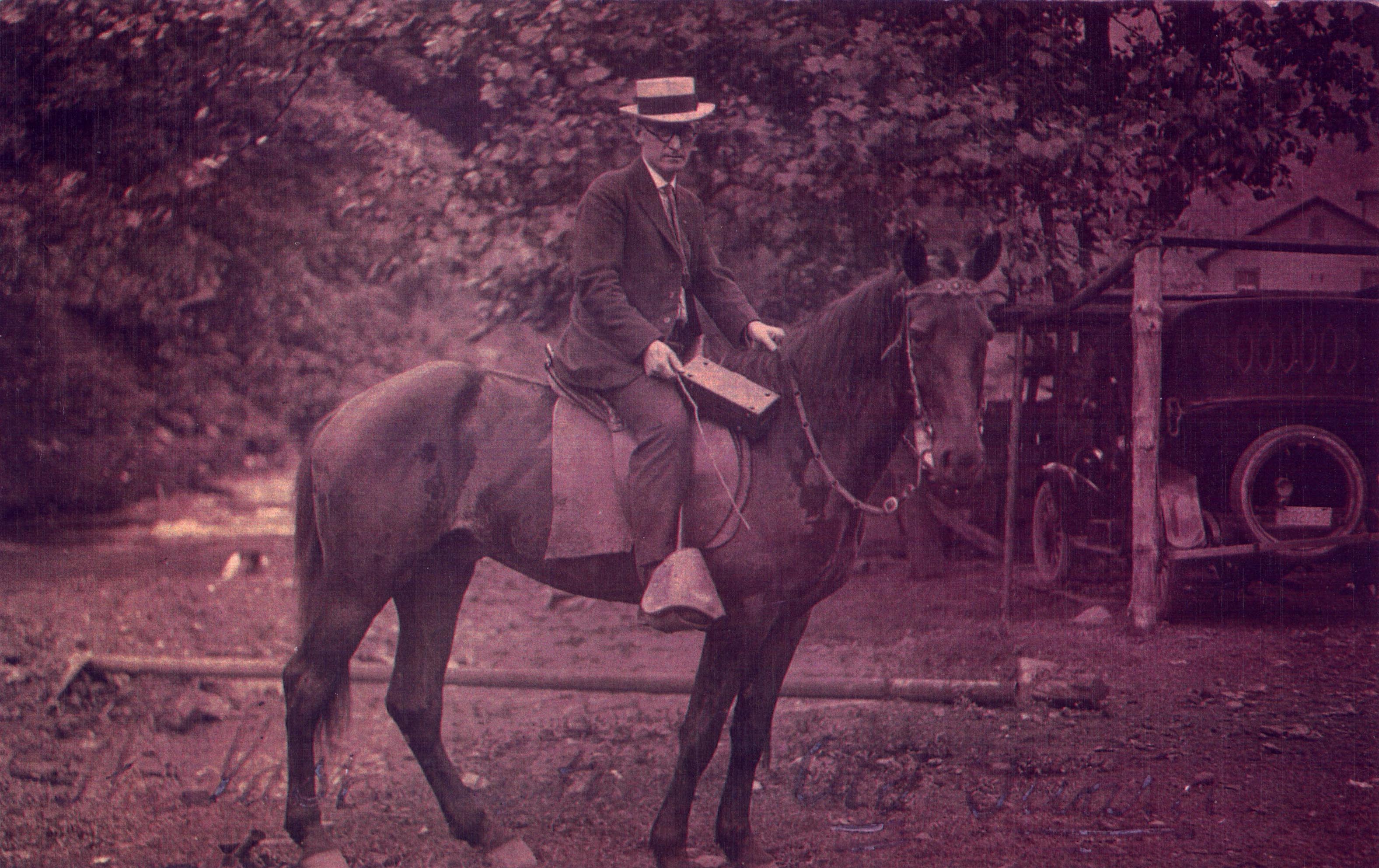
Dr. H.H. Holbrook, Jenkins, Kentucky, circa 1916
03 Friday May 2013
Posted in Ed Haley
Tags
Doc Holbrook, Ed Haley, fiddle, fiddler, history, J P Fraley, John Hartford, Kentucky, Lawrence Haley, Lexington, music, Paul Holbrook, writing
Back in Nashville, with Lawrence’s encouragement, I made contact by telephone with Paul Holbrook, a retired general practitioner living in Ashland. Paul’s father, Dr. H.H. Holbrook, had been a good friend to Ed, who once gave him a fiddle and a silver trophy cup for delivering Mona. In talking with Paul, I could tell right away that he was well-educated. He also seemed to be advanced in years; his memory was a little foggy.
“Well, I think Dad was a friend of his,” he said. “I think he delivered maybe one of his children. Dad fiddled a little bit and he always was interested in hearing Ed play. The fact Dad liked to fiddle and learned to when he was a young boy was the attraction. Other than that, I really can’t tell you a whole lot.”
I asked Paul if he remembered the names of any of Doc’s tunes and he said, “No, not really. If I heard them I would, but I was never interested much in it.”
Paul told me as much as he could remember about his father’s fiddling.
“Dad just played some for his own amusement,” he said. “He must have done most of his playing when he was a young boy or young man maybe playing at some of the country dances. He was from Lawrence County. My grandfather’s farm was between Blaine and Martha.”
Paul said his father moved a lot after becoming a doctor.
“Well, he was at Burdine, Kentucky, and Jenkins, Kentucky, many years ago and as far as I know that’s where he first saw Ed Haley. That was up in the coalfields of southeastern Kentucky. And he was in Louisa for a couple of years. And then we moved to Ashland here back in 1922. As far as I know, Ed was down here at that time. I remember seeing him when he and his wife used to play on the street corners back in the twenties. Dad was here for ten years and then moved to Greenup. I believe Ed was down in Greenup once and played some for Dad at home. Now, Dad had made a little recording of Ed in Greenup, Kentucky playing the fiddle on a little old machine and I think I still have the record around someplace. I don’t know what kind of shape it’s in and I’m not even sure I can find it. I can try to find it if you might be interested in it.”
Lord have mercy.
What about him giving your dad a silver cup or trophy?
“I don’t ever remember seeing a cup and I don’t remember ever hearing of it,” Holbrook said.
What about him giving your dad a fiddle?
“Yes, Dad had one of his fiddles and my son now has it,” he said. “J.P. Fraley borrowed the old fiddle and I think he used it to make some recordings for the National Archives or someplace in Washington. He had it for a while and brought it back and my son had a friend who had a child who was taking fiddle lessons and he used it some. But I don’t really know what shape it’s in, but the last time I heard my son say anything about it he said it needed some repair.”
Just before hanging up, Paul gave me his son’s telephone number in Lexington, Kentucky.
“He teaches some in Lexington at the university and also at Midway College and he comes home up here about every two or three weeks,” he said.
I asked if he was a doctor, too, and Paul said, “He’s a Ph.D. doctor. He’s not an MD.”
This was too much: new recordings, one of Ed’s fiddles…
I called up Paul, Jr. to ask about the fiddle. His speech reminded me a lot of his father, although his mind was quicker, not having been clouded with age. When I mentioned the fiddle, he said, “J.P. Fraley had used it for a while and gotten some blue ribbons with it, but it is in Lexington with me at the moment. It has a very low bridge — a fiddle player’s bridge. I don’t know if it came from Ed Haley in this particular case or not. It is in the case that Grandfather kept it in. It’s difficult for us to say what Grandfather might have done to it. Since Grandfather’s death, nothing has ever changed about it. Grandfather died in 1961. His fiddle playing, I would describe as casual. I don’t think Grandfather was a terribly good fiddler, but he liked to play around.”
02 Thursday May 2013
Posted in Ed Haley
Tags
Appalachia, culture, genealogy, Harts Creek, history, Lawrence Haley, life, Liza Mullins, Logan County, photos, U.S. South, West Virginia

Lawrence Haley and Liza Mullins, Trace Fork of Harts Creek, Logan County, West Virginia, 1950s
02 Thursday May 2013
Posted in Ed Haley
Tags
Ashland, Georgia Slim Rutland, history, Kentucky, Lawrence Haley, Liza Mullins, Minnie Hicks, music, Natchee the Indian, Rosie Day, Sandy Hook, writing
A few weeks later, I met Lawrence and Pat Haley at my show in Lexington, Kentucky. Lawrence was having more health problems, but he looked pretty good. I told him to stay active — at least walk a little every day — but he said he’d walked enough as a mail carrier to fill several lifetimes. After the show, Lawrence was quick to offer his advice on my playing.
“That piece you played there at the theatre — ‘Catlettsburg’ — that was a real good rendition to me of it,” he said. “But the only thing, John, that I could see you going wrong on is you’re not using the force that my dad used to have when he’s playing them high notes especially. You’re a little bit too light on the strings with your bow there. You gotta use a little bit more ‘umph’. I really wouldn’t know how to explain it except Pop had the perfect note for everything he played and he played it with strength. You gotta use a little bit more pressure.”
Lawrence said, “The only time I knew he ever got beaten in a contest was down here… They used to have a big ballpark and things down at the steel mill. They called it Armco Park. And they’s having a contest and old Natchee the Indian come out there playing over his shoulder. He had the hair on his bow strung up underneath and playing it that a way and all that kind of stuff and it pleased the crowd I reckon, and he beat Pop out at the fiddling contest there. He was kinda mad that day. He talked like, ‘I’ll never enter another contest.’ To let somebody like Natchee the Indian beat him out, it kinda made him mad.”
Lawrence said Ed did something in that contest he’d never seen him do before: stand up while playing the fiddle.
I asked Lawrence if he remembered a lot of fiddlers visiting his father when he was young — especially the famous radio fiddler, Georgia Slim Rutland.
“They had a couple of three recording studios here in Ashland back in the early twenties,” Lawrence said. “They was a lot of these fellas passed through Ashland, but I can’t say that I ever met any of them because Pop would get out and go on his own when I was in school a lot of times. And then in summer months, we’d take off to West Virginia or Morehead or Sandy Hook or someplace like that where my mother was from — Wrigley — and we might stay half the summer with Aunt Liza or somebody like that up on Harts Creek or Aunt Minnie. Or we might stay at home and Pop and Mom would take off somewhere, and old Rosie Day would stay with us usually — Jilson Setters’ wife.”
Writings from my travels and experiences. High and fine literature is wine, and mine is only water; but everybody likes water. Mark Twain
This site is dedicated to the collection, preservation, and promotion of history and culture in Appalachia.
Genealogy and History in North Carolina and Beyond
A site about one of the most beautiful, interesting, tallented, outrageous and colorful personalities of the 20th Century
 Brandon Ray Kirk